He Laughed at the Easement Until the HOA Had to Dig Up His Entire Yard
Chapter 1: The Valve Four Feet Past the Line
The surveyor stopped walking so abruptly that Michael nearly stepped into the back of him.
“Whose irrigation valve is this?”
Michael looked down.
At first he saw nothing unusual—just the narrow strip of gray gravel running beside the wooden fence between his yard and Robert Martin’s. Then the surveyor nudged a few stones aside with the toe of his boot.
A round green plastic lid appeared beneath them.
Michael frowned. “Not mine.”
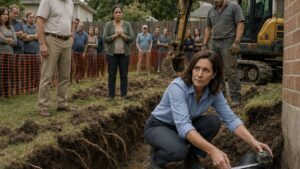
The surveyor crouched, brushed more gravel away, and lifted the lid. Beneath it sat a shutoff valve, damp with condensation, connected to black irrigation pipe disappearing under the ground.
“You sure?”
“I’ve owned the house three weeks.”
“That wasn’t what I asked.”
Michael glanced toward his own lawn. His sprinkler controls were mounted beside the garage on the opposite side of the house.
“That’s Robert’s system.”
The surveyor stood and checked the measurements on his handheld equipment. A row of temporary flags already ran from the rear corner toward the street. Michael had hired him because the closing packet contained a plat old enough that several dimensions were difficult to reconcile with the existing fence.
Michael had expected a fence problem.
He had not expected plumbing.
The surveyor walked back to the nearest flag, checked his instrument again, then stretched a tape toward the valve box.
“Four feet, give or take a couple inches.”
Michael stared at him.
“Four feet what?”
“Inside your parcel.”
For several seconds, the only sound was water ticking somewhere inside the valve box.
Michael looked from the survey flag to the fence.
The fence was not on the property line. It sat well inside Robert’s yard, which meant the gravel strip Michael had assumed belonged to Robert actually belonged to Michael.
Along with whatever was buried beneath it.
“Let’s make sure,” Michael said.
The surveyor gave him a brief look that suggested he already had.
Still, he rechecked the rear pin, then the front monument near the sidewalk. He measured again. When he returned, he planted another flag in the soil.
Same line.
Same result.
Michael went inside and pulled the closing documents from the folder he had promised himself he would organize after the move.
He found the legal description, the subdivision plat, and the title documents. The numbers matched the surveyor’s measurements closely enough to remove the comforting possibility of a simple mistake.
When Michael came back outside, the surveyor was kneeling beside the open valve box.
“This feeder heads that way,” he said, pointing beneath the gravel toward Robert’s property. “Could be supplying most of his zones.”
Michael looked over the fence. Robert’s backyard was immaculate. Deep green lawn. Rounded shrubs. A flower bed along the patio. Sprinkler heads were visible at regular intervals near the edge of the grass.
The surveyor replaced the lid.
“You’ll want to find out whether there’s an easement.”
Michael nodded.
That was the obvious next step.
Verify first.
Accuse nobody.
He had spent too much of his savings buying the house to start a neighborhood feud three weeks after unloading the boxes.
That afternoon, Robert was washing dust from his pickup in the driveway when Michael walked over.
Robert was in his late fifties and had the comfortable manner of someone who knew which trash day changed on holidays and which neighbor kept a spare key for whom. He had introduced himself the morning after Michael moved in and had offered the names of a roofer, a plumber, and the “only decent pizza place within ten miles.”
Michael liked him.
That made the conversation harder.
“Got a minute?”
Robert shut off the hose.
“Sure.”
Michael explained the survey. He kept his tone neutral and pointed toward the side yard rather than using words like encroachment.
Robert listened without interrupting.
When Michael mentioned the valve, Robert nodded.
“Yeah, that’s mine.”
“You knew it was over there?”
“It’s been there forever.”
Michael waited.
Robert seemed to think that answered the question.
“The survey puts it about four feet onto my lot.”
Robert shrugged. “Fence has always been where it is.”
“The fence isn’t the boundary.”
Another shrug.
Michael felt the first small tightening in his chest.
“I’m not asking you to dig anything up tomorrow,” he said. “If there’s an easement recorded somewhere, great. We verify it and move on.”
“There’s no problem to move on from.”
“There could be later.”
Robert smiled faintly. “You planning to build something there?”
“No.”
“Then what’s the issue?”
Michael looked toward the gravel strip.
“The issue is that your main irrigation line crosses my property.”
Robert picked up the hose nozzle again but did not turn it on.
“Previous owner never cared.”
Michael could already hear how the conversation would sound if he chose the wrong sentence.
New guy arrives.
Measures everything.
Starts demanding changes.
So he kept his voice even.
“If the arrangement needs to stay, we can put it in writing. A limited easement. Something that defines access and responsibility.”
Robert stared at him.
Michael added, “I’d rather solve it that way than have anyone tear up landscaping.”
“An easement?”
“Right.”
Robert laughed.
Not loudly. Not cruelly.
That somehow made it worse.
He shook his head as if Michael had proposed registering the backyard bird feeder with the county.
“You just got here.”
“I know.”
“And you want paperwork for a sprinkler line that’s probably older than half the houses on this street.”
“I want both of us to know what happens if it leaks, gets damaged, or one of us sells.”
Robert’s smile disappeared.
“It has worked fine for years.”
“That doesn’t answer who has the right to keep it there.”
Robert turned the hose back on.
Water struck the driveway.
“That system isn’t going anywhere, Michael.”
Michael stood there another moment.
“I’m not asking for an answer today.”
Robert aimed the hose toward a patch of soap near his front tire.
“You already got mine.”
Michael walked back across the lawn.
At the fence, the green valve lid was no longer visible. The surveyor had pushed the gravel back into place before leaving.
Nothing looked different.
That was what bothered Michael most.
An entire argument was buried beneath a few inches of stone, and Robert seemed completely certain that because it had been hidden for years, Michael had no right to uncover it.
Chapter 2: The Offer Robert Chose to Mock
The certified letter came back unsigned.
Michael found it in his mailbox on a Monday afternoon, still sealed inside the postal envelope, with the delivery attempts marked across the front.
He carried it inside and placed it on the kitchen counter beside his copy of the easement proposal.
The terms were modest.
Robert could keep the existing irrigation line in place. He would be responsible for maintenance, any damage, and future relocation if Michael ever needed reasonable use of that part of the lot. The annual fee was small enough that Michael had chosen it mostly to establish that the use was formal rather than assumed.
He had expected Robert to negotiate.
He had not expected silence.
Two days later, Michael saw Melissa Martin trimming dead flowers along the fence.
“Melissa.”
She glanced up.
“Did Robert get the paperwork I sent?”
Her expression told him he had chosen the wrong opening.
“He got it.”
“He hasn’t responded.”
Melissa clipped another stem.
“I think he thinks this has gotten a little bigger than it needs to be.”
Michael rested one hand on the fence rail.
“I’m trying to keep it from getting bigger.”
“The line has been there since before we bought our house.”
“That doesn’t make it recorded.”
She smiled, not quite dismissively but close.
“The people who lived in your house before never complained.”
Michael had heard the sentence from Robert. Now it sounded different coming from her.
Not as an argument.
As a warning about social expectations.
“I’m not the previous owner.”
Melissa’s smile faded.
“No. You’re not.”
She returned to the flowers.
Michael walked inside before the conversation became something neither of them could take back.
That evening, he reopened every page of his closing file.
Title commitment.
Legal description.
Subdivision plat.
Disclosures.
Recorded restrictions.
Utility language.
He found easements for drainage and public utilities near the rear property line. He found the HOA covenants. He found no reference to Robert’s irrigation system.
No cross-lot irrigation easement.
No private maintenance agreement.
No recorded permission for a shutoff valve four feet inside Michael’s parcel.
The absence should have reassured him.
Instead, it made him more careful.
He sent one email to the HOA management address asking whether the association held any historic utility or landscape records affecting the two lots.
He attached the survey.
He did not attach the certified letter.
By Friday, the neighborhood version of the dispute had arrived before the HOA response.
A man from two houses down stopped Michael near the community mailbox.
“Heard you’re making Robert pay you for his sprinklers.”
Michael turned.
“That’s not exactly what’s happening.”
The man gave him a sympathetic grimace that somehow felt worse than hostility.
“Robert’s been here a long time.”
“So I keep hearing.”
“I’m just saying, sometimes these old subdivisions have weird arrangements.”
“I’m trying to figure out whether this one is actually an arrangement.”
The man nodded without looking convinced.
That evening, Michael received an email from Carol Wilson, the HOA president.
She wanted a site inspection.
Robert, the email said, had raised concerns that Michael intended to interrupt an established irrigation system affecting landscaping visible from the street. Because the HOA had standards regarding yard maintenance, Carol wanted to understand the dispute before it escalated.
Michael read the message twice.
He had said nothing about cutting off water.
Robert apparently had.
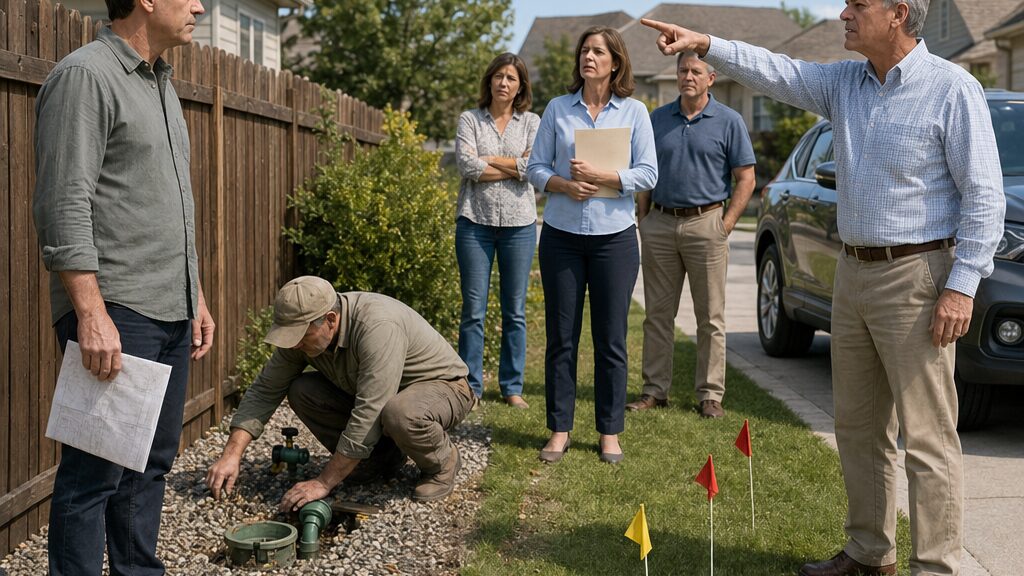
The inspection took place Saturday morning.
Carol arrived with an HOA management representative and two neighboring homeowners who, she explained, had served on past landscape committees.
Robert was already outside.
Melissa stood near the patio with her arms folded.
Michael felt surrounded before anyone spoke.
Robert did not waste time.
“He wants to kill my entire yard over four feet of dirt.”
Carol raised a hand.
“Let’s keep this factual.”
“That is factual.”
Michael said nothing.
Robert pointed toward the fence.
“That line has been there for years. He buys the house, gets a survey, and suddenly I’m supposed to pay him rent for my own water.”
One of the neighbors looked at Michael.
“Is that what you asked for?”
Michael walked to the gravel strip.
“No.”
He crouched and pulled several handfuls of stone aside.
The green valve lid appeared.
He opened it.
Then he pointed toward the bright survey flag several feet away.
“The boundary is there.”
The group went quiet.
Carol stepped closer.
“That far?”
Michael nodded.
The HOA representative checked the survey copy.
Robert folded his arms.
“It still doesn’t change how long it’s been there.”
“No,” Michael said. “But it changes whose land it’s on.”
Robert’s jaw tightened.
Michael went to the folding table he had set near the garage and brought back the easement proposal.
He handed it to Carol.
“I offered to let it stay.”
Carol read the first page.
The neighboring homeowners leaned closer.
Michael saw Robert’s expression change—not to concern, exactly, but irritation.
Carol turned another page.
“This is not a removal demand.”
“No.”
“You offered continued access?”
“Yes.”
Robert spoke over her. “For money.”
“A nominal annual fee,” Michael said. “And responsibility for maintenance.”
“How much?”
Michael told them.
The neighbor nearest Carol blinked.
“That’s it?”
Robert looked at him sharply.
Michael disliked the tiny sense of satisfaction that gave him.
He pushed it away.
“I’m not trying to make money from this.”
“Then make it free,” Robert said.
Michael looked directly at him.
“Because it needs to be acknowledged as permission, not ownership.”
Carol closed the proposal.
For the first time, the social balance had shifted.
Not entirely toward Michael.
But away from the version of him Robert had described.
Then Carol said, “There is something else.”
She walked to her car.
When she returned, she carried a large yellowed sheet inside a plastic sleeve.
She laid it across the hood.
It was an old subdivision landscape plan.
Faded lines showed lots, common planting beds, irrigation zones—and a pipe drawn almost exactly where Robert’s current feeder line ran.
Robert stepped beside Carol.
“There.”
Carol studied the sheet.
Michael leaned closer.
A date in the corner put the plan years before either he or Carol had joined the neighborhood.
Michael felt the brief confidence of the previous five minutes drain away.
Carol tapped the line with one finger.
“This line was here before either of us joined the board.”
Chapter 3: A Map Is Not an Easement
The real-estate attorney looked at Carol’s scanned landscape plan for less than a minute before asking Michael one question.
“Where is the easement instrument?”
Michael sat across from him with a folder open on his lap.
“I don’t have one.”
“That wasn’t my question.”
Michael recognized the phrasing. The surveyor had done the same thing to him.
The attorney rotated the landscape drawing on his monitor.
“This shows a pipe.”
“Yes.”
“It does not show a property right.”
Michael leaned forward.
“So the HOA plan means nothing?”
“I didn’t say that.”
The attorney enlarged the legend.
“It may mean the line was installed as part of an original landscaping plan. It may help establish age. It may explain why previous owners tolerated it. It may even help someone make an argument depending on facts we haven’t examined.”
Michael’s stomach tightened.
“But?”
“But a maintenance diagram is not automatically an easement.”
The attorney opened the recorded plat Michael had brought.
“A deeded or recorded right should show up somewhere we can identify. Let’s find out whether it does.”
Over the next several days, Michael learned how much uncertainty could hide inside words homeowners used casually.
Utility easement.
Access easement.
License.
Encroachment.
Prescriptive use.
Permission.
Common maintenance.
Each sounded simple until someone asked who had signed what, when, and whether it had ever been recorded.
Michael had hoped the attorney would give him a clean answer immediately.
Instead, he got a list of things to verify.
That frustrated him more than he admitted.
He wanted the documents to end the argument.
He wanted facts to behave like switches: on or off.
The attorney refused to let him treat them that way.
“Your survey is strong evidence of where the boundary is,” he said. “The missing recorded easement matters. But we don’t threaten anyone until we understand the history.”
Michael nodded.
That evening Carol called.
“I think we need you to hold off on doing anything physical.”
“I haven’t done anything physical.”
“I know. I’m asking you to keep it that way while we check our files.”
Michael looked through the kitchen window toward the fence.
“Robert told people I was planning to shut his system off before I ever said that.”
“I know.”
“He also left out the easement offer.”
A pause.
“I know that too.”
Michael could hear the strain in her voice.
Carol was not defending Robert as much as trying to keep the association from being dragged into a private land dispute.
“There’s another reason I’m cautious,” she said. “If that irrigation plan was association-approved years ago, people are going to assume the board authorized the route.”
“Did it?”
“That’s what I’m checking.”
Michael almost said, A map is not permission.
Instead he stopped himself.
That was the attorney’s conclusion, not yet Carol’s.
“All right,” he said. “I’ll wait.”
The county records search took the better part of a week.
The attorney’s office traced Michael’s parcel through prior transfers and reviewed the recorded easements affecting it. Michael obtained an older title policy from the previous closing file that had been left among appliance manuals in a kitchen drawer.
Nothing.
The recorded drainage easement did not reach the valve.
The public utility easement did not authorize private irrigation service between neighboring lots.
No separate agreement appeared.
The attorney finally called him back in.
He placed the HOA landscape drawing beside the recorded plat.
On one sheet, the pipe existed.
On the other, the property rights did.
They were not the same document.
“There is no recorded easement we can identify for Martin’s irrigation line,” the attorney said.
Michael let out a breath.
“So I can make him move it.”
The attorney looked at him.
“You can require him to address the encroachment. That does not mean your first move should be excavation.”
Michael felt mildly rebuked, though he had not suggested excavation.
Or at least had not meant to.
“What would you do?”
“I’d give him another opportunity to formalize it. Clear terms. Clear deadline. If he declines, then you decide whether continued permission makes sense.”
Michael stared at the two documents.
The distinction mattered.
He had not bought a weapon.
He had bought a boundary.
Later that afternoon, Carol asked Michael to meet her at the HOA office.
She closed the door after he entered.
“I found the approval records for that landscaping plan.”
Michael waited.
“It was installed during an early neighborhood improvement phase. The HOA approved irrigation coverage and landscaping appearance.”
“Property access?”
Carol shook her head.
“No recorded grant. No cross-lot maintenance agreement. Nothing authorizing the association to give Robert rights over your parcel.”
Michael sat back.
Carol looked tired.
“I owe you something.”
“You don’t.”
“I do. I treated the old plan like it settled the issue because I wanted it to settle the issue.”
Michael said nothing.
“If that drawing had been enough, then we had one old arrangement and no larger governance problem. If it isn’t enough, I have to wonder how many other informal lines, drains, fences, or access paths exist around here.”
“That isn’t my fault.”
“No.”
The answer came quickly.
Then she added, “But you can understand why the board doesn’t want every neighbor dispute turning into a title search.”
Michael looked at her.
“I can understand that. I can’t give away part of my lot to make the board comfortable.”
Carol nodded.
“No. You can’t.”
It was the first unqualified acknowledgment he had received from anyone connected to the HOA.
For a moment, Michael expected to feel vindicated.
Instead he thought about Robert’s lawn.
The old shrubs.
The mature grass.
The line that had probably fed them for years without anyone thinking about whose dirt it crossed.
That evening Michael revised the easement offer.
He removed anything Robert might plausibly call punitive. He added a temporary access clause. He clarified maintenance responsibilities and created a transition option if Robert wanted to reroute later.
Then he walked next door instead of mailing it.
Robert opened the door but did not invite him inside.
“The HOA checked the records,” Michael said.
Robert’s face remained unreadable.
“The plan doesn’t create an easement.”
“So?”
“So I revised the agreement.”
Michael held out the pages.
Robert did not take them.
“You still trying to charge me?”
“I’m trying to give you a legal way to keep the system where it is.”
“I already have a way. Leave it alone.”
Michael lowered the papers.
“You know the HOA can’t authorize it.”
Robert looked past him toward the street.
“Carol told you that?”
“Yes.”
Robert gave a small humorless smile.
“Of course she did.”
That response caught Michael off guard.
There was no surprise in it.
No confusion.
Only resentment.
Michael studied him.
“Have you talked to an attorney?”
Robert’s eyes returned to his.
“None of your business.”
It was not an answer, but it was close enough to one that Michael felt the shape of a larger question.
“If you don’t want the easement, then we need a timeline for relocation.”
Robert finally took the pages—not to read them, but to fold them once.
“You can send me whatever legal letter you want.”
Michael waited.
Robert handed the folded proposal back.
“Nothing is getting dug up.”
Chapter 4: Sixty Days and One Hidden Answer
The first day of the sixty-day deadline began with a signature.
Michael sat in the attorney’s office while the final notice lay between them. It gave Robert two choices: sign a limited easement allowing the irrigation line to remain under defined conditions, or relocate the line entirely onto his own property.
There was no demand for immediate excavation.
No threat to damage the system.
No language about punishment.
Just a date.
Michael signed where the attorney indicated.
“You understand what happens after the deadline?” the attorney asked.
“If he does nothing, I can stop allowing the line to use my property.”
“Subject to doing it properly.”
“I know.”
The attorney watched him for a moment.
“You sound like you want me to tell you not to.”
Michael capped the pen.
“I’d prefer he sign.”
“Then give him every reasonable opportunity.”
Michael had already done that, but he nodded anyway.
The notice was delivered two days later.
Robert did not acknowledge it.
For the first week, nothing changed.
His sprinklers still rose before dawn, clicking through their zones. The grass remained green. The valve under Michael’s gravel remained closed beneath its plastic lid, invisible unless Michael deliberately uncovered it.
That invisibility bothered him more now.
Every morning, the system crossed the boundary as if none of the letters, surveys, meetings, or legal opinions existed.
Carol stayed mostly out of it.
The HOA management representative sent a brief written statement clarifying that the association did not claim authority to grant private cross-lot irrigation rights. Carol also asked both homeowners to avoid actions that could damage landscaping while the private matter remained unresolved.
Michael considered that fair.
Robert apparently considered it betrayal.
He stopped waving when their cars passed.
By day seventeen, Michael had heard nothing.
By day twenty-four, he began to wonder whether Robert’s silence was itself the strategy.
If Michael extended the deadline once, Robert might expect another extension after that.
If Michael refused, everyone could say he had chosen escalation.
The more Michael tried to avoid appearing unreasonable, the easier it became to imagine himself being maneuvered by that fear.
On day thirty-one, Melissa caught him taking the trash bin to the curb.
“Michael?”
He stopped.
She stood at the end of the Martins’ driveway holding a garden glove in one hand.
“What would it actually cost to move that line?”
The question was so different from her earlier tone that Michael took a second before answering.
“I don’t know exactly.”
“Robert says eight or ten thousand.”
“That sounds high, but it depends on the route.”
“He says they’d have to tear up half the yard.”
“They’d have to connect from his own municipal supply and reach the existing zones. I’m not an irrigation contractor.”
Melissa looked toward their lawn.
“You offered that temporary access thing?”
“Yes.”
“What does that mean?”
“If he decides to reroute, I’ll allow contractors limited access where they need it along my side so they don’t have to choose the most destructive route just to avoid stepping on my property.”
Her eyes narrowed slightly.
“You’d put that in writing?”
“It already is.”
Melissa looked down at the glove.
Michael could have left it there.
Instead he added, “The point isn’t to make the work expensive.”
“Robert doesn’t believe that.”
“I know.”
“He thinks once he signs anything, you control him.”
Michael almost laughed, but there was nothing funny in her face.
“He’s already using my land,” he said. “The paperwork would define what each of us can do. That’s the opposite of me controlling him.”
Melissa rubbed dirt from the glove with her thumb.
“He doesn’t see it that way.”
Michael looked toward the side yard.
“Then what does he see?”
She did not answer immediately.
When she finally spoke, her voice had dropped.
“He sees himself being told he was wrong about something he’s treated as his for fifteen years.”
“That’s not a legal argument.”
“I didn’t say it was.”
Michael heard the correction.
For the first time, Melissa was not defending Robert’s position.
She was explaining him.
“Did he talk to a lawyer?” Michael asked.
Melissa’s shoulders tightened.
“That’s between you two.”
“He told me it was none of my business.”
She gave him a tired look.
“That means yes.”
Michael stayed still.
“What did the lawyer say?”
Melissa hesitated long enough to answer without words.
Then she looked toward the house.
“He paid for a consultation after that HOA meeting.”
“And?”
“He came home angry.”
“That doesn’t tell me anything.”
“It told me plenty.”
Michael waited.
Melissa pressed her lips together.
“He was told the line could be a problem because there’s no recorded easement. He was told he should negotiate before this gets more expensive.”
Michael felt something inside him shift.
Not triumph.
Something closer to disappointment.
“He knew.”
Melissa looked at him sharply.
“Don’t use me to start another argument.”
“I’m not.”
“He thinks you’re trying to prove a point.”
“I’m trying to solve a property problem.”
“I know that now.”
The word now landed harder than Michael expected.
Melissa looked toward the lawn again.
“He doesn’t want the neighborhood thinking the new guy made him rewrite something that’s worked for years.”
Michael said nothing.
There it was.
Money mattered.
But pride mattered too.
And unlike money, pride did not appear on a contractor’s estimate.
“I can extend the transition period after he signs,” Michael said.
Melissa looked back at him.
“For how long?”
“Long enough to schedule a contractor reasonably. Not indefinitely.”
She nodded slowly.
“I’ll tell him.”
Michael almost said thank you.
Instead he said, “The offer is still open.”
For the next two weeks, he heard nothing.
Then, on day forty-seven, an irrigation contractor’s truck appeared in Robert’s driveway.
Michael saw two workers walking the side yard with measuring wheels.
His first reaction was relief.
Maybe Robert had decided to reroute.
But the truck left after twenty minutes.
No work followed.
A week later, Michael asked Carol whether Robert had filed anything with the HOA for excavation approval.
“No.”
“Any architectural request?”
“No.”
“Then what was the contractor doing?”
“I don’t know.”
Michael disliked not knowing.
Day fifty-six arrived.
Then fifty-seven.
On day fifty-eight, Michael printed the temporary access language again and placed it in an envelope.
He walked halfway toward Robert’s house before stopping.
He looked at the envelope in his hand.
This was his weakness, he realized.
He kept believing one more document would make his intentions unmistakable.
One more clean paragraph.
One more reasonable option.
One more chance for facts to speak louder than resentment.
He returned to his house and left the envelope on the kitchen counter.
On day sixty, Robert’s sprinklers started at 5:12 in the morning.
Michael knew the time because he was awake.
He stood at the bedroom window and watched silver arcs of water sweep across Robert’s lawn.
At noon, no message came.
At three, no contractor arrived.
At five, Michael checked his email.
Nothing.
At 7:43 that evening, he walked outside.
The gravel strip was cool beneath his shoes.
He knelt beside the hidden valve and brushed away enough stone to see the green lid.
He did not open it.
Across the fence, Robert’s yard was quiet.
Michael stayed there for several seconds, looking at the thing everyone had spent two months arguing about without touching.
The deadline had expired.
No signed easement.
No relocation plan.
No request for more time.
No reply at all.
Michael stood, pulled out his phone, and called the licensed irrigation contractor whose number had been sitting in his contacts for three weeks.
“I need to schedule the work,” he said.
Chapter 5: The Morning the Sprinklers Stayed Dry
At sunrise on Tuesday, a licensed irrigation contractor knelt over the green valve box with both hands inside Michael’s property.
Michael stood three feet away holding the survey.
The contractor looked from the pipe to the marked boundary.
“You’re certain this is the feeder?”
“Yes.”
“And the homeowner next door has been notified?”
“Multiple times.”
The contractor wiped his fingers on a rag.
“I’m asking because once I isolate this, his irrigation zones fed from here won’t run.”
“I understand.”
The answer sounded cleaner than Michael felt.
The contractor followed the pipe several feet, probing the soil carefully and checking the route against the survey markers.
“No reason to cross over there,” he said. “We can do everything from this side.”
Michael nodded.
That mattered.
He did not want anyone entering Robert’s yard.
He did not want a broken sprinkler head, damaged shrub, or disturbed flower bed becoming the next argument.
The contractor exposed a short section of the feeder line.
Robert’s lawn lay beyond the fence, impossibly green in the early light.
Michael stared at it.
The grass did not know about deeds.
The shrubs did not know what an easement was.
They had simply received water because the pipe beneath Michael’s feet had carried it.
The contractor reached for a cutting tool.
Michael said, “Hold on.”
The man stopped.
Michael looked across the fence.
He could still postpone.
Call Robert one more time.
Give him another day.
Maybe a week.
The thought felt humane for exactly three seconds.
Then Michael remembered day sixty.
The silence.
The lawyer Robert had already consulted.
Melissa explaining that Robert knew.
The sentence at the front door: Nothing is getting dug up.
If Michael delayed now without being asked, the deadline would become another suggestion.
“What?” the contractor asked.
Michael exhaled.
“Nothing. Go ahead.”
The cut itself was almost disappointingly small.
No dramatic gush.
No explosion of water.
The contractor shut down the supply, separated the feeder, installed the proper cap, pressure-tested Michael’s side, and photographed the completed work.
He showed Michael the result.
“His system’s isolated. Your property is intact. Nothing touched beyond the surveyed line.”
Michael looked into the open box.
For months, the buried valve had represented Robert’s assumption that the arrangement could continue simply because it had always continued.
Now it was just plumbing.
That should have felt satisfying.
Instead Michael felt tired.
The contractor replaced the lid.
“Keep the invoice and photos.”
“I will.”
Michael almost smiled at how predictable that advice was.
Of course he would keep them.
Documentation was the one language he trusted.
By eight-thirty, the truck was gone.
Robert had already left for the day.
Nothing happened that afternoon.
Nothing happened Wednesday either.
Thursday morning, Michael noticed one of Robert’s sprinkler heads sitting motionless while the controller presumably tried to start a cycle.
By Saturday, the lawn still looked healthy.
Michael caught himself checking it from the kitchen window and disliked the habit.
He was not waiting for grass to die.
At least he did not want to be.
The first person to discover the problem was not Robert.
It was the lawn-service crew.
The following Monday, a truck pulled into the Martins’ driveway shortly after eight.
A worker walked the yard while another adjusted the irrigation controller.
Then they tried again.
Nothing.
One worker opened a valve box near Robert’s patio.
Another walked toward the shared fence.
Michael was outside sweeping leaves from his front walk when the lawn-service foreman approached.
“You Mr. Davis?”
“Yes.”
“Do you know anything about the irrigation feed on this side?”
Michael set down the broom.
“Yes.”
The foreman waited.
Michael did not make him drag it out.
“The portion crossing my property was disconnected by a licensed contractor after notice to the owner.”
The foreman looked toward Robert’s house.
“So it’s not a broken controller.”
“Not on my side.”
“You turn it off?”
“I had the encroaching feeder isolated.”
The foreman gave him the expression Michael had come to recognize.
A stranger hearing the shortest version of the story always thought the same thing first.
You shut off your neighbor’s sprinklers?
Michael resisted the urge to explain everything.
“The owner has the paperwork,” he said.
The foreman nodded and returned to the crew.
They finished mowing.
The invoice, Michael assumed, would still arrive.
That afternoon Melissa came outside while Michael was collecting mail.
“Was that you?”
Michael knew what she meant.
“Yes.”
She closed her eyes briefly.
“He said you wouldn’t.”
“I gave him sixty days.”
“I know.”
“He never asked for an extension.”
“I know.”
The repetition made the conversation strangely quiet.
Melissa looked at the grass.
“What happens now?”
“He reroutes from his own municipal connection.”
“And until then?”
“The temporary access offer is still available if it helps the contractor.”
She looked surprised.
“You’re still offering that?”
“Yes.”
“After he ignored you?”
Michael almost answered with a defensive sentence.
Instead he said, “The boundary is the point. Not making the repair harder.”
Melissa nodded once.
Then she went inside.
The next several days were hotter than usual for early October.
The lawn did not collapse overnight, but signs appeared.
Edges near the patio dulled.
A strip beside the fence lost some of its deep green.
Robert began moving a portable hose sprinkler around in the evening.
Michael saw him drag it across the yard but never looked toward Michael’s house.
On Friday, an irrigation contractor visited Robert again.
This time he stayed nearly an hour.
He marked the lawn with small flags and traced a possible route from the municipal supply connection.
The following morning, Robert was outside before eight.
He stood beside one of the flags with a sheet of paper in his hand.
Michael could tell from across the fence that it was an estimate.
Robert folded it sharply and went inside.
Later that day, Carol called.
“Robert contacted the HOA about reroute approval.”
Michael leaned against the kitchen counter.
“So he’s doing it.”
“He’s asking what landscaping restoration the association will require.”
“That sounds like doing it.”
Carol was silent for a moment.
“He also said you disconnected the irrigation without board authorization.”
Michael closed his eyes.
“Carol.”
“I told him the board does not control your private line.”
“Good.”
“I also told him we would document that.”
Michael looked toward the gravel strip.
“Thank you.”
“Michael?”
“Yes?”
“Keep doing this carefully.”
He almost laughed.
“I’ve done nothing else.”
“I know. Keep doing it anyway.”
The confrontation came Monday.
Michael had just stepped into his side yard when he heard the gate on Robert’s fence slam.
Robert appeared around the corner carrying a sprinkler head in one hand.
It was dry.
He crossed the grass fast enough that Michael instinctively straightened.
Robert stopped at the surveyed boundary.
At least he noticed it.
For half a second, neither man spoke.
Then Robert held up the sprinkler head.
“You did this?”
Michael looked at it.
“Yes.”
Robert’s face hardened.
“You shut off my water.”
Michael felt every explanation he had rehearsed rise at once.
He forced himself to choose none of them.
“I disconnected the irrigation line crossing my property after the deadline expired.”
Robert stepped closer.
“That is my system.”
Michael stayed where he was.
“The part on my land isn’t yours to use without permission.”
Robert pointed the dry sprinkler head at him.
“You’re going to turn it back on.”
“No.”
Robert stared at him.
Michael heard a door open behind Robert’s house.
Then another voice from the front sidewalk.
The confrontation they had avoided for months was no longer private.
Robert tightened his grip around the sprinkler head.
“Then we’re going to have this conversation right now.”
Chapter 6: His Water, My Property, Their Audience
“Turn my water back on.”
Robert’s voice carried farther than it needed to.
Michael saw Carol coming up the sidewalk before he answered. Two neighbors had also slowed near the curb, drawn by the same raised voice Michael had spent months trying to avoid.
Melissa stood near the Martins’ gate.
Michael looked at Robert.
“No.”
Robert gave a short disbelieving laugh.
“You admit it?”
“I’ve never denied it.”
“You cut off an irrigation system that has been here fifteen years.”
“After sixty days’ formal notice.”
“Because you wanted control.”
Michael felt the old temptation to reach for paperwork.
His deed was inside.
The attorney letter was inside.
The survey was inside.
He could produce a stack thick enough to build a wall between them.
Instead he stayed where he was.
“I offered you permission to keep the system.”
“For a fee.”
“A small fee and written responsibility.”
Robert turned toward Carol and the neighbors as if presenting the case to a jury.
“You hear this? He moves in, finds a pipe, and suddenly I’m supposed to pay him to water my own yard.”
One of the neighbors shifted uncomfortably.
Carol stepped onto the grass.
“Robert, the association already reviewed the property issue.”
“This isn’t about the association.”
“You made it about the association when you filed the complaint.”
Robert looked at her sharply.
Michael saw the moment his anger changed direction.
Carol continued.
“The old landscape plan does not give you an easement.”
“I know what you said.”
“Then don’t imply to everyone here that Michael bypassed some HOA right you have.”
Robert’s jaw tightened.
Michael expected satisfaction.
Instead he felt exposed.
This was exactly the kind of public correction he had wanted to avoid.
Robert pointed toward the side yard.
“That valve has served my property since before he knew this neighborhood existed.”
Michael answered quietly.
“That’s true.”
Robert seemed thrown by the agreement.
Michael continued.
“It was also on land I bought.”
“You knew it wasn’t hurting anything.”
“I knew it created a responsibility neither of us had documented.”
“So you shut it down.”
“After offering you a way to keep it.”
Robert took another step.
Michael did not move.
“You wanted me to sign something saying you could decide when I get water.”
“No.”
“That’s what an easement does.”
“No. It defines what you’re allowed to use and what I’m required to tolerate.”
Robert’s face reddened.
“There. Required to tolerate. That’s what this is about. You couldn’t stand that something was happening on your land without you controlling it.”
The accusation landed more cleanly than Michael wanted it to.
Because part of it was true.
Michael had spent months insisting the problem was purely procedural.
But he had also lain awake thinking about a pipe crossing the property he had poured most of his savings into, controlled by someone who dismissed every question with because it’s always been there.
He had wanted certainty.
He had wanted control over uncertainty.
That was not the same as wanting Robert’s water.
But it was not nothing.
“I wanted an agreement,” Michael said. “You wanted me to pretend there already was one.”
Robert opened his mouth.
Melissa spoke first.
“Robert.”
He turned.
She had moved closer.
“Don’t.”
“What?”
“Don’t stand here acting like you didn’t know.”
The yard went still.
Robert stared at her.
Melissa folded her arms, but the gesture looked defensive rather than confident.
“You talked to the attorney.”
Michael watched Robert’s face.
There was no surprise.
Only anger.
“This is between us.”
“No,” Melissa said. “It stopped being between us when you brought everybody outside.”
Robert glanced at the neighbors.
Melissa continued.
“You paid for that consultation after the HOA meeting.”
Robert lowered the sprinkler head.
“Melissa.”
“He told you there wasn’t a recorded easement.”
Robert’s voice dropped.
“That’s not exactly what he said.”
“He told you Michael had the stronger position if you refused to negotiate.”
Carol looked at Robert.
One of the neighbors shifted his weight.
Michael felt the entire social argument rearrange itself.
For months, Robert had behaved as though confidence meant certainty.
Now everyone could see they were not the same thing.
Robert rubbed his thumb over the sprinkler head’s plastic threads.
“He said there were arguments about prior use.”
Melissa nodded.
“And he told you those arguments could cost more to fight than rerouting the line.”
Robert said nothing.
Michael could have pressed him.
He could have asked why Robert ignored the deadline.
Why he mocked the easement.
Why he told neighbors Michael was trying to charge him for his own water after learning privately that the problem was real.
Instead Michael asked one question.
“Why didn’t you tell me?”
Robert looked at him.
For the first time since the dispute began, the answer did not come quickly.
“Because I thought you’d back down.”
The words were quiet.
Michael almost wished Robert had shouted them.
“You knew?”
“I knew there was risk.”
“And you let the deadline expire.”
Robert looked toward his lawn.
“I thought when it came down to actually cutting it, you wouldn’t do it.”
There it was.
Not a hidden legal argument.
Not an old recorded right nobody had found.
Robert had simply believed Michael’s reluctance to escalate meant he lacked the will to follow through.
The realization hurt more than the insults had.
Michael said, “You thought I was bluffing.”
Robert looked back at him.
“Yes.”
Melissa exhaled through her nose and turned away.
Carol spoke carefully.
“Then the association has nothing further to determine about the old plan.”
Nobody answered.
The two neighbors began moving away, not triumphantly, not embarrassed enough to apologize, simply aware that there was no longer much spectacle left to watch.
Michael was grateful.
Robert looked suddenly older without an audience.
He held out the sheet he had brought with him.
It was not a complaint.
It was the contractor’s estimate.
Michael took it.
The total was higher than he expected.
Considerably higher.
The route from Robert’s municipal connection required trenching along one side of the yard, crossing beneath an existing walkway, tying into multiple irrigation zones, permitting, inspection, and restoration.
Michael handed it back.
“That’s a lot.”
Robert laughed once, bitterly.
“Now you care?”
Michael let the question sit.
“Yes.”
Robert looked at him as if that answer irritated him more than no would have.
“You could turn it back on while I get the work done.”
“I’m not restoring the old arrangement without terms.”
“So the grass just dies?”
“I already offered temporary access for the reroute.”
“That doesn’t water anything.”
“No.”
Robert stared toward the dry strip along the fence.
Michael could see the fear underneath the anger now.
Not fear of losing a legal argument.
Fear of paying for it.
Fear of explaining the expense.
Fear of seeing his yard dug open where he had insisted no one would dig.
Michael understood those things.
Understanding them did not make the previous two months disappear.
Melissa stepped nearer.
“Ask him.”
Robert’s head turned.
“No.”
“Robert.”
“I said no.”
She looked at Michael, then back at her husband.
“You’ve spent two months refusing the thing you need because you don’t like needing it.”
Robert’s face tightened.
Melissa did not retreat.
“The contractor said the least destructive route needs access along Michael’s side for equipment.”
Michael glanced at Robert.
So that was why the contractor had visited earlier.
Robert stared at the estimate.
When he finally spoke, his voice was barely above conversational.
“If I reroute it, I need temporary access along your property.”
Months earlier, he had laughed when Michael suggested formal permission.
Now he could not even ask for access without the irony standing between them.
Michael felt the answer forming.
Part of him wanted Robert to sit with the consequences.
To hire the more expensive crew.
To take the longer route.
To discover exactly what refusing permission cost when the permission belonged to someone else.
That part of Michael frightened him more than Robert’s anger did.
He looked toward the gravel strip.
The valve remained hidden beneath it.
“I’ll consider a temporary access license,” he said.
Robert’s eyes lifted.
“In writing?”
“Yes.”
The old irritation flickered across Robert’s face.
Then disappeared.
This time, he did not laugh.
“When can I see it?” he asked.
Chapter 7: The Trench Where the Shortcut Ended
The excavator arrived on a Thursday morning and stopped exactly where Robert had once said nothing was getting dug up.
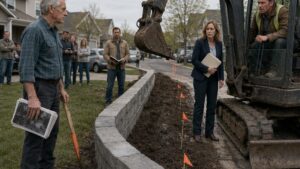
Michael watched from his driveway as the operator lowered the bucket beside the Martins’ side yard. Orange flags marked the route from Robert’s municipal connection toward the existing irrigation zones. The new path stayed entirely inside Robert’s property except for one narrow section where equipment access would be easier from Michael’s side.
That was the part Michael had agreed to.
Not casually.
Not verbally.
The temporary access license sat in both households now, signed and dated. It allowed the contractor to cross a defined strip of Michael’s yard during specific hours, required protective mats beneath equipment, made Robert responsible for restoration, and expired automatically when the work was finished.
Six months earlier, Michael would have assumed the paper explained everything that mattered.
Now he knew better.
When Robert signed it at Michael’s kitchen counter, neither man pretended the document repaired what had happened between them.
Robert read every page.
He paused at the clause confirming that the temporary access created no permanent right.
“You really put that in there.”
“Yes.”
Robert looked up.
“You think I’m going to claim this route too?”
Michael could have said, I didn’t think you’d claim the first one.
Instead he said, “I think we both know exactly what the agreement means this time.”
Robert stared at him for a moment, then signed.
That had been three weeks earlier.
Now the first bucket of soil rolled away from Robert’s lawn.
There was no satisfaction in the sound.
Only metal against dirt.
The contractor had chosen a route that avoided most of the mature shrubs but required opening a trench along the side yard and boring beneath part of the walkway. The estimate was painful. Robert had not discussed the final number with Michael, but Michael knew enough from the earlier paperwork to understand that the project had become the expensive outcome everyone had tried to avoid.
Melissa stood on the patio watching the crew work.
Robert stayed closer to the trench.
He asked questions about pipe depth, connection points, inspection timing, and restoration. His tone with the contractor was precise but restrained.
Michael recognized something in it.
The instinct to control uncertainty by understanding every detail.
For the first time, he wondered how different he and Robert really were.
Their conflict had not begun because one man cared about property and the other did not.
It had begun because both men wanted certainty, and each believed the other was the source of the uncertainty.
By noon, protective mats stretched over the portion of Michael’s yard covered by the temporary license.
The excavator crossed slowly.
Michael stood near the fence.
Robert noticed him watching.
“You want to inspect the mats?”
The question carried just enough edge to remind Michael of the old resentment.
Michael looked down.
“They’re fine.”
Robert gave a short nod.
The machine continued.
That small exchange would once have bothered Michael for the rest of the day. He would have replayed the tone, considered whether Robert meant to provoke him, and possibly taken photographs just in case.
He still took photographs.
But he no longer needed them to prove to himself that he was right.
Two days later, Carol stopped by.
She carried a folder from the HOA but did not open it immediately.
“The board adopted a new review process last night.”
Michael looked toward the trench.
“For irrigation?”
“For undocumented cross-lot utilities generally.”
He raised an eyebrow.
Carol smiled without much humor.
“Apparently once you start looking, you discover everybody has a story about a drainpipe, fence, cable, tree line, or access path that somebody’s been tolerating for twenty years.”
“That sounds unpleasant.”
“It is.”
They stood beside the driveway while workers joined sections of new pipe.
Carol continued.
“We’re not turning the HOA into a title company. But if a dispute comes up, we’re not going to treat an old maintenance drawing like proof of a property right again.”
Michael nodded.
“That seems reasonable.”
Carol looked at him.
“You could say you told us so.”
“I could.”
“You’re not going to?”
“No.”
“Good.”
She handed him a copy of the board notice anyway.
Michael glanced at it.
Then he folded it once and put it in his pocket without reading every line.
Carol noticed.
That made him smile.
By the end of the first week, the new feeder line reached the existing irrigation manifold entirely from Robert’s side.
The old system crossing Michael’s parcel was no longer necessary.
The contractor asked Michael to be present when they removed the abandoned section near the original valve.
He agreed.
The green lid appeared again when the workers scraped away the gravel.
Michael had seen it dozens of times by then, but something about the final excavation made it look smaller.
One worker lifted the lid.
Another cut out the old valve assembly and raised it from the ground.
Mud clung to the pipe.
Robert stood on the other side of the boundary.
For several seconds, nobody spoke.
The object that had dominated nearly a year of their lives fit easily in one worker’s hands.
Michael almost laughed at the scale of it.
Four feet of disputed ground.
One plastic valve box.
A few lengths of buried pipe.
And around them: lawyers, letters, HOA meetings, neighborhood gossip, contractors, dead patches of grass, thousands of dollars, and months of resentment.
The worker held up the removed assembly.
“Want this saved?”
Robert looked at Michael.
Michael looked at Robert.
“No,” they said at nearly the same time.
The worker tossed it into the truck.
For the first time, Robert smiled.
Barely.
But it was real.
The final inspection passed the following week.
Water returned to Robert’s irrigation system from his own municipal connection.
The lawn did not recover immediately.
Some areas had to be reseeded. Several sections remained pale through the colder months. The disturbed soil settled unevenly along the trench.
The work stretched into late fall.
Then winter simplified everything.
By spring, crews returned to finish the restoration.
Michael stood on his porch one morning as fresh seed went down over the last damaged strip.
Robert walked across the yard toward him.
Not quickly.
Not angrily.
He stopped at the sidewalk.
“They’re done with your side.”
“I saw.”
“Contractor says the mats kept the equipment from compacting much.”
“Good.”
Robert slipped his hands into his jacket pockets.
Michael waited.
Months earlier, silence between them had felt like pressure.
Now it simply felt unfinished.
Robert looked toward the side yard.
“I should’ve taken the first agreement.”
Michael said nothing.
Robert glanced at him.
“That’s about as close as I’m getting.”
“To what?”
“You know.”
Michael did know.
An apology.
Maybe not for the legal disagreement.
Not even for being afraid of the cost.
For choosing to treat Michael’s restraint as weakness.
Michael considered making Robert say more.
There had been a time when that would have mattered.
Instead he nodded.
“I should’ve talked to people before I started sending documents.”
Robert looked surprised.
Michael continued.
“I thought if the paperwork was clear enough, nobody could misunderstand what I meant.”
Robert gave a quiet laugh.
“That worked well.”
“No.”
Another silence.
Then Robert said, “You still would’ve made me move it.”
“If you refused an easement?”
“Yes.”
“So we would’ve ended up here anyway.”
Michael looked toward the new grass.
“No. We would’ve ended up with the same boundary. That isn’t the same thing.”
Robert followed his gaze.
The distinction seemed to settle slowly.
The new line remained entirely inside Robert’s property.
Michael had not surrendered an inch of the right he had spent months protecting.
Robert had paid for the reroute.
The HOA had corrected its process.
None of those facts changed.
But neither did another fact: when Robert finally needed access, Michael had granted it because refusing would have made the construction worse without protecting anything important.
That mattered too.
Later that afternoon, Robert replaced the gravel along the shared side yard.
Michael happened to be outside when he reached the place where the old green valve box had been.
Robert stopped.
There was only compacted soil beneath the open patch now.
No pipe.
No shutoff.
No hidden arrangement.
Robert shoveled gravel into the hollow and spread it evenly with a rake.
Michael watched from his side of the boundary.
Robert looked up once.
Neither man waved.
Neither turned away.
Then Robert dragged the rake across the final strip until the ground looked ordinary again.
This time, there was nothing buried underneath it.
The story has ended.