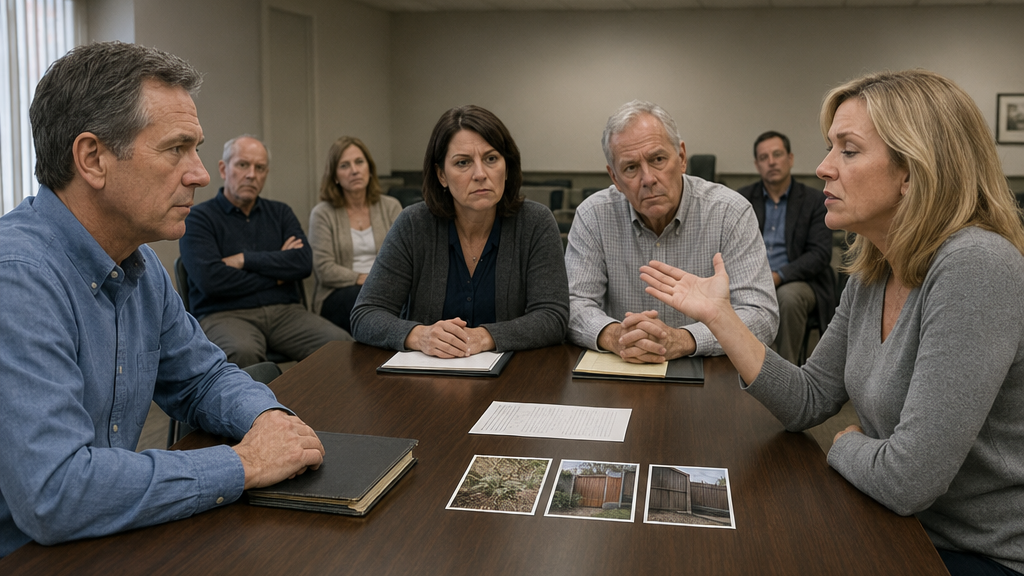
The Neighbor Called My Ruined Garden an Accident Until the HOA Learned Why the Gate Stayed Open
Chapter 1: The Third Footprint Was No Longer an Accident
The zucchini plant was lying on its side when Andrew Mitchell reached the garden.
Its roots, normally buried beneath six inches of dark soil, were exposed to the morning air like a fistful of pale wires. One broad leaf had been crushed into the path. Beyond it, two tomato cages leaned at different angles, and a line of small shoe prints crossed the damp bed toward the rear gate.
The gate was swinging open.
Andrew heard children laughing on the other side of the fence.
“Hey.”
He did not shout it. He rarely shouted anything.
The laughter stopped for half a second, then footsteps hurried across the narrow strip between the yards.
Andrew stood with the zucchini plant in his hands.
He had closed that gate the night before.
He remembered because closing it was part of his evening routine: hose wound, shed locked, notebook returned to the kitchen, gate pulled until the metal tongue settled into the latch with a dull click.
He set the plant carefully beside the bed and walked toward the fence.
Cynthia Moore appeared from around the corner of her house before he reached it. Her son and daughter hovered several yards behind her.
Andrew pointed at the open gate.
“They came through again.”
Cynthia glanced past him toward the garden. “I’m sorry. They were in a hurry.”
“There’s a plant out of the ground.”
“I can see that.”
“And two tomatoes knocked over.”
“They’re kids, Andrew.”
He looked at her.
“That’s not really the point.”
Her expression tightened almost imperceptibly. “I said I was sorry.”
Six weeks earlier, after the first crossing, she had said almost exactly the same thing.
That morning her daughter had stepped through the bean row while chasing her brother. Andrew had found a broken stem and a flattened patch of lettuce. He had spoken to Cynthia beside the fence. She had apologized, called it an accident, and promised she would tell them to be careful.
Andrew had accepted it.
The second incident had happened two Saturdays later. This time the children had crossed diagonally through the garden, knocking over one pepper plant and crushing several seedlings.
Cynthia had apologized again.
Andrew had said, “They really can’t use this as a path.”
He remembered the sentence now because of how weak it sounded.
Can’t use this as a path.
Not: Do not come through my yard.
Not: The gate stays closed.
He had softened it because he did not want a neighborhood feud over vegetables.
Now the uprooted zucchini was lying behind him.
“This is the third weekend,” he said.
Cynthia folded her arms. “I don’t know what you want me to say. Nobody’s doing it on purpose.”
Andrew looked toward the children.
The boy stared at the ground.
The girl whispered something to him.
Andrew lowered his voice. “An accident happens once.”
Cynthia gave a small, exhausted sigh.
“Oh, come on.”
“Three times is a pattern.”
“They thought they could cut through.”
“Why would they think that?”
Cynthia paused.
“People have always gone through there.”
Andrew looked at the gate.
“Not through my garden.”
“The gate has been there forever.”
“So?”
“So maybe you’re treating this like something it isn’t.”
He felt the argument beginning to take shape, and with it the familiar pressure behind his ribs. He disliked public disputes, neighbor disputes, any disagreement that required him to stand somewhere and explain why something obvious should be obvious.
He had spent years being the reasonable person.
Reasonable people did not measure every inconvenience. They did not write complaint letters because a basketball rolled onto their lawn. They returned packages delivered to the wrong porch. They moved their car when someone needed room.
Andrew had built an identity around not being difficult.
Cynthia seemed to know that without ever having discussed it.
“I’m asking you to keep them out of the garden,” he said.
“And I’m telling you I will talk to them again.”
She turned toward the children.
Andrew almost let her walk away.
Then he looked at the zucchini.
“Cynthia.”
She stopped.
“The gate stays closed.”
Her shoulders stiffened.
“All right.”
It was not quite agreement. It sounded more like the end of a conversation she believed had lasted too long.
She ushered the children toward her house.
Andrew returned to the garden.
He inspected the damage slowly.
One zucchini, likely lost. Two tomato plants bent, though one might recover. Three marigolds crushed along the edge. Soil compacted in the bed where shoes had landed.
He went inside for his notebook.
The notebook had never been intended for disputes.
Its early pages contained planting dates, soil amendments, weather notes, rotations, fertilizer amounts, and small observations accumulated over years.
May 4: beans germinating unevenly north row.
May 12: added compost around tomatoes.
June 1: zucchini flowering strongly.
Andrew sat on the low garden stool and turned to a clean page.
He hesitated before writing.
Then he recorded the date.
Third crossing.
He listed what he saw.
The act made him feel foolishly formal, as if he were documenting a crime scene rather than a ruined vegetable plant.
He nearly tore the page out.
Instead, he left it.
Then he photographed the zucchini with his phone.
He photographed the tomato cages.
He photographed the shoe prints.
Finally, almost as an afterthought, he photographed the gate.
The latch hung slightly crooked.
Andrew frowned.
He pulled the gate shut.
The tongue entered the metal receiver, then bounced back.
He tried again.
This time he pushed harder.
Click.
He tugged the gate.
It opened.
Andrew crouched.
The latch itself was old, but not broken. He had adjusted it in spring. The post had shifted slightly over the years, enough that the tongue sometimes needed pressure to seat properly, but when it caught, it held.
He closed it again.
This time he watched more closely.
Something pale was lodged beneath the lower edge of the receiver.
He reached in with two fingers and pulled it free.
A short piece of folded plastic.
No longer than the top joint of his thumb.
It had been wedged exactly where the latch needed to drop.
Andrew held it in his palm.
It might have blown there.
Except folded plastic did not usually blow upward into a metal latch and wedge itself firmly enough to prevent the gate from closing.
He looked across the fence toward Cynthia’s yard.
Her back door had shut.
The children were gone.
The neighborhood was quiet again.
Andrew photographed the plastic in his palm.
Then he placed it beside the damaged zucchini and took another picture.
For the first time that morning, the ruined plant bothered him less than the open gate.
Chapter 2: The Shortcut Everyone Remembered Differently
“People did use that gate years ago.”
William Jackson said it casually, as if he were remembering where somebody once parked a pickup.
Andrew stopped walking.
They were standing near the community mailboxes on Monday afternoon. William, the HOA treasurer, had lived in the neighborhood longer than Andrew and seemed to remember every fence replacement, roof dispute, drainage complaint, and board resignation going back twenty years.
“What people?” Andrew asked.
William shrugged. “Neighbors. Kids. Whoever was going between that side and the common path.”
“Through my yard?”
“Not exactly your yard then.”
Andrew waited.
William scratched at the edge of an envelope in his hand.
“The previous owners didn’t have the beds running that close to the fence. Mostly grass back there. They weren’t fussy about people cutting across.”
Andrew felt something shift inside him—not relief, exactly.
Complication.
“So there was permission?”
“I wouldn’t call it permission.”
“What would you call it?”
William gave him a faint smile. “The sort of thing nobody thinks to define until somebody gets mad.”
That sentence followed Andrew home.
He spent the afternoon testing the gate latch.
Closed normally, it caught roughly three times out of five.
Closed with a firm push, it caught every time.
With a small object under the receiver, it did not catch at all.
He removed the obstruction and tried again.
Click.
He opened it.
Click.
Again.
By the seventh attempt, the action had become irritatingly precise.
Cynthia’s argument had sounded ridiculous on Saturday. Now William’s recollection had given it enough shape to make Andrew uncomfortable.
If people had crossed there before, perhaps the children honestly believed the route was acceptable.
Andrew still owned the property. Previous informality did not grant permanent access.
But he had lived there for eight years.
Why had nobody crossed regularly until now?
That question sent him out the side gate after dinner.
The official neighborhood pedestrian path ran behind the next row of houses, connecting the cul-de-sac to the small park and the elementary-school route beyond it.
Andrew had used it hundreds of times.
When he reached the entrance, he found a chain-link construction panel stretched across it.
A white notice was zip-tied to the fencing.
DRAINAGE IMPROVEMENT PROJECT.
TEMPORARY CLOSURE.
He stared at it.
He remembered receiving an HOA email about drainage work but had barely read it. His house sat uphill from the problem area. To him, the project had meant trucks and orange cones somewhere else in the subdivision.
He walked along the fencing.
The normal path disappeared behind disturbed earth, stacked drainage pipe, and temporary barriers.
To reach the other side legally, someone from Cynthia’s house would have to walk out to the main residential street, around the end of the block, then back toward the school route.
Andrew checked his watch.
He walked the detour.
Then he walked back.
The difference was not enormous.
But it was enough.
For an adult walking alone, perhaps eight or nine extra minutes.
For a parent moving between school pickup, errands, sports practices, and two children who wanted the shortest route available, it was the kind of inconvenience that became larger each day.
Andrew stood near the closed path and looked toward the rear line of his own property.
The shortcut suddenly made sense.
That did not make it acceptable.
But sense mattered.
It bothered him that it mattered.
The following afternoon, Cynthia was taking trash bins toward the curb when Andrew approached.
“I talked to William.”
Her face changed immediately.
“About me?”
“About the gate.”
“And?”
“He said people used to cut through years ago.”
Cynthia set one bin against the curb.
“Exactly.”
“He also said it was informal.”
She gave a short laugh. “Of course he did. William calls everything informal when nobody wrote it down.”
Andrew ignored that.
“The walkway is closed.”
“Yes.”
“For the drainage work.”
“Yes, Andrew. That’s why everybody’s been going around.”
“Everybody isn’t going through my yard.”
“No. Mostly my kids.”
Her willingness to say it plainly surprised him.
“You knew?”
“I knew they used the route.”
“After I asked you to stop?”
“I knew they used the route before you decided it was suddenly forbidden.”
He stared at her.
“I didn’t suddenly decide anything.”
“You put garden beds where there used to be grass.”
“On my property.”
“I understand that.”
“Do you?”
Cynthia’s face hardened.
“Do you know what my mornings look like right now?”
“No.”
“No, you don’t.”
She gestured toward the blocked path behind the houses.
“The association closed the cut-through. My son has practice three afternoons a week. My daughter gets out at a different time. I’m doing pickups, groceries, work calls, trying to get everybody where they need to be, and that gate saves us ten minutes each way.”
Andrew was quiet.
There it was: not entitlement without reason, but entitlement built around inconvenience.
Cynthia continued.
“And before you lived here, people used that route.”
“That doesn’t make it permanent.”
“I didn’t say it did.”
“You keep saying the kids thought it was allowed.”
“Because they did.”
“After Saturday?”
She looked away for half a second.
Andrew noticed.
“Cynthia.”
“I told them to stay off the plants.”
“That isn’t what I asked.”
“They’re not trying to wreck your garden.”
“That also isn’t what I asked.”
She exhaled sharply.
“You want everything stated like a rule.”
“No. I want the gate closed.”
“There. Same thing.”
She pulled the second trash bin into line with the first.
Andrew watched her walk back toward the house.
For the first time, he understood why she was angry.
She did not see herself as invading his property.
She saw him as withdrawing a convenience the neighborhood had once casually shared precisely when she needed it most.
It was an explanation.
Not permission.
That evening Andrew repaired one bent tomato cage and tied the surviving stem upright.
He wrote in the notebook:
Common path closed. Possible reason shortcut resumed.
Then he crossed out possible.
Reason shortcut resumed.
He sat there looking at the sentence.
His anger had been cleaner when he thought Cynthia simply did not care.
Now he had to hold two ideas at once.
She had a genuine problem.
And she was solving it through his yard without his consent.
A small movement beyond the kitchen window caught his attention.
Andrew looked up.
Cynthia and both children were approaching the rear fence.
He stayed inside.
Her son reached for the gate.
Cynthia stopped him.
For one moment Andrew thought she was finally turning them back.
Then she stepped forward herself.
She lifted the latch.
The gate opened.
Cynthia held it while both children passed through.
Andrew remained motionless behind the glass.
She looked once toward his house.
Then she followed them through.
Chapter 3: What Andrew Put on the Clubhouse Table
“So apparently tonight we’re discussing two kids walking through some vegetables.”
Cynthia said it before Andrew had taken his seat.
The clubhouse meeting room was not large enough for a dramatic audience. Twelve folding chairs faced two plastic tables pushed together beneath fluorescent lights. The HOA board president sat at one end. Susan Clark, the community manager, had a laptop open beside a stack of printed agendas. William Jackson was sorting papers near the opposite corner.
Two homeowners Andrew recognized had come for unrelated business.
Both looked up when Cynthia spoke.
Andrew felt heat rise under his collar.
This was precisely why he hated neighborhood disputes.
A private disagreement entered a room, lost half its details, and became a sentence people could repeat.
Two kids walking through some vegetables.
Andrew placed a thin folder on the table.
Susan glanced between them.
“Let’s keep this focused. Andrew requested time regarding repeated property damage and rear access.”
Cynthia sat back.
“Repeated property damage sounds a little dramatic.”
Andrew said nothing.
Susan looked at him.
“Go ahead.”
He opened the folder.
His first instinct had been to prepare an explanation. He had written one the previous evening, two pages describing the garden, the history, the three incidents, the gate, the conversations.
That morning he had thrown it away.
Instead, he placed his notebook on the table.
Then three photographs.
The first showed the uprooted zucchini.
The second showed the crushed row and bent tomato cage.
The third showed the gate latch.
Cynthia glanced at the images.
“I already apologized for the plants.”
Andrew placed another photograph beside the first.
Then another.
Then a third.
Three views of the same latch on different dates.
In two, the gate stood open.
In one, the receiver was visibly blocked.
Nobody spoke for several seconds.
William leaned forward.
“Those dates are different?”
Andrew nodded.
“Three weekends.”
The board president picked up one photograph.
“What are we looking at?”
“The rear gate between my property and the Moore property.”
Cynthia interrupted. “It’s not between our properties. It opens from his yard toward the shared side.”
“Cynthia,” Susan said.
Andrew continued.
“The latch works if it’s fully engaged. On these dates it wasn’t engaged. On the third incident, I found plastic wedged beneath the receiver.”
Cynthia crossed her arms.
“That proves somebody stuck plastic in a latch.”
“Yes.”
“It doesn’t prove who.”
“I didn’t say it did.”
That slowed her.
Andrew opened the notebook.
He turned past pages of planting records until he reached the damage entries.
“I’ve kept this notebook for years. Planting dates, soil amendments, crop rotation, replacement costs when something fails.”
One of the homeowners smiled slightly.
“You really write all that down?”
Andrew looked at him.
“Yes.”
The smile disappeared—not from embarrassment, exactly, but because Andrew had not treated the question as a joke.
He placed a single printed sheet on the table.
At the bottom was the total:
$387.
Cynthia stared at it.
“You’re charging me three hundred eighty-seven dollars?”
“I’m showing the documented replacement loss.”
“For vegetables.”
“For mature plants, replacement stock, damaged supports, and the plantings that were destroyed.”
“They’re tomatoes.”
“One tomato plant is recoverable. It isn’t included.”
The room went quiet again.
Andrew had expected satisfaction.
Instead he felt exposed.
His notebook, something private and ordinary, was now open beneath fluorescent lights while neighbors looked at numbers he had written for soil amendments and seed dates.
But he also felt something else.
The disagreement had stopped being vague.
Cynthia could say “vegetables.”
The photographs showed uprooted plants.
She could say “accident.”
The dates showed repetition.
She could say “just kids.”
The latch photographs raised a different question.
The board president looked toward Cynthia.
“Did you know they were going through there?”
Cynthia’s jaw tightened.
“I knew they had gone through.”
“After Andrew asked them not to?”
“He didn’t say it the way he’s saying it now.”
Andrew looked at her.
“That Saturday I said the gate stays closed.”
“Yes. After weeks of acting like this was some huge issue.”
Susan raised a hand.
“Let’s separate the interpersonal part from the property issue.”
“That’s what I’ve been trying to do,” Cynthia said.
Andrew almost answered.
He stopped himself.
This was the moment he had imagined during the walk to the clubhouse: the moment he could say he had watched her open the gate herself.
He could make the room turn toward her.
He could say she had knowingly led the children through after telling him they merely “thought” they were allowed.
He did not.
Not yet.
Instead, he said, “The first time may have been an accident.”
Cynthia looked at him.
“The second time, I probably wasn’t clear enough.”
William’s eyebrows rose slightly.
Andrew continued.
“But after the third conversation, there wasn’t any ambiguity.”
The board president tapped the $387 sheet.
“What exactly are you asking the HOA to do?”
Andrew had anticipated the question.
“I want the property damage addressed, and I want the access issue clarified.”
Susan closed her laptop halfway.
“The association can clarify whether there is a recorded easement or common-access right. But we cannot adjudicate a private damage claim between owners.”
“So the $387 is private?”
“Yes.”
“And the gate?”
“If it is entirely within your lot boundaries, generally also private, unless it affects a common element or recorded easement.”
Cynthia let out a small breath through her nose.
Andrew heard it.
It sounded almost like victory.
Susan continued.
“We can, however, look at whether residents have been directed toward that area because of association work.”
Andrew turned toward her.
“Directed?”
“Not formally directed.”
“What does that mean?”
Susan glanced toward William.
William stopped sorting papers.
The shift was small, but Andrew saw it.
“There’s been drainage work behind that row,” Susan said.
“I know.”
“The pedestrian path has been temporarily closed.”
“For how long?”
Susan hesitated.
“Approximately six weeks.”
Andrew looked at Cynthia.
Six weeks.
The same span in which the shortcut had become a recurring problem.
Cynthia did not look triumphant now.
She looked tired.
One of the homeowners near the wall spoke.
“Was there a temporary route?”
Susan turned to him.
“This agenda item is about Andrew’s request.”
“That seems related.”
Susan straightened several papers.
“The construction plan did not include a temporary pedestrian route.”
Andrew felt the entire shape of the dispute change.
Not disappear.
Change.
He thought of Cynthia saying ten minutes each way.
He thought of William saying people had once used the gate casually.
He thought of the construction fencing he had walked around two nights earlier.
Then he looked at the three photographs on the table.
Someone had still kept the gate open.
A closed HOA path explained why the shortcut mattered.
It did not explain who had decided Andrew’s yard was the replacement.
Susan finally met his eyes.
“The association closed the normal pedestrian access six weeks ago,” she said. “We expected the drainage work to take considerably less time.”
Chapter 4: The Path the Association Forgot to Replace
Andrew timed the detour twice.
The first walk took nine minutes and forty-three seconds longer than the direct route past his rear fence. The second took ten minutes and eleven seconds because a delivery truck blocked one sidewalk and forced him across the street.
He stood at the temporary construction fencing with his phone still running.
Behind the chain-link panels, the neighborhood’s normal pedestrian path ended in a trench of pale dirt and exposed drainage pipe. An orange barrier leaned against a stack of concrete sections. No crew was working that morning. No machinery moved.
A heavy padlock held the construction gate shut.
Andrew looked at it longer than he expected to.
His own gate had become a problem because it would not reliably stay closed.
The association’s gate had no such difficulty.
He stopped the timer.
Ten minutes.
Cynthia had not exaggerated that part.
For weeks he had treated her shortcut as evidence of laziness. Walking the detour himself made the explanation less comfortable.
A parent taking two children to school could make the extra walk. Of course they could.
But twice a day, several days a week, combined with errands, work, sports, and everything else Andrew did not see from the other side of the fence, ten minutes became a real inconvenience.
He disliked how much sympathy the number created.
At noon he carried his notes to the management office.
Susan Clark met him in a small conference room with a window overlooking the parking lot.
“I figured you might come in,” she said.
“Why?”
“Because you heard ‘six weeks’ last night.”
Andrew set his phone and notebook on the table.
“I walked the detour.”
Susan glanced at the screen.
“You timed it?”
“Yes.”
She gave him a look that might have been amusement under different circumstances.
“Ten minutes?”
“About that.”
“That sounds right.”
“So Cynthia was telling the truth.”
“About the inconvenience? Yes.”
Andrew leaned back.
“Why didn’t you give people another route?”
Susan’s expression shifted immediately into professional caution.
“The drainage project was scheduled for twelve business days.”
“It’s been six weeks.”
“We had delays.”
“What kind?”
“Utility marking. Weather. A damaged section of pipe that had to be reordered.”
“Residents were told any of that?”
“Updates went out.”
Andrew remembered the emails he had ignored.
“Updates saying the path would stay closed?”
Susan hesitated.
“Not clearly enough.”
It was the first answer she had given him that sounded less like management language and more like admission.
Andrew opened the notebook.
“The crossings started around the same time.”
“I’m aware of the timing.”
“Were residents told to use the route behind my house?”
“No.”
“Were they told not to?”
“No.”
“Was any temporary walkway provided?”
Susan folded her hands.
“No.”
The single word changed the room.
Andrew had expected resistance. Instead, Susan looked tired.
“We believed the closure would be short,” she said. “By the time it became obvious it wasn’t, the contractor was already mobilized. Creating a temporary pedestrian route would have required additional barriers, insurance review, and another authorization.”
“So nobody did it.”
“That is a simplified version.”
“It’s also accurate.”
Susan did not argue.
Andrew looked through the glass wall toward the lobby.
For weeks he had wanted someone to say Cynthia was wrong.
Now Susan was giving him something harder.
Cynthia was wrong about using his yard after he told her to stop.
The HOA had still created the conditions that made the shortcut useful.
Both could be true.
“I’m not asking the association to pay for my vegetables,” Andrew said.
“Good.”
“I’m asking whether the association is going to fix the access problem.”
Susan exhaled.
“That is a board decision.”
“You manage the project.”
“I manage what the board authorizes.”
“That sounds convenient.”
Her eyes narrowed.
“And timing every sidewalk in the neighborhood sounds a little excessive.”
Andrew almost answered sharply.
Then he looked at the notebook between them.
He had walked into the office prepared to document another opponent.
That realization embarrassed him.
He closed the notebook.
“Maybe.”
Susan’s expression softened slightly.
“I understand why you’re angry.”
“I’m not sure I do anymore.”
That seemed to surprise her.
Andrew continued.
“I still want the damage addressed. But I also understand why the route mattered.”
Susan nodded.
“That distinction will help.”
“With what?”
“With getting the board to discuss the actual problem instead of deciding which neighbor they like better.”
For the first time since the garden damage began, Andrew almost smiled.
Almost.
On his way home he stopped at the blocked path again.
A woman with a stroller approached the fencing, read the closure notice, and turned around. A teenager on a bicycle did the same.
The inconvenience was not only Cynthia’s.
That mattered too.
Later that afternoon Andrew found Cynthia near the shared fence.
She was watering two potted plants on her patio.
“I talked to Susan.”
Cynthia set down the hose nozzle.
“I’m sure that went well.”
“They should have provided a temporary route.”
Her face changed.
“You’re admitting that?”
“I’m saying the HOA made this worse.”
“And?”
“And that doesn’t make my yard the temporary route.”
The brief relief on her face vanished.
“Of course.”
Andrew kept his voice level.
“I’m separating the two things.”
“You’re separating them because it helps you.”
“No. I’m separating them because they are separate.”
Cynthia turned off the water.
“If the association hadn’t closed that path, none of this would have happened.”
“Maybe.”
“Not maybe.”
“The first crossing might not have happened. The second might not have happened. But after I told you to keep the gate closed, that part was no longer the HOA.”
She looked toward his fence.
“You really want three hundred eighty-seven dollars from me.”
“I want the damage paid for.”
“You know the HOA created this situation.”
“Yes.”
“And you’re still coming after me.”
“I’m asking you to pay for damage that happened after we talked.”
Cynthia gave a short, bitter laugh.
“That distinction matters a lot to you.”
“It matters because otherwise nobody is responsible for anything.”
She picked up the hose.
“I’m not paying you.”
Andrew waited.
Cynthia looked directly at him.
“If you think somebody owes you money, take it wherever you think it belongs.”
That evening, an envelope appeared beneath Andrew’s front door mat.
It was not mailed.
Inside was the itemized sheet he had given Cynthia after the board meeting.
Across the bottom she had written one sentence in dark ink.
I will not reimburse damage caused by an access problem the HOA created.
Andrew read it twice.
Then he placed it beside his garden notebook.
Until that moment, he had thought he was deciding whether to pursue Cynthia or the association.
Her note made the next step simpler.
Not easier.
Simpler.
Chapter 5: The Ten-Day Letter Changed More Than the Money
Andrew wrote “$387.00” three times before the number looked right.
The first version was on his kitchen notepad.
The second was on the formal demand letter.
The third appeared on the certified-mail form at the post office.
He could have rounded it to four hundred.
He could have reduced it to three hundred and called the difference peace.
Instead he used the exact total because exactness had become important to him.
That worried him more than he admitted.
The clerk stamped the receipt and slid it back across the counter.
“Keep this.”
Andrew folded it into his notebook.
Ten days.
The letter was brief.
It listed the three incidents, the plant damage, the replacement calculations, and the amount requested. It did not mention Cynthia’s parenting. It did not mention disrespect. It did not mention anger.
He had removed every sentence that sounded personal.
That should have made him feel calm.
Instead, on the drive home, he imagined Cynthia signing for the envelope and reading it at her kitchen counter.
He wondered when a reasonable boundary became a campaign.
Then he remembered the zucchini roots lying in the sun.
At home, the gate was closed.
Andrew tested it.
Click.
He opened it and closed it again.
Click.
He stood there listening to the small mechanical sound.
For weeks it had seemed like proof of something.
Now it sounded like an argument neither neighbor knew how to finish.
Four days later, the certified-mail tracking showed delivery.
That evening Cynthia knocked on Andrew’s side gate.
He was tying up late-season tomatoes.
“I got your letter.”
Andrew straightened.
“I know.”
“You tracked it?”
“It was certified.”
“That wasn’t really a question.”
She held a folded copy in one hand.
“I’m not paying three hundred eighty-seven dollars.”
Andrew set the garden twine down.
“Then I’ll file.”
“So that’s where we are?”
“You told me to take it where I thought it belonged.”
Cynthia stared at him.
“I was angry.”
“So was I.”
“That doesn’t mean you have to turn this into court.”
“No. The repeated damage is what did that.”
She took a breath through her nose.
“The HOA created the access problem.”
“We already covered that.”
“No, you keep dividing everything into separate boxes because that’s how you think.”
Andrew said nothing.
Cynthia stepped closer to the fence.
“You want to know what actually happened with the gate?”
His attention sharpened.
She saw it.
For a second, neither spoke.
Then Cynthia said, “I propped it.”
Andrew felt the admission before he fully processed the words.
“With the plastic?”
“Once with plastic. Once with a piece of folded cardboard.”
“Why?”
“Because the latch kept catching when the kids came back.”
Andrew stared at her.
“You knew I wanted it closed.”
“Yes.”
The word landed harder than any denial had.
Cynthia looked away.
“I thought you were being unreasonable.”
“That made it your gate?”
“No.”
“My yard?”
“No.”
“Then what did you think you were doing?”
Her face tightened.
“I thought I was keeping a route open that people had used before you turned it into some absolute boundary.”
“After I told you not to.”
“You told me after weeks of acting like my kids were destroying your life.”
“They were destroying plants.”
“They were plants, Andrew.”
He looked toward the rows behind him.
“Yes.”
Cynthia rubbed one hand across her forehead.
“I know how that sounds.”
“Do you?”
“Yes.”
For the first time, there was no defensiveness in her voice.
Only fatigue.
“I was late constantly. The path was closed. The kids knew the shortcut. I knew people used it years ago. And every time you objected, I told myself you were making something small into something big.”
Andrew did not interrupt.
Cynthia looked at the ground.
“Then after a while I kept doing it partly because I didn’t want you to be right.”
That was not the answer Andrew expected.
It was worse in one way and better in another.
No secret legal right.
No misunderstanding remaining.
Just pride.
Ordinary, recognizable pride.
He knew something about that.
Cynthia unfolded the letter.
“I’ll give you two hundred.”
Andrew blinked.
“What?”
“Two hundred dollars. We stop this.”
It was nearly the resolution he had wanted a month earlier.
He should have considered it.
He knew that immediately.
Instead he heard himself say, “The documented amount is three eighty-seven.”
Cynthia’s face closed.
“So this isn’t about getting compensated.”
“It is.”
“No. If it were, you’d take two hundred and be done.”
“That doesn’t cover the loss.”
“The loss according to your notebook.”
“Yes.”
She gave a tired laugh.
“There it is.”
“What?”
“The notebook.”
Andrew felt irritation rise.
“You admitted you kept the gate open.”
“Yes. And I’m offering to pay more than half.”
“You knew after I told you.”
“I said I was wrong.”
“You said you thought I was unreasonable.”
“I did think that.”
“You still do.”
“Sometimes.”
The honesty stung more than an insult would have.
Andrew picked up the garden twine.
“Then we don’t have anything else to discuss.”
Cynthia stood there a moment.
“You’d rather win.”
He looked at her.
“That’s not what this is.”
“Okay.”
She folded the letter and walked back toward her house.
Andrew watched her go.
Only after the gate closed did he look at the twine in his hand and realize he had been gripping it hard enough to leave a red line across his palm.
Two hundred dollars.
He could have ended it.
Not fully. Not fairly, perhaps.
But practically.
Instead he had refused because the number in his notebook had become inseparable from the principle in his head.
That night he did not write anything about the conversation.
The blank page bothered him.
Three days later he found the latch open again.
His first reaction was anger so immediate that he crossed the yard before thinking.
Then he stopped.
No children were present.
No plants were damaged.
A narrow piece of cardboard sat beneath the receiver.
Andrew pulled it free.
He stood there looking at it.
Cynthia had admitted everything already.
There was nothing left to prove.
Still, he photographed the latch.
The motion felt automatic now.
He hated that.
The ten-day period expired.
Andrew filed the small-claims paperwork.
The clerk took his forms, checked the amount, and asked whether he had attempted informal resolution.
“Yes.”
“Any offer?”
Andrew hesitated.
“Two hundred.”
The clerk looked up.
“You declined?”
“Yes.”
She did not comment.
She did not need to.
A week later the court notice arrived.
So did an HOA email.
Andrew opened the email first.
Drainage project delay.
The pedestrian path would remain closed for approximately four additional weeks.
He read the sentence twice.
Then he opened the court envelope.
Hearing date.
He placed both papers on the kitchen table.
One represented the dispute he had chosen to formalize.
The other represented the practical problem nobody had fixed.
For the first time, Andrew wondered whether he could win the first and still lose something more important.
Chapter 6: The Question the Judge Asked Both Neighbors
“Mr. Mitchell, did you ever explicitly tell Ms. Moore that any previous permission to use the shortcut was withdrawn?”
The question came before Andrew expected it.
He had barely finished explaining the first damaged planting.
The judge sat behind a low bench in a small courtroom that felt more like an office than the setting Andrew had imagined during weeks of preparation. No jury. No dramatic rows of spectators. Just a clerk, a handful of people waiting for other cases, Cynthia at the opposite table, and the notebook Andrew had carried everywhere for two months.
Andrew looked at the judge.
“Not after the first incident. Not in those exact words.”
Cynthia turned slightly toward him.
The judge made a note.
“What did you say?”
“I told her the children couldn’t use the garden as a path.”
“Did you tell her the gate was not to be used at all?”
Andrew thought carefully.
“Not the first time.”
That answer cost him more emotionally than he expected.
For weeks, the first crossing had occupied the same category in his mind as the later ones.
Damage.
Trespass.
Disrespect.
But under the judge’s questioning, the distinctions Andrew had demanded from everyone else now applied to him.
The judge looked toward Cynthia.
“Ms. Moore, what did you understand after that first conversation?”
“That he didn’t want the children stepping on the plants.”
“Not that they were prohibited from crossing?”
“No.”
Andrew wanted to object.
Then he remembered his own words.
They really can’t use this as a path.
Softened.
Indirect.
Reasonable.
The kind of sentence a person used when he wanted the other person to understand without forcing himself to say exactly what he meant.
The judge turned back to him.
“What happened after the second incident?”
Andrew described the damaged pepper plant and seedlings.
“I spoke to her again.”
“More clearly?”
“Yes.”
“What did you say?”
“That the route wasn’t available anymore and the children needed to stay out of my yard.”
Cynthia looked down at the table.
“And the third incident?”
“After that conversation.”
Andrew opened the folder.
He placed the dated photographs in order.
The judge examined them one at a time.
The uprooted zucchini.
The crushed row.
The latch.
Then the photograph showing the plastic beneath the receiver.
“What is this?”
“A piece of plastic wedged under the latch so it couldn’t catch.”
“Do you know who put it there?”
“At the time, no.”
“At the time?”
Andrew looked across at Cynthia.
“She later admitted she did.”
The judge turned.
“Ms. Moore?”
Cynthia’s mouth tightened.
“Yes.”
The courtroom seemed to become smaller.
The judge set down the photograph.
“Why?”
Cynthia answered without looking at Andrew.
“The association path was closed. That gate had been used as a shortcut in the past. I thought he was overreacting.”
“After he told you not to use it?”
She paused.
“Yes.”
Andrew expected satisfaction.
Instead he remembered Cynthia standing beside the garden fence saying she had kept doing it partly because she did not want him to be right.
The judge asked about the HOA closure.
Cynthia explained the detour.
She explained school pickup and practices.
She explained the history William had described.
None of it sounded ridiculous in the courtroom.
That mattered.
The judge asked Andrew whether he disputed the path closure.
“No.”
“Or the prior informal use?”
“No.”
“Or that the detour was inconvenient?”
“No.”
“Then what is your claim?”
Andrew looked at the photographs.
Months earlier he would have answered differently.
He might have said it was his property, full stop.
He might have talked about respect.
Instead he said, “My claim is for the damage after I clearly told her the shortcut was no longer available.”
The judge watched him for a moment.
“That distinction matters.”
“Yes.”
The judge looked toward Cynthia.
“Do you agree he clearly told you before the later crossings?”
Cynthia did not answer immediately.
Her attorney-free table held only a few papers and the copy of Andrew’s demand.
Finally she said, “Yes.”
Andrew looked at her.
She continued.
“I thought he was being unreasonable, but yes. He told me.”
There it was.
Not caught in a contradiction.
Not exposed by a secret witness.
Chosen.
Cynthia could have kept arguing ambiguity.
Instead she admitted the part that made her responsible.
The judge asked Andrew about the amount.
He presented the itemization.
Replacement plants.
Lost mature stock.
Damaged supports.
Comparable nursery prices.
The judge questioned two entries and reduced one support cost slightly before Andrew explained that the figure on his demand already excluded the tomato plant that recovered.
“You kept records before this dispute?”
“Yes.”
“How long?”
“Years.”
The judge flipped through several pages.
“These are planting notes?”
“Yes.”
“And soil amendments?”
“Yes.”
A faint smile crossed the judge’s face.
“You are thorough.”
Andrew almost said, Sometimes too thorough.
He did not.
Then Cynthia raised the issue Andrew had been waiting for.
“He refused two hundred dollars.”
The judge looked up.
“You offered settlement?”
“Yes.”
“After admitting you had propped the gate?”
“Yes.”
Andrew felt his stomach tighten.
“Mr. Mitchell?”
“I declined.”
“Why?”
He had prepared an answer about documented value.
It was accurate.
It was also incomplete.
“The loss was three hundred eighty-seven dollars.”
“That is why you declined?”
Andrew glanced at Cynthia.
She looked tired rather than angry.
“No,” he said.
The judge waited.
Andrew forced himself to continue.
“Not entirely.”
Cynthia looked at him now.
“I was angry. By that point, I wanted the full amount because I wanted the record to show I had been right.”
The courtroom was silent.
Andrew hated saying it.
He also felt something loosen.
The judge leaned back.
“Settlement decisions are not the issue before me, but candor is useful.”
The ruling took less time than Andrew expected.
The judge found the first incident ambiguous enough that it would not independently establish knowing misuse of the property.
The later incidents were different.
Andrew had clearly withdrawn permission.
Cynthia had understood that.
She had nevertheless facilitated continued access, including intentionally interfering with the gate latch.
The HOA closure explained the inconvenience.
It did not transfer access rights to Andrew’s private property.
The court awarded Andrew the documented $387 in damages, plus allowable court costs.
Andrew heard the number.
He had imagined that moment many times.
In those imagined versions, the number felt like vindication.
In the actual courtroom, it felt smaller.
Not meaningless.
Just smaller.
Cynthia gathered her papers.
Andrew closed his notebook.
Outside the courtroom, they stood several feet apart while other people moved around them.
Cynthia spoke first.
“You won.”
Andrew looked at her.
“That’s what the judgment says.”
“That’s not what I meant.”
He knew.
Before he could answer, she walked toward the elevators.
Andrew stayed where he was.
His phone vibrated.
A message from Susan Clark.
When you’re done today, please call me. The board wants you at one final session regarding the walkway and rear access.
Andrew read it twice.
The case was over.
Apparently the problem was not.
Chapter 7: The Gate Closed Without Becoming a Wall
“Do you want us to cite Cynthia formally?”
Susan Clark asked the question before Andrew had finished sitting down.
The clubhouse looked almost exactly as it had the night he placed his garden notebook on the table, but the room felt smaller now. Fewer residents had come. William Jackson sat beside the board president with a thin folder in front of him. Cynthia was already there, two chairs away from Andrew, looking toward the tabletop.
Susan slid a sheet of paper across the table.
“The board can issue a violation for repeated unauthorized access after notice,” she said. “Given the court judgment, documentation would be straightforward.”
Andrew looked at the form.
A month earlier, he would have wanted it.
Not because of the fine. Because it would have been another official sentence saying he had been right.
He looked at Cynthia.
She did not meet his eyes.
“What happens if you issue it?” Andrew asked.
“Written violation. Possible fine depending on response. Permanent association record.”
“And the path?”
Susan paused.
“We’re getting to that.”
Andrew pushed the violation form back.
“No. Let’s get to it first.”
The board president shifted in his chair.
“The drainage contractor can open a temporary pedestrian corridor along the north side of the work area.”
“When?”
“Tomorrow, if authorized tonight.”
Andrew looked at Susan.
“You could have done that before?”
“Technically, yes.”
“Why didn’t you?”
Susan did not reach for management language this time.
“Because it cost money, and we expected the closure to be temporary.”
William cleared his throat.
“And because some of us thought people could manage the detour for a couple weeks.”
“Some of us?” Susan asked.
William lifted one hand.
“I voted against the temporary route the first time it came up.”
Andrew turned toward him.
“You knew?”
“I knew the closure was causing complaints. I didn’t know people were cutting through your property.”
“Would it have mattered?”
William considered the question.
“Yes.”
Then he added, “It should have mattered before that.”
The admission settled into the room without drama.
Andrew thought of the stroller he had watched turn around at the construction fence. The teenager with the bicycle. Cynthia’s ten-minute detour.
The association had saved money by treating everyone’s inconvenience as minor.
Cynthia had saved time by treating Andrew’s boundary the same way.
And Andrew, at least at first, had saved himself from an uncomfortable conversation by assuming Cynthia would understand what he had never said plainly.
The mistakes were not equal.
But they rhymed.
Susan pulled out another page.
“There’s also the gate.”
Andrew frowned.
“What about it?”
“The contractor inspected the post yesterday. The alignment is off enough that the latch doesn’t reliably self-seat.”
“I know.”
“We can replace the hardware and install a self-closing hinge.”
“Why would the association pay for my private gate?”
Susan glanced at the board president.
“Because the walkway closure contributed to increased traffic pressure in that area, and because clarifying the boundary is cheaper than continuing the dispute.”
William smiled faintly.
“That means we finally found a solution inexpensive enough for the board to become principled.”
The board president ignored him.
Andrew looked again at the violation form.
“And Cynthia?”
Susan folded her hands.
“That depends partly on what you want.”
Cynthia finally spoke.
“It shouldn’t.”
Everyone turned toward her.
She looked at Susan.
“I did what the court said I did. Andrew shouldn’t have to decide whether I get punished again.”
Andrew watched her.
There was no challenge in her tone.
Only a kind of tired acceptance.
Susan nodded slowly.
“That’s fair.”
Cynthia reached into her purse and removed an envelope.
She placed it between herself and Andrew.
“The judgment.”
Andrew did not touch it.
“Full amount?”
“Three eighty-seven, plus the costs listed.”
Her mouth tightened slightly.
“I was going to mail it.”
“Why didn’t you?”
“I figured if we were all going to sit in this room again, I might as well save a stamp.”
William looked down, hiding a smile.
Andrew picked up the envelope.
It felt heavier than it should have.
For months, $387 had become the numerical shape of the entire conflict.
He had imagined receiving it as proof.
Now it was simply money inside paper.
Cynthia looked at him.
“For what it’s worth, I shouldn’t have kept opening the gate.”
Andrew waited.
She continued.
“I still think you could have handled some of it differently.”
“I could have.”
That answer surprised her.
Andrew looked at the envelope.
“I should have been clearer the first time.”
Cynthia nodded once.
“But after you were clear,” Andrew said, “you still did it.”
“I know.”
Neither apologized for everything.
Neither needed to.
Susan tapped the violation form.
“So?”
Andrew looked at it one final time.
“If the judgment is paid, the temporary path opens, and the gate is fixed, I don’t want another violation.”
The board president leaned forward.
“You understand the association could still choose to act independently.”
“Yes.”
“But you’re asking us not to?”
“I’m asking you to fix the problem you can actually fix.”
Susan’s expression changed slightly.
Not approval exactly.
Recognition.
William spoke before anyone else could.
“I support that.”
The board president looked around the table.
The vote was brief.
The temporary pedestrian route would open the next morning.
Andrew’s gate would receive new hardware.
The board would issue a written clarification to residents that historic informal crossings through private lots did not establish community access rights.
No additional violation would be filed against Cynthia.
When the meeting ended, Cynthia stood at the same time Andrew did.
For an awkward second, they were trapped between chairs.
She stepped aside.
“Go ahead.”
Andrew almost laughed at the absurd courtesy of it.
“Thanks.”
Outside the clubhouse, they walked in the same direction for half a block.
Not together.
Not exactly apart.
At the corner, Cynthia stopped.
“My kids won’t use your yard again.”
Andrew nodded.
“They don’t have to avoid me.”
“I know.”
She looked toward her house.
“They’re embarrassed.”
“They’re kids.”
Cynthia glanced back at him.
It was the first time he had used the phrase without resentment.
“I’ll tell them.”
They separated at the next driveway.
Two mornings later, a landscaping contractor arrived at Andrew’s fence.
The old latch came off first.
The contractor adjusted the gate post, installed a new hinge, then mounted a self-closing latch higher than the old one.
“Try it.”
Andrew opened the gate.
He released it.
The gate swung back slowly.
Click.
He opened it again.
Click.
No shove.
No second attempt.
No folded plastic.
Across the rear lots, orange barriers now marked a narrow temporary pedestrian corridor beside the drainage project. A mother pushed a stroller through it. Two children on bicycles followed behind.
Nobody approached Andrew’s fence.
The contractor packed his tools.
Andrew stood with one hand on the new latch.
For weeks, he had imagined the final resolution as keeping people out.
Instead, the real solution had been giving them somewhere appropriate to go.
By early autumn, the damaged section of the garden had changed.
The zucchini was gone.
One tomato plant had recovered enough to produce several late fruit. Andrew removed the crushed marigolds and cleared the bed for fall planting.
One afternoon he saw Cynthia’s children on the temporary path beyond the fence.
The boy noticed him.
He hesitated.
Andrew raised one hand.
After a moment, the boy raised his.
His sister did the same.
They kept walking.
That was all.
No apology scene.
No sudden friendship.
No lesson delivered across the fence.
Andrew preferred it that way.
He carried his notebook into the garden and sat on the low stool.
For several pages, the entries had stopped being about plants.
Dates of crossings.
Photographs.
Replacement prices.
Certified mail.
Court costs.
He turned past them until he reached a clean sheet.
For a moment, the blank page looked strange.
Then Andrew wrote the date.
Fall bed, north row.
He paused, studying the cleared soil.
Spinach first.
Maybe carrots beside it.
He wrote both down.
Behind him, the gate moved in a light push of wind.
It opened less than an inch against the tension of the new hinge.
Then it settled back into place.
Click.
Andrew did not turn around.
He kept writing.
The story has ended.