The HOA Drained His Vineyard Well for Decorative Fountains—Then Needed His Water to Survive Summer
Chapter 1: The Fountain Was Running When His Pressure Dropped
William Harris knew something was wrong before he looked at the gauge.
He opened the irrigation line for Block Four and heard the pipes fill, but the sound was weak. Instead of the sharp, full rush he expected, water moved through the buried line with a hollow rattle. Along the first row of vines, several emitters spit once, dribbled, then settled into an uneven thread.
William stood with one hand on the red steel valve and watched.
The vineyard had taught him not to trust first impressions. A stuck regulator could look like a dry well. A cracked fitting could steal pressure underground without leaving so much as a wet patch on the surface. A bad pump capacitor could turn a simple morning into an expensive afternoon.
He checked the pressure gauge.
Twenty-three pounds.
He frowned.
The line should have been above forty.
William shut the valve, walked into the pump house, and listened to the motor. No grinding. No uneven cycling. The amperage on the panel sat where it usually sat. He opened the bypass, checked the filter housing, then crouched beside the manifold and ran his thumb under every joint he could reach.
Dry.
He reopened the irrigation line.
The gauge climbed to twenty-six, stalled, and slid back toward twenty-two.
“Come on,” he muttered.
One of the vineyard workers called from two rows over. “Still weak?”
William nodded without looking up.
By ten in the morning, the heat had settled over the property like weight. The leaves nearest the end of the affected rows were already hanging flatter than he liked. The vines were not dying. Not yet. But grapes did not need catastrophe to lose value. A few bad days during the wrong stage of the season could show up weeks later in the fruit.
William walked the line himself.
At the western edge of the vineyard, the ground rose just enough for him to see over the boundary landscaping of the neighboring development.
The fountains were running.
Three pale stone basins stood near the HOA entrance beyond a row of ornamental trees. Water arced high into the air, broke in sunlight, and spilled back over polished edges. The jets pulsed steadily.
William stopped.
He had seen the fountains hundreds of times. Usually he barely noticed them.
That morning, they looked obscene.
He turned back toward the pump house.
The pressure gauge had dropped another two pounds.
For several minutes he stood between the vineyard and the development, looking from one to the other as if distance alone could explain it.
The HOA development had been built in stages along land that once held pasture and two old orchards. William’s vineyard had been there long before the stucco walls, landscaped medians, controlled entrances, and meeting notices. His father had drilled the main well in 1992, when William was still young enough to think a deep hole in the ground was more permanent than any building.
The well had never been generous, but it had been dependable.
Dependable mattered more.
William spent the rest of the morning trying to prove the problem belonged to him.
He checked the pump seals. He flushed the filters. He inspected the electrical panel again. He isolated two irrigation zones and ran them separately. Pressure improved slightly when demand dropped, but not enough.
By early afternoon, an irrigation contractor had crawled halfway through the pump house with a flashlight and a meter.
“You’ve got wear,” the contractor said, standing again. “Everybody does. But I’m not seeing enough here to explain that kind of falloff.”
“You sure?”
“As sure as I can be without pulling the pump.”
William disliked that answer because it removed the easiest explanation.
They walked outside.
The fountains beyond the boundary were still running.
The contractor followed William’s gaze.
“They change something over there?”
William looked at him. “What do you mean?”
“I saw a drilling rig back there in spring. Thought maybe it was landscaping.”
William felt something tighten behind his ribs.
“What drilling rig?”
The contractor shrugged. “Big rotary setup. North side of their common area. Was there three, four days.”
William said nothing.
That afternoon he drove to the HOA entrance instead of calling.
Rachel Nelson was standing near the community center speaking with the property manager when William approached. She wore sunglasses and carried a thin folder against one hip. The fountains threw a fine mist behind her.
“William,” she said, with the cautious recognition of someone who knew him mainly from boundary questions and county notices. “What can I do for you?”
“You drill a well this spring?”
Rachel glanced toward the property manager, then back at him.
“We installed supplemental groundwater capacity, yes.”
“How deep?”
“I’d have to check.”
“When did you start pumping?”
Rachel’s expression changed slightly. Not hostile. Administrative.
“Why?”
“My irrigation pressure fell apart this morning.”
The property manager shifted his weight.
Rachel removed her sunglasses.
“William, your well is older than most of the houses here.”
“It was working last week.”
“That doesn’t mean our system caused anything.”
“I didn’t say it did.”
“You came here asking when we started pumping.”
“Because somebody told me you drilled.”
Rachel exhaled through her nose. “We completed a permitted water project. If your private well is having mechanical issues, you should probably have it inspected.”
“I did.”
“And?”
“He didn’t find a mechanical reason for losing half my pressure.”
Rachel’s jaw tightened.
William heard the fountain pump cycling behind her, followed by another clean surge from the stone basins.
He pointed toward the common area.
“Are those on the new well?”
Rachel looked where he pointed.
“Common-area water use is part of the system.”
“That wasn’t my question.”
“No,” she said. “It wasn’t.”
The answer irritated him more than a direct refusal would have.
William kept his voice level. “I need to know when the pumping started.”
“You can submit a records request to management.”
“We’re neighbors, Rachel.”
“We’re also an association with procedures.”
For a second he almost laughed.
Instead, he nodded once.
“Fine.”
As he turned away, Rachel added, “I’m not trying to be difficult. But you can’t assume a new system next door caused an old well to lose pressure.”
William looked back at her.
“No,” he said. “I can’t.”
That was the last thing he said.
By evening, he had the affected rows on reduced rotation. He moved water away from a younger block and toward vines carrying heavier fruit. It was triage, and he hated it.
At sunset he stood inside the pump house with the door open.
The old pressure gauge trembled at twenty-four pounds.
Outside, the red valve was half open. His father had painted it that color years ago because, as he used to say, a man should be able to find the shutoff quickly when something went wrong.
William could still hear the words clearly.
Know your own system. Don’t depend on somebody else to save it.
He had lived by that longer than he cared to admit.
The next morning, he called the county.
It took three transfers before a clerk found the permit record.
“Yes,” she said, “there’s a groundwater well associated with the development.”
William gripped the phone tighter.
“Can you tell me where?”
There was keyboard noise.
“Approximate coordinates, yes.”
He wrote them down on the back of an irrigation invoice.
Then he walked outside with the coordinates pulled up on his phone.
He crossed the edge of the vineyard, stopped near the western fence, and measured the distance on the map twice.
The new HOA well was only a few hundred feet from his.
William looked across the boundary.
The fountains had just come on.
Chapter 2: His Father’s Well Had Never Failed Before
The envelope was exactly where William remembered it, beneath a stack of old fertilizer receipts and two rusted hose clamps in the bottom drawer of his father’s metal desk.
He pulled it out carefully.
Inside was the original well certificate from 1992, folded into thirds, along with pages of handwritten pump records on yellowing graph paper.
His father’s handwriting leaned hard to the right.
June 14. Static level stable.
July 3. Pressure good through south block.
August 9. Pump serviced. No loss.
Year after year, the entries were plain, almost stubbornly unremarkable.
William sat on the wooden stool beside the desk and read them until the pump motor clicked on behind him.
The sound carried differently now.
He had spent the previous day thinking about the HOA well. Thinking was not proof.
His father would have said that too.
So William started recording everything.
Time. Pressure. Irrigation zone. Pump amperage. HOA fountain status.
At 6:10 a.m., with the fountains off, pressure held at thirty-eight pounds.
At 7:42, the fountains began running.
By 8:05, pressure had fallen to thirty-one.
At 9:10, twenty-seven.
At 10:30, twenty-four.
The next day, he repeated the readings.
The pattern returned.
On the third morning, he drove to the county records office with the 1992 certificate in a plastic folder.
The planning clerk brought up the neighboring development’s well permit on a monitor.
William leaned closer.
“Completion date?”
“Late spring.”
“Operational date?”
“That would be with the association or installer.”
“Depth?”
The clerk scrolled.
“Deeper than yours.”
William felt irritation rise, but he kept his voice steady.
“How much deeper?”
The clerk gave him the number.
He wrote it down.
“Any interference study?”
“You’d need the supporting file.”
“I’d like it.”
“There may be consultant documents attached. I can request the archive.”
“How long?”
“Couple days, maybe.”
William nodded.
He hated maybe.
Back at the vineyard, one of the workers met him beside Block Four holding a cluster of grapes.
“These are starting to soften wrong.”
William pressed one berry between his fingers. It gave too easily.
“How many rows?”
“Not all of them.”
“That wasn’t what I asked.”
The worker looked toward the lower section.
“Seven bad. Maybe nine if tomorrow’s like today.”
William handed the cluster back.
He knew what stress looked like. A vine could remain green long after the economics had gone bad.
By noon, the irrigation contractor returned to test the pump under load.
They shut down every zone, ran the system in stages, checked voltage, checked line draw, and tested the pressure tank.
The contractor finally stood, wiped his hands on a rag, and said, “Your system isn’t healthy because nothing this old is healthy. But the pump’s doing what it should.”
“So the drop is supply.”
“That’s where I’d look.”
William stared at the gauge.
“Could another well do it?”
“Sure.”
“Could that well?”
The contractor followed William’s eyes toward the development.
“I’m not a groundwater guy.”
William disliked him for being careful, even though careful was exactly what he had paid for.
The contractor added, “Get a hydrogeologist.”
William called Edward Wright that afternoon.
Edward did not sound impressed by the story.
“How far apart?”
William told him.
“Depths?”
William gave him both.
“Do you know screened intervals?”
“No.”
“Pump rates?”
“No.”
“Aquifer data?”
“No.”
William rubbed his forehead.
“I know my pressure falls when they run.”
“That matters,” Edward said. “It just doesn’t answer why.”
William went silent.
Edward continued, “If you want somebody to tell you they caused it because the timing looks bad, call somebody else.”
“I’m calling because I want to know what’s happening.”
“Good. Then we measure.”
Before Edward could come out, the HOA property manager called.
Rachel wanted to propose a joint test.
William listened without interrupting.
The association would allow temporary access to system data if William agreed to share his own logs and let the HOA’s consultant participate.
“When?” William asked.
“Tomorrow morning.”
“Who chose the consultant?”
“The board.”
William leaned against the pump-house wall.
“Then no.”
There was a pause.
“No?”
“I’ll do independent testing.”
“It would be faster if both systems were monitored together.”
“I said no.”
The manager’s voice cooled.
“Rachel is trying to cooperate.”
William looked at his father’s old records on the desk.
“No. Rachel is trying to control the test.”
“That’s not fair.”
“Neither is asking me to hand over everything before I know what I’m dealing with.”
He ended the call.
For a few seconds, he felt relieved.
Then he looked at the pressure gauge.
Twenty-five pounds.
He had chosen independence over speed, and the vines did not care why.
Edward arrived the following morning in an aging white pickup loaded with cases, probes, cables, and a portable data logger.
He wore a faded field shirt and spoke little until he had seen the pump house.
He examined the 1992 certificate, then the handwritten logs.
“Your father kept decent records.”
“He kept everything.”
“That can be useful.”
William showed him the newer pressure data.
Edward studied the columns.
“You marked fountain operation?”
“Yes.”
“You watch them all day?”
“I can see them from the western rows.”
Edward nodded but did not react.
They installed a pressure transducer, measured static water level, and ran the pump through several controlled cycles.
Edward watched the readings.
“Your recovery is slower than I’d expect from these older records.”
“So they’re pulling it down.”
“I didn’t say that.”
William turned.
Edward remained focused on the monitor.
“You keep wanting the conclusion before the test.”
“I’ve got fruit going bad.”
“I understand.”
“No, you understand numbers.”
Edward finally looked at him.
“That’s what you hired me for.”
The words landed harder than William expected.
He stepped away.
By late afternoon, Edward had enough baseline information to propose a peak-demand test.
“We need them pumping normally,” he said. “Preferably when your pressure is already under stress.”
“They won’t cooperate.”
“We don’t necessarily need full access tomorrow. But eventually I’ll need their operating data.”
William’s mouth tightened.
Edward noticed.
“You already ask?”
“They offered a joint test.”
“And?”
“I turned it down.”
Edward stared at him for a moment.
“That would have been useful.”
“They wanted their consultant involved.”
“So?”
William looked away.
Edward closed the equipment case.
“You want independent evidence. Fine. But independent doesn’t mean isolated.”
William said nothing.
Edward pointed at the old handwritten log.
“Your father kept records because he understood that memory isn’t measurement. Don’t turn his habits into a religion.”
William’s jaw stiffened.
Edward loaded the final case into his truck.
“Tomorrow. Six-thirty. We’ll monitor through their morning demand cycle.”
As Edward drove away, William stood beside the pump house.
Across the boundary, the fountains were off.
The pressure gauge rested at thirty-seven.
An hour later, the first fountain started.
The needle began to move.
Chapter 3: Ten Minutes Changed the Entire Board Meeting
Rachel Nelson began the emergency board meeting with the fountains running behind her.
William noticed that before he noticed anything else.
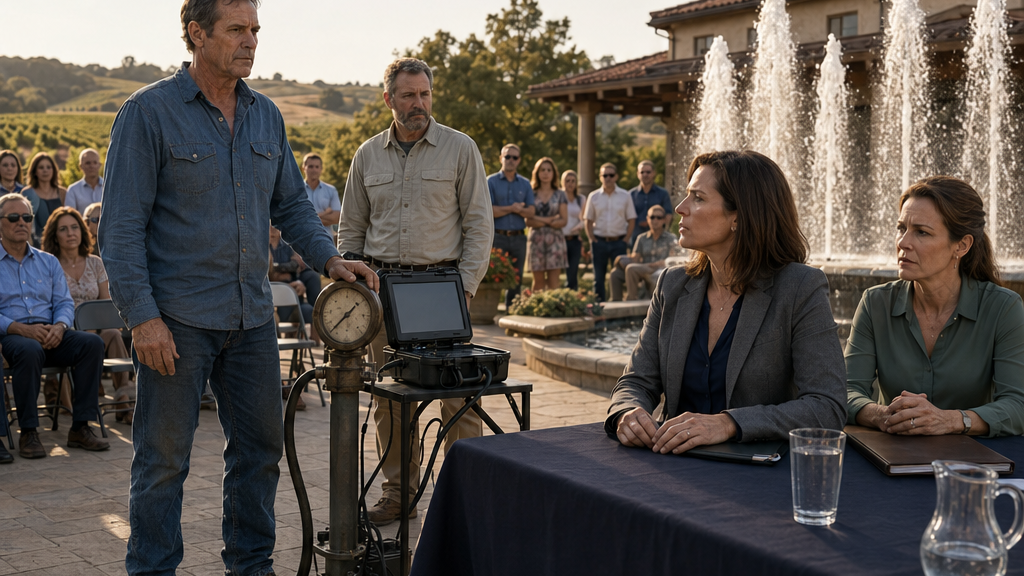
The courtyard outside the HOA community center had been arranged with folding chairs in uneven rows. Homeowners filled most of them, with more people standing near the doors. The stone fountains formed the backdrop to the board table, their pumps pushing clean arcs of water into the afternoon heat.
William had brought his old pressure gauge.
Edward had brought a digital monitor.
Rachel had brought a folder thick enough to look authoritative.
She called the meeting to order at six.
“We’re here because of concerns raised regarding the association’s supplemental groundwater system,” she said. “We want residents to understand that no formal determination has been made that our well has caused damage to neighboring property.”
Several people looked toward William.
He sat near the aisle with the gauge resting between his boots.
Rachel continued. “We are cooperating with appropriate professionals. Until we have verified findings, I don’t think speculation helps anyone.”
William almost smiled.
Speculation.
For the last week he had watched his pressure drop nearly every morning the HOA system ran.
Edward’s instruments had captured the same pattern.
But Rachel was right about one thing: pattern was not yet remedy.
When public comments opened, two homeowners spoke first.
One wanted to know whether household service was at risk.
Another asked whether shutting the well down would raise monthly dues.
Then Rachel looked at William.
“You requested time.”
William stood.
He carried the old gauge to a small table Edward had positioned beside the digital monitor.
A few residents craned their necks.
William did not begin with the crop damage.
He did not mention money.
He did not mention his father.
He pointed to the instruments.
“This mechanical gauge is tied to my vineyard system. The digital unit is recording the same pressure independently.”
Rachel folded her hands.
“And?”
“And my pressure drops during your peak pumping periods.”
A man in the second row said, “You know that for sure?”
William looked at him.
“I know the timing matches.”
Rachel leaned toward her microphone.
“That is not the same as proving causation.”
“No,” William said. “It isn’t.”
The answer created more silence than arguing would have.
Rachel seemed briefly uncertain.
William looked past her at the fountains.
“Turn your well off for ten minutes.”
Several people murmured.
Rachel’s expression hardened.
“This is not a demonstration.”
“It can be.”
“We have residents relying on that system.”
“For ten minutes?”
“It’s not that simple.”
William nodded toward Edward.
Edward stood but kept his hands at his sides.
“A controlled shutdown would provide useful response data,” he said. “It would not, by itself, establish the final remedy.”
Rachel looked between them.
“So if I agree, and his gauge rises, you’re going to tell everyone we caused his crop loss?”
“No,” Edward said.
That answer surprised the room.
Edward continued. “I’ll tell you the aquifer response is consistent with hydraulic interference. Then we collect more data.”
William saw several homeowners exchange looks.
Emma Lewis, seated at the board table with a laptop open, spoke quietly to Rachel.
“We can shut ornamental demand for ten minutes.”
Rachel turned to her.
Emma shrugged. “That’s what most of the well is serving right now.”
The sentence changed the mood.
William heard it move through the chairs.
Ornamental demand.
Rachel lowered her voice, but William still caught the edge in it.
“It also supports common-area irrigation.”
“Ten minutes,” Emma said.
Rachel looked at William again.
He could see the decision costing her something.
“Fine.”
The property manager made a call.
At 6:17, the fountain jets weakened.
Water that had been rising six feet into the air dropped to three, then one. The final streams broke apart and disappeared into the basins.
The courtyard became strangely quiet.
William looked at the gauge.
Twenty-six pounds.
The digital monitor showed nearly the same.
No one spoke.
At two minutes, the needle moved.
Twenty-seven.
At four minutes, twenty-nine.
Someone behind William whispered, “Is that normal?”
Edward said nothing.
At six minutes, the gauge touched thirty-one.
William kept his hands off the table.
He had imagined this moment while standing alone in the pump house. In those private versions, Rachel always looked defeated.
The real Rachel looked pale.
That felt different.
At eight minutes, the digital monitor read just above thirty-two.
Emma stood from the board table and came closer.
“How fast does it usually recover?”
Edward answered. “Depends on pumping conditions and aquifer response.”
Rachel exhaled sharply.
“Meaning?”
“Meaning this is meaningful,” Edward said. “Not magical.”
At ten minutes, William’s old gauge read thirty-four pounds.
The courtyard erupted into low conversation.
Rachel turned toward the property manager.
“Restart.”
The manager hesitated.
Rachel repeated, “Restart the system.”
William looked at Edward.
Edward watched the monitor.
Two minutes after the fountains came back, the pressure stopped climbing.
Four minutes later, it began to fall.
That was the moment the room changed.
Not when William spoke.
Not when Edward explained.
When the needle reversed.
A homeowner near the back said, louder than he probably intended, “You have got to be kidding me.”
Rachel raised one hand.
“Everyone, please.”
Another resident asked, “How long has the board known about this?”
“We didn’t know this,” Rachel said.
William turned toward her.
She saw it.
“I mean this specific response,” she added.
Emma looked up from her laptop.
“What did we know?”
Rachel’s eyes moved to her.
“We knew there were questions about drawdown.”
“Questions from whom?”
“The consultant.”
William felt the first clean satisfaction of the evening.
It lasted perhaps three seconds.
Then Edward leaned toward him and spoke quietly.
“Don’t celebrate yet.”
William frowned.
“You saw it.”
“I saw interference.”
“That’s the point.”
“It’s one point.”
Edward straightened and addressed the board.
“The shutdown response strongly supports communication between the pumping systems. But I want to be precise. We still need operating rates, screened intervals, seasonal usage, and recovery data before anyone starts talking about permanent restrictions.”
Rachel seized on the distinction.
“Exactly.”
William looked at her.
Edward continued before she could build momentum.
“But I would recommend reducing peak pumping until we understand the effect.”
That stopped her again.
A homeowner asked, “Reduce by how much?”
“That requires more data.”
Another voice: “What happens to our water?”
Emma spoke this time.
“Household supply is not the same thing as fountain operation.”
Rachel looked at her sharply.
Emma closed the laptop.
“I think we need to separate them.”
The meeting broke into overlapping questions.
William remained beside the gauge.
He should have felt vindicated.
Instead, he felt the first flicker of something less comfortable.
If the HOA shut down the well completely, what happened to the residents who depended on it?
He had not asked that because until then he had not cared.
Rachel had made his vineyard problem sound private.
He had made the HOA’s problem sound deserved.
Neither description seemed sufficient anymore.
When the noise settled, Emma asked the property manager to produce the original consultant materials for the well.
Rachel said, “Those have already been summarized for the board.”
“I don’t want the summary.”
“Emma—”
“I want the file.”
The room became quiet again.
Rachel’s expression changed.
It was small. A pause. A glance toward the folder in front of her.
William noticed because he had spent the last week watching small changes.
Pressure gauges.
Pump cycles.
Fountain jets.
People were not so different when they were trying to hide strain.
Emma noticed too.
She turned fully toward Rachel.
“Was there something in the consultant file that wasn’t circulated?”
Rachel did not answer immediately.
William felt his earlier satisfaction disappear.
The ten-minute test had answered one question.
Now there was a larger one sitting in the middle of the board table.
Chapter 4: The Cheap Water Plan Was Never Really Cheap
Emma Lewis was waiting for William outside the HOA office the next morning with three sheets of paper folded under one arm.
She did not say hello.
“You were right about the pressure,” she said.
William stopped beside the walkway.
“That doesn’t sound like good news.”
“It isn’t.”
She handed him the first sheet.
At the top was a municipal water projection for the development. William read the annual total once, then again.
“That’s what you were paying?”
“That’s what we were going to be paying.”
The second sheet showed an assessment proposal divided among the homes.
William looked up.
Emma crossed her arms.
“Now you understand why Rachel pushed the well.”
The number was large enough to make even William pause. Not ruinous for every household, perhaps, but enough to matter. Enough to produce angry meetings, payment plans, and people asking why they had bought into a managed community only to receive another bill.
“She told people the well would eliminate most of this?”
“Reduce it enough to avoid the assessment.”
“And the fountains?”
Emma glanced toward the courtyard.
“The fountains are easy to hate because you can see them.”
“That doesn’t answer me.”
“They’re part of the common-area load. So are the lawns, the community center, medians, fire-reserve storage, maintenance use.”
William folded the pages along their existing crease.
“So I’m supposed to feel better because my vines are competing with grass too?”
“No.”
Emma’s answer came quickly.
“You’re supposed to understand why people supported it.”
That bothered him because he did understand.
He had spent days imagining the HOA’s well as a vanity project built to keep decorative water flying through the air. The fountains remained wasteful in his mind, but the numbers in his hand changed the shape of the problem.
Rachel had not invented the cost increase.
She had responded to it.
Badly, perhaps. But not absurdly.
“What happens if you shut the well down today?” William asked.
Emma looked toward the office door.
“We go back to municipal supply as much as we can.”
“As much as you can?”
“There are capacity issues with the old connection.”
William narrowed his eyes.
“You didn’t tell the residents that last night.”
“We didn’t know how serious the interference was last night.”
“That’s not what I asked.”
Emma gave him a tired look.
“No. We didn’t tell them everything.”
The sentence stayed with him through the afternoon.
At the vineyard, Edward had installed another monitor beside the main line. William watched the numbers stabilize after the HOA reduced pumping following the meeting.
The improvement was immediate enough to make anger easy.
The vines did not care about HOA budgets.
A damaged crop did not repair itself because the people responsible had been trying to save money.
William walked to the backup manifold near the old storage tank.
The red valve there had not been opened in nearly a year.
His father had installed the secondary line during a drought period, when everybody in the valley had started thinking about redundancy. The backup system was not large enough to run everything at once, but it gave William choices.
He turned the valve a quarter turn.
Water moved into the secondary line.
The gauge rose.
He opened it farther, watched the pressure stabilize, then shut it again.
The red handle stopped under his palm.
For a moment he imagined feeding part of the neighboring development through that line.
The thought irritated him immediately.
He had spent his adult life making sure the vineyard did not need anyone else’s system.
Why should theirs be allowed to need his?
His phone rang.
Emma.
“Municipal meeting moved up,” she said. “They can see us at four.”
“I’m not part of the HOA.”
“You’re part of the water problem.”
William looked at the red valve.
“Fine.”
The municipal representative met them in a small conference room with Rachel already seated at the table.
Rachel looked different without a crowd.
Less composed.
A stack of utility maps sat in front of her.
She did not acknowledge William beyond a nod.
The representative pointed to a service diagram.
“The association can increase municipal draw temporarily, but not to full summer demand without upgrades.”
“How long?” Emma asked.
“Best case?”
“Yes.”
“Several weeks.”
Rachel leaned back.
“Weeks?”
“For the larger meter and connection modifications. Longer if materials delay.”
“What do we do until then?”
“Reduce nonessential demand.”
Rachel’s face tightened.
“We already have.”
“Reduce it further.”
“And if that’s not enough?”
The representative glanced at the plans.
“Then you need temporary supplemental supply or stricter internal restrictions.”
William said nothing.
Rachel looked at him once.
Only once.
He knew what she was thinking because he had thought it too.
Backup water.
He kept his hands folded on the table.
After the meeting, Rachel caught him in the hallway.
“You enjoyed that?”
William stopped.
“What?”
“Watching the numbers become our problem.”
He stared at her.
“You think I enjoyed losing fruit?”
“I think you came into that meeting knowing you had leverage.”
“I came into that meeting because Emma called me.”
Rachel lowered her voice.
“You’ve wanted us to shut the well down since the first conversation.”
“I wanted you to stop pulling my pressure into the ground.”
“And now you know shutting it down has consequences for people who didn’t make the decision.”
William felt the old anger return.
“You made the decision.”
“Yes.”
The answer was so immediate that it stopped him.
Rachel held his gaze.
“I did.”
No excuse followed.
Then she walked away.
That evening, William found himself standing in Block Four checking fruit damage under the fading light. One cluster had begun to shrivel along the exposed side.
He cut it free.
Thirty years earlier, his father would have tossed it into the dirt without ceremony.
William held it too long.
He thought of Rachel saying I did.
Not because it erased anything.
Because responsibility sounded different when somebody accepted even part of it.
The next morning Emma arrived at the vineyard carrying a banker’s box.
“I got the consultant archive.”
William wiped his hands and looked at the box.
“All of it?”
“I think so.”
“You think?”
“I asked for every water-project document.”
They took the box into the pump house.
For nearly an hour, the material seemed disappointingly ordinary: invoices, drilling logs, emails about scheduling, pump specifications, vendor proposals.
Then Emma stopped turning pages.
“What?”
She did not answer.
William leaned closer.
A consultant memorandum was clipped behind a pump-rate estimate.
Emma read one line twice.
Then she handed it to William.
The recommendation was plain.
During high-demand summer conditions, pumping should be limited pending further interference evaluation with nearby wells.
William looked at the date.
It had been issued before his worst pressure losses.
Emma sat down slowly.
“This wasn’t in the board packet.”
William kept reading.
The recommendation did not say the HOA well was forbidden.
It did not predict certain damage.
But it warned of the exact possibility now sitting in his vineyard.
“Rachel saw this?” William asked.
Emma turned to the distribution line.
Her expression changed.
Rachel Nelson was listed as a direct recipient.
Chapter 5: The Warning She Chose Not to Circulate
Emma placed the memorandum in the center of the emergency board table and left her hand on it.
Nobody spoke.
Rachel Nelson sat at the opposite end with the property manager beside her. William took a seat against the wall rather than at the table. Edward stood near a portable screen displaying the pressure data from the previous week.
Emma tapped the date.
“This was sent before the high-demand period.”
Rachel looked at the page.
“I know what it is.”
“Then why wasn’t it in the board materials?”
“It was a preliminary recommendation.”
“That isn’t what I asked.”
A few homeowners shifted in their chairs.
Rachel kept her voice level.
“The consultant did not say we had proven interference. They said additional evaluation was advisable.”
William felt his jaw tighten.
Edward looked toward him but said nothing.
Emma opened the memorandum.
“They also recommended limiting summer pumping until that evaluation was complete.”
“Yes.”
The word landed quietly.
Emma leaned back.
“You received this?”
“Yes.”
“And you continued full operation?”
Rachel’s fingers closed around a pen.
“We had just finished the installation. Municipal rates had increased again. We were already facing pressure from homeowners over the assessment projection.”
“That explains the pressure,” Emma said. “Not the decision.”
Rachel’s mouth tightened.
“I believed the risk could be managed.”
William spoke for the first time.
“Managed by who?”
Rachel turned toward him.
“William—”
“Because nobody called me.”
“You had already made your position clear.”
“I hadn’t even seen the data yet.”
“You had made your position clear long before that.”
He pushed away from the wall.
“What does that mean?”
Rachel looked at the homeowners, then back at him.
“It means you rejected the first shared monitoring proposal.”
The room went still in a new way.
William felt heat rise into his face.
Emma looked at him.
“You rejected what?”
William did not answer immediately.
Rachel opened her folder and removed a printed email.
“The association offered a joint test three days after he first complained. Shared readings. Both consultants. Temporary reduction during evaluation.”
William knew the email before she finished describing it.
He had heard the same proposal by phone.
Emma turned toward him.
“Is that true?”
“I wanted independent testing.”
“That wasn’t my question.”
William looked at the table.
“Yes.”
The word tasted worse than he expected.
Rachel continued.
“He refused to share his logs until he had his own consultant.”
“That doesn’t excuse your pumping,” William said.
“No. It doesn’t.”
Again, she did not hide behind an excuse.
“That’s the difference,” Rachel said. “I’m not saying it excuses me. I’m saying you keep telling this room there was one person refusing cooperation.”
William felt the statement strike somewhere deeper than the dispute.
His father’s pump log flashed in his mind.
Know your own system.
Don’t depend on somebody else to save it.
He had taken a lesson about preparation and turned it into something harder.
Something narrower.
Edward stepped forward before the argument could become personal.
“The important issue now is what happens next.”
He changed the display.
A graph showed William’s pressure against the HOA pump schedule.
The lines told the story cleanly.
When HOA demand climbed, William’s pressure declined.
When the system shut down, it recovered.
Edward pointed to the lowest readings.
“This is enough for me to recommend immediate restrictions on HOA pumping during peak vineyard demand.”
A county groundwater technician seated near the end of the table nodded.
“I agree.”
Rachel looked at him.
“How restrictive?”
“Until we have a full operating model? Significant.”
A homeowner spoke from the back.
“Does that mean the well is illegal?”
The technician shook his head.
“No.”
Another homeowner asked, “Then what exactly did she do wrong?”
Emma answered before Rachel could.
“She operated past a caution the board should have discussed.”
Rachel looked at Emma.
Emma did not look away.
William found that more powerful than accusation.
No cheering followed.
No one stood up demanding Rachel resign.
Instead, residents began asking practical questions.
How much municipal water could they use?
Would dues rise?
What happened to landscaping?
Could the fountains stay off?
Would household pressure change?
The questions stripped away the satisfying simplicity William had carried into the room.
A woman near the aisle said, “I don’t care about the fountain. I care whether my mother’s house has water.”
A man beside her added, “Then shut the landscaping down.”
The property manager made notes.
Rachel sat quietly.
For the first time since William had met her, she looked less like the person controlling the room than one of the people trapped inside the decision.
Emma turned to William.
“What are your documented losses?”
He hesitated.
The vineyard workers had already helped him estimate damaged fruit, reduced yield, labor changes, and irrigation adjustments.
“Still calculating.”
“Ballpark.”
William told her.
Several homeowners reacted.
Rachel closed her eyes briefly.
Emma said, “We’ll need documentation.”
“You’ll get it.”
“And you expect compensation?”
William looked at Rachel.
“Yes.”
Rachel nodded once.
“That’s fair to discuss.”
It was not an apology.
William realized he did not actually want one in that room.
Not yet.
The county technician outlined temporary pumping thresholds and recommended independent monitoring on both sides of the boundary. Edward agreed to develop a shared reporting format.
For twenty minutes, the meeting almost felt solvable.
Then the municipal representative spoke.
“There’s another issue.”
Everyone turned.
The representative opened a service map.
“If the HOA follows the recommended groundwater restrictions immediately, the current municipal connection cannot cover projected residential demand through the end of the month.”
Rachel stared at him.
“You said we could increase supply.”
“You can.”
“Then what’s the problem?”
“Not enough to replace the restricted well entirely.”
Emma leaned forward.
“How long until the upgrade?”
“Weeks.”
A homeowner muttered something under his breath.
William felt the room’s attention shift before anyone looked at him.
He already knew why.
The western edge of his property had an old secondary connection point from a drought-sharing plan that had never been fully used. His storage capacity and backup line were not enough to support the entire development, but under controlled conditions they could provide temporary supplemental flow.
Rachel knew it.
Emma knew it.
The property manager probably knew it.
William’s hands went cold.
The county technician looked at him.
“Mr. Harris, does your backup system still operate?”
William stared at the red pressure line on Edward’s screen.
“Yes.”
“How much capacity?”
“Depends on vineyard demand.”
“Could it provide temporary supplemental supply without impairing your primary irrigation?”
William did not answer.
He thought of damaged clusters in Block Four.
He thought of Rachel’s omitted warning.
Then he thought of the phone call he had rejected because cooperation sounded too much like dependence.
The municipal representative closed the map.
“If that backup capacity is available, it may bridge part of the gap until the service upgrade is complete.”
Rachel said nothing.
She did not ask him.
That somehow made the choice heavier.
The county technician waited.
William finally stood.
“I’d have to test it.”
He gathered his papers and walked out before anyone could call that an agreement.
But by the time he reached his truck, he understood exactly what the next question was.
The people whose well had damaged his vineyard now needed him to open his.
Chapter 6: The Valve Was Finally His Choice
Rachel came to the pump house alone.
No property manager.
No board folder.
No laptop.
William saw her crossing the vineyard access lane and almost wished she had brought all three.
Official things were easier.
People were harder.
He was standing beside the backup manifold with a wrench in one hand. The red valve had been cleaned that morning, and the paint on its handle looked brighter where years of dust had been wiped away.
Rachel stopped several feet from him.
“Emma said you were testing capacity.”
“I am.”
“Does it work?”
William looked at the gauge.
“Yes.”
“How much?”
“Enough to help. Not enough to replace your well.”
Rachel nodded.
“I figured.”
William set the wrench down.
“You came to ask me to supply you.”
“I came to ask what your conditions are.”
He studied her.
“You’re assuming I have conditions.”
“No. I’m hoping you do.”
That answer irritated him less than it should have.
William turned toward the manifold.
“My vineyard gets priority.”
“Of course.”
“Not ‘of course.’ Written.”
“Fine.”
“If primary pressure drops below the threshold Edward sets, your supply shuts automatically.”
“Fine.”
“No override from your side.”
Rachel paused.
Then nodded.
“Fine.”
“Monitoring is shared. Full pump schedule. Full usage. No summaries.”
“I can agree to recommend that.”
William looked at her.
“Then we’re done.”
She held up a hand.
“I can’t bind the board standing in your pump house.”
“You could bind them when you kept pumping.”
Rachel’s face tightened.
There it was.
The old fight.
For a moment William wanted it.
Wanted her angry enough to make refusal easy.
Instead, Rachel looked at the red valve.
“You’re right.”
He frowned.
She continued.
“I had discretion then. I used too much of it.”
William leaned against the workbench.
“Why?”
Rachel was quiet long enough that he thought she might leave.
Finally she said, “Because I told people I could keep costs under control.”
“That’s it?”
“No.”
She looked toward the development beyond the vineyard.
“The assessment draft hit households harder than we expected. Some people could pay it. Some couldn’t without changing things that mattered to them. I had residents coming into meetings with spreadsheets, medication bills, mortgage increases.”
William said nothing.
“I told them the new well would stabilize common costs.”
“And when the warning came?”
“I thought the consultant was protecting himself.”
“You thought wrong.”
“Yes.”
“And after my pressure dropped?”
Rachel looked at him directly.
“I thought if I slowed the system immediately, I was admitting I had pushed something through too fast.”
“So you kept going.”
“Yes.”
William picked up the wrench again, then put it back down without using it.
“You know what I thought?”
Rachel waited.
“I thought if I accepted your joint test, you’d control the numbers.”
“You didn’t trust us.”
“No.”
“That wasn’t unreasonable.”
“That’s not all of it.”
He surprised himself by saying that.
Rachel’s expression changed.
William looked at the old pressure gauge mounted above the manifold.
“My father built this system so we wouldn’t need favors from anybody. He used to say you should know where your water comes from and keep your hand on your own shutoff.”
Rachel glanced at the valve.
“Sounds practical.”
“It was.”
William rubbed a thumb over a worn spot on the handle.
“I turned it into something else.”
She waited.
“I didn’t want to test with you because I didn’t want a solution that required me to cooperate with you.”
Rachel said nothing.
“I wanted proof that the problem was yours.”
“It was ours.”
“Mostly.”
That word seemed to matter.
Mostly.
Not entirely.
Rachel stepped closer to the manifold.
“What does the backup line actually do?”
William showed her.
The system pulled from storage and a secondary source, feeding through a separate controlled connection near the boundary. It had limits. The vineyard could still irrigate if the HOA draw stayed below a defined amount and shut off automatically when pressure approached danger.
Rachel listened without interrupting.
When he finished, she said, “So you could turn us off.”
“Yes.”
“Any time?”
“Technically.”
She looked at him.
“And would you?”
William almost answered yes.
The word sat ready.
Then he thought of the woman at the meeting asking about her mother’s house.
“Not because I’m angry.”
Rachel nodded slowly.
“That needs to be in writing too.”
William almost smiled.
They spent the next hour sketching terms on a legal pad.
Vineyard irrigation priority.
Automatic shutoff thresholds.
No ornamental fountain use from William’s backup supply.
Shared monitoring.
A temporary rate based on actual volume and operating cost.
An end date tied to the municipal upgrade.
Independent review of any extension.
Rachel objected to the rate calculation.
William objected to the HOA’s proposed threshold.
Neither gave way immediately.
It felt, strangely, healthier than the earlier conversations.
By midafternoon Edward arrived to observe the capacity test.
William opened the red valve.
Water moved through the backup line with a low vibration under the concrete floor.
The primary vineyard pressure dropped two pounds, then stabilized.
Edward checked the digital monitor.
“Hold it there.”
They waited.
Five minutes.
Ten.
Fifteen.
The vineyard line stayed above the preliminary protection threshold.
Rachel watched the monitor as if it were a verdict.
Edward said, “At this draw, temporary supply is workable.”
Rachel exhaled.
William kept his hand on the valve.
There was the reversal he had imagined.
The HOA needed his water.
He controlled the handle.
He could have closed it in one motion and watched Rachel carry that answer back across the boundary.
Instead he asked Edward, “Where would you set automatic cutoff?”
Edward showed him.
William nodded.
“Put it in the draft.”
Rachel looked at him.
“Thank you.”
William did not answer.
Gratitude felt premature.
There was still money.
Two days of negotiations made that clear.
The HOA accepted responsibility for part of the documented crop loss but disputed William’s full estimate. Their insurer wanted proof separating groundwater interference from heat stress and ordinary agricultural variability.
William wanted the entire loss covered.
Emma worked through invoices, historical yield, discarded fruit, and labor adjustments.
At one point William pushed the folder away.
“They damaged the crop. They pay for the crop.”
Emma remained seated.
“If you want the board to approve it, give them a number they can defend.”
“I shouldn’t have to make this easy for them.”
“No,” she said. “You should make it durable.”
The phrase annoyed him because it sounded like something his father might have respected.
Rachel arrived for the final discussion with a reduced compensation figure.
William rejected it.
She raised it.
He rejected that too.
Finally she closed the folder.
“I can take your documented number to the homeowners.”
William leaned back.
“And recommend it?”
Rachel hesitated.
There was the line.
The old Rachel would have hidden behind procedure.
The new one still had to choose.
“Yes,” she said. “I’ll recommend it.”
Emma looked at her.
Rachel continued.
“I’ll also explain the municipal upgrade cost, the temporary supply agreement, and why the pumping restrictions are necessary.”
“All of it?” Emma asked.
Rachel nodded.
“All of it.”
William studied her face.
“You know what that might cost you.”
“I know.”
She meant the presidency.
Maybe reputation too.
For the first time, William understood that accountability was not the same as defeat.
Rachel gathered the papers.
“The homeowner meeting is Thursday.”
She stood.
“I can’t promise they’ll accept the compensation.”
William looked through the open pump-house door toward the red valve.
“No,” he said. “You can’t.”
Rachel paused before leaving.
“But you’ll keep the temporary line available until then?”
William looked at the gauge.
The vineyard pressure was stable.
“For residential backup under the thresholds.”
“Not the fountains.”
“Not the fountains.”
Rachel nodded and walked out.
William remained beside the manifold.
The red valve was open.
Not wide.
Not blindly.
Open exactly as far as the agreement allowed.
For years, William had believed control meant never needing another person’s cooperation.
Now he understood the harder version.
Sometimes control meant deciding the terms under which you were willing to cooperate—and accepting that the other side still had a choice too.
Chapter 7: When the Fountains Came Back, the Rules Were Different
The first alert reached William’s phone at 6:43 on a Tuesday morning.
He was halfway down Block Six checking a repaired emitter when the device vibrated in his shirt pocket.
PRIMARY PRESSURE APPROACHING THRESHOLD.
William stopped between the rows.
For one second, the old instinct returned whole.
Something’s wrong.
He turned toward the pump house before opening the monitoring screen.
The vineyard pressure was still safe, but falling.
On the second line, HOA supplemental draw was active.
William started walking.
He had covered less than twenty yards when the third line changed.
ORNAMENTAL LOAD: SUSPENDED.
The HOA draw dropped.
His own pressure flattened, then began to recover.
William stopped again.
Across the boundary, the entrance fountain weakened.
The tallest jet shortened first. Then the smaller arcs folded inward until water ran only along the stone basin before the circulation system stopped altogether.
The houses beyond it still had water.
The vineyard did too.
William stood in the dirt with the phone in his hand and watched the pressure number climb.
No one had called him.
No one had asked permission.
He had not touched the red valve.
The system had done exactly what the agreement required.
Six weeks earlier, that would have felt impossible.
The final arrangement had survived three homeowner meetings, two insurance reviews, one uncomfortable negotiation over crop-loss calculations, and more revisions than William wanted to remember.
The compensation approved for the vineyard did not match every dollar William had first claimed. Some fruit loss could not be separated cleanly from heat stress. Some labor costs were disputed. Emma had insisted that every number be supported well enough that the association could defend it to residents and insurers.
William had hated that standard until he realized it was the same standard he had demanded when he accused them.
In the end, the HOA covered the documented crop damage, part of the additional labor, Edward’s monitoring costs, and the modifications needed to protect William’s irrigation system.
More important to William, the final agreement did not rely on promises.
The HOA’s new well could operate only within seasonal limits.
Peak pumping was tied to measured groundwater response.
The ornamental systems shut down first when shared demand approached the vineyard threshold.
The municipal connection was being upgraded at the HOA’s expense.
Until that work was complete, William supplied a limited amount of backup water under a written temporary contract.
His vineyard had priority.
The language appeared three times in the agreement.
William had checked.
At 7:05 that morning, his phone showed the primary line back above the protection threshold.
He put the phone away.
One of the workers came down the row carrying a replacement filter.
“Problem?”
“No.”
The worker glanced toward the development, where the fountain remained still.
“Looks like one.”
William shook his head.
“Looks like the system working.”
The worker seemed unconvinced but kept walking.
William looked at the vines.
New growth had filled some of the visual damage from July. The lost fruit was still lost. Nothing in the agreement changed that. A check could compensate for a crop, but it could not put grapes back onto a vine.
He found he preferred that truth to the kind where everything was made whole simply because somebody had finally admitted fault.
At nine, Emma called.
“Did you see the shutoff?”
“I saw it.”
“Worked.”
“It did.”
There was satisfaction in her voice, but not celebration.
“The municipal contractor says the larger connection should be active by the end of next week.”
“That’ll reduce the backup draw.”
“Eventually eliminate it.”
“That was the idea.”
Emma hesitated.
“Rachel is presenting the full project cost tonight.”
William leaned against an end post.
“To the homeowners?”
“Yes.”
“I thought that was already done.”
“The compensation was approved. The full accounting wasn’t.”
William understood.
The final total would include the well installation, consultant work, municipal upgrades, legal review, monitoring system, crop compensation, and temporary backup supply.
The cheap-water project had become very expensive water.
“What happens after that?” he asked.
“Board election next month.”
“Is she running?”
“No.”
William looked across the vineyard.
He had expected that answer to please him more.
“She told the board?”
“Last night.”
“Why?”
Emma was quiet for a moment.
“She said she shouldn’t ask residents to judge the project honestly while asking them to overlook her part in it.”
William rubbed the dust from the top of the post with his thumb.
“That sounds like Rachel.”
Emma gave a short laugh.
“No. It really doesn’t.”
After they hung up, William walked toward the pump house.
The red valve sat where it always had, bolted into the secondary manifold.
But the line around it had changed.
A new pressure sensor had been installed upstream. Another sensor monitored the vineyard side. Wiring ran through a sealed conduit to the control panel. Beside the old mechanical gauge was a digital display carrying the same information both William and the HOA could see.
For most of his life, William would have disliked that.
Shared information meant shared access.
Shared access meant somebody else knowing his system.
Now he saw the distinction he had refused to see before.
Knowing was not owning.
Cooperation was not surrender.
He put his hand on the red valve.
The paint was rough beneath his palm.
His father had taught him to keep control of the shutoff.
William still had it.
The difference was that he no longer needed to stand there proving it every morning.
That evening, he attended the HOA meeting but stayed near the back.
He had not planned to speak.
Rachel stood at the board table with a single folder in front of her.
The fountains outside were running again, though lower than they had in July.
Rachel began with the financial statement.
No attempt to soften it.
She explained the original municipal-rate increase, the projected special assessment, and the decision to accelerate groundwater use.
Then she explained the consultant warning.
A few homeowners already knew the details. Others did not.
The room became tense.
Rachel continued.
She described the crop damage next door.
The monitoring test.
The pumping restrictions.
The municipal upgrade.
The compensation.
The backup-water contract.
One homeowner interrupted.
“So we paid for a well, and now we’re paying to use less of it?”
Rachel nodded.
“For now, yes.”
“That’s ridiculous.”
“Yes,” she said. “It is.”
The room quieted.
Rachel rested both hands on the table.
“I made the decision to keep operating at full summer demand after we received a recommendation to limit pumping while interference was evaluated. I believed the financial risk of slowing down was greater than the environmental and neighboring-property risk.”
She paused.
“I was wrong.”
There was no applause.
William was glad.
Applause would have made it cheap.
A resident near the front asked whether the board could recover some costs from contractors.
Emma answered that they were reviewing contractual responsibilities but that the HOA could not simply shift responsibility for its own operating choices.
Another homeowner asked whether the vineyard owner had threatened to cut them off.
Rachel looked toward the back of the room.
William felt dozens of people follow her gaze.
“No,” Rachel said.
William remained still.
“He required protection thresholds,” she continued. “He required written priority for his agricultural system. He required us to pay for what we use.”
The resident pressed.
“But he can shut the valve.”
Rachel nodded.
“Yes.”
A few people murmured.
Then she added, “So can the automated system. That’s the point.”
William looked down.
He had imagined this room once as a place where everyone would finally understand who had been right.
Now he understood how incomplete that fantasy had been.
Being right about the water had not made him right about everything.
Rachel finished the accounting.
At the end she announced that she would serve through the next election but would not seek another term.
There were questions.
Some angry.
Some practical.
One person thanked her for staying long enough to finish the correction.
Another said she should have resigned sooner.
Rachel accepted both without arguing.
William left before the meeting ended.
Outside, the fountain was still running.
He stood beside it for a moment.
The sound no longer bothered him the way it had in July.
Then his phone vibrated.
Another monitoring alert.
Not a warning this time.
STATUS NORMAL.
He almost laughed.
The following week, the municipal upgrade became active.
The HOA’s dependence on William’s backup line dropped sharply.
By the end of the month, the connection was used only during limited peak conditions.
The temporary contract remained in place until the final testing period ended.
One afternoon, Emma came to the vineyard with the last signed amendment.
William read it beside the pump house.
“You can stop checking for hidden pages,” she said.
“I wasn’t.”
“You checked the page count twice.”
William looked at her.
Emma smiled.
He signed.
She took the papers.
“That’s it.”
“For now.”
“You always say that?”
“People change. Systems break.”
Emma nodded toward the red valve.
“That one seems to be doing fine.”
William followed her gaze.
“Yes.”
After she left, he opened the main irrigation line for the western rows.
The old mechanical gauge climbed steadily.
Thirty-two.
Thirty-six.
Forty.
He waited until it settled.
Across the boundary, the fountain continued running at its reduced setting.
For a moment both systems operated together.
Then HOA demand rose slightly.
The control panel registered the change.
The fountain dropped to its lower conservation cycle.
The vineyard pressure did not move.
William stood there long enough to see that nothing else needed him.
That was new.
For years he had treated vigilance as proof of responsibility. If something mattered, he watched it. If something could fail, he stood close enough to stop it.
His father had lived much the same way.
But his father had also built backup lines.
Kept logs.
Installed gauges.
Prepared for the day when one pair of hands would not be enough.
William had remembered only half the lesson.
He walked to the red valve and rested his hand on it one last time.
Then he left it open.
Not fully.
Not carelessly.
Exactly where the agreement and the system required.
He closed the pump-house door behind him and walked back into the vineyard.
The rows stretched ahead in straight lines, green against dry earth.
Behind him, water moved through both properties under rules neither side could change alone.
William did not turn around to check.
The story has ended.