After My Neighbor Turned Six Floodlights Toward My Bedroom, I Refused to Become His Kind of Neighbor
Chapter 1: The Lights Were Pointed at My Bedroom
The drilling started at 8:07 on Saturday morning, close enough to my bedroom window that the vibration seemed to travel through the glass.
I was standing barefoot in the kitchen, waiting for the coffee maker to finish, when the second burst came. Metal against wood. A pause. Then the high, grinding whine of another screw being driven into something solid.
I set my mug down before I had taken a sip.
The sound was coming from the fence between my house and Jeffrey Clark’s.
From the upstairs landing, I could see two workers in his backyard. One stood on a ladder while the other passed him rectangular black fixtures from an open cardboard box. Jeffrey was below them, one hand on his hip, pointing toward the top rail.
At first I thought they were cameras.
Then the worker lifted one into place and I saw the broad glass face.
Floodlight.
Not the little motion lights people mounted above garages. These were wide, heavy-looking fixtures, each nearly the length of my forearm.
By the time I walked downstairs and out the back door, three were already attached.
“Jeffrey?”
He turned but did not come closer.
“What are those for?”
“Security.”
The fourth worker—there were only two, but Jeffrey had managed to make the yard feel like a job site—tightened the bracket on the last fixture.
I looked from the lights to my house.
Every one of them faced my direction.
One pointed almost directly toward the upstairs bedroom. Another aligned with the living-room windows. The remaining two covered the space between them.
“You know those are aimed at my house.”
Jeffrey gave the fixtures a brief glance as if the fact had only just been mentioned.
“They cover my property line.”
“They cover my windows.”
“They’re outdoor lights, Catherine.”
I waited.
He smiled, not warmly.
“Outdoor lighting is legal.”
There were sentences people used because they wanted to explain something, and sentences people used because they wanted a conversation to end. Jeffrey’s belonged to the second kind.
“Could you angle them down?”
“They’re not even on yet.”
“That isn’t what I asked.”
One of the workers looked at the other and then suddenly became very interested in his drill bits.
Jeffrey folded his arms.
“I’m securing my property. That’s all.”
He went inside.
I stood by the fence longer than I needed to.
I had lived in that house for nineteen years. Long enough to know which maple root lifted the back corner of the patio every winter. Long enough to remember Samantha learning to ride a bicycle in the cul-de-sac, wobbling toward the curb while I ran behind her with one hand hovering over the seat.
Long enough that I had started saying things like our street when I really meant the place where I lived.
Jeffrey had moved in fourteen months earlier.
That fact should not have mattered.
I knew that.
But standing there with four black floodlights pointed over a fence I had looked at for almost two decades, I felt the arithmetic anyway.
Nineteen years.
Fourteen months.
It had not been hostile at first.
The first disagreement had been about parking. Samantha had come over with two friends, and one of their cars sat near the curb opposite Jeffrey’s driveway. It was legal, but he knocked on my door to tell me it made backing out “unnecessarily difficult.”
The second was about his sprinklers, although somehow that became my problem too. He adjusted the heads until water sprayed across the property line and onto my side path, then told me my flowerbed drainage was causing mud near his fence.
The third was Samantha’s guitar.
That one stayed with me because she had been sitting on my back patio at three in the afternoon, playing softly while I pulled weeds.
Jeffrey filed a noise complaint with the HOA.
The property-management representative called me the next morning sounding embarrassed.
“We’re required to log it,” she said. “That doesn’t mean the board found a violation.”
I remember laughing after I hung up.
Not because it was funny.
Because sometimes laughter was cheaper than anger.
By noon on Saturday, the workers had left.
The four lights remained.
I walked my yard, checking the angles from different positions. From the garden bed, I could see the underside of the fixtures. From the patio, their glass faces stared directly toward me.
From my bedroom window, I could see all four.
Jeffrey came outside once while I was standing near the fence.
“You’re checking them again?”
“I’m checking where they point.”
“They’re adjustable.”
“Then adjust them.”
“They’re set how I want them.”
There it was.
Not careless.
Not temporary.
Not a misunderstanding.
I felt something cold settle beneath my irritation.
“You want them pointed at my windows?”
Jeffrey exhaled through his nose.
“I want my yard covered.”
“Your yard is below them.”
“And?”
“And my second floor isn’t.”
For the first time, his expression shifted.
Only slightly.
But enough.
He knew exactly what I meant.
He looked toward my bedroom window, then back at me.
“If they bother you, close the blinds.”
I stared at him.
He shrugged and walked toward his garage.
That afternoon I tried not to think about the lights.
I cleaned the kitchen. I watered the plants along the front porch. I sorted a stack of mail I had ignored all week.
At five, Samantha called.
“You sound irritated.”
“I’m fine.”
“That means you’re irritated.”
I told her about the lights.
She was quiet for a second.
“The same guy who complained about my guitar?”
“Yes.”
“Mom.”
“It may be nothing.”
“Four floodlights aimed at your house doesn’t sound like nothing.”
“They haven’t even come on yet.”
She gave a short laugh.
“You’re already defending him.”
“I’m not defending him.”
“You always do this. You wait until something becomes unbearable so nobody can accuse you of overreacting.”
I did not answer.
She knew me too well to mistake silence for agreement.
“Just take pictures,” she said. “Before he changes anything.”
“I will.”
I took them at 6:23.
One from the patio.
One from the side path.
One from the upstairs bedroom window.
In the last photo, all four fixtures appeared in a neat row above the fence.
By seven-thirty, the neighborhood had settled into its usual Saturday evening rhythm. A lawn mower stopped two houses down. Someone rolled a trash bin toward a garage. A television murmured through an open window.
I was in my bedroom folding laundry when the first light clicked on.
Then the second.
Then the third.
Then the fourth.
For half a second the glass flashed white.
Then my entire bedroom filled with light.
Chapter 2: The House That Would Not Get Dark
At 11:42 that night, I could read the small print on a paperback from across the room without turning on a lamp.
The blinds were closed.
It did not matter.
White light leaked around the edges, cut through the narrow gaps between slats, and spread across the ceiling in hard bands.
I tried pulling the curtains over them.
The fabric glowed.
I moved my pillow to the other side of the bed.
The light followed because the room itself was lit.
By one in the morning, I had draped an old quilt over the curtain rod. It reduced the glare from punishing to merely absurd.
I lay down again.
Ten minutes later I sat back up.
I could hear nothing from Jeffrey’s property.
That was almost worse.
No party. No work. No activity that required illumination.
Just four floodlights running against the dark.
At 1:36, I went downstairs and stepped into the backyard.
The fixtures were brighter from outside than I had expected. I could see shadows of individual fence pickets stretched across my lawn.
My own porch light looked weak beside them.
I took more photographs.
Then I stood near the fence and held my hand in front of my face.
The shadow landed on my living-room wall.
I went back inside.
At 7:15 the next morning, Samantha came over carrying two coffees.
“You look terrible.”
“Thank you.”
“I meant tired.”
“You were right the first time.”
She walked upstairs before I could stop her.
The quilt was still pinned across the bedroom window.
She stared at it.
“You slept like this?”
“I didn’t sleep much.”
“Did you call anyone?”
“It’s Sunday.”
“You can still document it.”
“I did.”
She glanced through the narrow opening at the side of the quilt.
“Those are ridiculous.”
I took one of the coffees and sat on the edge of the bed.
Samantha stayed by the window.
“You know what he’s doing.”
“I know what it looks like.”
“Mom.”
“What?”
“You’re doing that thing where you make every possibility equally reasonable.”
“I’m trying not to start a war over a fence.”
“He already complained about me playing guitar in the afternoon.”
“That doesn’t prove this is retaliation.”
She turned.
“He told you yesterday he wanted them that way.”
I had no answer for that.
The guitar complaint had happened four months earlier.
Samantha had been visiting on a Wednesday. She brought the old acoustic guitar she kept at her apartment because she wanted me to hear a song she was learning.
She played for maybe forty minutes.
No amplifier. No speaker.
At three in the afternoon.
Two days later, I received an email from the property manager noting a complaint about “persistent musical disturbance.”
When I asked Jeffrey about it, he said he worked from home and expected people to respect neighborhood quiet.
I told him it was three o’clock.
He told me noise did not become courteous simply because it was daytime.
I had laughed then.
He had not.
Samantha sat beside me.
“You’ve been here nineteen years.”
I looked at her.
She smiled faintly.
“You say that every time he does something.”
“I do not.”
“You absolutely do.”
“That’s because I know what normal is here.”
“You know what normal was here.”
The distinction irritated me because it was accurate.
By Sunday evening, I had decided I was not going to argue with Jeffrey again.
I opened the city website instead.
The lighting section was less simple than I expected.
There was no sentence saying Neighbor may not point ridiculous lights into bedroom.
There were definitions. Measurements. Terms like light trespass, property boundary, shielding, foot-candles.
I read the pages twice.
Ownership of the fixture was not the deciding issue.
Where the light traveled mattered.
That gave me something better than anger.
It gave me a standard.
Monday morning, I called code enforcement.
The clerk asked whether the lights remained on overnight.
“Yes.”
“Are they motion activated?”
“No.”
“Are they mounted on a structure?”
“Fence posts.”
“And the concern is spill onto your property?”
“My bedroom looks like a waiting room.”
There was a pause.
“I’ll write direct illumination into the complaint.”
She asked me to email photographs and note the approximate time they were taken.
At ten-thirty, I sent fourteen images.
The daytime angles.
The nighttime glare.
The quilt over the bedroom window.
At eleven-fifteen, the clerk called back.
“We can open a case.”
I had not expected those five words to make me feel as relieved as they did.
“What happens next?”
“An inspector will look at fixture placement. If necessary, they’ll take readings at the property line.”
“So it’s not about whether he’s allowed to have lights.”
“Correct. The question is whether the installation complies.”
That distinction stayed with me.
Not whether he could own them.
Not whether I disliked them.
Whether their effect crossed a measurable line.
When I hung up, I went outside.
Jeffrey was by his mailbox.
He looked at me, then at the phone in my hand.
“Calling the HOA again?”
“I haven’t called the HOA.”
He nodded as though I had confirmed something.
“Good.”
“I called the city.”
His face tightened.
“For what?”
“The lights.”
He laughed once.
“They’re on my property.”
“That isn’t the only thing they measure.”
The smile disappeared.
“You really want to do this?”
I almost said, You started it.
The words came all the way to my tongue.
Then I swallowed them.
“I want to sleep.”
Jeffrey shook his head.
“You’ve had a problem with everything since we moved in.”
I stared at him.
“Everything?”
“The parking. The sprinkler adjustment. The fence crew.”
“You complained about my guests. Your sprinklers crossed onto my path. And I asked why the workers were drilling next to my bedroom.”
“That’s exactly what I mean.”
I saw it then.
In Jeffrey’s version of the neighborhood, every disagreement was evidence.
The same way, if I was honest, I had begun storing each of his complaints as proof of what kind of man he was.
He turned away.
“Do what you need to do.”
“I am.”
That afternoon the inspector called.
He asked if the lights were visible from the public street.
“Somewhat.”
“Do they create glare from inside the house?”
“Yes.”
“Can you be available after dark Wednesday?”
I looked toward the fence.
The four black rectangles waited above it.
“What time?”
“Eight-thirty.”
“I’ll be here.”
When the call ended, I wrote the appointment on the calendar.
For the first time since Saturday morning, I felt the situation had moved beyond Jeffrey’s opinion and mine.
Wednesday night, someone would stand in my yard with an actual meter.
And whatever that meter showed would be harder to shrug away.
Chapter 3: Six Lights After the Warning
The inspector had not even reached my bedroom window when the meter jumped.
He stopped halfway across the backyard and looked down at the display.
Then he looked toward Jeffrey’s fence.
“All four are on?”
“Yes.”
He moved three feet closer to the property line.
The reading climbed again.
Jeffrey stood on the other side of the fence with his arms folded.
The inspector had introduced himself to both of us when he arrived, explained that he was there to document conditions, and asked Jeffrey to leave the lights configured exactly as they normally were.
Jeffrey had agreed.
Now he watched the meter like he expected it to apologize.
The inspector took a reading near the patio, another beside the living-room windows, then walked upstairs with me.
I removed the quilt but left the blinds closed.
The room filled immediately with the same hard white glare.
He stood near the bed.
“This is with the interior lights off?”
“Yes.”
He took another reading.
Then he photographed the window and fixture alignment.
Jeffrey was waiting near the fence when we came back outside.
“Well?”
The inspector did not dramatize it.
That somehow made the answer stronger.
“There is excessive spill illumination crossing the property boundary.”
Jeffrey looked at me rather than him.
“They’re security lights.”
“The issue isn’t the purpose of the fixtures.”
“They’re on my property.”
“The issue isn’t fixture ownership either.”
I almost smiled.
The inspector continued.
“The current angle and output do not meet the applicable residential standard at the receiving property.”
Jeffrey’s jaw shifted.
“What does that mean?”
“It means the installation requires correction.”
“How?”
“Shielding. Re-aiming. Lower-output fixtures. There are several options.”
“Removal?”
“Not necessarily.”
Jeffrey looked relieved for half a second.
Then the inspector added, “But the current condition cannot remain as measured.”
He returned to his vehicle and printed paperwork from a small portable unit.
When he handed Jeffrey the notice, the yard felt strangely quiet.
I had imagined that moment several times since Monday.
In most versions, I felt triumphant.
Instead, I mostly felt tired.
There it was.
A neutral measurement.
A written correction.
A deadline.
The argument could end.
Jeffrey read the first page.
“How long?”
“Thirty days for correction under the notice. Earlier would obviously resolve the nuisance sooner.”
Jeffrey folded the paper once.
The inspector looked at both of us.
“I strongly recommend you treat this as a lighting issue, not a neighbor issue.”
Neither of us answered.
After he left, I went inside.
I slept badly that night, but not because of the glare.
For the first time, I believed the lights were temporary.
That changed something.
The next morning I removed the quilt from the curtain rod.
I washed it and folded it over the chair in the guest room.
At noon, Samantha called.
“So?”
“They exceeded the limit.”
“I knew it.”
“He has thirty days.”
“Thirty days?”
“That’s the correction window.”
“He can keep blasting your bedroom for a month?”
“I assume he’ll fix them sooner.”
There was a silence long enough to become judgment.
“What?”
“You still think people behave reasonably once someone explains the rule.”
“That’s generally how civilization works.”
“Let me know how that goes.”
She was teasing.
Mostly.
Friday afternoon, I heard drilling again.
I was at the kitchen counter slicing an apple when the sound started.
For one second, I thought Jeffrey was correcting the fixtures.
I walked to the back door.
A ladder leaned against the fence.
One worker stood on it.
Jeffrey stood below.
Two new black boxes sat open on the grass.
I stepped outside.
The worker lifted a floodlight.
My stomach tightened.
“Jeffrey.”
He turned.
“What are you doing?”
“Improving coverage.”
I looked at the existing four fixtures.
Then at the fifth being bolted into place.
“You received a correction notice.”
“I received a notice about spill levels.”
“And you’re adding more lights?”
“These are aimed differently.”
They were not.
Not enough.
The sixth fixture went up while I stood there.
The row now stretched farther down the fence, six black faces catching the afternoon sun.
“Why?”
Jeffrey sighed as if I were the one making this exhausting.
“Because my rear yard has blind spots.”
“You were told the current lighting exceeds the limit.”
“I’ll make adjustments before the deadline.”
“You’re making it worse now.”
“That’s your interpretation.”
“No, Jeffrey. That’s counting.”
His expression hardened.
“You don’t get to decide how I secure my property.”
“And you don’t get to use my bedroom as part of your security system.”
One of the workers climbed down.
Jeffrey looked toward my house.
Then back at me.
“You could solve most of this with better curtains.”
I stared at him.
He went inside before I answered.
At 4:18 my phone buzzed.
A message from Jeffrey.
I opened it.
You really should invest in blackout curtains. Much cheaper than turning everything into a complaint.
I read it twice.
Then I set the phone facedown.
Samantha would have answered.
Samantha would have produced three paragraphs so precise that Jeffrey would have felt each one.
I wanted to answer too.
I wanted to tell him nineteen years of quiet living had required fewer rules than fourteen months beside him.
I wanted to remind him who had measured what.
I wanted to tell him exactly what I thought of a man who responded to a correction notice by adding two more versions of the same problem.
Instead, I left the message unanswered.
That evening, six lights came on.
My bedroom became brighter than before.
The new fixtures widened the glare across the upper wall and pushed another band of light into the hallway.
I stood in the center of the room, looking at the white rectangles burning around the edges of the blinds.
For the first time, I did not feel helpless.
I felt furious.
That frightened me more.
I went downstairs and opened the folder where I had kept the inspector’s paperwork.
I read the language again.
Property boundary.
Measured spill.
Receiving surface.
Fixture orientation.
Everything precise.
Everything defined.
I walked outside with a tape measure.
Jeffrey’s deck light was on. I could hear voices through his back door, but I did not look over.
Starting at the corner post, I measured the open length of my side of the fence.
Eight feet.
Sixteen.
Twenty-four.
At thirty-two, I stopped.
I wrote the number on the back of an envelope.
Then I measured the height from the ground to the top rail.
The six floodlights burned above me.
Their beams crossed the fence.
I looked at the empty wooden surface on my side.
For several minutes, I stood there with the tape measure still extended between my hands.
Then I went inside and searched for the nearest home-improvement store that opened early on Saturday.
Chapter 4: The Night His Own Light Came Back
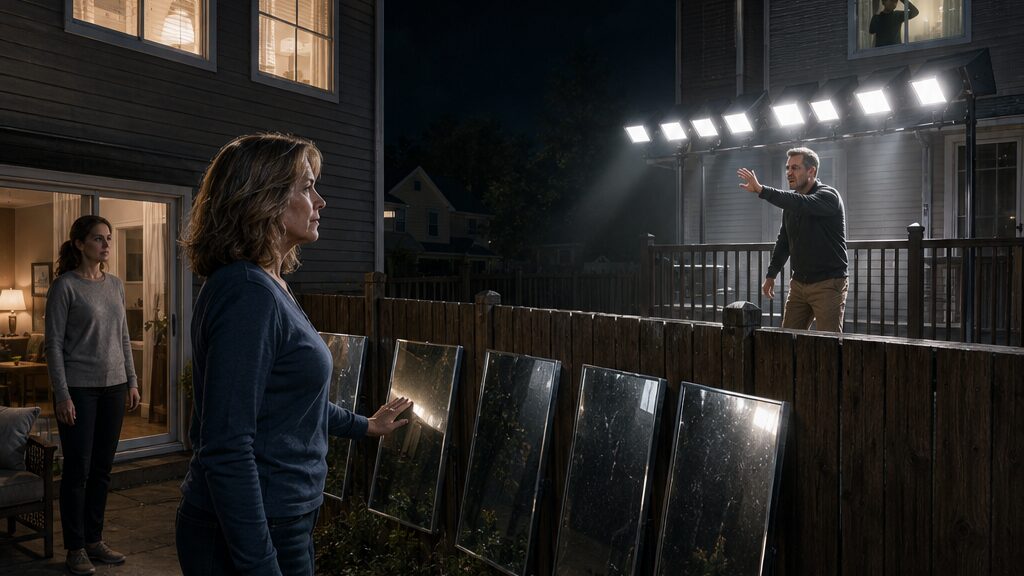
At 7:06 Saturday morning, I was pushing a flat cart through the home-improvement store with four mirror panels stacked upright where lumber usually went.
An employee in an orange apron glanced at them, then at me.
“Bathroom project?”
“Fence.”
He looked at the mirrors again.
I did not explain.
By eight-thirty, the panels were in my garage. By nine, I had measured the fence twice more and marked the mounting points with a pencil.
Everything stayed on my side.
That mattered to me.
I did not touch Jeffrey’s fence caps. I did not loosen one of his brackets. I did not step into his yard.
I built simple supports against my side of the fence and mounted the mirrors slightly below the top rail, angled upward just enough to catch the beam paths I had photographed the previous night.
It took most of the afternoon.
Samantha arrived while I was tightening the second panel.
She stopped at the patio door.
“What are you doing?”
“Solving my curtain problem.”
She came outside and stared.
“Mom.”
“He suggested better curtains.”
“So you bought mirrors.”
“Yes.”
“That is the most you thing you’ve ever done.”
I almost smiled.
Then she walked closer.
“Are these legal?”
“They’re on my property.”
“That wasn’t my question.”
I tightened another screw.
“I checked the HOA rules. They don’t say anything about temporary reflective panels.”
“Temporary?”
“We’ll see.”
She watched me align the third mirror.
“You know this could turn ugly.”
“It already is ugly.”
“No. Right now he’s the guy with the lights.”
I looked at her.
“And after tonight?”
She left the question there.
At dusk, I sat at the kitchen table with the back door open.
The mirrors reflected a soft gray version of the yard.
For twenty minutes, nothing happened.
Then Jeffrey’s six lights came on.
The effect was immediate.
White beams struck the glass panels and exploded back across the fence.
Jeffrey’s deck lit up so brightly that the railing threw sharp shadows onto his siding. His rear windows flared white. The underside of his porch roof glowed.
I stood.
For the first time since the lights had gone up, none of that glare was entering my bedroom.
It was going back.
A laugh escaped me before I could stop it.
Not a big laugh.
One sharp breath of satisfaction.
Jeffrey’s back door opened.
He stepped onto the deck, squinted, and put a hand over his eyes.
“What the hell?”
I stayed on my side of the yard.
He walked to the railing.
“Catherine!”
“Yes?”
“What did you do?”
“I put mirrors on my fence.”
“You’re reflecting my lights.”
“They’re your lights.”
“Turn them.”
“They don’t turn on.”
“You know what I mean.”
I looked at the six fixtures above him.
“Adjust your lights.”
His mouth tightened.
For several seconds, neither of us moved.
Then Jeffrey disappeared inside.
I went upstairs.
My bedroom was dim.
Actually dim.
The blinds were still down, but now their edges held darkness instead of white bands.
I sat on the bed.
The silence felt different.
Not peaceful.
Victorious.
That should have bothered me.
Instead, I enjoyed it.
For almost fifteen minutes.
Then Samantha called from downstairs.
“Mom.”
Something in her voice made me stand.
I went down.
She was at the front window.
“Come here.”
A pale wash of reflected light stretched beyond Jeffrey’s property and reached partway across the cul-de-sac. It was not as intense as the glare hitting his house, but it was visible.
“I didn’t think it would reach that far,” I said.
Samantha looked toward Jeffrey’s upstairs windows.
“One of those mirrors is catching the second floor.”
I followed the angle.
A bright rectangular patch landed across an upstairs room.
The curtain moved.
A silhouette crossed behind it.
Smaller than Jeffrey.
His son.
The satisfaction in me thinned.
A minute later, Jeffrey came through his back door again.
This time his spouse followed.
Neither of them shouted.
That made it worse.
Jeffrey pointed toward the upstairs window.
“You’re lighting my son’s room.”
I looked at the beam.
“You’ve been lighting mine for a week.”
“He didn’t install anything.”
The sentence landed cleanly.
I hated that because it was true.
Jeffrey continued.
“You want to fight with me, fine. Leave my family out of it.”
“You brought your lights to my house.”
“And you aimed these back.”
“I aimed them at the source.”
“That isn’t where all of it is going.”
I had no answer.
He waited, perhaps expecting one.
When I stayed silent, he shook his head.
“You’re proving my point.”
“What point?”
“That you don’t care about rules when you’re the one doing it.”
He went inside.
Samantha stood beside me.
I was angry enough to defend myself.
That was the problem.
I could have said Jeffrey created the light.
I could have said he had been ordered to correct it.
I could have said none of this would exist if he had simply angled his fixtures down.
Every sentence would have been true.
None of them would have changed the bright patch across his son’s window.
Samantha looked at the mirrors.
“You wanted him to feel what you felt.”
“Yes.”
“He does.”
I folded my arms.
“Good.”
She looked at me.
That one word sounded worse after I heard it.
She waited.
Then she said quietly, “Did his kid choose this fight?”
I stared across the fence at the upstairs curtain.
For the first time since the six lights came on, I wished the mirrors worked a little less well.
Chapter 5: The HOA Finally Took a Side—Against Both of Us
The HOA notice arrived Sunday morning in my email before I had decided what to do about the mirrors.
The subject line was enough.
Exterior Modification Review Required.
I opened it at the kitchen counter.
The message was carefully neutral. The management company had received a complaint concerning reflective panels mounted along my rear fence. The board wanted photographs, dimensions, and an explanation of whether the installation was permanent.
I read the sentence twice.
Then I laughed once.
Of course.
Jeffrey’s lights had brought a city inspector.
My mirrors had brought the HOA.
By noon, I had sent photographs and measurements.
At one, Ronald Harris called.
“I want to avoid this becoming two separate enforcement tracks that make the underlying problem worse.”
“It already has two tracks.”
“I know.”
“His lights violate city code.”
“Yes.”
“My mirrors are on my side of the fence.”
“Yes.”
“So what exactly are we discussing?”
Ronald paused.
“The association does not enforce municipal lighting code. The city does not enforce our exterior appearance standards.”
There it was again.
Lines.
Different authority on different sides of them.
Ronald continued.
“The board meeting is tomorrow evening. I’ve asked Jeffrey to attend.”
“I’ll be there.”
The clubhouse meeting room was half full when I arrived Monday.
Not an audience.
Mostly board members and three homeowners who were there for unrelated landscaping requests.
Jeffrey sat at the far end of the table.
He did not look at me.
Ronald placed a folder between us.
“We’re not here to decide who started this.”
Jeffrey spoke first.
“She installed mirrors specifically to reflect light into my home.”
I said, “After you added two more fixtures following a municipal correction notice.”
Ronald raised one hand.
“This is exactly what I mean.”
He opened the folder.
“The city has jurisdiction over measurable light spill. Catherine, your complaint there is already active. Separately, our covenants require review for certain fence attachments and exterior materials visible from neighboring properties.”
“The mirrors are temporary.”
“How temporary?”
“Until the lights are corrected.”
Jeffrey leaned back.
“So she gets to violate rules until I do what she wants?”
I turned toward him.
“You were already told what you have to do.”
“By the city, within thirty days.”
“And instead of correcting it, you added two more.”
Ronald looked at Jeffrey.
“Is that accurate?”
Jeffrey hesitated.
“I added coverage. The fixtures can be adjusted before the compliance deadline.”
“Have they been?”
“No.”
The room went quiet.
Ronald looked at me.
“And have all reflected beams remained on Jeffrey’s property?”
I thought about the upstairs window.
“No.”
Jeffrey looked over.
Ronald did not.
“That matters.”
I felt my shoulders tighten.
“The source is still his.”
“Yes,” Ronald said. “And your installation still has effects beyond your property.”
I hated how calm he was.
I hated even more that calmness made him difficult to dismiss.
One of the board members slid a simple property diagram toward Ronald. Fence line. Houses. Rear setback.
Ronald turned it so both of us could see.
“Municipal code can say Jeffrey’s spill is excessive. HOA rules can separately say Catherine’s reflective fence treatment requires review. Both can be true.”
Jeffrey said, “So she has to remove them.”
Ronald looked at him.
“I didn’t say that.”
“You just said they violate the covenants.”
“I said they require review.”
Jeffrey’s face tightened.
Ronald tapped the diagram.
“And I’m also not prepared to treat your lighting as unrelated simply because the city handles the violation. This association has nuisance provisions too. We have been slow to address this because I did not want the board duplicating municipal enforcement.”
“For once,” I said, “we agree.”
Ronald gave me a look that said not to enjoy that too much.
Then he asked the question I had been avoiding.
“Catherine, can you reduce the reflected spill beyond Jeffrey’s house?”
I knew the answer.
“Yes.”
“Will you?”
Jeffrey looked at me.
That made me want to say no.
For one stupid second, I wanted to keep every panel exactly where it was simply because he expected me to fold.
Then I thought of the silhouette moving behind his son’s curtain.
“Yes,” I said. “I’ll take down the panel catching the upstairs room and street.”
Jeffrey gave a short laugh.
“So the mirrors are a problem.”
I looked at him.
“That mirror is.”
“Convenient.”
“No. Specific.”
Ronald leaned back.
“Specific is useful.”
The meeting ended without anyone winning.
That irritated both of us equally.
Tuesday morning, I removed the panel nearest the front edge of the property.
It took twelve minutes.
Without it, the array looked incomplete.
An empty section of fence showed between the remaining mirrors.
Jeffrey came outside while I was carrying the panel toward the garage.
“You taking all of them down?”
“One.”
He glanced at the empty space.
“So you know you overdid it.”
“I know where that one was sending light.”
He looked at the others.
“They all need to go.”
“When your six fixtures stop crossing my property.”
“They will be adjusted.”
“When?”
“Before the deadline.”
I set the mirror inside the garage.
Jeffrey stayed by the fence.
“You made your point.”
I turned.
“So did the inspector.”
He looked away.
That afternoon the bedroom was darker than it had been before the mirrors, because the remaining panels still caught most of the direct beams.
Not perfect.
But livable.
For the first time, I understood that removing one panel had not weakened me as much as I feared.
It had clarified something.
I did not need every possible advantage.
I needed the nuisance to stop.
That evening, Ronald called.
“Jeffrey contacted the board.”
“What now?”
“He wants confirmation that security lighting itself is permitted.”
“It is, if it doesn’t light my bedroom.”
“I told him essentially the same thing.”
I waited.
Ronald sighed.
“He intends to keep some form of security lighting.”
“That’s fine.”
“You sound surprised.”
“I don’t care if he lights his yard.”
“That distinction may be more important than either of you has been making it.”
After we hung up, I looked through the back window.
Jeffrey stood beneath the six fixtures.
He was not looking toward my house.
He was looking into the dark corner behind his garage.
For the first time, I wondered why that darkness seemed to bother him so much.
Chapter 6: What Jeffrey Had Been Trying to Control
“The garage was entered three weeks after we moved in.”
Jeffrey said it without looking at me.
We were standing outside the HOA clubhouse after a follow-up meeting, and I had asked a question I had almost decided not to ask.
Why do you need that much light?
His answer stopped me.
He leaned against the hood of his car.
“They didn’t take much. Tools. A compressor. Some things I could replace.”
I waited.
“My wife woke up because she heard the side gate.”
His voice changed slightly there.
“She thought someone was trying the back door.”
I looked toward him.
“And your son?”
“He came downstairs with a baseball bat.”
Jeffrey rubbed one hand over his jaw.
“He was fifteen.”
I had never heard him mention the break-in.
Nothing in the HOA notices about parking, noise, irrigation, or lighting had hinted at it.
“I didn’t know.”
“Why would you?”
The words were not hostile.
Almost worse.
He looked across the parking lot toward the line of decorative trees separating the clubhouse from the street.
“We moved here because it was supposed to be quiet.”
“It is quiet.”
“That night it didn’t feel quiet.”
For a moment, I saw his house differently.
Not the new neighbor’s house.
Not the source of six floodlights.
A kitchen where his spouse had stood listening to a gate move in the dark.
A staircase his son had come down gripping a bat because none of them knew whether someone was inside.
Understanding arrived before forgiveness.
They were not the same thing.
“I’m sorry that happened,” I said.
Jeffrey nodded.
Then I added, “It still doesn’t explain aiming lights at my bedroom.”
His jaw tightened.
There he was again.
Not the frightened homeowner.
The man who had made a choice.
“I aimed them to cover the fence.”
“No.”
He looked at me.
“The first four, maybe you can argue that. The last two came after the inspector.”
He said nothing.
“You knew exactly what those were doing.”
Jeffrey pushed away from the car.
“You want honesty?”
“Yes.”
“You acted like everything I raised was ridiculous.”
I almost interrupted.
He kept going.
“The parking. The noise. The sprinklers. Every time I said something, you had this look like I was some guy who had wandered onto your street and didn’t know how people lived here.”
I felt heat climb into my face.
“That doesn’t justify—”
“I know.”
The answer surprised me.
He looked down.
“I know.”
We stood there in silence.
Then he said, “When the inspector came, I felt like you’d been waiting to prove I didn’t belong.”
“That wasn’t what it was.”
“Maybe not to you.”
I thought about the number I had repeated in my head.
Nineteen years.
Fourteen months.
I had never said it to Jeffrey.
I had not needed to.
Maybe it had been visible anyway.
He continued.
“So yes. I added the other two.”
There it was.
No paperwork.
No clever technicality.
Just a man admitting the ugliest part.
“To annoy me?”
“To make the point that you don’t get to decide everything.”
I stared at him.
“And you chose my bedroom.”
His eyes moved away.
“Yes.”
That answer did more than the inspector’s meter had.
It settled the question I had carried since the first Saturday morning.
The lights had not been accidental.
Not all of them.
Jeffrey’s fear might have started the security system.
His pride had aimed it.
I folded my arms.
“Your break-in explains why you want light.”
He looked at me.
“It does not explain why I should have to sleep inside it.”
He nodded once.
“I know what you think.”
“No. I think you know I’m right about that.”
He almost smiled.
Not because it was funny.
Because the sentence had cornered him.
“You’re not taking the mirrors down.”
“Not all of them.”
“Then neither am I.”
“The city already told you to correct the lights.”
“And the HOA told you those panels need review.”
“We can do this until Christmas.”
“Yes.”
The simplicity of it exhausted me.
We could.
Notice against notice.
Measurement against measurement.
My rule against his rule.
Two houses separated by a six-foot fence and enough paperwork to pretend none of it was personal.
I looked toward the clubhouse window.
Ronald was still inside stacking folders.
“There has to be a way to light your yard without lighting my house.”
“There is.”
“Then why aren’t you doing it?”
“Because I’m not taking mine down while yours stay up.”
I almost laughed.
“So this is about who moves first.”
Jeffrey’s silence answered.
I understood him then more completely than I wanted to.
Because I had been doing the same thing.
The mirrors had started as a solution.
Then they became leverage.
I had told myself removing them first meant surrender.
Jeffrey had told himself adjusting his lights first meant I had won.
Neither of us was protecting property anymore.
We were protecting position.
I looked across the parking lot at him.
“What if I move first?”
He frowned.
“All mirrors?”
“Most.”
“No.”
I held up a hand.
“Listen.”
He did.
“I remove the panels that can reflect beyond your rear deck and upstairs windows. I’ll keep one temporary panel aligned only with the central fixtures until the lighting is corrected.”
Jeffrey started to speak.
I stopped him.
“In return, you replace or redirect all six fence-facing lights so the spill at my property line stays under the city limit. Shielded. Downward. Measurable.”
He stared at me.
“And who decides measurable?”
“The same instrument that started this.”
“The inspector?”
“Yes.”
He looked toward his car.
“What if you remove your mirrors and I make the changes, but you still complain?”
“If the readings comply, I’m done.”
“The HOA too?”
“I’ll tell Ronald in writing the nuisance is resolved.”
Jeffrey studied my face like he was looking for the part I had hidden.
There wasn’t one.
That felt strange.
I had spent weeks thinking the safest position was the one with the most leverage.
Now I was offering to give some away first.
“I want all the mirrors gone,” he said.
“After your six lights are corrected.”
He shook his head.
“No. First.”
I felt the old anger rise.
The part of me that wanted to say then nothing changes.
Instead, I took a breath.
“I’ll dismantle the active array first.”
Jeffrey looked at me sharply.
“All of it?”
“I’ll take the panels off the fence. One stays in my garage until we have a compliant reading.”
“That’s not the same thing.”
“It’s not supposed to be. It’s a measurable condition, Jeffrey. Not trust.”
He was quiet.
Then he asked, “When?”
“Saturday morning.”
He looked toward the darkening street.
For once, neither of us had a rule to hide behind.
I held out my hand.
He did not take it.
I had not really expected him to.
But after a moment he said, “Saturday.”
And that was enough to make the next move mine.
Chapter 7: A Boundary Neither of Us Could Measure Alone
At eight-fifteen Saturday morning, I put the screwdriver against the first mirror bracket while Jeffrey stood on the other side of the fence watching.
Neither of us said good morning.
The metal screw resisted for half a turn, then loosened with a sharp click.
I had expected taking the panels down to feel like surrender.
Instead, it felt strangely ordinary.
One screw.
One washer.
One bracket.
The first mirror came free after five minutes.
I carried it across the patio and leaned it inside the garage.
When I returned, Jeffrey was still there.
“You’re really doing all of them?”
“The ones on the fence.”
He looked toward the garage.
“You said one stays.”
“One stays stored until the reading.”
His mouth tightened, but he nodded.
I started on the second panel.
Samantha arrived twenty minutes later with coffee and stopped when she saw the bare section of fence.
“You started without me.”
“I didn’t know this required supervision.”
“It absolutely requires supervision.”
She handed me a cup, then glanced toward Jeffrey’s yard.
He was working near his deck now, not on the floodlights, but close enough that I knew he was listening.
Samantha lowered her voice.
“You trust him?”
“No.”
“Good.”
I looked at her.
“That’s not why I’m doing this.”
She leaned against the patio railing.
“I know.”
I removed the third mirror.
Then the fourth.
By ten o’clock, my fence looked almost like it had before the dispute began.
Only small screw holes and cleaner rectangles in the wood showed where the panels had been.
The last mirror went into the garage beside the others.
I left one panel upright against the interior wall, exactly as I had promised.
When I came back outside, Jeffrey had disappeared.
For half a second, anger flared.
Of course.
I had moved first, and he had gone inside.
Samantha saw my face.
“Give it a minute.”
“I’m giving it thirty.”
“You’re giving it one.”
Before I could answer, Jeffrey’s garage door opened.
He came out carrying a cordless drill and a step ladder.
He placed the ladder beneath the nearest floodlight.
I did not move.
Neither did Samantha.
Jeffrey climbed two steps and began loosening the bracket.
The first fixture came down.
Then the second.
Not redirected.
Removed.
I felt something in my chest release that I had not realized I was holding.
Samantha looked at me.
I kept my face neutral.
“You can smile,” she whispered.
“I am not smiling.”
“You are absolutely smiling.”
Jeffrey carried both fixtures toward his garage.
On his second trip, he looked across the fence.
“I’m taking all six down.”
I nodded.
“Okay.”
“I’m replacing them with shielded fixtures on the house, not the fence.”
“Downward?”
“Yes.”
“And the side by the garage?”
“Motion activated.”
That was the first time either of us had discussed the future without making it sound like a threat.
By noon, four fixtures were gone.
The fence posts looked oddly narrow without them.
The final two took longer because one bracket had been overtightened.
Jeffrey muttered something under his breath while he worked at it.
I almost offered him a wrench.
I did not.
There were limits to reconciliation.
At one-ten, the sixth floodlight came off the fence.
Jeffrey held it in both hands for a moment, looked at the empty brackets, then carried it away.
No applause.
No triumphant speech.
No apology.
Just six dark mounting points where six lights had been.
That afternoon, Ronald emailed both of us a short written summary.
Jeffrey would install shielded, downward-facing security lights subject to HOA exterior standards. The municipal light-spill requirement still applied. My mirror panels would remain off the fence as long as the nuisance condition was corrected.
The inspector returned Monday evening.
He walked the same path through my yard that he had taken before.
This time Jeffrey’s new fixtures were mounted under the eaves of his house.
Smaller.
Shielded.
When they came on, his yard brightened.
Mine did not.
The inspector stopped near the property line and checked the meter.
Then he moved toward my living-room window.
Another reading.
Then upstairs.
I stood beside the bed while he held the meter where the white glare had once crossed the blinds.
He looked at the display.
“Well within the limit.”
I exhaled.
Jeffrey was waiting in the backyard when we came down.
The inspector gave him the same information.
“The correction satisfies the notice.”
Jeffrey nodded.
“Good.”
The inspector packed the meter away.
Before leaving, he looked from Jeffrey to me.
“This is what shielded lighting is supposed to do. Illuminate the intended property without making the neighboring property part of the installation.”
Neither of us said anything.
We did not need to.
After his vehicle left, Jeffrey and I stood near the fence.
The sun had gone down, but his new lights made soft pools over the patio, garage door, and side gate.
Nothing reached my windows.
Jeffrey looked toward my house.
“Your bedroom dark?”
“Yes.”
He nodded.
“My son’s too.”
The words were simple.
They carried more weight than an apology would have if he had forced one.
“I’m glad.”
He looked at the fence.
“I shouldn’t have added the last two.”
I waited.
He continued.
“The first ones were about security.”
“And the last two?”
He glanced at me.
“You already know.”
“Yes.”
He looked uncomfortable.
Good.
Some discomfort belonged to him.
“I shouldn’t have done it,” he said.
It was not elegant.
It was enough.
I looked at the empty fence brackets.
“I shouldn’t have let the mirrors hit your son’s room.”
Jeffrey nodded.
No forgiveness ceremony followed.
No handshake.
He simply said, “Okay.”
Then he went inside.
Tuesday morning, I put three of the mirrors back into their packaging.
The fourth remained against the garage wall.
Samantha noticed it when she came by that afternoon.
“Keeping a souvenir?”
“Maybe.”
“Or a warning?”
I considered that.
“No.”
I looked at my reflection in the glass.
For weeks, I had thought the mirror’s purpose was to show Jeffrey what his own behavior felt like.
That had been true.
Just not entirely.
It had shown me something too.
I had spent nineteen years in the neighborhood and started treating that time like a deed to more than my own property. Jeffrey had spent fourteen months there and tried to force certainty onto every dark corner he could not control.
We had both confused boundaries with authority.
The difference was that boundaries were supposed to stop at the line.
That evening, Jeffrey’s new lights clicked on automatically.
They illuminated his deck.
His garage.
His gate.
Nothing crossed the fence.
I went upstairs.
For habit more than need, I closed the blinds.
No white lines appeared around their edges.
No glow spread across the ceiling.
The room was simply a room again.
I stood beside the bed for a moment, listening to the ordinary sounds outside.
A car door shutting.
Someone rolling a trash bin toward the curb.
A dog barking once and stopping.
I switched on the bedside lamp long enough to put away a book.
Then I reached for the switch.
The lamp clicked off.
Darkness stayed.
The story has ended.