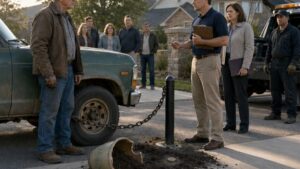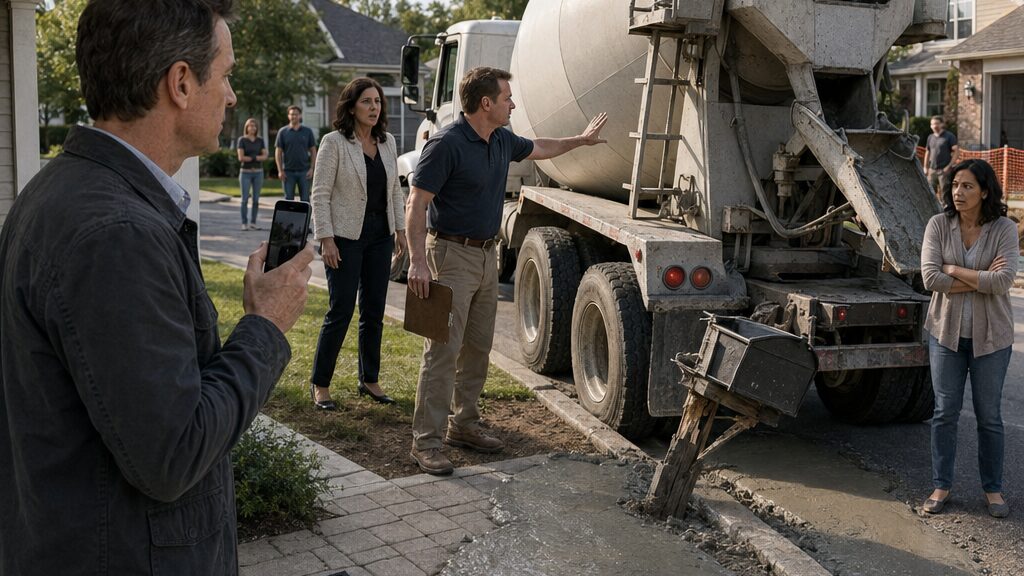
The HOA Said My Porch Damage Wasn’t Their Problem—Until the Same Concrete Truck Came Back
Chapter 1: The Concrete Was Already Crossing My Front Step
By the time I understood what the sound was, wet concrete had already crossed the bottom step of my porch.
It came toward the house in a slow gray wave, thick enough to carry pebbles and scraps of grass with it. The edge folded over itself as it spread across the walkway, swallowed the corner of my black welcome mat, and began climbing the lip of the first step.
For half a second, I stood inside the doorway with one hand still on my coffee mug.
Then I put the mug down and ran outside.
“Stop the truck.”
The ready-mix driver either didn’t hear me or didn’t understand what I was pointing at. His truck sat crooked in our cul-de-sac, rear wheels close to my curb, the chute angled toward the common-area drainage trench the HOA had been rebuilding for three weeks.
Except the chute was not over the trench.
It was over my property.
“Stop it,” I said again.
The driver turned, saw the spreading concrete, and reached for the controls.
The flow slowed, then stopped.
It was too late.
A heavy stripe of concrete covered part of my front walk. Gray slurry had splashed the porch riser and filled the joints between the pavers. My welcome mat was half submerged.
The driver climbed down.
He looked at the mess, then at the truck, then toward the orange construction barriers farther down the street.
“That shouldn’t have happened.”
I stared at him.
“No.”
He rubbed the back of his neck.
“They’ve got us coming in tight.”
I followed his glance.
The HOA’s drainage project ran behind three homes and along the edge of the cul-de-sac. For the last month we had lived with utility markings, temporary fencing, pallets of pipe, and trucks squeezing past parked cars. I had complained about the noise once, then decided it wasn’t worth becoming the neighbor who complained about everything.
Now a concrete mixer had entered through the narrowest part of the street and swung its rear end across the corner of my lot.
The driver pointed toward the trench.
“I’m supposed to feed them from there.”
“You’re standing on my walkway.”
His expression hardened a fraction.
“I’m saying that’s the route they gave us.”
I took out my phone.
Years earlier, I would have started with names, statements, measurements, and timestamps before I even thought about cleanup. Eleven years adjusting commercial liability claims had trained that response into me.
I had left that work behind for a reason.
I had gotten tired of turning bad days into files.
Still, I photographed the concrete before anyone touched it.
Wide shot.
Truck position.
Chute position.
Porch.
Walkway.
Welcome mat.
Rear tires.
The driver watched me.
“You with insurance?”
“Not anymore.”
That answer was close enough.
A worker from the drainage crew hurried up from the common area carrying a shovel.
“We need to get this washed before it sets.”
“Not yet.”
He looked from me to the driver.
“If we leave it—”
“I know what concrete does.”
The HOA property manager arrived in a golf cart a minute later. I knew him by sight from meetings but had never spoken to him for more than thirty seconds.
He looked irritated before he looked concerned.
“What happened?”
The driver pointed toward my porch.
“Chute shifted when I straightened out.”
The property manager stepped closer, frowned, then looked toward the workers waiting down the street.
“Can we clean this quickly? We’ve got the pour scheduled.”
I almost laughed.
Instead, I said, “I need photographs first.”
“You have photographs.”
“I need the truck information too.”
The driver exhaled.
The property manager lowered his voice.
“Michael, nobody’s saying it didn’t happen.”
That sentence stayed with me.
Nobody’s saying it didn’t happen.
Not yet.
I photographed the unit number printed near the cab, the time on my phone, the position of the truck relative to the curb, and the point where the rear tires had rolled onto the edge of my driveway apron.
Only then did I let the crew begin scraping.
Water made the mess look worse.
The concrete thinned into gray streams and ran between the pavers. A worker lifted my welcome mat by one corner. It sagged under the weight.
“Probably ruined,” he said.
“Put it by the garage.”
The driver handed me a card for the supplier.
“Call the office. Management will handle it.”
“You’re reporting it?”
“Yeah.”
“What are you reporting?”
He paused.
“A spill.”
“On my property?”
Another pause.
“I’ll tell them what happened.”
Then he shrugged—not dramatically, not cruelly. More like a man who had already moved mentally to his next delivery.
That bothered me more than anger would have.
The truck left twenty minutes later.
Its tires tracked wet gray marks along the curb as it rolled away.
By noon, the walkway had been scraped clean enough to use, but not clean enough to forget. Concrete remained pressed into the joints. Two pavers had hairline cracks near the porch. The first step carried a chalky gray stain.
I brought the welcome mat around back and sprayed it until the water stopped running cloudy.
Then I called the supplier.
A woman took my information, confirmed the HOA project, and told me someone from operations would contact me.
“How long?”
“Usually within seven business days.”
I wrote the phrase down because that was another old habit I hadn’t managed to lose.
Seven business days.
That evening, the HOA property manager emailed a brief notice saying the morning incident had been referred to the contractor and that the delivery route had been previously approved for project access.
Previously approved.
I read those two words twice.
Then I walked outside.
The construction workers were gone. The cul-de-sac had returned to its usual quiet. Sprinklers clicked across two neighboring lawns. Somewhere behind the houses, a compressor shut off.
I stood at the edge of my driveway and looked at the tire tracks.
The cleanup had washed most of them away, but one dark arc remained visible where the mixer had turned.
I followed it slowly.
The rear tire had crossed the curb line, rolled over the edge of my driveway apron, and continued several feet farther onto my property than I had first realized.
I took another photograph.
Then I looked back toward the narrow entrance to the cul-de-sac.
The truck had not simply spilled concrete beside my house.
To make that turn at all, it had used part of my property as roadway.
And someone had approved the route.
Chapter 2: Seven Business Days Became a Closed File
The letter arrived eleven days later and told me there had been no visible property damage.
I read that sentence standing beside the same porch step that still carried a gray stain.
Then I read it again.
The letter came from the concrete supplier’s operations office and was signed by Scott Allen. It thanked me for my patience, said the incident had been reviewed, and explained that the driver reported a minor discharge outside the residence.
According to the letter, no visible property damage had been observed.
The matter was considered closed.
I set the page on my dining table.
Beside it lay twelve printed photographs.
In three of them, wet concrete physically touched my porch.
I had spent the previous week doing exactly what I had promised myself I would not do when I left claims work: documenting a loss like it belonged to somebody else.
I measured the contaminated portion of the walkway.
I photographed the cracks.
I asked a repair contractor to inspect the pavers and porch surface.
His estimate came to just under twenty-four hundred dollars, not including replacement of several matching pavers if the existing color could not be sourced.
It was not catastrophic money.
That almost made the denial more irritating.
Nobody was facing bankruptcy. Nobody had been injured. A reasonable company could have inspected the damage, negotiated the repair, and closed the file honestly.
Instead, they had written that nothing visible had happened.
I called Scott Allen.
His assistant transferred me after a short hold.
“Scott speaking.”
“This is Michael Clark. I received your letter about the HOA delivery spill.”
A pause.
“Yes.”
“I’m trying to understand what evidence you reviewed.”
“The driver’s report, dispatch information, and the field notes available to us.”
“Did you review my photographs?”
Another pause.
“I don’t have the file in front of me.”
“The photographs show concrete on my porch.”
“If you have additional documentation, you can send it.”
“I already did.”
His tone did not change.
“Then it would be in the file.”
I looked at the denial letter.
“Your driver says the discharge occurred outside the residence.”
“That’s my understanding.”
“He drove onto my property.”
“I can’t speak to exact wheel placement.”
“That’s in the photographs too.”
Scott let out a controlled breath.
“Mr. Clark, I’m not saying you didn’t experience inconvenience. I’m saying our internal review did not establish property damage attributable to the delivery.”
There it was.
Not denial exactly.
Something cleaner.
A sentence designed to survive being forwarded.
I knew the style because I had written versions of it myself.
“I’ll send the documentation again,” I said.
“You’re welcome to do that.”
When the call ended, I sat at the table longer than I should have.
Part of me wanted to mail the repair estimate, wait another week, and see whether someone sensible took over.
Another part wanted to write a four-page chronology identifying every gap in their investigation.
I did neither.
I made coffee.
Then I called the HOA.
Laura Martinez agreed to meet me at the clubhouse the following afternoon.
She had been board president for two years. I knew her mostly from annual meetings and neighborhood emails. She was organized, precise, and capable of saying no without raising her voice.
She placed my photographs beside the contractor estimate and studied them.
“I understand why you’re frustrated.”
“I’m beyond frustrated.”
“I understand that too.”
“Then I need to know what the association is doing.”
Laura folded her hands.
“The concrete supplier is responsible for its delivery operations.”
“The delivery was for an HOA project.”
“Yes.”
“Using an HOA-approved access route.”
Her eyes lifted.
“The contractor determined site access.”
“The property manager wrote that the route had been approved.”
“Approved for access doesn’t mean the association assumed liability for a driver error.”
I leaned back.
There were several ways I could answer that.
The old adjuster in me began sorting them automatically.
Control of premises.
Contractual indemnity.
Site-access responsibility.
Negligent routing.
I hated how quickly the language came back.
“I’m not asking you to accept liability today,” I said. “I’m asking whether the HOA is documenting a safety issue.”
Laura’s expression tightened.
“What safety issue?”
“A truck used private property to complete a turn and discharged concrete onto a residence.”
“The incident was addressed.”
“The concrete was cleaned.”
“Yes.”
“That isn’t the same thing.”
She looked toward the clubhouse window.
Outside, workers were replacing a section of sidewalk.
“If every contractor incident becomes an association dispute,” she said, “this project stops.”
“So that’s the concern?”
“The concern is getting necessary drainage work completed without costs continuing to climb.”
That was the first moment I understood her pressure.
It did not make her right.
But it made her less simple.
When I left the clubhouse, two neighbors were standing near the mail kiosk.
One asked whether my complaint was going to delay the concrete work.
“I don’t know.”
“We already lost almost a week from the rain.”
“I’m not controlling the schedule.”
The other neighbor said, “Laura said there’s an insurance issue.”
“Apparently.”
He gave me the kind of look people reserve for someone who has complicated a problem that was working fine for everyone else.
I went home with my folder under my arm.
The next morning, I compared Scott’s letter with the driver’s reported description again.
Outside the residence.
Minor discharge.
No visible damage.
The wording depended on an invisible boundary: if the spill had happened near the project area rather than on my property, the supplier could treat it as cleanup instead of damage.
But the photographs showed the porch.
The tire marks showed the driveway apron.
The repair estimate identified paver cracking at the entrance.
The more I looked, the less accidental the wording felt.
That afternoon, Rachel Garcia stopped me while I was bringing the trash bin back from the curb.
She lived three houses down.
“I heard you’re still fighting them.”
“I wouldn’t call it fighting.”
She smiled without humor.
“You used to handle insurance claims, didn’t you?”
“Years ago.”
“That explains the folder.”
I started toward the garage.
Rachel hesitated.
“For what it’s worth, I told Laura those trucks were too big for this turn before they started pouring.”
I stopped.
“When?”
“Before the first delivery.”
“What exactly did you tell her?”
“That one of the mixers almost clipped my SUV during the test run.”
“Was it in writing?”
“No. I caught her outside the clubhouse.”
“What did she say?”
Rachel looked uncomfortable now.
“She said they’d reviewed the route.”
The trash bin handle was still in my hand.
“Reviewed it with whom?”
“I don’t know.”
Then she added quickly, “I’m not getting involved in some board fight, Michael. I just thought you should know.”
She walked away before I could ask anything else.
I stood at the curb looking toward the construction entrance.
Until that moment, I had assumed my accident had created the first serious question about the route.
Now I had a different question.
Had Laura known there was a problem before concrete ever reached my porch?
Chapter 3: The Complaint Laura Said Never Became Official
“There were no prior safety complaints regarding the approved delivery route.”
Laura said it into the clubhouse microphone as if the sentence had already been settled before the meeting began.
I was sitting in the second row with my folder closed on my lap.
Around twenty homeowners had come to the monthly HOA meeting, more than usual because the drainage project was behind schedule. Nobody had shown up to hear about my porch.
They wanted dates.
They wanted costs.
They wanted to know when the barriers would disappear.
Laura moved through the construction update quickly.
Then one of the board members mentioned “resident concerns about contractor access.”
That was when Laura gave her answer.
No prior safety complaints.
I looked two rows over.
Rachel was staring at the floor.
I could have raised my hand immediately.
I could have said, Ask Rachel.
Instead, I waited.
The property manager explained that the existing route had been selected to keep heavy equipment away from the main entrance during school-bus hours. Rerouting mixers would require temporary removal of a landscaping barrier and coordination with another contractor.
The explanation was practical.
That made it more troubling.
This had not been a random driver improvising his way through the neighborhood.
The route existed because someone had chosen it.
During homeowner questions, I stood.
Laura recognized me.
“Michael.”
“I’m requesting the basis for the route review.”
The room shifted slightly. Not dramatically. Just enough that I could feel people listening.
“What do you mean?” she asked.
“You said there were no prior safety complaints. The property manager has also said the route was reviewed. I’d like to know what that review included.”
“The contractor evaluated vehicle access.”
“Was turning clearance measured?”
“I don’t have that detail.”
“Was private-property encroachment considered?”
A man near the back sighed loudly.
Laura kept her eyes on me.
“If you have a document request, send it to management.”
“I will.”
“Then we can address it through the normal process.”
I nodded and sat down.
That should have been the end of it.
Instead, one of the board members leaned toward Laura and whispered something. She covered the microphone with her hand.
For a moment I saw the version of this situation from her side.
A delayed project.
Angry homeowners.
Contractors billing for downtime.
One homeowner with an insurance background asking increasingly technical questions in a public meeting.
If I were sitting where she sat, I might have found me exhausting too.
That recognition bothered me.
It also kept me from pushing harder.
After the meeting, people gathered around the coffee station and folding tables.
I was putting my papers away when Rachel approached.
“You made that sound very official.”
“It was an official meeting.”
“That’s not what I mean.”
I waited.
She lowered her voice.
“When I told Laura about the truck, she didn’t brush me off.”
“What did she say?”
Rachel glanced toward the front of the room.
“She said they already knew the turn was tight.”
The folder stopped halfway into my bag.
“That’s different from what you told me yesterday.”
“I told you she said it had been reviewed.”
“You left out the first part.”
“I didn’t want this turning into a thing.”
“It already is a thing.”
Rachel’s jaw tightened.
“I wanted the project finished. Everybody does. My backyard floods every time we get two inches of rain. That drainage line is supposed to fix it.”
I said nothing.
That was the first time I understood why she had stayed quiet.
Not because she trusted Laura completely.
Because she needed the project.
Rachel continued.
“She said the drivers would take it slowly and the property manager would keep cars away from the corner during pours.”
“Did she say who decided that was enough?”
“No.”
“Did she say the supplier had approved it?”
“I don’t remember.”
“That matters.”
“I know.”
She looked toward the door.
“Michael, I’ll tell them what I told you if someone directly asks me. But I’m not volunteering to become the reason this job stops.”
There was fear in her voice, though not fear of Laura.
Fear of being blamed.
I knew that feeling too well.
“All right.”
Rachel looked surprised.
“That’s it?”
“I’m not going to use your private conversation without your permission.”
For the first time that evening, she looked embarrassed.
“That probably makes me sound selfish.”
“No. It makes you a homeowner with water in your backyard.”
She gave a small nod and left.
Outside, I walked the construction route alone.
The crews had gone home, but evidence of the day’s work remained everywhere: tire impressions in dirt, orange barriers, stacked pipe, a hose curled beside the curb.
Near the tight corner, dried gray splashes marked the common-area curb.
I crouched beside them.
They were older than the spill at my house.
Not much older, perhaps. But they were not fresh.
A truck had discharged or splashed concrete here before.
Maybe harmlessly.
Maybe not.
I took a photograph anyway.
At home, I sent the HOA a narrow request.
I did not ask for every project email.
I asked for contractor-access communications, route assessments, and correspondence concerning mixer clearance through the cul-de-sac.
Then I attached only three photographs from my first incident.
No accusations.
No conclusions.
Just dates.
That was how I had handled difficult files years ago: establish what could be proven before deciding what it meant.
Yet something felt different now.
In claims work, distance had been part of the job. The damaged building belonged to someone else. The angry customer eventually went home somewhere else.
Here, everybody involved would still be at the mailbox tomorrow.
The next morning, the repair contractor came back to look at the pavers.
He knelt near the porch with a small metal tool and picked hardened material from one joint.
“You can clean the surface,” he said, “but once this gets down between these, you never really get all of it.”
He held up a pea-sized chip of concrete.
Gray. Irregular. Hard.
I thought about how small the original decisions probably had been.
Use this route.
Keep the schedule.
Driver can make the turn.
Clean the spill.
Let the supplier handle the claim.
No prior safety complaint.
Nothing dramatic by itself.
But each one had hardened around the next.
My phone buzzed.
The message came from the HOA property manager.
It was not the document response I had requested.
It was a construction notice.
Concrete placement would resume on my side of the neighborhood the following Thursday.
Large delivery vehicles would again enter through the cul-de-sac.
I read the route description twice.
Then I walked to the window and looked toward the same narrow turn where the first mixer had crossed onto my property.
They were using the same route again.
Chapter 4: Six Weeks Later, The Same Truck Turned In
I recognized the truck before it finished the turn.
The same white mixer eased into the cul-de-sac just after eight on Thursday morning, its rear drum rotating steadily, its tires brushing the edge of the curb as the driver tried to square the turn.
For one second, I thought I was imagining the unit number.
Then the truck straightened.
Same number.
Same route.
Same narrow angle toward my house.
I was already outside before the property manager reached the corner.
“Hold the truck.”
The driver leaned out his window.
“I’ve got a pour scheduled.”
“I know.”
The property manager came walking fast from the drainage trench.
“Michael, we went over this.”
“No. You sent a route notice.”
“It’s an active work zone.”
“And that truck already damaged my property once.”
The mixer idled between us.
A couple of neighbors had stepped onto their porches. Rachel stood near her driveway with her arms folded.
The property manager lowered his voice.
“You can’t interfere with the contractor.”
“I’m not interfering with the contractor. I’m asking whether anyone changed the turning plan after the first incident.”
He glanced toward the truck.
“The route remains approved.”
That word again.
Approved.
The driver began inching forward.
I stepped back onto my lawn.
“Fine.”
The property manager looked relieved.
Then the mixer’s rear wheels climbed the curb.
Not much.
Maybe three inches.
But I saw it.
So did Rachel.
The truck swung wider.
The chute assembly drifted toward my mailbox.
“Stop.”
The driver kept moving.
“Stop the truck.”
The property manager raised one hand.
“He’s clearing it.”
He wasn’t.
The rear frame clipped the mailbox post with a dull wooden crack.
The box tilted hard toward the street.
The driver braked.
For half a heartbeat, nobody moved.
Then something metal shifted behind the mixer.
I heard the scrape first.
A heavy gray stream spilled from the chute.
Not toward the trench.
Toward my walkway.
It struck the grass, splashed against the curb, and pushed across the edge of the pavers in a thick rolling sheet.
My welcome mat was lying at the base of the porch.
I had scrubbed it after the first spill until my hands ached.
The concrete reached it in seconds.
Rachel said something from across the street.
I didn’t catch the words.
I was already taking pictures.
Truck number.
8:14 a.m.
Mailbox.
Wheel position.
Chute.
Concrete path.
The property manager moved toward the driver.
“We need to clean this immediately.”
“No.”
He turned.
“We cannot let this set.”
“I know.”
“Then let us move the truck.”
“Not until you photograph the wheel position.”
His expression changed.
“Michael.”
“Photograph it.”
“This is an emergency cleanup.”
“It becomes cleanup after the incident is documented.”
One of the crew workers arrived with a shovel.
I held up my hand.
“Please don’t touch anything yet.”
The worker stopped.
The property manager stared at me.
“You’re obstructing them.”
“No. I’m preserving the scene.”
“That’s not your decision.”
“It’s my property.”
The sentence came out quieter than I expected.
That was the moment everything shifted.
Not because I raised my voice.
Because I didn’t.
The property manager looked at the phone in my hand, then at the truck, then at the neighbors now watching from three driveways.
Rachel crossed the street.
“The tire is over the curb,” she said.
He looked at her.
Rachel pointed.
“It is. Take the picture.”
He did.
The driver climbed down and walked around the rear of the mixer.
“I barely touched the post.”
The mailbox leaned at nearly forty-five degrees.
I photographed that too.
The driver frowned at me.
“You do this for a living or something?”
“Used to.”
“What?”
“Commercial liability claims.”
The property manager looked up.
I had never told him.
I had never told Laura either.
I had mentioned insurance work to Rachel months ago in passing, but that was different.
The driver looked back at the spilled concrete.
“So you know we’ve got to get this cleaned.”
“Yes.”
“And you know accidents happen.”
“Yes.”
“And you know that doesn’t mean the truck caused every crack you point at.”
The old part of my brain sharpened instantly.
That was exactly the wrong sentence to give somebody who understood claims.
But I did not answer it.
I photographed the cracked mailbox post instead.
Then the truck’s rear assembly.
Then the fresh concrete running into the same paver joints that had been cleaned six weeks earlier.
The driver noticed.
His expression became more cautious.
The cleanup started twelve minutes later.
This time I watched every step.
No pressure washing directly into the lawn.
No scraping before photographs.
No moving the mailbox pieces until I had measured their positions.
I hated myself a little for how natural it all felt.
For years I had complained that claims work trained people to look at suffering through the lens of documentation.
Now my own porch was covered in concrete for the second time, and documentation was the only thing keeping everyone honest.
Laura arrived twenty-five minutes after the spill.
She parked beyond the truck and walked toward me quickly.
“What happened?”
I looked at her.
“The same thing.”
“That’s not possible.”
I pointed toward the porch.
“It’s visible.”
Her eyes moved to the mailbox, then the gray slurry, then the mixer.
For the first time since this began, she looked genuinely shaken.
The property manager began explaining.
Laura stopped him halfway through.
“Was this the same route?”
“Yes.”
“The same truck?”
The driver answered.
“Looks like it.”
Laura looked at me again.
“This needs to be handled through the supplier.”
“No.”
Her face tightened.
“No?”
“I did that the first time.”
“They’re still the delivery company.”
“And you’re still the association that directed site access.”
“Michael, this isn’t the time.”
“This is exactly the time.”
Several neighbors were close enough to hear.
That made me want to stop.
The old instinct rose immediately: lower the temperature, move the discussion private, keep everyone comfortable.
Then I looked down at the welcome mat.
Only one corner remained visible beneath the fresh concrete.
I had already made everyone comfortable once.
“I want all contractor-access communications for this project,” I said.
Laura’s voice went flat.
“Send the request through management.”
“I will.”
“Then we’ll respond under the association’s document policy.”
“Good.”
She waited as if she expected more.
There wasn’t any.
By early afternoon, the truck was gone.
The mailbox post had been pulled out of the ground and laid beside the garage. The walkway had been scraped again. Gray water collected in the grass.
The welcome mat was beyond saving now.
I left it where the crew had placed it, stiffening in the sun.
Inside, I opened my laptop.
I drafted the request carefully.
Not every email.
Not every invoice.
Not every board discussion.
Only the records that mattered.
Contractor access.
Delivery routing.
Clearance concerns.
Site instructions.
Any communication concerning the use of the cul-de-sac by ready-mix trucks.
I read it twice.
Then I added one final line.
Please preserve all records relating to the first and second incidents pending resolution of the associated property-damage claims.
That was not the language of an angry homeowner.
It was the language of someone who knew what happened next.
I clicked send.
Chapter 5: The Route Was Cheaper Than Admitting the Risk
The email that changed the shape of the dispute was only six lines long.
It came from the contractor three weeks before the first spill.
I found it in the document packet the HOA finally sent after four business days of silence.
Most of the records were ordinary.
Delivery schedules.
Site maps.
Parking notices.
Messages about dumpster placement.
Then I reached a thread discussing mixer access.
One line stopped me.
Preferred routing remains through the east cul-de-sac per board direction.
Below it, the contractor had written that the turn would be tight for full-size ready-mix vehicles and that a western access option would require temporary landscape removal and additional labor.
I printed the email.
Then I printed the site map beside it.
The western route was longer.
It also avoided my property.
That evening, I placed the two pages on the dining table next to a small piece of hardened concrete I had chipped from the joint beside my porch.
For six weeks I had been trying to answer the wrong question.
I had been asking whether the supplier should have prevented the first spill.
Now I wanted to know why anyone had insisted on using the route after being warned the turn was tight.
The board hearing was two nights later.
Laura sat at the front table with the property manager and two board members.
Scott Allen attended by video.
I almost admired the symmetry of it.
The HOA believed the supplier controlled the truck.
The supplier believed the HOA controlled the site.
My property sat between those two sentences.
Laura opened with project updates.
I waited.
When resident questions began, she called on me.
I walked to the front with three pages.
Not the entire packet.
Just three.
The route email.
The map.
The first incident photograph.
I placed them on the table.
“Who chose the east cul-de-sac route?”
Laura glanced at the documents.
“The contractor proposed several options.”
“That wasn’t my question.”
One of the board members shifted in his chair.
Laura looked at me.
“The board approved the final access plan.”
“After being told the turn was tight?”
“We were told it could be managed.”
“Where?”
She looked at the property manager.
He leaned toward his microphone.
“The contractor indicated the route was workable with controlled parking.”
I pointed to the email.
“That says tight. It doesn’t say safe.”
Scott’s voice came through the speaker.
“If I can clarify, our drivers enter sites based on customer access instructions. We don’t design HOA traffic plans.”
I turned toward the screen.
“Your driver still operates the vehicle.”
“Of course.”
“And your company still denied the first claim without inspecting my property.”
Scott’s expression hardened slightly.
“The first incident was reported as a minor discharge adjacent to the work area.”
“Because your driver described it that way.”
“That was the information available.”
“You had my photographs.”
There was a pause.
Laura intervened.
“We are not going to retry the insurance claim at a board meeting.”
“No,” I said. “We’re going to talk about the route.”
That silenced the room.
I slid the site map toward her.
“What did the western route cost?”
Laura stared at the paper.
“I don’t have the number in front of me.”
“How much more?”
The property manager answered.
“There were additional mobilization and landscaping costs.”
“How much?”
He hesitated.
“A few thousand dollars depending on restoration.”
One of the homeowners behind me muttered something.
Laura’s mouth tightened.
“The project was already over budget.”
That was the first honest answer I had heard all evening.
She continued before I could respond.
“We had drainage failures behind four homes. People had standing water after storms. We had a contractor warning that delays would affect pricing. We also had residents threatening to challenge another special assessment.”
I looked at her.
“So you chose the cheaper route.”
“We chose the route the contractor said could be managed.”
“You chose the cheaper route.”
Her face flushed.
“We chose a route that allowed the project to continue.”
The room went very quiet.
For the first time, I could see the pressure behind her decisions without having to imagine it.
Laura had not been sitting in some office plotting how to damage my porch.
She had been looking at numbers.
Drainage complaints.
Dues.
Schedules.
Homeowners already angry about cost.
And when a contractor told her the tight route could probably work, she had accepted the answer she most needed to hear.
That did not absolve her.
It made the mistake more believable.
Scott spoke again.
“For the record, if site access placed the vehicle in an unreasonable turning condition, that is relevant to allocation.”
Laura turned toward the screen.
“You approved deliveries.”
“We approved deliveries to the site.”
“You knew what equipment was coming.”
“We did not select the path through the community.”
The responsibility split itself in real time.
Not cleanly.
Not conveniently.
Exactly the way real claims did.
Everybody had a piece.
Nobody wanted the whole.
I looked at Laura.
“After the first spill, why wasn’t the route changed?”
She drew a breath.
“Because we were told the incident was driver error.”
“By Scott’s company?”
“Yes.”
Scott leaned toward his camera.
“I would characterize that differently.”
“Of course you would,” Laura said.
There was no anger in her tone.
Only fatigue.
That mattered.
Because by then I understood something else.
The first spill had created an opportunity to correct the route.
The supplier minimized the damage.
The HOA accepted the explanation because changing the route would cost money.
I accepted the promise of a private claim because I did not want a neighborhood fight.
Three separate acts of convenience.
One second spill.
After the meeting, Laura caught me near the door.
“You think we ignored you because we didn’t care.”
“I think you ignored the problem because fixing it was inconvenient.”
She looked tired.
“That’s not the same thing.”
“No.”
I put the documents into my folder.
“It isn’t.”
She seemed surprised that I agreed.
Across the parking lot, Rachel stood waiting beside her car.
I walked toward her.
“What happened?” she asked.
“I found the route email.”
Her shoulders dropped.
“So you were right.”
“About part of it.”
“That sounds like you.”
“What does?”
“Being careful even when you should be angry.”
I almost smiled.
Then Scott’s comment from the meeting returned to me.
Allocation.
Site access.
Driver operation.
I could already see the framework.
The contractor’s carrier for the property damage.
The HOA carrier on notice for access-control decisions.
Not one claim.
Two overlapping responsibilities.
For weeks I had been waiting for someone to decide which party owed me an answer.
I finally understood that I did not need their permission to ask both.
Chapter 6: I Knew Exactly Which Questions Insurers Would Ask
I opened the claim forms at 6:12 on Saturday morning and stared at them for almost ten minutes before typing anything.
The contractor’s carrier wanted a description of loss.
The HOA’s carrier wanted notice of circumstances that might give rise to liability.
I knew both forms.
Not literally these forms, but their logic.
What happened?
When?
Where?
Who controlled what?
What was known before?
What changed after the first incident?
And the question insurers almost always cared about most when two similar losses appeared close together:
What should have been done differently after the first one?
I began with the chronology.
No adjectives.
No accusations.
First delivery.
First spill.
Photographs.
Driver report.
Repair estimate.
Supplier denial.
Rachel’s informal route warning.
Board-approved access plan.
Second delivery.
Second spill.
Mailbox damage.
Same route.
Same truck.
I stopped there.
Then I read it again.
Too clean.
Too much like work.
I stood and walked to the porch.
The replacement mailbox post had been installed the day before. The pavers were still stained. The second welcome mat had not been replaced.
I had stopped buying one.
For some reason that bothered me.
It felt like surrender in miniature.
Back at the desk, I opened the photographs.
Wet concrete glistening against the porch.
Concrete packed between pavers.
The first welcome mat folded under slurry.
The second incident spreading across the same edge of the walk.
Before it hardened, the damage had looked almost temporary.
That was the deceptive thing about concrete.
At first it moved.
Then it became difficult to remove.
I returned to the claim narrative.
My first draft included the phrase known unsafe route.
I deleted it.
I could prove the route was known to be tight.
I could prove concerns existed.
I could prove the same route remained in use.
Unsafe was a conclusion.
Not a fact.
Next I had written repeated negligent supervision.
I deleted that too.
What I actually knew was that two similar incidents had occurred.
The carrier could ask about supervision.
I did not need to answer the question before they asked it.
By nine, the submission was shorter than when I started.
It was also stronger.
That surprised me less than it should have.
In my old work, the weakest claims often arrived buried under outrage. Every sentence accused somebody of something. Every inconvenience became misconduct. Every unanswered call became bad faith.
The strongest files usually did the opposite.
They made denial difficult without telling the reader what to think.
I attached the contractor estimates.
Photographs.
Site map.
Route email.
My original correspondence.
The supplier’s denial letter.
The second incident record.
Then I created a one-page index.
At eleven, my phone rang.
Laura.
I considered letting it go to voicemail.
Then answered.
“Michael.”
“I heard you’re preparing an insurance notice.”
“Who told you?”
“The property manager.”
“He knows because I requested the association’s carrier information.”
There was a pause.
“Can we talk before you submit anything?”
“About what?”
“About whether involving the association’s carrier is necessary.”
I leaned back.
“It is.”
“You don’t know that.”
“I know the association selected the route.”
“The contractor told us it was workable.”
“And after the first spill?”
“We were told that was a driver issue.”
“By the company that denied my claim without inspecting the damage.”
Laura exhaled.
“If you file against the association, our renewal becomes more complicated.”
There it was.
Not an apology.
Not a denial.
The next pressure point.
“Laura, I’m not filing against my neighbors.”
“That is what association insurance is.”
“No. Association insurance exists because association decisions create exposure.”
“You know what I mean.”
“I do.”
Her voice softened.
“We’ve already got people furious about dues.”
“I know.”
“This could cost everybody.”
“So could a third incident.”
Silence.
That landed harder than I expected.
When she spoke again, her voice was quieter.
“There isn’t going to be a third incident.”
“Why?”
“Because we suspended mixer access through the cul-de-sac.”
I sat forward.
“When?”
“Yesterday.”
That was the first concrete correction anyone had made since the problem began.
“Good.”
“I thought you’d say that.”
“I mean it.”
Another pause.
“Then maybe give us a chance to resolve this internally.”
The old version of me wanted to say yes.
Give them a week.
See what happens.
Keep the claim contained.
Avoid the renewal issue.
Avoid the board fight.
Avoid becoming the person everyone blamed for higher costs.
It was the same instinct that had kept me from formally notifying the HOA after the first spill.
I looked at the packet on my desk.
Two incidents existed because everyone, including me, had preferred a smaller conflict.
“No,” I said.
Laura did not answer immediately.
“I’m not trying to punish the board.”
“It won’t feel that way.”
“I know.”
“Then why?”
“Because if I don’t put the carrier on notice now, we’re doing the same thing again.”
“What thing?”
“Waiting until the problem hardens.”
She was silent long enough that I wondered if the call had dropped.
Then she said, “That sounds rehearsed.”
“It isn’t.”
“I’d like to meet before the next board session.”
“Why?”
“Because there are things I should have said earlier.”
My hand stopped over the mouse.
“What things?”
“Not on the phone.”
“Laura.”
“Tomorrow evening. Clubhouse. Just you and me.”
I looked again at the two claim forms.
The contractor submission was ready.
The HOA notice was ready.
All I had to do was press send.
“You’re not asking me to withdraw anything?”
“No.”
“Delay it?”
A pause.
“Yes.”
“For how long?”
“Until tomorrow night.”
That was different.
Not enough to change the facts.
Enough to make me curious.
I submitted the contractor claim.
The confirmation number appeared on the screen.
Then I saved the HOA notice without sending it.
One night.
No more.
At 7:03 the next evening, a message from Laura appeared on my phone.
Clubhouse is open. I’m here.
I closed my laptop, picked up the folder, and headed for the door.
Chapter 7: What Laura Finally Admitted Was Smaller Than a Conspiracy
“I never thought you made it up.”
Laura said it before I had even sat down.
The clubhouse was empty except for us. No board members. No property manager. No coffee station set up for a meeting. Just fluorescent lights, stacked folding chairs, and the long table where she usually sat with an agenda in front of her.
I stopped beside the chair across from her.
“What?”
“The damage,” she said. “I never thought you invented it.”
For weeks, I had wanted someone from the HOA to say exactly that.
Now that Laura had, it gave me less satisfaction than I expected.
I sat down.
My folder rested against my shoe. A faint gray crust still clung to the tread from the cleanup around the porch. I had scraped at it twice with a screwdriver and never gotten all of it out.
Laura looked at the folder.
“You brought everything.”
“I didn’t know what kind of meeting this was.”
“Neither did I.”
That was probably the most unguarded thing I had ever heard her say.
She folded her hands on the table, then unfolded them.
“The first spill happened three days before the contractor was supposed to finish that section of drainage.”
“I know.”
“We were already over the original schedule.”
“I know that too.”
She nodded.
“Then you also know we’d been getting complaints for weeks.”
“About the project?”
“About everything.”
She began counting them almost absently.
“Noise. Mud. Temporary parking. The common-area grass. Trucks blocking mailboxes. Then people started asking whether the delays meant another assessment.”
She looked toward the dark windows.
“We had homeowners saying they couldn’t afford another increase. We had four properties flooding in heavy rain. We had a contractor warning us that remobilizing equipment would cost more money.”
I waited.
None of that answered the question.
Laura knew it.
“When your spill happened,” she said, “the property manager told me the supplier considered it a driver mistake.”
“And you accepted that.”
“Yes.”
“Even after you saw the photographs?”
Her mouth tightened.
“Yes.”
That word cost her something.
I leaned back.
“Why?”
“Because if it was a driver mistake, the route could stay.”
There it was.
Not a hidden contract.
Not a payoff.
Not some elaborate scheme.
Just convenience wearing professional language.
Laura continued.
“If the route itself was the problem, then we had to stop deliveries, redesign access, remove landscaping, and possibly push the job into another billing period.”
“And explain why the board approved it.”
“Yes.”
She said it quietly.
I looked down at my shoes.
A small piece of gray concrete sat in the edge of the sole.
“What about Rachel’s complaint?”
Laura’s face changed.
“She told you.”
“She told me what she said to you.”
Laura nodded slowly.
“She caught me outside the clubhouse.”
“She said you told her you knew the turn was tight.”
“I did.”
“So your statement at the meeting that there were no prior safety complaints wasn’t true.”
“I said there were no formal safety complaints.”
“No. You said there were no prior safety complaints.”
Her eyes met mine.
“I chose the wording badly.”
“No.”
I heard the sharpness in my own voice and stopped.
Then I tried again.
“You chose the wording carefully.”
Laura looked down.
That was the closest either of us had come to open accusation.
She did not defend herself.
“I did.”
The admission landed harder than any argument would have.
I had spent weeks imagining that I needed to prove she had lied.
Now she was telling me she had.
Not because she hated me.
Not because she wanted my porch damaged.
Because the supplier’s denial gave her somewhere to hide a decision she no longer wanted to examine.
“I let their conclusion become ours,” she said.
“Because it was useful.”
“Yes.”
The room was silent except for the air conditioner cycling on.
I thought about Scott’s letter.
No visible property damage.
The words had seemed absurd because the photographs contradicted them.
But a sentence did not have to be believable to become powerful.
It only had to be convenient enough for everyone downstream to repeat.
Scott had relied on the driver.
Laura had relied on Scott.
The board had relied on Laura.
And I had relied on the idea that sending enough reasonable documentation would make someone reverse course.
Everyone had passed the problem to the next person.
Then the second truck arrived.
Laura looked at my folder again.
“What are you asking the association for?”
“I haven’t decided.”
“That’s why I asked you here.”
“You want me not to file.”
“I want you to understand what happens if you do.”
“I already understand.”
“Then understand this too.”
Her voice tightened.
“We are not sitting on some reserve account nobody knows about. A claim affects renewal. Renewal affects premiums. Premiums affect dues. People will blame the board.”
“They already blame the board.”
“They will blame you too.”
There it was.
Not a threat.
A warning.
And she was probably right.
I thought of the man at the mailbox who had asked whether my complaint would delay construction.
Rachel worrying about her flooded backyard.
People who did not care about indemnity clauses or route control.
They wanted dry yards and predictable dues.
“So what are you offering?” I asked.
Laura took a breath.
“I will support changing the contractor access policy.”
“That should already happen.”
“It will.”
“And the damage?”
“The supplier’s carrier should handle the physical loss.”
“Should?”
“I’m not their adjuster.”
“No.”
She flinched slightly at that.
I continued.
“The HOA made a route decision. The HOA had prior notice the turn was tight. After the first incident, the HOA kept the route because changing it cost money.”
“You want us to accept sole responsibility?”
“No.”
That stopped her.
“I want everyone to accept their part.”
Laura stared at me.
For the first time since this began, I realized she had expected revenge.
Maybe I had expected it too.
“You’re not asking me to resign?” she said.
“That’s not my decision.”
“You could ask.”
“I could ask for a lot of things.”
“Then why aren’t you?”
I thought about the claim forms on my computer.
Years earlier, I had seen disputes get worse because winning became more important than solving.
I had also seen the opposite: people so afraid of appearing aggressive that they accepted bad outcomes just to keep the peace.
I had spent most of this dispute doing the second.
“I want the route fixed,” I said. “I want the claim handled. I want the record to say why this happened so the next board can’t pretend they didn’t know.”
Laura looked toward the empty chairs.
“And if I support that?”
“I still notify the carrier.”
Her face fell slightly.
“You said you wanted everyone to accept their part.”
“I do.”
“That includes the association?”
“Yes.”
She nodded once.
Not agreement.
Acceptance.
“I won’t publicly take sole blame.”
“I’m not asking you to.”
“I will say the board relied too heavily on the contractor’s assurances after the first incident.”
“That’s true.”
“I will say we should have suspended the route.”
“That’s also true.”
She gave me a tired look.
“You really do talk like an adjuster.”
“I’ve been trying not to.”
“Maybe that’s part of the problem.”
The sentence hit me harder than she knew.
For years, I had treated my old profession like something I had escaped.
The detachment.
The endless arguments.
The suspicious eye for every document.
I had promised myself I would not bring that way of seeing people home.
So when the first spill happened, I had gone too far the other way.
I had documented the damage but avoided the conflict.
I had known the HOA’s role might matter and chosen not to press it.
I had wanted the problem to remain small.
Laura had wanted exactly the same thing.
For different reasons, we had both helped the first incident become easier to dismiss.
I stood.
“The board meeting starts in twenty minutes.”
Laura stood too.
“So what are you going to say?”
“I don’t know yet.”
“That’s reassuring.”
I picked up the folder.
At the door, she stopped me.
“Michael.”
I turned.
“I am sorry about your porch.”
It was not the apology I might have wanted six weeks earlier.
It did not erase anything.
But it was the first one that sounded like it belonged to a person instead of an institution.
I nodded.
Then I opened the clubhouse door.
Homeowners were already arriving for the formal meeting.
Rachel stood near the entrance.
The property manager carried a stack of agendas.
Two board members were taking their seats.
I looked down once at the gray concrete still lodged in the tread of my shoe.
Then I walked into the room knowing the decision in front of me was no longer whether I could prove what they had done.
It was what I wanted the truth to do next.
Chapter 8: The Porch Was Repaired, But That Wasn’t the Real Fix
The next concrete truck never entered our cul-de-sac.
Three weeks after the board meeting, I watched it stop at the main intersection, reverse under a crew member’s direction, and take the western access road behind the common area.
A strip of landscaping had been temporarily removed to make room.
The world did not end.
No houses were damaged.
No truck crossed my driveway.
Nobody’s mailbox fell over.
The drainage crew poured its concrete and went home.
That was the first time I understood how avoidable the whole thing had been.
My own porch had been repaired two days earlier.
The supplier’s carrier accepted the physical-damage portion of the claim after reviewing both incidents, the photographs, and the delivery records. They did not admit every allegation I had raised because I had been careful not to raise allegations I could not prove.
They paid for the paver replacement, resurfacing, the mailbox post, and associated cleanup.
The HOA’s carrier handled the access-control portion separately.
There was no dramatic settlement.
No giant check.
No public confession.
The association agreed to contribute to administrative and route-restoration costs, and the board adopted a new contractor-access procedure requiring vehicle-clearance review before large equipment entered residential streets.
More importantly, after any property-contact incident, the route had to be suspended until someone other than the original contractor reviewed it.
That sentence mattered more to me than the repair invoice.
At the board meeting where the new policy was approved, Laura sat at the same table where she had once said there had been no prior safety complaints.
This time, the property manager read the proposed access protocol aloud.
When he reached the suspension requirement, one board member asked whether it was necessary.
Laura answered before I could.
“Yes.”
The board member frowned.
“For every incident?”
“For any incident involving private-property contact.”
“That could delay a project.”
Laura looked down at the page.
“Then the delay needs to be part of the cost.”
She did not look at me when she said it.
She did not need to.
The vote passed without applause.
That felt right.
Afterward, one neighbor stopped me near the door.
“So this whole thing is why we lost another week?”
There was accusation in the question.
“A few days,” I said.
He shook his head.
“My yard was torn up for two months.”
“I know.”
“Sometimes you just have to let people finish the job.”
For a second, I felt the old reflex.
Explain everything.
Defend every decision.
Show him the photos.
Tell him about the mailbox and the route warnings and Scott’s denial letter.
Instead, I said, “I wanted them to finish it too.”
He looked as if he had expected an argument.
Then he walked away.
Not everyone had changed their mind.
That was another thing I had once struggled to accept in claims work.
A resolved file did not mean everyone agreed on what had happened.
It meant the important parts had been addressed well enough that the damage stopped spreading.
Rachel caught up with me in the parking lot.
“My backyard stayed dry during Tuesday’s storm.”
“That’s good.”
“It is.”
She hesitated.
“I still think this got bigger than it needed to.”
“So do I.”
She looked surprised.
“But probably for different reasons.”
“Probably.”
Then she smiled.
“You know, I kept thinking if I had said something at that first meeting—”
“It wasn’t your job to fix it.”
“I could have.”
“So could I.”
She studied me.
“That doesn’t sound like you.”
“What?”
“Admitting you could have done something sooner.”
I laughed.
“I’m improving.”
“Slowly.”
“Apparently.”
She left.
I stood beside my car for a moment, listening to the low mechanical rumble from the construction zone behind the clubhouse.
The project was finally almost finished.
At home, the repaired porch looked strangely new.
The replacement pavers had not yet weathered to match the older ones. The concrete surface was clean enough that the afternoon light showed every tiny texture.
For weeks, I had avoided replacing the welcome mat.
The first one had survived the first spill after an hour of scrubbing.
The second incident finished it.
I had thrown it away folded inside a contractor trash bag, heavy with dried gray concrete.
A week earlier, I had found the same plain black style at a hardware store.
I bought it and left it in the garage.
Now I carried it outside.
Before putting it down, I heard the warning beep of a truck reversing somewhere beyond the houses.
My body reacted before my mind did.
Shoulders tight.
Eyes toward the street.
For six weeks, that sound had meant I needed my phone.
I stepped to the end of the walkway.
The mixer was visible through the gap between two houses, moving along the western access lane.
A crew worker guided it slowly.
Plenty of clearance.
No parked cars squeezed against curbs.
No porch in its path.
I stayed there until it disappeared.
Then I went back to the front step.
Laura was walking along the sidewalk carrying a binder.
She slowed when she saw me.
“They’re using the new route.”
“I noticed.”
“Landscaping contractor says they can restore the access strip by Friday.”
“Good.”
She looked at the mat in my hand.
“Replacing it?”
“Eventually.”
For a moment, neither of us said anything.
We were not friends.
I did not expect that to change.
She still believed I had made the association’s insurance renewal harder.
I still believed she had chosen convenience over a problem she knew was real.
Both things could be true.
“Scott’s company sent the final release?” she asked.
“Yesterday.”
“So you’re done.”
“With the property claim.”
She gave me a faint smile.
“Still talking like an adjuster.”
“Occupational damage.”
She glanced toward the western access lane.
“I meant what I said at the meeting.”
“About delays being part of the cost?”
“Yes.”
“That was the right thing to say.”
“I should have said it six weeks earlier.”
I could have agreed.
Instead, I said, “We both should have done a few things earlier.”
Her eyes returned to mine.
Then she nodded.
There was no need to make the moment larger than it was.
Laura continued toward the clubhouse.
I unfolded the mat.
The porch beneath it was smooth and dry.
I placed it in front of the door, adjusted one corner, then stepped back.
It looked ordinary.
That was what I had wanted from the beginning.
Not a victory.
Not an apology in front of the neighborhood.
A porch I could walk across without thinking about claims, photographs, truck numbers, board minutes, or who controlled which ten feet of roadway.
At the far end of the street, another mixer rolled past the entrance to our cul-de-sac and continued toward the approved route.
I watched it for a second.
Then I went inside and left the welcome mat where it belonged.
The story has ended.