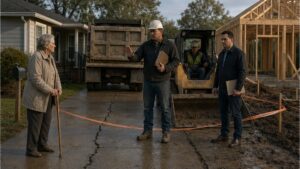
The HOA Fined His Storm-Damaged Roof—Then He Found What Their President Had Built Behind His House
Chapter 1: The Notice Arrived Before the Roofers Did
Jeffrey Carter was standing on Gregory Mitchell’s front porch with a white envelope in his hand before Gregory had finished his first cup of coffee.
Gregory opened the door, glanced at the HOA logo in the corner, then looked past Jeffrey toward the street as if a second person might be waiting there to explain why the association president had come by at seven forty-five on a Monday morning.
“There a meeting I forgot?”
“No.” Jeffrey held out the envelope. “Formal violation notice.”
Gregory took it without opening it. “For what?”
“The roof.”
For a moment he thought Jeffrey meant the main roof, which had lost a dozen shingles in the hailstorm two weeks earlier. Then Jeffrey nodded toward the rear of the house.
“The addition.”
Gregory unfolded the notice.
NON-COMPLIANT ROOFING MATERIAL.
Initial fine: $250.
He read the line twice.
The rear addition had a temporary sheet-metal covering over one section where hail had cracked the shingles badly enough for water to get into the decking. His insurance adjuster had photographed it. The roofing contractor had covered it. The county had issued the repair permit. Replacement shingles were already ordered.
“You know that’s temporary,” Gregory said.
Jeffrey’s expression barely changed. “Temporary doesn’t make it compliant.”
“The roofer put it there so rain doesn’t come through my ceiling.”
“I understand why it’s there.”
“Then what exactly are we doing?”
Jeffrey shifted his weight. His polo shirt had the small embroidered HOA logo the board had started wearing at meetings the previous year.
“We’ve had complaints about visible maintenance issues. The covenants require approved exterior materials.”
Gregory looked again at the notice.
“You fined me two hundred and fifty dollars because a contractor covered storm damage?”
“It’s not personal.”
That phrase bothered Gregory more than the amount.
He folded the paper along its existing crease.
“My replacement is scheduled.”
“How soon?”
“Contractor told me next week, assuming the supplier gets the shingles in.”
“That needs to be documented.”
“It is.”
Gregory stepped back inside, went to the narrow desk by the kitchen, and returned with a clear folder.
He had spent most of his working life organizing things other people lost: freight manifests, compliance logs, insurance certificates, inspection records. He did not trust memory when paper could settle a question.
He handed Jeffrey copies of the county permit, the insurance estimate, and the roofing contract.
Jeffrey looked through them.
“There,” Gregory said. “Active permit. Work order. Insurance claim.”
Jeffrey tapped the permit with one finger.
“This says full roof replacement.”
“Yes.”
“It doesn’t approve the metal covering as a permanent exterior finish.”
“It isn’t permanent.”
“I’m telling you how the covenant reads.”
Gregory stared at him.
“So this isn’t a safety problem.”
“No.”
“It isn’t an abandoned repair.”
“No.”
“It isn’t unpermitted construction.”
“That’s not the issue.”
Gregory felt something tighten behind his ribs.
He had expected the paperwork to end the conversation. Not because he thought rules disappeared when they became inconvenient, but because he believed documents existed precisely so reasonable people did not have to argue about obvious facts.
Jeffrey handed the folder back.
“You have ten days to cure it.”
“The roofers may not be here in ten days.”
“Then file an appeal.”
Gregory almost laughed.
“You’re standing here with the permit in your hand.”
“The board still has a process.”
“You’re the president of the board.”
“I’m one vote.”
Gregory knew enough about the association to know that sentence was technically true and practically incomplete.
Jeffrey turned toward the steps.
“File the appeal, Gregory.”
Gregory looked at the white notice in one hand and his approved permit in the other.
“No.”
Jeffrey stopped.
“No?”
“I’ve already shown you what this is. I’m not writing three pages asking permission to have storm damage.”
“That’s your choice.”
“Yes.”
Jeffrey gave a small nod, the kind people used when they wanted to make disagreement look administrative.
“Then the timeline stays in place.”
After he left, Gregory walked around the side of the house.
The metal covering looked exactly as it had the day before: dull gray, screwed down squarely, ugly but functional. The contractor had tucked its edge under intact shingles and sealed the damaged section before the next storm.
Gregory held the HOA notice against the light.
The paper looked absurd beside the roof.
By noon, the roofing contractor called.
The shingles had been delayed.
“Maybe another week,” the contractor said. “Possibly ten days. Supplier’s backed up from the storm.”
Gregory looked at the notice on his desk.
“Can you email me that?”
“Sure.”
That evening, he printed the email and clipped it behind the permit.
He considered the appeal form Jeffrey had mentioned. It was available on the association website, four pages long, with a section requiring the homeowner to explain why enforcement should be reconsidered.
Gregory downloaded it.
He read the first page.
Then he deleted the file.
At eight thirty the doorbell rang again.
No one was there.
A second envelope had been tucked beneath the doormat.
Gregory opened it under the porch light.
It acknowledged that the violation remained uncured and stated that, after the ten-day period, additional penalties could be assessed daily until compliance was confirmed.
At the bottom, in bold type, was the date the accumulating fines would begin.
Gregory stood on the porch holding the paper while the temporary roof covering glinted under the backyard floodlight.
The first notice had been irritating.
The second told him this was going to cost him if he refused to bend.
Chapter 2: Ten Days Became Three Weeks of Fines
The balance crossed one thousand dollars on a Thursday.
Gregory knew because the latest notice arrived by certified mail and listed every assessment separately.
Initial violation: $250.
Continuing penalties.
Administrative charge.
Total due: $1,075.
He read the page at his kitchen table while his phone sat beside it with a message from the roofing contractor: shipment delayed again.
The new shingles were now expected early the following week.
Gregory called the association office.
Laura Davis answered.
“Homeowners association.”
“This is Gregory Mitchell.”
There was a slight pause.
“Yes, Gregory.”
“I’m looking at a balance of a thousand seventy-five dollars for a roof that is already under contract.”
“I know the account.”
“Then tell me who can suspend the penalties.”
“The board can review it.”
“I already gave Jeffrey the permit.”
“I understand.”
“Do you?”
Laura was quiet for a second.
“The appeal window has closed.”
Gregory leaned back.
“That’s your answer?”
“I’m telling you what the policy says.”
“I didn’t appeal because there was nothing to appeal. It’s storm damage. The county approved the work.”
“The county permit and the HOA covenant are different things.”
He almost repeated the same argument he had made on his porch.
Instead he said, “When is the next board meeting?”
“Tuesday.”
“I’ll be there.”
Tuesday evening, five folding tables had been pushed into a rectangle in the small association meeting room. Jeffrey sat at the end with a binder in front of him. Laura sat to his right, surrounded by financial statements.
Gregory waited through irrigation repairs, pool access complaints, and a discussion about mailbox paint before Jeffrey called his name.
Gregory placed his folder on the table.
“My roof replacement is scheduled. The temporary covering is there because of hail damage. You have the permit. You have the contractor’s schedule. I’m asking the board to stop accumulating fines.”
Jeffrey opened the binder.
“The exterior-material rule applies uniformly.”
“I’m not asking you to change the rule.”
“You’re asking us not to enforce it.”
“I’m asking you to recognize the difference between an unfinished renovation and an emergency repair.”
One of the unnamed board members glanced at Jeffrey.
Jeffrey folded his hands.
“If we start deciding that visible noncompliance is acceptable whenever somebody has an explanation, enforcement becomes subjective.”
“It already is subjective.”
Jeffrey’s eyes hardened slightly.
Gregory continued.
“You’ve decided a temporary covering is more important than the fact that the permitted repair is scheduled.”
“What happens when the next homeowner says their unapproved siding is temporary? Or a fence? Or a shed?”
“That’s not my property.”
“No. But those are the precedents the board has to think about.”
There it was.
Not anger. Not even personal hostility.
Fear of losing control of the line.
Gregory understood the logic better than he wanted to.
Jeffrey believed every exception created the next argument. Gregory also understood something else: Jeffrey was willing to make Gregory pay for that fear.
“The fine remains,” Jeffrey said.
Gregory closed the folder.
“Fine.”
Jeffrey frowned. “You understand the penalties continue?”
“I understand exactly what you’re doing.”
Outside, Gregory walked to his truck instead of joining two neighbors talking near the entrance.
The meeting room sat across from a row of houses on the association’s central street. Jeffrey’s house was three lots down from the corner.
Gregory had driven past it hundreds of times.
That night he noticed the rear addition.
From the side street, its upper level projected beyond the original rear wall, supported by dark steel posts. The structure had a covered roof and railing, somewhere between an elevated porch and an enclosed balcony.
He slowed.
Years of looking at logistics sites had trained his eye to notice alignment. Loading zones. Fence offsets. Easements. Fire lanes. Things that were supposed to be parallel but were not.
Jeffrey’s addition seemed unusually close to the rear drainage strip.
Gregory drove on.
The thought should have disappeared.
It did not.
Two days later, another notice arrived.
Total due: $1,225.
The roofers still had not come.
Gregory put the newest letter on top of the stack and drove home from work by a different route, one that took him behind Jeffrey’s property.
The rear addition looked even larger from there.
Its outside posts stood near a shallow grassy channel that ran between the backyards.
Gregory knew the channel. After heavy rain, water moved through it toward the retention pond.
He went home and opened the county property website.
He told himself he was only curious.
Jeffrey Carter’s parcel appeared on the screen.
Gregory pulled the current tax card, then searched archived permits.
There was a permit for an interior remodel.
A fence permit.
An old HVAC replacement.
He searched again using the parcel number instead of the street address.
Nothing for the addition.
He frowned.
Missing online records were not proof. Older permits were sometimes scanned badly or filed under contractor numbers. He knew that.
He searched the inspection history.
No final inspection appeared.
Gregory sat back.
For the first time in three weeks, the pile of white violation notices on his desk stopped looking like the only paperwork that mattered.
He printed the permit history and placed it beside them.
One empty line on a county record did not mean Jeffrey had done anything wrong.
But it meant Gregory finally had a question Jeffrey could not answer by pointing at the covenant book.
Chapter 3: The Plat Showed Four Feet Nobody Mentioned
The oldest tax photograph on Jeffrey Carter’s parcel showed nothing behind the house except a concrete patio and a narrow strip of grass.
Gregory enlarged the image on the county terminal.
The date in the corner was from the year Jeffrey bought the property.
No steel posts.
No elevated roof.
No balcony.
Gregory clicked to the next archived image.
Still nothing.
The third image, several years later, showed the beginning of the structure.
That narrowed the timeline.
A county permit clerk sat behind a counter twenty feet away, helping a contractor who had come in with rolled plans under one arm. Gregory waited until the contractor left.
“I’m trying to trace permit history on a residential addition,” he said.
The clerk took the parcel number.
“Your property?”
“No.”
The clerk looked up.
“Records are public. Just asking because owner files can have different request options.”
She searched.
Gregory watched her face, careful not to interpret every pause.
“There was an architectural review attached to something,” she said. “Not county. Looks like HOA paperwork got uploaded as supporting material later.”
“What about building?”
She clicked again.
“I see no final.”
“Could the permit be under a contractor?”
“Could be. Could be older data migration. Could be permit-exempt work depending on what it originally was.”
“So no conclusion.”
She gave him a faint smile.
“That’s the correct conclusion.”
Gregory appreciated that.
He requested the subdivision plat and copied the relevant permit index. By lunch he had a flat folder containing tax photographs, parcel history, and a large-format copy of the original neighborhood plat.
That evening he spread everything across his kitchen table.
His own HOA notices sat at one end.
Jeffrey’s parcel records sat at the other.
Gregory located the Carter lot on the plat.
A drainage and utility easement crossed the rear portion of the property.
He measured from the recorded rear boundary toward the house, then compared the dimensions with aerial imagery.
The structure appeared to enter the restricted strip.
Appeared.
That word mattered.
Gregory had seen enough people at work make expensive mistakes because they turned approximation into certainty.
He pulled up satellite imagery from different years.
The addition’s outer posts aligned uncomfortably close to the easement area.
He printed two images and drew reference lines in pencil.
Then he stopped himself.
He was doing exactly what irritated him when other people did it: building a conclusion before he had the full file.
The next morning he called Nicholas Hall.
Gregory knew him indirectly through a work matter involving a warehouse setback dispute. Nicholas handled land-use and property cases but had never represented Gregory personally.
Nicholas listened for five minutes without interrupting.
Then he said, “What do you want?”
Gregory looked at the newest HOA bill.
“I want the fines gone.”
“That’s one issue.”
“And I want to know whether Carter’s addition is legal.”
“That’s another.”
“They’re connected.”
“Emotionally, yes.”
Gregory did not like the answer.
Nicholas continued.
“An HOA can enforce architectural restrictions even if county code is satisfied. County code can be violated even if an HOA approved something. One doesn’t automatically erase the other.”
“He’s fining me over a temporary roof while he may have built into an easement.”
“I understand the hypocrisy argument.”
“It’s more than hypocrisy.”
“Maybe. But don’t confuse leverage with a legal defense.”
Gregory was silent.
Nicholas said, “Send me what you have.”
By afternoon, Nicholas called back.
“The missing final inspection is worth checking. Not enough by itself. The setback question is more interesting.”
Gregory leaned forward at his desk.
“How interesting?”
“Do you have actual field measurements?”
“No.”
“Then don’t say four and a half feet like it’s established.”
Gregory looked at the pencil calculation on his copy.
“That’s what the scale suggests.”
“The scale suggests. Good. Keep that language.”
Nicholas asked him to photograph the visible drainage markers from public property if they could be seen without entering Jeffrey’s lot.
After work, Gregory walked the common path behind the houses.
The shallow drainage channel was dry. Near Jeffrey’s rear corner, a capped marker was visible through the grass.
Gregory photographed it from the path.
He did not step over the property line.
Back at home he overlaid the marker location with the plat dimensions.
His estimate remained almost exactly the same.
Four and a half feet.
The number produced a small pulse of satisfaction.
That bothered him.
He imagined Jeffrey receiving a county notice. He imagined the expression on his face. For several seconds Gregory enjoyed the picture.
Then he folded the plat closed.
He had spent three weeks resenting being reduced to a violation number. He did not want to become a man searching records only because he wanted someone else to suffer under one.
The following morning he met Nicholas in his office.
Nicholas laid the plat flat between them.
“Here’s what matters,” he said, tracing the shaded strip with a pen. “This isn’t only a standard rear setback.”
Gregory followed the line.
“What is it?”
“Drainage easement.”
Gregory looked up.
Nicholas tapped the drawing again.
“If those support posts are where you think they are, the issue isn’t whether the addition looks right. Permanent structures can interfere with access, maintenance, water flow, sometimes emergency work depending on the recorded terms.”
“So the county cares.”
“The stormwater people may care very much.”
Gregory looked down at the shaded strip.
Until that moment he had been thinking about Jeffrey’s addition as a technical inconsistency, something embarrassing enough to expose selective enforcement.
A drainage easement changed the weight of it.
This was no longer merely a missing signature on an old permit.
Nicholas leaned back.
“Before you do anything, decide what you actually want out of this.”
Gregory glanced at the folder of fines beside his chair.
He had come in wanting a contradiction.
He was leaving with something that might become a real violation.
And he still did not know whether exposing it would free him from a single dollar he owed the HOA.
Chapter 4: The Board Knew More Than Gregory Expected
The board refused to suspend collections before Gregory had even finished laying his documents on the table.
Jeffrey Carter sat at the end of the meeting room with the same binder he had used three weeks earlier. Laura Davis was beside him, her calculator and financial report aligned squarely in front of her. The two other board members avoided looking directly at Gregory.
“The account remains active,” Jeffrey said. “Your roof is still out of compliance.”
“The replacement starts Monday.”
“Then the violation can be closed after inspection.”
“And the fines?”
“Remain due.”
Gregory placed the original $250 notice on the table, then the later notices behind it in order.
“You have the permit. You have the contractor’s letters. You have the insurance documentation.”
“We’ve already covered this.”
“No. You’ve repeated the rule. That isn’t the same thing.”
Jeffrey’s jaw shifted.
Gregory had brought copies of the county records concerning Jeffrey’s addition, but they stayed inside his folder.
He had spent most of the week deciding whether to put them on the table.
Nicholas had advised against using them as a threat.
“If the structure is a county problem,” Nicholas had said, “treat it like a county problem. Don’t say, ‘Drop my fines or I report you.’ That turns a legitimate complaint into leverage.”
Gregory had understood immediately.
He had also resented it.
Jeffrey opened his binder.
“The appeal deadline expired.”
“I know.”
“You chose not to use it.”
Gregory stared at him.
There was the part he could not blame on anyone else.
He had refused the appeal because filling it out felt humiliating. He had believed the permit should have ended the matter without requiring him to request mercy from people who already had the facts.
That pride had cost him.
“I made that choice,” Gregory said. “But the board made choices too.”
Laura looked up.
Jeffrey said, “Meaning?”
Gregory took a breath.
“Meaning you had discretion to pause enforcement while a permitted repair was underway.”
“Not unilaterally.”
“I didn’t say unilaterally.”
Jeffrey leaned back.
“The board has been under pressure for months. People complain about fences, paint, yards, additions. If we make exceptions selectively, we lose any credible standard.”
“You already select what deserves urgency.”
“Based on complaints and visibility.”
“So appearance.”
“Property standards.”
Gregory almost reached for the county file.
Instead, he closed the stack of HOA notices.
“I’m asking for my account to be reviewed based on the facts of my property.”
Jeffrey looked down the table.
One board member shook his head slightly.
The other said, “I’d rather wait until the repair is complete.”
Laura did not speak.
Jeffrey nodded.
“Motion to defer review until cure.”
It passed.
Gregory gathered his papers.
The whole discussion had lasted eleven minutes.
Outside, the parking lot was nearly empty when he heard Laura behind him.
“Gregory.”
He stopped beside his truck.
Laura carried no files now. Her hands were tucked into the pockets of a light jacket.
“If you’re going to say I should’ve appealed—”
“I’m not.”
He waited.
She glanced toward the meeting-room windows.
“You’ve been looking at Jeffrey’s addition.”
Gregory said nothing.
Laura gave a tired little breath.
“It isn’t hard to notice you driving past his house.”
“I’ve been checking public records.”
“I assumed.”
That surprised him more than the accusation.
“You assumed?”
“You work in compliance.”
“So?”
“So people who work in compliance don’t stare at steel posts because they admire steel posts.”
Gregory almost smiled, but did not.
Laura stepped closer.
“That addition was questioned before.”
His attention sharpened.
“By whom?”
“Me.”
“When?”
“Months ago.”
“Why?”
“There was an insurance discussion. Not your insurance. The association’s. We were updating property records and someone asked whether any board members had alterations that affected common drainage areas.”
Gregory looked at her.
“And Jeffrey’s came up?”
“I asked about it.”
“What did he say?”
“That it had been approved.”
“By the county?”
Laura hesitated.
“By the architectural committee.”
Gregory felt a quiet shift inside him.
“That isn’t the same thing.”
“I know that now.”
“You knew it then.”
“I knew there was a difference. I didn’t know there was a problem.”
“What did you ask him to do?”
“Confirm the permit.”
“And?”
“He brought in an old approval letter.”
“From the HOA.”
“Yes.”
Gregory looked toward the darkened meeting room.
“You let that settle it.”
Laura’s face tightened.
“I did.”
“Why?”
“Because he’d been president for six years. Because the board was already fighting about reserve funding. Because two members had threatened to resign. Because he said the addition predated some of the current procedures.”
“That doesn’t answer why you stopped asking.”
“It does, actually.”
Gregory studied her.
Laura did not look defensive now. She looked ashamed.
“I thought keeping the board functioning mattered more than opening another argument,” she said.
“And meanwhile you kept sending me notices.”
“I process what the board authorizes.”
“That’s convenient.”
“Yes.”
The answer stopped him.
Laura did not excuse herself.
She looked at his truck, then back at him.
“I should have pushed harder.”
Gregory folded his arms.
“Did Jeffrey know you were asking about county approval specifically?”
“Yes.”
“And he gave you an HOA letter.”
“Yes.”
“Did anyone verify it against the county file?”
“No.”
Gregory felt his anger widen.
Until then, Jeffrey had been the obvious target. Laura had seemed like part of the machinery around him.
Now the machinery had faces.
People who saw gaps.
People who chose quiet.
People who convinced themselves that silence kept things stable.
“Do you still have the board notes from that meeting?”
Laura’s gaze lifted.
“I keep all minutes.”
“Official minutes?”
“And working notes.”
“Would they show what you asked?”
She was silent long enough that Gregory understood the answer before she spoke.
“They might.”
“Can I see them?”
“Not tonight.”
“Why not?”
“Because if I give you internal working notes without checking what can be released, I’d be doing exactly what everyone accuses this board of doing—making rules up depending on who asks.”
Gregory exhaled through his nose.
For once, he could not argue with the reasoning.
Laura turned toward her car, then stopped.
“One more thing.”
Gregory waited.
“The architectural approval Jeffrey showed us?”
“Yes.”
“It never had a county permit number attached to it.”
Gregory said nothing.
Laura opened her car door.
“I should have noticed that sooner.”
She drove away, leaving Gregory beside his truck with a question that no longer concerned whether Jeffrey’s paperwork was incomplete.
It concerned whether Jeffrey had known it was incomplete and decided that nobody would look closely enough to matter.
Chapter 5: The Tape Measure Crossed the Easement Line
The county vehicle stopped in front of Jeffrey Carter’s house at 9:12 on a Wednesday morning.
Gregory knew the time because he had been standing at his kitchen window with his phone in his hand, trying not to watch for it.
A white utility SUV rolled to the curb. A stormwater inspector stepped out carrying a clipboard, a camera, and a hard case.
Gregory set his coffee down.
He had filed the complaint six days earlier.
Not anonymously.
Nicholas had told him not to hide behind anonymity if he expected the complaint to be taken seriously.
“State what you know,” Nicholas had said. “Separate it from what you suspect. Attach the plat. Attach the public photos. Let them determine the rest.”
Gregory had done exactly that.
Now determination had arrived in a county vehicle.
Jeffrey appeared outside within minutes.
Even from Gregory’s property, the set of his shoulders was unmistakable.
The inspector spoke with him near the driveway, then they walked around the side of the house toward the rear addition.
Gregory stayed where he was.
Five minutes later his doorbell rang.
Jeffrey stood on the porch.
“The inspector says you filed the complaint.”
“I did.”
“You couldn’t come to me?”
Gregory looked at him.
“I came to you about my roof.”
“That has nothing to do with my property.”
“That’s what Nicholas told me too.”
Jeffrey blinked at the name.
“My attorney.”
Something in Jeffrey’s expression changed.
“So this is where we are.”
“No. This is where your addition is being checked.”
Jeffrey stepped closer to the door.
“You’re trying to embarrass me.”
“I submitted county records to the county.”
“You knew exactly what would happen.”
“I knew they might inspect.”
“You’ve been waiting for this.”
Gregory could not deny that part completely.
There had been a moment, more than one, when he had imagined Jeffrey standing under an official notice of his own.
He looked past Jeffrey toward the inspector.
“I wanted someone outside the board to decide whether the records matter.”
Jeffrey’s mouth tightened.
“The addition was approved.”
“By the HOA.”
“It was reviewed.”
“Then show the county what you have.”
Jeffrey stared at him another second.
“Come see it, then.”
Gregory frowned.
“What?”
“You’ve spent weeks researching my house. Come look.”
He almost refused.
Then the stormwater inspector appeared around the side of the property and called Jeffrey’s name.
Jeffrey walked away without waiting.
Gregory followed only as far as the common path behind the lots.
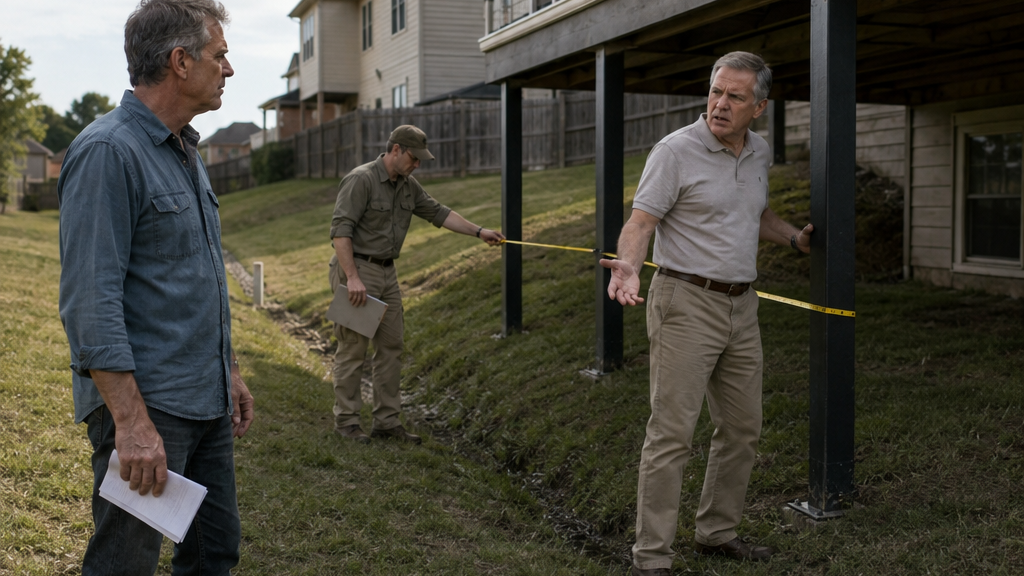
From there, the addition rose above the shallow drainage channel on dark steel supports.
The inspector had located the easement markers. He opened the hard case and took out a long measuring tape.
Jeffrey stood beside him with a folder.
“I have the approval letter,” Jeffrey said.
The inspector glanced at it.
“This is association approval.”
“That’s what I was given when the project was done.”
“Do you have county building documents?”
“I was told the contractor handled that.”
“When was it built?”
Jeffrey gave the year.
The inspector wrote it down.
Gregory stayed near the property edge.
He had folded his first HOA notice into quarters that morning without thinking and shoved it into his jacket pocket. His fingers found it now.
The inspector hooked the tape at the easement marker.
He walked it toward the steel posts.
The yellow line passed the first support.
Then the second.
He checked the plat on his clipboard and measured again.
Jeffrey’s face changed by degrees.
Not panic.
Not yet.
Just the gradual loss of certainty.
“That marker may have shifted,” Jeffrey said.
“Possible,” the inspector replied.
Gregory respected the answer.
The inspector measured from a second reference point.
Then he photographed the post.
“Based on what I’m seeing today,” he said, “the structure appears to extend into the recorded drainage easement.”
“How far?”
“I’m not giving you a final measurement until I verify the recorded dimensions.”
Jeffrey looked toward Gregory.
There was anger in his face, but underneath it was something Gregory had not expected to see.
Fear.
“This was built by a licensed contractor,” Jeffrey said.
The inspector nodded.
“That may be relevant.”
“I had architectural approval.”
“That may also be relevant.”
“You’re making it sound like I knowingly built something illegally.”
“I’m not making a finding about intent.”
The inspector’s calm made the scene feel heavier, not lighter.
Jeffrey turned on Gregory.
“Are you satisfied?”
The question landed exactly as Gregory had once imagined it might.
He could have answered with the $1,500 in accumulated fines.
He could have mentioned the ten-day deadline.
He could have repeated Jeffrey’s line about standards.
Instead Gregory took the folded white notice from his pocket and looked at it.
“I wanted the same seriousness applied to both houses.”
Jeffrey laughed once without humor.
“That’s what you call this?”
“Yes.”
“You called the county over a porch.”
“You fined me over emergency roofing.”
“There it is.”
Gregory looked up.
“What?”
“The revenge.”
The word struck because Gregory had used it privately himself.
The inspector stepped away to photograph the drainage channel.
Jeffrey lowered his voice.
“The contractor told me everything was approved. The architectural committee signed it. Nobody told me there was an easement conflict when it went up.”
Gregory studied him.
“You never checked?”
“Why would I check after I was handed an approval?”
“Laura asked you to.”
Jeffrey’s expression hardened.
“So she’s talking to you now.”
“She told me she asked for county verification.”
“She asked during an insurance review. I brought her the file.”
“The HOA file.”
“The file I had.”
Gregory wanted the answer to be simpler.
He wanted Jeffrey to admit he had known from the beginning.
Instead he was looking at a man who may genuinely have trusted a contractor and an old board approval at first.
That did not erase what happened later.
But it changed the shape of it.
The inspector returned.
“I’m issuing a field notice today,” he said. “Building will review the addition separately. Stormwater will verify the easement and access requirements.”
Jeffrey’s face went still.
“Am I being fined?”
“I’m not assessing penalties today.”
“Do I have to remove it?”
“I can’t tell you that today either.”
The inspector walked to the post nearest the house and attached a red county notice where it could be seen from the yard.
The color was almost painfully bright against the dark steel.
Gregory looked at the white folded HOA notice in his own hand.
Three weeks ago, paper had meant humiliation.
Now another piece of paper was fixed to Jeffrey’s property, and Gregory discovered the sight did not feel as good as he had expected.
The inspector packed away the tape.
“What happens next?” Jeffrey asked.
“You’ll receive written findings after review.”
“When?”
“Usually within two weeks.”
The inspector left.
Jeffrey remained under the addition staring at the red tag.
Gregory turned toward home.
Behind him, Jeffrey called his name.
Gregory stopped.
“If they make me tear this apart,” Jeffrey said, “that still doesn’t make your roof compliant.”
Gregory looked back.
“I know.”
For the first time, Jeffrey seemed unsure what to say next.
And Gregory walked home knowing the county had validated his concern without answering the question that now mattered most.
What, exactly, was that red tag going to cost Jeffrey—and would it change anything at all about the debt still attached to Gregory’s name?
Chapter 6: The Red Tag Did Not Cancel Gregory’s Debt
The collection letter arrived four days after the red tag went up.
Gregory stood at his mailbox and read the first paragraph twice.
The HOA balance remained due.
Failure to resolve the account could lead to additional collection action and recovery of administrative expenses.
He looked three houses down.
From the street, Jeffrey’s red county tag was not visible.
Gregory’s debt was.
It existed in the association ledger, in certified envelopes, in formal notices carrying his name.
He took the letter inside and placed it beside a photograph he had taken from the common path after the county inspection.
In the photograph, the red tag hung from the steel post.
On his kitchen table, the HOA letter was white.
For several seconds Gregory simply looked at the two pieces of paper.
Then he called Nicholas.
“I thought this would matter.”
“It does matter.”
“My account says fifteen hundred and change.”
“That’s still a separate process.”
“I know what you said.”
“Knowing it and liking it are different.”
Gregory rubbed his forehead.
“The county is reviewing whether his structure sits in a drainage easement while the HOA is threatening collection over a temporary covering that’s gone next week.”
“Yes.”
“You don’t find that ridiculous?”
“I find it useful.”
Gregory frowned.
“Useful?”
“It shows why you need to decide what remedy you want.”
“I want the fines erased.”
“And if the board refuses?”
Gregory looked at the photograph.
Nicholas continued.
“We can challenge procedure. We can dispute proportionality. We can argue inconsistent enforcement if the facts support it. We can also pursue fees. But every step costs money.”
“How much?”
“Depends how aggressive you want to be.”
Gregory disliked the phrase.
Aggressive.
It sounded too close to satisfying.
That afternoon Laura called.
“I have something you should see.”
They met in the association office after closing.
Laura had a thin folder waiting on the conference table.
“I checked what I could release,” she said.
Gregory sat down.
Inside were copies of meeting minutes and two pages of handwritten working notes.
Laura pointed to a date eight months earlier.
The typed minutes said only:
Board discussed insurance documentation for exterior structures. Further verification requested where applicable.
“That tells me almost nothing.”
“I know.”
She slid the handwritten page toward him.
Gregory read the entry.
Carter addition—architectural approval on file. Need county permit/final? Drainage map possibly affected. Jeffrey to verify.
Gregory read it again.
“How long after this did you follow up?”
“Three weeks.”
“And?”
“He said the contractor had handled the county.”
“Did he give you proof?”
“No.”
“Then what?”
Laura looked down.
“I let it go.”
Gregory pushed the page back.
“Why?”
“I told you.”
“No. You told me why you didn’t want another fight. I’m asking why, after writing ‘drainage map possibly affected,’ you let it disappear.”
Laura folded her hands.
“Because I didn’t think it was dangerous.”
“That isn’t the point.”
“I know that now.”
“You knew enough to ask.”
“Yes.”
“And Jeffrey knew enough to be asked.”
“Yes.”
The room was very quiet.
Gregory felt the story simplify again, though not completely.
Jeffrey might not have known when the addition was built.
He might have believed the contractor.
But eight months ago someone had specifically asked him to verify county approval and possible drainage involvement.
He had not done it.
Then, months later, he had stood on Gregory’s porch holding a $250 notice and insisted that process mattered more than circumstances.
That was the double standard.
Not the original construction.
The refusal to look when looking became inconvenient.
“What happens if these minutes go to the rest of the board?” Gregory asked.
Laura’s expression tightened.
“They should have had them already.”
“Should have?”
“I summarized the discussion.”
Gregory stared at her.
“You softened it.”
“Yes.”
“Why?”
“Because I thought I was preventing an unnecessary fight.”
“And instead?”
“I helped avoid a necessary one.”
It was the first time Gregory had heard anyone on the board say the thing plainly.
He gathered the copies.
Laura stopped him.
“What are you going to do?”
“I don’t know yet.”
“If you demand Jeffrey’s resignation, you may get it.”
“That what you want?”
“No.”
“Why not?”
“Because he’s good at half the job.”
Gregory almost laughed.
Laura did not.
“He knows the budget. He answers residents. He gets contractors to show up. He also thinks consistency matters more than judgment, and he hates admitting when he’s lost control of something.”
“That’s more than a small flaw.”
“I didn’t say small.”
Gregory slipped the minutes into his folder.
At Nicholas’s office the next morning, they laid out three possible approaches.
Challenge the fines formally and demand reimbursement of legal costs.
Threaten litigation over inconsistent enforcement.
Or propose a settlement tying Gregory’s account resolution to broader procedural changes without making Jeffrey’s county issue a bargaining weapon.
Nicholas circled the second option with his pen.
“This is the expensive one.”
Gregory looked at it.
“And the most satisfying?”
Nicholas looked up.
“That’s not a legal category.”
“It’s still an answer.”
Nicholas leaned back.
“You can spend months proving they treated you badly. You may win. You may recover some fees. You may also turn every board meeting into a trench.”
Gregory glanced at the handwritten note from eight months earlier.
Jeffrey to verify.
He thought of the red tag.
He thought of Jeffrey standing under it, frightened and furious.
And he thought of himself deleting the appeal form because he could not tolerate asking a board to reconsider something he believed should have been obvious.
Both of them, in different ways, had treated process as something other people should submit to.
“What would the narrow settlement look like?” Gregory asked.
Nicholas pulled a legal pad toward him.
“Your fines rescinded. Collection stopped. Written grace period for documented emergency repairs. Conflict-of-interest review when a board member’s own property is implicated. Clear appeal timelines. Maybe independent review for disputed architectural enforcement.”
“And Jeffrey?”
“County handles Jeffrey.”
“No resignation demand?”
“That’s your choice.”
Gregory sat with it.
For weeks he had imagined a clean reversal: his notices gone, Jeffrey humiliated, the ledger balanced morally as well as financially.
But fairness was not a ledger.
If he demanded maximum punishment simply because he finally had leverage, he would be using procedure for the same reason he despised Jeffrey’s use of it.
“Leave resignation out,” Gregory said.
Nicholas nodded once.
“You sure?”
“No.”
“That’s usually a better sign than being sure.”
By late afternoon, Gregory had a two-page settlement proposal.
No insults.
No reference to the county fine Jeffrey might face.
No demand that the addition be demolished.
No request for public apology.
Just terms.
Rescind Gregory’s accumulated assessments.
Close the violation upon completion of the scheduled roof replacement.
Adopt a documented repair grace period.
Require conflict review when an enforcing board member has a related unresolved property matter.
Record enforcement decisions with stated reasons.
Gregory added one final sentence himself.
Standards remain enforceable, but documented temporary repairs shall not be treated as permanent violations absent a specific safety or nuisance finding.
He read it twice.
Then he placed his original $250 notice inside the same folder.
That evening he walked into the association meeting room carrying the settlement terms under one arm.
Jeffrey was already there.
So was Laura.
For the first time since the dispute began, Gregory was not entering the room to prove that someone else was wrong.
He was entering with a choice about what winning was supposed to look like.
Chapter 7: The Rule Stayed, but the Power Changed
Jeffrey Carter arrived without the blue president’s binder.
Gregory noticed before Jeffrey even sat down.
For six years, Jeffrey had carried that binder into every meeting as if the association lived inside it: covenants tabbed by color, violation logs, contractor bids, reserve schedules, architectural decisions. Tonight he placed only a thin folder on the table and took a chair two seats away from the head.
Laura Davis sat at the center.
She looked at the clock.
“Seven o’clock. I’m calling the meeting to order.”
No one commented on the change.
That made it feel larger.
Gregory sat opposite them with Nicholas Hall beside him. Between his hands lay the two-page settlement proposal and, underneath it, the original $250 violation notice.
The white paper had softened along the folds from being opened too many times.
Laura began with the county matter.
“The association received written confirmation this afternoon regarding the Carter property.”
Jeffrey’s eyes stayed on the table.
“The county determined that part of the rear addition extends into the recorded drainage easement. The remedy requires removal and reconfiguration of the outer supported section sufficient to restore drainage and maintenance access.”
One board member shifted in his chair.
“Is there a fine?”
Jeffrey answered before Laura could.
“Yes.”
His voice was flat.
Gregory did not ask how much.
He had once imagined wanting the number. Now it seemed less important than the sentence Laura had just read: restore access.
Something built over an invisible line had to move because the line served a purpose.
Laura turned toward Gregory.
“Your matter.”
Nicholas slid copies of the proposal around the table.
Jeffrey read quickly. Laura read slowly.
One of the other members stopped at the section requiring a documented grace period for emergency repairs.
“This changes enforcement.”
“It changes timing,” Gregory said. “The rule stays.”
Jeffrey looked up for the first time.
“You’re not asking us to waive exterior standards?”
“No.”
“Then what are you asking?”
Gregory tapped the page.
“If a homeowner has documented storm damage, an active permit, and scheduled repair work, there should be a reasonable period before daily fines begin unless there’s a safety problem.”
Jeffrey leaned back.
“That still requires judgment.”
“Yes.”
For a second neither man spoke.
That was the word Jeffrey had resisted from the beginning.
Judgment.
Not exception. Not weakness.
Judgment.
Laura pointed to another paragraph.
“And conflict review?”
“If someone enforcing a property rule has an unresolved issue involving the same kind of approval or common-area impact, another board member handles the decision.”
Jeffrey’s mouth tightened.
“You wrote that for me.”
“I wrote it because of what happened.”
“That’s not the same answer.”
“No,” Gregory said. “It isn’t.”
Nicholas remained silent.
This part belonged to Gregory.
Jeffrey closed the proposal.
“If your goal was to remove me, you could have just said so.”
Gregory frowned.
“That isn’t in there.”
“I noticed.”
“So why bring it up?”
“Because half the neighborhood already thinks this is about forcing me out.”
Gregory glanced toward the two board members.
Neither looked surprised.
“Do you want me to demand your resignation?”
“No.”
“Then stop arguing with something I didn’t ask for.”
Jeffrey’s face colored slightly.
Laura intervened.
“The proposal asks for rescission of Gregory’s assessments, closure of the roof violation after completion, revised emergency-repair procedure, conflict review, and written reasons for disputed enforcement actions.”
“That’s correct,” Nicholas said.
“And legal fees?” Laura asked.
“Each side bears its own,” Gregory said.
Nicholas looked at him briefly but said nothing.
Jeffrey stared across the table.
“You paid an attorney and you’re not asking us to reimburse you?”
“I paid an attorney because I needed one.”
“That doesn’t sound like you.”
Gregory almost smiled.
“You don’t know me very well.”
The room went quiet again.
Then Jeffrey said, “Your roof was still noncompliant.”
There it was—the last piece he would not surrender.
Gregory looked at the original notice beneath his hand.
“Yes.”
Jeffrey seemed surprised.
Gregory continued.
“The metal covering wasn’t an approved permanent material.”
“No.”
“But it wasn’t permanent.”
Jeffrey’s shoulders lowered slightly.
“No.”
“You could have enforced the standard and still recognized the repair.”
Jeffrey looked at Laura, then down at the proposal.
“I should have paused the fines.”
It was not an apology.
Not yet.
But it was the first admission Gregory had heard from him.
Laura made a motion to rescind Gregory’s accumulated assessments and adopt the proposed repair grace period subject to final policy language.
One board member seconded.
The vote passed.
The conflict-review provision passed next.
Then the requirement that disputed enforcement decisions include a written reason rather than only a covenant citation.
No applause followed.
No neighbors packed the room.
Only pens moved over paper.
Laura took Gregory’s original violation notice and wrote across the association copy.
RESCINDED.
She initialed it and returned a stamped copy to him.
Gregory held the page.
The word looked almost too ordinary.
Jeffrey waited until the others began collecting papers.
“Gregory.”
Gregory looked up.
Jeffrey’s voice was lower now.
“I’m not apologizing for having standards.”
“I didn’t ask you to.”
“I do apologize for ignoring the repair circumstances after you showed me the documents.”
Gregory studied him.
Jeffrey continued.
“And for not checking my own county paperwork when Laura raised it.”
That second sentence cost him more.
Gregory could see it.
“I appreciate that,” Gregory said.
Jeffrey nodded.
Nothing between them was repaired completely.
That felt more believable than if it had been.
A month later, the roofers finished Gregory’s house.
The temporary metal covering disappeared beneath new shingles that matched the rest of the roof so closely that from the street no one would know there had ever been a dispute.
Three houses away, a contractor worked beneath Jeffrey’s addition.
The outer railing had been removed. Two steel supports were coming out. The elevated section would be shortened and rebuilt clear of the drainage easement.
Gregory walked along the common path one afternoon and stopped where the shallow grassy channel ran behind the properties.
For years it had looked like unused space.
Now he understood what it represented.
Not ownership.
Not victory.
Access.
A boundary that existed because something beyond either homeowner’s preference depended on it.
He unfolded the rescinded violation notice one final time.
The paper still carried the original $250 assessment beneath Laura’s stamp.
He did not tear it up.
He put it back in the folder with the permit, the contractor letters, the plat, and the county records.
Then he looked toward his finished roof.
Across the drainage strip, workers lifted one of Jeffrey’s steel posts free and carried it toward the truck.
Jeffrey stood nearby speaking with the contractor.
He saw Gregory.
Neither man waved.
But Jeffrey gave a small nod.
Gregory returned it and kept walking.
The rule had not disappeared.
Neither had the people who had misused it.
What had changed was that no one person could point to the rule anymore and pretend the conversation ended there.
The story has ended.