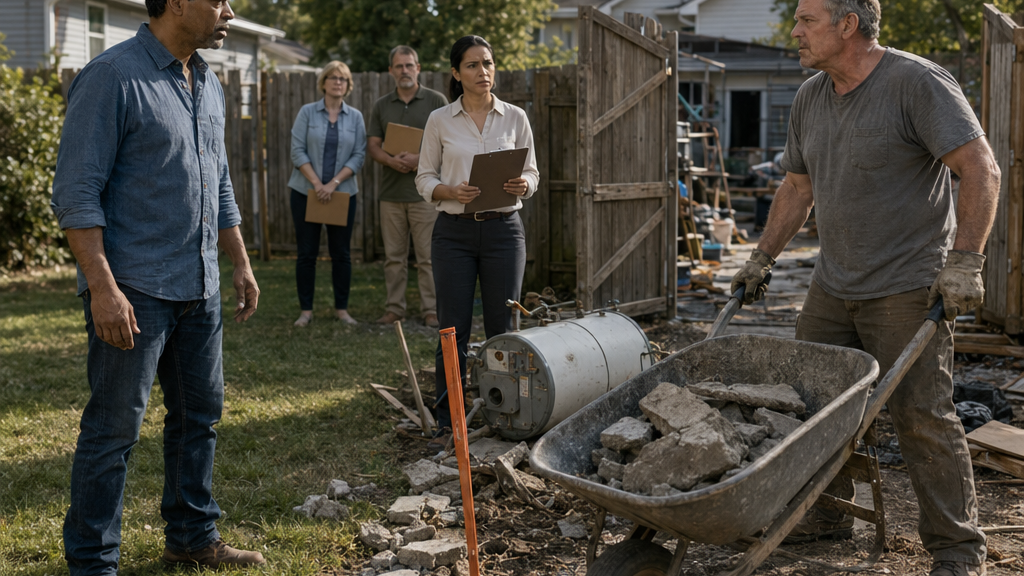
My Neighbor Used My Inherited Lot as His Dump—Then an Old Permission Changed Who Owed What
Chapter 1: The Water Heater Beside the Survey Stake
The water heater was lying on its side where Charles Carter had expected to see nothing but grass.
He stopped at the edge of the lot with one hand still resting on the mower handle.
For a few seconds, he thought someone had dragged it there overnight as a joke. The white metal tank was dented along one side and streaked with brown rust. A length of copper pipe still clung to the top. Beside it sat three broken concrete blocks, a torn bag of hardened cement, and a stack of gray lumber that Charles knew had not been there the previous Saturday.
What bothered him most was the orange survey stake.
It leaned at an angle beneath the lip of the water heater, nearly hidden in the grass.
Charles shut off the mower.
The sudden silence made the pile look worse.
He had inherited the quarter-acre parcel from his uncle two years earlier. It was an awkward piece of land tucked between two backyards and a narrow residential street, too small to feel like an investment and too useful to sell without thinking carefully about it.
Charles had done neither.
He paid the property taxes. He mowed it every other Saturday through spring and summer. Once a year he walked the boundary with a copy of the survey in his truck and made sure the corner stakes were still visible.
That was the extent of his stewardship.
He had never built on it. Never fenced it. Never even put up a sign.
Until that morning, he had assumed none of those things were necessary.
Charles took out his phone.
He photographed the water heater first, then the cement bags, lumber, and broken masonry. When he moved around the pile, he noticed older material underneath: trimmed branches, a warped section of plywood, two cracked patio pavers.
This was not one load.
Someone had been adding to it.
He crouched near the rear edge of the parcel and saw two muddy wheel tracks pressed through the grass. They cut diagonally from the pile toward the wooden privacy fence behind the neighboring house.
One gate in that fence stood slightly open.
Charles knew the homeowner only by sight.
Gregory Hall.
They had exchanged waves a few times when Charles mowed. Once Gregory had asked whether Charles planned to build a house on the lot.
“Not anytime soon,” Charles had said.
That had been the whole conversation.
Charles walked the tracks.
They stopped at Gregory’s gate.
He could have knocked then. Instead, something in him resisted acting on assumption. He had spent most of his working life avoiding disputes that depended on one person’s memory against another’s. If he was going to tell a man he was using property illegally, Charles wanted to know exactly where he stood.
He drove home, left the mower in the garage, and opened the county parcel website on his laptop.
The map loaded slowly.
He entered the parcel number from his tax statement.
Owner: Charles Carter.
Property classification: vacant residential.
The recorded boundaries matched the survey his uncle had kept folded in a yellow envelope.
No easement crossed the rear corner. No shared-access notation appeared. No utility right-of-way explained the debris.
Charles printed the page anyway.
By noon, he was back at the lot.
The pile seemed larger now that he knew there was no obvious legal excuse for it.
Gregory was outside behind his house, carrying a short piece of lumber toward a utility trailer.
Charles called through the open gate.
“Gregory?”
Gregory turned.
He was a broad man in his late fifties, wearing work gloves and a faded gray T-shirt. He looked from Charles to the pile and did not seem surprised.
Charles held up one of the photographs on his phone.
“Is this yours?”
Gregory glanced at it.
“Some of it.”
“Which part?”
“The lumber. Concrete. Probably the heater.”
The admission came so easily that Charles was briefly unsure what to say.
“You put it on my lot.”
Gregory pulled off one glove with his teeth.
“It’s temporary.”
Charles looked back toward the debris.
“The water heater is temporary?”
“I’m clearing my yard. I’ll move it.”
“When?”
Gregory gave a small shrug.
“When I get through this.”
Charles felt irritation rise, but what unsettled him more was Gregory’s tone. There was no embarrassment in it. No attempt to deny the boundary.
Charles pointed toward the orange stake.
“That’s my property line.”
“I know where the line is.”
“Then why put your stuff across it?”
Gregory’s face changed slightly. Not anger. More like impatience that Charles was forcing him to explain something obvious.
“It’s an empty lot.”
“It’s private property.”
“I didn’t say it wasn’t.”
Charles studied him.
There was a difference between a man making a mistake and a man believing the mistake did not matter. Gregory sounded like neither.
He sounded like he believed he had some other argument.
Charles held up the printed parcel page.
“I checked the county record before I came over. There’s nothing showing access or shared use.”
Gregory gave a short laugh.
“You checked the county website?”
“Yes.”
“That doesn’t tell you everything.”
“What am I missing?”
Gregory looked past Charles toward the vacant lot. For the first time, his expression lost some of its casualness.
Charles waited.
Gregory folded the glove into his palm.
“You inherited that place. Right?”
“Yes.”
“From your uncle.”
Charles nodded.
Gregory leaned one shoulder against the gatepost.
“Then maybe you should ask around before you start talking like I wandered onto somebody’s property yesterday.”
Charles felt the irritation sharpen.
“If you had permission, say so.”
Gregory looked him directly in the eye.
“Your uncle never had a problem with it.”
Chapter 2: Two Weeks Was More Than Enough
“Your uncle never had a problem with it” stayed with Charles longer than he wanted it to.
He stood at Gregory’s gate, trying to decide whether the sentence was an explanation or a bluff.
“What exactly does that mean?” Charles asked.
Gregory looked toward his own backyard.
Half the yard appeared to be under renovation. A strip of old fencing had been removed. Broken landscape timbers were stacked near the patio. A contractor’s tarp covered what looked like demolished steps.
“It means people used that corner before you inherited it.”
“For dumping?”
“For staging stuff. Storm debris. Yard waste. Whatever needed to get moved.”
“Who gave permission?”
“Your uncle.”
Charles did not answer immediately.
Gregory seemed to take the silence as progress.
“Look, I’m not saying I’m leaving it there forever. I’m getting the yard cleaned up.”
“You put a water heater on it.”
“I heard you the first time.”
Charles glanced again at the work around Gregory’s yard.
“How long do you need?”
Gregory hesitated.
“Couple weeks.”
“Two.”
Gregory frowned.
“Charles—”
“Two weeks. Everything off my parcel.”
Gregory exhaled through his nose.
“All right.”
Charles walked back toward the lot before either of them could turn the conversation into something worse.
At the survey stake, he stopped.
The water heater had pressed it almost flat.
Charles gripped the wooden marker, worked it loose from the damp soil, and reset it upright. He tamped dirt around the base with his boot until the orange top stood clearly above the grass.
It was a small action, but it made him feel steadier.
A line was easier to respect when it could be seen.
That Monday, Charles called the HOA office.
He had never needed anything from them before. The lot sat inside the association’s recorded development, but because it was vacant, Charles received little more than annual dues notices and landscaping reminders.
Kimberly Ramirez answered after the receptionist transferred him.
Charles explained the debris and Gregory’s claim about past permission.
Kimberly was quiet for a moment.
“You own the vacant parcel behind the Hall property?”
“Yes.”
“I know the one.”
“Is it common property?”
“No.”
“Has the association ever treated it as common property?”
“Not that I’m aware of.”
Charles leaned back in his chair.
“So if someone is storing construction debris there—”
“That would normally be between the property owners unless it creates a separate covenant or municipal issue.”
“Gregory said he’s clearing his yard.”
Another pause.
“Yes,” Kimberly said. “He has an exterior-compliance matter open.”
Charles straightened.
“What kind?”
“I can’t give you every detail of another homeowner’s file.”
“I’m not asking for that.”
She seemed to consider how much she could say.
“We issued a notice about visible debris and unfinished exterior work. There’s a follow-up inspection scheduled.”
Charles looked at the photographs on his phone.
Suddenly Gregory’s urgency made sense.
“He’s moving the problem off his property before you inspect it.”
“I didn’t say that.”
“No. But that’s what it looks like.”
Kimberly sighed softly.
“If he put material on land he doesn’t own, that doesn’t satisfy anything from our side.”
Charles felt some of his anger loosen.
For the first time, Gregory’s behavior looked less like casual contempt and more like pressure badly handled.
It did not make the dumping acceptable.
But it made it understandable.
“I gave him two weeks,” Charles said.
“That seems reasonable.”
Charles almost ended the call.
Then Kimberly said, “Although…”
He waited.
“I have a vague memory of that parcel being mentioned in older maintenance notes.”
“What kind of notes?”
“I’d have to look.”
“Could you?”
“Yes. Give me a day or two.”
Charles thanked her and hung up.
For the next week, he stayed away from the lot.
That was deliberate.
Part of him wanted to drive past every evening and count bags. He knew if he did, the two-week deadline would become fourteen small arguments in his head.
Instead, he waited until the following Saturday.
Some of the loose branches were gone.
The water heater was still there.
So were the concrete pieces.
A narrow section of lumber had been restacked more neatly, but that only made the pile look intentional.
Gregory was not outside.
Charles photographed the lot from the same three angles as before.
He noticed the survey stake still standing.
At least nobody had knocked it down again.
His phone rang while he was finishing the last photograph.
Kimberly.
“I found something,” she said.
Charles stepped away from the debris.
“What?”
“An old association work log. It’s not a property agreement. It’s just an internal note.”
“What does it say?”
“There was storm cleanup in 2017. Several homes had fence and tree damage.”
Charles remembered the year. His uncle had mentioned losing part of a maple tree, though Charles had never visited during the cleanup.
Kimberly continued.
“There’s a line connected to temporary debris removal. It references your parcel.”
Charles stared toward Gregory’s gate.
“Read it.”
She hesitated.
Then she did.
“Temporary debris staging—owner permission.”
Charles felt a small tightening behind his ribs.
“Does it name the owner?”
“No. Just the parcel number.”
“Does it say how long?”
“No.”
“Who wrote it?”
“Looks like a former property manager.”
Charles watched a breeze move through the tall grass around the water heater.
“So Gregory might be telling the truth.”
“I said there was a note,” Kimberly replied carefully. “I didn’t say it gave anyone permanent permission.”
“But it happened.”
“Yes.”
Charles thanked her and ended the call.
He stood beside the survey stake for a long moment.
He had wanted the county map to settle the entire question.
It had settled only ownership.
Not history.
And now history had entered the dispute.
Chapter 3: Everyone Thought the Empty Corner Was Shared
Charles heard the concrete hit the ground before he reached the back of the lot.
A heavy crack carried across the grass.
He rounded the line of shrubs and stopped.
Gregory was standing behind a wheelbarrow.
Two broken slabs of concrete had just slid from it onto Charles’s parcel.
Kimberly Ramirez stood ten feet away with two HOA board members, each holding inspection folders.
The water heater was still lying near the rear corner.
The orange survey stake stood between Gregory’s boots and the wheelbarrow tire.
For one second, nobody spoke.
Then Gregory looked at Charles and said, “We’re in the middle of something.”
Charles stared at the concrete.
“So am I.”
Kimberly stepped forward.
“Charles, we’re doing Gregory’s follow-up inspection.”
“I can see that.”
One of the board members glanced from Gregory’s yard to the vacant parcel.
Gregory rested both hands on the wheelbarrow handles.
“I’m moving material while they’re here.”
“Onto my property.”
“It’s temporary.”
Charles almost laughed.
Instead, he looked at Kimberly.
“Can I ask you one question?”
She nodded.
“Does the association record show this parcel as HOA common property?”
“No.”
“Association-owned land?”
“No.”
“Shared storage?”
Kimberly glanced toward Gregory.
“No.”
Charles pointed at the survey stake.
“Then why is he moving concrete across that line while you’re inspecting his yard?”
Gregory’s jaw tightened.
“Because this corner has always been used for this.”
One of the board members spoke for the first time.
“I thought people did use this area during cleanup.”
Charles turned toward him.
“People?”
The man looked uncomfortable.
“Years ago.”
“That’s not the same as ownership.”
“I didn’t say it was.”
“No. But everyone keeps talking about my property like it’s a neighborhood utility shed without walls.”
Kimberly raised one hand.
“Let’s keep this narrow.”
Charles nodded.
“Good. Narrow is fine.”
He pointed again to the lot.
“Who owns it?”
“You do.”
“Is there a permanent use agreement?”
“Not that I’ve found.”
“Is there an easement for debris storage?”
“No.”
Gregory pushed the wheelbarrow forward an inch.
The tire crossed over the line of the survey stake.
“You’re acting like I’m stealing land.”
Charles looked at him.
“No. I’m acting like you’re putting your concrete on it after I asked you not to.”
Gregory’s expression hardened.
“You gave me two weeks.”
“And you’re using those two weeks to add more.”
“I’m moving it out of my yard so I can sort everything.”
Charles looked at Kimberly.
“There. That’s the problem.”
Kimberly’s face remained neutral, but she no longer looked merely administrative.
“Gregory,” she said, “if Charles has withdrawn permission, you shouldn’t be placing additional material there.”
Gregory turned toward her.
“Withdrawn what permission?”
“The permission you say existed.”
“I’m saying it did exist.”
Charles folded his arms.
“And I’m saying it doesn’t now.”
Gregory gave a short, disbelieving shake of his head.
“This is exactly why people hate when property changes hands. Somebody comes in later and pretends every old arrangement never happened.”
The sentence landed harder than Charles expected.
Not because Gregory was right about the dumping.
Because Charles knew there was something in the accusation that touched his own neglect.
He had inherited the lot and treated it like a tax bill with grass on top.
He had never asked Nancy what his uncle did with it.
Never asked neighbors.
Never even wondered why one rear corner was more worn than the rest.
Kimberly opened her folder.
“There is an old record,” she said.
The two board members looked at her.
Gregory’s face changed immediately.
Charles felt his stomach tighten.
Kimberly continued.
“2017 storm cleanup. It says, ‘temporary debris staging—owner permission.’”
Gregory looked at Charles.
“There.”
Charles did not answer.
One of the board members shifted his weight.
“So he was allowed.”
“Temporarily,” Kimberly said.
Gregory gestured toward the pile.
“This is temporary.”
Charles looked at the water heater.
“How long has that been here?”
“A few weeks.”
“The lumber?”
Gregory said nothing.
“The branches?”
Still nothing.
Charles looked back at Kimberly.
“Does the note say permanent?”
“No.”
“Does it say future homeowners are bound by it?”
“No.”
“Does it even say Gregory specifically had permission?”
“No.”
Gregory stepped away from the wheelbarrow.
“You know what it says. Your uncle let us use it.”
“Us?”
“People on this side. After the storm.”
“And from that you decided you could keep using it seven years later?”
Gregory’s face reddened.
“I decided nobody cared because nobody ever said otherwise.”
Charles almost answered immediately.
Then he stopped.
That was the part he did not like hearing.
Nobody ever said otherwise.
Charles had owned the lot for two years.
He had mowed around old wheel ruts and flattened grass without asking where they came from.
His uncle had clearly created some sort of precedent.
Gregory had clearly stretched it.
The line between those facts was not as clean as the survey stake.
Kimberly closed the folder.
“Here’s what matters now. Charles is the current owner. He has stated he does not consent to additional debris staging. Whatever happened in 2017, nobody should be adding new material today.”
Gregory looked at her.
“So the old arrangement means nothing?”
“I didn’t say that.”
“It either matters or it doesn’t.”
“It matters to understanding how this started,” Kimberly said. “It doesn’t override the current owner.”
Charles watched Gregory absorb that.
For the first time since the dispute began, Gregory looked less entitled than cornered.
Not defeated.
Cornered.
Charles stepped toward the wheelbarrow.
“Take this back.”
Gregory did not move.
“The concrete,” Charles said. “Take it back across the line.”
One board member stared at the ground.
The other pretended to examine Gregory’s fence.
Gregory finally gripped the wheelbarrow handles.
He pulled it backward.
The tire bumped the survey stake and tilted it.
Charles crouched after Gregory moved away and pressed the marker upright again.
When he stood, Kimberly was watching him.
“You should talk to whoever knows the history,” she said quietly.
“I know.”
“Because the record doesn’t tell us what the owner actually meant.”
Charles nodded.
He knew exactly who she meant.
Nancy.
He had avoided calling her because every conversation about his uncle still seemed to pull grief into ordinary things.
But this was no longer ordinary.
Charles drove to his aunt’s house that evening.
He did not tell her the whole story at first.
He began with the year.
“Do you remember the storm in 2017?”
Nancy’s expression changed before he said anything else.
“The one that took the maple?”
“Yes.”
She set down the cup she was holding.
Charles continued.
“There’s an HOA note saying the vacant lot was used for debris staging.”
Nancy looked at him for a long moment.
Then she said, “Gregory isn’t lying about your uncle.”
Chapter 4: What His Uncle Actually Promised
Nancy did not ask whether Gregory had been putting debris on the lot.
She asked, “How much is there now?”
Charles stood in her kitchen with one hand on the back of a chair.
“Enough that I noticed.”
“That wasn’t what I asked.”
He looked at her.
“Lumber. Concrete. Yard waste. An old water heater.”
Nancy closed her eyes briefly.
“That much.”
“You knew people used the lot?”
“I knew what happened once.”
“Gregory says it was an arrangement.”
Nancy picked up her cup again but did not drink.
“It was not an arrangement.”
Charles pulled out the chair and sat.
“Then what was it?”
Nancy looked toward the window over the sink. The backyard beyond it had changed since his uncle died. The flower beds were smaller. The wooden bench beneath the maple was gone.
“The storm in 2017,” she said. “You remember it?”
“Barely.”
“It came through after midnight. Wind took fences, branches, half a shed two streets over. We lost the top of the maple and part of the back fence.”
Charles nodded.
“You called me afterward.”
“I called everyone afterward.”
She gave a tired half-smile.
“For two days, the neighborhood looked like people had emptied their garages into the street.”
Charles waited.
“Your uncle had the vacant lot,” Nancy continued. “Nothing built there. Easy access from the road. So he told a few neighbors they could put storm debris in the back corner until the county pickup came through.”
“Gregory?”
“Gregory was one of them.”
Charles leaned back.
“So he did have permission.”
“For storm debris.”
“How long?”
“Two weekends.”
“You’re sure?”
Nancy looked at him sharply.
“I was there.”
Charles said nothing.
She stood and walked toward a narrow hall closet.
“Come here.”
Inside were several storage boxes Charles recognized from the months after his uncle’s death. Nancy had asked whether he wanted any of them. He had taken the tax records, the survey, and some tools.
He had left the rest.
Nancy pulled out a plastic bin and set it on the dining table.
“You never wanted these.”
“I didn’t know what was in them.”
“You didn’t ask.”
The words were not cruel.
That made them harder to dismiss.
She opened the lid.
Inside were photographs, receipts, old HOA notices, gardening catalogs, and envelopes with dates written across the front.
Nancy searched until she found a stack of printed photographs held together by a rubber band.
She handed one to Charles.
The picture showed the rear corner of the vacant lot.
Branches were piled waist-high. A broken section of fencing lay beside them. Gregory, younger and thinner, stood near a pickup with another neighbor.
Charles’s uncle was in the background holding a rake.
The orange survey stake was visible near his boot.
Charles turned to the next photograph.
Same corner.
No debris.
Only flattened grass.
“When was this?”
“After the second weekend.”
Nancy pointed to a handwritten date on the back.
“They cleared it.”
Charles looked at the empty grass again.
“So he expected everything gone.”
“Of course.”
“Did he ever let people use it again?”
“Not that I know of.”
Nancy sat across from him.
“Gregory helped us that week. He cut up half the maple himself. Your uncle was grateful.”
“That doesn’t mean he gave him permanent use of the lot.”
“I didn’t say it did.”
Charles set the photographs down.
“Then why does Gregory talk like it did?”
Nancy folded her hands.
“Because people remember favors the way it benefits them.”
Charles almost smiled.
Then Nancy continued.
“But your uncle also hated signs.”
“What?”
“Private property signs. No trespassing signs. He thought they made neighbors feel like strangers.”
Charles glanced toward the old photographs.
“That worked out well.”
“Don’t do that.”
“What?”
“Turn him into a fool because you’re angry.”
Charles felt the words land.
Nancy touched the edge of the photograph.
“He made one temporary allowance after a storm. That was kind. Gregory treating it like a permanent right is something else.”
Charles looked at her.
“Did Uncle ever tell him that?”
“Yes.”
“You heard it?”
“More than once.”
Nancy leaned back.
“The first time somebody tried leaving yard clippings there after the storm cleanup, your uncle told them the corner wasn’t a drop site. Gregory was there.”
Charles stared at her.
“So Gregory knew.”
“He knew the storm arrangement was over.”
“Then why did you say he wasn’t lying?”
“Because he wasn’t lying that your uncle let him use it.”
Nancy’s voice softened.
“He just left out the part where permission ended.”
Charles looked down at the photographs.
The distinction should have made him feel vindicated.
Instead, it made the whole dispute uglier.
Gregory’s story had contained enough truth to sound reasonable. Charles’s own certainty had contained enough ignorance to sound arrogant.
Nancy watched him.
“What are you planning to do?”
“I gave him two weeks.”
“And?”
“If it’s still there, I’ll file with code enforcement.”
“That’s fair.”
Charles looked up.
“You don’t think Uncle would have objected?”
“To enforcing your property line? No.”
“To making Gregory pay?”
Nancy was quiet.
Then she said, “Your uncle believed people should clean up their own mess.”
Charles nodded.
“That sounds simple.”
“It is.”
She gathered the photographs together.
“But he also would have known the difference between being made whole and making somebody hurt because you finally got the chance.”
Charles felt a small tightening in his chest.
“I haven’t even gotten a bill yet.”
“I know.”
Nancy slid the photographs toward him.
“That’s why I’m telling you now.”
He took the stack.
The next morning, Charles drove to the lot before work.
He wanted to compare the old photographs to the present corner.
The first thing he noticed was the survey stake.
He could not see it.
The second thing he noticed was the new material.
Three broken lengths of concrete edging lay beside the water heater. A pile of splintered deck boards had appeared behind the lumber. White dust from broken masonry coated the grass.
Charles stood still.
The deadline had not merely been ignored.
The pile had grown.
He pulled out his phone and photographed the new debris.
Then he walked toward the rear gate.
A strip of fresh sawdust marked the ground on Gregory’s side.
Whatever ambiguity had existed in 2017 was no longer the question.
The new boards had been cut this week.
Chapter 5: The Old Permission Could Not Explain This
The pile was larger three weeks after Charles’s warning than it had been the morning he gave it.
He stood at the rear corner with Nancy’s old photograph in one hand and his phone in the other.
In the photograph, the grass was flattened but clear. The survey stake stood plainly at the edge of the frame.
In front of him now, that same spot was buried under broken concrete, deck boards, two torn contractor bags, and a rusted water heater.
Charles stepped carefully around the rubble.
He found the stake by its orange tip.
Only an inch showed above the debris.
He pulled one concrete fragment away and uncovered fresh dust underneath.
Not old storm waste.
Not forgotten yard clippings.
Fresh demolition material.
He photographed it beside the date display on his phone.
Then another angle.
Then another.
He had already begun a folder at home.
Before.
After warning.
After deadline.
Charles disliked how much satisfaction the labels gave him.
Documentation made the situation feel clean.
The people inside it were not.
Gregory came through the rear gate while Charles was photographing the contractor bags.
“You taking pictures of everything now?”
Charles did not turn immediately.
“Yes.”
“You planning a scrapbook?”
Charles straightened.
“I gave you two weeks.”
“I’ve been working on it.”
Charles pointed at the new deck boards.
“Those weren’t here.”
Gregory’s face tightened.
“I had nowhere else to put them.”
“You have your own property.”
“My yard has to pass inspection.”
“That is not my problem.”
Gregory gave a humorless laugh.
“No, apparently nothing is your problem until it lands six feet past a survey pin.”
Charles looked at him.
“Stop.”
Gregory stopped too.
For several seconds, the only sound came from a power tool somewhere inside Gregory’s house.
Charles pointed to the fresh debris.
“Your argument was that my uncle let people stage storm waste here years ago.”
“He did.”
“And now you’re putting current renovation debris here after I specifically told you not to.”
Gregory crossed his arms.
“You inherited a neighborhood arrangement and decided it vanished because the deed changed.”
“No. I learned what the arrangement was.”
Gregory’s expression shifted slightly.
Charles held up the old photograph.
“Two weekends after the storm. Then cleared.”
Gregory looked at the picture.
“Who gave you that?”
“Nancy.”
Gregory’s mouth compressed.
Charles continued.
“She also remembers my uncle telling people afterward that the lot wasn’t a dump site.”
Gregory looked away.
That was enough.
Not proof.
But enough to tell Charles that Nancy’s memory was not unfamiliar to him.
“Did you know?” Charles asked.
Gregory rubbed his jaw.
“I knew he didn’t want people leaving stuff forever.”
“That is not the same thing as what you’ve been saying.”
“I’m not leaving it forever.”
“You left it after my deadline.”
“I’m trying to get through my own mess.”
Charles folded the photograph and put it in his pocket.
“That doesn’t give you my grass.”
Gregory’s face hardened again.
“You know what this is really about?”
Charles waited.
“You want to establish control. You inherited that parcel, barely came around except to mow it, and now suddenly every inch is sacred because somebody touched it.”
Charles felt the accusation strike closer than he wanted.
He could have denied it.
Instead, he looked at the buried survey stake.
“I should have paid more attention to the lot.”
Gregory seemed caught off guard.
Charles went on.
“I should have known what my uncle allowed. I should have talked to people sooner.”
Gregory said nothing.
“But I talked to you.”
Charles pointed at the new boards.
“And you added those after I did.”
The pause between them changed.
Gregory no longer looked like a man arguing history.
He looked like a man trying to decide whether history could still protect a present choice.
Charles put his phone away.
“I’m filing a complaint today.”
Gregory shook his head.
“You’re really going to call the county over this?”
“Yes.”
“You could just give me another week.”
“I already gave you more than two.”
Charles walked back toward his truck.
Gregory called after him.
“You’re rewriting the rules because you own the paper now.”
Charles turned.
“No. I’m writing them down because talking didn’t work.”
At the county code-enforcement office, Charles kept his complaint narrower than he had expected.
The clerk asked for photographs, dates, the parcel number, and whether he had attempted contact.
Charles submitted only what he could document.
He did not include Nancy’s memory.
He did not include his opinion of Gregory’s motives.
He did not write that Gregory had lied.
He wrote that debris had been placed on the parcel, that permission had been expressly denied, and that additional material appeared afterward.
The clerk reviewed the file.
“You’re requesting inspection?”
“Yes.”
“Any hazardous material?”
“Nothing I can confirm.”
“Appliances?”
“One water heater.”
She marked a box.
“We’ll schedule someone.”
Charles left with a reference number.
Two days later, Gregory texted him for the first time.
You didn’t need to do this.
Charles read the message twice.
Then he typed:
I asked you directly first.
He almost added more.
Deleted it.
Sent only that.
The inspector arrived the following Tuesday.
Charles met him at the lot.
Gregory watched from his backyard but did not come through the gate.
The inspector walked the boundary, photographed the debris, checked the parcel map, and asked Charles when he had withdrawn permission.
Charles gave the date.
“And material was added after that?”
“Yes.”
“Can you distinguish it?”
Charles showed him the photographs.
The inspector compared the images.
Fresh deck boards.
Broken concrete edging.
Contractor bags.
The inspector nodded once.
“That helps.”
He walked to the rear corner and crouched beside the rubble.
“Where’s the survey marker?”
“Under there.”
Charles pointed.
The inspector shifted one piece of concrete and exposed the orange top.
He looked toward Gregory’s gate.
Then he wrote something on his form.
“What happens now?” Charles asked.
“Owner of the originating property gets notice to remove the material.”
“How long?”
“He’ll have a compliance period.”
“And if he ignores it?”
The inspector capped his pen.
“Then the violation becomes subject to daily penalties.”
Across the yard, Gregory was still watching.
The inspector turned toward him.
For the first time since the dispute began, the deadline belonged to someone other than Charles.
Chapter 6: He Cleared the Pile but Left the Cost
For the first time in weeks, Charles could see grass from the road.
He slowed his truck as he passed the lot, then pulled over.
Most of the lumber was gone.
The contractor bags were gone.
The broken concrete edging had disappeared.
For one hopeful second, Charles thought Gregory had cleared everything.
Then he walked to the rear corner.
The water heater was still there.
So was a low heap of rubble beneath it, mixed with small stones, bits of mortar, and fragments too scattered to pick up without a rake and shovel.
The survey stake stood visible again.
Gregory had cleared around it.
Charles was not sure whether that was compliance or a message.
He took several photographs.
Later that afternoon, Gregory came through the rear gate carrying a shovel.
Charles was already there.
“You happy now?” Gregory asked.
“Almost.”
Gregory looked toward the water heater.
“That thing’s heavy.”
“It was heavy when it came onto my property.”
Gregory leaned on the shovel.
“I got ninety percent of it out.”
“You got the obvious part out.”
“I have a deadline.”
“So do I.”
Gregory shook his head.
“This whole thing got out of hand.”
Charles looked at him.
“It got out of hand when?”
“You know what I mean.”
“No. I don’t.”
Gregory drove the shovel into the rubble.
For a moment, he worked instead of answering.
Then he said, “The disposal fees are ridiculous.”
Charles said nothing.
Gregory lifted a shovel load into a plastic bin.
“The contractor wanted extra every time he hauled debris. HOA was on me about the yard. I figured I could stage it here, get the inspection cleared, then move it in one load.”
Charles watched him.
“You figured I’d allow that.”
“I figured you’d let it go.”
The words came out quietly.
Not defiant.
Just plain.
Charles felt something settle inside him.
There it was.
Not confusion.
Not old permission.
A calculation.
“You knew I objected.”
Gregory kept his eyes on the rubble.
“Yes.”
“You knew after the first conversation.”
“Yes.”
“And you kept putting material here.”
Gregory shoved the shovel back into the pile.
“I thought you were making a point.”
“I was.”
“I know that now.”
Charles looked toward the survey stake.
For weeks, he had been trying to decide how much of Gregory’s behavior belonged to misunderstanding.
The answer had finally become simple.
Some of it did.
The rest did not.
Gregory filled another bin.
“I can finish this.”
“When?”
Gregory looked tired.
“I don’t know.”
Charles nodded.
“That’s the problem.”
The next morning, Charles called a junk-removal company.
The crew leader met him at the lot and walked the remaining debris.
“Water heater, mixed masonry, loose rubble,” he said. “We can take it.”
Charles asked for the estimate in writing.
The man raised an eyebrow.
“Dispute?”
“Yes.”
“Then get before-and-after photos too.”
“I already have them.”
The man smiled slightly.
“Then you’re ahead of most people.”
Charles did not feel ahead.
He felt exhausted.
The crew arrived two days later with a small dump trailer.
The water heater was the first thing they loaded.
Two men tipped it upright, rolled it on a dolly, and pulled it toward the trailer. The rusted cylinder bumped over the grass, past the survey stake, and up the metal ramp.
Charles watched it disappear.
That object had changed meaning more times than he expected.
First it had been proof of disrespect.
Then proof of ambiguity.
Now it was simply weight someone had to pay to remove.
The crew raked the rubble, shoveled concrete fragments, and cleared the damaged patch down to bare soil.
When they finished, Charles could finally see the whole corner.
The invoice was larger than he had hoped and smaller than his anger had once imagined.
Hauling.
Appliance removal.
Masonry disposal.
Labor.
Site cleanup.
Each line had a number beside it.
No insult.
No penalty.
No moral judgment.
Just cost.
Charles photographed the cleared ground and sent the invoice with the inspection reference to the county contact handling the violation.
Kimberly also asked for copies because Gregory’s HOA compliance file was still open.
Charles sent those too.
That evening, Kimberly called.
“The association can consider additional enforcement because the debris was shifted off his property during an active compliance period.”
Charles stared at the itemized invoice on his kitchen counter.
“What kind of enforcement?”
“Fines, depending on the board.”
“For what happened on my parcel?”
“For conduct related to avoiding the original violation.”
Charles rubbed his forehead.
“Is that automatic?”
“No.”
“Then don’t do anything because of me yet.”
Kimberly paused.
“You sure?”
“I want the cleanup resolved first.”
After the call, Charles placed the old 2017 photograph beside the new invoice.
In one, his uncle stood near the survey corner with storm debris behind him.
In the other, every consequence had been converted into dollars.
Charles could imagine how easy it would be to keep going.
County penalties.
HOA fines.
Every available rule.
He also remembered Nancy’s words.
Being made whole was not the same thing as making somebody hurt.
At eight that evening, headlights swept across Charles’s front window.
A truck door slammed.
Then came three hard knocks.
Charles opened the door.
Gregory stood on the porch holding a sheet of paper.
His face was flushed.
He laid the itemized invoice flat on the porch rail between them.
“What exactly do you expect me to pay for?”
Chapter 7: The Bill Was for the Cleanup, Not Revenge
Gregory tapped the invoice with two fingers.
“What exactly do you expect me to pay for?”
Charles stood inside the doorway for a moment before stepping onto the porch.
The porch light caught every crease in the sheet between them. Gregory had folded it twice, then flattened it again. The paper no longer looked official. It looked handled.
Charles picked it up.
“What it says.”
Gregory gave a short laugh.
“That’s not an answer.”
“It’s the cleanup.”
“It’s a junk company charging whatever they want because they know there’s a dispute.”
Charles looked down at the itemized lines.
Appliance removal.
Mixed masonry.
Labor.
Disposal.
Site cleanup.
“No,” he said. “It’s what they charged to remove what was left.”
“I removed most of it.”
“I know.”
“So why am I paying for a full service call?”
“Because there was still enough there to require one.”
Gregory stepped back from the porch rail and folded his arms.
“You could’ve waited.”
Charles looked at him.
“For what?”
“For me to finish.”
“You told me you didn’t know when you could.”
“I was working on it.”
Charles nodded once.
“You were. After the county order.”
Gregory’s jaw tightened.
“There it is.”
“What?”
“That tone.”
Charles felt himself harden.
“What tone?”
“Like this was all some plan. Like I spent months thinking, how do I take advantage of Charles Carter?”
“I never said that.”
“You don’t have to.”
Charles almost answered sharply.
Instead, he took the invoice inside, returned with a manila folder, and placed both on the porch rail.
Gregory looked at the folder.
“What’s that?”
“The part you keep leaving out.”
Charles opened it.
He took out the earliest photograph first.
The water heater. Old lumber. Concrete. The orange survey stake nearly flattened beneath the pile.
Then the photograph after their first conversation.
Then the one from the end of the two-week deadline.
Then the pictures of new deck boards and concrete edging that had appeared afterward.
He arranged them beside the invoice.
Gregory watched without speaking.
Charles pointed to the first photograph.
“This is before I talked to you.”
His finger moved to the second.
“This is after I told you not to put anything else there.”
Then the third.
“This material wasn’t in the first picture.”
Gregory looked away.
Charles did not raise his voice.
“I’m not charging you for every piece that ever touched that corner. I’m not charging you because my uncle made a temporary arrangement seven years ago. I’m charging you for what was still on my land after you knew the arrangement was over.”
Gregory stared at the photographs.
“You really saved every one.”
“Yes.”
“That’s what I mean. You turned it into a case.”
Charles rested his hands on the porch rail.
“Because talking didn’t work.”
Gregory looked up.
For a second, anger returned to his face.
Then it thinned into something more tired.
“I had a contractor bill already. HOA wanted the yard cleared. Then the hauling estimate came in.”
Charles waited.
Gregory rubbed the back of his neck.
“I thought if I moved everything for a few weeks, I could get through the inspection and deal with it after.”
“You could have asked me.”
“I figured you’d say no.”
“I did say no.”
“Exactly.”
Charles stared at him.
Gregory saw it too.
The contradiction hung there between them.
He exhaled.
“Fine.”
Charles said nothing.
Gregory pointed to the pictures.
“I knew you didn’t want it there.”
“Yes.”
“I thought you’d cool off.”
“I didn’t.”
“No.”
A car passed at the end of the street. Its headlights moved across Gregory’s face and disappeared.
Gregory looked at the invoice again.
“So this is all you’re asking?”
Charles understood the question immediately.
“You mean the HOA fines.”
Gregory’s eyes narrowed.
“You know about those?”
“Kimberly called.”
“What did she say?”
“That the board could consider penalties because you moved debris off your property during an active compliance matter.”
Gregory looked toward the street.
“And?”
“I told her not to do anything because of me yet.”
Gregory turned back.
“Why?”
Charles almost said because Nancy told him not to become vindictive.
That would have been easier than saying what he actually believed.
“Because I want the cleanup paid for.”
“That’s it?”
“That’s what you cost me.”
Gregory gave him a skeptical look.
“You could make this a lot worse.”
“Yes.”
The answer surprised both of them.
Charles picked up the old 2017 photograph from the folder.
He had added it after visiting Nancy.
His uncle stood in the background with the rake. Gregory stood near the pickup. Storm debris filled the same corner.
Charles placed it beside the newer pictures.
“My uncle let you use the lot.”
Gregory’s expression shifted.
“For two weekends after the storm,” Charles continued. “You helped him. Nancy remembers that.”
Gregory looked down at the photograph.
“He was a good guy.”
“I know.”
“He didn’t make everything a rule.”
Charles felt the old irritation return, but not as strongly.
“No. Sometimes he should have made things clearer.”
Gregory glanced at him.
Charles tapped the survey stake visible in the photograph.
“I inherited the land. I also inherited the confusion around it. That part isn’t entirely yours.”
Gregory said nothing.
“But after I spoke to you, it was clear.”
Charles moved his finger to the photograph of the fresh deck boards.
“This part is yours.”
Gregory studied the row of images for a long time.
Finally he said, “I can’t pay the whole thing tonight.”
“I didn’t ask you to.”
“I can cover half this month.”
Charles nodded.
“And the rest?”
“Next month.”
“All right.”
Gregory looked at him as if he expected another condition.
Charles gathered the photographs.
“There is one more thing.”
Gregory’s expression tightened again.
“The corner needs to stay clear.”
“That’s obvious now.”
“No. I mean clear. No temporary piles. No staging. Not yours, not anybody else’s.”
Gregory nodded slowly.
“Fair.”
“And I’m putting up a private-property marker.”
Gregory gave a faint, humorless smile.
“Your uncle would hate that.”
“Probably.”
For the first time that evening, Gregory almost smiled too.
“Maybe that’s why you need one.”
Charles considered the sentence.
“Maybe.”
The following week, Charles attended the HOA meeting in person for the first time since inheriting the lot.
Kimberly sat at the end of the table with the property files open in front of her. Gregory was there too, three chairs away.
The matter itself took less time than Charles expected.
Kimberly summarized the parcel status, the historical 2017 note, and the current enforcement issue without taking sides.
“The important distinction,” she said, “is that the association’s old record documents temporary owner permission. It does not identify the vacant parcel as common property, association property, or a permanent debris-staging location.”
One board member looked toward Charles.
“Do you want the association to pursue additional fines connected to the transfer of debris?”
Charles knew Gregory was watching him.
He also knew how satisfying a different answer might have felt a month earlier.
“No.”
Gregory shifted slightly.
Charles continued.
“The county process addressed the violation. The remaining cleanup cost is being handled between us.”
The board member frowned.
“You’re sure?”
“Yes.”
Kimberly closed the file.
“Then I recommend we update the association records so the old note can’t be misread again.”
That mattered to Charles more than he had expected.
Not because it punished anyone.
Because it ended the ambiguity.
The board agreed to add a notation that the parcel was privately owned and that any future use required express current-owner permission.
When the meeting ended, Gregory waited near the door.
“You didn’t have to do that,” he said.
“Do what?”
“Decline the fines.”
Charles put on his jacket.
“I told you what I wanted.”
“The cleanup.”
“Yes.”
Gregory nodded.
“I’ll bring the second payment next month.”
Charles started toward the exit.
Gregory said, “I still think that hauling company charged too much.”
Charles looked back.
“I know.”
That drew the smallest smile from Gregory.
Three weeks later, the last payment arrived exactly when promised.
Charles deposited it and drove to the lot that Saturday with a new wooden marker in the bed of his truck.
The rear corner looked different without the debris.
Not better in some dramatic way.
Just visible.
The grass was thin where the rubble had sat. The soil showed pale scars from concrete dust. But there was space again.
Charles carried the marker toward the survey stake.
Gregory was already there.
He had a five-gallon bucket and a garden rake.
Charles stopped.
“What are you doing?”
Gregory pointed toward the rear corner.
“Last stones.”
Charles looked down.
Small pieces of concrete remained scattered through the grass, no bigger than walnuts.
“You don’t have to.”
Gregory shrugged.
“They’re mine.”
Charles set down the marker and picked up the spare rake lying beside the bucket.
They worked without saying much.
Gregory collected broken fragments while Charles pulled loose stones from around the survey stake.
When they finished, Charles loosened the soil around the orange marker and pressed it upright one final time.
Gregory held the wooden sign while Charles drove the post into the ground a few feet away.
It was plain.
PRIVATE PROPERTY.
Nothing threatening.
Nothing about prosecution.
Nothing about fines.
Gregory stepped back and looked at it.
“Your uncle really would hate that.”
Charles wiped dirt from his hands.
“He’d probably tell me it was unfriendly.”
“He would.”
Charles looked at the cleared corner.
“Then he’d probably tell you to quit putting junk on my grass.”
Gregory laughed once.
“Yeah.”
Charles picked up the empty bucket.
For years, the survey stake had existed as a technical fact, a small piece of wood buried in grass that Charles assumed everyone understood.
Now it stood straight and visible.
Not as a weapon.
Not as a victory marker.
Just a boundary both men had finally agreed to see.
The story has ended.