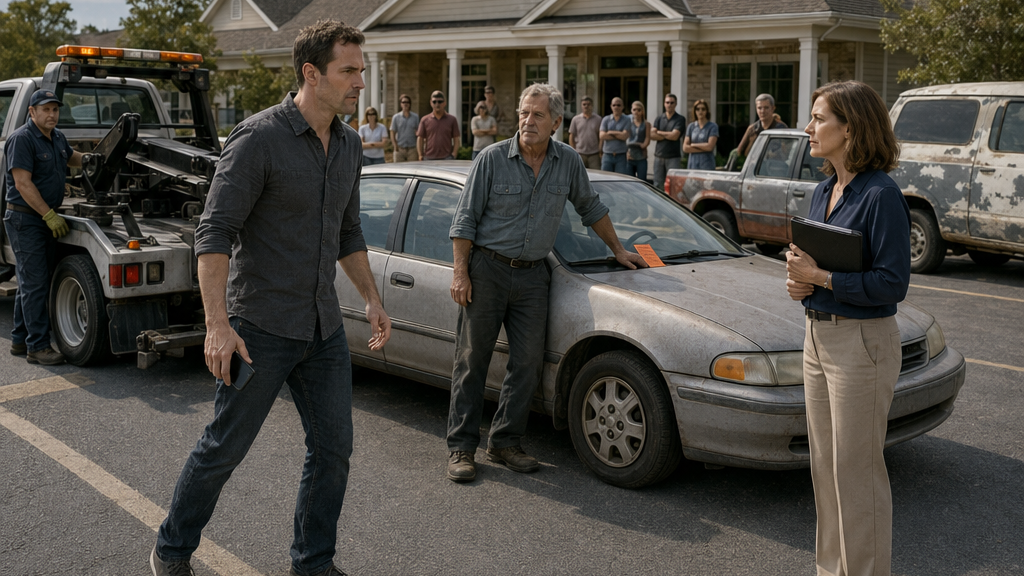
The HOA Shamed His Old Car Until the Neighbors Learned Why He Refused to Replace It
Chapter 1: The Car Everyone Decided Meant Failure
The white envelope was taped to the windshield directly above a rust spot Larry had been promising for two years to sand down.
Brandon saw it before he saw anything else.
He stopped halfway down the front walk with his laptop bag over one shoulder and coffee in his hand. The silver sedan sat crooked in the driveway exactly where his father had left it the night before, clean enough to reflect the garage door but old enough that no amount of washing could disguise its faded hood.
Across the top of the envelope were three words:
PROPERTY COMPLIANCE NOTICE.
“Dad.”
Larry was kneeling beside a planter near the porch, trimming dead leaves from a hosta.
“Morning.”
“You see this?”
“I saw somebody tape something to my windshield at seven fifteen.”
Brandon pulled the envelope free. “And you didn’t think that was worth mentioning?”
Larry clipped another brown leaf.
“You found it.”
Brandon unfolded the notice.
The association had cited “visible conditions inconsistent with neighborhood appearance standards.” Beneath that was a reference to the driveway’s discoloration, some peeling trim near the side garage door, and, in bold, the “continued presence of an aesthetically deteriorated vehicle visible from the common street.”
Brandon read the phrase twice.
“Aesthetically deteriorated?”
Larry stood, knees cracking. “That sounds expensive.”
“It sounds embarrassing.”
Larry looked at him.
Brandon immediately wished he had used another word.
He folded the notice harder than necessary. “I mean the whole thing. Samantha keeps sending these. People see them.”
“People have mailboxes. I assume they receive things too.”
“You know what I mean.”
Larry took the pruning shears toward the garage.
Brandon followed him. “The car is twenty-three years old.”
“Twenty-two.”
“The clear coat is gone.”
“Mostly.”
“The rear bumper doesn’t match.”
“That’s because the original one lost an argument with a city salt truck.”
“And you can afford another car.”
Larry stopped at the garage door.
There it was—the part Brandon had been circling for months.
Since moving back into his childhood bedroom in June, supposedly temporarily, he had begun noticing every flaw in the house as if the neighborhood had assigned him to inspect it. The cracked edge of the driveway. The faded shutters. The silver sedan.
Especially the sedan.
At thirty-eight, after a project-management job had disappeared in a corporate restructuring and an apartment lease had become impossible to justify, Brandon had told everyone he was “helping Dad for a while.”
That explanation sounded better than coming home.
Larry opened the garage.
“I don’t need another car.”
“That isn’t the point.”
“It starts.”
“That still isn’t the point.”
“Brakes work. Air conditioning works. Paid off eleven years ago.”
Brandon glanced toward the street.
A woman walking a small dog slowed just enough to look toward the driveway before continuing.
He lowered his voice. “You don’t hear the comments.”
Larry’s expression changed, but only slightly.
“What comments?”
Brandon regretted starting.
“At the Labor Day thing, Rachel asked whether you were restoring it as a hobby.”
Larry waited.
“And somebody said it looked like a city surplus auction car.”
“It was never city-owned.”
“Dad.”
“I’m correcting the record.”
Brandon shoved the notice into his laptop bag.
He drove to work in his own five-year-old SUV, irritated with Larry, irritated with the HOA, and most of all irritated that those two irritations had become difficult to separate.
That evening, Anthony Rivera was replacing a sprinkler head along the property line when Brandon came home.
Anthony lifted two muddy fingers in greeting.
“Get one too?” Brandon asked.
Anthony looked at the envelope Brandon was holding.
“No. What’d they get you for?”
Brandon handed it over.
Anthony read slowly, then looked toward the sedan.
“That thing leaking oil?”
“No.”
“Registration current?”
“Yes.”
“Does it run?”
“Better than it looks.”
Anthony handed back the notice. “Then what’s the violation?”
Brandon pointed to the phrase.
Anthony read it again.
“Aesthetically deteriorated.”
“Apparently.”
Anthony laughed once, without much humor. “Interesting.”
“What?”
Anthony nodded down the street.
Three houses away, a dark pickup sat at the curb with primer-gray panels along one side. Across from it, an older minivan occupied a driveway with a cracked taillight and a missing wheel cover.
“Those have been there all summer,” Anthony said.
“Maybe they’ve gotten notices.”
“The pickup belongs to a board member’s brother.”
Brandon looked at him.
Anthony pushed loose soil around the sprinkler head. “I’m not saying anything. I stopped saying things around here a while ago.”
“That sounds like saying something.”
“It sounds like me fixing a sprinkler.”
The next morning Samantha Roberts arrived at nine sharp.
She wore a navy blouse, carried a clipboard, and walked the front of the property with the careful seriousness of someone conducting an insurance inspection.
Brandon had stayed home specifically to meet her.
Larry had not.
His father had taken the silver sedan to the hardware store.
Samantha looked toward the empty driveway.
“Where’s the vehicle?”
“Being driven.”
She made a note.
Brandon said, “I read the section you cited.”
“Yes.”
“It doesn’t mention vehicle age or cosmetic condition.”
“It doesn’t need to list every possible condition.”
“It says exterior conditions must be maintained in a manner consistent with community standards.”
“Correct.”
“So what’s the standard for an old car?”
Samantha lowered the clipboard.
“Brandon, these provisions necessarily allow some discretion. We’re not trying to make this adversarial.”
“It already came with a compliance deadline.”
“We’re heading into a heavy listing season. Several owners have expressed concern about visual consistency.”
That phrase landed differently.
Not safety.
Not obstruction.
Visual consistency.
Samantha softened her voice.
“No one is asking your father to buy something extravagant. We’re asking the property to present appropriately from the street.”
Brandon almost said he agreed.
That frightened him more than the notice.
Instead he asked, “Are you inspecting the pickup three houses down?”
Her mouth tightened.
“I’m here regarding this property.”
“So no?”
“I don’t discuss other homeowners’ compliance matters.”
By Friday afternoon, a new email arrived.
FORMAL FOLLOW-UP: VEHICLE CONDITION.
Brandon opened it at his desk.
The message said the board would conduct a neighborhood event at the clubhouse Saturday morning and requested that the silver sedan be removed from common-view areas before then.
The final line was more direct.
Failure to comply may result in authorized removal or towing consistent with association enforcement procedures.
Brandon read it once.
Then again.
At dinner he slid his phone across the table to Larry.
Larry read the email while chewing.
“Well,” he said, “guess I’ll drive to the meeting.”
Brandon stared at him.
“You cannot possibly be serious.”
Larry put the phone down.
“I’m getting tired of people telling me where my own car is allowed to exist.”
For the first time, Brandon realized his father was not merely refusing to replace the sedan.
He was preparing to put it exactly where the board did not want anyone to see it.
Chapter 2: The Tow Truck Arrived Before the Meeting
The tow truck was already backing toward the silver sedan when Brandon turned into the clubhouse lot.
For one second, he did nothing.
The truck’s amber lights flashed across the sedan’s faded trunk. A steel wheel lift hung inches above the pavement.
Larry stood beside the driver’s door with his arms folded.
Samantha Roberts was ten feet away holding a folder.
Brandon parked badly across two spaces and got out.
“What are you doing?”
The tow-company driver glanced toward Samantha.
Samantha answered.
“Brandon, this didn’t need to become a scene.”
“You brought a tow truck.”
“We sent notice.”
“To tow a registered vehicle from a lot where residents are allowed to park?”
“It was specifically requested that this vehicle not be brought here today.”
Larry leaned against the sedan.
“Requested.”
Samantha ignored him.
Around them, homeowners carried folding displays and trays of pastries into the clubhouse for the neighborhood open-house event. Several had stopped pretending not to watch.
Brandon felt the old heat rise into his face.
This was exactly what he hated.
The car.
The attention.
His father refusing to make anything easy.
Then he noticed the warning card tucked beneath the windshield wiper.
Bright orange.
Impossible to miss.
He took out his phone.
Samantha said, “What are you doing?”
“Taking pictures.”
“Of what?”
Brandon photographed the warning.
Then the sedan.
Then he turned.
At the far end of the lot sat a pickup with a dented tailgate and a temporary plastic rear window. Beside it was an older utility van with peeling paint along the roof.
He photographed both.
Samantha stepped closer.
“Those vehicles are not the subject of today’s enforcement.”
“That’s what I’m trying to understand.”
“Brandon.”
He held up a hand.
Not angrily.
That surprised even him.
“What exact rule authorizes you to tow this car?”
“The board has authority to enforce appearance standards.”
“What exact rule?”
Samantha opened her folder.
“Section seven, paragraph four.”
“I read it.”
“Then you know.”
“I know it says exterior property must be maintained consistent with neighborhood standards.”
“Yes.”
“It says nothing about the age of an operable vehicle.”
“The language is intentionally broad.”
“Then show me the policy that defines what qualifies.”
Samantha’s voice lowered.
“This is not a courtroom.”
“No. It’s a parking lot. With a tow truck.”
Somebody behind Brandon coughed to cover a laugh.
He did not turn around.
The tow driver climbed out of the cab.
“Ma’am, I need to know if we’re moving forward.”
Samantha looked toward the clubhouse entrance.
Rachel Miller stood there now, watching.
Two board members had emerged behind her.
Samantha said, “The association has already determined that the condition falls under the appearance provision.”
Brandon nodded slowly.
“Put that in writing.”
“It is in writing.”
“No. The towing basis. Put down the specific condition, the exact provision, and the reason this car qualifies when those don’t.”
He pointed toward the pickup and van.
Samantha’s expression hardened.
“You’re conflating separate matters.”
“Then separate them for me.”
Larry looked at Brandon for the first time since he arrived.
There was no smile on his face, but something in his posture changed.
Brandon suddenly remembered every time over the previous three months he had told Larry just to clean something up, move something, replace something, stop giving people reasons.
He had never once asked whether the reasons were legitimate.
The tow driver rubbed the back of his neck.
“I’m not hooking a vehicle if ownership and authorization are being disputed like this.”
Samantha turned to him.
“We have an association authorization.”
“I understand. But he’s asking for the basis, and the owner’s standing right here objecting. I’m not making that call for you.”
Silence spread farther than Brandon expected.
Samantha closed the folder.
“Fine.”
The word came out clipped.
“The tow can be paused.”
Larry said, “How generous.”
Brandon glanced at him.
“Dad.”
Larry raised both palms.
“I didn’t say anything.”
Samantha faced Brandon.
“Do not mistake a pause for withdrawal of enforcement. The architectural committee can issue a formal determination if that’s what you prefer.”
“I prefer knowing what rule we broke.”
“You know what the concern is.”
“The concern and the rule aren’t the same thing.”
That stopped her.
Only for a second.
Then Samantha gathered herself.
“You work in project estimating, correct?”
The sudden change surprised him.
“Yes.”
“Then you understand that standards aren’t always reducible to one measurement.”
“I also understand that if you’re going to enforce a standard, you need to know what it is.”
Rachel moved closer.
“That seems fair.”
Samantha looked toward her sharply.
Rachel smiled as though she had merely commented on the weather.
The tow truck pulled away six minutes later.
Nobody applauded.
Nobody apologized.
The sedan stayed where it was.
But something had changed.
During the event, three different homeowners spoke to Brandon who had barely acknowledged him before.
One asked about construction pricing.
Another asked whether he knew a reliable exterior contractor.
A board member who had once walked past Brandon while he was carrying groceries now introduced himself and asked whether Brandon planned to stay “long term.”
Brandon answered cautiously.
Near noon, Samantha approached while he was pouring coffee.
Her tone had changed too.
“We don’t want this becoming unnecessarily contentious.”
“Neither do I.”
“There may be a way to resolve the vehicle issue informally while the committee reviews the language.”
Brandon looked at her.
“This morning you had a tow truck.”
“I’m saying there may be flexibility.”
“Why now?”
She picked up a napkin.
“Because escalating every disagreement is bad governance.”
It was reasonable.
That was what made Brandon want to believe it.
When he walked outside, Larry’s sedan sat in full view under the bright September sun.
No one was pointing at it now.
No one had tucked another warning under the wiper.
Rachel caught up with him near the curb.
“You handled yourself well in there.”
“I asked for a rule.”
“You’d be surprised how few people do.”
She smiled.
“A few of us are meeting Tuesday evening about neighborhood improvements. Entrance landscaping, clubhouse repairs, maybe resurfacing. You should come.”
“Me?”
“You do this professionally, don’t you?”
“Estimating, yes.”
“Exactly. We could use somebody who understands actual numbers instead of whatever contractors decide to tell us.”
A week earlier, Rachel had asked Larry whether the sedan was some kind of restoration project.
Now she was inviting Brandon into a private planning meeting.
He should have distrusted the speed of it.
Instead he heard himself say, “What time?”
“Seven.”
She touched his arm lightly, friendly and familiar.
“I’ll save you a seat.”
As Brandon drove home behind Larry’s silver sedan, he noticed something uncomfortable.
For the first time since returning to the neighborhood, he was looking forward to being invited somewhere.
Chapter 3: Suddenly Everyone Wanted Brandon Included
Rachel had saved him a seat directly beside Samantha.
Brandon stopped in the doorway of the community room with a folder under his arm.
Six weeks earlier, Samantha had introduced herself to him by asking whether he was “the adult son staying temporarily at the Anderson property.”
Now she pulled out the chair beside her.
“Brandon. Perfect.”
Perfect.
He sat.
On the table were contractor proposals for new stonework at the subdivision entrance, resurfacing near the clubhouse, and replacing several aging light fixtures.
Rachel slid a coffee toward him.
“Black, right?”
He had told her that once.
At the open house.
He hated how much he liked that she remembered.
“We’re getting murdered on the entrance bids,” she said.
Brandon opened the first packet.
“You’re not getting murdered. You’re paying for three different scopes because nobody gave them the same specifications.”
One of the board members leaned closer.
“Can you tell from this?”
“Pretty quickly.”
For the next forty minutes, Brandon did what he knew how to do.
He compared quantities. Found duplicated mobilization costs. Flagged vague allowances. Pointed out that one contractor had priced full demolition while another assumed the existing base could remain.
The room changed around him.
People stopped explaining things to him and started asking.
“What would you carry for contingency?”
“Is this drainage number reasonable?”
“If we phase it, do we save anything?”
He answered carefully.
Nobody mentioned the sedan.
Not once.
When the meeting paused, Brandon walked to the window.
Larry had driven him over because Brandon’s SUV was at a repair shop for a brake job.
The silver sedan sat beneath the parking-lot light, the same faded car that had nearly been towed four days earlier.
Tonight nobody even seemed to see it.
“You’re good at this.”
Rachel stood beside him.
“It’s my job.”
“Still.”
He glanced at her.
“What?”
“Nothing. I think people had the wrong impression.”
The words landed softly.
“What impression?”
Rachel looked embarrassed.
“You know how neighborhoods are.”
“No. Tell me.”
She hesitated.
“That you were just staying with your dad while you figured things out.”
“I am.”
“I mean they didn’t know your background. What you did.”
He looked back through the window at the table, where Samantha was showing one board member the notes Brandon had made.
“So now they do.”
Rachel gave a small shrug.
“People make assumptions.”
He almost laughed.
That was apparently the most truthful sentence anyone had spoken all night.
When they returned to the table, Samantha pushed the vehicle-notice folder aside.
“By the way, Brandon, I think we can work something out on your father’s car.”
His eyes moved to the folder.
“What does that mean?”
“It means we don’t need to spend the next month exchanging formal letters.”
“Has the rule changed?”
“No. But enforcement always involves judgment.”
A week earlier, that sentence would have angered him.
Tonight, surrounded by people taking his advice seriously, it felt different.
Less like a threat.
More like an invitation.
He heard the danger in that and ignored it.
Samantha continued.
“If the property is moving toward broader improvements anyway, it may make sense to address everything holistically.”
Brandon frowned.
“What broader improvements?”
Rachel answered.
“You mentioned replacing the garage trim and maybe doing the driveway.”
“I said I was getting prices.”
“And possibly the siding later,” Samantha added.
“I said I was looking at conditions.”
The other board member smiled.
“Either way, investment in that corner would be good for everybody.”
That word stayed with him.
Investment.
By the end of the meeting, Brandon had agreed to compare revised bids for the entrance project.
Rachel added him to a committee email thread before he reached home.
The next morning another neighbor waved him down while he was taking trash bins to the curb.
“I heard you’re helping fix the entrance mess.”
“Just reviewing numbers.”
“Thank God somebody competent is.”
Two days later, someone left a contractor’s business card in Larry’s mailbox with a handwritten note recommending exterior painting.
The same afternoon Samantha emailed Brandon directly—not through the management company—to say the vehicle matter could “remain pending without further action” while they discussed a broader property plan.
Larry read the email from Brandon’s phone.
“Huh.”
“What?”
“That car got prettier fast.”
Brandon took the phone back.
“They’re trying to de-escalate.”
Larry opened the refrigerator.
“Of course.”
“You don’t have to make everything cynical.”
“I didn’t make anything.”
“You’re acting like they can’t possibly have realized they were overdoing it.”
Larry removed a pitcher of iced tea.
“Maybe they did.”
Brandon waited.
“That’s it?”
“You seem to want me to argue.”
“No. I want you to admit sometimes people change their minds.”
Larry poured a glass.
“Sometimes they do.”
The answer irritated Brandon more than disagreement would have.
Tuesday evening, he returned to the clubhouse to drop off revised bid notes.
The community room was empty.
He left the folder at Rachel’s place, then realized his phone was missing.
He checked his pockets.
Nothing.
He remembered setting it beside the coffee machine in the clubhouse kitchen.
As he walked down the hall, he heard Rachel speaking through the half-open kitchen door.
“Once the Anderson place gets updated, it could move every comp on that side of the street.”
Brandon stopped.
Another voice answered too quietly for him to identify.
Rachel continued.
“No, I’m serious. If he does the driveway, trim, siding eventually—plus if we get him supporting the entrance assessment—people listing next spring are in a much better position.”
Brandon looked through the narrow opening.
His phone lay on the counter between two coffee cups.
He did not reach for it.
Not yet.
Inside, Rachel lowered her voice.
“And after Saturday, Samantha finally understood we weren’t going to get anywhere by pushing him.”
Brandon stood absolutely still.
Rachel laughed softly.
“Now that we know he can actually help us, we need to bring him in, not chase him out.”
The phrase settled deeper than any violation notice had.
Bring him in.
Not because they had decided he belonged.
Because they had decided he was useful.
Chapter 4: The Friendly Invitation Had a Price
Brandon waited until the second voice left the kitchen before he reached through the half-open door and picked up his phone.
Rachel was still standing beside the counter.
She looked at him, then at the empty spot where the phone had been.
For a moment neither of them spoke.
“You forgot that,” she said.
“Apparently.”
Her face changed in small stages. First surprise. Then calculation. Then something closer to embarrassment.
“How much did you hear?”
Brandon slid the phone into his pocket.
“Enough.”
Rachel lowered her voice.
“You’re taking it the wrong way.”
“I heard you say people needed to bring me in because I could help them.”
“That isn’t what I meant.”
“It sounded pretty specific.”
Rachel glanced toward the hallway.
“Can we not do this standing in the kitchen?”
Brandon almost laughed. “Why? Does it look bad?”
She winced.
He immediately regretted the sharpness, but not enough to take it back.
Rachel folded her arms.
“Fine. You want the ugly version?”
“I’d settle for the honest one.”
“The neighborhood has six houses likely to list between now and spring. Maybe seven. Three are on your side.”
Brandon said nothing.
“The Anderson property is one of the older exteriors on that stretch. Everybody knows it.”
“So?”
“So comparable sales matter.”
“I know how comps work.”
“I know you do. Which is partly why people wanted you involved.”
There it was again.
Wanted you involved.
Not wanted you.
Rachel continued before he could interrupt.
“If your father’s place gets cleaned up, if the driveway gets resurfaced, if the entrance looks better, all of that helps.”
“And the car?”
She looked away.
“The car was never the biggest issue.”
Brandon stared at her.
“Really.”
“I’m saying some people made it bigger than it was.”
“Samantha brought a tow truck.”
“Yes.”
“And now she’s offering flexibility.”
Rachel exhaled.
“Because Saturday changed things.”
“How?”
“You showed her you weren’t going to be bullied into moving it. And people learned what you do.”
Brandon’s jaw tightened.
“You mean they learned I might be useful.”
“That’s not fair.”
“Isn’t it?”
Rachel stepped closer.
“Brandon, people make judgments. You made judgments too.”
He frowned.
“About what?”
“About Samantha. About the board. About this whole place.”
“They tried to tow my father’s car.”
“I’m not defending that.”
“It sounds like you are.”
“No. I’m saying the board’s under pressure.”
She paused.
“Two owners have already complained that the entrance looks dated. Another is blaming landscaping and curb appeal for a low appraisal. Samantha has been getting calls for months.”
“So she picked the oldest car she could see.”
Rachel’s silence answered for her.
Brandon looked toward the dark window.
The silver sedan was parked outside beneath the clubhouse light.
Nobody had put a warning on it tonight.
Nobody had asked Larry to move it.
Nobody had even mentioned it.
Rachel followed his gaze.
“Samantha told people not to push you too hard now.”
Brandon turned back.
“Now?”
Rachel realized what she had said.
“That came out badly.”
“No, I think it came out exactly right.”
She rubbed her forehead.
“She thinks if you’re already planning improvements, forcing another fight over the vehicle is counterproductive.”
“I told her I was getting prices. That’s all.”
“You also just saved the committee thousands if those revisions are right.”
“They are right.”
“That’s my point.”
“No. That’s my problem.”
Rachel’s expression tightened.
“I invited you because you know what you’re doing.”
“Would you have invited me before Saturday?”
She did not answer fast enough.
Brandon nodded.
“That’s what I thought.”
He left the clubhouse with the folder he had brought still sitting on the table.
Halfway across the lot he almost turned back for it.
The revised bids contained three hours of his work.
He had marked duplicated mobilization costs, corrected quantities, and written questions in the margins that would likely save the association real money.
Rachel could use all of it.
So could Samantha.
He had already helped them.
That fact bothered him more than he expected.
At home, Larry was in the garage with the hood of the silver sedan open.
A work light hung from the latch.
“What happened?” Larry asked without looking up.
“Why does something have to happen?”
“You only shut the garage door that hard when something happens.”
Brandon set his keys on the bench.
Larry was replacing a cracked vacuum hose near the engine. His hands were black around the fingertips.
Brandon leaned against the tool cabinet.
“They want me on the committee because of the house.”
Larry tightened a clamp.
“House has always been here.”
“They think I’m going to renovate it.”
“You’ve been talking about renovating it.”
“They think if I do, it helps their sale prices.”
Larry nodded once.
“And they think if I help with the entrance project and support the assessment, that helps them too.”
Larry wiped his hands on a rag.
“There it is.”
Brandon looked at him sharply.
“There what is?”
“The reason everybody suddenly discovered your phone number.”
“You knew?”
“I suspected.”
“How?”
Larry closed the hood gently.
“Because people rarely change that fast without learning something new.”
Brandon paced once across the garage.
“You could have said something.”
“You wouldn’t have listened.”
“You don’t know that.”
Larry looked at him.
Brandon hated that look because it contained no triumph.
Only familiarity.
“You liked it,” Larry said.
Brandon stopped.
“What?”
“Being asked.”
“That has nothing to do with it.”
“It has everything to do with it.”
“They were treating me like I belonged.”
“And you wanted that.”
“Yes.”
The word came out louder than he intended.
Larry did not react.
Brandon took a breath.
“Yes. I wanted that. Is that supposed to be some kind of character flaw?”
“No.”
“Because you act like caring what people think is a moral failure.”
“I didn’t say that either.”
“You don’t have to.”
Larry folded the rag and set it on the bench.
“People wanting you around feels good. Especially when you spent a while feeling like they didn’t.”
Brandon looked down.
Larry’s voice softened.
“But sometimes you need to know what changed.”
Brandon thought about Rachel remembering he drank his coffee black.
Samantha pulling out a chair.
Neighbors asking his opinion.
The board member suddenly interested in whether he planned to stay.
A week ago, he had interpreted those things as respect.
Now each one seemed to have a price tag attached.
He said, “Why are you not surprised?”
Larry looked toward the sedan.
Then toward Brandon.
“Because I’ve seen this before.”
“Here?”
“Some of it.”
Brandon waited.
Larry picked up the rag again, though his hands were already clean.
“When I retired, a few things changed.”
“What things?”
“People.”
The garage went quiet.
Brandon had expected another half-answer.
This time Larry did not move away from the question.
He looked directly at him.
“I figured you’d notice eventually.”
Brandon felt irritation rise again.
“You figured I’d notice?”
Larry nodded.
“That’s why you kept the car, isn’t it?”
Larry’s expression did not change.
But the answer took too long.
Chapter 5: Larry Finally Explained the Old Sedan
“Did you keep that car just to prove something to me?”
Brandon’s question landed between them with the hood of the sedan still warm.
Larry leaned against the workbench.
“No.”
Brandon waited.
Larry added, “Not just to prove something.”
“That’s worse.”
“I figured you’d say that.”
“So you did.”
Larry looked toward the open garage door.
“Come inside.”
“No.”
“Brandon.”
“No. You don’t get to drag me through three months of this and then make coffee before explaining it.”
Larry’s mouth tightened.
“I didn’t drag you through anything.”
“The HOA treated the car like a stain on the neighborhood. I asked you to replace it. You kept acting like none of it mattered.”
“It didn’t matter to me.”
“It mattered to me.”
That stopped him.
Brandon stepped closer.
“You knew I hated being judged for coming back here. You knew I already felt like I’d failed. Then every time somebody looked at that car or the house like we were lowering the block, you just stood there and acted above it.”
Larry stared at him.
Brandon’s voice dropped.
“Were you waiting for me to learn some lesson?”
Larry did not answer immediately.
That was answer enough.
Brandon turned away.
“Unbelievable.”
“I wasn’t trying to humiliate you.”
“You let it happen.”
“I let people show themselves.”
Brandon laughed once.
“There. That. You hear how that sounds?”
Larry’s face hardened.
“Yes.”
“Like you were running an experiment.”
“I kept my car.”
“You knew what people thought about it.”
“So did you.”
The words hit cleanly.
Brandon turned back.
Larry continued.
“You wanted me to replace a perfectly good car because you were embarrassed.”
“I wanted them to stop treating us like we didn’t belong.”
“And buying a different car would have fixed that?”
“It would have stopped one thing.”
“One thing you could see.”
Brandon folded his arms.
“Fine. Tell me what I couldn’t see.”
Larry was quiet for several seconds.
Then he picked up the work light and carried it into the kitchen.
This time Brandon followed.
Larry set two glasses of water on the table and sat down.
He did not touch his.
“When I retired from the city, people knew me.”
Brandon frowned.
“You were a fleet mechanic.”
“Fleet supervisor the last nine years.”
“I know.”
“They called when a truck was down. Called when they needed a vendor recommendation. Called when their kid wanted to get into public works. Called when somebody wanted to know whether a used pickup was worth buying.”
Larry looked at the table.
“For a long time, I thought those calls were friendships.”
Brandon sat across from him.
“What happened?”
“I retired.”
“That’s it?”
“That was enough.”
Larry gave a small shrug.
“The phone got quieter.”
“That happens when people leave work.”
“Yes.”
“But?”
Larry rubbed one thumb across a scratch in the tabletop.
“But then I sold the newer SUV.”
Brandon remembered it vaguely. Dark blue. Comfortable. Too large for Larry after his mother died.
“I didn’t need two vehicles,” Larry said. “Insurance was stupid. The sedan was paid for and easier to maintain.”
“And people noticed.”
“Some did.”
He smiled without humor.
“One neighbor asked if I was having money trouble.”
Brandon looked up.
“Another offered to give me the number for a credit counselor.”
“You’re serious.”
“Completely.”
“What did you say?”
“Thank you.”
That sounded exactly like Larry.
“Then somebody stopped asking me to look at bids for a drainage project because apparently being retired also made me unable to read numbers.”
Brandon shifted in his chair.
Larry continued.
“Couple of people I’d helped for years got distant. Not everybody. Anthony didn’t. Some others didn’t.”
“So you decided everyone was fake.”
“No.”
“But you decided to test them.”
Larry finally took a drink.
“That came later.”
Brandon stared at him.
Larry set the glass down.
“When you moved back, you were already wound tight.”
“I was unemployed.”
“You were between jobs.”
“I lost my job.”
“You found contract work in six weeks.”
“That doesn’t change what it felt like.”
“I know.”
“No, you don’t.”
Larry nodded.
“Maybe I don’t.”
The admission quieted Brandon.
Larry looked tired now, not wise.
That difference mattered.
“I saw you watching people watch you,” Larry said. “The house. The driveway. The car. Every little thing.”
“So you decided not to explain.”
“I decided if I told you, you’d think I was bitter.”
“Were you?”
Larry’s mouth moved as if he might deny it.
Then he stopped.
“Yes.”
The word surprised Brandon.
Larry looked toward the dark doorway leading to the garage.
“Still am, some days.”
Brandon said nothing.
“I kept the car because it works,” Larry continued. “Because it’s mine. Because I don’t owe anybody a newer one.”
He rubbed his hands together.
“And yes. Part of me liked knowing what people showed me when they thought I couldn’t offer them anything.”
There it was.
Not wisdom.
Not entirely.
A wound.
Brandon leaned back.
“So when I got embarrassed…”
“I thought you needed to see it too.”
“You could have told me.”
“I could have.”
“You should have.”
Larry nodded.
“Yes.”
That answer did more than an argument would have.
Brandon looked at him carefully.
“You really mean that?”
“I thought silence would teach you better than a lecture.”
“And?”
“And maybe silence was easier for me.”
Larry’s eyes stayed on the table.
“I didn’t have to tell you how much it bothered me when people changed.”
Brandon felt something in his anger loosen.
Not disappear.
Just become less simple.
“I thought you didn’t care.”
“I cared too much.”
For a while neither spoke.
The refrigerator clicked on.
Outside, a car passed slowly along the street.
Brandon thought about the tow truck, Rachel’s coffee, Samantha’s sudden flexibility.
He thought about how quickly he had wanted to believe the change.
“I liked being invited,” he said.
Larry looked up.
“I know.”
“I knew the timing was strange.”
“That doesn’t make you stupid.”
“I ignored it anyway.”
“That makes you human.”
Brandon smiled despite himself.
“Careful. That sounded supportive.”
Larry almost smiled back.
Brandon’s phone buzzed on the table.
An email.
Samantha Roberts.
SUBJECT: PROPOSED RESOLUTION — ANDERSON PROPERTY.
Brandon opened the attachment.
It was a one-page waiver.
The association would suspend enforcement regarding the sedan provided the Anderson property proceeded with several exterior maintenance items within an agreed schedule.
No admission that the vehicle notice had been improper.
No change to the vague appearance language.
No standard applying to anyone else.
At the bottom was a signature line.
Brandon Anderson.
Larry read over his shoulder.
“Well,” he said.
Brandon scrolled to the last paragraph.
Acceptance of this resolution shall apply solely to the Anderson property and shall not constitute precedent regarding enforcement against other lots.
The words seemed colder than the orange tow warning had.
A private solution.
For him.
Only him.
Brandon stared at the blank signature line.
If he signed it, the problem disappeared.
His problem.
Everyone else would still be subject to whatever the board decided “appearance” meant.
Larry did not tell him what to do.
That might have been the first part of the lesson Brandon actually trusted.
Chapter 6: The Easy Exception Was the Real Test
Brandon signed the waiver at 8:12 Monday morning.
Then he stopped before writing the date.
His pen hovered over the line.
The document lay on his desk beside a mug of coffee and the original violation envelope, which he had flattened under a notebook overnight.
He had read the waiver six times.
Each time the same sentence pulled at him:
shall apply solely to the Anderson property.
All he had to do was date it, scan it, and send it back.
The tow issue would disappear.
The notices would stop.
Samantha would get her quiet resolution.
Rachel would probably stop looking embarrassed every time she saw him.
Brandon put down the pen.
From the kitchen, Larry called, “You sending it?”
“Maybe.”
“That means no.”
Brandon did not answer.
He opened the folder where he had saved the photographs from the clubhouse parking lot.
Larry’s sedan.
The primered pickup.
The utility van.
The cracked-taillight minivan from their street.
He enlarged each image.
Then he opened the association portal.
The records request he had submitted Friday had produced months of architectural-compliance summaries, stripped of owner names but organized by date, property category, and outcome.
Brandon started matching dates.
Fence stain.
Trash container visibility.
Mailbox paint.
Dead shrubs.
Trailer storage.
No vehicle condition notices except theirs.
He checked again.
Nothing.
At ten, he drove to the management office and asked to review the nonconfidential compliance log in person.
The records room was less dramatic than he expected: a small conference room, two gray filing cabinets, fluorescent lighting, and a binder with printed monthly reports.
The management representative placed it on the table.
“You can review, but no owner-identifying information.”
“Understood.”
Brandon worked for an hour.
He was not looking for a conspiracy.
He was looking for a pattern.
That distinction mattered to him.
He found one.
Two entries referenced “informal vehicle appearance concerns” but showed no formal notice.
One had been resolved through a verbal conversation.
Another had been closed with no action.
Neither had escalated.
Neither had produced a tow threat.
He photographed the relevant pages.
On the way home, Anthony was unloading bags of mulch.
Brandon pulled into his driveway and walked over.
“You ever get warned about a vehicle?”
Anthony froze with one bag against his hip.
“Why?”
“That’s not a no.”
Anthony lowered the bag.
“Couple years ago.”
“What happened?”
“I had an old work van.”
“The white one?”
“You remember that?”
“Barely.”
Anthony wiped his hands on his jeans.
“Samantha said somebody complained it made the street look commercial.”
“Written notice?”
“No.”
“Fine?”
“No.”
“Towing?”
Anthony shook his head.
“What did she say?”
“That I should think about parking it inside if I wanted to avoid making it an official issue.”
Brandon felt the shape of the pattern become clearer.
“Why didn’t you challenge it?”
Anthony looked toward his own house.
“My wife was sick then. I didn’t have energy for a board fight.”
“Did you move it?”
“Sold it six months later. Didn’t need it anymore.”
“Would you tell the board what happened?”
Anthony’s expression closed.
“I don’t know.”
“Why not?”
“Because I’ve lived here fifteen years without being on anybody’s committee, and I like it that way.”
Brandon nodded.
He understood that more than he wanted to.
Anthony added, “I’m telling you because you asked me privately. That’s different.”
“Okay.”
Brandon turned to leave.
“Brandon.”
He looked back.
Anthony shifted his weight.
“If you make it about Samantha personally, they’ll close ranks.”
“I’m not planning to.”
“Good.”
Anthony picked up another bag.
“Make it about the rule.”
By afternoon, Brandon’s desk had become an evidence table.
The orange warning.
The formal notice.
Photographs.
Compliance logs.
Samantha’s waiver.
A printed copy of the appearance provision.
He wrote dates on sticky notes and placed them in order.
The progression was obvious.
Informal criticism.
Formal notice.
Tow threat.
Public challenge.
Sudden friendliness.
Private waiver.
He sat back.
Larry appeared in the doorway.
“Looks serious.”
“I’m trying to decide if I’m angry or organized.”
“Could be both.”
Brandon looked at the waiver again.
“I almost signed it.”
“Would’ve been easier.”
“Yes.”
Larry nodded toward the documents.
“But?”
“But then every time I saw Anthony’s old van or somebody else’s car, I’d know I let them make a special rule for me.”
“You planning to save the neighborhood?”
“No.”
“Good.”
Brandon looked at him.
“I’m planning to ask them to write down what they actually mean.”
Larry nodded.
“That sounds more useful.”
At four twenty, Samantha called.
Brandon let it ring once before answering.
“I saw you accessed compliance records.”
“I did.”
There was a pause.
“Are you preparing some kind of complaint?”
“I’m reviewing how the vehicle standard has been applied.”
“There is no separate vehicle standard. We’ve discussed that.”
“Exactly.”
Her voice tightened.
“The waiver was intended to avoid this kind of escalation.”
“The waiver avoids it for me.”
“It resolves your issue.”
“It resolves my issue by saying the same thing can still happen to somebody else.”
“Brandon, homeowners regularly receive property-specific resolutions.”
“I understand.”
“Then I’m not sure what you want.”
“A standard.”
“We have one.”
“Then define it.”
Samantha exhaled audibly.
“The board cannot draft a rule for every cosmetic condition that might arise.”
“I’m not asking for every condition. I’m asking what makes an operable, registered car an appearance violation.”
“You’re reducing a broader community concern to one object.”
“It was one object when you brought a tow truck.”
Silence.
When Samantha spoke again, her tone had lost some of its polish.
“If you reject the waiver, the original enforcement status remains active.”
Brandon looked at the unsigned date line.
“So the tow threat comes back?”
“I said enforcement status.”
“That isn’t an answer.”
“It means the matter returns to the board process.”
Brandon closed his eyes.
A week ago, that would have been enough to scare him into signing.
Now it clarified the choice.
“Okay.”
“Okay what?”
“I’m rejecting the waiver.”
Another pause.
“You should think carefully about that.”
“I have.”
“You’re choosing a public dispute over a resolution.”
“I’m choosing a resolution that means the same thing for everybody.”
Samantha’s voice cooled.
“Then you’ll need to present your concerns at the next board meeting.”
“I will.”
After the call, Brandon opened his email.
He attached the waiver unsigned.
Then he attached the compliance-log excerpts and his photographs.
He did not accuse Samantha of targeting his family.
He did not mention Rachel.
He did not mention resale values.
He wrote only three paragraphs.
He requested that the board place the vehicle enforcement issue on the monthly meeting agenda, identify the objective criteria used to determine violations, and review whether those criteria had been applied consistently.
Before sending, he read the message aloud.
Larry listened from the kitchen.
“You asking them to rescind your notice?”
“Yes.”
“Anything else?”
“To adopt a clear standard before using the appearance clause against anybody else’s vehicle.”
Larry nodded once.
Brandon’s finger hovered over Send.
The old instinct returned for one last second.
Keep it private.
Get your exception.
Let everybody like you again.
He clicked.
The email left.
Four minutes later, a reply came from the management company.
Your request has been added to the open-session agenda for Thursday’s board meeting.
Brandon stared at the screen.
Below that was another sentence.
The board will address both the Anderson enforcement action and the association’s authority to apply appearance standards to resident vehicles.
What had started as a warning taped to one old sedan would now have to be defended in front of the neighborhood.
Chapter 7: One Rule Had to Mean the Same Thing
Samantha opened the meeting by sliding the waiver across the table toward Brandon.
“One final opportunity,” she said.
The clubhouse room was fuller than usual.
Not packed, but full enough that every chair along the wall had someone in it. A few homeowners stood near the back. The management representative sat beside the board with a laptop open. Rachel was two seats down from Samantha, hands folded around a paper cup.
Anthony had taken a chair near the aisle.
Larry sat in the last row.
Brandon had asked him whether he wanted to come.
Larry had said, “It’s your meeting.”
Then he had come anyway.
Samantha rested two fingers on the waiver.
“If you accept the property-specific resolution tonight, the board can close the Anderson matter without additional enforcement.”
Brandon looked at the page.
His signature was still there.
The date line was blank.
“Does accepting it change the vehicle standard for anyone else?”
Samantha’s expression remained controlled.
“It resolves your property.”
“That wasn’t my question.”
One of the board members shifted in his chair.
Samantha said, “The board has discretion to evaluate circumstances individually.”
Brandon pushed the waiver back.
“Then no.”
A small movement passed through the room.
Not applause.
Just people adjusting, looking up, realizing there would be no quick settlement.
Samantha leaned back.
“All right.”
The management representative clicked something on the laptop.
Samantha continued.
“The board’s position is that the association’s appearance provisions permit reasonable enforcement where a visible condition negatively affects community standards.”
Brandon opened his folder.
“What makes a vehicle qualify?”
“We’ve been through this.”
“I know. I’m asking because tonight it’s public.”
Her eyes narrowed slightly.
“The age and visible deterioration of the vehicle were factors.”
“Which deterioration?”
“Paint condition. Body condition. Overall appearance.”
“Mechanical condition?”
“No.”
“Registration?”
“No.”
“Safety?”
“That was not the concern.”
“So an operable, registered vehicle can violate the rules because the paint looks old.”
“When the overall appearance becomes inconsistent with neighborhood standards, yes.”
Brandon placed a photograph on the table.
Larry’s sedan in the clubhouse lot.
Then another.
The pickup with primer-gray panels.
Then the utility van with peeling roof paint.
Then the minivan missing a wheel cover.
He did not dramatize them.
He did not hold them up.
He simply placed them in a row.
“These were all visible during the same period.”
Samantha glanced at them.
“I’m not going to discuss individual owners.”
“I’m not asking you to.”
He placed copies of the compliance summaries beside the photographs.
“I’m asking why one vehicle received a formal written notice and a towing threat while comparable vehicle concerns were handled informally or not escalated.”
One board member leaned toward the papers.
“Are those from the management logs?”
“Yes.”
The management representative confirmed it.
“They’re redacted compliance records.”
Samantha looked at Brandon.
“You’re presenting different facts as though they’re identical.”
“I’m presenting the way they were treated.”
“The board has to consider context.”
“Then what context justified the tow truck?”
The room went quiet.
Samantha’s jaw tightened.
Brandon felt the old urge to push harder.
To make her admit everything.
He stopped himself.
Anthony’s advice returned to him.
Make it about the rule.
Brandon tapped the original notice.
“This says the car violated an appearance standard. It doesn’t say it blocked access. It doesn’t say it was inoperable. It doesn’t say it was unregistered. The only basis given was appearance.”
He looked around the table.
“If appearance is enough, what is the objective threshold?”
No one answered immediately.
One of the other board members finally said, “I think that’s a fair question.”
Samantha turned.
“We have never pretended every standard can be reduced to a checklist.”
“No,” the board member said. “But towing is more serious than asking someone to move trash cans.”
The second board member nodded.
“That part bothers me.”
Samantha exhaled slowly.
“You’re both ignoring the pressure we’ve been getting.”
Brandon looked at her.
“What pressure?”
She looked toward the homeowners in the room.
For the first time that evening, she seemed less like the president and more like a person who had been holding too many complaints.
“We have owners preparing to sell.”
A murmur came from the back.
Samantha continued.
“They’ve raised concerns about exterior maintenance, the entrance, landscaping, curb appeal, deferred repairs. We had an appraisal come in under expectation this summer. Whether everyone agrees with those concerns or not, people expect the board to protect neighborhood standards.”
Brandon said, “By targeting the most visible old car?”
“I didn’t say targeting.”
“But that’s what happened.”
“I said addressing conditions people were complaining about.”
“Were people complaining about my father’s car?”
Samantha hesitated.
“Yes.”
“How many?”
“That’s not relevant.”
“It seems relevant if complaints are what caused the escalation.”
Rachel looked down at her coffee.
Samantha’s voice hardened.
“Several owners expressed concern about the Anderson property generally.”
There it was.
Not just the car.
The driveway.
The trim.
The house.
The perception.
Brandon said, “And then the pressure stopped.”
Samantha looked at him.
“When did that happen?”
No answer.
He continued.
“After the tow attempt, I got invited to the improvement meeting. The vehicle matter was suddenly flexible. I was offered a private waiver.”
“Because the board was trying to resolve a dispute.”
“And because you learned I was considering work on the property.”
Rachel shifted in her chair.
Samantha’s eyes moved toward her.
Brandon saw it.
He had not planned to use what he overheard unless necessary.
He still did not quote Rachel.
Instead he asked, “Did the board’s approach soften after you learned I might renovate the Anderson property and help with the entrance project?”
Samantha’s silence lasted three seconds.
Maybe four.
Then she said, “Yes.”
The room changed.
Not dramatically.
But enough.
One of the homeowners near the wall whispered something.
Samantha lifted her hand.
“Not because we suddenly decided Mr. Anderson was more important.”
Brandon said nothing.
“Because if broader property improvements were already being discussed, continued aggressive enforcement over one vehicle seemed counterproductive.”
One of the board members frowned.
“That is not how this was presented to us.”
Samantha looked at him.
“We discussed resolving the matter.”
“You said the owner was becoming cooperative.”
Samantha’s face flushed.
Rachel finally spoke.
“She did tell some of us to back off.”
Every head near the table turned.
Samantha stared at her.
Rachel swallowed.
“I’m not saying there was some scheme. There wasn’t. But after Brandon started helping with the bids, the tone changed.”
“Rachel,” Samantha said.
“It did.”
Rachel looked at Brandon briefly.
“And that isn’t fair either.”
Brandon felt no satisfaction.
Only a strange heaviness.
He had wanted the truth in the room.
Now that it was there, it looked smaller and more ordinary than conspiracy.
People protecting investments.
People wanting easier outcomes.
People being nicer when somebody became useful.
That ordinariness made it worse.
Anthony stood from his chair.
“I had a vehicle conversation too.”
Samantha looked toward him.
Anthony kept his hands in his pockets.
“Couple years ago. Old work van. I was told to park it inside if I didn’t want it to become official.”
One board member asked, “Was there a written notice?”
“No.”
“Fine?”
“No.”
“Tow?”
Anthony shook his head.
“No.”
He looked at Brandon, then Samantha.
“I didn’t fight it because I had other things going on. But if we’re talking consistency, it wasn’t consistent.”
Then he sat down.
Brandon had not asked him to speak.
That mattered.
The management representative cleared her throat.
“There may be a practical way forward.”
Samantha looked tired now.
“What do you recommend?”
“Rescind the Anderson vehicle notice pending adoption of a more specific vehicle enforcement policy. If the board wishes to regulate cosmetic vehicle conditions, the standard should identify objective factors and an enforcement process.”
One board member nodded immediately.
The other asked, “And towing?”
“Reserved for clearly authorized circumstances.”
Samantha looked at the original orange tow warning sitting among Brandon’s papers.
For a moment, Brandon thought she might fight.
Instead she said, “I still believe the board has a responsibility to address conditions that affect the community.”
“So do I,” Brandon said.
She looked at him.
He continued.
“I’m not asking you to stop enforcing standards.”
“What are you asking?”
“That one rule mean the same thing before you decide who deserves flexibility.”
The sentence settled in the room.
Samantha glanced toward the board members.
“Motion?”
One of them made it.
Rescind the Anderson vehicle notice.
Suspend cosmetic vehicle enforcement under the vague appearance clause.
Draft a uniform vehicle standard for review at the next meeting.
The second board member seconded.
Samantha did not vote first.
She waited.
The two members voted yes.
Then Samantha raised her hand.
“Yes.”
No one applauded.
Brandon was grateful for that.
The management representative marked the decision.
The meeting moved on to landscaping bids.
For fifteen minutes Brandon sat with the original violation notice still in front of him.
It had once made him want to hide the car.
Now it looked like what it was.
Paper.
After adjournment, homeowners drifted toward the door.
Rachel approached him.
“I’m sorry.”
Brandon looked at her.
“For what?”
“For making usefulness look like friendship.”
It was more direct than he expected.
He nodded.
“Thank you.”
She seemed to expect more.
He did not offer it.
Anthony waited near the exit.
“You going home?”
“Yeah.”
“I’ll walk.”
Outside, Larry stood beside the silver sedan.
The same car.
Same faded hood.
Same mismatched bumper.
Brandon walked toward him.
Larry looked at his face, then at the papers in Brandon’s hand.
“Get your exception?”
“No.”
Larry raised an eyebrow.
“I got rid of it.”
For the first time all night, Larry smiled.
But Brandon did not.
Not yet.
Winning the board issue had been easier than deciding what to do with the part of himself that had once wanted the car gone too.
Chapter 8: He Kept the Car for a Different Reason
Larry found Brandon washing the sedan three Saturdays later.
He stood at the edge of the garage holding a cardboard box of furnace filters and watched for several seconds before speaking.
“You lose a bet?”
Brandon dragged the sponge across the hood.
“No.”
“Car wash closed?”
“No.”
“You feeling all right?”
Brandon looked over.
“Do you want me to stop?”
Larry set the box down.
“Absolutely not.”
The car was still old.
The paint was still tired.
Water gathered in dull beads across the roof instead of shining.
Brandon had ordered a replacement rear bumper from a salvage yard, but only because the old one had finally cracked near the mounting bracket.
He had not ordered new paint.
He had not priced another car.
That surprised him.
The HOA had rescinded the notice formally the week after the meeting. A draft vehicle policy was now circulating among homeowners, focused on registration, operability, fluid leakage, blocked access, and long-term storage rather than subjective appearance.
The Anderson driveway was scheduled to be resurfaced in spring.
Brandon had replaced the peeling garage trim himself.
He had also decided the siding could wait.
Not everything the HOA had noticed was imaginary.
That had been another uncomfortable discovery.
Some repairs were needed.
The difference was that he wanted to make them because the house needed them, not because he wanted the street to approve of him.
Larry walked around the sedan.
“You missed a spot.”
Brandon threw the sponge at him.
Larry caught it against his shirt.
“Violence against a senior citizen.”
“You’re sixty-eight.”
“Exactly.”
They worked without speaking for a while.
Larry rinsed the passenger side.
Brandon wiped water from the windows.
At last Brandon said, “I used to hate being seen in this thing.”
Larry stopped spraying.
“I know.”
“I mean really hate it.”
“I know that too.”
“Every time you pulled into the driveway, I’d look around first.”
Larry shut off the hose.
Brandon rested both hands on the roof.
“I thought people saw the car and then decided who I was.”
“Some probably did.”
“That’s not the part I was wrong about.”
Larry waited.
“I was wrong because I started agreeing with them.”
The words felt different spoken aloud.
Brandon continued.
“I looked at the car and saw myself coming home. Job gone. Living in my childhood room. Dad driving something with mismatched paint.”
Larry nodded slowly.
“So every time they judged it, I thought they were confirming something.”
“That you failed.”
“Yeah.”
Larry leaned against the rear quarter panel.
“You didn’t.”
“I know that now.”
“Good.”
“But you still should have talked to me.”
Larry lowered his eyes.
“I know.”
Brandon looked at him.
Larry rubbed one hand over the top of the hose nozzle.
“I was wrong about that.”
The apology was quiet.
No defense attached.
No lesson after it.
Larry continued.
“I told myself I was letting you figure people out.”
He looked toward the street.
“Truth is, part of me wanted somebody else to see what I saw after I retired.”
Brandon said nothing.
“That wasn’t fair to you.”
“No.”
Larry nodded.
“No.”
Brandon picked up the towel again.
After a moment he tossed Larry another one.
“That doesn’t mean you were wrong about everyone.”
“Didn’t say I was.”
“There he is.”
Larry smiled.
A car slowed near the house.
Rachel Miller pulled into the curb.
She got out carrying a folder.
Brandon felt his shoulders tighten automatically, then loosen.
Rachel came up the driveway.
“The car looks good.”
Larry glanced at Brandon.
Brandon ignored him.
“Thanks.”
Rachel handed over the folder.
“The board approved the revised entrance scope.”
“I heard.”
“We used your bid notes.”
“That’s fine.”
She hesitated.
“There’s something else.”
Brandon waited.
“The committee chair is stepping down after the project. Samantha and the others asked whether I’d see if you were interested.”
Larry busied himself with the hose.
Brandon almost laughed.
Not because the offer was insulting.
It wasn’t.
Three months earlier he would have wanted it badly.
A seat.
A role.
A visible sign that people considered him valuable.
Now he could see the offer without needing it to mean anything more.
“I appreciate it,” he said.
Rachel looked hopeful.
“But no.”
“Oh.”
“I’ll help if there’s a bid question or something I actually know about. I don’t want the committee job.”
Rachel studied him.
“Because of what happened?”
“Partly.”
“That’s fair.”
“And partly because I don’t need another meeting.”
That made her laugh.
“Also fair.”
She turned toward the street, then paused.
“For what it’s worth, I am trying to do better.”
Brandon nodded.
“I believe you.”
He did.
Believing her did not require becoming close to her.
That was another thing he had learned.
After Rachel left, Larry said, “Committee chair.”
“Don’t.”
“Could’ve had power.”
“Terrifying amounts.”
“Reserved parking.”
“Go inside.”
Larry laughed and carried the filters toward the garage.
That evening the HOA was holding a meeting to review the new vehicle-policy draft.
Brandon had not planned to attend until Anthony texted asking whether he was going.
Larry tossed Brandon the sedan keys.
“Take mine.”
Brandon caught them.
His first instinct was to ask why.
Then he looked through the front window.
The silver sedan sat in the driveway, clean but undeniably itself.
He put the keys in his pocket.
Anthony was waiting near his mailbox when Brandon backed out.
He opened the passenger door and looked around the interior.
“Smells like your dad.”
“Old coffee and motor oil?”
“Exactly.”
Brandon pulled onto the street.
They passed the house with the primered pickup.
The minivan was still across from it.
Neither looked offensive now.
They looked like vehicles people used.
At the clubhouse, Brandon parked in the same lot where the tow truck had once backed toward Larry’s rear bumper.
No warning was waiting under the windshield wiper.
No one stared.
Anthony got out and closed the passenger door.
“You know,” he said, “I still wouldn’t buy this thing.”
Brandon laughed.
“Good.”
“Just checking.”
They walked toward the clubhouse together.
Halfway there, Brandon glanced back once.
The silver sedan sat beneath the parking-lot light.
Months earlier, he had wanted everyone to stop seeing it.
Now he understood that was never something he could control.
What he could control was whether their opinion followed him home.
He turned away from the car and went inside.
The story has ended.