She Forced Him to Remove the Porch Lights—Then the Whole Neighborhood Went Dark
Chapter 1: The Lights She Called a Violation
“You need to take those down.”
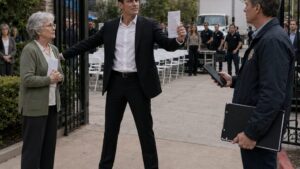
Deborah Wright stood at the bottom of Jack Davis’s porch steps with one arm raised, her index finger aimed at the strand of colored bulbs tucked beneath the roofline.
Jack looked up from his white coffee mug.
The bulbs were already glowing, though sunset was still half an hour away: blue over the porch column, amber above the front window, red near the driveway corner, then green and white continuing toward the side gate.
“They come on automatically,” he said.
“That wasn’t my question.”
Deborah wore a navy windbreaker embroidered with the association’s small oak-tree emblem. A clipboard rested against her hip. She had come prepared to make the conversation official, even if she had begun it from the sidewalk.
Jack took a slow drink. “You said I needed to take them down.”
“They’re holiday lights. It’s March.”
“They aren’t holiday lights.”
For a second, Deborah’s expression loosened, as if she expected him to smile and admit the joke. When he did not, she folded her arms.
“They are red, green, blue, and gold.”
“Amber.”
“What?”
“The gold one is amber.”
“That does not make them security equipment.”
Jack glanced toward the driveway. A dark camera housing sat beneath the eave, nearly invisible against the trim. Another watched the side yard. A third faced the narrow strip of road where four mailbox posts stood beyond the curve.
He could have pointed them out. He could have explained the low-light settings, the motion relays, the way the colored bulbs spread illumination without throwing a harsh white glare into bedroom windows.
Instead, he said, “They’re security lights.”
Deborah’s mouth tightened. “Nobody needs that many security lights.”
Jack rested the mug on the porch rail. “That depends on what they’re supposed to cover.”
“And what, exactly, are they covering?”
He looked past her toward the mailbox cluster.
A delivery truck had stopped there that morning. Two teenagers had cut through the grass the night before. Last winter, someone had opened three boxes and scattered envelopes along the drainage ditch.
None of that was Deborah’s business, he told himself. More importantly, none of it was information she had come to hear.
“They cover my property,” he said.
Deborah glanced at the bulbs again. “The architectural guidelines prohibit seasonal displays more than thirty days after the associated holiday.”
“They aren’t a display.”
“They look like one.”
“That isn’t the same thing.”
“It is when appearance is what the rule regulates.”
Jack almost smiled. Deborah had always spoken as though bylaws were physical objects she had personally measured and leveled. Years earlier, when he had helped replace a failed breaker in the pool pump room, she had stood beside him holding the flashlight exactly where he asked. She respected competence when it arrived with a work order.
She distrusted it when it appeared without permission.
A soft click sounded above them.
The amber bulb brightened first. Then the blue and white lamps along the driveway rose to full intensity.
Deborah turned.
Betty Thompson was approaching from the sidewalk with a canvas grocery bag tucked against her coat. She walked carefully, watching the uneven seam where the concrete met the curb.
As Betty reached the edge of Jack’s property, the lights ahead of her brightened in sequence. The camera near the driveway rotated a few degrees, then stopped.
Betty looked up. “Afternoon, Jack.”
“Need a hand?”
“I have carried heavier things than oatmeal and canned soup.”
“That wasn’t my question.”
Betty gave him a look that might have been amusement. She shifted the bag higher and continued toward her house near the dark end of the street.
Deborah watched her go.
Jack thought the demonstration had made the point for him. The sensor had recognized motion, increased the light level, and marked the path from the mailbox corner to the porch.
Instead Deborah wrote something on her clipboard.
“You altered the intensity,” she said.
“The system did.”
“Was that modification approved?”
“It’s plugged into an exterior circuit.”
“That is not what I asked.”
Jack picked up his mug again. “Then you already know the answer you want.”
The remark landed harder than he intended. Deborah lowered the clipboard.
“This is not personal, Jack.”
“It became personal when you walked onto my property and pointed at my roof.”
“I stayed on the common walk.”
“You crossed the lot marker by two feet.”
Her gaze dropped briefly to the line between the sidewalk squares. When she looked up, the color had risen in her cheeks.
“The board has been accused of selective enforcement for almost a year,” she said. “People notice when one homeowner gets an exception.”
“I didn’t ask for one.”
“That’s the problem. You act as if the rules should simply move around whatever you decide to build.”
Jack felt the old irritation stir under his ribs. He had spent decades working in buildings where mistakes could burn through walls before anyone smelled smoke. He had learned to distrust people who cared more about forms than function.
But he had also learned that anger made explanations longer and less useful.
So he kept his voice level. “Have the board send me the section they believe applies.”
“I can issue an inspection notice today.”
“Then issue it.”
Deborah stared at him, perhaps waiting for him to soften the invitation.
He did not.
“All right,” she said. “You’ll have forty-eight hours to demonstrate compliance or request a hearing.”
“You said inspection.”
“The inspection determines whether a violation exists.”
“You already called it a violation.”
“That is my preliminary determination.”
Jack lifted the mug in a small acknowledgment. “Then I look forward to the final version.”
Deborah turned sharply and walked toward the street. Before reaching the sidewalk, she looked back once at the colored bulbs.
The blue one dimmed as she left the motion zone.
Jack remained on the porch until her car disappeared around the corner. Then he carried his mug into the garage.
On the workbench, three monitors showed the front porch, driveway, and mailbox curve. The footage was crisp in the late daylight. Small green markers identified motion events. Betty’s passage appeared as a neat block on the timeline.
He clicked it open.
The lights brightened. Betty crossed safely. The camera adjusted exposure without losing her face or the numbers on the delivery van behind her.
A functional system, he thought.
That should have been enough.
He closed the recording without exporting it.
By the time he returned to the porch, a sheet of paper had been tucked beneath the brass door knocker. Deborah must have circled back on foot or sent the property manager.
The notice was printed on association letterhead.
EXTERIOR MODIFICATION INSPECTION.
Below it, in bold type:
POTENTIAL SEASONAL DISPLAY VIOLATION.
Jack read the deadline twice.
Forty-eight hours.
At the bottom, someone had added a handwritten note.
Failure to provide documentation may result in immediate enforcement.
The colored bulbs came fully alive as dusk settled over the street.
Jack folded the notice once, carried it inside, and placed it beside his untouched coffee mug.
Chapter 2: A Rule Applied Without Questions
“The committee does not recognize your installation as security equipment.”
The property manager delivered the sentence without looking away from her computer screen.
Jack sat across from her in the small HOA office, his photographs and wiring diagram arranged in a clean stack between them. Deborah occupied the chair to his right. Rebecca Lee sat near the end of the table as a nonvoting homeowner observer, a role she had accepted after leaving the board the previous year.
Jack tapped the top photograph. “The lights activate with the motion zones.”
“They may be connected to a security system,” the manager said, “but that does not change their visible classification.”
“What classification would white bulbs receive?”
“Permanent exterior lighting.”
“And colored bulbs?”
“Seasonal décor.”
“Even when they perform the same function?”
Deborah answered. “The committee is not evaluating electrical function. We’re evaluating exterior appearance.”
Jack leaned back.
He had expected resistance. He had not expected them to separate function from appearance as if the two belonged to different houses.
“The guideline says decorative display,” he said. “These are not decorative.”
The manager finally looked at him. “The board determines how the language is applied.”
“Did anyone review the technical material?”
“We reviewed your submission.”
“You opened the file?”
A pause followed.
Deborah’s fingers tightened around her pen.
Rebecca glanced from Jack to the manager. “Was the wiring diagram circulated to the committee?”
“This is not an evidentiary hearing,” Deborah said.
“It was his response to the inspection,” Rebecca replied.
“The relevant facts are visible from the street.”
Jack gathered the papers into one stack. “So the answer is no.”
The manager’s expression hardened. “Mr. Davis, your appeal is denied. You may replace the bulbs with approved white exterior lamps or remove the strand entirely.”
“They’re not a strand.”
Deborah exhaled. “Jack.”
“Each socket is independently controlled.”
“That distinction is not visible.”
“It becomes visible when someone walks past.”
Rebecca watched him carefully. “Show us.”
Deborah started to object, but the manager looked relieved to move the conversation out of the office.
Twenty minutes later, they stood in Jack’s garage facing three wall-mounted monitors. The room smelled faintly of sawdust, insulation, and old coffee. Labeled bins lined the shelves. A metal cabinet stood locked beside the workbench.
Jack dimmed the garage lights.
The left monitor showed the porch. The center displayed the driveway. The right showed the mailbox curve and the dark strip beyond it.
He selected a recording from the previous evening.
At first, the street was grainy. Then a figure entered the motion zone. The amber and blue bulbs brightened. The camera image sharpened almost instantly, revealing a delivery driver carrying a padded envelope.
Jack froze the frame.
“You can read the truck number,” he said. “You can see the package label shape and the driver’s face. Without the light increase, the camera gains produce blur.”
Deborah stepped closer despite herself.
Jack switched to a comparison file. This image showed the same area before he installed the system. A passing person appeared as a pale smear.
The manager said, “Why not use approved white lights?”
“Because full-spectrum white fixtures at the required output spill across the street and into second-floor windows. The colored bulbs let me layer lower intensities.”
“That sounds experimental,” Deborah said.
“It sounds electrical.”
Rebecca pointed at the monitor grid. “What is that?”
One section of the mailbox view was covered by a gray rectangle.
Jack moved his hand away from the controls.
“A privacy mask,” he said.
“What does it hide?” Deborah asked.
“A portion of the opposite driveway.”
“Whose?”
“That isn’t relevant to the lighting violation.”
“It may be relevant to whether this is a personal surveillance system covering common property.”
Jack felt the room shift. A moment earlier, the monitors had supported him. Now the gray block looked like a locked door.
Rebecca folded her arms. “Was there a complaint?”
“Yes.”
“From whom?”
“I agreed not to identify them.”
Deborah looked at the camera view. “So your system records the mailbox cluster, the street, and portions of other lots.”
“It records movement in public-facing areas.”
“Until someone objects, and then you decide which pieces disappear.”
“I mask private approaches.”
“Without board oversight.”
Jack turned the garage lights back on.
The manager picked up her folder. “This is precisely why modifications require approval.”
“The cameras weren’t part of your notice.”
“No,” Deborah said, “but you used them to justify the lights.”
“And I demonstrated that the lights work.”
“You demonstrated that your private system extends beyond your property.”
Jack looked toward Rebecca, expecting at least a procedural objection.
She gave him none.
Instead she said quietly, “You should have documented all of this before installation.”
“The circuit is on my house.”
“The effect isn’t limited to your house.”
He disliked that she was right enough to be inconvenient.
They returned outside as evening gathered along the roofs. Jack used a manual control on his phone to switch the bulbs to their lowest setting.
The mailbox curve almost vanished.
Then he restored normal operation. Amber light reached the curb. Blue and white filled the driveway edge. The camera above them made a soft mechanical adjustment.
“There,” he said. “That is the difference.”
Deborah watched the illuminated pavement. “I understand that it improves visibility.”
The admission surprised him.
Then she added, “That does not authorize you to ignore the guidelines.”
Jack slid the phone into his pocket. “If the result matters less than the color, there was no reason to bring you here.”
“The result matters,” she said. “So does process.”
He almost told her about the repeated maintenance requests. About the common-area light that had remained absent from three annual budgets. About the night he had found Betty sitting beside the mailbox post, one glove torn and blood running from her palm.
Instead, he said, “Process didn’t light the street.”
Deborah’s face changed, not with confusion but recognition. She had heard the accusation beneath the words.
Rebecca stepped between them before either spoke again.
“Jack, listen to me. I know you think this equipment proves its own value. It doesn’t. Not to an association. Undocumented work becomes a liability question, even when it helps.”
“So I should have let the dark stay dark until everyone completed a form?”
“You should have made them answer the form.”
He looked away.
That was the difference between Rebecca and him. She believed institutions could be forced to work if enough paper was placed in the correct hands.
Jack believed most people only noticed a hazard after someone was hurt.
The property manager left first. Deborah remained by the curb, writing on her clipboard beneath the colored glow.
“What happens now?” Jack asked.
“You have three days to remove or replace the bulbs.”
“And if I don’t?”
“Daily fines begin Monday.”
“How much?”
“Fifty dollars per day.”
Rebecca’s head came up. “That requires formal notice.”
Deborah tore a sheet from the pad. “This is formal notice.”
She handed it to Jack.
The first line cited the seasonal-display rule. The second listed the compliance deadline. The third authorized continuing fines until inspection confirmed correction.
Jack read it under the amber bulb.
At the bottom, beside Deborah’s signature, the property manager had added a typed instruction:
Removal must be completed no later than 6:00 p.m. Sunday.
Jack folded the paper into quarters.
For the first time, the lights above him no longer felt like protection.
They felt like a clock counting down.
Chapter 3: The Night the Street Disappeared
Jack switched off the final bulb at 5:57 on Sunday evening.
The white lamp above the side gate faded last, leaving a row of dark glass along the roofline. Without the layered glow, the curb seemed farther away than it was. The mailbox posts became narrow silhouettes against a strip of fading sky.
His phone vibrated.
A message from Deborah appeared.
Please confirm removal and sign the attached compliance acknowledgment.
Jack read the form without opening the signature field. It stated that the installation had been decorative, unauthorized, and corrected voluntarily.
He locked the phone.
Deborah had wanted compliance. She could inspect the dark sockets herself.
The bulbs sat in a cardboard box on his garage workbench, separated by folded shop towels. Blue. Amber. Red. Green. White. Without power, they looked cheaper than they had on the house, like something bought after Christmas and forgotten in an attic.
Jack closed the lid but did not tape it.
At six fifteen, headlights swept across the garage door. Deborah stopped at the curb and photographed the roofline from three angles. She did not come to the porch.
A minute later, Jack received another message.
Visual compliance confirmed. Signature still requested.
He deleted the notification.
The cameras remained active. Their infrared sensors could detect movement, but Jack knew the limitations. The driveway unit would manage. The porch camera had enough spill from the entry fixture. The mailbox angle was the weak point.
It had always been the weak point.
He opened the monitor view.
Three images filled the screen. The right panel was already muddy with digital grain. Beyond the mailbox cluster, the street dissolved into gray-black noise.
A rectangular privacy mask covered part of the opposite driveway. Jack had added it months earlier after a neighbor complained that a delivery notification image had captured their teenage daughter getting out of a car. The camera had recorded nothing improper, but the complaint had been specific, angry, and copied to the property manager.
So Jack had blocked the zone.
He had not told Deborah because he had not wanted the lighting dispute to become a surveillance hearing.
Now the masked area sat beside the darkest section of the road, creating a broad gap where useful detail disappeared.
At seven thirty, Betty called.
“My porch seems farther away tonight,” she said.
Jack stood at the garage window, looking toward her house. “Your own light is on.”
“I know. I’m making an observation, not filing a rescue request.”
He heard the effort behind her dryness.
“Do you need the mail?”
“I got it before dark.”
“Good.”
A brief silence followed.
“Did they make you remove them?” she asked.
“Yes.”
“That woman came by with her camera.”
“She was documenting compliance.”
“People do foolish things more confidently when they give them official names.”
Jack rubbed the edge of the workbench. “The lights weren’t approved.”
“They still worked.”
“That isn’t the only issue.”
“No,” Betty said. “It rarely is with you.”
Before he could ask what she meant, she wished him good night and ended the call.
At nine sixteen, the first motion alert appeared.
Mailbox zone: activity detected.
Jack opened the feed.
A shape crossed the frame, too dark and blurred to identify. It moved near the privacy mask, vanished behind it, then emerged as a pale streak beside the first mailbox post.
Jack increased contrast.
The image broke into blocks.
He stepped closer to the monitor. A second shape entered from the road. There might have been two people, or one person and a shadow cast by passing headlights. The system marked motion but could not hold an outline.
A sharp sound came through the microphone.
Wood striking metal.
Then another.
Jack reached for the exterior-light controls before remembering there were no bulbs in the sockets.
He could have gone outside. The garage door was ten feet behind him. A flashlight hung beside the cabinet.
Instead, he watched for three more seconds, trying to understand the frame.
A mailbox tipped sideways.
Jack grabbed the flashlight and opened the garage door.
Cold air rushed across the concrete floor. By the time he reached the driveway, an engine was accelerating somewhere beyond the curve. He saw no license plate, only a brief red glow between two parked vehicles.
“Hey!”
The word vanished into the dark.
He walked toward the mailbox cluster, flashlight beam jumping over grass and pavement.
The first post had split near its base. Two boxes lay in the road. A third hung open, its door twisted downward. Envelopes and advertising flyers shifted in the wind. Patrick Hall’s parcel locker had been struck hard enough to bend the mounting bracket.
Jack aimed the light farther down.
More debris.
Four properties had been hit.
A porch door opened behind him. Then another.
Patrick came out wearing sweatpants and a winter coat over his T-shirt. “What happened?”
“Someone hit the boxes.”
“With what?”
“I don’t know.”
Patrick reached the cluster and stopped beside the bent parcel locker. His face changed when he recognized it.
“My daughter’s medication was supposed to be delivered tomorrow.”
“The interior may still be usable.”
“That isn’t the point.”
“No.”
More neighbors gathered, carrying phones and flashlights. Deborah arrived from the direction of her house, walking quickly with the HOA windbreaker pulled over her pajamas.
She looked at the dark roofline of Jack’s house, then at the damaged posts.
“Did your cameras get it?”
“I have motion.”
“Did they get faces?”
“I haven’t reviewed everything.”
“Vehicles?”
“Not clearly.”
Patrick turned toward him. “Those cameras point right here.”
“They detect motion here.”
“What does that mean?”
“It means I need time to process the footage.”
Deborah’s voice sharpened. “You told us the system was for security.”
“It is.”
“Then why didn’t it secure anything?”
Jack looked at her.
For one reckless second, he wanted to say, Because you made me turn off the part that allowed it to see.
But the gray privacy mask remained in his mind. The missing lights were only part of the failure, and he knew it.
A police cruiser arrived without sirens. The officer began photographing the damage and asking residents to identify their property.
Jack returned to the garage to preserve the recordings.
The footage did not improve on replay.
At 9:16:08, the first shadow crossed the visible zone. At 9:16:11, it entered the masked area. At 9:16:14, the first mailbox fell.
The sequence was precise.
The evidence was useless.
Jack exported the files anyway.
At 10:03, someone struck his front door hard enough to rattle the frame.
He opened it to find Patrick on the porch, jaw tight, phone clenched in one hand.
Behind him, the row of empty sockets traced a black line beneath the roof.
Patrick held up the phone. On the screen was a neighborhood message thread already filling with accusations.
“You said those cameras covered the street,” he said. “So either you have footage, or you never told us what that system was actually doing.”
Jack said nothing.
Patrick stepped closer.
“Which is it?”
Chapter 4: The Frame That Showed Nothing
The first recording showed a shadow crossing the road, a burst of broken pixels, and then Patrick Hall’s mailbox falling out of the darkness.
Jack replayed it for the fourth time.
Patrick stood behind him in the garage, breathing through his nose. Deborah occupied the space beside the locked metal cabinet. The police officer leaned toward the center monitor without touching the workbench.
At 9:16:08, the system marked motion.
At 9:16:11, the shadow entered the gray privacy mask.
At 9:16:14, wood split.
Jack froze the image.
“That’s it?” Patrick asked.
“That’s the clearest frame.”
“There’s no face.”
“No.”
“No plate.”
“No.”
Patrick moved closer to the screen. “Then what were all those cameras for?”
Jack felt Deborah watching him.
The colored bulbs sat in their box at the far end of the bench. Through the folded towels, the amber glass caught the monitor’s pale glow.
“The camera detected the event,” Jack said. “It didn’t have enough light to resolve detail.”
Deborah crossed her arms. “You said the system worked.”
“It did when the lights were on.”
Patrick gave a short, disbelieving laugh. “So you built a security system that stops being useful when somebody tells you to remove decorations?”
“They weren’t decorations.”
The officer lifted one hand. “Let’s keep this to what the equipment captured.”
Jack opened the next file. A vehicle passed at the far end of the street, but the headlights flared across the lens and erased the shape behind them. The audio contained two impacts, a voice too distant to understand, and the sound of an engine accelerating.
The officer asked, “Can you isolate the vehicle?”
“Not enough to identify it.”
“Direction of travel?”
“West.”
“Make or model?”
“Possibly a compact SUV. Possibly a hatchback. I wouldn’t put that in a report.”
Patrick stared at the frozen image. “You’re awfully careful now.”
Jack turned toward him. “Careful is better than wrong.”
“Was it careful to point cameras at everyone’s houses?”
The accusation struck the room more sharply than Patrick’s fist had struck Jack’s door.
Deborah looked at the monitor grid. “What does the gray block cover?”
Jack did not answer immediately.
Patrick stepped around the workbench. “That’s my side of the street.”
“It covers part of the opposite driveway,” Jack said.
“Mine?”
“No.”
“Whose, then?”
“The name doesn’t matter.”
“It matters if the person who wrecked my mailbox walked through the part you decided not to record.”
Jack selected the camera settings. The mask appeared as four adjustable corners over the image.
“A privacy complaint was made,” he said. “I blocked the private approach and part of the curb.”
Deborah’s voice became quieter. “You never disclosed that at the hearing.”
“The hearing was about the bulbs.”
“You justified the bulbs with the cameras.”
“And the lights still affected all three views.”
“But the camera failed for two reasons,” she said. “The lights were off, and part of the image was hidden.”
Jack looked back at the frozen frame.
There it was—the truth he had avoided because it weakened the clean answer. The missing light had reduced the image to noise. The privacy mask had removed the route most likely used by whoever crossed the street.
Neither failure erased the other.
The officer straightened. “I’ll need copies of the original files and the system settings as they existed last night.”
Jack inserted a blank drive.
Patrick walked toward the box of bulbs. He lifted the lid before Jack could stop him.
Five colors lay beneath the shop towels.
“You kept them,” Patrick said.
“They’re mine.”
“Planning to put them back up?”
“That depends.”
“On whether the board admits you were right?”
Jack shut the lid. “On whether the system can be restored properly.”
Patrick’s expression sharpened. “My daughter’s medication comes through that parcel locker. I don’t care who wins your argument.”
“Neither do I.”
“That’s not what this looks like.”
The officer took the drive and asked Patrick to return outside for a property statement. Patrick left without looking at Jack.
Deborah remained.
“You should have told us about the mask,” she said.
“You should have reviewed the diagram.”
“I should have.”
The admission made him turn.
She stood beneath the dark camera housing with her clipboard tucked against her side. For the first time since the dispute began, she looked tired rather than certain.
Then she added, “But withholding information did not improve your position.”
“And refusing to ask technical questions did not improve yours.”
“No.”
They held each other’s gaze until the officer called for her from the driveway.
Before leaving, Deborah said, “The board president is calling an emergency meeting tonight.”
“For the vandalism?”
“For the vandalism, the lighting, and the camera coverage.”
Jack looked toward the monitors.
“People are saying you deliberately left the system ineffective after the violation,” she continued.
“That’s absurd.”
“I know.”
He waited.
“But I also know how the timeline looks.”
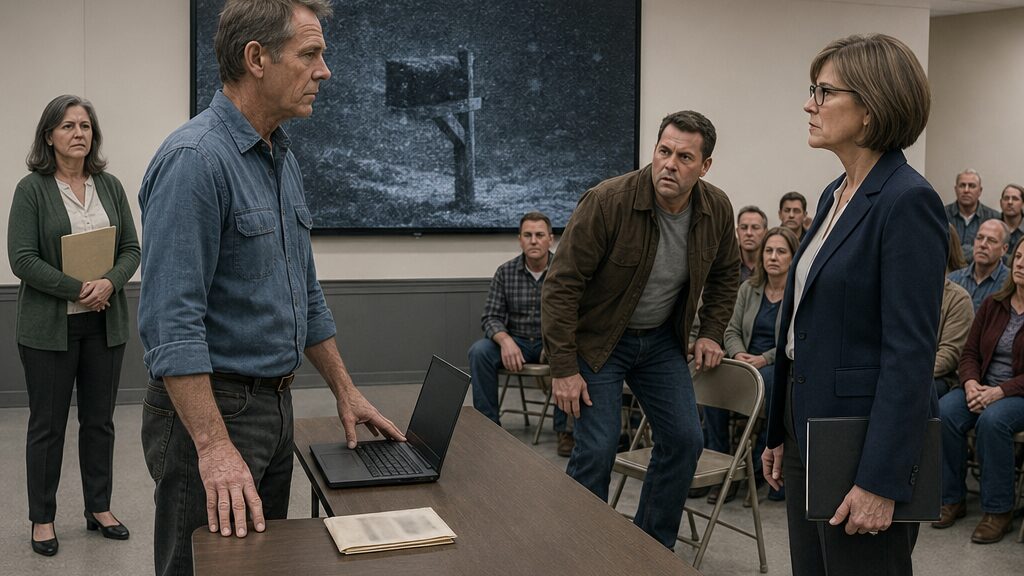
By seven that evening, every folding chair in the HOA meeting room was occupied. Residents stood along the back wall. Patrick sat in the front row beside photographs of the damaged mailbox cluster. Betty had chosen a chair near the aisle and held her cane horizontally across her knees.
Jack placed his laptop on the presentation table.
Deborah opened the meeting with a summary of the damage, the pending police report, and temporary mail-delivery arrangements. Her voice remained controlled until she reached the cameras.
“Mr. Davis represented his exterior lighting as part of a security system,” she said. “Residents have reasonably asked why that system failed.”
Murmurs moved across the room.
Patrick spoke without waiting to be recognized. “Failed, or was made to fail?”
The HOA president struck the table lightly with a pen. “Mr. Hall.”
“It’s a fair question.”
Jack connected the laptop to the wall display.
The gray security frame appeared above the room: darkness, one leaning mailbox, and a shadow without a face.
He set the folded violation notice beneath the projector light.
Deborah looked at the image and then at him.
“You insisted these lights were necessary,” she said. “Why didn’t your cameras catch whoever did this?”
Jack heard chairs shift behind him.
He could have answered with the clean sentence everyone expected. He could have let the notice carry all the blame.
Instead, he placed one finger beside the dark frame.
“The removal order took away the illumination the cameras required,” he said. “That is why the image lost detail.”
The room went still.
Then he moved his finger to the gray rectangle.
“And months earlier, I masked part of this view after a privacy complaint. That gap also mattered.”
Patrick leaned back.
Deborah’s expression changed, not to triumph but surprise.
Jack continued before anyone could turn the admission into an excuse.
“The lights worked. The board removed them without reviewing the system. I also built that system without giving the board or the neighborhood a full account of what it covered. Both facts are true.”
A resident near the wall asked, “Then why did you build it at all?”
Jack closed the settings window.
“That question is larger than tonight’s footage.”
Rebecca Lee entered through the side door carrying a thin records box. She crossed directly to the HOA president and placed an old folder on the table.
“I believe the answer may already be in the association’s files,” she said.
She opened the folder to a set of meeting minutes dated four years earlier.
Across the top page, beneath a discussion of common-area hazards, someone had underlined three words:
PERMANENT MAILBOX LIGHTING.
Chapter 5: What the Board Chose Not to Fix
Jack recognized his own signature before Rebecca turned the page toward him.
The maintenance request was four years old. The paper had yellowed slightly around the edges, but his handwriting remained clear beneath the typed description of the dark mailbox curve.
Jack Davis — electrical hazard and visibility review requested.
Clipped behind it was a faded receipt for six low-wattage colored bulbs.
Rebecca watched his face. “You remembered the request.”
“I didn’t know it was still in the file.”
“You submitted it twice.”
“The second copy disappeared from the meeting packet.”
“It didn’t disappear.”
They were seated at Rebecca’s dining table the morning after the emergency meeting. The records box rested between them. Through the window, temporary barricades surrounded the damaged mailbox posts.
Jack lifted the next document.
The board had obtained an estimate for two common-area fixtures, trenching, wiring, permits, and landscape repair. The total was more than the maintenance reserve could absorb that year.
Below the estimate, the treasurer had written: defer pending special assessment review.
No review date followed.
“So they buried it,” Jack said.
“They postponed it.”
“For four years.”
Rebecca pressed her lips together. “The board had just increased dues for roof repairs at the clubhouse. Another assessment would have caused a revolt.”
“Then they should have voted in public.”
“They discussed it in executive session because of liability.”
Jack dropped the page onto the table. “That is where boards put decisions they don’t want homeowners to remember.”
Rebecca’s eyes hardened. “And this is where you decide everyone who uses procedure is a coward.”
He sat back.
She had been the association secretary then. Her initials appeared beside the minutes.
“You recorded the decision.”
“I recorded what the board did.”
“You didn’t challenge it?”
“I asked for the lighting item to return the next quarter. It didn’t.”
“You could have told the neighborhood.”
“And exposed the association to a claim before we had the money to correct the hazard?”
“So you protected the board.”
“I protected homeowners from paying legal fees on top of the repair.”
Jack looked again at the estimate. Every explanation led to another choice someone had made quietly.
Rebecca slid a second folder toward him.
“Deborah was not on the board,” she said.
“I never said she was.”
“You were prepared to make it sound as though she caused all of this.”
“She caused the removal order.”
“Yes. She did. But not the original neglect.”
Jack stood and walked to the window.
A delivery driver had stopped beside the barricades and was carrying packages back to the truck. Mail service had been suspended until temporary boxes could be installed.
Behind him, Rebecca said, “You want the records because they make you right.”
“They prove the association knew.”
“They also prove you knew.”
He turned.
“You signed the request. You attended the meeting. Then, when nothing happened, you installed your own solution and told almost no one how it worked.”
“I prevented another accident.”
“Did you?”
The question caught him.
Rebecca opened the oldest set of minutes.
A resident incident had been noted without a name: fall near mailbox cluster after dusk; minor hand injury; no emergency transport requested.
Jack stared at the line.
“You left Betty out of the report.”
“She asked us to.”
“She was embarrassed.”
“She said she tripped over her own feet.”
“That wasn’t true.”
“No,” Rebecca said. “But you agreed to keep quiet too.”
Jack remembered Betty sitting on the curb, one glove torn across the palm. She had refused an ambulance and then refused to let him walk her home until he threatened to call one anyway.
The next morning, he had bought the bulbs.
He had chosen colors because lower-output layers gave the cameras usable contrast without flooding the opposite windows. He had mounted them under his own eaves because that required no trench, no common-area permit, and no vote.
He had told himself he was solving the problem.
Rebecca gathered the papers into order. “The records don’t clear anyone. That includes you.”
Jack looked toward the barricades again.
“What do you want me to do?”
“Stop treating the truth like a tool you only take out when it benefits you.”
That afternoon, Jack carried one amber bulb to the mailbox area on an extension cord. The police had released the scene, and the property manager had approved temporary illumination until portable fixtures arrived.
He clamped the socket beneath his porch eave and aimed the light toward the curve.
When Betty approached, the sensor activated.
Amber spread across the sidewalk.
She stopped beneath it.
“You put one back,” she said.
“Temporarily.”
“Rules allow temporary common sense?”
“Apparently.”
Betty rested both hands on the top of her cane. “Rebecca found the minutes.”
“Yes.”
“And my little performance is in there.”
“It says you fell.”
“It says I bruised my dignity.”
Jack looked at the uneven curb seam.
“Why didn’t you tell them how bad it was?”
“Because I was sixty-nine, not ninety. I did not want a committee discussing whether I could collect my own mail.”
“You needed three stitches.”
“And you needed an excuse to fix something.”
He looked at her.
Betty’s expression softened, but only slightly.
“Your wife fell inside her own house,” she said. “You could not have known the rug had shifted.”
Jack’s hand tightened around the extension cord.
“That has nothing to do with this.”
“It has everything to do with the way you inspect every dark corner as if it might confess.”
He turned away from her.
The amber bulb hummed faintly above them.
After his wife’s fall, Jack had replaced the hallway lighting, added stair sensors, changed the bathroom flooring, and removed every loose rug from the house. Each improvement had arrived after it could help her.
He had never told Betty that.
He had not needed to.
“You helped me,” she said. “But you also made the decision for everyone. You did not ask whether the neighborhood wanted your cameras watching the road.”
“The cameras were aimed at public space.”
“That is not the same as permission.”
Jack looked toward the gray shape of the damaged posts.
“I thought if it worked, people would leave it alone.”
Betty nodded. “And Deborah thought if the rule was applied equally, people would trust it.”
“Are you defending her?”
“No. I am telling you that certainty is crowded territory.”
A car stopped at the curb.
Deborah stepped out without her clipboard. She waited until Betty continued home, then approached Jack beneath the single amber bulb.
“I reviewed the old minutes,” she said.
“So did I.”
“The board should have installed common lighting years ago.”
“Yes.”
“And I should have requested a technical review before enforcement.”
Jack waited for the rest.
“I am not withdrawing every concern,” she said. “Your camera coverage still requires review.”
“There it is.”
“It matters.”
“I know.”
The answer seemed to unsettle her more than an argument would have.
She glanced at the temporary bulb. “The board president wants a proposal before the next insurance call.”
“Then hire someone.”
“We are.”
“Good.”
“We also want you involved.”
Jack laughed once, without humor. “You fined me for the system. Now you want me to redesign it.”
“I want a joint safety proposal. Permanent common lighting, defined camera limits, and an exterior standard that distinguishes functional equipment from decoration.”
“And if I say no?”
“Then a contractor will design it without the history you have.”
He studied her face.
“Is this about fixing the problem,” he asked, “or controlling what gets said at the next meeting?”
Deborah did not answer immediately.
“That depends,” she said at last, “on whether you intend to present the records as evidence or as a weapon.”
She handed him a printed workshop invitation.
At the bottom were two signature lines.
One for Deborah Wright, compliance chair.
One for Jack Davis, technical resident representative.
Chapter 6: The Exception Neither Side Deserved
The electrical contractor stood beneath Jack’s porch, looked from the colored bulbs on the folding table to the approved warm-white fixture in his hand, and said, “The uncomfortable answer is that both sides were partly right.”
No one spoke.
Deborah held a binder against her chest. Rebecca stood beside the property manager. Patrick watched from the curb with his arms folded. Jack remained near the garage door, refusing the chair someone had placed for him.
The contractor pointed toward Jack’s eaves.
“The system improves camera performance. That is measurable. It also extends functional illumination toward the mailbox area.”
Jack gave Deborah a brief look.
The contractor continued. “But the wiring was added without architectural approval, two junction points lack exterior-rated covers, and the camera field includes common space beyond what most residential systems would require.”
“The junctions are beneath the eave,” Jack said.
“Protected is not the same as rated.”
“They’ve been dry for four years.”
“That does not make them compliant.”
Patrick’s mouth shifted as though he almost smiled.
The contractor lifted one of the colored bulbs. “These are low-output lamps. Mr. Davis is also correct that using several tones reduces glare compared with a single high-output white fixture.”
Deborah opened her binder. “Then could the board approve them as a functional exception?”
“Not responsibly in their present configuration.”
Jack felt the word exception settle over the group.
He had spent weeks arguing that the lights were not decoration. Now approval would still require the board to treat his house differently.
The contractor walked them through the property. At the driveway camera, he measured the angle and marked the edge of the public sidewalk on a tablet. At the mailbox view, he asked Jack to display the privacy mask.
Patrick stepped close enough to see the gray block.
“That covers part of the road too,” he said.
“Yes,” Jack replied.
“Why that much?”
“Because the complaint identified the whole approach.”
“You could have adjusted the camera.”
“I would have lost the first mailbox.”
“So you chose what mattered.”
Jack looked at him. “Yes.”
Patrick’s anger did not disappear, but it changed shape.
The contractor tapped the screen. “This is the problem with one resident operating a system that serves a wider area. Every adjustment becomes a private policy decision.”
Deborah wrote that down.
Jack noticed.
“You don’t have to record every sentence as a future rule,” he said.
“That is what happens when people install systems without rules.”
Rebecca cut in. “And rules without technical review brought us here.”
The contractor moved toward the mailbox curve before the argument could harden.
He proposed two shielded fixtures on association-owned posts, warm enough to avoid a commercial appearance but bright enough for identification-quality footage. Any cameras covering the cluster would need posted notice, board ownership, retention limits, and defined access.
The cost estimate arrived at the afternoon workshop.
It was lower than the four-year-old trenching proposal but high enough to require insurance approval and a modest homeowner assessment.
The board treasurer rubbed a hand across his forehead. “Residents will say we are charging them because one person used the wrong bulbs.”
“Then tell them the truth,” Jack said. “You are charging them because the common area was left dark.”
Deborah looked at him across the table. “And because your private system cannot remain the neighborhood’s security plan.”
Jack’s first response rose immediately.
Then he stopped.
Both statements were true.
The property manager distributed a letter from the association’s insurer. Temporary lighting could remain for thirty days. After that, any security arrangement covering common property had to be documented, maintained by the association, and governed by a written privacy policy.
“No policy, no coverage,” the treasurer said.
“And no temporary extension,” Rebecca added.
Patrick read the letter twice. “So if the board does nothing, we lose the light again.”
“Yes,” Deborah said.
“And if Jack restores his system?”
“The insurer may exclude related claims.”
Patrick pushed the page away. “That is not much of a choice.”
“It is a choice we should have made years ago,” Rebecca said.
The room fell quiet.
Jack looked at the diagram he had brought but had not yet placed on the table. It showed two common-area fixtures, revised camera angles, shielded output, and a separate porch circuit retaining three of his colored bulbs.
He had drawn it the night Deborah gave him the invitation.
He had told himself it was only to prove the contractor would overcomplicate the job.
Deborah closed her binder.
“There is something I need entered into the minutes,” she said.
The property manager prepared to type.
Deborah looked directly at Jack.
“When Mr. Davis submitted his technical appeal, I did not request outside review. I believed delaying enforcement would appear inconsistent after the board had been accused of favoritism.”
The treasurer shifted in his chair.
Deborah continued. “I treated equal speed as equal treatment. It was not.”
Jack had expected an apology to feel satisfying.
Instead, he noticed how carefully she kept her hands still.
Rebecca asked, “Would a review have changed the outcome?”
“It would have changed the order of events,” Deborah said. “We would have addressed the security function before requiring removal.”
Patrick looked toward Jack. “And would you have disclosed the privacy mask?”
The room waited.
Jack glanced at the diagram inside his folder.
“No,” he said. “Not unless someone asked directly.”
“That’s not an answer you should be proud of,” Patrick said.
“I’m not.”
The words left Jack before he could protect them.
He placed both palms on the table.
“I assumed the work explained itself. When the board ignored the lighting request, I stopped asking. I built what I thought was needed, and when people objected, I adjusted it alone. That made the system useful. It did not make it accountable.”
No one wrote for several seconds.
Then the property manager resumed typing.
The board moved to a vote on the contractor’s proposal. Two members supported it. Two opposed the assessment. The HOA president, required to abstain because his property bordered the proposed fixture location, announced the tie.
Without approval, the permanent project could not proceed.
The treasurer closed the budget sheet. “We revisit next month.”
“The insurer’s deadline is before next month,” Rebecca said.
“Then we call a special meeting.”
“And present the same cost with less time?”
No one answered.
Jack looked at the darkened roofline through the workshop window. The temporary amber bulb had not yet switched on.
Deborah followed his gaze.
“You have another design,” she said.
It was not a question.
Jack kept his hand on the folder.
The plan inside could lower the cost enough to avoid the larger assessment. It would also require him to surrender control of the mailbox camera, remove one of his own units, disclose every remaining angle, and let the association adopt parts of work he had spent four years defending as private.
Patrick pointed at the folder.
“Is that something that fixes this?”
Jack thought of the useless gray frame, Betty beneath the amber bulb, and the signature on the maintenance request no one had forced into the open.
The board had tied.
The insurer’s deadline had not.
Everyone at the table was now waiting for the person they had blamed to decide whether being right was worth another night in the dark.
Chapter 7: When Protection Became a Shared Duty
Jack entered the final HOA meeting without his white coffee mug.
Instead, he carried a flat drawing case under one arm and a folder thick enough to keep both hands occupied. Every chair in the room was filled. Residents stood along the back wall, speaking in low voices that stopped when he crossed toward the presentation table.
Deborah had left the seat beside her empty.
Jack did not take it.
He placed the drawing case on the table and unrolled a site plan over the polished wood. The paper covered the old violation notice Deborah had set near her binder.
Patrick leaned forward in the first row.
“What is it?” the HOA president asked.
“A design that lowers the contractor’s estimate,” Jack said. “It also removes my private camera from the mailbox area.”
The room shifted.
Deborah looked down at the plan. “You would give up that coverage?”
“If the association installs its own lighting and camera under a written policy.”
Jack secured the corners of the paper with four small metal washers. The plan showed two shielded fixtures near the mailbox cluster, one association-owned camera aimed only at the boxes and public roadway, and a separate line marking the edge of Jack’s property.
His remaining cameras stopped at that line.
The gray privacy mask was gone because the camera that required it would be gone too.
“The common-area recording would retain footage for fourteen days,” Jack said. “Access would require two authorized board members, except for an active police request. Every access would be logged.”
Patrick raised his hand without waiting for recognition. “Does it record my driveway?”
“No.”
“The sidewalk in front of it?”
“A narrow section.”
“Audio?”
“No.”
“Motion alerts sent to whom?”
“The property manager and one rotating board officer.”
Patrick studied the diagram. “Not you?”
“Not me.”
The answer carried farther across the room than Jack expected.
For four years, the system had sent every alert to his phone. Every movement near the mailboxes had passed through equipment he controlled. He had called that responsibility.
Now, looking at the boundary line on the plan, he could see how easily responsibility had become ownership.
The electrical contractor stood and examined the specifications. “This uses the existing conduit along the irrigation easement.”
“Yes.”
“That reduces trenching.”
“And landscape repair.”
The contractor traced the fixture locations. “The output levels are adequate. Shielding meets the insurer’s recommendation.”
The board treasurer asked, “Total cost?”
Jack handed him the revised estimate.
A low murmur moved through the room.
It was still more than the maintenance reserve could absorb, but less than half the original proposal.
The treasurer adjusted his glasses. “This requires a one-time assessment.”
“Twelve dollars per household,” Deborah said. “Or three dollars per month for four months.”
A homeowner near the back stood. “We already pay dues. Why should we pay again because the board ignored this years ago?”
Rebecca answered from the side wall. “Because the reserve was underfunded then, and it remains underfunded now. The board’s delay was wrong. Pretending the cost disappeared would repeat it.”
Another resident said, “Why not make Jack restore what he had? It worked.”
“Parts of it worked,” Patrick said.
Several heads turned toward him.
He stood slowly.
“The lights helped the cameras,” he continued. “The police confirmed that. But one person should not decide where neighborhood cameras point or what they hide.”
Jack met his eyes.
Patrick looked at the plan again. “I’ll support this if the privacy rules are part of the vote, not something the board adds later.”
“They are attached as Exhibit B,” Deborah said.
“And homeowners are notified before any angle changes?”
“Yes.”
“And no facial recognition, license-plate database, or audio added without another membership vote?”
The property manager checked the document. “That restriction is included.”
Patrick sat down. “Then I support it.”
The statement did not sound like an apology. Jack respected it more because it did not pretend to be one.
The HOA president opened public comment.
Residents objected to the assessment, the camera, the colored bulbs still drawn above Jack’s porch, and the possibility that the new fixtures would make the street look commercial. Others asked why the common area had remained dark for years. Betty said nothing until a resident suggested that anyone uncomfortable walking after sunset should simply collect mail earlier.
Her cane struck the floor once.
The room quieted.
“I collected my mail earlier for four years,” she said. “That did not repair the curb, install the light, or make the darkness less public.”
She looked toward Jack.
“It only made the problem easier for everyone else to ignore.”
Jack lowered his eyes to the plan.
When public comment ended, Deborah stood with the original violation notice in her hand.
“This enforcement action classified Mr. Davis’s lighting as a seasonal display without reviewing its documented function,” she said. “That classification was incomplete.”
She tore neither the notice nor the rulebook page behind it. Instead, she placed the paper flat on the table and signed a withdrawal form.
“The violation is withdrawn.”
No one applauded.
The scratch of her pen was the only sound.
She slid the form toward Jack.
He read it once and placed it in his folder.
“The withdrawal does not approve the old installation,” Deborah added. “Mr. Davis has agreed to remove two noncompliant junctions, redirect one porch camera, and limit the approved roofline lighting to three low-output bulbs.”
“Amber, blue, and white,” Jack said.
Someone at the back muttered that blue still looked festive.
Deborah glanced in that direction. “The revised standard evaluates output, shielding, duration, and function. Not whether one resident dislikes the color.”
Jack almost smiled.
The vote passed by seven votes.
The assessment passed by three.
Work began the following week.
Jack removed the mailbox camera himself. He stood on the ladder beneath the empty sockets, disconnected the cable, and lowered the housing into a box. There was no satisfaction in it, only the clean finality of a circuit opened on purpose.
The contractor installed the common fixtures and association camera. Rebecca posted the privacy notice near the mailbox cluster. Patrick inspected the camera angle from his driveway and made the contractor shift it two degrees away from his front walk.
Deborah attended each inspection with her binder, but she asked the contractor questions before writing anything down.
At Jack’s porch, three approved bulbs remained.
Amber near the walk.
Blue over the driveway edge.
White beside the side gate.
The red and green bulbs stayed wrapped in shop towels inside the garage.
One month after the meeting, the new common-area lights were ready for their first full test.
Residents gathered near the curb as dusk settled. The contractor closed the breaker.
For an instant, nothing happened.
Then the two shielded fixtures rose gradually from a dim glow to even, warm light. The mailbox numbers became readable. The curb seam appeared clearly. The road beyond remained dark enough that bedroom windows did not flare.
The association camera activated without turning toward any house.
Jack watched from the edge of his driveway.
Deborah stood several feet away. Neither of them mentioned the first afternoon she had pointed at his roof.
“The insurer approved the installation,” she said.
“I heard.”
“The board president wants a safety working group.”
“I heard that too.”
“They asked whether you would serve.”
Jack looked at the lights.
“For one year,” he said.
Deborah nodded. “That seems reasonable.”
It was not forgiveness. It was not friendship.
It was an answer they could both live with.
Behind them, Jack’s amber porch bulb brightened as motion entered its zone.
Betty had stepped from her walkway.
She carried no cane that evening, though it hung from one wrist by its strap. She walked past Jack without asking for help and continued toward the mailbox cluster beneath the new lights.
At the curb seam, she slowed.
Jack’s body tightened before he could stop it.
Betty lifted one foot over the uneven edge, planted it securely, and kept walking.
She unlocked her box, removed two envelopes, and closed the door with a firm metal click.
On her return, she paused beneath the association fixture and looked toward Jack’s porch.
The amber bulb glowed behind him.
Not enough to light the whole neighborhood.
Only enough to show where his responsibility ended—and where everyone else’s began.
The story has ended.