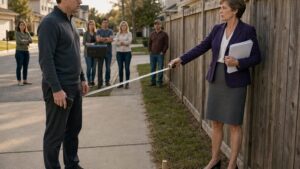
The Woman Who Removed Our Street Library Never Expected the Neighborhood to Learn Why
Chapter 1: The Notice Covered Her Name
Debra White slapped the red notice across the brass plate before Daniel could stop her.
The adhesive caught along one edge first, then flattened under the heel of her hand until the engraved name disappeared beneath the words UNAPPROVED EXTERIOR STRUCTURE.
Daniel stood on the grass with a watering can hanging uselessly from two fingers. Behind Debra, two neighbors had slowed on the sidewalk. One held a terrier close to her leg. The other pretended to check his mailbox.
“Take that off,” Daniel said.
Debra stepped back from the cedar book box and folded her arms. She wore the white polo the architectural committee used during inspections, though no inspection had been scheduled.
“The notice stays until the structure is removed.”
“It’s paper glued to finished wood.”
“It’s removable adhesive.”
“That isn’t what I meant.”
Debra’s expression tightened. She pointed at the box as though Daniel might have forgotten it was there.
“You need to remove this by tomorrow morning.”
The library stood at the front edge of Daniel’s lawn, waist-high on four cedar posts. Its small glass door reflected the white fence across the street. Inside, paperback mysteries leaned against picture books and two worn biographies. Someone had returned a cookbook upside down.
Daniel set the watering can beside the porch steps.
“On whose authority?”
“The architectural committee.”
“You are the architectural committee.”
“I chair it.”
“That wasn’t my question.”
A car rolled past more slowly than necessary. Debra waited until it turned the corner.
“The structure was never submitted for approval. It sits inside the association setback. It creates a possible sightline issue for drivers leaving your property, and one of the posts is visibly leaning.”
Daniel looked at the posts. None appeared to lean.
“It’s been here eleven months.”
“That doesn’t make it approved.”
“People use it every day.”
He reached for the notice. Debra caught his wrist—not hard, but publicly. Daniel looked down at her fingers until she released him.
Then he peeled the notice away carefully.
The brass plate beneath it was no larger than two fingers. The engraving had dulled from rain and sun, but he could still read it without bending closer.
MARGARET’S BOOKS SHOULD KEEP MOVING.
Debra looked away first.
Daniel smoothed the notice against his thigh and held it out to her.
“Send it through management.”
“We did.”
“No. You left a photocopy in my door.”
“Twice.”
The second word landed harder than he expected.
Daniel remembered the first sheet. He had found it half folded beneath the doormat after a windy afternoon in April. It had used phrases such as informal concern and voluntary correction. He had carried it into the workshop, set it beneath an invoice, and decided he would deal with it when someone sent something official.
The second notice he did not remember seeing.
Debra saw the hesitation.
“So you did receive them.”
“I received one piece of paper that didn’t cite a violation.”
“It cited three sections.”
“It cited headings.”
“It invited you to submit an application.”
“It invited me to ask permission for something already standing on my property.”
“That is how an association works, Daniel.”
“That is how your committee works.”
A child’s bicycle clicked against the curb. A girl in a purple helmet stopped beside the library with a younger boy trailing her. Neither seemed to notice the adults until the girl reached for the glass door.
Debra moved aside automatically.
The girl removed a paperback about horses and replaced it with a science book. The boy pressed both palms to the glass, studying the lower shelf.
“Can I take two?” he asked Daniel.
“If you bring one back someday.”
“I brought one last time.”
“Then you’re ahead.”
The boy chose a picture book with a torn dust jacket. The girl closed the door carefully, making sure the latch caught.
Their mother waited near the sidewalk. She glanced at the red paper in Daniel’s hand, then at Debra’s polo.
“Is something wrong?”
“Routine compliance issue,” Debra said.
The mother’s mouth thinned. “The kids love this thing.”
“No one is discussing the books.”
“You’re discussing the box holding them.”
Debra’s cheeks colored. “Structures still have to meet safety and appearance standards.”
The mother called the children toward her. Before leaving, the girl turned and said, “Don’t take it down.”
Daniel felt the sentence enter the silence between him and Debra.
He wanted to say that no one would. He wanted to say the cedar had come from Margaret’s old garden bench, that the glass had once covered a cabinet in her classroom, that she had spent twenty-eight years teaching children to return books even when no one was keeping score.
Instead, he said nothing.
Explanations had a way of becoming public property. Sympathy was worse. Sympathy entered a room before you and rearranged the furniture.
Debra watched the children ride away.
“This is exactly the problem,” she said.
Daniel turned toward her. “Children reading?”
“You know that isn’t what I mean. People think because they like something, rules stop applying. Then the next person installs a sign. Someone else builds a shed. Someone puts a basketball hoop in the street and says the neighborhood uses it.”
“This isn’t a basketball hoop in the street.”
“No. It’s your exception.”
Daniel folded the notice once, then again.
Across Debra’s lawn, a curtain shifted in the upstairs window. A thin face appeared behind the glass and vanished almost immediately. Her grandson, Jason, had been staying there since early spring. Daniel had seen him at night a few times, hood up, walking without a dog or destination.
Debra glanced toward the same window.
For the first time, her certainty seemed to break. It lasted less than a second.
Then she stepped closer to the library and pressed one hand against its side. The box barely moved.
“You have until tomorrow morning.”
“That deadline isn’t in your bylaws.”
“It is an immediate safety correction.”
“You just called it an appearance violation.”
“It can be more than one thing.”
“Then send an inspector.”
“I am trying to keep this informal.”
Daniel laughed once. There was no humor in it.
“You put a red notice over my wife’s name in front of half the street.”
The two neighbors on the sidewalk stopped pretending not to listen.
Debra lowered her voice. “Then perhaps you should have answered the earlier notices before it became public.”
Daniel looked at the folded paper in his hand. She was right about that much, and the fact irritated him more than the rest.
He had treated the committee’s letters as an insult because answering them would have meant acknowledging that someone else could judge the one thing he had built after Margaret died. He had measured every joint twice, sealed every board, rounded every edge. He had not asked permission because he could not bear to hear no.
But he would not tell Debra that.
He placed the folded notice on top of the library.
“It stays tonight.”
Debra’s eyes moved from the notice to the brass plate. Then she looked once more toward her house.
When she faced Daniel again, her voice was quiet enough that only he heard it.
“Not after tonight.”
She turned and crossed the strip of grass between their properties without waiting for an answer.
Daniel remained beside the cedar box as the street resumed pretending nothing had happened.
Inside, the cookbook was still upside down.
Chapter 2: Four Holes Where the Books Stood
At seven the next morning, four wet holes were all that remained of Margaret’s library.
Daniel stopped halfway down the front steps.
For several seconds, his mind refused to identify the absence. He saw the lawn, the sidewalk, the white fence across the street. He saw a torn page pasted to the grass by dew.
Then he saw the holes.
They were dark and clean-edged, positioned exactly where the posts had stood. Small piles of loosened soil sat beside two of them. Whoever had removed the library had dug rather than yanked. The grass around the site was pressed flat but not torn.
Daniel crossed the lawn in his socks.
The page in the grass came from the horse book the girl had taken the day before. No—another copy, perhaps. The illustration showed half a gray horse and one line of text cut through the middle.
He lifted it by a dry corner.
There were no broken boards, no scattered books, no screws, no glass. Even the red notice was gone.
A garage door opened across the street. Daniel turned so sharply that the damp grass slipped beneath his heel.
The neighbor with the terrier backed her car out, saw him, then saw the holes. Her window lowered.
“What happened?”
“That’s what I’m trying to find out.”
She looked toward Debra’s house before answering. “Maybe management took it.”
“On Sunday morning?”
The window began rising.
“I don’t know, Daniel.”
“Did you hear anything?”
But the glass was already closed.
Within ten minutes, the sidewalk had collected people. A father carrying a travel mug stood near the curb. Two children stared at the empty space as if waiting for the box to reappear. Someone took a photograph of the holes. Someone else asked whether teenagers had done it.
Daniel stayed kneeling beside the nearest hole, pressing his fingers into the soil.
The lower six inches were damp. The upper dirt was dry and loose. Fresh work.
A wrench had scraped one metal anchor. The fasteners had been removed, not broken.
“This wasn’t vandalism,” he said.
No one asked how he knew.
He had spent thirty-four years fitting wood into spaces other people had measured badly. He knew the difference between destruction and dismantling.
Debra’s front door opened at eight twelve.
She emerged in dark pants and a beige sweater, carrying a ceramic mug. Her hair was pulled back more casually than it had been during the confrontation. She paused on her porch as though surprised to find a gathering.
“What happened?”
Daniel rose.
“You tell me.”
Several phones came up—not obviously, but enough.
Debra walked to the edge of her lawn and looked at the holes.
“I told you it was unsafe.”
“That isn’t an answer.”
“I don’t know what happened to it.”
“You said it wouldn’t be here this morning.”
“I said it needed to be removed.”
“You said, ‘Not after tonight.’”
Debra took a measured sip from the mug. “You were angry. Perhaps you heard what you expected to hear.”
The father with the travel mug looked down.
Daniel stepped onto the sidewalk but stopped before crossing onto her property.
“Did the HOA authorize a contractor?”
“You’ll need to ask management.”
“It’s Sunday.”
“Then ask tomorrow.”
“Where are the books?”
“I don’t know.”
The answer came too quickly, but Daniel could not tell whether anyone else noticed.
A woman near the curb said, “My daughter had three books in there.”
“The books were donated,” Debra replied. “They weren’t checked out.”
“That isn’t the point.”
“The point,” Debra said, looking only at Daniel, “is that an unapproved structure with a deteriorating post created a liability.”
Daniel looked back at the four holes. The posts had been cut from the same cedar stock. He had sealed the bottoms before setting them. There had been no rot when he checked them in March.
Or he had believed there was none.
“What deteriorating post?”
“The rear left.”
“Who inspected it?”
Debra’s grip tightened around the mug. “I observed movement.”
“You pushed it yesterday.”
“And it moved.”
“Everything moves if you push hard enough.”
The front door behind her opened a few inches. Jason stood in the gap wearing a gray hooded sweatshirt. His face looked pale in the shadowed doorway.
Debra turned.
“Inside.”
Jason did not move immediately. His gaze traveled across the street to the empty holes, then dropped to Daniel’s hand, where the torn page had begun to soften from moisture.
“Jason,” Debra said.
He stepped back and closed the door.
The gathering changed after that. It became quieter, less curious. Daniel felt the story forming around them without his control: the strict committee chair, the widower’s memorial, the missing box, the frightened grandson. People preferred a shape they could recognize.
A phone chimed.
Then another.
The neighborhood group had begun.
Daniel did not belong to it. Margaret had joined years ago, mostly to find lost dogs and warn people when the creek rose. After she died, he had left her account untouched until the messages became too painful, then deleted the application.
The father with the travel mug read from his screen.
“Someone posted a picture from yesterday. The notice.”
Another neighbor said, “They’re saying Debra took it.”
“No one knows that,” Daniel said.
Debra’s expression shifted, almost imperceptibly. Not gratitude. Calculation.
“You should tell them that,” she said.
“I said no one knows.”
“That is not the same as telling them they’re wrong.”
Before Daniel could answer, Catherine Lewis appeared at the end of the sidewalk in gardening gloves and house slippers. She lived two doors down, in the corner house with the wide-angle doorbell camera mounted above a blue ceramic planter.
She walked past the group without looking at Debra.
“Daniel, come with me.”
Catherine had been an elementary-school librarian for nearly three decades. Retirement had not changed the way she gave instructions: softly, as though refusal would only embarrass the listener.
“Why?”
“My camera recorded a vehicle at two in the morning.”
The sidewalk went silent.
Debra set her mug on the porch rail.
Catherine looked at her then. “I haven’t posted anything.”
A neighbor raised a phone. “People are already asking for footage.”
“They can ask.”
Daniel studied Catherine’s face. She looked troubled, not triumphant.
“Can you tell what vehicle?”
“I think so.”
Debra stepped off her porch.
“If this is about association enforcement, you should send it to management rather than circulate it publicly.”
Catherine removed one gardening glove finger by finger. “Then perhaps you can tell us whether it was enforcement.”
“I have already said I don’t know who removed it.”
Catherine nodded, but the nod did not agree.
She led Daniel through her side gate and into a kitchen that smelled of coffee and potting soil. A laptop sat open beside a stack of seed catalogs.
The footage showed the street in washed-out gray. Catherine dragged the timeline backward. Headlights crossed the frame at 2:11 a.m. Two minutes later, an SUV rolled slowly from Debra’s driveway without its lights on.
Catherine paused.
“Keep watching.”
At 2:13, a figure entered the frame carrying one end of the cedar box. The other end rested against the open rear of the SUV. The person’s face was turned away, but the white lettering on the vehicle’s rear window was visible.
WHITE FAMILY DENTAL 5K.
Debra had driven the same SUV to the neighborhood cleanup in May.
The figure lifted the box, pushed it inside, and closed the hatch.
Catherine froze the image.
There was Margaret’s library, pale in the infrared light, lying on its side inside Debra White’s vehicle.
Chapter 3: The Footage Solved the Wrong Question
The timestamp read 2:13 a.m., but Daniel kept staring at Debra’s hands.
In the grainy recording, she wore gardening gloves and moved with care. She had wrapped something around the glass door before tipping the box into the SUV. A folded moving blanket protected one cedar corner.
She had not dragged it away in anger.
She had prepared.
“That’s her,” Catherine said.
Daniel said nothing.
On the laptop, Debra lowered the hatch and stood beside the vehicle for several seconds. Her face remained indistinct. Then she looked toward Daniel’s house.
Not toward the camera.
Toward the dark windows behind which he had slept.
Catherine let the footage continue until the SUV disappeared.
“I can export the clip,” she said.
“For management?”
“For you.”
“What am I supposed to do with it?”
“That depends on what you want.”
Daniel leaned back from the screen. The kitchen chair pressed against an old ache below his shoulder blade. On Catherine’s counter, a mug held pens stamped with the names of schools where she had worked.
“I want the box back.”
“Then proof may help.”
“Proof she took it. Not proof where it is.”
Catherine closed the laptop halfway.
“She lied to you.”
“Yes.”
“In front of everyone.”
“Yes.”
“And you’re worried about embarrassing her?”
Daniel looked toward the kitchen window. From there, he could see the top of Debra’s house beyond two yards and a maple tree.
“I’m worried about turning this into something it isn’t.”
“What do you think it is?”
“I don’t know yet.”
Catherine sat across from him. “That is more patience than she offered you.”
“It isn’t patience.”
He did not explain that public certainty made him uneasy. In carpentry, the hidden side mattered most. A cabinet door could sit square while the frame behind it twisted. A staircase could feel solid until someone removed the trim.
The footage proved Debra had taken Margaret’s library. It did not explain why she had wrapped the glass.
Catherine reopened the laptop and created a short export.
“I’ll send this to you.”
“Don’t post it.”
“I won’t.”
Her phone vibrated against the table.
She looked at the screen, and her mouth tightened.
“What?”
“The clip is already in the neighborhood group.”
Daniel stood so quickly the chair legs scraped tile.
“How?”
“This isn’t my angle.”
She turned the phone toward him. The video had been recorded from farther down the street. It showed Debra’s SUV and the box, though less clearly. Someone had added a caption:
SHE ACTUALLY TOOK THE FREE LIBRARY AFTER THREATENING HIM.
Comments multiplied beneath it while Daniel watched.
Call the police.
That’s theft.
She thinks the HOA makes her queen.
My kids used that box every week.
Someone should put ten more on her lawn.
The reactions rose faster than he could read them.
Catherine scrolled once, then stopped. “This is exactly what I hoped wouldn’t happen.”
“You said proof would help.”
“I said proof may help. This is punishment looking for a crowd.”
A new comment appeared from the HOA president.
The Board is aware of the situation. Residents are asked not to speculate while facts are reviewed.
It did nothing to slow the thread.
Daniel’s phone began ringing in his pocket. He had given the number to three neighbors in twenty years. By the time he answered, it had stopped and another call had begun.
He silenced it.
Outside Catherine’s house, two people stood near the curb looking toward Debra’s garage. A child had placed a stack of books beside the empty postholes. Someone else had added a handwritten sign on cardboard:
BRING IT BACK.
Daniel removed the sign.
The father who had carried the travel mug earlier raised his eyebrows. “Why are you taking that down?”
“Because this isn’t a rally.”
“She stole from the neighborhood.”
“She took something from my yard.”
“That everybody used.”
“That doesn’t give everybody permission to make it worse.”
The man looked offended, as though Daniel had rejected support offered at personal cost.
Across the street, Debra opened her door.
She did not step outside. She stood just behind the threshold with her phone in one hand. The confident posture from the day before had vanished. Her shoulders were held too high, and the color had drained from her face.
For a moment, Daniel thought she might speak.
Then a teenager on a bicycle slowed and shouted, “Thief.”
Debra closed the door.
Daniel turned on the boy.
“Keep moving.”
The boy pedaled away, laughing nervously.
By noon, residents had stacked thirty-seven books beside Daniel’s porch. One woman offered a replacement cabinet. A local carpenter left a voicemail promising donated labor. A parent sent photographs of children reading at the box during the previous summer.
Each gesture should have felt like vindication.
Instead, Daniel felt Margaret’s library being taken from him a second time—first into Debra’s SUV, now into a story strangers were rewriting faster than he could object.
At one fifteen, Debra posted a statement.
Daniel read it on Catherine’s phone.
The structure was removed due to an observed safety hazard involving a compromised support post. Temporary removal was necessary to prevent injury pending formal review. No books were discarded. The matter is being handled through appropriate association channels.
The comments beneath it were merciless.
Catherine pointed to one sentence. “She’s claiming emergency authority.”
“She doesn’t have it.”
“Committee chairs can recommend immediate correction.”
“Recommend.”
“Yes.”
Daniel read the statement again.
No books were discarded.
That meant she still had them. It also meant she expected to defend what she had done rather than deny it.
A message appeared from the property-management representative, addressed to both Daniel and Debra.
Please preserve all relevant property and communications. The board will schedule a compliance hearing concerning the unapproved structure, its reported condition, and its unauthorized removal.
Daniel focused on the phrase unapproved structure.
Catherine noticed.
“You knew?”
“I knew she objected.”
“That isn’t what I asked.”
Daniel handed back the phone. “There was a notice in April.”
“Formal?”
“Not exactly.”
“Did it ask you to submit an application?”
He did not answer.
Catherine sat on the edge of his porch. “Daniel.”
“I built it on my property.”
“In an HOA.”
“I know where I live.”
“Apparently you preferred not to.”
The words were mild. They still struck.
Daniel looked at the empty holes. “She had no right to take it.”
“No. She didn’t.”
“And now everyone is acting like that settles everything.”
“It settles what she did.”
“Not what I did.”
Catherine was quiet for a moment.
“Then perhaps the footage solved the wrong question.”
At three forty, the HOA president sent a formal email confirming a hearing for Friday evening. Attached were two separate allegations.
The first concerned Debra’s unauthorized removal of private property.
The second concerned Daniel’s installation and continued maintenance of an exterior structure without architectural approval, within the required setback, despite prior written notice.
He printed the pages in his workshop.
The printer clicked softly beside Margaret’s old cabinet glass, spare hinges, and a jar of brass screws.
At the bottom of Daniel’s notice, one sentence had been bolded:
Failure to correct or obtain approval may result in daily fines and mandatory removal.
His phone chimed before he finished reading.
A second message from management contained scanned copies of the notices previously delivered to his home.
There were two.
The first was the paper he remembered ignoring.
The second bore a delivery date from six weeks earlier and a photograph showing a white envelope tucked beneath his workshop door.
Daniel looked across the room.
Beneath a stack of unpaid material invoices, the corner of a white envelope was visible.
Chapter 4: The Rule Daniel Chose to Ignore
The white envelope came free with a strip of old sawdust stuck to its seal.
Daniel stood at the workbench and stared at his own name through the plastic window. The envelope had been there for six weeks, buried beneath invoices he had postponed paying and a catalog he had never opened.
He slit it with a marking knife.
The second notice was more specific than the first.
It cited the architectural standards, the setback requirement, and the association’s authority to order correction. A photograph showed the library from the street with a yellow measurement line drawn between its rear post and the edge of Daniel’s driveway.
At the bottom, someone had handwritten:
Please contact the committee. We may be able to approve a relocated installation.
The handwriting was Debra’s.
Daniel read the sentence twice.
He had imagined the second notice as a threat because that had been easier than opening it. A threat demanded resistance. An invitation required an answer.
He set the page beside the hearing notice and looked around the workshop.
Margaret’s old cabinet door leaned against the wall where it had rested for nearly a year before he built the library. The remaining cedar boards were stacked by length. He had kept every offcut larger than his palm.
He had told himself this was thrift.
His phone rang.
The property-management representative spoke with the patient neutrality of someone paid to stand between angry homeowners.
“We need to inspect the original location before Friday.”
“The structure isn’t there.”
“The placement still matters.”
“Debra took it.”
“That allegation is being reviewed separately.”
Daniel pressed two fingers against his forehead. “You keep saying separately as though one thing didn’t cause the other.”
“Separate violations can arise from the same dispute.”
“When can you come?”
“Tomorrow at ten.”
The representative arrived with a measuring wheel, a clipboard, and one of the board members. Debra watched from behind her front window but did not come outside.
Daniel stood beside the four holes while the wheel clicked across the grass.
The rear corner of the former library had been twenty-nine inches inside the association’s required clear zone.
“Twenty-nine,” Daniel repeated.
The representative nodded. “The standard calls for thirty-six.”
“Seven inches.”
“Yes.”
“No one could see around it?”
“That isn’t what the rule says.”
Daniel almost laughed. Instead, he looked toward his driveway. From where a driver would sit, the library had partly overlapped the sidewalk approach. A child on a low bicycle might have been hidden for a second.
He could see it now because someone else had measured it.
The board member pointed closer to Daniel’s front walkway. “An installation here would probably comply.”
Daniel followed the direction of his hand. The suggested location sat nine feet farther from the street, beside a bed of ornamental grass. It would still be visible from the sidewalk.
“So it could stay.”
“Pending application, dimensions, anchoring details, maintenance responsibility, and board approval.”
“In other words, no.”
“In other words, not where it was.”
After they left, Daniel called the local carpenter who had offered help online.
The carpenter arrived that afternoon carrying a level and a narrow steel probe. He examined the empty holes, then crouched near the soil Daniel had saved in a bucket.
“You still have the posts?”
“No.”
“Then I can’t be certain.”
Daniel showed him photographs from the previous week.
The carpenter zoomed in on the rear left support.
“There,” he said.
A dark line ran along the base, almost invisible beneath dirt.
“Surface stain.”
“Maybe.”
“You said maybe.”
The carpenter handed back the phone. “If water got past the sealer and sat near the anchor, it could soften from the inside. Cedar lasts, but it doesn’t last because someone loves it.”
Daniel looked at him.
The carpenter seemed to realize he had said more than he intended.
“I’m not saying it was about to fall. I’m saying the concern may not have been invented.”
Daniel walked to Debra’s driveway after sunset.
Her SUV was there. The garage door was closed. Through the small upper windows, he could see only darkness and the faint outline of storage shelves.
He rang the bell.
Debra opened the door but left the storm door latched.
“Where is it?”
“I’ve given management the relevant information.”
“That’s not an answer.”
“The box is secure.”
“The books?”
“Secure.”
“You wrapped the glass.”
Her eyes changed.
Daniel leaned closer to the storm door. “The footage shows it.”
“I was preventing damage.”
“While stealing it?”
“I removed a hazard after you refused.”
“You had no authority.”
“You had no approval.”
“I know.”
The admission seemed to unsettle her more than another accusation would have.
Daniel continued. “The setback was wrong. I ignored the notices. One post may have had damage.”
Debra’s fingers tightened around the inside door handle.
“But none of that gave you the right to come onto my lawn at two in the morning.”
“I know what the neighborhood group has decided.”
“I’m not asking about them.”
“What do you want, Daniel?”
“My property.”
“Not tonight.”
“Why?”
Debra looked over her shoulder before answering.
“Because returning it before the hearing would be treated as an admission.”
“You were filmed taking it.”
“That proves transport.”
“It proves enough.”
“To you.”
She began closing the door.
Daniel put one hand against the storm door frame. “Did Jason help you?”
Debra stopped.
The silence answered something, though not what he had asked.
“Leave him out of this,” she said.
The inner door closed.
On Wednesday morning, management emailed a preliminary compliance diagram. The alternate location near Daniel’s walkway met setback and sightline requirements if the structure was reduced by four inches and anchored to a concrete pad.
It was the first useful thing anyone had sent him.
Daniel printed the drawing and laid it beside his own plans.
Margaret had hated unnecessary symmetry. She would have approved of the new location because it sat closer to the path children already used. She would also have asked why he had spent months defending seven inches rather than filling out one page.
He could hear her question in the workshop.
He did not answer it.
That evening, someone knocked twice on the side door instead of ringing the bell.
Jason stood outside in the gray sweatshirt. His hood was down, and his hair looked as if he had been pulling at it.
“I need to give you something.”
He held out the brass plate.
Daniel did not take it immediately.
The edges were clean. One screw still sat in the lower hole.
“Where did you get this?”
Jason looked toward Debra’s house.
“I took it off before she moved the box.”
Chapter 5: The Boy Who Read After Dark
Jason kept the brass plate balanced on both palms as though it might break under the weight of Daniel’s question.
“Why?”
The teenager swallowed. “Because she was going to cover it.”
“With what?”
“I don’t know. A label. A tarp. She said it didn’t matter.”
Daniel took the plate.
The metal was cold from the evening air. Margaret’s words caught the porch light in shallow, worn grooves.
MARGARET’S BOOKS SHOULD KEEP MOVING.
“You knew what this was?”
“I read it.”
“That isn’t what I asked.”
Jason pushed his hands into the pocket of his sweatshirt. “I knew it mattered to you.”
Daniel opened the side door wider. “Come inside.”
“No.”
“Then sit.”
Jason lowered himself onto the porch step but stayed near the edge, ready to stand.
Daniel remained by the door.
“You helped remove it.”
“I loosened the plate. That’s all.”
“You watched her take the rest.”
Jason nodded.
“Why didn’t you stop her?”
A bitter expression crossed his face. “You think she listens to me?”
Daniel heard the unfairness in his own question and let it pass without defending it.
“What happened that night?”
Jason stared at the grass between the houses.
“She found something.”
“In the library?”
“Yes.”
“What?”
“A note.”
Daniel waited.
Jason rubbed his thumb against a frayed cuff. “I left it inside a book.”
“For whom?”
“No one.”
“Then why leave it?”
“I don’t know.”
“That’s not true.”
Jason stood.
Daniel lowered his voice. “Sit down. I’m not going to drag it out of you.”
“You already are.”
“You came here.”
Jason looked toward the street. A porch light came on across the way, and both of them waited until the neighbor’s door closed again.
Then he sat.
“I used to go out there after she went to bed,” he said. “Not every night.”
Daniel had seen him more than once.
“What did you read?”
“Whatever was there.”
“That isn’t true either.”
Jason’s mouth almost moved toward a smile.
“Science fiction. The old ones. The ones with the bad covers.”
“Margaret liked bad covers.”
Jason looked at the plate in Daniel’s hand.
“I found notes in some books.”
Daniel’s grip tightened. “What notes?”
“Just little things. On cards.”
Margaret had tucked index cards into books for years. Not messages to anyone in particular. Suggestions. Questions. Sometimes a sentence about where she had read the book or why she kept it.
Daniel had placed the books in the library without checking them all.
“What did hers say?”
“One said, ‘You don’t have to finish a book just because someone says it is important.’”
“That sounds like her.”
“Another said, ‘A quiet person is still allowed to ask for help.’”
Daniel sat beside him.
The porch boards gave a soft complaint beneath his weight.
“What did your note say?”
Jason’s jaw shifted.
“That I was failing two classes. That my mom said if Grandma couldn’t handle me, I might have to go stay somewhere else.”
“Somewhere else where?”
“My dad’s brother. Maybe.”
“Did Debra know?”
“She knew about school.”
“But not the rest.”
Jason shook his head.
“I wrote that I didn’t want people deciding where I belonged without asking me.”
The sentence hung between the houses.
Daniel looked down at Margaret’s plate.
Debra had said the box did not belong in the neighborhood. Jason had written that he did not want others deciding where he belonged.
“When did she find it?”
“Saturday night. I put the book back wrong. She saw me from the window and went out after I came inside.”
“What book?”
“One of the space ones.”
“Why remove the whole library?”
Jason looked embarrassed for her.
“She thought somebody would find the note. She said people around here turn everything into gossip.”
“She wasn’t wrong about that.”
Jason glanced at him, surprised.
“That doesn’t excuse what she did.”
“I know.”
“Do you?”
Jason stood again. This time Daniel did not stop him.
“The hearing is Friday,” Daniel said. “They’ll ask why she acted.”
“I’m not speaking.”
“I didn’t ask you to.”
“You were going to.”
“I was going to ask what you wanted.”
Jason’s shoulders loosened slightly.
“What I want doesn’t matter.”
“It mattered enough for you to bring this back.”
Daniel held up the brass plate.
Jason looked at it, then away.
“She put books in there,” he said.
“Who?”
“Grandma.”
Daniel thought he had misheard.
“Debra put books in my library?”
“Sometimes. She’d order used ones online and leave them early in the morning.”
“What kind?”
“The ones I liked.”
Daniel remembered books appearing that he had not recognized: old science fiction, repair manuals, a thick illustrated astronomy guide. He had assumed Catherine or one of the parents had donated them.
“She told me it was a clutter problem,” he said.
“She calls everything clutter when she cares about it too much.”
Jason stepped off the porch.
“Where is the box?”
“In the garage.”
“Intact?”
“Mostly.”
“What does that mean?”
“She took the door off. One post split near the bottom when we moved it.”
“We?”
Jason stopped.
“You said you only removed the plate.”
“I held the back while she lifted it. I didn’t know what else to do.”
His voice carried no plea for forgiveness, only exhaustion.
Daniel understood then how easily Jason had let the neighborhood blame Debra without explaining. Silence had protected him. It had also left her alone inside the shape of her worst choice.
Daniel knew something about that bargain.
“I won’t use your note,” he said.
Jason faced him.
“At the hearing?”
“Anywhere.”
“She won’t believe you.”
“That’s her problem.”
“No,” Jason said. “It becomes mine.”
He crossed the grass toward Debra’s house.
The garage door began rising before he reached the driveway.
Debra stood inside with one hand on the wall control.
Behind her, half concealed by stacked plastic bins and a folded patio table, lay the cedar library on its side.
Its glass door had been removed and wrapped in a quilt. The books were packed in three cardboard boxes. One post was split at the bottom, exposing a dark softened seam.
Debra looked from Jason to Daniel.
“You shouldn’t be here,” she told him.
Jason continued past her into the house.
Daniel stepped to the edge of the driveway but no farther.
“You had books in it.”
Debra’s face closed.
“That is irrelevant.”
“To you?”
“To the violation.”
“You took it because of his note.”
She pressed the garage control. The door did not move because her hand had begun to shake.
“Leave Jason out of this.”
“I told him I would.”
“Then why are you standing here?”
“Because the box is mine.”
Debra looked back at the dismantled cedar pieces.
“You can have the wood,” she said. “But not the story.”
Chapter 6: What Debra Was Trying to Hide
The library had been taken apart with more care than Daniel expected and less care than it deserved.
Debra let him into the garage Thursday night after he promised not to photograph anything. The cedar body rested on a moving blanket. The glass door stood wrapped against the wall. The books had been sorted into labeled cartons: CHILDREN, FICTION, NONFICTION.
Even the loose hinges were sealed in a sandwich bag.
Daniel crouched beside the split rear post.
The dark seam extended upward nearly nine inches. When he pressed a thumbnail into it, the wood yielded.
Debra stood near the workbench with her arms crossed.
“It moved when we lifted it.”
“You should have stopped.”
“I had already removed the anchors.”
“You should have stopped before that.”
“Yes.”
The answer came without argument.
Daniel looked up.
Debra’s face was tired. Without the committee polo and fixed posture, she seemed smaller than she had on his lawn.
She placed a folder on the workbench.
“I will return all of it tonight.”
“There are conditions.”
“One.”
He waited.
“You do not mention Jason’s note at the hearing.”
“I wasn’t planning to.”
“You do not mention his grades, his mother, or why he was living here.”
“I know what privacy means.”
Debra gave him a look that said she was no longer certain either of them did.
“The board will ask why you acted,” Daniel said.
“I will say I observed a safety issue and made a bad decision.”
“That’s true, but not complete.”
“It is complete enough.”
“For you.”
“For him.”
Daniel stood.
The garage smelled faintly of cedar and gasoline. On a shelf behind Debra were three used paperbacks identical in age and style to the books Jason had described.
“You bought those for him.”
Her gaze followed his.
“He would not take them from me.”
“So you put them in the library.”
“He would take them if he believed no one had chosen them for him.”
Daniel ran a hand along the damaged post.
“You objected to the box while stocking it.”
“I objected to the location and the lack of approval.”
“You said it didn’t belong.”
“I was angry.”
“So was I.”
“You were proud.”
“So were you.”
Neither looked away.
From inside the house came the soft sound of a cabinet closing.
Debra lowered her voice.
“My daughter left him here in March. She said it would be for two weeks.”
Daniel had seen cars arrive late, heard arguments through closed windows, watched Jason begin appearing on the sidewalk after midnight. He had never asked.
“Where is she now?”
“Trying to get stable.”
The phrase carried practiced edges.
“And his father?”
“Not useful.”
Daniel did not press.
Debra opened the folder. Inside were printed emails, school notices, and a document from a family-services office. She covered the names with her hand before Daniel could read them.
“My daughter told Jason that if he failed again, he might have to stay with relatives in another district. He wrote that down as though it had already been decided.”
“He was frightened.”
“Yes.”
“And you removed the one place he was using to manage it.”
Her eyes flashed. “I removed a note that could have been read by anyone.”
“You removed the whole structure.”
“I panicked.”
The word seemed to cost her.
Daniel waited.
Debra stared at the boxes of books.
“A neighbor had already asked why he was outside so late. Someone else asked whether he was living here permanently. The association rules limit long-term occupants who are not listed with management. The rule is rarely enforced, but once people start asking questions—”
“You thought the note would become evidence.”
“I thought everything would become evidence.”
“Against you?”
“Against keeping him here.”
Daniel looked toward the kitchen door.
“Would they remove him over an HOA form?”
“No. But questions spread. His mother would hear. His school counselor might call. Family services might decide this arrangement was unstable.”
“Is it?”
Debra’s mouth tightened.
“It is what he has.”
Daniel understood the sentence because Margaret’s books had once been what he had.
After her death, people brought casseroles, cards, and offers to help. He thanked them, closed the door, and returned to the workshop. The house had become so quiet that he began leaving the radio on in empty rooms.
Building the library had given him a reason to open the front curtains.
He had told everyone it was for the neighborhood.
That had been true.
It had not been the first truth.
“I built it because I couldn’t stand looking at her books inside the house,” he said.
Debra’s expression softened, but he raised a hand before sympathy could form.
“I said they were for everyone because that sounded better than admitting I needed strangers to carry pieces of her away.”
The garage remained still.
“You didn’t need approval for grief,” Debra said.
“No. I needed approval for the setback.”
A brief, unwilling breath escaped her. It might have become laughter in another life.
Daniel looked at the split post again.
“We both found rules that let us avoid saying what was actually happening.”
Debra closed the folder.
“That does not make what we did equal.”
“No.”
“You ignored paper.”
“You entered my property.”
“Yes.”
“You lied.”
“Yes.”
“And you used Jason’s fear to justify control.”
Her eyes hardened. “Be careful.”
“I am being careful. More careful than either of us was Saturday.”
The kitchen door opened.
Jason stood there, one hand on the frame. He had heard enough to know the shape of the conversation.
“I’m not speaking Friday,” he said.
Debra turned. “You don’t have to.”
Daniel nodded. “No one asked you to.”
“You both keep saying that like you aren’t building the whole thing around me.”
Neither adult answered.
Jason looked at the cartons.
“I just wanted somewhere to go.”
Then he went back inside.
Debra sat on a low stool near the workbench.
For the first time since the conflict began, she looked neither powerful nor defensive. Only tired.
“I am sorry I took it,” she said.
Daniel said nothing.
“I am not sorry I objected to where it was. It was unapproved. It blocked part of the driveway view. The post was damaged.”
“All true.”
“I should have called management.”
“Yes.”
“I should have spoken to you again.”
“Yes.”
“You would not have listened.”
Daniel considered denying it.
He could not.
“No,” he said. “Probably not.”
Debra opened the folder again and removed the hearing agenda.
Two possible fines were listed. Daniel faced continuing daily penalties for maintaining an unapproved structure after notice. Debra faced censure, removal from the committee, and financial liability for the damaged property.
Below those items, the board had added a third:
Discussion of neighborhood lending libraries and potential policy.
Daniel read it twice.
“They’re willing to consider one.”
“They’re trying to stop people from installing ten of them in protest.”
“Same opening.”
Debra slid the agenda toward him.
“If you tell them the box was a memorial, they may approve an exception.”
Daniel folded the paper along its existing crease.
“That would make it mine again.”
“It is yours.”
“That’s the problem.”
She looked at him.
He imagined rebuilding the box in the approved location, locking Margaret’s plate beneath the glass, and standing guard over every book. He imagined Debra watching from her window and Jason waiting until both houses were dark.
The library would return.
Nothing else would change.
Daniel placed the agenda on the workbench.
“Tomorrow, I’m going to tell them I received both notices.”
Debra’s shoulders stiffened. “Why?”
“Because I did.”
“You’ll damage your own case.”
“I already damaged it.”
“You may lose approval.”
“Maybe.”
“And the fines?”
“I’ll deal with them.”
Debra searched his face as if trying to find the strategy.
There was none.
Daniel lifted the wrapped glass door and carried it toward the garage opening. Debra moved to help, but he shook his head.
“I’ll take the parts after the hearing.”
“You said you wanted it back.”
“I want it back correctly.”
He set the door down again.
At the threshold, he looked toward the lit kitchen where Jason’s shadow crossed once and disappeared.
Then he faced Debra.
“I won’t tell his story,” Daniel said. “But I’m done hiding mine.”
Chapter 7: The Hearing Did Not End With an Apology
Daniel began the hearing by admitting he had ignored both notices.
The room went still before he finished the sentence.
The HOA clubhouse was usually used for birthday parties, committee lunches, and exercise classes. That night, rows of folding chairs faced a narrow table where the board sat beneath fluorescent lights. The property-management representative had arranged two stacks of documents and placed a digital recorder between them.
Daniel stood at the end of the table with his hands resting on the back of an empty chair.
“I received the first notice,” he said. “I decided it wasn’t official enough to deserve an answer. I received the second one too, though I didn’t open it. The structure was inside the setback, and I installed it without approval.”
A murmur moved through the chairs behind him.
Several residents had arrived expecting him to accuse Debra. Some had printed screenshots from the neighborhood group. One woman carried a petition demanding Debra’s removal from every committee. The father with the travel mug sat in the second row with his arms crossed.
The HOA president looked over his glasses.
“You understand that those admissions may affect the board’s decision?”
“Yes.”
Catherine sat near the aisle. She gave Daniel no encouraging nod. He was grateful for that.
The president turned toward Debra.
She sat three chairs away in a navy blouse, a closed folder in front of her. Jason occupied the last row by the exit, hood down, eyes fixed on the floor.
The management representative summarized the allegations. Daniel’s installation had violated the approval process and the required clear zone. Debra had entered his property without authorization, dismantled the structure, and transported it in her personal vehicle.
When the representative mentioned the security footage, several residents shifted forward.
Debra did not.
The president addressed her.
“Did you remove the structure?”
“Yes.”
The answer landed more heavily than the footage had.
“Were you acting under written authorization from the board or management?”
“No.”
“Had an emergency inspection established an immediate danger?”
“No.”
A board member glanced up. “Then on what basis did you act?”
Debra opened her folder but did not remove anything.
“I observed movement in the rear support post. Mr. Carter had not responded to prior notices. I believed removal was necessary.”
“Necessary that night?”
“No.”
“Necessary without contacting management?”
“No.”
The woman with the petition whispered something that drew a short laugh from the row behind her.
Debra heard it. Her jaw tightened, but she continued.
“I believed I could prevent a larger dispute by handling it before the structure caused an injury or became the subject of a formal enforcement action.”
Daniel watched her hands. They remained flat on the folder.
The president said, “Instead, you created a larger dispute.”
“Yes.”
It was not an apology. It was also not an excuse.
The board reviewed the footage, photographs, measurements, and carpenter’s written observation that one post showed internal deterioration. They confirmed that Debra’s safety concern had not been entirely fabricated, but her action had exceeded any committee authority.
Then the meeting opened for resident comments.
The father with the travel mug stood first.
“My children used that library every week. What happened was theft. We shouldn’t soften that because the person responsible knows the bylaws.”
A board member reminded him that the hearing was not a criminal proceeding.
Another resident demanded reimbursement. Someone else proposed installing a library on every block. The woman with the petition said Debra had humiliated the entire neighborhood.
Daniel looked toward the last row.
Jason had pulled his sleeves over his hands.
The discussion was turning him into evidence without anyone knowing it.
Daniel rose again.
“I don’t want ten libraries put up in anger.”
The room quieted reluctantly.
“I don’t want anyone standing outside Debra’s house or shouting at her grandson. I don’t want screenshots used as a substitute for this process.”
The father shook his head. “She’d still have the box if nobody posted the video.”
“That may be true.”
“Then why defend her?”
“I’m not.”
Daniel faced the board.
“She damaged my property and lied about knowing where it was. She should be responsible for that. But I also ignored the rules because I believed the reason I built the library made the rules less important.”
He reached into his folder and removed the alternate-location diagram.
“This location meets the setback. The design can be reduced by four inches and anchored properly. I’m willing to submit full plans.”
The president studied the diagram.
“The current standards do not authorize lending libraries as a structure category.”
“Then create a narrow category.”
Several residents began speaking at once.
The management representative raised a hand. “The board can consider a pilot policy, but approval would require defined ownership, maintenance, liability, and removal procedures.”
Daniel had expected that.
“I’ll maintain it.”
“That leaves the same problem,” one board member said. “A private structure presented as a community resource.”
Daniel looked at the brass plate lying inside his folder.
For nearly a year, he had thought the words on it gave him the right to decide everything that happened to the box. What books belonged there. Where it stood. Who touched it. Who understood it.
Margaret’s books should keep moving.
Not remain under his control.
He placed the plate on the table.
“Then it shouldn’t belong only to me.”
The president leaned back.
Daniel continued. “Create a volunteer stewardship agreement. Let residents sign up for maintenance. Let the association approve the location and inspect it. If the pilot fails, remove it through the process.”
“And the structure itself?” the management representative asked.
“I’ll donate it to the neighborhood once it’s rebuilt.”
The word donate caught in his chest.
Catherine looked down.
The woman with the petition whispered, “After what happened?”
Daniel heard her.
“Yes,” he said. “After what happened.”
The board called a brief recess.
Residents clustered in groups. Debra remained seated. Daniel walked to the water fountain and found Jason standing beside the exit.
“You don’t have to stay,” Daniel said.
Jason looked toward the board table.
“They’re talking like the books were decoration.”
“They don’t know otherwise.”
Jason’s face tightened.
Daniel did not remind him of the note. He had promised.
The board returned after twelve minutes.
The president announced that Daniel’s continuing daily fines would be suspended if he submitted a compliant application within ten days. He would still receive a formal violation for the original installation.
Debra would be removed from the architectural committee pending a six-month review, required to reimburse Daniel for verified damage, and issued a formal censure for acting without authority.
The room reacted in fragments. Some thought it too little. Others thought it enough.
Then the board addressed the library.
A ninety-day pilot policy would be drafted for one approved structure. It would require shared stewardship, documented maintenance, no advertising, no political material, and immediate removal only through management or an established safety procedure.
Approval would not be automatic.
The rebuilt structure would belong to the association.
Daniel felt the cost of the decision only when it was spoken aloud.
He could restore the library, but he could no longer claim it as solely his.
The president looked at him.
“Do you accept those conditions?”
Daniel touched the edge of Margaret’s plate.
“Yes.”
A chair scraped in the last row.
Jason stood.
Debra turned sharply. “You don’t need to say anything.”
“I know.”
He walked to the front but stopped several feet from the table.
“I used the library,” he said.
His voice was quiet enough that the recorder might not have caught it.
The president asked him to speak closer.
Jason did not.
“I used it when I couldn’t sleep. There were books in there I wouldn’t have asked anyone to buy me. Nobody watched what I took. Nobody asked why I brought it back late.”
He looked at Daniel once.
“It was the only place in the neighborhood where I didn’t feel like I had to explain why I was there.”
No one moved.
Jason returned to his chair without mentioning the note, his grades, or the reason he lived with Debra.
He had told only his part.
It was enough.
Debra lowered her head.
Before the hearing ended, she opened her folder and removed a small padded envelope. She crossed the space between their chairs and placed it in front of Daniel.
Inside was the brass plate’s missing screw.
“I found it in the garage,” she said.
Daniel looked at the screw, then at her.
“You could have mailed it.”
“Yes.”
She did not apologize again. He did not thank her.
Three weeks later, the new library stood beside Daniel’s front walkway.
The cedar body had been shortened and repaired. The damaged post was replaced. A concrete pad kept the base clear of wet soil, and the door opened away from the path.
Daniel had rebuilt it with the local carpenter, Catherine, two parents, and Jason.
Debra had not joined them, but the garage had opened one morning and three boxes of books had appeared at the curb. The science fiction titles were packed separately.
The brass plate remained.
It no longer sat on the outside like a claim. Daniel mounted it beneath the glass, above a smaller card listing the volunteer maintenance schedule.
On the first afternoon, several children gathered before the sealant had fully lost its smell. Daniel made them wait until he tested the latch twice.
Jason arrived after they had gone.
He carried the worn science-fiction paperback in which he had left the note. The note was no longer inside.
He opened the glass door and placed the book on the middle shelf beneath Margaret’s plate.
Across the lawn, Debra stood beside her mailbox with a stack of envelopes. She looked toward them but did not approach.
Daniel nodded once.
After a moment, she nodded back.
Jason adjusted the paperback until its damaged cover faced outward.
Then he closed the door.
The latch caught cleanly, and the book remained visible through the glass, waiting for whoever needed somewhere to go next.
The story has ended.