The Rancher Beneath the New Subdivision Read the Agreement Everyone Else Chose to Ignore
Chapter 1: The Brown Water Reached the Barn Before Sunrise
The calf stood on the wrong side of the water.
Samuel Green saw it from the barn doorway, a small black shape pressed against the lower fence while a brown stream widened between them. The calf had been born sometime after midnight. Its legs still carried the uncertain angles of something newly assembled, and each time it tried to move along the fence, the mud pulled at its hooves.
The smell reached Samuel before he stepped outside.
It was not creek water. It was not manure washed from the upper lot. It had the sour, chemical weight of the subdivision line.
He grabbed a coil of rope from a nail and crossed the yard at a careful run. The runoff had already covered the wagon track. It moved in sluggish folds around clumps of grass, carrying gray foam, scraps of paper, and a sheen that caught the first light.
“Easy,” Samuel called.
The cow paced on the higher bank, bellowing at her calf. Samuel tied the rope to a fence post, looped the other end around his waist, and stepped into the flow.
The mud gave way beneath his right boot.
He went down hard on one knee. Brown water climbed over the leather and soaked through his jeans. For a moment he stayed there, one hand buried in the mud, feeling the current press against his thigh.
Above the pasture, rows of pale houses stood along the hill in perfect repetition. Their porch lights glowed. Sprinklers clicked over clean lawns.
Samuel got up.
He crossed to the calf, lifted it under the chest, and half carried, half dragged it through the shallowest part. By the time he reached dry ground, his arms were trembling. The cow shoved her nose against the calf so hard it nearly fell again.
Samuel turned toward the source.
Near the old stone wall, a gray pipe rose from the earth beside a round green valve housing. Water seeped from the soil around it, gathering force before spreading downhill. The valve wheel itself was half submerged.
That had never happened before.
The easement corridor had crossed the ranch since Samuel was a boy. His father had called it the sanitation line and spoken of it as if it were weather—something unpleasant but settled. Back then it served a handful of homes beyond the north ridge. Now several hundred houses depended on it.
Samuel walked to the barn and took out his phone. At the bottom board, the water had left a dark line three inches above the mark he had cut the previous spring.
He photographed it.
Then he found a red livestock tag, wrote LEAK—DO NOT OPERATE across it in black marker, and tied it to the valve stem with baling wire.
At seven twelve, he called the emergency number printed on the utility cabinet.
At eight thirty, a white service truck appeared at the upper gate. A contractor in rubber boots inspected the pipe, took photographs, and spoke quietly into his phone. He did not look at Samuel until he had finished.
“Pump surge,” the contractor said. “Probably temporary.”
“Temporary water doesn’t leave toilet paper in my pasture.”
The contractor glanced toward the barn. “I’ll report it.”
“You’ll shut the line down.”
“I can’t authorize that.”
“Then call someone who can.”
The man hesitated. “Mr. Roberts is on his way.”
Samuel looked up the hill. “Of course he is.”
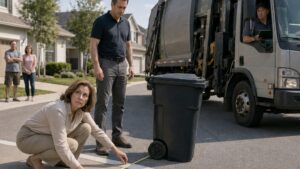
Richard Roberts arrived in a black pickup that was too clean for the road. Scott Brown sat beside him, holding a leather folder against his chest as he stepped around the mud.
Richard wore a dark suit and narrow polished shoes. He stopped near the flooded track, took in the water, the calf, Samuel’s soaked clothes, and the red tag tied to the valve.
Then he laughed once through his nose.
“You called this an emergency?”
Samuel pointed toward the barn. “It reached the wall.”
“It’s drainage.”
“It came out of your line.”
“Our line is operating under a recorded easement.”
“A recorded easement doesn’t let you flood livestock.”
Richard’s expression tightened, though his voice remained even. “You have no idea what that system is carrying right now.”
“I know what it’s carrying across my land.”
Scott opened the folder. “The easement grants access for conveyance and maintenance. Interference could expose you to liability.”
Samuel looked at him. “Did I interfere?”
Scott’s eyes shifted to the tag.
The contractor walked to the valve, cut the baling wire with pliers, and removed it.
Samuel took one step forward. “Put that back.”
Richard raised a hand without looking at the contractor. “Leave it off.”
The red tag disappeared into the contractor’s pocket.
Something colder than anger moved through Samuel. He had spent years treating the line as an inconvenience because his father had. He had watched the houses rise, then the retaining walls, then the new pump station. He had noticed the flow increasing in wet months and told himself it was not his business until it crossed the fence.
Now it had crossed the fence, and Richard stood in the mud as if the ranch belonged to whoever could afford better shoes.
“How many homes are connected now?” Samuel asked.
Richard glanced uphill. “That isn’t relevant.”
“It is to the pipe.”
Scott said, “System capacity is a technical question.”
“So answer it technically.”
Richard exhaled. “The newest phase is scheduled for occupancy next month. Any shutdown would delay inspections, closings, and move-ins. You’re talking about families, lenders, contractors. Not just your lower field.”
The admission sat between them.
Samuel looked at the nearly completed homes at the far end of the ridge. Fresh roofs. Plastic still covering some windows.
“You added more houses before you fixed the line.”
“We expanded a permitted development.”
“And this is the result.”
Richard’s jaw flexed. “The result is a manageable discharge after an unusual pressure event.”
A thin wave of brown water curled around Samuel’s boot.
He looked down at it. “Manage it.”
Richard stepped closer. “Listen carefully. You can make a complaint. You can hire an attorney. You can file whatever action someone convinces you to file. But if you try to stop that line, we will seek an emergency order, damages, and every cost attached to the disruption.”
Samuel met his eyes.
Richard lowered his voice.
“You will lose this ranch before your case reaches a courtroom.”
For several seconds, the only sound was the cow calling to her calf.
Scott looked away first.
Richard turned back toward the truck. The contractor followed, carrying Samuel’s red warning tag. Before getting in, Richard wiped a spot of mud from the side of his shoe with a folded handkerchief.
The pickup climbed the road toward the subdivision.
Samuel remained beside the exposed pipe.
He had no attorney on retainer. The feed bill from winter sat unpaid on his kitchen table. One tractor needed a transmission rebuild, and the bank had stopped speaking gently about the operating note.
Richard probably knew some of that.
But Richard had also said the easement was recorded.
Samuel looked at the dark water line on the barn, then at the green wheel half buried beneath the runoff.
Recorded meant written.
Written meant there were terms.
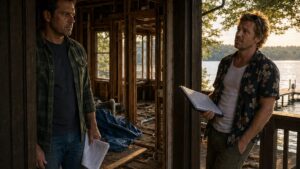
He went inside, changed his clothes, and found the old metal deed box his father had kept under the desk. It contained tax receipts, grazing leases, and a faded survey with one corner missing, but no easement agreement.
At the bottom lay a yellow envelope with three words in his father’s handwriting.
County has original.
Samuel read the words twice.
Then he set the envelope beside the photograph of the new water mark and reached for his truck keys.
Chapter 2: The Old Map Had More Boundaries Than Anyone Remembered
The modern parcel map stopped where the subdivision began.
The older map did not.
Deborah Lopez placed both sheets beneath the reading-room lamp and held their corners flat with brass weights. On the newer map, the hillside was divided into narrow lots, cul-de-sacs, utility strips, and common areas. On the older one, all of it belonged to a single irregular block labeled GREEN RANCH.
A thin ink line crossed the lower pasture and ended at a small circle beside the barn.
Samuel leaned closer.
“That circle is the valve.”
Deborah adjusted her glasses. “It was called a control gate when this was recorded.”
The county records office occupied the lower floor of the courthouse annex, where the air smelled of paper, dust, and floor polish. Rolled plans filled steel racks along one wall. Bound deed books sat behind a locked counter.
Deborah had known Samuel since school, though neither of them mentioned it until she said, “You still press your thumb against paper when you’re trying not to tear it.”
He lifted his hand from the map.
“I need the easement.”
“I’m finding it.”
“I need to know whether they can do what they’re doing.”
She looked at him over the top of her glasses. “I can retrieve the record. I can explain where it was filed and what later documents refer to it. I cannot give you legal advice.”
“Richard’s lawyer gave me plenty yesterday.”
“That doesn’t make me yours.”
Samuel sat back.
Deborah turned to a terminal and searched by parcel number, then by grantor name. The first result led to a 1987 utility agreement. The second led to a survey correction. The third referenced an older instrument stored on microfilm.
She disappeared into the archive room.
Samuel stared at the maps.
The easement line had once served five properties beyond the ridge. A handwritten note near the northern boundary listed a design flow far below the number he had heard contractors mention during subdivision construction.
When Deborah returned, she carried a gray folder and a cardboard tube.
“This is the original survey copy,” she said. “The agreement is in here.”
The document was six pages long, typed on cream paper with signatures in blue ink. Samuel recognized his father’s name immediately.
He read the first page too fast and forced himself to begin again.
The Green family granted a right to install and operate a wastewater conveyance line across a defined corridor. The beneficiary received access for inspection, repair, and maintenance. The line had to be kept in serviceable condition. Discharge had to remain contained. Flow could not exceed the stated daily maximum without written amendment.
Samuel tapped the number.
“They’re over this.”
Deborah kept her hands folded. “Do you have measured flow records?”
“I have a pasture full of it.”
“That proves a failure. Not necessarily the amount.”
He read on.
The agreement required treatment standards consistent with county health rules. It required restoration of disturbed land. It required notice before nonemergency entry.
Then he reached the paragraph headed Default and Cure.
His eyes slowed.
“If the beneficiary fails to correct a material breach within thirty days after certified notice,” he read, “the grantor may terminate the easement by recording a declaration of revocation.”
Deborah said nothing.
Samuel read it again.
“All three conditions are broken.”
“That is a conclusion.”
“You can see the photographs.”
“I can see damage.”
“The line isn’t maintained. The flow isn’t contained. They’ve exceeded the volume.”
“You need to establish each one carefully.”
Samuel felt the first clean edge of hope since the water reached the barn.
“They told me the easement was permanent.”
“It continues until terminated under its terms.”
He looked toward the old map. “My father never told me that.”
“Most people remember what an agreement allows. They forget what it requires.”
Deborah turned to the final page. “There’s more.”
A clause preserved the ranch owner’s right to inspect the corridor and request operating records. Another required the beneficiary to maintain an emergency bypass or temporary containment plan if service interruption threatened upstream properties.
Samuel frowned. “I’ve never seen a bypass.”
“That may be outside this file.”
“Or it may not exist.”
Deborah began listing related filings. A pump-station permit. Two subdivision-phase plats. A flow allocation letter. An inspection request from three years earlier.
She stopped.
“What?”
She rotated the screen toward him.
The file note stated that a utility inspection had been postponed because the landowner denied access to the easement corridor.
Samuel read his own name at the bottom.
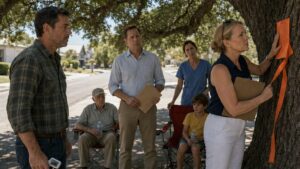
“They moved my stakes,” he said.
Deborah waited.
“They came through the south gate without notice. Put orange flags ten feet outside the corridor. When I told them to leave, they said they’d return with authority.”
“Did they?”
“They sent a letter.”
“Did you answer it?”
“No.”
“Did you offer another date?”
Samuel looked back at the screen.
He remembered the truck, the crew, the orange stakes driven into ground his father had fenced by hand. He remembered pulling every one of them and tossing them onto the county road.
“I told them not to come back.”
Deborah’s voice remained quiet. “Richard can use that.”
“He can’t use it to justify sewage.”
“No. But he can use it to complicate responsibility.”
The hope did not disappear. It changed shape.
Samuel had expected the record to divide the world cleanly: his rights on one side, Richard’s violations on the other. Instead it contained his own stubbornness in black type.
Deborah opened the cardboard tube and removed a later engineering sheet. The drawing showed the pump station, the ranch crossing, and a proposed additional flow from the newest subdivision phase.
At the bottom was a boxed amendment.
The space for the ranch owner’s signature was blank.
So was the county approval line.
Yet a filing stamp showed the drawing had been submitted eight months after construction on the new phase had begun.
Samuel traced the proposed flow number with one finger. It nearly doubled the original limit.
“Who filed this?”
Deborah checked the index sheet.
“Roberts Development.”
“Was it approved?”
“I don’t see approval.”
“Was the line expanded anyway?”
She looked at the new parcel map, then at the engineering sheet.
“That is not something the record can answer by itself.”
Samuel rolled the words around in his mind. An unsigned amendment. New houses. More flow. A line breaking through his field.
He gathered copies of the agreement, survey, inspection note, and filing sheet.
Deborah stopped him before he closed the folder.
“If you send notice, Samuel, write only what you can prove. Dates, photographs, measurements, clauses. Not what you think Richard intended.”
He nodded.
“And if you are going to enforce the agreement,” she added, “you should be prepared for everyone who depends on that line to notice you exist.”
Samuel looked through the reading-room window toward the white courthouse steps.
“Maybe they should have noticed before now.”
Deborah did not answer.
She placed one final photocopy on top of his stack: the unsigned capacity amendment, filed after the newest subdivision phase had already opened.
Chapter 3: Thirty Days of Notice Became Thirty Days of Pressure
The postal receipt said Richard Roberts had signed for the notice at 9:14 on Monday morning.
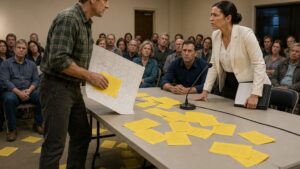
At 7:00 that evening, he stood in the HOA clubhouse and told sixty homeowners he had received nothing.
Angela Davis sat at the front table with the board packet open before her. Richard spoke without notes beneath a projection of the subdivision map. His company’s logo occupied the corner of every slide.
“The ranch owner has raised informal concerns,” he said. “We have attempted to communicate, but no valid notice of interruption or revocation has been served.”
Angela looked down at the email on her phone.
Samuel had sent her a photograph of the signed certified-mail card an hour earlier.
The signature was Richard’s.
She raised her hand. “Are you saying no certified notice was delivered?”
Richard’s eyes found hers. “I’m saying no legally effective notice has been delivered.”
“That isn’t the same thing.”
A few residents turned toward her.
Scott Brown sat near the wall, his folder closed on his lap.
Richard smiled in the patient way he used when a question threatened to become an accusation. “The owner appears to be attempting to leverage an old agreement for financial gain. Our attorneys are reviewing it.”
“What amount did he demand?” a resident called.
Richard paused.
“He has not stated one.”
The room shifted. Not much, but enough.
Over the next week, Samuel followed Deborah’s advice with punishing precision. He logged the depth of standing water each morning. He photographed the valve, the barn, and the runoff channel. He collected samples for the county environmental office. He mailed copies of the notice to Richard’s company, Scott, the HOA, and the county clerk.
He did not touch the valve.
Every day he walked to it, checked the wheel, read the gauge, and wrote the numbers in a spiral notebook.
On the ninth day, an HOA letter arrived accusing him of threatening essential services.
On the eleventh, a process server delivered notice that Richard’s company might seek an injunction.
On the thirteenth, a pickup stopped along the upper fence and two residents photographed Samuel feeding cattle as though documenting suspicious activity.
He told himself they were Richard’s people.
It was easier that way.
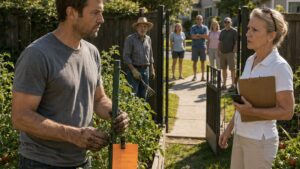
On the fifteenth day, Angela came to the ranch with twelve residents and a sheriff’s deputy.
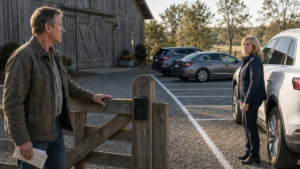
Samuel met them at the chained gate.
Angela wore work shoes unsuited to the mud and carried a binder beneath one arm.
“We’re here to inspect the utility corridor.”
“Who is we?”
“The HOA board and affected homeowners.”
“The HOA doesn’t own the line.”
“We pay for it.”
“To Richard’s company.”
“That’s not the point.”
“It may be.”
The deputy shifted his weight. “Mr. Green, they’re asking for access, not possession.”
Samuel looked beyond Angela at the residents. Some appeared angry. Others avoided his eyes. One man held a phone at chest level, recording.
“No entry without written conditions,” Samuel said.
Angela’s face tightened. “You are holding families hostage over a property dispute.”
Samuel pulled a clear plastic sleeve from inside his jacket. It contained the easement, the certified-mail receipt, and photographs of the flooded barn.
He tied the sleeve to the fence wire.
“Come to the boundary,” he said. “You can see from there.”
He led them along the outside lane to the lower pasture. The smell reached them before the water did.
The resident with the phone lowered it.
Brown discharge spread between the gray pipe and the barn. The newest water mark cut across the red siding in a dark horizontal stain. Near the fence, dead grass lay flattened beneath a skin of foam.
Angela stopped.
Richard arrived five minutes later with Scott and a wastewater contractor. His black pickup remained on the gravel shoulder.
“You had no authority to organize this,” he told Angela.
“I’m the HOA president.”
“You manage covenants and common areas. Infrastructure remains under developer control.”
A murmur passed through the residents.
Angela turned. “We pay a monthly infrastructure fee.”
“For operation and reserve obligations.”
“Do we own the system?”
Richard did not answer immediately.
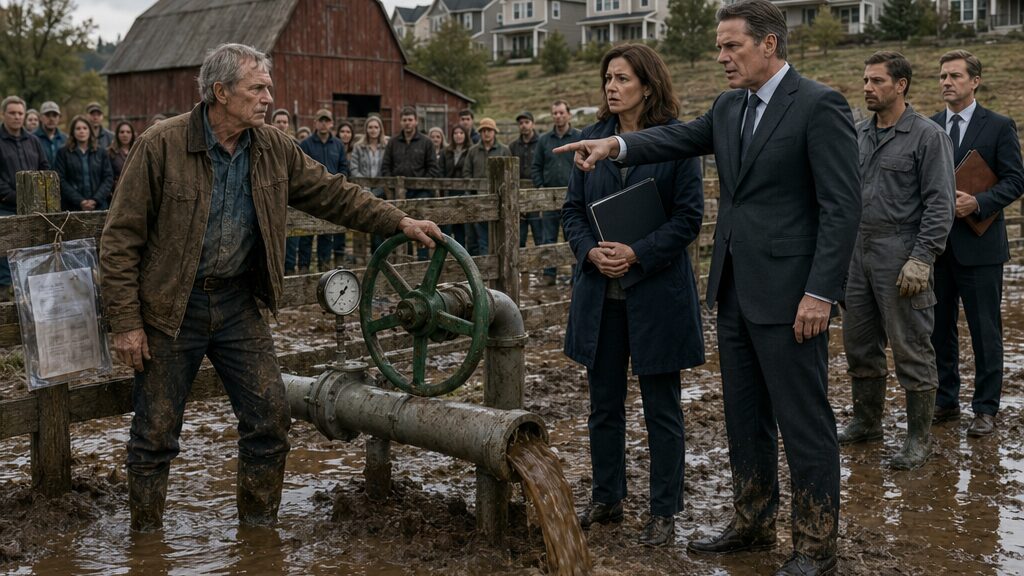
Samuel stepped down into the pasture. Mud closed around his boots as he approached the green valve. He rested one hand on the wheel.
Richard pointed at him. “Do not touch that.”
Samuel looked at the residents, not Richard.
“The original agreement has three conditions that matter here. Maintain the line. Keep the discharge contained and treated. Stay within the permitted flow unless an amendment is signed.”
He tapped the plastic sleeve on the fence.
“I sent notice fifteen days ago. He signed for it.”
Richard’s voice sharpened. “Your interpretation is disputed.”
Samuel turned to him. “Which condition are you meeting?”
Scott opened his folder.
Richard said, “This is not the place.”
“The water’s here.”
“The system serves hundreds of people.”
“Which condition?”
Richard looked toward the residents. “We are addressing a temporary maintenance event.”
Samuel pointed to the barn. “That mark is from last year. This one is from two weeks ago.”
Angela stared at the two lines.
Richard said, “You refused inspection access.”
“I refused a crew that moved boundary stakes outside the corridor.”
“You obstructed maintenance.”
“I offered you the recorded corridor after that.”
“You offered impossible conditions.”
Samuel’s hand remained on the valve.
The wrongness of the scene was visible even without the documents: Richard in a clean suit above the contaminated ground, residents gathered behind him, Samuel standing ankle-deep in what their homes had sent downhill.
Richard motioned to the contractor. “Check the gate.”
The contractor took a step.
Samuel turned the wheel one quarter-turn.
The gauge needle dropped.
A vibration inside the pipe softened to a lower hum.
Several residents stepped back.
Richard’s face lost color. “Open it.”
“It’s still flowing.”
“You have no right to restrict service.”
“I have the right to stop a breach after notice.”
Scott moved closer to the gauge. “A partial closure could create upstream pressure.”
“Then show me your emergency bypass.”
No one spoke.
Angela looked at Richard. “There is a bypass. It’s in the disclosure package.”
Richard’s answer came too quickly. “There are contingency measures.”
“Where?”
“The pump station.”
The wastewater contractor stared at the mud.
Samuel saw it.
“So which is it?” he asked. “A bypass or measures?”
Richard rounded on the contractor. “Do your job.”
The man did not move.
One of the residents, a woman standing near Angela, folded her arms. “My complaint against him was based on what we were told. That he blocked a repaired line and caused the leak.”
She looked at Samuel.
“I’m withdrawing it.”
The statement was small, almost swallowed by the pasture, but it changed the group. People began asking Richard separate questions instead of accepting one answer.
How long had he known?
Who owned the system?
Where had the fees gone?
Was the notice valid?
Scott closed his folder again.
Before the crowd dispersed, a county environmental inspector arrived. She photographed the discharge, examined Samuel’s logs, and requested access records from both sides.
By afternoon, she issued preliminary citations.
Richard’s company was cited for unauthorized discharge and failure to produce maintenance documentation.
Samuel was cited for incomplete access records connected to the inspection he had refused three years earlier.
He read his own citation twice.
Angela stood beside him at the fence. “So he wasn’t lying about that.”
“Not entirely.”
“You never told anyone.”
“No one asked me.”
She looked at the brown water. “That answer seems to be how we got here.”
Samuel folded the citation and put it in his pocket.
For the remaining fifteen days, pressure came from every direction. Richard’s attorneys demanded withdrawal of the notice. Residents left letters in Samuel’s mailbox—some threatening, some pleading. The county requested daily valve readings. Angela sent him questions about ownership that the HOA’s own contracts did not clearly answer.
Samuel responded in writing.
He gave dates. He cited clauses. He admitted the refused inspection. He offered supervised access within the recorded corridor.
He did not withdraw the notice.
On the thirtieth day, he sat alone in the county records office while Deborah checked the filing one last time.
“You understand that recording termination does not settle every dispute,” she said.
“I understand.”
“It changes the legal position. It does not make the pipe disappear.”
“I know.”
“And people uphill will react.”
“They already have.”
At eleven fifty-eight, the county clerk stamped the declaration.
At midnight, the recorded easement terminated.
Deborah handed Samuel the certified copy.
The page felt too light for what it carried.
He drove back to the ranch under a black sky. At the lower pasture, the green valve stood beneath the dark outline of the subdivision. Porch lights dotted the hill. Behind those windows, families slept above a system most of them had never seen.
Samuel laid the recorded termination inside the clear sleeve and tied it to the fence.
Then he placed both hands on the valve wheel.
At sunrise, he would close it.
Chapter 4: The First Turn of the Valve Was Not the Victory
Samuel closed the valve at six twelve in the morning.
The wheel resisted for the first half-turn, then moved with a deep iron groan that traveled through the pipe beneath his boots. The gauge needle fell steadily. The vibration in the ground weakened until the only sound in the pasture was water dripping from the barn siding.
For one brief moment, the ranch seemed to exhale.
Then an alarm began on the hill.
It was faint at first, a mechanical pulse carried through the still air. Within seconds, a second alarm joined it from farther east. Porch lights appeared in rows. Garage doors rose. People stepped into driveways wearing robes, work clothes, and slippers.
Samuel kept one hand on the wheel.
The brown flow around the valve slowed to a dirty trickle. Mud settled against the grass instead of spreading toward the barn. He watched the gauge until it reached zero.
He had imagined this moment for thirty days. He had expected relief.
Instead, he could hear the neighborhood waking in fear.
A pickup came down the access road so fast that gravel struck the fence. Richard stopped beyond the chain and got out before the engine had fully died. Scott followed, carrying two folders and a phone.
“You closed it,” Richard said.
“The easement ended at midnight.”
“Open it.”
Samuel lifted the recorded termination from the clear sleeve tied to the fence. “You received notice. You had thirty days.”
“You have created an active sanitation emergency.”
“You created it when you ignored the breach.”
Richard reached for the gate chain.
Samuel stepped between him and the latch. “That chain stays closed.”
A white utility truck arrived behind Richard’s pickup. The wastewater contractor climbed out, listened to the alarms, and looked uphill.
Richard pointed toward the valve. “Get in there and restore full flow.”
The contractor did not move. “We don’t have land access.”
“You have an easement.”
“Not according to the record attached to the gate.”
Richard turned on Scott. “Tell him.”
Scott opened the first folder but did not approach the fence. “The termination is disputed. Until a court rules, unilateral entry would create additional exposure.”
“So you’re saying he can choke off four hundred homes?”
“I’m saying we should not trespass while arguing that he interfered unlawfully.”
Richard stared at him, then at Samuel.
The alarm changed from a pulse to a steady tone.
Angela’s car stopped behind the utility truck. She got out with the HOA treasurer and two residents. Her hair was still damp, and she had thrown a coat over sleep clothes.
“What is happening?” she asked.
Richard answered before Samuel could. “He shut the line.”
Angela looked at Samuel. “Fully?”
“Yes.”
“You said you would wait until the notice period ended.”
“It ended.”
“My street has pump alarms.”
“That line was flooding my pasture yesterday.”
“I know what it did here.” She glanced uphill. “I also know what sewage does when it cannot go downhill.”
The wastewater contractor stepped closer to the fence. “We need pressure readings from the pump station.”
Richard thrust a phone toward him. “Then get them.”
The contractor made a call and waited. His face altered as he listened.
“How bad?” Scott asked.
“Wet well is rising faster than projected.”
“Projected by whom?” Samuel said.
No one answered.
The contractor covered the phone. “At this rate, the lower houses could see backup in under two hours.”
Angela looked at Richard. “What about the emergency bypass?”
Richard kept his attention on the contractor. “Activate it.”
The contractor lowered the phone.
“There isn’t one to activate.”
The words seemed to flatten the morning.
Angela said, “The disclosure package shows a bypass connection.”
“It shows a proposed connection,” the contractor replied.
Richard’s voice sharpened. “Be careful.”
The man looked at him. “You asked me for the operational answer.”
Samuel felt the valve wheel under his palm. Thirty days of exact procedure had brought him to the point where the contract recognized his right to close it. Yet the pressure now building uphill did not belong only to Richard. It was moving toward kitchen drains, basement toilets, and families who had signed mortgage papers without ever seeing the pipe beneath Samuel’s field.
A county environmental inspector arrived with a sheriff’s deputy. She read the recorded termination, examined the gauge, and asked for the pump station’s current level.
Richard spoke over everyone. “This is sabotage. I want the line reopened and the property secured.”
The deputy looked at the chain, then at Samuel. “Mr. Green, has anyone crossed your fence?”
“Not yet.”
The inspector said, “No machinery enters without permission while title and access are disputed. But if upstream overflow threatens public health, we need a temporary operating plan.”
“I’m not granting the easement back,” Samuel said.
“No one asked you to.”
Richard laughed without humor. “That is exactly what reopening means.”
Scott’s head turned toward him.
Samuel caught it.
The contractor received another call. “First residential alarm,” he said. “House on the lower curve.”
Angela’s face changed. “Whose?”
“The older woman at the end lot.”
Angela was already reaching for her phone. “Her laundry room is below grade.”
Samuel looked uphill. He could not see the house from the pasture, only the roofs and the pump station’s flashing red beacon.
Richard stepped toward the gate again. “You heard him. Open it.”
Samuel held his ground.
“You do not order me on my land.”
“And you do not get to punish an entire neighborhood because you hate what was built above you.”
Samuel’s grip tightened on the valve handle.
The accusation struck close enough to hurt. He had hated the houses. Not the people inside them, perhaps, but the walls, roads, streetlights, and drainage cuts that had replaced pasture he remembered as open land. He had treated every new roof as evidence that someone else’s future required the shrinking of his own.
Angela ended her call. “The resident has water pushing into the laundry drain.”
The inspector looked at Samuel. “You can authorize a limited emergency release without restoring the easement. Put the conditions in writing. Time, flow, supervision, no entry beyond the corridor.”
Richard said, “He opens it, he recognizes continued use.”
“That is not what she said,” Scott replied.
Richard turned on him. “Whose side are you on?”
Scott closed his folder. “The side that does not make an avoidable emergency worse.”
Samuel studied the gauge. He knew the wheel’s response better than anyone present. He had watched his father turn it during maintenance shutdowns when Samuel was young. A full opening would restore Richard’s practical control. A measured opening could relieve pressure without surrendering the boundary.
“Paper,” Samuel said.
The inspector handed him a field form.
He wrote slowly against the fence post: temporary emergency flow only; no acknowledgment of easement; county supervision required; access limited to named personnel; all readings logged; termination remains in effect.
Angela read it first. Scott read it next. Richard refused.
“That document is meaningless,” he said.
“Then the valve stays closed,” Samuel replied.
Angela took the pen and signed as HOA president.
The inspector signed beneath her.
Samuel unlocked the gate only long enough for the inspector and contractor to enter on foot. Richard tried to follow.
Samuel caught the chain before he crossed.
“Not you.”
“You cannot exclude the system owner.”
“The system owner had thirty days.”
Richard’s face hardened, but the deputy stepped between them.
Samuel walked to the valve.
The contractor called out the upstream pressure while the inspector wrote. Samuel opened the wheel one eighth-turn. The pipe shuddered. The gauge lifted from zero.
“Still rising,” the contractor said after thirty seconds.
Samuel opened it another fraction.
“Slowing.”
He waited.
“Hold there.”
The alarm on the hill continued, then broke back into separate pulses. A minute later, one beacon went dark.
Angela released a breath.
The brown trickle in the pasture thickened, but it remained inside the shallow channel Samuel had dug during the notice period. He looked at the barn. The water was not yet advancing.
The inspector marked the wheel position with paint and sealed the adjustment under her authority.
“This stays here until we have a controlled alternative,” she said.
Richard took out his phone.
He photographed Samuel beside the partially open valve, the flow returning beneath his hand.
Then he turned the screen toward Scott.
“There,” Richard said. “He reopened it. Continued use accepted.”
Samuel looked at the image.
For the first time that morning, Richard smiled.
Chapter 5: The Report Hidden Behind the Homeowners’ Monthly Fees
The sealed envelope was inside Angela’s board packet when she opened it at the clubhouse.
It had no name on the front. Only three words in Scott Brown’s narrow handwriting:
Read before voting.
She locked the meeting-room door and broke the seal with her thumbnail.
The first page was an engineering report dated eighteen months earlier. The title identified the subdivision pump station and the Green Ranch conveyance corridor. Beneath it, a red stamp read FINAL CAPACITY REVIEW.
Angela sat down.
The report stated that the existing line could not safely carry the planned flow from the final subdivision phase. It warned that peak use would exceed the recorded easement limit, increase pump pressure, and create a high probability of discharge at the lower control gate.
A handwritten note filled the margin beside the recommendation for a replacement route.
DEFER UNTIL PHASE SALES COMPLETE.
The initials were Richard’s.
Angela read the page again, hoping she had misunderstood it.
She had spent the previous two days defending the emergency flow agreement to homeowners who believed Samuel had nearly flooded their houses. She had repeated Richard’s claim that the crisis came from an unpredictable legal attack. She had told residents the HOA’s monthly infrastructure fee protected them against system failures.
The second section showed where those fees had gone.
Consulting charges. Marketing support. Landscape completion. Interest coverage for unfinished lots.
The reserve line for the replacement wastewater route had been reduced to almost nothing.
The clubhouse door opened.
Scott stepped inside and closed it behind him.
“You left this,” Angela said.
He looked at the envelope, not her. “I left a packet.”
“You knew.”
“I knew there was a capacity concern.”
“This says failure was probable.”
“It says probable under full occupancy.”
“The final phase is occupied.”
“Nearly.”
She pushed the report across the table. “You drafted the notices calling Samuel an extortionist.”
“I drafted notices stating the company’s position.”
“That sentence is how you sleep?”
Scott’s jaw tightened. “You think I have not spent eighteen months trying to get a replacement line funded?”
“Did you tell the board?”
“I told Richard the HOA needed disclosure.”
“And?”
“He said disclosure before the last closings would collapse sales, trigger lender defaults, and leave the whole development unfinished.”
Angela looked toward the window. Beyond the clubhouse lawn, children waited at a bus stop beneath identical young trees. Every house around them carried a mortgage tied to assumptions Richard had known were false.
“You helped him hide it.”
Scott sat across from her. “I kept the report.”
“That is not the same as acting.”
“No.”
The admission was so plain that it unsettled her more than an excuse would have.
“Why give it to me now?”
“Because Samuel had every reason to keep the valve closed yesterday, and he did not.”
Angela said nothing.
Scott continued. “Richard expected him to choose revenge. He planned to use the backups to get an emergency order and discredit the termination. Samuel gave controlled flow instead. It changes the facts.”
“It changes what you are willing to admit.”
“Yes.”
Angela turned to the attached flow logs. The numbers recorded at the green valve rose month by month, then spiked after the newest phase opened. Richard’s public statements described the system as operating below design limits. The logs showed otherwise.
One entry caught her attention.
Inspection attempt denied by landowner following corridor stake dispute.
Attached photographs showed orange markers driven beyond the recorded easement. One stood beside Samuel’s cattle trough. Another crossed an old stone wall.
Angela remembered telling residents that Samuel had blocked necessary maintenance without cause.
She closed her eyes briefly.
By noon, the county inspection trailer beside the pump station was crowded. The environmental inspector had spread diagrams across a folding table. Samuel stood near the door, his hat in his hands, while the contractor compared pump readings with the valve log.
Angela placed the report in front of the inspector.
Richard arrived before anyone finished the first page.
“What is that?”
Angela did not answer.
He saw the cover and looked at Scott. “Where did she get it?”
Scott remained by the wall.
Richard took one step toward the table. The inspector placed her hand on the report.
“This is now part of the county review.”
“It is privileged.”
“It is an engineering capacity document tied to a public-health discharge.”
“It was preliminary.”
The inspector turned to the signature page. “It says final.”
Richard looked at Angela. “You have no authority to release company records.”
“I have a duty to the homeowners paying for a system you knew could not carry their homes.”
“You have a duty not to destroy their property values.”
The words struck the room with the force of truth used for the wrong purpose.
Angela understood why he had hidden the report. Panic could freeze sales, lenders could withdraw, and residents who had put everything into their houses could lose more than money. She had feared the same thing. She had kept board discussions private when complaints about odors first appeared because she believed protecting values protected families.
Richard saw recognition in her face.
“You know what happens if this goes public,” he said. “Every home in this development becomes difficult to sell. Insurance reviews. Health notices. Lawsuits. You think the rancher pays for that?”
“No,” Angela said. “You were supposed to prevent it.”
“The line kept operating.”
“By flooding his land.”
“His land can be remediated.”
Samuel’s head lifted.
Angela looked at him. “I said something close to that once.”
He did not rescue her from the silence.
Richard opened his own folder. “The HOA board is meeting at four. I am proposing an emergency resolution authorizing access to the utility corridor. Your governing documents require preservation of essential services.”
“The HOA does not own the line,” Angela said.
“It represents the affected residents.”
“It cannot authorize entry onto someone else’s property.”
“A court can decide that later.”
Samuel stepped forward. “A bulldozer decides it now.”
Richard faced him. “You reopened the valve. You acknowledged necessity.”
“I authorized emergency flow under county supervision.”
“You restored operation.”
“Not your rights.”
Richard smiled faintly. “We will see.”
He left the trailer.
Angela followed Samuel outside. The green valve lay down the slope, visible between the barn and the fence. An inspector’s paint mark showed the exact position Samuel had set.
“I knew some things were wrong,” she said.
Samuel kept looking toward the pasture.
“Not the report,” she continued. “But complaints disappeared from board summaries. Richard told us not to create a record that could be misread. I agreed because people were trying to sell, refinance, retire.”
“You thought silence would protect them.”
“Yes.”
Samuel rubbed the edge of his hat brim with his thumb. “So did I.”
She looked at him.
He nodded toward the old stone wall. “When their crew moved those stakes, I stopped answering. Figured if I gave one inch, the corridor would become whatever they said it was. I should have reported the flow years ago.”
“That does not make this your fault.”
“No. But it gave him room.”
At three forty-five, the HOA treasurer called Angela. Residents were gathering. Richard had brought contractors and circulated a resolution stating that the HOA would take necessary action to preserve sanitation service.
Angela forwarded the report to the county inspector, the board, and Samuel.
Then she sent one additional message to every homeowner:
Do not vote until you read the attached engineering review and fee records.
Her phone erupted with calls.
From the trailer window, she saw heavy equipment turning onto the ranch road.
A bulldozer led the line.
Samuel’s reply arrived as the first machine reached his gate.
I have the report. The chain stays closed.
Chapter 6: No Machine Crossed the Fence Until the Truth Was Recorded
The bulldozer bucket stopped three inches from the ranch gate chain.
Samuel stood on the other side with the recorded termination in one hand and a heavy padlock in the other. The machine’s engine idled low enough to shake dust from the gateposts.
Behind it waited two utility trucks, Richard’s black pickup, and a line of residents’ cars. County vehicles approached from the opposite direction, their lights flashing without sirens.
Richard stepped down from his truck.
“Move the chain.”
Samuel fitted the padlock through the links and snapped it shut.
“No.”
The bulldozer operator lifted both hands from the controls.
Richard pointed toward the hill. “The HOA passed an emergency resolution.”
Angela came through the gathering crowd holding a printed copy. “It did not.”
Richard turned.
“The vote was suspended after the report went out,” she said. “You brought the equipment anyway.”
“A delayed vote does not erase the emergency.”
“The county-approved flow is holding.”
“For the moment.”
The environmental inspector crossed the road with the sheriff’s deputy and two county technicians. She looked at the bulldozer bucket, then at Richard.
“Back the machine ten feet from the gate.”
Richard said, “We need access to stabilize the system.”
“You have controlled flow under yesterday’s agreement.”
“We need full operational authority.”
“You do not have property access.”
Richard’s eyes moved from the inspector to Samuel. “He is obstructing a utility.”
Samuel held up the termination. “The utility had a conditional easement. The conditions were broken. Notice was served. Termination was recorded.”
“You reopened the line.”
“Temporarily.”
“That proves the service cannot be interrupted.”
“It proves I chose not to flood your customers’ homes.”
The residents behind Richard began speaking among themselves.
Samuel could see fear in their faces. Some had read the report. Others had come because Richard told them their toilets would overflow if the valve remained under Samuel’s control. A few still looked at Samuel as though the chain itself were an attack.
He had spent years not caring what those houses thought of him.
Now every person behind the gate was attached to the same pipe.
The inspector addressed the operator. “Back up.”
The bulldozer rolled away from the chain.
Richard’s composure slipped. “This county is allowing one landowner to hold a public-health system hostage.”
Scott stepped out from beside the second utility truck.
“It is not a public system,” he said.
Richard turned slowly.
Scott carried the original engineering report in a clear evidence sleeve.
“It is owned by Roberts Development Services,” he continued. “The HOA pays operating fees but does not hold title, and the county has not accepted dedication.”
Richard stared at him. “You are counsel for the company.”
“I was.”
The word moved through the crowd.
Scott gave the report to the inspector. “The attached emails authenticate the capacity review. Mr. Roberts directed that it not be disclosed to the HOA or filed with the county until final-phase sales were complete.”
Richard’s face became still.
“You stole privileged documents.”
“I preserved operational records after being instructed to remove them from the active project file.”
“You were told to organize the file.”
“I was told to make the report unavailable.”
The inspector took the sleeve.
Samuel watched Scott’s hands. They were trembling.
It would have been easy to see courage in the act and forget the long delay before it. Scott did not ask anyone to forget.
“I should have released it earlier,” he said. “I did not.”
Richard stepped close enough that the deputy moved between them.
“You think handing over one report saves you?”
“No.”
“Then why?”
Scott looked toward the green valve below the barn. “Because yesterday he protected the same residents we were prepared to use against him.”
The crowd quieted.
Samuel felt no triumph. Only the weight of every day the report had remained hidden.
The inspector opened the sleeve and scanned the first email.
“We need controlled testing before anyone changes the valve,” she said. “All pump controls remain under county supervision.”
Richard pulled out his phone. “The system owner does not consent.”
“You are under active environmental review.”
“You cannot seize private infrastructure without process.”
“We are not seizing it. We are preventing alteration while documenting a discharge.”
Richard’s thumb moved across the screen.
Down the slope, the pipe gave a sudden metallic knock.
The contractor turned toward the pump station. “Pressure spike.”
The inspector looked at her tablet. “Who changed the setting?”
“No one here,” a technician said.
Another knock traveled through the pipe. Brown water surged around the green valve and spilled over the channel Samuel had dug.
Richard put his phone in his pocket.
Samuel saw the movement.
“You did that.”
Richard said nothing.
The contractor checked his own device. “Remote command forced Pump Two online.”
The inspector faced Richard. “Disable it.”
“It was an automatic response.”
“The log will show the source.”
The pipe shuddered again.
At the barn, water began climbing over the lowest mark.
Richard raised his voice so the residents could hear. “This is exactly why an untrained landowner cannot control critical infrastructure.”
Samuel unlocked the gate.
Richard smiled.
Then Samuel opened it only wide enough for the inspector, technicians, contractor, Angela, and Scott to pass.
He closed it before Richard reached the entrance.
“You stay outside.”
“The pump is mine.”
“The overflow is on me.”
Samuel led the group toward the valve. Behind them, the deputy held the gate.
The green wheel vibrated under Samuel’s hand. The gauge needle had climbed beyond the position authorized the day before.
“Upstream pressure?” he asked.
A technician read the tablet. “Still rising. Pump Two is fighting the restricted gate.”
“Can you shut it remotely?”
“Command rejected.”
The contractor said, “Manual control is at the station.”
Richard called from the fence. “Open the valve fully and the pressure clears.”
“And the discharge takes my pasture,” Samuel said.
“You cannot have both.”
Samuel looked at Angela.
She held the emergency agreement from the previous morning. “What do you need?”
“A license.”
“For what?”
“Temporary flow directly from the HOA. Not Richard’s company. Limited time, limited rate, county control, full access to records, and no claim that use restores the easement.”
Richard shouted, “The HOA has no authority to operate my system.”
Angela turned toward him. “Then stop using our fees to run it.”
Samuel set the wheel brace against the valve. “Write it.”
They used the hood of the inspector’s truck as a desk. Scott dictated narrow language while Angela amended it by hand. The HOA accepted responsibility for emergency service solely to protect residents. The county supervised every adjustment. Roberts Development received no access right. Samuel retained termination and trespass claims. All flow data became public to the HOA and county.
Angela read the page once.
Then she added a sentence of her own.
The HOA acknowledges that prior board silence contributed to the present emergency.
Scott looked at her.
“You do not have to put that in this document,” he said.
“I do.”
She signed.
Samuel signed beneath her.
The inspector noted the time.
“Pressure?” Samuel called.
“Critical in six minutes,” the technician answered.
Samuel returned to the wheel.
“Call readings every ten seconds.”
He opened it one narrow increment.
“Upstream one-eighty-two. Downstream forty-six.”
Another increment.
“Upstream one-seventy. Downstream sixty-one.”
Brown water pushed into the channel, dark and fast, but remained below the barn track.
Samuel adjusted again.
“Upstream one-fifty-two. Downstream seventy-three.”
“Hold there,” the contractor said.
The pump continued forcing pressure. The wheel strained against Samuel’s grip.
The inspector called to the station crew over speakerphone. “Cut power at the main disconnect.”
A distant alarm changed pitch.
The technician watched the tablet. “Pump Two dropping.”
Samuel eased the wheel back a fraction.
“Upstream one-thirty.”
“Flow steady.”
“Barn channel holding,” Angela called.
For the next twenty minutes, Samuel moved the valve by inches. Each turn was photographed. Each reading was logged. The county technicians sampled the discharge. Scott identified the remote command timestamp. The contractor confirmed that Richard’s phone credentials had initiated the second pump.
Outside the fence, residents watched the process Richard had told them Samuel was incapable of managing.
The valve no longer felt like a weapon.
It felt like a promise that could be broken in either direction.
When the pump finally shut down, the pressure settled into the emergency range. No homes backed up. The water in Samuel’s pasture stopped below the newest barn mark.
The inspector placed a county lock on the remote-control cabinet and revoked Richard’s access credentials pending review.
At the gate, Richard stood alone beside his pickup. The bulldozer and utility trucks had been ordered off the road.
“You are destroying this development,” he told Angela.
She looked uphill at the houses. “No. We are finding out what it costs to keep living in it.”
Richard turned to Samuel. “You think they will thank you when their fees triple?”
Samuel wiped mud from his hands.
“I’m not asking them to.”
“You will still need a permanent line.”
“They will.”
“And you think they can build one without crossing your property?”
“That is a problem we discuss with the truth on the table.”
The inspector handed Richard a written order barring him from altering the pump system or entering the ranch corridor. He read it, folded it once, and put it into his coat.
There was no arrest. No crowd celebrated. Residents remained frightened about assessments, home values, and what would happen next.
But when Richard drove away, he no longer controlled the valve, the pump settings, or the story told about either one.
At sunset, the temporary license took effect.
The green wheel remained at the exact position Samuel had set, sealed with county paint and recorded in three separate logs.
For the first time since the subdivision reached full occupancy, the people uphill could see precisely how much was flowing through Samuel Green’s land—and under whose permission.
Chapter 7: The New Line Followed the Hill Instead of the Pasture
The excavators arrived at Samuel’s gate six months later, but their survey flags did not point toward the pasture.
They climbed the hillside instead.
A line of blue stakes curved above the old stone wall, followed the county road, and crossed a strip of common land behind the subdivision’s eastern houses. The route was longer than the pipe beneath Samuel’s field. It required a new lift station, two road cuts, and a reinforced crossing over the creek.
It also stayed off the ranch.
Samuel stood beside the gate with the rolled construction plan under one arm. The lower pasture behind him had been scraped, treated, reseeded, and fenced away from the cattle while the soil recovered. New grass showed in thin green rows where brown water had once spread toward the barn.
The old water marks remained on the red siding.
He had refused to paint over them.
Angela parked beside the contractor’s truck and came toward him carrying a folder. She no longer wore the HOA president’s silver name badge. After the board’s emergency election, the residents had asked her to continue, but the title now belonged to an association that controlled its own records, not one managed through Richard’s development company.
“The county approved the upper route,” she said.
Samuel unrolled the plan across the hood of his truck. “I saw.”
“There is one problem.”
“There’s always one.”
“The final connection has to cross the north service lane for three days. Not the pasture. The lane.”
Samuel looked at the narrow gravel track that ran between his equipment shed and the upper fence. It was unquestionably his land. The old easement had never touched it.
Angela opened the folder. “Temporary construction license. Exact dates, vehicle list, hours, restoration bond, no storage, no expansion, automatic expiration.”
“You wrote all that before asking.”
“We learned something.”
He studied her face for humor and found only fatigue.
The new utility had taken months to form. Residents had voted to purchase the functioning portions of the system after county auditors separated them from Richard’s company. Their assessments had risen. Several households had listed their homes. Lawyers had filed claims over false disclosures, diverted fees, and environmental damage.
Richard had not vanished. He attended hearings with counsel, challenged the county’s orders, and argued that market collapse would harm homeowners more than delayed repairs ever had. Some residents agreed with parts of what he said, even while suing him.
Justice had not arrived as a clean event.
It had arrived as invoices, soil samples, recorded meetings, and people learning what they had signed.
Samuel flipped through the temporary license.
“Who carries the insurance?”
“The resident utility.”
“Who supervises the crossing?”
“The county contractor.”
“No Roberts Development vehicles.”
“It says that on page four.”
He turned to page four. She was right.
The last section required the gate to be closed each evening and prohibited any future claim of easement, prescription, necessity, or continued right based on the temporary permission.
Samuel tapped the clause.
“Deborah wrote this.”
“She corrected it.”
“That means she wrote it.”
Angela almost smiled. “She said the county records what people agree to. It should not have to guess later.”
Samuel rolled the document again.
“I’ll read it.”
“The crew is scheduled for Monday.”
“Then you should have brought it sooner.”
“I brought it as soon as the financing cleared.”
He looked up the hill. A work crew was already setting barriers along the public road. None had crossed his fence.
“That is not the same thing.”
“No,” Angela said. “It isn’t.”
She left the folder with him.
That afternoon Samuel took it to the county records office.
Deborah had moved the old Green Ranch map into a protective sleeve. It lay on the same reading table where he had first discovered the revocation clause. Beside it rested a thinner file he had never seen.
“What’s that?” he asked.
“An attachment to the original easement.”
“It wasn’t there before.”
“It was indexed under a health-district case number, not the property record. We found it while consolidating the replacement filings.”
She slid the file toward him.
Inside were three letters dated the summer his father signed the agreement. The first came from the county health office. Several shallow septic systems beyond the ridge had failed after heavy rain. Wastewater had surfaced near two family wells. Temporary tanks were full, and the county needed a route to the treatment connection south of the ranch.
The second letter was from Samuel’s father.
The handwriting was blocky and familiar.
Samuel sat down before reading it.
His father agreed to the crossing because the families beyond the ridge needed a sanitary outlet before autumn. He objected to permanent access without maintenance duties and demanded a flow limit, inspection rights, restoration of disturbed ground, and the right to terminate if the users failed to care for the system.
At the bottom, beneath the formal text, he had added a note in pencil.
Help the neighbors, but make them care for what they use.
Samuel read the sentence twice.
For years he had imagined the easement as weakness—a concession his father had made because county officials or wealthier landowners pressured him. He had resented the pipe as proof that the ranch had been expected to absorb other people’s needs.
The letters told a different story.
His father had not surrendered the land. He had used it to solve an emergency, then built conditions around the help so it could not become entitlement.
Deborah sat across from him.
“He knew what an open-ended promise becomes,” she said.
Samuel ran one finger along the pencil line. “He could have told me.”
“Would you have heard it?”
He looked at her.
She did not soften the question.
At twenty-eight, Samuel had believed contracts were things people signed when a handshake had failed. At forty, he had believed boundaries spoke for themselves. At sixty-eight, he had learned that silence invited other people to describe the boundary for you.
He folded the copied letter and placed it inside the temporary-license folder.
On Monday morning, the construction crew waited outside his gate.
Samuel made them read the access conditions before he unlocked it. The foreman signed the vehicle list. Angela signed as utility representative. A county inspector photographed the gate, the lane, and the clock on the dashboard of the first truck.
Only then did Samuel remove the chain.
The trucks entered one at a time.
For three days they crossed the north lane carrying pipe sections toward the upper connection. They stayed between temporary barriers. They washed mud from their tires before leaving. Each evening the foreman reported the work completed, and Samuel closed the gate behind them.
The new line went live on the fourth morning.
At the old valve, the county contractor shut down the temporary flow through Samuel’s pasture. The green wheel turned for the last time beneath operating pressure. The gauge fell to zero without an alarm sounding on the hill.
No porch lights flashed. No drains backed up.
The pipe beneath the pasture was disconnected, capped at both ends, and abandoned in place until removal could be completed without disturbing the recovering soil.
The contractor unbolted the green valve wheel and set it on the tailgate.
“You want us to dispose of this?” he asked.
Samuel picked it up.
Its paint had chipped away around the rim where his hands had turned it in measured increments. County inspection marks remained near the hub. Rust stained the inner spokes.
“No,” he said. “Leave it.”
He cleaned it at the barn sink and mounted it on the wall beside the two old water marks. Beneath it, he fixed a narrow metal plate with the original easement’s recording date and the date of termination.
Nothing else.
The settlement funded soil remediation, fence replacement, and the loss of one grazing season. It did not buy Samuel’s silence. The agreement stated that plainly because he insisted it should.
Scott provided records to the county and the homeowners’ attorneys. He surrendered his company position and testified about the withheld report. Angela disclosed the board minutes she had once agreed to keep informal. Neither asked Samuel to call those actions heroic.
They had acted late.
Late still mattered.
On the final afternoon of construction, one last truck waited inside the ranch while workers removed the temporary barriers from the north lane. Samuel stood at the open gate with Angela.
“The bond release says the lane is restored,” she said.
He examined the fresh gravel and the repaired ditch.
“It is.”
She handed him a signed copy of the completed license. “The permission expires when that truck crosses the gate.”
Samuel looked toward the driver.
The truck moved slowly down the lane. Its tires passed between the posts and reached the county road.
Samuel swung the gate shut.
The latch dropped cleanly into place.
Angela remained outside the fence. For a moment, neither of them spoke.
Above them, the new wastewater line followed the hill toward the public treatment route, invisible except for a strip of unsettled soil and a row of inspection covers. Below, calves grazed near the restored pasture. None stood trapped behind brown water.
Samuel threaded the chain through the gate.
Angela said, “We may need to inspect the upper connection next year.”
“Then send notice.”
“We will.”
“And use the right gate.”
She nodded.
Samuel locked the padlock, then rested one hand on the top rail.
His father’s note was folded in the deed box at home, no longer hidden under tax receipts or mistaken resentment. Help the neighbors, but make them care for what they use.
The lesson had never been to keep everyone out.
It had been to know why the gate opened, what the crossing allowed, and when to close it again.
Samuel watched the final truck disappear up the road.
Then he turned back toward the barn, where the cleaned green valve hung above the marks the water had left behind.
The story has ended.