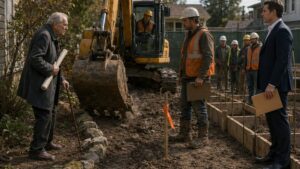
She Dug Up His Grandmother’s Garden, Then Learned Why the HOA Had Never Touched It
Chapter 1: The Shovel Was Already in His Garden
The shovel was already in Thomas Allen’s garden when he opened the front door.
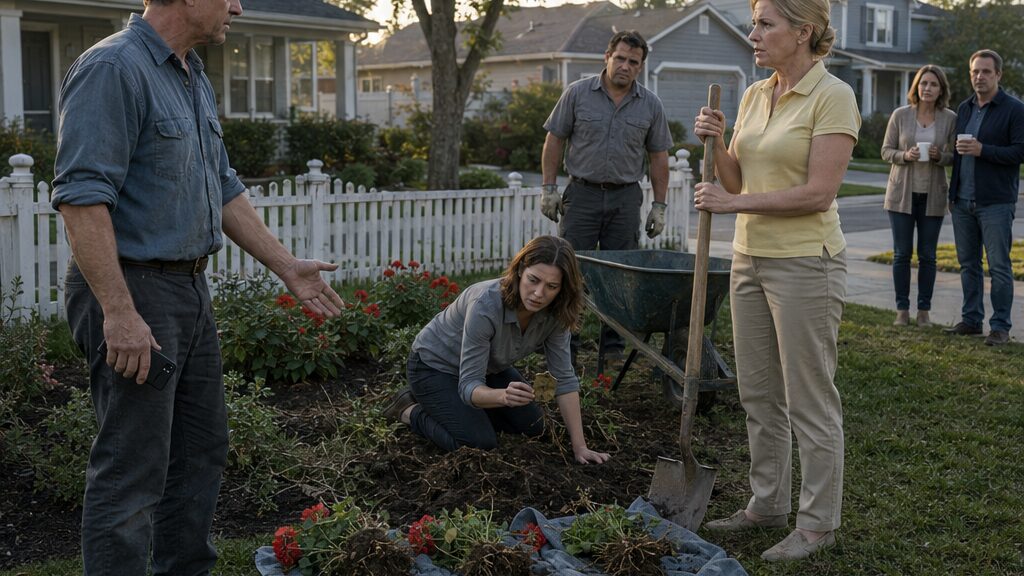
Its steel blade had been driven into the dark soil beside the red bee balm, deep enough that the wooden handle stood upright without anyone holding it. Three plants lay uprooted near the sidewalk, their roots exposed and silver with morning dew.
Karen Wright stood inside the flower bed with one hand on her hip.
Behind her, a man in a gray landscaping shirt waited beside a wheelbarrow. He had not moved since Thomas stepped onto the porch.
“What are you doing?” Thomas asked.
Karen glanced over her shoulder as though he had interrupted a scheduled inspection.
“Correcting the border,” she said. “You received notice.”
Thomas came down the steps without hurrying. He was barefoot, wearing yesterday’s work pants and a white undershirt. The concrete felt cold beneath his feet, but the sight of the torn roots made the rest of the morning disappear.
The flower bed ran along the low fence separating his yard from Karen’s. It had never been symmetrical. Tall stalks leaned over smaller blooms. Patches of bare earth appeared where spring flowers had died back. His grandmother had planted by season and memory, not by diagram.
Karen preferred diagrams.
Two neighboring residents had opened their front doors. One held a coffee mug against her chest. Another stood beside his mailbox pretending to examine the flag.
Karen gestured toward the plants with a folded paper.
“They’re crossing the property line, obstructing the sight line, and violating the approved landscape palette.”
Thomas looked at the shovel.
“That’s my property.”
“The committee voted.”
“The committee doesn’t own my yard.”
“The committee acts for the association.”
The landscaper shifted his weight.
Thomas took out his phone. He photographed the uprooted plants, the wheelbarrow, Karen’s shoes in the soil, and finally the shovel blade. He moved close enough to show where it had cut through a thick root.
Karen’s mouth tightened.
“You can take as many pictures as you like. This should have been handled months ago.”
Thomas stepped between her and the remaining flowers.
“No one moves another root.”
His voice was quiet. That made the landscaper look at him more carefully.
Karen gave a short, disbelieving laugh. “Thomas, you don’t get to ignore every letter and then act surprised when enforcement happens.”
“Show me the work order.”
“I just told you. The committee authorized it.”
“That isn’t a work order.”
The landscaper removed one glove. “Ma’am, do you have something from the property manager?”
Karen turned toward him. “You were told this was approved.”
“I was told it was association work.”
“It is.”
He looked from her to Thomas. “I need written authorization before I continue on an occupied lot.”
Karen stared at him as if he had broken an agreement.
Thomas did not feel victorious. Three plants were still lying in the grass. One of them had belonged to the oldest cluster in the bed, a narrow-leafed variety his grandmother had called river red. She had never used its formal name.
The landscaper set his glove on the wheelbarrow.
“I’m stopping until somebody from management confirms it.”
Karen pulled the shovel free. Soil slid from the blade.
Thomas’s hand moved before he could stop it, but he caught himself. He did not grab the handle. Instead, he raised his phone and took another photograph.
Karen saw the motion.
“You think this makes you look reasonable?”
“I think it shows where the shovel was.”
“It shows a neglected garden.”
The words landed harder than he expected.
Karen unfolded the paper she had been holding and pressed it toward him. It was not one notice but four, stapled at the corner. The first was dated nearly six months earlier.
He recognized the red association header.
Catherine had once placed a stack of similar envelopes beside his keys and asked whether he planned to open them. He had told her they were reminders about mulch.
They had not been only about mulch.
“First notice,” Karen said, tapping the top page. “Encroaching growth and unapproved species. Second notice, no response. Third notice, hearing date. Fourth notice, final opportunity to cure.”
Thomas did not take the papers.
“You entered my yard.”
“You refused the process.”
“That doesn’t give you the right.”
“It gave the board the right to act.”
“Then show me the board order.”
For the first time, Karen hesitated.
It lasted less than a second, but the landscaper noticed.
“So there isn’t one?” he asked.
Karen folded the notices again. “The landscaping committee has delegated authority.”
“Delegated to recommend,” Thomas said.
He was no longer certain that was true. He had served on a municipal grounds crew for twenty-six years, and he knew what delegated authority usually meant. He also knew that memory was not the same as a current rule.
Karen’s confidence returned when she saw the doubt on his face.
“You should have attended the hearings.”
Thomas looked toward the house. The unopened envelopes were still in a kitchen drawer under rubber bands, spare keys, and his wife’s old address book.
Karen followed his glance.
“That’s what I thought.”
A car stopped at the curb. Catherine climbed out before the engine had fully quieted. She wore black work slacks and carried a canvas grocery bag. Her expression changed when she saw the uprooted plants.
“What happened?”
“Your father happened,” Karen said. “He ignored six months of notices.”
Catherine set the bag on the sidewalk.
“Why are you standing in his garden with a shovel?”
Karen lifted the papers. “Committee enforcement.”
Catherine looked at Thomas. “Did you get notices?”
Thomas hated the question because it was the correct one.
“Yes.”
“And?”
“I didn’t agree with them.”
“That isn’t what I asked.”
Karen made a small sound of satisfaction.
Thomas turned to the landscaper. “You’re done here.”
The man nodded. “Until management contacts us.”
Karen stepped out of the flower bed. “This isn’t finished.”
“No,” Thomas said. “It isn’t.”
She walked toward her house carrying the notices but left the shovel beside the wheelbarrow. The landscaper noticed and picked it up by the middle of the handle.
“Is this yours?” he asked Thomas.
“No.”
He leaned it against Karen’s fence.
When they were alone, Catherine knelt near the damaged plants. She touched one stem and drew back when it bent too easily.
“How many?”
“Three out. Maybe more cut.”
She looked at him. “Why didn’t you tell me about the notices?”
“They weren’t entitled to touch the bed.”
“That can be true, and you can still have made this worse.”
Thomas went to the garage for buckets and damp towels. When he returned, Catherine had removed her jacket and was loosening the soil around a crushed cluster. They worked without speaking, placing the uprooted plants in shallow containers and covering the roots.
One of the neighboring residents approached the edge of the yard.
“I saw her start,” the woman said. “She told the landscaper the HOA approved it.”
“Would you write that down?” Catherine asked.
The woman looked toward Karen’s house.
“I suppose.”
Thomas saw the hesitation and understood it. In a neighborhood governed by committees, people often preferred private sympathy to public involvement.
Catherine dug carefully around the largest damaged root. Her fingers struck something hard.
“At first I thought it was a stone,” she said.
She scraped away the soil with the side of her hand.
A narrow brass plate emerged beneath the torn roots. It was green at the edges and bent near one corner. Catherine lifted it free and wiped it against her sleeve.
Two faded initials were stamped into the metal.
E.A.
Below them was a small county seal Thomas had not seen in years.
Catherine held the marker out to him.
“What is this?”
Thomas stared at it until the garden around them seemed to contract.
His grandmother had once pushed that marker into the soil with the handle of a small hand shovel. He had been standing beside her, young enough to believe anything planted properly would remain where it was.
“I thought it was gone,” he said.
“That doesn’t answer me.”
He took the marker. The metal was cold despite the morning sun.
“It belonged to a county program.”
“What kind of program?”
Thomas looked toward Karen’s fence, then at the three uprooted plants laid across the damp towels.
“One they stopped talking about a long time ago.”
Chapter 2: The Marker No One Remembered Seeing
“There is no work order,” the HOA property manager said.
Thomas stood at the front counter of the association office with Catherine beside him and the bent brass marker sealed inside a clear food-storage bag. A framed photograph of the community entrance hung behind the manager’s desk. Every shrub in the picture had been trimmed into the same rounded shape.
The manager clicked through a series of files on her monitor.
“I have violation notices,” she continued. “I have committee recommendations. I have hearing records. I do not have an approved vendor order for your lot.”
“So Karen acted on her own,” Catherine said.
The manager’s shoulders tightened. “I did not say that.”
“You said no one authorized the work.”
“I said I cannot locate a work order.”
Thomas placed his phone on the counter and opened the photograph of Karen’s shovel in the soil.
“The contractor said she told him it was association work.”
The manager looked at the image without touching the phone.
“Please email that to the compliance address.”
“I emailed it an hour ago.”
She turned back to her monitor.
Thomas knew the movement. Municipal offices had their own language of delay: a screen angled away, a form requested twice, a sentence built to admit nothing.
Catherine leaned forward. “Can the landscaping committee enter a homeowner’s property?”
“The association has certain rights of access.”
“For emergencies?”
“For maintenance under defined conditions.”
“Was this one of those conditions?”
The manager paused.
“No.”
It was the first clean answer they had received.
Thomas felt a brief release in his chest. It lasted until the manager opened another document.
“However, Mr. Allen, your account shows repeated noncompliance.”
She rotated the monitor enough for him to read.
The words ABANDONED LANDSCAPING appeared near the top of the file.
Below them were photographs of the garden taken from the sidewalk. In winter, the stalks had been cut low. Fallen leaves had gathered against the fence. The brass marker was not visible.
Thomas knew why. Three years earlier, after his wife died, he had stopped clearing the bed in the careful way his grandmother taught him. He removed what threatened the roots and left the rest until spring. To him, it had been protection.
In the photographs, it looked like neglect.
“That classification is wrong,” he said.
“You had opportunities to contest it.”
“I didn’t authorize anyone to reclassify my property.”
“You were notified.”
Catherine folded her arms.
“How many hearings did he miss?”
The manager looked at Thomas before answering.
“Three.”
The relief he had felt vanished.
The first hearing notice had arrived the week of his wife’s memorial service. He had placed it under a ceramic bowl and forgotten it until the date passed. The second came during a month when he could not walk through the kitchen without noticing which chair was empty. By the third, ignoring the envelopes had become less a decision than a habit.
Catherine turned toward him.
“Three?”
“They already knew I objected.”
“Did you tell them?”
“I didn’t need to explain my garden to a committee.”
The manager’s eyes dropped to the desk.
Catherine’s voice lowered. “Apparently you did.”
The office door opened behind them. Janet Moore entered carrying a binder against her chest. She wore a navy cardigan and reading glasses on a thin chain. Thomas knew her from annual meetings, where she spoke slowly and rarely allowed anyone else to raise the temperature of the room.
“I heard there was an incident,” she said.
“Karen entered his yard with a contractor,” Catherine replied.
Janet looked at the property manager. “Was there an authorization?”
“Not from management.”
Janet’s expression changed only slightly.
“Then the contractor should not have been there.”
“And Karen?” Thomas asked.
“We’ll need to determine what she represented to him.”
“She represented that the committee had authority.”
Janet set the binder on the counter.
“The committee does have authority to inspect common-facing landscape conditions.”
“From the sidewalk,” Catherine said.
“Yes.”
“And to remove plants?”
“No.”
The answer was quiet but decisive.
Thomas looked at Catherine. This was the fact he had wanted. Karen’s committee could recommend, document, and pressure. It could not enter his yard and dig.
Janet opened the binder.
“That does not erase the underlying file. Mr. Allen was given notice. He missed scheduled hearings. The board relied on the absence of response when the bed was classified.”
“So the HOA made a bad decision because he stayed silent,” Catherine said, “and Karen used that bad decision to trespass.”
Janet met her gaze. “That is one possible description.”
“It’s the accurate one.”
Thomas touched Catherine’s wrist. Not to stop her, only to remind her that he was still there.
Janet noticed.
“We need to keep separate issues separate,” she said. “The entry onto the property, the committee’s authority, and the condition of the garden are three different questions.”
Thomas understood the logic and disliked it because it prevented the simple vindication he wanted.
“What happens now?”
“The board will review Karen’s actions. Your landscaping status remains unresolved.”
Thomas lifted the plastic bag containing the marker.
“This was buried in the bed.”
Janet leaned closer.
“I’ve never seen that.”
“It’s a county heritage marker.”
The property manager searched the seal on her computer.
“Do you have current registration?”
Thomas did not answer quickly enough.
Janet looked at him over her glasses.
“Do you?”
“It was registered.”
“That isn’t the same question.”
Catherine closed her eyes for a moment.
Thomas placed the bag back on the counter. “The program may not even exist anymore.”
“Then we need confirmation,” Janet said. “Until then, the board cannot treat the bed as protected.”
“You never treated it as protected before.”
“We did not know.”
“You didn’t ask.”
“You did not respond.”
The sentence remained between them because neither side could remove its share of truth.
The property manager printed a copy of the committee charter. A highlighted paragraph stated that the landscaping committee could inspect visible conditions, document suspected violations, and make recommendations to the board. It contained no authority to order work on private lots.
Thomas folded the paper and placed it in his pocket.
A small payoff, clean and limited.
Karen had overreached.
Thomas had also left the door open for the association to misread everything behind it.
Outside, Catherine stopped beside his truck.
“You let me argue in there as if they had invented the whole problem.”
“They did invent part of it.”
“You missed three hearings.”
“I know.”
“You never told me.”
“I didn’t think it involved you.”
Her face changed.
“The garden belonged to my family too.”
Thomas looked toward the brass marker inside the bag. “Your grandmother gave it to me.”
“And that meant no one else was allowed to know why it mattered?”
He unlocked the truck but did not open the door.
“She didn’t like making a display of private things.”
“Maybe you didn’t.”
Catherine walked around to the passenger side.
His phone rang before either of them got in. The number carried the county prefix.
Thomas answered.
“Mr. Allen? This is Samuel Davis with county horticultural preservation.”
Thomas straightened.
“I received an inquiry about a brass marker recovered from your property.”
“Yes.”
There was a rustle of paper.
“I found a dormant file under that address. I need to inspect the site before I can tell you what it means.”
“Dormant?”
“That is the status in the system.”
“Is the garden protected?”
Samuel did not answer immediately.
“I can come tomorrow morning,” he said. “Please do not replant, remove, or dispose of anything before I arrive.”
Thomas looked at Catherine through the windshield.
Samuel’s tone was careful enough to extinguish the hope Thomas had already begun to build.
Chapter 3: Protection Did Not Mean What Thomas Expected
Samuel Davis recognized the brass marker before Thomas removed it from the plastic bag.
“That came from the Heritage Seed Exchange,” he said.
He stood at the edge of the damaged flower bed wearing an orange county vest over a pale work shirt. A clipboard rested against his forearm. His boots were clean when he arrived; within minutes, soil darkened the edges.
Thomas felt Catherine watching him from the porch.
“So it is protected,” Thomas said.
Samuel crouched beside the uprooted plants instead of answering. He examined the roots, then measured the depth of the shovel cuts. He asked Thomas to show where the blade had been positioned.
Thomas opened the photographs on his phone.
Samuel studied the image of Karen standing in the bed. He enlarged the area around the shovel, then compared it with the cut roots.
“Was the person using the shovel employed by the association?”
“No.”
“County contractor?”
“No.”
“Did you give permission?”
“No.”
Samuel wrote something down.
The same neighbor who had witnessed the confrontation stood near her mailbox again. This time, she did not pretend to check it.
Karen’s blinds were closed.
Samuel moved to the surviving plants. He identified several by leaf shape, marking their locations on a rough sketch.
“The good news,” he said, “is that some of these appear to be original stock or direct divisions.”
Thomas held on to the phrase good news.
“And the bad?”
Samuel stood.
“The file has not been active for seven years.”
Thomas looked at the marker in his hand.
“The plants didn’t stop being what they are.”
“No. But program status involves more than plant origin.”
“The county seal is right there.”
“The seal confirms participation. It does not create permanent protection.”
Catherine came down from the porch.
“What exactly did the program protect?”
Samuel glanced at his clipboard.
“Originally? Recorded heritage beds from unauthorized public removal, certain zoning actions, and county-funded landscape projects. It also gave participating homeowners access to preservation stock and technical support.”
“What about a neighbor with a shovel?” Catherine asked.
“That would fall under ordinary property law and association rules unless the registration was current and the plant material met preservation criteria.”
Thomas heard the careful boundaries in every sentence.
Samuel was not there to rescue him.
“What would have kept it current?” Thomas asked.
“An inspection every three years. Updated plant inventory. Continued access for seed or division collection when requested. A visible marker.”
Thomas looked toward the empty space where the marker had once stood.
“It was visible.”
“When?”
He could not remember.
Samuel checked the old file.
“The last completed inspection was eleven years ago. A renewal packet was mailed eight years ago. A closure warning followed the next year.”
Thomas saw Catherine’s head turn.
“I never got a closure warning.”
Samuel asked for the address history. Thomas confirmed it had not changed.
“Then it was mailed here.”
Catherine’s voice was quiet. “Did you open it?”
Thomas stared at the damaged bed.
The packets had come in cream-colored county envelopes. He remembered one lying on the kitchen table while his wife sorted medication bottles. He had moved it beneath a magazine because she was asking whether the red flowers would bloom before summer.
Later, the envelope disappeared into a drawer.
“I don’t know,” he said.
Catherine’s expression hardened, not with surprise but recognition.
Samuel walked the perimeter. He found two narrow metal stakes beneath the mulch and one surviving numbered tag hidden under leaves.
“These are useful,” he said. “They tie at least part of the bed to the old inventory.”
“So you can reinstate it.”
“I can begin a review.”
“How long?”
“If the records are complete, several weeks.”
“The HOA has already classified it as abandoned.”
Samuel looked toward Karen’s house.
“The county cannot order your association to reverse a private landscape classification solely because this site once participated in our program.”
Thomas felt anger rise, but there was nowhere clean to direct it.
“Then what does any of this matter?”
Samuel closed the clipboard.
“It matters because the site has documented historical value. It matters because surviving stock may be preserved. It matters because someone removed plants from private property without confirmed authority.”
“But you cannot make them put it back.”
“Not exactly as it was.”
The answer was worse because it was honest.
Catherine asked, “Can the damaged plants be saved?”
Samuel knelt again. Together, they examined the three uprooted clusters. One had dried along the edges. Another still held moisture around its crown. The third was badly split.
“These two may survive if they’re stabilized today,” Samuel said. “The third can possibly be divided.”
Thomas exhaled.
A smaller victory than he wanted, but not nothing.
Samuel showed them how to heel the roots into temporary soil without returning them to their original positions. He collected a leaf sample and photographed the numbered tag. Catherine wrote every instruction in a notebook.
Thomas watched her and felt the shape of his failure expanding.
She should not have been learning the garden from a county officer.
She should have learned it from him.
Samuel stood near the fence where Karen had claimed the flowers crossed the line.
“Do you have a recent survey?”
“In the garage.”
“Bring it to the review. Heritage status does not excuse an actual encroachment.”
Karen’s complaint, Thomas realized, had not vanished. Even if her action was wrong, the border question remained.
When Samuel finished, he handed Thomas a receipt listing the samples and photographs collected.
“I’ll contact the association and advise them not to authorize additional disturbance during review.”
“That will stop them?”
“It should.”
“That isn’t what I asked.”
Samuel met his eyes.
“It is the authority I have.”
After he left, Catherine carried the temporary plant containers into the shade. Thomas remained by the bed.
Across the fence, Karen finally opened her door.
She did not approach. She stood on her porch with her arms folded.
“So?” she called.
Thomas did not want to give her anything.
Catherine answered first.
“The county recognized the marker.”
Karen’s posture shifted.
Thomas saw the moment of uncertainty and understood why the short answer felt satisfying.
Then Catherine added, “The registration lapsed.”
Karen looked at Thomas.
The uncertainty disappeared.
“I knew it,” she said. “You let the whole thing go.”
“You still had no right to enter my yard.”
“And you had no right to ignore the rules for years.”
Samuel’s truck turned at the end of the street.
Karen stepped back inside.
Thomas wished Catherine had not told her. He also knew Catherine had refused to build their case on half a truth.
Inside the house, she went directly to the kitchen drawer where Thomas kept old correspondence.
“What are you doing?”
“Finding the county letters.”
“There’s no need to go through everything.”
“There is now.”
She removed rubber bands, warranty cards, expired coupons, and his wife’s old address book. Beneath them lay three cream-colored envelopes bearing the county seal.
Two had been opened.
One had not.
Thomas recognized his grandmother’s handwriting before Catherine lifted it out. The envelope was smaller than the county mail and yellowed at the corners. His name was written in dark blue ink.
There was no stamp. She must have handed it to him before moving into assisted living.
Catherine turned it over.
The flap remained sealed.
“You kept this in the same drawer?” she asked.
Thomas’s mouth went dry.
“I thought I’d read it.”
“When?”
He had no answer that would survive being spoken.
Catherine held the letter between them.
“What did you promise her, Dad?”
Chapter 4: His Grandmother Had Built More Than Flowers
The photograph showed Thomas’s garden before Thomas’s house had shutters.
Catherine held it beneath the archive lamp and recognized the low fence, though in the image it was raw wood instead of painted white. The flower bed was narrower, the sidewalk newer, and a line of mud stained the curb. At the center stood her grandmother, younger than Catherine had ever known her, holding a small hand shovel beside six residents with paper bags of seeds.
On the back, someone had written: Heritage Seed Exchange, first distribution after the flood.
The county records clerk placed a second folder on the table.
“That one survived because the program partnered with the extension office,” she said. “Most neighborhood files were consolidated later.”
Catherine looked across the reading room at Thomas. He had not touched the sealed letter since they left his kitchen. It rested in his shirt pocket, its top edge visible whenever he leaned forward.
Samuel sat beside him, comparing the old planting map with the photographs he had taken during his inspection.
“This confirms the address,” he said. “And several varieties.”
Thomas studied the photograph without reaching for it.
“My grandmother said the flood took every garden on the lower street.”
The clerk nodded. “The county notes say residents lost topsoil, bulbs, seed stock, all of it. Your grandmother helped organize replacements.”
Catherine turned another page.
There were typed lists of households, handwritten planting dates, and copies of small index cards. Some families had donated irises. Others had brought bean seeds, medicinal herbs, or flowering plants divided from surviving yards on higher ground.
Her grandmother’s name appeared repeatedly beside the words distribution, storage, and follow-up.
“She ran it?” Catherine asked.
Thomas shifted in his chair. “She helped.”
Samuel glanced at the pages. “This is more than helping.”
One report described how she had opened her garage every Saturday for nearly a year. Residents brought jars, envelopes, and paper-wrapped roots. She recorded where each plant came from and where it went. The garden at Thomas’s address became a demonstration bed, maintained so surviving stock could be divided again.
Catherine looked at him.
“You told me she liked flowers.”
“She did.”
“You didn’t tell me any of this.”
Thomas’s eyes remained on the photograph. “It was her work.”
“That’s exactly why you should have told me.”
The clerk returned with a smaller envelope of photographs. In one, Thomas’s grandmother knelt beside the same brass marker Catherine had found under the roots. Her hand rested on a short wooden shovel with a worn D-shaped grip.
Catherine recognized it.
“That shovel is in your garage.”
Thomas looked up.
“No. The handle split years ago.”
“The short one behind the seed trays?”
He was quiet.
She had seen it often as a child and assumed it was another old tool he refused to discard. The blade was narrow, darkened by rust, the handle polished by use.
Samuel pointed to the numbered garden map.
“The marker established the site, but the program depended on continued exchange. That may help with reinstatement if the living material matches the record.”
“How much matches?” Thomas asked.
“We won’t know until the samples come back.”
“And if they do?”
“The county can reopen the file. It still won’t settle the association dispute by itself.”
Catherine heard Thomas breathe out through his nose. Each answer gave him something and removed something else.
The records clerk slid a photocopy toward them.
“This might matter.”
It was a letter from Thomas’s grandmother to the county program coordinator, written two years after the first distribution. Her handwriting was small and angled.
The garden must remain useful, not merely admired.
Catherine read the sentence twice.
Thomas stood abruptly and walked toward the window.
The archive room overlooked a parking lot bordered by young ornamental trees. From behind, he looked older than he had the morning Karen entered the garden.
Samuel closed the folder.
“I can request temporary reinstatement review today,” he said. “The association would be notified that the site has documented heritage value.”
“Temporary,” Thomas repeated.
“Pending inventory and a stewardship plan.”
Catherine looked again at the sentence.
“What does a stewardship plan require?”
“Maintenance records. Plant identification. A contact person. And if the historic purpose involved exchange, some provision for access to divisions or seeds.”
Thomas turned from the window.
“No.”
Samuel waited.
“No public access,” Thomas said. “Not through my yard.”
“It does not have to mean unrestricted access.”
“It means strangers asking to come onto the property.”
“It can mean scheduled distribution.”
“No.”
Catherine felt the argument move before either man did.
“You promised her, didn’t you?”
Thomas’s hand went to his shirt pocket.
“That letter is private.”
“You haven’t opened it.”
“That doesn’t make it yours.”
“No. But the garden wasn’t only yours either.”
The clerk looked down at her desk. Samuel gathered his papers, giving them the courtesy of appearing occupied.
Thomas’s voice lowered.
“She asked me to keep it going.”
“The exchange?”
“The bed.”
“That isn’t the same thing.”
His face tightened.
Catherine understood then that the distinction was not accidental. He had kept the plants alive because plants did not ask him to speak. They did not ask why his grandmother had left, why his wife had died, or why each envelope remained unopened until its deadline became useless.
He could water them without explaining anything.
“When did you stop sharing seeds?” she asked.
“A few years after she moved.”
“Why?”
“People stopped asking.”
“Or you stopped telling them they could.”
Thomas pulled the sealed letter from his pocket. He did not open it.
“I maintained the garden.”
“You preserved the evidence of her promise and let the promise disappear.”
The words came out sharper than Catherine intended. Thomas looked as if she had struck the table between them.
She turned back to the photograph.
Her grandmother was smiling, not at the camera but at a child holding a paper bag. Mud covered the hem of her dress. The little shovel rested beside her knee.
Catherine’s anger changed shape. It no longer pointed only at Thomas. It widened into grief for all the years in which a family story had existed three blocks from her apartment and no one had thought to hand it to her.
Samuel slid the temporary-review form toward Thomas.
“You do not need to decide the final access plan today,” he said. “But without a willing steward, the county cannot reactivate the site.”
Thomas read the form.
Catherine expected him to refuse.
Instead, he picked up the pen.
“I’ll be the contact,” he said.
“For now,” Catherine added.
Thomas looked at her.
“For now,” he agreed.
Back at his house, the sealed letter remained on the kitchen table while Catherine sorted photocopies into piles. Thomas brought the small hand shovel in from the garage. The wooden handle had been repaired with two narrow brass pins. Dried soil clung beneath the blade’s shoulder.
He placed it beside the photograph.
“She sharpened this every February,” he said. “Even after her hands got bad.”
Catherine touched the worn grip.
“What did she call the red flowers?”
“River red.”
“That’s not their real name.”
“No.”
“Will you tell me the real one when Samuel confirms it?”
Thomas looked toward the damaged bed outside the window.
“Yes.”
His phone vibrated against the table.
The message came from the HOA property manager. Attached was a formal request filed by Karen Wright for an emergency board hearing. The stated issue was selective enforcement, unregistered landscaping, and potential suspension of all restoration activity pending association review.
The proposed hearing time was the following evening.
Catherine read the last line aloud.
“Karen wants the board to rule before the county can reinstate the garden.”
Thomas picked up his grandmother’s unopened letter.
For the first time, he broke the seal.
Chapter 5: Karen Explained Why Order Mattered to Her
Karen placed the cleaned shovel on the clubhouse table before anyone sat down.
The steel blade had been scrubbed until only faint scratches remained. Even the dried soil around the socket was gone. She laid it horizontally between her chair and Thomas’s, as if returning borrowed property.
“It isn’t mine,” Thomas said.
Karen pulled out her chair. “It was used on your lot.”
“That doesn’t make it mine.”
Janet Moore stood near the closed meeting-room doors with the property manager. The formal hearing was scheduled for the next evening, but Janet had asked Thomas, Karen, and Catherine to attend a private preliminary conference.
Catherine looked at the shovel.
“Cleaning it doesn’t undo the photographs.”
“I wasn’t trying to undo anything,” Karen said.
She had brought a binder marked LANDSCAPING COMMITTEE. Colored tabs divided the pages.
Thomas sat across from her.
On the drive over, Catherine had asked what his grandmother’s letter said. He had told her only that it confirmed the promise. He had not yet been able to repeat the final sentence.
Do not keep the garden so tightly that no one else can carry it.
Janet closed the door.
“We need to determine whether tomorrow’s hearing can be narrowed,” she said. “Public discussion may increase exposure for everyone.”
“Exposure for the HOA,” Catherine said.
“For all parties.”
Karen opened her binder.
“I requested the hearing because this cannot become an exception without standards.”
“You entered his property,” Janet said. “That issue is not in dispute.”
Karen’s fingers stopped on the tab.
“The bed had been classified as abandoned. He failed to appear three times. The contractor was already scheduled for association work on the block.”
“Not on his lot,” Thomas said.
“No,” Karen replied. “Not on his lot.”
It was the first time she had admitted it without adding a qualification.
Catherine leaned forward. “Then why did you tell him it was authorized?”
“Because I believed the committee decision was sufficient.”
“You chair the committee. You know the charter.”
“I know what the board expects us to accomplish.”
Janet’s voice remained controlled. “The board does not expect unauthorized entry.”
Karen turned toward her.
“The board expects complaints to decrease. It expects inspections finished. It expects buyers to see consistency when they drive through. Every meeting, somebody asks why standards are not being enforced, and when enforcement happens, nobody wants responsibility for it.”
“That is not a defense,” Janet said.
“It is the system you built.”
The room became still.
Thomas watched Janet’s expression. Karen had not invented that part. Volunteer committees were praised when conflict remained invisible and blamed when it became public.
Karen opened to a set of printed photographs. They showed another neighborhood: cracked sidewalks, overgrown yards, boarded windows, and sale signs leaning at angles.
“My husband and I bought there eighteen years ago,” she said. “We were told the area was improving.”
Catherine glanced at Thomas.
Karen continued without looking at either of them.
“One neglected property became four. The association stopped enforcing because every decision turned into an argument. By the time we sold, we lost most of what we had put into the house.”
“The flowers aren’t boarded windows,” Catherine said.
“No. They’re not.”
“Then why treat them that way?”
“Because decline never announces which exception will matter.”
Thomas studied the photograph nearest him. A child’s bicycle lay on a brown lawn beside an overflowing trash bin.
Karen’s fear was not contained in the picture. It lived in the way she had organized the pages, each image labeled and dated, every loss turned into proof that disorder spread when no one acted early enough.
He understood the logic.
He did not accept what she had done with it.
“You saw my garden and decided you already knew the ending,” he said.
Karen met his gaze.
“You saw every notice and decided none of us had the right to ask questions.”
Thomas looked at the shovel between them.
She was right about that much.
Karen continued. “If the county restores your status after years of noncompliance, every resident with an overgrown bed will claim special treatment.”
“My garden has records.”
“Records no one could see.”
“Because the marker was buried.”
“And whose responsibility was that?”
Catherine started to speak, but Thomas raised one hand.
“Mine.”
The word surprised everyone, including him.
Karen closed the binder halfway.
Thomas touched the edge of his grandmother’s letter inside his jacket.
“I should have answered the notices. I should have renewed the file. I should have told my daughter what the bed was for.”
Catherine looked down.
“But you did not have authority to dig.”
“No,” Karen said.
“And you knew enough to ask for a work order.”
“I thought delay would become another excuse.”
“So you chose not to ask.”
Karen’s jaw tightened.
“Yes.”
The admission did not sound like surrender. It sounded like a fact she had finally stopped trying to polish.
Janet opened a folder.
“We may have a path that avoids a public hearing. The association can rescind the abandoned-landscaping classification, suspend further enforcement pending county review, reimburse documented plant-loss costs, and issue a written clarification of committee authority.”
Catherine frowned. “What happens to Karen?”
“There would be an internal committee review.”
“That means nothing.”
“It means the board addresses governance without turning tomorrow into a spectacle.”
Thomas recognized the offer before Janet reached its final condition.
“In exchange for what?”
Janet slid two pages toward him.
“Mutual confidentiality concerning the preliminary settlement and no public attribution of fault beyond the written board notice.”
Catherine read the first page.
“They want you to stay quiet.”
“We want the matter resolved,” Janet said.
“The matter is bigger than his reimbursement.”
“It does not need to be.”
Thomas looked at the shovel.
In his grandmother’s letter, she had written about the first flood season, when residents arrived at her garage embarrassed to ask for seeds. She had told him a garden survived because people could name what they had lost and what they still needed.
Thomas had spent years refusing to name either.
Janet placed a pen beside the settlement.
“If you sign tonight, tomorrow’s hearing will be canceled.”
Karen sat back. Her face revealed nothing, but the relief in her shoulders was visible.
Thomas understood what the agreement offered. The garden could be protected temporarily. Karen’s overreach would be handled privately. He would not need to admit his failures in front of the neighborhood.
It was precisely the kind of resolution he had always preferred.
Quiet. Controlled. Hidden.
He folded the pages once and returned them to Janet.
“No.”
Catherine looked at him.
Janet removed her glasses. “Thomas, consider the practical benefit.”
“I am.”
“A public hearing may produce a less favorable result.”
“It may.”
“Your missed notices will be part of the record.”
“They should be.”
Karen’s eyes narrowed.
Thomas pushed the cleaned shovel toward the center of the table.
“She used this because the rules were unclear enough for her to believe no one would stop her. I ignored the rules because I believed the garden’s meaning excused me from explaining it. A private agreement protects both mistakes.”
Janet’s expression cooled.
“What are you asking for?”
“An open hearing.”
The property manager shifted near the door.
Catherine said nothing, but Thomas felt her attention settle on him.
Karen looked at the photographs in her binder.
“You may regret that.”
Thomas stood.
“I already regret the part I kept private.”
Chapter 6: The Hearing Could Not Restore a Single Root
“I ignored three notices,” Thomas said before the board could read the first allegation.
The meeting room was full enough that residents stood along the back wall. No one applauded. No one spoke. The silence felt heavier than anger.
Thomas placed the association notices on the evidence table.
“I failed to renew the county file. I let the marker disappear under the bed. I assumed the garden’s history gave me the right not to answer questions about its condition.”
Janet sat at the center of the board table. Karen occupied a chair to one side, no longer representing the landscaping committee. Catherine sat in the first row with the county archive folder on her lap.
Two shovels rested on the table before Thomas.
The long-handled one Karen had used stood for the violation everyone could see. The smaller hand shovel had belonged to his grandmother. Its repaired handle was dark from decades of use.
Thomas had brought both because documents alone made the conflict too easy to misunderstand.
Janet adjusted the microphone.
“Mr. Allen, the board appreciates the acknowledgment. We will address your compliance separately from the unauthorized entry.”
“That separation is part of the problem.”
A murmur moved through the room.
Janet waited for it to settle.
“Explain.”
Thomas pointed to the long-handled shovel.
“Karen entered my property without permission. She told a contractor the work was authorized when it wasn’t. That is her responsibility.”
Karen kept her hands folded.
Then Thomas touched the stack of unopened and late-opened notices.
“But the garden looked abandoned in the association records because I refused the process. That is mine.”
One of the board members asked, “Are you contesting the landscaping classification?”
“Yes. But not by pretending I did everything correctly.”
The property manager projected the winter photographs onto the wall. Brown stalks leaned across the bed. Leaves gathered against the fence.
Several residents shifted in their chairs.
Thomas described how dormant plants were protected through winter and why some stalks remained for seed and insects. He did not call the photographs dishonest. They showed what they showed.
Then Catherine carried the enlarged archive photograph to an easel.
Thomas’s grandmother appeared beside the original garden, surrounded by residents holding seed bags after the flood.
The room changed.
Not dramatically. There were no gasps. People simply leaned forward.
Thomas read the county summary aloud. The garden had served as a preservation and distribution site. Several surviving plant lines had been recorded there for decades. The registration had lapsed because he failed to complete inspections and maintain the stewardship agreement.
A board member looked toward Samuel Davis, who sat near the aisle.
“Does historical status supersede association rules?”
Samuel stood.
“No. A reinstated heritage site must still comply with lawful property standards. The county’s role is limited to documented plant material, preservation support, and recognition of the site’s historic function.”
“So the HOA can require maintenance?”
“Yes.”
“Can the HOA remove the garden?”
“Not through the heritage program. That question depends on its governing documents, property rights, and due process.”
The answer disappointed residents who wanted one authority to settle everything.
Thomas had wanted the same thing two days earlier.
Janet turned toward Karen.
“Do you dispute that you ordered the contractor onto Mr. Allen’s lot?”
“No.”
“Did you have a written work order?”
“No.”
“Did you review the committee charter before acting?”
Karen’s mouth tightened.
“I had reviewed it previously.”
“That is not the question.”
“No. I did not review it that morning.”
“Why not?”
Karen looked toward the crowded room.
“Because I believed another delay would reward noncompliance.”
A resident from the back called, “So you decided you were the board?”
Janet struck the table once with the gavel.
“No interruptions.”
Karen’s face flushed, but she continued.
“I thought the classification gave us authority to cure the condition. I was wrong.”
The admission sounded smaller in the room than it had in private. That did not make it meaningless.
One board member proposed removing Karen from the committee immediately and barring her from future service.
A few residents nodded.
Thomas looked at the long-handled shovel.
“That does not fix the rule.”
The board member frowned. “Mr. Allen, she entered your property.”
“Yes.”
“And you oppose consequences?”
“No. I oppose pretending one person is the only reason this happened.”
Karen turned toward him.
Thomas continued. “The committee charter says it can inspect visible conditions and make recommendations. The enforcement policy says the association may cure violations under defined circumstances. Neither document tells residents clearly when anyone can cross a private property line. Karen took advantage of that gap. The board benefited from that ambiguity until it became a liability.”
Janet’s expression hardened, but she did not interrupt.
Thomas pointed to the winter images.
“And I used the same ambiguity in the other direction. I treated every notice as interference because I knew what the garden meant. No one else did.”
Catherine lowered her eyes to the archive folder.
The board recessed for fifteen minutes.
Residents gathered in small groups. Some blamed Karen. Others asked whether every unusual garden would now require a county investigation. One man complained that rules were useless if personal stories could override them.
Thomas listened without answering.
Catherine approached him.
“You could have let them remove her.”
“They still may.”
“You made it harder.”
“I made it accurate.”
She looked at the small shovel.
“What did Grandma’s letter actually say?”
Thomas ran his thumb over one of the brass repair pins.
“That I should not keep the garden so tightly no one else could carry it.”
Catherine’s expression softened, then tightened again.
“You did exactly that.”
“I know.”
The board returned.
Janet read the proposed findings. Karen had exceeded committee authority and misrepresented approval to the contractor. Thomas’s abandoned-landscaping classification would be suspended pending county review. The association would reimburse reasonable recovery costs and contribute to restoration if reinstatement succeeded.
Karen would be removed as committee chair for the remainder of the term, though not barred permanently from service.
Then Janet read the proposed rule amendment.
No committee member, vendor, or volunteer could enter an occupied private lot for nonemergency enforcement without written authorization, advance notice, and documented board approval.
This time the room reacted. Not with applause, but with a low exchange of agreement.
The board voted.
The amendment passed unanimously.
The findings against Karen passed four to one.
The suspension of Thomas’s classification passed three to two.
It was practical justice, narrow and incomplete.
Then Samuel approached the microphone.
“There is another issue,” he said.
Thomas felt the room tighten again.
“The damaged plant inventory includes varieties no longer available through commercial suppliers. Two may be reconstructed from county partner gardens. Others cannot be replaced if the surviving roots fail.”
The board member who had favored Karen’s removal asked, “What does that mean financially?”
“It means money alone cannot restore the original bed.”
Thomas looked at the uprooted-root photographs on the wall.
The hearing could assign costs. It could correct rules. It could put Karen’s error into the official minutes.
It could not make a severed root whole.
Janet asked Thomas what remedy he wanted the board to consider.
The question had been listed on the agenda, but he had not known his answer until that moment.
He picked up his grandmother’s small shovel.
“I want the garden reinstated as a supervised heritage site.”
A few residents exchanged looks.
Thomas continued.
“Scheduled seed and division days. No open access. The county can approve the inventory. The association can publish the dates. Catherine and I will maintain the records.”
Catherine stared at him.
He had not asked her.
The old habit—deciding privately, presenting the result afterward—had followed him even into confession.
Thomas stopped.
“If she agrees,” he added.
Catherine held his gaze long enough for him to understand that the correction mattered.
Then she nodded.
Janet asked, “What are you requesting from the association?”
“A revised landscape plan recognizing the bed. Restoration funding equal to the documented damage. And one committee representative present during replanting so no one can say the rules were hidden.”
“Which representative?”
Thomas looked at Karen.
She had gone still.
“I think the person who removed it should see what restoration requires.”
The room turned toward her.
Karen’s first reaction was refusal. It appeared in the lift of her chin and the tightening of her shoulders.
Then she looked at the archive photograph, at Thomas’s grandmother holding the small shovel, and finally at the polished tool she had placed on the table.
Janet asked, “Ms. Wright?”
Karen did not apologize.
Not yet.
But she said, “If the county approves the plan, I’ll be there.”
Chapter 7: They Put the Marker Back Together
Only eleven original plants survived.
Samuel had counted them twice, first from the temporary containers and then again after Catherine matched the root tags to the county inventory. Two were red bee balm divisions. Three were narrow-leafed asters. One was a pale coneflower so damaged that Samuel marked it provisional.
The rest occupied a single sheet in Catherine’s binder under the heading LOST OR UNCONFIRMED.
Thomas stood at the edge of the garden with the list folded in his pocket.
Six weeks had passed since the hearing. The association had removed the abandoned-landscaping classification, approved the revised plan, and paid the first portion of the recovery costs. The county had granted temporary reinstatement, conditional on a full growing-season review.
None of those actions made the empty ground less visible.
The restored bed followed the old shape but not the old density. Fresh compost darkened the soil. Small wooden stakes marked where the surviving plants would go. Along the fence, one entire section remained bare.
Samuel had advised against filling it with commercial substitutes.
“If you cover every absence,” he had told Thomas, “you won’t know what returns from the original roots.”
So the emptiness had become part of the plan.
Catherine arrived carrying two plastic crates and a thick folder. She placed them beneath the maple tree, away from the work area.
“What’s in those?” Thomas asked.
“Copies.”
“Of what?”
“Everything.”
She opened the folder. Each surviving plant had a page with photographs, source records, bloom dates, and care notes. Behind those were copies of his grandmother’s county correspondence, the flood photographs, and the new stewardship agreement.
Thomas turned one page.
“You numbered them?”
“You didn’t.”
He looked at her.
She smiled slightly, taking the edge off the words without removing their truth.
At nine, the HOA property manager arrived with a folding table, a first-aid kit, and a printed copy of the approved plan. Janet came ten minutes later carrying bottled water.
Karen was last.
She walked across the grass holding the long-handled shovel.
The blade was still clean.
Thomas watched her approach the garden. She had not attended the two planning meetings. Her required role could have been fulfilled by signing the restoration acknowledgment, but the final agreement stated that one landscaping representative should observe the work.
After the hearing, no one had expected Karen to volunteer.
She stopped near the first wooden stake.
“Where do you want me?”
The question was practical, without apology or challenge.
Thomas pointed to the bare area beside the fence.
“Not there.”
Karen looked at the empty soil. “I thought that was part of the bed.”
“It is.”
“Then why leave it open?”
Samuel, kneeling beside the temporary containers, answered without looking up.
“Dormant roots may still emerge next spring. Disturbing the area could destroy what remains.”
Karen’s gaze stayed on the empty section.
“So nothing goes there?”
“Not yet,” Thomas said.
The words sounded familiar. For years he had treated delay as preservation. Now delay had a purpose, a record, and people who understood it.
Samuel lifted the first container.
“River red,” he said.
Catherine glanced at Thomas.
“That’s still not the proper name.”
“Monarda didyma,” Samuel replied. “The local accession was recorded under the family nickname.”
Catherine wrote both names on the temporary tag.
Thomas felt something loosen in him. His grandmother’s name for the plant had not been foolish or informal. It had existed beside the formal one all along.
He showed Karen where to place the shovel.
“Angle the blade away from the root zone.”
She set her foot on the step.
“Here?”
“Two inches farther back.”
She adjusted.
The first push made a soft tearing sound as the blade entered the prepared soil. Thomas’s shoulders tightened despite himself.
Karen noticed.
She stopped.
“I’m not near the roots.”
“I know.”
“Do you want to do it?”
Thomas looked at the small hand shovel resting on the folding table. It would have been easy to take over. Easier still to tell himself no one else understood the work well enough.
Instead, he pointed to the depth marked on the wooden stake.
“Stop at that line.”
Karen pressed the blade down carefully.
The hole took several minutes because Thomas corrected the width twice. Karen did not argue. When the soil was ready, Samuel lowered the plant while Thomas supported the crown.
Catherine photographed the placement and noted the time.
Janet watched from the table.
“This is more documentation than most construction projects,” she said.
Catherine closed the binder halfway. “That’s why no one will be able to call it abandoned again.”
Thomas looked at her and knew the sentence was meant for him too.
They moved along the bed one plant at a time.
The work did not become friendly. Karen asked direct questions. Thomas gave exact answers. When she placed the shovel too close to a numbered stake, he corrected her. When he began giving Samuel instructions Samuel had already considered, Catherine told him to let the county officer do his job.
By noon, seven plants were back in the ground.
The pale coneflower was next.
Samuel removed it from its container and frowned at the crown.
“This one may not hold.”
Thomas crouched.
A thin strip of living tissue remained beneath the split.
“We plant it,” he said.
“We can,” Samuel replied. “But if it fails, the record should show the damage occurred before replanting.”
Karen stood behind them with the shovel lowered at her side.
“I cut that one?”
Thomas looked at the old photograph on Catherine’s tablet. The shovel blade had been positioned within inches of the coneflower cluster.
“Probably.”
Karen’s grip shifted on the handle.
“I thought I was cutting out an ornamental border.”
“You were.”
She looked at him.
“That’s what it was to you,” Thomas said. “That was the problem.”
Karen did not defend herself.
They prepared a shallow space and placed the coneflower carefully. Samuel packed soil around it with both hands.
When they finished, Karen remained kneeling.
“My old neighborhood had a garden two houses down from us,” she said. “Tall plants. Broken edging. Everybody complained.”
Thomas waited.
“The owner stopped coming outside. Then the house went into foreclosure. The weeds spread through the fence. A year later, three more houses were empty.”
Catherine stood a few feet away, listening without pretending not to.
Karen brushed soil from her gloves.
“I know this wasn’t the same.”
“No,” Thomas said.
“I know that now.”
He considered telling her she should have known before. The sentence was true and no longer useful.
Karen looked toward the empty section.
“I kept thinking if we stopped the first thing, the rest wouldn’t happen.”
Thomas glanced at his grandmother’s small shovel on the table.
“I kept thinking if I didn’t let anyone near it, nothing would change.”
Karen gave a dry, humorless breath.
“That worked out well for both of us.”
It was not an apology. It was closer than anything she had offered.
By midafternoon, all eleven plants were in place. Samuel watered each slowly, watching for settling soil. Catherine installed small numbered tags below the leaf line.
The brass heritage marker remained on the table.
Its bent corner had been straightened, but a fracture ran through one mounting hole. Catherine had taken it to a metal shop, where the repair had been reinforced from behind. The crack was still visible from the front.
Thomas picked it up.
“Where does it go?” Catherine asked.
The old position had been near the fence, half-hidden by summer growth.
Thomas walked to the front edge of the bed, where anyone on the sidewalk could see it.
“Here.”
He pressed the marker into the soil. It resisted.
Karen held out the shovel.
Thomas shook his head and took the smaller one instead.
The worn hand grip fit his palm. He opened a narrow slot, then pushed the marker down until the county seal sat above the mulch.
E.A. caught the afternoon light.
Below the initials, Catherine installed a new plaque approved by both the county and association. It identified the site as a supervised heritage seed garden and listed the two annual distribution dates.
No grand language. No claim that the bed was untouched.
Just a record of what it was and what it was meant to do.
Janet signed the completion form. The property manager photographed the boundaries. Samuel scheduled the first follow-up inspection.
Karen rinsed the long-handled shovel with the garden hose.
When she finished, she carried it toward Thomas.
He looked at the blade.
“Keep it.”
She stopped.
“It’s mine?”
“It always was.”
Karen rested the shovel against her shoulder.
“I don’t think I’ll be doing committee inspections for a while.”
“No.”
“Janet asked whether I’d help rewrite the landscape guide.”
Thomas glanced toward the board president.
“Will you?”
“I haven’t decided.”
“Read the property-entry section first.”
A faint expression crossed her face. Not quite a smile.
“I will.”
She walked home through her own yard rather than crossing the flower bed.
The others packed slowly. Samuel took the temporary containers. Janet folded the table. The property manager carried away the association copies.
Catherine remained beneath the maple with the heritage folder.
Thomas joined her.
“You kept the originals separate?” he asked.
“At my apartment.”
His first instinct was to tell her they belonged in his filing cabinet.
He recognized the instinct before it became words.
Catherine opened the folder and showed him the stewardship contact page. Both their names appeared on it.
“You can still keep the old letters,” she said. “I scanned them.”
Thomas removed his grandmother’s sealed-then-opened letter from his shirt pocket. The folds had softened from being carried.
He placed it inside the front sleeve.
Catherine looked at him.
“You’re giving me this?”
“I’m giving you the file.”
“All of it?”
“All of it.”
She closed the binder carefully.
“What if I organize it differently?”
“You already have.”
“What if I disagree with how you want to run the seed days?”
“You probably will.”
“And?”
Thomas looked over the restored bed.
The eleven plants seemed too small against the open soil. The empty section beside the fence drew the eye. Anyone passing could see that something was missing.
For the first time, he did not want to hide that.
“Then we talk about it,” he said.
Catherine tucked the folder beneath her arm.
Near the marker, the newly planted river red leaned slightly. Thomas started toward it, then stopped when Catherine stepped into the bed and adjusted the support stake herself.
She checked the plant against the numbered page.
“Too tight?” she asked.
“A little.”
She loosened the tie.
Thomas watched the stem settle upright.
Beyond it, the empty ground waited for spring, holding whatever roots had survived and making no promise about what would return.
The story has ended.