The HOA Fined Her Quiet Wednesday Gathering, Then Her Old Ledger Exposed What Everyone Had Ignored
Chapter 1: The Notice Waiting Beside the Floral Teapot
The violation notice had been taped at eye level, exactly where Rebecca Williams would have to face it before she could unlock her own front door.
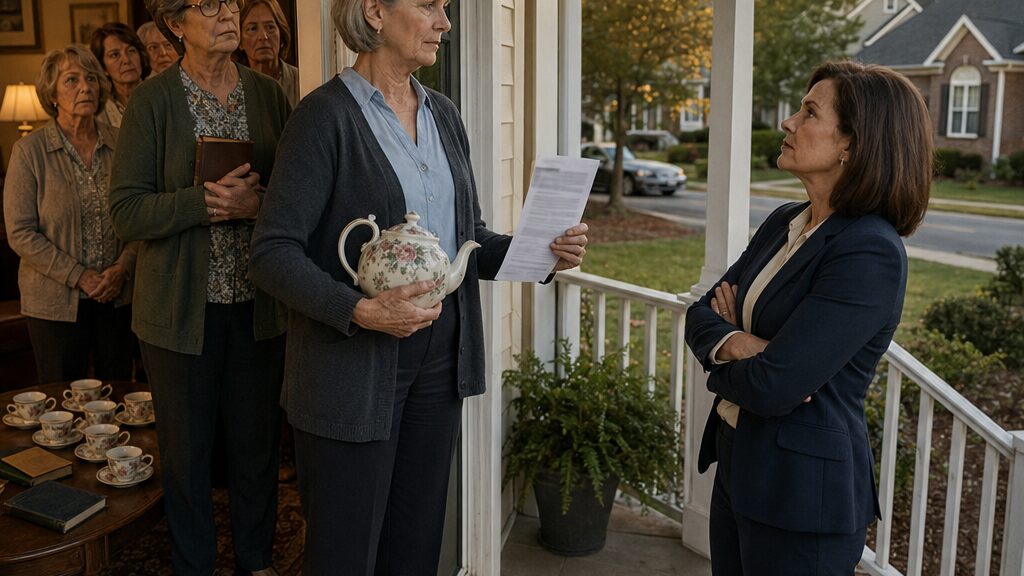
She stood on the porch with the floral teapot balanced against her hip, the handle warm through the folded dish towel. Across the top of the white page, in block letters large enough to be read from the sidewalk, were the words FORMAL NOTICE OF VIOLATION.
Below them, a boxed figure read: $400.
Rebecca did not touch the paper at first.
A sedan slowed at the corner. The driver glanced toward her porch, then continued past. On the opposite side of the street, Kimberly Hall stood beside her mailbox with her arms folded over a pale blue blouse.
Rebecca shifted the teapot into her left hand and peeled the tape away with her right.
“Evening, Rebecca,” Kimberly called.
Her voice was pleasant enough to travel. Not loud. Not private.
Rebecca read the first paragraph.
Unauthorized commercial gathering.
Excessive noise.
Payment due within thirty days.
Her fingers tightened on the page, leaving a faint crease beneath the amount.
The first of the Wednesday women turned into the driveway. Cynthia Lee raised one hand from behind the wheel, then saw the notice and lowered it.
Kimberly crossed the street.
“I wanted to make sure you received it before tonight’s event,” she said.
“Event?”
“The gathering.”
Rebecca looked at the teapot, then at the eight cups waiting through the living-room window. “You mean Bible study.”
Kimberly’s expression remained composed. She had been elected association president six weeks earlier after a campaign built around restoring standards. The phrase had appeared on her yard sign and in every message she sent to homeowners.
“The board has to use consistent categories,” she said. “Once money is collected, even voluntarily, the activity becomes commercial.”
“The women put cash in an envelope for a missionary fund twice last year.”
“That is still money changing hands.”
Cynthia had stepped out of her car. Two more women were walking up the sidewalk now, slowing as they noticed Kimberly.
Rebecca felt the heat rising under her collar. She could have asked Kimberly why the notice had been posted publicly instead of mailed. She could have pointed out the graduation parties, sales-club dinners, and paid tutoring sessions held elsewhere in the neighborhood.
Instead, she held out the notice.
“Which section defines a private donation as commercial activity?”
Kimberly’s chin lifted slightly. “Section seven. Use restrictions.”
“Which paragraph?”
“You can review the governing documents.”
“I have reviewed them.”
For the first time, Kimberly glanced toward the women gathering near the driveway.
“There is also a noise complaint.”
“From whom?”
“I’m not permitted to identify a reporting resident.”
“How was the noise measured?”
“That isn’t required for an initial violation.”
Rebecca looked again at the page. It cited “repeated disruption” but gave no dates except the current one.
Behind her, Cynthia said quietly, “Rebecca, maybe we should go.”
The suggestion hurt more than the notice.
For eleven years, Wednesday evenings had begun the same way. Rebecca warmed the teapot. Cynthia brought sliced lemon no one used. The others arrived between six forty-five and seven, carrying marked-up Bibles, reading glasses, and whatever private burden they had not managed to leave at home. They spoke softly because several of them had husbands who went to bed early, grandchildren who called at eight, or knees that made long evenings difficult.
They had never thought of themselves as an event.
Rebecca folded the notice once, matching the top corners. Then again, pressing the crease with her thumbnail until the page became a neat white rectangle.
“The gathering will continue,” she said.
Kimberly gave a brief nod. “Then further violations may be assessed.”
Rebecca unlocked the door.
The women entered without their usual greetings. Someone closed the door too carefully. Someone else moved the floral teapot from Rebecca’s hands and set it on the coffee table.
From the living room, Rebecca could still see Kimberly standing across the street.
She poured the tea.
No one opened a Bible.
Finally, one of the women asked, “Can they really do this?”
Rebecca sat in her usual chair but kept the folded notice beside her cup. “They can issue a notice.”
“That isn’t what she asked,” Cynthia said.
Rebecca met her eyes.
Cynthia had been coming to the gathering longer than anyone. She knew when Rebecca was answering the narrowest possible question to avoid the larger one.
“Can they make us stop?” Cynthia asked.
“I don’t know yet.”
The admission changed the room. The women looked not frightened, exactly, but displaced. Their familiar chairs no longer seemed safely inside a private home. Every sound—the clink of a spoon, the turn of a page—felt newly measurable.
Rebecca reached for the thin association binder on the lower shelf. As she did, her hand passed the brown leather ledger stored beside it.
The ledger had belonged to her working life. Its corners were rubbed pale, and the spine bore a shallow crack from years of being opened flat beneath fluorescent office lights. She had not written in it since the month she retired.
She left it on the shelf.
The evening ended twenty minutes early.
As the women gathered their bags, Cynthia remained by the front window.
“There’s something you should know,” she said after the others had gone.
Rebecca waited.
“The first Wednesday this month, Pamela’s sister parked near the curb cut.”
“The fire-lane approach?”
Cynthia nodded. “Kimberly came over and asked her to move. She did. But it happened again last week.”
“Why didn’t you tell me?”
“I thought it was handled.”
Rebecca looked toward the empty driveway.
A real parking concern did not explain a commercial-gathering fine. It did not explain a public notice. But it took away the clean certainty she had been holding.
Cynthia touched the folded paper. “You could pay it. We could meet somewhere else for a while.”
Rebecca thought of the women entering her home in silence. She thought of Kimberly saying event as if the word settled the matter.
“I’m not paying before I know what rule I broke.”
After Cynthia left, Rebecca washed the cups and dried the floral teapot. The house settled around her.
Only then did she return to the shelf.
She removed the leather ledger and carried it to the kitchen table. The pages smelled faintly of paper dust and the hand cream she had used when she still worked downtown.
On the first clean line, she wrote the date.
Under it, she made four headings:
Rule cited.
Evidence offered.
Procedure followed.
Response required.
She unfolded the notice and copied each claim exactly as written. When she finished, she turned the page over and found the appeal form attached to the back.
The panel consisted of three names.
Rebecca recognized all of them.
Kimberly had appointed every one.
Chapter 2: The Rulebook Had More Gaps Than Answers
Section seven did not contain the word commercial anywhere.
Rebecca read it twice at the kitchen table, then carried the binder to the window for better light and read it a third time.
The section governed residential use. It prohibited operating a storefront, maintaining visible business inventory, employing on-site staff, or creating traffic inconsistent with normal household activity. Nothing defined a voluntary donation among invited guests as commerce.
She placed a yellow tab on the page.
In the ledger, beneath Rule cited, she wrote: No stated definition.
Under Evidence offered: None provided.
She hesitated before filling the third column.
Procedure followed.
The governing documents required violation notices to identify the conduct, date, relevant provision, and available evidence. Kimberly’s notice named the conduct and cited the broad section, but it provided no complaint dates, no witness statement, and no description of the alleged noise.
Rebecca wrote: Incomplete.
At ten that morning, she walked to the small association office attached to the clubhouse. The management clerk sat behind a counter with a printer on one side and a bowl of wrapped peppermints on the other.
Rebecca placed a copy of the notice on the counter.
“I’d like to see the complaint log connected to this violation.”
The clerk read the name, then looked up. “You’ll need to submit an appeal.”
“I’m not appealing yet. I’m asking to inspect the supporting record.”
“I can’t release owner complaints.”
“Then redact the name.”
The clerk’s polite expression tightened. “I don’t have authority to do that.”
“Who does?”
“The board.”
“Kimberly?”
“The board.”
Rebecca let the silence stand.
“May I see the enforcement log without personal information?” she asked. “Dates, categories, outcomes?”
“You’ll need to submit a formal records request.”
“For the log?”
“For association records.”
The clerk slid a blank form across the counter as if ending the matter.
Rebecca folded it into her bag.
Outside, two landscaping workers were trimming the hedge along the clubhouse wall. One wore a shirt printed with GREENFIELD LANDSCAPING GROUP. Rebecca noticed the name only because the lettering was directly in front of her while she waited for the sidewalk to clear.
She walked home by the longer route.
On Cypress Lane, a row of folding chairs stood visible through a neighbor’s open garage. A handwritten sign on a small table advertised a weekly language class with a suggested contribution for materials. Three houses farther down, a minivan bore the magnetic logo of a home bakery.
Rebecca had seen both for years. She had never considered reporting either.
That bothered her almost as much as Kimberly’s notice. She did not want to become a person who searched the neighborhood for matching violations simply to prove she had been treated unfairly.
At home, she called Kimberly.
“I reviewed section seven,” Rebecca said. “It doesn’t define my gathering as commercial.”
“The board’s interpretation is reasonable.”
“Where was that interpretation adopted?”
“Rebecca, the association cannot draft a separate rule for every possible activity.”
“I’m not asking for a separate rule. I’m asking what existing language supports a four-hundred-dollar fine.”
Kimberly exhaled. “There have been complaints about traffic and noise.”
“How many?”
“I cannot discuss confidential reports.”
“The noise provision requires documented incidents.”
“The notice is the beginning of documentation.”
Rebecca looked down at her ledger. “So there was no prior documented incident.”
“That is not what I said.”
“It is what the record currently shows.”
A pause followed.
When Kimberly spoke again, the warmth had left her voice. “You may appeal. That is the appropriate process.”
“To the panel you appointed.”
“All presidents appoint committee members.”
“Did any of them review this notice before it was issued?”
“I’m not going to conduct an appeal over the telephone.”
Rebecca thanked her and ended the call before irritation sharpened her words.
For most of her career, she had been paid to distinguish between what someone believed and what a record proved. Retirement had been, in part, a refusal to keep doing that for people who resented the difference.
After her husband died, she had promised herself she would no longer spend evenings correcting other people’s numbers. She would keep her garden small, her friendships private, and her obligations chosen.
The promise had felt like peace.
Now it felt uncomfortably close to retreat.
That afternoon, an email arrived from the HOA with the subject line COMMUNITY SAFETY AND RESIDENTIAL USE REMINDER.
It mentioned blocked emergency access, unapproved recurring gatherings, excessive guest traffic, and money collected during home-based activities. No homeowner was named.
None needed to be.
By five, Cynthia had called.
“Everyone knows it’s about us,” she said. “One of the women’s daughters saw it and asked whether we were running some kind of business.”
Rebecca closed her eyes.
“I’m sorry.”
“You didn’t send it.”
“I didn’t tell any of you I was asking questions, either.”
“What are you asking?”
Rebecca looked at the ledger.
She had intended to settle the matter privately and report back only when she had a clean answer. That instinct now seemed less protective than controlling.
“The cited rule doesn’t say what Kimberly claims,” she said. “And there’s no documented noise complaint in the notice.”
Cynthia was quiet.
“So we fight it?”
“I’m finding out what happened.”
“That sounds like Rebecca for yes.”
“It isn’t yes yet.”
Before dinner, Rebecca returned to the association binder. The financial section required annual budgets, reserve disclosures, and owner access to specified records upon written request. She remembered one meeting three years earlier when a landscaping increase had appeared as a single line without explanation. She had noticed it, calculated the percentage in her head, and said nothing.
She had been newly retired then. Tired of being the woman who always asked for the backup.
In the ledger, she created a fresh page.
Date.
Request.
Deadline.
Response.
The folded violation notice went beneath the first line, its creases still exact.
She completed the official records form, but the space provided was too small. On a separate page, she requested four years of enforcement logs, complaint records with identifying information redacted, board minutes, vendor contracts, invoices, bids, payment registers, and conflict-of-interest disclosures.
She read the list once and removed nothing.
At the bottom, she added that the request was made for the proper purpose of evaluating consistent covenant enforcement and association governance.
Then she scanned the pages and emailed them to the management office, Kimberly, and the full board.
Six minutes later, the clerk confirmed receipt.
Nine minutes after that, Kimberly replied.
Your request is unusually broad and may require substantial time and copying expense.
Rebecca entered the response in her ledger.
For the first time since the notice appeared, she felt something steadier than anger.
Resistance.
Chapter 3: Three Banker’s Boxes Outside Her Door
The three banker’s boxes arrived on the eleventh business day, after Rebecca copied her attorney on a second written demand.
They were stacked at the edge of her driveway beneath a clear plastic sheet, though the morning sky was dry. No delivery slip had been left. No one had rung the bell.
A white envelope rested on the top box.
Responsive records enclosed, the letter said. Documents provided in available organizational condition. Additional requests may incur administrative costs.
Rebecca read the phrase twice.
Available organizational condition.
She carried the boxes inside one at a time. The first held board minutes mixed with insurance correspondence. The second contained invoices, contracts, and photocopied checks arranged without dates. The third seemed to have been filled from a desk drawer: complaint printouts, maintenance photographs, unsigned notes, and duplicate pages in no visible order.
If the arrangement was meant to discourage her, it had misunderstood the kind of work she had done for thirty-seven years.
Rebecca cleared the kitchen table.
She placed the ledger to the left of her laptop, set the floral teapot on the counter instead of the table, and built four stacks: governance, enforcement, vendors, unresolved.
By noon, the unresolved stack was the largest.
The enforcement records contained complaints about trash bins, fence colors, overnight street parking, rental signs, and an inflatable pool left in a front yard. Several notices included photographs and dates. Some included written warnings before fines.
Rebecca found her own notice file in a thin folder.
Inside were a copy of the violation, a screenshot of an email announcing the Wednesday gathering’s annual missionary collection, and a handwritten note: recurring guest activity; traffic concern; possible commercial use.
There was no noise complaint.
No date of measurement.
No witness statement.
No prior warning.
Rebecca entered each absence into the ledger.
That was the first clean answer the boxes gave her: the fine had not been processed like the other fines.
It was not yet proof of motive. But it was proof of difference.
Late that afternoon, she opened the vendor stack.
Greenfield Landscaping Group appeared on the fourth invoice. Then the ninth. Then the twelfth.
She began a spreadsheet.
Date. Invoice number. Description. Amount. Approval.
The first payment was for storm debris removal and emergency tree work. The description filled half a page. The amount was uneven, down to the dollar.
The next quarter’s invoice was shorter.
Common-area maintenance and landscape recovery.
$18,500.
Three months later:
Seasonal maintenance and restoration.
$18,500.
The next:
Grounds services and storm follow-up.
$18,500.
Rebecca stopped entering data and spread the invoices across the table.
The descriptions changed slightly. The amount did not.
By evening, she had found seven consecutive quarterly invoices ending at exactly eighteen thousand five hundred dollars. Some had attached crew sheets. Others did not. None in the box included competing bids.
She wrote the total in the ledger, then drew a line beneath it.
She did not write fraud.
Numbers could be wrong without being criminal. Records could be incomplete without being false. She knew the danger of letting pattern become verdict.
At seven fifteen, the doorbell rang.
Cynthia stood outside holding a covered casserole.
“I thought you’d forget to eat.”
“I had crackers.”
“That is not a defense.”
Cynthia stepped inside, saw the boxes, and stopped. “They gave you all that?”
“They gave me something.”
Rebecca moved several invoices so Cynthia could set down the dish.
“Did you find the complaint?”
“No.”
Cynthia’s relief was immediate and too visible.
Rebecca looked at her. “You knew there wasn’t a noise complaint?”
“I didn’t know.”
“But you suspected.”
Cynthia took off her glasses and cleaned them with the edge of her blouse. “Kimberly spoke to me after Pamela’s sister parked near the curb cut the second time.”
“What did she say?”
“That emergency access had to stay clear. That repeated guest traffic might become an enforcement matter.”
“And what did you say?”
“I said I would handle it.”
“Did you?”
“I asked Pamela to remind her sister.”
Rebecca waited.
Cynthia put her glasses back on. “She parked there again the following Wednesday. Only for ten minutes.”
“Why didn’t you tell me?”
“Because I knew what you would do. You would move the entire gathering, apologize to everyone, and spend three weeks making a parking chart.”
“That would have prevented a valid complaint.”
“It might have prevented the parking complaint. It would not have turned tea and prayer into a business.”
“No. But it means Kimberly did not invent every concern.”
Cynthia’s mouth tightened. “Are you defending her now?”
“I’m trying not to become careless because she was.”
The words landed harder than Rebecca intended.
Cynthia looked toward the boxes. “You think facts are cleaner than people.”
Rebecca almost denied it.
Instead, she sat down.
The kitchen seemed suddenly crowded with everything she had not asked soon enough: Cynthia’s silence, her own refusal to involve the group, the board’s selective records, the repeated invoices.
“I think facts are the only part I know how to hold still,” she said.
Cynthia lowered herself into the chair opposite her. “Then hold this still. We made a mistake with the parking. Kimberly used it to shame all of us.”
Rebecca nodded.
That distinction would matter later.
After Cynthia left, Rebecca returned to the invoices. She worked until the numbers blurred, then switched to the board minutes.
A resolution from four years earlier authorized emergency contracting after a severe storm damaged trees and drainage areas. Donald Roberts, then serving as treasurer, had abstained from one vote involving Greenfield Landscaping.
In later minutes, the abstentions disappeared.
Rebecca searched the vendor records for ownership disclosures. She found an unsigned conflict form and a state registration printout naming Donald as Greenfield’s organizer.
That was troubling, but still not enough.
At nearly midnight, she opened a batch of payment approvals.
Most carried two signatures: the management company and an HOA officer.
On Greenfield’s invoices, the second signature appeared again and again.
Donald Roberts.
Rebecca compared the handwriting on the approvals with the vendor contact forms.
Same slant. Same heavy downward stroke on the R. Same phone number in both files.
Treasurer.
Approver.
Vendor owner.
She entered the relationship into the ledger, then sat back.
The boxes had answered one question and opened a worse one.
The contracts might represent real work. The repeated amounts might be retainers. The missing bids might exist elsewhere.
But Donald had been standing on both sides of the transaction.
And someone on the board had allowed it.
Chapter 4: The Numbers Were Wrong, but Not Simple
The photograph on Rebecca’s screen showed Donald Roberts standing knee-deep in storm debris beside a Greenfield truck.
Behind him, two uprooted pines lay across the community walking path. A crew member was cutting branches away from a crushed section of fence. The date stamped in the corner matched the first emergency invoice in Rebecca’s spreadsheet.
The work had happened.
She leaned back from the laptop and looked at the figure she had written in the ledger the night before. Two hundred eleven thousand dollars. She had circled it once, hard enough to leave an impression on the next page.
Now she drew a line through the circle.
Not the number. The meaning she had attached to it.
Rebecca spent Saturday walking the common areas listed on Greenfield’s invoices. She carried copies folded inside a plain folder and stopped where the retention pond met the wooded boundary. Newer drainage stone bordered the water. Several trees along the path were younger than the surrounding oaks. A rebuilt fence ran behind the tennis courts.
The landscaping contracts were not imaginary.
But the records still did not fit.
The initial storm invoice included crew hours, disposal fees, equipment rentals, and material costs. Later invoices used broad descriptions and repeated rounded amounts. Emergency work had become quarterly maintenance without a visible bid, scope revision, or formal extension.
At the old clubhouse entrance, Rebecca found Benjamin Clark inspecting a loose handrail.
He had served on the board during the storm year and resigned the following spring. He still attended annual meetings but rarely spoke.
“Benjamin,” she called.
He looked toward the folder in her hand before meeting her eyes. “I heard you requested records.”
“That traveled quickly.”
“Nothing travels slowly here except repairs.”
She showed him the storm invoice and the later quarterly payments.
“Do you remember how Greenfield was selected?”
Benjamin rested one hand on the rail. “After the storm? Nobody was selecting. We were calling anyone with equipment.”
“Was competitive bidding suspended?”
“For emergency work.”
“For how long?”
His gaze shifted toward the drainage area. “Longer than it should have been.”
Rebecca opened the folder. “I can’t find a resolution restoring the bid requirement.”
“You probably won’t.”
“Why?”
“Because we never passed one.”
The answer was quiet, almost embarrassed.
Benjamin explained that Greenfield had arrived before larger contractors returned calls. Donald had brought crews on weekends, cleared blocked roads, and deferred part of his payment when the association’s insurance reimbursement was delayed.
“He helped,” Benjamin said. “That mattered then.”
“And afterward?”
“Afterward, people were tired. The property manager said continuity would cost less than rebidding. Donald already knew the grounds.”
“Did the board disclose his ownership?”
“Everyone knew.”
“That isn’t the same as disclosure.”
Benjamin rubbed his thumb along the peeling rail paint. “No. It isn’t.”
Rebecca asked whether he would give her a written statement.
His hand stopped.
“I’ve already had my turn on that board.”
“This happened during your turn.”
“I know.”
He handed back the invoices. “You should be careful, Rebecca. A bad process does not mean the work was bad.”
“I know that too.”
But she had not known it the night before.
At home, Rebecca rebuilt the spreadsheet. She separated emergency invoices with supporting detail from recurring invoices without bids. She marked payments for which crew sheets or material receipts existed. She highlighted amounts that appeared to include management fees not described in the contracts.
The clean accusation she had imagined dissolved into categories.
Supported.
Partially supported.
Unsupported.
Conflict not disclosed.
Approval procedure unclear.
By Sunday afternoon, the total remained two hundred eleven thousand dollars, but only a fraction could be identified as unsupported from the records she had received. The larger, stronger issue was not that every dollar had been stolen. It was that Donald had influenced or approved payments to his own company under exceptions that had never ended.
Rebecca crossed out a sentence she had written in the ledger: Greenfield payments invalid.
Below it, she wrote: Work substantially performed; pricing and approval require independent review.
The correction bothered her less than the original certainty.
At four, a Greenfield pickup stopped at the curb.
Donald got out without closing the driver’s door. He was broad through the shoulders, with gray at his temples and red dust on his boots. He walked up the path carrying no papers.
“You’ve been photographing my work,” he said.
“I’ve been verifying invoices.”
“Same thing, the way people are talking.”
“I haven’t discussed the invoices publicly.”
“Kimberly says you requested every payment my company ever received.”
“I requested association vendor records.”
Donald looked through the front window toward the boxes on her kitchen floor. “Do you know what those roads looked like after the storm?”
“I saw the photographs.”
“My crews worked fourteen-hour days. I paid for fuel before the insurance check came. Two men slept in the shop because the bridge to their side of the county was closed.”
“I’m not disputing the emergency work.”
“Then what are you disputing?”
“The contracts that followed. The missing bids. Your approvals.”
His face hardened. “I signed payment registers as treasurer. The management company approved the invoices.”
“You approved transactions benefiting your company.”
“Because the bills still had to be paid.”
“You should have recused yourself.”
“From what? Work everyone knew I was doing?”
“Knowing your company existed did not make the process independent.”
Donald stepped closer, then seemed to remember the street behind him. His voice dropped.
“The association still owes Greenfield money.”
“For what?”
“Work that never made it into those boxes.”
“Then provide the invoices.”
“I provided plenty. Kimberly wanted the records delivered fast because you threatened attorneys.”
“I copied an attorney after the deadline passed.”
Donald gave a humorless laugh. “You think the boxes contain the whole history because somebody put them on your driveway?”
“No.”
That answer checked him.
Rebecca had spent enough years auditing companies to know that records were often incomplete through neglect before they were incomplete through deception. She also knew neglect could become useful to anyone who benefited from it.
“Who authorized the quarterly amount?” she asked.
Donald looked away.
“The board.”
“Which vote?”
“You’d have to ask the people who were there.”
“You were there.”
His jaw moved once before he answered. “You don’t understand what it took to keep this place functioning.”
“Then help me understand.”
But Donald returned to his truck.
Before leaving, he said, “Be certain before you call a man a thief.”
Rebecca stood on the porch after the pickup disappeared.
She had not called him one. Not aloud.
In the ledger, however, her first calculation had carried the accusation even without the word.
That evening, she reviewed old annual budgets and found the landscaping increases she had noticed years earlier. The numbers had been presented without explanation. She had sat three rows from the front, calculated the change, and kept her hand in her lap.
She had told herself she was retired.
At eight twelve, an email from Kimberly arrived with a formal attachment.
FINAL DEMAND FOR PAYMENT.
The association would add late fees and begin collection procedures if Rebecca did not pay within ten days.
The letter did not mention her records dispute.
It did not mention the missing complaint.
At the bottom, one sentence had been bolded:
Continued noncompliance may result in further remedies available under the governing documents.
Rebecca placed the demand beside the corrected ledger total.
Accuracy had made the case harder.
The deadline had made silence impossible.
Chapter 5: Sixty-Two Signatures and One Missing Witness
The first homeowner Rebecca asked to sign the petition refused before she reached the second paragraph.
“You told Cynthia they stole two hundred thousand dollars,” the woman said.
They stood beneath the community mail pavilion while metal doors clicked around them. Two residents sorting envelopes slowed without turning.
Rebecca held the petition briefing against her chest. “I said the contracts involved that amount.”
“That is not what I heard.”
The woman shut her mailbox. “I’m not putting my name on an accusation you can’t prove.”
She walked away.
Rebecca remained beside the recycling bin, aware of the other residents pretending not to watch.
Two nights earlier, frightened by the final demand, she had spoken too quickly at Cynthia’s kitchen table. She had called the Greenfield contracts stolen money before explaining the supported work, the emergency history, or the limits of the records.
The phrase had traveled farther than any correction.
Cynthia arrived carrying a clipboard and a canvas bag of petition copies.
“How many?”
“None.”
“You’ve asked one person.”
“And she was right.”
Cynthia’s expression changed. “About not signing?”
“About what I said.”
Rebecca placed the briefing on the pavilion counter and uncapped a pen.
At the top of the first page, she crossed out suspected misappropriation of $211,000.
She replaced it with: $211,000 in contracts involving an undisclosed or inadequately managed conflict of interest, including amounts requiring independent verification.
Cynthia read the sentence. “That is not going to fit in anyone’s head.”
“It fits the facts.”
“People understand stolen.”
“People also repeat it.”
Rebecca turned to the residents still at the mailboxes.
“I need to correct something,” she said.
One of them looked over reluctantly.
“I described all Greenfield payments as stolen money. The records do not prove that. They show real work, incomplete bidding, conflicted approvals, and some unsupported charges. I should not have said more than I could establish.”
No one applauded. One resident nodded once. Another asked for the revised briefing.
By noon, they had nine signatures.
The correction slowed them at first. Then it began to work in Rebecca’s favor. Skeptical homeowners asked questions instead of dismissing her. She showed them the missing complaint log, the repeated invoices, and the rule requiring an emergency meeting if twenty percent of owners signed a written petition.
Some refused.
One man said he cared more about keeping the entrance attractive than about which contractor trimmed it. A woman with a rental property said Kimberly was the first president willing to enforce parking restrictions. Another homeowner signed the petition but told Rebecca she believed the Bible-study group had been inconsiderate.
Rebecca thanked each person without arguing.
By the third afternoon, they had thirty-eight signatures.
Cynthia proved better at doorsteps. She knew who had recently lost a spouse, who worked night shifts, and who disliked being approached during dinner. She also told every signer about the parking problem before they asked.
“We made a mistake,” she would say. “That does not make the fine consistent.”
The admission kept the petition from becoming a demand that Rebecca be declared blameless. It became a request for records, review, and an emergency meeting.
At Benjamin Clark’s house, Rebecca carried the clipboard alone.
He opened the door only halfway.
“I’ll sign,” he said after reading the petition. “But I won’t speak at the meeting.”
“You were on the board when bidding was suspended.”
“That is why I won’t speak.”
“Your knowledge matters.”
“So does my wife’s peace.”
Rebecca saw movement behind him, then the edge of a curtain settling.
Benjamin lowered his voice. “When I resigned, people called my house for months. Some said I had abandoned the board. Others said I had covered for Donald. I am not beginning that again.”
“You voted for the emergency exception.”
“Yes.”
“Did you vote to continue it?”
“There was no vote.”
“That is exactly what needs to be said.”
He signed the petition and gave back the clipboard.
“I have old notes,” he said. “I’ll let you copy them. That is all.”
The notes showed that the board had planned to solicit bids after storm recovery. A handwritten line in the margin read: Donald says wait until spring—crews already mobilized.
There was another name beside the notation.
Kimberly Hall.
At the time, she had not been president. She had served on the landscape committee.
Rebecca looked up. “She knew.”
“She knew Donald owned Greenfield,” Benjamin said. “Everyone involved knew.”
“And she knew rebidding had been postponed.”
“Yes.”
“Why would she issue a selective fine while this was unresolved?”
Benjamin’s face tightened. “You are assuming the fine was meant to hide the contracts.”
“Wasn’t it?”
“I don’t know. Kimberly came into office promising enforcement. She may have believed that was how she proved she was different from the old board.”
“While protecting its decisions.”
“People are capable of both.”
He would not promise to attend.
By Friday evening, the petition had fifty-nine signatures. The deadline for Rebecca’s payment was four days away.
Cynthia stood with her outside the clubhouse while homeowners arrived for a scheduled landscaping update. Kimberly was inside arranging packets on folding chairs.
“We need three,” Cynthia said.
“We need more than three. Some signatures may be challenged.”
A current board member approached them before they entered.
“The president says this petition is disruptive to an official association function.”
“We’re standing outside,” Rebecca said.
“She is asking you to stop soliciting during the meeting.”
“We aren’t soliciting during the meeting.”
The board member looked at the clipboards. “She also says an emergency meeting would interfere with contract negotiations.”
“That is one reason owners need the meeting.”
The doors opened. Kimberly appeared holding a printed notice.
“This gathering is canceled,” she announced to the homeowners waiting outside. “The board has determined that current legal and vendor matters should not be discussed in an open forum.”
“This is the scheduled landscaping update,” someone said.
“It will be rescheduled.”
Cynthia leaned toward Rebecca. “She thinks we already have the signatures.”
They had fifty-nine.
Then the woman who had first refused stepped out of the crowd.
She held Rebecca’s revised briefing, folded in half.
“You corrected the amount publicly,” she said.
“I corrected the claim.”
“That is why I’m signing.”
Her husband signed after her.
A third homeowner took the clipboard, read the first paragraph, and added his name beneath theirs.
Sixty-two.
Kimberly’s gaze moved from the clipboard to Rebecca.
“You cannot compel a meeting on an issue under legal review.”
“The bylaws say twenty percent of owners may compel one,” Rebecca said.
“The board will determine whether the petition is valid.”
Cynthia handed a copy to the meeting moderator, who had arrived carrying the association’s procedural binder.
The moderator counted the signatures, checked the ownership list, and looked at Kimberly.
“The threshold is met.”
For a moment, no one moved.
Then Kimberly folded her cancellation notice.
“The emergency meeting will be held Tuesday,” she said. “The board will set the agenda.”
Rebecca watched her return to the clubhouse.
They had forced open the room.
Kimberly still controlled what would happen inside it.
Chapter 6: She Read the Fine Before She Read the Millions
Kimberly began the emergency meeting by reading the parking complaint aloud.
Rebecca had not yet reached the podium.
Seventy folding chairs filled the clubhouse room, and nearly all of them were occupied. Cynthia sat in the front row with the leather ledger on her lap. The original violation notice, folded into quarters, rested beneath its cover.
Kimberly stood behind the board table.
“On three documented occasions,” she read, “vehicles connected to the recurring Wednesday gathering obstructed or partially obstructed the designated fire-lane approach.”
Murmurs moved across the room.
Rebecca stopped beside the aisle.
The complaint contained dates. It named no driver, but the dates matched the weeks Cynthia had described.
Kimberly lowered the page. “This meeting has been called after a homeowner facing legitimate enforcement began investigating unrelated association contracts. The board welcomes accountability. It does not accept retaliation presented as reform.”
Several people turned toward Rebecca.
The meeting moderator gestured to the podium. “Mrs. Williams, you may respond.”
Rebecca took the ledger from Cynthia and walked forward.
She had prepared to begin with the contracts.
Instead, she opened the ledger to the first page.
“Our gathering created a parking problem,” she said. “A guest used the fire-lane approach after being asked not to. It happened more than once. That should not have happened.”
The room became still.
Kimberly’s posture changed almost imperceptibly, as if a support she had expected to lean against had moved.
Rebecca continued. “We have already changed our parking arrangement. That correction does not require me to accept an unsupported noise allegation or a commercial-use fine that was processed differently from other violations.”
She placed the folded notice on the podium.
“This notice cited repeated noise. The records provided contain no noise complaint, no incident date, no measurement, and no prior warning. The commercial claim relies on a voluntary missionary donation, though the cited bylaw does not define that as business activity.”
A current board member leaned toward the microphone. “This meeting is about contracts.”
“It is about governance,” Rebecca said. “The fine explains why I looked.”
She unfolded the notice and laid it across the ledger’s first entry.
Then she displayed the enforcement comparison: photographs and warnings in other files, none in hers; documented complaint dates elsewhere, none for the alleged noise; staged penalties for other owners, an immediate $400 demand for her.
She did not say Kimberly had invented everything.
She no longer needed to.
“The procedure changed when the target changed,” Rebecca said.
A voice from the back asked, “What about Greenfield?”
Rebecca turned to the spreadsheet.
“The association paid Greenfield Landscaping Group two hundred eleven thousand dollars over the period reviewed.”
The number produced the reaction she expected: whispers, a sharp breath, one chair scraping the floor.
Donald sat near the wall with his arms folded.
Rebecca raised one hand.
“That number is not proof that two hundred eleven thousand dollars was stolen.”
The room quieted more slowly this time.
“Greenfield performed substantial work, including emergency storm cleanup. Some invoices are well supported. Some are partially supported. Some recurring charges lack sufficient detail in the records provided.”
Donald’s arms loosened.
“The stronger problem is the process. Donald Roberts owned Greenfield while serving as treasurer. He signed or influenced payment approvals to his own company. Competitive bidding was suspended during an emergency and was not formally restored. Later quarterly contracts continued without documented independent review.”
Kimberly leaned toward her microphone. “The ownership was common knowledge.”
“Common knowledge is not an independent control.”
“The board relied on continuity after a severe storm.”
“For a time, that may have been reasonable.”
Kimberly looked surprised by the concession.
Rebecca turned another page.
“What was not reasonable was allowing a temporary exception to become the normal procedure. What was not reasonable was failing to document recusal. What was not reasonable was withholding organized records until an attorney was copied.”
The management clerk looked down at the table.
Donald stood.
“You’re making it sound like I billed for work I didn’t do.”
“I have said the opposite.”
“You put my company’s name on a petition all over the neighborhood.”
“The petition requests an independent review.”
“My men did that work.”
“Then a review will protect the work that was legitimate.”
His face reddened. “You have never run a crew. You have never had equipment payments due while sixty homeowners complain because branches are blocking their morning walk.”
“No,” Rebecca said. “And you have never been entitled to approve your own invoices because the work was difficult.”
The sentence landed without volume.
Donald looked toward Kimberly.
She did not meet his eyes.
Rebecca saw it then—not proof, but a fracture. Donald had expected the board president to defend the arrangement more directly. Kimberly had expected the documents to remain an abstraction. Each had relied on the other’s silence.
The moderator asked whether any former board member could clarify how the emergency exception continued.
No one answered.
Rebecca looked toward the empty chair she had mentally reserved for Benjamin.
She had known he would not come.
Then the clubhouse door opened.
Benjamin entered carrying a thin folder.
He did not look at Rebecca as he walked to the microphone.
“I served on the board during the storm year,” he said. “We authorized Greenfield without bids because roads and drainage areas were blocked. The plan was to solicit bids after recovery.”
Kimberly’s fingers closed around her pen.
Benjamin opened the folder. “We did not vote to make the exception permanent. We simply stopped asking when it would end.”
Donald pushed his chair back.
Benjamin continued. “Kimberly Hall was on the landscape committee. She knew Greenfield belonged to Donald. So did I. So did the rest of the board.”
Kimberly’s face went pale, but Benjamin did not spare himself.
“We treated knowing as disclosure. We treated urgency as permission. Later, we treated silence as approval.”
Donald walked out before Benjamin finished.
No one followed him.
The room erupted only after the door closed. Homeowners demanded resignations, repayment, police reports, removal of the entire board. One man called for an immediate vote to terminate every Greenfield contract. Another insisted Rebecca should replace Kimberly that night.
The moderator struck the table with a wooden block.
Rebecca remained at the podium.
This was the moment she had imagined while sorting invoices—the room finally seeing what she saw. Yet the anger now moving through it had the same appetite for certainty she had felt when she first circled the total.
Cynthia met her eyes from the front row.
Rebecca leaned toward the microphone.
“I am not asking you to declare every invoice false,” she said. “I am not asking for a trial conducted in this room.”
The shouting thinned.
“I am asking for an independent contract and payment review. I am asking that Greenfield approvals be frozen during that review. I am asking for a written conflict policy, restored competitive bidding, accessible records, and enforcement procedures that apply the same way to every homeowner.”
A woman near the aisle called, “And Kimberly?”
Rebecca looked at the president.
Kimberly’s campaign promises had turned into control. Her fear of appearing weak had made her cruel where fairness would have been stronger. But removing her in the heat of the meeting would allow the neighborhood to replace examination with punishment.
“The board should answer after the review,” Rebecca said. “Not before it.”
Kimberly stared at her, perhaps hearing mercy, perhaps hearing restraint as a more dangerous form of judgment.
The board withdrew for twelve minutes.
When they returned, the current members voted to freeze Rebecca’s fine and all further collection activity. They suspended new payments to Greenfield, authorized an independent review, and scheduled a homeowner vote on procurement and conflict rules.
Kimberly voted last.
“Yes,” she said.
There was no applause, only the rustle of people writing down dates and conditions.
Rebecca folded the original notice again and placed it inside the ledger.
The fine had not been canceled. Donald had not been cleared or condemned. Kimberly remained president.
But the records would leave the neighborhood this time.
And for the first time, no one person in the room would control what they were allowed to say.
Chapter 7: The Wednesday Table Stayed, but Nothing Stayed Private
The cancellation letter arrived six weeks later without the word sorry anywhere on the page.
Rebecca read it standing at the kitchen counter, one hand still resting on the unopened mail. The $400 fine was rescinded. All related late fees and collection actions were withdrawn. The enforcement record would be corrected to reflect insufficient documentation and inconsistent procedure.
The language was exact.
It was also bloodless.
Attached behind it was a summary of the independent review. Greenfield Landscaping had performed most of the work billed to the association, including the emergency cleanup Donald had described. The reviewer had nevertheless identified unsupported markups, duplicate administrative charges, missing bid documentation, and repeated approvals that violated basic conflict safeguards.
Donald had resigned as treasurer before the report was completed. Greenfield had agreed to repay the unsupported amounts and would not compete for association work for one year.
Kimberly remained president.
Rebecca placed the letter beside the leather ledger and looked through the doorway into the living room.
The Wednesday chairs were arranged farther apart than before. Cynthia had drawn a parking diagram and placed copies beneath the teacups. Guests would use Rebecca’s driveway first, then three designated curb spaces that did not interfere with the fire-lane approach. Anyone bringing an additional visitor would call ahead.
The solution had taken ten minutes to design.
The humiliation had lasted nearly two months.
At six forty-five, Cynthia arrived carrying lemon slices and a roll of blue painter’s tape.
“What is the tape for?”
“Temporary parking markers.”
“We are not marking the street.”
“I thought you might say that.”
Cynthia set the tape on the counter and read the cancellation letter.
“No apology.”
“No.”
“Does that bother you?”
Rebecca looked at the corrected enforcement statement. “Less than it would have six weeks ago.”
“That means yes.”
“It means the record is accurate.”
Cynthia smiled faintly. “You still think facts are cleaner than people.”
“They usually wash better.”
The other women arrived in pairs. No one lowered her voice at the doorway. They placed their bags beneath the same chairs they had used for years, and the floral teapot returned to the center of the coffee table.
Before they began, Rebecca admitted that she had considered moving the gathering permanently.
“Why?” one woman asked.
“Because I wanted my house to feel private again.”
Cynthia poured tea into Rebecca’s cup. “And does it?”
Rebecca looked toward the front window.
Across the street, Kimberly’s porch light was on. The blinds were open, but no one stood watching.
“No,” Rebecca said. “Not in the same way.”
The answer did not spoil the evening. It made it more honest.
They discussed the week’s reading. They collected no money. When one of the women mentioned a family in need, Cynthia suggested they each donate separately rather than passing an envelope. Rebecca almost objected to changing a harmless tradition out of fear, then stopped.
A change could be practical without becoming surrender.
At eight fifty-five, the last guest left from the correct curb space.
Rebecca was carrying cups to the kitchen when the doorbell rang.
Kimberly stood on the porch alone.
She held no binder, notice, or board packet.
“I won’t stay,” she said.
Rebecca opened the storm door but did not invite her inside.
Kimberly looked past her toward the floral teapot. “The gathering went well?”
“It ended before nine.”
“I wasn’t asking as president.”
The distinction sounded rehearsed.
Rebecca waited.
Kimberly clasped her hands in front of her. Without the board table between them, she appeared smaller, though not softer.
“The review report will be distributed tomorrow,” she said.
“I received an advance copy with the cancellation.”
“Of course.”
“You signed the letter.”
“Yes.”
“Was there something missing from it?”
Kimberly looked toward the street.
“I should not have posted the notice on your door.”
Rebecca felt the sentence settle between them. It was narrower than an apology for the fine, the email, the delayed records, or the appeal panel.
But it was not nothing.
“Why did you?” Rebecca asked.
Kimberly pressed her lips together before answering.
“Because people elected me to make changes. Every meeting, someone complained that the old board let everything slide—rentals, parking, neglected yards, contractors. Then when I enforced anything, they said I was overreaching.”
“So you chose something visible.”
“I chose something I thought I could defend.”
“You knew the financial procedures were weak.”
“Yes.”
“You knew Donald owned Greenfield.”
“Yes.”
“Then why make enforcement your first public fight?”
Kimberly’s gaze moved back to Rebecca.
“Because I knew how to issue a notice. I did not know how to admit that the board I had just taken over was built on decisions I had helped make.”
There it was.
Not innocence. Not remorse large enough to repair the harm. Fear shaped into authority.
“You made me easier to confront than Donald,” Rebecca said.
“Yes.”
Kimberly did not decorate the answer.
For a moment, Rebecca understood how the decision had happened. Understanding did not excuse it.
“The board is creating a temporary audit committee,” Kimberly continued. “The reviewer recommended a homeowner representative with financial experience.”
“No.”
The answer came before Rebecca considered it.
Kimberly nodded as if she had expected that. “The appointment is six months.”
“I retired for a reason.”
“I know.”
“No, you know what my former profession was.”
Kimberly glanced at the ledger visible on the kitchen table. “I know you did work the rest of us avoided.”
“That does not obligate me to continue.”
“No.”
Kimberly stepped back from the door.
“The board will ask you formally tomorrow. You can refuse formally then.”
She turned toward the steps.
“Kimberly.”
She stopped.
“The cancellation letter should have included the parking issue.”
Kimberly faced her again.
“It should say the access concern was legitimate and the penalty was not.”
“Why?”
“Because correcting the record does not require pretending my group did nothing wrong.”
Kimberly considered this, then nodded. “I’ll amend it.”
It was the closest they came to reconciliation.
The next afternoon, Rebecca attended the board meeting intending to decline the appointment.
The room contained fewer people than the emergency session. No one demanded resignations. No one raised a voice. That made the work ahead appear more difficult, not less. Anger had filled the chairs once. Procedure would have to keep filling them after anger left.
The proposed reforms included competitive bids above a set threshold, annual conflict disclosures, documented recusals, standardized enforcement notices, access to redacted complaint records, and quarterly vendor summaries.
Several sections were vague.
Rebecca marked them in the margin.
When the board asked whether she would serve as the temporary homeowner audit representative, she looked at Kimberly, then at Benjamin seated in the back row. He gave no encouraging gesture. He had offered enough of himself for one season.
Rebecca thought of the budget meeting years earlier, when she had recognized the landscaping increase and kept her hand down. She had called that retirement. It had also been relief purchased with silence.
“I will serve for six months,” she said. “The meeting records must be open to homeowners, and the committee’s questions must be included even when the board does not adopt its recommendations.”
One board member shifted in his chair.
Kimberly said, “Agreed.”
Rebecca opened the leather ledger that evening at her kitchen table.
The early pages contained accusations, deadlines, invoice totals, and corrections. She turned past them to a clean sheet.
Instead of Rule cited, Evidence offered, Procedure followed, and Response required, she wrote a new heading:
Questions still open.
Under it, she listed the reserve balance, the vendor renewal calendar, and the date for reviewing the new enforcement policy.
Then she stopped.
The floral teapot sat on the counter, washed and empty. Rebecca carried it to the table and placed it beside the ledger.
For years, she had believed peace meant keeping the difficult parts of life outside her front door.
Now the door was closed. The house was quiet. The table still belonged to her.
But the ledger remained open.
The story has ended.