The One Call Nobody Wanted to Give
The One Call Nobody Wanted to Give
Part I — The Wrong Man in the Right Place
By the time the man asked for a phone, people were already looking at him the way they looked at trouble.
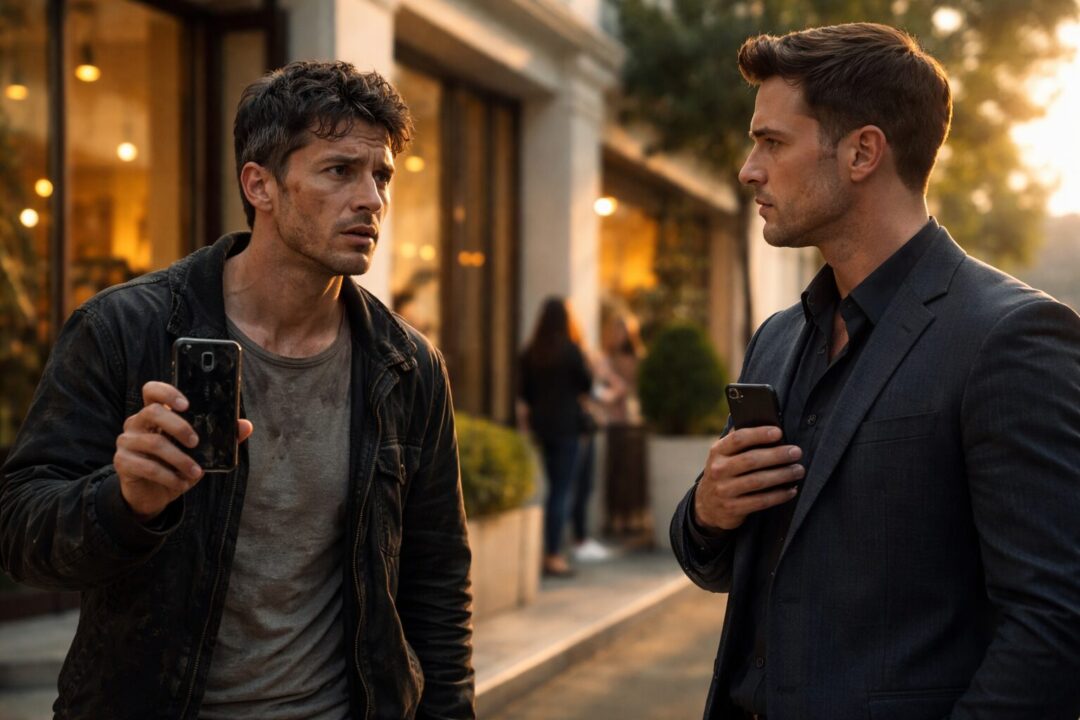
He stood in the valet lane outside Marlowe Row, the most expensive shopping district in the city, where glass storefronts glowed gold in the late afternoon and black cars rolled forward in a slow, polished line. Women stepped out of boutiques with ribboned bags. Men in tailored jackets checked watches that cost more than rent. Even the silence there had money in it.
And in the middle of all that shine stood a man who looked as though he had been dragged out from beneath an engine.
His jacket was dark with old grease. One sleeve was torn at the cuff. His left sneaker had started to split at the sole, and his cheek carried a long smear of black grime that made him seem rougher than he might have been. He held a phone with a cracked screen in one hand, tapping it as if willing it back to life. It stayed dead.
“Just one call,” he said.
The man he was speaking to recoiled before the sentence had even settled.
The stranger in the blazer was the sort of man Marlowe Row had been built for—trim beard, expensive haircut, phone in a leather case, two shopping bags looped casually over one wrist. He stepped backward and lifted his own phone out of reach as if the other man had asked for a kidney instead of a favor.
“Don’t touch me,” he said.
The words landed harder than they should have.
A few people nearby slowed, not enough to intervene, only enough to witness. That was always worse.
The grease-streaked man lowered his hand at once. “I wasn’t—” he began, then stopped. He swallowed. “I just need to make one call.”
“Then ask someone else.”
His voice was loud, carrying just far enough to make the moment public. That seemed intentional.
The man with the dead phone glanced down the line of parked cars, then toward the street beyond the valet stand, as though calculating something urgent and not liking the answer. There was no swagger in him. No aggression. Only strain.
“It’s important,” he said quietly.
The man in the blazer gave a short, disbelieving laugh. “Everything’s important when someone wants something.”
That was when the older woman turned around.
She had been standing near the curb with a reusable grocery bag resting against her leg, waiting for the bus that stopped one block down from the shopping district. She was small, gray-haired, plainly dressed in a beige cardigan and worn flats. Nothing about her suggested wealth or authority. She looked like someone the crowd would forget ten seconds after passing.
But she had been watching.
Not with suspicion. With attention.
The man in grease tried again, still not looking at the blazered stranger now. “My phone died. I only need to call my driver.”
That did it.
The man with the shopping bags laughed outright. “Your driver?”
The few heads turned more fully at that. The sentence sounded ridiculous in that voice, from a man in those clothes. It was exactly the kind of absurd line that made people feel clever for disbelieving it.
The older woman looked at the stranger with the dead phone a second longer. She noticed, perhaps, what the others did not: that he was embarrassed. Not dangerous. That he wasn’t performing desperation. He was trying to get through it with as little humiliation as possible.
“Here,” she said, already unlocking her phone. “Use mine.”
The man looked at her as if the offer had startled him.
“You don’t have to,” he said.
“I know,” she replied.
For the first time, the hard line in his face shifted. Not into relief exactly, but into something close enough.
“Thank you.”
He took the phone carefully, as though it were something fragile. The man with the shopping bags rolled his eyes and looked away, but not before the stranger had seen him. That glance held no anger. If anything, it carried something colder than anger—a private note taken down for later.
The older woman watched him dial.
He didn’t ramble when someone answered. He gave a location. His voice changed slightly, becoming firmer, cleaner, almost practiced.
“Yes,” he said. “I’m outside Marlowe Row. South valet entrance.”
A pause.
“No, don’t call ahead. Just come.”
Then he ended the call and handed the phone back.
“Thank you,” he said again, more quietly this time.
The older woman slipped the phone into her cardigan pocket. “I hope whoever it is gets here soon.”
The man nodded once. “He will.”
The blazered stranger smirked without turning around. “I’m sure.”
The bus did not come. The crowd shifted and thinned and replenished. The lights inside the stores glowed brighter as the sun lowered. Somewhere, a valet whistle cut through the air. And then, less than two minutes later, a black SUV rolled into the lane and stopped directly in front of the man everyone had already decided was worthless.
At first, nobody moved.
Then the passenger door opened, and a man in a dark suit stepped out with the kind of speed reserved for emergencies and people who mattered.
He looked straight at the grease-streaked stranger.
“Sir.”
The word changed the temperature of the air.
Part II — The Cost of Looking Poor
The man in the torn jacket did not answer immediately.
He stood perfectly still as the suited man came around the SUV, carrying a clean charcoal coat over one arm. There was no hesitation in him, no confusion, no searching glance to make sure he had approached the right person. He knew exactly who he was there for.
The man with the shopping bags turned so fast one of the glossy bags brushed his leg and crumpled.
The older woman stayed where she was, her grocery bag hanging from her fingers, her expression somewhere between caution and concern.
The suited man stopped in front of the stranger and lowered his voice. “Are you all right, Mr. Vale?”
So that was his name.
The stranger—Mr. Vale—gave the smallest nod. “I’m fine.”
“Your brother’s doctor has been trying to reach you.”
At that, something flickered across his face. It wasn’t fear, not exactly. It was the look of a man carrying too much at once and refusing to let any of it spill in public.
“I know,” he said. “I’ll call back from the car.”
The suited man offered him the coat. Up close, the contrast was almost violent. The man everyone had dismissed as a nuisance slipped into the coat with the ease of someone long accustomed to expensive fabric, to people waiting on his next movement, to a world that arranged itself around his inconvenience. The grime on his hands was still there. The split in his sneaker still visible. But now those details read differently—not as proof of inferiority, but as clues to a story nobody had bothered to ask for.
The man with the shopping bags stared openly. “Wait,” he said. “That’s your car?”
Mr. Vale looked at him then.
Not angrily. Not triumphantly. That would have been easier for the other man to absorb. No, his expression was far worse than that. It was calm. Measured. The face of someone who had already placed him in the correct category and moved on.
For a moment, nobody said anything.
The older woman finally broke the silence. “You should sit down,” she said softly. “You look exhausted.”
That nearly undid him.
It happened so quickly most people would have missed it: the brief tightening around his mouth, the fractionally lowered eyes, the breath he took before answering. The kindness in her voice had found the bruise under everything else.
“My brother’s in rehab three blocks from here,” he said. “I went to see him. He didn’t want staff, or press, or anyone from my office involved.”
The older woman nodded as if that explained more than it did.
“I borrowed clothes,” he continued. “Walked out the back. My phone died before I got my car around the block.”
It was a simple explanation. Almost too simple. But the truth often sounded less dramatic than the stories people told themselves at first glance.
The man with the shopping bags shifted his weight. “Look, I didn’t know—”
“No,” Mr. Vale said.
The interruption was gentle. Absolute.
“You didn’t.”
The older woman looked from one man to the other and seemed to understand at once that the moment was no longer about appearances. It was about character, and one of them had already failed.
A valet nearby pretended not to stare. A couple leaving a jewelry store slowed just enough to catch the shape of the scene and filed it away for dinner conversation. The city went on moving around them, but inside that small circle of pavement, something had already turned.
The suited man opened the rear door of the SUV.
Instead of getting in, Mr. Vale looked at the older woman. “What’s your name?”
“Lorraine,” she said.
He repeated it once, as though storing it carefully. “Lorraine.”
Then he turned to his driver. “Bring me the envelope case.”
The man with the shopping bags let out a small breath, perhaps hoping this was some final theatrical flourish that would reduce the awkwardness into a joke. But no one was laughing now.
The driver reached inside the vehicle and returned with a rigid cream envelope tucked inside a leather folio.
Mr. Vale took it and held it for a moment before offering it to Lorraine.
She frowned. “What is this?”
“A thank-you.”
She didn’t move to take it. “For a phone call?”
“For seeing me.”
That landed differently than anything else had.
Lorraine’s hand came up slowly. “I don’t understand.”
“I know.”
His tone had softened. For the first time, the distance between them disappeared. He no longer sounded like a man reclaiming authority. He sounded like a tired son. A frightened brother. Someone who had spent his entire adult life learning that the higher people believed you stood, the less often they truly looked at you.
“I spend a lot of time around people who know exactly what to do when they think I can do something for them,” he said. “Today I wanted one thing from a stranger, and you were the only person who gave it without making me earn your trust first.”
Lorraine stared at the folio in his hands, then at his face. “You don’t owe me anything.”
“That may be true,” he said. “But I’m giving it anyway.”
When she finally took the envelope case, she held it like something breakable. Inside was a cashier’s check for more money than she had seen in one place in her life, along with a handwritten card bearing a private number and a single line in steady black ink.
For the woman who saw a person before she saw a problem.
Lorraine looked up at him, speechless.
The man with the shopping bags had gone pale.
Part III — What Kindness Looks Like Up Close
His name, it turned out, was Dorian Pike.
He introduced himself only after Lorraine had asked three times if this was some kind of mistake.
“It isn’t,” he said.
The driver had stepped discreetly back, giving them space, but the tension around the scene had not dispersed. It had changed shape. Earlier, the pressure had fallen on the man in ruined clothes. Now it rested squarely on everyone who had watched him be diminished and done nothing.
Lorraine looked down at the check again, then at the card, then back at Dorian. “I can’t take this.”
“Yes, you can.”
“It’s too much.”
“For one phone call?” he said, and there was the faintest trace of humor in his voice now. “Maybe.”
She shook her head. “No. For decency. It should not cost that much.”
That answer made him smile for real, though sadness still sat underneath it.
“You’d be surprised what it costs some people.”
The man with the shopping bags took one half-step forward. “Sir, I really think there’s been a misunderstanding.”
Dorian turned his head just enough to acknowledge him. “There wasn’t.”
“I didn’t mean anything by it.”
“You meant exactly what you said.”
The words were not loud. They didn’t have to be.
For the first time, the other man seemed to understand that apologies offered after consequences arrived were not apologies at all. They were negotiations. A bid to escape the version of oneself that had just been made visible.
Lorraine, who had likely spent her whole life watching people reveal themselves in tiny moments, said nothing. She simply folded the card back into the envelope case and held it against her chest.
Dorian looked at her more carefully then. Her shoes were worn at the edges. The skin on her hands was thin and lined. The grocery bag at her feet contained canned soup, medicine, and store-brand bread. He had seen enough in one glance to know she was not a woman to whom help came easily or often.
“Is there someone waiting for you?” he asked.
“My sister,” she said after a moment. “At home. She can’t get out much anymore.”
“And you take care of her?”
Lorraine gave a small shrug. “We take care of each other.”
He nodded, as if that answer confirmed something he already believed. “Then take it,” he said. “Use it where life has been hardest.”
She looked down again, and when she spoke her voice trembled. “People don’t usually stop for me either.”
Those words lingered between them.
Perhaps that was why she had stopped for him. Not because she was unusually saintly or impossibly brave, but because she knew what it was to become invisible in public. To watch people glance through you as if your need might be contagious. To understand that the smallest mercy could feel enormous when the world had gone cold.
Dorian’s eyes softened. “Then maybe we recognized each other.”
The city noise seemed to recede for a moment.
Then his driver stepped forward just enough to remind him of the time. “Mr. Pike, the doctor—”
“Yes,” Dorian said.
Reality returned. His brother was still waiting inside a different kind of crisis. The day was not magically transformed because justice had briefly appeared in a valet lane.
He turned back to Lorraine. “There’s a number inside that card. It reaches my office directly. No assistants. No filters. If you need help using the check, or if your sister needs care, call.”
Lorraine’s lips parted as if she meant to object again, but this time she stopped herself. Pride was one thing. Being offered a hand by someone who understood humiliation was another.
“All right,” she said.
Dorian gave a single nod.
He might have left then, and the story would still have been complete. But he paused one last time and looked at the man with the shopping bags, who was now staring at the ground with the sickly stillness of someone replaying the last ten minutes from a new angle.
“Next time,” Dorian said, “lend the phone.”
Then he got into the SUV.
The door closed softly. The vehicle pulled away from the curb with the same controlled grace with which it had arrived. Within seconds it blended back into the river of polished traffic, leaving behind a silence so total it felt staged.
But nothing about Lorraine’s shaking hands was staged.
Neither was the shame burning in the face of the man who had laughed at the idea of a driver.
Lorraine stood there for another few seconds, then bent to pick up her grocery bag. The man beside her opened his mouth, perhaps to offer some pathetic version of assistance now, but she spared him nothing—not anger, not forgiveness, not even attention. She simply turned and started walking toward the bus stop.
“Ma’am,” he called after her.
She did not stop.
Part IV — The Weight of a Small Favor
That night, after she had made tea for her sister and explained the impossible thing that had happened, Lorraine sat at the kitchen table with the envelope case in front of her and cried more quietly than she had cried in years.
Not because of the money, though that mattered.
The money meant the overdue rent could be cleared. It meant medication without bargaining, repairs without postponement, a home aide twice a week if her sister agreed. It meant relief in practical, measurable ways.
But that was not what broke her open.
What broke her open was the note.
For the woman who saw a person before she saw a problem.
She read it again and again until the words seemed to shift from gratitude into accusation—not toward her, but toward a world that had trained people to sort one another in seconds and call that wisdom.
Across the city, Dorian Pike sat in a private hospital corridor outside his brother’s room, wearing the same coat over the same grease-stained shirt. The doctor had finished speaking. The prognosis was uncertain. Recovery, as always, would come in humiliating inches if it came at all.
He stared at his dead phone lying on the chair beside him and thought, unexpectedly, of Lorraine’s face when she handed hers over without a question. No flattery. No caution sharpened into cruelty. Just simple human permission.
Use mine.
He had spent years surrounded by efficiency, loyalty, calculation, and polished forms of respect. He knew who returned calls fastest. Who smiled hardest in boardrooms. Who knew his coffee order. Who never forgot his birthday once they needed access to him.
But there was a different kind of recognition, rarer and more costly.
Lorraine had offered that with a cardigan sleeve pushed up and grocery bread in her bag.
A week later, one of Dorian’s staff arranged private nursing support for Lorraine’s sister. A month later, the leaking roof over their apartment was repaired through a housing fund so quietly managed that Lorraine never had to feel displayed by gratitude. Dorian did not appear again in person. He understood, perhaps, that some gifts soured when they came attached to the continued presence of the giver.
Still, every so often, Lorraine would see a black SUV in traffic and feel the old astonishment rise in her chest—not at wealth, but at the memory of how thin the line had been between being helped and being despised.
As for the man with the shopping bags, she saw him once more.
It was nearly winter. She was outside a pharmacy, her scarf wrapped tight against the wind, when he came out carrying a bag of cough medicine and froze at the sight of her. His face filled with instant recognition and something close to dread.
He opened the door for her without being asked.
Lorraine looked at him for a moment, then walked through.
She didn’t thank him. She didn’t need to.
Sometimes people changed because life taught them gently. Sometimes they changed because shame had finally introduced them to themselves. Either way, the lesson was the same.
It had never been about the car.
Or the check.
Or the driver waiting at the curb.
It had been about the smallest thing in the world: a phone in an outstretched hand.
A person deciding, in one unguarded second, whether another person was worth the inconvenience of kindness.
And on a street built to worship appearances, that one quiet decision had turned out to be the only thing that mattered.