They Escorted The Old Man Out Before He Could Unroll The Line They Moved
Chapter 1: The Rolled Paper At The Glass Doors
The first time Jeffrey Clark put a hand on Samuel Walker’s shoulder, he did it gently enough that no one in the glass lobby would call it force.
That was the trouble with people like Jeffrey. They knew how to make pressure look like courtesy.
Samuel stood just inside the double doors of the sales center with the rolled survey held tight against his chest. The paper had been wrapped in a rubber band gone pale with age, and his fingers pressed around it as if warmth alone could keep it from being taken. Beyond the glass walls, late sun flashed on the metal arms of machines parked near the half-framed townhomes. Inside, everything smelled of fresh coffee, floor polish, and the sweet icing from the miniature cupcakes arranged beside glossy brochures.
A woman near the model display turned to look at him, then looked away.
“You came at a busy time, Mr. Walker,” Jeffrey said.
His voice was smooth. It carried just far enough for the closest guests to hear the patience in it.
Samuel looked past him toward the long table where the neighborhood drawings were spread beneath clear plastic. A large rendering showed the new units, the landscaped walking path, the drainage channel, the row of young trees that did not exist yet. The drawing made everything look clean and generous. It did not show the mud already pushed against Samuel’s side fence. It did not show the old stones Anna had set one by one along the garden edge, the ones now half-buried under dust from the grading work.
“I need to show the board this,” Samuel said.
He did not raise his voice. He had learned, in seventy-eight years, that raising your voice gave people an excuse to stop listening.
Kathleen Roberts stood near the table in a black suit, a paper cup in one hand, her mouth arranged in a careful line. As president of the HOA board, she had sent three cheerful notices about the project: improved access, increased property values, temporary inconvenience. She had signed her name below all three.
“Samuel,” she said, “we can schedule you for the next open session.”
“The stake is wrong.”
A small silence opened. Not large enough to stop the room. Just enough that two neighbors glanced over from the refreshment table.
Jeffrey’s hand settled more firmly on Samuel’s shoulder blade. “We’ve already had licensed people mark that area.”
Samuel shifted the survey in his arms. “Then one of them marked it from the wrong reference point.”
Jeffrey smiled, not at Samuel, but at the guests nearest them. It was the kind of smile people used when a child spilled something. “You see? This is exactly why I’d like to walk through it with you privately. These drawings can be confusing.”
“They are not confusing.”
The words came out sharper than Samuel intended. His chest tightened afterward, not from fear, but from the awareness of how quickly an old man’s certainty could be made to look like stubbornness.
A younger couple standing near the model kitchen display stopped whispering. One man with a drink in his hand tilted his head, curious now. Samuel felt the room beginning to turn him into a scene.
He looked down at the roll of paper. The survey was older than most of the people in the room. He and Anna had paid for it the year they bought the house, back when the lot behind them was scrub grass and drainage ditch, back when the neighborhood had fewer rules and more shade. Anna had written “side garden line” on the outside in blue ink. The words were faded now, almost gone where Samuel’s thumb rested.
“Mr. Walker,” Jeffrey said, “you’re not being ignored.”
Samuel looked at him.
That was exactly what being ignored sounded like when it wore a tie.
Kathleen stepped closer, lowering her voice. “No one wants to upset you.”
“I’m not upset.”
“We all understand this has been your home a long time.”
Samuel felt that one land quietly. Your home a long time. Not your property. Not your boundary. Just something sentimental an old man was having trouble releasing.
“The machine cut inside my fence line yesterday,” Samuel said. “This morning there’s orange tape past the stone border.”
Jeffrey’s smile thinned. “The fence is not the legal line.”
“I know.”
“Then you know we can’t have this conversation in the middle of a public reception.”
Samuel looked toward the table again. He could see the corner of the site plan beneath plastic, the bold line where the construction access road curved too close to his yard. If he could lay his survey beside it, if he could put his finger on the old pin, maybe someone would see before the concrete forms went in.
He moved one step toward the table.
Jeffrey moved with him.
The hand on Samuel’s shoulder became an arm guiding him sideways, away from the drawings, toward the glass doors. It was not a shove. It was worse. It was controlled enough to be explained as help.
“Let’s get you some air,” Jeffrey said.
Samuel’s shoes slid slightly on the polished floor. His right knee, the bad one, hesitated before following the rest of him. He tightened his grip on the survey. The rubber band dug into the soft skin between his thumb and forefinger.
A few guests smiled politely, relieved that someone official was handling the interruption. One of the construction company men near the wall looked down into his cup. Kathleen did not move to stop Jeffrey. Her eyes stayed on the rolled paper for a second, then moved away.
At the door, Samuel turned his head. “Kathleen.”
She met his eyes.
“The line moved,” he said.
The words were not loud. They did not fill the room. But they were the truest words he had brought with him.
Kathleen’s expression flickered, almost toward doubt, then closed again. “Please call the office tomorrow.”
Jeffrey pushed the door open with his free hand. Outside, the air held the dry grit of disturbed soil. A backhoe sat beyond the temporary fencing, its bucket lowered like a jaw. The orange sunset caught on the metal teeth.
Samuel stepped out because the hand at his back left him no graceful way not to.
Jeffrey followed him onto the walkway and let go. “You have to understand how this looks.”
Samuel turned slowly. “How does it look?”
“It looks like you’re trying to stop a project the whole community approved.”
“I’m trying to stop your crew from taking what isn’t yours.”
For the first time, Jeffrey’s face lost its softness. Only for a second. Then the polished version returned.
“Go home, Mr. Walker. Sleep on it. Nothing permanent is happening tonight.”
Samuel looked past him. Through the glass, the lobby had already resumed its motion. People leaned over the renderings. Someone laughed. Kathleen was speaking to a neighbor as if the interruption had been folded away.
Nothing permanent, Jeffrey had said.
Samuel thought of Anna kneeling in the side yard with a paper sack of flat stones, choosing each one as if the border mattered. He thought of her tapping the first stone into soil with the handle of a trowel and saying, not joking, “There. Now the yard knows where to hold itself.”
He did not answer Jeffrey. He tucked the survey under one arm, turned toward the sidewalk, and walked home in the fading light.
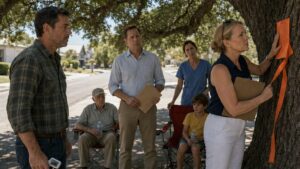
The route took him along the temporary construction fence. The wind moved dust across the pavement. Behind the mesh, stakes stood in fresh dirt, their tops marked in bright paint. Samuel stopped once where the fence opened near his driveway and looked through.
One strip of orange tape fluttered from a stake planted beyond the old side fence, beyond the place where Anna’s garden stones should have made anyone hesitate.
Samuel stood there until the tape snapped twice in the wind.
Then he went inside, set the rolled survey on the kitchen table, and did not remove his coat.
Chapter 2: The Bucket Stops At Anna’s Stones
The backhoe started before seven.
Samuel heard it through the kitchen window while the kettle was still warming on the stove. The sound was not like thunder, though people often said machines thundered. Thunder passed over. This sound stayed. It ground into the morning in short reverses and low growls, as if something large and impatient had come to chew the edge of the world.
He left the kettle untouched.
The rolled survey lay where he had placed it the night before. In daylight, the paper looked more fragile than it had in the lobby, the edges softened from decades in the closet above the hall shelf. Samuel slid it under his arm, took his walking stick from beside the door, and stepped out through the back.
Cold air met him. Dust was already moving.
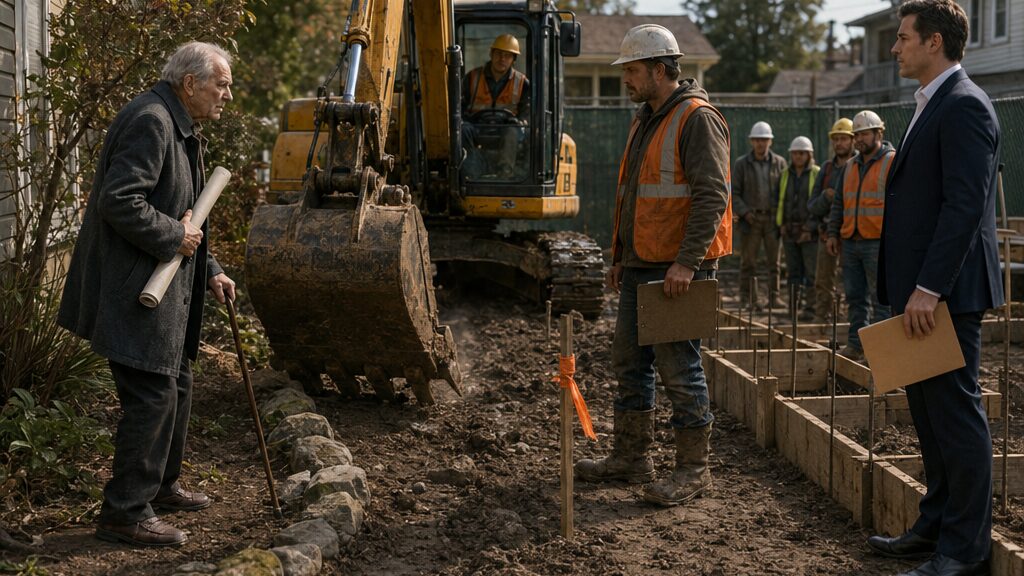
The side yard had never been wide. A narrow run of grass, Anna’s garden stones, a strip of soil where she used to plant thyme because it did not mind heat. Beyond that had once been open ground. Now there was a torn stretch of temporary fence, a row of concrete forms, and a yellow backhoe backing toward the border with a beeping that made Samuel’s teeth press together.
The orange tape he had seen the evening before was tied to a new stake two feet inside his side of the stones.
At first he simply looked.
That was how he had caught most errors in his life: by looking before speaking. The tape twisted in the breeze. A worker walked behind it with a measuring wheel, rolling it across dirt as if dirt alone decided ownership. Another worker bent near a string line. The backhoe bucket lifted, swung, and dropped its teeth toward the soil beside Anna’s stones.
Samuel moved faster than his knee wanted.
“Stop that bucket.”
The worker with the measuring wheel looked up first. The foreman turned from the forms. He was a broad man in a hard hat and orange vest, with a clipboard tucked under one arm and mud on one boot.
The backhoe bucket kept lowering.
Samuel stepped onto the grass between the bucket and the stones.
The operator saw him and jerked the machine still. The bucket hung there, teeth angled down, close enough that Samuel could see damp soil stuck to the metal.
The foreman came toward him. “Sir, you can’t be inside the work zone.”
Samuel kept his hand on the rolled survey. “Your work zone is inside my yard.”
The foreman looked at the tape, then at Samuel, then back toward the forms with the expression of a man who had already decided which one of them was real. “We’re inside the marked line.”
“The marked line is wrong.”
“Sir, please step back.”
Samuel planted his walking stick beside the nearest garden stone. It was one Anna had chosen because it was shaped almost like a heart, though she had denied that when he teased her. Half of it was covered in gray dust.
“My property runs to the pin near that old drain notch,” Samuel said. “Not to your orange tape.”
The foreman’s eyes flicked to the rolled paper. “Are you the homeowner?”
“Yes.”
“Then you probably got the notice. We’ve got approved access along this side.”
“Common access behind the fence. Not my side yard.”
The foreman exhaled through his nose. “I’m David Martin. I’m the site foreman. I’m telling you we’re working from the survey we were given.”
“And I’m telling you the survey you were given moved the line.”
A worker near the forms stopped tying wire. The backhoe idled, its engine shaking the morning. Samuel could feel the vibration in his shoes.
David lowered his voice, as if gentleness would make the words less insulting. “These marks are done by professionals. Property lines aren’t always where residents think they are.”
Samuel looked at him for a moment.
Residents.
Not owners. Not people. Residents, as if he were staying in a room someone else could rearrange.
“My wife set these stones thirty-six years ago,” Samuel said. “But I’m not asking you to honor her memory. I’m asking you not to dig past the recorded boundary.”
David’s face tightened at the mention of Anna, maybe from discomfort, maybe from annoyance. “I’m not here to argue history.”
“It isn’t history if your bucket is touching it this morning.”
The backhoe operator leaned out of the cab. “You want me to shut down?”
David did not answer right away.
Samuel stepped one pace closer to the bucket, not far enough to be foolish, only far enough that every man there had to see where he stood. His knee pulsed. His fingers ached around the survey. He did not let either thing show.
“Sir,” David said, “I need you to move.”
“No.”
The word came out plain.
David blinked once, as if he had expected age to soften refusal.
“No,” Samuel said again, because the first one felt too small against the engine. “Not until that bucket lifts and someone checks the line.”
A white pickup rolled in from the street entrance, tires crunching over gravel. Samuel did not turn at first. He watched the bucket rise six inches, then a foot, the operator finally drawing it back from the stones.
Only then did Samuel look.
Jeffrey Clark stepped out of the truck wearing a dark jacket over his shirt and tie. He carried a tan permit folder in one hand. Even at a construction site, he looked as if dust had been instructed not to touch him.
“Mr. Walker,” Jeffrey called. “We talked about this.”
Samuel held his ground. “No. You talked around it.”
Jeffrey approached with the folder raised slightly, like an answer already printed. “The HOA approved staging and access for this portion of the work.”
Samuel pointed with his walking stick to the stake. “Did they approve that?”
Jeffrey glanced at it. “That stake reflects the approved plan.”
“It reflects a plan that entered my property.”
David looked between them. “Jeffrey, we’re losing time.”
“I know.” Jeffrey smiled thinly at Samuel. “Which is why we need to resolve this without anyone getting hurt.”
The words hung there.
Samuel understood what they were meant to do. Not threaten, exactly. Shift the room, though there was no room. Turn him from homeowner into hazard. Turn his refusal into a safety issue. Make the machine innocent and the old man dangerous.
He bent slowly, picked up one of Anna’s dust-covered stones, and set it on top of the rolled survey in his palm. It was heavier than he remembered.
“This stone has been here longer than your project,” he said.
Jeffrey’s patience thinned. “A garden border is not a legal marker.”
“No,” Samuel said. “But it tells me where to look.”
He lowered the stone back to the ground exactly where it had been. Then he unhooked the rubber band from the survey. The paper loosened slightly, but he did not unroll it yet. The wind tugged at the outer edge.
Jeffrey’s gaze sharpened. “This is not the place.”
“This is exactly the place.”
David shifted his weight. Behind him, the workers waited with the dull resentment of men paid by the hour but measured by the day’s progress. Samuel could feel all their eyes on his back. He could also feel the house behind him: old siding, porch step, kitchen window, all the small things that had never needed defending until somebody put tape in the wrong dirt.
Jeffrey opened the permit folder. “Here. The board authorized temporary access for grading, drainage, and form placement along the east boundary.”
Samuel looked at the papers but did not reach for them. “Temporary access where?”
Jeffrey tapped a page. “Along the boundary.”
“Whose boundary?”
Jeffrey stopped.
It was only a small pause. But Samuel saw it. David saw it too.
“The community boundary,” Jeffrey said.
“My land is not community land.”
Kathleen Roberts arrived a few minutes later, walking carefully across the uneven soil in low heels, her phone in hand and worry tucked behind her professional face. A neighbor stood at the temporary fence, watching. Then another. Public attention, Samuel thought, always arrived after the damage began.
“Samuel,” Kathleen said, “please don’t stand in front of equipment.”
“I’m standing in my yard.”
“Jeffrey says this was approved.”
“Jeffrey says many things.”
Color rose in her cheeks. “That isn’t helpful.”
“No,” Samuel said. “The truth rarely is when the forms are already built wrong.”
David muttered something to a worker, who killed the measuring wheel and stepped back. The backhoe engine dropped into a rough idle. For the first time all morning, the site sounded uncertain.
Samuel looked at Kathleen. He wanted to ask why she had not looked closer before signing. He wanted to ask whether the board had thought his age made him less likely to notice. Instead he held up the rolled survey.
“This line was recorded when Anna and I bought the house. The old pin is near the drain notch. If you check before you pour, this can be fixed.”
“And if you’re mistaken?” Jeffrey asked.
Samuel turned toward him. “Then you’ll have lost an hour.”
David looked at the machine, then at the forms, then at Jeffrey.
Jeffrey closed the permit folder. “The HOA has already approved access.”
Samuel looked down at the orange tape tied to the false stake. It fluttered as if waving away the past.
“Then the HOA approved something it didn’t own,” he said.
Chapter 3: Two Feet They Called Temporary
By evening, dust had settled on the porch railing in a pale film, soft enough that Samuel could write his name in it with one finger.
He did not.
He stood by the kitchen sink and washed mud from the side of his walking stick. The water ran brown for a moment, then clear. Outside, the backhoe had gone quiet, though the silence did not feel like peace. It felt like men waiting to begin again.
The rolled survey lay open on the kitchen table for the first time in years.
Its paper had a memory of being curled. Even with two mugs holding down the corners, the edges lifted slightly, trying to return to the shape Samuel had carried against his chest. He had placed a small pencil mark beside the old boundary pin, then another near the drainage notch, then a third where the orange tape had been set. The distance between the true line and the new stake measured less than the width of the kitchen doorway.
Two feet, Jeffrey had said before leaving. Temporary.
Two feet did not sound like much when spoken in a smooth voice beside a truck. Two feet was less than a grave. Less than a bed. Less than the distance between two chairs at a table.
But two feet was enough to move water.
Samuel heard a car pull into the driveway and closed his eyes for a second before opening them again.
Janet did not knock. She had a key, and she still used it with the quick turn of someone who remembered being sixteen in the same house. She came in carrying a paper grocery bag and a worry she tried to disguise as irritation.
“Dad?”
“In here.”
She appeared in the kitchen doorway, hair pulled back, work blouse creased at the elbows. Her eyes went first to him, then the map, then the mud on the towel by the sink.
“I got your message,” she said. “You said there was equipment in the yard.”
“There was.”
“Was?”
“They stopped for now.”
“For now.” She set the bag on the counter carefully. “What does that mean?”
“It means they haven’t admitted the line is wrong.”
Janet looked at the survey. “Is this the old one?”
“The recorded one.”
She drew out a chair but did not sit. “Dad, I’m not saying you’re wrong.”
Samuel smiled faintly. “That’s usually what people say before asking me to act as if I am.”
Her face tightened. “I’m asking you to be careful.”
“I was careful.”
“You stood in front of a backhoe.”
“I stood in front of my wife’s garden stones.”
Janet looked away.
The kitchen held too much history for silence to be empty. Anna’s blue mixing bowl still sat on the open shelf because Samuel had never found a reason to move it. The little hook beside the door still held the faded gardening hat she used to wear in May, though its brim had curled with age. Janet saw those things whenever she came home, but she had grown skilled at not letting them stop her.
“Jeffrey called Kathleen,” Janet said.
Samuel looked at her. “Did he.”
“She called me.”
That stung more than he expected.
Samuel dried the walking stick with slow strokes. “I see.”
“She was worried. She said you seemed upset.”
“I was standing where they were digging.”
“She said the crew has permits.”
“The permit does not include my yard.”
“Maybe not, but this can get expensive.” Janet finally sat, then stood again almost immediately. “They offered to compensate you, didn’t they?”
Samuel folded the towel once, then again. “Jeffrey mentioned a landscaping credit.”
“That might not be nothing.”
“It is nothing if it pays me to pretend the line moved by itself.”
Janet pressed her fingers against her forehead. “Dad, I’m not trying to hurt you.”
“I know.”
“You’re almost seventy-nine. You can’t spend every morning fighting contractors. You can’t run around county offices and board meetings and construction sites over—”
She stopped herself too late.
“Over two feet,” Samuel finished.
Her eyes shone with frustration. “Over two feet that they might fix later.”
“Concrete does not fix later easily.”
“Then let me help you find someone who can talk to them.”
“I talked to them.”
“No, Dad. You confronted them.”
Samuel looked down at the survey. The little pencil marks seemed too small for all the heat gathered around them.
For a moment, he wanted to roll the paper back up and tell her she was right. He wanted the house quiet. He wanted his daughter not to look at him the way Kathleen had looked at him, as if his feelings were a weather condition to be managed. He wanted not to know the difference between common access and private land, drainage pitch and foundation risk, old pins and new stakes.
But he did know.
He touched the spot on the survey where the side yard narrowed near the porch steps. “When your mother put those stones in, I told her nobody would care where the thyme ended and the weeds began.”
Janet’s expression changed, softened despite herself.
“She said she cared,” Samuel continued. “She said a home needed edges. Not walls. Edges. Places where you could say, this is where we tend, and that is where the world begins.”
Janet looked toward the back window. The first clouds of evening had lowered over the framed townhomes. Beyond the glass, the orange tape was a dim slash in the gray.
“I miss her too,” she said.
“This is not only missing her.”
“I know, but sometimes it sounds like—”
“Like I’m making a boundary line into a memorial?”
She did not answer.
Samuel let that sit between them because it was not entirely false. Part of him was afraid the yard would look different without those stones. Part of him hated that strangers with machines had touched what Anna had once arranged with bare hands. He would not deny that. But grief was not the same as confusion.
He pointed to the slope marked on the site plan copy Jeffrey had left behind. “If they move their drainage edge here, water comes this way. Toward the porch. Toward the foundation. Your mother’s stones are how I noticed. They are not the only reason it matters.”
Janet leaned closer despite herself. “Are you sure?”
“No,” Samuel said honestly. “Not about everything.”
That seemed to surprise her.
He tapped the old survey. “I am sure about this line. I am sure the new stake is on my side of it. And I am sure they want the work far enough along that correcting it feels unreasonable.”
Janet lowered herself into the chair again. This time she stayed.
“What do you want me to do?” she asked.
“Nothing tonight.”
“Dad.”
“I mean it. Tonight I want you to eat something from that bag you brought and stop looking at me like I’ve already fallen.”
Pain crossed her face so quickly he almost wished he had not said it.
“I don’t think that,” she said.
“You’re afraid I will.”
“Yes.” Her voice thinned. “I’m afraid you’ll get hurt trying to prove you don’t need help.”
Samuel looked at his hands. They were not steady all the time anymore. He hated that she knew it. He hated more that she had a right to worry.
“I need help,” he said. “I do not need surrender dressed as help.”
Rain touched the window then, a few light taps at first. Both of them turned toward the sound.
Outside, the dust darkened. Drops struck the loose soil beyond the stones and made tiny craters. For a minute nothing moved but rain.
Then a thin brown thread of water began to slide from the construction side under the temporary fence. It curved around the false stake, crossed the strip they called temporary, and moved toward Samuel’s back steps.
Janet stood.
Samuel did not. He watched the water find the low place near the porch, exactly where he had feared it would go.
The rolled survey lifted at one corner under the kitchen light, trying again to close itself.
Chapter 4: The Permit Folder With No Neighbor Signature
The county building smelled of wet coats and old paper.
Samuel stood beneath a fluorescent light that hummed softly above the permit counter, the rolled survey tucked under his left arm and a folder of photographs pressed flat beneath his right hand. He had taken the pictures the morning after the rain: the brown thread of runoff crossing under the temporary fence, the orange tape beyond Anna’s stones, the water gathered near his back steps in a shallow muddy fan.
The clerk behind the counter had silver reading glasses low on her nose and a patient way of moving through computer screens. She did not hurry him. For that alone, Samuel felt an unexpected gratitude.
“You’re asking for the access authorization packet?” she said.
“Yes.”
“For the development along the east boundary?”
“For the part they say lets them work in my yard.”
She paused at that. Not long, but long enough to look at him over her glasses. “Let me pull the full file.”
Samuel waited while a printer began behind the partition. Through a tall window, he could see rainwater still clinging to the parking lot stripes. His knee ached from standing, but he did not ask for a chair. There was one by the wall. He had seen it when he came in. He refused to need it before the papers appeared.
The clerk returned with a stack clipped at the top. “There’s the grading permit, drainage revision, temporary staging plan, HOA authorization, contractor insurance certificate, and the site access agreement.”
Samuel touched the survey under his arm. “May I see the access agreement?”
She set the packet on the counter and turned it toward him.
The top page bore Kathleen Roberts’s signature. Samuel knew it at once from the HOA notices, the wide K, the careful loop in Roberts. Beneath it was the association seal. The typed line read: Common-area construction access and temporary staging along east boundary.
Samuel read it twice.
Then he read the attached map.
The common strip behind the back fence was shaded in blue. The access route curved along it, then widened near the unfinished townhomes. His side yard was not shaded. His porch was not shaded. Anna’s garden stones were outside the marked area entirely.
He took out his own survey and laid it beside the permit packet. The old paper curled at the edges, so he held one corner down with his palm. The clerk glanced at it, then at the county map, and leaned forward.
“That’s your private lot?”
“Yes.”
“And this is the HOA common area?”
“Yes.”
She turned one page back, then another. “There should be an owner consent form if they’re entering private property.”
Samuel looked at the empty place in the packet where such a page should have been.
“There isn’t one,” the clerk said quietly.
He did not feel triumph. Triumph would have been too large for the moment. What he felt was something smaller and colder, a confirmation of the shape his fear had taken.
“They told my daughter I was upset,” he said.
The clerk’s face changed, not into pity, but into recognition. She had likely heard many versions of that sentence from many counters. “I can’t speak to what they told anyone. I can tell you what’s in the file.”
Samuel nodded. “What is in the file?”
“HOA authorization for common access. Not individual permission for private-yard entry.” She tapped the map. “If the field work is past this shaded area, someone needs to verify it.”
“How do I request that?”
She handed him a form and a pen attached to the counter by a chain. “You can file a boundary-related complaint tied to permit activity. Include photos. Ask for a field inspection.”
Samuel bent over the form.
His hand moved slower than it once had. Block letters helped. Name. Address. Permit number. Description of complaint. He wrote without embellishment: Contractor placed stake and construction tape inside private lot. Equipment crossed garden boundary. Drainage runoff directed toward rear steps. HOA authorization does not include private-yard consent.
At the line for signature, he stopped.
The pen chain clicked softly against the counter. For a second he remembered signing the original mortgage papers beside Anna, both of them young enough to think thirty years was a far country. Anna had laughed because his signature had been stiff and formal, and she had whispered, “You look like you’re buying the whole county.”
He signed now with a slower hand.
The clerk copied his photographs. She made a copy of the old survey too, handling it more carefully than Jeffrey had handled Samuel himself. When she finished, she slid the originals back to him.
“You’ll get a call when it’s assigned,” she said.
“When?”
She hesitated. “Inspection schedules are tight. It may not be today.”
“They’re moving forms.”
“Concrete?”
“They haven’t poured yet.”
Her fingers went back to the keyboard. “The project notes show concrete placement scheduled for Thursday morning.”
Samuel looked at the calendar taped to the side of her monitor.
Thursday was two days away.
“Can the inspection happen before then?”
“I can mark it urgent because it involves possible work outside the authorized area.” Her voice grew careful. “That doesn’t guarantee a stop.”
“What does?”
“A field finding. Or voluntary pause by the contractor. Or a revised authorization.”
Samuel almost smiled at the last one. Revised authorization. A polite phrase for asking permission after taking it.
He thanked her and rolled the survey, sliding the old paper back into its tube with more care than his stiff fingers made easy. Before leaving, he turned to the packet once more.
“May I have a copy of the HOA authorization?”
“I already made one.”
She handed it to him. Kathleen’s signature sat at the bottom, neat and confident.
Samuel carried it across the parking lot beneath a low gray sky. His truck was at home, too temperamental for the drive downtown, so Janet had brought him before work and planned to pick him up at noon. He had an hour before then. The HOA office was only two blocks away.
He walked.
By the time he reached the building, the ache in his knee had sharpened, but the glass door opened easily, and the hallway inside was warm. A bulletin board displayed notices about landscaping standards, pool hours, holiday lights, and the developer reception rescheduled for later in the week.
Kathleen came out of the office carrying her phone and stopped when she saw him.
“Samuel.”
He held up the copied authorization. “This is what you signed.”
Her gaze fell to the page. “I signed what the board approved.”
“You approved common access.”
“That’s what the project required.”
“My side yard is not common.”
Her face tightened. “Jeffrey told us the crew might need room along that edge for drainage work.”
“Room from whom?”
She did not answer.
A door opened behind her. Someone inside the office laughed, then went quiet.
Samuel lowered the paper. He had not come to shame her. Shame was too easy to pass around and too hard to make useful.
“Kathleen, did you see the field line before signing?”
She looked past him toward the glass entry. “We reviewed the site materials.”
“That is not what I asked.”
Her jaw worked once. “No. I did not personally walk your side yard.”
The answer settled between them.
Samuel nodded. “Then walk it before they pour.”
“I can ask Jeffrey to pause.”
“Ask him today.”
Her phone buzzed in her hand. She looked at it, and the old habit of authority returned to her posture. “There are costs to delays.”
“There are costs to water under a foundation.”
“I understand that.”
“No,” Samuel said. “You understand a delay. You do not yet understand the line.”
He left before she could soften or sharpen the moment.
Outside, the clouds were low enough to make the afternoon feel like evening. Samuel stood under the small awning and tucked the copied pages beside the rolled survey.
For the first time since Jeffrey’s hand had guided him through the lobby doors, Samuel had something that was not only memory, not only anger, not only an old map.
He had the absence of a signature.
But as Janet’s car pulled to the curb, the clerk’s words followed him down the sidewalk.
Concrete placement scheduled for Thursday morning.
Chapter 5: Mud At The Porch Before Rain
Two days later, a cement truck blocked Samuel’s driveway before breakfast.
It sat angled across the entrance with its drum turning slowly, a low wet churn that seemed to reach through the kitchen window and stir the air inside the house. A second truck idled along the curb. Workers moved in and out of the side yard carrying boards, stakes, and lengths of pipe. The sky had the green-gray heaviness that came before a summer storm.
Samuel stood on the porch with his phone in one hand and the rolled survey under his arm.
The survey tube had a smear of dried mud near one end. He had tried to wipe it off the night before and stopped when he realized the mark mattered. It had been clean when he carried it into the glass lobby. Now it looked as if the dispute itself had touched it.
He took a photograph of the blocked driveway.
Then another.
A worker glanced at him and looked away.
Samuel stepped down carefully and walked to the driver’s side of the cement truck. The driver lowered the window halfway.
“I need to get out of my driveway.”
The driver looked toward the site. “Foreman said this is the staging spot.”
“It is my driveway.”
“Just following placement directions.”
“I understand. I still need it moved.”
The driver rested one hand on the steering wheel, uncomfortable now but not hostile. “You’ll have to ask the foreman.”
Samuel did not say what he thought of a world where a man had to ask a stranger to unblock his own driveway.
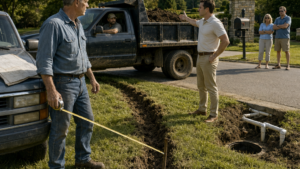
He found David near the concrete forms, one boot on a board, pencil behind his ear. The forms ran close to the orange tape. Too close. Beyond them, a shallow trench had been cut at an angle that would carry runoff toward the low place near Samuel’s porch unless it was corrected.
David saw him coming and sighed. “Mr. Walker.”
“You’re blocking my driveway.”
“For maybe half an hour.”
“You’re also cutting that trench the wrong way.”
David looked toward the trench. “Drainage plan was approved.”
“Not for my yard.”
“We’ve been through this.”
“We have not been through the inspection.”
David pulled the pencil from behind his ear and tapped it against the clipboard. “I heard you filed something.”
“I did.”
“Then let the process work.”
Samuel looked at the cement truck. “Is this the process?”
David followed his gaze, and for a moment his expression showed fatigue instead of irritation. “I’ve got a schedule. I’ve got a crew. I’ve got concrete ordered. If we don’t pour today, that’s money.”
“And if you pour across the wrong line?”
“Then someone above me should have stopped it before the truck got here.”
That was the first honest sentence Samuel had heard from him.
Before he could answer, Jeffrey arrived in his white pickup, moving faster than usual. He stepped out with his phone already in his hand and his jacket unbuttoned. The weather had put a curl in his hair near one temple, a small disorder that made him look less certain but not less determined.
“Samuel,” he called, using his first name now, as if familiarity might smooth the ground. “We’re not doing this again in front of the crew.”
Samuel took another photograph of the trench.
Jeffrey stopped walking. “What are you taking pictures of?”
“My yard.”
“That trench is part of the approved drainage correction.”
“Correction for whom?”
Jeffrey’s eyes narrowed slightly. “For the development.”
“Because if it stays on your side, the slope does not work.”
The sentence came out before Samuel had fully planned it. But as soon as he said it, he saw Jeffrey’s face answer.
Not much. A tightening around the mouth. A pause before denial.
“That’s not accurate,” Jeffrey said.
“It is why you need my two feet.”
David looked down at the clipboard.
Samuel saw that too.
The sky rumbled faintly.
Jeffrey lowered his voice. “There are engineering tolerances on every site. The final condition will be clean. Your yard will be restored.”
“My yard should not be used first and restored later.”
“We offered a landscaping credit.”
“You offered a receipt for silence.”
Jeffrey’s polished patience cracked just enough to show the pressure beneath it. “Do you know what a redesign costs? Do you know what happens when a drainage plan gets reopened this late? It affects buyers, crews, schedules, financing. This is not only about your strip of grass.”
Samuel looked at the trench. Brown water from the previous rain had left a stain along the cut, pointing toward his porch like a finger.
“No,” he said. “It is about whether my strip of grass is easier to take than your plan is to fix.”
A gust of wind lifted dust from the disturbed soil. The orange tape sagged, wet from mist beginning in the air. One end had come loose and fluttered against a concrete form.
Jeffrey looked toward the street. Two neighbors had stopped near the temporary fence. One held a dog leash. Another had a phone but was not filming, only pretending to check messages while watching.
Jeffrey noticed them and changed his tone. “Mr. Walker, nobody is taking your property.”
Samuel almost admired the speed of it. The public voice returning. The careful address. The denial shaped for witnesses.
“Then move the truck,” Samuel said.
Jeffrey’s nostrils flared. “David, can you shift the truck?”
David looked toward the driver, then at the forms. “It’ll slow placement.”
“Shift it enough for access.”
The driver received the signal and began to move. The cement truck groaned, backed, pulled forward, and left Samuel a narrow angle through which a car could pass if driven carefully. It was not respect, but it was space.
Samuel took a photograph of that too.
By midmorning, the first heavy drops began. Work did not stop. Men moved faster. A pump hose was dragged near the forms. Mud clung to boots and tracked across Samuel’s grass in half-moon prints. The trench darkened. Water gathered, then chose its path.
It ran toward the porch.
Samuel stood beneath the eave and filmed only the ground. No faces. No shouting. Just water crossing the false line, curling around Anna’s stones, and sliding toward the steps where the old foundation met the soil.
His hands shook by the end, not from fear but from the effort of holding still.
At noon, Kathleen arrived with an umbrella.
She stepped around the mud and stopped at the porch, looking down at the water. For once, she had no immediate sentence prepared.
“You see it,” Samuel said.
“I see water,” she replied carefully.
“You see where it is going.”
Her eyes moved from the trench to the porch, then to the forms. “I spoke with Jeffrey.”
“I’m sure.”
“He says the finished grading will correct this.”
“After the pour.”
She looked tired. There were small lines near her mouth he had not noticed in the lobby. “Samuel, the board is willing to hear you tonight. The reception is still happening, but we can add an emergency review before the program.”
“Tonight?”
“Yes. Bring your documents. Bring your photos. But you have to come calmly.”
Samuel looked at her.
Rain tapped against the umbrella above her head. Behind her, Jeffrey stood near the forms talking into his phone. David watched the sky as if weather, not choice, had made the day difficult.
“Calmly,” Samuel repeated.
Kathleen’s face flushed. “I mean it needs to be orderly. If you come in angry, Jeffrey will say you’re interfering again.”
“Jeffrey will say that anyway.”
“Then don’t help him.”
It was the first thing she had said that sounded less like a notice and more like advice.
Samuel shifted the survey tube under his arm. The mud mark had darkened in the damp air. He thought of the glass doors, the hand on his shoulder, the room returning to its cupcakes and brochures after he had been guided out.
“What time?” he asked.
“Six.”
“I want the county inspector notified.”
“I can’t promise they’ll come.”
“Notify them.”
Kathleen nodded once.
She turned to leave, then paused near the bottom step. “Samuel?”
He waited.
“I should have walked the line before I signed.”
The apology was not complete. It did not repair the trench or move the forms. It was only a small admission standing in rain.
Samuel accepted it as such.
“Yes,” he said. “You should have.”
Kathleen walked back across the muddy yard, her umbrella tilting in the wind.
Samuel stayed on the porch until the trucks quieted and the workers covered the forms with plastic. Rain slid from the roof in steady strings. At his feet, muddy water reached the first brick of the back step and spread there, shallow but certain.
He raised his phone and took one last photograph.
Then he went inside to wipe the survey tube dry.
Chapter 6: The Line Unrolled Before Everyone
The second time Samuel entered the glass lobby, no one offered him coffee.
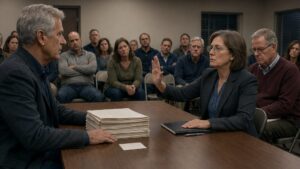
He came in at six exactly, his coat damp at the shoulders, the rolled survey under one arm and a plain folder of photographs in his hand. The sales center had been rearranged since the first reception. The model displays still glowed along the walls. The renderings still promised clean sidewalks, young trees, and sunlit porches. But one end of the long table had been cleared, and several HOA board members sat there with paper cups and stiff expressions.
Guests lingered near the back of the room, pretending not to listen.
Jeffrey stood beside the table with his permit folder open in front of him. Kathleen was at the far end, hands folded. Near the glass doors, a county inspector in a rain jacket spoke quietly with David Martin. Samuel noticed David’s boots first. Mud clung to the soles.
For a moment, the old humiliation tried to return to his body before anyone said a word. His hand remembered Jeffrey’s pressure on his shoulder. His chest remembered the tightness of being moved away from the table. Even the smell of polished floor and coffee seemed to tell him where old men belonged: near the door, not at the center.
He walked to the table anyway.
Kathleen stood. “Thank you for coming, Samuel.”
Jeffrey’s smile was in place, but it no longer reached both sides of his face evenly. “Mr. Walker, we all want clarity here.”
Samuel set his folder down. “So do I.”
A board member cleared his throat. “We understand there may be some confusion regarding temporary construction access.”
Samuel looked at the man until the word confusion had nowhere to hide.
Kathleen stepped in quickly. “Let’s review the materials.”
Jeffrey turned a large site plan toward the board. “As you can see, the approved drainage adjustment runs along the east boundary. The crew placed field markers according to the working plan. Mr. Walker has concerns because some of the work is near his garden border, but as I explained, garden borders don’t establish legal boundaries.”
The sentence was neat. Reasonable. Designed to make the room nod.
Samuel placed one palm on the rolled survey but did not open it yet.
Jeffrey continued. “We’ve offered restoration, landscaping credit, and continued communication. The challenge is that stopping work at this stage creates significant cost exposure for the association and developer.”
There it was. The larger thing made larger. The small thing made small.
Samuel heard a murmur behind him. Someone shifted near the refreshment table. The county inspector watched without expression.
Kathleen looked at Samuel. “You can respond.”
Jeffrey added, gently, “Take your time.”
Samuel almost laughed. Not because it was funny. Because the same man who had rushed him through the doors now offered time in public.
He removed the rubber band from the survey.
The paper loosened with a dry whisper. Samuel laid it on the table. The edges curled at once. He took two coffee cups and placed them on the corners, then looked at Kathleen. She understood and set her own cup on a third corner. After a hesitation, David came forward and placed a small measuring tape on the fourth.
The old survey lay open.
There was no drama in it. No hidden message. No red circle. Just lines, numbers, pin references, notations, and the faded blue words Anna had written on the outside years ago, now partly visible along the roll: side garden line.
Samuel touched the old boundary mark with one finger. “This is my lot.”
Jeffrey leaned in. “No one disputes the lot exists.”
Samuel moved his finger. “This is the recorded pin near the old drain notch.”
The county inspector came closer.
“This,” Samuel said, placing a photograph beside the survey, “is the orange stake your crew placed.”
The photograph showed the tape, the concrete form, the edge of Anna’s stones.
Samuel laid down a second photograph. “This is the water during yesterday’s rain.”
A third. “This is the truck blocking my driveway.”
A fourth. “This is the trench cut inside the line.”
The room had gone still in a way it had not the first time. Not sympathetic, not yet. But attentive.
Jeffrey reached for the working plan. “The field stake corresponds with the construction access boundary.”
Samuel picked up the HOA authorization copy and placed it beside the survey. “Common access boundary.”
Kathleen closed her eyes briefly.
The inspector looked at the page. “Do you have a private-yard consent form?”
Jeffrey’s hand paused over the permit folder. “The HOA authorization was understood to cover necessary access along that side.”
“That isn’t what he asked,” Samuel said.
No one moved.
Jeffrey looked at him, and for the first time that evening, dislike showed plainly before he covered it. “Mr. Walker, this is a complex site. The grading has to tie into the approved drainage. There are tolerances.”
Samuel nodded. “Yes.”
The agreement seemed to catch Jeffrey off guard.
Samuel pointed to the construction plan. “Your tolerance is on my side.”
The inspector bent over both documents. “Where is the current field stake?”
“Still there,” Samuel said. “Unless someone pulled it up after I arrived.”
David spoke from near the door. “It’s still there.”
Jeffrey turned sharply toward him.
David’s jaw tightened. He did not look away. “It’s still there,” he repeated.
Kathleen stood. “Then we walk it.”
Jeffrey straightened. “In this weather?”
“In this weather,” Kathleen said.
They went through the same glass doors Samuel had been guided through days before. This time no hand touched his shoulder. He walked slowly, and the others adjusted to his pace or moved ahead and waited. The rain had thinned to a mist, silvering the construction lights. Mud pulled at shoes. The guests stayed inside, faces faint behind the glass.
At the side yard, the temporary lights cast hard shadows over the forms. The orange tape sagged from the disputed stake. Anna’s stones curved beside it, several pushed crooked by boots and runoff. The backhoe stood dark beyond the forms, bucket lowered but still.
The inspector took out a small measuring device. David held a flashlight. Samuel stood by the old drain notch and pointed with his walking stick.
“The pin is near there.”
The inspector scraped mud away with the edge of his boot, then crouched. For several minutes there was only rain tick, mud suck, the faint hum of traffic beyond the development fence. He used a probe. Metal clicked against metal.
Samuel did not breathe fully until he heard it.
The inspector cleared more soil. A small round boundary pin showed through, dull and old and exactly where Samuel had said it would be.
David looked at the orange stake, then at the pin.
The distance between them was not large.
That was the cruelty of it. The wrong was small enough to be dismissed and large enough to change everything.
The inspector stood and looked at Jeffrey. “This stake is inside the private lot.”
Jeffrey’s expression went blank. “We’ll need the surveyor to confirm.”
“You should,” the inspector said. “Until then, no concrete placement in this disputed section.”
Kathleen let out a breath that was almost lost in the rain.
Samuel looked at the pin. Mud had filled the old groove around it. He thought of Anna’s hands pressing thyme into the soil, her hat brim low, her voice telling him the yard needed edges.
Jeffrey closed his permit folder slowly. “A temporary pause, then.”
“A stop in this section,” the inspector said. “Temporary until corrected.”
Samuel looked at the backhoe bucket, at the forms, at the trench that had sent water toward his porch. He felt no victory rise in him. Only the weight of having been right later than he should have needed to prove.
Kathleen turned to him. “Samuel, the board will document this.”
“Document the damage too,” he said.
She nodded.
Jeffrey’s gaze flicked toward the lobby, where silhouettes watched through glass. “We can discuss restoration.”
“No,” Samuel said. “We can discuss correction first.”
The inspector took a roll of temporary marker tape from his jacket and tied it near the true boundary pin, then placed a stop marker beside the disputed form. It was small, almost plain, but every person there looked at it.
The orange tape on the false stake fluttered weakly in the mist.
Samuel stood between the two markers, the rolled survey under his arm again, no longer hidden against his chest.
Chapter 7: Where The Stones Were Set Back
The construction site was quiet for six days.
Quiet did not mean unchanged. The forms stayed under plastic. The backhoe sat with its bucket lowered. Rain dried in pale streaks across the mud, and the false orange stake leaned farther each morning as if even the ground had stopped believing it.
Samuel watched from the porch more than he meant to.
The stop marker near the old boundary pin was small, a plain county tag tied to a short stake, but it altered the whole yard. Workers walked around it. David measured around it. Jeffrey stood beside it twice with a phone to his ear and one hand on his hip, looking toward Samuel’s house but not coming to the door.
On the seventh morning, a smaller crew arrived without the cement truck.
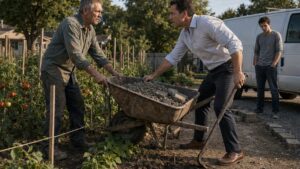
Samuel was in the kitchen when he heard the soft scrape of shovels instead of engines. He looked through the window and saw David Martin kneeling beside the crooked garden stones, pulling mud away with gloved hands. Two workers lifted the concrete forms back from the disputed strip. Another carried sections of pipe toward the development side, not Samuel’s.
The rolled survey stood in the corner by the back door, still marked with mud at one end. Samuel had not put it away.
He took his walking stick and went outside.
David saw him approach and stood. His hard hat was pushed back on his head. He looked tired in the clear morning light.
“Mr. Walker.”
“Mr. Martin.”
“We’re pulling the forms back today.” David nodded toward the trench. “Drainage is being revised to stay on our side. There’ll be a swale cut behind the common strip instead.”
Samuel looked at the shallow cut that had carried water toward his porch. “And this?”
“Filled and compacted. Topsoil after inspection. They’ll reseed.”
Samuel said nothing.
David glanced down at the stones. “I told the guys not to toss these.”
That, more than anything, made Samuel look at him fully.
“They’re just setting them aside until the grading’s done,” David added. “I figured you’d want them back where they were.”
Samuel crouched slowly, one hand braced on his walking stick. The stones lay in a small pile on a sheet of plywood. Dust and mud had dulled them all to the same color. Still, he knew the heart-shaped one. He knew the long flat one Anna had set near the thyme because it warmed early in spring.
“Thank you,” he said.
David gave a small nod, uncomfortable with gratitude. “For what it’s worth, I should’ve checked when you said the pin was near the notch.”
“For what it’s worth,” Samuel replied, “yes.”
David almost smiled. Then he turned back to the crew.
By midmorning, Kathleen Roberts arrived in shoes more suited to mud than meetings. She carried a folder but did not open it at once. Samuel was seated on the porch step with the survey across his knees, not unrolled, only held.
Kathleen stopped at the bottom of the steps. “May I sit?”
Samuel moved his stick aside.
She sat on the other end of the step, careful to leave space between them. For a while both watched the workers.
“The revised plan was approved this morning,” she said. “The county wants another field check after the fill is complete. Jeffrey agreed to pay for the surveyor’s revisit and the drainage correction.”
“Jeffrey agreed?”
“After the inspector made it clear the alternative was a formal hold on the whole east section.” Kathleen looked down at her hands. “Agreement may be too generous a word.”
Samuel watched a worker carry the false orange stake toward a scrap pile.
“What about the board?” he asked.
Kathleen opened the folder and drew out a single page. “We’re recording that the HOA authorization applied only to common staging. We should not have let Jeffrey describe the boundary without verifying it. I should not have signed without walking the site.”
Her voice stayed controlled, but the words cost her something.
Samuel accepted the page. It was not an apology letter. It was better than one. It was a correction entered where future people might have to read it.
“And the damage?”
“Restoration of the side yard. Replacement soil. Reseeding. Resetting the stones under your direction. A written note that no future access to your private lot is permitted without your signed consent.”
Samuel held the page on his knee. “No landscaping credit.”
“No landscaping credit,” Kathleen said. “Repair.”
The distinction settled gently.
Across the yard, Jeffrey stood near his truck speaking with David. He did not come over. Samuel was glad. There were conversations that could only shrink a thing already made clear.
Kathleen followed his gaze. “He thought you would take the credit.”
“I know.”
“He thought the cost of fighting would feel heavier than the loss.”
“It did.”
She looked at him then.
Samuel folded the page once. “That is why it was tempting.”
Kathleen’s expression changed, not to surprise, exactly, but to something more respectful than regret. “Janet called me yesterday.”
Samuel sighed faintly. “I imagine she had things to say.”
“She asked whether the corrected drainage would be in writing.”
“That sounds like her.”
“She also asked whether you were standing too much.”
“That sounds like her too.”
For the first time in days, Samuel felt a small laugh move through him without bitterness.
That afternoon, Janet came by while the crew was resetting the side yard. She arrived with work shoes in the trunk and changed into them beside the driveway. She did not ask Samuel to sit down. She only came to stand beside him near the stones.
David had left the final placement to Samuel, as promised. One by one, the workers set the stones where he pointed. Samuel checked the curve against the old survey, then against memory, then against the exposed boundary pin near the drain notch.
Janet picked up the heart-shaped stone and brushed dried soil from its edge.
“Here?” she asked.
Samuel looked at the line.
“A little closer to the thyme bed,” he said.
“There isn’t a thyme bed anymore.”
“No,” he said. “But there was.”
She set it down carefully.
When the last stone was placed, the curve looked smaller than Samuel remembered. Lower. Less certain. The soil around it was new and dark, and the grass was gone. The repaired yard did not pretend nothing had happened.
Samuel found that he preferred it that way.
Janet stood with her arms folded, looking from the stones to the construction fence. “I thought you were fighting because you couldn’t let Mom’s garden change.”
“I was,” he said.
She turned to him.
“And because water was coming to the porch,” he added. “And because the line was wrong. A person can have more than one reason and still be right.”
Janet nodded slowly. “I’m sorry I made it sound smaller.”
Samuel looked at her shoes, already muddy at the edges. “You were afraid.”
“I still am.”
“I know.”
A worker began removing the last of the orange tape from the old false line. It came loose in a wet twist, bright and useless in his hand.
By evening, the trucks were gone. The corrected drainage cut lay beyond the common strip, covered with straw. The temporary stop marker had been replaced by a clean boundary stake set beside the old pin. Anna’s stones curved again along the side yard, not perfect, not untouched, but back where they belonged.
Samuel stood alone at the kitchen table after Janet left.
He unrolled the survey once more. The paper still curled at the edges, but less sharply now, as if it had grown tired of holding itself closed. He ran his finger along the boundary line, past the pin, past the drain notch, past the place where Anna had written in fading blue.
Then he rolled it carefully, slid the rubber band around it, and carried it to the back door.
For years, the survey had lived hidden above the hall shelf, a document for emergencies no one expected. Samuel set it upright in the corner by the door, beside his walking stick.
Not clutched.
Not buried.
Not displayed for anyone else.
Just near enough to reach.
Outside, the repaired stones caught the last light and held it in a thin, quiet line.
The story has ended.