The Food Truck She Tried to Remove Became the Neighborhood’s Last Chance to Stay Together
Chapter 1: The Truck Sandra Said Would Be Gone
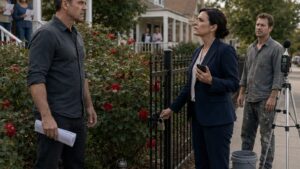
Sandra Moore took six photographs of Robert Ramirez’s food truck before she said a word to him.
She stood at the edge of his driveway with her phone held upright, moving two careful steps to the left so the lens could capture the truck’s bright orange side against the row of beige houses. The fold-out serving window was shut and locked. The wheels rested well behind the seam where Robert’s driveway met the sidewalk.
Robert set down the bucket he had been carrying from the garage.
“You need something?” he asked.
Sandra lowered the phone but did not put it away. Her pink polo was tucked neatly into pressed khaki pants, and an HOA identification badge hung from a blue cord at her waist. She did not need the badge. Everyone on Alder Glen knew she chaired the compliance committee.
“You need to move that food truck.”
“It is moved.”
“Off the property.”
Robert glanced at the painted line he had marked years ago while replacing a cracked section of concrete. The truck’s rear bumper sat nearly four feet inside it.
“It’s on my driveway.”
Sandra looked toward the neighboring homes, as if expecting someone else to confirm that this answer was inadequate.
“You cannot operate a commercial vehicle from a residential lot.”
“I’m not operating it.”
“The truck has menus on the side.”
“They’re painted on.”
“It has a serving window.”
“So does every food truck.”
“That isn’t an answer.”
Robert bent to pick up the bucket. Inside were degreaser, rags, and a box of disposable gloves. He had spent the morning cleaning the hood vents because the truck was booked for an office lunch across town on Tuesday. Nothing would be cooked or sold on Alder Glen. Nothing had been sold there since he brought the truck home.
Sandra stepped farther onto the driveway.
“People have noticed.”
“People can see it from the street. That isn’t the same as operating it.”
“It changes the appearance of the property.”
The truck’s orange paint was faded near the roof. Along one side, a blue heron curved around the painted name of a restaurant that no longer existed. Robert had considered covering the name. He had even bought white vinyl once. It remained unopened on a shelf in the garage.
He looked back at Sandra.
“The covenants allow work vehicles if they’re licensed and contained on the owner’s lot.”
“They allow ordinary work vehicles.”
“It is ordinary to me.”
For the first time, irritation moved across her face. It was small, no more than the tightening of her mouth, but Robert recognized it. Sandra did not like arguments that made her repeat herself.
“I’m giving you the courtesy of speaking privately before the board becomes involved.”
“You were taking pictures before you spoke.”
“For the record.”
“Then it wasn’t private.”
A garage door rose two houses down. Someone paused behind it, half hidden in shadow. Sandra noticed and lowered her voice.
“The board will make it disappear if you force the issue.”
Robert felt the sentence settle somewhere beneath his ribs.
Not because he believed she could legally take the truck. He had the registration, the business license, the insurance card, and three printed sections of the covenants in a folder inside the kitchen.
But the truck was the only equipment he owned outright. The restaurant’s ovens had gone to auction. The freezer had been taken by the lender. Even the stainless-steel prep tables had been sold for less than the cost of moving them.
The truck had survived because the title carried no lien.
Sandra could not know that. Robert had made sure no one knew.
He opened the driver’s door and removed the registration from the visor. Sandra watched him unfold it.
“Current through next April,” he said. “Commercial insurance is current too.”
She glanced at the document without taking it.
“That does not answer the residential-use question.”
“It answers whether this is abandoned or unlicensed.”
“I never said abandoned.”
“You photographed the plates.”
“I document everything.”
Robert refolded the paper along its worn creases. “Then document that it’s inside the property line.”
Sandra raised her phone again and took another picture, this time including him.
He resisted the urge to turn away.
There had been a period, after the restaurant closed, when every camera felt like an accusation. Suppliers had photographed equipment before removing it. An insurance adjuster had photographed water damage that the policy did not cover. A bank representative had photographed the empty dining room as though emptiness required proof.
Sandra slipped the phone into her pocket.
“You have until Monday to remove it voluntarily.”
“Under what rule?”
“You’ll receive the citation.”
“That wasn’t my question.”
She started back toward the sidewalk.
“Then bring your questions to the board.”
Robert watched her cross the strip of grass between their driveways. Her own property looked exactly as Alder Glen’s original brochure had promised fifteen years earlier: clipped hedge, pale brick edging, two identical planters beside the front step.
At the property line, she stopped.
“And Robert?”
He waited.
“No customers. No signs. No gatherings. Not even for one afternoon.”
The bucket handle dug into his fingers.
“There aren’t any customers here.”
Sandra looked at the closed serving window.
“Not yet.”
She walked away.
Robert remained beside the truck until the neighbor’s garage door came down again.
Only then did he return the registration to the visor.
Inside the truck, the air smelled faintly of metal, detergent, and old cumin. He unlocked the side door but left the serving window latched. On the prep counter lay a yellow legal pad covered with names, phone numbers, and short notes.
Soup vendor—can donate first twenty bowls.
Bakery—waiting on date.
Maria—tables, volunteers, call after approval.
He turned the pad facedown.
The afternoon passed without another confrontation. Robert scrubbed the vents, checked the propane seals, and avoided looking toward Sandra’s house. Just before five, a white city vehicle slowed in front of his driveway. The driver looked at the truck, wrote something on a tablet, then continued down the street.
At six, Robert found an HOA envelope taped to his front door.
It cited commercial storage, visual nuisance, and suspected home-business activity. The penalty would begin at fifty dollars per day. A hearing could be requested, but the vehicle had to be removed while the request was pending unless the board granted a temporary stay.
At the bottom, in bold type, were four words:
COMPLIANCE REQUIRED WITHIN 72 HOURS.
Robert read the notice twice.
Then he looked through the front window at the food truck, its serving window dark and tightly shut, and wondered whether a vehicle parked on his own concrete could be taken from him before anyone agreed to hear why it was there.
Chapter 2: The Rule That Almost Protected Him
“Your license is valid,” the city zoning clerk said, “but that is not your problem.”
Robert stood at the permit counter under fluorescent lights that made every sheet of paper look slightly gray. He had arranged his documents in a clean stack: vehicle registration, county health permit, commercial insurance, commissary agreement, fire inspection, and the city business license.
The clerk tapped the top page with one finger.
“You can prepare at your approved commissary. You can cater off-site events. You can park the truck at your residence if local property rules allow it.”
“So the city has no objection.”
“The city has no objection to storage.”
“That’s what I’m doing.”
“Mostly.”
Robert did not answer.
The clerk turned her monitor slightly, not enough for him to read it. “A complaint says you intend to sell food from the property.”
“I haven’t sold anything there.”
“Intent matters if you’re requesting an event permit.”
“I haven’t requested one.”
The clerk looked at him over the monitor.
Robert felt his jaw tighten.
He had filled out most of the temporary-event application three nights earlier. He had saved the draft online but had not submitted it because he still needed the HOA’s written consent to use the common green and a traffic-control map for the west entrance.
The clerk clicked twice.
“A draft exists under your business account.”
“A draft isn’t an event.”
“No. But it means your neighbor didn’t invent the concern.”
“She said I was running a business from my driveway.”
“Are you planning to?”
“For one day.”
“That is a different answer.”
Robert gathered the edge of the papers into alignment. He had come expecting a stamp, a sentence, anything that would reduce the dispute to a rule he could meet. Instead the truth had divided into narrow categories, each one correct enough to be dangerous.
“What do I need for one day?” he asked.
“Location approval, sanitation plan, fire clearance, vendor list, proof of insurance, parking plan, and permission from whoever controls any private common area.”
“The HOA.”
“Apparently.”
“What if everything stays on my lot?”
The clerk studied the frontage dimensions on the property record.
“Then maybe two service tables and your truck. No amplified sound. No public parking obstruction. No more than the occupancy limit for the lot. And you would still need to address the HOA restriction.”
“Which is?”
“That is your problem.”
At the HOA office that afternoon, Edward Hall listened while Robert explained the distinction between storage and operation. Edward sat behind a folding table in a room meant for pool passes and architectural applications. File boxes filled one wall.
“I understand the distinction,” Edward said.
“Then suspend the citation.”
“I can’t do that alone.”
“You signed it.”
“As president, on the recommendation of compliance.”
“Sandra’s recommendation.”
“The committee’s.”
Robert placed the registration and city license on the table.
Edward looked tired rather than hostile. He wore a work shirt with a company logo stitched above the pocket, as though he had come directly from his day job.
“The truck may be lawful,” he said. “The question is whether it is allowable.”
“Those should be the same thing.”
“They often aren’t.”
Robert gave a short laugh without humor. “The city clerk said almost exactly that.”
Edward folded his hands. “Request the hearing. I’ll ask the board to pause the daily fine until then.”
“And the removal order?”
“I’ll ask.”
“That is not a stay.”
“No.”
Robert left with a hearing form and no protection.
Maria Hernandez was waiting in his kitchen when he returned. She had let herself in with the key he had once given her to water the plants during catering trips. A thick binder lay open on the table beside three old menu cards from the restaurant.
“You keep coffee in a place no sane person would look,” she said.
“You found it.”
“After checking four cabinets.”
He saw the binder. “Where did you get that?”
“Online. The association posts old amendments if you know where to look.”
Maria had managed a school cafeteria for thirty-two years. Retirement had not softened her voice or her habit of organizing paper into exact piles.
She pushed the binder toward him.
“Read paragraph six.”
The amendment dated back nine years. It allowed temporary neighborhood events on common property twice each calendar year, subject to board approval, proof of insurance, and a resident sponsor.
Robert read it again.
“That is the clause I need.”
“It is a clause you can use.”
“The board said commercial activity was prohibited.”
“This says vendors may participate if sales are incidental to a community event.”
Hope came so quickly that Robert distrusted it.
Maria tapped the page. “You submit the application. I sponsor it. We use the common green instead of your yard.”
“The board still has to approve it.”
“So make them vote.”
He closed the binder.
Maria’s eyes moved to the folded permit packet on the counter, then to the legal pad he had hidden under it.
“How many vendors have you called?”
“Not many.”
“That is not a number.”
“Four.”
“Robert.”
“Two confirmed. Two waiting.”
“You told me you were gathering information.”
“I am.”
“You gave them a date?”
He looked toward the window.
The truck sat in the driveway, bright against the uniform roofs. He had opened its serving window that morning to check the hinges, but only after backing it into the garage far enough that no one outside could see. The hinges had groaned once. The stainless counter beneath had caught a bar of sunlight.
Then he had shut it again.
Maria lowered her voice. “Did you promise them Saturday?”
“I said it was likely.”
“Likely is what people say when they want someone else to take the risk.”
“I needed to know who was available before I applied.”
“You needed approval before you started building expectations.”
Robert slid the old menu cards under the permit packet. One showed the Saturday plate his wife had designed: rice, roasted chicken, beans, and a square of cornbread beneath a handwritten price that no longer covered the ingredients.
Maria noticed the movement but said nothing.
After she left, Robert completed the event application. He listed the common green, six vendors, thirty volunteers, temporary signs, waste stations, and two hours of restricted curb parking. For the event name, he typed Alder Glen Saturday Table.
He did not submit it.
Instead, he printed the draft and folded it beneath the city permit documents.
On Wednesday evening, he carried the packet into the truck to compare equipment serial numbers. The side door stood open while he worked. An email notification flashed across the laptop on the stainless counter.
SUBJECT: SATURDAY VENDOR CONFIRMATION
Robert heard footsteps on the sidewalk.
Sandra had stopped beside the driveway. She was looking through the open side door at the screen.
Her eyes moved from the email to the folded application in Robert’s hand.
“So there is an event,” she said.
Robert shut the laptop.
Sandra’s expression changed—not to surprise, but to vindication.
“You told me there were no customers.”
“There haven’t been.”
“You were planning them.”
“It is a neighborhood event.”
“Not without approval.”
He stepped down from the truck.
“I found the temporary-event provision.”
“I know the provision.”
The answer stopped him.
Sandra turned toward her house before he could ask why she had never mentioned it.
“I’ll make sure the board sees what you were doing before you found it,” she said.
Robert stood beside the open truck door with the unfinished application in his hand, understanding that the rule that might protect him also proved he had started planning before anyone had given him permission.
Chapter 3: The Tow Cable Reached His Driveway
The sound that woke Robert was not an engine.
It was the hard metallic clatter of a chain dropped onto concrete.
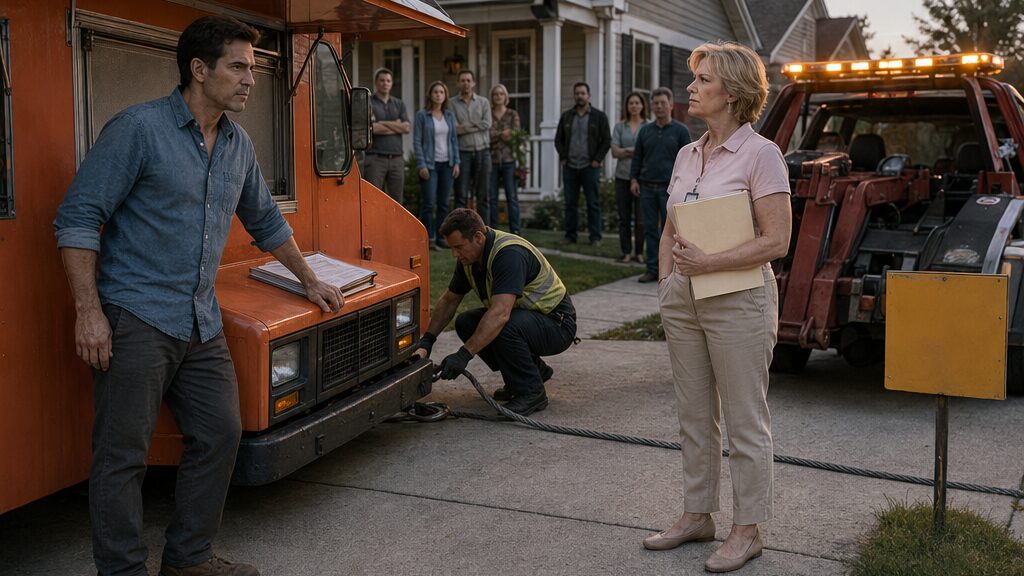
He came out of bed already moving. Through the front window, he saw a tow truck angled across the curb, amber lights turning silently over the neighboring lawns. A driver in a reflective vest was kneeling beside the food truck’s front axle.
Sandra stood near the sidewalk holding a folder.
Three porch lights were on across the street.
Robert pulled on jeans and went outside barefoot.
“Stop.”
The driver looked up but did not rise. “You the owner?”
“Yes.”
“I have an authorization.”
“From whom?”
Sandra answered before the driver could. “The association.”
Robert stepped onto the driveway. The morning concrete was cold under his feet. A steel cable ran from the tow truck toward the food truck but had not yet been attached.
“You don’t have permission to enter my property.”
“The board has emergency authority to remove a continuing nuisance,” Sandra said.
“The hearing is next week.”
“The violation period expired.”
“Edward said he was requesting a pause.”
“He requested one. It was not granted.”
Robert looked at the folder in her hands. “Show me.”
Sandra held it out without approaching him.
The first page bore the HOA letterhead and Edward Hall’s signature. It authorized removal of an “unregistered white commercial catering van” obstructing visibility near the west pedestrian crossing.
Robert read the description twice.
Then he looked at his truck.
It was orange. Its plates were current. The nearest pedestrian crossing was half a block east, and the truck rested inside his driveway.
The driver stood.
“That the vehicle?” Robert asked him.
“That’s what they pointed out.”
“Does it match the order?”
The driver glanced between the paper and the truck.
Sandra’s voice sharpened. “The description was copied from the original complaint.”
“Whose original complaint?”
“That is not relevant.”
“It is if the vehicle does not exist.”
A garage door rose across the street. A man stepped out holding a coffee mug. Farther down, a woman stood at the end of her walk with a dog beside her. Robert could feel the scene widening around him.
Sandra folded her arms.
“The plate number is in the file.”
“It is not on this page.”
“There are attachments.”
“Then show them.”
The tow-truck driver rubbed his jaw. “Ma’am, I need the authorization to identify the vehicle.”
“It does.”
“It says white van.”
“It is plainly the commercial vehicle at issue.”
Robert went back into the house and returned with the permit packet. He had put on shoes but no socks. The pages were clipped in order: registration, insurance, city license, fire inspection, commissary agreement, and the draft event application beneath them.
He placed the packet on the food truck’s hood.
“Read the registration,” he told Sandra.
She did not move.
“Robert, this is not a hearing.”
“No. At a hearing, I would have received notice.”
“You received notice Friday.”
“Not of a tow.”
“The citation warned of enforcement.”
“Read the registration.”
Sandra’s eyes flicked toward the neighbors.
The tow driver picked up the top page. “Plate matches the truck,” he said. “Color says orange. Body type says step van.”
“And expiration?” Robert asked.
“Next April.”
Robert pointed to the HOA order. “This says unregistered white catering van blocking a crossing. None of those facts describe this truck.”
Sandra stepped closer. “You are using a clerical mistake to continue a violation.”
“I am using the document you brought to take my property.”
“You admitted you planned an event.”
“I drafted an application.”
“You recruited vendors.”
The words carried farther than she intended.
The woman with the dog stopped walking.
Robert saw the moment Sandra realized she had made the private issue public. Her face did not soften. Instead, she opened the folder and pulled out a second set of pages.
“This is the event email,” she said. “Six vendors. Saturday date. Thirty volunteers. Street restrictions. You were building a commercial festival while telling the board the truck was only being stored.”
A murmur moved from one porch to another.
Robert felt heat rise into his face despite the cold morning.
The towing order was wrong. Sandra’s accusation was not entirely wrong.
He could deny the word festival. He could say the vendors had not paid fees, that no contract had been signed, that the common green had not been reserved. Each statement would be true in the narrow way that had protected him at the city counter.
Instead, he took the event application from beneath the licenses.
“I filed the city draft,” he said.
Sandra’s gaze sharpened. “So you admit it.”
“I admit I intended to apply for a one-day event.”
“You intended to announce it first.”
“No.”
“You gave vendors a date.”
“Yes.”
The word changed the air.
The driver stepped away from the cable. Robert could hear the tow truck’s diesel engine idling and the faint clicking of its hazard lights.
Sandra lifted the emergency order. “This is exactly why the board acted.”
“The board acted on a vehicle description that is false.”
“The underlying violation remains.”
“Then hold the hearing.”
“You had seventy-two hours.”
“To move a legally registered vehicle from my property.”
“To stop unauthorized commercial use.”
“There has been no use.”
“You were preparing for it.”
Robert placed one hand on the hood. Beneath the orange paint, the metal held the night’s cold. Behind him, the serving window remained locked. He could picture the counter on the other side—clean, empty, waiting.
He looked at the tow driver.
“Will you remove a vehicle that does not match your authorization?”
The driver shook his head. “Not on this paperwork.”
Sandra’s face reddened. “Call your dispatcher.”
“I already know what they’ll say.”
“Then I will call the board president.”
“Please do,” Robert said.
Sandra took out her phone.
Edward answered on the third attempt. Sandra put him on speaker.
“We have a problem,” she said. “The driver refuses enforcement because of an incorrect description.”
A pause followed.
Edward’s voice came thinly through the phone. “What is incorrect?”
“All of it,” Robert said.
“Robert is here?”
“Yes,” Sandra replied.
Edward sighed. “Read me the order.”
She did.
Another pause.
Then Edward said, “Do not tow the vehicle.”
Sandra turned away from the gathering neighbors. “Edward, the compliance period has expired.”
“The authorization cannot be used for a different vehicle.”
“It is not a different vehicle. It is a drafting error.”
“It is a legal description.”
“This is an association matter.”
“And the association will not authorize a tow under defective paperwork.”
Robert watched Sandra’s shoulders stiffen.
Edward continued, “The truck stays until the hearing.”
A small exhale came from somewhere across the street. It was not applause. No one moved closer. The neighbors simply remained where they were, watching the cable lie unused on Robert’s driveway.
Sandra ended the call.
The tow driver gathered the chain and carried it back toward his truck.
Robert should have felt relief. Instead he noticed the event application still exposed on the hood, the vendor list visible beneath his hand, the old restaurant name painted across the truck’s side for everyone to read.
Sandra saw it too.
“You stopped the tow,” she said quietly. “You did not prove you were honest.”
The sentence landed harder than her threat had.
Robert closed the packet.
A teenage boy across the street called to his mother, “What festival?”
Sandra looked toward him, then back at Robert.
He had no answer he was willing to give in front of them.
The tow truck pulled away, leaving a dark curve of tire dust near the curb. One by one, the neighbors returned inside, but not before looking at the truck differently. It was no longer merely an oversized vehicle. It was a plan Robert had hidden.
At eight-thirty, Edward called.
“The board is moving your hearing to Thursday evening,” he said.
“Next Thursday?”
“This Thursday. Emergency session.”
“For the tow?”
“For the truck, the event application, and the communications with vendors.”
Robert leaned against the closed serving window.
Edward’s voice became quieter.
“Bring everything, Robert. Not just the documents that help you.”
The call ended.
Through Sandra’s front window, he saw her standing at her dining table, sorting papers into piles.
The truck remained in his driveway. The tow had failed. His registration had protected it.
But by sunrise, the whole street knew he had planned something he had never been willing to explain, and the board would now decide whether any version of it could happen at all.
Chapter 4: What Robert Had Already Promised
Maria placed a small brass token on the stainless-steel counter inside the truck and waited for Robert to look at it.
He did not.
He stood with one hand on the serving-window latch, listening to the garage door hum shut behind them. The truck sat half inside the garage, its painted side hidden from the street. In the dimness, the token looked dull and ordinary.
“You kept one,” Maria said.
“I kept a box.”
“Then you know what it is.”
Robert pulled the latch free. The serving window lifted with a dry groan, opening not onto customers or sunlight but onto shelves of paint cans, a folded ladder, and the concrete wall of his garage.
The counter beneath the window caught a thin strip of light from the side door.
Maria pushed the token toward him.
One side carried the old restaurant’s heron logo. The other had a stamped number and the words SATURDAY TABLE.
Robert picked it up.
It weighed almost nothing.
“We handed those out so people didn’t have to say they couldn’t pay,” Maria said.
“I remember.”
“You act like no one else does.”
Robert set the token down harder than he intended. It spun once, rattled, and fell flat.
Maria leaned against the opposite counter. “The board hearing is in two days. People are already asking me what the festival is for.”
“You shouldn’t be answering them.”
“I wouldn’t have to if you did.”
“There is no approved festival.”
“There was enough of one to bring a tow truck to your house.”
He looked through the open serving window at the garage wall.
Maria’s voice softened, which made it more difficult to ignore.
“Why didn’t you tell them?”
“Tell them what?”
“That this wasn’t about selling tacos in your driveway.”
“It isn’t their business.”
“You asked them to make it their business when you applied to use the common green.”
“I didn’t submit it.”
“You called vendors. You chose a date. You asked me for volunteers.”
“I was checking whether it was possible.”
“You were building the whole thing except the part where other people got to decide.”
Robert turned toward her.
“You think I don’t know that now?”
“I think you knew it then.”
The words struck cleanly because they were true.
He stepped out of the truck and opened a cabinet beside the garage workbench. Inside were old invoices, extension cords, spare menu boards, and a plastic container filled with brass tokens. He brought it back and placed it beside Maria’s single token.
There were hundreds.
Some were scratched. Some still carried grease in the stamped letters. His wife had ordered them after a man once stood at the register counting coins while a line formed behind him. The man had left before ordering.
The following Saturday, she began passing out tokens through the serving window to anyone who asked about the low-cost plate. She never called it charity. She called it keeping the line moving.
Maria lifted the lid.
“You saved all of them.”
“I didn’t know what else to do with them.”
“You could use them.”
“For what? The restaurant is gone.”
“The meal isn’t.”
Robert closed the container.
The restaurant had not disappeared all at once. First they stopped opening on Mondays. Then lunch service ended. Then the walk-in freezer failed, and the repair estimate sat unpaid for three weeks.
His wife had continued the Saturday meal even when every plate cost them more than it brought in.
After she died, Robert kept it going for another month. Then a lender’s representative arrived before opening and taped a notice to the front door.
Robert had told the waiting customers there was an equipment problem.
By the time the restaurant officially closed, he had repeated that lie often enough to hear it as fact.
Maria studied him.
“How much did you lose?”
“That does not matter.”
“How much?”
Robert ran his thumb along the serving-window frame. There was a shallow dent near the hinge where his wife had struck it with a tray and laughed before he could complain.
“The restaurant closed with debt,” he said.
Maria waited.
“More than the equipment covered. Less than the bank wanted.”
“And the house?”
“Current.”
“The truck?”
“Mine.”
“Because you protected it.”
Robert looked at her.
“Because it had no lien.”
Maria nodded slowly. She had assumed competence. Everyone had. They saw the truck, the license, the catering jobs, and Robert’s careful silence and concluded that he had managed the closure.
He had not managed it. He had survived the order in which things were taken.
“I told her I would keep the Saturdays going,” he said.
Maria did not ask whom he meant.
“Before the hospital,” Robert continued. “She knew the restaurant was failing. She said the meals mattered more than the building.”
“And you decided that meant you had to do it alone.”
“I decided it meant I had to do it.”
“That is not the same thing.”
He slid the serving window halfway down. Maria reached up and stopped it.
“Do not close it while I am talking to you.”
His hand remained on the latch.
“People are defending you,” she said. “They think Sandra is trying to remove a legal truck because she does not like looking at it.”
“She is.”
“She is also accusing you of planning an unauthorized event. Which you did.”
“I planned to request one.”
“You planned around the answer you wanted.”
Robert let go of the latch.
The window stayed open.
Maria picked up the token again. “You do not get to ask the neighborhood to trust a promise they are not allowed to know about.”
He turned away from her and stepped down from the truck.
They drove separately to the old restaurant that afternoon.
The building sat in a narrow shopping strip twelve minutes from Alder Glen. The new tenant had covered the windows with brown paper, but the faded outline of the heron logo remained above the door where the sign had been removed.
Robert stood at the curb while Maria looked through a gap in the paper.
“You told everyone the lease ended,” she said.
“It did.”
“After the bank closed you.”
“Yes.”
“And the Saturday Table ended because you lost the kitchen.”
“Yes.”
“Not because people stopped coming.”
Robert looked at the dark glass.
“No.”
A delivery truck passed behind them, shaking loose gravel across the lot. For an instant, Robert remembered the sound of folding tables being opened inside, his wife calling out plate counts, Maria arguing that no one needed that much cinnamon in the beans.
The memory did not feel warm. It felt unfinished.
Maria folded her arms.
“I told six people what the event was for.”
Robert turned sharply. “You what?”
“They asked why I was gathering volunteers.”
“You had no right.”
“They had a right to know what they were volunteering for.”
“You told them about her?”
“I told them about the meal program.”
“That was ours.”
“It stopped being only yours when people depended on it.”
Robert stepped away from the storefront.
Maria followed. “Be angry later. Right now you need to know what happened after I told them.”
“I don’t want to know.”
“They signed up.”
He stopped.
“How many?”
“Forty-three residents.”
“For what?”
“Tables, trash, traffic, serving, setup. Two people offered canopies. A parent offered first-aid coverage. Someone from the next street has event insurance through a neighborhood nonprofit.”
Robert stared at her.
“You put out a sign-up sheet before approval.”
“Yes.”
“That makes everything worse.”
“It makes it real.”
“It makes it look like I was organizing behind the board’s back.”
“You were.”
He turned toward his car.
Maria called after him. “Robert.”
He did not stop.
“You are not the only person allowed to miss her.”
That did.
He stood with one hand on the car door, unable to answer.
By evening, the sign-up list had been shared through three neighborhood email groups. Maria forwarded it to him without a message.
Forty-three names had become fifty-one.
At the bottom, someone had added a question:
Will families need to register for meal tokens?
Robert read it twice.
Then his phone chimed again.
An email from Edward Hall had arrived, copied to the board and Sandra.
Due to significant resident interest and unresolved compliance concerns, Thursday’s emergency hearing would include public comment.
Robert looked toward the garage.
The truck’s serving window was still open inside the darkened space.
By the time anyone officially decided whether the event could happen, more than fifty people had already decided that it should.
Chapter 5: Sandra’s Reason Was Not the Rulebook
“You cannot miss another mortgage payment and then tell me everything is fine.”
Sandra’s voice carried across the narrow strip of grass between the houses.
Robert stopped beside his trash bins.
It was Wednesday evening, less than twenty-four hours before the hearing. He had gone outside to retrieve the temporary-event amendment from the truck when he heard Sandra speaking through her open kitchen window.
Another voice answered, lower and strained.
“I said I would handle it.”
“Ashley, you said that last month.”
Robert stayed still.
He had not seen Sandra’s daughter in nearly two years. The last he had heard, Ashley Perez lived across town with her child and worked for a property management company.
“I did not come here for you to take over,” Ashley said.
“You came here because the apartment was gone.”
“I came here because I needed three weeks.”
“It has been seven.”
A chair scraped.
Robert should have gone inside. Instead he looked toward Sandra’s driveway and saw a compact car parked close to the garage, partly hidden behind a hedge. A child’s booster seat was visible through the rear window.
Ashley spoke again.
“The bank already has the paperwork.”
“For what?”
“A hardship modification.”
“You told me they denied it.”
“They denied the first one.”
Sandra’s reply came after a pause.
“If this house appraises lower next year, none of this works.”
Robert looked down at the amendment in his hand.
Paragraph six was highlighted in yellow. The clause Sandra had said she already knew.
He crossed the grass and knocked on the frame of the open window.
The conversation stopped.
Sandra appeared at the back door seconds later and stepped outside, pulling it closed behind her.
“How long were you standing there?”
“Long enough to know Ashley is home.”
Sandra’s face changed, but only briefly.
“That is not your concern.”
“No.”
“Then go back to your property.”
Robert held up the amendment.
“This is.”
Sandra looked at the page.
“You knew the temporary-event rule existed before I found it.”
“Yes.”
“You never mentioned it.”
“I was not obligated to build your case for you.”
“You recommended an emergency tow while knowing there was a process available.”
“The event process does not authorize permanent commercial storage.”
“The truck is a separate issue.”
“That is your interpretation.”
“It is the city’s.”
“The city does not enforce our covenants.”
Robert took one step closer, stopping at the property line.
“You could have told the board the event clause applied.”
“I told them you had not applied.”
“That is not the same thing.”
“No,” Sandra said. “It is the relevant thing.”
The kitchen curtain moved behind her. Ashley was listening.
Robert lowered the amendment.
“You think the truck lowers property values.”
“I think visible commercial use changes expectations.”
“One truck on one driveway?”
“One exception becomes two. Then someone runs auto repair from a garage. Someone else parks construction equipment on the street. The board waits because everyone has a reason, and by the time it acts, the rules mean nothing.”
“You tried to tow the wrong vehicle.”
“I tried to enforce the rule before the violation became normal.”
“You used paperwork you knew was defective.”
Her jaw tightened. “I did not prepare the description.”
“You brought it.”
She looked toward his garage. The truck’s serving window was closed now, and the dark glass reflected her kitchen window behind her.
“This neighborhood is not as stable as you think,” she said.
Robert waited.
“Three houses have sold below asking. Two owners are behind on assessments. The pool repair was deferred because reserves are short.”
“And my truck caused that?”
“No. But disorder compounds.”
The word sat between them.
Disorder.
Robert thought of stainless counters sold at auction, unopened mail, and the weeks after the funeral when he slept in his clothes because choosing what to wear felt impossible.
Sandra continued.
“Ashley’s situation is private.”
“I am not going to use it.”
“You already heard it.”
“That is not the same as using it.”
Her eyes narrowed, as though privacy were not something she could accept on trust.
Robert folded the amendment.
“Why did she move back?”
Sandra said nothing.
Ashley opened the back door.
“Because my company cut half the office,” she said.
Sandra turned. “Go inside.”
“No.”
Ashley stepped onto the patio. She looked older than Robert remembered, not by years but by exhaustion. Her hair was pulled back, and there was a stain near the pocket of her work blouse.
“My lease renewed two weeks after I lost the job,” she said. “I used savings until they were gone. Then the car needed a transmission.”
“Ashley.”
“He knows enough already.”
Robert kept his eyes on Sandra.
Ashley rested one hand on the doorframe. “Mom refinanced this place to help me settle the lease and keep the car. The payment is higher now.”
Sandra’s mouth tightened.
“That did not need to be said.”
“Neither did half the things you said about his truck.”
The kitchen went quiet behind them.
Robert understood then why Sandra photographed peeling paint, overgrown hedges, work trailers, and trash bins left at the curb too long. She was not merely collecting violations. She was collecting proof that decline could be stopped before it reached her own door.
The understanding did not excuse the tow cable.
But it removed the ease of hating her.
“You think if the neighborhood looks uncertain, the house becomes uncertain,” Robert said.
Sandra looked at him. “Appearance influences value.”
“So does whether people want to live here.”
“That is not an argument for commercial events.”
“It is an argument for neighbors knowing each other.”
“People do not need vendors to know each other.”
“No. But sometimes they need a reason to come outside.”
Sandra gave a tired laugh. “You are turning a permit violation into a moral lesson.”
“I am trying not to.”
He handed her the amendment.
She did not take it.
“At the hearing,” Robert said, “I am going to argue that the truck is legal storage and that the event qualifies for review.”
“I know.”
“I will not mention Ashley.”
Something shifted in her face. Suspicion, perhaps, or shame.
“You expect that to change my position?”
“No.”
“Then why tell me?”
“So you know the difference between a boundary and a weapon.”
Ashley looked down.
Sandra remained very still.
For a moment, Robert thought she might withdraw the complaint. Not apologize. Not admit fault. Just remove the most damaging part and allow the board to separate the parked truck from the proposed event.
Instead, she folded the amendment and held it against her side.
“I will oppose the application tomorrow,” she said.
Ashley looked at her. “Mom.”
Sandra did not turn.
“I will acknowledge the towing order was inaccurate,” she continued. “But the application was incomplete, the vendors were contacted prematurely, and the insurance does not cover the common area. Those are facts.”
“So is the provision you withheld.”
“I did not withhold it from the board.”
“Did you include it in your compliance recommendation?”
Sandra’s silence answered.
Robert nodded once.
“I will see you tomorrow.”
He crossed back to his driveway.
Behind him, Ashley said something too low to hear. Sandra answered sharply. The back door closed.
Robert entered the garage and stood beside the truck. In its shut serving window, Sandra’s illuminated kitchen appeared as a small rectangle, divided by the reflection of the property line.
He could understand why she was afraid.
He could also understand that she had chosen to turn that fear into authority over him.
At nine that night, an updated hearing packet arrived by email. Sandra had added a written statement acknowledging the towing order’s inaccurate vehicle description.
She had also recommended denial of both the event and continued truck storage.
Her final sentence read:
Personal sympathy should not replace consistent enforcement.
Robert closed the document.
The next evening, Sandra would oppose him in public, and he would have to answer her without exposing the private reason he now knew she was so desperate to win.
Chapter 6: The Hearing Where Both Stories Failed
“City approval is not sufficient,” Edward Hall said before Robert had finished setting his folder on the table.
The clubhouse was fuller than Robert had ever seen it. Folding chairs reached the back wall. Residents stood near the doors, some holding printed copies of Maria’s volunteer list. Sandra sat at the board table with her hearing packet aligned squarely in front of her.
Robert took the only empty chair facing them.
“I understand that,” he said.
Edward adjusted the microphone, though the room was small enough that no one needed it.
“I want the distinction clear from the beginning. A city license does not override the association covenants, and an HOA approval would not replace city permits.”
Robert nodded.
One of the board members clicked a pen. The other kept glancing toward the crowd.
Edward continued. “We are considering three separate questions. Storage of the truck. The attempted tow. The proposed neighborhood event.”
“Then they should have been separate from the start,” Robert said.
Sandra looked down at her notes.
Edward sighed. “That is part of what we need to address.”
He summarized the towing order first. The vehicle description was materially inaccurate. The emergency authority had been invoked without full board review. No tow should have occurred.
A quiet movement passed through the room.
Robert expected relief. Instead he felt only the memory of the cable lying across his driveway.
Edward turned toward Sandra.
“Compliance recommended the emergency action.”
“Yes,” she said.
“Knowing a hearing request was pending?”
“Yes.”
“Why?”
“Because the violation period expired, and evidence showed preparations for unauthorized commercial use.”
“Did you verify the vehicle description?”
“No.”
“Did you inform the board that the temporary-event provision might apply?”
“I informed the board that no completed application had been submitted.”
“That was not the question.”
Sandra lifted her eyes.
“No. I did not include that provision in the enforcement recommendation.”
Several residents whispered.
Ashley stood near the back wall. She did not look at her mother.
Edward turned to Robert.
“The attempted tow was improper. That does not resolve the remaining issues.”
Robert opened his folder.
He could win the truck question. He believed that now. The registration was current. The city allowed storage. The covenant language did not define commercial vehicles by color, menu graphics, or use off-site.
The event was different.
Edward asked, “Did you contact vendors before receiving approval?”
“Yes.”
“Did you provide them with a date?”
“Yes.”
“Did you request volunteers?”
Robert glanced toward Maria.
“Yes.”
“Did you represent that the event was approved?”
“No.”
Sandra spoke for the first time since her questioning.
“You told vendors it was likely.”
Robert looked at her. “I did.”
A murmur rose from the chairs.
One of the board members leaned toward the microphone. “Why would they hold a date if they believed approval was uncertain?”
“They would not,” Robert said.
Edward’s hand paused above his notes.
Robert could have softened it. He could have explained that the vendors were friends, that no deposits had changed hands, that everyone knew permits were pending.
Instead he said, “I gave them more confidence than I had the right to give.”
The room grew quieter.
Maria’s expression did not change, but her shoulders lowered slightly.
Robert removed the event application and placed it before the board.
“I treated approval like a final box to check,” he said. “It was not.”
Sandra watched him carefully.
“I also did not tell people why I wanted the event.”
Edward looked at the crowd. “You are not required to disclose a personal reason.”
“No. But I asked people to trust a plan I kept hidden.”
He reached into his pocket and placed the brass latch from the serving window on the table. He had removed it that afternoon because the spring had begun sticking. In the fluorescent light, the metal looked worn and small.
“My wife and I ran a low-cost meal every Saturday at our restaurant,” he said. “We used tokens so people could eat without explaining why they needed the lower price.”
Someone in the second row shifted.
“When the restaurant closed, the meal ended. I told her before she died that I would find a way to continue it.”
Robert kept his eyes on the latch.
“I thought the truck was that way. Then I thought the event was. I did not want to tell anyone the restaurant failed in debt, or that I could not keep the program going alone.”
No one spoke.
He had imagined this truth reaching the room like a plea. Instead it sounded plain, almost administrative. A loss listed beside permits and insurance.
Edward asked, “Would food have been sold?”
“Some vendors planned regular sales. The Saturday meal would have used donated ingredients and tokens.”
“So commercial activity was part of the plan.”
“Yes.”
Sandra’s pen stopped moving.
Robert continued before she could speak.
“The plan was not approved. The parking map was unfinished. I had not obtained coverage for the common green. Sandra was wrong to push the tow. She was not wrong that I moved ahead too early.”
The sentence changed the room more than any accusation had.
A resident near the aisle raised a hand. Edward allowed public comment.
Maria stood.
“I support the event,” she said. “I also thought Robert had more completed than he did. That is on me too.”
A parent spoke next, then an elderly resident, then a man who objected to street closures. No one gave a speech. They asked about bathrooms, trash, noise, sales tax, emergency access, and whether nonresidents could attend.
The questions made the festival less beautiful and more possible.
Then Edward opened an email printed on association letterhead.
“We contacted the association’s insurance representative this afternoon,” he said.
Robert looked up.
“The current policy will not cover an event organized by an individual resident involving outside commercial vendors on common property.”
Maria leaned forward. “What if the association sponsors it?”
“That would require a separate endorsement and board-approved controls. The carrier cannot issue it before Saturday.”
The date landed like a closing door.
Robert had known the insurance was incomplete. He had not known it was impossible on the current timeline.
One board member asked whether the event could be held entirely on Robert’s lot.
The fire inspector’s written guidance limited occupancy and required clear access. With vendors, volunteers, and the number of expected families, the answer was no.
Sandra folded her hands.
“Then the application must be denied.”
Edward looked at her. “The current application cannot proceed.”
“That is what denied means.”
“No,” Robert said.
Everyone turned toward him.
He picked up the serving-window latch.
“Denied means the board refuses it. Incomplete means I submitted something that cannot work.”
Sandra’s expression tightened. “The result is the same.”
“Not to me.”
Edward asked, “What are you proposing?”
Robert looked at Maria, then at the residents holding volunteer lists they had signed before knowing the plan was unfinished.
He had come prepared to defend the event. To prove the clause applied. To force a vote that might let him keep the promise in the exact form he had imagined.
But the room had exposed the flaw in that promise.
It belonged to his wife. It belonged to him. He had never allowed it to belong to anyone else.
“I am withdrawing the application,” he said.
Maria stood halfway. “Robert.”
He shook his head.
Sandra’s surprise was visible before she controlled it.
Edward leaned toward him. “You understand that withdrawal ends consideration tonight?”
“Yes.”
“The event cannot take place as submitted.”
“I understand.”
The residents began speaking at once. Edward tapped the microphone and asked for order.
Robert closed his folder.
Sandra watched him as though searching for a trick.
There was none.
He had lost the common green, the vendor arrangement, the planned street closure, and the Saturday date he had promised too early.
But for the first time since the restaurant closed, he had told the truth before someone forced it from him.
Edward called a brief recess.
As chairs scraped and residents gathered around Maria, Robert stepped outside. The clubhouse doors opened behind him, releasing fragments of argument into the parking lot.
Maria followed.
“You gave up too fast,” she said.
“No.”
“We had fifty people.”
“We had fifty people signed up for something that could not be insured.”
“We could have asked for another date.”
“The board would spend a month fighting over my application.”
“So?”
“So it stays my event. My truck. My promise. Everyone else waits for permission to help.”
Maria studied him.
“What are you saying?”
Robert looked through the clubhouse window at the residents clustered in small groups. One parent was speaking with the board member who had asked about occupancy. Two volunteers were comparing printed lists. Ashley stood near Edward, pointing to something on the insurance letter.
“I am saying I filed the wrong application.”
The doors opened again.
Edward stepped outside carrying the temporary-event amendment.
“There may be another structure,” he said.
Sandra stood behind him, expression unreadable.
Robert looked from the amendment to the residents still arguing inside.
He had withdrawn the festival he had built in secret.
Now, if anything happened on Saturday, it would have to be something he could not own alone.
Chapter 7: The Festival He Could Not Own Alone
Robert removed his own name from the banner draft before anyone else arrived.
The paper lay across his kitchen table beneath a ruler and a black marker. At the top, Maria had written ROBERT RAMIREZ’S ALDER GLEN SATURDAY TABLE in block letters large enough to read from the street.
He drew one line through the first three words.
When Maria entered without knocking, she saw the change immediately.
“You could have used a computer,” she said.
“I wanted to be certain.”
“Certain of what?”
“That it is not mine.”
She set a box of coffee on the counter and read the revised title.
ALDER GLEN SATURDAY TABLE.
“That is better,” she said.
Robert waited for the satisfaction he had expected. Instead, the missing name left a strange clean space on the paper.
Edward arrived ten minutes later carrying an insurance summary and the temporary-event amendment. Ashley came behind him with a laptop. By seven-thirty Friday morning, Robert’s kitchen had become a planning room.
The original festival was gone.
No outside vendor would operate independently. The neighborhood nonprofit would sponsor a resident potluck and a small food-service pilot. The commercial vendors who had already held the date could donate prepared items or serve under the nonprofit’s coverage, but they would not collect individual sales. The common green would hold only tables, canopies, and seating. Robert’s truck would remain on his driveway as a licensed preparation and serving station.
“What about the token meals?” Maria asked.
Ashley looked up from the spreadsheet. “They can be distributed through the nonprofit. Suggested donations only.”
“No names collected?” Robert asked.
“No income verification,” Ashley said. “No explanation required.”
Maria gave him a brief look.
Edward slid the insurance summary across the table. “The pilot is covered if we cap attendance, keep the access lane open, and designate traffic volunteers.”
“By tomorrow?” Robert asked.
“If we submit the final map by noon.”
The map did not exist.
Robert pulled out the rough drawing from his original application. It showed six vendor spaces, a closed section of curb, and traffic diverted through the west entrance.
Edward shook his head. “Too much street impact.”
“We remove four vendors,” Robert said.
“Still need emergency access.”
Ashley rotated the paper. “Move the tables to the north edge. Leave the center open.”
Maria pointed to the corner near the playground. “Trash and handwashing there.”
They worked until the coffee went cold.
At eleven-fifteen, a shadow crossed the window.
Sandra stood on the porch holding a rolled sheet of paper.
Robert opened the door.
She did not greet him.
“This is the original parking layout for the common area,” she said. “Fire access is marked in red.”
He took the roll but did not open it.
“You had this?”
“It is in the compliance archive.”
“Why bring it now?”
“Because the west entrance cannot be blocked.”
“That is not what I asked.”
Sandra looked past him toward the kitchen table, where Maria, Edward, and Ashley were bent over the draft plan.
“I am not withdrawing my position on the truck,” she said.
“No one asked you to.”
“The event requires accurate parking control.”
“And you are helping because?”
“Because if it happens badly, it becomes proof that these exceptions should never happen again.”
Robert almost smiled.
“Then we agree on one thing.”
She handed him a folder of yellow temporary no-parking signs.
“These are reusable. The arrows can be changed.”
The signs resembled the one that had stood beside the tow cable. For a moment Robert saw the old scene again: Sandra holding the defective order, neighbors watching, the serving window locked.
He opened the top sign.
The original wording had been covered with removable tape. Beneath it, Sandra had drawn a directional arrow toward visitor parking.
“No towing language,” Robert said.
“Not unless a vehicle blocks the fire lane.”
“Who decides?”
“The traffic volunteers document it. Edward authorizes any action.”
Robert nodded.
Sandra turned to leave.
“Ashley is inside,” he said.
“I know.”
“She made the insurance arrangement possible.”
“I know that too.”
Sandra stepped off the porch.
“Thank you for the map,” Robert said.
She paused without turning.
“It was necessary,” she replied.
By afternoon, the common green had changed shape.
Teen volunteers carried folding tables from garages. Elderly residents tied trash bags to temporary frames. Two parents measured the fire lane twice. Maria assigned jobs with masking tape labels and a voice that allowed no debate.
Robert backed the truck deeper into the driveway, leveled it, and unlocked the serving window.
The latch was still on Edward’s table at the clubhouse, so Robert used a temporary pin through the hinge.
He pushed upward.
The window rose into bright daylight.
For several seconds, no one noticed.
Then Maria looked over from the sidewalk.
“There,” she said. “That is what it was built for.”
Robert set the stainless serving shelf into place. Volunteers brought boxes through the side door: paper trays, gloves, ladles, foil pans, sealed ingredients.
Nothing inside the truck belonged only to him anymore.
The realization should have felt like loss.
Instead, for the first time, the empty counter did not resemble the restaurant after the auction.
It looked ready.
At four, Edward received the revised coverage confirmation. At four-ten, the board approved the pilot by email, with one abstention from Sandra.
At four-thirty, every phone in the kitchen sounded at once.
A severe-weather advisory had been issued for Saturday morning. Heavy rain and strong wind were expected before noon.
Maria read the alert.
“We can move the tables into the clubhouse.”
“Capacity is lower,” Edward said.
“We reduce attendance,” Ashley replied.
Robert looked at the canopies already strapped down on the common green. The forecast graphic showed a thick band of red moving toward Alder Glen at the exact hour they planned to open.
“We do not cancel tonight,” he said.
Edward hesitated. “We need a weather decision by six tomorrow morning.”
Robert nodded.
They covered the tables and moved the dry supplies into the clubhouse. The yellow signs were stacked inside Robert’s garage, arrows facing outward. By dark, the green looked empty again.
Robert slept for less than three hours.
At five-forty in the morning, he stood inside the truck listening to rain strike the roof hard enough to drown the refrigerator motor.
The serving window was closed against the wind.
At five-fifty-two, headlights appeared through the wet windshield.
A small delivery van stopped at the curb.
The driver climbed out, pulled up a hood, and carried the first trays toward Robert’s driveway.
The event had no guarantee of weather, attendance, or trust.
But before sunrise, someone had come anyway.
Chapter 8: For the Whole Neighborhood, Not Against Her
The rain stopped at six minutes before opening.
Water still ran along the curb, and the common green shone beneath a gray sky, but the wind had weakened enough for volunteers to raise two canopies.
Robert opened the serving window.
The metal panel lifted slowly, carrying beads of rain along its edge. Beneath it, the stainless counter held a neat row of brass meal tokens.
Maria stood beside the truck with a towel over one shoulder.
“You are staring,” she said.
“I am checking the hinge.”
“The hinge is fine.”
At the end of the driveway, the first yellow sign directed cars toward visitor parking. Another marked the fire lane. Sandra had positioned both before Robert came outside.
She now stood behind the parking table with a clipboard, speaking to a volunteer.
Robert had not asked her to come.
He had also not asked her to leave.
Families arrived in small numbers at first. A parent pushed a stroller across the damp grass. Two elderly residents carried covered dishes from a golf cart. Teen volunteers wiped chairs and retied the canopy straps.
There was no dramatic crowd, no line stretching down the street.
There were simply enough people to make the place feel occupied.
Ashley approached the truck with her child beside her.
Sandra watched from the parking table.
Robert picked up a token.
Ashley shook her head. “My mother gave us two.”
“She did?”
“She said we should be first because we had been in the way long enough.”
Robert glanced toward Sandra.
She was pretending to study the parking map.
He placed two trays on the counter. Rice, chicken, beans, cornbread.
The same meal his wife had served on the first Saturday Table.
Ashley accepted them carefully.
“My child asked what the token means,” she said.
“What did you say?”
“That it means you do not have to explain.”
Robert looked down at the brass tokens.
“That is close enough.”
By nine-thirty, the serving line reached the sidewalk. Some people donated. Some used tokens. Most brought food, helped carry trash, or stayed to talk beneath the canopies.
Edward came to the truck holding a signed board statement.
“The record has been corrected,” he said.
Robert dried his hands before taking it.
The statement acknowledged that the emergency tow had been improperly authorized and that Sandra had recommended action without verifying the vehicle description. It also separated lawful vehicle storage from event activity pending a permanent policy review.
At the bottom was Sandra’s signature.
“She wrote part of it,” Edward said.
Robert folded the paper.
“That does not erase the cable.”
“No.”
“It should not.”
Edward nodded. “No.”
Sandra approached after he left.
She stopped several feet from the serving window.
“I assume you read it.”
“I did.”
“I should have verified the order.”
“Yes.”
Her eyes moved toward the line of residents.
“I still believe the truck needs clearer rules.”
“So do I.”
That answer seemed to unsettle her more than disagreement would have.
A car turned into the lane and stopped beside the yellow sign. The driver appeared confused.
Sandra looked toward the parking table.
Robert lifted the clipboard from the counter and held it out to her.
“The volunteer needs help.”
Sandra took it.
“You are assigning me?”
“I am asking whether you know the map.”
“I made the map.”
“Then you are qualified.”
For the first time, the corner of her mouth moved.
Not a smile. Something less certain.
She returned to the table and guided the car toward an open space.
Robert watched her go, then turned back to the serving line.
Near noon, the clouds separated. Sunlight struck the wet pavement and the orange side of the truck. The blue heron painted across it appeared brighter than it had in years.
Maria placed the last covered tray on the counter.
“We ran out of tokens,” she said.
Robert opened the plastic container beneath the register.
Only one remained.
He held it in his palm.
“You keeping that one?” Maria asked.
Robert looked at the line, at the tables, at Sandra directing a delivery vehicle away from the fire lane, and at Ashley helping her child carry empty trays to the wash station.
Then he handed the token to Maria.
“Put it back in circulation.”
The final guest left after three.
Volunteers folded chairs, gathered signs, and carried leftovers into the clubhouse. Sandra returned the parking clipboard without comment. Edward locked the storage room. Ashley loaded her child into the car.
Robert wiped the serving counter.
His hand reached for the temporary pin that held the window open.
He stopped.
The neighborhood was quiet again, but it no longer felt empty. Damp footprints crossed his driveway. A forgotten paper napkin rested near the curb. Someone had left a container of cornbread beside the truck with a note that read NEXT SATURDAY?
Robert set the cloth down.
He left the serving window open.
The story has ended.