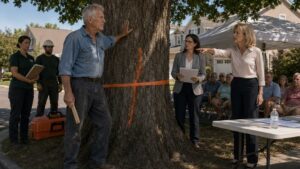
The Day Brian Drew a Grey Line Through the HOA’s Power
Chapter 1: The Lock Closed Before Brian Spoke
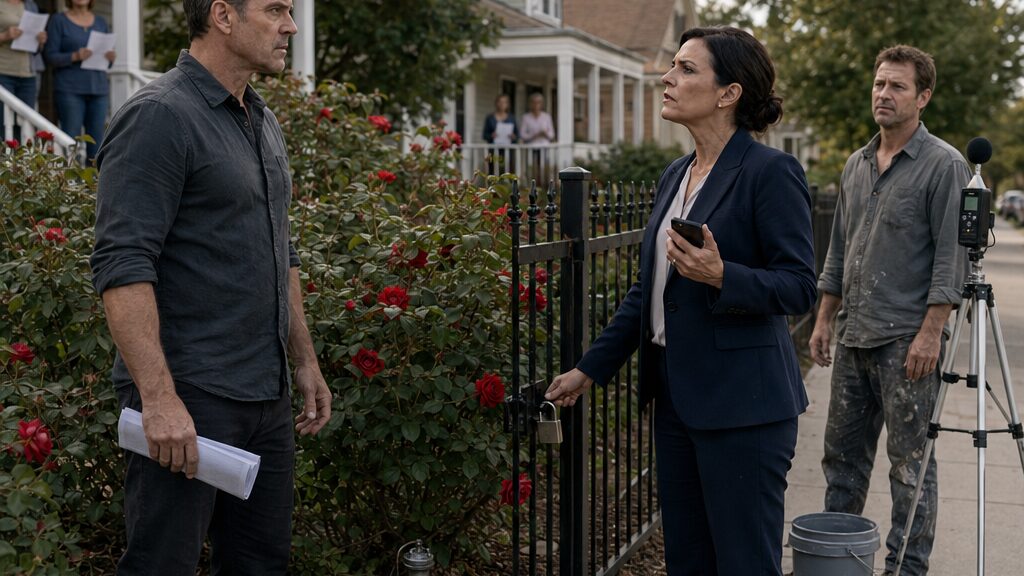
The steel padlock snapped shut while Brian Miller was still kneeling beneath his grandfather’s oldest rose bush.
The sound carried across the quiet street—bright, metallic, final.
Brian froze with one hand around a dead cane and the pruning shears half open in the other. A red petal rested against his knuckle. Beyond the row of mature bushes, Nancy Torres stood at his driveway gate with one hand on the new lock and the other planted on her hip.
“There,” she said to the man beside her. “Document the time.”
The man glanced at a tablet. He wore paint-spattered work trousers and a faded shirt with the sleeves rolled above his elbows. At his feet sat a sealed bucket of grey paint, a hard plastic equipment case, and an aluminum tripod.
Brian rose slowly.
Nancy watched him as though she had been waiting for that exact movement.
She had dressed for authority: navy blazer, pressed slacks, laminated HOA badge clipped high on her chest. The badge was new. So was the title printed beneath her photograph.
BLOCK CAPTAIN.
Brian set the pruning shears on the low stone border.
“You locked my gate.”
Nancy gave the padlock a testing tug. “Your gate has been temporarily sealed pending correction.”
“For what?”
“The hinges.”
He looked at them. Two heavy iron hinges, painted the same satin black they had been for eleven years.
Nancy unfolded a white notice. “Wrong shade of black.”
For a moment, Brian thought she might smile and reveal the absurdity as a joke. She did not.
Behind her, two curtains shifted in neighboring windows.
Brian brushed soil from his knees. “Remove the lock.”
“I’m afraid the compliance period expired yesterday.”
“The notice arrived yesterday.”
“The date of receipt is not the date of issuance.”
Brian studied her face. Nancy had always spoken as though every conversation came with minutes and a motion to adjourn. Since her promotion three weeks earlier, her voice had acquired something harder: the confidence of someone who had finally been given a title large enough to fit her grievances.
The worker lifted the equipment case.
“Where do you want the meter?” he asked.
“Inside the property,” Nancy said. “Near the gate.”
Brian stepped toward the rose bushes.
“No.”
The worker stopped.
Nancy did not. “Eric, set it where we discussed.”
Brian looked at him. “Eric, you do not have permission to enter.”
Eric Hall shifted the case in both hands. “Ma’am said the association authorized access.”
“The association doesn’t own this ground.”
Nancy raised the notice. “Section fourteen, subsection six, authorizes inspection when an exterior feature creates a measurable nuisance or design inconsistency.”
Brian held out his hand. “Let me see that.”
She did not give it to him. Instead, she began reading in a carrying voice, loud enough for the watching windows.
“Exterior hardware visible from the common roadway shall remain consistent with the approved community palette and shall not create excessive glare, reflection, noise, or visual disruption.”
Brian knew the covenants. He had spent thirty-one years in municipal records, where people learned that one altered word could move a fence, deny a permit, or cost a family half its savings.
He did not recognize that sentence.
“What rule number did you say?”
“Fourteen-six.”
“That section covers roof drainage.”
Nancy’s mouth tightened. “It was updated.”
“When?”
“At the board’s discretion.”
“That isn’t a date.”
Eric set the equipment case down without opening it.
Nancy turned toward him. “The tripod goes three feet inside the gate. We need a clean reading.”
Brian walked to the nearest rose bush and parted two flowering branches. Beneath them, nearly hidden under mulch, a dull metal cap broke the soil.
He pointed to it.
“That is the survey pin. The property line runs from that marker to the one at the south corner. The roses are planted six inches inside it.”
Nancy barely glanced down. “Those bushes are overgrown.”
“They are on my land.”
“They obstruct visibility from the street.”
“They are the boundary.”
“They are shrubbery, Brian.”
He straightened. “They were planted by my grandparents before this association existed.”
Nancy’s expression changed—not to sympathy, but to impatience.
“Age does not create exemption.”
“No. Ownership does.”
Brian reached into his shirt pocket and removed a folded copy of a letter. He had mailed the original to the HOA office two months earlier after Nancy had walked behind the roses to photograph his water meter.
He opened it.
“This is the no-entry notice your board received and acknowledged. No officer, representative, contractor, or volunteer is permitted beyond the surveyed line without my written consent.”
Nancy glanced at the signature block and looked away.
“You cannot obstruct a lawful inspection.”
“You cannot invent one.”
A car slowed at the end of the street. Nancy stood taller until it passed.
Then she pointed at the bushes.
“Eric, proceed.”
Eric looked from her to Brian. “You sure?”
“I’m the Block Captain.”
“That isn’t permission,” Brian said.
Nancy’s voice sharpened. “Set up the meter.”
Eric opened the case. Inside lay a polished digital instrument with multiple sensors, a small display, and a mounting bracket. It looked far too expensive for measuring the color of gate hinges.
He fixed it to the aluminum tripod and carried it toward the roses.
Brian moved into his path.
Eric stopped close enough that Brian could smell machine oil and coffee.
“I don’t want trouble,” Eric said quietly.
“Then stay on the pavement.”
Nancy came around the gatepost. “He is performing association work. Interfering with him will be included in the report.”
Brian looked down at the ground between them. “The report should include the survey pin.”
She stepped over it.
The movement was small, almost casual.
It changed everything.
Nancy was now standing inside Brian’s property, one polished shoe pressing into the mulch beneath the roses.
Brian felt his jaw tighten.
“Step back.”
“I will not be intimidated on association business.”
“This is private property.”
“And this is an enforcement action.”
Eric waited with the tripod, visibly wishing someone else would make the decision.
Nancy pointed deeper into the garden.
“Place it there.”
The tripod’s front leg crossed first. Then Eric shifted his weight and pushed through a gap between two bushes.
A thorn caught his sleeve. He twisted away.
His boot came down on a cluster of fallen petals and the tip of a young cane Brian had tied that morning.
The cane cracked.
Brian heard it over the scrape of the tripod feet.
He stared at the splintered green stem lying beneath Eric’s boot. The bush had come from a cutting his grandmother carried in a damp cloth when she and his grandfather first moved into the house. Every spring, its flowers opened darker than the others.
Eric lifted his foot. “I’m sorry.”
Nancy was already speaking. “Damage caused by inadequate maintenance is the homeowner’s responsibility.”
Brian’s hand closed around the folded no-entry letter.
For one dangerous second, he imagined taking the tripod by its center column and throwing it into the street.
Instead, he crouched and lifted the broken cane from the soil.
A bead of clear sap gathered at the split.
Behind him, a soft electronic tone sounded.
Eric had switched on the meter.
Its display brightened. Numbers moved across the screen. A tiny red indicator began blinking.
Recording.
Brian looked at the tripod, then at Nancy standing beyond the survey pin, then at the black hinges trapped beneath her steel padlock.
His anger settled into something colder.
Nancy mistook his silence for surrender.
“Good,” she said. “Now we can proceed properly.”
Brian rose, still holding the broken rose cane.
He looked directly at the blinking red light.
“Good,” he said. “Leave it running.”
Chapter 2: The Rule That Was Never Passed
“That was never voted on.”
Ashley Roberts’s voice cut across the street just as Nancy began reading the hinge clause for the second time.
Everyone turned.
Ashley stood on her porch in house slippers, one hand gripping the railing and the other holding her phone. She looked as if she regretted speaking before the last word had left her mouth.
Nancy recovered first.
“This is an active compliance matter, Ashley.”
“I heard the wording.” Ashley lifted the phone slightly. “That sentence came from the design committee draft.”
Nancy folded the notice against her palm. “The current standards incorporate committee guidance.”
“No, they don’t.”
Brian remained beside the broken rose branch, watching the tension travel across Nancy’s face. It was the first sign that the argument had reached ground she had not prepared to control.
Ashley had volunteered on the HOA document committee the previous year. She had once knocked on Brian’s door carrying three warning letters and asked whether his notices used the same unexplained language as hers.
He had told her he preferred to handle his own matters.
At the time, he had believed it was prudence.
Now she stood alone on her porch because he had made solitude look like principle.
Nancy stepped toward the curb. “You resigned before the final revisions.”
“I resigned because there were no final revisions.”
“Ashley,” Nancy said, with a gentleness that sounded more threatening than anger, “your fence stain remains under review. So does the storage container beside your garage. And I believe the board postponed action on your downspout extension as a courtesy.”
Ashley’s fingers tightened around the phone.
The curtains behind her porch window moved. Someone inside was watching.
Nancy waited.
Ashley lowered the phone an inch.
Brian understood the exchange. Nancy had not needed to order her silent. She had simply reminded Ashley how many private weaknesses could be turned into public violations.
Brian walked to the gate.
“Read the adoption date,” he said.
Nancy turned back to him. “I have already explained—”
“The date the rule was approved. Read it.”
“The governing documents allow the board to issue interpretive standards.”
“Then show me the board vote.”
“This inspection is not a hearing.”
“No. It’s a trespass.”
Eric stood beside the tripod without touching it. The meter continued blinking.
Nancy unfolded the notice again, but Brian had already removed his phone. He opened a scanned copy of the association covenants and enlarged section fourteen.
“Subsection six,” he said, turning the screen toward Eric. “Roof drainage shall not discharge onto common walkways.”
Eric read it, then glanced at Nancy.
Brian scrolled. “Exterior finishes are in section twenty-one. The approved palette is attached as exhibit C.”
Nancy gave a short laugh. “You think pulling documents onto your phone makes you an expert?”
“No. Working in municipal records for thirty-one years made me careful.”
He opened another file: the most recent certified copy of the architectural standards. Six shades appeared in labeled squares.
One was satin black.
Brian touched the hinge. “This paint was purchased under the last approved palette. Product code and receipt are in my records.”
Nancy looked at the hinge without bending toward it.
“The current finish reflects too much light.”
Brian turned his head slowly.
“What?”
“The nuisance is measurable.” She pointed at the tripod. “That is why the equipment is here.”
The meter gave another faint tone, as if responding to its mention.
Nancy moved closer to it. “Excessive reflectivity can impair drivers, create visual inconsistency, and reduce neighborhood appearance standards.”
Ashley spoke again, more quietly. “That meter measures decibels and ambient light.”
“It measures environmental disturbance.”
“It doesn’t measure paint color.”
Nancy’s face flushed. “The glare is the issue now.”
“Now?” Brian asked.
“The violations overlap.”
He looked down the street. The morning sun sat behind the houses opposite him. His gate was in shade.
“No direct light is striking the hinges.”
“Readings account for projected conditions.”
Brian nearly smiled. “Projected by whom?”
Nancy stepped beside the tripod and angled the sensor toward the gate. The display changed.
“Initial numbers already show irregularity.”
Brian moved closer, stopping short of the survey pin.
The screen showed ambient light, sound level, time, and a location field. Beneath the location was a set of coordinates.
He knew those coordinates.
They corresponded not to the public pavement, but to a point nearly eight feet inside his property.
“Eric,” he said, “did you enter the location?”
Eric leaned toward the screen. “No. It was loaded when I picked it up.”
“By the HOA?”
“I got the case from Ms. Torres.”
Nancy reached for the control panel. Brian lifted one hand.
“Don’t alter it.”
“This is association equipment.”
“It is recording on my land.”
“You told us to leave it running.”
“I did.”
Her eyes narrowed as she realized that his permission concerned the recording, not the trespass.
Brian crouched near the tripod without touching it. The device displayed a saved project name:
MILLER GATE—NUISANCE CONFIRMATION.
Not evaluation.
Confirmation.
A smaller field showed a target threshold already selected. The reading was being compared against a preset number rather than an adopted HOA standard.
“Where did this threshold come from?” Brian asked.
Nancy folded her arms. “Technical specifications.”
“Which specifications?”
“You wouldn’t understand the calibration.”
Eric spoke before she could stop him. “It came with the job file.”
Nancy looked at him sharply.
Brian photographed the screen.
The shutter sound was soft, but Nancy reacted as though he had struck something.
“You do not have permission to photograph association data.”
“The equipment is standing inside my property, displaying a file named after me.”
“You are interfering with an official measurement.”
Ashley stepped off her porch onto the top step. “Nancy, did the board authorize this?”
Nancy turned toward her.
“I am acting under delegated enforcement authority.”
“That isn’t what she asked,” Brian said.
Nancy’s composure began to split at the edges. “This neighborhood has spent years tolerating inconsistency because nobody wanted to be the difficult person. Property values do not decline all at once. They decline hinge by hinge, fence by fence, exception by exception.”
For the first time, Brian heard something beneath her performance that sounded almost sincere.
She believed disorder spread through permission. She believed someone had to stop it.
The problem was that she had decided belief granted jurisdiction.
Brian looked again at the project screen. The coordinates, threshold, and label had all been entered before Nancy arrived.
“You didn’t come to determine whether there was a violation,” he said.
“I came to document one.”
“You named the file ‘confirmation.’”
“That is standard terminology.”
“You placed the measurement point inside my boundary before setting up the equipment.”
“The gate is the subject location.”
“The gate isn’t eight feet into my garden.”
Nancy moved toward the display. “Eric, reset the location.”
Eric hesitated.
Brian raised his phone and took another photograph.
Nancy stopped.
Across the street, Ashley had raised her own phone again.
The balance of the morning shifted—not enough to end the trespass, but enough that Nancy could feel people watching her fail to control the meaning of what they saw.
She pointed toward the grey paint bucket.
“We are wasting time. The violation will be corrected, and any objection can be appealed through the usual process.”
Eric looked at the black hinges, then at the preloaded coordinates.
Brian saw the doubt forming.
Nancy saw it too.
“Open the paint,” she ordered.
Eric bent toward the bucket.
As he did, Brian stared at the location field glowing on the meter.
Someone had entered the exact interior coordinates before the tripod ever crossed the roses.
Someone had built the result first and brought the measurement afterward.
Chapter 3: A Rose Branch Under Eric’s Boot
The lid came free with a wet metallic pop, revealing a smooth circle of grey paint.
At the same moment, the broken rose cane sprang loose from beneath Eric’s boot and struck his trouser leg.
He stepped back quickly.
“I said I was sorry.”
Brian stood between him and the gate. “Close the bucket.”
Eric held the lid in one hand and a narrow brush in the other. “I’m just here to do the job.”
“You were told I authorized it.”
Eric’s eyes shifted toward Nancy.
She was standing beside the tripod, typing on her phone with quick, angry taps.
“Mr. Miller has been formally notified,” she said without looking up. “That is sufficient.”
Brian watched Eric. “Were you told I consented?”
Eric set the brush across the open rim. Grey paint gathered on the bristles.
“The work order said owner access was authorized.”
“Show me.”
Nancy looked up. “The contractor’s paperwork is not your concern.”
“It claims I gave permission. That makes it my concern.”
Eric hesitated, then wiped one hand on his trousers and took out his phone. He opened an app and scrolled through the job details.
Nancy walked toward him. “You are not authorized to disclose internal vendor information.”
Eric angled the screen away from her and held it toward Brian.
The order was brief.
REPAINT FRONT GATE HINGES—APPROVED GREY.
ACCESS STATUS: OWNER-AUTHORIZED.
SITE CONTACT: NANCY TORRES, BLOCK CAPTAIN.
There was no signature. No date of consent. No attached email. Only a checked box beside the access statement.
Brian read it twice.
“When did I authorize this?”
Eric shook his head. “I assumed she had it.”
“You didn’t call me?”
“I don’t get homeowner numbers unless they’re in the file.”
“My number isn’t there.”
“No.”
Nancy reached for the phone. Eric lowered it.
“This is an enforcement correction,” she said. “Owner approval is not required after the compliance deadline.”
“Then why does the order say I approved access?” Brian asked.
“It is a vendor coding category.”
“It is a false statement.”
“It is administrative shorthand.”
“For trespass?”
Nancy’s lips thinned. “For entry.”
Brian looked at Eric. The man’s shoulders had changed. He was no longer leaning toward the task. He stood with his weight back, as though trying to remove himself from a line he had already crossed.
Eric glanced at the broken rose branch.
“I was told this was cleared.”
“It was,” Nancy said.
“By him?”
“By the association.”
“That’s not the same thing.”
Nancy stared at him.
Brian saw the precise instant Eric understood that his contract did not protect him from being the person physically standing on someone else’s property.
Eric lowered the brush.
Nancy’s voice turned cold. “You have six open maintenance assignments through the HOA.”
He did not answer.
“Your company was selected because you assured us you could complete compliance work without allowing residents to interfere.”
“I didn’t say I’d enter without permission.”
“You accepted the order.”
“Because it said authorized access.”
Nancy took one step closer. “If you abandon this job, I will recommend cancellation of the remaining assignments.”
Eric’s jaw moved. He looked at the bucket, then at Brian’s modest house, then across the street where Ashley was still watching.
“I’ve got two people working under me,” he said. “I can’t lose a month of jobs.”
Brian heard no threat in it. Only arithmetic.
For several seconds, no one moved.
The meter blinked.
A rose petal drifted onto the open paint and darkened at the edge.
Brian remembered his grandfather teaching him how to guide a new cane along the wire without forcing it. Too much pressure, and the stem split. Too little, and it grew wherever wind pushed it.
Brian had spent years thinking firmness meant never needing anyone else to hold the line.
Now Eric stood in front of him, trapped by a false check mark and a stack of unpaid work.
“Close the bucket,” Brian said again, more quietly. “Stand on the public side. Send yourself a copy of that work order before it changes.”
Nancy laughed once. “Are you instructing my contractor to steal association records?”
“I’m telling him to preserve the document that brought him onto my land.”
Eric looked down at his phone.
Nancy pointed at him. “Do not forward anything.”
That was enough.
Eric tapped the screen several times and put the phone back in his pocket.
“I’m not painting until somebody shows me actual authorization.”
Nancy’s face went still.
Brian expected anger. What appeared first was fear.
It lasted only a moment, but it was real. Not fear of Brian. Fear of losing control in front of the street, the worker, the windows, the people who might tell the board that her first major enforcement action had stalled over a sentence she could not defend.
Then the anger covered it.
“You think this is about one gate?” she asked Eric. “Every resident watches what happens when someone refuses. If the rules become optional, the entire neighborhood pays for it.”
Brian answered before Eric could.
“Then enforce a real rule.”
Nancy turned on him. “You have obstructed every attempt at voluntary compliance.”
“You locked my gate.”
“Because you ignored repeated notices.”
“I requested the adopted standard.”
“You buried the office in paperwork.”
“I asked for one vote record.”
“You make every issue impossible.”
Brian felt the accusation land because part of it was true. He had spent months responding with certified letters, archived minutes, photographs, and narrowly written objections. He had never knocked on Ashley’s door. Never asked whether anyone else had the same problem. Never given Nancy a public opponent—only a private file she could describe as obsession.
But her frustration did not make the false authorization true.
“The rule still wasn’t passed,” he said.
Nancy looked toward Ashley’s porch.
Ashley did not lower her phone this time.
Eric lifted the paint lid and pressed it back into place.
Nancy reached down and pulled it from his hand.
“Open it.”
“I’m done until this is cleared.”
“You are under contract.”
“And that order says he agreed.”
“I told you it was authorized.”
“You also told me the bushes were common landscaping.”
Brian’s eyes moved to Nancy.
Eric noticed.
“That’s what she said,” he added. “That the gate and front plantings were inside an association easement.”
Nancy gripped the lid. “There is a visual-maintenance easement.”
“Show it,” Brian said.
“I do not carry the entire covenant archive in my handbag.”
“I do.”
He raised his phone.
For the first time that morning, a low murmur came from somewhere down the street. A front door had opened two houses away. An older man stood just inside the screen, arms folded.
Nancy saw him.
Her chin lifted.
“This spectacle is exactly why enforcement has been weak,” she said. “Residents have learned that if they argue long enough, volunteers back down.”
“You crossed a surveyed line after receiving written notice,” Brian said. “That is not volunteering.”
“You want everyone to believe you are the victim because you planted flowers over a disputed boundary.”
The words struck harder than Brian expected.
“My grandparents planted them.”
“And now they obstruct association access.”
“They mark the line.”
“They are encroaching junk.”
Brian’s right hand closed.
The break in the rose cane flashed in his mind, wet and pale at the center. He saw Nancy’s shoe on the mulch. Eric’s false work order. The padlock hanging from the gate his grandfather had welded by hand.
He took one step forward.
Nancy raised her phone at once.
There it was.
The expectation.
The hope.
She wanted the image of him advancing. She wanted anger without context, a raised hand cropped away from the broken branch, a silent video that could be titled however she chose.
Brian stopped.
Nancy’s mouth curved—not quite a smile, but close.
She turned the camera toward herself and spoke clearly.
“Homeowner is becoming physically confrontational during lawful correction.”
Eric stared at her. “He stopped.”
Nancy ignored him.
She set her phone to continue recording and wedged it upright against the tripod case.
Then she took the handle of the grey paint bucket.
“Nancy,” Eric said, “don’t.”
She lifted it.
The weight pulled her arm straight, but she steadied herself and stepped toward the narrow gap in the roses.
Brian moved sideways, placing himself between her and the gate.
Nancy raised her free hand, palm outward toward the camera.
“Do not touch me.”
She took another step, carrying the grey paint toward his grandfather’s hinges.
Chapter 4: The Grey Line Across the Pavement
Nancy lifted the paint bucket with one hand and raised her phone with the other.
The camera faced Brian before she took her next step.
“Homeowner is blocking an authorized correction,” she announced. “He has become agitated and is preventing an HOA representative from performing her duty.”
Brian watched the red recording symbol on her screen. Behind her, the tripod meter blinked from inside his property. Eric stood near the broken rose cane, his hands empty now, his expression tight.
“Nancy,” he said, “put the bucket down.”
She advanced through the gap between the bushes.
“Do not touch me, Brian.”
She said it loudly, for the phone and the neighbors, before he had moved.
That was the trap. She wanted his hand on her arm, his body in her path, one sharp motion she could separate from everything that had come before it.
Brian stepped sideways instead.
Nancy adjusted her course toward the gate.
The bucket passed close enough that he could smell the paint—chemical, chalky, wrong. His grandfather had welded those hinges in the narrow garage behind the house, filing each edge by hand. Brian remembered standing nearby as a boy, holding a flashlight badly and being told, with endless patience, to keep the beam on the work.
Nancy reached the stone border.
Brian caught the metal handle of the bucket.
He did not touch her.
The weight swung between them.
Nancy’s face brightened with sudden satisfaction. “He is taking association property.”
“You are carrying it across a posted boundary.”
“Release it.”
“Step back.”
She pulled. Paint slapped beneath the lid.
Brian held the handle steady, keeping his free hand visible.
Nancy turned the phone toward their joined grip. “You can all see this. He is physically interfering.”
Eric moved closer. “He hasn’t touched you.”
“Call the police.”
“For what?”
“Threatening an officer.”
“You’re not an officer,” Ashley called from across the street.
Nancy’s head snapped toward her.
That moment of distraction was enough. Brian drew the bucket from Nancy’s hand and stepped back with it. She released the handle rather than be pulled forward, then immediately raised her empty palm toward the camera.
“You saw him wrench that away from me.”
Brian lowered the bucket to the pavement outside the rose line.
“I removed an object you were carrying onto my property after being denied entry.”
“You assaulted me.”
“No.”
“You used force.”
“On the bucket.”
Nancy’s breathing had quickened. She turned to Eric. “Tell them.”
Eric looked at the phone, then at Brian.
“He took the paint,” he said. “He didn’t touch you.”
Nancy stared at him as though he had broken a private agreement.
Brian placed one hand lightly against Eric’s shoulder—not pushing, only directing—and guided him backward until both of Eric’s boots were beyond the metal survey pin.
“Stay there,” Brian said.
Eric nodded.
Brian returned to the tripod. Without folding it, he lifted the center column and carried the whole device over the rose boundary. Its legs swung above the bushes. He set it on the public pavement, careful not to strike the sensors.
The red light continued blinking.
Nancy stepped toward it. “You have contaminated the reading.”
“No,” Brian said. “I corrected the location.”
He took the folded no-entry notice from his pocket and laid it beside the meter case. Then he removed his phone and opened a folder of photographs.
The first showed Nancy behind the roses two months earlier, taking pictures near his water meter.
The second showed an HOA warning letter tucked inside the gate after his written no-entry notice had been acknowledged.
The third showed a temporary marker driven into his garden bed, falsely shifting the apparent boundary by almost three feet.
Nancy’s eyes moved across the images.
“You have been following me?”
“My security camera has been watching my property.”
“This is obsessive.”
“This is a record.”
He opened another file: the certified delivery receipt for the no-entry notice, signed at the HOA office. Beneath it were copies of unanswered requests for the board vote authorizing the hinge rule.
Nancy kept filming, but the phone had lowered slightly.
Brian saw the change and hated how much he enjoyed it.
Months of being ignored had narrowed into this one public moment. Part of him wanted to recite every date, expose every inconsistency, strip away her title one page at a time while the street watched.
That desire frightened him more than her camera did.
He closed the folder.
Nancy mistook the restraint for weakness and found her voice again.
“Your collection of complaints does not exempt you from community standards. Those roses have expanded beyond their approved dimensions, your gate finish is inconsistent, and your behavior confirms the need for immediate enforcement.”
“My behavior?”
“You have created a hostile environment.”
“You entered my land.”
“To protect the neighborhood.”
“From black hinges.”
“From owners who believe every rule is optional.”
Her voice broke on the final word—not with sadness, but with strain. Brian saw the promotion beneath the blazer, the probationary review, the need to prove that people would move when she pointed.
Nancy looked toward the watching houses.
“Do you know what happens when no one enforces anything?” she demanded. “Paint peels. Fences lean. Trash stays out for days. Buyers drive through once and never return. Everyone’s investment suffers because one person decides his preferences matter more than the whole community.”
For a breath, the street was silent.
Her fear was not invented. It was simply being used to justify something else.
Brian looked at the rose bushes. Their branches followed the line his grandparents had chosen decades before Nancy had a badge.
“A shared standard does not give you ownership,” he said.
Nancy laughed bitterly. “Ownership. That is all you ever say. Your land. Your records. Your roses.”
“They are my responsibility.”
“They are encroaching junk.”
The words entered him cleanly.
His fingers tightened around the bucket handle.
He saw his grandfather tying a young cane to wire with strips cut from an old shirt. His grandmother carrying clipped blooms to neighbors who were sick, grieving, or newly arrived. The roses had never been a wall to them. They had been a boundary that still allowed something kind to cross.
Brian stepped toward Nancy.
Her phone rose instantly.
“Yes,” she said softly. “Come closer.”
He stopped.
The smile at the corner of her mouth told him everything.
Brian looked down at the bucket, then at the pale pavement separating Nancy from his gate.
He set the bucket upright between them.
Nancy’s expression shifted. “What are you doing?”
He placed the sole of his work shoe against its side.
“Brian,” Eric warned.
Brian pushed.
The bucket tipped.
The lid broke loose and grey paint surged across the pavement in a heavy wave. It spread from curb to driveway, thick enough to cover old cracks, then slowed into a broad, unmistakable line.
Nancy jumped back before it reached her shoes.
Her phone shook.
The paint settled between them.
Brian stood on the side nearest the roses. Nancy stood on the side nearest the street.
He raised his eyes to hers.
“Cross it,” he whispered. “I dare you.”
Chapter 5: The Report Nancy Wrote Too Quickly
The emergency notice arrived at 2:17 that afternoon.
Brian was at his kitchen table wrapping the broken rose cane in damp cloth when his phone chimed. Through the window, Nancy’s padlock still hung from the gate. Beyond it, the grey paint had begun drying into a dull stripe across the pavement.
The subject line read:
IMMEDIATE HAZARD ACTION—GATE REMOVAL AUTHORIZED.
Brian opened the attachment.
The HOA had given him forty-eight hours.
According to the notice, he had assaulted an association representative, damaged testing equipment, spilled hazardous material on a common surface, obstructed an official inspection, and maintained an unsafe gate subject to emergency removal.
He read it once without moving.
Then he checked the document properties.
Created: 10:42 a.m.
His paint line had not existed at 10:42.
At that time, Eric had barely opened the bucket.
Brian scrolled to Nancy’s incident narrative.
At approximately 10:40 a.m., the homeowner seized association materials, overturned paint onto common pavement, and advanced in a threatening manner toward the Block Captain.
She had written the result before it happened.
His first feeling was satisfaction. The kind that came when a false record exposed itself through one careless timestamp.
His second was shame at how quickly satisfaction arrived.
Brian saved three copies and printed one. The page slid from the printer with faint grey smudges along its margin, toner echoing the stripe outside.
A knock sounded at the side door.
Ashley stood on the step holding a thick envelope against her chest.
“I saw the emergency notice,” she said.
“How?”
“Nancy copied the block distribution list.”
Brian stepped aside.
Ashley entered but did not sit. Her eyes moved to the kitchen table: survey maps, certified receipts, photographs, covenant binders, and the wrapped rose cane resting beside them like an injured finger.
“You had all this already?”
“Most of it.”
“For how long?”
“Months.”
Ashley set her envelope down harder than necessary. “I came here in February.”
Brian knew what she meant.
“You had three letters.”
“I had five. I only showed you three.”
He said nothing.
“You told me you handled your own affairs.”
“I did.”
“No. You documented your own affairs.”
The distinction landed.
Ashley opened the envelope and spread warning letters across the table. Fence stain. Downspout placement. A storage container that could not be seen from the road. Each notice used the same structure: an accusation, an abbreviated appeal deadline, and a warning that further noncompliance could trigger entry or corrective work billed to the owner.
Two letters cited inspection times when Ashley had been home and seen no inspector.
Another included a photograph taken from inside her side yard.
Brian placed Nancy’s report beside them.
“She did this to someone else?” he asked.
Ashley gave him a flat look. “You never asked.”
He studied the pages.
One notice concerned a retired couple two houses down. Another referenced a child’s basketball hoop and claimed it blocked sight lines despite being behind a fence. Ashley had copied both while serving on the document committee.
“Nancy told each of us the complaints were isolated,” she said. “She said no one else had a problem.”
Brian remembered every certified envelope he had filed alone. Every evening he had spent comparing dates instead of crossing the street.
“I thought bringing people in before I had complete proof would weaken it.”
“It weakened us.”
He looked at her.
Ashley’s anger was edged with embarrassment. She had complied with two invalid demands, paid for unnecessary work, and remained quiet when Nancy threatened to reopen the rest.
Brian folded his hands.
“You were right to come in February.”
“That is not the same as saying you were wrong.”
“I was wrong.”
The words felt less dramatic than he expected. They did not repair anything. They simply stopped him from defending the silence.
Ashley sat down.
Together they placed the letters in date order. A pattern emerged: complaints intensified just before HOA reviews, budget meetings, and volunteer appointments. Nancy’s current campaign had begun days before her probationary evaluation as Block Captain.
At 3:06, Brian received a call from Joseph Anderson, the HOA treasurer.
Joseph’s voice was low and careful.
“I would prefer to resolve this before counsel becomes involved.”
“Counsel is already involved.”
A pause.
“Brian, the board did not authorize anyone to damage your roses.”
“You authorized the enforcement program.”
“Not every operational decision.”
“You sent an emergency removal notice.”
“That was issued through the compliance office.”
“It carries your electronic approval.”
Another pause.
Joseph shifted into the language of containment. The HOA would remove the padlock, reimburse reasonable landscaping repairs, cover pavement cleaning, and suspend the hinge citation.
In return, Brian would sign a confidentiality agreement, release the board and its volunteers from liability, and withdraw all pending claims.
Ashley listened from across the table.
“What happens to Nancy?” Brian asked.
“Personnel matters are internal.”
“She is a volunteer.”
“Appointments are internal.”
“What happens to the other notices?”
“Other homeowners may use the appeal process.”
Brian looked at Ashley’s spread of letters.
Private compensation. Private silence. Every case separate again.
Joseph continued. “Litigation would be expensive for everyone, including you. The association’s legal costs ultimately affect the residents.”
There was truth in that. Enough truth to make the offer tempting.
Brian could have the lock removed before evening. The roses repaired. His gate left alone.
He imagined his grandfather asking whether the line was safe.
Then he imagined Ashley carrying her letters back across the street.
“No,” Brian said.
Joseph exhaled. “Think carefully.”
“I am.”
After the call ended, Brian stared through the window at the gate.
Ashley gathered her letters but did not put them away.
“You could have taken it,” she said.
“Yes.”
“Part of you wanted to.”
“Yes.”
Her expression softened by a fraction.
Brian pulled a blank evidence index toward him and wrote a new heading:
RELATED RESIDENT INCIDENTS.
His phone chimed.
A message from Eric appeared with an attached file.
Brian opened it.
The original work order filled the screen, including the owner-authorized access box and Nancy’s submission credentials. Below it was a brief message.
She told me you had agreed.
Chapter 6: The Lawsuit Resting on the Meter
Nancy stepped out of her car smiling until she saw that Brian had left the dried grey line untouched.
It stretched across the pavement in a broad, chalky band, uneven at the edges but still unmistakable. On Brian’s side stood the tripod meter, folded documents resting beneath one leg. On the street side waited Joseph Anderson, Nancy, and a replacement maintenance crew with tools secured in the back of a utility truck.
Monday morning had turned Brian’s gate into a hearing room without chairs.
Nancy looked at the line, then at the houses.
Most doors remained closed.
Her smile returned.
“You were ordered to remove that obstruction.”
“It is evidence,” Brian said.
“It is vandalism on common pavement.”
“The survey shows the pavement inside my apron is mine.”
Joseph raised one hand. “We are not beginning with accusations.”
Nancy turned toward him. “The homeowner rejected the board’s settlement and remains noncompliant.”
Joseph looked tired. He carried a slim binder rather than a badge. “We are here to determine whether the gate removal should proceed.”
“It was already authorized.”
“Conditionally.”
Nancy’s mouth tightened.
Brian stood behind the rose line. The damaged cane had been pruned cleanly, leaving a pale cut beneath the leaves. He had resisted tying anything over it. The break needed air.
Eric arrived in his work truck before anyone opened the gate.
Nancy watched him park.
“You are no longer assigned to this site,” she said.
“I know.”
“Then you have no reason to be here.”
Brian answered. “I asked him to confirm his records.”
Nancy turned to Joseph. “This has become harassment. He is gathering people against me.”
Joseph did not respond. He was reading the copy Brian had handed him moments earlier: the hinge clause, the certified covenants, the design committee draft, and the official board minutes.
He stopped at the vote index.
“There is no adoption entry,” he said.
Nancy folded her arms. “The design standard was incorporated under delegated authority.”
“By which motion?”
“It did not require a separate motion.”
Joseph turned another page. “Every enforceable amendment requires one.”
“The board relied on the committee recommendation.”
“I am the treasurer. I have no record of that.”
“You do not manage architectural enforcement.”
“No, but I manage document certification.”
The replacement crew remained beside the truck, making no move toward Brian’s gate.
Nancy pointed at the tripod. “The violation was independently measured.”
Brian touched the meter’s screen and opened the stored project file. The preloaded coordinates and title appeared.
MILLER GATE—NUISANCE CONFIRMATION.
Joseph leaned closer.
“Who created this project?”
Nancy said, “The equipment vendor.”
Eric shook his head. “It was in the case when she gave it to me.”
Nancy turned on him. “You do not know who entered the technical data.”
“I know you said the readings had to confirm the complaint.”
“That is not what I said.”
Eric removed his phone. “The work order came from your account.”
He showed Joseph the original file.
The owner-authorized box was still checked.
Joseph read it twice. “Did Brian authorize entry?”
“No,” Eric said. “I found that out after I was already inside.”
Nancy’s voice rose. “The association authorized corrective access.”
“Then why describe it as owner-authorized?” Brian asked.
“It is a software category.”
“You used a category that made your contractor believe I consented.”
“You blocked lawful work.”
“You falsified the condition that put him on my land.”
Nancy looked from face to face. The street had not rallied around her, but neither had it visibly rallied around Brian. Closed doors gave her room to rebuild the story.
She drew herself upright.
“This is exactly the hostile environment I reported. A homeowner with a personal grievance has recruited a contractor and pressured a board officer into challenging routine enforcement. I have been filmed, threatened, and publicly humiliated for trying to protect community standards.”
Brian heard the break in her voice again.
For one moment, she looked less like a tyrant than a person who had built her entire worth around being obeyed and now found obedience withdrawing.
Then she pointed at the grey line.
“He dared me to cross that while advancing toward me. I feared for my safety.”
Joseph opened Nancy’s incident report.
Brian handed him a separate page.
“Check the creation time.”
Joseph compared the timestamp with the meter log and Eric’s photographs.
His brow furrowed.
“The report says the paint was overturned at 10:40.”
“It was 11:18,” Brian said. “The meter captured the sound spike and continued recording.”
Nancy’s face lost color.
Joseph looked at her. “You drafted the account thirty-six minutes before the event?”
“I began notes during the inspection.”
“You described an event that had not happened.”
“I anticipated escalation based on his behavior.”
“You wrote that it had happened.”
Nancy took out her phone. “I am calling the police. This has moved beyond association procedure.”
“You are free to call,” Brian said.
She looked at him as if disappointed by the lack of panic.
Brian lifted the top document from the stack beneath the tripod.
The civil complaint was heavier than the warning letters Nancy had left at his gate. It named the HOA, Nancy in her enforcement capacity and individually where permitted, and several claims subject to legal review: trespass, property damage, emotional distress, fraudulent enforcement practices, and interference with access to his home.
The damages demand reached into the millions because the filing included injunctive relief, broader pattern allegations, legal costs, and potential claims from related residents. Brian knew the amount would be challenged. He knew some claims might narrow or fail.
This was not a magic number.
It was a door the HOA could no longer close with a private check.
Joseph saw the caption. “You filed this?”
“This morning.”
Nancy laughed, but the sound was thin. “Anyone can print a complaint.”
Brian turned to the service copy and displayed the court stamp.
“I did not print it here.”
He placed the document against the tripod meter, covering the false project title with the filed case number.
Nancy’s phone remained in her hand.
Before serving her, Brian looked at the closed houses.
He had imagined this moment for two days as a clean reversal: his evidence against her report, his legal line against her invented rule. He had imagined the satisfaction of watching her title collapse.
But Ashley’s letters were now indexed behind his complaint. So were copies from two other residents, delivered Sunday evening through his mail slot without conversation. The filing included a process for related statements and preserved claims, not merely his own repair demand.
Brian faced Joseph.
“This does not end with my gate.”
Joseph’s eyes moved toward the houses.
“Other owners will have to come forward themselves.”
“They will.”
“You cannot promise that.”
“No,” Brian said. “I can only stop making them fight separately.”
Nancy shook her head. “There is no neighborhood pattern. There is one angry man encouraging complaints.”
Eric stepped beside the utility truck.
“There is a false work order,” he said. “I’ll confirm it.”
Nancy pointed at him. “You are destroying your own contract.”
“Maybe.”
His voice was unsteady, but he did not step back.
Joseph closed the binder. “All physical enforcement is suspended pending board review. Nancy, your Block Captain authority is suspended effective immediately.”
“You cannot do that alone.”
“I can suspend expenditures and contractor activity. The board can decide the rest.”
Nancy’s face hardened. “After everything I have done to stop this place from slipping, you are siding with him because he made a scene.”
“No,” Joseph said. “Because the record does not support you.”
Brian lifted the complaint from the meter.
Nancy looked at it, then at the grey line she had refused to cross.
He held the papers out.
“You’ve just been served.”
Across the s
Chapter 7: When the Whole Block Chose a Side
Ashley Roberts stepped into the street holding the warning letter that had frightened her into silence for five months.
Nancy was still staring at the complaint in Brian’s hand when Ashley crossed the pavement. She wore the same house slippers she had worn on Saturday, but there was nothing hesitant in her pace now.
“This one says my downspout created a drainage hazard,” she said.
Nancy lowered her phone. “Ashley, return to your property.”
Ashley stopped at the dried grey line.
The paper trembled once between her fingers.
Nancy noticed. “You do not need to involve yourself in his dispute.”
“It was never just his dispute.”
“That notice was issued through the proper process.”
“There was no inspection.”
“There are photographic records.”
“The photograph was taken from inside my side yard.”
Nancy’s gaze moved toward Joseph. “This is becoming a coordinated ambush.”
Joseph kept his binder closed against his chest. “Residents are entitled to speak.”
“Not during an active enforcement action.”
“The action is suspended.”
“I heard what you said.” Nancy’s voice sharpened. “You cannot erase my authority in the street because people are emotional.”
Ashley looked at the warning letter, then at Brian.
“You should have listened in February.”
The accusation struck harder than praise would have.
Brian nodded. “I should have.”
“You had records. You knew she crossed boundaries.”
“I knew what she had done here.”
“You knew enough to ask whether she had done it elsewhere.”
Nancy gave a short, scornful laugh. “There it is. He kept everything to himself, and now he wants to pretend he is protecting you.”
Ashley’s eyes stayed on Brian.
For one second, he wanted to defend himself. He wanted to explain that incomplete evidence could collapse a case, that people contradicted themselves under pressure, that one careless claim could discredit ten accurate ones.
All of that was true.
None of it changed the fact that Ashley had knocked on his door.
“I thought waiting made me careful,” he said. “It made you stand alone.”
Ashley’s grip on the letter loosened.
Brian gestured toward the documents behind the tripod. “Your records can be added. Only if you choose. Nothing goes in without your statement and your approval.”
Nancy stepped toward Ashley. Her shoe stopped inches from the grey paint.
“If you join this filing, every violation on your property will be reviewed. Your fence, your storage container, your drainage work. All of it.”
Ashley looked down at the line.
Then she tossed the warning letter.
It sailed across the grey stripe and struck the pavement near Nancy’s feet.
The sound was almost nothing.
A soft slap of paper.
But another door opened.
The retired man two houses down emerged carrying a plastic folder. He did not throw it. He walked to the edge of the street and placed it beside Ashley’s letter.
“My basketball-hoop citation,” he said. “The photograph shows a hoop that isn’t mine.”
Nancy turned toward him. “That matter was closed as a courtesy.”
“I paid the fine.”
A woman from the corner house appeared with two envelopes and a repair receipt. Behind her came a younger neighbor holding photographs on his phone. More doors opened, not all at once, but one after another, as though each person needed to see someone else survive the first step.
Nancy raised her phone and began filming them.
“Be advised that public interference with HOA operations may result in additional enforcement.”
No one returned inside.
A warning letter fluttered from a porch and landed in the street. Another followed. Some residents threw theirs toward Nancy. Others laid them carefully near Joseph, protecting them from the damp edge of the paint. What had arrived in mailboxes as private shame now formed a scattered record across the pavement.
Brian looked at the papers and understood how little he had known.
Different dates. Different accusations. The same narrow appeal language. The same threat of corrective access. The same signature line.
Nancy’s.
“This proves nothing,” she said. “A pile of complaints does not invalidate standards.”
“No,” Joseph replied. “But it requires review.”
“You are encouraging mob behavior.”
“No one has touched you.”
“They are throwing things at me.”
“They are throwing paper on the ground.”
Nancy looked at Brian as if he had arranged every opening door.
“You wanted this.”
Part of him had.
He had imagined her standing beneath the weight of every notice she had issued, reduced by the same paper she used to reduce others. The image had carried him through the weekend.
Now that it existed, it did not feel like victory.
It felt like evidence of how long fear had been distributed house by house.
Brian stepped over the rose-side edge of the grey line and began collecting the letters nearest the gutter.
Nancy recoiled. “Do not approach me.”
“I’m preserving documents.”
“You are directing these people.”
“No,” Ashley said. “That was the problem. He didn’t.”
A few neighbors laughed, but the sound died quickly. Brian glanced at Ashley. Her expression remained serious.
He accepted the correction.
Joseph crouched and picked up one of the notices. “Anyone who wants an independent review should retain the original and submit a copy. Do not surrender your only record.”
Nancy stared at him. “You are giving procedural advice against the association.”
“I am protecting the association from destroying evidence.”
Her face changed.
The sentence reached where public embarrassment had not. Joseph was no longer merely pausing her authority. He was treating the organization itself as exposed.
Nancy looked toward the replacement crew.
“You were hired to remove the gate.”
The workers remained beside the truck.
Joseph answered for them. “The work order is suspended.”
“You cannot leave that padlock in place indefinitely.”
Brian turned toward the gate.
The steel lock still hung from the latch, bright against the old satin-black metal. Nancy’s original violation had become secondary to everything around it, but the lock remained the first act and the most intimate one. It had sealed his grandfather’s gate while Brian knelt in the soil.
He walked to the garage and returned with a pair of bolt cutters.
Nancy lifted her phone again. “That lock is HOA property.”
“It is attached to my gate without permission.”
“Destroying it will be added to the claim.”
Brian positioned the jaws around the shackle.
Joseph watched without interfering.
The first pressure did not cut through. The metal groaned. Brian adjusted his grip and tried again.
The shackle snapped.
The severed padlock struck the pavement beside the warning letters.
Brian opened the gate.
The hinges moved without squealing, black and unchanged.
Behind the roses, the house looked exactly as it had before Nancy arrived. Yet the street beyond it no longer did.
Joseph came closer, stopping before the survey pin.
“You understand this could take years,” he said quietly. “The insurer will challenge the damages. The board will argue about authority. Some residents may change their minds when statements become public.”
Brian looked at Ashley.
She had retrieved her letter and now held it flat against the folder from the retired neighbor.
“I understand.”
“The amount in the complaint will attract scrutiny.”
“It should.”
“You may not win every claim.”
“I know.”
Nancy heard him and seized on it. “So this spectacle guarantees nothing.”
Brian faced her.
“No. It guarantees nothing.”
The neighbors fell quiet.
He looked at the roses. The oldest bush had survived storms, summer heat, careless delivery drivers, and years when Brian had almost neglected it after his grandparents were gone. Its canes were scarred and crooked, but new buds still crowded the tips.
His grandfather had never called the roses a wall.
He had called them the line that told people where care began.
Brian looked back at the scattered notices.
“It gives us a record,” he said. “And this time, it won’t be separated.”
Nancy stood amid the paper, her badge still clipped to her blazer though the authority printed beneath her photograph had already begun to hollow out.
She stepped backward.
One of Ashley’s letters caught against her shoe. She kicked it aside, then turned toward her car.
No one applauded.
No one needed to.
Eric left his work order with Joseph and returned to his truck. The replacement crew packed away their untouched tools. Neighbors gathered their papers into careful stacks, comparing dates and photographs instead of hiding them under kitchen drawers.
Ashley approached Brian at the open gate.
“The roses need tying back,” she said.
“One branch does.”
“I have garden tape.”
Brian almost told her he had some.
The answer rose automatically, shaped by years of handling everything himself.
He stopped it.
“Bring it over.”
Ashley nodded and crossed back toward her house.
Brian lifted the broken padlock from the pavement. Beneath it, the grey paint line remained, but warning letters now lay on both sides.
He set the lock beside the tripod and opened the gate wider.
The story has ended.