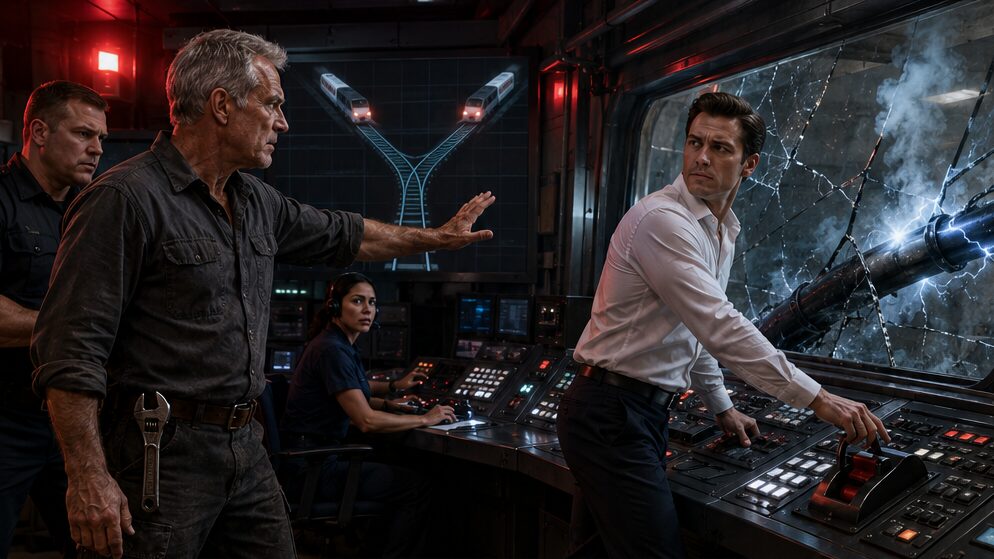
The Welder They Threw Out Was The Only Man Who Could Stop Both Trains
Chapter 1: The Smell The Sensors Could Not Read
Raymond Mitchell smelled the cable burning before the control room knew anything was wrong.
He stopped in the welding corridor with one gloved hand on his tool cart and lifted his head. The ventilation fans pushed cold filtered air across his face, carrying dust, hot metal, cleaning solvent—and beneath them, faint but unmistakable, the bitter sweetness of rubber cooking from the inside out.
No alarm sounded.
Through the glass wall ahead, the metro network glowed across a thirty-foot display. Blue lines branched under the city. White train icons slid between stations with clean mathematical precision. Operators sat in curved rows beneath the screen, headsets on, hands resting near touch panels.
Everything looked orderly.
Raymond set down the welding mask he had been carrying.
Donna Torres glanced toward him from the second console row. She had recognized him when he arrived that morning, though she had only given him a careful nod. Years earlier, when she was still a junior technician, he had taught her to listen to a relay before trusting its indicator light.
Now she watched him pull a scarred adjustable wrench from the side pocket of his work bag.
“You’re assigned to the handrail bracket,” she said through the open service doorway.
“I know.”
Raymond crossed to the conduit running along the corridor wall and pressed the flat side of the wrench against it. The tool was older than half the people in the control room. Its steel jaw had been polished smooth by his thumb, and a dark crescent marked the handle where heat had once burned through his glove.
He touched two fingers to the wrench.
A vibration traveled through it.
Not the steady hum of current under load. This came in uneven pulses, faint pauses followed by a harder shudder, like a heart skipping and then striking too hard.
Raymond looked through the glass at the network display.
“Donna,” he said, “check the west approach axle count.”
Christopher Wright turned before she could answer.
He stood on the raised command platform in a fitted white shirt with his sleeves buttoned at the wrist. He was younger than Raymond had expected from the executive photographs, perhaps thirty-two, with the upright stillness of a man accustomed to people waiting for him to finish.
“Contractors don’t issue instructions in this room,” Christopher said.
Raymond kept his fingers against the wrench. “Then issue it yourself.”
Several operators looked away from their screens.
Christopher descended one step from the platform. “Is there a problem with your assigned repair?”
“There’s a problem behind that wall.”
He pointed toward the negative-pressure electrical chamber beyond the far side of the room. Its heavy glass panels reflected the network map. Behind them sat the traction-power switching cabinets and the old emergency braking feed that the modernization plans claimed had been retired.
Christopher glanced at the environmental panel.
“Temperature normal. Air pressure normal. Current within tolerance.”
“Rubber’s burning.”
“I don’t smell anything.”
“You will.”
Donna had already opened the axle-count diagnostic. Her fingers moved quickly across the console.
“West approach shows clear,” she said.
Raymond watched her face.
She frowned.
“But the physical counter at Junction Four still shows occupied.”
Christopher walked toward her station. “Sensor lag. We’ve had intermittent ghost occupancy since the software update.”
Donna opened a second window. “Train 714 cleared Junction Four thirty-one seconds ago according to central routing.”
“And the axle counter?”
“Still holding the section.”
Christopher leaned over her shoulder. “Run a synchronization reset.”
Raymond removed the wrench from the conduit.
“Don’t reset anything.”
The room went quieter.
Christopher straightened slowly. “You were told not to interfere.”
“If you erase the mismatch, you won’t know which side is lying.”
“The axle counters are legacy hardware. The central system is authoritative.”
Raymond looked at Donna. “What train is eastbound toward the river tunnel?”
She hesitated, then checked.
“Train 302.”
“Where is 714 being routed?”
Donna’s eyes moved to the main display.
A white icon representing Train 714 slid south from Junction Four. Train 302 moved west beneath it. Between them, the river tunnel appeared as a single blue line shared by both directions until the underground crossover.
Donna enlarged the route assignments.
Her breath caught.
“Christopher.”
He stepped closer.
The software had given both trains green authorization into the same single-track section.
For an instant, no one moved.
Then Christopher touched Donna’s screen and opened the route logic.
“It’s a visual duplication,” he said. “The pathing engine would not generate opposing clearances.”
“Yet it did,” Donna said.
“No. The display layer is misreading one of the route packets.”
Raymond looked back toward the conduit. The uneven vibration had become strong enough to feel in the soles of his boots.
“Relay bank C will start chattering next.”
Christopher gave him a cold glance. “Based on what?”
“Based on the sound moving through that pipe.”
“There is no sound.”
A rapid metallic clicking began behind the chamber wall.
Three operators turned toward it.
The noise came in tight bursts—click-click-click, pause, click-click—like a handful of coins shaken inside a steel box.
Donna whispered, “Bank C.”
Christopher’s jaw tightened. He returned to the command platform and brought up the system architecture.
“Route duplication is a control-layer fault,” he said. “We’ll isolate the affected server and force a recalibration.”
Raymond moved toward the room.
The security gate at the service entrance slid shut in front of him.
Christopher had locked it from the platform.
“You don’t recalibrate while the physical count disagrees,” Raymond said.
“You don’t enter an active command floor without authorization.”
“Those trains don’t care about my badge.”
“Your presence is becoming a distraction.”
Christopher selected the recalibration sequence.
Donna swiveled toward him. “A reset could clear the occupied flag.”
“It will clear the false flag.”
“And if it isn’t false?”
Christopher’s voice sharpened. “The routing model has fourteen independent protections. Two trains cannot be authorized into the same block.”
Raymond looked up at the network display.
Train 714 continued south.
Train 302 continued west.
The blue route ahead of both icons changed to green.
Somebody in the rear row said, “That can’t be right.”
Raymond gripped the bars of the gate.
“Open this.”
Christopher ignored him.
The relay chatter grew louder.
The smell of burning rubber thickened until even the nearest operators began looking toward the electrical chamber.
Donna lifted her headset microphone. “Train 714, central control. Confirm your current signal aspect.”
Static cracked through the room.
Then a driver answered.
“Central, 714. Green approach into River Section.”
Donna’s face drained of color.
She switched channels. “Train 302, confirm signal.”
A second voice replied almost immediately.
“Green into River Section. Is there a restriction?”
The room erupted into overlapping speech.
Christopher raised one hand. “Silence. We are dealing with a synchronization error. Hold communications until I complete the reset.”
Raymond struck the gate once with the heel of his hand.
“Order both drivers to brake.”
“The automated system will resolve the conflict.”
“Order them now.”
Christopher stared at him across the room.
For the first time, Raymond saw fear beneath the younger man’s composure. Not fear of the trains. Fear of surrendering command in front of the operators who had been told the new system no longer needed men like Raymond.
Donna did not wait.
“Train 714, apply service braking and hold position.”
Her console flashed amber.
COMMAND REJECTED — AUTOMATED ROUTE PRIORITY ACTIVE.
She tried Train 302.
The same rejection appeared.
Christopher looked at the message, then at the architecture map.
“That’s part of the display fault.”
“No,” Raymond said. “Your braking link is losing power.”
A countdown appeared at the bottom of the main screen.
Not part of the passenger system. A maintenance timer, triggered when the route conflict exceeded tolerance.
SIX MINUTES, FORTY-EIGHT SECONDS TO SHARED BLOCK ENTRY.
Every train icon on the display kept moving.
Raymond released the gate and looked at the wrench in his hand.
He had come to repair a handrail, collect six hours of contract pay, and leave through the same service door without speaking to anyone who remembered him.
Instead, twelve hundred people were moving toward a tunnel the system insisted was empty.
Chapter 2: The Man Whose License Was Revoked
Raymond’s face appeared on the main display before Christopher opened the security gate.
It was an old identification photograph, taken when Raymond’s hair had still been mostly black. Beside it, in large red letters, stood the record Christopher had pulled from the metro’s archived personnel system.
OPERATING LICENSE REVOKED.
UNAUTHORIZED SYSTEM INTERVENTION.
RESTRICTED FROM CONTROL FUNCTIONS.
The collision countdown continued beneath the record.
Six minutes, eleven seconds.
Christopher turned from the screen. “This man has no authority to touch any active equipment.”
Raymond stared at his own younger face.
Donna said, “He predicted the relay fault.”
“A fortunate guess does not restore a revoked license.”
“The cable is overheating,” Raymond said.
Christopher pointed toward the environmental readings. “Every sensor says otherwise.”
“Your sensors are mounted above the insulation joint. Heat rises after the sheath fails. By then the core’s already cooking.”
“Then how exactly do you know where this supposed failure is?”
Raymond did not answer.
The old habit came easily. Keep the truth behind his teeth. Let them discover it after the damage had a number and a committee and somebody safe to blame.
Christopher mistook the silence for defeat.
“That’s what I thought.”
He reopened the gate only long enough for the security guard to step through from the corridor. The guard was broad through the shoulders, with one hand resting near the restraint clips on his belt.
“Escort him out of the command area,” Christopher said.
Raymond walked in before the gate could close.
The guard moved to block him.
“Don’t make this harder.”
“I’m going to the chamber door.”
“You’re leaving.”
Raymond held up the wrench. “No one has to let me touch a control. I only need the frame.”
Christopher laughed once without humor. “You’re diagnosing a ten-thousand-volt network with a wrench?”
“With steel. Steel doesn’t care who signed your diploma.”
The words drew a few glances, but Raymond kept walking until the guard placed a hand against his chest.
Donna stood. “Let him test the frame.”
Christopher looked at her. “Sit down.”
“We have under six minutes.”
“And that is why unlicensed improvisation is unacceptable.”
Raymond stepped sideways and pressed the wrench against the metal seam beside the chamber entrance.
The vibration struck hard enough to make the tool buzz in his hand.
He moved it slowly along the frame, stopping near a sealed access panel at knee height. Heat pushed through the steel. Not enough to burn his glove yet, but far above normal.
“Joint seven,” he said. “Main feed bends behind this panel. Outer sheath is softening.”
Christopher checked the schematic. “There is no joint seven in the active feed.”
“There was when I welded the support cradle.”
Donna looked sharply at Raymond.
“You worked on this chamber?”
“I worked on the braking loop.”
The room seemed to contract around the sentence.
Christopher studied him. “The emergency loop was decommissioned twelve years ago.”
“No. It was relabeled.”
“You expect us to believe the modernization team left an obsolete physical circuit energized?”
“They left it because it was the only circuit that didn’t need your servers.”
Christopher went back to the platform. “Convenient. An invisible system known only to the man barred from operating it.”
Raymond pressed the wrench harder to the panel.
The pulse came again.
“There,” he said. “Watch the cable monitor.”
A camera feed from inside the chamber filled one section of the display. Thick black cables ran through insulated trays behind the glass. At first nothing changed.
Then one cable shifted.
Its outer casing expanded near a curved support, swelling like a muscle tightening beneath skin.
Donna stepped toward the screen.
“That’s exactly where he said.”
The cable contracted slightly, then bulged again.
Christopher’s expression changed, but only for a second.
“Thermal deformation.”
“Caused by what?” Donna asked.
“A transient overload.”
“That is what he has been saying.”
Christopher brought up the load controls. “Which is why we need to balance the current through the active network.”
Raymond turned from the chamber.
“If you send more through that line, the insulation will split.”
Christopher’s fingers hovered over the console.
“The route conflict began because the braking system lost synchronization. Rebalancing the feed restores stable communication.”
“You’re treating a broken artery by raising the pressure.”
“And you are describing complex traction architecture with workshop metaphors.”
“Because the trains won’t wait for your vocabulary.”
The security guard took Raymond’s arm.
Raymond’s body tightened, but he did not pull away.
Christopher looked directly at him now, his composure narrowing into anger.
“Get out of the way, you filthy welder. I have an MIT doctorate. I know what I’m doing.”
The insult landed more quietly than the alarm.
Raymond had been called worse in machine rooms, tunnels, hearings, and offices where men in clean shirts had used careful language to erase thirty years of work. But Christopher said it while the cable visibly swelled behind him and two trains carried families toward each other.
That made it different.
Raymond looked at the young man’s spotless hands.
“You know what the diagram says,” he replied. “You don’t know what the machine is doing.”
A new face appeared on the side wall monitor.
Pamela Jones joined the emergency conference remotely from the inspection office. Her gray jacket was buttoned, her identification badge fixed precisely at the collar. Raymond recognized her before the image sharpened.
She recognized him too.
Her eyes flicked toward the license record displayed above the room.
“Why is Raymond Mitchell inside the control facility?”
Christopher answered at once. “Temporary contractor. He has entered the command floor and is obstructing emergency operations.”
Pamela’s gaze returned to Raymond. “Mr. Mitchell, you are restricted from active-system access.”
“The west main feed is failing.”
“That determination belongs to licensed personnel.”
“You signed the paper that took mine.”
“And you know why.”
Donna moved into the camera’s view. “Inspector Jones, the physical axle count conflicts with central routing. Both trains have green authorization into River Section. Mr. Mitchell predicted relay chatter and cable deformation before either appeared.”
Pamela’s expression remained controlled.
“Then his observations should be logged and evaluated by the technical director.”
Christopher nodded. “My recommendation is full-current redistribution through the primary feed, followed by route recalibration.”
Raymond took one step toward Pamela’s image.
“You do that and the cable opens.”
Pamela said, “Your record does not support granting you operational discretion.”
“My record was written to protect yours.”
The guard tightened his grip.
The countdown reached four minutes, fifty-two seconds.
Pamela’s eyes hardened. “Remove him.”
Christopher sent the order to security. A digital removal notice appeared beside Raymond’s revoked-license record.
At its bottom was the approving authority.
PAMELA JONES.
Raymond stared at the signature.
Years had passed, but the shape of it had not changed: the tall first stroke, the narrow loop in the surname. He had seen it beneath the old closure report, beneath the claim that the defective cable had been replaced, beneath the sentence declaring his intervention reckless and unnecessary.
He raised his head toward the screen.
“You knew,” he said.
Pamela said nothing.
“You knew this cable would fail.”
Chapter 3: The Report That Protected The System
Pamela replaced Raymond’s face on the central display with the report that had ended his career.
The first page carried an official seal and a black heading:
UNAUTHORIZED MANUAL BYPASS — WEST TRACTION INCIDENT.
Below it, a summary described Raymond forcing open a live-system interlock during a service disruption six years earlier. It noted damaged equipment, an unapproved shutdown, passenger delays, and his refusal to complete a full sworn account.
Christopher read the final line aloud.
“Subject demonstrated persistent disregard for established emergency procedure.”
The guard guided Raymond toward the security corridor.
Raymond did not resist. His wrench remained clenched in his right hand.
Donna followed them to the doorway, still holding her tablet.
“Pamela, was the cable replaced after that incident?”
“The report says corrective work was completed.”
“That isn’t what I asked.”
Pamela’s image watched Raymond rather than Donna. “Replacement was certified.”
Christopher stepped between Donna and the door. “We are not reopening a six-year-old disciplinary case during an active routing failure.”
“The same feed is overheating,” Donna said.
“The system designation is not the same as the physical component.”
Raymond stopped walking.
“That sentence is how they buried it.”
The guard pushed lightly at his shoulder. “Keep moving.”
Raymond turned his head toward the chamber. The relay chatter had become a continuous irregular rattle.
Donna lowered her voice. “What did you do six years ago?”
He said nothing.
“You did bypass the interlock?”
“Yes.”
Christopher’s expression sharpened. “There. Finally.”
Donna ignored him. “Why?”
Raymond looked at her.
He remembered her at twenty-four, kneeling beside an open cabinet with grease across her cheek, listening while he explained why a clean indicator could still hide a burned contact. She had trusted his hands then. He had not expected her to remember.
“The insulation was failing,” he said.
“And the sensors missed it?”
“Yes.”
“What happened when you opened the interlock?”
“I dropped power to half the west network.”
“You stranded nine trains,” Christopher said.
“I kept the feed from flashing over.”
“According to you.”
Raymond’s fingers tightened around the wrench. “According to the melted support behind the panel.”
Pamela’s voice came through the monitor. “You were asked repeatedly to provide a complete technical account. You refused.”
“The chamber was opened. They could see it.”
“That is not a sworn statement.”
“You wanted my words shaped into your conclusion.”
“I wanted evidence that could survive review.”
“You wanted me to say the bypass was unnecessary.”
Pamela’s composure slipped for the first time.
“I wanted the network reopened before morning service.”
The words hung in the corridor.
Christopher glanced toward her image.
Donna’s tablet chimed. She had accessed the archived work order attached to the old incident.
“Cable replacement,” she read. “Ten-thousand-volt primary feed, western emergency distribution. Completed and inspected.”
Raymond looked at the document.
“Open the physical maintenance log.”
Christopher said, “We do not have time.”
Donna entered another command.
The maintenance database returned a list of chamber entries, equipment scans, and technician sign-offs. She searched the date on the replacement invoice.
No corresponding chamber access appeared.
She widened the range to one week.
Nothing.
“There’s no entry,” she said.
Pamela’s image remained still.
Christopher walked toward her. “Records were migrated. Old access logs are incomplete.”
Donna opened the material inventory.
“The invoice lists eighty meters of high-voltage cable. Warehouse dispatch shows twelve.”
“That could be a clerical discrepancy.”
“Twelve meters wouldn’t reach from the isolation bus to the first support.”
Raymond finally moved. He stepped closer to Donna’s screen, forcing the guard to follow.
“Show me the contractor stamp.”
She enlarged the invoice.
A faded certification mark sat beneath the line for completed work.
Raymond’s jaw shifted.
“They replaced the exposed tail,” he said. “Painted the old sheath and closed the chamber.”
Christopher shook his head. “You cannot infer that from an inventory entry.”
“I can infer it from the cable swelling at the same bend I marked six years ago.”
Pamela said, “The emergency at present is the route conflict. Technical Director Wright remains in command.”
Donna looked from the missing maintenance log to the cable camera.
“Was the replacement done or not?”
Pamela did not answer directly.
“The closure documentation was accepted according to the standards in effect.”
“That means no,” Raymond said.
The countdown reached three minutes, twelve seconds.
An operator called from the command floor. “Train 714 reports braking commands are still locked out.”
Another voice followed. “Train 302 has entered the river approach.”
Christopher turned back toward the platform. “We are proceeding with current redistribution.”
Raymond stepped after him.
The guard pulled him back.
Christopher pointed at the archived incident summary. “This man once crippled the west network because he believed he knew more than the licensed control team. He refused investigation, blamed everyone else, and disappeared when asked to prove his claims.”
Raymond’s face went rigid.
Donna looked at him. “You did disappear.”
“I left.”
“You abandoned the appeal.”
“They had the chamber photographs.”
“They had no statement explaining what you saw.”
Raymond looked away.
That silence cost him something in Donna’s face.
Not trust completely. But certainty.
Christopher saw it.
“He does this,” he said. “He acts first, refuses accountability, then turns his silence into moral superiority.”
Raymond faced him.
The accusation was cruel because part of it was true.
After the old incident, Raymond had sat through two hearings while officials asked the same questions in different language. Why had he ignored procedure? Why had he opened the interlock? Why had he caused a shutdown? Each answer had been shortened, reframed, entered into minutes that made the cable failure sound hypothetical and his anger sound unstable.
At the third hearing, he had stood up and walked out.
He had believed the burned support, the photographs, and the smell embedded in his clothes should have been enough.
He had been wrong about what institutions could refuse to see.
“I violated procedure,” Raymond said.
Christopher spread one hand toward Donna, as if presenting the conclusion.
Raymond continued. “Because procedure was feeding power into damaged insulation.”
“Then why didn’t you finish your testimony?”
The question came from Donna.
Raymond did not answer.
The guard began moving him down the corridor again.
Behind the glass, Christopher took the command platform and ordered the load-balancing model opened. Pamela authorized him remotely. Operators exchanged frightened looks but returned to their stations.
Donna stayed near the archive terminal.
She copied the invoice and missing access log into a separate file.
Christopher noticed. “Close that archive.”
“I’m preserving the maintenance record.”
“You are diverting attention from a live incident.”
“I’m documenting the physical fault.”
“You are disobeying a direct instruction.”
Donna’s hand paused over the screen.
She had a mortgage, two children, and eighteen years inside the metro. Raymond knew because workers always knew those things about one another, even after years apart. Losing a job at sixty-eight had emptied his life. Losing one in her forties could break hers before anyone admitted the order had been wrong.
Pamela said, more gently, “Donna, return to your station. We can review the records afterward.”
For one second, Donna almost obeyed.
Then the chamber gave a deep metallic bang.
Everyone turned.
On the camera feed, the swollen cable jerked against its support. A thin line opened along the black outer casing.
Blue-white light flashed through the split.
The monitors flickered.
A pale ribbon of smoke curled upward inside the chamber.
Raymond stopped so suddenly the guard nearly collided with him.
“That isn’t smoke,” he said.
The negative-pressure gauge dropped.
At the edge of the chamber’s thick glass, a whitish vapor began threading through the seal into the control room.
The cable casing split wider with a sound like fabric tearing under enormous strain.
Raymond looked at Pamela’s image.
Then at Christopher’s hand moving toward the current-redistribution controls.
The old report remained open behind them, still calling the
Chapter 4: When The Model Refused The Smoke
The pale vapor slipped through the cracked seal in a thread no wider than a shoelace.
Donna saw it before the environmental monitor changed. It drifted across the chamber glass, almost graceful, then curled downward toward the nearest operator station.
“Move back from the wall,” Raymond said.
No one moved quickly enough.
A warning tone sounded three seconds later.
NEGATIVE PRESSURE LOSS.
Christopher stared at the message as if the screen had betrayed him.
“The chamber is compensating,” he said. “The suppression system will contain it.”
“The suppression system is what you’re breathing,” Raymond replied.
He pulled once against the guard’s grip. The guard tightened both hands around his arm.
Pamela’s voice came through the wall monitor. “Evacuate nonessential personnel from the chamber perimeter.”
“There are no nonessential people in a control room with two trains in conflict,” Donna said.
The countdown read two minutes, forty-six seconds.
Train 714 had passed its last safe crossover. Train 302 was descending into the opposite approach. The automated system still showed both routes green.
Christopher returned to the power architecture display. “The braking-link voltage is collapsing because the load is unstable. We restore voltage, then issue a network stop.”
“With what?” Raymond asked. “The same cable that just opened?”
“The primary feed has sufficient reserve capacity.”
“The primary feed is the one burning.”
“The model identifies a transient thermal event.”
Raymond looked at the vapor.
“The model can’t smell.”
Christopher selected the current-redistribution sequence.
Donna stepped between him and the command panel.
“Don’t.”
He looked at her with disbelief more than anger. “Return to your station.”
“The cable sheath is split.”
“The current remains below catastrophic threshold.”
“According to sensors that missed the heat.”
“According to calibrated instrumentation.”
Raymond raised the wrench and struck the chamber frame.
The sound cut through the alarms—a deep, warped note that seemed to roll inside the steel.
He struck it again, higher this time.
A thin crack appeared along the edge of the glass.
Donna saw the seal flex inward, then release.
Raymond lowered the wrench.
“The pressure differential is pulling the frame apart.”
Christopher frowned at the chamber schematic. “That glass is rated beyond the present load.”
“It was rated before somebody painted over a six-year-old problem.”
Pamela said, “Mr. Mitchell, stop striking containment equipment.”
“I’m listening to it.”
“You are damaging it.”
“No. I’m telling you it’s already damaged.”
The vapor widened.
Operators nearest the chamber coughed and pulled their jackets over their mouths. One of them stumbled away from the console, eyes watering.
Donna turned to the rear row. “Respirators from the emergency cabinet. Now.”
Christopher said, “No one abandons an active station.”
“Then give them masks.”
He hesitated, calculating whether the order would look like panic.
That hesitation was enough.
Donna opened the cabinet herself and threw respirators across the room.
Pamela’s face hardened on the monitor. “You are creating disorder.”
Donna fitted a mask over her mouth. “The disorder is coming through the glass.”
Raymond watched the load bars on Christopher’s screen. Three routes had been removed from the modern diagram. Their labels were gray, marked DECOMMISSIONED.
One of them was the old emergency braking loop.
“That loop isn’t gone,” Raymond said.
Christopher did not turn. “We established that you believe otherwise.”
“It runs beneath the new bus. The cable splits behind the chamber, crosses the west relay rack, then feeds the braking contactors directly.”
“The modernization records list it as disconnected.”
“They disconnected the controls. Not the copper.”
Donna looked at the architecture map.
“If the physical loop still exists, could we use it?”
Raymond nodded toward the chamber. “If the bridge point hasn’t burned through.”
Christopher shook his head. “No licensed engineer would energize an undocumented legacy circuit during a live fault.”
“No licensed engineer left you another one.”
The countdown reached one minute, fifty-eight seconds.
A driver’s voice burst through Donna’s headset.
“Central, 714. We have opposing headlights in the distance. Confirm route.”
The room fell silent except for alarms.
Donna pressed the transmit key.
“Apply maximum manual braking.”
“Brake command is fighting automatic acceleration.”
Christopher leaned toward her microphone. “Maintain present control. Central is correcting the signal fault.”
Raymond’s head snapped toward him.
“You told them to keep moving?”
“A sudden emergency application at current speed could derail the train in the tunnel approach.”
“A collision will do worse.”
“I am balancing two risks.”
“No. You’re protecting your model.”
Christopher’s face flushed.
He opened the manual interlock controls.
For one moment, Donna thought he meant to restore local braking.
Instead, he entered an administrative override.
The screen flashed.
MANUAL INTERRUPTION DISABLED.
“What did you do?” she asked.
“I removed unauthorized access from the emergency sequence.”
“You locked us out.”
“I prevented conflicting commands.”
Raymond pulled against the guard again.
The guard shifted his stance. “Don’t.”
“Let go.”
“I can’t.”
“You can. You don’t want to.”
The guard’s grip weakened for half a second, but Pamela’s voice came through immediately.
“Maintain restraint.”
He obeyed.
Donna looked at the raw relay data streaming beneath the main display. She selected the packet history, copied the last three minutes, and routed it through an external safety channel.
A red authorization warning appeared.
Pamela noticed.
“Donna, cancel that transmission.”
Donna kept typing.
“Who are you sending it to?” Christopher demanded.
“Katherine Anderson.”
Pamela stood so abruptly that her image shook.
“That channel is reserved for independent incident escalation.”
“This is an incident.”
“You do not have authority to bypass local review.”
Donna pressed SEND.
The packet left the system.
For the first time, Pamela’s fear became visible.
Not fear of the vapor. Not fear of the trains.
Fear of someone outside the room seeing the records before they could be arranged.
Christopher saw it too.
He returned to the current controls with renewed urgency.
“Once voltage stabilizes, none of this matters.”
Raymond laughed once, without amusement.
“That’s what you think matters?”
The cable camera flashed white.
A section of outer insulation peeled away, exposing a glowing line beneath it. The chamber lights dimmed. The vapor burst through the seal in a heavier stream.
The pressure alarm became continuous.
Pamela stared at the live image.
Raymond watched her make the choice.
She saw the split cable. She saw the failing glass. She saw two train icons closing on the same blue line.
Still, she said, “Technical Director Wright remains in command.”
Christopher keyed in the final redistribution values.
Donna moved toward him.
The guard released one of Raymond’s arms long enough to block her.
Christopher placed his hand above the final power switch.
The system voice filled the room.
“Braking-link failure in twenty seconds.”
Raymond looked from the guard’s exposed side to the red fire extinguisher mounted beside the chamber door.
His wrench felt heavy in his hand.
Christopher’s fingers touched the switch.
Chapter 5: The Fire Extinguisher And The Final Switch
Train 714 entered the west approach tunnel as Christopher began the reroute sequence.
On the main display, its white icon accelerated into the narrowing blue line. Train 302 received a false clear signal from the opposite end.
“Fifteen seconds,” the system announced.
Raymond opened his hand.
The wrench struck the floor beneath the guard’s boots.
The guard glanced down.
Raymond moved.
He drove his shoulder backward into the man’s chest, broke the grip on his arm, and lunged for the fire extinguisher. The guard recovered quickly and caught him around the waist.
Christopher shouted, “Stop him!”
Raymond tore the extinguisher from its bracket.
The guard pulled him away from the chamber.
Raymond twisted, raised the cylinder with both hands, and swung.
The red metal struck the guard across the cheek and brow. The man dropped sideways against the gate, stunned but conscious, one hand going to his face.
Raymond let the extinguisher fall.
Christopher’s hand slammed toward the switch.
Raymond crossed the distance in three strides and hit him low.
They crashed into the command console. Christopher’s shoulder struck the edge, and the reroute command froze halfway through authorization.
“You attacked him!” Pamela screamed from the monitor.
Christopher clawed for the panel.
Raymond seized his wrist and drove him against the wall hard enough to knock the breath from him.
“Stay down.”
“You’re insane.”
“Maybe.”
Raymond released him and ran for the chamber.
“Ten seconds.”
Donna was already at her station.
“The bridge point,” she called. “Where?”
“Lower west cabinet. Copper strap behind the ceramic block.”
“The chamber’s live.”
“I know.”
The negative-pressure door had locked automatically when containment failed. Raymond struck the manual release with the base of his palm.
Nothing.
Christopher pushed himself upright behind him.
“If you open that door, you’ll flood the room with suppressant.”
Raymond grabbed the extinguisher from the floor and rammed its base into the release housing.
The plastic cover shattered.
He reached into the exposed mechanism and pulled the mechanical latch.
The chamber door opened six inches.
A wave of chemical vapor rolled through the gap.
Operators coughed and backed away. Donna kept her respirator sealed and reached for the local braking control.
“Five seconds.”
Raymond forced the door wider and entered.
The heat struck him first.
Not flame. A heavy radiant pressure that tightened the skin across his face and made the air feel solid. The cable arced inside its broken sheath, throwing blue light across the cabinets.
The fractured glass bowed inward.
Raymond saw the bridge point.
The copper strap hung behind the ceramic block exactly where he remembered it, dark with age but intact. The failed cable had pulled free from the contact assembly, starving the old braking loop while the modern system kept issuing false route commands.
He crossed the chamber in two steps.
The glass seal tore wider.
Vapor blasted through the opening.
“Raymond!” Donna shouted.
He looked back once.
Through the fogged glass, Train 714 and Train 302 were now shown inside the same shared block.
“Three seconds.”
Raymond wedged his left shoulder and torso against the cracked panel.
The glass groaned against him.
Pressure pushed from behind, trying to force it outward into the control room. He planted his boots against the chamber floor and leaned harder, using his body to cover the gap.
The vapor stream narrowed.
His right hand reached for the copper strap.
The insulation around the fallen cable had melted into black curls. The exposed conductor glowed at the edge.
He could not bridge it with the wrench.
The wrench was outside.
For one bitter instant, he saw it lying on the floor where he had dropped it—his oldest tool, the thing men mocked because they mistook wear for ignorance.
Then the system voice said, “Two seconds.”
Raymond grabbed the cable.
Pain erased the room.
It shot through his palm, up his arm, and across his chest in a white burst. His muscles locked. The smell of burned rubber became the smell of his glove.
He tore the glove free with his teeth and seized the conductor again with his bare hand.
Skin blistered instantly.
Blood ran from where the jagged copper cut into his palm.
He forced the cable toward the emergency contact.
“Now!” he shouted.
Donna slammed the local braking controls.
Nothing happened.
“Circuit open!” she called.
Raymond pushed harder.
The conductor fought him like a living thing. Current snapped across his fingers. Smoke rose from his hand.
Christopher staggered toward the chamber entrance.
“You’ll energize the whole frame!”
Raymond looked at him through the glass.
“No,” he said. “You almost did.”
He drove the cable against the copper strap.
The contact arced with a sound like a gunshot.
Every light in the control room went black.
For half a second, there was no display, no alarm, no system voice.
Then red emergency lamps came on.
Donna’s console rebooted into local mode.
A single line appeared.
LEGACY BRAKING CIRCUIT DETECTED.
She pressed both palms against the emergency command.
“Apply.”
The relay bank behind the wall slammed shut.
Deep beneath the city, magnetic brakes engaged on both trains.
Train 714’s passengers were thrown forward against belts, poles, seats, and one another. Train 302 shrieked along its rails, wheels fighting momentum in the dark.
Raymond heard none of it.
The chamber glass cracked beneath his ribs.
The gap widened above his shoulder.
He shifted his body upward to seal it, pressing his cheek against the hot surface. The cable remained trapped in his burned hand, held against the contact by force alone.
Donna watched the braking data.
“Deceleration on 714.”
An operator shouted, “302 responding.”
Christopher reached for the control console.
Donna blocked him.
“Don’t touch anything.”
“I can stabilize the feed.”
“You are done.”
Pamela ordered, “Restore centralized command.”
No one moved to obey her.
The guard had pushed himself upright against the wall. Blood ran from his eyebrow, but his eyes were clear enough now to see Raymond through the glass.
He looked at the extinguisher on the floor.
Then at the two train speeds falling on Donna’s screen.
He lowered his hand from his restraint clips.
Inside the chamber, Raymond’s knees began to buckle.
The current had not passed cleanly through him, but heat and pain had hollowed out his strength. His arm shook violently.
“Raymond,” Donna said through the chamber intercom. “Hold it. Five more seconds.”
He could not answer.
His body slid an inch down the glass.
Vapor hissed through the opening near his shoulder.
Donna grabbed a canister of emergency sealant and ran to the chamber door.
Christopher caught her sleeve.
“You can’t enter.”
She ripped free.
“You already entered where you didn’t belong.”
She opened the inner gap just enough to spray sealant along the fracture behind Raymond’s shoulder. The foam expanded, hardening against his jacket and the glass.
“Three seconds,” she said.
Raymond’s burned hand slipped.
He closed his fingers again.
Blood smeared the copper.
The braking display showed both trains slowing, but the position map began to flicker. The central system could no longer reconcile the legacy circuit with its own routing data.
Train 714’s icon turned gray.
Then Train 302’s.
Christopher pointed at the screen.
“We’ve lost telemetry.”
Donna stared at the blank section of tunnel.
“No,” he said, louder now. “We lost the trains.”
The final speed readings vanished.
Inside the chamber, Raymond sagged against the sealed glass, still gripping the cable.
The collision map went from red to gray.
No one knew whether the trains had stopped—or whether the system had simply lost sight of twelve hundred people before impact.
Chapter 6: The Distance Between Two Trains
The tunnel camera returned in a burst of static.
For a moment, the image showed only darkness and reflected emergency lights. Then the lens adjusted.
Train 714 stood motionless at the western signal gate.
Train 302 stood beyond the eastern gate, facing it from the opposite end of the shared section.
Between their front cars lay thirty-seven feet of empty rail.
No one in the control room spoke.
Donna gripped the edge of her console until her knuckles whitened.
An operator whispered, “They stopped.”
Passenger emergency calls flooded the communications board.
Injuries from sudden braking. Broken glass. Panic. No collision. No fire in either train.
Alive.
All of them alive.
Christopher broke the silence first.
“Security, detain Raymond Mitchell for assault and sabotage.”
Donna turned toward him.
His shirt was torn at the shoulder. A red mark ran along his temple where he had struck the wall. He stood crookedly but held himself as though command could be restored by posture alone.
“You still think he sabotaged the system?” she asked.
“He attacked two people, breached a sealed electrical chamber, and interfered with live traction power.”
“He restored the braking circuit.”
“He destabilized the entire network.”
“He stopped both trains.”
Christopher pointed to the gray position map. “We lost system control.”
“We lost central telemetry after your reroute isolated the physical loop.”
Pamela’s image remained on the monitor.
“Secure all logs,” she said. “Separate the emergency record from general system access. No one exports additional data without my approval.”
Donna looked at her.
“You want the logs isolated?”
“For chain of custody.”
“You mean before Katherine sees them.”
Pamela’s mouth tightened. “This is no longer the time for personal accusations.”
The chamber door opened behind them.
Two medical responders entered wearing respirators and insulated gloves. Donna moved aside as they pulled Raymond from the glass.
His jacket had hardened into the emergency sealant. They had to cut part of the fabric away. When they freed his right hand from the cable, his fingers remained curled as though still gripping it.
The palm was blackened at the edges and cut across the center. Blood had dried between the burns.
Raymond did not cry out.
That frightened Donna more than if he had.
They lowered him onto a stretcher near the chamber entrance. One responder began cooling the hand with sterile fluid while another checked his breathing.
The smell of burnt rubber clung to him.
Donna crouched beside the stretcher.
“You did it.”
Raymond opened his eyes.
“How far?”
“Thirty-seven feet.”
He gave the smallest nod.
Then he looked toward the control room floor.
“My wrench.”
Donna followed his gaze.
The old tool lay beneath the edge of the console, half hidden by the extinguisher hose. She picked it up.
A number had been carved into the handle near the dark heat scar.
W-17-04.
She had seen that code minutes earlier in the old archive.
It was not a tool number.
It was an inspection reference.
Christopher approached the stretcher.
“You will not touch any further equipment.”
Raymond looked at him through half-closed eyes.
“You should learn where it is first.”
Christopher’s face hardened.
Donna stood.
“Trace the route,” she said.
“What?”
“The current path you ordered. Start at the primary feed and show where the redistributed load would have gone.”
“I don’t answer examinations from operators.”
“Then answer the room.”
She pulled a blank physical schematic onto the side display.
The surviving technicians looked toward Christopher.
He stepped closer to the screen.
“The primary feed supplies the active braking bus through the control layer.”
“Which conductor?”
“The western main.”
“Where does it cross the legacy loop?”
“It doesn’t. The legacy loop was decommissioned.”
Raymond’s burned fingers twitched beneath the cooling wrap.
Donna held up the wrench.
“Then why is the inspection number for that loop carved into his tool?”
Christopher looked at the handle.
Pamela said, “Donna, place that item into evidence.”
“Gladly.”
She set it beside the copied invoice and missing access log.
A new alert sounded from the external channel.
INDEPENDENT SAFETY AUTHORITY INBOUND.
Estimated arrival: four minutes.
Pamela moved closer to her camera.
“Security, arrest Mitchell before outside personnel enter the facility.”
The guard stood near the gate with gauze pressed to his eyebrow.
He looked at Raymond on the stretcher.
“He warned me,” the guard said.
Pamela’s expression froze.
“What?”
“He told me to let go. He said the switch would kill them.”
“You were assaulted while performing your duty.”
“Yes.”
“Then carry out the order.”
The guard lowered the gauze.
“No.”
The word seemed louder than any alarm.
Pamela said, “You are refusing a lawful instruction.”
“I’m refusing to handcuff the man who stopped the trains before anyone asks what happened.”
Donna moved to the central archive terminal and began transferring the raw relay files to an independent evidence partition.
Christopher reached toward the keyboard.
She blocked his hand.
“If you touch this, everyone will see.”
“You are destroying chain of command.”
“No,” she said. “I’m preserving chain of evidence.”
Pamela’s image disappeared from the main display.
For a second Donna thought the connection had failed.
Then the doors to the upper command floor unlocked remotely. Pamela was coming in person from the inspection wing.
The medical responders lifted Raymond’s stretcher.
He reached weakly toward the wrench.
Donna placed it beside his uninjured hand.
His thumb rested against the carved number.
Outside, rotor noise began pounding against the roof.
The sound grew until dust shook loose from the upper vents and the emergency lights trembled.
Through the high windows, a dark helicopter descended toward the service landing pad.
Donna looked at the external feed.
Katherine Anderson stepped down before the rotors had fully slowed.
Under one arm, she carried a sealed archive case.
A label on its side showed the reference number from Raymond’s wrench.
Inside the case was the appeal he had walked away from six years earlier.
Chapter 7: The Badge Signed Beneath The Lie
Katherine Anderson entered the command floor carrying a blank schematic.
She ignored the damaged chamber, the medical team, and Pamela Jones approaching from the inspection corridor. Her eyes went first to Christopher Wright.
“Trace the emergency braking circuit.”
Christopher stared at the unmarked diagram she placed on the console.
“I need the system architecture.”
“You designed the operating model.”
“The model uses logical routing, not obsolete physical layouts.”
Katherine handed him a stylus.
“Then begin with the active feed.”
The room watched him place the tip near the primary traction bus. He drew a line toward the control servers, paused, and glanced at the live equipment display.
“Where does it cross the independent braking loop?” Katherine asked.
“It does not.”
“Where did Raymond Mitchell restore contact?”
Christopher’s stylus remained motionless.
Katherine turned to Donna. “Show me the relay record.”
Donna opened the protected evidence partition. Raw current values, command timestamps, and local braking responses filled the screen.
Christopher pointed to the incomplete reroute sequence.
“My command was interrupted. You cannot conclude what the stabilized result would have been.”
Katherine selected the projected load path.
A red line ran directly through the ruptured cable.
“This would have raised current beyond the damaged sheath’s tolerance.”
“The sensor data did not indicate structural damage.”
“The camera did.”
“The deformation could have remained stable.”
“The insulation was open.”
Christopher’s voice rose. “I had two trains receiving conflicting authority. Centralized control had to be restored.”
“You had observable evidence that your model was incomplete.”
“I had seconds.”
“So did Raymond.”
Katherine left the blank schematic in front of him and crossed to the stretcher.
Raymond was sitting upright now, his right hand covered in layers of wet sterile dressing. His face had regained some color, though every breath remained shallow.
The scarred wrench lay beside him.
Katherine picked it up carefully.
“W-17-04,” she read.
Raymond said nothing.
She opened the archive case and removed a faded inspection file. The same number appeared on the first page.
Pamela stopped several feet away.
“That appeal was closed.”
“Abandoned,” Katherine said. “Not resolved.”
“He refused to complete his testimony.”
Katherine looked at Raymond. “Is that true?”
“Yes.”
Donna glanced toward him.
The answer seemed to cost him more than the accusation had.
Katherine opened the file across a nearby table. Photographs showed scorched insulation, a warped support cradle, and a section of cable marked for replacement. Raymond’s handwritten notes filled the margins in block letters. The final pages were blank.
“No sworn explanation,” Katherine said. “No completed sequence of events. No signed technical conclusion.”
“The photographs showed enough,” Raymond replied.
“For an engineer, perhaps. Not for a tribunal deciding whether you had acted recklessly.”
“They had already decided.”
Pamela stepped closer. “Because you walked out.”
Raymond looked at her.
“You wrote the conclusion before the hearing.”
“I wrote that your bypass had caused an unnecessary shutdown.”
“You knew the cable was damaged.”
“I knew there was damage. I did not know whether it justified shutting down half the west network.”
“You saw the support.”
“I saw a support after you opened a live system without authorization.”
Katherine closed the file.
“Was the cable replaced?”
Pamela’s face changed.
Not much. A slight loss of rigidity around the mouth. A glance toward the command staff gathered behind Donna.
“The corrective order was issued.”
“That was not the question.”
Pamela looked at Raymond’s bandaged hand.
“The contractor certified replacement.”
“With twelve meters of cable for an eighty-meter run,” Donna said.
Pamela’s shoulders lowered.
“The network was under threat of suspension,” she said. “A full shutdown would have displaced hundreds of thousands of passengers. The city had already warned us that funding would be frozen if the modernization schedule slipped again.”
Katherine waited.
Pamela continued quietly.
“The contractor proposed replacing the exposed tail, sealing the chamber, and completing the full run during the next closure.”
“And did that closure occur?”
“No.”
“Did you certify the work?”
Pamela looked directly at Raymond.
“Yes.”
No one spoke.
The confession did not sound dramatic. It sounded administrative, almost ordinary, which made it worse.
Christopher stepped away from the schematic.
“You placed me in charge of a system built on falsified records.”
Pamela turned toward him. “You had authority to stop when the physical evidence contradicted your model.”
“You repeatedly confirmed the documentation.”
“And you repeatedly ignored what was in front of you.”
Katherine looked between them.
“One protected the institution by certifying work that was not done. The other protected his authority by treating evidence as an inconvenience.”
She faced Pamela.
“Your badge.”
Pamela’s hand rose to her collar.
For a moment, she did not move beyond that. Then she unclipped the identification badge and placed it in Katherine’s palm.
The small metallic click carried through the room.
Raymond watched without satisfaction.
Katherine turned to him.
“Your warning was correct. Your intervention saved both trains. But your silence helped them call the danger unproven.”
Pamela’s eyes flashed. “He was not silenced. He refused to speak.”
Raymond looked at the unfinished pages in the appeal.
“They changed every answer.”
“You stopped answering,” Pamela said.
“I thought the metal spoke for itself.”
“It did not speak in the hearing room.”
The words struck because they were true.
Donna stood beside the evidence terminal, saying nothing. Raymond remembered the disappointment in her face when she learned he had walked out. He remembered the workers who had been laid off after the emergency closure, men who had avoided his eyes because management told them his unauthorized action had caused the shutdown.
He had let anger decide that no explanation could matter.
The cable had remained behind the wall.
Katherine placed Pamela’s badge inside the archive case.
“I can reopen the license determination,” she said. “I cannot restore it on an incomplete record.”
Raymond looked at her.
“You want another hearing?”
“I want the statement you refused to give.”
“My hand doesn’t change what happened.”
“No. But your signature changes whether it can be buried again.”
A medical responder adjusted the dressing around Raymond’s palm. Pain tightened his jaw.
Christopher remained near the blank schematic, his own authority reduced to a half-drawn line that led nowhere.
Pamela stood without her badge.
Raymond could still leave.
He could take the silence that had protected what remained of his pride and carry it out of the building. The trains were safe. The cable was exposed. Someone else could write the report.
Then he looked at the fractured glass, at Donna’s preserved files, and at the wrench marked with an inspection number no database had honored.
His burned hand began to shake.
“Donna,” he said.
She came closer.
“Put the statement in front of me.”
Chapter 8: The Wrench He Chose To Carry Home
The metro offered Raymond control of the department that had thrown him out before he had finished signing his statement.
Three executives entered the emergency command floor near sunset. Their jackets were immaculate despite the chemical haze, the cut cables, and the medical equipment still scattered near the chamber.
One placed a slim folder beside Raymond’s bandaged hand.
“Senior Director of Infrastructure Integrity,” he said. “Full authority over field inspection, emergency maintenance, and contractor compliance.”
Raymond looked at the title.
The dressing around his right hand had been replaced twice. Burn ointment darkened the gauze, and his fingers remained partly curled.
“What do you want changed in the statement?” he asked.
The executive’s expression held.
“We want accuracy.”
“You want softer verbs.”
“No one is asking you to conceal anything.”
Another executive leaned forward. “But terms such as deliberate suppression and falsified certification could be interpreted before the internal review is complete.”
“The cable was certified as replaced.”
“Yes.”
“It wasn’t replaced.”
“We understand.”
“Then the word fits.”
The first executive closed the folder halfway.
“This position would allow you to prevent that kind of failure from inside the organization.”
Raymond looked through the damaged glass toward the chamber. Workers in protective suits were fastening a temporary shield across the fracture. The burnt-rubber smell still clung to the air, mixed now with disinfectant and cooling foam.
He had spent years imagining what it might feel like to walk back into this place with authority.
The reality felt like another uniform they wanted him to wear so the building would look repaired.
“What happens to Donna?” he asked.
The executives exchanged a glance.
“She remains under review for bypassing escalation procedure.”
Raymond pushed the folder back.
“Then you still don’t understand the problem.”
Katherine stood near the evidence table, allowing the conversation to unfold without interrupting it.
Raymond nodded toward Donna.
“She sent the raw relay data outside because local command was preparing to isolate it. That becomes protected action.”
“That policy decision requires board approval.”
“Then get it.”
He pointed with his uninjured hand toward the physical schematic still lying near Christopher’s abandoned station.
“Every emergency system gets two checks. One digital. One physical. Neither can certify the other.”
The executive took out a pen.
“Dual verification.”
“Independent teams.”
“What else?”
“Any worker who reports a life-safety defect gets external review before local management can discipline them.”
“That could generate abuse.”
“So can ignoring them.”
The executive wrote again.
Raymond continued.
“The false closure report is corrected publicly. Not buried in a technical appendix. Every maintenance crew sees what was certified, what was not done, and what nearly happened.”
One of the executives shifted uneasily.
“That level of disclosure may damage public confidence.”
Pamela, standing under supervision near the corridor, lowered her eyes.
Raymond said, “Public confidence almost put two trains into the same tunnel.”
No one answered.
The medical responder returned carrying a smaller roll of gauze.
“We need to rewrap the hand.”
Raymond held it out.
The responder removed the dressing carefully. His palm was raw and swollen, the cuts closed with temporary strips. Two fingers barely moved when asked.
“Will it heal?” Donna asked.
The responder paused.
“There will be healing.”
“That isn’t what she asked,” Raymond said.
The responder met his eyes.
“You may not regain full grip strength.”
Raymond looked at his hand.
For most of his life, usefulness had been something he could hold. A wrench. A torch. A cable under tension. A piece of steel that needed persuasion more than explanation.
He tried to close his fingers.
The hand stopped halfway.
The responder wrapped it again.
Donna placed the old wrench on the table beside him.
The scarred steel seemed heavier now.
Katherine opened a second folder.
“This is the revised licensing determination,” she said. “The revocation is withdrawn. The old finding of incompetence is removed.”
Raymond looked at the page.
“Am I licensed?”
“You are technically cleared pending medical evaluation.”
“So I may not be able to use it.”
“Perhaps not in the way you did before.”
The answer might once have sounded like pity. From Katherine, it did not.
She placed the document beside his signed statement.
“There are other ways to keep people alive.”
Raymond looked at Donna.
She had once learned by watching his hands. Maybe someone else could learn by hearing what he had refused to say.
He returned his attention to the executives.
“I don’t want the director’s job.”
The first executive nodded slowly. “What do you want?”
“The rules written before I leave.”
“We cannot complete full policy language tonight.”
“You can sign interim orders.”
The executives conferred in low voices.
Raymond waited.
He no longer mistook waiting for surrender.
Within twenty minutes, they produced emergency directives covering dual verification, external preservation of safety data, and temporary protection for employees who bypassed local command to report imminent danger.
The documents were imperfect. Narrow in places. Full of language that would need to be fought over later.
Raymond read every line.
When he found a clause allowing internal suspension before external review, he crossed it out.
The executive started to object, saw Katherine watching, and initialed the change.
Donna signed as witness.
Raymond took the pen in his left hand.
His writing was clumsy. The letters leaned unevenly across the page.
But he signed.
Afterward, the command floor emptied by degrees. Operators returned to limited service duties. Investigators sealed consoles. Christopher was escorted from the technical platform without restraints, carrying nothing. Pamela left later, her collar bare where the badge had been.
Neither asked Raymond for forgiveness.
He did not need them to.
At the service exit, Donna walked beside him with the wrench in her hand.
“You forgot this,” she said.
Raymond looked at it.
“I dropped it.”
“You dropped it because you needed both hands.”
“One hand now.”
She placed the tool against his left palm.
He closed his fingers around the handle.
Awkwardly, but firmly enough.
Outside, hundreds of engineers, maintenance workers, operators, and contractors stood along the service road. No one had arranged them. They had simply gathered as shifts changed and the truth moved through the building.
There was no applause.
The silence held the weight of what nearly happened and what had been hidden long before that morning.
Raymond walked between them.
Some lowered their eyes. Others looked directly at his bandaged hand. The injured guard stood near the gate with stitches above his eyebrow. When Raymond passed, the man gave one small nod.
Raymond returned it.
At the end of the road, he stopped and looked back once.
Behind the glass, the collision map was dark. The damaged chamber had been sealed. On the evidence table lay his completed statement, the corrected record, and the old badge removed from Pamela’s collar.
The wrench rested against his left shoulder.
He had come to repair a handrail and leave without reopening the wound that place had given him.
Instead, he had opened it himself and finally refused to let anyone close the wall over it.
Then Raymond Mitchell turned toward home.
The story has ended.