The HOA Cut Down the Gate That Kept His Cattle Off the Highway
Chapter 1: The Sparks Were Already Falling Across His Gate
Timothy Harris heard the metal scream before he saw the sparks.
For half a second, standing barefoot on the back steps with a white mug warming his hands, he thought the sound belonged to one of the old machines he kept near the barn. A grinder. A repair job. Something ordinary.
Then another burst of sparks flashed across the morning light.
They came from his gate.
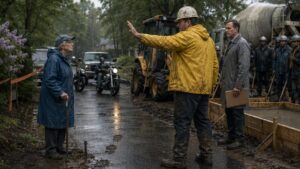
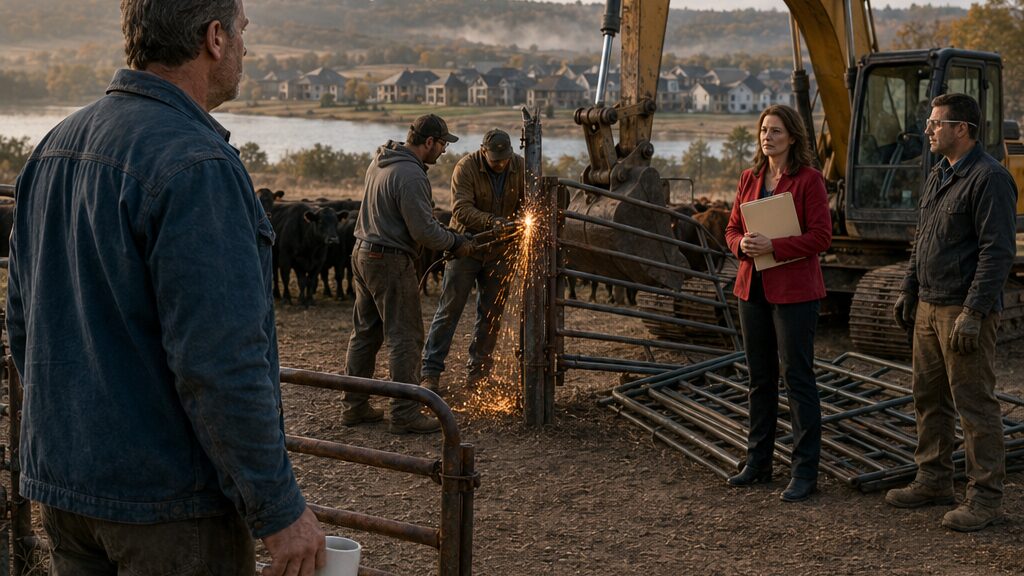
The steel livestock gate he had installed three nights earlier was throwing bright orange fragments into the cold air as a worker pressed a cutting saw into the hinge post. An excavator sat behind the fence line with its engine running. A flatbed truck waited beside it, already positioned like someone had decided the work was finished before he ever knew it had started.
Timothy did not move at first.
The ranch was supposed to be quiet at that hour. The cattle were supposed to be moving slowly toward the water trough after the night. The only people who should have been near the boundary were the ones who lived there.
Instead, strangers were cutting apart the thing that kept his animals contained.
He set his mug on the fence rail and walked toward them.
“Turn that off.”
The worker looked up but did not remove his safety glasses.
A woman standing near the truck did.
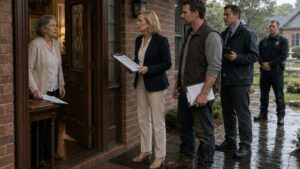
Rebecca Miller wore a clean red jacket that looked untouched by the dust around her. She held a folder against her side, protected from the flying dirt and metal fragments. She looked less like someone standing beside a ranch fence and more like someone arriving at a scheduled meeting.
“Mr. Harris,” she said. “You need to step back from the work area.”
Timothy looked past her at the cut post.
“Who gave you permission to cut my gate?”
Rebecca opened the folder.
“The Lakeside Ridge Homeowners Association issued an enforcement removal authorization. This structure was installed without approval and extends into the association’s protected boundary corridor.”
Timothy stared at her.
“My cattle gate?”
“The metal structure,” Rebecca corrected.
“That’s what you call it?”
The saw stopped briefly. The worker glanced toward Brian Walker, the crew supervisor, who stood beside the excavator controls.
Brian walked closer.
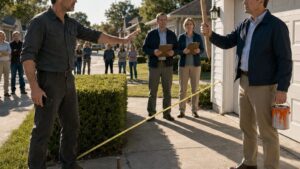
“We have paperwork from the association. We’re just removing the non-approved fencing and replacing it with the approved perimeter design.”
Timothy looked at the folder in Rebecca’s hand.
“Show me the parcel number.”
Rebecca hesitated for only a moment before opening the document.
He took out his phone and photographed the page.
“You don’t even have the right parcel listed.”
Rebecca’s expression tightened.
“The property exhibit matches the development boundary.”
“An exhibit isn’t my deed.”
“It’s the approved boundary plan.”
“It’s a picture your development uses.”
The worker behind them started the saw again.
Timothy turned.
“Stop.”
Brian lifted a hand.
“Sir, I understand you’re upset, but we have a contract.”
“You have a contract with someone who doesn’t own this gate.”
The machine noise swallowed the rest of his sentence.
The second hinge post began to glow.
Behind the damaged opening, several cattle lifted their heads. They had learned the sound of the gate. They knew the path. They started drifting toward the gap, confused by the sudden movement in their usual route.
Timothy noticed before anyone else did.
The fence was not decoration.
It was not an improvement meant to satisfy a neighborhood rule.
It was the only thing between a pasture lane and a road where vehicles moved faster than people expected.
He stepped closer to Brian.
“Your crew needs to understand something. If that gate comes down, the cattle route opens toward the county road.”
Brian looked past him.
“Then you should have gotten approval before installing it.”
Timothy felt the anger rise, but he kept his voice level.
“I repaired it because the old corner collapsed.”
“After the storm,” Rebecca said. “And without submitting the required materials.”
Timothy looked at her.
“I sent notice.”
“You sent a message saying you were making repairs.”
“Because repairs were needed.”
Rebecca closed the folder.
“And because you ignored follow-up requests for details, the association had no choice but to proceed.”
That sentence bothered him more than the machinery.
No choice.
He had heard those words before. Usually from people who wanted to make their decision sound inevitable.
A worker grabbed the first gate panel.
Timothy stepped forward.
“Put that down.”
The worker stopped.
Brian looked annoyed.
“Mr. Harris.”
“That panel belongs to me.”
“We’re removing it as part of the project.”
“Photograph it first.”
Brian frowned.
“What?”
“Your authorization. The truck. The panel. The serial number on the equipment. Everything.”
Rebecca gave a small, impatient breath.
“You think taking pictures changes the situation?”
“No,” Timothy said. “I think remembering what happened does.”
He walked to the edge of the work area and began recording. Not angrily. Not dramatically.
Just carefully.
The camera captured the cut post.
The excavator.
The workers.
Rebecca’s folder.
The gate panel being lifted away.
The cattle gathering behind the opening.
Brian noticed the phone.
“Are you recording my crew?”
“Yes.”
“Why?”
“Because right now everyone here seems certain they’ll remember this differently later.”
For the first time, Brian looked uncertain.
Rebecca noticed too.
“Continue the work,” she said.
Brian looked at the open lane.
“Rebecca—”
“Continue.”
The saw started again.
Timothy looked down at his white mug still sitting on the fence rail.
A normal morning object.
A reminder that he had walked outside expecting coffee, not a fight.
He picked it up and moved it farther from the cutting sparks.
Then he heard a sound that changed the entire situation.
A low, heavy movement behind him.
The cattle were no longer watching.
They were moving.
The open gate had become an invitation.
And beyond the pasture was the road.
Rebecca pulled out her phone.
“I’m calling the authorities.”
Timothy looked at her.
“For what?”
“For interference with authorized work.”
He almost laughed, but there was nothing funny about it.
“You cut my gate open, and I’m the interference?”
Rebecca did not answer.
A few minutes later, a county deputy vehicle appeared at the end of the ranch road.
The deputy stepped out, looked at the machinery, the damaged gate, the paperwork, and finally the cattle gathering near the opening.
He did not reach for his radio immediately.
He just stared.
Because the first thing he saw was not a boundary dispute.
It was an open path from a pasture to a highway.
And Timothy knew the next few minutes mattered more than proving who was right.
The gate was already gone.
Now he had to stop what the missing gate had allowed.
Chapter 2: The Missing Gate Changed More Than the Boundary
One heifer was through the opening before the deputy finished reading the enforcement notice.
Timothy saw the animal’s head rise beyond the broken fence line, and everything else became secondary.
The argument.
The papers.
Rebecca’s authorization.
The contractor’s schedule.
None of it mattered if a two-thousand-pound animal reached the county road.
“Close that lane,” Timothy said.
The deputy turned.
“Can you get the animal back?”
“Yes.”
“Then do that first.”
It was the first thing anyone had said all morning that sounded practical.
Timothy moved toward the pasture slowly. He did not shout. He did not wave his arms. The cattle knew his voice, and they knew his routine.
Behind him, Brian lowered the machinery.
The workers stopped.
Even Rebecca stopped taking pictures for a moment.
The missing gate had changed the mood of everyone standing there.
When the gate was closed, it had been an argument about ownership.
When the gate was gone, everyone could see what it had been doing.
Timothy guided the heifer back through the opening while the other cattle pressed against the remaining fence. The animal resisted for a few seconds, then followed him toward the pasture.
Donna Harris came from the barn carrying a jacket over her arm.
“What happened?”
Timothy looked at her.
“They removed the gate.”
Her eyes moved to the empty space.
The expression on her face changed.
“That was the only route between the lower pasture and the water.”
“I know.”
“And the barn access?”
Timothy did not answer immediately.
Because he knew she was right.
The gate was not just about cattle.
It was the path Donna used when she needed to bring supplies from the storage building. After her knee surgery, walking the longer route around the property had become difficult.
She looked toward Rebecca.
“You removed this without checking how the ranch actually operates?”
Rebecca straightened.
“We followed the association process.”
Donna looked at the open ground.
“Your process doesn’t know where the animals walk.”
Rebecca looked away.
Timothy noticed.
It was brief.
Almost nothing.
But for the first time, Rebecca looked at the damage instead of the paperwork.
Then the moment passed.
“The temporary opening can be secured once the approved fencing is installed,” she said.
Timothy looked at the excavator trench.
“Your crew removed the gate before installing anything.”
Brian rubbed his forehead.
“We were scheduled to replace this section today.”
“On whose land?”
Nobody answered.
The deputy stepped between them.
“Everyone needs to stay calm. This is a civil issue. I’m not deciding property lines.”
Timothy nodded.
That was exactly what he expected.
The deputy could stop people from fighting.
He could document what happened.
He could not tell a map which piece of dirt belonged to whom.
The workers eventually moved some temporary equipment panels into position. They were not designed as a permanent barrier, but they reduced the immediate opening.
Timothy watched them place the panels where his gate had been.
A strange feeling settled over him.
The people who removed the safety measure were now trying to recreate it.
Poorly.
Rebecca photographed the temporary panels.
“You understand this is another unauthorized modification.”
Timothy looked at her.
“You’re photographing the thing your removal made necessary.”
“It does not change the fact that your original installation was not approved.”
He almost responded.
Then he stopped.
Because that was the trap.
Every conversation returned to approval.
Not cattle.
Not roads.
Not the storm damage.
Not why the repair existed.
Approval.
That evening, after the workers left, Timothy sat at the kitchen table with Donna and looked through the documents he had.
She held up a printed email.
“Did you answer this?”
He looked at it.
The HOA request for additional information.
Photos.
Drainage details.
A sketch of the temporary repair.
He remembered receiving it.
He remembered seeing the request.
And he remembered thinking he did not have time to explain something that was obvious to anyone who understood the land.
“No,” he said.
Donna looked at him.
“Timothy.”
“I was fixing a fence.”
“You were fighting a system.”
“I didn’t ask for a fight.”
“No. But you also didn’t tell them enough to stop one.”
The words bothered him because they were fair.
He had spent years believing experience should count for something.
And it should.
But he had mistaken experience for explanation.
The next morning, he drove to the boundary with the enforcement order in his truck.
He read it again.
Then he noticed something.
The parcel number.
He checked it against his tax documents.
Then against his property records.
They were different.
Timothy called Donna over.
“Look at this.”
She leaned closer.
“What does that mean?”
“I don’t know.”
He stared at the paper.
The HOA had been confident.
The crew had been confident.
Rebecca had spoken like the answer was already settled.
But the number on the order did not match the land beneath his feet.
For the first time since the saw started cutting, Timothy wondered if the problem was not that the HOA misunderstood the gate.
Maybe they had misunderstood the ground itself.
Chapter 3: The Marker Proved Less Than Timothy Needed
The old survey cap was buried beneath the dirt where the excavator had already passed.
Timothy found it because the machine had disturbed enough soil to expose something that had been hidden for years.
A small metal marker.
Not impressive.
Not dramatic.
Just a piece of the property history that had been sitting quietly while everyone argued over a map.
Kathleen Davis knelt beside it and brushed away the dirt.
“Don’t touch it.”
Timothy pulled his hand back.
“You know what it is?”
“I know what it might be.”
That answer frustrated him.
He had expected certainty.
A clear answer.
A point where someone could finally say: This is yours. This is theirs.
Instead, Kathleen studied the marker like it was one piece of a much larger puzzle.
“It appears to be a survey monument.”
“Appears?”
She looked up.
“Mr. Harris, a marker can tell us something important. It cannot tell us everything.”
Timothy looked across the damaged fence corridor.
The HOA’s temporary stakes stood farther inside his pasture than the old fence line.
The sight still felt wrong.
But Kathleen’s caution slowed him down.
“What does it prove?”
“That this area may belong to your parcel.”
“May?”
“It supports your claim.”
He waited.
She continued.
“But it does not automatically prove every post location you installed was correct.”
Timothy looked at her.
The words landed harder than he expected.
Because part of him had wanted the marker to erase every mistake.
His.
Rebecca’s.
Everyone’s.
But the land did not work that way.
The land only recorded what happened.
It did not choose sides.
Kathleen walked along the corridor, studying the old fence remains.
“The original fence line moved over time.”
“Moved?”
“Maintenance. Repairs. Erosion. Different owners making practical decisions.”
Timothy looked toward the damaged corner.
“That’s what I did.”
“Yes.”
The honesty bothered him.
But it also helped.
Kathleen opened a folder.
“I reviewed the HOA exhibit. Rebecca’s document is not a boundary survey.”
“So she was wrong.”
“About using it as proof, yes.”
Timothy waited.
Kathleen looked at him.
“But your temporary fence placement also needs review.”
He looked away.
The answer was not the one he wanted.
The old version of himself would have rejected it immediately.
But that version of himself had also ignored emails and assumed explanations were unnecessary.
“What about the gate?”
Kathleen studied the records.
“That depends.”
“On what?”
“On whether the access agreement is still valid.”
They searched county records that afternoon.
The document they found was older than the development surrounding the ranch.
It described a corridor.
A route.
An agricultural access point.
Kathleen read the language carefully.
Then she stopped.
“What?”
She looked back at the page.
“This agreement references a working livestock gate.”
Timothy felt something shift.
Not victory.
Not yet.
Something more complicated.
“The HOA knew there was a gate?”
“Someone connected to the development knew.”
“Then why remove it?”
Kathleen did not answer immediately.
Because the answer was not written in the document.
It was in the decisions people made afterward.
When they returned to the ranch, Timothy saw Brian near the new fencing materials.
The contractor looked uncomfortable.
Timothy approached him.
“You knew those stakes didn’t match.”
Brian did not deny it.
“I noticed.”
“When?”
“Before we cut the post.”
Timothy stared at him.
“Then why did you keep going?”
Brian looked toward the development.
“Because I had a signed authorization. And because stopping a crew costs money.”
It was not a good answer.
But it was an honest one.
Timothy understood something then.
The machinery had not moved because everyone believed the same thing.
It moved because everyone had a reason to keep moving.
Rebecca wanted certainty.
Brian wanted payment.
The board wanted a finished project.
And Timothy wanted everyone to understand something he had never properly explained.
The gate was not a decoration.
It was not a challenge to authority.
It was a working part of a working ranch.
Kathleen folded the access agreement.
“There’s another problem.”
Timothy looked at her.
“What?”
“The agreement says the agricultural access point must remain operable.”
He looked back at the empty space where his gate had stood.
The cut hinge posts.
The disturbed ground.
The missing barrier.
The thing everyone had called a violation.
Now had a chance of being something the HOA was required to preserve.
But before Timothy could feel relief, his phone rang.
It was Donna.
“Timothy,” she said. “You need to come home.”
“What happened?”
“The HOA called an emergency meeting.”
“About what?”
A pause.
Then:
“They’re voting to approve the new fence anyway.”
Timothy looked toward the boundary.
The answer was becoming clearer.
But the fight was not over.
The HOA was no longer just defending a decision.
It was preparing to make that decision official.
Chapter 4: The Water Had Been Moving the Line for Years
The first rain after the gate was removed exposed what nobody wanted to discuss.
Water rushed through the open trench where Timothy’s steel hinge post had stood.
It came from the drainage channel above the ranch, crossed the edge of the pasture, and collected exactly where the old fence corner had failed months earlier.
Timothy stood beside the muddy cut in the ground with his boots sinking into the soft soil.
He watched the water move.
Then he looked toward the development.
The lake houses sat beyond the trees, clean and finished, their fences straight and uniform.
From a distance, they looked like a place where nothing went wrong.
But the land between them and the ranch told a different story.
Donna walked up beside him.
“You knew this was happening?”
Timothy shook his head.
“I knew the fence was failing.”
“That’s not what I asked.”
He looked at her.
She pointed toward the water.
“Did you know why?”
Timothy did not answer immediately.
Because the truth was uncomfortable.
He had noticed the corner getting worse. He had noticed the ground staying wet longer after storms. He had noticed the posts leaning.
But he had done what he always did.
He fixed what he could reach.
He handled what was in front of him.
“I thought I could repair the fence and deal with the drainage later.”
Donna nodded slowly.
“And that’s exactly what everyone else did.”
The sentence stayed with him.
Not because it was harsh.
Because it was true.
For years, every person involved had treated a piece of the problem.
The development built drainage improvements.
The HOA maintained appearances.
Timothy repaired the fence.
Nobody stepped back far enough to see how the pieces connected.
Kathleen Davis arrived later that morning carrying a waterproof folder.
She looked at the water channel before she looked at Timothy.
“That wasn’t visible before.”
“The rain helped.”
She walked along the edge.
“The original corner failed because the soil underneath was being displaced.”
“By the runoff?”
Kathleen nodded.
“I need to verify it.”
Timothy watched her examine the ground.
“You already know.”
“I suspect.”
“You always say that.”
“Because suspicion is not evidence.”
He almost smiled.
Kathleen had the same habit as every good person who worked with facts.
She refused to let certainty arrive before the facts did.
By afternoon, they were in Timothy’s ranch office reviewing old photographs.
The original fence.
The storm damage.
The temporary gate.
The drainage path.
Kathleen placed them side by side.
“The important thing is this.”
She pointed at the images.
“Your repair was not placed randomly.”
Timothy leaned closer.
“The old corner was unsafe.”
“Yes.”
“And the new gate avoided the worst ground.”
“Yes.”
He waited.
“But?”
Kathleen looked at him.
“But your documentation did not show that.”
The words landed quietly.
That was worse than an accusation.
Because there was no anger behind them.
Only reality.
Timothy looked down at the table.
“I should have sent the pictures.”
“Yes.”
“I should have answered their questions.”
“Yes.”
He rubbed his hand across his face.
He hated admitting it.
Not because he thought he was completely wrong.
He knew he was not.
But because he had spent years believing being right was enough.
It was not.
Facts needed a path to reach people.
And he had blocked part of that path himself.
A knock came at the office door.
Brian Walker stood outside.
Timothy looked surprised.
“You’re working?”
Brian held up his hands.
“I’m not here to argue.”
Timothy let him in.
Brian looked at the photographs on the table.
“I need to tell you something.”
Kathleen watched him carefully.
“When did you know the stakes were wrong?”
Brian looked uncomfortable.
“Before we cut the post.”
Timothy’s expression hardened.
“Then why did you keep going?”
Brian looked down.
“Because Rebecca told me the authorization was valid.”
“That isn’t an answer.”
“It’s the answer you’re going to get from a contractor who has employees waiting for a paycheck.”
Timothy said nothing.
Brian continued.
“I told her the survey stakes didn’t line up. I told her the gate looked like it had been there for a reason.”
“What did she say?”
Brian hesitated.
“She said stopping the project would create bigger problems.”
Kathleen looked toward Timothy.
There it was.
Not proof.
Not everything.
But another piece.
Rebecca had not been completely unaware.
She had been warned.
That evening, Timothy received a notice from the HOA.
An emergency board meeting.
The language was formal.
The kind of language that made decisions sound like weather.
“Review.”
“Authorization.”
“Completion.”
At the bottom was the part that mattered.
The board intended to approve the replacement fence and assign removal costs to Timothy.
Donna read it over his shoulder.
“They’re charging you?”
“They think they can.”
She looked at him.
“What are you going to do?”
Timothy stared at the notice.
Months ago, he would have answered immediately.
He would have gone there angry.
He would have told them exactly what they had done wrong.
But anger had not stopped the saw.
Anger had not brought back the gate.
He folded the paper carefully.
“I’m going to make them look at the whole thing.”
Donna nodded.
“Not just the part where you were right?”
He looked at her.
“No.”
The admission was difficult.
But necessary.
“The whole thing.”
Outside, the cattle moved through the temporary panels near the pasture.
The makeshift barrier held.
For now.
But Timothy knew temporary solutions had a way of becoming permanent when people stopped asking questions.
And the HOA was about to vote on a permanent answer built on a problem nobody wanted to fully see.
Chapter 5: The Board Approved a Fence It Had Not Seen
The first image on Rebecca Miller’s presentation showed Timothy’s gate.
But it was not the whole gate.
The photograph had been cropped.
The cattle lane was missing.
The county road was missing.
The water route was missing.
Only the metal structure remained.
“This is what the association was asked to address,” Rebecca told the board.
Timothy sat at the far end of the community room with Kathleen beside him.
He watched the board members study the image.
Most of them had never stood at the ranch boundary.
Most of them had never seen cattle moving through the opening.
They were deciding the future of his property from a rectangle of light on a wall.
Rebecca continued.
“The association has a responsibility to maintain consistent boundaries and reduce liability.”
Timothy raised his hand.
The board president nodded.
“You may respond.”
Timothy stood.
“I want to start with something simple.”
He walked toward the screen.
“Can you show the full photograph?”
Rebecca looked at him.
“It is not relevant.”
“It is the same photograph.”
“It is an edited presentation image.”
“Exactly.”
A few board members shifted.
Timothy connected his phone.
The full image appeared.
The difference was immediate.
The gate was no longer floating in empty space.
Behind it were the pasture lanes.
The barn route.
The county road.
The water access.
The reason the gate existed.
One board member leaned forward.
“I didn’t realize the road was that close.”
Timothy looked at him.
“That’s because the picture was taken out of context.”
Rebecca stepped in.
“The location does not change the approval issue.”
Timothy turned.
“No. But it changes the safety issue.”
Silence followed.
He placed the cut hinge section on the table.
Not dramatically.
Not like evidence in a courtroom.
Just a piece of steel that showed what had happened.
“This gate was removed because it did not match a standard.”
Rebecca shook her head.
“That is not accurate.”
“Then tell me why it was removed.”
“Because it was installed without proper review.”
Timothy nodded.
“That’s part of it.”
Rebecca looked surprised.
He continued.
“I should have provided more information. I should have responded to the requests I received.”
Kathleen glanced at him.
The admission changed the room.
Because it removed the easiest argument against him.
He was not pretending to have done everything perfectly.
“But,” Timothy said, “a mistake in communication does not turn a working safety structure into something that can be removed without understanding what it protects.”
One board member looked at Rebecca.
“Did anyone visit the property before authorizing removal?”
Rebecca paused.
“We reviewed the documents.”
“That wasn’t my question.”
The room became quieter.
Rebecca looked down.
“No.”
Timothy noticed something.
For the first time, she seemed less certain.
Not defeated.
Just aware that the situation had become larger than the paperwork.
Kathleen spoke next.
“The development exhibit used by the HOA is not a recorded boundary survey.”
Rebecca responded quickly.
“But it has been used for years.”
“As a planning document.”
“And the association relied on it.”
Kathleen nodded.
“That appears to be true.”
The answer surprised Timothy.
Kathleen was not attacking Rebecca.
She was separating what happened from why it happened.
The meeting continued for more than an hour.
Maps were displayed.
Documents were reviewed.
Questions were asked.
By the end, the board voted to pause additional fence construction.
Timothy expected relief.
Instead, the motion contained a condition.
The gate would not be restored until a thirty-day review period was complete.
Timothy looked at the board.
“Thirty days?”
“The board needs time.”
“My livestock route cannot wait thirty days.”
“The temporary barrier is in place.”
Timothy looked around the room.
They were still discussing the situation as if the problem existed on paper.
Not on the ranch.
Not beside the road.
Not where animals moved.
He wanted to argue.
But he stopped.
He had spent years believing the strongest voice won.
He knew better now.
Documentation mattered.
Precision mattered.
He simply said:
“Then I need that decision recorded exactly as stated.”
Rebecca watched him.
“You’re preparing for another dispute.”
“No.”
Timothy gathered his papers.
“I’m preparing so nobody can say they misunderstood what happened.”
The next morning, the county road inspector arrived at the ranch.
Timothy met him near the temporary panels.
The inspector looked toward the cattle.
Then toward the road.
“I’m giving you forty-eight hours.”
“For what?”
“To secure the opening.”
Timothy stared at him.
“I’m trying.”
“I know.”
The inspector pointed toward the disputed corridor.
“But trying is not the same as having a solution.”
After he left, Timothy stood beside the empty space where his gate had been.
Forty-eight hours.
The HOA would not restore it.
The county would not allow the opening to remain.
And rebuilding the old gate without approval would only give Rebecca another reason to claim he ignored the process.
He looked toward the interior pasture.
Then toward the disputed boundary.
A thought formed.
Not a way to win.
A way to solve the problem.
But it would require him to give up something.
And he was not sure he was ready to decide what.
Chapter 6: He Built the Alternative They Could Not Ignore
Timothy drove the first post into the ground before sunrise.
Not on the disputed boundary.
Inside his own pasture.
The temporary containment line was not the fence he wanted.
It was not the gate he lost.
It was a solution.
That difference mattered.
Donna watched from the truck.
“You’re giving them what they wanted.”
Timothy looked back.
“No.”
He tightened the wire.
“I’m giving the cattle what they need.”
The temporary interior panels created a safe route away from the county road. They protected the livestock without accepting the HOA’s claimed boundary.
And that was the part Rebecca had not expected.
The HOA could block a disputed fence.
It could not force Timothy to leave his animals unsafe while the dispute continued.
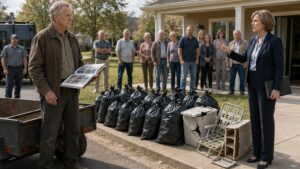
By afternoon, Rebecca arrived with Brian and two board representatives.
She looked at the new containment route.
“You built another structure.”
“Yes.”
“Without approval.”
Timothy nodded.
“Yes.”
Rebecca looked ready to respond.
Then she stopped.
Because this time the answer was different.
The first repair had been undocumented.
This one had photographs.
Measurements.
A written safety explanation.
A copy sent to the county.
A copy sent to the insurance representative.
Timothy had finally learned the lesson he resisted.
A person could know the land and still need records.
Brian walked the new route.
“This works.”
Rebecca looked at him.
“That isn’t your decision.”
“No,” Brian said. “But it is what I see.”
The sentence changed the conversation.
Not because Brian became an ally.
He had not.
He still wanted his company paid.
But he was no longer pretending the situation was simple.
Kathleen arrived later with the updated survey results.
Everyone gathered near the boundary.
“The ownership issue is clearer now,” she said.
Rebecca crossed her arms.
“And?”
“And Timothy’s parcel includes the disputed strip.”
Timothy exhaled.
But Kathleen continued.
“However, the temporary repair line he installed before was not completely supported by the historical records.”
Nobody spoke.
Timothy looked at the ground.
A month earlier, he would have fought that sentence.
Now he listened.
“How much?”
Kathleen pointed.
“A small adjustment.”
“Meaning?”
“Meaning you were correct that the HOA crossed onto your property. But you were not correct about every foot of the temporary placement.”
Rebecca looked at him.
There was no victory in that moment.
Only accuracy.
And somehow, that felt stronger.
The next day, the insurance representative sent a written statement.
The association’s continued refusal to address the safety issue could increase liability exposure.
The language was careful.
Professional.
But the meaning was clear.
The HOA could no longer claim that waiting was safer.
Rebecca requested another meeting.
This time, it was not about enforcement.
It was about settlement.
She placed a document on the table.
Timothy read it.
Then looked up.
“No.”
Rebecca frowned.
“You haven’t read the entire agreement.”
“I read enough.”
The agreement required confidentiality.
It released the HOA from future drainage claims.
It restored the gate.
But it also erased the reason the problem happened.
Rebecca looked tired.
Not angry.
Tired.
“If this becomes public, residents will blame the board.”
Timothy looked at her.
“They should know what happened.”
She looked away.
“Do you know what happens when people think their leaders made mistakes?”
“Yes.”
“They lose confidence.”
Timothy nodded.
“I know.”
He folded the paper.
“Because that’s what happens when someone thinks admitting a mistake is worse than fixing it.”
Rebecca was silent.
For the first time, Timothy saw the pressure behind her decisions.
Not cruelty.
Fear.
Fear of admitting the development had contributed to the problem.
Fear of explaining the costs.
Fear of looking unprepared.
But fear did not remove responsibility.
“I’m willing to adjust the line,” Timothy said.
Rebecca looked at him.
“But I’m not willing to hide what happened.”
The room stayed quiet.
Then Rebecca picked up the agreement.
She removed the confidentiality section.
“What are your terms?”
Timothy looked down at his notes.
The old version of himself would have asked for punishment.
For a public admission.
For everyone to know he had been right.
Instead, he listed what mattered.
Restore safe access.
Repair the drainage problem.
Replace damaged materials.
Cover documented losses.
Create a process requiring field verification before future enforcement near working properties.
Rebecca listened.
No argument.
No interruption.
When he finished, she nodded slowly.
“I’ll take it to the board.”
Timothy looked out the window toward the ranch.
The gate was still missing.
The old fence was still damaged.
But for the first time since the saw started cutting, the next step was no longer controlled by a machine.
It was controlled by a decision.
And this time, everyone involved had to look at the entire piece of land.
Chapter 7: The Restored Gate Opened on the Right Side
The excavator arrived at the ranch at seven in the morning.
Timothy was already standing beside the boundary line with the certified survey plan folded in his hand.
For a moment, the sight looked almost identical to the morning everything went wrong.
A machine.
A crew.
A fence line.
But there was one important difference.
The excavator was not running.
Brian Walker climbed down from the truck and walked toward him.
“Morning.”
Timothy nodded.
“Morning.”
Brian looked at the plan.
“You want to verify the stakes before we start?”
“Yes.”
Brian glanced toward the machine.
“Fair enough.”
Three weeks earlier, Timothy would have found satisfaction in that sentence.
The same crew that had cut through his gate was now waiting for him to confirm where the machine could move.
But the feeling was different than he expected.
There was no victory in making someone wait.
Only responsibility.
Kathleen Davis stood near the new survey markers while the crew checked measurements.
“The line is correct,” she said.
Timothy looked toward the old fence corner.
“The adjustment still bothers me.”
Kathleen nodded.
“I know.”
“I spent thirty years maintaining that boundary.”
“And you still missed part of the record.”
He smiled slightly.
“Sounds like you enjoy reminding me.”
“No.”
Kathleen looked at the damaged materials stacked nearby.
“I think you needed someone to tell you that knowing a place and documenting a place are different skills.”
Timothy looked at the steel pieces.
The old gate panels.
The cut hinge section.
The pieces that had been loaded away like they were nothing more than unwanted material.
“They both matter.”
“Yes.”
The crew began installing the new gate.
Not a replacement of the exact old structure.
A better one.
The design kept the ranch access.
Protected the cattle route.
Followed the verified boundary.
And respected the small adjustment where Timothy’s temporary placement had not been fully supported.
That compromise had been the hardest part.
Not because he lost land.
He did not.
Not because he lost the argument.
He did not.
It was difficult because accepting the correction meant admitting something he had spent his life avoiding.
He could be right about the important thing and still be wrong about part of the way he handled it.
Rebecca arrived before noon.
She walked toward the gate quietly.
She was different from the first morning.
The confidence was still there.
But it no longer carried the same certainty.
The folder in her hand looked heavier.
“The board approved the settlement.”
Timothy nodded.
“What changed?”
Rebecca looked at the new gate.
“Everything became harder to ignore.”
She handed him a document.
“The violation notice has been withdrawn.”
Timothy read the page.
“The drainage repair?”
“Scheduled.”
“The reimbursement?”
“Approved.”
“The damaged materials, feed disruption, and veterinary costs?”
“Covered under the settlement.”
He looked up.
“And the field verification requirement?”
Rebecca nodded.
“That passed as well.”
Timothy folded the document.
It was what he wanted.
But it was not the way he imagined it.
No public meeting.
No dramatic admission.
No moment where everyone stood and agreed he had been right.
Just paperwork.
The same kind of thing that had caused the problem.
Only this time, it was being used to prevent one.
Rebecca looked toward the gate.
“There’s one more thing.”
Timothy waited.
“The insurance review will cover most of the association’s costs.”
“And the rest?”
She looked back toward the development.
“Reserves.”
Timothy understood.
The residents would pay part of it.
Not because they had personally ordered the removal.
But because communities often shared the consequences of decisions made in their name.
Rebecca noticed his expression.
“You expected that to make you feel better.”
“No.”
She seemed surprised.
“What did you expect?”
Timothy looked at the gate.
“I expected fixing the damage to fix everything.”
Rebecca was quiet.
“But it doesn’t.”
“No.”
He looked at the ranch.
“The gate being back doesn’t return the time.”
That was the part nobody could reimburse.
The mornings spent gathering documents.
The hours spent moving cattle through temporary barriers.
The uncertainty.
The feeling of standing on his own land while proving he belonged there.
Rebecca nodded.
“I understand.”
Timothy looked at her.
Did she?
Maybe not completely.
But more than before.
That mattered.
Later that afternoon, Donna drove the truck through the restored opening for the first time.
She stopped halfway and looked back.
“You know, this is the first time in weeks I haven’t had to plan my day around a missing gate.”
Timothy smiled.
“That’s a strange thing to miss.”
“It’s a strange thing to lose.”
The cattle moved toward the water route.
Slowly.
Naturally.
Like they had been waiting for the land to make sense again.
Timothy carried his white mug outside and placed it on the new gatepost.
The same mug from the morning of the cutting.
The same ordinary object.
But it no longer represented the moment before everything changed.
It represented the moment after.
He kept the damaged hinge section inside the barn.
Not displayed.
Not mounted.
Not turned into a warning sign.
Just stored.
A record.
Something that showed what happened without becoming the only thing that mattered.
That evening, Timothy stood near the fence line as the sun lowered behind the development.
The long row of replacement fencing ended exactly where the certified boundary said it should.
The ranch looked the same.
And it did not.
He had learned something he never expected to learn.
Ownership was not only about having the right papers.
It was about being willing to create the record.
To explain.
To listen.
To protect what mattered without pretending every answer was obvious.
The gate swung open.
The cattle followed the correct path.
And this time, nobody was guessing where the boundary ended.
The story has ended.