They Bulldozed Katherine’s Garden for Breaking HOA Rules—Then the Old Boundary Line Changed Everything
Chapter 1: The Machine Was Already Inside Her Garden
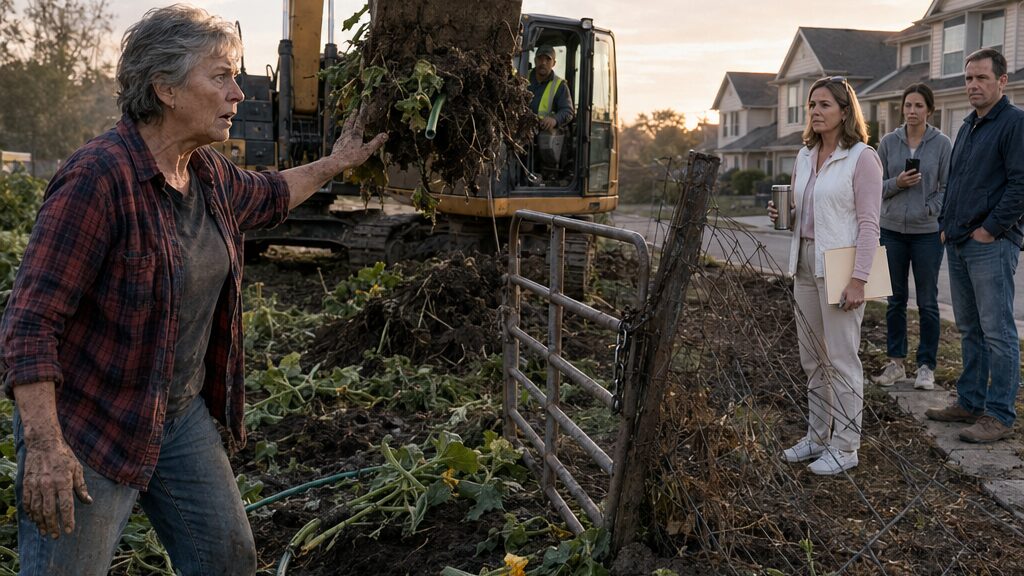
The excavator bucket rose above Katherine Mitchell’s bean rows carrying a black mass of roots, irrigation tubing, and young zucchini plants.
For one second she did not understand what she was seeing.
Then the bucket swung.
Soil rained from it in heavy clods. A snapped length of green hose slapped against the steel teeth. The plants she had set out six weeks earlier—plants she had covered through two late cold nights with old bedsheets and clothespins—fell into a growing mound beside the fence.
Katherine ran.
“Stop!”
The machine’s engine swallowed her voice.
She crossed the gravel behind her house in work boots she had not tied properly, one lace striking her ankle. The old gate at the end of the drive was shaking against its chain. Beyond it, the excavator had entered through a section of wire fencing that had been folded down toward the garden.
A second scoop bit into the edge of a raised row.
Katherine stepped through the broken fence.
“Stop the machine!”
The operator saw her then. His head turned sharply inside the cab. The bucket froze halfway down.
Katherine kept moving until she was directly in his line of sight. Her breath scraped in her throat. She could smell diesel, torn tomato leaves, damp clay.
“Back it out,” she said.
The operator lifted both hands from the controls.
A woman’s voice came from behind Katherine.
“Do not interfere with contracted work.”
Katherine turned.
Sandra Wright stood on the subdivision side of the old gate with a stainless travel mug in one hand and a folder tucked beneath her arm. She wore clean white sneakers that had not touched the garden mud. Behind her, two neighbors watched from the sidewalk. One had a phone held upright.
Katherine looked from Sandra to the machine.
“What contracted work?”
“You received notice.”
“I received fines.”
“You received multiple compliance notices.”
“That is not an answer.”
Sandra’s mouth tightened. “The board authorized removal of the noncompliant agricultural installations.”
Katherine looked at the torn rows.
“Those are vegetables.”
“The activity was addressed in writing.”
“You put a machine on my land.”
Sandra exhaled as if Katherine had chosen to be difficult in a way that exhausted everyone but herself.
“The board voted.”
The sentence landed strangely.
Not because Katherine had not expected it. For three months every exchange had ended with some version of the same claim: the board had reviewed, the board had determined, the board had authority.
But standing beside the broken fence, with dirt still sliding from the excavator’s bucket, Katherine heard what Sandra had not said.
She walked toward the operator.
“Do you have a work order?”
He looked past her toward Sandra.
“I asked you.”
The operator leaned down inside the cab and picked up a clear plastic sleeve. “I’ve got a site sheet.”
“Let me see it.”
“Katherine,” Sandra said, “you are not directing the contractor.”
Katherine held out her hand.
The operator hesitated, then opened the cab door and passed the sleeve down.
Sandra’s shoes finally touched the dirt.
“That document is for the contractor.”
Katherine ignored her.
The top page bore the HOA management company’s name. Beneath it was a short description of work: remove unapproved planting structures and clear encroaching agricultural use along common boundary.
Her eyes moved lower.
There was a tract reference.
She read it once.
Then again.
The sound around her seemed to recede until she heard only the idle knock of the diesel engine.
Sandra reached for the sleeve. “You’ve seen enough.”
Katherine did not release it.
The tract number ended in 18B.
She knew 18B.
Not because she had memorized every county record. Not because she was a surveyor or lawyer.
Because years ago her husband had written that number in red pencil across a folded plat on their kitchen table and said, That one is theirs. Ours is the old piece behind it.
Katherine looked toward the gate.
The gate had never sat where people assumed the line was.
That had been the problem.
And perhaps the protection.
“What parcel number are you enforcing against?” she asked.
Sandra held out her hand for the sleeve. “The affected property is clearly identified.”
“What parcel number?”
“You are standing in the violation area.”
“That is not a parcel number.”
One of the neighbors lowered the phone slightly.
Sandra’s face changed—not much, but enough. A tiny pause before irritation returned.
“The subdivision property records have been reviewed.”
“By whom?”
“Our management office and counsel.”
“What parcel number?”
Sandra gave a short, humorless laugh.
“This is exactly why the board had to act. Every simple compliance issue becomes an interrogation.”
Katherine looked again at the site sheet.
18B.
The machine had already crossed well beyond the gate. It had torn through the zucchini bed and the outer edge of her pollinator strip. Another ten feet and it would reach the first hive stand.
Her fear did not leave. It narrowed.
She gave the sleeve back to the operator.
“Do not move that machine until someone shows you the parcel you were hired to clear.”
The operator rubbed his jaw. “Ma’am, I’m just here on the ticket.”
“And the ticket identifies 18B.”
He looked down at the page.
Sandra stepped between them.
“The board has legal authority to correct continuing violations affecting the community.”
Katherine pointed toward the houses beyond the fence.
“Those houses are in the community.”
Then she pointed toward the uprooted rows.
“Tell me what parcel that is.”
Sandra’s grip tightened around her mug.
“The boundary is obvious.”
Katherine almost answered.
The words rose immediately: No, it isn’t.
She could have told them about the old plat. About the red pencil line. About the peculiar strip of land left when the subdivision was drawn around an older agricultural tract. About the years of arguments between her husband and a developer over where a gate could open.
She said none of it.
Pride arrived disguised as caution.
Why should she explain her own property history to a woman who had sent a machine before answering a single direct question?
Sandra took Katherine’s silence as weakness.
“You had months to resolve this.”
“I asked for the rule.”
“You received the board’s decision.”
“I asked for the rule.”
“And you chose not to comply.”
A bee moved through the torn lavender near Katherine’s boot, circling once over a crushed stem.
From the cab, the operator said, “I can hold off until somebody confirms the site.”
Sandra turned on him.
“You have written authorization.”
“I’ve also got a homeowner standing in front of the machine.”
“She is obstructing lawful work.”
Katherine looked at Sandra.
“Lawful under what parcel?”
This time Sandra did not even pretend to answer.
She opened the folder under her arm, removed a printed page, and held it toward the operator.
“The board voted at a properly noticed meeting. Management issued the work order. Continue with the contracted scope.”
The operator stared at the page.
“Katherine,” Sandra said, quieter now, “step away.”
Katherine felt something colder than anger move through her.
She looked at the number on the site sheet one last time. 18B.
Then at the old gate, still trembling faintly where the chain had been struck.
Behind that gate, years ago, her husband had drawn a red line and made her promise not to let anyone simplify what was not simple.
She had spent years wishing he had finished the matter himself.
Now a machine stood in the unfinished space.
Katherine stepped aside.
Not because Sandra had won.
Because suddenly she needed to know exactly how wrong they were.
Sandra raised one hand toward the cab.
“Continue.”
The excavator engine deepened, and the bucket began to lower again.
Chapter 2: Four Hundred Dollars a Week for Growing Food
The first four-hundred-dollar notice had arrived beneath Katherine’s front door three months earlier, folded once down the middle as if someone had wanted to make certain she could not miss the amount.
She found it with soil still under her fingernails.
UNAPPROVED AGRICULTURAL ACTIVITY.
$400 PER WEEK UNTIL CORRECTED.
Katherine read it standing in the entryway.
Then she read it again at the kitchen table.
The notice listed “visible crop production,” “nonconforming apiary equipment,” and “commercial-style cultivation inconsistent with residential character.”
She looked through the window at six zucchini plants, two hive boxes, beans climbing twine, and a row of marigolds.
For several minutes she honestly believed the letter had been sent to the wrong house.
Her house itself was within the subdivision. The narrow cultivated ground behind it was older than the subdivision by decades. Most neighbors barely noticed the distinction. Katherine had stopped explaining it years ago because explanations invited opinions, and opinions had a way of becoming claims.
She emailed the management office that afternoon.
Please identify the exact covenant provision and parcel to which this notice applies.
The reply came two days later.
The board has determined that the activity is inconsistent with applicable community standards.
She wrote back.
Please send the exact provision.
Another reply.
The board’s authority includes enforcement of conditions affecting neighborhood use and appearance.
No section number.
No quotation.
No parcel.
Katherine called.
The property manager spoke in the patient tone of someone reading from notes.
“The board has reviewed the matter.”
“I understand that. What rule am I violating?”
“The agricultural use.”
“Where is it prohibited?”
“The board has interpreted the governing documents.”
“Which document?”
A pause.
“I can send you the compliance determination.”
“You already did.”
The second week brought another four hundred dollars.
Then photographs began.
A man with a clipboard stood outside the fence shortly after sunrise, aiming his phone at the gate hinges, the hive stands, the squash rows. Katherine walked toward him with a basket under one arm.
“Can I help you?”
He said he was documenting conditions.
“For whom?”
“Management.”
“Which parcel are you documenting?”
He glanced toward the road.
“I’m just assigned the inspection.”
Katherine had heard that sentence too many times in other forms. I’m just assigned. I’m just following. The board decided.
She went back to picking beans.
By the fourth week, the running balance on the notices was sixteen hundred dollars.
Brian Moore came through the side yard one afternoon carrying an empty produce crate. He had bought tomatoes from Katherine for years, though never in a formal enough way to satisfy anyone’s definition of commerce. Usually he left cash in an old coffee tin and took what she had too much of.
He read the notice on her counter.
“Four hundred a week?”
“Apparently zucchini is organized crime now.”
Brian did not smile.
“You could pull the roadside table for a while.”
“The table is on my ground.”
“I’m not saying it isn’t.”
“You sound like you are.”
“I’m saying they’re looking for a fight.”
Katherine folded the notice.
“I didn’t start one.”
Brian rubbed a thumb over the crate handle.
“No. But you do have a way of standing still until everybody else mistakes it for a challenge.”
She looked at him.
He raised both hands. “I’m going.”
After he left, she emailed the board again.
This time she attached a numbered list of questions.
What specific covenant language prohibited vegetables?
What authority extended to the hive stands?
What parcel was alleged to be within HOA jurisdiction?
Had the board reviewed the recorded plat?
Three days later, Sandra Wright called.
Katherine almost let it go to voicemail.
“Mrs. Mitchell,” Sandra began, “we need to stop talking past each other.”
“Good.”
“The board is not objecting to gardening as a concept.”
“As a concept.”
“We are dealing with the scale and character of the activity.”
“Then quote the rule.”
A breath on the line.
“You keep demanding a magic sentence. That is not how community governance works.”
“It is how fines should work.”
“The board has discretion.”
“Over what land?”
Sandra’s tone sharpened.
“You live in this association.”
“My house does.”
“And the activity is accessed through the neighborhood, visible from neighboring property, and creating concerns.”
“What concerns?”
“Traffic. Commercial use. Liability. Appearance.”
“I have six rows of vegetables.”
“You have hives.”
“Two.”
“You have people stopping at the gate.”
“Neighbors.”
“People like you always reduce the issue until it sounds absurd.”
The words sat between them.
Katherine said, “People like me?”
Sandra was quiet for half a second.
“People who refuse every reasonable attempt at compliance.”
“Send me the bylaw.”
“You can either correct the activity or continue accruing fines.”
The call ended there.
Katherine remained at the kitchen table with the phone in her hand.
Humiliation was an odd feeling at sixty-six. It did not burn the way it had when she was young. It settled deeper, mixed with disbelief. Sandra had made her sound childish, stubborn, almost dishonest, and Katherine hated most that some part of the description had found a place to attach.
The next morning Jennifer Baker came alone.
She stood outside the old gate rather than opening it.
“I’m not here officially.”
Katherine continued tying tomato vines.
“That usually means somebody is here officially without wanting responsibility for it.”
Jennifer winced.
“I voted for enforcement.”
Katherine’s hands stopped.
“At least you said it plainly.”
“We were told there was a continuing agricultural violation and an insurance concern.”
“By Sandra?”
“By the board packet.”
“Did you read the rule?”
Jennifer looked toward the subdivision.
“I read the summary.”
Katherine gave a small nod. “Of course.”
“That’s fair.”
“No, it isn’t. But it is familiar.”
Jennifer stepped closer to the gate.
“I went back through the packet after your emails.”
“And?”
“There wasn’t an old plat.”
Katherine felt her shoulders tighten.
Jennifer noticed.
“I asked whether anyone had checked the original boundary.”
“What did Sandra say?”
“That management had verified jurisdiction.”
“Did you see that verification?”
“No.”
The two women stood with the gate between them.
Jennifer lowered her voice.
“If you have older property papers, bring them to the next meeting.”
Katherine returned to the tomato vine.
“No.”
Jennifer blinked. “Why not?”
“Because I asked them to show their authority. I’m not doing their work for them.”
“Katherine, if you have something that settles this—”
“They sent fines before they settled it.”
“That doesn’t mean you should let it get worse.”
Katherine tied the vine too tightly. The stem bent under the twine.
She loosened it without looking at Jennifer.
“Thank you for coming.”
Jennifer stayed another moment.
Then she said, “Sandra is talking about physical correction if the violation continues.”
Katherine finally looked up.
“What does that mean?”
“I don’t know.”
But her face said she knew enough to be afraid of the answer.
A week later, the excavator entered the garden.
Two nights after that, Katherine stood in the bedroom she had shared with her husband and opened the bottom drawer of an old oak dresser.
Beneath tax folders and a stack of appliance manuals lay a thick cream envelope.
The county surveyor’s seal was still visible.
Across the front, in her husband’s handwriting, were four words:
GATE ISSUE — DO NOT LOSE.
Katherine sat on the edge of the bed with the envelope in both hands.
She broke no seal.
She opened nothing.
Instead, she carried it to the kitchen, placed it beside the newest four-hundred-dollar notice, and stared at it until the room went dark around her.
Chapter 3: The Red Line Behind the Fence
The old plat put Katherine’s garden outside the subdivision.
At 12:17 in the morning, under the yellow light above her kitchen table, she traced the boundary three times before she allowed herself to believe what she was seeing.
The subdivision line ran in a clean black angle behind the residential lots.
Her cultivated tract sat beyond it.
Separate.
Older.
The parcel number printed in the lower corner was not 18B.
Katherine leaned back.
For the first time since the excavator had lifted her plants from the ground, something inside her unclenched.
She spread the newer HOA map beside the old plat.
The management company’s diagram showed a simplified rear boundary, a broad line that appeared to sweep across the garden as though the subdivision and Katherine’s cultivated ground were one continuous piece.
But the original plat did not.
Her husband’s red pencil mark followed the older parcel edge.
That one is theirs. Ours is the old piece behind it.
Katherine pressed two fingers to the paper.
“Then why didn’t you finish it?” she whispered.
The house gave no answer.
Inside the cream envelope were more documents than she remembered: a survey sketch, handwritten notes, a copy of an old deed description, and several pages clipped together face down. She read everything except the clipped pages.
She knew what they were before she turned them over.
So she did not.
At eight the next morning she called the county planning office.
By ten she was sitting across from Michael Allen, a narrow-faced man with rolled shirtsleeves and three different stacks of files competing for space on his desk.
He looked at the old plat.
Then at his screen.
Then back at the plat.
“I need to be careful here,” he said.
“I’m not asking you to be reckless.”
“You’d be surprised how often people are.”
“Is that parcel inside the subdivision?”
Michael enlarged a digital map.
“The subdivision plat does not appear to include the agricultural tract.”
Katherine felt the answer like a door opening.
“So the HOA had no authority.”
“I did not say that.”
Her relief checked itself.
“You said the tract isn’t included.”
“I said it does not appear to be included in the subdivision plat. Authority can arise from more than one recorded instrument.”
“What instrument?”
“I’m checking.”
Katherine folded her arms.
Michael noticed and gave her a tired look.
“I know waiting is frustrating.”
“A machine already went through the garden.”
That changed him. Not dramatically. He simply stopped speaking in the neutral rhythm of routine requests.
“A machine?”
She showed him photographs.
The broken fence. Uprooted rows. Excavator tracks curving toward the hive stands.
Michael studied them.
“Who ordered this?”
“The HOA.”
“On the agricultural tract?”
“That is what I came to ask you.”
He turned back to the computer.
For nearly twenty minutes the only sounds were keyboard clicks, the printer in the outer office, and a cart rolling down the hallway.
Then Michael said, “Here.”
He rotated the monitor.
The county’s parcel layer showed the same basic configuration as the old plat: subdivision lots to one side, Katherine’s older tract behind them.
The damaged crop rows lay inside the older tract.
Katherine pointed.
“So that is mine.”
“Based on this layer and the deed description, it appears associated with your agricultural parcel.”
“Associated?”
“Mrs. Mitchell—”
“Katherine.”
“Katherine, parcel viewers are not surveys. I’m not going to tell you a colored shape on a county screen is a final legal determination.”
“But the HOA’s work order used 18B.”
Michael typed the number.
A different shape highlighted.
It stopped before the damaged rows.
Katherine stared.
There it was.
Not victory exactly. But confirmation that her memory had not betrayed her.
The machine had been sent using a tract reference that did not cover the ground it tore up.
Michael printed the parcel view.
“Take this as a research copy, not a legal opinion.”
“I understand.”
“You should probably speak to counsel.”
“I asked for records.”
“And I’m giving you records.”
He searched again.
Then his expression changed.
Not alarm. Recognition.
“There’s another instrument indexed here.”
Katherine’s fingers tightened around her bag.
“What kind?”
“Access.”
The word was small enough to fit anywhere and heavy enough to change the room.
Michael clicked.
A scanned document opened.
The top line contained a recording date from years before the subdivision was built out. Below it were references to ingress, egress, shared use, maintenance obligations.
Katherine looked away.
Michael scrolled.
“This strip appears to involve access between the older tract and the road.”
“The gate has always been there.”
“That may be true.”
“It is true.”
“I’m not disputing your memory.”
His tone remained calm, which made her more defensive.
“Then what are you saying?”
“That ownership of the cultivated tract and rights connected to the gate may be separate questions.”
Katherine looked at the screen again.
The narrow strip ran from the old gate toward the road, crossing land now tied to the subdivision’s common edge.
Her husband had argued about this.
Not the garden.
The gate.
She remembered him standing at the same kitchen table with the red pencil, angry at the developer’s lawyer, saying they wanted to turn temporary language into permanent control.
She had told him to settle it.
He had said he would.
Then illness had made every unfinished matter seem small until it was too late to finish any of them.
Michael printed another page.
“This does not necessarily mean the HOA can regulate your farming.”
“Good.”
“But it could mean access is subject to terms you need to understand.”
“The machine didn’t destroy an access strip. It destroyed crops.”
“I agree those are distinct issues.”
The answer should have satisfied her.
Instead, Katherine felt cornered by the distinction because she had spent three months refusing to make one.
Sandra had asked about traffic.
Brian had warned her.
Jennifer had asked for old papers.
And Katherine had treated every question as part of the same insult.
Michael tapped the document.
“Do you have a signed copy of this agreement?”
She said nothing.
He looked at her.
“Katherine?”
Inside her bag, beneath the old plat, lay the clipped pages from the cream envelope.
She had turned them over before leaving home.
She knew the signatures.
Her husband’s.
The developer’s.
A shared-access agreement with conditions no one had discussed openly in years.
“I’d need to check,” she said.
Michael waited.
The lie was mild in sound and immediate in effect.
Katherine hated how easily it came.
“You don’t know whether you have it?”
“I said I’d need to check.”
He leaned back.
“All right.”
The professional caution returned to his face.
“I suggest you do that before anyone treats this as a simple boundary victory.”
Katherine folded the parcel printout carefully.
The garden, it seemed, was likely hers.
The rows the excavator destroyed were likely beyond the HOA tract.
The fines looked weaker than they had the day before.
For ten minutes she had believed the red line would give her everything back.
Now the old gate sat between two truths.
And one of them was folded inside her bag.
Michael gathered the remaining pages.
“If you find the signed agreement,” he said, “bring it in.”
Katherine stood.
“I will.”
It was her second lie.
Chapter 4: The Document Katherine Would Not Put on the Table
Katherine carried three county maps into the HOA meeting and left the signed access agreement beneath a flour canister on her kitchen counter.
She had moved it there twice that afternoon.
First from the cream survey envelope to the table. Then from the table to her canvas document bag. Then, five minutes before leaving, back out again.
The pages in her bag could prove the excavator had crossed beyond the tract named in the work order.
The pages under the flour canister could prove something else.
She arrived early enough to watch Sandra Wright arrange the room.
Six folding tables had been pushed into a rectangle beneath a framed photograph of the subdivision entrance. A pitcher of water stood at one end beside paper cups. Sandra’s travel mug sat near the center.
Jennifer Baker was already seated.
When Katherine entered, Jennifer looked first at the canvas bag.
Then at Katherine’s face.
Sandra did not stand.
“I assume those are the materials you referred to in your email.”
“I referred to county records.”
“Fine.”
Katherine took the chair opposite her.
The property manager sat to Sandra’s right. Two other board members shuffled printed packets. At the far end, a speakerphone waited for the HOA attorney.
Katherine placed the original plat on the table.
Not dramatically.
She simply unfolded it.
The paper had softened along its creases. Her husband’s red pencil line remained visible behind the black survey markings.
Sandra glanced down.
“Our counsel has already advised us not to rely on homeowner annotations.”
“The red line isn’t my evidence.”
Sandra’s eyes moved to Katherine’s.
“The recorded plat is.”
Katherine laid the county parcel printout beside it.
Then the HOA work order.
Then the contractor’s tract reference.
18B.
“The machine was authorized against that tract,” Katherine said. “The crop rows are not on that tract.”
One of the board members leaned forward.
Sandra did not.
“Maps are not legal conclusions.”
“That is what the county told me.”
“Then we agree.”
“No. The county also confirmed the subdivision plat does not appear to include the agricultural parcel.”
The speakerphone gave a soft electronic chirp.
The attorney joined.
For several minutes the meeting dissolved into procedural language. Apparent boundaries. Recorded instruments. No admission. Pending review. Need for counsel.
Katherine watched Sandra.
The confidence was still there, but it had changed shape. At the garden, Sandra had spoken as though jurisdiction were a settled fact. Now every sentence contained a cushion.
May.
Potentially.
Subject to.
The property manager cleared his throat.
“For the record, the board’s enforcement position was based on the impact of the activity on the community as well as the board’s understanding of the property configuration.”
“Understanding from what?” Katherine asked.
Sandra answered.
“Management review.”
“Show me.”
“This is not discovery.”
“You fined me four hundred dollars a week.”
“You were given multiple opportunities to correct.”
“Under what exact provision?”
Sandra’s jaw tightened.
The attorney’s voice came through the speaker.
“Mrs. Mitchell, I think it would be productive to separate the issues.”
Katherine almost laughed.
She had spent months asking them to do exactly that.
“Good,” she said. “Let’s separate them. First: the crop rows. Second: the gate. Third: whatever commercial activity you think exists. Which one authorized a machine to enter the agricultural parcel?”
Silence held the room.
Jennifer looked down at her packet.
Sandra said, “There were urgent liability concerns.”
Katherine turned toward her.
“Urgent enough to skip knowing whose land you were clearing?”
“That is not a fair characterization.”
“Then characterize it.”
Sandra opened a folder.
For the first time that evening, Katherine saw not irritation but preparation.
Sandra removed six printed photographs.
She placed them on the table one by one.
Cars stopped near the old gate.
A pickup partly angled onto the shoulder.
Two vehicles facing opposite directions while a third waited behind them.
A child standing beside the roadside table.
Katherine’s confidence thinned.
“These were submitted by residents over the last four months,” Sandra said. “There have been repeated complaints about obstruction, visibility, and people entering through that gate.”
Katherine studied the photographs.
She recognized Brian’s truck in one.
Another car belonged to a woman who bought honey twice a year.
“This is not a farmers market.”
“I did not say it was.”
“You called it commercial activity.”
“You accept money.”
“For extra produce.”
“You advertise availability by placing items at the road.”
“A chalkboard.”
“Which causes vehicles to stop.”
Katherine looked at the image of the child.
She did not know whose child it was.
The boy stood too close to the pavement.
Sandra leaned back.
“The board’s insurer asked questions after the complaints increased.”
Jennifer looked up sharply.
Katherine noticed.
“What questions?”
Sandra answered without looking at her.
“About unmanaged access and potential common-area exposure.”
“Common area,” Katherine repeated. “You mean the gate.”
“I mean the point where your activity interacts with association property.”
The old agreement under the flour canister seemed suddenly present in the room.
Katherine could picture the first paragraph.
Shared ingress and egress.
Maintenance.
No unreasonable obstruction.
Terms her husband had hated because, he said, temporary construction access had been turned into language broad enough to cause trouble later.
Katherine had known.
Not every detail. Not every legal effect.
But enough.
She looked at the red line on the plat.
The garden was outside.
The gate was not simple.
Sandra pushed the photographs toward her.
“You keep presenting this as vegetables versus an HOA. It is not.”
“No,” Katherine said. “It is also about a board that sent a machine where it had not established authority.”
One board member shifted.
The attorney spoke.
“We need to be very careful not to conflate possible contractor scope issues with ongoing access concerns.”
Katherine looked toward the speakerphone.
“Possible?”
She took out her phone.
The photographs she had taken after the damage appeared on the screen: tracks beyond the tract line, broken irrigation pipe, uprooted rows.
“The site sheet names 18B. The machine crossed beyond it.”
Sandra said, “Again, the boundary was not physically marked.”
“That sounds like a reason to wait.”
The room went quiet.
Jennifer’s hand tightened around her pen.
Katherine knew, in that instant, she had landed the point she came to make.
Not everything.
But enough.
The crop rows were not simply HOA property because Sandra called them violation ground. The work order did not match the damaged tract. The board had acted before the line was settled.
It was a small victory, but real.
Then Sandra said, “Very well.”
Her calm returned so quickly Katherine distrusted it.
“Pending further review of the agricultural parcel, I move that the board suspend physical enforcement against cultivation itself.”
Jennifer stared at her.
Katherine did too.
Sandra continued.
“And separately require closure of the disputed gate until access rights and liability responsibilities are resolved.”
There it was.
Not surrender.
A narrower battlefield.
The property manager nodded slowly.
One of the board members asked, “Can we do that?”
The attorney answered with caution.
“There may be grounds to restrict use affecting association-controlled property, subject to review of the recorded access instrument.”
Recorded access instrument.
Katherine felt Jennifer’s eyes on her.
Sandra did not know whether Katherine possessed it.
Perhaps no one did.
But Katherine had left it beneath a flour canister.
The motion did not pass that night. The board postponed the vote pending counsel review.
Still, when Katherine walked home, the old gate no longer felt like the edge of her property.
It felt like evidence against two people.
Sandra, for acting before knowing.
And Katherine, for knowing more than she admitted.
Jennifer caught up with her near the sidewalk.
“Katherine.”
She kept walking.
“Katherine, stop.”
Katherine turned.
The meeting room lights glowed behind Jennifer. Her face looked pale and angry.
“I need to ask you something.”
“Then ask.”
Jennifer glanced toward the old gate.
“You knew about the access agreement, didn’t you?”
Katherine said nothing.
Jennifer’s expression changed.
Not triumph.
Disappointment.
“You did.”
Chapter 5: Sandra’s Fear Did Not Make Her Innocent
Jennifer placed the printed email on Katherine’s kitchen table and kept one hand over it.
“You cannot say where you got this.”
Katherine looked at the date before she read a single word.
Three days before the excavator entered the garden.
The message had been sent to Sandra, the property manager, and the HOA attorney. The sender’s title indicated insurance risk review.
Katherine read the relevant line twice.
Physical removal should be deferred until parcel jurisdiction and access responsibilities are confirmed.
She looked up.
“Sandra saw this.”
Jennifer removed her hand from the page.
“Yes.”
“And authorized the work anyway.”
“I don’t know exactly what she authorized.”
“You voted for it.”
Jennifer flinched.
“I voted for enforcement based on the packet we were given.”
“The packet with no old plat.”
“Yes.”
“The packet that described an urgent insurance problem.”
“Yes.”
Katherine pushed the email back.
Jennifer did not take it.
“I thought the operator was going to remove the roadside table and some fencing,” she said. “I did not understand that he would enter the crop rows.”
“You voted.”
“I know.”
Katherine stood.
The chair legs scraped hard across the floor.
“You do not get to come in here and turn yourself into another person who was misled.”
“I’m not trying to.”
“That is exactly what you’re doing.”
Jennifer’s face reddened, but she did not leave.
“I am telling you why I am giving you this.”
“Because now you are afraid.”
“Yes.”
The answer stopped Katherine.
Jennifer looked down at the email.
“I’m afraid the board did something wrong. I’m afraid I helped. I’m afraid Sandra is going to keep calling it a misunderstanding until nobody can tell the difference between a mistake and a choice.”
Katherine looked again at the line instructing them to defer physical removal.
The paper was ordinary.
Black text. White background.
Nothing in it looked like uprooted plants.
“Why did she do it?” Katherine asked.
Jennifer folded her arms.
“The election is next month.”
“That is not enough.”
“No.”
“What else?”
Jennifer hesitated.
“You should ask Sandra.”
“I have.”
“No. You’ve fought with Sandra.”
Katherine gave her a hard look.
Jennifer gathered her bag.
“I’m not saying she deserves sympathy.”
“I did not ask for sympathy.”
“I’m saying there is something about that road.”
After Jennifer left, Katherine carried the email to the window.
The old gate stood closed.
The chain had been replaced after the excavator struck it, but one hinge remained twisted. From inside the garden, the road beyond it looked harmless. Two lanes. A shallow curve. Mailboxes.
She had defended that gate for years because it was hers.
Or because she had believed it should be.
Two days later, Sandra called.
“I understand Jennifer has been sharing internal correspondence.”
Katherine said, “I understand you were told to wait.”
A pause.
“Insurance correspondence is being taken out of context.”
“Did they tell you to defer physical removal?”
“The board had already dealt with months of noncompliance.”
“That is not an answer.”
“I am tired of your courtroom questions.”
“And I was tired of four-hundred-dollar fines.”
Sandra’s breath came through the phone.
Then, unexpectedly, she said, “My sister was hit on that road.”
Katherine did not speak.
Sandra continued before she could.
“Not in front of your property. Farther east. Years ago. A pickup stopped where it shouldn’t have. Another driver went around. She was walking from the shoulder.”
The words were delivered without softness.
Almost as if Sandra resented having them.
“She lived,” Sandra said. “She never walked normally again.”
Katherine looked through the window at the curve.
Sandra’s voice tightened.
“So when I see cars stopping at an uncontrolled gate, children near the shoulder, people backing out because there is nowhere to turn, I do not find it charming.”
Katherine thought of the photograph from the meeting.
The boy near the road.
“You still sent a machine onto land you had been told to verify.”
“Yes.”
No evasion.
Katherine gripped the phone.
Sandra said, “Because every week the complaints increased, the insurer was asking about unmanaged access, the board election was coming, and I believed—”
“You believed what?”
“That if I waited and someone got hurt, everyone would ask why I did nothing.”
There it was.
Not innocence.
Fear.
Fear sharpened by status, pressure, and the conviction that action was always safer than uncertainty.
Katherine said, “So you made uncertainty someone else’s problem.”
Sandra went quiet.
“You were warned.”
“Yes.”
“You acted anyway.”
“Yes.”
The admission should have satisfied Katherine.
Instead, she looked at the old gate.
“Why didn’t you tell the board the insurer said to wait?”
“I told them the insurer had raised an urgent concern.”
“That is not the same thing.”
“No.”
Katherine closed her eyes.
Sandra said, “You also knew there was an access agreement.”
The blow came quietly.
Katherine opened her eyes.
“Who told you?”
“No one had to. Counsel found the recording.”
Katherine’s silence answered.
Sandra gave a short breath.
“You accuse me of treating uncertainty as permission. What did you treat it as?”
“My garden is outside your subdivision.”
“I am not disputing that now.”
“The machine—”
“I know what the machine did.”
“Do you?”
“Yes.”
For the first time, Sandra sounded tired rather than controlled.
“I see those photographs every time I open my email.”
Katherine almost said good.
The word reached the back of her teeth.
She did not let it out.
Sandra continued.
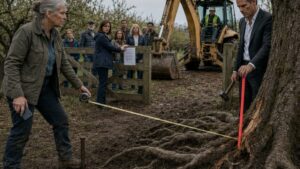
“The gate is still a problem.”
After the call, Katherine walked the access strip.
She took no maps.
No documents.
Only a measuring tape and a notebook.
At the old gate, she stood where cars usually stopped.
The shoulder narrowed near the curve.
A driver pulling out from inside the gate had to angle left before gaining a clean view. Katherine had done it so many years she no longer noticed.
She watched a delivery van pass.
Then Brian’s truck approached from the other direction.
He slowed when he saw her.
“What are you doing?”
“Looking.”
“At what?”
She pointed toward the curve.
Brian parked farther down and walked back.
For ten minutes they said little.
Then a car came through too fast.
Katherine heard it before she saw it.
Brian stepped away from the pavement.
The car vanished around the bend.
He looked at Katherine.
“That’s what I was trying to tell you.”
She hated him for saying it.
Mostly because he was right.
“The machine was still wrong.”
“I know.”
“The fines were wrong.”
“Probably.”
“The garden is mine.”
“Yes.”
Brian put his hands in his pockets.
“And the gate can still be bad.”
Katherine stared at the twisted hinge.
For months she had arranged the conflict into clean sides because clean sides were easier to defend.
Sandra had broken that simplicity by being afraid for a reason.
Jennifer had broken it by being guilty without being malicious.
Brian had broken it by standing beside her and refusing to flatter her.
None of that excused the excavator.
None of it made Katherine innocent of silence.
That evening she opened the cream envelope again.
This time she read the full access agreement.
Her husband’s signature seemed smaller than she remembered.
A note in his handwriting sat in the margin of the final page.
Need alternate entrance eventually. This one will cause trouble.
Katherine touched the words.
He had known.
Perhaps he had intended to fix it.
Perhaps she had turned intention into promise because grief preferred unfinished plans to failures.
The next morning she called Michael Allen.
When he answered, she did not begin with the HOA.
“I have the signed access agreement,” she said.
Michael was silent for a moment.
“All right.”
“I should have brought it before.”
Another pause.
“All right.”
She appreciated that he did not rescue her from the admission.
Katherine looked through the window at the closed gate.
“I want to know something else.”
“What?”
“My parcel touches the county road farther west.”
“Yes.”
“Could I build another entrance?”
This time Michael’s silence was different.
Keyboard keys clicked.
“Possibly.”
Katherine gripped the phone.
“What would it take?”
Chapter 6: She Won by Giving Up the Easy Revenge
Katherine handed Michael Allen the signed access agreement before he asked for it.
No envelope.
No explanation.
She placed it on his desk and sat down.
Michael read the first page, then looked at her over the top of it.
“You found it.”
“I knew where it was.”
He waited.
Katherine disliked him a little for that.
“I lied.”
“Yes.”
“You could pretend you didn’t notice.”
“I could.”
He returned to the document.
“But then we’d both be wasting time.”
Katherine almost smiled.
Almost.
Six weeks followed in survey stakes, application forms, revised diagrams, and conversations that ended with new questions instead of answers.
The second road frontage existed.
That was the first good fact.
It lay west of the old gate, beyond the curve, where the agricultural parcel touched the county road directly.
The second good fact was that sight distance appeared better.
The bad facts arrived immediately after.
Drainage ditch.
Culvert requirement.
Setback.
Limited entrance width.
No unrestricted event traffic.
A surveyor placed bright stakes through the grass one morning. Katherine stood beside them while Michael pointed to the proposed drive path on a printed plan.
“If transportation signs off, this could support farm access.”
“And vendors?”
“Potentially limited vendor activity.”
“How limited?”
“That depends on the use permit.”
Katherine looked at him.
He gave a small shrug.
“You asked for the honest version.”
“I’m regretting it.”
“Most people do.”
The old gate remained chained throughout the process.
Sandra’s attorney sent a letter demanding that Katherine cease any increased use through the shared strip.
Katherine’s first instinct was to reopen it out of spite.
She even carried the key outside.
At the gate, she put it into the padlock.
Then she saw the red survey stakes farther west.
She removed the key.
The easier victory would have been to force the old argument until someone declared her right.
The harder one was to build something that did not depend on winning every point.
The HOA special meeting took place in the same room as before.
This time Katherine brought the access agreement.
She placed it on the table herself.
Sandra’s eyes dropped to the signature page.
The property manager shifted.
Jennifer sat two chairs away, no longer looking at Katherine as though silence were neutral.
Katherine said, “The agricultural tract and the access strip are separate questions.”
The attorney joined by video instead of speakerphone.
“Yes.”
“The crop rows were outside the tract named in the work order.”
“Based on current records, that appears substantially supported.”
“The gate has access conditions.”
“Yes.”
Katherine nodded.
“I am not contesting that.”
Sandra looked at her.
For a moment the room seemed to lose its prepared script.
One board member said, “Then what are we doing here?”
Katherine answered.
“Separating what should have been separated before the machine came.”
The insurance representative spoke next.
He had reviewed photographs, work orders, correspondence, and contractor records.
His conclusion was cautious.
The access dispute did not erase questions about contractor scope.
The board’s liability concerns did not automatically authorize entry into the agricultural tract.
The fines, because they had been issued under a disputed interpretation while jurisdiction remained unresolved, should be suspended pending independent review.
Sandra’s face remained still.
Katherine felt no rush of triumph.
Only a strange release.
Four hundred dollars a week had become a number someone else finally had to justify.
The insurance representative continued.
Crop damage would be handled through a separate claim process.
Not full restitution.
Not immediate payment.
A documented assessment.
Depreciation, replacement cost, lost seasonal production—each would be argued.
But for the first time, the damage was not being called compliance.
It was being called damage.
Jennifer lowered her eyes.
Sandra said, “And the gate?”
The attorney answered.
“Separate issue.”
The words hung in the room.
Katherine thought of how many months she had wanted to hear them.
Then she thought of how long she herself had refused to say them.
The independent review was approved.
The fines were suspended.
Sandra did not apologize.
Katherine did not ask her to.
Three weeks later, the county sent preliminary conditions for the western entrance.
Katherine read them at the kitchen table.
Maximum vendor count.
Limited Saturday hours.
No parking on the county shoulder.
Traffic cones during operating periods.
Temporary restroom requirement above a stated attendance level.
Emergency access lane.
The permit she had imagined in anger had been much larger.
She had pictured rows of tents and cars stretching beneath Sandra’s windows. She had pictured success so visible nobody could deny who had won.
The county’s version was smaller.
Nine vendors would not fit under the first operating condition.
Maybe five.
Perhaps six with revised parking.
Brian read the conditions over coffee.
“This is workable.”
“It is tiny.”
“It is bigger than nothing.”
“That is not inspiring.”
“Neither is drainage compliance.”
Katherine pushed the pages away.
Brian tapped one line.
“Saturday mornings. Produce. Flowers. Honey. Controlled entrance.”
“I can read.”
“You’re grieving a revenge fantasy.”
She stared at him.
He drank his coffee.
“You asked me once why everybody mistakes you standing still for a challenge.”
“I did not ask you that.”
“Maybe I asked myself.”
Katherine looked toward the window.
The old gate remained closed.
Beyond it, the twisted hinge had begun to rust.
At the western edge, orange survey flags moved in the wind.
The county approved the entrance subject to final construction inspection.
The vendor permit required another application.
Katherine filled it out at midnight.
Name of operation.
Expected attendance.
Number of vendors.
Traffic plan.
Emergency procedures.
For months every form had felt like submission.
This one felt different.
Not because she liked the conditions.
Because she had chosen the question she was answering.
At the next planning appointment, Michael reviewed the application.
“You reduced the vendors to five.”
“For the first phase.”
“Good.”
“I did not say permanently.”
“I heard you.”
“No amplified music.”
“Correct.”
“Limited hours.”
“Yes.”
“No shoulder parking.”
“That one is not negotiable.”
Katherine signed each acknowledgment.
Michael turned the final page toward her.
“Once the entrance passes inspection, this can move to approval.”
She held the pen above the signature line.
There were still people telling her to sue.
Neighbors who wanted Sandra removed immediately.
Messages from residents she barely knew, describing what they would do in her position.
Some wanted spectacle.
Katherine had wanted it too.
A public defeat.
An open gate beneath Sandra’s window.
A market large enough to make the HOA choke on its own complaints.
Instead she had a restricted permit application and five possible vendors.
She signed.
The first construction crew arrived the following Monday.
Not with an excavator inside her garden.
With county-approved plans.
The machine cut into the western edge of the parcel where survey stakes marked the new drive.
Katherine stood nearby.
The sound still tightened something in her chest.
The operator paused.
“You good?”
She looked at the bucket.
Then at the stakes.
“Yes.”
He continued.
That afternoon, Katherine walked to the old gate.
She touched the chain once.
On the subdivision side, Sandra stood near the sidewalk.
Neither woman had expected the other.
Sandra looked toward the construction farther west.
“So you’re really doing it.”
“Yes.”
“Smaller than what people are saying.”
“Yes.”
Sandra seemed almost puzzled.
“I thought you wanted to prove we couldn’t stop you.”
Katherine looked at the closed gate.
“For a while, I did.”
“And now?”
Katherine did not answer immediately.
The new entrance had cost money. The claim would not cover everything. The board review might remove Sandra as president or might only censure procedure. The market might fail.
Nothing was clean.
“Now I want something that still works after everybody stops being angry.”
Sandra looked away.
Katherine left her there.
That evening, she returned to the kitchen table.
The restricted vendor application waited beside the old cream survey envelope.
She signed the last page, dated it, and slid it into the county submission packet.
Then she carried the packet to the mailbox.
The old gate stayed locked behind her.
The new one had not yet been built.
For the first time in months, Katherine stood between
Chapter 7: The Gate Stayed Closed, but the Farm Opened
On opening morning, Katherine Mitchell walked past the old gate without touching the chain.
For three months she had imagined that moment differently.
In the angry version, the chain was gone. The gate stood wide. Cars streamed through beneath a hand-painted sign while Sandra Wright watched from the subdivision and understood, finally and publicly, that she had lost.
The real gate remained closed.
One hinge was still twisted from the excavator strike. Rust had spread beneath the replacement chain. Grass had grown up around the bottom rail.
Katherine stopped long enough to look at it.
Then she kept walking west.
The new entrance had a gravel apron, a culvert beneath it, and two plain wooden posts supporting a modest sign:
SATURDAY FARM MARKET
8 A.M.–12 P.M.
No slogan.
No accusation.
No reference to the HOA.
At seven thirty, Brian Moore arrived with peaches stacked in shallow crates.
“You’re early,” Katherine said.
“So are you.”
“I live here.”
“That sounds like an excuse.”
He parked where the county plan told him to park.
That alone felt strange.
For years, people had come through the old gate according to habit. Pull in where there was room. Back out when there was not. Stop at the shoulder if someone ahead took too long.
Now bright cones marked a one-way loop.
A narrow emergency lane remained empty.
Five vendor spaces sat along the eastern side of the parcel.
Five.
Katherine had resented the number when she signed the permit.
This morning, she found herself checking the spacing twice.
Brian unloaded peaches.
A flower grower arrived next.
Then a woman with eggs and cut herbs.
A beekeeper from farther west brought jars of honey after Katherine decided her own damaged hives would not produce enough for sale this season.
The fifth vendor sold bread.
At eight o’clock, Katherine opened the new gate.
The first car entered slowly.
Then another.
A couple stepped out carrying reusable bags. An older man asked whether the peaches were local. A child pointed toward Katherine’s surviving beehive and was immediately pulled back by a parent.
By eight twenty, Katherine had sold six baskets of tomatoes.
By eight forty, she had forgotten to be angry.
That surprised her more than the customers.
The market did not look like the fantasy that had carried her through the worst weeks.
There were no rows of white tents stretching toward Sandra’s house.
No line of traffic long enough to prove anything.
No county tourism page.
No crowd gathered to witness justice.
There were five vendors, twenty-three marked parking spaces, two temporary signs, and a laminated traffic plan clipped to a post.
It was smaller.
It worked.
Jennifer Baker came shortly after nine.
She carried no board folder.
Katherine watched her approach the produce table.
“I wasn’t sure I should come,” Jennifer said.
“You’re here.”
“I am.”
Jennifer picked up a zucchini.
For a second both women looked at it.
Then Jennifer gave a short laugh that sounded close to embarrassment.
“Four hundred dollars a week.”
Katherine said, “This one is six.”
Jennifer set it carefully in her basket.
“The independent review is finished.”
Katherine’s hands stopped over a crate of tomatoes.
Jennifer lowered her voice.
“The fines are being withdrawn.”
Katherine did not answer.
She had known the review was close. She had not known the result.
“All of them?” she asked.
“All of them tied to the agricultural violation.”
“And the damage?”
“Separate claim, like they said.”
“How separate?”
Jennifer hesitated.
“Partial compensation recommended. Irrigation, fencing, documented plant loss. Not everything you asked for.”
Katherine looked toward the section of garden where the excavator had passed.
New growth had softened the scars, but the rows still bent differently there.
“Of course not everything.”
Jennifer nodded.
“There was also a board finding.”
Katherine waited.
“Sandra is no longer president.”
The words produced less satisfaction than Katherine expected.
“What happened?”
“She resigned the position before the vote on removal. She’s still a homeowner. Still technically on the board until the next election unless she resigns that too.”
Katherine looked past Jennifer.
At the far side of the parcel, cars entered through the new gate one at a time.
Jennifer said, “The review found the physical enforcement decision was premature and not properly supported by the information available to the board.”
“That is a careful sentence.”
“Yes.”
“Did you write it?”
“No.”
“Good.”
Jennifer almost smiled.
Then someone called Katherine’s name from the entrance.
She turned.
A delivery van had stopped too close to the new gate.
Behind it, two cars were waiting in the road.
Katherine moved quickly.
“Brian!”
“I see it.”
Before either of them reached the entrance, another voice cut across the gravel.
“You need to move that van now.”
Sandra stood outside the gate.
For one startled moment, Katherine thought the morning had folded back on itself.
Sandra wore no vest, carried no board packet, and held no travel mug. She pointed toward the road.
“The second car cannot see around the van.”
The delivery driver had stepped out and was checking an address on a phone.
Katherine felt the old response rise instantly.
This is my permit.
This is my entrance.
You do not get to come here and tell me—
Then a vehicle approached around the bend.
The waiting cars edged forward.
Katherine saw the problem.
“Brian, stop incoming traffic.”
He moved without arguing.
Katherine crossed to the van.
“You can’t unload here,” she told the driver.
“I’m looking for the bread vendor.”
“Pull through and park in the marked area.”
“It’ll take one minute.”
“No. Move now.”
Something in her voice ended the discussion.
The driver got back in.
Brian held one hand up toward an approaching car until the van cleared the sight line.
Thirty seconds later, traffic moved again.
No accident.
No shouting.
No one filmed anything.
Katherine stood beside the new gate, breathing harder than the situation deserved.
Sandra had not moved.
“You missed the delivery restriction,” she said.
Katherine looked at the laminated plan.
She had.
The permit prohibited loading at the entrance, but Katherine had briefed the vendors, not outside deliveries.
“I did,” she said.
Sandra’s expression shifted faintly.
Perhaps she had expected resistance.
Katherine turned to Brian.
“Get me a marker.”
He handed her one from the produce table.
Katherine added a temporary note to the entrance board:
ALL DELIVERIES USE VENDOR PARKING
NO STOPPING AT GATE
She looked at Sandra.
“I’ll put a proper sign up next week.”
Sandra nodded.
The silence between them was not friendly.
But it was no longer the silence of two women waiting for the other to submit.
Katherine said, “You were right about that van.”
Sandra’s mouth tightened.
“I was wrong about the machine.”
It was not an apology.
Not quite.
Katherine considered demanding more.
She could have named the email. The warning. The crops. The months of fines.
Instead she said, “Yes.”
Sandra looked toward the old gate in the distance.
“You could have told us about the agreement.”
Katherine felt the old defensiveness stir.
“I could have.”
Sandra looked at her then.
“And I could have waited.”
“Yes.”
That was all.
Sandra left without buying anything.
By eleven, the peaches were nearly gone.
The flower grower sold out first.
The beekeeper had to put aside three jars for customers who promised to return the next week.
A county vehicle passed once, slowed, and continued.
Katherine noticed.
So did Brian.
“Inspection?” he asked.
“Maybe.”
“You nervous?”
“Yes.”
“Good.”
She gave him a look.
He grinned.
Near noon, Katherine counted the cars.
The total was enough to make the market viable.
Not enough to violate the permit.
She felt an unexpected pride in that distinction.
When the final customer left, the vendors began packing.
Brian carried an empty crate toward his truck.
“You know what everyone is going to say.”
Katherine folded the tablecloth.
“What?”
“That you won.”
She looked across the parcel.
The western entrance was rutted slightly where morning traffic had pressed the fresh gravel.
The old gate remained closed.
The crop-damage claim would not repay the season.
The board review would not restore the uprooted plants.
Sandra still lived nearby.
Nothing had become simple.
“Did I?” Katherine asked.
Brian set down the crate.
“You tell me.”
Katherine thought of the cream envelope.
Of Michael waiting while she lied.
Of Jennifer voting for something she had not understood.
Of Sandra receiving a warning and deciding fear justified action.
Of herself carrying the key to the old gate with every intention of reopening it out of spite.
She looked at the new entrance.
“I stopped needing the answer to be yes.”
Brian nodded once.
“That sounds expensive.”
“It was.”
He picked up the crate.
After the vendors left, Katherine walked the market grounds alone.
She collected two paper bags caught against the fence.
Straightened a cone.
Checked the emergency lane.
Then she returned to the western entrance.
The new gate swung smoothly.
No twisted hinge.
No old argument built into the ground beneath it.
She closed it.
The latch settled into place with a plain metal click.
Across the field, the old gate stood where it always had.
Katherine could have walked over.
She could have touched the chain.
She did not.
She turned toward the garden instead.
The story ha