The HOA Marked Her Family Orchard for Demolition, but the Oldest Tree Held the Boundary They Feared
Chapter 1: The Stake Driven Through the Oldest Roots
The first strike landed before Sandra Miller reached the gate.
Metal rang against something harder than soil, sharp enough to carry through the orchard rows. A flock of starlings lifted from the upper branches as Sandra came around the packing shed with one glove still tucked into her back pocket.
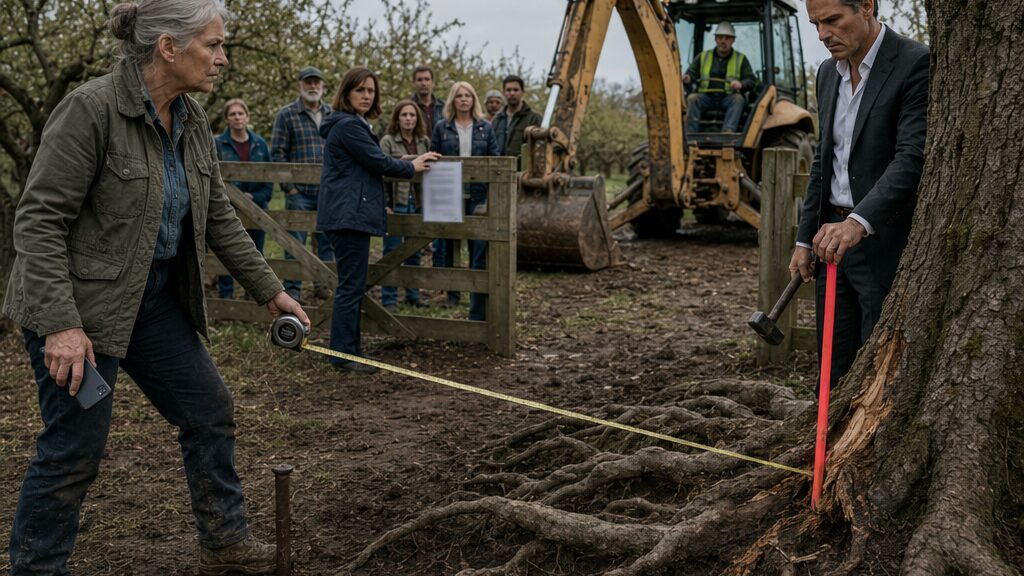
Jonathan Wright stood beneath the oldest apple tree in a pressed blue shirt and polished brown shoes. He had one hand wrapped around a fluorescent survey stake and the other gripping a short sledgehammer. The stake had been driven at an angle through a ridge of exposed root.
He raised the hammer again.
“Don’t.”
Sandra’s voice stopped him halfway down.
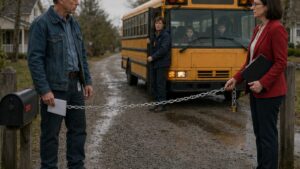
Jonathan turned. Behind him, the HOA property manager was fastening a laminated notice to Sandra’s wooden gate. Two surveyors stood beside a tripod. Beyond them, on the gravel shoulder, a yellow backhoe idled with its bucket lowered.
Three neighbors watched from the road.
Jonathan rested the hammer on his shoulder. “Morning, Sandra.”
She crossed the last twenty feet without hurrying. At sixty-nine, she had learned that haste gave other people something to use against you. Her eyes went first to the torn bark. A pale strip of living wood showed beneath the stake.
“You drove that through the root.”
“It’s a marker.”
“It’s in the tree.”
“It’s where the centerline goes.”
Sandra stopped beside him. The tree’s trunk was broad enough that she could not have circled it with both arms. One side leaned slightly east, shaped by decades of wind coming over the ridge. Her great-grandfather had planted it before the first paved road reached the valley. Her husband had grafted a late-bearing branch onto it thirty years ago.
Jonathan glanced toward the watching neighbors. “The board approved emergency access. You received notice.”
“I received a packet with three different maps.”
“The final route was attached.”
“No. The route through the northern fence was attached.”
The property manager stepped closer. “Mrs. Miller, the association has authority under the recorded easement. We’re posting the emergency access order now.”
Sandra looked past her at the laminated page. Across the top, in bold letters, were the words TEMPORARY CLEARANCE AND ACCESS AUTHORIZATION. Jonathan’s signature sat beneath the board seal.
She did not touch it.
Instead, she took out her phone.
Jonathan gave a thin smile. “You can photograph it. That doesn’t change the easement.”
Sandra crouched beside the root. She photographed the stake from above, then from the road side. She placed the edge of her phone case against the metal, using it as a rough guide, and took another picture showing the angle.
One of the surveyors shifted his weight.
“What are you doing?” Jonathan asked.
“Recording where you put it.”
“We have professional coordinates.”
“Then you won’t mind mine.”
She brushed loose soil from the root with her gloved hand. The stake had gone in beside an old split in the bark, but something dark showed below it. Sandra scraped carefully with two fingers until a rusted iron head appeared, round and flat, almost swallowed by the tree’s growth.
The nearest surveyor bent forward.
Jonathan’s smile disappeared. “That’s probably farm hardware.”
“It’s the original pin.”
“You don’t know that.”
Sandra wiped more dirt away. A shallow cross had been cut into the iron.
“I know what my grandfather showed me.”
The survey crew leader stepped toward the pin but did not kneel. “We weren’t given that monument in the field notes.”
Jonathan looked at him. “The filed plat controls, not family stories.”
Sandra stood. “Which filed plat?”
No one answered immediately.
The backhoe engine rumbled behind them. The operator leaned out of the cab and watched.
Sandra pointed toward the laminated notice. “That map puts your route thirty-eight feet north of this tree. The stakes you set this morning cut straight through it.”
“The route was adjusted for grade,” Jonathan said.
“By whom?”
“The engineer.”
“Which engineer?”
Jonathan lowered the hammer. “Sandra, we have spent nine months trying to solve a real problem. The upper road is too narrow for emergency vehicles. The drainage ditch failed twice last winter. Insurance premiums are climbing. People are facing another assessment because you refuse to allow one practical improvement.”
There was enough truth in it to make the neighbors keep watching.
The orchard sat at the western edge of Cedar Ridge, where newer homes curved around land that had once been pasture. The HOA had inherited a patchwork of old lanes, drainage channels, and access rights when the development expanded. The previous summer, a brush fire had burned three miles away. Fire engines had backed down the upper road because they could not turn around.
Sandra had watched the same footage everyone else had.
But the route Jonathan wanted did not lead only to the upper road. It continued past the drainage basin toward two undeveloped parcels owned by his company.
She looked at the fluorescent line of stakes disappearing between the apple rows.
“You adjusted it for more than grade.”
Jonathan’s jaw tightened. “That accusation is exactly why the board stopped negotiating informally.”
“What accusation?”
“That every proposal is some scheme to steal your orchard.”
“You’re standing under my tree with a hammer.”
The neighbors looked away from Jonathan then, but only for a moment.
The property manager tapped the posted notice. “The authorization allows preliminary clearing beginning tomorrow. Today is survey and marking only.”
Sandra turned to the crew leader. “You hit another root, and I file for an emergency injunction naming every person who entered.”
Jonathan exhaled through his nose. “Threatening contractors won’t help you.”
“I’m not threatening them. I’m telling them what happens if they rely on a route you changed after the vote.”
The survey crew leader studied the iron pin again. “We can stop until the coordinate sheet is checked.”
Jonathan looked at him sharply. “The sheet has already been checked.”
“Not against a monument that wasn’t listed.”
The crew leader’s answer was quiet, professional, and final enough to matter.
Sandra felt the first shift in the morning. Small, but real.
Jonathan stepped away from the root and took out his phone. “Fine. One hour.”
The property manager protested. “The board authorization—”
“One hour,” he repeated. “We verify the coordinates and resume.”
Sandra slipped her phone into her jacket pocket. “The backhoe leaves.”
“It stays on the shoulder.”
“It’s blocking my delivery entrance.”
“It’s on HOA right-of-way.”
“The bucket is over my gravel.”
Jonathan looked down the road, measuring the argument against the people watching. Then he raised two fingers toward the operator.
The engine shut off.
Silence settled over the orchard in stages. First the diesel stopped. Then the hydraulic whine faded. Wind moved through the leaves, carrying the faint sweetness of fallen apples beginning to soften beneath the trees.
Jonathan handed the sledgehammer to the property manager.
“An hour,” he said to Sandra. “After that, the survey continues.”
She pointed to the notice. “Who signed off on the changed route?”
“The association did.”
“That wasn’t my question.”
His expression hardened. “You’ve had every opportunity to participate.”
“I attended the meetings.”
“You attended to say no.”
Sandra glanced toward the neighbors. Amy Nelson stood near the end of her driveway with her arms folded, still wearing the navy cardigan she used for work. Amy had bought bags of apples from Sandra every September for years. That morning, she did not come closer.
Jonathan followed Sandra’s gaze.
“This isn’t personal,” he said. “People are tired of paying for delay.”
Sandra looked again at the stake lodged in the living root.
“It became personal when you swung the hammer.”
For a second, Jonathan seemed almost ashamed. Then the look closed.
He took a folded document from the property manager and held it out. “Emergency authorization. Signed by the board. County review pending, but not required for preliminary access work.”
Sandra did not accept it, so he placed it on the gatepost.
“The association’s attorney will be at tonight’s meeting,” he said. “You can raise your objections there.”
“Will the map you voted on be there?”
“All governing documents will be available.”
“That still isn’t an answer.”
Jonathan walked toward his SUV.
The surveyors gathered beside their equipment, speaking low enough that Sandra could not hear. The property manager photographed the posted notice. The neighbors drifted away, reluctant to be seen choosing a side.
Sandra remained under the tree.
She crouched again and pressed two fingers against the cut bark. A bead of sap had already formed beside the metal. She resisted the urge to pull the stake free. Removing it might damage the root more. It might also destroy the best evidence she had.
So she measured.
From the iron pin to the stake. From the stake to the trunk. From the trunk to the northern fence line visible through the rows. She wrote the distances on the back of an old feed receipt.
The crew leader returned twenty minutes later.
“Our field coordinates match the sheet we were issued,” he said.
“Do they match the posted map?”
He looked toward Jonathan’s vehicle, though Jonathan was sitting inside with the windows closed.
“The sheet shows a revised alignment.”
“When was it revised?”
“I don’t have that information.”
“Was the iron pin included?”
“No.”
Sandra folded the receipt.
“Then you don’t know what you marked.”
His face tightened, not with anger but discomfort. “I mark what the client certifies.”
“And when the client certifies the wrong line?”
He did not answer.
At the end of the hour, Jonathan got out of the SUV. The survey crew resumed, but they moved around the oldest tree without driving another stake. It was not a victory. The fluorescent marker remained buried in the root, and the backhoe remained on the road.
Still, Sandra had bought time.
Before leaving, the operator climbed down from the cab and checked the chain securing the bucket.
Sandra walked to the gate. “You working tonight?”
He shook his head. “We’re staged for morning.”
“What time?”
He hesitated, glancing toward Jonathan.
Then he said, “First cut is at dawn.”
Chapter 2: The Board Had Already Chosen Her Answer
Sandra entered the clubhouse to find her orchard burning red on the wall.
A projected hazard map covered the folding screen behind the board table. The orchard was shaded in dark orange, with a thick red line running from the lower subdivision road through its center. A photograph of the oldest tree appeared in the corner. The fluorescent stake was visible, but the split bark and iron pin had been cropped out.
Across the top of the slide were the words EMERGENCY ACCESS CORRIDOR.
Nearly every chair was filled.
Sandra paused just inside the door. Conversations lowered, then resumed in quieter voices. Someone had placed a hand-lettered sign on the refreshment table: STOP THE NEXT SPECIAL ASSESSMENT.
Jonathan stood at the front in a gray jacket, speaking with Paul Baker, the HOA attorney. Paul was compact, silver-haired, and carried a leather portfolio thick with tabs. Amy Nelson sat at the treasurer’s position, turning pages in a binder.
Sandra chose a chair in the second row.
The property manager called the meeting to order.
Jonathan began without looking at Sandra.
“We are here because the association has a responsibility to provide safe access for residents, emergency services, and maintenance crews. Last year’s evacuation review identified a serious bottleneck on the upper road. The proposed corridor would create a secondary route, improve drainage, and reduce future liability.”
A resident near the aisle raised a hand. “And reduce the assessment?”
Jonathan nodded. “The road project allows us to combine drainage work with access construction. That avoids doing both separately.”
“How much?”
“Current projections show a savings of approximately twenty-seven percent.”
Murmurs moved through the room.
Sandra watched Amy. The treasurer’s pen had stopped over one line in the binder.
Jonathan changed the slide. A diagram showed the proposed road, a widened drainage channel, and two turning areas. The line passed directly through the orchard.
No northern route appeared.
Sandra raised her hand.
Jonathan continued speaking.
She kept it raised until several residents turned to look at her.
Finally he said, “Sandra.”
“Who selected that alignment?”
“The board approved the engineering recommendation.”
“Which engineer?”
Paul Baker leaned toward his microphone. “Mrs. Miller, the association is not required to debate individual design decisions in an open forum.”
“I’m asking whether a fire official selected the route.”
Jonathan answered. “The route addresses the fire review.”
“That isn’t what I asked.”
A man in the back row muttered, “Here we go.”
Sandra looked toward him but said nothing.
Paul opened his portfolio. “The underlying question is whether the association has access rights. It does. The recorded declaration reserves an ingress and egress easement across the western agricultural parcel for emergency and maintenance purposes.”
He removed a copy and held it up.
“This was recorded with the county before the current subdivision was completed. Every owner purchased subject to those governing documents.”
Sandra’s stomach tightened.
She knew the language. She had read it years earlier, after her husband died, when she went through every paper in the cedar box beneath their bed. The easement existed. Denying that would make her look foolish.
But she also knew it was not the only recorded language.
Paul handed copies to the board.
“The association has attempted voluntary resolution,” he said. “Mrs. Miller has declined access, declined appraisal, declined mediation, and threatened contractors performing authorized work.”
“I warned them not to damage a tree outside the route you voted on.”
Jonathan changed the slide back to the hazard map. “This is the approved route.”
“No. This is the route marked this morning.”
“They are the same corridor.”
“Then show the board packet from last month.”
Amy looked up.
The room went quiet enough for Sandra to hear the projector fan.
Jonathan said, “Minor engineering adjustments do not require a new vote.”
“Moving the road from the northern fence into the center of my orchard is not minor.”
“It’s less than forty feet.”
“It puts the oldest tree under the roadbed.”
A woman near the front said, “Sandra, nobody wants to cut your trees. But some of us can’t absorb another assessment.”
Sandra faced her. “I understand that.”
“Do you?”
The question landed harder because it was not cruel.
Sandra had no mortgage. She grew enough fruit to cover taxes and repairs. Many of the newer residents had bought when interest rates were low and insurance was cheaper. Now dues had risen twice in three years.
Jonathan let the silence work for him.
Then he said, “This is exactly the difficulty. We all respect the orchard. But one property cannot prevent necessary infrastructure for an entire community.”
Sandra looked at the photograph on the screen. Whoever took it had stood far enough away to make the fluorescent stake look harmless, like a ribbon at a school field day.
“Zoom in,” she said.
The property manager frowned. “Excuse me?”
“Zoom in on the base of the stake.”
Jonathan’s hand moved toward the laptop. “The photograph is illustrative.”
“Then illustrate what your hammer did.”
He did not move.
Amy closed her binder.
Sandra stood. “The stake went through a living root. Beside it is an original iron boundary pin that does not appear on the survey sheet. The crew leader confirmed he was given a revised alignment.”
Paul’s eyes shifted to Jonathan.
Only briefly, but Sandra saw it.
Jonathan said, “The field crew paused, verified its instructions, and completed the survey.”
“They did not verify the old pin.”
“It may not be a valid monument.”
“It has a survey cross cut into the head.”
A board member at the far end cleared his throat. “Was the pin documented?”
Jonathan answered before anyone else could. “Not on the controlling plat.”
Sandra felt the cedar box in her mind. The brittle pages. Her husband’s handwriting in the margins. The clause she had not shown anyone.
Not yet.
Paul tapped the easement copy. “Even if an older marker exists, the association’s recorded access right remains enforceable.”
“Along which route?”
“The precise location may be reasonably determined by necessity.”
“Reasonably determined by whom?”
“By the association, with professional guidance.”
“Not by the fire department?”
Paul’s expression changed.
Sandra turned toward the property manager. “Was any fire marshal, fire chief, or emergency-management official asked to approve this alignment?”
The property manager looked at Jonathan.
Jonathan said, “The route responds to the evacuation review.”
“That review identified the upper-road bottleneck. It did not recommend cutting through my orchard.”
Amy pulled a loose document from the binder. “She’s right.”
Jonathan looked at her.
Amy kept her eyes on the page. “The fire review recommends a secondary western exit. It doesn’t specify this alignment.”
A murmur moved through the room, different from the earlier one. Not support for Sandra. Uncertainty.
Jonathan recovered quickly. “Because route design is not the fire reviewer’s job. That is why the board retained engineering consultants.”
Sandra had won one fact and lost the larger argument. She could feel it in the room. The residents did not need Jonathan to prove his route was perfect. They needed him to prove it was possible.
And Sandra had offered them no alternative.
The property manager opened public comment.
For twenty minutes, residents spoke about insurance notices, drainage failures, wildfire smoke, and dues. One man accused Sandra of valuing trees over children. Another said Jonathan should have negotiated longer. A woman who lived near the upper road admitted she was frightened every summer.
Sandra listened.
She could have stood and told them about the northern lane. She could have mentioned the old plat.
She could have told them about the clause.
But Amy’s house sat on one of the parcels named in that language. So did six others, depending on how the boundary was interpreted. The clause had never been tested. Raising it publicly might freeze sales, alarm lenders, and send everyone running to attorneys before Sandra fully understood it herself.
So she remained silent.
When the board voted, Amy hesitated before raising her hand.
The preliminary access authorization passed four to one, subject to county review.
Jonathan did not smile. He only wrote something on the paper before him.
After the room emptied, Sandra folded her coat over one arm and headed for the door. Amy caught up with her beside the darkened refreshment table.
“I’m sorry,” Amy said.
“You voted yes.”
“I voted to keep the review moving.”
“You voted for the backhoe.”
Amy’s mouth tightened. “My insurance went up thirty-two percent. The board is looking at a special assessment that some families here cannot pay. Jonathan says combining the road with drainage work brings outside reimbursement.”
“From whom?”
Amy glanced toward the board table. Jonathan was speaking quietly with Paul.
“That’s what I’m trying to understand.”
Sandra studied her.
Amy lowered her voice. “There’s a reimbursement line in the project budget from Wright Residential. Jonathan’s company. It covers part of the road extension.”
“Part of the community road.”
“Yes.”
“For what in return?”
“It doesn’t say.”
Sandra looked back at Jonathan. He had one hand on Paul’s portfolio and was pointing to a document.
Amy stepped closer. “Sandra, have you ever seen the original subdivision plat?”
The question was too precise to pretend she had not heard it.
Sandra put on her coat.
Amy watched her face. “You have.”
Sandra opened the clubhouse door.
Cold air came in around them.
“I’ve seen more than one,” she said.
Chapter 3: The Map Beneath the Modern Map
Christopher Ramirez placed two subdivision plats side by side and said, “These should not be filed under different names.”
The county records room was windowless and colder than Sandra expected. Flat archival drawers lined one wall. A scanner hummed behind the counter. Christopher wore blue gloves and handled the old pages by their edges.
On the left lay the Cedar Ridge preliminary plat, recorded when the first homes were approved. On the right was an older agricultural division labeled Miller-West Tract.
The road alignments did not match.
Sandra leaned over the table. “The northern lane is there.”
Christopher nodded toward a narrow strip following the upper fence. “It appears as reserved access on the older plat. On the later subdivision map, that strip is referenced but not drawn in full.”
“Why?”
“I can’t tell you why.”
“Which one controls?”
“I can’t give legal advice.”
“You can tell me which one was recorded first.”
“The agricultural division.”
“And whether it was released.”
Christopher checked the index sheet. “I don’t see a release in this chain.”
Sandra felt a quiet lift in her chest. Not victory. Something firmer than hope.
The lawful access route had existed all along.
She pointed to the broad corridor drawn across the later plat. “What is this?”
“General easement notation. It refers back to recorded instruments.”
“Not a fixed road?”
“That would be a legal interpretation.”
Christopher’s patience had boundaries, but he was not unkind. He had already spent forty minutes searching references that had been misindexed under family names, subdivision names, and parcel numbers.
Sandra took out the photographs from the orchard gate.
“This is the iron pin.”
Christopher studied the image. “Could be a monument.”
“It sits beside the oldest tree.”
“Then the tree may have grown around the original corner.”
He returned to the drawer and retrieved a linen-backed sheet smaller than the others. When he unfolded it, three parcel outlines appeared in faded black ink. A handwritten note ran along the western edge.
Sandra stopped breathing for a moment.
She knew the handwriting.
Not the original ink. The pencil beneath it.
Her husband had written in the margin: Ask county before any combined access. Three-parcel condition may revive.
Christopher noticed her expression. “You’ve seen this notation?”
“My husband made it.”
“Then this may be a family copy deposited later, not the original record.”
“Does that matter?”
“For the pencil, yes. For the recorded language beneath it, no.”
He adjusted the overhead lamp.
The original clause was cramped and formal. Sandra read it twice.
If any portion of the retained orchard parcel were severed or incorporated into a common improvement serving three adjoining tracts, a conditional right of reentry would arise in favor of the Miller family successors until the land was restored or otherwise settled.
The words had frightened her the first time she found them years ago.
They frightened her more now.
“Three adjoining tracts,” she said.
Christopher pointed to the parcel references. “These numbers were later renumbered.”
“Can you trace them?”
“I can show you the conversion index.”
He brought up a digital map on the public terminal. The old parcel numbers translated into modern lots and undeveloped tracts. One belonged to Sandra. One included land now held by Wright Residential.
The third contained a row of finished homes.
Amy’s home was among them.
Sandra gripped the edge of the table.
Christopher glanced at her. “Are you all right?”
“If that clause is enforceable, what happens to those houses?”
“That is a question for a property attorney.”
“Would it cloud their titles?”
“It could cause a title company to ask questions. That doesn’t mean anyone loses a home.”
“But it could stop a sale.”
“It could.”
The small lift inside her collapsed.
She had come looking for a line that would save the orchard. She had found one that might tie half the neighborhood to a dispute none of them knew existed.
Christopher returned to the old plat. “There is one thing I can say. The northern access strip is separately described. If the association only needs emergency access, there appears to be an existing corridor that does not run through the center of your parcel.”
“Then why would Jonathan move it?”
Christopher removed his glasses. “I don’t know Jonathan.”
Sandra thought of Amy’s reimbursement ledger.
The road through the orchard did more than solve a turn-radius problem. It extended toward Jonathan’s undeveloped land. It could serve three tracts with one improvement.
Exactly the condition named in the old clause.
Christopher scanned certified copies of the plats, the conversion index, and the deed restriction. Sandra paid the fee in cash. Before she left, he slid a county request form across the counter.
“If there has been a recent variance application, it may reference these instruments.”
“Can you find it?”
“Land use is upstairs.”
“Will they give it to me?”
“If it’s public.”
The variance file contained Jonathan’s company name.
Sandra read it standing at a counter while phones rang behind the glass partition. The application requested flexibility from historical access limitations to allow consolidated emergency and infrastructure improvements across three connected parcels.
It had been filed six weeks before the HOA board voted.
Jonathan had known.
Maybe not everything. Maybe his attorney had told him the clause was obsolete. But he had known enough to seek a way around the older restriction before presenting the road as a neutral community solution.
Sandra drove home with the certified copies on the passenger seat.
At the orchard, the backhoe was still parked outside the gate. The bucket teeth pointed toward the dirt like a row of blunt fingers. No workers were present.
Inside her kitchen, Sandra cleared the table and laid out the documents. She placed the modern route map over the old plat, holding both to the window so the lines showed through.
The fluorescent stake at the oldest tree aligned almost exactly with the old parcel corner.
From there, Jonathan’s proposed road crossed Sandra’s land, touched the HOA drainage parcel, and continued toward Wright Residential’s tract.
Three parcels.
She lowered the papers.
For years she had told herself that silence protected people. She had not recorded a new notice. She had not raised the clause when Jonathan first proposed buying an easement. She had not told Amy that an old family condition might touch her title.
But silence had also protected Sandra from having to choose.
Her husband had wanted the orchard preserved. Near the end, when illness made long conversations difficult, he had said, Don’t let them turn it into roofs.
Sandra had treated the sentence like a command to refuse everything.
Yet the pencil note on the plat did not say refuse.
It said ask county.
She opened the old cedar box from the hall closet. Beneath tax receipts and pruning records lay a folded letter from a conservation group dated nine years earlier. They had proposed a public orchard trust, limited walking access, school harvest days, and an emergency lane along the northern fence.
Sandra had rejected it without meeting them.
She sat at the table.
Outside, the oldest tree stood beyond the kitchen window, its upper branches bare except for a few stubborn leaves. From this distance, the fluorescent stake was a bright slash at its base.
The phone rang.
Paul Baker’s name appeared on the screen.
Sandra let it ring three times before answering.
“Mrs. Miller,” he said. His tone was formal but quicker than the night before. “The county has agreed to hear the access dispute.”
“When?”
“Tomorrow morning at nine.”
“You said review would take a week.”
“The association requested an expedited determination because equipment is already staged.”
“Jonathan requested it.”
“The association did.”
Sandra looked at the variance application on her table.
“Will the revised route map be part of the record?”
There was a pause.
“All current project documents will be submitted.”
“Current as of when?”
“Mrs. Miller, I’m calling as a courtesy.”
“No. You’re calling because you want me to know I have less than a day.”
Paul’s voice cooled. “If you intend to challenge the easement, bring whatever evidence you believe supports your position.”
Sandra touched the corner of the old deed.
“And if my evidence affects property beyond the orchard?”
This pause was longer.
“What do you mean?”
She almost told him.
Then she looked at Amy’s lot number in the conversion index and stopped.
“I’ll see you at nine,” Sandra said.
She ended the call and sat alone with the map that could save her trees and unsettle every home drawn across it.
Chapter 4: The Promise Sandra Never Explained
Amy Nelson arrived carrying a blue ledger before Sandra had finished clearing the breakfast dishes.
She did not knock on the kitchen door. She stood on the back step with the binder pressed to her chest and said through the glass, “Jonathan’s company is paying part of the road cost.”
Sandra opened the door but did not invite her in.
“How much?”
“Two hundred eighty thousand dollars, depending on final grading.”
“For a community emergency road?”
“That’s how it’s described in the board budget.”
Amy opened the ledger to a page marked with yellow tabs. A line near the bottom listed WRIGHT RESIDENTIAL INFRASTRUCTURE REIMBURSEMENT.
Sandra read it twice.
“What does his company receive?”
“The agreement says shared access to future improvements.”
“Future improvements where?”
“It doesn’t identify the parcels.”
“It doesn’t have to.”
Amy looked past Sandra toward the orchard. The oldest tree stood three rows beyond the kitchen garden. Even from there, the fluorescent stake showed through the branches.
“I voted for preliminary access,” Amy said. “I did not vote to build Jonathan a private road.”
“You voted before reading the reimbursement agreement.”
“I read the board packet.”
“Not all of it.”
“That’s why I’m here.”
Sandra stepped aside.
Amy entered and placed the ledger on the kitchen table, directly over the county copies. Her eyes moved to the old plat before Sandra could cover it.
“So you found it.”
“I found several things.”
Amy pulled out a chair. “Then show me.”
Sandra remained standing.
“Why?”
“Because my name is on a vote that may have been used to approve something else.”
“You can withdraw your vote.”
“Not without a reason.”
“You have the ledger.”
“It raises a question. It doesn’t answer it.”
Sandra folded her arms. “Jonathan filed a variance before the board approved the road.”
Amy’s face tightened. “How long before?”
“Six weeks.”
“For what?”
“Historical access limitations across three connected parcels.”
Amy looked down at the old map.
“Three parcels,” she repeated.
Sandra said nothing.
Amy touched one of the penciled conversion notes. “Which parcels?”
Sandra could have pointed only to Jonathan’s land. She could have said the clause was unclear. She could have sent Amy to an attorney and kept the worst possibility to herself for another day.
Instead, she turned the modern parcel index around.
Amy found her street.
Then her lot.
The color left her face.
“This is my house.”
“It’s one of the modern lots created from the third tract.”
“What does the clause do?”
Sandra sat across from her. “It creates a conditional reentry right if part of the orchard is incorporated into a common improvement serving three adjoining tracts.”
Amy waited.
Sandra forced herself to continue.
“If Jonathan’s road connects my parcel, the drainage parcel, and his development tract, the old family claim may revive.”
“Against what?”
“That’s what I don’t know.”
“My title?”
“It could cloud it.”
“Cloud it how?”
“A closing agent might stop a sale. A lender might ask for a release. Lawyers might disagree about whether the clause still applies.”
Amy closed the ledger.
“You knew this at the meeting.”
“I knew the clause existed.”
“And you let me vote without telling me my home could be involved.”
“I didn’t know how the old tracts converted until this morning.”
“You knew enough to stay silent.”
Sandra looked toward the window.
The orchard had always given her somewhere else to put her eyes. Rows, branches, pruning cuts, broken fence wire. Problems that could be touched.
Amy stood.
“Jonathan hid a reimbursement agreement,” she said. “You hid a title problem. I’m supposed to decide which secret is more honorable?”
“I was trying not to frighten people before I understood it.”
“You were trying not to lose control.”
The words landed cleanly because Sandra had no answer ready.
Amy took the ledger.
“At least Jonathan tells himself he is saving us money.”
“He’s using your dues to improve access to his land.”
“Maybe. But he also has a road problem to solve. What are you offering?”
“The lawful route follows the northern fence.”
“Can a fire engine use it?”
“I don’t know.”
“Can the drainage work fit there?”
“I don’t know.”
“Then right now you have a better accusation, not a better plan.”
Sandra pushed back from the table. “He put a stake through that tree.”
“And that was wrong.”
“He moved the route after the vote.”
“Then prove it.”
“I am proving it.”
Amy’s voice sharpened. “No. You are collecting proof that everyone else is untrustworthy. That is not the same thing.”
Silence filled the kitchen.
Amy looked at the documents again. Her anger had not left, but something else had joined it. Fear, held tightly behind practical questions.
“Did your husband know about the clause?” she asked.
Sandra glanced at the penciled note.
“Yes.”
“What did he want you to do?”
Sandra’s first impulse was to say he wanted the orchard protected. That was true. It was also incomplete.
She stood and went to the cedar box in the hall. From beneath the tax receipts, she removed the conservation group’s letter and carried it back.
Amy read the first page.
“Public orchard trust,” she said.
Sandra nodded.
“School harvest days. Limited walking access. Emergency lane along the northern boundary.”
“He thought it could work.”
“And you?”
“I thought once other people had rights here, they would keep asking for more.”
“Did you meet with them?”
“No.”
Amy lowered the letter. “Why not?”
Sandra looked at the oldest tree.
Her husband had been thin by then. He had sat at the same table with a blanket over his knees, tracing the proposed northern lane with one finger. He had said the orchard needed hands younger than theirs. He had said children should know apples did not begin in plastic bags.
Sandra had heard only the part about giving something away.
“I promised him I would not let them turn this land into roofs,” she said.
“That isn’t the same as promising to lock everyone out.”
“No.”
“Did he ask you to reject the trust?”
Sandra’s throat tightened. “No.”
Amy waited, giving her no place to hide inside a longer explanation.
“I rejected it because I was afraid,” Sandra said. “If I gave up one decision, I thought I would lose all of them.”
The kitchen seemed smaller after she said it.
Amy sat again.
For several moments, neither woman spoke.
Then Amy slid the ledger back onto the table.
“I’m not walking away,” she said.
Sandra looked at her.
“But I won’t help you use that clause as a weapon against people who had nothing to do with Jonathan’s plan.”
“I don’t want that.”
“Wanting is not enough.”
“What do you need?”
“A real alternative. A route that meets emergency standards. A way to release innocent homeowners from any claim. And everything disclosed before the board votes again.”
Sandra gave a short, humorless breath. “You ask for a lot.”
“You hid a lot.”
That was fair, and Sandra disliked her for making it fair.
They spent the afternoon comparing the northern lane to the engineering map. The old corridor was narrower near the drainage bend, but it avoided the oldest rows. A few younger trees might have to be removed. Sandra marked them in pencil and felt a small betrayal each time.
Near sunset, she led Amy into the orchard.
At the oldest tree, Sandra showed her the graft her husband had added to the eastern limb. Its bark was smoother and lighter than the trunk, a younger line joined to older wood.
“He planted this after our last hard freeze,” Sandra said. “Said one branch surviving was enough to begin again.”
Amy touched neither the graft nor the wound below it.
“The tree may survive the stake,” she said.
“It should never have had to.”
“No.”
From the road came the sound of a truck slowing.
Headlights swept through the lower rows.
Sandra turned.
A survey vehicle stopped beyond the gate. Two workers climbed out carrying flashlights and a bundle of fluorescent stakes.
“They were finished this morning,” Amy said.
Sandra was already walking.
By the time they reached the gate, the survey crew leader had opened the latch.
“You don’t have permission to enter after dark,” Sandra said.
He held up a work order. “Revised field verification.”
“From whom?”
“The client.”
Amy stepped beside Sandra. “The HOA board did not authorize a night survey.”
The crew leader recognized her. “We were told the president approved it.”
Jonathan’s truck was not there.
One worker walked toward the oldest tree and pulled the fluorescent stake from the wounded root. For one hopeful second, Sandra thought they were correcting the route.
Then he carried it fifteen feet south and drove it into fresh soil.
Another worker began moving the next marker to match.
Amy lifted her phone and photographed the work order.
Sandra stared at the new line of stakes. It no longer followed the coordinates she had measured that morning.
They were not correcting the survey.
They were changing the evidence.
Chapter 5: Three Parcels and One Deliberate Route
“The easement exists,” the county hearing officer said. “That point is not in dispute.”
The words settled over the hearing room before Sandra had removed her documents from the canvas bag.
Jonathan sat at the opposite table with Paul Baker and the property manager. Three rolled maps rested beside them. Amy took a chair behind Sandra rather than at the HOA table, a choice that drew more attention than any announcement could have.
The hearing officer adjusted her glasses.
“This proceeding is limited to whether the association’s proposed work falls within its recorded rights and current administrative approvals. It is not a trial of title.”
Paul stood. “That limitation is important. Mrs. Miller has repeatedly characterized a valid access easement as a land seizure.”
Sandra opened the certified plat.
“I have characterized the road through my trees as different from the recorded route.”
Paul turned toward her. “The easement is not fixed to a surveyed centerline.”
“The northern access strip is.”
“That is one historical reference among several.”
“It is the first recorded reference.”
The hearing officer raised a hand. “We will take the documents in order.”
Paul presented the HOA declaration, emergency-access clause, engineering report, and board authorization. He spoke without theatrics. The upper road was narrow. Drainage had failed. Insurance costs had risen. The association needed a practical route and had authority to establish one reasonably.
Nothing he said was entirely false.
That made it harder to answer.
When Sandra’s turn came, she placed the oldest plat beside the modern route map.
“The board voted on a corridor following the northern boundary,” she said. “The stakes placed Monday crossed the center of my orchard. Last night, after I measured them, the markers were moved again.”
Paul looked at Jonathan.
Jonathan leaned close and whispered something.
Paul said, “Field adjustments are normal.”
“After dark?”
“The timing is irrelevant.”
“A board member was present,” Sandra said. “She did not authorize it.”
The hearing officer looked toward Amy.
Amy stood. “I am the association treasurer. I received no notice of a night survey and saw no board approval for moving the stakes.”
Jonathan’s jaw tightened.
The hearing officer made a note. “Continue.”
Sandra laid a transparent copy of the old plat over the modern map. The northern strip appeared as a narrow band along the fence. Jonathan’s route cut diagonally through the orchard.
“The association has access,” Sandra said. “But not wherever the president finds most useful.”
Paul stepped closer to the maps.
“Mrs. Miller is challenging the wrong document,” he said. “The board is not relying solely on the agricultural plat. The declaration grants a general easement across the western parcel. The precise route may be established according to present necessity.”
For a moment, the room tilted in Jonathan’s favor.
The hearing officer examined the declaration. “That language is broad.”
Sandra felt Amy shift behind her.
Paul continued. “The northern strip may have been suitable for farm traffic decades ago. That does not mean it can support modern emergency apparatus or drainage improvements.”
Sandra had no engineering report proving that it could.
The hearing officer looked at her. “Do you have professional evidence that the northern alignment is feasible?”
“No.”
“Then your historical map alone may not defeat the association’s necessity determination.”
Jonathan finally spoke.
“We are not trying to erase the orchard. We are trying to keep residents safe and avoid a six-figure special assessment. We adjusted the route because the northern grade requires retaining work and additional drainage structures.”
Sandra looked at him. “Then why did your company request a variance six weeks before the board vote?”
Paul went still.
Jonathan did not.
“The variance was precautionary.”
“For historical access limitations across three connected parcels.”
The hearing officer looked up. “Do you have that application?”
Sandra handed over the certified copy.
Paul reached for it, reading quickly. His eyes moved from the applicant name to the parcel description.
He turned to Jonathan. “I was not provided this version.”
Jonathan’s voice remained even. “Your office received the land-use packet.”
“I received the HOA packet.”
“The projects overlap.”
“That is not the same disclosure.”
The hearing officer read the application.
“What is Wright Residential’s interest in the proposed road?”
Jonathan folded his hands. “My company owns adjoining land. We offered reimbursement because the road may eventually provide secondary access to future homes, subject to approval.”
“Was that interest disclosed before the board vote?”
“It is in the budget.”
Amy stood again. “The reimbursement line is in the budget. The shared-access terms are in a separate agreement that was not included in the meeting packet.”
The hearing officer looked at the property manager.
The manager lowered her eyes to her notes.
Jonathan said, “There was no intent to conceal anything. The reimbursement reduces costs for every homeowner.”
Sandra heard the pressure beneath his control now.
His company had borrowed against construction schedules. Two planned sales depended on access. He likely believed he was solving several problems with one road: drainage, wildfire access, HOA finances, and his own development.
But he had arranged the solution so no one could separate the public benefit from the private one.
The hearing officer spread the variance application beside the old plat.
“Show me the three parcels.”
Sandra placed three transparent overlays on the table.
The first showed the original Miller tract. The second showed the HOA drainage parcel. The third showed Jonathan’s undeveloped land and the modern homes carved from the adjoining tract.
When she aligned the fluorescent stake coordinates with the iron pin, the proposed road touched all three.
The room became very quiet.
“This is why the exact route matters,” Sandra said. “The deed contains a conditional reentry clause if orchard land is incorporated into a common improvement serving three adjoining tracts.”
Paul stared at her. “You did not raise that in your written objection.”
“No.”
“Why?”
“Because the third tract now includes occupied homes.”
Amy’s home, she did not say.
The hearing officer read the clause, then shook her head slightly. “I will not determine title validity here.”
“I’m not asking you to.”
“What are you asking?”
“To suspend work on a route that may trigger a property claim the board was never told about.”
Jonathan opened one of his rolled maps.
“This is the current plan,” he said. “The alignment has been revised to avoid the disputed corner.”
He spread it across the table.
The date in the title block was from the previous week.
Sandra’s first reaction was confusion. The line bent north of the oldest tree, then curved back south beyond it. On paper, it seemed to avoid the iron pin.
Paul said, “This revised plan addresses the monument issue.”
Sandra looked at the stakes marked on the map.
They did not match the locations moved the previous night.
Amy came forward.
“May I see the approval page?”
Jonathan’s hand remained on the corner. “It was circulated electronically.”
“To whom?”
“The board.”
Amy scanned the signature panel.
Her name appeared beside an electronic approval mark.
She leaned closer.
“I never approved this map.”
Jonathan said, “You approved the project authorization.”
“Not this drawing.”
“The approval applies to engineering revisions.”
“No.” Amy pointed to a certification line. “This says I reviewed this specific exhibit last Friday.”
The hearing officer looked at Jonathan.
Paul took the map from under his hand.
“Where did this attachment come from?” he asked.
“The project portal.”
“Who uploaded it?”
“The engineer’s office.”
Paul examined the electronic approval page. “This is not the board resolution I drafted.”
Jonathan’s composure cracked for the first time.
“It is an administrative routing sheet.”
“With Amy Nelson’s approval represented as attached.”
“She voted for the project.”
“That is not the same thing.”
The hearing officer closed the file.
“I am not ruling on the easement today,” she said. “The association’s general access right remains recognized. However, no excavation may proceed under a route supported by disputed authorization.”
Sandra exhaled.
Then the hearing officer added, “This suspension lasts until five o’clock today unless the association provides a clean approval record or voluntarily extends the hold.”
Only hours.
Jonathan gathered the revised map.
Outside the hearing room, Paul caught his arm.
Sandra could not hear every word, but she heard enough.
“You told me the board saw this.”
“They approved the corridor.”
“You attached a member’s electronic vote to a map she says she never received.”
Jonathan pulled free. “We can ratify it this afternoon.”
Amy stepped into the hallway.
“No,” she said. “You can try.”
Her phone buzzed. She checked the screen and showed it to Sandra.
The property manager had called an emergency meeting for three o’clock at the orchard entrance.
Below the notice was a second message from the backhoe operator.
CREW TOLD TO BEGIN AS SOON AS BOARD RATIFIES.
Chapter 6: The Road That Exposed the President
The backhoe bucket rose above the oldest tree while the board was still unfolding its table.
Sandra stood inside the gate with the certified deed in one hand and the fluorescent stake in the other. She had pulled the marker from the fresh soil where the survey crew moved it after dark. She left the old iron pin untouched beneath the wounded root.
“Lower the bucket,” she called.
The operator looked toward Jonathan.
Jonathan stood beside the temporary board table in shirtsleeves, his jacket folded over a chair. Residents crowded the gravel shoulder and spilled between the first orchard rows. Paul Baker was setting out documents, moving faster than Sandra had seen him move before.
Jonathan raised one hand to the operator.
“Hold position.”
The bucket stopped six feet above the eastern limbs.
Not lowered. Waiting.
The property manager called the emergency meeting to order, though no one stopped talking.
Amy sat at the end of the table with the reimbursement ledger open in front of her. The two other board members avoided Jonathan’s eyes.
He began immediately.
“The county did not invalidate the easement. It requested clarification of the approval record. We are here to ratify the current alignment and prevent further delay.”
Sandra lifted the stake.
“Which current alignment?”
Jonathan looked at her. “The revised plan presented this morning.”
“The stakes moved last night do not match it.”
“The field crew was checking alternatives.”
“They were told to change the line.”
A resident called out, “Can we please settle this without another month of legal bills?”
Another said, “My renewal notice is due next week.”
Jonathan turned toward them.
“That is exactly why we must act. Every delay increases costs. Wright Residential has committed substantial reimbursement so homeowners do not carry the full burden.”
Amy closed the ledger.
“Tell them what the company receives.”
Jonathan’s eyes hardened. “Shared emergency access, subject to future approvals.”
“And development access.”
“Potentially.”
“To land you cannot build without this road.”
“That land is entitled for residential use.”
“Not with adequate access.”
Jonathan looked around the crowd.
“Yes,” he said. “My company benefits. So does the association. Those facts can coexist.”
For a moment, Sandra saw why people had trusted him.
He did not deny the private interest. He framed it as efficiency. One road, several problems solved. Less cost to residents. Better emergency access. New homes adding dues to the association.
If he had disclosed everything at the beginning, some residents might still have supported him.
But he had not.
Paul stood.
“Before any vote, counsel recommends the board address three issues: the disputed electronic approval, the unreported variance application, and the potential title restriction raised this morning.”
Jonathan turned. “The title restriction is untested.”
“So is the association’s exposure if it proceeds with notice.”
“We have a valid easement.”
“We may have a valid easement and an invalid route.”
The distinction moved through the crowd slowly.
Sandra placed the fluorescent stake on the table.
Then she unfolded the old deed.
“I need to say something I should have said Monday night.”
Amy looked at her, not encouraging, not rescuing.
Sandra faced the residents.
“The old clause does not only threaten Jonathan’s undeveloped parcel.”
The talking stopped.
“It may affect lots created from the third original tract. Some of your homes are on those lots.”
A woman near the front gripped her husband’s arm.
“What does ‘affect’ mean?”
“It may create a title question if orchard land is joined into one improvement serving all three tracts.”
“You knew this?”
“I knew the clause existed. I did not know which modern lots traced back to the old tract until yesterday.”
“You still didn’t tell us.”
“No.”
The answer brought anger faster than any defense would have.
A man near the road said, “So you were going to use our homes to save your trees?”
Sandra felt the urge to close herself off. To say Jonathan created the risk. To point at the backhoe and make the choice simple again.
Instead, she set the deed flat.
“I considered using the clause before I understood the damage it might cause.”
Amy watched her carefully.
Sandra continued. “I stayed silent because I told myself I was protecting people from a problem that might not be real. The truth is, I was also protecting my control over this land.”
Jonathan gave a short laugh. “At least we agree on something.”
Sandra looked at him.
“You knew enough to file a variance.”
“I filed to remove uncertainty.”
“You filed before the board voted.”
“I was planning ahead.”
“You planned a community road around your private deadline.”
His face changed.
Not guilt. Exhaustion.
“My construction loan resets next month,” he said. “Two buyers have already extended their closings. If the access is delayed again, the project loses financing. The association loses reimbursement, and every homeowner pays more.”
There it was: the pressure behind the urgency.
A resident asked, “Why didn’t you tell us?”
Jonathan looked toward the board members.
“Because every project in this neighborhood becomes a referendum on motives. I brought a plan that solved a safety problem and reduced costs. I knew what would happen if I led with the fact that my company also benefited.”
“You decided we couldn’t be trusted with the truth,” Amy said.
Jonathan turned to her. “And Sandra decided the same thing.”
Neither woman answered.
Paul picked up the revised map.
“I cannot advise ratification today,” he said. “Not while the approval record is disputed and the title implications remain unresolved.”
Jonathan stared at him. “You represent the association.”
“That is why I am saying stop.”
Amy raised her hand.
“I withdraw my prior approval of preliminary access until a new route is reviewed and the private reimbursement agreement is disclosed.”
One of the other board members followed.
“I support a temporary hold.”
The third hesitated, then nodded.
The operator lowered the bucket.
Hydraulics sighed as the steel descended away from the branches. When it touched the ground, several residents exhaled at once.
No one applauded.
The silence was too complicated for that.
Jonathan stood alone beside the table.
“You have stopped the road,” he said. “You have not solved the problem.”
He was speaking to Sandra, but the residents heard it as well.
A woman near the upper road stepped forward. “He’s right about that. We still need emergency access.”
“And the drainage ditch,” someone added.
“And we cannot spend another hundred thousand dollars fighting over maps.”
Sandra looked past them toward the northern fence. The old lane was overgrown but visible if one knew where to look. Blackberry canes covered part of it. Three younger apple trees leaned into the corridor. The grade dipped near the drainage bend.
It would cost money.
It would require cutting living trees.
It would require Sandra to allow engineers, emergency crews, board representatives, and perhaps school groups onto land she had guarded alone for years.
She picked up the fluorescent stake.
Then she walked to the oldest tree.
The iron pin showed beneath the scarred root. Sandra pressed the loose soil back around it, careful not to bury the cross on its head. She carried the fluorescent stake away and laid it beside the gate.
“This marker does not belong here,” she said.
Jonathan folded his arms. “Then where does the road go?”
“Along the northern boundary, if an independent engineer says it can meet emergency standards.”
“And if it cannot?”
“Then we find another lawful route.”
A resident called, “Who pays?”
Sandra turned back toward the table.
“The HOA pays its share. Jonathan’s company pays for any benefit to his development. The agreement is public.”
Jonathan shook his head. “That route requires retaining work.”
“Then your company can decide what access is worth.”
“And the title clause?”
Sandra looked at Amy.
“I will not assert it against occupied homes if the board accepts a recorded settlement that protects the orchard and releases innocent owners.”
Paul’s attention sharpened. “A release would require all affected interests to be addressed.”
“I know.”
“You would need counsel.”
“I know.”
Amy asked, “What protects the orchard after you?”
Sandra looked up into the oldest tree. Her husband’s graft crossed one high limb, lighter bark joined to dark. For years she had treated his final promise as a wall.
Now she understood it might have been a door she refused to open.
“I place the orchard into a conservation trust,” she said. “Local trustees. Agricultural use protected. Controlled public harvest days. Emergency access limited to the recorded lane.”
The residents began speaking at once.
Some objected to public access. Some wanted details about liability. One demanded proof that titles could be released. Another asked who would maintain the trees.
Sandra waited until the noise thinned.
“I would give up unilateral control,” she said.
That quieted them more effectively than raising her voice.
Amy studied her. “You rejected that before.”
“Yes.”
“What changed?”
Sandra looked at the wound where the stake had entered the root.
“I nearly saved the orchard by making everyone else afraid of losing their homes. That is not preservation.”
Jonathan picked up his jacket.
“You think a trust will fix this by next week?”
“No.”
“My financing cannot wait three months.”
“No.”
His face tightened around the answer.
Sandra did not soften it. His deadlines were real, but they were not authority.
Paul gathered the maps.
“The board should formally suspend all project activity and appoint independent counsel for the title settlement,” he said.
Amy moved that the work stop immediately.
The vote passed without Jonathan.
Residents remained by the gate after the meeting, asking questions Sandra could not yet answer. She gave them no promises beyond documents, independent review, and a public meeting before anything was signed.
Jonathan waited until most people had left.
He stood beneath the oldest tree but did not step over the root.
“You could have sold me an easement two years ago,” he said.
“You could have shown everyone the agreement.”
“We both thought control was safer.”
Sandra looked at the backhoe tracks pressed into the gravel.
“Only one of us brought a bucket.”
Jonathan glanced up
Chapter 7: What the Old Tree Was Meant to Hold
Sandra signed away the right to make every decision alone at 9:14 on a Thursday morning.
Christopher Ramirez watched from the other side of the county counter as she pressed the pen to the final page of the orchard trust. The document was thicker than the old deed and far less elegant. It contained maintenance schedules, liability provisions, access restrictions, voting rules, agricultural protections, and a clause requiring any future road change to pass independent engineering review.
Amy signed next as a founding trustee.
Paul Baker signed as counsel for the association, then slid forward the separate settlement releasing the occupied homes from any claim arising under the old three-parcel condition.
Sandra paused over that page.
The names of affected owners filled an attached schedule. Amy’s address appeared halfway down.
“This closes it?” Sandra asked.
Paul answered carefully. “It resolves the association’s use, releases the current residential lots, preserves the orchard boundaries, and limits future claims under the facts we have now.”
“That is a lawyer’s way of saying mostly.”
“It is the honest way.”
Sandra signed.
Christopher stamped the documents one by one. The sound was less dramatic than the hammer Jonathan had swung into the tree root, but each impression carried farther.
The northern access agreement took longer.
An independent engineer had determined that emergency vehicles could use the old corridor if the bend near the drainage channel was widened and reinforced. Two younger apple trees would have to be removed. A third could be transplanted. The retaining wall would cost more than Jonathan’s central route, but Wright Residential had agreed to cover the difference tied to future development access.
The HOA would pay only for the portion serving existing residents.
No reimbursement agreement could be kept outside the board packet again.
Sandra read the removal list twice.
The two trees were not ancient. She had planted one herself eighteen years earlier. The other had grown from a volunteer rootstock near the fence, bitter-fruited but strong.
“Still time to object,” Amy said quietly.
Sandra capped the pen.
“No. There is a difference between losing trees because someone wants the shortest road and removing two because the only fair route needs room.”
It did not make the choice painless.
It made it hers.
Three weeks after the emergency meeting, Jonathan appeared before the board in the clubhouse. He sat at the far end of the table rather than the president’s chair.
The room was less crowded than before, though several residents stood along the back wall. No hazard map glowed behind him. No photograph of Sandra’s orchard had been cropped to support a conclusion.
Amy read the findings in a steady voice.
Jonathan had failed to disclose the full extent of Wright Residential’s interest before the vote. He had allowed an electronic approval to be attached to a plan Amy had not reviewed. He had authorized field changes without a properly noticed board action.
The board removed him as president and barred him from managing the access project.
He did not contest the vote.
When public comment opened, a resident asked whether he intended to apologize.
Jonathan looked down at his folded hands.
“I intended to build a road the community needed,” he said. “I also intended for my company to benefit from it. I should have disclosed both things clearly.”
The resident waited.
Jonathan did not add anything.
After the meeting, Sandra found him alone beside the clubhouse parking lot. His truck was packed with rolled drawings and two cardboard file boxes.
“You could have said you were sorry,” she said.
He closed the tailgate. “Would that make the financing come back?”
“No.”
“Would it make people trust me?”
“Not by itself.”
“Then I would rather not perform it.”
Sandra studied him.
The construction loan had reset. One buyer had walked away. The other closing remained uncertain. He had lost money, status, and control of the project. None of that made him innocent.
It also did not make him simple.
“The northern road still helps your property,” she said.
“If I can afford to build it.”
“You signed the cost agreement.”
“I did.”
“Why?”
Jonathan looked toward the ridge where the orchard trees rose above the roofs.
“Because the road is still needed.”
Sandra nodded once.
He opened the driver’s door.
“We are not going to be friends,” he said.
“I did not put that in the settlement.”
For the first time in weeks, something almost like amusement crossed his face. It vanished before either of them could misuse it.
By late summer, the northern lane had been cleared.
The volunteer tree came out first. Sandra stood nearby while the crew cut the trunk low and ground the stump below grade. She kept a straight section of wood and stacked it beside the packing shed.
The second tree was removed the following day.
The transplant survived its move to the eastern row, though half its leaves browned before new growth appeared.
Emergency crews tested the lane in August. A fire engine entered from the lower road, followed the reinforced turn beside the drainage channel, and exited near the upper homes without backing once.
Residents watched from their driveways.
No one cheered.
Several simply nodded, as if acknowledging a fact that should have been established earlier.
The trust’s first public harvest was scheduled for early October.
Sandra nearly canceled it when the arborist examined the oldest tree.
He knelt beside the root wound for a long time, cutting away loose bark and testing the surrounding wood with a narrow probe.
“The stake damaged more than the surface,” he said.
“Will it live?”
“I don’t know.”
She disliked him for refusing certainty, though she had learned enough to respect it.
The wound had allowed moisture into a narrow channel along the root. There was no broad rot yet, but the tree’s age worked against recovery. He treated the damaged area, reduced weight from one upper limb, and told Sandra to watch the canopy the following spring.
“Anything else?”
“Don’t pack soil against the root. Don’t overwater. And understand that saving the land does not guarantee saving every tree on it.”
Sandra looked up through the branches.
Her husband’s graft still held green leaves.
On harvest morning, folding tables stood between the first two rows. Children carried canvas bags supplied by the trust. Residents signed liability forms and listened while Amy explained which sections were open.
The rules were plain: no climbing, no entering marked work areas, no picking from the preservation row without a guide.
Sandra had expected the orchard to feel invaded.
Instead, it felt noisy.
Shoes moved through dry grass. Apples struck the bottoms of buckets. A child laughed after biting into a sour variety and tried to give the rest to a parent. Someone asked Sandra how to tell when a late apple was ready.
She answered, “Lift and twist. If you have to pull, leave it.”
The phrase traveled down the row as one person repeated it to another.
Near noon, Amy found Sandra beside the oldest tree.
New boundary markers had been installed around the protected root zone. They were low, dark metal posts set beyond the spread of the major roots. Unlike the fluorescent stakes, they did not claim the shortest line. They marked distance.
“People keep asking whether this is the tree,” Amy said.
“What tree?”
“The one that stopped the road.”
Sandra looked at the scar near the iron pin.
“It did not stop anything.”
“You know what they mean.”
“The map stopped the road. The hearing stopped the road. You withdrawing your vote stopped the road.”
Amy smiled. “You can keep listing things until nobody gets credit.”
“That may be safest.”
A gust moved through the upper branches.
Something pale caught Sandra’s attention near the eastern limb.
She stepped closer.
On the younger graft, where the bark joined the old trunk, a small cluster of blossoms had opened out of season. Only three, delicate and white against the dark wood.
Amy followed her gaze.
“Is that normal?”
“No.”
“Is it bad?”
“Probably confused.”
Sandra reached up but did not touch them.
Her husband had grafted that branch after a freeze killed most of the orchard’s early growth. He had believed surviving wood should be given somewhere new to carry life.
Behind them, children moved between the rows. Beyond the northern fence, the completed emergency lane curved toward the upper road. The new boundary markers held their quiet circle around the tree.
Sandra had spent years believing her promise meant keeping every hand away.
Now the orchard held neighbors, trustees, emergency access, old claims released, and decisions she could no longer make by herself.
The oldest tree might not survive another decade.
It might not survive the next hard winter.
But beside the scar, the graft had flowered.
Sandra stood beneath it while the first community harvest continued around her, and for once she did not mistake sharing the land for losing it.
The story has ended.