The HOA President Said She Only Held a Paintbrush—Then She Read His Lien Back to Him
Chapter 1: The White Paint Across Eric’s Driveway
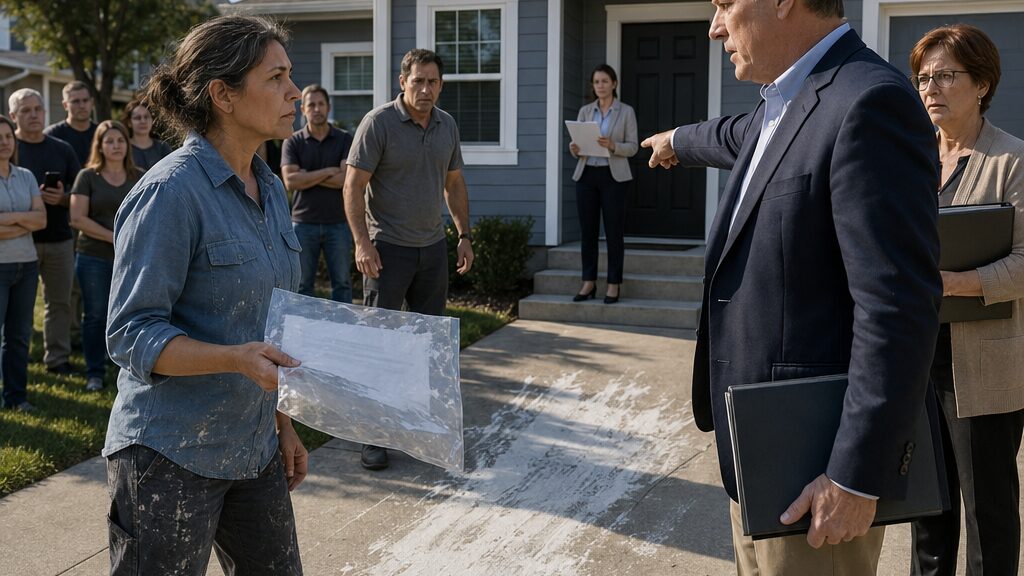
“Fifteen thousand dollars,” Ronald King said, pointing at the white paint spread across Eric Lewis’s driveway. “You accept the remediation charge, or we settle it in court. Pick one.”
Rachel Martinez looked past his finger to the paint.
It lay in a broad, careless splash over the concrete, too thick at the center and feathered at the edges where someone had dragged a shoe through it. Her paint did not fall that way. She kept lids closed unless a brush was entering the can, and she never set an open bucket on bare pavement.
Behind Ronald stood Michelle Anderson, the HOA treasurer, holding a tablet against her chest. The management clerk carried a stack of forms. Three neighbors had stopped along the sidewalk. Eric stood near his garage with his arms folded, his face tight with the embarrassment of having his home turned into a public meeting.
Rachel wiped her hands on her paint-stiffened trousers.
“What remediation?” she asked.
Ronald shifted his clipboard under one arm. He was a broad man in a pressed tan jacket, dressed too formally for a Monday-morning compliance walk. “Removal of the nonapproved coating. Surface correction. Repainting by an association-approved vendor. Concrete cleaning. Administrative costs.”
“The color was approved.”
“The finished result was not.”
“You inspected it Friday.”
“I conducted a preliminary walk-through.”
“You signed the completion sheet.”
His mouth tightened, but only for a second. “You hold a paintbrush, Ms. Martinez. That does not make you an expert on association contracts.”
One of the neighbors looked down. Another raised a phone, not quite recording, but ready.
Rachel felt the familiar pressure behind her ribs—the old impulse to turn facts into armor, arrange them in order, and wait for the other person to retreat. It had worked often enough to become a habit. It had failed once badly enough to become something else.
She glanced at Eric.
He gave the smallest shake of his head, a warning or a plea. Do not make this worse.
Rachel walked to her van and opened the side door. Inside, rollers hung by size, drop cloths were folded into squares, and copies of every approval rested in a clear document sleeve clipped above the tool cabinet. She removed the signed completion sheet and returned to the driveway.
Ronald continued speaking to Eric as if Rachel had left the conversation.
“The board is prepared to file against the property if the balance remains unresolved by Friday. We would prefer not to do that.”
“You told me the job passed,” Eric said.
“I told you the visible coverage appeared adequate before the final compliance review.”
Rachel stopped beside the paint spill.
A corner of transparent plastic drop cloth had been folded back near the porch. She knelt, slid Ronald’s signed sheet beneath it, and pressed the plastic flat. White smears streaked the surface above the page, but the signature remained clear.
Ronald King.
Approved upon final walk-through.
The date stood beside a faint brown thumbprint.
Rachel tapped it once.
“Is that your signature?”
Ronald looked down without bending. “The later report controls.”
“Under which covenant section?”
“The architectural standards.”
“Which section?”
A small silence opened around them.
Ronald’s face did not change, but Michelle’s grip shifted on the tablet.
Rachel continued. “The association’s enforcement process requires written notice of the specific violation, fourteen days to respond, and an opportunity for a hearing before monetary penalties are imposed. Repair costs require either owner authorization or documented emergency action. A lien cannot be considered until the charge becomes final.”
Ronald gave a short laugh. “You memorized a few paragraphs.”
“No. I read the packet Eric gave me before I started work.”
Eric looked at her sharply. “You knew all that?”
“I knew the approval process.”
“That isn’t what I asked.”
Rachel kept her eyes on Ronald.
He raised his clipboard. “The board has authority to protect property values. The paint is inconsistent with the community standard, and the spill demonstrates careless workmanship.”
Rachel looked at the porch. The siding was a warm white selected from the HOA’s approved palette. The line beneath the dark trim ran straight from the front steps to the corner post without a wobble. She had cut it by hand.
“The spill was not here when I left Friday,” she said.
Ronald glanced toward the neighbors. “That is your claim.”
“It was not here when you signed.”
“Again, the final review supersedes your paperwork.”
“Who performed it?”
“The association.”
“A person performed it.”
Michelle stepped forward. “Rachel, this is not the place to litigate every detail. The board can review supporting documents at the hearing.”
“What hearing?” Eric asked.
The management clerk separated one page from the stack.
Ronald answered first. “The one you may request after payment arrangements are established.”
Rachel looked at Michelle. “That reverses the procedure.”
Michelle’s expression closed. “I’m not discussing legal interpretations in a driveway.”
“It isn’t interpretation. It’s sequence.”
Ronald bent at last, placing one polished shoe beside the plastic-covered approval. “You have until Friday. If you force us to proceed, Eric’s property becomes lien-eligible. That could affect refinancing, sale, or title work. I suggest both of you think carefully before turning a correctable matter into an expensive principle.”
Eric’s folded arms dropped.
“Refinancing?” he said.
Ronald had been waiting for that word to land. “The association does not control a lender’s decision.”
Rachel stood. “But you knew he was refinancing.”
Eric looked from Ronald to her. “I mentioned it at the spring meeting.”
Ronald straightened. “Then you understand why prompt resolution is in everyone’s interest.”
The neighbor with the phone lowered it. The small audience began to disperse, discomfort overcoming curiosity.
Rachel removed the approval from beneath the plastic. No paint had reached the paper.
Eric followed her toward the van. “You made that sound like you’ve done this before.”
“I read contracts.”
“That’s not an answer.”
“It’s the answer I have right now.”
“My house is the one they’re threatening.”
“I know.”
“Do you?” His voice remained low, but the restraint hurt more than anger. “Because you can drive away from this.”
Rachel placed the document sleeve back on its clip. “Do not pay anything today.”
“Can they file by Friday?”
“Not properly.”
“That isn’t the same as no.”
No, it was not.
Before Rachel could respond, the management clerk crossed the lawn carrying a bright white notice. She peeled the backing from two strips of removable adhesive and pressed the paper to Eric’s front door.
FORMAL ARCHITECTURAL VIOLATION.
The black heading was visible from the street.
Eric stared at it.
Ronald walked toward his SUV without looking back.
Rachel crossed the porch and read the first line beneath the heading. The notice described the charge as already assessed, the hearing as optional, and the property as subject to collection.
Three steps placed in the wrong order.
Not carelessness, she thought.
A choice.
Chapter 2: The Signature That Changed Three Days Later
Ronald had signed the completion sheet while the porch rail was still tacky.
Rachel remembered warning him not to lean against it. He had smiled, tested the surface with the side of his thumb anyway, then wiped the faint mark on the bottom of the work order before writing his name.
That brown thumbprint remained beside the signature now lying on the folding table inside her van.
Monday’s public threat had made the page important. The date made it dangerous.
Two weeks earlier, Eric’s house had been a patchwork of sun-faded siding and old touch-ups that never quite matched. He had hired Rachel after receiving a general HOA reminder about exterior maintenance. The approved color sheet had come through the management office with Ronald’s initials at the bottom.
Rachel had spent four days preparing before opening the first finish can.
She scraped peeling edges, repaired nail holes, washed mildew from the shaded wall, and masked every hinge and light fixture. Eric’s teenage daughter had watched from the front steps one afternoon while Rachel cut the narrow white line beneath the porch roof.
“You don’t use tape there?” the girl had asked.
“Not when the surface is uneven.”
“How do you keep it straight?”
Rachel had moved the brush six more inches before answering. “You watch the edge, not your hand.”
On Friday, Ronald arrived just before sunset.
He walked around the house with his clipboard, rubbing one section of trim with his thumb and glancing up at the second-story fascia. He had spent more time checking his watch than the siding.
“Clean enough,” he said.
Rachel had held out the completion sheet. “Final approval here.”
Ronald signed.
Eric shook her hand and promised to send the final payment once the HOA released the remaining project deposit.
Three days later, white paint appeared across the driveway and the approved job became fifteen thousand dollars in damage.
By Monday afternoon, Rachel had arranged every document by date on the van’s table. Color authorization. Scope of work. Product specifications. Weather logs. Eric’s approval. Ronald’s completion signature. The new violation notice.
The paint was not the issue.
She knew that before she opened the inspection report, but she forced herself to test every ordinary explanation first.
Wrong sheen? No. The approved sheet specified satin.
Color variation? The batch numbers matched.
Moisture failure? The photographs showed no bubbling or adhesion loss.
Overspray? None appeared on the brick, windows, roofline, or landscaping.
The report accused her of “nonuniform exterior application and damage requiring full correction.” It included a photograph of the driveway spill and another of the front elevation.
Rachel zoomed in on the image metadata printed beneath the second photograph.
Thursday, 3:42 p.m.
She looked at the inspection date.
Wednesday.
The final report claimed the review had occurred a full day before the photograph supporting it existed.
She checked the page footer. Revision code 2.
The original inspection sheet, if there had been one, was missing.
Rachel drove to Ronald’s office before closing. It occupied one room behind the HOA clubhouse, crowded with banker’s boxes, framed community awards, and photographs of manicured entrances. Ronald sat behind a desk wide enough to make visitors feel farther away than they were.
She placed the report beside his signed approval.
“This says the inspection occurred Wednesday.”
Ronald did not touch either page. “Then it occurred Wednesday.”
“The supporting photograph was taken Thursday.”
“Photographs may be added later.”
“The report refers to the photograph as an observation made during inspection.”
He leaned back. “You are parsing language to avoid responsibility.”
“I’m comparing dates.”
“You are a vendor. The association does not owe you an internal records tutorial.”
“You approved the work Friday. The report says it failed Wednesday. Why did you sign two days after it had supposedly failed?”
His eyes moved to the signature at last.
For one moment Rachel saw calculation, not surprise.
Then he folded his hands. “The completion sheet acknowledged that your contracted work was finished. It did not waive final association review.”
“It says approved upon final walk-through.”
“Boilerplate.”
“Your form.”
“My office manages hundreds of documents. Occasional phrasing does not invalidate board authority.”
Rachel pointed to the brown print beside his name. “You signed this at the house.”
“I remember.”
“And you saw no spill.”
“I did not inspect the driveway for paint contamination.”
“You walked across it.”
Ronald’s jaw shifted. “Sweetheart, you can keep circling the same words, but you hold a brush. I read contracts.”
The sentence entered the room quietly and stayed there.
Rachel felt heat rise along her neck. Years earlier, men in county conference rooms had used softer words to make the same division: field people and paper people, labor and judgment, those who made things and those authorized to describe what had been made.
She slid the report back toward herself.
“Put your position in writing.”
“It already is.”
“The basis for fifteen thousand dollars is not.”
Ronald opened a drawer and removed another sheet.
“Then perhaps this will help.”
At the top, beneath the association logo, was an itemized collection notice. Remediation estimate: $14,625. Processing and document administration: $400.
Rachel read the final line twice.
The processing fee was due before the board would release supporting vendor estimates.
“You’re charging four hundred dollars to show the basis for the charge?”
“It covers staff time, duplication, and document handling.”
“Where is that authorized?”
Ronald smiled without warmth. “You may raise that at the hearing.”
“The hearing you will not schedule until payment arrangements begin.”
“Now you understand the process.”
Rachel gathered the papers.
Outside, the clubhouse parking lot was empty except for her van and Ronald’s SUV. She stood beneath the security light and looked again at the inspection report.
A false date could be a clerical error. A missing first version could be poor records management. A fee without clear authority could be overreach.
Together, they formed intention.
Her certainty should have steadied her.
Instead, she remembered a county file with every required signature in place, every box checked, and one omitted repair credit buried outside the official packet. She had approved its completeness. By the time she found the missing material, the homeowner had already lost the only deadline that mattered.
Rachel folded the memory away as she had for years.
Her phone rang.
Eric did not greet her.
“I just got an email from my lender,” he said. “The HOA reported a pending collection issue.”
“They cannot have a final lien yet.”
“They don’t need one. The lender wants it resolved before closing.”
“How long?”
“Ten business days.” His breath caught, then flattened. “I’m refinancing to pay off the medical bills from my wife’s last year. You should have told me this could happen.”
“I did not know Ronald would report an unfinalized charge.”
“But you knew enough in the driveway to quote the rules from memory.”
Rachel looked through the windshield at the clubhouse windows. Ronald’s office light went out.
“Rachel,” Eric said, “what aren’t you telling me?”
She closed her eyes.
“Nothing that changes what they did.”
“That wasn’t my question.”
A second email reached him while they were still on the phone. She heard the notification.
Eric read silently.
When he spoke again, his voice had lost its anger. That frightened her more.
“They’ve marked the property file as under active enforcement.”
Chapter 3: The File Rachel Had Not Opened in Years
The binder was labeled with the year Rachel left county employment.
She had written the numbers in black block letters, then placed the binder on the highest shelf of her apartment workspace where paint invoices, tax folders, and product manuals could hide it without covering it.
Thursday night, she brought it down.
Dust marked a clean rectangle where it had rested.
Her apartment was small enough that the dining table served as office, estimating desk, and place to repair brush handles. She cleared away two unopened paint catalogs and set the binder beside Ronald’s packet.
The difference between the files embarrassed her.
Her old county tabs aligned perfectly. Contracts. Notices. Statutory periods. Supporting invoices. Recorded instruments. Appeals.
The HOA pages were inconsistent in size, several undated, one printed from an email without its header. Ronald’s authority depended partly on making disorder feel official.
Rachel opened her laptop and logged into the county records portal.
For eleven years, she had audited construction contracts, payment claims, lien notices, public improvement assessments, and contractor disputes. She had reviewed enough filings that language patterns remained in her memory like familiar streets. Ten thousand liens, perhaps more. Most legitimate. Some careless. A few designed to look inevitable until someone checked the sequence.
She had left county work without a retirement party.
Her coworkers had assumed she wanted better money. Rachel had let them.
She entered the HOA’s legal name and pulled recorded property instruments from the past five years.
Eric’s address showed no lien yet. The pending enforcement flag existed only within the association’s records, but lenders often treated such warnings cautiously. Ronald did not need a valid lien to create immediate harm. He only needed to make one plausible.
Rachel compared the governing declaration with the violation notice.
The first defect appeared in nine minutes.
The HOA could recover actual correction costs after notice, hearing, and owner default. It could not impose an estimated correction charge before those steps occurred.
The second defect appeared six minutes later.
Administrative fees required adoption in a published annual schedule. The latest schedule listed copying charges, late-payment fees, and returned-check costs. No four-hundred-dollar processing fee existed.
The third defect was quieter.
The violation notice stated that Eric had fourteen days “from issuance.” The declaration gave fourteen days after delivery. Ronald’s date shortened the response period by however long the mail took.
Rachel searched prior filings tied to the subdivision.
Three unrelated homeowners had received releases within the last eighteen months. Each release referenced “satisfaction of compliance recovery.” She opened the associated documents.
Different houses. Different alleged violations. The same notice language.
Payment required before access to supporting estimates.
Four-hundred-dollar processing fee.
Accelerated deadline calculated from issuance rather than delivery.
Rachel leaned back.
One defective notice could be incompetence. Four matching notices were a system.
Her phone vibrated on the table. Eric.
She let it ring once too long before answering.
“Ronald called me,” he said.
“What did he want?”
“He wanted to help.”
Rachel almost laughed, but Eric’s tone stopped her.
“He said you used to work for the county. Contract auditing.”
The room seemed to narrow around the old binder.
“How did he know?”
“He said you were dismissed after mishandling a lien case.”
“I resigned.”
“Is the rest true?”
Rachel looked at the tabs she had not touched for years.
“I worked there eleven years.”
“And you didn’t think that mattered?”
“It matters to the documents.”
“It matters to me.” His voice rose, then dropped quickly, as if his daughter might hear from another room. “You stood in my driveway and told me not to pay. You told me they couldn’t properly file. You let me think you had picked up some legal knowledge from contractor work.”
“I never said that.”
“You let me think it.”
Rachel pressed her thumb against the edge of the table.
He was right. Silence could mislead without containing a single false word. She had known that professionally. She had ignored it personally.
“I found defects in the notice,” she said. “Enough to challenge the charge.”
“That is not what I asked.”
“No.”
“Were you dismissed?”
“No.”
“Did you mishandle a lien?”
Rachel looked at one section of the binder she had kept closed.
“A packet passed my review that should not have.”
“What happened?”
“The filing met the technical checklist. Supporting information had been omitted from the packet. I discovered it late.”
“How late?”
“After the homeowner’s response deadline.”
Eric said nothing.
Rachel could hear a television in the background and the faint clatter of a dish being set in a sink.
“So you know what this can do,” he said.
“Yes.”
“And you still decided to handle everything alone.”
“I was trying to keep it contained.”
“You were trying to keep yourself out of it.”
The accuracy of the sentence left no room to defend herself.
Eric exhaled. “Send me whatever you found. All of it. No more deciding what I need to know.”
“I will.”
“And Rachel?”
“Yes?”
“If Ronald is lying about the charge, prove that. But do not turn my house into a way to settle whatever happened at the county.”
The call ended.
Rachel sat still until the laptop screen dimmed.
She reopened the county binder.
Inside the final section was the old review sheet bearing her initials. The boxes were all checked. The page looked clean, precise, defensible. Beneath it she had placed the omitted credit memo that surfaced too late.
A straight line on paper did not make the decision behind it honest.
Rachel scanned Eric’s documents and sent him the full packet, including a brief explanation of every defect. Then she returned to the three earlier HOA matters.
The notices were not identical copies. Small wording changes suggested someone had refined the process over time. One homeowner had paid within five days. Another had entered an installment agreement. The third file showed a reduced charge after “informal board consideration,” though no minutes were attached.
Rachel searched the association’s publicly available meeting summaries.
Compliance revenue had increased.
Reserve contributions had decreased.
Not proof. A direction.
Near midnight, she printed the relevant pages and aligned them across the table. The old county files formed one clean stack. Ronald’s papers formed another.
For the first time, she placed them side by side.
The next morning, Rachel carried both stacks to her van.
A folded envelope waited beneath the driver-side wiper.
No stamp. No return address.
Inside was an HOA notice issued to Donna Green eight months earlier for peeling window trim. The amount was smaller than Eric’s charge, but the language was the same.
Estimated correction cost.
Payment before document access.
Four-hundred-dollar processing fee.
A handwritten note had been added beneath Donna’s name.
Please tell me whether I already agreed to something I cannot undo.
Chapter 4: The Quiet Pattern Inside the HOA Ledger
Donna Green’s notice contained the same four-hundred-dollar processing fee.
Rachel stood beside her van with the envelope open in both hands while the morning traffic at the end of the subdivision moved in slow, ordinary bursts. Lawn crews unloaded blowers. A delivery truck idled beside the mailboxes. Nothing around her looked urgent enough to justify the line printed near the bottom of Donna’s notice.
FAILURE TO REMIT MAY RESULT IN ACCELERATED COLLECTION.
The notice was eight months old.
Rachel called the number Donna had written beneath her signature.
Donna answered on the second ring. “You found it.”
“Yes.”
A pause. “Is it bad?”
“It is not clear enough to answer over the phone.”
“That means bad.”
“It means I need to see the rest of the paperwork.”
Donna gave her address, though Rachel already knew the house. It stood two streets beyond Eric’s, a narrow one-story home with hand-painted window trim that did not quite match from one frame to the next.
Donna opened the door before Rachel reached the porch.
“I did that part myself,” she said, following Rachel’s glance toward the windows. “My husband used to handle the outside. After he died, I thought paint was paint.”
The brush marks were uneven, but the wood had been scraped, primed, and sealed. Nothing was rotting. Someone had worked slowly and carefully without knowing how to make the finish look effortless.
Inside, Donna had arranged every HOA letter on her kitchen table. Several were still folded along their mailing creases.
“They told me the trim color was inconsistent,” she said. “Then they said the association could correct it. I asked for the estimate. They said I had to pay the document fee first.”
“Did you?”
Donna lowered her eyes. “I paid two hundred. They let me enter a plan for the rest.”
Rachel read the agreement.
Donna had not admitted the violation. She had agreed to a payment arrangement for “administrative and compliance obligations,” language broad enough to make surrender look like housekeeping.
“This date is wrong,” Rachel said.
Donna leaned closer. “Which one?”
“The notice says your response was due fourteen days after issuance. The declaration gives fourteen days after delivery. You received this five days after they printed it.”
“I called the morning it arrived.”
“Then your call was timely.”
“They told me it wasn’t.”
Rachel turned to the next page. The installment plan began two days later.
Donna pressed her fingertips together. “Can they take the house?”
“Not from this notice alone.”
“That isn’t what Ronald said.”
Rachel looked up.
Donna’s face had the composed stillness of someone who had been frightened for too long to display it every day.
“He said if I made the board spend money chasing a small balance, they would recover every dollar.”
Rachel closed the file.
At county meetings, people had often referred to documents as if the harm lived inside the paper. It did not. The harm lived in what someone believed the paper gave them permission to do.
“Do you want your case included if this becomes public?” Rachel asked.
“No.”
The answer came quickly.
Donna gathered the loose pages into a stack, then loosened her grip.
“I want it fixed,” she said. “I just do not want to become the woman everyone talks about when they argue over dues.”
Rachel understood. Visibility was often described as courage by people who did not have to survive its aftermath.
“I will not use your name without permission.”
Donna nodded, relieved but not reassured.
At noon, Rachel met Michelle Anderson in the HOA clubhouse records room. Michelle had agreed to let her inspect the published fee schedules and meeting summaries after Rachel sent a written request citing the association’s document-access provisions.
She did not invite Eric.
That choice bothered Rachel even before she made it.
Michelle unlocked a gray cabinet and placed three binders on the table. “You may review these. No photographs of owner information.”
“I only need policy records and totals.”
“You said that in your email.”
“I meant it there too.”
Michelle sat opposite her rather than leaving. Her posture made the review feel supervised.
Rachel opened the first binder. Annual budgets. Reserve transfers. Landscaping contracts. Insurance premiums.
The numbers were neat. The pattern was not.
Reserve contributions had been reduced twice over three years. At the same time, compliance recovery revenue had climbed from a minor line item to a figure large enough to cover roof repairs on the clubhouse and emergency drainage work along the east wall.
Rachel pointed to the column. “What does compliance recovery include?”
“Correction charges, administrative costs, and reimbursements.”
“Reimbursements from whom?”
“Owners responsible for violations.”
“Before or after hearings?”
Michelle’s expression tightened. “The records do not categorize by procedural stage.”
“Then how did the board verify the revenue?”
“We received monthly summaries.”
“Prepared by Ronald?”
“Prepared through the management process.”
“That was not my question.”
Michelle looked toward the closed door. “Ronald oversaw enforcement.”
Rachel turned to the reserve disclosure distributed at the annual meeting. The number presented to homeowners was higher than the ledger balance shown here.
“This disclosure says the reserve account held two hundred eighty-six thousand.”
“It did, at the reporting date.”
“The date is the final day of the quarter.”
“Yes.”
“The ledger shows two hundred nineteen thousand.”
Michelle reached for the page, then stopped before touching it.
“That may reflect pending transfers.”
“From compliance recovery?”
Silence settled between them.
Michelle’s voice lowered. “The reserve study underestimated drainage costs. Then insurance increased. Ronald believed a special assessment would cause panic.”
“And aggressive collections would not?”
“He believed enforcement should pay for correction.”
“Even when the association had not corrected anything?”
Michelle looked down at the ledger.
It was not surprise Rachel saw. It was recognition delayed until someone else spoke the words.
“We were told the amounts were supported,” Michelle said.
“Did you review the supporting files?”
“I reviewed summaries.”
“Did the board?”
“Not every one.”
“Did anyone ask why the processing fee does not appear in the adopted schedule?”
Michelle’s mouth hardened. “You are assuming misconduct when the association is trying to keep this place solvent.”
“No. I am asking whether people were charged money under a fee the board never adopted.”
“Those are not the same question.”
“They become the same problem.”
Michelle closed the binder.
“You have enough for today.”
Rachel gathered her notes. “How far below the disclosed figure is the reserve account now?”
Michelle remained still.
Then she said, “More than it should be.”
It was not an admission that would survive a meeting. It was enough to change the shape of the dispute.
That evening Eric stood in his kitchen with the lender’s email open on his phone. His daughter’s school papers had been pushed to one side of the counter.
“You found other notices,” he said.
Rachel had sent him the policy defects but not Donna’s name.
“Yes.”
“And the reserve account?”
“I found evidence that compliance money has been used to cover reserve expenses.”
“Evidence or suspicion?”
“A pattern. Not yet proof of why.”
Eric rubbed a hand over his face. “I cannot wait for you to prove the whole neighborhood is broken.”
“I know.”
“Do you? Because Ronald called again.”
Rachel looked at him.
“He said he can cancel the charge.”
“Under what condition?”
“He wants to meet tonight.”
Eric turned the phone so she could read the message.
PRIVATE RESOLUTION AVAILABLE. CONFIDENTIALITY REQUIRED.
“He will remove the enforcement flag,” Eric said. “My lender can proceed.”
“And the fee system stays.”
“My house stays too.”
Rachel heard the fear beneath the anger. Eric was not choosing comfort over principle. He was choosing between immediate damage and harm that might belong to strangers.
“You should understand the papers before signing,” she said.
“I thought that was why you were here.”
The words struck cleanly.
Rachel looked toward the refrigerator. A photograph of Eric’s late wife had been tucked beneath a magnet beside a hospital billing schedule.
He had told her what the refinance was for. She had still continued as if controlling information were the same as protecting him.
“I will go with you,” she said.
Eric’s phone chimed.
A second message from Ronald appeared with an attachment.
The first page was titled CANCELLATION OF COMPLIANCE CHARGE.
The second was a confidentiality agreement.
At the bottom, beneath the signature lines, Ronald had added one sentence.
Offer expires at midnight.
Chapter 5: The Settlement That Would Leave Everything Standing
Ronald placed the cancellation letter beside the nondisclosure agreement and aligned their bottom edges with the side of his hand.
The HOA conference room was smaller than the public meeting space, with no windows and one fluorescent light that hummed above the table. Michelle sat near the door. Eric and Rachel took the two chairs opposite Ronald.
“The arrangement is straightforward,” Ronald said. “The association will withdraw the fifteen-thousand-dollar remediation charge, remove the enforcement flag, and waive the processing fee.”
Eric looked at the cancellation letter.
“In exchange for silence,” Rachel said.
“In exchange for finality.”
Ronald uncapped a black pen. “No public allegations. No distribution of internal records. No solicitation of unrelated owner complaints. No statements that could damage the association or its contractors.”
“Your contractors,” Rachel said.
“My company performs work when the association requires immediate correction. That relationship is disclosed.”
“Where?”
Ronald set the pen down. “We are not here to conduct another audit.”
Michelle shifted in her chair.
Rachel opened the agreement. Ronald had underlined the confidentiality paragraph with a ruler. The line was perfectly straight.
“Eric cannot waive another owner’s rights,” she said.
“He is not being asked to.”
“This prohibits him from helping anyone with a similar notice.”
“It prohibits coordinated disruption.”
“And it prohibits me from using documents I received while working on his house.”
“You are not a member of the association. You have no independent right to interfere in governance.”
Eric reached for the pen.
Rachel saw the movement and stopped speaking.
He held it above the signature line without touching the page.
Ronald leaned back slightly. “Once you sign, I will send the withdrawal tonight. Your lender can receive confirmation in the morning.”
Eric’s thumb moved along the pen barrel.
Rachel thought of Donna’s kitchen table and the payment agreement she had signed without understanding that the deadline preceding it was wrong. She thought of the old county packet whose checked boxes had looked complete because she had not insisted on seeing what lived outside them.
Still, this was Eric’s house.
Not hers.
“You can sign,” Rachel said.
Eric looked at her.
“If that is what you decide, I will not stop you.”
Ronald smiled faintly. “Finally.”
“But read paragraph six first,” Rachel said.
Ronald’s smile disappeared.
Eric found the paragraph. His eyes moved slowly across it.
“What does ‘related resident claims’ mean?”
“It means this matter does not become a vehicle for broader conflict,” Ronald said.
“Could I show Donna Green’s notice to someone?”
Michelle turned toward him.
Ronald’s response came a fraction too late. “I am not discussing another owner’s private account.”
Eric placed Donna’s notice beside the agreement. Rachel had brought a redacted copy with permission, leaving only the fee language and dates visible.
“The same four-hundred-dollar charge,” he said. “Same wording.”
“That proves only that standard forms are used.”
“Her response deadline was wrong.”
“That is Ms. Martinez’s interpretation.”
“My daughter heard what you said to Rachel in the driveway.”
Ronald blinked. “I am not sure how that is relevant.”
“She asked me why grown men call women sweetheart when they want them to stop talking.”
The fluorescent hum seemed louder.
Eric put the pen down.
“I told her adults compromise because they have responsibilities,” he said. “Then I read this. This is not a compromise. It is moving the problem away from my house.”
Ronald’s voice cooled. “Your lender may not appreciate the distinction.”
“I know.”
“You could lose your refinance.”
“I know that too.”
Rachel watched Eric’s hand flatten on the table. He was afraid. Nothing about his refusal removed the fear.
Michelle stared at the redacted notice.
“Where did this come from?” she asked.
“An owner who received it eight months ago,” Rachel said.
“Was there a hearing?”
“No.”
Michelle looked at Ronald. “The monthly summary said the owner entered voluntary resolution.”
“She did.”
“After being told her response was late?”
Ronald’s patience cracked. “We are not reopening every settled account because a contractor has discovered vocabulary.”
Rachel turned toward Michelle. “Did you sign the monthly summaries?”
“I certified the totals.”
“Did you review supporting files?”
Michelle’s face changed.
Not dramatically. Her shoulders lowered, as though she had been holding herself upright against that question for years.
“I reviewed what Ronald provided.”
“Which was?”
“Aggregate collections. Open matters. Resolved matters.”
“No notices?”
“Not ordinarily.”
“Estimates?”
“No.”
“Hearing records?”
Michelle looked at Ronald before answering. “Not unless an owner appealed.”
Rachel nodded toward Donna’s notice. “The form told her payment arrangements came before hearing access.”
Michelle picked it up.
Ronald stood. “This meeting concerns Eric’s property, and the offer expires in forty minutes. Sign or decline.”
Eric slid the agreement back across the table.
“I decline.”
For the first time, Ronald’s confidence did not reorganize itself immediately.
He looked at Eric, then Rachel, then Michelle.
“All right,” he said. “The board will resolve the authority question formally.”
“What does that mean?” Eric asked.
“It means a special vote.”
Rachel understood before he explained.
“You are going to ratify the charges.”
“The board may clarify its enforcement policy.”
“Retroactively?”
“The board may confirm existing practice and authorize future collection.”
“You cannot create authority after using it.”
“That is an argument for the meeting.”
Michelle rose. “When?”
“Tomorrow morning.”
“The notice period—”
“This is an emergency financial matter. Electronic notice is permitted.”
“Not for a policy vote affecting owner charges.”
Ronald gathered the unsigned papers. “Then vote against it.”
The sentence landed differently than his threats. It was not dominance. It was accusation.
Michelle had signed the summaries. She had accepted the totals. Ronald was reminding her that responsibility did not belong to him alone.
Outside the clubhouse, Eric stood beside his car and stared at the dark windows.
“My lender deadline is still running,” he said.
“I know.”
“I almost signed.”
“You had reason.”
“That does not make me feel better.”
Rachel handed him the redacted notice. “It should.”
He looked at her.
“You stopped before fear made the decision for you,” she said. “That is not nothing.”
Her phone rang.
Michelle’s name appeared.
Rachel answered.
Michelle spoke quietly, as if Ronald might still be near enough to hear.
“He scheduled the vote for eight tomorrow morning. Before the management office opens. Before the county recorder’s desk takes calls.”
“Can he do that?”
“He can make us sit in the room.”
“And can the board validate past charges?”
“The attorney will argue that we are clarifying existing authority.”
“Do you believe that?”
Michelle did not answer directly.
“I found my signatures on summaries I never saw in final form,” she said. “Some of the attachments were added later.”
Rachel stopped walking.
“Do you have copies?”
“Not outside the records room.”
“Then preserve them.”
“If I remove anything, he will say I tampered with association records.”
“Photograph the index and note the file sequence. Do not alter the originals.”
Michelle inhaled sharply.
“You do know exactly what you are doing.”
Rachel looked through the clubhouse glass at the straight line Ronald had drawn beneath the confidentiality clause.
“No,” she said. “I know exactly what I should have done sooner.”
Chapter 6: The Hearing Where Rachel Named Her Own Failure
Ronald began the special meeting by projecting a photograph of white paint spread across Eric’s driveway.
The image filled the clubhouse wall behind him. Under the harsh projector light, the spill looked larger than it had in person, a pale wound across gray concrete.
“This,” Ronald said, “is the workmanship the association is being asked to excuse.”
Nearly forty residents sat in folding chairs. Some held printed notices. Others had come because the emergency meeting email mentioned possible changes to enforcement authority and reserve funding. Donna sat in the back row near the aisle, hands folded over her purse.
Rachel stood beside Eric at a narrow table facing the board.
Michelle occupied the far end of the dais. Two unnamed board members sat between her and Ronald. The association attorney arranged papers without looking toward the audience.
Ronald advanced the slide.
A close photograph showed the front siding. From a distance, the warm white finish appeared uniform.
“The contractor contends that the work was approved,” he said. “The association contends that completion acknowledgment did not waive final review. The board must also protect the community from delays that increase correction costs.”
Eric leaned toward Rachel. “He is making this about the paint.”
“That is safer for him.”
Ronald displayed the fifteen-thousand-dollar estimate.
“The proposed motion confirms the board’s existing authority to assess reasonable correction costs, administrative expenses, and emergency vendor charges.”
The association attorney adjusted his microphone. “For clarity, the motion may validate future charges under a clarified schedule. Whether it retroactively cures defects in an individual notice is a separate legal question.”
A murmur moved through the room.
Ronald looked at him. “The association has always possessed the underlying authority.”
“The board possesses enforcement authority,” the attorney said. “Procedure remains relevant.”
It was a narrow statement, carefully made. It was also the first public crack in Ronald’s certainty.
Rachel placed the clear document sleeve on the table.
When public comment opened, Ronald called Eric first.
Eric stood and described the approved color, Ronald’s walk-through, and the refinancing delay. He did not dramatize the medical bills or mention his daughter. His restraint made the facts harder to dismiss.
Then Ronald called Rachel.
“State your name and relationship to the property.”
“Rachel Martinez. I was the painting contractor.”
Ronald glanced toward the residents. “Your qualifications are in residential painting?”
Rachel felt the old instinct to answer only what had been asked.
“Yes.”
Ronald’s mouth shifted.
“And contract review,” she added. “I spent eleven years auditing construction contracts and lien documentation for the county.”
Heads turned.
Donna lowered her gaze, but not before Rachel saw relief cross her face.
Ronald folded his hands. “You did not disclose that background when you bid the work.”
“It was not relevant to applying paint.”
“Yet you now present yourself as an authority on association law.”
“No. I am presenting a document timeline.”
Eric placed the sleeve on the projector tray. The signed completion sheet appeared on the wall, Ronald’s name visible beneath streaks of dried paint on the transparent plastic.
Beside it Rachel displayed photographs of the trim line, the approved color authorization, and the inspection report.
“Ronald signed final approval on Friday,” she said. “The later report claims the work failed an inspection conducted Wednesday. Its supporting photograph was taken Thursday. The driveway spill appeared after the Friday approval.”
Ronald interrupted. “Photographs can be appended after inspection.”
“Yes. But the report describes the photograph as an observation made during that inspection.”
She highlighted the sentence.
“The document was revised,” she continued. “The first version has not been produced. The notice imposed an estimated correction cost before hearing, calculated the response period from issuance rather than delivery, and added a processing fee absent from the adopted fee schedule.”
One board member leaned toward the attorney. “Is that accurate?”
“The governing documents provide procedural requirements substantially as described,” he said.
Ronald’s face reddened. “This is a technical attack by a contractor avoiding responsibility.”
Rachel looked toward the projected approval.
Technical.
The word had protected her once.
She closed her folder.
“There is something else you should know before deciding whether to trust me.”
Eric turned toward her. She had not told him she would do this.
Rachel faced the residents.
“Years ago, at the county, I reviewed a lien packet that met the technical checklist. Required forms were present. Signatures were present. Dates appeared correct.”
The clubhouse became still.
“A repair credit had been omitted from the official packet. I did not know that when I approved the file as complete. I learned later, after the homeowner’s response deadline passed.”
Ronald seized the opening. “So you admit you mishandled a lien.”
“Yes.”
The answer stopped him more effectively than denial.
Rachel continued. “I reported the omission. The county corrected what it could. It could not restore the homeowner’s lost leverage. I resigned months later.”
She looked at the white paint spill projected beside Ronald’s signature.
“I told myself the failure belonged to the person who omitted the credit. Part of it did. But I had treated a clean file as proof of a fair process. I did not ask what was missing because every visible line was straight.”
No one moved.
“I came here prepared to prove only that Eric’s charge was defective. Then another owner showed me the same fee and the same shortened deadline. I delayed speaking publicly because I did not want to become responsible for another system.”
Rachel turned toward Donna but did not identify her.
“That delay was also a choice.”
Michelle removed a thick ledger from beneath the dais.
Ronald saw it and stood. “That is not on the agenda.”
“It is now,” Michelle said.
Her voice shook, but she did not sit back.
“I signed monthly collection summaries,” she told the room. “I did not review the underlying notices. I accepted Ronald’s explanation that resolved accounts had been voluntarily settled. I also accepted reserve totals without checking the timing of transfers.”
One of the other board members stared at her. “You certified those reports.”
“I did.”
“Are the reserve disclosures wrong?”
“They are incomplete.”
The word traveled through the audience in whispers.
Ronald moved toward the ledger. “We have a reserve shortfall because this community rejected assessment increases. Compliance recoveries paid for real work—drainage, roof repairs, exterior corrections. Everyone in this room benefited.”
“That may explain pressure,” Rachel said. “It does not authorize false sequence.”
Ronald turned on her. “Easy to say when you do not own property here.”
Eric stood. “She is not the one who used my house as leverage.”
The attorney lifted one hand. “The individual charge should be suspended pending review. The board may adopt a lawful future fee schedule, but I would not advise relying on this notice.”
A small release moved through Eric’s posture.
It was not victory. The lender issue remained. Donna’s payments remained. The earlier files remained.
Ronald sat slowly.
Michelle opened the ledger.
“I want the board to review all compliance recoveries from the past three years,” she said.
Ronald shook his head. “That will cost more than the disputed amounts.”
“Then we should have checked before collecting them.”
The two unnamed board members exchanged a look. One asked for a recess. The other asked whether an independent review could be limited to the fee and notice procedures.
Residents began speaking at once.
Ronald struck the table with his palm. “Order.”
The room quieted, but not for him.
Michelle turned the ledger so the board could see the payment columns.
Several entries were marked EMERGENCY CORRECTION.
The vendor name repeated beside them.
King Community Maintenance.
Ronald’s company.
Rachel leaned closer. The charges were not all round numbers, and none alone proved fabrication. Some included dates, material costs, and work descriptions. Others carried only a total and Ronald’s approval initials.
The deepest problem had changed again.
It was no longer whether Ronald had invented a paint failure.
It was how much of the neighborhood’s perfect appearance had been financed through procedures no one had wanted to examine.
Chapter 7: The Money Behind the Perfect Lawns
“The repairs were real,” the independent reviewer said.
Rachel sat across from him in a borrowed conference room while Michelle turned a page in the copied ledger. Eric occupied the chair beside Rachel, one ankle hooked behind the other as though holding himself in place.
The reviewer tapped three invoices.
“The clubhouse roof was patched. The east-wall drainage trench was cleared. Two exterior stair rails were replaced.”
Ronald, seated at the far end of the table, spread his hands. “Exactly what I have said from the beginning.”
The reviewer did not look at him. “That does not resolve how the work was authorized, priced, or charged back to individual owners.”
Ronald’s hands lowered.
A week had passed since the hearing. Eric’s charge remained suspended, but his lender had not cleared the refinance. The board had voted for an independent review by the narrowest possible margin: Michelle and one board member in favor, the other member against, Ronald abstaining only after the association attorney warned him that voting on payments to his own company would deepen the conflict.
Now the reviewer had separated the records into three stacks.
Documented work.
Unsupported fees.
Incomplete approvals.
Rachel had expected the first stack to be thin.
It was not.
Ronald’s company had repaired cracked masonry at the entrance after a winter freeze. It had removed a fallen limb from the walking trail before the association’s insurer inspected the site. It had cleared backed-up drains during a storm when water reached the lowest patios.
The work mattered.
That made the rest harder.
The reviewer lifted one invoice. “This drainage job was billed at eleven thousand eight hundred dollars.”
“It required emergency labor,” Ronald said.
“The subcontractor invoice was sixty-four hundred.”
“My company coordinated equipment, after-hours access, disposal, and restoration.”
“None of those charges is itemized.”
“The board knew our rates.”
Michelle shook her head. “We knew the totals.”
Ronald turned toward her. “You approved the payments.”
“I approved summaries.”
“You signed them.”
“Yes.” Michelle’s voice remained steady. “I should not have.”
The admission no longer sounded like self-defense. It sounded costly.
The reviewer continued. Several jobs had been performed, but Ronald’s company added broad management charges without a written rate schedule. In some cases, the HOA had recovered those costs from homeowners before holding hearings. In others, compliance payments flowed directly into the reserve account, obscuring how far regular contributions had fallen behind.
Nothing in the records showed that Ronald had invented every repair.
Nothing justified the process he had built around them.
Outside the review room, Rachel walked the neighborhood while Eric took a call from his lender. She passed homes whose defects were visible once she stopped seeing them as violations.
A porch column repainted with a color slightly too cool for the siding.
A garage frame touched up in three different whites.
Donna’s window trim, uneven but sealed against rain.
People had maintained what they could with the money, time, and skill they had. The neighborhood was not collapsing. It was aging unevenly.
Ronald found Rachel near the clubhouse entrance.
“You wanted fraud,” he said.
“No.”
“You expected fake invoices and imaginary work.”
“I expected the records to tell me what happened.”
He gave a bitter laugh. “That sounds noble after you forced everyone else into the cost of an audit.”
“You forced the audit when you used unsupported charges.”
“I kept the assessment flat for three years.”
“And replaced it with penalties people could not predict.”
“People vote against dues increases and then complain when grass dies, drains fail, and insurance demands repairs. Someone still has to pay.”
Rachel looked toward the entrance beds. Every hedge stood at the same height.
“You decided the easiest people to charge were the ones already accused of something.”
“I decided responsibility should follow conduct.”
“Donna painted her own window trim.”
Ronald’s expression shifted. “You used her records?”
“Not her name.”
“She entered an agreement.”
“After being told her deadline had expired when it had not.”
“She owed money for correction.”
“No correction occurred.”
“The fee covered enforcement.”
“The fee was never adopted.”
Ronald looked past her toward the houses. “You think procedure is cleaner than outcome because you used to sit behind a county desk.”
Rachel felt the strike in the sentence and let it pass through.
“No,” she said. “I know procedure can hide harm. That is why it matters who gets to question it.”
He studied her for a moment.
Then his shoulders dropped slightly.
“You know what happens now?” he asked. “They raise dues. The same residents who demanded an audit will blame the board for the assessment. They will say the neighborhood was fine before all this.”
“Was it?”
“The roofs did not leak.”
“Donna thought she might lose her house.”
Ronald’s face hardened again. “Fear is not the same as fact.”
“No. But you used it as if it were a collection tool.”
He walked away without replying.
That afternoon, the reviewer presented preliminary findings to the board. The unsupported four-hundred-dollar fees would need individual review. Several owner charges lacked complete notice records. Ronald’s company had performed substantial work, but pricing and conflict disclosures were inadequate. The reserve account had been made to appear healthier by including disputed compliance revenue.
No single sentence gave the residents a simple villain.
Michelle gave them something harder.
“We knew the reserve study was outdated,” she said during the open session. “We also knew a special assessment would be unpopular. Ronald told us stronger enforcement could close part of the gap. We accepted that because it postponed a vote none of us wanted to defend.”
One resident called it theft.
Another accused the board of negligence.
A third asked whether the drainage would have failed without Ronald’s emergency work.
Rachel stood when the chair recognized her.
“The review should decide which charges were unauthorized,” she said. “Calling every board member corrupt will not make the records clearer. Some work was necessary. Some prices were unsupported. Some procedures were bypassed. Those are different findings.”
The angry resident frowned. “Why are you defending them?”
“I am not. I am refusing to replace one convenient story with another.”
Michelle looked at her, gratitude and shame crossing her face together.
Before the final corrective vote, Ronald submitted a written resignation as president. He read only two lines aloud.
“I will not continue serving a community that demands perfect maintenance while treating the cost of that maintenance as someone else’s moral failure.”
He left his board packet on the table and walked out.
No one applauded.
The room remained divided after the door closed.
The board suspended all disputed compliance collections, ordered individual account reviews, and scheduled a vote on a transparent reserve assessment. Ronald’s unilateral enforcement authority disappeared with his resignation, but the financial hole remained.
As residents gathered their papers, Michelle approached Rachel with a draft document.
At the top it read RESIDENT COMPLIANCE APPEAL PROCEDURE.
“We need someone to help design this,” Michelle said.
Rachel did not take it.
“I am not joining the board.”
“I did not ask you to.”
“You are asking me to become responsible for the system.”
“I am asking you to show us where people need a door.”
Rachel looked at the blank lines beneath the heading.
For years she had insisted that she was only responsible for the documents placed directly in front of her.
Now Michelle was placing an empty one there.
Chapter 8: The Line They Chose to Keep Clean
The lender removed the enforcement warning from Eric’s file six weeks later.
He read the email twice in Rachel’s driveway before handing her the phone.
“They cleared it,” he said.
The refinance would close on Friday. The HOA’s fifteen-thousand-dollar charge had been voided, not reduced or privately withdrawn. The four-hundred-dollar fee was gone. The final letter stated that the original notice had failed to follow required procedure and could not support collection.
Rachel returned the phone.
Eric looked toward the pale mark still visible on the concrete. The spilled paint had been pressure-washed, scrubbed, and treated, but a faint white shadow remained where it had dried deepest.
“I thought about coating the whole driveway,” he said.
“That would hide it.”
“Isn’t that the point?”
“Sometimes.”
Rachel opened the back of her van and removed a narrow roller, a tray, and a can of concrete-edge paint. She had come to restore the border along the garden bed where the cleaning had stripped away the original finish.
She knelt and began at the porch.
The new line traveled straight beside the old stain without covering it.
Eric watched for a moment. “You always leave the bad part showing?”
“I leave what is not mine to erase.”
He smiled slightly. “That sounds like something you practiced.”
“I did.”
At the clubhouse that evening, residents filled fewer chairs than they had for the hearing. Crisis attracted more people than procedure.
The board adopted a published fee schedule, mandatory notice templates, a pre-charge hearing requirement, and an appeal process that paused collection while supporting records were reviewed. Any vendor connected to a board member would require competitive pricing and recorded disclosure.
Past compliance accounts would be examined individually. Refunds would not arrive quickly. Some charges would remain where work had been authorized and documented. Others would be reduced or reversed.
The reserve problem required a separate vote.
The new assessment was unpopular.
One resident said honest accounting should not become a punishment for people who had done nothing wrong. Another argued that the neighborhood could not repair drainage with apologies. A third demanded that Ronald’s company repay everything, though the independent review had not supported that conclusion.
Michelle did not hide behind the ledger this time.
“We postponed a necessary decision,” she said. “That made the eventual cost less visible, not smaller.”
The assessment passed by three votes.
No one celebrated.
After the meeting, Michelle approached Rachel near the folding tables.
“There is still an open board seat.”
“No.”
“You answered before I finished.”
“I answered six weeks ago.”
Michelle held up both hands. “Then I will ask the smaller question. Will you review appeal packets?”
Rachel looked at the printed procedure she had helped shape. Her revisions were practical: plain-language deadlines, a checklist of records the association had to provide, a place for residents to state what outcome they wanted, and a rule barring the person who issued a charge from controlling the appeal.
“I will hold a document clinic twice a month,” she said. “One hour. Residents and local contractors. No votes, no board title, no private access to accounts.”
Michelle nodded. “Boundaries.”
“Clean ones.”
The first clinic took place at a corner table in the clubhouse. Rachel brought three clear sleeves, yellow tabs, and a sign that read BRING EVERY PAGE.
Only two people came.
Donna was first.
Her account review found that the underlying trim concern had been valid but the administrative fee and accelerated deadline were not. Because the HOA had never performed the correction, most of her balance was removed. The remaining amount was placed on a payment schedule she could manage.
More important to Donna, the new letter stated her appeal rights in ordinary language.
She read that paragraph several times.
“So they cannot just say I am late before I receive it?”
“Not anymore.”
Donna placed the letter into a clear sleeve.
“I still need to repaint the back windows.”
“I can show you how to cut the edges.”
“I thought you would offer to do it.”
“I charge for painting.”
Donna laughed softly. “Good.”
The second visitor was a young painter who had completed a fence job in another subdivision. The management company had withheld final payment because one approval signature was missing from its own file.
“Did anyone sign at the property?” Rachel asked.
The painter produced a folded work order from a jacket pocket. The paper was creased, spotted with dust, and beginning to tear along the center.
Rachel flattened it.
A supervisor’s signature appeared at the bottom.
“Never keep the only copy folded in your pocket,” she said.
“I took a picture.”
“Keep that too.”
She slid the work order into a clear sleeve and handed it back.
The young painter ran a thumb over the protected signature.
“Will this make them pay?”
“No.”
The painter looked disappointed.
“It will make it harder for them to pretend the signature never existed,” Rachel said. “Then you still have to use it.”
Outside, evening settled across the subdivision. The lawns remained trimmed, though not perfectly. One hedge had grown higher than the others. Donna’s window frames showed fresh primer on the back side. Eric’s driveway held a clean painted border beside the faint white stain.
Rachel packed her tabs and spare sleeves into the van.
Eric’s daughter crossed the lawn carrying an empty paint tray Rachel had left near the porch.
“I washed it,” she said.
Rachel checked the corners. A narrow ribbon of white remained along one edge.
“Almost.”
The girl reached for it again.
Rachel handed her a rag. “Watch the edge, not your hand.”
Together they wiped the last wet line from the tray.
The stain on the driveway remained.
The document in the young painter’s sleeve remained.
So did the reserve assessment, the divided neighbors, Michelle’s signatures, Ronald’s completed repairs, and the costs no ruling could make disappear.
Rachel closed the van door.
Before leaving, she placed one last clear sleeve in the young painter’s hands.
“For every approval,” she said. “And when something is wrong, do not wait for the paper to speak by itself.”
The story ha