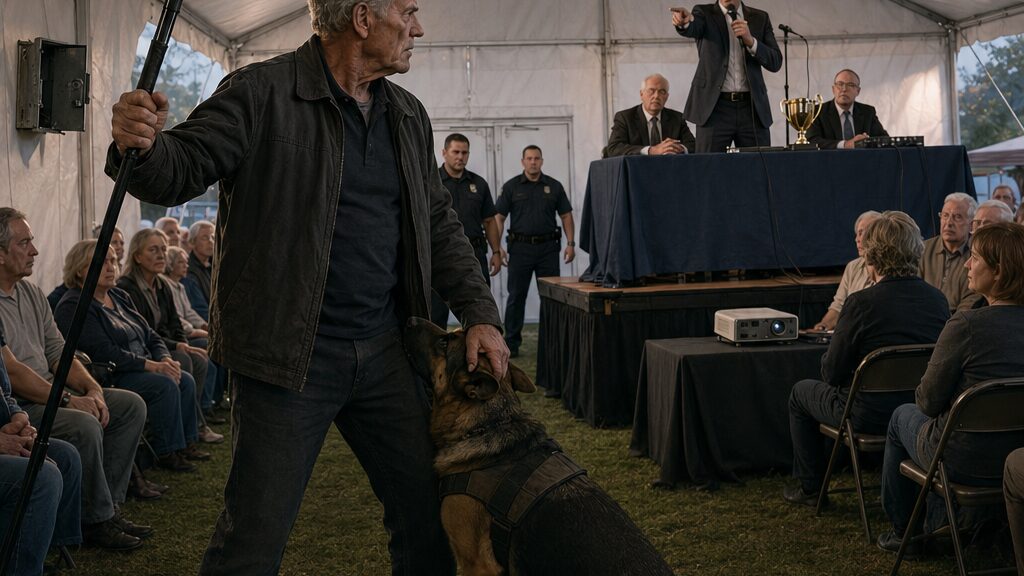
They Banned His Service Dog, So He Made the Entire HOA Hear the Recording
Chapter 1: The Animal Tyler Called Filthy
“That filthy animal is banned from every common area—effective immediately.”
Tyler Scott’s voice cracked through the loudspeakers before the meeting had officially begun.
The words traveled beyond the white canvas tent, across the lawn, and into the rows of identical houses surrounding it. Conversations stopped. Folding chairs scraped. More than sixty residents turned toward Ronald Harris and the large service dog sitting quietly against his left leg.
The dog did not bark or pull at its harness. It merely lifted its head at the sound of Ronald’s breathing changing.
Ronald kept one hand on the harness handle.
Across the tent, Tyler stood behind the center table on the raised wooden platform. The microphone looked small in his polished hand. Behind him sat Joseph Baker, the HOA president, and Alexander Mitchell, the treasurer. Between them stood a gold-colored trophy nearly two feet tall.
COMMUNITY OF THE YEAR gleamed across its black base.
Tyler tapped the microphone.
“This is an emergency association assembly,” he said. “We will maintain order.”
A second microphone had been placed in the aisle for residents. Ronald had been told to stand beside it when his case was called. Its green light was dark.
He pressed the switch anyway.
Nothing.
“I have the medical documentation,” Ronald said without amplification.
Tyler looked at him as if Ronald had interrupted a private conversation. “You will speak when recognized.”
“You named me before calling the meeting to order.”
“I identified the violation.”
Ronald felt the dog lean against his shin. Not hard. Just enough pressure to pull his attention away from the speakers and back into his body.
Canvas above him.
Grass beneath his shoes.
Warm harness handle in his palm.
Six breaths a minute.
Tyler lifted a folder. “Multiple complaints describe an uncontrolled animal occupying pathways, approaching residents, and creating sanitation concerns.”
A murmur passed through the chairs.
Ronald looked along the rows. Some people avoided his eyes. Others watched the dog, perhaps searching for the danger Tyler had described. The animal remained seated, shoulders loose, gaze fixed on Ronald.
“What complaints?” Ronald asked.
Tyler’s mouth tightened. “Anonymous submissions are protected.”
“The dog has never approached anyone unless instructed.”
Joseph leaned toward his own microphone. “This is not a debate about your personal interpretation.”
His voice came through the speakers louder than Tyler’s. Ronald’s shoulders locked before he could stop them.
The dog rose.
A woman near the aisle flinched.
The dog turned inward, pressing its body across Ronald’s knees, blocking his forward movement and lifting its face toward him. Ronald lowered his hand to the animal’s shoulder.
“Good,” he whispered.
The dog’s tags gave one soft metallic click.
Everyone had just watched the supposed threat respond to distress without barking, lunging, or looking away from its handler.
Tyler did not pause.
“The board has determined that the animal may remain inside your private property,” he said, “but it is prohibited from sidewalks, recreation areas, the clubhouse grounds, and this common lawn.”
Ronald stared at him. “My house has no private route to the street.”
“That is not the association’s concern.”
“It makes the order impossible to obey.”
“It makes compliance your responsibility.”
Ronald took a folded packet from inside his jacket. The top page carried a physician’s signature and the federal service-animal guidance Tyler had refused to acknowledge by email.
“I’m submitting this for the record.”
He walked two steps toward the dais.
The two contracted security guards shifted from beside the tent opening. Neither touched him, but their movement narrowed the aisle.
Tyler held up a hand. “The record is closed.”
A few residents whispered.
Ronald stopped. “Closed?”
“The board reviewed the available material in executive session yesterday.”
“You voted before hearing me.”
“We reviewed your repeated refusal to follow community rules.”
“You voted before this meeting.”
Joseph reached toward the trophy and rotated it slightly, positioning its engraved plate toward the crowd.
“We have a duty to protect the standards of this neighborhood,” he said. “Those standards are why this community received recognition last year.”
Ronald looked at the polished trophy, then at the torn edge of canvas flapping above a leaking irrigation trench outside the tent. The common lawn had dead strips where the sprinkler repairs had supposedly been completed twice.
Tyler opened another folder.
“Beginning tomorrow, each documented appearance of the animal in a common area will incur a five-hundred-dollar fine. Repeated violations will trigger accelerated collection procedures.”
Ronald’s fingers tightened around the medical packet. “Accelerated how?”
Tyler’s gaze held his.
“Lien enforcement.”
This time the crowd did not murmur. The silence was heavier.
Ronald had lived in the house for twenty-eight years. He had replaced the porch boards himself, planted the oak when its trunk had been thinner than his wrist, and paid every assessment before the due date. The house was not large, but it was the last place in his life that no one could order him out of.
Until now.
Tyler slid a notice toward the edge of the table.
“You can comply,” he said, “or you can face the consequences of continued defiance.”
Ronald walked to the dead microphone and placed his packet beside it.
“You are banning the medical assistance that lets me leave my home,” he said. “Then fining me for needing it.”
Tyler leaned closer to his microphone. “We are restricting an animal.”
“You called him filthy.”
“I described the condition reported to management.”
“You wanted everyone here to hear it.”
Tyler’s expression shifted, not quite into a smile. “Everyone here needs to understand that no resident is exempt from enforcement.”
There it was.
Not safety. Not sanitation. An example.
Ronald looked again at the faces around him. A man in the second row stared at his shoes. A woman near the rear held a violation envelope folded in half. Christine Wilson sat near the aisle with both hands clasped around her purse, her eyes moving between Ronald and the board.
No one spoke.
Tyler mistook the silence for agreement.
He lifted the notice and turned it toward the projector camera so the document appeared on the screen behind the dais. The image was crooked and too large, but the heading was clear:
FINAL ANIMAL ENFORCEMENT ORDER.
Below it, a schedule listed fines, collection fees, attorney charges, and a projected lien filing date.
Ronald read the first date twice.
Then he read the smaller line beneath the heading.
Draft created: May 4.
His records request for reserve-fund invoices had been delivered on May 3.
The first anonymous animal complaint had not appeared until May 9.
Ronald raised his head.
Tyler was still speaking about standards and compliance, unaware that the projector had displayed more than he intended.
The order against the dog had been written before anyone claimed the dog had done anything.
Ronald looked at Joseph.
Joseph had stopped touching the trophy.
Chapter 2: The Missing Pages Behind the Assessment
The invoice claimed the storm repairs had been completed six months before the storm occurred.
Ronald read the date a third time at his kitchen table.
November 18.
The storm that had supposedly damaged the western retaining wall had struck in May of the following year. Ronald remembered it because the dog had woken him before the emergency alert, pressing across his legs while wind threw branches against the windows.
Yet the HOA ledger showed forty-two thousand dollars paid for “urgent post-storm stabilization” the previous November.
Ronald placed the invoice beside the special-assessment letter. The letter demanded twenty-eight hundred dollars from every household to replenish reserves depleted by those repairs.
The numbers did not merely fail to align. They contradicted time.
His laptop gave a soft notification chime. The sound was low because he kept every device muted except for essential alerts. He opened the email.
PROPERTY MANAGEMENT RESPONSE TO RECORDS REQUEST.
The message contained twelve attachments. The board’s reserve ledger referred to thirty-seven.
He called Tyler’s office.
A recorded voice answered.
“Your call is important to us.”
Music began—bright, synthetic, and too loud. Ronald removed the phone from his ear. The dog lifted its head from beneath the table.
He ended the call and dialed again, choosing the extension for records.
Another recording.
He left his name, address, request date, and the list of missing documents. He did not mention the impossible invoice. Not yet.
For years, he had survived difficult rooms by learning what not to reveal too soon. Information given before the right moment became a weapon in someone else’s hand.
By noon, he had three duplicate invoices spread across the table.
Each billed exactly $18,750.
One was for drainage excavation. One was for retaining-wall reinforcement. One was for emergency tree removal. The descriptions differed, but the invoice numbers were separated by a single digit, and all three used the same misspelled street name in the vendor address.
Ronald searched the state contractor database.
No matching company appeared.
The dog nudged his knee.
“I see it,” Ronald said.
The animal nudged him again.
Ronald realized he had stopped breathing evenly.
He sat back and placed both feet flat on the floor. The dog’s tags clicked as it settled against him.
Twenty minutes later, Ronald carried copies to the small HOA office beside the clubhouse.
Tyler stood inside speaking with an assistant. When he saw Ronald through the glass, he closed the inner door before approaching the front counter.
“You received our response,” Tyler said.
“I received part of it.”
“You received the records management determined were responsive.”
“The ledger references invoices you didn’t send.”
“Some documents contain protected information.”
“Contractor invoices?”
“Banking information. Account identifiers. Resident data.”
Ronald slid the November invoice beneath the glass opening. “This repair predates the damage.”
Tyler glanced down for less than a second.
“Accounting descriptions are sometimes entered after the fact.”
“The payment date also predates it.”
“Then it may refer to an earlier event.”
“It names the May storm.”
Tyler pushed the page back.
“You are not an auditor, Mr. Harris.”
“No. I’m a homeowner paying for work I can’t find.”
Tyler folded his arms. “The association has declining reserves because residents delay assessments, challenge fees, and demand services while resisting their cost. My job is to stabilize that.”
“By hiding invoices?”
“By preventing amateur accusations from disrupting operations.”
Ronald studied him. Tyler’s irritation was genuine, but there was something beneath it—less confidence than calculation.
“Send the remaining documents,” Ronald said.
“You have what you are entitled to.”
Ronald took the invoice. “Then put that refusal in writing.”
Tyler’s jaw tightened.
Outside, the afternoon sun reflected from the clubhouse windows. The dog walked close at Ronald’s left side, ignoring a barking terrier behind a fence.
Near the mailboxes, Christine Wilson stepped into his path.
“Did you ask Tyler about the assessment?”
Ronald stopped. “Why?”
She glanced toward the office. “Because he called me this morning.”
“What did he want?”
“To remind me my landscaping fines remain unpaid.”
Ronald knew about the fines. Christine had replaced dead shrubs after the irrigation system failed. The board cited her for planting without approval, then cited her again when she removed the replacements.
“What does that have to do with me?”
“He asked whether you’d been speaking to neighbors about reserve money.”
Ronald’s face gave nothing away.
Christine noticed anyway. “You have.”
“I asked for records.”
“And now he thinks I’m helping you.”
“Are you?”
The question came out harder than Ronald intended.
Christine pulled a folded statement from her purse. “I might have been.”
She handed it to him.
Her special assessment listed the same retaining-wall project, but the amount allocated to her section was different from Ronald’s. A handwritten note showed late fees beginning only four days after she questioned the charge.
“They accelerated everything after I asked for an explanation,” she said. “My regular fines sat for months. Then I disputed the assessment, and suddenly I had a lien warning.”
Ronald compared the dates.
The pattern was not only in his head. Tyler had turned collections into discipline.
“Do you have more?” Christine asked.
Ronald folded her statement with his copies. “I have inconsistencies.”
“That isn’t what I asked.”
“It’s what I can verify.”
Her expression hardened. “You came into that office carrying something you didn’t want Tyler to see.”
Ronald looked toward the clubhouse. Through the window, Tyler stood watching them.
Christine lowered her voice. “If you want people to risk their homes, you have to tell them what they’re risking them for.”
“I didn’t ask you to risk anything.”
“No. You just let me hand you my statement while you keep yours hidden.”
She took the page back from him.
“Christine—”
“I already have one man deciding what I’m allowed to know.”
She walked away.
The dog looked after her, then back at Ronald.
He had gained proof that the retaliation pattern extended beyond him. He had also managed, in less than two minutes, to drive away the first person willing to confirm it.
That evening he reopened the association’s online archive.
Most files were minutes, budget summaries, and recordings of virtual meetings held during the previous year. He worked chronologically, cross-checking spoken approvals against ledger dates.
At 11:14 p.m., he opened a finance-session recording marked thirty-eight minutes long.
The official minutes said the meeting adjourned at thirty-four minutes and twelve seconds.
Ronald dragged the progress bar near the end.
Joseph’s formal voice concluded the session. Chairs moved. Someone said good night. A digital chime signaled that participants were leaving.
Then silence.
Ronald almost closed the file.
At thirty-six minutes, someone laughed.
Not the polite laugh Joseph used during meetings. This one was loose and unguarded.
A second voice joined him.
Alexander Mitchell.
Ronald increased the volume by one level.
Joseph said something too faint to catch. Alexander answered, and both men laughed again.
The dog came to Ronald’s side as he leaned closer to the laptop.
The session had ended for everyone who believed the red recording light had gone dark.
But the file still had one minute and forty-eight seconds remaining.
Chapter 3: The Laughter After the Meeting Ended
“Three hundred twelve thousand, six hundred forty,” Joseph Baker said through Ronald’s headphones.
Ronald froze.
The number did not appear in any budget the board had released.
On his screen, the finance-session timer read 36:17. The meeting had officially ended two minutes earlier. Joseph’s voice was quieter now, no longer arranged for residents.
Alexander answered, “That’s before the western wall reimbursement clears.”
“It clears if the paperwork matches.”
“It’ll match.”
A chair scraped. Glass touched a hard surface.
Ronald lowered the volume, though the headphones were already barely audible. The words were not loud, but the laughter between them filled more space than shouting would have.
Joseph spoke again.
“We move the reserves against the emergency repair entries. By the time anyone sees the annual statement, the replenishment assessment is already approved.”
Alexander gave a nervous chuckle. “And the difference?”
“We split the rest after the transfers settle.”
The dog rested its chin on Ronald’s thigh.
Ronald kept one hand on its neck and replayed the passage.
Same cadence. Same background hum as the public portion of the session. No audible splice. The file properties showed a single continuous recording created by the association’s meeting account.
He copied it to an external drive, then another.
At 36:54, Alexander asked, “Which destination account?”
Joseph began to answer.
The recording stopped.
Ronald stared at the flat end of the waveform.
No account name. No routing number. No admission that the transfers had been completed. Only a plan, exact amounts, fabricated repairs, and laughter.
Enough to destroy trust.
Perhaps not enough to survive Tyler.
By sunrise, Ronald had three columns on a legal pad.
Recorded amount: $312,640.
Published reserve balance: $191,890.
Unexplained difference: $120,750.
He found the difference spread across six ledger entries, including the three identical invoices. Two entries were labeled reimbursements but contained no payer. Another carried the phrase administrative adjustment.
He called the bank listed on an old association payment coupon. The representative would not discuss account activity with a homeowner.
He called the community attorney’s office. The receptionist said the firm represented the association, not individual residents.
He submitted another written records demand.
At ten in the morning, someone knocked.
Tyler stood on the porch holding a large envelope. Behind him, one of the contracted security guards waited near the sidewalk.
Ronald opened the door only far enough to step outside with the dog.
Tyler glanced at the animal. “You’ve been warned about bringing it onto common property.”
“This porch is mine.”
“The sidewalk is not.”
“The dog is not on the sidewalk.”
Tyler held out the envelope. “Final notice of animal violation and notice of emergency hearing.”
Ronald took it.
The hearing was scheduled for the following Tuesday beneath a temporary tent on the common lawn. The notice accused him of refusing corrective action, intimidating management staff with repeated demands, and allowing an animal to create a hostile environment.
“You delivered this by hand,” Ronald said.
“We need proof of service.”
“You brought security to deliver paper.”
Tyler looked past Ronald into the house. “Your recent conduct has become increasingly fixated.”
“Requesting invoices is fixation?”
“Showing up at the office with accusations. Approaching residents. Reviewing materials without understanding accounting practice.”
Ronald watched him carefully. “You know what I reviewed?”
“I know you have been searching for a scandal because you object to paying your share.”
“You haven’t seen my objection yet.”
For the first time, Tyler’s expression changed. Only slightly, but Ronald saw it: uncertainty, followed by a quick effort to bury it.
“Bring whatever you believe is relevant to the hearing,” Tyler said. “The board will determine whether it deserves consideration.”
“You already know it does.”
Tyler stepped back. “If the animal appears in any common area before the hearing, another fine will issue.”
“How am I supposed to reach the hearing?”
“That is your logistical problem.”
He turned and walked away with the guard.
Ronald opened the envelope inside.
The final page carried a proposed lien authorization. Joseph’s signature line was blank, but the filing date had already been entered.
The board did not intend to hear him. It intended to create a public record of his refusal before taking his home.
Ronald inserted the external drive into a small USB case and placed it in his jacket pocket.
Evidence alone was not a plan.
He spent the afternoon reading the bylaws. Removal procedures required notice, quorum, and a membership vote. The board controlled the agenda, the notice, the microphones, and the official count.
At dusk he walked the edge of the common lawn, staying on the street where Tyler could not pretend the dog had violated the order.
Workers were unloading folded sections of the white tent. A portable wooden platform rested beside stacks of chairs. Power cables ran toward a locked metal box mounted near the double entrance frames.
The meeting was being built like a stage.
Christine sat on a bench beyond the lawn, a folder across her knees.
Ronald nearly continued past her.
She said, “I found something.”
He stopped several feet away.
“You said that before,” he replied. “Then I gave you nothing.”
“That’s accurate.”
Her bluntness made him look at her.
Christine opened the folder. “The notice calls Tuesday an emergency association assembly.”
“I saw.”
“It doesn’t call it a disciplinary hearing.”
“What difference does the label make?”
She held out a photocopied bylaw page.
“Article six. Emergency membership sessions. If enough voting interests are present in person or by signed proxy, members can introduce a motion related to immediate association governance.”
Ronald read the section.
The language was dense but clear. A majority of all voting interests could remove board members for cause. Management contracts could be suspended by the same vote pending legal review.
“Tyler changed the meeting label so he could bring every resident under one notice,” Christine said. “He wanted an audience.”
“He gave the audience authority.”
“Only if we have the numbers.”
Ronald folded the page once, then stopped himself from putting it in his pocket.
Christine watched him. “Do you have proof?”
He looked toward the workers raising the tent. A metal pole locked into place with a sharp clang. His body reacted before his mind did; the dog stepped across his path and leaned into him.
Ronald placed his palm on the harness.
When the sound had passed, he said, “I have part of it.”
“How much?”
“Enough to show intent. Not enough to trace the destination.”
“Then we need more than the recording.”
He had not told her there was a recording.
Christine saw that realization cross his face.
“You keep looking at your jacket pocket whenever Tyler mentions evidence,” she said. “You’re not as unreadable as you think.”
Ronald’s first instinct was to leave.
That instinct had kept him alive in places where trusting the wrong person could cost more than pride. It had also left him alone at a kitchen table while the people threatening his home controlled every public channel.
“What do you need?” he asked.
“Statements. Proxies. People willing to remain in the room when Tyler threatens them.”
“He will.”
“I know.”
“And if you help me, your lien moves faster.”
“I know that too.”
Ronald looked down at the bylaw page between them.
Christine extended it again.
“This only works if the evidence belongs to more than one frightened person.”
He took the page.
Behind them, the white roof of the tent rose above the lawn, bright and empty, waiting for Tyler’s microphones.
Ronald touched the USB case through his jacket.
For the first time since finding the recording, the question was no longer whether the truth existed.
It was whether he could trust anyone else to carry it.
Chapter 4: The Votes No One Dared Admit
The first resident Ronald approached opened the door only six inches.
Before saying a word, the man glanced over Ronald’s shoulder toward the street. Then he pulled a white envelope from behind the door and held it where Ronald could see the red block letters stamped across the top.
NOTICE OF INTENT TO LIEN.
“I can’t be involved,” he said.
Christine stood one step below Ronald on the porch. “We’re only asking you to read the proxy.”
“I read enough notices already.”
The man’s fingers shook against the envelope. Through the narrow opening, Ronald saw a kitchen chair stacked with unopened mail.
“No one has to know you signed,” Christine said.
“Tyler always knows.”
The door closed.
Ronald remained facing it for a moment. His service dog sat beside him, harness loose, watching the empty porch.
A week earlier, Ronald would have called the man weak.
Now he pictured the kitchen chair and the unopened envelopes.
Christine tucked the unsigned proxy back into her folder. “That makes four.”
“Four refusals?”
“Four people too frightened to answer twice.”
They walked down the steps.
The neighborhood looked orderly from the street. Trimmed hedges. Matching mailboxes. Freshly painted curb numbers. The kind of surfaces a trophy committee photographed.
Behind one house, orange fencing still surrounded a drainage trench the HOA had charged residents to repair eight months earlier. Rainwater had collected in the bottom, green and motionless.
At the next home, a woman listened through the screen door while Christine explained the emergency-assembly provision.
“I don’t trust Joseph,” the woman said. “But I don’t trust a secret campaign either.”
“That’s fair,” Ronald replied.
Christine glanced at him, surprised by the answer.
Ronald took out a copy of the assessment comparison. He had removed the residents’ names but left the project descriptions, invoice dates, and amounts.
“We’re not asking you to trust us,” he said. “Check the numbers.”
The woman studied the pages.
Her eyes stopped on the retaining-wall entry.
“I paid that.”
“So did several sections,” Ronald said.
“No. I mean I paid this exact charge.” She disappeared inside and returned with a binder.
She opened it on a porch table. Her statement listed $18,750 for retaining-wall reinforcement. Ronald placed Christine’s statement beside it.
The same amount appeared there under drainage excavation.
Then he placed his own summary next to both.
Emergency tree removal: $18,750.
The woman’s mouth tightened.
“They billed the same work three ways?”
“We don’t know what they billed,” Ronald said. “We know the same number appears under three descriptions, and none of the supporting invoices identify a verifiable contractor.”
Christine slid the proxy across the table.
The woman did not sign immediately. “If I do this, can Tyler accelerate my fines?”
“He may try,” Christine said.
“That isn’t an answer.”
“No,” Ronald said. “It isn’t.”
The woman looked at him.
He could have promised protection. He could have said the evidence would end everything. Instead he said, “Signing may cost you before it helps you.”
The woman picked up the pen.
“Then make sure it helps.”
By noon they had six signatures.
By dusk they had eleven.
Some residents signed because they believed Ronald. Others signed because they hated Tyler. One signed only after Christine promised the proxy would be used solely for board removal and suspension of the management contract. Two demanded copies. Three refused to keep copies because they feared Tyler might see them through a window.
At each door, Ronald revealed only what he could prove.
He did not play the recording.
Christine noticed.
“You still don’t trust me with it,” she said as they crossed the street.
“I trust you with the proxy work.”
“That wasn’t what I said.”
A truck turned onto the common lawn carrying sections of the raised platform. Workers unfolded the white tent walls while another man unwrapped the gold-colored Community of the Year trophy from a quilted moving blanket.
The trophy caught the evening light as if it belonged to a different neighborhood.
Beside it, the broken irrigation trench remained open.
Christine watched Ronald watch the trophy.
“Tyler sent an email,” she said. “He called the meeting a demonstration of transparent governance.”
Ronald gave a quiet breath that held no humor.
They approached the tent from the sidewalk. A printed agenda had been taped to one of the entrance frames.
EMERGENCY ASSOCIATION ASSEMBLY.
Ronald read the wording again.
Not board hearing.
Not compliance review.
Association assembly.
Christine opened her folder to Article Six. “He wanted every homeowner bound by the same notice.”
“He wanted witnesses.”
“He gave us a voting session.”
A worker carried two microphone stands onto the platform. Another mounted a metal lockbox beside the double entrance doors. Power cables ran from it to the projector, speakers, and table lights.
Two men in security uniforms spoke with Tyler near the dais.
Tyler saw Ronald and Christine at the edge of the lawn.
He walked toward them.
“This area is closed during setup.”
“We’re on the public sidewalk,” Christine said.
Tyler ignored her. His eyes dropped to Ronald’s dog.
“You understand the final order takes effect tomorrow.”
“I understand what you wrote.”
“You should also understand that encouraging residents to interfere with a disciplinary proceeding may result in additional legal expense charged to your account.”
Ronald looked past him toward the guards. “You hired security for a dog hearing?”
“For an emergency assembly involving a resident who has displayed escalating behavior.”
“What behavior?”
“Repeated office visits. Unfounded accusations. Soliciting residents. Refusal to comply.”
Tyler’s tone was measured, almost reasonable. That was what made it effective. He was constructing a version of Ronald that could be repeated later.
Christine stepped forward. “Residents are allowed to discuss association business.”
“Of course,” Tyler said. “But spreading incomplete financial claims can harm property values.”
“The property values aren’t being harmed by questions,” Ronald said. “They’re being harmed by missing money.”
Tyler’s face changed only around the eyes.
“You have no proof of missing money.”
Ronald felt the USB case against his ribs.
“I didn’t say what I had.”
“No,” Tyler replied. “You never do.”
For a second, Ronald heard Christine’s accusation in Tyler’s voice.
Tyler turned toward the tent. “Be advised that anyone disrupting the assembly will be removed. Any owner in arrears who participates in obstruction may face immediate collection review.”
He walked away.
Christine stared after him. “That was a threat.”
“It was also information.”
“What information?”
“He’s afraid of attendance.”
They spent the following two days moving quietly through the neighborhood.
The count rose to nineteen, then twenty-three. Enough to challenge Tyler publicly. Not enough to remove the board.
Several residents promised to attend without signing. Others promised to sign at the meeting if someone else went first.
Ronald disliked every promise that depended on someone else’s courage.
On the afternoon before the assembly, Christine arrived at his porch with her folder pressed tight against her chest.
“Three of our signed proxies just called me.”
Ronald opened the door. “What happened?”
“They received notices this morning. Immediate lien filing unless their accounts are paid before the meeting.”
“All three?”
“All three.”
“Did they withdraw?”
“One did. Two haven’t decided.”
Ronald looked across the common lawn. The white tent stood complete now, its double doors closed, the false trophy visible through a clear side panel.
“How did Tyler know which homes to threaten?” Christine asked.
Ronald did not answer.
She followed his gaze toward the tent. “Someone told him.”
“Or he checked everyone who questioned an assessment.”
“That means he can reach the rest before tomorrow.”
Ronald counted the signatures again in his mind.
They had enough frightened people to fill a room.
They did not yet have enough who would remain standing when the room turned against them.
Chapter 5: Nobody Leaves Until Truth Is Settled
“You have thirty seconds to leave without the dog.”
Tyler’s voice struck the inside of the tent from four speakers at once.
Ronald stood beside the dead floor microphone with the medical packet beneath one hand. His service dog remained against his left leg, steady and silent.
Behind Tyler, Joseph Baker signed the proposed lien authorization.
The scratch of the pen was too far away to hear, but Ronald watched the point travel across the page.
“Twenty-five seconds,” Tyler said.
Residents shifted in their folding chairs. The white tent walls trapped the heat, the smell of cut grass, and every amplified breath from the dais.
Christine sat in the third row with the proxy folder beneath her chair. She had managed to preserve enough signatures to make a motion possible, but not enough to guarantee it.
The three threatened homeowners had not arrived.
Tyler lifted the Community of the Year trophy from the center of the table as if presenting evidence.
“This association has maintained standards through consistent enforcement,” he said. “No individual may intimidate the board into abandoning those standards.”
Ronald looked at the trophy’s polished gold surface. In its reflection, faces appeared curved and small.
“Twenty seconds.”
One of the guards moved into the aisle.
Ronald pressed the switch on the floor microphone again.
The green light remained dark.
“You cut my microphone,” he said.
“You forfeited recognition by refusing the order.”
Joseph slid the signed lien authorization toward Alexander. “Management may proceed immediately after adjournment.”
There was the real deadline.
Not tomorrow. Not after an appeal. As soon as the meeting ended.
Ronald lifted the medical packet. “This was never reviewed.”
Tyler gestured toward the guards. “Remove him. The animal stays outside the common area.”
The nearest guard hesitated.
The dog rose and moved across Ronald’s knees, responding to the sudden change in his breathing.
A sharp tone rang through the speakers as Tyler adjusted his microphone.
The sound tore through Ronald before he could brace.
Canvas walls disappeared.
For half a second there was only compression, command, nowhere to move.
His hand closed around the harness.
The dog leaned harder.
Grass beneath his shoes.
Warm body against his legs.
White canvas overhead.
Christine stood. “Give him a moment.”
Tyler pointed toward her. “Sit down, or you will also be removed.”
Ronald heard the crowd react—not loudly, but differently than before. A chair scraped backward. Someone said, “Let him speak.” Another voice agreed.
Tyler raised his volume. “This assembly will not be hijacked by a resident using his medical condition to excuse threatening behavior.”
Ronald looked at him.
Tyler believed the sentence had ended the matter. He believed Ronald’s visible distress had become proof of instability.
The guard reached for Ronald’s elbow.
Ronald stepped away.
Not toward Tyler.
Toward the double doors.
The guard followed. “Sir, please stop.”
Ronald reached the entrance before anyone understood what he meant to do. He pulled both doors shut. The metal latch dropped into place.
A square lockbox was mounted beside it, housing the manual release and electrical controls.
Ronald seized the unused microphone stand positioned near the rear speaker.
“Don’t,” Christine said.
He swung.
The weighted base struck the lockbox with a metallic detonation.
The lid buckled inward.
People screamed. Chairs overturned. The dog stayed where Ronald had left it, trained gaze fixed on him.
Ronald swung a second time.
The lockbox tore partly free from the frame. Plastic fragments and two screws scattered across the grass floor.
Then nothing moved.
The speakers carried only a low electrical hum.
Tyler had stopped speaking.
Joseph’s hand froze above the signed lien paper.
Ronald held the bent microphone stand at his side. He had not struck a person. He had not approached the dais. But every eye in the tent was finally off the raised platform.
“Nobody leaves this room until the truth is settled!”
His voice needed no microphone.
The words rolled beneath the canvas roof and returned in a dull echo.
One guard took a step toward him. The other put out an arm.
“Wait,” the second guard said.
Tyler found his voice. “This man has confined an entire assembly. Restrain him now.”
Ronald released the stand.
It fell onto the grass with a muted thud.
His hands had begun to shake.
Tyler pointed. “Look at him. This is exactly why the board acted. He is dangerous.”
The word passed through the room.
Dangerous.
Ronald’s vision narrowed around the dais. He could hear individual sounds too clearly: Tyler’s breath against the microphone, canvas snapping at one corner, the dog’s tags as it crossed the aisle toward him.
The animal pressed into his legs.
Ronald lowered one hand.
“Good,” he whispered.
The dog held the pressure.
No one spoke while Ronald counted his breaths.
One.
Two.
Three.
By the sixth, the tent returned.
Christine stood near the center aisle, pale but unmoving. Her expression held fear, and Ronald knew he had put it there.
He had wanted to shatter Tyler’s control.
He had also frightened the people he needed to trust him.
Tyler saw the damage and advanced into it.
“You have no evidence,” he said. “You have property destruction, unlawful confinement, and a traumatized man in crisis.”
Ronald straightened.
“The enforcement order was drafted May fourth,” he said.
Joseph shifted in his chair.
“My records request was delivered May third. The first complaint about the dog was filed May ninth.”
A murmur spread through the chairs.
Tyler shook his head. “Administrative drafting dates prove nothing.”
“The lien schedule was prepared before this hearing.”
“Standard process.”
“The same repair amount appears under three different projects.”
Alexander looked down.
Tyler turned toward the residents. “This is what obsession sounds like. Disconnected numbers, misunderstood documents—”
“And a recording,” Ronald said.
The room changed.
Joseph’s head came up.
Alexander looked at him sharply.
Tyler’s pause lasted less than a second, but it was visible.
Ronald reached inside his jacket and removed the USB case.
Christine stared at it. He had still not given her a copy.
He walked past the fallen microphone stand toward the dais. The guard did not stop him.
Tyler held his microphone with both hands now. “Any private recording obtained improperly is inadmissible and may expose you to liability.”
“I obtained it from the association archive.”
Joseph leaned toward Alexander. “What archive?”
Ronald climbed the first step of the platform.
The fake trophy stood between him and the projector console. He placed one hand against its base and shoved it aside.
It tipped, struck the table, and landed against Tyler’s folders with a hollow clang.
Gasps moved through the room.
Ronald inserted the USB into the projector computer.
The screen behind the board changed from the lien notice to a file directory.
FINANCE_SESSION_ARCHIVE.
Tyler moved quickly.
He reached beneath the table and pulled a master switch.
The projector went black.
The table lights died. The speakers fell silent. Evening light filtered weakly through the tent walls, leaving the dais in gray shadow.
Tyler’s voice no longer needed amplification.
“There,” he said. “There is your proof. Nothing.”
Chapter 6: The Recording Tyler Could Not Silence
“Three hundred twelve thousand, six hundred forty.”
Joseph’s recorded voice came out of the darkness.
No projector glowed. No wired speaker was powered. Yet the number carried across the tent with enough clarity to stop Tyler halfway around the table.
Ronald stood beside the dais holding his phone against the dented microphone he had pulled from the fallen stand.
The microphone’s wireless channel ran on its own battery.
A small receiver near the rear emergency speaker still blinked green.
Alexander’s recorded voice answered, “That’s before the western wall reimbursement clears.”
Someone in the crowd whispered, “Western wall?”
Another voice said, “We paid for that.”
Tyler moved toward the rear receiver.
A resident stepped into the aisle.
Not aggressively. Simply enough to block the shortest path.
On the recording, Joseph said, “It clears if the paperwork matches.”
“It’ll match.”
Ronald watched Joseph’s face while the laughter followed.
The HOA president no longer looked toward the residents. He stared at the black projector screen as though it might open and swallow him.
Tyler raised his unpowered microphone. “This is an edited fragment. There is no authentication, no context—”
Ronald increased the phone volume.
Joseph’s recorded voice filled the tent again.
“We move the reserves against the emergency repair entries. By the time anyone sees the annual statement, the replenishment assessment is already approved.”
Alexander’s laugh sounded smaller than Joseph’s.
“And the difference?”
“We split the rest after the transfers settle.”
A woman near the rear stood. “My assessment was for reserve replenishment.”
“So was mine,” someone answered.
The whispers became comparisons. Street sections. Amounts. Repair descriptions.
Ronald stopped the recording before the cut.
Tyler seized the silence.
“A conversation about projected accounting does not establish theft. You are hearing isolated remarks chosen by a man who just destroyed association property and locked you inside.”
Ronald held up his phone. “The file came from the association’s own meeting account. Creation time, account identifier, and continuous duration are preserved.”
“You expect them to accept your technical interpretation?”
“No.”
Ronald looked toward Christine.
Her face tightened. He had not prepared her for this part either.
He opened an email folder and held the phone where the front row could see.
“These are my requests for the original archive file. These are the automated confirmations. This is Tyler’s response saying no such extended recording existed.”
Tyler’s face hardened. “You are displaying selective correspondence.”
“The archive link remained active.”
“Because of a clerical oversight.”
“You denied the file existed after I had already downloaded it.”
“That does not make the contents criminal.”
“No,” Ronald said. “The contents do that.”
Joseph struck the table with his palm. “Enough. This assembly is adjourned.”
No one moved.
Without the speakers, his voice sounded older and thinner.
Christine stepped into the aisle. “An emergency association assembly cannot be adjourned while a properly raised governance motion is pending.”
“No motion has been recognized,” Tyler said.
She opened her folder. “It will be.”
Alexander pushed his chair back.
The legs scraped across the platform.
Everyone turned toward him.
Joseph said quietly, “Sit down.”
Alexander did not.
His face had gone the color of wet paper. “The voices are real.”
Tyler closed his eyes for an instant.
Joseph stared at Alexander. “You don’t know what you’re saying.”
“I know my own voice.”
“What you know is that this man has trapped us and manipulated an old conversation.”
Alexander looked toward Ronald, then toward the rows of residents.
“Joseph said the reserve transfers would be temporary.”
The room erupted.
Questions came from every direction.
“How temporary?”
“Where did the money go?”
“Why did we pay twice?”
Tyler moved to the front edge of the dais. “Do not answer. The association’s attorney must be present.”
Alexander gave a broken laugh. “You told us the attorney didn’t need to know.”
Tyler’s expression sharpened. “I told you not to make unsupported disclosures.”
“You saw the entries.”
“I saw discrepancies.”
“You saw them in February.”
The date struck Ronald harder than the admission itself.
February was three months before his records request.
Tyler had known there was a problem long before he began calling Ronald obsessive.
Alexander gripped the back of his chair. “You said if the annual report balanced by year-end, there was no reason to alarm residents.”
Tyler stepped closer. “I said incomplete bookkeeping should be corrected before irresponsible accusations damaged the community.”
“You told me to remove the invoice attachments from Harris’s response.”
A sound moved through the tent—not a gasp, but the collective intake of people understanding they had been managed rather than protected.
Tyler looked toward the residents.
For the first time, he seemed to see them as something other than accounts.
“The reserve fund was already unstable,” he said. “Delinquent assessments were rising. Repairs were delayed because half this neighborhood contests every charge. If I had released unverified discrepancies, vendors would have stopped work, insurers could have reviewed coverage, and property values would have suffered.”
“You protected your contract,” Christine said.
“I protected continuity.”
“You threatened people’s homes.”
“I enforced obligations. That is what management is hired to do.”
Ronald believed Tyler believed part of it. Order, collection, compliance—those words had become a structure in which every cruelty could be described as necessary.
But necessity had not forced him to draft the dog order before the complaint.
That had been a choice.
Ronald opened another email.
“May fourth,” he said. “Tyler sent Joseph a draft animal-enforcement order. May third, he received my reserve-record request. May ninth, the first complaint was entered.”
Joseph turned toward Tyler. “You said the complaints came first.”
Tyler did not answer him.
The crowd began moving closer to the dais.
Not as a mob. As homeowners carrying pages, phones, envelopes, and years of private humiliation.
The security guards stepped aside.
Tyler looked toward the destroyed lockbox and found the argument that could still save him.
“No vote conducted here can be valid,” he said. “You were confined. You witnessed violence against association property. Any decision made under fear is void.”
The residents fell quieter.
The bent lockbox hung from one screw beside the closed doors.
Ronald saw again the fear on Christine’s face when the metal burst.
Tyler pointed directly at him. “Even if every allegation is true, he removed your freedom to leave. He does not get to call coercion democracy.”
Ronald’s grip tightened around the dented microphone.
Tyler had finally said something true.
The recording could expose Joseph.
Alexander’s admission could expose Tyler.
Neither could erase what Ronald had done.
Ronald handed the microphone to Christine.
Then he walked to the entrance.
The service dog followed at his side.
He lifted the damaged latch, pulled the left door open, then the right. Evening air moved through the tent. Beyond the threshold lay the common lawn, the street, and every open direction.
Ronald stepped away from the doors.
“No one votes while those are closed,” he said.
Tyler watched him carefully.
Ronald faced the residents.
“What I broke, I broke. What I frightened, I frightened. Anyone who wants to leave should leave now.”
He moved farther from the entrance until no one could mistake his meaning.
The doors stood open.
The recording was no longer the question.
The question was whether anyone would stay once Ronald stopped holding the room together by force.
Chapter 7: The Community Chose to Stay
Both doors stood open.
No one left.
The evening air moved through the tent, lifting the corners of violation notices and proxy forms. Beyond the entrance, the common lawn stretched toward the sidewalk without a single person blocking the way.
Ronald stepped farther from the doors.
Still no one moved toward them.
Tyler scanned the rows as if waiting for the first frightened resident to break the others loose.
“You are not required to remain,” he said. Without amplification, his voice had lost its reach. “Anyone feeling threatened should exit immediately.”
A man in the second row folded his arms.
A woman near the rear picked up the chair she had knocked over when Ronald struck the lockbox and sat down again.
Christine walked to the center aisle holding the dented microphone. She looked at Ronald, then set it on an empty chair instead of using it.
“We can hear each other without that,” she said.
Tyler descended one step from the dais. “There will be no vote. The meeting has been contaminated by coercion, damaged equipment, and unauthorized material.”
“The doors are open,” Christine said.
“That does not erase what happened.”
“No,” Ronald said. “It doesn’t.”
The admission unsettled Tyler more than denial would have.
Ronald faced the residents. “I should not have closed those doors. I thought if anyone walked out, the truth would leave with them.”
His service dog stood against his leg, shoulder touching his knee.
“I was wrong.”
The words cost him more than the impact against the lockbox had.
Christine held his gaze for a moment. Then she placed her folder on the board’s table.
Joseph reached for it.
She moved it beyond his hand.
“These are signed proxies for owners who received notice of this emergency association assembly,” she said. “Article Six permits a governance motion when the required voting interests are present in person or by proxy.”
Tyler gave a short, contemptuous laugh. “You are nowhere near the required threshold.”
Christine opened the folder.
The first stack landed beside the fallen trophy.
Then a second.
Then a thinner third bundle bound with a rubber band.
Tyler’s expression changed.
“These came in before the meeting,” Christine said. “These were signed by residents present tonight. And these came from homeowners who were threatened with immediate lien filings if they attended.”
She removed three forms from a sealed envelope.
Ronald recognized the addresses.
The residents who had called her the day before had not withdrawn after all.
One of them had sent a proxy through a neighbor. Another had photographed the threat notice and attached it. The third had written across the bottom of the form:
Use my vote even if they take the house.
Tyler reached for the envelope. Christine pulled it back.
“Copies have already been sent elsewhere,” she said.
“To whom?”
“The community attorney. Two residents’ private counsel. And every homeowner whose email address we could verify.”
The crowd stirred.
Ronald looked at her. “You sent the recording?”
“No. You never gave it to me.”
There was no accusation in her voice now, which made the truth sharper.
He took the USB case from his pocket.
For weeks, he had carried it as if possession alone protected it. He had made duplicates, hidden copies, and trusted no one with the whole chain.
Now the board knew about it. Tyler knew where he kept it. Police were probably already coming.
The safest place for the evidence was no longer with him.
Ronald placed the USB in Christine’s hand.
“The original archive metadata is on my phone,” he said. “The invoice comparisons are in my house. Take copies of all of it.”
Tyler pointed toward them. “That exchange itself demonstrates coordination. This was a planned takeover.”
“Yes,” Christine said. “We planned to vote.”
She turned to the residents.
“I move that Joseph Baker and Alexander Mitchell be removed from the board for cause, effective immediately, and that Tyler Scott’s management contract be suspended pending legal and financial review.”
Joseph rose so quickly his chair tipped backward.
“You cannot remove elected officers based on a stolen recording and the claims of a man who destroyed property.”
A voice from the first row answered, “We can remove you because we elected you.”
Another resident stood. “Second.”
Then another: “Second.”
Tyler lifted his phone. “I am calling law enforcement.”
“You should,” Ronald said.
Tyler looked at him, searching for fear.
Ronald felt it. Sirens, uniforms, commands, questions asked under hard light—none of that was distant to his body. But fear was no longer the same as retreat.
Tyler made the call.
While he spoke, Christine counted the voting interests with two residents watching each page. People came forward one by one, no longer waiting to be recognized.
A retired couple produced their own statements showing duplicate roof charges.
A woman with an unpaid landscaping fine admitted she had been afraid to speak because Tyler threatened attorney fees.
The man who had stared at his shoes during Ronald’s hearing rose and said, “They put a lien warning on my door after I asked why the pool repair never started.”
Each voice weakened the dais.
Not because they were loud.
Because Tyler could not cut them off.
Joseph tried to interrupt. No one yielded.
Alexander remained standing behind the table, hands braced against the chair. When a resident asked whether the money had already moved, he looked at Joseph before answering.
“Some of it,” he said.
Joseph lunged verbally, not physically. “You approved every transfer.”
“I approved what you told me to approve.”
“You signed.”
“I know.”
Alexander’s face folded inward. “I kept telling myself it would be replaced before anyone was hurt.”
A woman near the aisle held up a foreclosure notice. “Someone was already hurt.”
Alexander lowered his eyes.
The count continued.
Tyler finished his call and slipped the phone into his pocket.
“Officers are on their way,” he announced. “No vote taken under these circumstances will survive review.”
Christine read the total.
The threshold had been reached by four voting interests.
She looked toward Ronald. “The motion is properly supported.”
For one moment, he almost stepped forward to take command again.
Then he stopped.
This part did not belong to him alone.
“Call it,” he said.
Christine asked for votes in favor.
Hands rose across the tent.
Some went up quickly. Others trembled. A few residents looked toward Tyler before raising theirs, as though expecting a fine to appear the moment their arms moved.
The count passed the threshold.
Joseph and Alexander were removed.
The management contract was suspended.
Tyler stood beneath the dead speakers with no microphone, no agenda, and no authority anyone in the room still accepted.
From beyond the open doors came the first rising note of sirens.
Red light flickered faintly across the white canvas.
Ronald looked at the shattered lockbox, then at the bent microphone stand lying on the grass.
The community had chosen to stay.
Now he would learn what that choice cost him.
Chapter 8: The Microphone Broke Before He Did
“Arrest him first.”
Tyler pointed at Ronald before the officers had fully entered the tent.
“He destroyed association property, locked these people inside, and threatened the entire assembly.”
The lead officer looked from Tyler to the broken lockbox, then to the open doors.
Two more officers entered behind him. Their radios crackled beneath the canvas.
Ronald’s body tightened at the sound.
The service dog pressed against his left leg before his hand reached the harness.
He breathed once, slowly.
“I broke the lockbox,” Ronald said.
Tyler turned tow