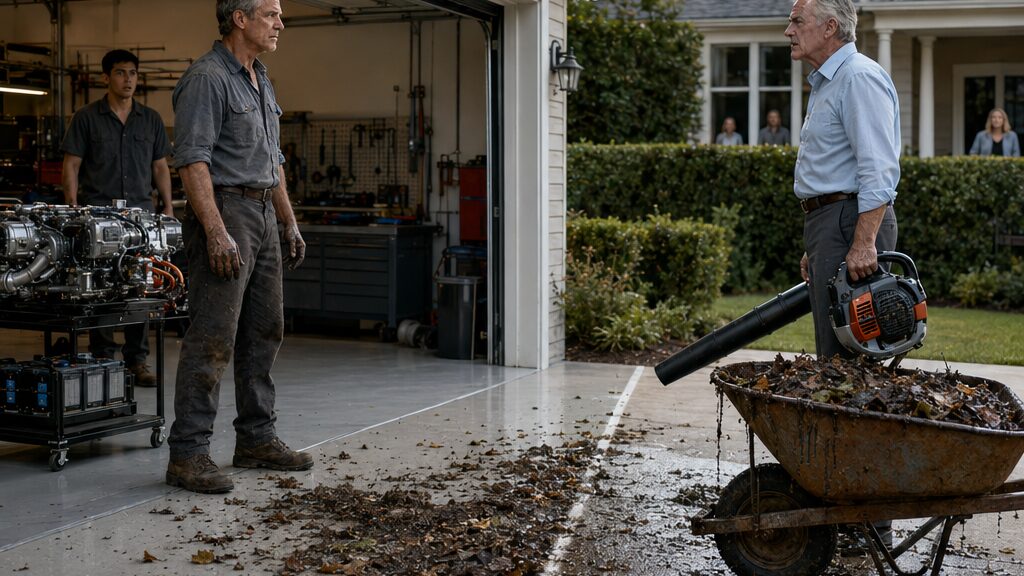
The Quiet Man in the Open Garage Owned the Line His Loud Neighbor Crossed
Chapter 1: The Leaf Blower Crosses the Quiet Line
The first piece of trash hit Robert Lewis’s battery tray like a thrown stone.
It was not large—just a wet knot of brown leaves and grit—but it landed inches from the exposed PHEV powertrain he had been tuning since sunrise. Robert’s hand stopped above the torque wrench. The garage around him held its breath in the half-open morning light: polished concrete floor, labeled trays of fasteners, insulated orange cables clipped safely away from the frame, every tool placed exactly where his mind expected it.
Then the roar came again.
A gas-powered leaf blower screamed from the edge of his patio, so close the vibration trembled through the metal shelving on the wall. Dust and rotting leaves blew across the spotless concrete. A cigarette filter skittered under the workbench. Something damp slapped against the sidewall of a tire mounted on a test stand.
Robert rose slowly from his crouch.
Across the patio, Edward Campbell stood with both hands on the blower, shoulders square, chin lifted as if he were holding a flag instead of a machine. He wore pressed slacks and polished shoes, absurdly formal for yard work, and his mouth had the small hard smile of a man who had rehearsed this.
The white chalk line Robert had brushed along the patio edge the week before was half buried under leaves.
Edward angled the blower lower.
A fresh stream of grit blasted over the line.
Robert reached over and switched off the diagnostic tablet before the dust could settle into the open ports. The hum of the powertrain died, leaving the blower’s shriek to fill the garage.
Kevin Torres came out from behind the frame, wiping his hands on a rag. “What is he doing?”
Robert did not answer at first. He watched the debris spread across the patio he had rinsed before dawn. He had swept it twice because fine grit made a man careless, and carelessness near high-voltage components had a way of becoming permanent.
Edward saw him watching and smiled wider.
The blower cut off. The sudden quiet rang.
“Morning, Robert,” Edward called, as if they had met over coffee. “Thought I’d help you clean up that showroom you call a garage.”
Robert stepped to the edge of the garage but not beyond it. “You’re blowing debris onto my property.”
Edward looked down at the chalk line, then at his own shoes. His toes were still on his side. Barely.
“Property,” he repeated. “That word gets bigger every year on this street.”
Kevin moved forward, but Robert lifted one hand slightly. Not a command. A quiet brake.
Edward shifted the blower against his hip. Behind him sat a rusted metal wheelbarrow with one crooked wheel and handles wrapped in old tape. It was filled above the rim with wet leaves, black mulch, broken twigs, and something gray-green that had the sour smell of gutter rot.
“That yours too?” Robert asked.
Edward glanced back. “Street waste. Somebody has to take care of things around here.”
“Then take care of it on your side.”
Edward gave a dry laugh. “Your side. My side. You people move in and start measuring like this street didn’t exist before you found it.” He tapped the chalk line with the toe of one polished shoe. “I’ve lived here thirty-eight years.”
Robert’s face did not change. “That doesn’t move the boundary.”
“It does when you understand the neighborhood.”
Kevin let out a short breath. “Robert, call someone.”
Edward’s eyes flicked to Kevin. “And who’s this? The apprentice? You teaching him to turn a garage into a factory too?”
Robert turned his head just enough to look at Kevin. “Check the battery cover.”
“The battery cover is fine.”
“Check it again.”
Kevin’s jaw tightened, but he backed away toward the frame. He knew that tone. Not fear. Not surrender. Something narrower.
Edward fired the blower again before Kevin reached the workbench.
The sound slammed into the garage. Loose grit lifted from the patio and hissed over the threshold. Robert took one step back, not because Edward had forced him, but because he refused to let the debris reach the exposed harness. He pulled a clean tarp over the powertrain and fastened two corners with magnets.
Edward swept the blower from side to side, grand and theatrical. Leaves cartwheeled across the line. The blower’s nozzle dipped toward a row of Robert’s labeled parts trays.
Robert moved then, fast enough that Kevin looked up.
He crossed to the wall beside the garage door and pressed a small button beneath a gray junction box. A soft red indicator lit above the rafters.
Kevin followed his glance.
There, tucked under the eave and painted to match the trim, a small camera looked down at the patio line.
Kevin stared at it. “You’ve had that recording?”
Robert adjusted the tarp. “For a while.”
Edward killed the blower again. His expression had shifted, but only for a second. “Cameras now? That’s what neighbors do?”
“Neighbors don’t dump garbage over property lines.”
“I haven’t dumped anything.” Edward patted the wheelbarrow handle. “Yet.”
The word hung there.
From across the street, a curtain shifted. Someone was watching. Edward knew it. He rolled his shoulders and raised his voice.
“You know, when the Young family had this place, the garage door wasn’t open all hours. Nobody had wires and batteries and God knows what sitting out where children can see it. We had standards.”
Robert’s eyes went to the street, then back to Edward. “There are no children standing in my garage.”
“There are families on this street.” Edward’s voice sharpened, enjoying its own echo. “People hear things. Smell things. They ask me because I’m the one who’s been here.”
Kevin came back beside Robert, lowering his voice. “He wants witnesses.”
“I know.”
“Then answer him.”
Robert looked at the line. The chalk was nearly gone under the mess.
Edward bent, grabbed the wheelbarrow handles, and lifted. The rusted wheel squealed as he rolled it forward, slow enough to make every inch deliberate. The sour smell thickened. Wet leaves slid against the metal tub with a heavy slap.
Robert stepped out from the garage to the patio edge.
Edward stopped with the front wheel less than an inch from the chalk.
“There,” Edward said. “See? Still on my side. Since you’re so particular.”
Robert looked at the wheelbarrow, then at the polished shoes, then at Edward’s face. “Move it back.”
Edward leaned on the handles. “Or what?”
Kevin whispered, “Robert.”
Robert did not move. The stillness in him had become visible now, like a cable pulled taut but not yet snapping.
Edward seemed to sense it too. He straightened a little. His smirk fought with something smaller around his eyes.
“You don’t scare me,” Edward said.
“I didn’t try to.”
Edward’s grip tightened on the handles. “You think because you’ve got money for toys and cameras, you can change how things work here. You can’t. The street remembers who kept it clean before people like you started drawing lines.”
Robert took one slow breath through his nose. He could smell battery coolant, old metal, hot dust from the blower, and beneath it the rot in the wheelbarrow.
“My line was surveyed,” he said. “Not imagined.”
Edward laughed again, too loudly. “Surveyed. Listen to yourself.”
The curtain across the street dropped. A car slowed near the corner, then kept going.
Kevin shifted beside the garage opening. “Let me record him.”
“No,” Robert said.
“He’s threatening you.”
“He’s performing.”
Edward heard enough to grin. “Smart boy. Listen to your boss. He knows better than to make this ugly.”
Robert’s hand closed once, then opened.
For a moment, Kevin thought he would step forward. Instead, Robert turned away, walked back to the garage wall, and took a push broom from its hook. He swept a clean path between the debris and the powertrain, each stroke quiet and controlled.
Edward watched him sweep. The pleasure faded from his face. Robert’s refusal to explode gave him nothing to push against.
So he pushed the wheelbarrow.
Only a little. The rusted wheel tapped the chalk line and smeared it.
Robert stopped sweeping.
Edward looked down, pretending surprise. “Old wheel pulls to one side.”
Robert turned. “Back it up.”
Edward did not. He lifted the handles and let the wheelbarrow thud down again, still kissing the line. The metal tub rattled. A clump of black leaves slid over the rim and landed on Robert’s patio.
Kevin stepped forward. “That crossed.”
Robert held the broom across his body, not as a weapon, but as a barrier he had not yet chosen to become.
Edward smiled at Kevin as if the younger man had confirmed something useful. “Tomorrow,” he said, louder now, for the houses and windows and anyone collecting a version of the morning, “I dump the rest where it belongs.”
He tapped the wheelbarrow forward until the rusted wheel kissed Robert’s side of the chalk.
Then he backed away, dragging the blower with him, leaving the sour heap looming at the edge like a promise.
Chapter 2: The Oldest House on the Street
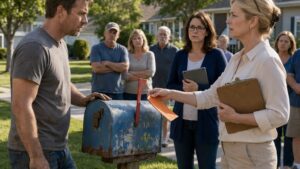
The complaint was waiting in Robert’s mailbox before the patio had fully dried.
It had been folded once, hard enough to crease the paper like a warning. No envelope. No signature. Just block letters pressed deep into the page:
OPEN GARAGE HAZARD. BATTERIES. CHEMICAL SMELL. NOISE. LOWERING PROPERTY APPEAL.
Robert stood at the curb with the paper in one hand and a clean rag in the other. Behind him, the garage sat open again, though the PHEV frame was covered now. He had swept the patio twice, rinsed the concrete, and marked the boundary again with chalk so pale it looked almost apologetic.
Kevin leaned over his shoulder. “That’s Edward.”
“Probably.”
“Probably?” Kevin jabbed a finger at the paper. “He basically signed it with that ‘property appeal’ line.”
Robert folded the complaint and put it in his shirt pocket.
Kevin stared. “That’s it?”
“That’s not it.”
“It looks like it.”
Robert closed the mailbox. Across the street, Edward Campbell was standing near the association cluster boxes, speaking with two neighbors and using both hands as if explaining a storm path. His house sat behind him, older than the others, with a deep porch, trimmed hedges, and a brass number plate polished brighter than the door handle. The place had the slightly overmaintained look of a thing protected against time by force.
Edward saw Robert and lifted a hand.
Not a wave. A claim.
Robert began walking toward the mailbox area. Kevin followed, still holding the damp rag like he might throw it.
Edward’s voice carried before they reached him.
“I’m only saying we used to have an understanding,” Edward told the neighbors. “People kept hobbies inside. Garages were garages. You didn’t open the whole thing like a service bay.”
One neighbor looked away when Robert approached. The other gave a tight smile and retreated toward her driveway.
Edward remained where he was, planted at the seam between sidewalk squares.
Robert stopped on his side of the seam.
Edward noticed. “Careful. You might need a surveyor for that.”
Kevin took a breath, but Robert spoke first. “Did you put this in my mailbox?”
Edward glanced at the folded paper. “You get a complaint?”
“You know I did.”
“There’s a difference between knowing and doing, Robert.”
The front door of a house two lots down opened, and Brenda Moore stepped out carrying a canvas folder against her chest. She was dressed neatly, as always, in a pale blouse and dark slacks, with reading glasses hanging from a chain. Association treasurer, keeper of dues, minutes, sidewalk notices, and everyone’s quiet embarrassments.
Edward’s face softened when he saw her. “Brenda. Perfect timing.”
Brenda slowed. Her eyes moved from Edward to Robert to Kevin, then to the paper in Robert’s hand. “Is this about the garage?”
“It’s about harassment,” Kevin said.
Edward laughed under his breath. “There it is. Harassment. A man can’t care about his own street now.”
Robert unfolded the paper and handed it to Brenda. “Did this come through the association?”
Brenda read it. Her mouth tightened at the corners. “Not formally.”
“But?”
She looked uncomfortable. “There have been concerns.”
“From whom?”
Edward stepped across the sidewalk seam and stood nearer to Robert. “From people who live here. People who remember what this block looked like before every new owner decided personal freedom meant ignoring everyone else.”
Robert looked down. Edward’s shoe was partly over the seam. A small thing. Not the property line. Not illegal. Just habit.
“Name one safety rule my garage violates,” Robert said.
Edward spread his hands. “I’m not an electrician.”
“No.”
“But I know when something doesn’t belong.”
Brenda handed the complaint back to Robert. “The issue is appearance as much as safety. The association can request an informal inspection if enough residents feel—”
“Enough residents,” Kevin cut in. “Or Edward?”
Brenda’s eyes flicked to him. “I understand you’re upset, but shouting won’t help.”
“I’m not shouting.”
Edward smiled. “Not yet.”
Robert folded the complaint again, slower this time. “Brenda, have there been prior complaints about Edward dumping yard waste near my property?”
Brenda went still.
Edward’s smile thinned. “Careful.”
Robert kept his eyes on Brenda. “Have there?”
She adjusted her folder. “There have been disagreements over maintenance.”
“That’s one way to say it,” Kevin muttered.
Brenda’s voice lowered. “Robert, Edward can be territorial. Everyone knows that. But he has also taken care of this street for decades. After the storm two years ago, he cleared half the drains himself.”
Edward nodded as if a verdict had been entered. “Because somebody had to.”
“And that gives him the right to blow gutter waste into Robert’s garage?” Kevin asked.
Brenda looked toward Robert’s house. The open garage seemed to make her uneasy, not because it was dirty—it was not—but because it revealed too much of a private man’s life. Tools lined in order. Mechanical diagrams clipped to a board. The skeletal powertrain like some quiet animal under a tarp.
“You don’t make it easy for people to understand what you’re doing,” she said to Robert.
Robert absorbed that. It struck harder than Edward’s complaint because there was no cruelty in it.
“I’m building a powertrain,” he said.
“For what?”
“A vehicle.”
“What kind?”
“A plug-in hybrid conversion.”
Brenda blinked. “That sounds… substantial.”
“It’s contained.”
Edward stepped in. “Contained until it catches fire. Or leaks. Or draws every curious teenager on the block to an open garage full of high-voltage parts.”
Kevin looked at Robert. “Tell them about the covers. The shutoffs. The insulated—”
Robert raised a hand.
Kevin stopped, frustrated.
Brenda noticed. “Why don’t you explain it, Robert?”
For a moment, he nearly did. He could have walked them into the garage, shown the lockout tags, the insulated caps, the storage cabinet, the separate charging circuit, the fire blanket, the permits in the folder beneath the diagnostic tablet. He could have dismantled Edward’s performance one item at a time.
But the street was watching through blinds. Edward was waiting for a lecture he could twist into arrogance. Brenda already looked tired, hoping for calm more than truth.
So Robert only said, “It’s safe.”
Edward gave a soft clap. Once. “There. Very reassuring.”
Brenda sighed. “Robert, an informal inspection would settle this.”
“Who requested it?”
She hesitated too long.
Edward answered. “I did.”
Kevin swore under his breath.
Edward turned to him. “That garage opens onto the street. That makes it our concern.”
“It opens onto his driveway,” Kevin said.
“The driveway opens onto the street.”
“And by that logic your mouth does too, but nobody’s inspected it.”
Edward’s face flashed red.
Robert stepped between them before the reaction could become useful to Edward. “When?”
Brenda pulled a paper from her folder. “Monday afternoon. It’s not punitive. Just a walk-through from the association’s maintenance inspector.”
Robert took the notice but did not read it. “You already scheduled it.”
“It seemed better than letting this continue.”
“This,” Robert repeated.
Brenda looked away.
Edward leaned toward Robert, lowering his voice enough to make it personal while still letting Kevin hear. “You should’ve kept the garage door closed. People don’t like mysteries next door.”
Robert placed the notice beside the complaint, both folded flat in his hand. He suddenly understood how long Edward had been speaking into the spaces Robert left empty. Every time Robert had swept instead of argued, every time he had documented instead of answered, Edward had filled the silence with a story the street could understand.
Dangerous garage. Strange neighbor. Old resident protecting standards.
Brenda started to leave, then paused. “Robert, if there’s nothing wrong, the inspection helps you.”
“Does it?”
“It can.”
Edward smiled at the careful wording.
By late afternoon, after Kevin left and the garage fell back into its disciplined quiet, Robert found a second paper taped to the garage door.
This one bore the association letterhead.
NOTICE OF INFORMAL REVIEW. RESIDENT IS REQUESTED TO CEASE DISRUPTIVE MECHANICAL ACTIVITY UNTIL MONDAY INSPECTION.
Robert stood with the notice in his hand while the covered powertrain cooled behind him.
Across the line, Edward’s porch light came on early, bright and watchful.
Chapter 3: The Camera Shows More Than Trespass
The first video showed Edward at 5:43 in the morning, emptying a black plastic bucket at the edge of Robert’s patio.
No blower. No audience. No speech about standards.
Just Edward in old yard gloves, stepping out from the shadow between the houses and tipping wet leaves onto the concrete with the careful posture of a man who knew exactly where the camera should not be.
Except he had guessed wrong.
Robert sat at the workbench with the laptop open, the garage door lowered halfway behind him. The PHEV frame stood under its tarp, quiet and pale in the bluish light. Kevin leaned over the back of the chair, silent for once.
On the screen, Edward looked smaller without his performance.
The second clip showed him two mornings later, sweeping grit from the gutter toward Robert’s side. The third showed the wheelbarrow parked just off camera, its tub visible only as a rusted crescent before Edward dragged something foul across the boundary with a rake.
Kevin straightened. “That’s enough. Send it to Brenda. Send it to everyone.”
Robert moved the cursor and tagged the clips.
“Robert.”
“I heard you.”
“Then why are you saving them into folders like this is a science project?”
“Because order matters.”
“People believe the first clean story they hear. Edward gave them one. You have the truth.”
Robert named the folder Boundary Incidents, then added the date. “Truth out of order becomes noise.”
Kevin laughed once, humorless. “That’s what you think this is? A filing problem?”
Robert looked at him then. Kevin was twenty-something, all quick hands and quicker anger, with grease under his nails and loyalty he had not learned to ration. He came three mornings a week to help with fabrication and calibration, paid fairly but taught more than the pay covered. Robert liked him. That made his impatience dangerous.
“This is a legal problem,” Robert said.
“It became a legal problem when he dumped garbage on your patio.”
“It becomes mine if I handle it wrong.”
Kevin pointed at the laptop. “He’s already handling it wrong for you.”
Robert turned back to the video.
There were other clips. Edward pausing by the mailbox. Edward photographing Robert’s garage from the street. Edward standing with a neighbor, gesturing toward the open door, his hand slicing through the air like a judge drawing a line.
Robert advanced through the timeline, then stopped.
The clip was from a week earlier.
On screen, Robert himself stepped out of the garage as Edward blew leaves toward the patio. He had walked halfway to the line, face hard, hands clenched. Edward had said something the camera did not catch beneath the blower’s rumble. Robert had taken one more step, close enough that Edward flinched.
Then Robert had stopped.
He had turned around, gone back inside, and closed the garage door.
Kevin saw it. “Why didn’t you show me that?”
Robert selected the clip.
“Don’t delete it.”
Robert did not answer.
Kevin reached over him, but Robert caught his wrist—not roughly, not even hard, but with enough finality that Kevin froze.
“Let go,” Kevin said.
Robert released him.
The cursor hovered over the file.
“That clip shows him provoking you,” Kevin said.
“It shows me nearly giving him what he wanted.”
“It shows you’re human.”
Robert’s mouth tightened. “That’s not always useful evidence.”
He moved the clip into a separate folder instead of deleting it. Kevin watched the file disappear from the main sequence.
“So that’s it,” Kevin said. “You’re not patient. You’re scared of what happens if you stop being patient.”
Robert leaned back. The words found a seam he had not offered.
Years earlier, another property dispute had crossed his desk at the firm. A landlord, a family, unpaid fees, a fence built two feet wrong. Robert had acted quickly because the documents were clear. Too quickly. The family had lost a narrow appeal they might have won with more time, and though the file had been correct, he still remembered a child’s bicycle left against a half-demolished fence.
Since then, he trusted paper more than impulse. Then he trusted silence more than paper.
Kevin softened when Robert did not answer. “I’m not saying ruin him. I’m saying stop letting him ruin you.”
Before Robert could respond, his phone buzzed on the workbench.
Lisa Johnson.
Robert stared at the name for half a second before answering. “Lisa.”
Her voice came through clipped and low. “Tell me you are not having a personal dispute with a Campbell account.”
Kevin’s eyes narrowed.
Robert turned slightly away. “Which Campbell account?”
“Edward Campbell. Property address on your street. Please don’t make me ask twice.”
Robert closed the laptop halfway. “He’s my neighbor.”
A pause. Paper shifted on Lisa’s end. “Robert.”
“I didn’t know his account was in our active risk review.”
“That is exactly what concerns me.”
Robert stood and walked toward the half-closed garage door. Outside, the patio line was a pale stripe under the porch light. Beyond it, Edward’s house glowed through its front windows.
Lisa continued, “His mortgage servicing file rolled into compliance review yesterday. Missed escrow adjustment. Two outstanding municipal notices. One association penalty pending, though not finalized. If your neighbor dispute touches any of that, we need separation immediately.”
Robert closed his eyes.
Kevin whispered, “What is she talking about?”
Robert held up one finger.
Lisa’s voice sharpened. “You haven’t contacted him about the account?”
“No.”
“Used the firm’s position in any communication?”
“No.”
“Threatened enforcement?”
“No.”
“Good. Keep it that way.”
Robert looked at the laptop, at the folded complaint and inspection notice pinned beneath a magnet. “He requested an inspection of my garage.”
“Association?”
“Yes.”
“Personal residence matter. Keep firm resources out of it.”
“He’s dumping debris onto my patio.”
“Then document it like any other homeowner. Camera footage. Written notices. Third-party reports. But you do not touch his debt file, you do not imply leverage, and you do not let anger make our clean process look retaliatory.”
Robert’s jaw shifted. “I know the line.”
“Do you?” Lisa asked.
That landed.
Outside, the street was quiet now. No blower. No performance. Only Edward’s porch light and the thin chalk line Robert had redrawn because chalk could be renewed, unlike trust.
Lisa lowered her voice. “I’m saying this because I know you. You wait too long, then you act like a hammer and call it precision.”
Kevin looked away, pretending not to listen.
Robert said nothing.
Lisa filled the silence. “If he crosses the line again, document it—but do not touch him, his property, or his debt file.”
The call ended.
Robert kept the phone at his ear for a moment after the screen went dark.
Kevin finally spoke. “Robert, what debt file?”
Robert lowered the phone and looked out under the garage door, across the patio, across the marked boundary, toward the oldest house on the street.
“That,” he said quietly, “is exactly the part I can’t use.”
Chapter 4: The Inspection Turns the Street Against Him
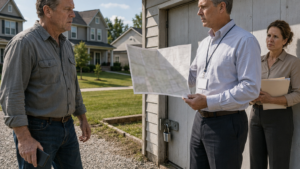
Robert opened the garage door on Monday and found Edward Campbell already standing at the edge of his patio with Brenda Moore, a clipboard, and a man in a reflective vest who was photographing the chalk line from the wrong side.
The garage door rattled upward, panel by panel, exposing the covered PHEV frame, the orderly tool wall, the locked cabinet, the insulated cable caps, and Robert himself standing in the dim interior with one hand still on the wall switch.
Edward turned with a smile that looked ready before Robert appeared.
“Good,” Edward said. “Now we can all see it in daylight.”
Robert stepped onto the garage threshold. “You’re early.”
Brenda held her folder tighter. “The inspector had another appointment nearby, so we thought—”
“You thought you’d begin without me.”
The man in the vest lowered his phone. He was not a city official, Robert saw immediately. Association maintenance. Polite shoes. No badge. A tape measure clipped to his belt as if measurement made him neutral.
Edward rocked back on his heels. “Nobody crossed into your precious laboratory.”
Robert looked at the patio.
The chalk line he had redrawn was still visible, but Edward had placed one foot beside it, forcing the inspector to stand at an angle that made Robert’s patio look like it wrapped into the shared drainage strip. The photograph would show the garage yawning open behind the line, tools and orange cables bright in the background, as if danger had been leaning over the neighborhood all along.
Robert walked to the edge and stopped on his side.
“Start over,” he said.
The inspector blinked. “Excuse me?”
“Take the photographs from the street and from the true boundary. Not from Edward’s lawn.”
Edward chuckled. “True boundary. Here we go.”
Brenda gave Robert a strained look. “This is informal.”
“So is distortion.”
The inspector glanced between them, then took two steps toward the sidewalk and lifted his phone again. Edward’s jaw tightened.
Robert noticed.
That should have satisfied him. A small correction. A small line restored. But Brenda’s eyes moved past him into the garage, and he felt the familiar closure in his chest—the old instinct to guard every detail until nobody could use it.
“May we see the work area?” Brenda asked.
Robert hesitated.
Edward saw it and stepped in at once. “That’s the problem. Nobody knows what’s in there.”
“There’s a vehicle powertrain,” Robert said.
“A homemade high-voltage vehicle powertrain in a residential garage,” Edward corrected, delivering the phrase as if he had polished it in his mouth all weekend.
Kevin Torres arrived then, jogging up the driveway with a paper cup of coffee in one hand and a toolbox in the other. He stopped short when he saw the group.
“Why is he here?” Edward asked.
Kevin looked at Robert. “Why is he?”
The inspector cleared his throat. “We’re only checking for visible safety or nuisance concerns. No one is accusing anyone of anything yet.”
“Yet,” Kevin said.
Robert glanced at him.
Kevin swallowed the rest.
Brenda stepped closer to the garage but remained outside. “Robert, if you could just explain the setup.”
Robert could explain it. The lockout tag hanging from the bright disconnect handle. The rubber mats under the frame. The vented storage cabinet. The sealed coolant reservoir. The permit binder in the drawer.
Instead, he heard Lisa’s voice from the phone: keep firm resources out of it, keep procedure clean, do not let anger contaminate the process.
He also heard Edward’s voice from Saturday: people don’t like mysteries next door.
Robert reached for the permit binder, then stopped. Not because the binder was dangerous, but because showing it felt like surrendering private order to public theater.
“It’s safe,” he said.
Edward breathed out a small laugh.
Brenda’s face fell a fraction.
Kevin stared at Robert as if he had dropped a tool into the engine bay and walked away.
The inspector made a note. “Do you have documentation for the electrical modifications?”
“Yes.”
“May I see it?”
Robert’s hand rested on the drawer pull.
Edward leaned toward Brenda, speaking loudly enough to be heard. “If everything was in order, he’d be proud to show it.”
Robert opened the drawer and removed the binder. He handed it to the inspector, not to Edward.
The inspector flipped through the pages. His posture changed slightly as he saw the tabs: electrical permits, fire safety equipment, storage procedures, component specifications, inspection receipts. This was not the mess Edward had described.
Kevin’s shoulders loosened.
Then Edward reached into his own folder.
“Documentation goes both ways,” he said.
He produced a stack of glossy photos and held them out to Brenda first, not the inspector. Robert saw the top image and felt the trap close.
His own patio, filthy with leaves and gutter sludge. The garage open behind it. The PHEV frame visible.
Edward had photographed Saturday’s mess before Robert cleaned it, cropping out the blower, the wheelbarrow, and the chalk line.
“This is what we’re living next to,” Edward said. “Debris. Odor. Runoff. And then he washes it into the shared drainage.”
Kevin snapped, “Because you blew it there.”
Edward turned slowly. “Do you have proof of that?”
Robert said nothing.
Kevin looked at him. “Yes. We do.”
Robert’s hand tightened at his side.
Brenda looked from Kevin to Robert. “You have proof?”
Edward’s expression sharpened, but there was worry under it now. A quick flicker. Robert caught it and hated that he had to decide in public how much truth to release.
“I have cameras,” Robert said.
“Then show them,” Kevin said.
Edward spread his hands. “Please. Show all the neighborhood surveillance you’ve been collecting.”
The phrasing landed exactly where he intended. Brenda’s eyes narrowed, not in accusation yet, but in discomfort.
The inspector paused with Robert’s permit binder half open.
Robert could have opened the laptop. He could have shown Edward at dawn, bucket in hand. He could have turned the morning. But the footage included angles from his garage, dates, patterns. Released badly, it would become another story: Robert watching neighbors, Robert building a case, Robert secretive and wealthy and cold.
His silence had already cost him. Now exposure might cost him differently.
“The footage will be provided through the proper channel,” Robert said.
Edward smiled.
Kevin looked away, furious.
Brenda closed Edward’s photo packet but kept it in her folder. “Robert, you must understand how this looks.”
“Yes,” Robert said. “I’m beginning to.”
The inspector returned the binder. “From what I can see, the garage equipment appears organized. I’ll note that documentation was provided. But I’ll also note the open-door concerns, the complaints of odor, and the drainage question.”
“There is no drainage question,” Kevin said.
Edward pointed at the patio. “Then why does the runoff trail start there?”
Robert looked. Near the edge of the concrete, faint brown staining traced a path toward the drainage channel. It was from Edward’s wet debris. Without the video, it looked like Robert’s mess.
Edward had not just dumped filth. He had composed evidence.
Brenda’s uncertainty hardened into caution. “Until the follow-up, I think it would be best if the garage remains closed during active work.”
Robert turned to her. “That isn’t an association rule.”
“No,” she said. “It’s a request.”
“From the association?”
She did not answer quickly enough.
Edward slid the photos back into his folder. “From people who still care what this street becomes.”
The inspector packed his phone away. “I’ll file notes tonight. Any footage or written statements can be submitted before the follow-up visit.”
“When is that?” Robert asked.
“Later this week, if needed.”
Edward stepped back, satisfied. His shoe brushed the chalk line, smearing a small pale break in it.
Kevin saw and started forward.
Robert caught his sleeve.
Edward noticed the motion and smiled as if he had won twice. “Don’t worry, Robert. If the mess is the issue, I’ll clear the problem personally before anyone has to come back.”
Brenda turned sharply. “Edward.”
“What? I’ve been maintaining this street longer than he’s been hiding in that garage.”
Robert’s grip on Kevin’s sleeve loosened. He stood in the open garage doorway, binder in hand, permits inside it suddenly inadequate against the version of him Edward had built.
Edward walked backward over the sidewalk seam, facing Robert as he went.
“Tomorrow,” he said, loud enough for the windows, “I’ll take care of what he won’t.”
Chapter 5: The Wheelbarrow Comes Over the Line
The leaf blower roared straight into the garage before Robert had finished removing the tarp from the powertrain.
Grit lifted from nowhere and peppered the floor in a hard, dry spray. A brown leaf spun past Robert’s face and slapped against the diagnostic tablet. Kevin swore from behind the frame and threw his arm over the open battery tray.
Robert reached the wall switch and killed power to the test bench.
The garage dropped into silence beneath the machine scream, as if every careful system in it had been forced to kneel.
Outside, Edward Campbell stood in the driveway gap with the blower strapped across his chest. The rusted wheelbarrow waited behind him, loaded higher than before, its wet contents slumped like something pulled from a ditch. A sour wave rolled into the garage every time the blower angled toward the patio.
Robert walked out slowly.
The chalk line was bright this morning. He had redrawn it before sunrise. Not pale. Not apologetic. A clean white boundary running along the patio edge, broken only where the surveyed pin sat flush in the ground.
Edward aimed the blower at it.
The chalk broke apart in a cloud.
Kevin grabbed his phone. “That’s it.”
“Put it down,” Robert said.
Kevin froze. “No. This time—”
“Put it down.”
Edward cut the blower and laughed. “Listen to him, son. He doesn’t want the world seeing how he handles neighbors.”
Robert kept his eyes on Kevin.
Kevin’s thumb hovered over the screen. His face was flushed, angry enough to mistake humiliation for justice. Then he lowered the phone to his side.
Edward watched the phone go down, disappointed for half a second. Then he recovered.
“That’s the first smart thing you’ve done all week,” he said.
Robert stepped to the property line. “Move the blower away from my garage.”
Edward lifted the nozzle and rested it against his shoulder. “Your garage is the problem. Open all day, humming all night, lights on like an operating room. People are tired of pretending this is normal.”
“You mean you are.”
“I mean the street.”
“The street didn’t bring that wheelbarrow.”
Edward glanced back at it. The wheelbarrow leaned crookedly, its metal tub flaking rust. Something black dripped from the front seam.
“Street waste,” he said. “You attract mess, mess gets returned.”
Kevin made a rough sound. “You are unbelievable.”
Edward pointed at him. “You don’t live here. You don’t know what this place was.”
Robert said, “I know where the line is.”
Edward’s mouth tightened. “That’s all you people know. Lines. Papers. Cameras. Money. You arrive quiet, make changes quiet, buy things through companies nobody sees, then act surprised when the rest of us notice the ground shifting.”
Robert’s stare sharpened.
It was the first time Edward had said anything close to the truth without knowing it.
“What do you think I bought?” Robert asked.
Edward’s eyes flicked toward the garage, then the house, then away. “You think people don’t talk? Permits. Contractors. Deliveries. That young man coming and going. A garage full of parts worth more than some cars.”
“None of that gives you rights on my property.”
Edward stepped closer to the line. “Maybe not. But this street belonged to families before it belonged to men with silent money and locked cabinets.”
There it was, stripped of performance for one breath: fear. Not of fire. Not of noise. Fear of being replaced while still standing on his own porch.
Robert felt it. He did not forgive it.
“Edward,” he said, “take the wheelbarrow back.”
Edward smiled again, but now it looked forced. “You keep giving orders.”
“I’m giving you a way to stop.”
“A way to surrender.”
“A way to stay on your side.”
Edward dropped the blower to the grass and grabbed the wheelbarrow handles.
The rusted wheel squealed as he pushed it forward.
Kevin stepped toward Robert. “Don’t.”
Robert lifted one hand, stopping him without looking.
Edward rolled the wheelbarrow to the line and paused with theatrical care. “See? Respect. This is me respecting your little chalk mark.”
Then he shoved.
The front wheel crossed fully onto Robert’s patio. Wet debris sloshed over the rim and splattered across the concrete. A clump struck Robert’s boot.
Edward’s eyes lit.
“Oops,” he said.
Robert did not move.
Edward pushed again. The wheelbarrow lurched farther over the line, both legs scraping Robert’s patio now. The sour odor thickened until Kevin gagged.
“Touch it,” Edward said. “Go on. Touch my property.”
Robert looked at the wheelbarrow handles. Old tape. Rusted bolts. Wet rot dripping from the tub. A tool turned into a threat because Edward thought the threat belonged to him.
Behind Robert, the garage waited with its covered powertrain, clean systems interrupted, silence imposed by someone else’s noise.
Lisa’s warning moved through his mind: do not touch him, his property, or his debt file.
Then Robert looked down at the surveyed pin set into the ground, half smeared with chalk dust and foul water. He had paid for that line to be measured because politeness had failed. He had documented because shouting had failed before it began. He had waited because he knew what power could do when it dressed itself as certainty.
Edward pushed the wheelbarrow another inch.
Something in Robert became very still.
“Last chance,” Robert said.
Edward leaned forward over the handles. “Or what?”
Robert stepped across the remaining distance.
He did not grab Edward. He did not shove him. He seized the wheelbarrow handles below Edward’s hands and wrenched them upward with such force that Edward stumbled back and lost his grip.
“Hey!”
Robert pivoted.
The wheelbarrow rose, heavy with rot and wet leaves, its rusted wheel spinning once in the air. For one suspended instant, all the noise on the street disappeared. Kevin stopped breathing. A curtain moved across the road. Edward’s mouth opened, already forming outrage.
Robert flipped the entire load upside down over Edward’s polished shoes.
The crash was wet and final.
Debris slapped across Edward’s cuffs. Black water spread around his feet. Rotten leaves clung to the shine of his shoes and the hems of his trousers. A gray wad of gutter muck slid down one ankle.
Edward gasped like the street had betrayed him.
The empty wheelbarrow landed on its side, wheel still spinning with a thin metallic whine.
Robert stepped forward, planted one boot on the rusted rim, and stomped.
The wheel folded under his weight with a flat, ugly crunch.
Silence followed.
Even the blower seemed ashamed of itself lying in the grass.
Edward stared at the crushed wheel. Then at his shoes. Then at Robert. His face had gone white except for two red patches high on his cheeks.
“You destroyed my property,” he whispered.
Robert’s chest moved once. “You crossed the line.”
Edward’s hands shook. For a second, without the leaf blower, without the wheelbarrow, without the street’s old script, he looked smaller than his porch, smaller than his polished number plate, smaller than the legacy he had been wearing like armor.
Then his eyes found the windows.
He bent, snatched his phone from his pocket with filthy fingers, and raised his voice.
“I’m calling the police,” he said, loud enough for every house to hear.
Chapter 6: The Victim Story Breaks in Public
Edward screamed into the phone while standing ankle-deep in the debris he had brought.
“Yes, I need an officer,” he said, voice cracking upward. “My neighbor just attacked me and destroyed my equipment. I’m standing here covered in filth because he lost control.”
Robert stood on his patio beside the overturned wheelbarrow. The crushed wheel lay bent against the axle like a broken mouth. His boot print marked the rust.
Kevin hovered near the garage entrance, phone in hand but still lowered. His face had the stunned look of someone who had wanted action until action arrived.
Across the street, doors opened.
Brenda Moore came down her walkway with her canvas folder clutched under one arm, moving faster than Robert had ever seen her move. Two neighbors remained on their porches. Another stood halfway behind a hedge. Nobody approached the line.
Edward pointed at Robert as he spoke into the phone. “He came at me. He grabbed it out of my hands. I want this recorded as assault and destruction of property.”
Robert said nothing.
Brenda reached the curb and stopped when the smell hit her. Her eyes dropped to Edward’s shoes, then to the debris spread on Robert’s patio, then to the bright broken chalk beneath the wheelbarrow legs.
“Edward,” she said quietly, “why is your wheelbarrow on Robert’s patio?”
Edward covered the phone with one hand. “Because he dragged it there.”
Kevin’s head snapped up. “That is a lie.”
Edward pointed again. “You stay out of this.”
Robert turned to Kevin. “Inside.”
“No.”
“Kevin.”
The younger man’s jaw clenched. But he stepped back into the garage, stopping just inside the threshold.
Brenda looked at Robert. “Did you touch the wheelbarrow?”
“Yes.”
Edward barked into the phone, “He admits it.”
Robert continued, “After he pushed it over the surveyed boundary and dumped debris into my garage area.”
Edward laughed sharply. “Surveyed boundary. He thinks that phrase gives him permission to destroy things.”
Brenda’s gaze moved to the chalk line. Some of it remained under the muck. Enough to show where the wheelbarrow had crossed.
“Robert,” she said, “do you have the footage?”
Edward’s face shifted.
It was small, but Brenda saw it this time.
Robert walked into the garage. Kevin was already beside the laptop, anger blazing into relief.
“Now?” Kevin asked.
“Now.”
Robert connected the camera feed to the wall monitor. He did not select every clip. He did not build a spectacle. He chose the angle from that morning and let it play from the moment Edward aimed the blower into the garage.
The neighbors on the porches leaned forward. Brenda stepped inside the garage but remained near the open door, as if crossing too far would make her partial.
On screen, the blower blasted grit across the patio. Edward pushed the wheelbarrow to the chalk line. Edward shoved it over. Edward dared Robert to touch it.
The audio was thin but clear enough.
Go on. Touch my property.
Edward lowered his phone slightly outside.
Robert paused the video there, on the frame showing both wheelbarrow legs planted on his patio.
The first officer arrived while the image was still frozen on the wall.
The officer walked up the driveway, took in the smell, the wheelbarrow, Edward’s shoes, Robert’s stillness, the watchers, the monitor. A second municipal vehicle slowed at the curb behind him.
Edward found his voice first. “Officer, that man destroyed my wheelbarrow.”
The officer looked at the screen. “Is that your wheelbarrow?”
“Yes.”
“Is that your hand pushing it there?”
Edward’s mouth opened. Closed.
Robert said, “I will provide the full file.”
The officer nodded. “Do that.”
Edward recovered enough to raise his chin. “He still had no right to destroy it.”
“No,” the officer said evenly. “That is one issue. Trespass and dumping may be another.”
The words were not a victory. Robert felt that immediately. Truth did not erase the crushed wheel. It only placed it beside Edward’s trespass and asked which line mattered first.
Brenda turned away from the monitor, face pale.
“I need to get something,” she said.
Edward snapped, “Brenda.”
She ignored him.
She crossed the street to her house and returned with the canvas folder bulging open. Her hands shook as she pulled out old association forms, yellow copies, handwritten notes. She did not give them to Robert. She gave them to the officer.
“These are prior complaints,” she said. “Some formal, some not. Dumping. Noise. Boundary disputes. Edward’s name appears on several.”
Edward stared at her as if she had slapped him. “After everything I’ve done for this street?”
Brenda’s eyes filled, but her voice held. “That is why I kept giving you chances.”
“You kept records on me?”
“I kept records for the association.”
The officer flipped through the papers. The municipal official at the curb joined him, scanning one page and then another.
Kevin stepped closer to Robert and spoke under his breath. “She had them the whole time.”
Robert watched Brenda. Her face carried shame, but not surprise. She had known Edward was not harmless. She had chosen calm over confrontation until calm became cover.
Robert recognized the shape of it too well.
Edward saw the officers reading and shifted tactics. His anger drained into injury. “I’m an old resident trying to keep standards. I cleared drains when nobody else would. I helped Brenda after that storm. Ask anyone. I’ve kept this place from turning into a repair yard.”
The officer looked toward Robert’s garage. “Do you operate a business from here?”
“No.”
“He has employees,” Edward said, pointing at Kevin.
Kevin bristled. “I help him part-time.”
“With a vehicle project,” Robert said. “Not customer work.”
The municipal official glanced at the permit binder now lying on the workbench. “May I?”
Robert handed it over.
The official reviewed several pages, then nodded once. “This appears cleaner than most hobby shops I’ve seen.”
Edward’s face tightened again. “So he can crush my property because he has binders?”
“No one said that,” the officer replied.
Robert felt the opening, and the danger inside it. He could win the morning and still lose the larger line if he reached too far.
Edward looked at him with sudden venom. “I’ll sue you. I’ll make sure every agency in the county knows what you’re doing in there. And when I’m done, you’ll wish you kept that garage closed.”
Robert looked at Edward’s ruined shoes, the debris on the patio, the crushed wheel, the neighbors listening from safe distances. He thought of Lisa’s warning. He thought of the file he had refused to touch. He thought of the way Edward had said men with silent money, as if he sensed a shadow without knowing its shape.
Robert walked to the workbench and picked up his phone.
He did not open the camera app. He did not play another clip.
He called Lisa Johnson.
She answered on the second ring. “Robert?”
“I need you to confirm something through proper channels,” he said.
Her pause was immediate. “What happened?”
“Documented trespass. Dumping. Police present. Association records also present.”
“Do not say another word about the account outside a controlled process.”
Edward barked a laugh. “Calling your lawyer now?”
Robert held Edward’s gaze.
“No,” Robert said. “I’m calling the compliance officer for the firm that services your mortgage.”
Edward’s face changed before he understood it fully. The anger stayed, but something underneath dropped away.
Robert lowered the phone from his ear just enough for Edward to hear the next words.
“Then you should know who services your mortgage.”
Chapter 7: The Mortgage File No One Expected
Lisa Johnson placed Edward Campbell’s mortgage file on Robert’s office desk as if it were something unstable.
“This cannot be personal,” she said.
The file was not thick, but Robert knew enough to mistrust thin files. Thin meant the dangerous pieces had already been summarized. Thin meant each page had survived somebody else’s sorting. On top sat the property address he could see from his own driveway, typed in clean black letters as though it belonged to any other house in any other neighborhood.
Edward’s house. The oldest house on the street.
Robert did not touch the folder.
Lisa stood across from him in a gray blazer, arms folded, expression controlled. Through the glass wall behind her, the property management office moved with its ordinary rhythm: phones muted, printers breathing, staff walking documents from one desk to another. No leaf blower. No sour debris. No chalk line. Only paper, procedure, and the colder kind of consequence.
“Say it back to me,” Lisa said.
Robert looked up.
She waited.
He exhaled. “The enforcement review is independent. I don’t direct it. I don’t use my position to punish him.”
“And?”
“I disclose the neighbor conflict.”
“And?”
Robert’s jaw tightened. “I stay out of any discretionary decision.”
Lisa nodded once. “Good. Because the moment this looks like you used a mortgage file to settle a driveway dispute, everything clean becomes dirty.”
Robert looked at the folder again. “He crossed onto my patio.”
“I saw the footage.”
“He dumped debris into my garage.”
“I saw that too.”
“He filed false complaints.”
“I believe you.” Lisa’s voice softened only a little. “That doesn’t remove the line. It makes the line more important.”
Robert almost smiled at the word, but there was no humor in it.
Lisa opened the folder and turned the top page toward him without sliding it across the desk. “Here is what existed before Tuesday morning. Missed escrow adjustment. Two municipal notices tied to exterior maintenance and drainage. One unpaid association penalty pending confirmation. Prior warning about nuisance conduct affecting property condition. None of that came from you.”
Robert scanned the page without touching it.
Edward’s name looked smaller in print.
“When did the conduct clause trigger?” Robert asked.
“It hasn’t fully. It can, if the association and municipal reports are confirmed. The dumping on your property may connect to drainage contamination. The police report may connect to nuisance and property damage. But we proceed carefully.”
Robert leaned back. “He’ll say I caused it.”
“He already did.”
Robert’s eyes lifted.
Lisa tapped the second page. “He called the general office this morning. Claimed you threatened his home in front of police.”
“I told him who serviced the mortgage.”
“That was close to the edge.”
“I know.”
“Do you?” Lisa asked, exactly as she had on the phone.
The question stayed between them.
Robert looked past her to the office floor, to employees who knew him as precise, fair, difficult to surprise. He wondered what they would think if they had seen his boot come down on that wheel. Not reckless, no. But not clean either. There had been anger in it. Anger with a shape. Anger that had waited long enough to call itself justice.
“I should have stopped him earlier,” Robert said.
Lisa studied him. “With the file?”
“No. With my voice.”
She closed the folder halfway. “That may be the first useful thing you’ve said today.”
By late afternoon, Robert was back in his garage with the door open only halfway. Not hidden, not displayed. The PHEV frame sat uncovered, and Kevin Torres worked beside it, tightening a bracket with more force than the bolt deserved.
“You went to the office,” Kevin said.
“Yes.”
“And?”
“And Lisa reminded me I’m not allowed to be stupid.”
Kevin gave a short laugh. “That’s her job?”
“Part of it.”
Across the street, Edward’s porch light was on though the sun had not gone down. The rusted wheelbarrow was gone from Robert’s patio, hauled away as evidence or trash. A dark stain remained where the foul water had pooled, despite two rounds of scrubbing.
Kevin followed Robert’s gaze. “He hasn’t come out all day.”
“He will.”
“Police charge him?”
“Municipal report first. Association report. Then whatever follows.”
Kevin set down the wrench. “That sounds slow.”
“It is.”
“That bother you?”
Robert looked at the surveyed pin near the patio edge. It had been cleaned of chalk and muck. Bare metal, flush with the ground, unimpressed by everyone’s feelings.
“Yes,” he said.
Kevin did not hide his surprise.
Robert picked up a cloth and wiped grit from the diagnostic tablet screen. “Slow is not the same as weak.”
“No. But sometimes slow gives people time to lie.”
“Sometimes fast gives people proof you wanted to hurt them.”
Kevin absorbed that and went quiet.
At dusk, Edward crossed the street.
He did not shout from his lawn. He did not bring the blower. He walked alone, shoulders hunched, wearing old shoes this time. He stopped short of the patio line and looked down at it like a dog remembering a fence.
Kevin straightened.
Robert said, “Stay by the bench.”
Edward heard him and gave a bitter smile. “Still giving orders.”
Robert stepped to the garage opening. “What do you want?”
Edward’s face looked older without an audience. The red patches were gone from his cheeks. The skin under his eyes sagged. He held a folded paper in one hand.
“They sent me notice,” Edward said.
Robert said nothing.
“You know they did.”
“I know a process started.”
Edward laughed, low and cracked. “A process. That’s what men like you call it when somebody else bleeds.”
Robert’s hands remained at his sides. “You had options before this.”
“I had a home before this.”
“You still do.”
“For how long?” Edward lifted the folded paper. “Escrow shortage. Penalties. Conduct review. Association fines. Municipal inspection. You think I don’t know where this goes?”
Robert felt Kevin shift behind him.
Edward’s voice dropped. “You know what that house is worth to me?”
Robert did not answer.
Edward looked back toward his porch. “My father put the front steps in himself. I painted that railing when I was sixteen. My wife planted the hedges before she got sick. Everybody leaves, Robert. Kids leave. Wives leave. Money leaves. Then one day the only thing that still says you were here is a house number people recognize.”
There was no performance in it this time.
For one dangerous moment, Robert saw not the man with the blower but the fear beneath him: Edward standing guard over a life shrinking room by room, mistaking control for proof he still mattered.
Then Edward looked back, and the softness hardened into accusation.
“And you waited,” he said. “You sat in there behind your cameras and waited until you could take it.”
Robert’s voice stayed quiet. “I waited for you to stop.”
“You waited because you could afford to.”
The line struck close enough to hurt. Robert thought of the old case, the family with the misplaced fence, the child’s bicycle leaning where a crew would later stack boards. He had told himself then that documents were clean because people were not. He knew better now. Documents carried hands on them too.
“I’m not deciding your file,” Robert said.
Edward’s mouth twisted. “Don’t insult me.”
“Lisa Johnson is handling compliance. The reports are independent.”
“I can make it go away if I admit trespass,” Edward said, spitting the word. “That’s what your people offered. Written admission, remediation costs, compliance plan. Like I’m some criminal.”
Robert held his gaze. “Did you cross the line?”
Edward looked down.
The question should have been simple. The answer was at his feet.
But pride had roots deeper than reason.
Edward folded the notice until the paper bent hard in his fist. “I kept this street alive.”
“You harmed people on it.”
“I corrected people.”
“You dumped waste onto my patio.”
“Because you wouldn’t listen.”
Robert stepped closer to the line but not over it. “Edward, sign the admission. Pay the remediation. Stop contacting neighbors about my garage. Stop crossing onto my property. That reduces the penalties.”
Edward stared at him.
It was mercy, though Robert knew Edward would not hear it that way. It required a smaller humiliation now to avoid a larger ruin later. It asked him to place truth above the house that held his last identity.
Edward’s eyes shone, not with tears exactly, but with pressure.
Then he tore the notice in half.
Kevin made a soft sound behind Robert.
Edward dropped the torn paper on his own side of the line. “I won’t confess to trespassing on a street that was mine before you knew its name.”
Robert looked at the torn halves. One corner had blown against the chalk dust still caught in a crack.
His phone buzzed.
Lisa’s name lit the screen.
Robert answered without taking his eyes off Edward.
Lisa said, “We have the association packet, municipal confirmation, and the police incident number. I need your formal recusal recorded tonight.”
“Do it.”
“And Robert?”
“Yes.”
“The compliance notice goes out after that.”
Edward’s face changed as he understood enough of the silence.
Robert lowered the phone.
Across the line, Edward stood very still, the torn notice at his feet and his porch light burning behind him like a house refusing to sleep.
Chapter 8: The For Sale Sign Faces the Clean Patio
The real estate sign went into Edward Campbell’s lawn with three hard blows from a rubber mallet.
Robert heard each one from inside the garage.
Thock.
The diagnostic tablet showed stable voltage across the module string.
Thock.
Kevin looked up from the workbench but did not speak.
Thock.
Across the street, the sign settled crookedly at first, then the agent straightened it with both hands until the red strip at the top faced the road. FOR SALE. The words were large enough to read from Robert’s patio, larger than the brass numbers Edward had polished for years, larger than any complaint he had ever taped to Robert’s garage.
Edward stood on the curb beside the agent, arms folded tight, wearing a jacket too heavy for the mild afternoon. He did not look at the sign. He looked at Robert’s open garage.
Kevin set down a socket. “You want me to close the door?”
Robert watched the powertrain hum softly on the stand. Electric sound, low and contained. Not silence, exactly. A working quiet.
“No,” he said.
The week had moved with procedural cruelty. Municipal fines for dumping and drainage contamination. Association penalties confirmed by Brenda’s old records and the new footage. Mortgage compliance letters that Robert did not write and did not soften. Edward had refused the admission plan until refusal became its own cost. By the time he tried to negotiate without admitting anything, the numbers had already narrowed around him.
He listed the house below value because speed had become the only thing left to sell.
The agent left first. Edward remained by the curb.
Brenda Moore came down the sidewalk a few minutes later carrying no folder this time. Without it, she looked less official and more tired. She stopped near Robert’s driveway but did not step onto it.
“I thought you’d want to know,” she said. “The association closed the complaint against your garage.”
Robert nodded. “Thank you.”
“It should have been closed sooner.”
“Yes.”
She accepted that without flinching.
Kevin pretended to sort fasteners but stayed close enough to listen.
Brenda looked across at Edward’s sign. “I told myself he was just difficult. After the storm, he cleared my drain before I even asked. Wouldn’t take money. Said that’s what neighbors did.” Her mouth tightened. “I let that one kindness excuse too much.”
Robert leaned against the workbench. “Most people do.”
“You did too.”
He looked at her.
“With your silence,” she said.
Kevin went still.
Brenda’s voice did not accuse sharply. That made it harder to dismiss. “I’m not saying this is your fault. It isn’t. But when nobody speaks plainly, the loudest person becomes the record.”
Robert looked toward the patio line. The chalk was faded now, broken by cleaning and foot traffic. The surveyed pin remained.
“You’re right,” he said.
Brenda seemed surprised by the ease of it. Then sad. “Will the street be quieter now?”
Kevin muttered, “It better be.”
Brenda kept her eyes on Robert. “That isn’t what I asked.”
Robert followed her gaze across the road. Edward had turned from the sign and was walking toward them.
Kevin straightened. “Robert.”
“I see him.”
Edward crossed slowly, stopping exactly where the driveway met the patio. For once, he did not test the line. His eyes looked bruised with sleeplessness. One hand worried the edge of a folded listing sheet.
Brenda stepped aside but did not leave.
Edward looked from her to Kevin, then to Robert. “Audience again.”
“No one asked you to come over,” Kevin said.
Edward ignored him. His attention stayed on Robert, fixed and bitter. “Offer came in this morning.”
Robert said nothing.
“Bad offer.” Edward laughed once. “Cash buyer. Quick close. Massive loss, but your people already know that, don’t they?”
“My people followed the file.”
“Your people.” Edward’s jaw worked. “You say it like that makes you clean.”
Robert stepped out from the garage shadow. “It makes the process separate.”
Edward’s eyes flashed. “Nothing was separate after you said mortgage.”
“No,” Robert said. “That was my mistake.”
The answer disarmed him for half a second.
Robert continued, “I should not have said it at the curb.”
Kevin looked at him sharply.
Edward’s fingers tightened around the listing sheet. “So you admit it.”
“I admit I stepped too close to the wrong line.”
Edward stared at him, breathing through his nose.
The garage hummed behind Robert. Soft. Steady. The sound seemed to make Edward angrier because it did not answer him.
“You waited until you could ruin me,” Edward said.
Robert looked at the For Sale sign facing his patio. The sentence could have been false and still cut. He had waited. He had documented. He had held back. Some of that had been discipline. Some of it had been fear of his own force. And because he had waited, the end had come all at once.
“I waited,” Robert said, “until you still had a chance to stop.”
Edward’s mouth trembled, then hardened. “You expect me to thank you for that?”
“No.”
“Apologize?”
Robert did not answer.
Edward looked at Brenda. Shame crossed his face when he saw her watching him without the old protective softness.
For a moment, he seemed near something human enough to save. His eyes lowered to the patio, to the line, to the place where his wheelbarrow had spilled and his shoes had disappeared under rot.
“I shouldn’t have—” he began.
The words hung there.
Then pride closed over them.
He looked back at Robert. “You’ll find out. Streets don’t stay yours either.”
He turned and walked away.
No one followed.
Brenda watched him cross back to the For Sale sign. “That’s the closest he’ll get.”
Robert nodded. “Probably.”
“Does it satisfy you?”
Kevin looked at Robert as if the answer mattered more than the question.
Robert listened to the electric hum inside the garage. He looked at the clean patio, not spotless now, not untouched, but his. He looked at the sign across the street, the visible cost of a man confusing memory with ownership.
“No,” he said. “But it ends it.”
Brenda considered that. “People may be afraid of you now.”
Robert looked down at his hands. Scarred knuckles. Grease near the cuticles. The same hands that had crushed the wheel. The same hands that had held files capable of doing worse.
“Then I’ll have to give them reason not to be.”
By evening, Kevin had gone and Brenda had returned to her house. Edward’s porch light came on automatically, shining above the sign like an old habit that had not received the news.
Robert took a bucket, a brush, and a clean towel to the patio. He did not scrub because of Edward. He scrubbed because residue damaged concrete if left too long, and because order mattered more when anger had passed.
When the stain had faded as much as it would, he knelt beside the chalk line.
The temporary mark was broken, smeared into pale dust. Robert wiped it away with the towel, inch by inch, until the patio edge no longer looked like an argument.
He left the surveyed pin untouched.
It sat small and certain in the ground, neither loud nor hidden.
Robert returned to the garage and lifted the door fully open. The PHEV powertrain waited under the work lights. He checked the tablet, adjusted one setting, and brought the system back online.
A quiet electric whir filled the garage.
Across the street, Edward stood behind his front window, half obscured by the reflection of the For Sale sign.
Robert did not look away first because he was afraid. He looked away because the work in front of him was his, and the line behind him no longer needed defending.
The story has ended.