He Paved Over the Drainage Swale, and the Storm Exposed What Our HOA Never Checked
Chapter 1: The Night Scott’s New Driveway Became a River
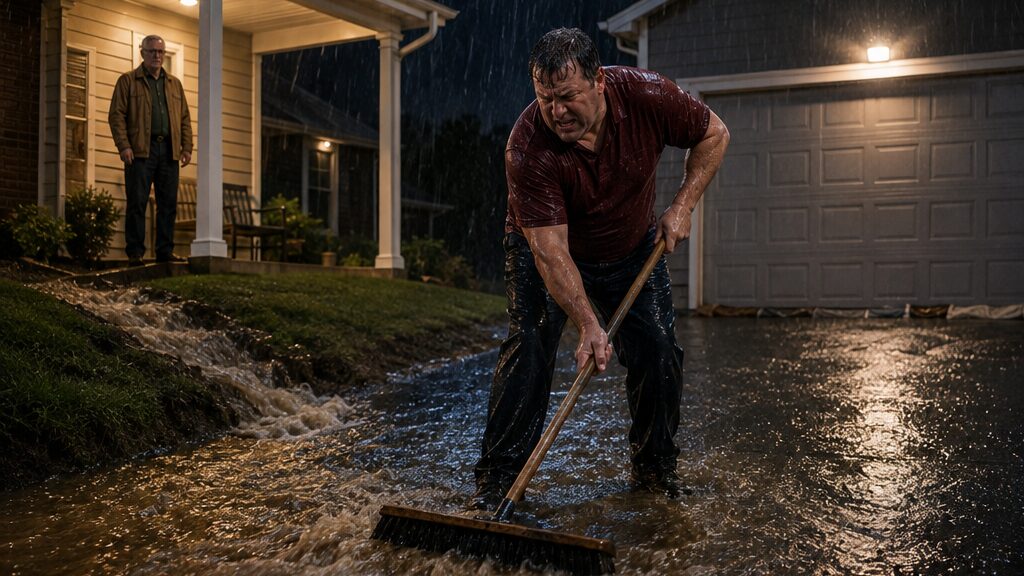
At eleven that night, Scott Davis was trying to sweep a river uphill.
From Joshua Martin’s covered porch, the absurdity of it was impossible to miss. Scott stood ankle-deep in brown runoff, both hands wrapped around a wide garage broom, shoving water away from the bottom edge of his garage door. Each stroke cleared a dark strip of asphalt for perhaps two seconds. Then another sheet of water slid across the driveway and erased his work.
Rain hammered the aluminum gutters hard enough to drown out everything except the occasional scrape of broom bristles.
Scott’s red shirt clung to his back. Water ran from his hair and down his face. He pushed again, harder this time, angling the broom toward the street.
The water refused.
It came from the narrow space between the two properties, spread across the widened section of Scott’s driveway, then curved toward the garage exactly where Joshua had said it would.
Three weeks earlier, Scott had looked him in the eye and said, “I know what I’m doing.”
Joshua remembered those words now with uncomfortable clarity.
He had spent twelve years working for the county stormwater department before retiring. Most of the job had not involved dramatic floods or washed-out roads. It had involved quieter things: standing in wet grass with a level rod, tracing shallow depressions between houses, explaining to homeowners why a strip of ground they considered useless had been shaped that way for a reason.
Water did not care whether something looked intentional.
It cared about elevation.
And the shallow grassy swale that had once run between Joshua’s lawn and Scott’s driveway had been the lowest path between the rear lots and the street.
Until Scott paved across it.
A flash of lightning turned the two yards white.
Scott stopped sweeping.
For one second he simply stood there, breathing hard, staring at the water gathering around his shoes.
Then he looked toward Joshua’s porch.
Joshua did not move.
Scott could see him. There was no question about that. Joshua had left the porch light on, and he stood in full view with one hand resting on the railing.
Scott lifted an arm.
“Josh!”
The rain almost swallowed his voice.
Joshua heard it anyway.
He knew what he could do. There was a trenching shovel in his garage. He had plastic sheeting, sandbags left from an old landscaping project, and enough experience to make a temporary diversion along the edge of the lawn.
Maybe not enough to solve the whole problem in the middle of a storm.
Enough to help.
Instead, Joshua stayed where he was.
He told himself there was a reason.
Scott had been warned. More than once. Joshua had explained the grade, the swale, the outlet near the curb. He had even offered to show him the original neighborhood grading sheets.
Scott had dismissed him.
Then Scott had paved over the drainage path anyway.
A man was allowed to experience the result of his own decision, Joshua thought.
That was what he told himself.
Across the property line, Scott shoved the broom through another surge. The water separated around the broom head and joined again behind it.
Joshua felt a brief, sharp satisfaction.
There.
Proof.
Not theory. Not the opinion of a retired man the neighborhood no longer needed. Not somebody being difficult because he had too much time after retirement.
Proof.
Then the water reached the first seam beneath Scott’s garage door.
Scott dropped the broom.
The satisfaction disappeared.
He ran to the garage, dragged the door upward a foot, and shoved rolled towels into the gap. His wife appeared behind him, carrying another armful. They moved quickly now, without arguing, each trying to block water that kept pressing against the threshold.
Joshua’s hand tightened around the porch rail.
This was what he had predicted.
He had wanted Scott to understand that.
But standing there watching a man protect his house from a problem Joshua had seen coming felt different from imagining vindication in daylight.
Scott looked back toward him once more.
This time he did not call out.
That was worse.
Joshua went inside.
For a few seconds he stood in the kitchen listening to rain strike the windows. On the counter lay his phone.
He picked it up, opened the camera, and returned to the porch.
He took one picture of the water crossing the widened driveway.
Then another showing the blocked path where the swale had once continued toward the street.
He told himself the photographs mattered.
If the county became involved, someone would need evidence of what happened during a real storm.
That was true.
It was also true that he could have taken photographs after carrying over a shovel.
The two truths sat beside each other uneasily.
By midnight, the rain weakened. The water on Scott’s driveway dropped from a moving sheet to shallow streams. The garage had stayed mostly dry, though wet towels and cardboard boxes were spread near the entrance.
Scott left the broom lying flat on the pavement.
Joshua watched until Scott shut the garage door.
Only then did he turn off the porch light.
He slept badly.
Every time he woke, he heard the same imaginary sound: broom bristles scraping asphalt, followed by water rushing back over the place Scott had just cleared.
By morning, the storm had moved east.
The lawns shone under a pale sky, and muddy residue marked the route the water had taken. From Joshua’s kitchen window, the flooded driveway looked almost ordinary again.
That was one of the deceptive things about drainage failures.
The evidence disappeared faster than the argument.
Joshua poured coffee and looked at the folded grading map on the far end of the kitchen counter.
He had kept it from his county days because the original subdivision plan included his property. The paper was soft at the folds now, the ink slightly faded.
On it, a shallow line crossed between the two lots and curved toward the street.
A line most people would never notice.
Three weeks earlier, Joshua had stood at the property edge and watched fresh black asphalt cover that exact route while a paving roller waited twenty feet away.
He had known what would happen before the last pass was even made.
What he still did not understand was why Scott had been so certain Joshua was wrong.
Chapter 2: The Strip of Grass Nobody Thought Mattered
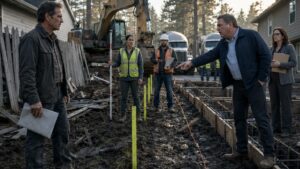
The paving crew was already spreading asphalt when Joshua saw where they were going.
He had stepped outside that morning to bring in his empty trash bin when the smell reached him first: hot asphalt, sharp and oily in the cool air.
Scott’s driveway had always been narrow by newer suburban standards, barely wide enough for two vehicles side by side. Now wooden stakes marked an additional strip along the side nearest Joshua’s property.
Joshua followed the stakes with his eyes.
Then stopped.
The new edge crossed directly over the grassy depression between their lots.
One worker was raking asphalt into place while another waited beside a small roller.
Joshua left the trash bin at the curb.
“Hold on,” he called.
The worker looked up.
Scott came around the side of his garage before anyone else answered. He wore work boots and carried a paper coffee cup.
“What’s up?”
Joshua pointed at the fresh asphalt.
“You’re crossing the swale.”
Scott glanced toward the ground as if Joshua had mentioned a weed.
“The what?”
“The drainage swale. That low strip.”
Scott looked at it again.
The swale was not impressive. It was perhaps two feet wide at its shallowest point, broadening farther downhill. Most days it looked like nothing more than a slight dip in the turf.
“That ditch?” Scott asked.
“It’s not a ditch.”
Scott gave him a look.
Joshua heard how that sounded and corrected himself.
“It’s a graded drainage path. Our lots slope into it, and it carries runoff to the street.”
One of the workers shifted his rake and waited.
Scott took a sip of coffee.
“We’re not changing your property.”
“I didn’t say you were.”
“You came out here telling my crew to stop.”
“I’m telling you the asphalt is going across the drainage route.”
Scott looked toward the crew, then back at Joshua. “They know what they’re doing.”
Joshua felt the familiar irritation of hearing confidence used where measurement should have been.
“Are they putting a culvert under it?”
“A what?”
“Pipe. Channel. Anything to preserve the flow?”
Scott’s expression hardened slightly.
“No. It’s a driveway.”
“Then you’re building a dam.”
The worker with the rake looked down.
Scott noticed.
“That’s a little dramatic.”
Joshua stepped onto the grass and pointed toward the rear yards.
“Your lot sits below mine by several inches through here. The houses behind us drain this direction too. Water runs into this low point, then follows it toward the curb.”
Scott stared at the lawn.
Joshua could almost see the problem from his perspective. There was no flowing water. No concrete channel. No grate. Just grass.
“Josh,” Scott said, “I mow that strip every week. I’ve never seen a river there.”
“You don’t need a river every week. You need somewhere for the water to go on the one week it matters.”
Scott exhaled through his nose.
The paving contractor approached but stayed a few steps away.
“We’re within the lines he gave us,” the contractor said.
Joshua nodded. “I’m not blaming you. I’m asking whether anybody checked the drainage easement.”
Scott’s eyes narrowed.
“There is no easement through my driveway.”
“There is along that swale.”
“You sure about that?”
“Yes.”
That single word came out harder than Joshua intended.
Scott took another sip of coffee.
“I submitted the plan.”
“To who?”
“The HOA.”
Joshua paused.
Scott noticed.
“Exactly,” he said. “Architectural committee approved it last month.”
The certainty in Joshua’s chest shifted—not disappearing, but changing shape.
“You have approval for this layout?”
“I have it in writing.”
“HOA approval doesn’t necessarily mean the county drainage requirement was checked.”
Scott gave a short laugh.
“So now the approval doesn’t count because you don’t like it?”
“That isn’t what I said.”
“It sounds pretty close.”
Joshua could feel the conversation moving away from water and toward something older and more personal: who had the right to tell whom what to do.
Scott gestured toward the street.
“You know why I’m widening this? Because the HOA keeps sending reminders about parking on the curb. My daughter visits, my wife’s sister stays over sometimes, and apparently one tire touching the street overnight is a crisis.”
“I understand that.”
“No, you don’t. You’ve got a two-car garage with one car.”
Joshua let that pass.
“I’m not telling you not to widen it. I’m telling you not to block the low point.”
Scott looked at the workers waiting behind him.
“How long would stopping this cost me?”
“I don’t know.”
“Exactly.”
Joshua heard the impatience beneath the answer. The contractor was there. Equipment was running. Hot asphalt was already on the ground. Every minute of delay felt expensive.
Still, the grade did not care about schedule.
“I have the original subdivision grading map,” Joshua said. “Give me ten minutes and I’ll show you.”
Scott shook his head.
“I already did what I was supposed to do.”
“Scott—”
“It’s my property, Joshua.”
Joshua looked at the black strip of asphalt filling the place where grass had dipped gently toward the street.
“I know.”
“And the HOA approved it.”
“That does not change where the water goes.”
Scott’s jaw tightened.
“I know what I’m doing.”
There it was.
Not shouted. Not theatrical.
Just final.
Scott turned toward the contractor.
“Keep going.”
The roller started.
Joshua stood beside the swale as the machine moved forward.
The asphalt compressed beneath the drum, smooth and dark. The shallow depression vanished under it one pass at a time.
Joshua could have gone home then.
Instead he stayed until the roller finished crossing the low point.
His concern had become something less generous.
Fine, he thought.
You’ll see.
The thought bothered him almost immediately, but not enough to make him leave.
That evening, after the crew was gone, Joshua unfolded his grading map at the kitchen table and found the line he remembered. He drafted a short note explaining the drainage route and offered to show Scott the full plan.
He walked next door and placed it at the edge of Scott’s porch.
An hour later, his doorbell rang.
When Joshua opened the front door, nobody was there.
A single sheet of paper lay on the welcome mat.
At the top was the HOA architectural committee’s approval for Scott’s driveway expansion.
Joshua picked it up.
The drawing attached beneath the approval showed the widened pavement exactly where the crew had installed it.
Chapter 3: The Approval Letter That Changed the Argument
Joshua read the approval twice before he finished his morning coffee.
The paper did not look questionable. It had Scott’s address, the dimensions of the proposed driveway extension, the date submitted, and the architectural committee’s approval.
Nothing had been scribbled in afterward.
Scott had done what he said he had done.
That did not make the pavement safe.
But it made the argument less simple.
Joshua laid the HOA sheet beside his old grading map on the kitchen table.
On Scott’s submission, the property line was clear. The driveway was clear. Landscaping was shown as pale blocks around it.
The swale did not exist.
On the county grading map, it was impossible to miss once Joshua knew where to look: a low drainage corridor connecting the rear lots to the street.
Two documents describing the same ground.
Only one acknowledged where the water went.
By ten that morning, Joshua was at the HOA clubhouse.
Amanda Wright met him in the small office beside the meeting room. She had a laptop open and a stack of architectural requests beside it.
“You’re here about Scott’s driveway,” she said.
“I am.”
“He mentioned there might be a complaint.”
“I haven’t filed one.”
“Good.”
Amanda said it too quickly.
Joshua sat across from her and unfolded the grading map.
“This is the original drainage plan.”
Amanda leaned forward.
Joshua pointed to the line between his property and Scott’s.
“That low area carries runoff from both lots. Scott paved straight across it.”
Amanda studied the paper for a few seconds.
“Is this current?”
“The grades haven’t been redesigned.”
“That isn’t what I asked.”
Joshua looked at her.
“It’s the recorded subdivision grading plan.”
“From when?”
“Twenty-eight years ago.”
Amanda leaned back slightly.
“There have been landscaping changes all over the neighborhood since then.”
“Grass and shrubs don’t erase gravity.”
Her mouth tightened.
Joshua knew the tone. He had used versions of it himself during county inspections when homeowners tried to explain why rules did not apply to their particular yard.
That realization did not improve his mood.
Amanda turned her laptop so he could see Scott’s application.
“We reviewed his property boundaries, the setback from the sidewalk, the surface material, and the width allowed under the design standards. It passed.”
“Did anyone check drainage?”
“We’re an architectural committee.”
“That’s not an answer.”
“It is, actually.”
Joshua sat back.
Amanda continued.
“We review what the HOA is responsible for. We are not the county permitting office.”
“Then the approval should say that.”
“It does.”
She scrolled downward and pointed to a paragraph Joshua had not seen on Scott’s printed page.
Approval by the association did not replace municipal, county, utility, or other required permissions.
Joshua read it slowly.
“So you approved something without knowing whether it crossed an easement.”
“We approve fences without calling the utility company. We approve sheds without inspecting soil. Homeowners are responsible for outside requirements.”
Joshua tapped the map.
“Except most homeowners see an approval letter and assume somebody checked the important things.”
Amanda’s face changed slightly.
Not agreement. Recognition.
She looked toward the closed office door.
“We had twenty-seven applications this summer.”
“That doesn’t change the drainage.”
“No, but it changes what you’re implying.”
Joshua waited.
Amanda folded her hands.
“The board started enforcing curb-parking rules more strictly in the spring. We got complaints every week. People with teenagers, adult children, visitors. Everybody suddenly wanted wider driveways.”
“So you approved them faster.”
“We processed them faster.”
“Same thing.”
“No.”
Her answer was sharper than his.
Joshua looked at the stack beside her laptop.
“How many?”
Amanda did not answer immediately.
“How many driveway extensions?”
“Several.”
“And did you check drainage on any of them?”
“We checked the standards we are authorized to check.”
Joshua stared at her.
Amanda closed the laptop.
“If you have evidence Scott’s driveway is causing an actual drainage problem, bring it to the board. If the county says there’s an easement violation, that’s different. But I’m not revoking an approval because a retired employee thinks something might happen.”
The words landed harder than they should have.
A retired employee.
Joshua felt heat rise in his neck.
For twelve years people had called him when their yards flooded, when culverts failed, when new construction sent runoff over old property lines. Now the same knowledge was apparently an opinion because nobody was paying him for it.
He folded the map more sharply than necessary.
“I don’t think it might happen.”
Amanda sighed.
“Then we’ll know when it does.”
Joshua stood.
On the walk home, he replayed that sentence until it sounded almost like a challenge.
Scott was in his driveway when Joshua returned.
He was washing dust from the new asphalt edge with a garden hose.
“Went to Amanda?” Scott asked.
Joshua stopped.
“Yes.”
“And?”
“She confirmed your HOA approval.”
Scott smiled without much warmth. “Glad we cleared that up.”
“She also confirmed they didn’t check the county easement.”
Scott turned off the hose.
“Here we go.”
“I’m telling you exactly what she told me.”
“No. You’re telling me the part you like.”
Joshua took a breath.
“You should call the county.”
Scott laughed once.
“I should call the county and ask them to find a problem with work I just paid for?”
“You should verify it before the next heavy rain.”
Scott looked at the dark, clean surface of his widened driveway.
“We had rain last month.”
“Not enough.”
“How much is enough for you?”
“That isn’t how drainage works.”
Scott shook his head.
“You know what I think? I think you miss your job.”
Joshua said nothing.
Scott continued.
“You spent years being the guy who showed up and told people what was wrong. Now you’re retired, and I happen to live next door.”
The accuracy of the insult made it worse.
Joshua folded his arms.
“This has nothing to do with retirement.”
“Sure.”
Scott turned the hose back on.
Water ran across the driveway in a thin sparkling sheet and disappeared harmlessly into the grass.
For a moment, Joshua hated the sight of it.
Three weeks later, the first real storm arrived.
Rain fell for most of an afternoon, steady enough to fill gutters and darken lawns but never particularly hard. Joshua checked the swale twice from his window.
Water collected along the edge of Scott’s pavement.
Then it found small paths around the ends and drained away.
No flood.
No garage threatened.
No emergency.
The next morning Scott was outside sweeping leaves from the driveway.
He saw Joshua looking.
Scott raised one hand.
Not quite a wave.
More like acknowledgment of a verdict.
Joshua stepped away from the window.
For the first time since the paving crew arrived, he wondered whether he had overstated the danger.
Perhaps the surrounding grass still provided enough relief. Perhaps the design had more tolerance than he remembered. Perhaps years away from county work had sharpened his certainty while dulling his judgment.
He hated that possibility.
Two days later, Joshua was checking the local forecast while eating breakfast.
A broad storm system was expected to arrive over the weekend. The rainfall estimate was more than double what the neighborhood had received in the previous storm, with the heaviest band predicted after dark.
Joshua looked through the kitchen window toward Scott’s driveway.
Then he unfolded the grading map again.
This time he did not look at the property lines.
He followed the drainage arrows from the rear lots to the exact place now covered in asphalt.
Chapter 4: At Eleven O’Clock the Water Answered Them
By ten forty-five, the water was crossing Scott’s driveway faster than he could push it away.
Joshua stood beneath his covered porch and watched the stream widen from a narrow brown ribbon into a moving sheet. It came down the shallow grade from the rear yards, reached the place where the grassy swale had once crossed Scott’s property, and struck the raised edge of the new asphalt.
For several minutes the runoff searched for another route.
Then it found Scott’s driveway.
Scott was outside in a rain jacket at first, dragging a push broom toward the garage. He planted his boots, leaned into the handle, and shoved water toward the street.
The water curled around the broom head and returned behind him.
Joshua had seen the same thing dozens of times during his county years. People treated stormwater as though it could be persuaded. They stacked boards, pushed gravel, dug little trenches with garden tools. Sometimes those measures bought a few minutes.
But water followed grade.
Always.
Scott swept again.
A car passing on the street sent headlights across the driveway, and for one bright second Joshua could see the whole pattern clearly. Water pooled along the former swale, backed against the pavement, then turned across the new extension toward the garage.
Exactly as the grading map predicted.
Joshua felt something loosen inside him.
Not relief.
Vindication.
He hated Amanda’s phrase more than he wanted to admit.
A retired employee thinks something might happen.
Well, it was happening.
Scott disappeared into the garage and came back without the rain jacket. His red shirt darkened almost immediately.
He pushed harder.
The broom scraped the asphalt with a rough, useless sound.
Joshua folded his arms.
Scott had been told.
Joshua had stood beside the paving crew and offered to bring out the map. He had written the warning down afterward. He had gone to the HOA. He had told Scott to call the county before the next major storm.
Scott had chosen not to.
That mattered.
At least, Joshua told himself it did.
The water rose another inch near the garage door.
Scott abandoned the broom and pulled two sandbags from beside the garage wall. They were lightweight landscaping bags, not real flood protection. He dropped them along the threshold and ran back for more.
His wife appeared inside the garage.
Even from across the property line, Joshua could see the alarm in the way she pointed toward the water.
Scott said something Joshua could not hear.
Then he looked directly toward Joshua’s porch.
Their eyes met.
For a moment neither man moved.
Scott lifted one hand.
“Josh!”
Joshua heard him through the rain.
He could cross the lawn in fifteen seconds.
He could take the trenching shovel from his own garage and cut a temporary relief path through the soft grass below the pavement. It might not save everything. It might even make a mess of the side yard.
But it would help.
Joshua knew that before Scott called his name a second time.
“Josh!”
Joshua stayed beneath the porch roof.
He told himself he did not want to alter somebody else’s property in the middle of an active drainage problem.
He told himself Scott had already made it clear where the property line mattered.
He told himself that if he touched anything and the garage flooded anyway, Scott might blame him.
All three things were reasonable.
None was the real reason.
The real reason was smaller and uglier.
Joshua wanted Scott to understand.
Not tomorrow.
Not after an inspector explained it.
Now.
He wanted Scott standing in the rain to feel the weight of those words: I know what I’m doing.
Scott stared toward the porch another second.
Then he turned away.
Joshua felt the victory leave his body.
It happened quickly.
One moment he was watching proof. The next he was watching his neighbor drag soaked towels toward a garage door while his wife moved boxes onto shelves.
The distinction was impossible to ignore.
Joshua stepped inside.
His trenching shovel hung on the garage wall.
He stood in front of it.
Rain thundered against the roof.
He reached for the handle.
Then stopped.
What would happen if he crossed over now?
Scott might accept the help.
Or reject it.
Or ask why Joshua had waited until water was already at the garage.
Joshua let go of the shovel.
When he returned to the porch, Scott had found the broom again.
The water was within a few feet of the garage threshold.
Joshua took out his phone.
He framed the first photograph wide enough to show the former swale, the driveway extension, and the direction of the runoff.
The second showed the water turning across the asphalt.
He almost took a third with Scott in the frame.
He lowered the phone instead.
That one would have been evidence of something else.
Near midnight the rain weakened. The flow dropped noticeably within twenty minutes. The water never rose high enough to flood the garage completely, though a thin line had passed beneath one corner of the door.
Scott’s wife carried wet cardboard into the house.
Scott left the broom lying on the driveway.
Joshua remained outside after Scott disappeared indoors.
He looked at the dark water marks stretching across the asphalt.
The old swale had not vanished.
Scott had covered it, but the storm had drawn its route back onto the surface.
The thought should have satisfied Joshua.
Instead he kept seeing Scott look toward his porch.
The next morning, the neighborhood looked washed clean.
Joshua carried his coffee to the kitchen table.
His phone lay beside the folded grading map.
He opened the storm photographs.
The evidence was good.
Clear enough that a county inspector could understand the failure without having witnessed it.
He found the county drainage complaint page online.
The form asked whether there had been property damage.
Joshua hesitated.
Minor water intrusion, he typed.
The next line asked whether the suspected obstruction affected a recorded drainage feature.
Joshua looked at the grading map.
Yes.
He attached the photographs.
Before pressing submit, he sat back.
Scott had ignored a specific warning.
The HOA had approved the work without checking the easement.
Amanda had told Joshua to bring evidence if there was an actual drainage failure.
Now he had it.
That should have made the next step simple.
Instead Joshua heard the broom against the asphalt again.
He moved the cursor away from the submit button.
Then back.
Correction, he told himself.
This was about correction.
He pressed submit.
Chapter 5: The Violation Notice Was Only Half the Truth
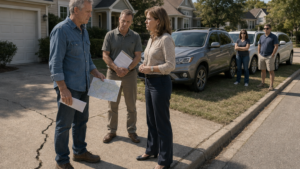
The county inspector drove a measuring rod into the grass beside Scott’s driveway and looked down at the number.
Scott stood ten feet away with his arms folded.
Joshua watched from his own side of the property line.
The inspector moved the rod downhill, took another measurement, then crouched near the edge of the widened pavement.
“Original swale ran through here?” he asked.
Joshua nodded.
“According to the subdivision grading plan.”
Scott pointed toward the asphalt.
“That plan is almost thirty years old.”
The inspector straightened.
“Grades can change.”
Scott looked at Joshua as if that settled everything.
The inspector continued.
“But drainage easements don’t disappear because somebody pours over them.”
Scott’s expression changed.
Only slightly.
The inspector asked for the HOA approval.
Scott went inside and returned with a clear plastic folder.
Joshua recognized the first page immediately.
The same approval Scott had left on his porch.
The inspector read it, then turned to the attached sketch.
“This is association approval.”
“Yes.”
“It isn’t county drainage clearance.”
“Nobody told me I needed that.”
The inspector glanced at Joshua.
Scott noticed.
“He told me,” Scott said. “After the crew was already working.”
Joshua almost corrected him.
He had spoken before the final asphalt crossed the swale.
But the difference suddenly seemed less useful than it had a week earlier.
The inspector walked toward the street, following the low ground. At the curb he examined the outlet area, then returned.
“The intended flow path is still obvious,” he said. “Your new pavement interrupts it.”
Scott looked toward his garage.
“So what happens now?”
“I’ll send the formal notice after I verify the recorded easement. Most likely you’ll need to restore positive drainage through or beneath the driveway.”
“Meaning tear it out?”
“Not necessarily. A culvert may work if it’s sized and installed correctly.”
Scott rubbed one hand over his face.
“And who pays for that?”
The inspector did not answer immediately.
“That’s between you, your contractor, your association, whoever else may be involved. My concern is restoring the drainage function.”
The inspector packed his rod into the county vehicle.
Joshua felt the old professional certainty return. The measurements were saying what he had said from the beginning.
The feeling lasted until Scott turned toward him.
“You happy?”
Joshua frowned.
“No.”
“That’s funny.”
“Scott—”
“No. Don’t.”
Scott held up the plastic folder.
“I filed the application. I drew the dimensions. I paid the fee. They approved it.”
“I know.”
“You reported me anyway.”
“The water nearly reached your garage.”
“And you stood there watching.”
The words landed cleanly.
Joshua said nothing.
Scott stepped closer to the property line but did not cross it.
“You want to know what bothered me most that night? It wasn’t that you were right.”
Joshua looked at him.
“It was realizing you were enjoying it.”
Scott walked back inside.
Joshua remained beside the wet grass.
He wanted to reject the accusation.
Instead he remembered taking out his phone while Scott pushed water with the broom.
The county notice arrived four days later.
Unauthorized modification of a regulated drainage easement.
Restoration required.
Scott had sixty days.
That afternoon he knocked on Joshua’s door.
The paper was folded in his hand.
“You reported me over some water.”
Joshua looked at the notice.
“It wasn’t some water.”
“I got sixty days to cut up a driveway I just paid for.”
“I warned you.”
The sentence came automatically.
For weeks Joshua had imagined saying it.
Now that he had, it sounded smaller than expected.
Scott gave a bitter laugh.
“Yeah. You did.”
He unfolded the HOA approval and held it beside the violation.
“And they told me yes.”
Joshua stared at the two documents.
For the first time they looked less like evidence for opposite sides and more like parts of the same mistake.
Scott tapped the approval page.
“No condition. No note saying check drainage. No mention of an easement. They approved the exact drawing.”
“You still had the responsibility to check.”
“I know that now.”
The answer stopped Joshua.
Scott was not denying what he had done.
He looked exhausted more than angry.
“I should’ve called the county after you said something,” Scott continued. “Fine. That part’s mine. But don’t stand there and pretend this was just me deciding rules didn’t apply.”
He folded both papers together.
“The HOA spent six months telling everybody to get cars off the street. Then they approved my solution.”
Scott left before Joshua answered.
The next morning Joshua went back to the clubhouse.
Amanda was already there.
She did not seem surprised to see him.
“You heard about the violation,” Joshua said.
“Yes.”
“How many driveway extensions did you approve?”
Amanda looked toward the stack of files.
“Five this year.”
“Same review?”
“Yes.”
“Any of them near drainage paths?”
“I don’t know.”
Joshua stared at her.
Amanda’s voice hardened.
“Don’t do that.”
“Do what?”
“Look at me like I paved Scott’s driveway.”
“You approved it.”
“And Scott built it.”
“You knew people were widening driveways because of the parking enforcement.”
Amanda stood.
“Of course I knew. I was at every meeting where people complained.”
She pulled a folder from a cabinet.
“The board started enforcing curb parking because emergency vehicles had trouble getting through two streets last winter. Then residents told us we were making it impossible for families with three cars.”
She placed the folder on the table.
“So yes, when people submitted driveway extensions that met the written architectural standards, we tried not to create another fight.”
Joshua opened the folder.
Several approval forms lay inside.
Almost identical.
“Did anybody ever create a drainage review step?”
“No.”
“Why not?”
“Because nobody thought we needed one.”
Amanda looked tired now.
“We’re volunteers, Joshua. We check fences, paint colors, sheds, driveways. We don’t have engineers sitting in the office.”
“You could have told people county approval might be required.”
“Yes.”
The answer came without defense.
Joshua looked up.
Amanda sat down again.
“We should have.”
The simplicity of it unsettled him more than another argument would have.
She slid Scott’s application across the table.
His site sketch showed dimensions, setbacks, even the new pavement edge.
The swale was absent.
Joshua unfolded his grading map and placed it beside the sketch.
On one sheet, the driveway extension looked harmless.
On the other, it sat directly across a drainage corridor.
Neither document was false.
Together they showed how the mistake had happened.
Amanda studied them.
“The board is calling an emergency meeting.”
“When?”
“Next Thursday. Before Scott starts restoration.”
Joshua began folding his map.
Amanda stopped him.
“I want you there.”
“For what?”
“To explain the drainage.”
“You have the county notice.”
“I’m not asking you to prove the county is right.”
She looked at the two plans.
“I’m asking you to explain how all of us missed this.”
Joshua thought of Scott’s words.
I should’ve called the county. That part’s mine.
Then he thought of the storm night.
You stood there watching.
Amanda pushed the meeting notice toward him.
“People are already choosing sides,” she said. “I’d rather they understand what actually happened.”
Joshua picked up the notice.
For the first time since the paving crew arrived, being right was no longer the difficult part.
The difficult part was deciding how much of the truth he was willing to tell when the whole neighborhood was listening.
Chapter 6: The HOA Meeting Where Being Right Wasn’t Enough
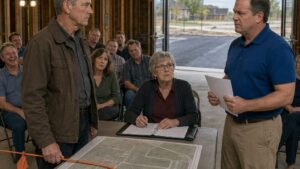
The board member at the center of the clubhouse table looked directly at Joshua.
“In your professional opinion, did Scott Davis cause this drainage problem?”
The room went quiet.
Scott sat three chairs away with the county violation in front of him.
Amanda sat across from Joshua.
Nearly twenty homeowners filled the folding chairs behind them.
Joshua had expected questions about slope, flow direction, culvert size.
Not that one.
He looked down at the two documents he had brought: the old grading map and Scott’s approved site plan.
“Yes,” he said.
Scott leaned back.
Joshua continued before anyone could speak.
“But not by himself.”
A murmur moved through the room.
One of the board members frowned.
“The county violation names his property.”
“It should. The obstruction is on his property.”
Scott’s jaw tightened.
Joshua spread the grading map across the table.
“This is the original neighborhood grading plan. The lots behind ours drain toward this low corridor. The swale carries that water to the street.”
He placed Scott’s site sketch beside it.
“This is the plan the architectural committee approved.”
The difference was obvious when they were side by side.
One showed water.
The other showed property improvements.
A homeowner in the back asked, “So which one is wrong?”
“Neither,” Joshua said. “That’s the problem.”
He pointed to Scott’s plan.
“This tells you where the driveway goes.”
Then the grading map.
“This tells you what the ground was designed to do.”
Amanda folded her hands on the table.
“The committee did not compare applications against drainage easements,” she said.
The room stirred again.
A board member turned toward her.
“Was that required?”
“Not under our old checklist.”
“Then how is that an HOA mistake?”
Amanda looked at Joshua briefly.
Then answered herself.
“Because we were issuing approvals homeowners reasonably treated as complete, even though our forms said outside permits were still their responsibility.”
Scott spoke for the first time.
“Reasonably?”
Amanda turned toward him.
“You received the same disclaimer everyone receives.”
“And a letter saying approved.”
“Yes.”
“And you knew why I wanted the extension.”
Amanda did not answer.
Scott looked toward the board.
“For six months you sent warnings about curb parking. I moved my cars off the street. I submitted a drawing. I waited for approval. Then I paid a contractor.”
One homeowner behind him muttered agreement.
The board member raised a hand.
“This meeting is not about parking.”
“It’s part of why this happened,” Joshua said.
The board member looked irritated.
Joshua understood the impulse. A clean story would be easier.
Scott ignored a drainage rule.
County caught it.
Scott repairs it.
Finished.
Joshua had wanted that version himself.
He looked at Scott.
“There’s another part too.”
Scott’s expression sharpened.
Joshua rested one hand on the grading map.
“I warned Scott while the paving crew was there.”
Several heads turned.
“He could have stopped the work long enough to verify the drainage issue.”
Scott looked down.
Joshua continued.
“He didn’t.”
The room stayed silent.
“So that part belongs to him.”
Scott nodded once.
It was barely visible.
Joshua felt how easy it would be to stop there.
He could leave with the room understanding that he had predicted everything. He could let the county notice carry the rest.
Instead he saw again the porch light reflecting off stormwater and Scott looking across the property line.
“I also need to say something about the night it flooded.”
Scott raised his eyes.
Joshua swallowed.
“Scott asked me for help.”
Amanda looked at him.
“I knew enough to make a temporary diversion. Maybe it wouldn’t have solved the whole problem, but I could have tried.”
Nobody interrupted.
“I didn’t.”
The admission felt strangely physical, like setting down something heavy.
“Why?” a homeowner asked quietly.
Joshua looked at Scott rather than the questioner.
“Because I wanted him to understand I was right.”
Scott’s face did not soften.
Joshua had not expected it to.
“I took photographs for the complaint while he was trying to keep water out of his garage. The photographs were useful. My reason for standing there wasn’t entirely useful.”
The board member shifted in his chair.
“We still need to determine responsibility for the restoration.”
“Yes,” Joshua said. “And telling the truth about my behavior doesn’t change the drainage.”
He pointed toward the county notice.
“Scott blocked a regulated flow path after being specifically warned. That is why the county can require restoration.”
Then he pointed toward the HOA approval.
“But the association approved the exact layout without checking whether the modification crossed a drainage easement. That helped convince him there was nothing left to verify.”
Scott looked toward Amanda.
She nodded.
“We failed to build that check into the process.”
One of the board members said, “So what are you proposing?”
Joshua unfolded a separate sketch prepared from the county inspector’s suggested restoration options.
“Correction instead of escalation.”
He traced the driveway edge.
“Scott does not necessarily have to remove the entire extension. A properly sized culvert can carry the swale beneath it. The grade on either side needs to be restored so water enters and exits without backing up.”
Scott leaned forward despite himself.
“How much pavement comes out?”
“A narrow section for installation, then it can be patched.”
Scott studied the sketch.
“And the county accepts that?”
“If it meets their specifications.”
“Who decides?”
“The county inspector. Not me.”
That distinction mattered.
Joshua left his finger on the paper.
“The HOA should also change its architectural checklist. Any driveway, retaining wall, fence, or grading request that could affect an easement should require the homeowner to verify county requirements before construction.”
Amanda nodded.
“I’ve drafted that change.”
The board member looked toward Scott.
“You understand that even with the HOA process problem, the association cannot cancel the county restoration order.”
Scott’s mouth tightened.
“So I still pay.”
“The physical work is on your property,” the board member said.
Scott stared at the culvert sketch.
“What about the money I already spent?”
Nobody answered.
Joshua wanted to say something comforting.
Nothing truthful came to mind.
Scott finally said, “Of course.”
There was no dramatic anger in it.
Only cost.
The contractor’s initial estimate, Scott explained, was a little over five thousand dollars if the culvert could be installed without rebuilding the full driveway edge.
A homeowner behind him whispered something.
Scott ignored it.
Amanda spoke.
“I can ask the board to waive any HOA review fee for the corrective work.”
Scott gave her a flat look.
“That’s generous.”
Amanda accepted the remark.
“It isn’t enough. I know.”
The meeting became quieter after that.
The board agreed to revise the architectural review process. Amanda would contact the other homeowners whose recent driveway extensions might intersect drainage features. Scott would submit a culvert plan to the county before beginning work.
No fines from the HOA.
No public apology demanded.
No easy solution to the money.
When the meeting ended, people folded chairs and drifted toward the parking lot.
Scott remained at the table studying Joshua’s sketch.
Joshua gathered the grading map.
“You can keep that copy,” he said.
Scott looked up.
“I’ve got the county documents.”
“This one shows the original elevations more clearly.”
Scott hesitated, then left the paper on the table.
Joshua nodded and began to walk away.
“Josh.”
He turned.
Scott tapped the culvert sketch.
“The contractor wants somebody here when they set the inlet grade.”
Joshua waited.
“If you want,” he said, “I can be here.”
Scott’s face closed again.
“No.”
Joshua said nothing.
“I’ll have the county inspector check it.”
“That’s probably better.”
Scott seemed surprised by the answer.
Joshua picked up his map.
At the doorway, Scott spoke again.
“I’m agreeing to fix it.”
Joshua looked back.
“I know.”
“That doesn’t mean you and I are fine.”
“I know that too.”
Scott folded the restoration sketch and slid it into the folder with the violation notice.
For the first time since the argument began, Joshua did not feel compelled to add one more explanation.
Scott had accepted the culvert.
He had not accepted Joshua.
And for now, those were two different problems.
Chapter 7: When the Water Finally Had Somewhere to Go
The saw cut into Scott’s new driveway at eight on a Tuesday morning.
Joshua heard it from his kitchen before he saw the crew.
By the time he stepped outside, a narrow rectangle had been marked across the widened section of asphalt. The culvert contractor guided a concrete saw along the painted line while another worker sprayed water over the blade to keep the dust down.
Scott stood near the garage with his hands in his jacket pockets.
He did not look toward Joshua.
The fresh driveway had been finished less than two months earlier. Now a section of it was being cut open because the ground underneath still needed to do what it had always done.
Joshua stayed on his side of the lawn.
The old version of him—the version from before the storm—would have walked straight over. He would have pointed to the inlet elevation, checked the trench depth, asked whether the contractor had accounted for settlement beneath the new pipe.
He knew what needed to happen.
That no longer meant he had to be the first person saying it.
The contractor removed the asphalt section and began digging.
Dark soil appeared beneath the black surface.
Then the shape of the old swale slowly returned.
Not as grass this time, but as grade.
The trench crossed the driveway on a slight angle, lower on Joshua’s side and opening toward the street.
Scott watched the work without speaking.
Near noon, the county inspector arrived.
Joshua remained on his porch while the inspector checked the pipe diameter, slope, and outlet elevation.
The contractor adjusted the bedding beneath one end.
Scott crouched beside them once, listening.
No one called Joshua over.
He discovered that bothered him less than he expected.
The next morning the crew finished the inlet and shaped the grass so runoff would enter the culvert instead of collecting against the pavement. They patched the asphalt above it, leaving a rectangular seam across the otherwise smooth driveway.
The repair was not invisible.
Neither was the cost.
Joshua knew Scott had paid more than five thousand dollars for the corrective work. He had also lost part of what he had paid for the original paving.
The HOA waived its review fee for the repair and changed its application process, but that did not put money back into Scott’s account.
Practical justice, Joshua had learned, rarely left everyone feeling satisfied.
Late that afternoon, the contractor packed up.
Joshua was trimming a shrub near his porch when he heard Scott call his name.
“Josh.”
Joshua looked over.
Scott stood beside the new culvert inlet.
For a second Joshua thought there might be another problem.
Scott pointed toward the shallow grade.
“You mind looking at this?”
Joshua set the trimmers down.
He crossed the lawn slowly.
It was the first time he had stepped onto Scott’s side of the property line since before the storm.
Scott handed him a four-foot level.
“The inspector already checked it,” he said. “I just want to know if this looks right to you.”
Joshua took the level.
He did not smile.
He did not remind Scott that he had offered to help earlier.
He placed the level along the shallow approach, then checked the pipe entrance.
“Looks right.”
Scott watched him.
“Enough fall?”
“Yes.”
“You sure?”
Joshua looked at him.
Scott’s mouth moved slightly, almost embarrassed by his own question.
Joshua checked it once more.
“Yes.”
Scott nodded.
Joshua handed the level back.
“That’s all?”
“That’s all.”
Scott looked down at the culvert.
“I thought you’d have six things to change.”
“I probably could.”
Scott gave a short laugh.
It was the first one Joshua had heard from him in weeks that did not contain anger.
“County guy said the same thing.”
Joshua started back toward his property.
“Josh.”
He stopped.
Scott stared at the repaired asphalt.
“I should have called the county when you told me.”
Joshua waited.
“That doesn’t mean I liked the way you handled it.”
“I know.”
“And I’m still out a lot of money.”
“I know.”
Scott looked at him.
Joshua could have said the HOA shared responsibility.
Could have repeated that Scott had been warned.
Could have explained, once again, the difference between approval and compliance.
Instead he said, “I should’ve brought the shovel over that night.”
Scott’s expression changed.
Not dramatically.
Enough.
“Yeah,” he said.
Joshua nodded.
There was no handshake.
No apology large enough to erase the storm.
Joshua went home.
Three weeks later, another strong rain arrived.
Not as severe as the storm that had flooded the driveway, but heavy enough that Joshua found himself standing at his kitchen window again.
Water gathered behind the houses.
It entered the grassy swale.
Then it reached Scott’s property.
For a second Joshua felt the old reflexive tension in his chest.
The runoff approached the repaired driveway.
And disappeared.
A few seconds later, water emerged from the culvert outlet on the downhill side and continued toward the street.
No spreading sheet across the asphalt.
No water turning toward the garage.
No broom.
Joshua stepped onto his porch.
Scott was already outside beneath his own overhang.
Neither man had an umbrella.
They stood on opposite sides of the property line watching the same narrow current move through the grass.
Scott pointed toward the culvert.
“Working.”
Joshua looked at the water.
“Looks that way.”
Scott nodded once.
The rain kept falling.
For years Joshua had thought of the swale as something obvious because he understood what it was for. Scott had seen only a strip of grass interrupting the driveway he wanted.
Now neither of them needed the old grading map to explain it.
The water passed beneath the asphalt, crossed the lawn, and continued toward the street without asking who had been right.
Joshua watched until it disappeared around the curb.
Then he went back inside and left the broom in his garage.
The story has ended.