She Painted “Get Out” on His Van Before Learning Who Owned Her Entire Street
Chapter 1: The Van Nobody Could Make Leave
Amanda Walker’s luxury SUV stopped so close to the open side door of Samuel Carter’s van that its polished bumper reflected the steam rising from his coffee.
Officer Eric Harris stood between them with one hand resting near his belt.
“He has more right to stand there than you’ve shown me,” Eric said.
Amanda stared at him as though he had spoken in another language. Behind her, identical stone-front houses climbed the gentle curve of the development, their lawns clipped flat and bright. At the end of the street, Samuel’s weathered van sat on a cracked strip of concrete surrounded by waist-high weeds and the exposed stones of a house demolished years ago.
“Look at this place,” Amanda said. “There isn’t even a house.”
Samuel remained seated in the van doorway. He wore a faded work shirt, dark trousers, and steel-toed boots marked with old oil stains. A paperback lay open beside him. He lifted his coffee, drank once, and returned the cup to the concrete beside a crack that split the driveway from edge to edge.
Amanda pointed at him. “He has been living here for four days.”
“Parking,” Samuel said.
It was the first word he had offered since Eric arrived.
“Living,” Amanda corrected. “Sleeping in a vehicle, cooking out here, leaving junk around. Children walk past this lot.”
Samuel looked at the folding chair, the closed toolbox beneath the van, and the single coffee cup. Nothing else stood outside.
Eric exhaled slowly. “I checked for warrants. I checked the vehicle registration. I checked the parcel map available to patrol. I don’t have evidence he’s trespassing.”
“You don’t have evidence he belongs here.”
“That isn’t the same thing.”
Amanda folded her arms. The movement tightened the expensive athletic jacket across her shoulders. Her phone kept lighting in her hand. Each time it did, she looked down and silenced it.
Samuel leaned forward and ran one thumb along the driveway crack. He knew where it led beneath the weeds: past the vanished porch line, toward the place where the front steps had once settled unevenly each winter. He had patched the same crack twice before deciding Catherine had been right to leave it visible.
A flaw could be a record if no one rushed to cover it.
“Sir,” Eric said, gentler now, “do you have anything showing permission to be here?”
Samuel reached inside the van and took a brass key from a hook beside the door. Its teeth were worn smooth at one end. He held it in his palm without offering it.
Amanda laughed. “A key to what? The ghost house?”
Samuel closed his fingers around it.
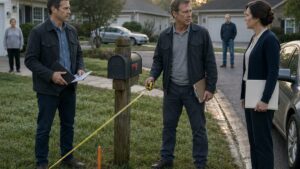
Eric watched him for a moment, then turned toward the weeds bordering the driveway. “You said there should be a survey marker?”
“North corner,” Samuel said. “Nine inches inside the hedge line. Iron pin with a flattened cap.”
Amanda’s expression changed slightly. “How would he know that?”
Samuel stepped down from the van. He moved carefully, but not weakly. At the hedge, he used the heel of his boot to press aside dead vines, then pointed.
Eric crouched and scraped through the dirt with a gloved hand. Metal appeared beneath the roots. He cleared the stamped cap and compared its position with the parcel map on his phone.
“This driveway is separately recorded,” he said.
“Recorded to whom?” Amanda asked.
“The county system isn’t giving me a complete ownership history.”
“So he could still be trespassing.”
“He could,” Eric said. “And you could be interfering with land you don’t own. Until someone brings me better documentation, nobody is being removed.”
A second vehicle slowed beside Amanda’s SUV. A couple stepped out, both dressed too carefully for a casual neighborhood visit. Amanda’s face brightened, though the brightness did not reach her eyes.
“You’re early,” she called.
“We finished at the inspection,” the man said. His attention moved immediately to Samuel’s van. “Is this the access lane you mentioned?”
Amanda stepped toward them, blocking their view of Samuel. “It will be. The development company is cleaning up this parcel.”
Samuel looked at her.
The woman beside the buyer frowned. “You said the property would have secondary access before closing.”
“It will.”
“Is he with the company?”
Amanda lowered her voice, but Samuel heard every word. “He’s an unauthorized occupant. The police are being cautious.”
Eric stood. “Ma’am.”
Amanda’s smile stiffened.
The buyer glanced from the officer to the van and then down the cracked driveway. “Our attorney warned us not to close with an unresolved access issue.”
“It isn’t unresolved.”
“He’s sitting on it.”
Samuel lifted his coffee from the concrete. The cup had left a dark ring beside the crack.
The buyer checked his watch. “Forty-eight hours. If you can’t show clear access by then, we delay.”
Amanda followed the couple back to their vehicle, speaking quickly about property values, pending improvements, and temporary complications. They left without entering her house.
For several seconds, only the soft ticking of the SUV’s cooling engine filled the driveway.
Then Amanda turned on Samuel.
“You heard that.”
Samuel picked up his book.
“I have my savings tied up in that property.”
He sat in the van doorway again.
“My family has spent six months living around contractors. I have a buyer ready. And you appear here with this—this performance.”
Samuel opened the book to the folded corner he had marked.
Amanda took two steps closer. “What do you want?”
He looked past her toward the houses.
Their roofs followed the slope Catherine had drawn across a kitchen table more than thirty years earlier. She had wanted the road to bend rather than cut straight through the trees. She had argued for smaller lots near the creek and wider sidewalks where children could ride bicycles. The company had changed much since then. Samuel had made sure of that by staying away.
“I want you off this driveway,” Amanda said.
“No.”
“You could at least explain yourself.”
Samuel’s gaze returned to the page.
Amanda’s mouth tightened. “Fine. I’ll get the explanation without you.”
She entered her SUV and reversed hard enough to throw gravel against the weeds. Eric remained behind.
“You’re making this harder than it has to be,” he told Samuel.
“Maybe.”
“She’s wrong to push. But if you have documents, now would be a good time.”
Samuel touched the brass key in his pocket. “Not yet.”
Eric studied him with the wary patience of a man deciding whether silence meant control or confusion.
“Not yet can become too late,” he said.
By late afternoon, the street had emptied. Samuel closed his book and walked the perimeter with a narrow wooden stake. Near the old porch line, he found a spot where weeds had been recently crushed.
A bright orange mark crossed the driveway.
Then another.
He followed them toward the street. They formed a broken path from a utility box, over the concrete, and into the foundation remains. Fresh paint clung to the grass blades.
Samuel crouched beside the nearest mark. The shape was standard: proposed service route.
At the far edge, half hidden beneath dirt, a small flag carried the name of the development company he had founded.
No one had called him.
No one had asked permission.
The orange line continued directly through the place where Catherine’s front steps had stood.
Chapter 2: The Lines Beneath the Weeds
The steel probe struck buried stone with a clean, unmistakable knock.
Samuel stopped pressing.
Morning light had barely reached the end of the street, but he had already cleared a narrow channel through the weeds beside the driveway. He drove the probe down again. The same sound returned—iron against the base of the old gatepost.
He set the tool aside and dug with a short hand trowel until the upper edge of the stone appeared. Moss clung to one side. A dark rectangular stain marked where the hinge plate had been fixed.
Behind him, a camera shutter clicked.
Amanda stood across the street in running clothes, holding her phone horizontally.
Samuel kept digging.
“You can’t excavate an abandoned lot,” she said.
He brushed dirt from the stone.
“I’m documenting this.”
“You’ve been documenting since yesterday.”
“Because the police apparently won’t.”
A second shutter sound came. Amanda aimed the phone at the van, the folding chair, and the narrow trench Samuel had opened.
“What exactly are you telling people?” he asked.
“That an unstable man is digging beside our homes.”
Samuel looked up.
Amanda hesitated under his gaze, then raised the phone again. “You threatened me yesterday.”
“I said no.”
“The way you said it was threatening.”
Samuel returned to the gatepost. Silence had once been useful. In the military recovery crews, it had kept frightened men from making bad situations worse. Later, in company meetings, it had forced people to fill empty space with what they actually believed. Since Catherine’s death, silence had become easier than choosing who deserved an explanation.
Amanda was filling it with whatever served her.
He worked the trowel beneath a thin piece of corroded metal. It resisted, then came loose with a clump of soil. Samuel rubbed it against his sleeve.
A rusted numeral appeared: 4.
The first digit from the old house number.
For a moment the development vanished. He saw the gate as it had been, white paint peeling at the bottom. Catherine stood inside it with rolled drawings under one arm, insisting they could build around the trees without turning every yard into a copy of the next.
“Is that stolen too?” Amanda asked.
Samuel closed his hand around the numeral.
She lowered the phone. “What?”
He rose and carried the piece to the van.
Inside, shelves lined one wall. Most held books, but the lower cabinet contained flat document cases, survey tubes, and ledgers with cloth-bound covers. Samuel placed the numeral beside the brass key, then opened a long gray case.
The original survey lay beneath a sheet of translucent drafting paper. Catherine’s lines were finer than his, her notes angled sharply across the margins. A curve marked the present road. Small circles showed trees she had refused to remove. At the bottom, in faded blue ink, she had written her full name.
Catherine Carter.
Samuel positioned the survey against the van’s small table. The crack in the driveway outside matched the penciled line of the original front steps. It had widened, but not shifted.
His phone rang.
The screen showed Mary Adams.
Samuel let it ring three times before answering.
“You found the markings,” Mary said.
“Who authorized them?”
A pause.
“Site assessment authorized them.”
“That isn’t a person.”
“The board is reviewing several access options.”
“On my parcel.”
“It’s part of a consolidation proposal.”
Samuel looked through the open van door. Amanda stood near a cluster of neighbors now, passing her phone from hand to hand.
“When is the vote?” he asked.
“Tomorrow afternoon.”
His grip tightened on the phone. “You waited until now.”
“I called you in March.”
“You left a message about quarterly records.”
“I left seven messages about governance.”
“Who requested the consolidation?”
Mary breathed out. “Samuel, come to the office.”
“Who?”
“I’m not doing this by phone.”
The line went dead.
Samuel stared at Catherine’s map. Beneath it sat unopened envelopes forwarded from the company office over the past year. He had skimmed financial summaries, signed only what required controlling approval, and sent every invitation to return unopened.
He had told himself the company no longer needed him.
Perhaps the company had listened.
Outside, one of the neighbors called, “Sir, are you planning to stay permanently?”
Amanda had posted her message.
By noon, people slowed as they passed. Some photographed the van. Others watched from porches. A neighborhood discussion appeared on Samuel’s phone after Eric forwarded him a screenshot.
UNIDENTIFIED MAN DIGGING ON VACANT PARCEL.
POSSIBLE ENCAMPMENT.
MAY BE CONFUSED OR AGGRESSIVE.
Amanda had written that Samuel possessed “old private documents of unknown origin” and had become hostile when asked to leave. She did not mention Eric’s survey pin. She did not mention the separate parcel. She did not mention the buyer.
Eric’s message beneath the screenshot contained only six words:
You should correct this before it spreads.
Samuel set the phone facedown.
He carried Catherine’s map outside and aligned it with the driveway. The old gatepost, the porch edge, and the deep crack formed a geometry more reliable than memory. Orange utility paint cut straight across it.
A shadow fell over the paper.
Amanda had approached without him noticing.
Her eyes dropped to the development seal printed in one corner.
“Where did you get that?”
Samuel folded the map closed.
“That belongs to the company.”
“It belongs here.”
“You broke into their records?”
“No.”
“You expect me to believe you just happen to have original plans for my neighborhood?”
He slid the map under his arm. “Your house is on page three.”
Amanda’s expression flickered. Curiosity, then suspicion.
“What does that mean?”
“It means you should read your deed before advertising access you don’t own.”
Her face colored. “My attorney reviewed everything.”
“Then ask him why your eastern boundary stops twelve feet short of this concrete.”
Amanda glanced toward her house. For the first time, the cracked driveway seemed to unsettle her not because it was ugly, but because it might be legally real.
“You’re trying to scare off my buyer.”
“I didn’t invite him here.”
“You knew exactly what to say.”
“I told the truth.”
“No. You hide behind half-sentences and old paper so everyone else has to guess.”
The accusation landed closer than she knew.
Samuel looked toward the van instead of answering.
Amanda gave a short, humorless laugh. “That’s what I thought.”
She walked away, already typing on her phone.
Near sunset, Samuel returned from the foundation with the probe over one shoulder. A white sheet of paper moved beneath the van’s windshield wiper.
He pulled it free.
NOTICE OF SITE PREPARATION.
The development company’s seal appeared at the top. Beneath it, a contractor was authorized to clear vegetation, locate buried utilities, and prepare the parcel for consolidation review.
Work could begin within forty-eight hours.
Samuel read the signature line twice. It belonged to an operations officer he had never met.
At the bottom, a handwritten addition had been made in black ink:
VEHICLE MUST BE REMOVED BEFORE ACCESS WORK.
Samuel looked from the notice to the orange lines, then toward the houses built from Catherine’s drawings.
The company he had founded had placed an eviction notice on his van.
Chapter 3: Amanda Walker Brings Her Own Daylight
The van’s engine turned over, but Samuel had nowhere to drive.
Amanda’s SUV sat sideways across the mouth of the driveway, close enough that its rear tire rested beyond the survey pin Eric had uncovered. Samuel pressed the horn once.
From her porch, Amanda raised one hand.
The SUV alarm chirped. She held up the key fob so he could see it.
Samuel shut off the engine.
It was late afternoon. The site-preparation notice lay folded on the passenger seat beside Catherine’s map. He had decided to take both to the company office before the next day’s vote. Amanda had decided otherwise.
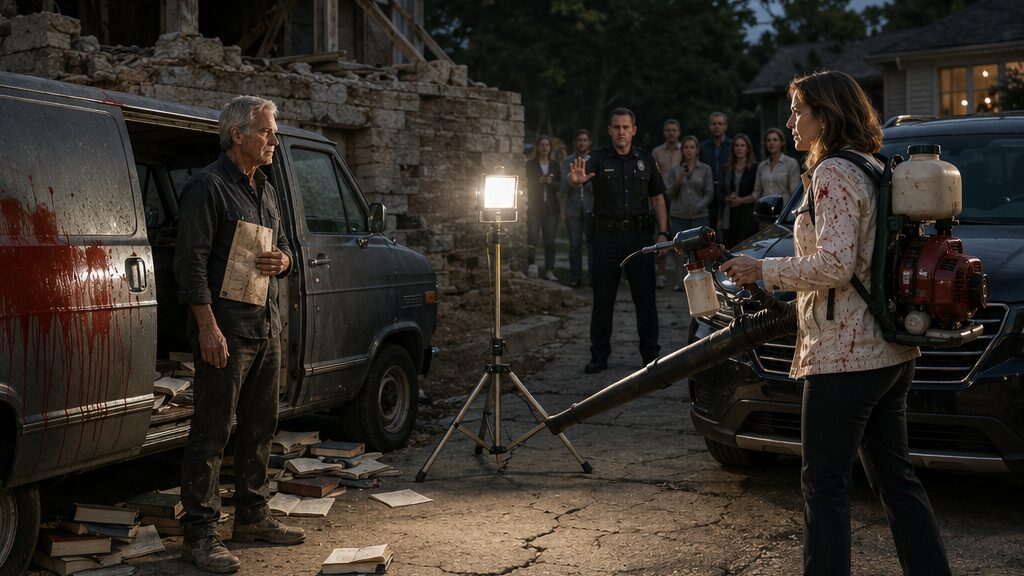
She crossed the street carrying a metal tripod over one shoulder. A commercial halogen fixture hung from its top, the thick glass lens protected by a wire cage. Behind her came a backpack leaf blower and two orange extension cords.
Samuel stepped from the van.
“You’re blocking a private parcel.”
“I’m blocking an unregistered vehicle from pulling into traffic while I clean up.”
“The van is registered.”
“The campsite isn’t.”
She set down the tripod and spread its weighted legs directly over one of the orange utility marks.
“You have until tonight,” she said. “My buyer’s attorney is checking the access records tomorrow.”
“There is no access.”
“There will be when the company clears this.”
Samuel held up the notice. “Did you request it?”
Amanda looked at the paper, then away. “I made calls.”
“To whom?”
“To people who answer.”
The words were aimed at him, but there was strain beneath them. Her phone rang. She rejected the call, then began uncoiling the extension cord.
Samuel glanced toward her house. Through an uncovered front window, he could see bare drywall and plastic sheeting. The property was not the polished success she presented from the street. It was an unfinished investment waiting for someone else’s money.
“You promised access you couldn’t convey,” he said.
Amanda’s hands stopped.
“My contract is none of your business.”
“You made it my business when you included my driveway.”
“I invested everything in that house.”
“That doesn’t move a boundary.”
“You think I don’t know that?” Her voice sharpened, then dropped. “I have forty-eight hours to show progress. If the closing stalls, the bridge loan resets. The carrying costs alone—”
She cut herself off.
Samuel saw the fear before pride covered it. It did not excuse the SUV. It explained why she had placed it there.
Amanda shoved her arms through the backpack blower straps. “This neighborhood has rules. People maintain things. They don’t sit in rusted vans waiting for property values to collapse.”
She pulled the starter cord.
The machine coughed, then roared.
Air struck the weeds in a violent wave. Dry stems flattened. Dirt lifted from the driveway and spun against the van’s open door. Samuel reached inside for Catherine’s map, but loose papers tore free from the table first.
The wind caught them.
Survey copies slapped against the van walls. Ledger pages whirled under the chassis. Samuel’s coffee tipped from the step, the cup rolling across the concrete as brown liquid vanished into the central crack.
“Amanda.”
She turned the nozzle toward the foundation.
Dust exploded from between the stones.
Samuel moved quickly, catching one ledger page against his leg. Another sheet skated toward the roadside drain. He recognized Catherine’s blue pencil marks and lunged after it.
The paper reached the muddy gutter.
He caught one corner beneath his boot.
Amanda released the blower trigger. The engine fell to an idle growl.
Samuel lifted the sheet carefully. Mud darkened the lower edge, but the neighborhood plan remained intact. Catherine’s original road curved outward from the old driveway like a branch. Lot lines spread from it. Amanda’s property sat near the third bend, outlined in blue with a small note beside the rear boundary.
Preserve pedestrian sightline to original entrance.
Amanda stepped closer. “That’s my lot.”
Samuel held the page away from her.
“I saw it.”
The halogen light flickered on.
White glare flooded the driveway. The shadows vanished beneath the van, and every crack in the concrete sharpened into a black fracture. Amanda adjusted the lamp until it shone directly into the open side door.
“That seal,” she said. “Those are company documents.”
“Original planning documents.”
“They aren’t yours.”
Samuel looked at her.
“Someone at the company told me the historical files were restricted,” she continued. “You’re using stolen records to interfere with a legal sale.”
“The person who told you that didn’t know what you had seen.”
“I know confidential material when I see it.”
“You saw a drawing.”
“I saw my property outlined on a document you shouldn’t possess.”
Samuel wiped mud from the edge of Catherine’s map with his sleeve. The paper had survived decades in controlled storage, only to be dragged through runoff because he had refused to take a phone call soon enough.
Amanda mistook his silence for uncertainty.
“I’m calling the company again,” she said. “And this time I’ll tell them exactly what you have.”
“You should.”
That answer unsettled her.
She removed the blower, left it running on the concrete, and strode back toward the SUV. For a moment Samuel thought she might finally move it.
Instead, she opened the rear hatch.
Inside were paint trays, cleaning supplies, and tools from the renovation. Amanda pulled out a plastic bucket with a discount label still stuck to the side. Then she lifted a compact powered paint sprayer by its handle.
The blower growled behind her. The halogen threw her shadow across the van.
Amanda set the paint bucket beneath the light and snapped open the lid.
Bright red paint shone inside.
Samuel folded Catherine’s map along its original creases.
Amanda connected the sprayer hose, raised the nozzle toward the weathered side panel, and said, “Maybe once everyone can see what you are, someone will finally make you leave.”
Chapter 4: The First Red Letters on Metal
The first burst of red paint struck the van before Samuel finished saying, “That surface belongs to me.”
A wet diagonal line spread across the weathered gray panel.
Amanda kept the sprayer raised.
The motor buzzed in her hand. Under the halogen light, the paint looked almost black at its center and bright at the edges where it began to run.
Samuel placed Catherine’s folded map inside the van.
“Amanda,” he said, “you are standing on private property. Your vehicle is blocking lawful access. You have damaged my records. Put the sprayer down.”
She glanced toward the houses. Curtains shifted. Several phones were visible behind windows and porch rails.
“Now you admit it,” she said loudly. “You’ve claimed the lot.”
“I said it was private.”
“You said everything except who you are.”
“That does not give you permission.”
Amanda squeezed the trigger again.
The next stroke formed the upright line of a letter.
Samuel watched the paint strike metal. He had bought the van twenty-two years earlier, when Catherine’s treatments made long flights difficult. They had driven it through small towns where no one knew the development company, no one asked him about quarterly returns, and Catherine could sit beside an open door with her shoes off and sketch whatever remained beyond the road.
The van was not valuable in the way Amanda understood value.
That made the damage worse.
She painted a broad G, then an E.
“Stop,” Samuel said.
“You stop.”
“Once more. Put it down.”
Amanda’s face was pale beneath the hard light. “The company is coming tomorrow. My buyer is coming tomorrow. This gets resolved tonight.”
She painted the T.
Red droplets floated on the air and settled on the concrete. They gathered in the driveway crack, turning its lowest channel into a thin, crooked line.
The leaf blower idled near Amanda’s feet. Its engine coughed and surged. The halogen hummed above both of them.
Samuel stepped forward.
Amanda jerked the nozzle toward him.
“Stay back.”
He stopped beyond the reach of the paint mist. “You have been told.”
“I have been ignored.”
“You were answered. You did not like the answer.”
“Because it makes no sense.” Her voice broke at the edge, then hardened. “A man sleeps in a van on a ruined lot, refuses to identify himself, carries company files, and threatens a sale. You expect everyone to pretend that is normal?”
“No.”
“Then explain it.”
Samuel looked at the red letters drying on the van.
He could have given her his name in a form she understood. He could have called Mary, summoned company counsel, or shown Amanda the controlling certificate locked inside the ledger case. He could have ended the argument before the first photograph.
Instead, he had protected Catherine’s memory by leaving it defenseless.
Amanda turned back to the panel and sprayed the first letter of OUT.
A patrol car’s siren sounded once at the mouth of the street.
Blue light washed across the houses.
Amanda released the trigger.
Eric Harris stepped from the cruiser and took in the scene: the SUV blocking the driveway, the powered sprayer, the red letters, the blower, Samuel beside the open van, and the halogen light aimed across them all.
“Put the equipment down,” Eric ordered.
Amanda lowered the sprayer but did not release it. “He came at me.”
“I saw him standing still when I arrived.”
“He advanced before that.”
Eric moved between them. “Mr. Carter, step back toward your vehicle.”
Samuel obeyed.
“Amanda, shut the sprayer off.”
“He has stolen documents.”
“Turn it off.”
She thumbed the switch. The buzzing stopped.
The silence felt temporary because the leaf blower still rumbled on the concrete.
Eric looked at the van’s side. The visible message read GET OU, the last letter unfinished.
“You did this?”
“I marked an abandoned vehicle on a nuisance property.”
“That is not an answer.”
“He refused to leave.”
Eric pointed toward the SUV. “Your rear tire is past the survey marker. The county parcel layer now shows this driveway as a separate recorded tract. You have been warned not to interfere until ownership is established.”
“My attorney said the development company controls it.”
“Your attorney is not here.”
“The company posted a notice.”
“On land it has not yet shown it owns.”
Amanda laughed once, sharply. “So he can block a sale, dig up the property, threaten people, and we all wait because he knows where an old pin is?”
Eric looked at Samuel. “Do you have the deed?”
“Yes.”
Amanda’s head snapped toward him.
Eric held Samuel’s gaze. “With you?”
“In the van.”
“Then get it.”
Samuel did not move.
The deed was beneath the ledgers, beside the corporate records and Catherine’s unsigned preservation instruction. Producing one would lead to the others. The private line he had defended for years would vanish.
Eric’s voice lowered. “This is the point where silence stops helping you.”
Samuel felt the brass key against his thigh.
Amanda saw his hesitation and lifted the sprayer again. “There. He doesn’t have anything.”
“Keep that down,” Eric said.
“He’s lying.”
“Amanda.”
“He has been manipulating all of you.”
The blower’s engine sputtered, then steadied. Amanda let the sprayer hang at her side and bent toward the machine.
Eric took a step after her. “Do not restart anything.”
“It is already running.”
She seized the blower tube and pulled the machine upright by its shoulder straps.
“Amanda, put it down.”
Instead, she slid one arm through a strap.
Samuel watched Eric’s posture change. The officer was trying to control too many hazards at once: the blocked vehicle, electrical cables, paint, fuel, the blower, Samuel’s refusal to produce proof, and the crowd growing along the street.
“Back away from him,” Eric ordered.
Amanda put on the second strap.
The blower rose against her back with a mechanical whine.
“He needs to leave,” she said.
Eric reached for the kill switch, but Amanda twisted away and pulled the throttle.
The blast struck Samuel’s chest.
His shirt snapped against his body. Dust and loose paper exploded from the van. The halogen light filled his eyes, flattening Amanda and Eric into dark shapes behind a white glare.
Samuel planted his boots.
The air pressure brought back another kind of noise: rotor wash over broken ground, a recovery cable thrashing loose, men shouting where words disappeared beneath machinery. In those moments, hesitation had injured people. You identified the danger, removed it, and accepted the cost afterward.
Amanda aimed the tube higher.
The blast caught Samuel’s face.
Eric shouted, but the words vanished.
Samuel stepped into the air current.
Amanda retreated half a pace.
He moved toward the light, not toward her.
The tripod’s nearest leg was weighted with a sand-filled block. Samuel drove the side of his steel-toed boot into the joint above it.
Metal snapped sideways.
The halogen fixture tipped.
Its glare swept across Amanda’s face, the van, the red paint, and the cracked driveway before striking the concrete with a heavy clang.
The lens remained intact inside its bent wire cage.
The blower fell silent as Amanda released the throttle.
Samuel stood over the fallen light.
Eric’s hand was raised, warning him to stop.
Amanda stared at the tripod, then at the phones pointed from the street.
“He attacked me,” she said breathlessly.
Samuel lifted his boot above the thick glass lens.
Chapter 5: Not This Ground, Not Again
Samuel’s boot came down through the halogen lens.
The glass failed with a deep, explosive crack. The wire cage buckled under his heel. White fragments jumped across the concrete and settled inside the driveway’s dark seams.
The blower died in Amanda’s hands.
For one suspended second, no one moved.
Then Amanda screamed, “Arrest him.”
Eric caught her arm as she lunged toward Samuel.
“Stay back.”
“He destroyed my property!”
Samuel withdrew his boot from the broken fixture. A shard clung to the sole before falling near the old gate line.
“Not this ground,” he said.
His voice was quiet, but Amanda heard it. So did the neighbors along the curb.
She pointed at him with a trembling hand. “You all saw that. He threatened me and smashed my equipment.”
Eric positioned himself between them. “Take off the blower.”
“I want him arrested.”
“Take it off.”
Amanda unfastened the straps. The machine dropped harder than necessary onto the concrete.
Eric looked at Samuel. “Hands where I can see them.”
Samuel raised both hands.
“Did you deliberately break that light?”
“Yes.”
Amanda seized on the answer. “There. He admitted it.”
Eric did not look away from Samuel. “Did you touch her?”
“No.”
“Did you threaten physical harm?”
“No.”
“He charged me,” Amanda said.
“I crossed the driveway.”
“He was coming at me.”
“I went toward the light.”
“You expect anyone to believe that distinction?”
Eric pointed to the roadside. “Amanda, move off the parcel.”
“This is not his parcel.”
“Move now.”
Her mouth opened, but Eric’s expression stopped her. She stepped backward over the survey pin, leaving the blower and sprayer where they lay.
Samuel lowered his hands only when Eric told him to. Then he crouched.
“Do not touch the glass yet,” Eric said.
“The foundation stone is beneath it.”
Eric followed Samuel’s gaze. Several pieces had scattered into a shallow depression beside the crack. Samuel used the edge of his boot to keep a neighbor from stepping closer.
“That stone stays clear,” he said.
Amanda stood at the roadside with her phone already pressed to her ear.
“James,” she said when the call connected. “I need you on speaker. Now.”
Eric took photographs of the scene: paint on the van, documents in the weeds, the blocked driveway, broken halogen, equipment positions, and Samuel’s boot prints.
Amanda activated the speaker.
A man’s voice came through. “What happened?”
“The squatter attacked me and destroyed my light.”
“Are police there?”
“Yes, and they’re refusing to arrest him.”
Eric glanced over. “That is not an accurate statement.”
James’s tone changed. “Who is speaking?”
“Officer Eric Harris. We are still investigating.”
Amanda cut in. “He needs an emergency eviction order. Tonight.”
“Eviction from what address?”
“The abandoned parcel beside my property.”
“It has a parcel number?”
Amanda gave him the number from the site notice.
Samuel recognized it before she finished.
James was silent for several seconds. Faint keyboard sounds came through the phone.
“This is an unusual record,” he said.
“Because he’s manipulating it.”
“I did not say that.”
Samuel went to the van.
Eric moved with him. “I need to see the deed.”
Samuel opened the lower cabinet. The paint smell had entered the interior, sharp enough to sting his throat. Catherine’s map lay protected on the table, but three ledger pages had torn along their punched edges.
He removed a heavy document envelope.
Beneath it rested the corporate certificate.
He left that behind.
Outside, he handed Eric his identification and the deed.
Eric compared the name, legal description, and parcel number. Then he entered information into the terminal in his cruiser.
Amanda kept speaking to James. “The development company posted clearance notice. That proves they control it.”
“It proves they believe they have authority to prepare it.”
“They own the neighborhood.”
“Neighborhood ownership is not a legal category.”
Samuel heard Amanda breathing through her nose.
Eric returned carrying the deed. “The county record matches Mr. Carter’s identification and legal description.”
Amanda stared at him. “No.”
“The driveway is recorded to Samuel Carter.”
“That could be an old deed.”
“It remains active.”
“What about access?”
Eric tapped one line. “Your adjoining parcel has no easement over this tract.”
Amanda’s face seemed to empty.
Samuel took the deed back.
The small payoff brought no relief. The red letters remained on the van. Catherine’s drawings lay scattered because he had waited for violence before using information that could have stopped it.
Eric turned toward Amanda. “You are formally ordered off this parcel. Your SUV is obstructing the owner’s exit. You need to move it.”
She did not move.
“James,” she said, “tell him the company can take control.”
The lawyer’s reply came slowly. “I’m reviewing that.”
“File the injunction.”
“An emergency injunction may be possible if we can establish contractual reliance, company authority, or disputed possession.”
Amanda looked at Samuel with renewed defiance. “You hear that?”
Samuel slid the deed into its envelope.
James continued, “I need the occupant’s full legal name.”
Eric said, “Samuel Carter.”
The keyboard sounds stopped.
James asked, “Middle initial?”
Samuel provided it.
Another pause followed.
Amanda looked from the phone to Samuel. “Well?”
James said, “Mr. Carter, are you claiming affiliation with Carter Development?”
Samuel did not answer.
Amanda gave a bitter laugh. “He has their private records. That’s the affiliation.”
James said, “Mr. Carter?”
Samuel looked toward the painted van, then at the paper notice bearing the company seal.
He had not wanted Catherine’s driveway reduced to a contest over who possessed more money. Amanda had forced that language onto the ground, but he had helped by refusing every other language available.
“Account seven-four-one-nine,” Samuel said. “Original principal six hundred eighty thousand. Adjustable bridge conversion attached to the Walker property renovation. Loan held through Carter Residential Finance.”
Amanda’s phone lowered by an inch.
James said nothing.
Samuel continued, “The access contingency is not recorded against parcel forty-two. It is a private representation in the buyer agreement.”
Amanda’s eyes widened. “How do you know my account number?”
Samuel looked at her. “Because I read the portfolio before I stopped attending meetings.”
“You stole my mortgage file.”
“No.”
James returned to the line. “Amanda, stop speaking for a moment.”
“What are you doing?”
“Verifying.”
“You are my lawyer.”
“Which is why you need to stop.”
Eric folded his arms. “Move the SUV while he checks.”
Amanda ignored him. “The company’s true owner will support the development plan. They are not going to side with a man living in a van.”
Samuel felt the old instinct to let her keep talking until the truth exhausted her. It had once been a useful method. Now it felt like cowardice disguised as patience.
He returned to the van and took out the corporate certificate.
The paper was thick, embossed, and older than Amanda’s house. He handed it to Eric, not to her.
Eric read the first page. His eyebrows lifted, but his voice remained neutral. “This shows controlling interest.”
“Controlling interest in what?” Amanda demanded.
“Carter Development and its financing subsidiaries.”
She shook her head. “That’s impossible.”
“No,” Samuel said. “It is neglected.”
The distinction mattered to him, though perhaps to no one else.
James came back on speakerphone. His tone had lost its earlier impatience.
“Amanda, I have the ownership filings.”
“Then tell them.”
“I am trying to.”
“Tell them he can’t interfere with the company.”
James took a breath.
“Amanda, Samuel Carter is the controlling owner of your mortgage holder.”
Chapter 6: The Company That Forgot Its Beginning
Samuel entered the conference room carrying a paint-stained fragment of Catherine’s map.
No one offered him the chair at the head of the table.
That was appropriate. He had not sat in it for six years.
A digital site plan filled the wall screen. The cracked driveway appeared as a clean gray access lane connecting Amanda’s renovated property to the main road. The old foundation stones were gone from the rendering. So were the trees Catherine had drawn around.
Samuel crossed the room and laid her damaged map over the printed copy of the proposal.
Her blue road curved beneath the red paint stain.
Mary Adams stood beside a cabinet with three binders in her arms. Her hair had gone almost entirely silver since Samuel had last seen her in person. She looked at the map, then at him.
“You finally came,” she said.
Samuel removed his coat. “Who requested the consolidation?”
“The property strategy committee.”
“Names.”
“They’re in the minutes you didn’t read.”
The words landed without raised volume. That made them harder to dismiss.
Two board representatives sat at the far end of the table, both role-bound and uneasy. James Brown occupied a chair near the door, a slim file open before him. He was there for Amanda’s damages position, not the company, but every fact crossed both matters now.
Mary placed the binders on the table.
“The proposal began as a utility correction,” she said. “Amanda Walker’s buyer wanted secondary access. Operations saw an opportunity to combine an orphan parcel with the company’s service corridor.”
“Orphan.”
“That is the internal classification.”
“It has an owner.”
“One who has declined board meetings, returned governance packets unopened, and delegated routine approvals without reviewing attached land schedules.”
Samuel looked at the digital plan. “My silence was not consent.”
“No. But it became convenient to treat it that way.”
One of the representatives shifted. “The legal team believed the company possessed a reversion option.”
“Believed?”
“The demolition agreement referenced future infrastructure use.”
Samuel turned to Mary. “Catherine excluded the driveway.”
“She wrote that she wanted it excluded.”
“She designed the agreement.”
“She did not record a preservation covenant.”
Samuel’s gaze dropped to the map between them.
Mary opened the first binder and removed a handwritten page protected by clear film. Catherine’s notes ran along both margins. Samuel recognized the pressure marks of her pencil.
Preserve original entrance. No widening through porch line.
Mary tapped a blank area below the instruction.
“She drafted it. You were supposed to execute it after the final survey.”
Samuel said nothing.
“You postponed the survey because she was ill,” Mary continued. “Then after she died, every time legal raised the issue, you said not to disturb the parcel.”
“That was an instruction.”
“It was not a covenant.”
The room held still around him.
For years, Samuel had treated the driveway’s survival as proof that his promise had been kept. In truth, it had survived because no one had needed it badly enough to challenge his absence.
Until Amanda.
He looked at the red stain on Catherine’s map. “The vote?”
“Scheduled for two this afternoon.”
Samuel checked the wall clock. Eleven minutes remained.
“Cancel it.”
One representative cleared his throat. “There are notice requirements.”
“Then record my controlling objection and suspend the action pending title review.”
Mary watched him carefully. “Are you returning to active governance?”
“I am stopping this vote.”
“That was not my question.”
Samuel met her eyes.
She had worked beside Catherine for twenty years. She had also allowed the proposal to move within hours of execution before calling him directly. Neither of them was innocent of delay.
“Stop the vote,” he repeated.
Mary picked up the conference phone and gave the instruction. Within two minutes, confirmations arrived from legal and operations.
A small line of text disappeared from the screen:
APPROVAL PENDING.
Samuel felt no triumph. The driveway remained only one ignored attachment away from erasure unless he did what Catherine had expected him to do years earlier.
James closed one section of his file. “That settles the immediate land issue. It does not settle yesterday.”
Samuel looked toward him.
“My client caused extensive damage,” James said. “That is clear. It is also clear that you intentionally destroyed her commercial light after police were pr
Chapter 7: What Ownership Does Not Permit
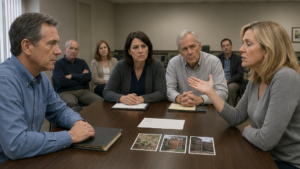
Amanda arrived at the settlement table carrying a written plea asking Samuel not to take her house.
She kept the page facedown beneath both hands, but its first line showed through the thin paper where she had pressed too hard with the pen.
Mr. Carter, I am requesting mercy—
Samuel sat opposite her in the development company’s smaller conference room. Mary Adams occupied one end of the table. James Brown sat beside Amanda with three organized files and none of the confidence he had carried on the speakerphone that night.
No one had invited reporters. No neighbors waited outside. Samuel had refused both suggestions.
Amanda looked thinner than she had beneath the halogen glare. Her expensive jacket was gone, replaced by a plain gray sweater. A patch of red paint remained beneath one thumbnail.
James opened the meeting.
“The parties have agreed that today’s discussion concerns restitution, property damage, access obstruction, and resolution of the disputed claims arising from the incident.”
“Not the mortgage?” Amanda asked.
James turned toward her. “We discussed this.”
“I need him to say it.”
Samuel looked at the page beneath her hands. “Your mortgage will remain under its original terms.”
Amanda did not seem to understand.
“I will not accelerate it,” he continued. “I will not cancel the loan. I will not use the company’s ownership of the debt to take your home.”
Her shoulders dropped, but only for a moment.
Samuel slid a separate document across the table.
“This is what you owe.”
Amanda read the total.
Her mouth opened without sound.
James moved the paper closer and pointed to the breakdown. “Van restoration. Specialist cleaning of the damaged planning documents. Environmental removal of paint from the parcel. Towing and obstruction costs. Legal fees. Replacement of the records that can be reproduced.”
“And the historical damage?” Amanda asked.
“Limited to verified restoration costs,” Samuel said. “Not punishment.”
She looked up. “This is almost everything I made from the sale.”
“The sale closed,” Mary said.
“After the access promise was removed and the price dropped.”
James spoke quietly. “The settlement remains below the estimated exposure if the matter proceeds to judgment.”
Amanda turned on him. “You said the light would offset it.”
“The replacement value of the light has been credited.”
Samuel had paid that amount directly. He had also signed a statement acknowledging that he had deliberately destroyed it after the blower stopped.
Amanda stared at the figures again. “So he gets to crush my equipment, and I lose my savings.”
“No,” Samuel said. “You receive payment for the equipment I broke. You pay for the property you damaged.”
“I was trying to protect my investment.”
“You were told the land was not yours.”
“I thought you were lying.”
“That did not make the paint yours to use.”
Her eyes hardened, and for a second Samuel saw the woman who had stood under the glaring lamp with the sprayer raised. Then the anger folded inward.
“You never told me who you were.”
“No.”
“If you had, none of this would have happened.”
Samuel let the accusation remain between them.
Mary shifted slightly but did not intervene.
Amanda leaned forward. “You watched everyone think you were homeless. You knew the police were uncertain. You knew my closing was in danger. You could have ended it with one piece of paper.”
“Yes.”
The answer disarmed her more than denial would have.
Samuel placed Catherine’s repaired map on the table. A conservator had flattened the muddy corner and stabilized the red-stained edge, but the damage remained visible.
“I believed silence kept this separate from the company,” he said. “Separate from money. Separate from people who would turn it into a story about ownership.”
Amanda glanced at the map.
“It also allowed other people to decide what the silence meant,” Samuel continued. “You decided it meant weakness. The company decided it meant consent. I allowed both decisions to stand too long.”
Mary’s gaze rested on him, steady and unsparing.
Amanda touched the first page of her plea. “Does admitting that reduce what I owe?”
“No.”
A strained laugh escaped her.
Samuel did not soften the answer. “My failure does not erase your warning. Officer Harris told you to stop. I told you the vehicle and land were private. You continued.”
James opened another file. “There is also the matter of the recording.”
Amanda went still.
He placed a transcript on the table. A neighbor’s phone had captured her conversation with James before the paint sprayer came out. In it, Amanda acknowledged that police had refused removal and that title was unresolved. She had not disclosed either fact when asking James about emergency eviction.
“You told me the police confirmed he was unauthorized,” James said.
“I said they wouldn’t act.”
“You said they had ‘basically confirmed’ it.”
“I was under pressure.”
“So was everyone else at that driveway,” Mary said.
Amanda looked around the table and seemed to realize that no argument remained capable of returning her to the person she had been before the red letters.
She signed the restitution agreement.
Her hand shook only once.
Afterward, Mary presented the company’s preservation proposal. The parcel would be protected from consolidation, widening, utility installation, or future access claims. The original foundation outline and cracked driveway would remain undisturbed except for safety work approved under the covenant.
“There is one naming issue,” Mary said.
Samuel looked up.
“The board proposes Carter Heritage Entrance.”
“No.”
Mary had expected the answer. “Catherine Carter Memorial Parcel?”
“No.”
Amanda watched them, confused.
Samuel placed two fingers on the repaired map. “Use the designation Catherine wrote.”
Mary found the note near the lower margin.
“Original Entrance,” she read.
“That is enough.”
The name identified the place without turning it into a monument to wealth or loss. It said what the driveway had been and what it still was.
Mary nodded. “Original Entrance Historical Parcel.”
Samuel signed the covenant.
His controlling signature was not enough by itself. This time legal counsel recorded the restriction, the board entered it into the development plan, and Mary scheduled annual compliance review. Samuel accepted a seat on that review committee.
Not the head chair.
A seat.
Several weeks later, a tow operator arrived at Amanda’s house.
Her SUV had remained parked there after the sale because she could no longer justify the second payment attached to it. Samuel watched from the cracked driveway as the vehicle rolled onto the carrier. Amanda stood near her porch, arms folded against the morning chill.
She looked toward him once.
Samuel inclined his head.
She did not return the gesture, but neither did she look away.
Two repair workers cleaned the final red shadows from the van’s metal panel. The words had disappeared, though under certain angles the newer finish caught the light differently. Samuel asked them to leave it that way.
At the driveway, specialists removed dried paint without filling the cracks. Orange utility marks were gone. The old gatepost base remained exposed within a low protective border. Beside it stood a small plaque bearing only a parcel number, the original house date, and Catherine’s designation.
No account of Amanda.
No account of Samuel’s company.
No claim that the place had survived because one powerful man had saved it.
Samuel opened the van door and set a framed photograph on the bumper. Catherine stood beside the old gate, drawings tucked beneath one arm, laughing at something outside the frame.
He made coffee inside the van.
When he returned, he did not place the cup in the doorway where it could be hidden from the street. He set it on the bumper beside the photograph, then lowered himself into the folding chair on the open driveway.
The central crack ran beneath his boots toward the buried front steps.
For years, he had treated it as a private line connecting him to what was gone. Now it crossed protected ground, visible to anyone who cared enough to look.
Samuel lifted the fresh coffee.
The street moved quietly around him. A delivery driver slowed to read the plaque. A child on a bicycle followed the curve Catherine had drawn decades earlier. No one applauded. No one needed to.
The driveway remained cracked.
It was no longer mistaken for empty.
The story has ended.