The Bank Came for Virginia Walker’s House and Found a Dead Man Inside Her Name
Chapter 1: The Crowbar Entered Before the Truth Could Speak
The first strike of the crowbar made three family photographs jump against the living-room wall.
Virginia Walker looked up from the eviction order in her hands. One frame settled crooked. Another tapped twice against the plaster before going still.
The man holding the crowbar did not apologize.
He stood just inside her front door in a gray contractor’s jacket, one polished shoe planted on the threshold as though the house had already begun belonging to him.
“Mr. Clark,” Virginia said, “you will take that tool outside.”
Richard Clark slid the curved end of the bar from beside the old brass door plate. “The lock resisted.”
“The door was unlocked.”
“It wasn’t open.”
Virginia lowered her eyes to the papers again. Her reading glasses rested low on her nose. The first page carried a court seal, her address, and language that seemed to have been written for the purpose of making a human being feel small.
WRIT OF POSSESSION.
DEFAULTED SECURED LOAN.
AUTHORIZED REMOVAL.
The words were clear. The facts were not.
Behind Richard waited two crew members in canvas gloves. A portable work-light stood folded near the porch rail. A large plastic sign leaned against the steps, its red letters visible through the open doorway.
FOR SALE — BANK OWNED.
A uniformed police officer stood slightly apart from them.
Virginia knew her.
“Sarah,” she said.
Officer Sarah Martinez did not meet her eyes immediately. She was studying the order in Richard’s duplicate packet.
“Mrs. Walker,” Sarah said, “I need you to keep your hands visible and let us sort through this calmly.”
“My hands are holding a lie.”
Richard exhaled through his nose. “We’ve been through this at thousands of properties.”
“You have never been through this property.”
“The bank obtained judgment. The court issued possession. My job is execution, not debate.”
Virginia turned the second page. The amount made her stop.
Three hundred eighteen thousand, four hundred and twelve dollars.
She read it again.
“This house did not cost half that when my husband and I bought it.”
“Loans accrue,” Richard said.
“I never took this loan.”
He stepped closer and tapped a line with one blunt fingernail. “That is your address.”
“Yes.”
“That is your Social Security number ending in forty-six.”
Virginia’s fingers tightened on the paper.
Sarah noticed. “Is it correct?”
“The last four digits are.”
Richard’s expression sharpened with satisfaction. “And there is your signature.”
The signature tilted slightly right. The V began with the same narrow hook Virginia had used for more than fifty years. The W in Walker rose above the other letters.
It looked enough like hers to disturb her.
It was not hers.
Richard mistook her silence for surrender.
“We need you to collect medication, identification, and essential clothing. Everything else will be inventoried.”
Virginia raised her head. “You will inventory nothing.”
One crew member shifted his weight. The other looked toward Sarah.
Richard gathered the papers from her hands without asking. “Mrs. Walker, refusing to cooperate does not invalidate the order.”
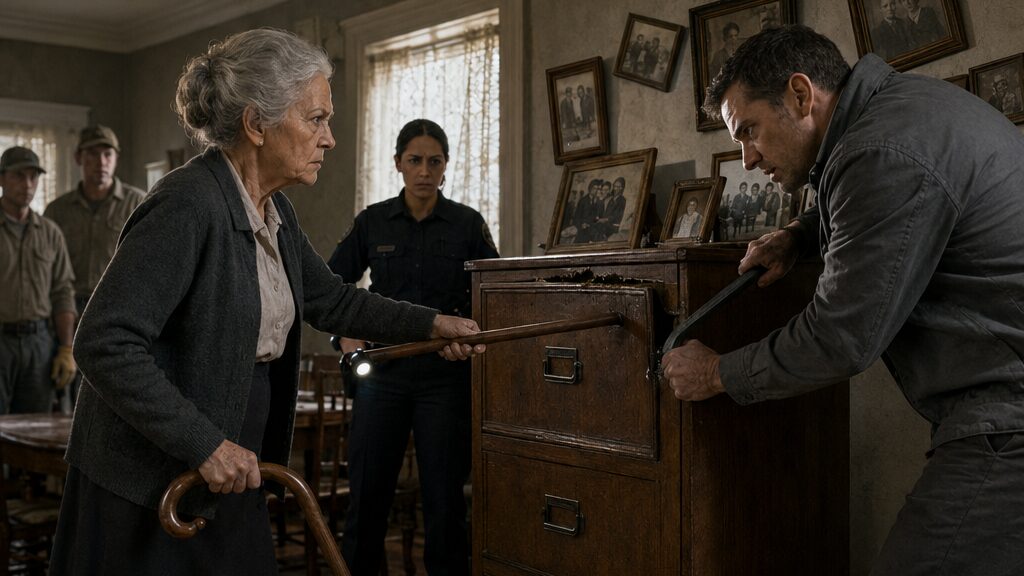
Virginia planted the rubber tip of her oak cane against the floor and rose from the armchair. She was slow only during the first inch. Once upright, she stood squarely between Richard and the center of the room.
Behind her, family photographs covered the wall in ordered rows. Birthdays. Graduations. Her wedding. Her husband in shirtsleeves beside a stack of mortgage papers, holding a metal wastebasket in which a single sheet burned.
Virginia crossed to that picture.
She lifted it carefully from its hook and handed it to Sarah.
“June nineteenth, nineteen ninety-eight,” she said. “The day the final payment cleared. We burned a copy of the payment book in the yard and kept the original release.”
Sarah studied the photograph. Virginia’s husband was laughing, his face turned from the smoke. A younger Virginia stood beside him holding a garden hose.
Richard glanced at it. “A photograph is not a title search.”
“No,” Virginia said. “It is proof that I know the history of my own house.”
“It proves you had a barbecue.”
Virginia took the frame back before his hand could touch it.
Sarah’s mouth tightened. She examined the court seal again, then the county parcel description, then the certification page.
“I can call this in,” she said. “But on its face, the order is valid.”
“On its face,” Virginia repeated.
“It means I don’t see an obvious defect that allows me to cancel enforcement here.”
“You have seen the debt.”
“Yes.”
“You have heard me say it is not mine.”
“I have.”
“And that changes nothing?”
Sarah lowered her voice. “Your statement matters. It does not give me authority to void a judge’s order at the doorway.”
Richard checked his watch. “Thank you.”
Virginia looked past him to the yard sign.
The metal stake was thick enough to hold through winter ground. Someone had placed a small rubber mallet beside it.
They had brought the declaration of her dispossession before they had even entered the house.
Richard turned to the crew. “Start with the front room. Photograph everything before removal. Large furniture first.”
“No,” Virginia said.
The nearer crew member hesitated.
Richard pointed toward the sofa. “Tag it.”
Virginia moved into his path.
“Mrs. Walker,” Sarah warned.
Virginia did not look away from Richard. “There is a filing cabinet beneath the photographs. The mortgage release is inside it.”
A dark wooden cabinet stood against the far wall. It was waist-high, built from oak, with two deep drawers and a smaller locked compartment at the top. Her husband had refinished it by hand. The brass keyhole was worn pale around the edges.
Richard glanced at it without interest.
“Then retrieve the document.”
“I will retrieve what is necessary when you stop treating my life like abandoned cargo.”
“We are past negotiation.”
“No. You arrived after a negotiation held without the correct debtor.”
Richard gave a thin smile. “Everyone says the paperwork is wrong once the truck arrives.”
“I am not everyone.”
“That is also something everyone says.”
He motioned again. The crew entered.
One carried rolls of numbered stickers and a camera. The other unfolded a dolly near the door. Their boots pressed dark marks into the polished floor Virginia had waxed two days before.
Sarah remained near the doorway, still holding her radio, her face careful and official.
Virginia returned the mortgage-burning photograph to its hook. She straightened it until its lower edge aligned with the frame beside it.
Richard noticed the precision.
“So you understand,” he said, “the sooner you cooperate, the less damage there will be.”
Virginia turned from the wall.
“The damage began when your bank put my number beneath another person’s debt.”
“It is not my bank.”
“You are carrying its crowbar.”
Richard’s jaw worked once. He stepped onto the porch and spoke quietly into his phone. Virginia could not hear every word, only fragments.
“Occupied resistance.”
“Valid order.”
“Still on schedule.”
When he came back, he did not look at her.
“Plant the sign,” he told one worker. “Then empty the living room first.”
Outside, the rubber mallet struck metal.
The first blow drove the bank’s claim into Virginia’s lawn.
Chapter 2: Every Photograph Became Something They Could Price
The numbered sticker landed across her husband’s face.
Virginia watched the worker press it flat against the glass of the framed portrait, smoothing one corner with a gloved thumb.
Item 014.
Her husband had been fifty-nine in that picture. He stood in the living room before the walls had been repainted, wearing the dark tie he disliked and trying not to smile.
Now a white rectangle covered his eyes and nose.
“Remove that,” Virginia said.
The worker looked over his shoulder at Richard.
Richard was at the dining-room archway, checking boxes on a tablet. “Photographs are personal effects. Tag, record, pack.”
“You can record the frame without covering the person.”
“The sticker is removable.”
“Then remove it.”
Richard kept typing. “We are not adjusting procedure around sentiment.”
Virginia crossed the room, cane striking the floor with measured taps.
Before she reached the portrait, the worker peeled the sticker away himself. He placed it on the back of the frame instead.
Richard looked up.
“I told you where to place inventory labels.”
“It’ll scan from the back,” the worker said.
For a moment, no one moved.
Then Richard turned back to the tablet. “Do not slow down again.”
The worker carried the portrait to a stack near the sofa. He set it upright rather than flat.
It was a small kindness. Virginia resented needing it.
Outside, another strike of the mallet rang through the open windows. The red bank-owned sign now stood at the edge of the lawn, tilted slightly toward the street.
Neighbors had begun gathering.
Some watched from porches. Others stood beside parked cars with their phones held low. A woman across the road had come out in gardening gloves. Two houses down, a man Virginia barely knew had stopped pushing a lawn mower.
William Adams came through the side gate without knocking.
He was carrying his phone in one hand.
“What’s happening?” he asked.
Richard moved to block him. “Private enforcement action. You need to remain off the property.”
William looked past him at Virginia. “You all right?”
“I am still in my house.”
“That wasn’t my question.”
“It is my answer.”
William had lived next door for nineteen years. He had fixed her porch rail once and complained for six months when she paid him. He was also the sort of man who believed every problem improved when someone younger took charge of it.
He raised his phone.
Richard pointed toward the sidewalk. “No recording inside.”
“I’m on the porch.”
“You’re interfering.”
“I’m documenting.”
Virginia saw the impatience in William’s face and knew some portion of it was directed at her. Three months earlier, he had offered to drive her to the bank over a packet of strange letters. She had refused.
He had called her stubborn.
She had called him nosy.
Neither description had been entirely wrong.
Sarah stepped between the men. “Mr. Adams, stay outside and do not obstruct the crew.”
William backed down one step but kept recording.
Inside, the workers began lifting smaller framed photographs from the wall. Each empty hook exposed a pale mark where sunlight had not reached the wallpaper.
Virginia followed them, straightening every frame before it went into a box.
Richard’s phone rang.
He answered near the front window, but the house was quiet enough that Virginia heard him.
“Yes, occupied.”
A pause.
“No, we’re moving.”
Another pause. He lowered his voice.
“I know what the cutoff is.”
Virginia watched his shoulders tighten.
“We clear before three, it counts. That was the agreement.”
He glanced toward her and turned farther away.
“No completion, no premium. I understand.”
When he ended the call, she said, “They pay you extra for speed.”
Richard slipped the phone into his pocket. “They pay for completed work.”
“They pay you to avoid questions.”
“They pay me because banks got tired of contractors being manipulated into wasting full days while occupants produced irrelevant papers.”
“Occupants.”
“That is your legal status today.”
“My legal status is owner.”
“Not according to the judgment.”
A worker lifted a wedding photograph from a side table. The frame caught against the lace runner beneath it, dragging a porcelain dish toward the edge.
Virginia reached out.
So did the worker.
The dish stopped, but the frame slipped.
It struck the floor on one corner.
The glass cracked diagonally across Virginia’s younger face.
Silence moved through the room.
The worker crouched. “I’m sorry.”
Richard said, “Photograph the damage and continue.”
Virginia bent slowly, refusing the worker’s hand. She picked up the frame herself. A narrow line split the wedding day in two, passing between her and her husband without touching either face.
She ran one finger over the broken glass.
“Put it on the mantel,” she said.
The worker obeyed.
Richard watched him do it. “That item has been tagged.”
“It has also been damaged under your supervision,” Virginia said. “It remains where I can see it.”
His expression said he intended to answer, but William called from the porch.
“Virginia.”
She turned.
He was holding an envelope pinched by one corner. It was dirty along the edge, as though it had lain beneath a hedge.
“Found this near your side steps.”
Richard moved toward him, but Sarah took the envelope first.
The return address belonged to the bank’s identity services department. Virginia’s street address appeared beneath a name she did not recognize aloud.
GARY SCOTT.
William looked at her. “That yours?”
“No.”
“Your address.”
“I can read.”
Sarah turned the envelope over. It had been opened carefully, then taped shut.
“When did you receive this?”
Virginia looked at the cracked wedding frame instead of Sarah.
“I do not remember.”
William gave a humorless breath. “You remember what day you paid off the house, but not when a dead stranger’s mail started coming here?”
Virginia’s gaze snapped to him.
Richard heard the word stranger and stepped closer. “You know the name?”
“I said the debt is not mine.”
“That isn’t what he asked.”
Sarah held the envelope out. “Mrs. Walker, please look at this.”
Virginia did not take it.
A worker crossed behind them carrying a carton of photographs. Richard ordered him to move faster.
The crew member stopped.
“Sir, there may be an identity issue.”
“There is an order.”
“The envelope has another name.”
“And her address. People receive mail for other people every day.”
William lowered his phone. “Not from a bank about a three-hundred-thousand-dollar debt.”
Richard pointed at the worker’s carton. “Keep moving.”
The man hesitated, then carried the box toward the door.
Virginia saw how it worked then. Not through one grand act of cruelty, but through a chain of people deciding the next person had already checked.
Sarah examined the envelope again.
“This should be included in any verification,” she said.
Richard’s voice hardened. “We already verified the order.”
“You verified that it exists. That isn’t the same as verifying this discrepancy.”
“We are not reopening adjudicated facts because a neighbor found old mail in a bush.”
Virginia held out her hand.
Sarah gave her the envelope.
The paper felt familiar.
Virginia had seen the name before. More than once.
She folded the envelope along its existing crease and slid it into the pocket of her dress.
Richard watched closely.
Then his attention shifted past her.
To the antique cabinet beneath the remaining photographs.
The upper compartment had a separate brass lock. The two lower drawers were closed flush. Virginia had positioned her chair near it from the moment the crew entered.
Richard walked toward it.
Virginia moved at the same time and placed her cane across the front.
He looked from the cane to her face.
“You have let them tag chairs, dishes, and photographs,” he said. “But not this.”
“It contains records.”
“Then open it.”
“No.”
“Why?”
“Because it is mine.”
Richard rested one hand on the cabinet’s top.
Virginia’s cane rose an inch.
He smiled without warmth.
“Why is the only thing you protect,” he asked, “the one thing you refuse to let anyone see?”
Chapter 3: The Clean Title Proved Less Than Virginia Expected
Sarah placed the clean title beside the eviction order, and both looked official enough to ruin Virginia.
The documents lay parallel on the dining table.
One declared that Virginia Walker owned the property free of liens as of the date it had been certified. The other declared that the same property had later secured a loan she had failed to repay.
Both carried seals.
Both carried recording numbers.
Both carried her correct address.
Richard stood at the end of the table with his arms folded.
“Now you understand,” he said.
Virginia remained beside the antique cabinet. She had unlocked only the left lower drawer, opening it no wider than the span of two fingers. From that narrow gap, she had removed a green folder labeled HOUSE—ORIGINALS in her late husband’s block handwriting.
She had not surrendered the key.
It rested in her palm, its teeth pressing into her skin.
“I understand that two pieces of paper disagree,” she said.
“No. They don’t.”
Sarah traced the dates with one finger. “The clean-title certification predates the lien by fourteen months.”
Virginia looked at her. “A lien for a loan I did not take.”
Sarah nodded. “That may be true. But the title doesn’t disprove a later filing.”
Virginia opened the green folder.
Inside were the mortgage release, county tax receipts, insurance declarations, and correspondence arranged by year. Every page sat in a clear sleeve. Her husband had typed labels on an old manual machine, and the letters struck the paper unevenly.
Richard leaned over the table.
“You have records through the payoff year. Nothing here addresses the later loan.”
“Because there was no later loan.”
“The county database says otherwise.”
“The county database did not sit at this table and sign anything.”
Sarah pulled a copy of the loan agreement from Richard’s packet. The signature appeared on the final page.
Virginia placed her mortgage release beside it.
The two signatures were similar.
Too similar.
Sarah bent closer.
“This curve on the W,” she said.
Virginia saw it.
The false signature was not merely an imitation. It matched the older one in tiny details—a shortened tail, a dark dot where her pen had paused, even the slight flattening of the final r.
“That was copied,” Virginia said.
Richard gave a dismissive shrug. “Or signed by the same person.”
Virginia took a magnifying glass from the cabinet drawer.
Richard’s eyebrows lifted.
“My husband filed records for thirty-seven years,” she said. “He taught me never to trust a resemblance when measurements are available.”
She laid the glass over the signatures. The ink differed, but the shape was exact. Not close. Exact.
Sarah took out her phone and photographed both.
Richard straightened. “What are you doing?”
“Documenting a potential discrepancy.”
“You are here to keep the peace.”
“I am keeping the peace.”
“By treating a debtor’s accusation like forensic evidence?”
Sarah looked up. “The same natural signature does not reproduce at identical scale and angle years apart.”
Virginia felt the first small opening in the wall that had been built around her that morning.
“Call the bank,” she said.
Richard checked his watch.
It was eleven forty-three.
“We already called.”
“You called about the order,” Sarah said. “Call about the identity record and signature.”
Richard’s mouth tightened. “Every delay pushes us past the completion window.”
“That is not my concern.”
“It becomes your concern when an authorized eviction turns into a crowd event.”
Outside, more neighbors had gathered along the sidewalk. William remained near the porch, recording through the open door. The bank-owned sign leaned farther now, its red plastic panel knocking softly against the metal stake whenever the breeze caught it.
Richard made the call.
He put it on speaker after Sarah insisted.
A bank dispatch representative asked for the case number, Virginia’s last four digits, and the property address. Keyboard clicks followed.
“Profile verified,” the voice said.
“Verified against what?” Sarah asked.
“Internal identity record and county lien.”
“There is a second name associated with correspondence sent to this address.”
A pause.
“What name?”
Virginia’s hand closed around the cabinet key.
Sarah looked at her.
Virginia said nothing.
William spoke from the doorway. “Gary Scott.”
The keyboard stopped.
Then resumed.
“The borrower profile may contain historical aliases,” the dispatcher said.
“I have never used an alias,” Virginia said.
“Ma’am, I’m not authorized to discuss protected account details over speakerphone.”
“You are authorized to remove my house over speakerphone.”
Richard rubbed his forehead. “Is the enforcement status active?”
“Yes,” the dispatcher said. “The account remains verified. Proceed according to the order.”
“There,” Richard said, ending the call. “We are done.”
Sarah did not move. “No. We have confirmed your system repeats the same information. We have not confirmed it is accurate.”
“My authority comes from the order, not your interpretation of a signature.”
Virginia looked down at the documents. Her original mortgage release had survived moves, storms, a roof leak, and her husband’s death. She had believed that preserving it meant preserving the truth.
But the bank had created a newer truth and filed it in more places.
Her paper had become older, quieter, easier to dismiss.
Richard began gathering his packet.
“Resume removal,” he told the crew.
Sarah put one hand on the pages. “Give me ten minutes.”
“For what?”
“To contact county records directly.”
He stared at her.
“Ten,” she said. “No property leaves the house until I finish the call.”
Richard checked the time again. “Fine. Ten.”
He walked outside, already dialing someone else.
Virginia began returning the green folder to the cabinet.
Sarah stopped her. “Leave it out.”
“No.”
“We may need those originals.”
“You may examine them here.”
“I may need certified copies.”
“You may obtain copies.”
“Mrs. Walker, cooperation would help.”
Virginia slid the folder through the narrow opening.
The drawer closed with a clean wooden click.
Sarah watched her lock it.
“You said this cabinet contains the mortgage release,” she said. “What else does it contain?”
“Family records.”
“Does it contain letters from the bank?”
Virginia put the key into her dress pocket.
Outside, Richard’s voice rose as he argued with someone about scheduling. William remained by the doorway, the dirty envelope in his mind even though the paper itself was now in Virginia’s pocket.
Sarah lowered her voice.
“That name on the envelope. Gary Scott. You reacted before Mr. Adams said it.”
Virginia’s face remained still.
“Have you seen it before?” Sarah asked.
The room seemed stripped even with most of the furniture still in place. Pale rectangles marked the walls. Tagged boxes crowded the doorway. The cracked wedding photograph rested on the mantel, the fracture catching light.
Virginia drew the envelope from her pocket.
She looked at the unfamiliar name printed above her own address.
Then she folded it again.
“It means nothing,” she said, and took it back before Sarah could reach for it.
Chapter 4: The Notices She Hid Made Doubt Look Reasonable
Sarah did not reach for the envelope again.
Instead, she looked toward the front porch, where Richard stood with his back to the room, speaking into his phone. Then she looked at the locked cabinet, the green folder hidden inside it, and Virginia’s hand closed around the folded paper.
“I stood on this porch three months ago,” Sarah said.
Virginia’s fingers stopped moving.
William lowered his phone slightly.
Sarah continued. “You called about letters arriving under another name. When I offered to make an identity-theft report, you said the mail had been misdirected and the matter was finished.”
“It should have been finished.”
“That is not the same thing.”
Richard glanced through the doorway. “Officer, the verification period is almost over.”
“You agreed to ten minutes.”
“I agreed because you said county records. Not because you wanted to conduct an interview.”
Sarah ignored him. “Mrs. Walker, how many letters came?”
Virginia studied the envelope. The paper had softened along the fold from being opened and closed too many times.
“Several.”
“How many is several?”
“Enough to know they were wrong.”
William gave a short, frustrated laugh. “That isn’t an answer.”
Virginia turned on him. “You have spent the morning pointing a telephone at my house. Do not pretend that gives you authority inside it.”
“I’m trying to keep them from carrying your life onto the curb.”
“By making a spectacle of it?”
“By creating a record. Something you should have done months ago.”
The words landed harder because they came from William, not Richard.
Virginia’s cane shifted against the floor.
Richard stepped closer to the table. “So she knew there was an identity problem and did nothing.”
“I did not do nothing.”
“What did you do?”
“I returned one letter.”
“One?”
“With a written correction.”
“Certified?”
Virginia said nothing.
“Did you keep a copy?” Sarah asked.
“Yes.”
“In the cabinet?”
“Yes.”
“Did the bank respond?”
Virginia looked toward the cabinet but did not move to open it.
A worker carried an empty carton through the room. He slowed when he sensed the silence, then continued toward the hallway.
Sarah lowered her voice. “You told me there were no documents worth reporting.”
“I said there was no crime.”
“You could not have known that.”
“I knew I had not borrowed money.”
“That does not mean someone had not used your information.”
Virginia’s mouth tightened. “You wanted me to hand over original correspondence.”
“I asked to see it.”
“You said it might need to go with a report.”
“For copying and evidence.”
“Evidence disappears.”
Sarah’s face changed slightly. Not disbelief. Recognition.
Virginia looked at the cabinet’s brass lock.
Years earlier, before the final mortgage payment, the bank had misplaced a packet containing the original adjustment agreement. Her husband had spent six weeks proving the terms the bank itself had drafted. Every evening he had sat at the dining table with carbon copies, call logs, and envelopes arranged in straight lines.
Afterward, he had purchased the cabinet at an estate sale.
“No original leaves this house,” he had told Virginia as he sanded the old finish from its top. “A copy can argue. An original can end the argument.”
She had promised him.
Sarah followed her gaze. “This is about what happened to your husband’s mortgage file.”
Richard spread his hands. “We are discussing a thirty-year-old clerical complaint while I have a current court order.”
Virginia looked at Sarah. “They lost an agreement and then accused us of missing payments. He kept every receipt. Every canceled check. If he had trusted them with the only originals, we would have lost this house then.”
“And now?” Sarah asked.
“Now they want the cabinet too.”
“No one wants the cabinet,” Richard said. “We want access to property subject to removal.”
“You want speed,” Virginia said.
His eyes hardened. “I want to complete a lawful assignment.”
“Before three.”
The crew member near the hallway looked down.
Richard took a breath. “My company schedules labor, transport, storage, and locksmith services. A failed completion costs money. That does not make the order less valid.”
“No,” Sarah said. “But it gives you a reason not to examine anything that might slow you down.”
He faced her. “And her refusal gives her time to manufacture doubt.”
Virginia unfolded the envelope.
Inside was a single page. She had placed it there after finding the envelope beneath the hedge that morning, before Richard arrived. The letter referred to an account review and requested confirmation of identifying information associated with Gary Scott.
She had read it twice when it first came.
Then she had locked it away with the others.
Sarah held out her hand.
Virginia hesitated, then gave her the page.
It felt less like cooperation than surrender.
Sarah read silently. “This asks you to contact the fraud department within thirty days.”
“I wrote back.”
“Did you call?”
“No.”
“Did you complete the identity affidavit they sent?”
Virginia’s eyes shifted.
William saw it. “They sent an affidavit?”
“It demanded copies of my Social Security card, birth certificate, driver’s license, and title.”
“That is standard for identity verification,” Sarah said.
“It was a list of everything someone would need to become me.”
“So you ignored it.”
“I protected myself.”
Richard gave a quiet, humorless sound. “By refusing to dispute the account.”
Virginia turned toward him. “By refusing to mail my identity to the same institution that had already attached someone else’s name to it.”
For the first time, Sarah did not answer immediately.
The logic was flawed, but not foolish.
That made it worse.
Sarah returned the letter. “You were frightened.”
“I was careful.”
“You were both.”
Virginia looked away.
Outside, the bank-owned sign knocked against its stake. Once. Twice.
Sarah’s radio crackled. She stepped toward the porch to respond.
Richard moved with her, speaking low enough that Virginia could not catch every word.
She heard only fragments.
“Escalating behavior.”
“Cane.”
“Threatening posture.”
Sarah’s head turned sharply. “That is not what I said.”
Richard kept the phone pressed to his ear. “Occupant is obstructing access and has raised an object toward personnel.”
“I placed my cane across my own cabinet,” Virginia said.
He held up one finger, silencing her while he listened.
Sarah stepped closer. “Who are you speaking to?”
“Dispatch.”
“Tell them the verification is ongoing.”
Richard’s gaze remained on Virginia. “Officer has not identified a legal defect. Proceeding under active order.”
Sarah reached for the phone, but he turned away.
The crew members stood motionless by the doorway.
Richard ended the call.
“The pause is withdrawn,” he said. “Bank counsel confirms we proceed unless law enforcement orders a stop based on immediate criminal evidence.”
Sarah’s jaw tightened. “I requested time to check the county filing.”
“And I granted more time than required.”
“You misrepresented her behavior.”
“I reported obstruction.”
“You reported a threat.”
Richard looked toward the cabinet. “A locked container within repossessed property is subject to access. If she continues to prevent that access, her conduct becomes a safety issue.”
Virginia felt shame rising beneath her anger. Not because Richard was right, but because he had found the weak place in her defense.
She had hidden the notices.
She had refused Sarah.
She had let fear wear the clothing of certainty until no one could tell them apart.
Richard walked to the equipment stacked near the porch.
He picked up the steel crowbar.
The worker who had removed the sticker from her husband’s photograph shifted into his path.
“Sir, maybe we wait for records.”
Richard stopped.
“You are paid to move property.”
“There’s clearly something wrong.”
“There is clearly an occupant delaying enforcement.”
He stepped around the worker and entered the living room.
Virginia moved beside the cabinet, cane planted before her.
Sarah raised one hand. “Richard, do not force that lock until I finish the records call.”
“The cabinet is secured property within an active removal.”
“It may contain evidence supporting a fraud claim.”
“It may contain old utility bills.”
Virginia placed her palm flat against the cabinet’s scarless oak front.
Richard lowered the hooked end of the crowbar toward the lock.
“If she will not open it,” he said, “I will.”
Chapter 5: The Light Broke Before the Cabinet Did
The crowbar split the cabinet’s outer molding inches from Virginia’s hand.
A thin strip of oak snapped free and struck the floor.
The sound was not loud, but Virginia felt it through her palm.
She looked at the pale wound in the wood. Beneath the dark finish lay the raw grain her husband had once sanded smooth.
Richard pulled the crowbar back.
“Move away from the cabinet.”
Virginia did not move.
Sarah stepped between them as far as the narrow space allowed. “I told you not to force it.”
“You did not issue a lawful stop.”
“I am issuing one now. Step back while I determine whether those records relate to potential fraud.”
Richard’s grip tightened. “On what criminal basis?”
“Possible identity misuse.”
“Based on a misdelivered envelope and an occupant who admits she ignored verification requests?”
“Based on conflicting names, identical signatures, and your own dispatch acknowledging an alias issue.”
He shook his head. “Historical aliases are not fraud.”
“I have never had an alias,” Virginia said.
Richard pointed the crowbar toward her without quite raising it. “Then open the cabinet.”
“No.”
“Mrs. Walker,” Sarah said, “this may be the moment to show us what is inside.”
Virginia looked at her.
Sarah’s voice softened. “Not to him. To me.”
The key was still in Virginia’s pocket. She could feel its shape against her thigh.
For one second she imagined putting it into the lock.
Then she imagined the drawer opening, hands entering, files leaving in plastic bags, pages separated from the labels her husband had made. She imagined being told the originals would be returned after review.
She had heard that promise before.
“Not while he stands over it with a bar,” she said.
Richard gave a sharp nod, as if she had proved something. “Continued refusal.”
He turned to the crew. “Move her away.”
Neither worker stepped forward.
Richard looked at them. “You heard me.”
The worker nearest the hallway removed his gloves.
“I’m not putting hands on her.”
“This is a lawful removal.”
“I move furniture. I don’t restrain people.”
“You were told occupied-site duties were part of the contract.”
“Not this.”
The second worker stared at the floor but did not approach.
Richard’s face reddened. His authority had depended on everyone accepting that someone else had already decided the difficult part. Now the chain had begun to separate.
He lowered his voice. “If this job fails, none of you get the completion premium.”
The first worker shrugged once. “Then we don’t.”
Outside, William’s phone remained raised.
Richard saw it through the doorway.
“Stop recording.”
William did not.
“Get off the property.”
“I’m on the walkway.”
Sarah said, “Let him document from there.”
Richard turned on her. “So now this is a performance.”
“No,” Virginia said. “The performance was planting the sign before you entered.”
The sign rattled outside as though answering her.
Richard looked from Virginia to the crew, then at the cabinet.
His phone vibrated.
He read the screen.
Whatever appeared there made his expression close.
Sarah noticed. “What did they say?”
“Nothing relevant.”
“Was it dispatch?”
He slid the phone into his pocket.
“Richard.”
He ignored her and repositioned the crowbar at the cabinet’s upper seam.
Virginia saw the decision happen before he spoke.
The documents no longer mattered to him as evidence. They mattered as the thing between him and completion.
“Last chance,” he said.
Virginia’s fingers wrapped around the curved handle of her cane.
“This cabinet contains the first letter that put Gary Scott’s name beside my number.”
The room changed.
Even Richard paused.
Sarah stared at her. “The first letter?”
“Yes.”
“How long ago?”
“Before the lien.”
Richard recovered quickly. “Then you knowingly withheld material during adjudication.”
“There was no adjudication with me in the room.”
“You received notices.”
“I received demands addressed partly to a dead stranger.”
Sarah took one step toward Virginia. “If the first letter predates the lien, it could establish sequence.”
“It establishes that the bank corrupted the identity before it claimed the debt.”
Richard lifted the crowbar again. “Or it establishes that she knew of the account and failed to dispute it.”
Sarah caught his wrist.
“Put it down.”
He pulled free, not violently, but hard enough to force her back a step.
The crew member moved forward.
Sarah raised a hand to stop him.
“Everyone stay where you are.”
Richard’s breathing had become audible. “You are obstructing execution based on speculation.”
“I am preventing destruction of potential evidence.”
“It is a wooden cabinet.”
“It contains the evidence.”
“According to her.”
“According to the letter you have refused to examine.”
Richard pointed toward Virginia. “She has controlled every document we have seen. She produced what helps her and hid what does not. You are letting her turn delay into proof.”
The accusation struck because it contained truth.
Virginia had selected the green folder.
She had hidden the other letters.
She had told Sarah the name meant nothing.
Richard saw the hesitation in her face.
“There,” he said. “She knows.”
Virginia’s shoulders drew back. “I know I was afraid.”
No one spoke.
Her own admission seemed louder than the crowbar strike.
She looked at Sarah. “I thought if I did not answer under the wrong name, the error could not become mine.”
Sarah’s expression held no triumph.
Virginia continued. “I thought the originals were safer locked here than copied into another system that had already failed.”
“And now?” Sarah asked.
“Now they have used my silence as consent.”
Richard shifted the crowbar into both hands. “Now we proceed.”
He drove its flat end into the seam again.
The cabinet groaned.
Three remaining photographs jumped against the wall. The cracked wedding frame slid on the mantel and nearly fell.
Virginia stepped between Richard and the cabinet.
The crowbar stopped at chest height.
“Move,” he said.
“No.”
Sarah reached for his arm. “Lower it.”
He did not.
“Arrest her for interference,” he said. “Or I will report that you abandoned a lawful assist.”
Sarah’s face became still. “You do not direct arrests.”
“Then do your job.”
Virginia could see the heavy portable work-light behind him. One worker had set it on its stand to brighten the cabinet area. Its white glare flattened every face and threw the family photographs into hard-edged shadows.
The power cord ran across the floor near Virginia’s cane.
Richard raised the crowbar for another strike.
Not at her.
Not quite.
But high enough that the room inhaled.
Virginia shifted her weight.
For years, the cane had been the thing strangers noticed before they noticed her. They opened doors she had not asked them to open. Spoke slowly when she had heard perfectly. Reached for her elbow without permission.
Her husband had chosen the cane after her hip surgery because it was solid oak and balanced properly in the hand.
“Do not use a weak tool for a strong need,” he had said.
Virginia lowered its tip.
Richard mistook the movement for retreat.
He turned toward the cabinet.
Virginia swept the cane sideways.
The oak shaft struck the work-light’s stand just above its folding brace.
The stand flew from beneath the lamp.
Metal crashed against wood. The bulb burst with a flat, violent pop.
The living room dropped into shadow.
Someone shouted.
The extension cord snapped taut and dragged a carton sideways. Glass fragments ticked across the floor. Outside light entered through the bare spaces where photographs had been removed, leaving narrow gray shapes on the walls.
No one moved.
In the darkness, Virginia stood with both hands on her cane.
Richard’s breathing came fast and furious from somewhere near the cabinet.
Sarah’s flashlight clicked on.
Its beam crossed the fallen work-light, the crowbar, the splintered molding, and Virginia’s face.
Virginia looked directly into the glare.
“Now,” she said, “you will listen before you touch it again.”
Chapter 6: Two Lives Had Been Stapled to One Number
Sarah’s flashlight found two birth dates printed beside the same Social Security number.
One belonged to Virginia Walker.
The other belonged to Gary Scott.
The page lay on the floor where it had slipped from the envelope after the work-light fell. Its lower edge rested among glittering fragments of glass.
Sarah crouched without touching it.
“Everyone stay back.”
Richard stood near the cabinet with the crowbar still in his hand. “She destroyed equipment and endangered the crew. Place her under arrest.”
Sarah swung the flashlight toward him. “Put the bar down.”
“She assaulted the site.”
“She struck a light stand.”
“With a weapon.”
Virginia remained where she was, cane planted before her. “It is a walking cane.”
“You used it to destroy property.”
“I used it to stop you from destroying mine.”
Richard turned toward Sarah. “You witnessed it.”
“I also witnessed you continue after being ordered to pause.”
“You had no basis.”
“I have one now.”
She pointed the beam back to the fallen page.
The document carried the bank’s identity services header. Beneath Virginia’s full name appeared her date of birth and partial Social Security number. A second section listed Gary Scott, a different birth date, and the same final digits.
A handwritten note ran across the bottom in Virginia’s precise script.
NOT MY NAME. NOT MY DATE. REQUESTED CORRECTION.
Sarah looked up. “Mrs. Walker, is this the copy you said you returned?”
“No. That is the response they sent afterward.”
“Where is the first letter?”
“In the cabinet.”
Richard lifted his free hand. “Convenient.”
Sarah rose. “Crowbar on the floor.”
“She damaged—”
“Now.”
His face tightened.
For several seconds, he held the bar as though putting it down would erase the authority it had given him.
Then he let it fall.
The metal struck the floor beside the broken light.
Sarah moved it away with her boot.
She turned to the crew. “No property leaves this room. Do not touch the cabinet, boxes, documents, or equipment.”
Richard laughed once. “You cannot convert a civil eviction into a crime scene because two records share digits.”
“I can preserve a scene where identity fraud may have generated a court action.”
“There is no proof the loan came from this.”
“There is enough to stop further damage.”
Sarah spoke into her radio, requesting a supervisor and an identity-crimes contact. Her tone was controlled, but Virginia heard the shift. Sarah was no longer asking whether the eviction should continue. She was describing why it had stopped.
Richard stepped toward the door.
William blocked none of his path, but his phone followed him.
Richard pointed at it. “Turn that off.”
William said, “You told dispatch there was a mismatch.”
Richard stopped.
Sarah lowered her radio. “What?”
William tapped the screen. “I recorded from the porch. Before he came in with the crowbar, he was on speaker for part of the call.”
“That was a private contractor communication.”
“You were standing in an open doorway.”
“What exactly did you hear?” Sarah asked.
William played the recording.
The audio was thin, filled with street noise and the rattle of the bank sign. Richard’s voice came first.
“Officer found an identity discrepancy, but the order remains active.”
A distant voice answered through his phone.
“Profile has an alias conflict. Counsel says proceed unless law enforcement documents fraud.”
Then Richard:
“We clear before three, correct?”
The reply was unclear.
Richard’s next words were not.
“Then I’m not stopping over a name mismatch.”
William paused the recording.
The worker who had removed his gloves looked at Richard differently now.
Sarah said, “You knew dispatch identified a conflict.”
“I knew there was an alias notation.”
“You told me there was nothing relevant.”
“Because it did not invalidate the order.”
“You concealed it while forcing the cabinet.”
Richard looked toward the sidewalk, perhaps measuring the distance between himself and his truck.
Sarah stepped into that line.
“Stay on the property.”
“Am I detained?”
“You are being directed not to remove potential evidence, including your work records and equipment.”
“This is absurd.”
“No,” Virginia said. “It is finally slow enough for you to see.”
Richard turned toward her, but whatever he meant to say died under Sarah’s stare.
The room settled into a new shape.
The crew remained near the doorway. William stayed outside. Richard stood separated from his crowbar. Sarah’s flashlight illuminated the floor between Virginia and the cabinet.
Virginia reached into her pocket.
The brass key lay warm in her palm.
Sarah saw it.
“Mrs. Walker,” she said carefully, “I need to examine the contents.”
Virginia closed her fingers.
“You may examine them here.”
“That is acceptable for now.”
“No original leaves the room.”
“I may need to secure evidence.”
“You may photograph every page where it rests.”
Sarah nodded. “All right.”
“You will photograph the folder before opening it.”
“Yes.”
“You will keep each page in order.”
“Yes.”
Richard shook his head. “You are letting her dictate an investigation.”
Sarah did not look at him. “She is preserving original records. Her conditions are reasonable.”
Virginia studied Sarah’s face for signs of impatience.
There were none.
Only attention.
“Your camera will show the time,” Virginia said.
“It will.”
“And William will record the cabinet opening from the doorway.”
William lowered his phone in surprise.
Sarah said, “As long as he does not enter or interfere.”
Virginia looked toward him. “No commentary.”
He nodded.
She turned back to the cabinet.
The damage Richard had made seemed worse under the flashlight. A strip of molding hung loose near the lock. One gouge exposed pale wood. Her husband’s careful finish had been broken in less than a minute by a man who considered speed a form of proof.
Virginia inserted the key.
Her hand trembled.
Not from age.
From the sound of the mechanism turning after months of refusal.
The lock released.
She opened the upper compartment.
Inside stood six folders, arranged by year and subject. Her husband’s typed labels remained straight.
IDENTITY.
PROPERTY.
BANK CORRESPONDENCE.
DISPUTES.
She touched the first folder but did not remove it.
Sarah photographed the cabinet exactly as it was.
Then Virginia lifted the folder marked IDENTITY and placed it on the dining table.
Sarah photographed the cover.
Virginia opened it.
The first pages were copies of her Social Security card, birth certificate, and driver’s license. Behind them lay notices bearing Gary Scott’s name, some sent to Virginia’s address, others referencing another state.
Sarah read the dates.
“This begins eight months before the lien.”
Virginia nodded.
The next document was a data-correction notice from a third-party verification company. It stated that two consumer profiles had been consolidated after a “matching identifier review.”
The identifiers listed were partial.
Name similarity: none.
Birth date similarity: none.
State history: none.
Social Security number: exact match.
Sarah frowned. “They treated the number as controlling and merged everything else beneath it.”
Virginia turned the page.
A criminal-history alert identified Gary Scott as deceased. His death date appeared beside an out-of-state correctional record.
The worker near the doorway whispered, “He was already dead?”
Sarah compared the date with the later bank letters.
“Yes.”
Richard said, “That still does not establish who took the loan.”
“No,” Sarah answered. “It establishes that the bank’s verified profile combined a living homeowner with a deceased felon.”
Virginia continued through the folder.
Each document added weight but not completion. A correction request. A rejected dispute. A notice asking Gary Scott to confirm Virginia’s address. A bank response stating that the identity had been verified by automated review.
Sarah photographed every page.
When they reached the final divider, Virginia stopped.
Behind it was a sealed envelope with her own handwriting across the front.
FIRST NOTICE—ORIGINAL.
She looked at the cabinet, then at Sarah.
“This is the one I did not send.”
“Why?”
“Because it was the first proof that the mistake existed before the debt.”
Sarah waited.
Virginia broke the seal.
Inside was a bank letter dated nearly nine months before the lien had been recorded. It welcomed Gary Scott to an identity update associated with Virginia Walker’s Social Security number and instructed him to review the enclosed profile.
The property address was Virginia’s.
The loan number was not yet present.
Sarah read the date twice.
“This came before the loan was attached to the house.”
“Yes.”
Richard stepped forward. “That does not prove the later lien resulted from the merge.”
Sarah raised one hand.
He stopped.
She was right to hesitate. The letter proved sequence, not causation. It showed the bank had corrupted Virginia’s identity before the debt appeared, but not yet that the corrupted identity had generated the foreclosure.
Virginia looked into the cabinet’s lower drawer.
The green HOUSE—ORIGINALS folder waited there with years of property records.
Between the identity letter and the clean title lay the missing bridge.
She removed the green folder and set it beside the first.
Sarah photographed it unopened.
Virginia placed her fingers on the cover.
For the first time that day, the cabinet stood fully open.
The papers inside were no longer hiding her.
They were waiting for her to speak.
Chapter 7: The Bank’s Certainty Collapsed Page by Page
Virginia opened the green folder and found a dead man borrowing money three weeks after his funeral.
The date appeared on the electronic lien notice clipped behind her clean-title certification. Gary Scott’s recorded date of death was printed on the identity report beside it.
Sarah placed the pages next to each other.
“May fourth,” Virginia said, touching the death record.
Then she touched the lien authorization.
“May twenty-fifth.”
Richard leaned forward. “That does not mean he signed the loan on that date. Liens are recorded after closing.”
Virginia turned another page. “Then let us find the closing date.”
The living room had become an evidence table without anyone moving the dining table. Folders lay open across the floor in a careful line from the cabinet to Sarah’s boots. The work-light remained on its side, surrounded by glass. The crowbar rested beneath Sarah’s chair where Richard could not reach it.
Virginia arranged each document by date.
The first identity-update letter.
Her written correction.
The bank’s rejection.
The automated profile confirmation.
The loan application.
The lien.
The foreclosure notices.
Her husband had taught her that disorder favored whichever person spoke loudest. She did not intend to let Richard recover that advantage.
Sarah photographed each page before Virginia moved it.
William recorded from the doorway without speaking.
“The application is dated May seventeenth,” Virginia said.
Thirteen days after Gary Scott’s death.
Richard looked toward Sarah. “Then someone used his identity. That does not prove the bank used hers.”
Virginia slid the application beneath the flashlight.
The borrower name read GARY SCOTT.
The Social Security number belonged to Virginia.
The property address belonged to Virginia.
The employment field contained a company in another state that had closed years earlier.
The signature at the bottom looked like Virginia Walker’s.
Sarah placed the mortgage release beside it again. The matching pause mark in the final letter was visible even without magnification.
“They copied her signature from the earlier record,” Sarah said.
Richard shook his head. “You cannot establish who copied anything from paper on a dining table.”
“No,” Virginia said. “But I can establish where they found it.”
She opened the section marked REQUEST HISTORY.
Inside was a bank response to her mortgage-release inquiry from two years earlier. The page reproduced her signature and account details. In the lower corner, a routing code matched the department named on the later loan application.
Sarah followed the code with her finger.
“The loan department accessed the archived mortgage file.”
Virginia nodded. “After the identity profiles had already been merged.”
Sarah sat back.
The chain was not dramatic. No single page confessed. Each one merely passed an error forward.
A data company had joined two identities because one number matched.
The bank had accepted the joined profile.
A loan department had pulled an authentic signature from Virginia’s old mortgage record.
An automated lien request had attached the resulting debt to her house.
A foreclosure department had then treated the lien as proof that the identity was correct.
The same mistake had been used to confirm itself at every stage.
Richard saw the conclusion forming.
“You are making assumptions about internal systems.”
Sarah looked at him. “The dates and routing codes are not assumptions.”
“They are not a criminal finding either.”
“No one said they were. They are enough to preserve the evidence and stop this removal.”
“The court order remains valid until a judge withdraws it.”
“The order was produced from records now showing signs of identity corruption.”
“My crew cannot adjudicate that.”
“Your crew is no longer acting.”
Richard reached for the packet he had brought.
Sarah placed her hand over it.
“That stays.”
“It is company property.”
“It is part of the enforcement record.”
“I can provide copies.”
Virginia watched him.
The objection sounded familiar.
Sarah’s eyes flicked toward her for the briefest moment, as if she heard it too.
“You may keep copies later,” Sarah told Richard. “The originals remain until they are documented.”
Richard’s mouth tightened. “You are seizing business records without a warrant.”
“I am preventing removal while a supervisor responds. Do not take anything from this room.”
He stepped back, but his gaze moved toward his phone.
Sarah held out her hand. “Place it on the table.”
“You have no right to my phone.”
“I am not searching it. I am directing you not to delete communications related to today’s enforcement.”
“I have not deleted anything.”
William said, “The call is already on my recording.”
Richard turned toward him. “You have no idea what you heard.”
The worker who had removed his gloves spoke from beside the door.
“I heard it too.”
Everyone looked at him.
He swallowed once. “Outside. Before Mr. Clark came back in. Dispatch said there was an alias conflict and an officer was checking it.”
Richard’s face went still. “You were carrying boxes.”
“I stopped when they said mismatch.”
“And I told you the order remained active.”
“You told us there was no issue.”
“There was no issue that legally stopped the job.”
The worker looked at the splintered cabinet. “You knew there might be.”
Richard’s voice sharpened. “Your employment is not protected by contradicting me in front of a client.”
The worker glanced at the cartons of photographs.
Then at the numbered sticker he had moved to the back of Virginia’s husband’s portrait.
“Maybe it should not be.”
That was the moment Richard lost the crew.
Not when Sarah moved the crowbar. Not when Virginia broke the light. When the man dependent on Richard’s paycheck chose not to help him pretend.
Sarah gathered the court order, Richard’s work authorization, and the printed dispatch sheet into one stack.
“This removal is suspended,” she said. “No property leaves the premises. The damaged cabinet, crowbar, work-light, recordings, and documents will be noted for investigation.”
Richard gave a bitter laugh. “Suspended by whom?”
“By the officer responsible for preventing further harm while credible evidence of fraud is reviewed.”
“You will answer for that.”
“Yes,” Sarah said. “I will.”
Outside, the neighbors shifted closer to the walkway. The red sign knocked against its stake again.
Virginia looked at the open cabinet.
Its folders had done what her husband promised. They had argued. They had ended Richard’s certainty one page at a time.
But Sarah was holding the identity letter now.
The original.
Virginia felt the old resistance return.
“What happens to these?” she asked.
Sarah looked down. “Investigators will need them.”
“They can have copies.”
“Some originals may need formal examination.”
“No.”
“Mrs. Walker—”
“No original leaves this house.”
Richard smiled faintly, sensing the first crack in the reversal. “There it is.”
Virginia ignored him.
Sarah approached slowly. “The records can protect you only if the people correcting the fraud can authenticate them.”
“They are authenticated by age, envelopes, postmarks, and sequence.”
“That may be enough. It may not.”
“My husband made one rule.”
Sarah waited.
Virginia looked at the typed labels, their uneven black letters still aligned after all these years.
“No original leaves the house.”
“And did that rule save you today?” Sarah asked.
Virginia’s hand tightened around the cabinet key.
“It preserved the proof.”
“Yes. But keeping everything locked away also kept us from seeing it.”
The words hurt because Sarah did not use them cruelly.
Virginia looked toward the porch.
William had lowered his phone. The crew stood silent. Even Richard no longer appeared impatient. He was watching to see whether Virginia’s fear would finish what his crowbar had failed to do.
She opened the cabinet’s bottom drawer.
Behind the green folder sat a package of blank copy paper and a small desktop scanner her husband had bought during the final mortgage dispute.
It had not been used in years.
Virginia pointed to it.
“Copies are made here. Every page is numbered. Every image includes the original beside today’s date and Officer Martinez’s identification.”
Sarah nodded. “Agreed.”
“I keep the originals.”
“For now.”
Virginia looked at her.
Sarah corrected herself. “Unless a court specifically orders otherwise, and you have counsel present.”
Virginia drew a breath.
“That is acceptable.”
For the next twenty minutes, the scanner clicked and hummed. Sarah photographed each original. William wrote page numbers on removable notes. The hesitant worker supplied an extension cord from the truck after Sarah inspected it.
Richard stood near the door, separated from his papers, his phone, and the crew he had commanded.
When the copies were complete, Virginia placed them in a new folder.
Her hand paused over the label.
Then she wrote in firm block letters:
WALKER–SCOTT IDENTITY FRAUD: EVIDENCE COPIES.
She handed the folder to Sarah.
The originals returned to the cabinet in their exact order.
Virginia closed the drawer but did not lock it yet.
“My husband’s rule kept these papers safe,” she said. “I used it to keep myself from admitting I was not.”
Sarah held the copy folder against her vest.
“You do not have to surrender control to accept help.”
Virginia looked at Richard.
“No,” she said. “But he does have to surrender the house.”
She turned the key in the cabinet lock.
Then she pointed toward the front door.
“Remove him before I say anything else.”
Chapter 8: The Sign Left the Lawn, but the Scar Remained
Richard stepped backward through the front door beneath the bank-owned sign he had ordered planted.
Sarah did not shove him hard enough to make him fall. She placed one firm hand against his upper arm and guided him across the threshold when he refused to move on his own.
“This is an active investigation scene,” she said. “You will remain off the property until instructed otherwise.”
“I followed a court order.”
“You continued after receiving notice of an identity conflict.”
“The order was active.”
“You damaged a secured cabinet after being told it might contain evidence.”
“I was performing contracted access.”
“You concealed the dispatch warning.”
Richard stopped on the porch. “I did not conceal anything. I judged it irrelevant.”
“That judgment is now part of the record.”
The neighbors began clapping.
It started across the street with two sharp beats. Then someone laughed. More hands joined. The sound spread along the sidewalk until it became loud enough to drown the rattle of the plastic sign.
Richard looked toward them.
For the first time that day, he appeared smaller than the paperwork he carried.
Someone called, “Lost your bonus?”
Another voice answered, “Maybe the bank owns him now.”
The laughter grew.
Virginia came to the doorway.
Her cane touched the threshold once.
“Stop.”
The applause thinned but did not end immediately.
Virginia waited.
The last few claps fell apart.
She looked at the neighbors gathered behind their phones and folded arms. Some had come out of concern. Some had come because another person’s disaster made an ordinary afternoon interesting.
“This was not entertainment,” she said.
No one answered.
Richard stared at the porch floor.
Virginia continued. “A mistake nearly took my home because every person after the first mistake decided checking was someone else’s responsibility. Mocking one man does not correct that.”
William lowered his phone completely.
Richard looked up at her, surprise passing across his face before defensiveness replaced it.
“I did not create the records,” he said.
“No.”
“I did not sign the order.”
“No.”
“I arrived to execute it.”
“And when the records cracked, you chose not to look inside.”
His jaw tightened.
Virginia glanced toward the damaged cabinet visible through the doorway.
“That choice belongs to you.”
Sarah directed Richard to stand beside his truck while she documented his identification, company information, and account of the morning. She did not arrest him. She did not promise Virginia that anyone would be charged. She recorded times, statements, damage, and the dispatch warning.
The absence of instant punishment felt more honest than applause.
The crew began returning the boxes to the living room.
Virginia supervised.
“Photographs upright,” she said. “No frame placed glass-down.”
The worker who had removed the sticker nodded. He returned her husband’s portrait to the wall, using the pale rectangle in the wallpaper to find its exact position.
The cracked wedding photograph remained on the mantel.
“You want me to replace the glass?” William asked.
“Not today.”
He looked at the diagonal fracture dividing the photograph.
“It could cut someone.”
“It will remain where it is.”
William understood enough not to argue.
Outside, Richard stood beside Sarah, answering questions in clipped phrases. His gray jacket had collected a streak of dust from the doorframe. The red bank-owned sign leaned behind him at an angle, its metal stake driven deep into Virginia’s lawn.
William walked toward it.
He wrapped both hands around the stake and pulled.
It did not move.
He braced one foot against the ground and pulled again. The sign came free with a sucking sound, lifting a dark plug of soil from the grass.
A few neighbors began clapping once more.
William did not acknowledge them.
He carried the sign to the curb and laid it flat, red letters facing the ground.
Virginia watched from the doorway.
“That hole will need filling,” she said.
“I’ll do it.”
“I can do it.”
“I know.”
She almost objected again.
Then she nodded.
By late afternoon, the living room had been restored enough to resemble itself. Boxes stood open while photographs returned to their hooks. Chairs were moved back into place. The lace runner lay straight across the side table.
But the room would not become what it had been that morning.
The cabinet’s molding was split near the upper lock. The gouge from the crowbar exposed a pale stripe of oak. Glass from the work-light had been collected, though tiny fragments still flashed when the angle changed.
Sarah stood at the dining table with the evidence-copy folder.
“My supervisor has contacted the county,” she said. “The removal is formally paused pending review. The bank has been instructed not to alter the account records.”
“Paused,” Virginia repeated.
“Not canceled yet.”
“I understand the difference.”
“There will be an identity-fraud interview. Likely tomorrow or the next day.”
“Here?”
Sarah hesitated. “At the investigations office.”
Virginia’s hand moved toward the cabinet key in her pocket.
The office meant leaving the house. Entering another building. Sitting beneath fluorescent lights while strangers asked why she had ignored letters, refused forms, and waited until a crowbar reached the cabinet.
Sarah saw the hesitation.
“I can drive you,” she said. “William can come if you prefer. You may also bring counsel.”
Virginia looked at the copy folder.
For months, she had treated every request for information as an attempt to take something from her. Some had been. Others had been doors she refused to open because she could not control what stood beyond them.
“What must I bring?” she asked.
“Identification and the copies we prepared. The originals can remain secured until an investigator explains precisely what is required.”
Virginia nodded once.
“I will attend.”
Sarah’s shoulders eased, though she did not smile.
“Good.”
Virginia crossed to the cabinet.
She unlocked it and checked the folders one final time. Each stood in order. Each label faced forward. She placed the originals inside, then added a note on top of the first folder.
COPIES PROVIDED TO OFFICER SARAH MARTINEZ. ORIGINALS RETAINED BY VIRGINIA WALKER.
She dated and signed it.
Then she locked the cabinet.
Sarah handed her the key, but Virginia shook her head.
“You did not take it.”
“No.”
“You watched me set it on the table.”
“I did.”
Virginia found the key beside the scanner, exactly where she had placed it.
She slipped it into her pocket.
“Thank you,” she said.
Sarah accepted the words without making them larger than they were.
At the front door, she paused beside the scarred cabinet.
“We will need photographs of the damage.”
“You already took them.”
“For the report.”
“You may return tomorrow.”
Sarah nodded. “Tomorrow.”
After she left, William finished filling the hole in the lawn. The crew departed without Richard, taking only their own empty cartons and the broken work-light after Sarah released it to them with documentation. Richard’s truck remained until another company representative arrived to collect him.
No one applauded when it drove away.
Evening settled into the pale spaces on the living-room walls.
Virginia rehung the final photographs herself.
Her husband’s portrait returned to its place above the cabinet. The mortgage-burning photograph went beside it. She straightened both until their lower edges aligned.
Then she lifted the cracked wedding frame from the mantel.
William, standing by the door, watched her place it on its original hook.
“You’re leaving it like that?”
“Yes.”
“You kept spare glass in the hall closet.”
“I still do.”
He waited for an explanation.
Virginia touched the crack with one finger.
The line passed between the young bride and groom, but it did not separate them. Both remained visible. The damage had changed the picture without destroying what it proved.
“I do not want tomorrow to make today look impossible,” she said.
William nodded slowly.
He picked up his phone. “I can send you the recording.”
“Send it to Sarah.”
“And you?”
Virginia considered.
“Send me a copy too.”
He did not smile, but something in his face softened.
When he left, Virginia stood alone in the restored room.
The cabinet was locked.
The house was quiet.
But the copy folder was gone with Sarah, carrying proof beyond the walls Virginia had trusted more than people.
She placed her cane beside the cabinet instead of across it.
On the dining table, she set out her identification, a notebook, and a pen for the interview.
Then she wrote one final label.
QUESTIONS FOR INVESTIGATORS.
She left the page open.
The cracked wedding photograph watched over it from the wall, and the pale scar in the cabinet caught the last light without being hidden.
The story has ended.