The Old Valve Man Bled Against the Glass While the Commander Hid Under a Desk
Chapter 1: The Sirens Started Before the First Cut
The first red alarm struck just as Sandra Hill lifted the artificial aortic valve from its sterile tray.
For half a second, no one moved.
The valve rested in her gloved hands, small and pale beneath the surgical lights, while the emergency medical bay around her flashed crimson. Beyond the sealed glass wall, the hazardous chemical plant groaned as if something enormous had shifted in its sleep. A child no larger than the folded blanket beneath her shoulders lay open on cardiopulmonary bypass, her blood moving through clear tubes into a machine that clicked with quiet discipline.
Emily Rivera’s heart was not beating on its own.
Sandra looked up at the pressure board.
Tank D-14 blinked yellow.
Then orange.
Then red.
“Hold flow,” she said.
The perfusion tech adjusted the cardiopulmonary bypass machine with two fingers that had suddenly lost their steadiness. “Flow holding.”
On the other side of the observation glass, Richard Green stopped walking.
He had been carrying a dented steel toolbox low in one scarred hand, head down, trying to look like what everyone preferred him to be: maintenance, old, temporary, beneath notice. He wore a gray work shirt with one torn cuff and boots still dusted white from the neutralizing powder scattered near the west processing wing.
His access badge was clipped backward.
He had done that deliberately.
A backward badge made fewer people ask questions than an expired one.
The alarm changed tone.
Not louder. Worse.
A pulsing double-beat moved through the corridor speakers, low and fast, like a second heart beginning to fail somewhere inside the plant. Richard turned toward the tank schematic mounted above the command desk. His eyes narrowed.
“Not a vent alarm,” he said.
A young engineer at the console glanced at him and then away. “Sir, please stay behind the yellow line.”
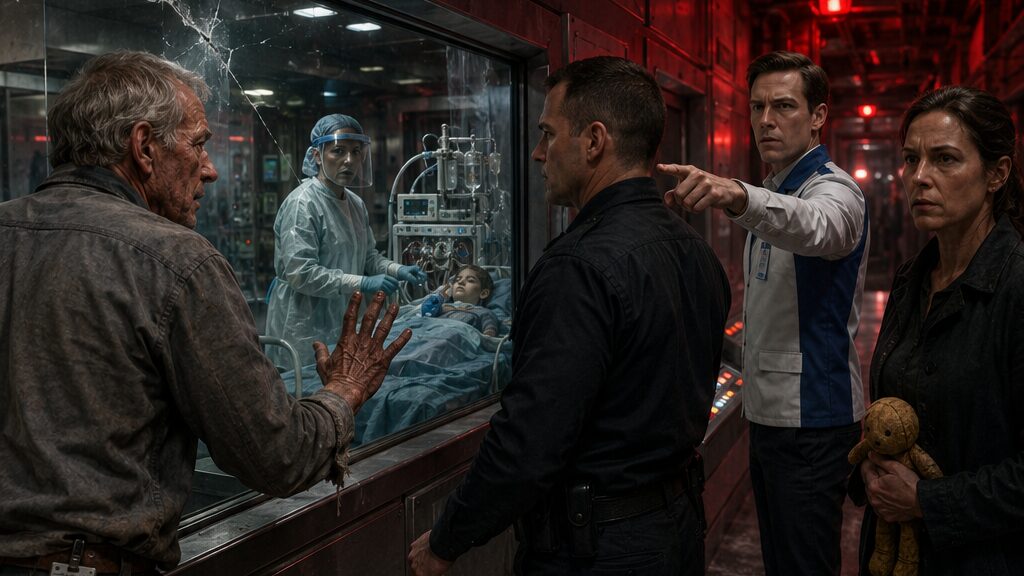
Richard ignored him. He stepped closer to the glass and stared through it at the operating bay, at the negative-pressure indicators glowing beside the sealed room door, at the bypass lines draped like fragile veins between machine and child.
His fingertips touched the observation window.
They left dark smudges on the clean glass.
Inside the bay, Sandra saw the marks before she fully saw the man. Four rough ovals and a dragging line from his thumb, grease caught in skin that had cracked and healed badly for decades. She knew who he was. Everyone in the plant knew, or knew enough.
Richard Green. Former containment man. License revoked. Kept around when the plant needed someone willing to crawl under pipes no one wanted to name in paperwork.
He tapped the glass once.
Sandra could not hear him through the sealed barrier, but she read his mouth.
Wrong rhythm.
The surgical resident beside her said, “Dr. Hill?”
Sandra’s eyes dropped to the child. Emily’s lashes lay still against her cheeks. The bypass machine continued its disciplined clicking.
“Proceed to valve seating,” Sandra said.
Her voice did not shake. That mattered. In rooms like this, steadiness traveled faster than fear.
Outside, Richard moved toward the wall monitor.
“Who authorized tank isolation during bypass support?” he asked.
The engineer stiffened. “That’s above my clearance.”
“That’s not an answer.”
“It’s the only one I’m giving.”
Richard leaned in until the schematic reflected in his eyes. Tank D-14 fed into a shared suppression network. The network passed under the old isolation corridor, wrapped the surgical containment zone, then split beneath the negative-pressure medical bay. On paper, it looked separated.
Paper had never smelled hot metal before a gasket failed.
Another alarm bloomed: MED-BAY SEAL DIFFERENTIAL: ACTIVE COMPENSATION.
Richard set his toolbox down so hard the engineer flinched.
“Who is running command?”
Before the engineer could answer, the double doors at the far end of the corridor opened and Brian Campbell entered like a man arriving at a camera line.
His vest was spotless.
Not clean. Spotless.
White commander panels, blue trim, fresh laminate badge, polished shoes that had not touched powder, oil, or standing water. Two guards came behind him, then three junior administrators with tablets hugged to their chests. Brian’s jaw was set in a practiced angle, the kind of severity that made young men look older from a distance and frightened up close.
“Route all decisions through me,” Brian said before anyone asked him anything. “No independent calls. No floor improvisation. We follow the emergency sequence.”
The engineer straightened at once. “Commander Campbell, tank D-14 is breaching—”
“I can read the board.”
Richard stared at him.
Brian noticed. His eyes flicked over the gray shirt, the toolbox, the backward badge, the stained hands still hovering near the glass.
“You,” Brian said. “Maintenance doesn’t stand at command.”
Richard did not move. “Who gave you the sequence?”
Brian smiled as if he had been handed exactly the interruption he needed to establish himself. “I don’t answer to maintenance.”
“Then answer to the girl on bypass.”
That put silence into the corridor.
Inside the bay, Sandra had just seated the valve. Her team moved around her with swift, contained motions. Clamp. Suction. Suture. Flow reading. The sealed room hummed as negative pressure tried to keep the outside world from entering the place where a child’s chest lay open under light.
Brian stepped to the command desk. “Status?”
The engineer glanced once at Richard before reading. “Tank D-14 pressure rising past safety limit. Suppression grid is compensating, but medical bay seal is drawing harder than expected.”
“Because you’re pulling against the wrong side,” Richard said.
Brian’s face tightened.
Sandra looked up again at the glass. Richard had both hands raised now, not in surrender, but as if holding an invisible pipe between them.
The guard nearest him shifted. “Sir, step back.”
Richard pointed at the schematic. “D-14 isn’t venting clean. It’s pulsing against the shared grid. If you isolate by standard sequence, you don’t protect the med bay. You make it the relief point.”
The engineer swallowed. “That’s not how the grid is modeled.”
“That’s how it was built.”
Brian’s tablet chimed. He glanced down, then lifted his chin.
“The emergency sequence remains.” He pointed to the console. “Prepare partial shutdown on the secondary suppression loop.”
Richard went still.
There were alarms, people, machines, the child beyond the glass. Yet the stillness around Richard seemed to pull sound toward it.
“No,” he said.
Brian looked at him as if the word had come from a chair. “Excuse me?”
Richard’s voice dropped. “Not while that bypass machine is running.”
“The bypass machine is inside negative pressure.”
“And the negative-pressure room is tied to the secondary loop you’re about to starve.”
Brian turned to the engineer. “Execute preparatory shutdown.”
The engineer hesitated.
Brian saw it and sharpened his voice. “That was not a discussion.”
The engineer reached toward the console.
Richard’s scarred hand slammed onto the desk before the command could be keyed in. Everyone jumped except Brian.
Behind the glass, Emily Rivera’s blood moved through the machine.
Richard looked at the red board and then at Brian.
“Touch that sequence,” he said, “and the medical bay becomes the weakest tank in the plant.”
Chapter 2: The Old Man With No Clearance
“The medical bay becomes the weakest tank in the plant,” Richard said again, because no one had moved and the engineer’s finger still hovered above the command key.
Brian Campbell let out a small laugh.
It was not amusement. It was relief wearing a costume. Richard had heard men laugh that way before inspections, before hearings, before they did something dangerous because admitting doubt would cost them rank.
“Get your hand off my console,” Brian said.
Richard did not.
The nearest guard stepped in and placed a hand on Richard’s shoulder. Richard’s eyes remained on the board, tracking the pressure pulses. Red. Red. Red. A fractional drop. Then red harder.
That rhythm was wrong. Not a steady breach. A trapped surge searching for a thin place.
“The secondary loop is carrying more than suppression load,” Richard said. “It’s feeding differential stability to that negative room.”
The engineer frowned despite himself. “The schematic says the med bay has independent isolation.”
“The schematic is wrong.”
Brian turned fully then, giving the corridor his profile, letting the staff see how patient he was being. “The schematic is certified.”
“The pipe isn’t.”
“Do you have current authorization to access plant command data?”
Richard’s jaw shifted.
Brian nodded once, as if a private suspicion had been confirmed. “Badge.”
The guard took Richard’s shoulder harder. Richard pulled the badge from his shirt and flipped it around. The plastic was scratched cloudy; the expiration stripe was obvious from five feet away.
The engineer looked down.
One of the administrators whispered into a tablet.
Brian took the badge between two fingers, not touching Richard’s hand. “Temporary maintenance access. Expired yesterday.”
“I was called in for west wing neutralization.”
“You were called to mop up, not command.”
Richard’s fingers curled.
Inside the sealed bay, Sandra could see only pieces of the exchange. Brian’s polished shoulders. Richard’s old profile. The guard’s hand. The expired badge held up like evidence. She had a suture needle poised above Emily’s small chest, but her attention kept splitting toward the corridor.
“Dr. Hill,” the perfusion tech murmured.
“I see it,” Sandra said.
The bypass pressure had trembled, not enough to stop them, enough to make everyone’s silence heavier.
Sandra touched the intercom switch with her elbow. “Command, confirm no action will affect med-bay differential during valve seating.”
Brian did not look at her. “Confirmed.”
Richard snapped his head toward the speaker. “Not confirmed.”
Brian’s eyes cooled. “Cut that channel.”
The engineer did not move quickly enough. Brian reached past him and muted the surgical intercom himself.
Sandra stared at the dead light on the wall speaker.
Richard saw it happen. That was when the old anger rose behind his ribs, the anger he had spent years packing down under routine, under cheap coffee, under signing forms for men who did not know which valves hissed in winter.
He pointed at the lower left of the schematic. “Valve bank C-seven.”
The engineer’s face changed.
Brian noticed. “What?”
Richard kept pointing. “C-seven was rebuilt after the hydrofluoric transfer expansion. Nobody changed the overlay because the expansion had to open by quarter end. That bank cross-feeds the medical seal under load. Shut the secondary loop and you draw poison toward the glass.”
The engineer said nothing, but his eyes moved to a locked layer on his screen.
Brian leaned closer. “You don’t have access to that layer.”
“I installed it.”
“No,” Brian said, too fast.
Richard looked at him then. “You weren’t here.”
A small, ugly silence opened.
Brian covered it with command. “Richard Green, former containment-valve specialist. License revoked after the west manifold incident. Am I correct?”
The words worked exactly as he intended. Two nurses visible through the glass glanced toward Richard. The engineer’s shoulders tightened. The guard’s hand became less hesitant.
Richard’s hand dropped from the board.
Brian stepped closer. He had color high in his cheeks now, but his voice stayed controlled. “That incident released three workers into exposure treatment and cost this company millions in shutdown review. You are lucky this plant gives you contract labor instead of a lawsuit.”
Richard looked past him to the red light pulsing over Emily’s bay.
“You buried my report,” he said.
Brian blinked. A tiny break, quickly repaired. “I wasn’t in this division then.”
“No. Your uncle was.”
The corridor inhaled.
Brian’s smile returned, thinner now. “There it is. This isn’t about safety. This is about a bitter old man who lost his license and never got over it.”
Richard’s hands flexed at his sides. The knuckles were swollen, scarred white where old cuts had healed badly. Brian looked at them, then at the staff.
“Look at him,” Brian said. “Grease on the glass, expired badge, no clearance, shouting over surgeons. These are not the hands that make command decisions.”
The words hit harder than Richard wanted them to. Not because Brian believed them. Because part of Richard had spent years letting men like him write the labels.
Dirty. Difficult. Unlicensed. Unstable.
Useful in a crawlspace. Dangerous near a microphone.
He had signed the revocation paper with a thumb still split from turning a manual valve the night everyone else ran. A blood mark had dried beside his name. He had not appealed after the second denial. He had told himself the truth was in the metal and anyone who mattered would know.
No one had known.
The pressure alarm climbed again.
Sandra slapped the intercom from inside the bay, then realized it was dead. Through the glass, she mouthed something.
Richard read only one word.
Pressure?
He stepped toward the window.
The guard blocked him. “That’s enough.”
Brian turned to the engineer. “Prepare partial shutdown. Now.”
The engineer said, “Commander, maybe we should verify C-seven routing—”
Brian cut him off with a look that carried more fear than anger. “You want to delay an emergency sequence because a revoked mechanic guessed a bank number?”
“He didn’t guess,” the engineer said quietly.
Brian stared at him.
The engineer looked back down. “Preparing shutdown.”
Richard surged forward one step. The guard grabbed both his arms.
“Listen to me,” Richard said, voice rough now. “That child’s bypass flow depends on stable differential. You pull that loop, the seal hunts. The glass takes the surge.”
Brian moved close enough that Richard could smell mint on his breath.
“You are not saving anyone,” Brian said. “You are contaminating command with panic.”
“I’m telling you how it fails.”
“You’re telling me why you should have stayed fired.”
Richard’s eyes darkened.
For a moment, Sandra thought he might strike Brian then and there. His shoulders bunched; his cuffed sleeve rode up; the old tendons stood out in his forearm. But he pulled himself back. Barely.
Brian saw the effort and mistook it for defeat.
“Remove him,” he said.
The guard reached for handcuffs.
Richard looked through the glass at Emily Rivera, at the clear tubes carrying what her heart could not yet carry, at Sandra Hill standing trapped between protocol and a warning she had no permission to trust.
Brian raised his voice so the corridor, the bay, and every camera would catch it.
“I am the commander here. If it blows, it’s on me. Guards, handcuff this old man!”
The cuffs opened with a bright metal click.
Chapter 3: The Report That Never Reached the Wall
Richard hit the wall of the security alcove shoulder-first, hard enough to make the pressure monitor beside him tremble in its bracket.
The guard shoved him one more step for emphasis. “Sit.”
Richard did not sit.
His wrists were cuffed in front of him because no one wanted to waste time fighting an old man into a rear restraint while alarms were climbing, but the metal still bit. He turned his hands under the alcove light and watched one old scar whiten across his thumb. For a second, the cuff edge became the memory of a clipboard, a company pen, a hearing room with cold coffee, his own blood marking the corner of a report no one would later admit receiving.
On the monitor above him, Tank D-14 pulsed higher.
Not steady.
Hunting.
He stepped toward the open alcove doorway.
The guard planted a palm against his chest. “You move, you go down.”
Richard looked at the man. Young. Afraid. Hiding it behind procedure.
“You hear that rhythm?”
The guard frowned despite himself.
The corridor speakers gave the double-beat again. Low, fast, then a tiny drop.
“That’s not pressure venting,” Richard said. “That’s pressure looking.”
“I said sit.”
Richard shifted his gaze to the wall intercom panel beside the alcove door. Old model. Plant-wide auxiliary. They had replaced the buttons twice but never the wiring, because auxiliary wiring did not impress visitors.
His cuffed hands rose.
The guard caught his wrist. “Don’t.”
“If she cuts flow compensation, the kid dies.”
The guard’s grip loosened half an inch.
That was enough.
Richard jammed two fingers into the recessed service toggle beneath the panel and pressed until the cracked plastic gave. Static burst from the speaker.
Inside the emergency bay, Sandra heard it above the bypass machine.
She looked toward the observation glass. Richard was gone from it. Brian stood at command, speaking fast to the engineer, pointing at screen layers Sandra could not see. The intercom light remained dead.
Then a second speaker, older and lower on the wall, spat static.
“Sandra Hill.”
She froze.
The resident looked up. “Is that command?”
“No,” Sandra said.
Richard’s voice came through grainy and close. “Ask me one thing he can’t answer.”
Brian’s head snapped toward the bay window. He could not hear the auxiliary line from where he stood.
Sandra kept her face angled down toward Emily’s chest. “This is not a secure channel.”
“No secure channel left.”
She looked at the bypass readings. Arterial flow stable. Venous return stable. Med-bay differential overcompensating by eleven percent.
She should have ordered the auxiliary cut. She should have told security. She should not have been listening to a restrained, unlicensed man during a valve procedure inside a chemical plant.
But Richard had named C-seven.
And the hidden warning on the bypass interface had begun to flash a pale amber she had not mentioned to anyone.
NEG-PRESS VARIANCE: FLOW SENSITIVITY ELEVATED.
Sandra lowered her voice. “If the secondary loop is isolated, what happens first?”
A pause.
Not long, but long enough that she knew he was not guessing. He was seeing it.
“The room pulls harder for eight to twelve seconds,” Richard said. “The bypass system reads it as pressure drift and compensates. Then C-seven sends the surge back through the seal return. Glass takes the flex. If there’s fatigue, it cracks from the inside edge near the upper hinge.”
Sandra’s throat tightened.
The warning on her screen showed a diagram of the room seal.
Upper hinge quadrant highlighted amber.
She glanced once through the glass at Brian.
He was watching her now.
Richard’s voice roughened. “You’re seeing it, aren’t you?”
Sandra did not answer.
“Dr. Hill?” the resident whispered.
Sandra kept her hands moving. “Maintain field. Do not break.”
In the alcove, Richard closed his eyes for one beat. Not relief. Confirmation.
The guard stared at him. “How did you know that?”
Richard looked at the monitor instead of the man. “Because I wrote the report.”
“What report?”
“The one that never reached the wall.”
The guard did not understand. Richard barely heard himself over the past rising in him.
Three years earlier, he had stood in west manifold steam with blood running into his glove, shouting for the isolation sequence to be stopped. Afterward, when the exposure counts came in and the company needed one name instead of eight signatures, he had written thirty-two pages on negative-pressure seal fatigue, cross-fed loops, outdated overlays, and managers who opened expansions before field corrections were complete.
The report vanished before the hearing.
The wall display in the safety office kept every approved incident review in neat frames.
His never reached it.
A sharp voice cut through the auxiliary speaker.
“Who is on that line?” Brian demanded.
Sandra’s eyes lifted.
Brian had crossed to a side panel and was staring toward the older intercom array. He could hear enough now—maybe not words, but betrayal.
Sandra withdrew her elbow from the switch.
“Dr. Hill,” Brian said through the main system, which he had reactivated for himself. “You will not take instruction from unauthorized personnel during surgery.”
“I asked for a technical clarification.”
“You asked a revoked contractor.”
Emily’s monitor chirped. Not failure. Protest.
Sandra checked the flow and made a microscopic adjustment. “I asked the only person who identified a risk your sequence didn’t show.”
Brian stepped closer to the glass. His face, reflected over Emily’s draped body, looked paler than it had minutes ago.
“The emergency sequence has been reviewed.”
“By whom?”
The question escaped before Sandra could soften it.
Brian stared at her.
On the other side of the corridor, Richard heard the silence and knew Sandra had crossed a line she could not uncross. He pulled against the cuffs once, not to free himself, but because his hands needed something to fight.
Brian’s voice became quiet. “Dr. Hill, your role is surgical continuity. Not plant command. If you cannot maintain that distinction, I will replace you with a compliance surgeon.”
No one in the bay breathed loudly.
Sandra looked at Emily Rivera’s face. The child was eight years old, maybe nine, with skin made almost translucent by the lights and illness. Her family had paid for the emergency containment suite because the city road between the plant district and the hospital had been closed by the toxic spill. Moving her would have killed her. Keeping her here might still.
Sandra’s anger had no room to become visible.
“My patient remains on bypass,” she said. “No personnel change is advisable.”
“Then follow your lane.”
Brian turned away before she could answer. “Execute partial shutdown.”
The engineer’s hand moved.
Richard lunged toward the alcove opening. The guard caught him across the chest and drove him back into the wall.
The pressure monitor behind them climbed.
Inside the bay, the overhead lights flickered once. The bypass machine compensated with a soft mechanical whine, almost polite. Sandra saw the amber warning deepen.
NEG-PRESS VARIANCE: CRITICAL WATCH.
Then the sound came.
Not an alarm.
A tick.
Small. Dry. Precise.
Sandra turned her head slowly toward the upper hinge of the negative-pressure glass.
At first, the line was too thin to be real, a bright hair caught in reflected surgical light.
Then it lengthened.
A hairline crack opened in the glass behind Emily Rivera’s bypass machine.
Chapter 4: Clean Orders, Dirty Hands, Rising Glass
The crack in the negative-pressure glass did not spread like a broken window.
It breathed.
Sandra watched the thin white line at the upper hinge brighten, dim, then brighten again with each pulse from the plant outside. The seal around the emergency bay drew harder, trying to protect Emily Rivera from the toxic world beyond the surgical room, but the glass had begun to flex with a rhythm no room built for surgery should have had.
“Do not stop bypass flow,” Sandra said.
The perfusion tech’s hands hovered over the console. “Flow is fighting differential.”
“Then let it fight.”
On the other side of the corridor, Richard heard nothing but the alarm and the older sound beneath it. The plant was telling the truth through metal and glass while men argued over authority. He twisted his cuffed wrists against the chain until pain sharpened his focus.
The guard at the alcove kept a hand on him. “Stay back.”
Richard stared past him. “You see the window?”
The guard did not answer.
“You see it?”
The guard glanced toward the bay. His face changed.
“That’s the hinge quadrant,” Richard said. “When it goes, it won’t shatter outward. It’ll pull inward. Everything outside that room tries to get in.”
“Then they’ll seal the inner door.”
“With the child on bypass? With her chest open?”
The guard’s grip weakened again, not enough to free him, enough to tell Richard the man still had a human part under the uniform.
At command, Brian Campbell looked from one screen to another as if the right answer might appear if he gave the screens enough disappointment. He had unmuted the main surgical intercom but kept the auxiliary locked out. His cheeks were flushed now, his commander vest too bright beneath the red warning lights.
“Status,” he said.
The engineer swallowed. “D-14 pressure remains above safety ceiling. Secondary loop standing by for partial shutdown. Med-bay differential is unstable.”
“Unstable because we haven’t completed the sequence.”
Richard barked a laugh. It came out ugly.
Brian turned. “Something funny?”
“That you think the plant cares who signed your badge.”
Brian’s fingers tightened around his tablet. “You’re cuffed in a security alcove. Speak carefully.”
“Uncuff me and I’ll speak slower.”
The guard pushed him back, but not as hard as before.
Brian looked at the engineer. “Proceed.”
“Commander,” the engineer said, voice thin, “if C-seven is routed the way he says—”
Brian slammed his hand on the console. The sound cracked through the corridor. “It is not routed the way he says.”
Sandra heard that through the intercom. She looked past her surgical field at the far wall monitor. The bypass warning had shifted from amber to amber-red.
NEG-PRESS VARIANCE: COMPENSATION LIMIT APPROACHING.
A sterile nurse whispered, “Dr. Hill, if command shuts the secondary loop—”
“I know.”
But she did not know enough. That was what stung. She knew tissue, flow, pressure through vessels, the delicate arrogance of replacing what a human heart could not hold. She knew the artificial valve in front of her and the child beneath her hands. She knew that chain of command existed because panic killed.
She also knew Richard Green had named a hidden failure before the machine did.
The glass ticked again.
A motion at the corridor entrance turned every head that was not locked on a monitor.
Cynthia Rivera arrived with two family security aides and the stillness of a person who had learned that panic made weaker people talk too much. She wore a dark coat over hospital clothes, and one hand held a small cloth doll by its ribboned arm. It looked absurd in the chemical plant corridor, soft and yellow beneath the red emergency lights.
Her eyes went first to the surgical bay.
Then to the crack.
Then to Brian.
“Who is in charge of my child’s life?” she asked.
Brian straightened so abruptly that the tablet nearly slipped from his hand. “Mrs. Rivera, I’m Brian Campbell, emergency project commander. We have the event contained.”
Richard pulled against the guard’s hand. “No, you don’t.”
Cynthia’s gaze moved to the alcove. She took in the cuffs, the old shirt, the bloodless tension in Richard’s hands.
“Who is that?”
“No one relevant,” Brian said.
Richard’s face hardened. “Your daughter’s room is tied into C-seven through the secondary loop. He cuts it, that glass becomes a mouth.”
Cynthia turned back to Brian. “Is that true?”
Brian gave her the smile he had been saving for boardrooms. “No. The medical isolation suite is independent. The, ah, vascular valve machine is separately supported.”
Sandra’s head snapped up inside the bay.
“Vascular valve machine?” the resident whispered.
Sandra said nothing.
Brian heard the small silence his phrase created, but he could not identify the mistake inside it. He pushed forward, faster. “Your daughter is protected by redundant negative isolation, chemical suppression, and approved emergency procedures. We are reducing load on a compromised tank.”
Richard’s voice cut through. “Ask him which bank feeds the return seal.”
Brian did not look at him. “Security, remove Mr. Green from audio proximity.”
The guard hesitated.
Brian saw it. Cynthia saw it too.
“Now,” Brian said.
The guard took Richard by the arm and pulled him from the alcove. Richard’s boots scraped against the floor as he resisted just enough to force every eye to notice him, not enough to be thrown down before he could speak.
“C-seven,” Richard said to Cynthia. “Upper hinge fatigue. Secondary loop surge. Those three things are your warning.”
Cynthia looked at Sandra through the glass. “Doctor?”
Sandra could have hidden behind protocol. The whole room waited for her to.
Her gloved hands remained in Emily’s open chest. Her voice came through the main intercom, controlled and flat. “There is a crack in the upper hinge quadrant. The bypass system is registering differential instability.”
Brian swung toward the glass. “Dr. Hill.”
Sandra continued, “I cannot verify Mr. Green’s full claim from inside the sterile field.”
Brian seized on that. “Thank you.”
“But he has correctly identified every active warning before it displayed.”
That landed harder than an accusation.
For a second, Brian’s command face slipped. Beneath it was a younger man than he wanted to be, terrified, angry that terror had witnesses. He looked toward the ceiling camera, toward the administrators, toward Cynthia Rivera’s cold eyes. Richard saw the calculation pass through him.
If Brian paused now, he became the nephew who needed rescuing.
If he proceeded, he might still become the man who made the hard call.
“Emergency command authority is not transferred to a surgeon or a fired mechanic during pressure breach,” Brian said. “My appointment was signed by Andrew Campbell and logged with central operations.”
Richard went still again.
Andrew.
The name brought back the hearing room. Andrew Campbell at the far end of the table, not yet CEO but already untouchable, saying the expansion timeline had no bearing on a field operator’s failure to follow procedure.
Richard’s report had been in a folder beside Andrew’s left hand.
By the end of the hearing, it had not existed.
“You’re here because of him,” Richard said.
Brian’s eyes flashed. “I’m here because I am qualified to lead cross-functional emergency response.”
“You don’t know the room from the pipe.”
“I know enough to act while you shout.”
“You know enough to be scared.”
Brian’s mouth tightened.
The pressure board gave a new warning tone.
MED-BAY SEAL STRAIN: LIMIT EXCEEDED.
Inside the room, the crack lengthened one inch down from the hinge.
Sandra said, “Brian, stop the shutdown and stabilize the secondary loop.”
The corridor went silent around the impossible thing she had done: used his first name, rejected his order, named the action.
Cynthia stepped closer to the glass. “Do what she says.”
Brian looked at Cynthia, and now Richard understood the worst part. Brian would not back down in front of her. Her power did not restrain him. It cornered him.
His hand rose, pointing at the engineer.
“Complete partial shutdown.”
The engineer whispered, “Commander—”
Brian’s voice cracked through the alarms.
“Cut it now.”
Chapter 5: The Fire Extinguisher Broke the Chain of Command
The glass began ticking louder than the alarms.
Each tick came with a tiny white jump in the crack, and each jump dragged a sound from Emily Rivera’s monitor that made Sandra’s team move faster and breathe less. The bypass machine whined under compensation load. The surgical lights stayed bright. The child’s face did not change.
That was the horror of it to Richard.
A disaster could enter a room before the body knew enough to flinch.
“Hold arterial flow,” Sandra said.
The perfusion tech’s voice broke. “It’s drifting.”
“Hold it.”
Brian stood at command with one hand still extended toward the engineer, as if the shutdown order had turned him into a statue. On the screen, the secondary suppression loop began to step down by increments.
Ten percent.
Fifteen.
The plant answered with a long groan beneath the floor.
Richard shoved against the guard holding him. “Stop that sequence.”
“Stay back,” the guard snapped.
“Look at the glass.”
“I said stay back.”
Richard twisted hard enough that the cuff chain cut skin. A bead of blood slid across the old scar below his thumb. His hands, dirty and cuffed and shaking now from force rather than fear, caught the red light as he pulled again.
Cynthia Rivera had stopped looking at Brian. She was watching the crack.
“What happens if it opens?” she asked.
No one answered quickly enough.
Brian seized the gap. “It won’t. We are reducing pressure.”
Sandra’s voice came through the intercom. “You are increasing differential across the medical seal.”
“That is not your lane.”
“My patient is inside that lane.”
The engineer’s screen chirped.
SECONDARY LOOP: 22% REDUCTION.
The crack widened.
A pale ribbon of vapor slipped from the upper hinge area into the narrow space between the medical bay’s inner and outer pressure layers. The room’s airflow pulled at it greedily, stretching it thin, then drawing it toward the glass behind Emily’s bypass machine.
Sandra saw it and made her choice.
“Maintain bypass flow,” she ordered. “Ignore command shutdown compensation. Lock manual support.”
The perfusion tech looked up. “That contradicts external sequence.”
“Lock manual support.”
The tech did it.
Brian whirled toward the bay. “Dr. Hill, reverse that.”
“No.”
The word was quiet, almost swallowed by the machines, but it changed the room more than shouting would have.
Brian looked around, suddenly searching for a face that would give him back command. The administrators stared into their tablets. The engineer stared at the shutdown progress. The guard stared at Richard.
Richard saw Brian understand enough to be afraid.
Not the system. Not the solution. But the fact that the room had begun to move without him.
Brian took one step back from the command desk. “Security, get him out of here. Now. Remove him from the corridor.”
The guard on Richard’s right grabbed his elbow. Another moved in from the wall, broader, helmeted, young enough to think force could simplify anything.
Richard looked once through the glass.
Sandra was bent over Emily, one hand inside the surgical field, the other lifted in a command to hold. The crack behind her had begun to feather outward. Vapor pooled along it like breath on winter glass.
Between Richard and that glass stood two guards, Brian’s order, his own cuffs, and forty years of being told that procedure was where truth went to die.
The broader guard seized him.
Richard let himself stumble.
The guard adjusted to catch the weight.
Richard dropped his shoulder, turned into the slack, and drove his cuffed hands down between them. The chain scraped across the guard’s wrist. Not enough to free Richard. Enough to twist both men off balance.
The first guard slammed him from the side.
Richard hit the wall near the emergency station. Pain flashed up his ribs, bright and old. His fingers struck cold metal.
A fire extinguisher.
For half a second, his hand closed around the cylinder handle without thought. Its weight came alive in his grip.
The guard saw his eyes change.
“Don’t,” the guard said.
Richard heard Emily’s monitor issue the first flatline warning chirp.
Not a flatline.
A warning that the body was running out of tolerance.
Sandra shouted from inside the room, “Flow is falling—keep her up, keep her up!”
Brian said something, but Richard no longer heard words from him. He heard only the plant. The glass. The bypass machine. The old report no one framed on the wall. The names of the three workers who had gone into exposure treatment while executives argued language.
He had tried to explain.
He had tried to warn.
He had been right too late before.
The broader guard lunged.
Richard swung the fire extinguisher.
The impact was not clean or heroic. It was a heavy, sickening collision of metal, helmet edge, and cheekbone. The guard went sideways into the wall and slid down hard, hands grasping at nothing. Someone screamed. The extinguisher burst a puff of white powder from its hose, dusting Richard’s sleeve, making him look ghosted under the red lights.
For one naked instant, everyone froze around the fact of what he had done.
Richard did not.
He drove the extinguisher low into the second guard’s thigh, not full force, just enough to buckle him, then ran.
The cuffs made his arms awkward. His ribs screamed. His boots slipped in the extinguisher dust. A security aide reached for him and missed.
Brian backed away from the command desk.
“Stop him!” he shouted.
No one between Richard and the glass moved fast enough.
The crack leapt down another six inches.
Vapor snapped through, not a cloud yet, not a flood, but a thin, poisonous tongue drawn inward by the differential. The medical bay alarms shifted from warning to hazard. Sandra’s team recoiled, then forced themselves back toward the child because there was nowhere else to go.
“Seal masks,” Sandra ordered. “Do not break sterile field.”
A nurse slapped a mask over Sandra’s face from behind. The resident’s hands shook so badly Sandra took the clamp from him without looking.
Richard reached the outer pressure door and slammed his cuffed hands into the release bar.
It did not open.
LOCKED: COMMAND HOLD.
He turned toward the manual override cabinet beside it. A keypad blinked red.
Brian had locked him out.
Of course he had. Even now, Brian’s authority reached the door better than Richard’s knowledge did.
Richard lifted the extinguisher again and smashed the keypad.
Once.
Twice.
The cover cracked. Sparks spat. The lock stayed red.
Behind him, the second guard was up on one knee, drawing a weapon with shaking hands.
“Down!” the guard shouted.
Cynthia’s voice cut across the corridor. “Do not fire toward my daughter’s room!”
The guard hesitated.
Richard jammed two fingers into the broken keypad casing and found the manual release wire by feel. Old model. Same cheap redesign. He hooked the wire with his cuff chain and pulled.
Nothing.
The pressure board screamed.
MED-BAY SEAL BREACH IMMINENT.
Inside, Sandra looked up and saw Richard at the door. Their eyes met through the glass, through red reflection and vapor, through every reason she had waited too long.
She hit the internal emergency release.
Brian saw her do it. “Dr. Hill, no!”
Sandra did not look at him. “Open the outer boundary.”
The door released with a violent hiss.
The change in pressure almost took Richard off his feet. Air rushed around him toward the crack. The toxic ribbon thickened. His eyes burned instantly. His lungs tried to reject the first taste of chemical sharpness.
The corridor behind him erupted into shouted orders.
Richard did not enter the surgical field. He knew better. He moved along the narrow outer boundary between the pressure layers, the maintenance channel no one used unless something had already gone wrong. The cracked glass bowed in front of him, trembling with each pulse.
It was worse up close.
The crack had opened at the hinge and forked downward behind the bypass machine. If the glass flexed once more, a panel could pull inward. Poison would not need a door after that.
Richard dropped the extinguisher.
His hands were still cuffed.
For one absurd second, that stopped him.
He looked down at the cuffs, at the blood beginning to run from his wrist, at the dirty half-moons of his nails.
These are not the hands that make command decisions.
The glass ticked.
Richard lifted both cuffed hands, pressed them to the crack, and felt the leak bite into his skin.
Pain lit him white.
He could not seal enough with his hands.
He knew it instantly.
So he did the only thing left.
Richard turned sideways, drove his shoulder and chest against the cracked glass, and threw his whole body into the failing seal.
Chapter 6: The Body Against the Poisoned Glass
Richard hit the glass chest-first, and the crack bit back.
For a moment he thought the whole panel had opened through him. Cold pressure punched the air from his lungs. Heat followed, chemical and sharp, crawling up his throat and into his eyes. He jammed his cuffed hands flat against the branching line and pressed until the broken edges cut through skin already split by the cuffs.
The leak changed sound.
Not stopped. Choked.
A high whistle became a wet hiss under his palms.
“Hold him there!” Sandra shouted, though no one could safely touch him.
Inside the emergency bay, Emily’s bypass machine gave six clean beats of stable flow.
Six.
Sandra saw them on the screen like candles lit in a tunnel.
Then Richard slipped.
His boot slid in condensation and extinguisher powder. The crack opened under his right palm. Vapor spat through, white and fast.
The bypass flow dipped.
“Richard!” Sandra shouted.
He drove his shoulder harder into the glass. His cheek struck the pane. Blood from his wrist smeared across the crack and spread thin under pressure, absurdly bright beneath the red lights.
Dirty hands, he thought, but the thought had no bitterness left. Only instruction.
Press higher.
The hinge was the mouth.
He lifted his cuffed hands another inch and sealed the branch closest to the hinge with the heel of his left palm. Pain tore up his arm. He made a sound he did not recognize.
On the other side of the glass, the surgical team worked around Emily with the forced discipline of people balancing a life on a shaking table.
“Flow?” Sandra demanded.
“Coming back,” the perfusion tech said. “Coming—holding at minimum.”
“Keep her there.”
Richard could see Sandra through the glass, blurred by vapor and his own watering eyes. Her mask hid half her face, but not the fury in it. Not at him now. At the room. At Brian. At herself.
The intercom crackled uselessly.
Richard pressed harder.
The plant fought him in pulses. Each one shoved the glass against bone. Each drop tried to pull him forward. His ribs became a cage of knives. His hands went slick, then sticky. The cuff chain dug into the crack and helped, catching where flesh alone would not. He angled it deliberately, turning restraint into a brace.
“Secondary loop rebalance!” he tried to shout.
It came out hoarse, muffled by glass and maskless breath.
Sandra read his mouth badly. “Say again!”
Richard lifted his chin enough to shape the words.
“Rebalance. Not shut. Rebalance.”
Sandra turned to the perfusion tech. “Can we manually offset for external rebalance?”
“Not without command clearance.”
“Use surgical override.”
“That only buys local flow.”
“Then buy it.”
In the corridor beyond the pressure boundary, Brian was no longer at the console.
At first Cynthia did not understand what she was seeing. The command desk stood empty except for the engineer, who was typing with shaking hands and looking around for permission that had fled. Brian’s tablet lay facedown on the floor.
“Where is he?” Cynthia asked.
No one answered.
The guard Richard had struck groaned against the wall. The second guard had his weapon raised toward the pressure door, arms trembling.
“Down!” he shouted. “Get down from the glass!”
Richard could hear the tone, not the words. It did not matter. If he moved, the room opened. If he stayed, he might hold long enough for the loop to rebalance.
The weapon came higher.
Cynthia stepped into the guard’s line and slapped the barrel down with one hand. “If you make him move, you kill my child.”
“He assaulted security.”
“He is holding the room closed.”
The guard looked toward the engineer. The engineer looked at the board.
MED-BAY SEAL BREACH: ACTIVE
NEGATIVE PRESSURE: UNSTABLE
TOXIC INGRESS: REDUCED
Reduced.
Not solved.
Reduced because an old man’s body had become part of the seal.
“Commander?” the guard called.
No answer.
“Commander Campbell?”
Still no answer.
Cynthia turned slowly toward the command area. “Where is Brian Campbell?”
The administrators looked at one another.
Under the desk, something shifted.
Not enough for Cynthia to see yet. Enough to make one administrator glance down and then away too fast.
Inside the bay, Sandra had no space for that discovery. She was watching the bypass system claw its way back from failure.
“Valve seating secure,” she said. “Flow support?”
“Minimum viable,” the perfusion tech said. “But if external pressure spikes again—”
“It won’t if they rebalance.”
“They’re not rebalancing.”
Sandra looked through the glass at Richard.
His face was pale except where the pressure had forced blood vessels red around his eyes. One side of his cheek flattened against the pane. His hands were spread above his shoulder, palms pressed over the crack, blood threading downward like red roots.
He was not trying to clear his name. She knew that now. He was not even trying to survive the next minute with dignity.
He was counting pulses.
His lips moved against the glass.
One.
Two.
Three.
The engineer at the command station saw the same rhythm on the pressure board. The old man had been right from the beginning. The surge was not random. It was cycling through the secondary loop and throwing its force into the med-bay seal with each attempted isolation step.
The engineer’s hand hovered over the reversal command.
Brian had not authorized it.
Sandra had surgical override for the bypass, not plant rebalance. Cynthia had power, not passwords. Richard had the answer, not access.
The engineer whispered, “I can’t.”
Cynthia heard him.
She crossed to the command station, the small yellow doll still gripped in one hand. “Can’t because it will not work, or can’t because someone told you not to?”
The engineer’s eyes flicked toward the empty space where Brian should have been.
“That command requires emergency lead approval.”
Cynthia leaned closer. Her voice lowered. “Look at my daughter through that glass. Then decide who your lead is.”
The engineer’s fingers moved.
A warning flashed: UNAUTHORIZED REVERSAL REQUEST.
He swallowed and entered his own code.
The system rejected it.
Inside the boundary, Richard felt the next pulse build through the glass before the monitors showed it. The panel pushed against him, a giant breath trying to inhale him through the crack. He shifted his weight higher, but his right foot slid again.
For the first time, he knew he could not hold the next one.
Sandra saw his knee buckle.
“No,” she said.
The perfusion tech said, “Flow dropping.”
Sandra’s hands moved with terrifying calm. “Manual support. Now.”
The resident adjusted suction. A nurse held the mask tighter to Sandra’s face. Emily’s monitor stuttered.
Richard’s palm slipped off the upper branch of the crack.
Vapor burst through.
He slammed his forehead into the glass and forced his hand back up, screaming without sound.
At the command desk, the engineer tried another route. “System won’t accept my authorization.”
Cynthia looked at the administrators. “Who has it?”
No one moved.
She followed their eyes.
This time she saw the shoe under the command desk.
Polished. Clean. Trembling.
Cynthia walked around the desk.
Brian Campbell was crouched beneath it, one hand clamped over his mouth, tablet forgotten, commander vest bunched at his shoulders. His eyes shone with panic. He looked up at Cynthia as if she had found him undressed.
“I was accessing the lower panel,” he said.
There was no lower panel.
Cynthia did not speak. Not yet.
Behind her, the pressure board surged toward failure.
Richard’s vision narrowed to red light, white vapor, and the small black numbers on the med-bay display. He could no longer feel his fingers clearly. That frightened him more than pain. Pain meant contact. Numbness meant he was losing the shape of the crack.
Then the sound changed again.
A descending tone.
The engineer had reached across the command desk, grabbed Brian’s fallen tablet, and pressed it toward the scanner still logged under Brian’s authority. The tablet chimed approval before anyone could stop him.
SECONDARY LOOP REVERSAL: ACCEPTED
PRESSURE REBALANCING
The next pulse came weaker.
Richard almost fell because he had braced for a blow that did not arrive. He caught himself on the crack and kept pressing, sobbing air through clenched teeth.
Inside the bay, the bypass numbers steadied.
“Flow returning,” the perfusion tech said, stunned.
Sandra did not look away from Emily. “Hold until full stabilization.”
The red warning lights flickered.
Once.
Twice.
Then the med-bay seal indicator changed to green.
For three seconds, no one trusted it.
Then another green light came on.
NEGATIVE PRESSURE STABLE
TOXIC INGRESS CONTAINED
Richard stayed against the glass because he did not believe the plant until it had told him the truth three times. Blood ran from his hands down the pane, crossing the green reflection in trembling lines.
In the corridor, a security aide pointed under the command desk.
“He’s there,” the aide said.
Every head turned.
Brian Campbell, official emergency commander, was hiding beneath the place where command had been abandoned.
Chapter 7: The Commander Under the Desk
Brian Campbell crawled out from under the command desk with dust on his vest and rage already forming over the terror in his face.
“Arrest him,” he shouted.
No one moved.
Brian grabbed the edge of the desk and pulled himself upright too fast. His knee struck the underside hard enough to make the tablets rattle. He winced, then turned the wince into fury, pointing past Cynthia, past the engineer, past every person who had seen where he had been hiding.
“That man assaulted security. He breached a restricted medical boundary. He interfered with emergency command.”
Richard was still pressed against the glass when the accusation reached him.
The green indicators glowed above his shoulder. Blood had run from his palms in uneven paths, gathering where the cracked pane met the seal. He had not stepped away because his body had not yet accepted that the room would hold without him.
Sandra looked through the glass at him and lifted one hand.
Slowly, carefully, Richard peeled his chest away from the pane.
The cracked glass held.
His knees almost did not.
A guard stepped forward, weapon lowered but ready. “Sir, get down.”
Richard turned his head. The motion sent pain through his ribs so sharply that the corridor blurred. He looked at the guard, then at Brian.
“You still think I’m the breach?”
Brian’s voice shook. “You created chaos and got lucky.”
Sandra’s voice came through the intercom before Richard could answer. “No.”
One word. Surgical, cold, complete.
Brian swung toward her. “Dr. Hill, you will not—”
“The bypass remained viable because he held the seal.”
The corridor heard it. The engineer heard it. Cynthia heard it with both hands curled around the little yellow doll as if the cloth could be crushed into proof.
Brian stepped toward the glass. “Your patient was endangered by his unauthorized violence.”
“My patient was endangered by your shutdown.”
The words did not rise. Sandra did not need them to. The monitors behind her carried more force than shouting: stable flow, stabilized seal, green pressure balance. Emily Rivera lay under lights, still open, still fragile, but no longer losing the invisible fight against the room.
Brian turned to the engineer. “Print the command record.”
The engineer did not move.
“Now.”
The engineer’s hands hovered above the keys. He looked young again, younger than he had in any moment before, as if the crisis had burned the uniformity out of him. “The record will show the shutdown surge widened the crack.”
Brian’s eyes narrowed. “It will show an unauthorized person assaulted security and manipulated a restricted boundary.”
“It will show both.”
That small answer cut Brian deeper than defiance. For the first time, he seemed to understand that his authority had not vanished in one dramatic moment. It had been leaking, steadily, every time someone compared what he said with what the room did.
The doors at the far end opened.
A man in a gray inspection coat entered with two plant officials and a hard case in one hand. Raymond Torres did not hurry. He took in the corridor the way experienced inspectors took in all dangerous places: not with shock, but with inventory.
Bleeding man against cracked glass.
Commander disheveled near desk.
Guard injured.
Green warning lights.
Surgical team still working.
Cynthia Rivera watching everyone like a blade.
Raymond’s eyes settled on Richard last. Recognition passed across his face, not warm and not clean.
“Richard Green,” he said.
Richard leaned one hand against the wall. “Raymond.”
Brian seized on the arrival. “Inspector Torres, good. This man attacked my security personnel and compromised a restricted medical—”
Raymond lifted one hand.
Brian stopped, offended by the silence more than the gesture.
Raymond opened the hard case, connected a diagnostic module to the command station, and watched the screen fill with timestamped pressure data. The corridor waited around the click of keys and the distant surgical rhythm from the bay.
“Who authorized secondary loop reduction?” Raymond asked.
“I did,” Brian said.
“On what basis?”
“Standard emergency sequence for toxic tank pressure breach.”
“Did you check medical bay cross-feed load?”
Brian blinked. “The medical bay is independent.”
Raymond looked at the engineer. The engineer looked down.
Richard laughed once under his breath, then coughed. The cough pulled pain across his ribs and left him gripping the wall harder.
Raymond turned to Brian. “Identify valve bank C-seven on the live layout.”
Brian’s lips parted.
The screen displayed a layered map of the plant, dense with color-coded routes, pressure marks, service histories, hidden branches. Brian stared at it like a man handed a language he had rehearsed speaking but never learned to read.
“It’s part of the old suppression grid,” he said.
“Point to it.”
Brian looked at the screen.
No finger rose.
Raymond waited.
The waiting became unbearable.
Brian tried again. “The exact bank location is not relevant to command-level decision-making during immediate—”
“Point to it.”
Richard pushed off the wall.
Cynthia moved as if to stop him, then let him pass.
He crossed three painful steps toward the display, leaving faint red marks where his fingers brushed the desk edge. He did not touch the screen. He only lifted his bandaged-by-blood hand and pointed from a distance.
“Lower return branch. Under the med bay tie-in. Old route sits behind the expansion overlay.”
Raymond tapped the layer.
C-seven appeared.
The engineer made a small sound, not surprise. Shame.
Brian’s face drained.
Raymond opened the command history. “Secondary loop reduction created a surge across that bank. Med-bay seal reached breach threshold twelve seconds before reversal. Manual seal obstruction reduced toxic ingress.”
He looked toward Richard’s blood on the glass.
“Manual seal obstruction,” Cynthia repeated, softly.
Brian found anger again because there was nowhere else for him to stand. “You are building a narrative after the fact. I had an unstable tank. I acted under authority. He attacked a guard.”
“He did,” Raymond said.
Brian looked relieved too soon.
Raymond continued, “And if he had not reached that glass, the room would have taken a toxic draw during open bypass.”
Sandra’s voice came through the intercom. “Emily Rivera is still viable because he held it.”
The surgical team remained working, but that sentence moved through the corridor like an official stamp no one had yet dared apply.
Then the outer doors opened again, harder this time.
Andrew Campbell entered with his coat unbuttoned and two corporate legal staff behind him. He had the look of a man who disliked being summoned to scenes before they were cleaned. His eyes went first to Brian, then to the guard on the floor, then to the cracked glass.
Last of all, he saw Richard.
The years between them folded into one narrow line.
“Mr. Green,” Andrew said.
Richard’s mouth tasted like metal. “You still losing reports?”
Andrew’s face did not change, but Brian turned sharply toward him.
Cynthia saw it.
Raymond saw it too.
Andrew approached the command desk. “This incident will be reviewed in full. For now, our priority is containment and patient transfer. Security, separate Mr. Green from operational areas and document the assault.”
Cynthia stepped forward. “Document the rescue first.”
Andrew gave her a practiced, respectful nod. “Mrs. Rivera, I understand your distress.”
“You do not.”
“My nephew appears to have followed an approved emergency protocol.”
Richard’s hand closed around the edge of the desk.
There it was again. The clean sentence built before the blood dried. Approved protocol. Unauthorized worker. Unfortunate result. Names rearranged until responsibility had somewhere smaller to live.
He could let Cynthia fight it. Let Raymond parse it. Let Sandra testify when the surgery ended. Let the machines speak in data no executive could fully erase.
And still, if he stayed silent now, Andrew would find language.
Richard straightened, though pain dragged at him.
“The protocol was wrong because the overlay was wrong,” he said. “The overlay was wrong because your expansion crew left C-seven tied into the old seal return. I wrote that three years ago.”
Andrew’s gaze cooled. “This is not the time.”
“It was never the time with you.”
Brian looked from his uncle to Richard. “What report?”
Andrew’s jaw tightened. That was all, but it was enough.
Raymond glanced at him. “There was a prior report?”
Andrew said, “Mr. Green has made many claims since his license review.”
Richard lifted his hands.
Blood ran from one wrist to the cuff line. His palms were torn in ragged crescents where glass had opened them. Under the green warning lights, they looked less like hands than evidence dragged from inside a machine.
“I signed one report,” Richard said. “Thirty-two pages. Negative-pressure seal fatigue. C-seven cross-feed. Expansion overlay mismatch. I signed it with a split thumb because I’d just shut the west manifold manually while your supervisors argued evacuation language.”
The corridor had gone very still.
Andrew did not look at the glass. He looked at Raymond, measuring institutional risk.
Brian, for once, said nothing.
Then Sandra’s voice came through, tired and fierce. “We are closing. The child has a rhythm.”
Cynthia’s eyes filled, but no tears fell. She kept herself upright with the force of a verdict not yet spoken.
A guard moved toward Richard, uncertain, waiting for Andrew’s order or Brian’s or Raymond’s.
Cynthia stepped into his path.
The little yellow doll hung from one hand. Her other hand rose, palm out, not pleading. Stopping.
“Touch him,” she said, “and this city buries you.”
Chapter 8: The Green Light on His Bloodied Hands
Sandra came out of the medical bay with mask lines pressed into her face and blood on her sleeves that was not Richard’s.
“Emily’s heart is beating on its own,” she said.
Cynthia closed her eyes.
The corridor did not cheer. No one seemed to know how. The alarms had quieted to a low system tone, and the green lights over the negative-pressure seal made the cracked glass look strangely calm, as if it had never nearly opened its mouth and swallowed a child’s room.
Richard sat on a metal step beside the inspection station while a medical worker wrapped his hands. The cuffs were gone. Their marks were not. Under the bandages, his palms burned in deep, jagged lines. Every breath reminded him that his ribs had taken the weight of the plant for longer than any old body should.
The guard he had struck was conscious now, sitting against the wall with gauze at his cheek and humiliation in his eyes. Richard looked at him once.
“Didn’t want your face,” Richard said.
The guard stared at him.
“Wanted the door.”
After a moment, the guard looked away and nodded once.
Not forgiveness. Enough.
Across the corridor, Brian sat in a chair under watch of plant security, no longer issuing orders. His spotless vest had a gray smear across the front from the underside of the desk. He kept rubbing at it with two fingers, making it worse.
Andrew Campbell stood near Raymond Torres, speaking in a low voice that tried to make emergency sound like administration.
“We can isolate the present incident,” Andrew said. “The priority should be medical outcome and contamination prevention. Historical claims can be reviewed separately.”
Raymond had the diagnostic case open on the inspection station. Lines of data moved across the screen: shutdown timestamps, pressure spikes, seal strain, toxic ingress reduction, reversal command. The record did not flatter anyone. It simply remained.
“Historical claims may explain why the present incident happened,” Raymond said.
Andrew’s smile was thin. “Careful. Explanation is not proof.”
Richard flexed one bandaged hand and regretted it immediately.
Cynthia noticed. She crossed to him, still holding Emily’s yellow doll. Up close, her coldness was not absence of feeling but containment. She had built a wall around panic because her daughter had needed her standing.
“You need a hospital,” she said.
“So does your girl.”
“She has one waiting.”
“Good.”
Cynthia studied him. “My family will protect you.”
Richard looked past her to Andrew.
Protection. A clean word. A tempting one. He could let her lawyers stand in front of him. He could let Raymond write the narrow truth: Richard Green assaulted a guard but prevented immediate breach. He could survive this night as a bruised exception, a messy footnote forgiven because a powerful child lived.
The old report could stay where buried things stayed.
Raymond approached with a tablet. “Richard.”
Richard looked up.
“I need your statement for the emergency action record.” Raymond hesitated. That hesitation told Richard more than the words. “Keep it to tonight. What you saw, what you did, why you believed the glass would fail.”
Andrew turned slightly.
Brian stopped rubbing his vest.
Sandra, halfway through stripping off her gloves, looked over.
Richard understood the gift Raymond was offering. A narrow bridge. Cross here. Don’t look down. Clear the assault, save the present, leave the old rot under the floor.
His bandaged hands rested in his lap under the green reflection from the warning lights. The gauze was already bleeding through at the centers.
Three years ago, he had thought facts would climb out on their own. He had thought metal remembered loudly enough. He had mistaken being right for being heard.
He looked at Raymond’s tablet.
“No,” Richard said.
Raymond’s face tightened. “No?”
“I won’t keep it to tonight.”
Andrew stepped forward. “Mr. Green, you are injured and not in a position to understand the legal complexity—”
Richard laughed, and the laugh hurt enough to bend him forward. He waited for the pain to pass. No one filled the silence.
When he looked up, his eyes were clear.
“I understand being alone in a room with men deciding which words make you disappear.”
Andrew’s mouth closed.
Richard turned to Raymond. “Record it all or don’t record me.”
Raymond held the tablet very still.
Cynthia said, “Record it.”
Andrew’s voice sharpened. “Mrs. Rivera—”
“My daughter breathed because he told the truth with his body when no one accepted it from his mouth.” She looked at Raymond. “Record it.”
Raymond activated the statement file.
The red recording mark appeared.
Richard stared at it for a moment, smaller than he expected, less dramatic than the thumbprint he remembered leaving on paper no one kept.
“Name,” Raymond said quietly.
“Richard Green.”
“Role.”
Richard looked at the cracked glass. “Former containment-valve specialist. Contract maintenance tonight.”
“Statement.”
Richard swallowed. His throat still burned from the vapor.
“Three years ago, after the west manifold incident, I filed a thirty-two-page safety report on negative-pressure seal fatigue and C-seven cross-feed exposure. The report named an expansion overlay mismatch. I was told my field sequence caused the exposure. That was false.”
Andrew’s legal staff shifted.
Richard continued before anyone could interrupt. “I signed the report after manually closing the west manifold valve. My right thumb was split open. There was blood on the signature page. The report did not reach the safety wall. It did not reach the crew. Tonight, the same routing error drove tank pressure into the medical bay seal during active bypass support.”
Raymond’s eyes flicked once toward Andrew, then back to the tablet.
“What did you do tonight?”
“I warned command not to reduce the secondary loop. I didn’t explain it well enough.” Richard’s gaze went briefly to Sandra. “I thought naming the failure would be enough. It wasn’t.”
Sandra lowered her eyes, not in shame only, but in recognition.
Richard looked at the guard with the gauze on his face. “When the shutdown widened the crack and security blocked the boundary, I struck a guard with a fire extinguisher. I broke the command hold on the outer door. I entered the pressure boundary and used my body to seal the cracked glass until the loop was reversed.”
“Why?”
Richard’s bandaged hands tightened in his lap.
Because the room was failing. Because the child was there. Because Andrew Campbell had been allowed to turn truth into debris once. Because Brian had been hiding under a desk while calling himself command. Because dirty hands still knew where to press.
He said, “Because if I moved, she died.”
No one spoke.
Behind the glass, the surgical team prepared Emily for transfer. The child’s chest was closed now, covered and guarded by tubes, monitors, hands that moved with exhausted care. Her heartbeat sounded through the open intercom, one clean rhythm after another.
Brian lowered his head.
Andrew said nothing.
Raymond saved the recording.
Cynthia placed the yellow doll gently on the metal step beside Richard. “Emily will want to know whose hands held the glass.”
Richard looked at the doll, then at his bandages stained beneath green light.
For years, he had hidden his hands in pockets when executives passed. He had let their silence teach him shame. Now the same hands shook openly in front of them all, wrapped and ruined and recorded.
Sandra came to the doorway of the bay. “Transfer team is ready.”
Cynthia picked up the doll again, but only after pressing it once against Richard’s sleeve. Then she followed her daughter.
Richard remained seated beneath the warning lights while Raymond took a sealed copy of the statement and Andrew watched the old story move beyond his reach.
The green glow rested on Richard’s bandaged hands.
This time, the blood stayed on the record.
The story has ended.