The Chairman in a Dirty Hard Hat Closed the First Class Lounge Forever
Chapter 1: The Man With Tools at the Wrong Door
The scanner rejected Joshua Carter twice before the guard even looked at his face.
A soft red light blinked above the staff-side door of the First Class VIP Lounge, bright against the polished brass frame. Beyond the glass, a family in tailored coats rolled three pearl-colored suitcases through the main entrance without slowing down. No one checked their boarding passes. No one asked why the little boy was dragging a chocolate bar across the marble floor.
Joshua stood in the service corridor with a scuffed metal toolbox in one hand and a scratched yellow hard hat tucked under his arm.
The guard at the staff door wrinkled his nose. “Maintenance is downstairs.”
Joshua held up the old access badge clipped to his faded work shirt. “This door still feeds the west lounge panel.”
“This door feeds First Class,” the guard said. “And First Class doesn’t need whatever that is.”
He looked at the toolbox as if it might leak.
The corridor smelled faintly of machine oil, floor polish, and cold recycled air. Joshua remembered when that smell meant home. Before glass partitions and private boarding lanes. Before the lounge network had spread across thirty-two airports. Before someone else had begun deciding who was clean enough to breathe behind the gold doors.
He lifted the badge closer to the scanner.
Red again.
Inside the lounge, the lighting was warmer than the corridor, engineered to make every surface look expensive. Marble veined like cream. Chairs in smooth cream leather. A champagne station glowing under soft lights. A long touchscreen kiosk stood near the glass boarding partition, its black surface pulsing with the blue logo of the company Joshua had built.
The kiosk gave a faint electrical tick.
Joshua heard it under the lounge music.
Not a beep. Not a speaker fault. A tiny, uneven tick from behind the lower access plate, the kind that came from a loose contact heating and cooling against bad insulation.
A junior lounge attendant in a fitted uniform had been watching him from the other side of the door. Her name tag read Heather. She held a stack of folded linen napkins against her chest like a shield.
Joshua pointed past her toward the kiosk. “That panel was serviced recently?”
Heather’s eyes flicked toward the black screen, then back to him. “You’re not supposed to be here.”
“That wasn’t what I asked.”
Her grip tightened on the napkins. “It flickers sometimes. They said it’s cosmetic.”
“They who?”
She looked over her shoulder before answering. “Management.”
The guard stepped closer. “You need to move.”
Joshua set the toolbox down gently, not because it was heavy, but because old habits did not let him drop tools on hard floors. The box had dents along one corner from a night shift twenty-three years ago when a belt loader had rolled backward and nearly crushed his hand. The same socket wrench was still inside. The same insulated pliers. The same stubby screwdriver wrapped with black tape where the rubber had split.
He kneeled, ignoring the guard’s sharp inhale, and pressed two fingers against the marble near the threshold. The vibration carried through the floor.
“West kiosk is drawing uneven power,” he said. “It’s cycling against the boarding partition lock.”
Heather stared at him. “You can hear that?”
Joshua stood. “Someone should have heard it before now.”
The guard looked less certain for half a second, then remembered the toolbox, the stained cuffs, the faded shirt. His mouth hardened again.
A second family entered the lounge through the main arch. Their luggage wheels whispered over the marble. A staff member bowed, offered warm towels, and called them by name before they reached the desk. Joshua watched the ritual with the calm face he had learned to wear in boardrooms. The face made people keep talking.
Here, in this uniform, it made people talk differently.
Heather touched the door release, hesitated, then withdrew her hand. “I can call facilities.”
“Facilities sent three reports this month,” Joshua said.
Her face changed before she could hide it.
There it was. Not surprise that he knew. Fear that someone else might hear him say it.
“Who are you?” she asked quietly.
The answer sat behind his teeth.
He could have ended it there. One name. One call. One chairman’s code, and every locked door in the lounge would open. Stephen Martin would come running with both hands extended and a smile full of panic. The guard would step backward. Heather would apologize for a mistake that was not hers.
But Joshua had not come to watch them perform for power.
He had come to see what happened when power was not visible.
“Just here to look at the kiosk,” he said.
Heather’s disappointment was small and fast, but he saw it. She had hoped, for a second, that someone had finally come with enough authority to ask the questions she had been punished for asking.
The staff-side door clicked.
For one breath, Joshua thought she had opened it.
Then another voice cut across the glass.
“Heather.”
The door remained locked.
A man in a dark tailored suit walked into view from the lounge floor, carrying a slim black tablet in one hand. Stephen Martin moved with the smooth, practiced urgency of someone who never ran because running looked like service, and service was for people beneath him. His hair was perfect. His smile appeared before warmth reached his eyes.
“What is happening at my staff entrance?” Stephen asked.
Heather stepped away from the door. “There’s a maintenance issue with the west kiosk.”
Stephen looked through the glass at Joshua’s shirt, his toolbox, his hard hat. The smile thinned.
“Maintenance issues are handled before guest hours.”
Joshua said, “Then this one was missed.”
The guard made a small sound, almost a laugh.
Stephen’s eyes flicked to the gold-rimmed clock above the champagne station. “We have a priority boarding window in eighteen minutes.”
“Then you’ll want the partition lock checked before it cycles under load.”
Stephen’s tablet chimed. He glanced down, and his posture changed. Not fear exactly. Anticipation.
At the main entrance, a young man in a pale designer jacket strode in with the careless force of someone who expected doors to apologize for not opening sooner. Beside him walked Samantha, elegant and quiet, her hand resting lightly on the strap of a small leather bag. She looked around the lounge as if measuring whether pleasure required silence.
The staff straightened.
Stephen’s face brightened.
“Steven Harris,” he said under his breath, then raised his voice. “Mr. Harris. Welcome back.”
Steven did not answer at first. His gaze had landed on Joshua.
On the hard hat.
On the toolbox.
On the wrong kind of man standing near the right kind of door.
The lounge seemed to hold its breath.
Steven pointed with two fingers, as though identifying a stain on glass.
“Why,” he asked loudly, “is airport garbage standing in First Class?”
Chapter 2: The Lounge Director Chooses the Rich Man
Stephen Martin smiled at Steven Harris before he looked back at Joshua.
It was a polished smile, trained and symmetrical, the kind used to calm wealthy irritation before it became a complaint. Then Stephen turned slightly toward Heather and lowered his voice just enough to make the words feel private while ensuring everyone nearby could still hear.
“Sanitize the area.”
Heather’s face went pale. “Sir?”
“The service threshold,” Stephen said. “Guests should not be exposed to maintenance residue.”
Joshua watched the word land. Residue. Not grease. Not dust. Not a safety concern. A way of making a person into something that could be wiped away.
Steven laughed once, sharp and pleased. Samantha did not. She looked at Joshua’s toolbox, then at the faces of the staff, and her fingers tightened on the strap of her bag.
Joshua stepped through the staff door only because Heather, flustered by the order, had pressed the release without noticing. The guard moved to block him, but Joshua was already inside, standing with his boots on the lounge marble. The warm air touched his face. It smelled of citrus towels, coffee, and expensive silence.
Stephen’s eyes hardened. “You are not authorized to enter.”
“The west kiosk is cycling against the boarding partition lock,” Joshua said. “I need the incident log.”
Stephen lifted the tablet. The screen reflected a clean blue glow across his cuff. “You need to leave.”
“Then log my refusal and the safety concern.”
Steven leaned toward Samantha. “Listen to him. He thinks this is a negotiation.”
Joshua opened the toolbox and took out the taped screwdriver. He did not approach the kiosk yet. He simply held the tool down at his side, the way any technician would before touching a live panel.
Stephen’s gaze dropped to it. “Put that away.”
“Was this reported as Code L-Seven or guest-flow delay?”
The question changed the room.
Not loudly. No one gasped. No glass broke. But Heather’s eyes snapped to him, and one of the guards shifted his weight. Stephen’s thumb stopped moving over the tablet.
“Excuse me?” Stephen said.
“Internal safety code,” Joshua said. “L-Seven. Partition lock irregularity with adjacent guest interface power draw. If that kiosk fails during boarding, the glass lane can freeze half-open.”
Stephen’s jaw flexed. “You have no reason to know that.”
“No,” Joshua said. “You have no reason to ignore it.”
Steven lifted his phone.
Samantha touched his wrist. “Steven.”
“What?” he said, already recording. “This is hilarious.”
The tiny red light of the camera pointed at Joshua’s stained shirt.
Stephen noticed the phone and straightened. His performance sharpened. “Mr. Harris, I apologize. This individual seems to have wandered in from a restricted maintenance zone. We’re handling it.”
“You call this handling?” Steven asked. “My father pays for this lounge. I don’t want some terminal worker breathing over the champagne.”
Stephen’s lips pressed together. For a moment, Joshua saw the calculation behind his eyes: the Harris account, the renewal, the regional promotion, the kind of complaint that traveled upward wrapped in money.
The director chose.
“Heather,” Stephen said, “step back from him.”
Heather obeyed.
Joshua looked at her, not accusingly, and that seemed to hurt her more.
“I need the incident log,” Joshua repeated.
Stephen tapped the tablet. “There is no active incident.”
“Then open the closed reports.”
“I said there is no active incident.”
“Closed reports can still burn.”
Steven snorted. “Did he just threaten the lounge?”
“I’m identifying a hazard,” Joshua said.
“No,” Stephen said, voice lowering. “You are disrupting a premium environment.”
Joshua turned toward the kiosk. Its screen shimmered, almost imperceptibly. A line of light stuttered along the bottom edge.
Heather saw it too.
“Sir,” she whispered to Stephen, “it did that last week before the glass panel jammed.”
Stephen did not look at her. “Not now.”
Joshua’s hand tightened around the screwdriver. “Who cleared it?”
Stephen stepped closer, tablet held flat against his chest like a shield. “You are confused about your position.”
“I’m clear about the wiring.”
“You are dirty, unauthorized, and disturbing guests who paid not to be disturbed.”
“They paid for safety too.”
“They paid,” Stephen snapped, then caught himself. He smoothed his tie. “That is the part you seem unable to understand.”
Steven’s camera moved closer. “Say that again. That was good.”
Joshua looked at the phone lens, then at Steven’s grin. He had seen men like him in lounges from Dubai to London to Singapore. Men who had inherited access and mistaken it for worth. Usually they hid the cruelty under manners. Steven was young enough, or spoiled enough, not to bother.
“Put the phone away,” Joshua said.
Steven’s grin widened. “Or what?”
Samantha said softly, “Steven, stop.”
He ignored her.
Stephen seized on the moment. “Security.”
The guard at Joshua’s left moved forward.
Joshua did not move. “If you remove me without logging the concern, the liability attaches to management.”
Stephen’s eyes flashed. “You think you can lecture me on liability?”
“I think you already know the report exists.”
That struck deeper than Joshua intended. For the first time, Stephen’s composure cracked enough to show fear. Not of Joshua. Of the record. Of something written down with names attached.
Heather took one step forward, then stopped.
Joshua saw it and understood too much. Someone had already tried to tell the truth here. Someone without power. Someone who needed the job.
Stephen turned sharply. “Heather, return to service.”
She lowered her eyes.
The old anger stirred in Joshua’s chest. Not hot yet. Heavy. Familiar. The anger of night shifts when passengers stepped over workers cleaning spills. The anger of managers who called people “replaceable” because they had never repaired anything with their own hands. The anger that had built his first company because he had wanted one place where no worker had to swallow that word.
Replaceable.
He had built thirty-two lounges.
And here was Heather, swallowing it anyway.
“Open the incident log,” Joshua said.
Stephen’s voice went cold. “No.”
Steven angled the phone for a better shot. “Come on, Martin. Handle it like management.”
Stephen looked at Steven. That was all it took.
The director raised two fingers.
“Take his toolbox,” he told security. “Escort him through the public terminal. Let everyone see what happens when a man like this mistakes himself for a guest.”
The guard reached for the handle of Joshua’s toolbox.
Joshua’s hand moved first, closing over the metal grip.
For the first time since entering the lounge, his voice lost its softness.
“Do not touch my tools.”
Chapter 3: The Hard Hat Rolls Beneath the Gold Cart
The guard lifted the toolbox anyway.
Only an inch.
That was enough.
Joshua’s fingers clamped over the handle with such force that the guard stopped moving. The metal grip creaked between their hands. For one second, the lounge saw the shabby maintenance worker not as clutter near a service door, but as a man rooted to the floor.
“Let go,” the guard said.
Joshua looked at him. “You first.”
Stephen’s face tightened. “This is exactly the kind of behavior I warned corporate about. Unscreened contractors become aggressive when corrected.”
“I’m not a contractor.”
“Then you’re trespassing.”
Heather’s voice cut in, small but clear. “Sir, the log—”
Stephen turned on her. “One more word and you can finish your shift in arrivals.”
Heather’s mouth closed.
Joshua released the toolbox slowly, not surrendering it, but lowering it back to the marble before the guard could carry it away. The latch had loosened in the struggle. Inside, his tools shifted with a dull, familiar clink.
He remembered buying the first socket set from a pawn shop after a double shift. He had been twenty-one, broke, and too proud to borrow from anyone. A senior mechanic had told him cheap tools taught careful hands. That man had died years ago, but Joshua still heard his voice every time he opened the box.
The guard reached again.
Joshua stepped between him and the tools.
Stephen inhaled through his nose. “Remove him.”
Two guards moved now.
The first caught Joshua by the sleeve. The second took his shoulder. They expected him to stumble, maybe plead, maybe curse. He did none of those. He let them feel the weight of him and watched Stephen’s tablet.
The director’s thumb hovered over a menu Joshua recognized: access control, incident flag, staff override.
Not safety.
Containment.
“You’re locking the lounge record,” Joshua said.
Stephen’s eyes flicked up.
Steven laughed behind his phone. “He’s still doing the mysterious worker thing. This is insane.”
Samantha stood half a step behind him, no longer smiling for anyone. “Steven, you’ve filmed enough.”
“No, this is perfect,” Steven said. “Dad says places like this are getting soft. This is what happens when you let everybody feel included.”
The word everybody carried across the lounge.
A man in a cashmere coat looked away. A woman near the champagne station lowered her glass. Staff members pretended to polish surfaces already clean.
Joshua looked at them one by one. Not for help. He had stopped expecting that from rooms built to reward looking away.
He looked because he wanted to remember who had seen.
“Heather,” Joshua said without turning. “Was someone injured near this kiosk?”
Stephen’s voice cracked like a whip. “Do not answer him.”
Heather’s hands trembled against her apron. “I don’t know.”
Joshua heard the lie and the fear under it.
Then, barely audible: “A porter’s hand. The glass partition closed early. I filed it.”
Stephen stepped toward her. “Enough.”
Joshua turned his head. “When?”
Heather swallowed. “Six weeks ago.”
The old anger became colder.
Six weeks. Three complaints. A cycling lock. A director with a tablet and a promotion to protect. Joshua had wanted proof clean enough that no executive could smooth it over. He had wanted to catch the rot in its own language, with logs and codes and timestamps.
But Heather’s face was not a timestamp.
The injured porter’s hand was not a report.
Stephen came close enough that Joshua could smell his mint and expensive cologne. “You think you’re noble because you know a few codes? You people always do this. You learn one small piece of a system and mistake it for ownership.”
Joshua met his eyes.
“I asked for the log.”
“You asked for access you don’t deserve.”
“The worker deserved a record.”
“The worker,” Stephen said, “was compensated.”
Heather flinched.
Joshua saw it. There had been compensation, then. Or a signature. Or pressure dressed as settlement.
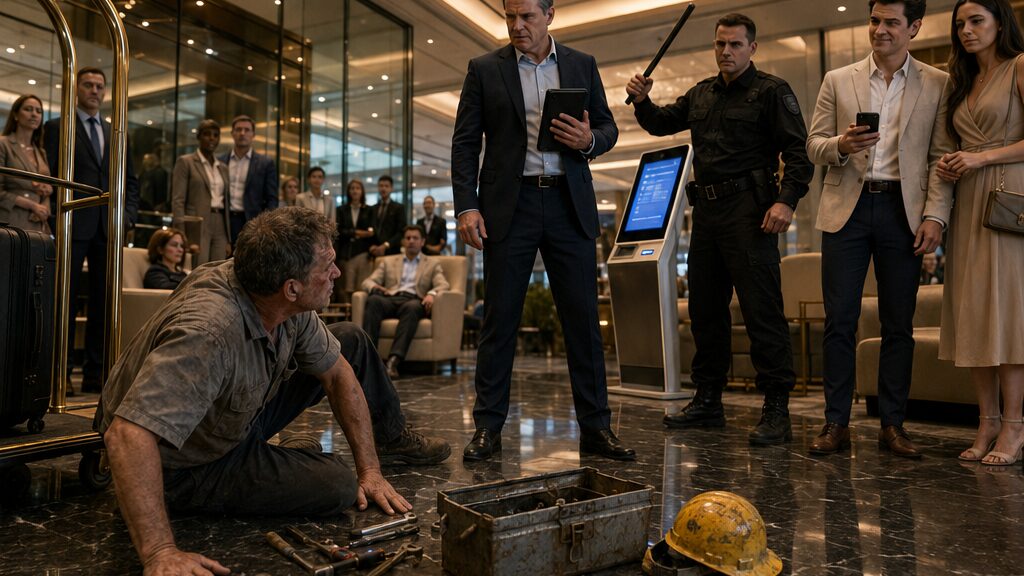
The guard tried again, this time shoving Joshua backward from the toolbox. Joshua took one step, his boot sliding slightly on the polished marble. His hard hat slipped from under his arm and dropped near his feet.
Steven pointed the phone lower. “Get the hat. That’s the best part.”
The second guard nudged the toolbox with his shoe.
Not hard. Not enough to break it. Just enough to make it slide away from Joshua.
The latch popped.
Tools spilled across the marble.
A wrench rang out, bright and ugly. The taped screwdriver skidded beneath a cream leather chair. Socket heads rolled toward the champagne station, small dark circles against pale stone.
Something inside Joshua went very still.
No one moved to pick them up.
Stephen looked down at the scattered tools, then back at Joshua. “Look at this mess.”
Joshua bent.
Stephen’s hand came fast.
The slap cracked through the lounge, louder than the music, louder than the rolling tools, louder than Steven’s pleased intake of breath.
Joshua’s head turned with the force of it.
His hard hat spun away, hit the wheel of a gold luggage cart, and rolled underneath until only the scratched yellow rim showed in the shadow.
For a moment, there was no sound but the uneven ticking inside the kiosk.
Stephen stood over him, breathing harder now. His face had flushed. The slap had surprised him too, but he covered it with contempt.
“Garbage like you,” he said, each word sharpened for the room, “doesn’t deserve to breathe the same air as us.”
Heather made a sound as if she had been struck.
Samantha lowered Steven’s phone with her hand, but Steven pulled it back up.
Joshua tasted blood where his cheek had cut against a tooth. He did not lift a hand to it.
He looked at the hard hat beneath the luggage cart.
Years ago, before his name was on glass towers and airport contracts, that hat had hung from a nail in a maintenance shed. He had worn it through nights when passengers slept in terminals and no one saw the men keeping the lights alive. He had kept it after the first contract, after the first office, after the first board tried to replace his crews with cheaper labor and prettier uniforms.
A reminder, he used to tell himself.
A promise, if he was being honest.
And he had walked into this lounge wearing it like a test.
Maybe that had been pride. Maybe cowardice. Maybe he had wanted the room to condemn itself so completely that his own delay would look like wisdom.
Stephen stepped back and gestured sharply to security. “Remove him now.”
Joshua slowly crouched and reached toward the luggage cart.
The nearest guard drew his baton.
Heather whispered, “Please don’t.”
Joshua’s fingers closed around the rim of the fallen hard hat. He pulled it from under the gold cart, scratched and dusty now, and held it at his side.
The guard raised the baton.
Joshua looked up, cheek burning, tools scattered around his boots, and did not defend himself yet.
Chapter 4: The Baton Breaks Before the System Does
Joshua caught the baton before it touched him.
The guard’s arm stopped in the air as if the lounge itself had frozen around it. The black baton was angled toward Joshua’s shoulder, one end trapped in his hand, the other still gripped by the guard whose face had gone slack with disbelief.
Joshua did not step back.
The hard hat hung from his other hand, scratched and dusty from the floor. His cheek burned where Stephen had slapped him. Around his boots, his tools lay scattered across the marble like pieces of a life the room had decided was worthless.
“Let go,” the guard said, but his voice had lost its force.
Joshua looked at the baton. “You were really going to use this.”
“Security response,” Stephen snapped. “He assaulted my staff.”
No one answered him.
Steven’s phone was still raised, though his smile had become uncertain. Samantha stood beside him with one hand against her throat. Heather had moved near the service desk, her eyes fixed not on Joshua’s face but on his hand around the baton.
Joshua remembered other hands around tools. Older hands. Grease-stained hands. Men and women whose names had never appeared in annual reports, though their work had kept the terminals alive through storms, outages, and holiday crowds. He had built his first company because he believed labor should not have to beg for dignity.
Now a guard in his own lounge had lifted a weapon over a man reaching for a fallen hard hat.
Joshua twisted.
The baton came free.
The guard stumbled forward, shocked by how easily he had lost it. Stephen jabbed at the tablet in his hand.
“Lock this zone,” Stephen ordered. “Now.”
A soft tone pulsed overhead. The glass boarding partition slid shut. The staff-side door clicked. The main lounge entrance sealed with a quiet mechanical confidence that made several guests turn sharply.
Joshua heard each lock engage.
Stephen’s breathing steadied once the doors were closed. He had his room again, or thought he did. His thumb moved across the master control tablet, and a red security banner appeared at the top of its screen.
“Unauthorized violent disturbance,” he said, reading as he typed. “Male trespasser. Maintenance disguise. Threatening guests with stolen security equipment.”
Joshua stared at him. “You’re filing that?”
“I am documenting reality.”
Heather took one step forward. “Sir, that’s not what happened.”
Stephen did not look up. “Return to your station.”
“I saw him reach for his hard hat.”
“He seized a baton.”
“After—”
“Heather,” Stephen said, finally turning. “Your employment depends on whether you understand what a secure guest environment requires.”
Her face closed.
Joshua felt the mistake inside himself like a weight shifting. He had wanted them to reveal themselves. He had wanted the record to catch their choices cleanly. But Stephen was writing the record in front of him, converting cruelty into procedure with two fingers and a glowing screen.
Reports did not protect people when the wrong person controlled the report.
“Open the incident log,” Joshua said.
Stephen’s laugh was breathless. “You are in no position to demand anything.”
Joshua looked at the tablet. “That device can seal the doors, file a disturbance, override guest flow, suppress maintenance alerts, and bury closed reports under service classifications.”
Stephen’s thumb stopped.
Steven lowered his phone slightly. “How does he know all this?”
“He doesn’t,” Stephen said too quickly. “He’s guessing.”
Joshua lifted the baton. The guard backed away.
The black polymer was heavy, cheaper than it looked, worn smooth at the grip. Joshua had approved a security procurement plan years ago after being told nonlethal deterrence was necessary for high-volume airports. He had asked then whether training would emphasize restraint.
He had believed the answer.
That was the part that tightened his throat now. Not Stephen’s slap. Not Steven’s laugh. The memory of himself accepting polished assurances because they had come in polished language.
He placed the hard hat on the floor beside his toolbox.
“Joshua,” Heather whispered, barely realizing she had used his name from the badge. “Please.”
Stephen heard the name and misread it as familiarity, weakness. “Yes. Joshua. Put the baton down before you turn a trespass into a criminal charge.”
Joshua looked at him. “You closed the doors.”
“For guest safety.”
“You filed a false incident.”
“For legal protection.”
“You buried an injury.”
Stephen’s face flickered. “Careful.”
The kiosk behind Joshua ticked again. Louder now. Its blue logo pulsed, dimmed, then brightened. A thin line of white text flashed at the bottom of the screen and vanished.
Joshua turned toward it.
Stephen stepped sharply sideways, tablet lifted. “Do not touch company property.”
Joshua almost laughed. It would have sounded ugly in the clean room.
Company property.
The phrase struck the precise nerve Stephen could not have known existed. Joshua had heard it twenty years ago from a procurement director who wanted to replace injured workers before their claims cleared. Company property. Company time. Company risk. Words that made people disappear behind assets.
He gripped the baton with both hands.
The guard said, “Sir?”
Joshua snapped it in half.
The crack cut through the lounge like a shot.
Steven flinched backward so hard he bumped Samantha’s shoulder. The guard stared at the broken pieces in Joshua’s hands. Stephen froze with the tablet glowing against his palm.
Joshua kept one half: the handle.
He crossed to the touchscreen kiosk.
“Stop him!” Stephen shouted.
No one moved fast enough.
Joshua drove the broken handle into the lower corner of the glass interface. The first strike spiderwebbed the screen. The second punched through the glowing surface. The third split the kiosk open with a violent burst of sparks and blue-white light.
The lounge alarm screamed.
Guests recoiled. A glass of champagne toppled and shattered near a cream leather chair. The boarding partition flickered. The kiosk coughed out a strip of paper from a service slot no guest had ever noticed.
Joshua hit it once more.
The screen went black.
Then, from the cracked display, old diagnostic text began to crawl upward in pale broken lines.
L-SEVEN OVERRIDE.
PARTITION FORCE EXCEEDED.
MANUAL RECLASSIFICATION: GUEST-FLOW INTERRUPTION.
Six weeks ago.
Heather put both hands over her mouth.
Stephen stared at the ruined kiosk, then at the tablet in his hand, as if one machine had betrayed the other.
Joshua dropped the broken baton handle onto the marble. It landed beside a socket wrench with a small, final sound.
Stephen found his voice in a shout.
“Call airport police! He destroyed private property! Lock him up!”
But no one looked at Joshua’s tools anymore.
They looked at the broken kiosk, where the suppressed injury report flashed across the dead luxury screen.
Chapter 5: The Report That Proved Too Little
The kiosk kept printing after the screen died.
Thin white paper fed from the cracked service slot in uneven jerks, curling down over the smashed glass like a confession too late to matter. Each strip carried broken lines of diagnostic text, time stamps, override codes, and one phrase that appeared three times before the printer jammed.
MANUAL RECLASSIFICATION APPROVED.
Stephen lunged for the paper.
Joshua caught his wrist before he touched it.
“Don’t,” Joshua said.
The word landed quieter than the alarm, but stronger.
Stephen’s face was slick with sweat now. The perfect part in his hair had loosened. “That is internal data.”
“That is evidence.”
“That is vandalized property producing corrupted output.”
Joshua looked past him. “Heather.”
She was standing rigid near the service desk, eyes wet but focused.
“Who filed the first complaint?”
Her lips parted, then closed. Stephen’s wrist trembled under Joshua’s grip. The staff watched her from behind the bar, from near the lounge entrance, from beside the champagne station where no one was drinking anymore.
Heather swallowed. “I did.”
Stephen jerked against Joshua’s hand. “You are not authorized to discuss internal—”
Joshua tightened his grip just enough to stop him.
Heather spoke faster, as though courage might leave if she slowed down. “A baggage porter got his hand caught when the glass partition closed early. He was moving delayed carry-ons through the service side. The kiosk flickered, then the partition reset. His fingers were trapped for maybe four seconds.”
Samantha flinched.
Steven muttered, “That has nothing to do with—”
“It has everything to do with why he asked for the log,” Samantha said.
Steven stared at her.
Joshua released Stephen’s wrist and crouched by the kiosk. He pulled his taped screwdriver from where it had stopped near a chair leg, then used it to pry open the lower panel the impact had bent loose. The smell of heated plastic rose immediately.
“Power relay is scorched,” he said.
Heather nodded, her voice smaller. “Facilities said it needed replacement.”
“Who changed the report?”
She looked at Stephen.
Stephen raised the tablet like a judge raising an order. “I am ending this right now.”
His thumb moved fast. Joshua saw the screen flash: SECURITY DISTURBANCE ACTIVE. GUEST THREAT. POLICE RESPONSE REQUESTED.
Then another window appeared.
Incoming Call: Christopher Scott.
Stephen’s face changed so quickly the whole lounge seemed to see it. The panic became relief, then calculation.
He answered at once. “Mr. Scott. We have a serious disturbance in the lounge.”
The tablet projected the sound just enough for those closest to hear Christopher’s voice, clipped and tense. “Contain it.”
Joshua’s head turned slightly.
Stephen swallowed. “Airport police are being called.”
“No police inside the lounge until I arrive,” Christopher said. “Keep guests calm. Keep cameras controlled. Do not let this spread.”
Joshua watched Stephen’s eyes. There was no surprise in them at Christopher’s priority. Only obedience.
“Yes, sir,” Stephen said.
“And Stephen?”
“Yes?”
“Is the old man there?”
The old man.
A silence opened around those words.
Stephen did not look at Joshua. “There is a maintenance trespasser, yes.”
Christopher exhaled sharply through the speaker. “I’ll be there in minutes.”
The call ended.
Stephen lowered the tablet, newly pale.
Joshua rose. “You called him old man.”
Stephen’s mouth worked. “He meant—”
“He knew someone was coming.”
“No.”
Joshua took one step closer. “He told you to contain the lounge before he asked who was hurt.”
Stephen looked toward Steven, searching for the familiar shelter of wealth.
Steven had turned his attention back to his phone. “This is already going up.”
Samantha grabbed his sleeve. “Don’t.”
“Are you kidding? He smashed a kiosk in an airport. This will explode.”
Steven tapped the screen before she could stop him.
Joshua saw the cropped frame reflected in the glass partition: himself with the baton handle raised, the kiosk bursting under his strike. Not the slap. Not the toolbox. Not the guard’s baton lifted first. Not Stephen’s false report. Just the one image that made him look like exactly what Stephen wanted him to be.
A violent trespasser in dirty clothes.
Joshua felt, for the first time that evening, the cost of remaining unnamed.
He had trusted the room to reveal the truth by behaving badly enough. He had trusted evidence to sit cleanly in broken machines and hidden logs. But Steven’s clip had already left the lounge, stripped of every cause before the consequence.
Stephen saw Joshua understand and seized the opening.
“There,” he said loudly, pointing at Steven’s phone. “Every guest here can confirm what happened. He became violent. We acted with restraint.”
Heather said, “That’s not true.”
“It will be,” Stephen said.
The words were meant for her. Maybe for all of them.
Joshua looked down at the half-printed report. Names had been shortened to employee numbers. The injured porter was a code. Heather’s complaint was a code. Stephen’s reclassification was a code. Christopher’s containment call was only sound in the air unless someone else admitted what it meant.
A report could prove a fault.
It could not prove why people had allowed the fault to survive.
The alarm shifted to a lower tone. Outside the glass entrance, rain streaked across the darkening airport curb. Blue runway lights blinked in the distance through the water.
Stephen, recovering, walked backward toward the lounge desk. “Everyone remain calm. The situation is under control.”
Joshua picked up his old wrench from the floor.
The tool was warm from the marble where the kiosk sparks had landed near it. He wiped it once on his work shirt and looked at the scratched handle. It had opened panels in terminals before his company had a name. It had tightened bolts under conveyor belts while executives complained about delays above him.
He used it now to reach into the kiosk and lever out the scorched relay.
The blackened piece dropped onto the marble.
Heather stared at it as though it were a bone.
“This was not cosmetic,” Joshua said.
Stephen’s eyes darted to the door, to the tablet, to the guests. “You are not qualified to make that determination.”
“No,” Joshua said. “You were not qualified to ignore it.”
The sound came from outside before Stephen could answer.
Tires.
Not the soft roll of airport shuttles. A sharp, controlled screech against wet pavement. Then another. Then a third.
Every head turned toward the rain-slick VIP curb beyond the glass entrance.
Three black Rolls-Royces had stopped in a line beneath the private awning, their headlights cutting white through the downpour.
Stephen’s tablet chimed again, but this time he did not look down.
Joshua did not move.
Chapter 6: The CEO Kneels in the Mud
Christopher Scott ran from the first Rolls-Royce before the driver had fully opened the door.
Rain struck his dark suit and flattened his hair against his forehead. He ignored the umbrella thrust toward him by another man and crossed the curb so quickly his polished shoes slid at the edge of a muddy strip beside the private awning.
Inside the lounge, Stephen stood with the tablet clutched against his chest.
Steven lowered his phone at last.
The glass entrance unlocked with a command from outside. Cold wet air pushed into the warm lounge, carrying the smell of rain, fuel, and runway pavement. Christopher stepped over the threshold, saw the shattered kiosk, saw Stephen, saw the guard, saw the scattered tools.
Then he saw Joshua.
Whatever color remained in his face vanished.
Christopher did not walk to him.
He dropped.
Both knees hit the muddy edge of the entrance mat where rainwater had blown in from the curb. The sound was dull, impossible, and final. Mud splashed the front of his suit trousers.
“Chairman,” Christopher said, his voice breaking. “We deserve death. Please forgive us.”
No one breathed.
The word seemed to move through the lounge slower than the alarm light.
Chairman.
Steven’s mouth opened, but nothing came out. Samantha’s hand dropped from his sleeve. Heather stared at Joshua as if the room had tilted and every hidden line in it had suddenly become visible.
Stephen whispered, “No.”
Joshua stood among the scattered tools in his faded work shirt, cheek still marked red from the slap. He did not look larger. His clothes did not change. The toolbox remained dented. The hard hat was still scratched.
Only the room changed around him.
Christopher bowed lower, hands braced on the wet floor. “I came as soon as I understood.”
Joshua looked at him for a long moment. “Understood what?”
Christopher lifted his head just enough to meet his eyes, then looked away. “That you were inside.”
“Not that a worker was struck.”
The silence after that was worse than the kneeling.
Christopher’s throat moved. “Sir—”
“Stay there.”
Christopher froze.
Stephen took one step forward, desperation sharpening him. “Mr. Scott, this man destroyed—”
“Quiet,” Christopher said.
It was not loud, but it cut Stephen down instantly.
Joshua watched that too. One word from Christopher could silence Stephen. One word from Joshua could silence Christopher. And yet Heather had filed reports for six weeks that no one wanted to hear.
He looked at the mud darkening Christopher’s knees.
“How many complaints reached your office?” Joshua asked.
Christopher closed his eyes briefly. “More than one.”
“How many?”
“Four formal. Several informal.”
Heather made a small sound.
Stephen said, “They were guest-flow matters. Minor service disruptions.”
Christopher did not defend him.
Joshua’s voice stayed even. “Why were they softened?”
A second Rolls-Royce door opened outside.
Brian Harris stepped out beneath an umbrella, heavy coat buttoned, silver hair untouched by rain. He moved with the irritation of a man summoned from comfort into inconvenience. His eyes found Steven first, then the broken kiosk, then Christopher kneeling on the wet floor.
His expression shifted.
“What is this?” Brian demanded.
Steven took one step toward him. “Dad, this lunatic—”
“Be silent,” Brian said, though he had not yet understood enough to be afraid.
Joshua did not look at Steven. He kept his eyes on Christopher. “Answer me.”
Christopher swallowed. “The Harris renewal was under review. Their family office controls multiple long-haul corporate contracts through our lounges. The service complaints were flagged as sensitive because they involved guest experience.”
“Guest experience,” Joshua repeated.
Christopher flinched.
Stephen gripped the tablet harder. “I followed escalation guidance.”
“You reclassified an injury,” Joshua said.
“I protected the lounge from overreaction.”
“You protected yourself.”
Stephen’s face twisted. For one moment the polished director disappeared, and what remained was a frightened ambitious man backed into the ruin of his own performance.
“You don’t understand what this place is like,” Stephen said. “One bad review from someone like him”—he pointed at Steven—“and corporate wants names. Not theirs. Mine. The guests complain if they see carts, uniforms, tools, workers eating near the corridor. They pay for separation. I gave them what the brand sells.”
Joshua’s eyes moved across the lounge: the cream chairs, the gold luggage cart, the dead kiosk reflecting alarm light, the tablet glowing in Stephen’s hand.
“And when workers bled?”
Stephen’s mouth shut.
Brian had gone still beside the entrance. “Steven,” he said slowly, “what did you do?”
Steven’s confidence returned in the wrong shape: defensive, childish, loud. “I didn’t do anything. The guy was standing there like some dirty terminal worker. Martin handled it badly, maybe, but then the maniac smashed the kiosk.”
Samantha looked at him as if seeing him from a distance. “You told them to throw him out.”
Steven glared at her. “Don’t start.”
“You recorded him after they scattered his tools.”
“I said don’t start.”
Brian’s gaze moved to the tools on the floor. The socket heads. The taped screwdriver. The old wrench near the scorched relay. Then to Joshua’s face.
Recognition did not come from memory. Brian did not know the man personally. It came from Christopher still kneeling.
From Stephen’s fear.
From the word Chairman hanging in the expensive air.
Brian’s face tightened with a shame that had arrived too late to look noble.
“Mr. Carter,” he said.
Joshua finally turned to him.
Brian lowered his head slightly. Not a bow. Not yet. A calculation bending under consequence. “Whatever my son said or did, I will make it right.”
Joshua looked at Steven. “Will you?”
Steven’s face flushed. “Dad, you can’t be serious.”
Brian’s jaw hardened. “Did you insult him?”
Steven looked around at the lounge, searching for support and finding only witnesses.
“He didn’t belong here,” he said.
Heather’s voice, quiet but steady, crossed the room. “He belonged before any of us.”
Joshua looked at her then. She seemed startled by her own courage, but she did not take it back.
Christopher’s hands were shaking against the wet floor.
Joshua felt the anger widen until it was no longer centered on his cheek, or the tools, or the insult. It reached backward into every softened report, every worker told to stay invisible, every executive summary that had turned fear into language safe enough to ignore.
His own name was at the top of all of it.
Brian stepped toward Steven.
The ring on his hand caught the alarm light.
“Get on your knees,” Brian said, voice low and dangerous, “before he orders us all out.”
Chapter 7: The Heir Crawls for the Scattered Tools
Brian slapped Steven before Steven understood he had lost the room.
The sound was clean and flat, sharper than the alarm now pulsing low through the First Class Lounge. Steven’s head turned with the force of it. His phone slipped from his fingers, hit the marble, and spun to a stop beside one of Joshua’s socket heads.
No one moved to pick it up.
Steven stared at his father with one hand pressed to his cheek. His eyes were wide, more stunned than hurt.
“Dad—”
“On your knees,” Brian said.
Steven’s mouth opened again.
Brian took one step closer. His face was not red with rage. That would have been easier to look at. It was pale with recognition, the kind that arrives when a man sees not one mistake but the long road of permissions that led to it.
“You wanted everyone to see you,” Brian said. “Now let them see you.”
Steven looked around the lounge. The guests he had tried to entertain would not meet his eyes. The guards stood useless near the sealed entrance. Stephen Martin clutched the master control tablet, but its authority had drained from it; the screen still glowed, still offered commands, and no one believed in it anymore.
Samantha stood very still. Rain glimmered behind her through the glass. Her face carried no satisfaction. Only a quiet disgust, and something like grief for the version of herself that had almost kept standing beside him.
Steven dropped to one knee as if the floor had been lowered beneath him.
“Both,” Brian said.
Steven sank fully.
Joshua watched without speaking.
The old toolbox sat open near the ruined kiosk. Its contents were spread across the marble: socket wrench, taped screwdriver, insulated pliers, small voltage tester, loose sockets, a roll of worn black tape, a stubby flashlight with scratches along its side. Every item seemed louder now than the champagne glasses, the leather seats, the locked glass partition, the dead kiosk whose cracked screen reflected the alarm lights in broken red strokes.
Brian pointed to the nearest tool. “Pick them up.”
Steven’s face twisted. “You can’t make me crawl around like—”
Brian’s hand lifted half an inch.
Steven stopped.
Then he bent forward and picked up the first socket.
It was small enough to disappear in his palm. He held it as if it were dirty.
“Properly,” Brian said.
Steven crawled toward the toolbox.
The room watched him move across the same marble where he had laughed at Joshua moments before. His designer trousers creased at the knees. One cuff dragged through a thin smear of mud Christopher had brought in from outside. He placed the socket into the box too quickly, and it clanged against the bottom.
Joshua’s eyes flicked to the toolbox.
“Don’t throw it,” he said.
Steven froze.
For the first time, he looked directly at Joshua without the protection of mockery. His cheek was reddening under the shape of his father’s hand. His voice, when it came, sounded younger.
“I didn’t know.”
Joshua said nothing.
Steven swallowed. “I didn’t know who you were.”
The words changed the air in the wrong way.
Joshua looked down at him. “That was the problem you chose to keep.”
Steven’s eyes dropped.
Brian closed his eyes briefly.
Christopher remained kneeling near the threshold, rainwater darkening the edge of the mat around him. Joshua had not told him to rise, and the CEO had not dared to decide for himself that his apology was finished.
Stephen tried.
“Chairman Carter,” he said, voice brittle, “with respect, Mr. Harris’s behavior was unacceptable, but we have a larger operational issue. The lounge cannot remain sealed. There are departures. High-value guests. Airport coordination. Media exposure.”
Joshua turned his head slowly.
Stephen’s words faltered under that look, but he forced himself on. “I accept that mistakes were made in classification. I can suspend the staff involved, submit a corrected report, and personally oversee the reopening process.”
Heather’s face went white at “staff involved.”
Joshua saw it. So did Samantha.
“You mean her,” Samantha said.
Stephen’s eyes flashed toward her. “Miss, you don’t understand internal procedure.”
“I understand blaming the only person who told the truth.”
Steven, on hands and knees near the champagne station, stopped reaching for the taped screwdriver.
Samantha stepped away from him at last. The movement was small, but in that room it sounded like a door closing.
She crossed to where the screwdriver lay half under the cream leather chair. She crouched, pulled it free carefully, and held it for a moment by the taped handle. Her hands trembled.
Then she walked to Joshua.
“I should have stopped him earlier,” she said.
Joshua took the screwdriver from her. “Yes.”
She flinched, but did not look away.
He placed it into the toolbox himself.
That small act loosened something in the room. A lounge attendant near the bar bent and retrieved the roll of tape. Another staff member picked up the voltage tester, then glanced at Stephen as if expecting punishment. Stephen’s mouth tightened, but he said nothing. The staff member put the tester into the box.
Steven looked around, realizing the humiliation had changed shape. He was no longer being punished only by his father. He was being abandoned by the silence that had protected him.
He crawled toward the hard hat last.
Joshua stopped him with one word.
“No.”
Steven’s hand hovered above the scratched yellow brim.
Joshua walked over and picked up the hard hat himself. Dust clung to the rim. A faint scuff marked the place where it had hit the gold luggage cart. He turned it over in his hands, thumb passing once across an old faded sticker inside the shell.
For a second, the lounge disappeared.
He saw a maintenance shed in the back of a terminal, the hot smell of old wiring, a crew eating sandwiches on overturned buckets because no one had given them a break room. He heard a man telling him, “Build it different if you ever get the chance.”
He had gotten the chance.
And still Heather had learned to whisper.
Christopher’s voice came from the floor near the entrance. “Chairman, I can terminate Stephen immediately. I can issue a statement before Steven’s clip spreads. We can preserve the lounge opening if we move quickly.”
Joshua looked at him.
There it was again. The polished instinct. Remove one bad piece. Protect the machine. Keep the premium environment breathing.
Stephen seized the offer. “Yes. I’ll cooperate fully. This can be contained.”
“Contained,” Joshua said.
Christopher’s face tightened. He heard it then.
Brian turned toward Joshua. “Mr. Carter, whatever action you require from my family—”
“This is not only your son.”
Brian fell silent.
Joshua looked around the lounge, at the staff, the guests, the guards, the shattered kiosk, the useless tablet, the gold cart, the glass partition sealed across the private boarding lane. Luxury had always been theater, but he had once believed it could be decent theater: comfort without contempt, service without erasure.
He had been wrong, or careless, or too willing to accept clean reports from men paid to keep dirt out of sight.
Steven placed the last socket into the toolbox, slower this time.
Joshua closed the lid.
The latch clicked.
The sound was small, but it ended something.
Stephen tried one final time. “Chairman, the departures—”
Joshua lifted the hard hat and put it back on.
The scratched yellow shell sat above the red mark on his cheek. It looked absurd against the marble and gold. It looked truer than anything else in the room.
“No one boards from this lounge tonight,” Joshua said.
Chapter 8: The Lounge Closes Without Applause
VIP boarding staff began protesting before Joshua finished the order.
Their voices rose from the glass partition, from the desk, from the corridor beyond the sealed entrance. Flights were waiting. Guests had paid. Private transfers had been scheduled. A family near the champagne station demanded a manager, then remembered Stephen was standing there with a dead tablet and said nothing more.
Joshua pointed to the main doors.
“Open the general terminal route,” he said. “Every passenger here will be escorted through standard boarding.”
Stephen looked stricken. “Chairman, that will create chaos.”
Joshua turned to him. “No. It will create inconvenience.”
The distinction landed hard.
Christopher finally lifted his head from the wet entrance mat. “Sir, airport operations will need a formal reason.”
“They’ll have one.”
Joshua picked up the scorched relay from the marble and placed it on the lounge desk. Beside it, he set the printed diagnostic strips from the ruined kiosk, the broken baton handle, and Stephen’s master control tablet.
The tablet still displayed the false disturbance report.
Joshua touched the screen once, not to unlock it, only to wake it from dimming. The words returned in blue-white light: maintenance disguise, violent trespasser, guest threat.
He looked at Stephen. “This is what you tried to make true.”
Stephen’s mouth moved, but no defense came out.
Heather stood a few feet away with her hands clasped so tightly her knuckles had gone pale. She had not joined the other staff gathering tools. She looked like someone waiting for punishment to remember her name.
Joshua saw it and hated how familiar it was.
“Heather,” he said.
She straightened. “Sir.”
The title struck him worse than the slap.
For a moment, he considered telling her not to call him that. But that would have asked her to pretend the room had not changed. She had spent the evening surviving people who renamed things to protect themselves: injury into guest flow, assault into disturbance, fear into service culture.
He would not demand another false word from her.
“You filed the complaints?”
“Yes.”
“How many?”
“Three formal reports. One written statement after the porter came back from the clinic. I sent copies to lounge operations.”
Stephen’s voice returned in a rush. “Those were reviewed.”
“No,” Heather said, and the single word shook as it left her. “They were returned.”
Joshua looked at her. “Returned?”
She nodded. “With wording changes. I was told to remove anything that suggested guest risk. Then the porter was moved to night baggage transfer.”
Brian’s jaw tightened. “Because of my family’s renewal?”
Heather looked at him, terrified by the idea of answering.
Joshua did it for her. “Because everyone here knew which comfort mattered.”
Brian absorbed that without protest.
Christopher pushed himself up from the floor at last, not to stand fully, but to kneel straighter. Mud streaked his trousers. “Chairman, I will resign publicly.”
Joshua looked at him. “No.”
Christopher blinked.
“You don’t get to leave before facing them.”
He motioned toward Heather, the attendants, the guards, the workers who had stood at the edges of the room all evening, trained to be present and invisible at once.
Christopher’s face folded with something deeper than fear. Shame, maybe. Or the beginning of it.
Joshua turned to the staff. “Every complaint filed in this lounge for the past year will be reopened by an independent safety and labor review. No one who cooperates will be terminated, reassigned, demoted, or pressured into silence. If any supervisor tries, they will be removed before the review is finished.”
Heather’s eyes filled.
She did not smile. That would have been too simple. She looked as if someone had lifted a weight she had learned to carry without showing it.
Stephen said, “Chairman Carter, I understand the optics, but closing the lounge publicly will damage confidence across the network.”
Joshua picked up the broken baton handle. “Confidence in what?”
Stephen stared at it.
Joshua set it back down. “In the locks? The tablets? The glass? The idea that no one poor enough to fix the room is clean enough to stand in it?”
No one answered.
Steven sat on his heels beside the toolbox, cheeks flushed, hair fallen out of place. He looked smaller without the phone in his hand. Brian stood behind him, no longer performing authority, only facing the shape of what money had protected.
Samantha picked up Steven’s phone from the floor. For one second Steven reached for it, panic flashing across his face.
She did not hand it to him.
Instead, she opened the video. The cropped upload still glowed on the screen, already gathering comments from strangers who had seen only Joshua’s strike against the kiosk.
Samantha deleted it.
Steven stared. “What are you doing?”
“Not helping you lie.”
He looked at his father for rescue. Brian gave none.
Joshua watched the exchange and felt no triumph. The room had given him everything he had come for: proof, witnesses, the hidden injury, the fear in his staff, the cowardice of his executives, the cruelty of a guest whose family mattered too much. It should have felt clean.
It did not.
Because he had received anonymous complaints weeks ago, printed and placed in a private folder on his desk. Because he had chosen to arrive quietly instead of calling every executive into a room and demanding names. Because part of him had wanted undeniable proof, not simply for justice, but so no one could accuse him of overreacting.
Heather had not had the luxury of waiting for undeniable proof.
The injured porter had not had it either.
Joshua lifted the toolbox. Its weight settled into his palm, familiar and unforgiving.
“Christopher.”
“Yes, Chairman.”
“Before you resign, before you issue any statement, you will meet with every staff member assigned to this lounge. Not in a boardroom. Not through counsel. Here. You will listen to what they filed and what they were told to change.”
Christopher nodded. “Yes.”
“Brian.”
Brian straightened.
“Your renewal is suspended until the review is complete.”
Steven jerked his head up. “Dad—”
Brian said, “Quiet.”
Joshua looked at Steven. “You will apologize to every worker you insulted tonight. Not because your father slapped you. Because you understand why you were wrong. If you don’t understand, stay silent until you do.”
Steven looked down at the closed toolbox. “I’m sorry,” he said, but it came out thin and frightened.
Joshua did not accept it. Not yet.
The lounge doors opened at last, not to the private boarding lane but to the public terminal corridor. The warm air spilled out and mixed with the ordinary airport noise beyond: rolling bags, boarding calls, tired children, shoes squeaking on tile. The sound entered the First Class Lounge like a truth it had been built to exclude.
Guests filed out under staff direction, irritated, confused, some embarrassed. No one clapped. No one cheered. A few avoided Joshua’s eyes. One guard removed his security earpiece and set it quietly on the desk beside the broken tablet.
Heather stayed near the threshold.
Joshua stopped beside her. “The porter. Do you know where he is assigned tonight?”
“Night baggage transfer,” she said. “Gate service basement.”
“Bring him to the review tomorrow.”
“He may not trust it.”
Joshua looked at the service corridor where he had entered, the narrow passage half-lit beyond the staff door, smelling faintly of machine oil and cold air.
“I wouldn’t either,” he said.
He tucked the hard hat under his arm now instead of wearing it. The red mark on his cheek had darkened. The toolbox pulled at his shoulder as he walked, but he did not switch hands.
Behind him, Christopher remained with the staff. Brian stood beside Steven without touching him. Stephen sat in a lounge chair, tablet taken from him, staring at the dead kiosk as if the screen might still restore the world he understood.
Joshua reached the staff-side corridor.
For years he had entered lounges through private boardrooms, ribbon cuttings, executive doors, places where everyone already knew his name. Tonight he left through the maintenance passage, past the scanner that had rejected him, past the brass frame that had kept workers waiting outside luxury.
At the door, he turned back once.
Heather was watching him.
Joshua lifted the toolbox slightly, not as a salute, not as performance, but as acknowledgment.
Then he walked into the service corridor, and the First Class entrance locked behind him with a soft, final click.
The story has ended.