The HOA Graded Over His Property Markers—Then the Drainage Map Changed Who Controlled the Project
Chapter 1: The Morning Four Bright Markers Disappeared
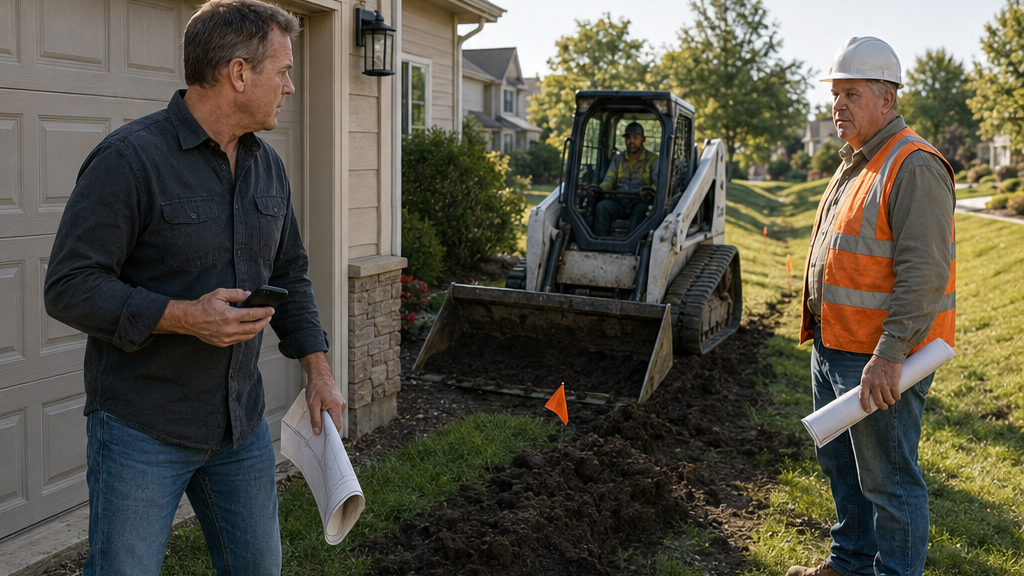
The loader blade reached the first orange survey flag before Gregory Miller reached the edge of his lawn.
“Hold up!”
The operator either did not hear him or did not understand that Gregory meant now. The compact track loader kept crawling forward, steel bucket lowered, pushing a dark roll of damp soil through the shallow swale that separated Gregory’s side yard from the landscaped common strip.
The orange flag bent.
For half a second it lay flat against the dirt.
Then it vanished beneath the blade.
Gregory stopped walking.
There had been four flags.
He knew because he had driven around them with his mower for five years.
They were not decorative stakes. Beneath each one sat a survey marker placed when he had hired a licensed surveyor in 2019, after replacing the fence behind his garage. The markers defined the narrow strip of land his uncle had left him along with the house.
Now fresh dirt covered the first location.
A second flag trembled ten yards ahead.
Gregory pulled out his phone.
The loader stopped only when a man in an orange safety vest raised one hand toward the operator. The man wore a white hard hat and carried a rolled plan under one arm. Gregory recognized him from the drainage-project notices: Joseph Hall, the superintendent for the contractor hired by the homeowners association.
Joseph walked over without hurrying.
“You Gregory?”
“Yes. That machine just went over my property marker.”
Joseph glanced toward the track loader.
“We’re shaping the drainage corridor.”
“That isn’t what I said.”
Joseph looked back at him. “I heard you.”
Gregory pointed at the dirt. “There was a pin right there. Survey flag over it.”
“Pins move.”
“Not three feet underground, they don’t.”
Joseph gave a small, tired smile. It was not quite laughter, but Gregory disliked it more than anger.
“We work off approved plans,” Joseph said. “Not homeowner flags.”
Gregory felt the reply rise in his throat and stopped it there. He had spent twenty-six years estimating lumber, concrete, fasteners, and delivery costs for a building-supply company. He knew what happened when two men began arguing beside operating machinery. Facts got replaced by volume.
So he crouched instead.
At the edge of the loader track, a shallow scrape had exposed the top of a rust-colored metal rod before the next pass covered it. Gregory took three photographs: one wide enough to show his garage corner, one showing the flag lying beside the disturbed soil, and one close enough to capture the rod.
Joseph watched.
“You documenting me?”
“I’m documenting my property.”
“This whole strip is drainage easement.”
“Show me the width.”
Joseph unrolled the plan against the hood of his pickup.
There were heavy black lines, shaded areas and contractor notes Gregory could not read from where he stood.
Joseph tapped a broad band running behind several houses.
“Association drainage corridor.”
“That doesn’t answer my question.”
“It answers the one that matters to us.”
Gregory stepped closer. “Where is my property line on that drawing?”
Joseph’s finger stopped.
Only for a second.
Then he tapped another line.
“Here.”
Gregory studied it. The line appeared to run almost against the wall of his garage.
His 2019 survey did not.
“That’s wrong.”
Joseph rolled the sheet halfway closed. “Then take it up with management.”
The operator revved the machine.
Gregory looked toward the remaining flags. The second stood near a clump of ornamental grass. The third was farther downhill. The fourth, barely visible, marked the lower end of the narrow parcel.
“Don’t continue until somebody verifies this.”
Joseph’s expression hardened.
“I’ve got six men here, rented equipment, erosion-control work open, and a schedule approved by the HOA. I’m not shutting down because you remember a line differently.”
“I don’t remember it differently. I have a survey.”
“Then send it to the association.”
Gregory stared at him.
Two project notices had arrived during the summer. He remembered both now with uncomfortable clarity: white envelopes from the management company, each describing drainage improvements along the eastern common area. He had skimmed them, seen nothing naming his lot, and dropped them into the kitchen drawer with old meeting agendas.
He had assumed that if the association needed his land, someone would ask.
Nobody had.
That assumption suddenly felt less principled than lazy.
Joseph stepped away and lifted his hand toward the operator.
Gregory said, “I’m asking you one more time to stop until the boundary is checked.”
Joseph hesitated.
Then he took out his own phone and called someone.
“Yes,” he said after a moment. “Homeowner on the Miller lot says our corridor is on his parcel.”
A pause.
“He says he has a survey.”
Another pause.
Joseph looked directly at Gregory.
“All right.”
He ended the call.
“Paul Wright says proceed according to the approved plan. You can send your documents to management.”
The loader moved.
The second flag folded beneath a track.
Gregory’s anger came oddly cold. He did not step in front of the machine. He did not shout after Joseph. He moved along the yard taking photographs as each marker location was disturbed, using the fence posts and garage foundation as fixed reference points.
By the time the machine reached the lower end of the swale, all four orange flags were gone.
The strip looked wider already.
Fresh earth had replaced the shallow grassy depression Gregory had known for years.
Joseph’s crew worked on.
Gregory went inside.
He opened the kitchen drawer and pulled out both HOA notices. Under them were insurance renewals, appliance receipts, and meeting packets he had never opened.
He left those on the table and went to the hall closet.
The survey tube was exactly where he had put it in 2019.
Gregory carried it back to the kitchen, slid out the rolled plat, and flattened it beneath four coffee mugs.
The familiar black boundary line ran beside his garage, then angled gently toward the street.
He found the swale.
Then he found the measurements.
Gregory took his phone outside again, stood at the corner of the garage, and paced the distance shown on the survey.
Once.
Then again.
He stopped on the fresh dirt.
The center of the newly graded swale was not merely close to his property line.
It sat several feet inside it.
And on the contractor’s drawing Joseph had shown him, that same line appeared somewhere else entirely.
Chapter 2: The Survey Said One Thing, the HOA Map Another
The word EASEMENT sat in small capital letters near the bottom of Gregory’s 2019 survey.
He had looked at that sheet dozens of times.
He had never really looked at that word.
By eleven that morning, the contractor had moved farther downhill, away from Gregory’s lot. The rumble of machinery remained audible through the kitchen windows while he studied the survey under the bright pendant light.
A dashed line crossed the narrow strip.
Beside it was a reference to a recorded drainage easement.
Gregory leaned back.
For the first time since the loader crossed his marker, certainty deserted him.
He called the management company.
The representative who answered already knew his name.
“Yes, Mr. Miller. We received the contractor’s report.”
“Did you receive my survey?”
“I see an email with attachments.”
“Then can you tell me why the contractor’s plan shows the drainage corridor against my garage?”
“The project follows the association’s recorded easement.”
“That isn’t what I asked.”
A pause.
“The board approved the project based on the engineering package provided.”
“Do you have the deed or easement document?”
“We have the association records.”
“Can you send me the actual recorded instrument?”
Another pause, longer this time.
“I can send what we have on file.”
Within twenty minutes, an email arrived containing a scanned plat, several meeting exhibits, and a document recorded decades earlier when the subdivision was first developed.
Gregory printed everything.
His kitchen table disappeared beneath paper.
The deed for his property clearly included the narrow strip. The legal description matched the survey. Nothing transferred ownership of it to the association.
But the easement was real.
It granted access for inspection, maintenance, repair, and preservation of stormwater drainage facilities across a defined portion of several lots, including his.
Gregory read that paragraph three times.
His first instinct was to seize on the ownership language.
Then he stopped himself.
Ownership was not the whole question anymore.
That afternoon, Ruth Allen knocked on his back door.
She lived two houses over and had known Gregory’s uncle before Gregory moved into the neighborhood. She was retired now, but for years she had worked as a civil-engineering technician for a regional utility contractor.
Gregory had emailed her a photograph of the documents with one question: Does this mean what I think it means?
Ruth set her glasses low on her nose and studied the easement.
“It means they have rights here,” she said.
Gregory frowned. “They don’t own it.”
“I didn’t say they did.”
“They graded it.”
“I can see that.”
“They buried my pins.”
“I can see that too.”
Gregory folded his arms.
Ruth looked up.
“You asked what the easement means, not whether they behaved well.”
He sat across from her.
“So they can do whatever they want in that strip?”
“No.”
“You sound very sure.”
“I’m sure enough not to tell you what you want to hear.”
She put the easement beside the 2019 survey.
“Ownership and use rights can overlap. You own the land. The association may have a recorded right to enter part of it for drainage work. Those things can both be true.”
Gregory looked at the dashed easement line.
It did not cover the entire narrow parcel.
“That’s narrower than Joseph’s plan.”
“Yes.”
“And it says maintenance and repair.”
“Yes.”
“Not redesign.”
Ruth tapped the page with one finger. “That’s where I’d stop guessing.”
Gregory disliked the word guessing because it described exactly what he had been doing since morning.
He had been certain the HOA had no right to touch the strip.
Then he had found the easement.
Now he was tempted to become equally certain that the easement did not authorize the new grading.
Ruth gathered the pages into two neat stacks.
“Your uncle used to do this too.”
“Do what?”
“Wait until he had paperwork, then assume everyone else should understand the problem without him saying anything.”
Gregory looked toward the drawer containing the unopened HOA notices.
“He was usually right.”
“That wasn’t my point.”
She left before dinner.
Gregory spent the next hour comparing documents.
The association’s project map used a wide shaded band labeled as drainage area. His recorded easement showed a narrower corridor. The 2019 survey showed both the property boundary and the easement limits, each with measurements tied to fixed corners.
He found one of the notices he had ignored.
It announced “stormwater conveyance improvements within existing association-controlled drainage areas.”
Existing association-controlled drainage areas.
At the time, Gregory had assumed that phrase meant common property.
Now he wondered whether the board had assumed the same thing.
He called management again and asked one question.
“Did the board obtain a new easement or grading agreement from me?”
The representative put him on hold.
When she returned, her voice was careful.
“I don’t see one.”
“Did anyone request one?”
“I can’t answer that from the file.”
Gregory looked out the window.
Fresh earth ran down the side of his property where grass had been that morning.
“Then what exactly did the board approve?”
“The drainage project.”
“Under what authority to change the grade on privately owned land?”
“I’ll have to refer that to the board.”
After the call, Gregory read the easement from beginning to end.
The association could enter.
It could inspect.
It could maintain existing drainage facilities.
It could repair obstructions and preserve flow.
There was language broad enough that Gregory could no longer pretend the HOA had no legitimate rights there.
But one word never appeared.
Regrade.
Neither did redesign, excavation for a new slope, or permanent alteration of the owner’s grade.
Gregory put the easement beside the project map.
Both could be real.
Both could be legally meaningful.
And they still did not match.
Chapter 3: A Flooded Garage Made the Argument Harder
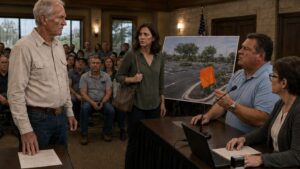
Michelle Brown placed three photographs directly on top of Gregory’s survey.
“Before we spend forty minutes arguing about lines,” she said, “I want everyone to see what happened last October.”
The HOA meeting room went quiet.
Gregory looked down at the first photograph.
Brown water stood halfway across a garage floor.
In the second, soaked cardboard boxes sagged against a wall.
The third showed water covering the curb and flowing across a driveway toward the garage door.
Michelle stood on the opposite side of the folding table. She was the HOA treasurer, but that night she looked less like a board officer than a homeowner who had carried damaged possessions out of dirty water.
“That’s my house,” she said.
Gregory had known that.
He had not known how bad it had been.
Paul Wright sat at the center of the board table with a binder open in front of him.
“The Miller property issue is important,” he said, “but so is the reason this project exists.”
Gregory felt several residents turn toward him.
He kept his hands flat on the survey.
“I’m not saying drainage isn’t important.”
A man in the second row said, “Then why are you trying to stop it?”
“I’m trying to stop work that crossed my boundary without anyone verifying what they were allowed to do.”
Michelle pointed toward the photographs.
“Two other houses had water too.”
“I understand.”
“Do you?”
The question landed harder because she did not raise her voice.
Gregory looked again at the stained garage wall.
He could have answered with the deed. He had brought copies.
He could have explained the difference between ownership and an easement.
Instead he said, “No. Not until tonight.”
Michelle’s posture changed slightly.
Gregory continued.
“I knew the street flooded. I didn’t know it came inside your house.”
Paul closed his binder.
“That’s why we cannot lose weeks here. We already lost months getting engineering work, bids and contractor availability. We’re heading toward another storm season.”
“And that makes my property line optional?”
“No.”
“Then why did you tell Joseph to keep grading after I said the plan didn’t match my survey?”
Paul’s face tightened.
“I told the contractor to proceed under the approved scope.”
“That’s another way of saying yes.”
A board member asked everyone to keep the discussion orderly.
Gregory almost laughed at that. The room was perfectly orderly. That was part of the problem. Every sentence sounded reasonable until it collided with the next one.
Michelle slid the flood photographs aside.
“What do you actually want?”
“I want the grading on my parcel verified against the recorded documents.”
“And if the HOA has the right to be there?”
“Then it has the right to be there.”
Several faces shifted.
Gregory saw Paul notice it too.
“But if the easement only allows certain work,” Gregory continued, “then the association doesn’t get more rights because the project is urgent.”
Paul leaned forward.
“The engineer designed a functioning system, not a courtroom exhibit.”
“And whoever designed it appears to have treated my private strip like common property.”
“We disagree with that interpretation.”
“Based on what?”
“The project documents.”
“Show me the document that moves my boundary.”
Paul did not answer immediately.
That silence changed the room.
Not dramatically. Nobody gasped. Nobody applauded Gregory.
But the conversation stopped being about whether Gregory was an obstinate homeowner and became, briefly, about the paper itself.
Paul turned to the management representative.
“Can we put the engineering exhibit on screen?”
A PDF appeared on the wall monitor.
Gregory recognized the broad shaded drainage corridor Joseph had shown him beside the loader.
Michelle stood and moved closer.
“The work south of Gregory’s lot can continue either way, correct?”
Paul nodded. “Yes.”
She looked at Gregory.
“Would you object to that?”
“No.”
That answer surprised Paul more than anyone.
Gregory pointed to the map.
“My objection is the part crossing my parcel. Keep working elsewhere. Verify this section.”
After a short discussion, the board voted to continue construction in undisputed common areas while pausing further excavation directly beside Gregory’s garage. It was not the full stop Gregory had wanted Monday morning.
But it was the first decision that treated his objection as something other than inconvenience.
Outside after the meeting, Michelle asked him to walk down to her house.
The garage still smelled faintly of damp concrete.
A pale brown line crossed the lower drywall several inches above the floor.
“We replaced the bottom section,” she said. “That stain kept coming back through the primer, so I left it.”
Gregory studied it.
“It came from uphill?”
“Mostly. When the old swale backs up, water jumps the curb.”
She opened a cabinet and showed him warped storage bins she had not bothered replacing.
“I wasn’t trying to make you the bad guy in there.”
“You were doing a decent impression.”
Michelle gave him a tired look.
“My insurance didn’t cover everything.”
Gregory nodded.
For two days, he had thought of the altered swale mainly as the place where four markers had disappeared.
Standing in Michelle’s garage, he saw something else.
The strip beside his house was his property.
The water running through it did not care.
Back in the meeting room, Michelle returned to the board packet to reconcile an invoice against the approved project amount. Gregory waited near the doorway while she flipped through pages.
Then she stopped.
“Paul?”
He looked up.
“This contractor invoice references Exhibit C-4.”
“So?”
Michelle turned several pages backward.
“We have C-3.”
She turned forward.
“Then C-5.”
Paul came around the table.
Gregory stepped closer.
Michelle ran her finger beneath the invoice description.
“‘Grading limits per revised Exhibit C-4.’”
She looked at the electronic board packet, then at the printed set.
“Where is C-4?”
Nobody answered.
Gregory looked at the project map projected on the wall.
For the first time, the question was no longer whether his survey disagreed with the HOA’s drawing.
It was whether the board had ever seen the drawing the contractor was actually using.
Chapter 4: The Approval Package Was Missing One Important Page
The approved packet skipped directly from Exhibit C-3 to Exhibit C-5.
Gregory noticed it again the next morning because he did not trust how easily a missing page could become an explanation for everything.
He sat at his kitchen table with the board packet open beside his 2019 survey and the contractor invoice Michelle had photographed after the meeting. The invoice referred to “revised grading limits per Exhibit C-4.”
C-4 was nowhere in the packet.
The management company sent him a second electronic copy after he requested the complete approval file. It had the same gap.
When Gregory called, the representative sounded less certain than she had earlier in the week.
“We’re checking archived correspondence.”
“Was C-4 before the board when they voted?”
“I can’t verify that yet.”
“Was it sent to the county?”
“I can’t verify that either.”
Gregory looked through the kitchen window toward the side yard. Work beside his garage had stopped, but farther downhill, equipment still moved through common property. A loader backed up with a sharp warning tone, then disappeared behind a row of shrubs.
He had wanted the entire project halted Monday morning.
Now he was relieved that it had not been.
Michelle’s water-stained garage had made that harder to admit.
“Can you tell me what the board actually approved?” he asked.
“The minutes say the drainage-improvement package.”
“That’s a title. I’m asking what drawing.”
“I understand.”
“No, I don’t think anyone does.”
He heard himself and closed his eyes.
The sharpness in his voice embarrassed him.
For years he had avoided HOA meetings because he disliked exactly this kind of exchange: people turning documents into weapons and irritation into principle. Now he was doing a version of it himself.
He lowered his voice.
“I need the exhibit that Joseph’s crew used.”
“I’ll send anything we locate.”
By noon, nothing arrived.
Gregory drove to the county records office.
The clerk behind the counter found the subdivision drainage easement quickly. The instrument matched the copy Gregory already had. A second search brought up the original development plat, later lot maps, and several recorded amendments.
None moved Gregory’s property line.
None enlarged the drainage easement.
The clerk rotated her monitor slightly.
“If you’re asking about current construction approval, that would be stormwater, not land records.”
Gregory thanked her and walked to the engineering counter in the adjoining building.
He had brought too much paper.
The county staff member took only three items: the recorded easement, Gregory’s 2019 survey, and the HOA project plan.
She aligned them on the counter.
“This one is conceptual,” she said, tapping the HOA drawing.
Gregory leaned forward. “Meaning?”
“It shows intended drainage improvements. It isn’t a boundary survey.”
“Can a contractor grade from it?”
“That depends on what approvals were issued and what their construction set shows.”
He slid the invoice toward her.
“It references Exhibit C-4.”
She read the line.
“Do you have C-4?”
“No.”
“Then I can’t tell you what C-4 says.”
Gregory almost smiled. Ruth would have approved of that answer.
The staff member searched the permit database.
Her expression changed.
“What?”
“I see erosion-control authorization for work in the common areas.”
“And my parcel?”
“I’m not seeing a grading approval tied to this lot.”
Gregory felt the first clean surge of vindication he had experienced since Monday.
“So they had no right to be there.”
The staff member looked up immediately.
“I didn’t say that.”
The feeling vanished almost as quickly.
She tapped the easement.
“This is still valid. The association has recorded access rights within the easement. That may allow maintenance activity.”
“But not regrading?”
“I’m saying I don’t see a county approval here for the constructed grade you’re describing. That is different from saying the association has no right to enter.”
Gregory nodded slowly.
Two truths again.
He was beginning to dislike how often the dispute refused to become simple.
The staff member asked whether there was active disturbed soil on the property.
“Yes.”
“Any sediment controls?”
“Some. I’m not qualified to tell you if they’re sufficient.”
“Any change to the swale elevation?”
“Several inches at least. Maybe more.”
She made a note.
“Someone from stormwater may need to look at it.”
Back home, Gregory received an email from Michelle.
She had found a copy of Exhibit C-4 attached to an old contractor billing message.
He opened it.
The drawing looked almost identical to the one Joseph had shown him beside the loader, but the title block described it as a revised field exhibit.
A broad shaded strip ran through Gregory’s side yard.
His lot number appeared near the garage.
What did not appear was a surveyed property boundary.
The shaded drainage corridor simply continued through the parcel as though the entire strip belonged to the association.
Gregory enlarged the lower-right corner.
A note read: “Limits approximate—verify existing conditions in field.”
He stared at it.
The drawing did not prove the board had deliberately ignored his ownership.
It proved something more ordinary and, in a way, more troubling.
Someone had taken a conceptual drainage area, removed the distinction between easement and ownership, and allowed the approximation to become an instruction for machinery.
He called Michelle.
“Did the board see this?”
“I’m checking.”
“Paul?”
“He says he remembers an updated exhibit but not whether this exact version was in the packet.”
“That sounds convenient.”
“It sounds possible.”
Gregory said nothing.
Michelle continued.
“I’m not defending it. I’m telling you the records are messy.”
“They shouldn’t be messy when they’re moving dirt across somebody’s lot.”
“No. They shouldn’t.”
That evening, the management company finally sent the board approval materials.
C-4 was still absent.
The meeting minutes referenced a drainage concept but did not identify the revised field exhibit by date.
Gregory printed the email from the county and placed it beside the missing exhibit gap.
He now had proof of a procedural problem.
But he also had the easement sitting on the table, refusing to disappear.
At six thirty the next morning, his phone rang.
“This is county stormwater. Are you Mr. Miller?”
“Yes.”
“We received the site information you provided. I’d like to inspect the drainage work on your lot.”
“When?”
A short pause.
“Tomorrow morning, if you’re available.”
Gregory looked through the window at the fresh slope cut into his property.
“I’ll be here.”
The county inspector said, “Please have your survey and the recorded easement ready.”
When the call ended, Gregory looked at the documents spread across the table.
For the first time, the question was no longer what the board believed it had approved.
Tomorrow, someone outside the neighborhood would decide what had actually been built.
Chapter 5: When the Machines Stopped, Nobody Had Really Won
The county vehicle turned onto Gregory’s street while Joseph Hall’s loader was already idling beside the disturbed swale.
Gregory had not expected the contractor to be there.
Joseph stood near the trailer with a travel mug in one hand. He watched the county vehicle slow at the curb, then looked toward Gregory.
“You call them?”
“I asked a question.”
Joseph gave a humorless nod.
“Looks like you got an answer.”
The inspector stepped out carrying a tablet, a measuring rod, and a folded safety vest. Gregory met her at the edge of his driveway.
Paul Wright arrived less than five minutes later.
Nobody had invited him through Gregory, but he walked over with a board binder tucked beneath one arm.
“Morning,” Paul said.
Gregory answered with the same word and nothing more.
The inspector asked for the recorded easement first.
Then Gregory’s survey.
Then the construction exhibit.
Paul provided a printed copy of C-4.
Gregory noticed that immediately.
“So you have it now.”
Paul glanced at him.
“Management located the contractor set.”
“Was this before the board?”
“We can discuss that later.”
The inspector looked between them.
“I’d rather discuss what’s in the ground.”
That ended the exchange.
She began at the upper end of the swale and worked downhill.
Gregory followed several yards behind. Joseph and Paul came with him.
The inspector stopped at the first missing marker location.
“Where was the monument?”
Gregory showed her the photograph from Monday morning.
She compared the garage corner, fence post, and edge of disturbed soil.
“Surveyor coming?”
“This afternoon.”
Joseph said, “Those pins were not visible when we started.”
Gregory turned.
“The flags were.”
“I saw flags. I did not see verified monuments.”
“You told me pins move.”
Joseph tightened his jaw.
“I told you we work from approved plans.”
The inspector lifted one hand.
“Let’s stay with physical conditions.”
She took measurements through the reconstructed easement corridor.
At the lower end, she studied the new grade for several minutes.
“This was lowered?”
Joseph answered.
“Cut here, fill farther down. We were reshaping for positive flow.”
“Based on this exhibit?”
“Yes.”
“Any sealed grading sheet?”
Joseph looked at Paul.
Paul opened the binder.
“This was the project package.”
“That isn’t what I asked.”
Gregory almost looked away.
He had used nearly the same words with Joseph four days earlier.
Paul handed over several pages.
The inspector read them.
Then she walked back to the upper end of the strip and crouched beside the fresh soil.
“The association has a valid drainage easement,” she said.
Gregory’s stomach tightened.
Paul exhaled through his nose.
Joseph shifted his weight.
The inspector continued.
“That easement provides access for drainage maintenance. I’m not making a private-property ruling beyond that.”
Paul said, “So the work is authorized.”
“No.”
The word was quiet.
Joseph looked up.
The inspector pointed toward the new slope.
“This is not simple maintenance of an existing swale. You’ve materially changed grade through a privately owned lot, and I do not have an approved grading plan for that work.”
Paul opened his mouth.
She continued before he could speak.
“The conceptual exhibit does not substitute for a site-specific grading authorization.”
Gregory felt the vindication arrive again, stronger this time.
Then the inspector pointed farther downhill.
“And the disturbed corridor needs stabilization. Until we establish an acceptable corrective plan, there will be no additional grading within this disputed section.”
Joseph looked toward the loader.
“You’re issuing a stop?”
“For this corridor, yes.”
The machine kept idling for another minute while the inspector entered notes into her tablet.
Then Joseph walked over to the operator.
He drew one finger across his throat.
The engine shut down.
The sudden silence seemed larger than the machine had.
Gregory stood beside the fresh dirt and listened to a bird calling from somewhere behind Michelle’s house.
On Monday, the loader had continued while he stood ten feet away asking it to stop.
Now it sat motionless.
He had imagined this moment more than once.
In those imaginings, it felt cleaner.
Paul would be exposed.
Joseph would be embarrassed.
Gregory would be proved right.
Instead, the inspector turned to him and said, “Mr. Miller, this does not eliminate the drainage requirement.”
He frowned.
“The HOA still has an easement. The existing system appears to convey runoff through this area, and based on what I’m seeing, some correction is probably necessary before the heavy-rain period.”
“So they stop now and come back later?”
“With an acceptable plan and within their legal rights, potentially.”
Gregory looked at Paul.
Paul did not look triumphant.
He looked exhausted.
The inspector added, “The goal here isn’t to leave an unstable ditch because ownership is disputed.”
The word ditch bothered Gregory.
It was his land.
But the water did not care whose deed contained it. Michelle’s garage had already demonstrated that.
The licensed surveyor arrived shortly before noon.
He set a tripod near the garage and began rebuilding the missing points from recorded coordinates and surviving monuments elsewhere on the block.
At the first location, he dug through loose soil.
Nothing.
At the second, the metal detector chirped beneath a compacted track mark.
He scraped down and uncovered a bent cap attached to a disturbed rod.
Joseph stared at it.
“That one got hit.”
Gregory looked at him.
Joseph did not offer an excuse.
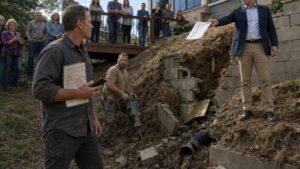
The surveyor placed temporary stakes at all four reconstructed locations. Their alignment confirmed what Gregory had said from the beginning: the project had entered his parcel well beyond the contractor’s assumed line.
The inspector photographed the stakes.
“That’s enough for today,” she said.
Paul asked what happened next.
“Submit a corrective drainage plan. Show property limits, recorded easement limits, existing grade, proposed grade, and stabilization.”
“And until then?”
“No earthwork in this corridor.”
Gregory watched her drive away.
The loader remained silent.
It should have felt like victory.
Then he noticed Paul standing alone beside the lower stake.
“Gregory.”
“What?”
Paul looked toward Joseph, who was securing equipment to the trailer.
“There’s something I need to tell you.”
Gregory waited.
Paul rubbed one hand across the back of his neck.
“Before Joseph continued Monday, I knew there was a question about whether your whole strip was common area.”
Gregory’s face went still.
“You knew?”
“I knew the records weren’t clear.”
“And you told him to continue.”
“Yes.”
For a moment Gregory heard nothing except the metallic clank of a chain being tightened on the trailer.
“Why?”
Paul looked down at the exposed dirt.
“That’s the part you’re not going to like.”
Chapter 6: Paul’s Worst Decision Had a Reason
Paul placed the bent survey cap on the empty HOA meeting-room table.
Mud still clung around its rim.
Gregory recognized the faded plastic color from the marker the surveyor had recovered that morning.
“You kept it?”
“Joseph gave it to me.”
Paul sat down across from him.
The chairs were still arranged from Wednesday’s meeting, but no residents filled them now. No management representative. No board members. Just Gregory, Paul, and a damaged piece of metal between them.
Gregory did not sit at first.
“You said you knew.”
“I said I knew there was a question.”
“That’s a careful distinction.”
“It’s an accurate one.”
Gregory pulled out the chair.
“Then be accurate.”
Paul looked tired enough to be older than Gregory remembered.
“The original developer plats show the drainage system running through that side of your lot. Our old maintenance maps shade most of the same strip. When the engineer developed the project, we treated the corridor as existing drainage access.”
“You treated it as association property.”
“Yes.”
“Even after I objected.”
Paul nodded once.
Gregory waited for anger to arrive.
It did, but not the hot kind.
It sat heavily behind his ribs.
“Why didn’t you stop the work?”
Paul looked toward the dark windows at the back of the room.
“Last October, Michelle had four inches of water in her garage. Another house had water in the finished basement. A third had it against the back door.”
“I know.”
“No. You know now.”
Gregory looked at him.
Paul continued.
“The week after that storm, I had people calling me every day. Why hadn’t the board cleaned the swale? Why hadn’t we replaced the collapsed inlet? Why did we spend money on landscaping and not drainage?”
“That still doesn’t answer Monday.”
“I’m getting there.”
Gregory said nothing.
“We spent winter getting proposals. Spring getting engineering review. Summer arguing over the bid. Then the contractor gave us a start date. If we lost that window, Joseph told us he couldn’t promise another crew before late fall.”
“So you gambled with my land.”
Paul’s expression tightened.
“I gambled that the old drainage rights were broad enough to cover the work.”
“That isn’t the same thing.”
“No.”
It was the first time Paul had said it without qualification.
Gregory looked at the bent cap.
“You could have called me.”
Paul gave a short, bitter laugh.
“We sent notices.”
“You sent notices about common drainage areas. My lot wasn’t named.”
“You didn’t respond.”
“That doesn’t make silence permission.”
“No.”
Gregory stopped.
Again, Paul had not fought him.
That made the conversation harder.
Paul leaned forward.
“I’m not going to pretend I handled it correctly. When Joseph called Monday, I should have told him to stop until we verified the boundary.”
“But you didn’t.”
“No.”
“Because you were afraid of looking weak?”
Paul looked at him.
“Partly.”
The answer surprised Gregory.
Paul continued.
“I spent a year telling people we would fix this. If I stopped the project the first morning because one homeowner said the plan was wrong, I thought we’d lose the contractor and maybe the season. And if another garage flooded after that…”
He let the sentence end.
Gregory understood it without agreeing with it.
Paul had not believed Gregory’s strip was worthless.
He had believed everyone downhill mattered more.
There was a difference.
Not enough of one.
But a difference.
The meeting-room door opened, and the association attorney stepped in carrying a slim folder. She remained role-only to Gregory, someone he had seen at annual meetings but never spoken with.
“I can come back,” she said.
Paul shook his head.
“No. We need to hear it.”
She sat at the end of the table.
“The association has exposure here,” she said. “Survey replacement, restoration, potentially property damage, professional costs. Mr. Miller also has exposure if this becomes a dispute over obstruction of recorded easement rights.”
Gregory folded his arms.
“I haven’t obstructed anything.”
“Not yet.”
Paul looked irritated.
The attorney continued.
“My point is that litigation would be expensive for both sides and would not make the drainage problem disappear.”
“How expensive?” Paul asked.
She named no dramatic figure.
She did not need to.
Expert review, surveying, legal fees, engineering revisions, reserve spending.
Each item was ordinary.
Together they threatened money the association had already earmarked for drainage repairs.
Gregory felt something shift.
A week ago he had wanted a hard line: his property, their mistake, their problem.
But if he forced the board into a long fight, the people paying for it would include Michelle and every other neighbor whose dues funded the association.
And the water would still run downhill.
The attorney closed her folder.
“You need a surveyed solution.”
Gregory looked at Paul.
Paul looked back.
Neither apologized.
Not yet.
Gregory picked up the bent marker cap.
His uncle had once told him that property lines only seemed invisible until somebody wanted something on the other side of them.
Gregory had remembered the warning as a lesson about defending land.
He wondered whether he had missed the other half.
A line could tell people where rights changed.
It could not tell them what to do when legitimate needs crossed it.
He stood.
Paul said, “Where are you going?”
“To call the surveyor.”
“For what?”
Gregory put the bent cap in his pocket.
“I want him to draw the narrowest drainage corridor that actually works.”
Paul stared at him.
“You’re willing to allow access?”
“I’m willing to look at a solution.”
“That’s not the same thing.”
“No,” Gregory said. “It isn’t.”
At the door, he stopped.
“And if the solution requires my land, this time you ask.”
Paul nodded.
Gregory left the meeting room and called the surveyor from the sidewalk.
“I need another drawing,” he said when the man answered.
“What kind?”
“One that assumes I still own every inch of my property.”
A pause.
“And?”
Gregory looked downhill toward Michelle’s house.
“One that assumes the water still has to go somewhere.”
Chapter 7: The New Line Protected More Than Property
The new survey stakes appeared three feet away from the contractor’s original grade line.
Gregory noticed them before he noticed the surveyor.
They ran in a clean sequence down the side of his lot, thin wooden stakes topped with bright ribbon, beginning near the garage and narrowing toward the lower swale. Beyond them, the raw earth Joseph’s crew had shaped three weeks earlier formed a much broader scar.
Gregory stood at the first reestablished property point while the surveyor unfolded a drawing across the hood of his truck.
“This is your boundary,” the surveyor said, tapping the solid line. “This is the recorded easement.”
A second line ran inside it.
“And this?”
“Proposed maintenance corridor. Narrower than what they graded. Wide enough for the drainage section the engineer says they actually need.”
Gregory studied the measurements.
The proposed swale remained on his property for much of its length.
That fact irritated him even though he had asked for exactly this drawing.
“Could they move it completely onto common land?”
“Not without changing the drainage geometry significantly.”
“Meaning expensive?”
“Meaning more excavation, another outlet adjustment, probably work on two additional lots. And the county would want to review all of it again.”
Gregory looked downhill.
Michelle’s house sat beyond the curve of the street.
“So this is the practical route.”
“This is one practical route.”
The distinction mattered.
Gregory had spent the last three weeks learning how often professionals avoided words like only, obvious, and guaranteed.
He folded his arms.
“If I accept this, I’m not giving the HOA ownership.”
“No.”
“Not expanding the old easement.”
“No. Your attorney would need to review the instrument, but what we discussed was a defined maintenance-access agreement tied to the redesigned swale.”
“And no machinery outside the marked corridor without permission.”
“That can be written.”
Gregory looked at the stakes again.
For most of the dispute, he had imagined the final line as something defensive: a clean edge that forced everyone else back.
This one did something stranger.
It protected the edge while deliberately permitting someone to cross part of it.
That evening, the HOA meeting room was fuller than Gregory had seen it in years.
The revised plan rested on the table between him and Paul Wright.
Michelle sat beside the management representative with a calculator and several pages of reserve projections. Paul looked from the drawing to Gregory.
“The county has reviewed the concept?”
“The inspector said it is acceptable for formal submission,” Gregory said. “Not approved yet.”
Paul nodded.
“And you’ll grant maintenance access within this corridor?”
“If the agreement says exactly what can be done, how access is requested, and how damage gets restored.”
A resident near the wall said, “Why should the HOA have to ask every time? We already have an easement.”
Gregory turned toward him.
“Routine inspection under the recorded easement is one thing. Bringing in equipment to change grade is another. That difference is why we’re sitting here.”
The resident started to respond, but Michelle spoke first.
“The new agreement makes that difference clear.”
Several heads turned toward her.
Three weeks earlier, she had been the person most visibly impatient with Gregory.
Now she pushed a copy of the revised engineering calculation toward the center of the table.
“I asked the engineer to confirm runoff capacity,” she said. “The narrower corridor still handles the modeled flow if the inlet and lower section are repaired as proposed.”
Paul looked at her.
“You’re comfortable with it?”
“My garage doesn’t care whose idea it was.”
A few people smiled.
Michelle did not.
“I want the drainage fixed. I also don’t want the board pretending private property is common land because our files were sloppy.”
Gregory felt something in the room change.
Not allegiance.
That would have been easier and less believable.
It was recognition that the two concerns no longer had to defeat each other.
Paul opened his binder.
“There is another issue.”
Gregory waited.
Paul looked down at the minutes drafted for approval.
“The prior minutes say the contractor proceeded within an approved association drainage corridor.”
Gregory said, “That isn’t accurate.”
“I know.”
Silence settled over the room.
Paul took a pen.
“What language do you want?”
Gregory had expected resistance. He had prepared three sentences in his head on the drive over.
Now none of them seemed useful.
“The record should say the board authorized work before verifying the private boundary and scope of grading authority.”
Paul wrote slowly.
“And that the work exceeded the approved county scope,” Michelle added.
Paul nodded and wrote that too.
One resident shifted uncomfortably.
“That makes the board look incompetent.”
Paul stopped writing.
“We were wrong.”
The words were quiet.
Nobody applauded.
Gregory was glad.
Paul continued.
“We can make the minutes prettier or we can make them accurate.”
He finished the sentence and slid the page toward Gregory.
Gregory read it.
For weeks, he had thought he wanted Paul forced into that admission.
Instead, seeing the words on paper made the mistake feel smaller and more serious at the same time.
Smaller because there was no hidden scheme.
More serious because ordinary people had made an ordinary shortcut while controlling equipment capable of changing someone else’s land.
The financial motion came next.
Survey costs reimbursed.
Restoration of the disturbed portion of Gregory’s parcel.
Replacement of all four boundary monuments with permanent concrete markers.
Engineering revision paid from the project budget.
No punitive payment.
No dramatic settlement.
Just the costs required to put the property and paperwork back into alignment.
Then came the difficult part.
The recorded access agreement.
The association attorney summarized it.
The HOA would retain its original drainage-easement rights. Gregory would grant defined access for the redesigned corridor. Routine inspections could occur with notice. Heavy equipment or grade alteration would require written notice and work within surveyed limits except in genuine emergencies. Damage caused during maintenance would be restored.
Paul looked at Gregory.
“You understand once this is recorded, it runs with the property.”
“Yes.”
“So if you sell, the next owner is bound.”
“I understand.”
“And if another board comes in ten years from now—”
“They’re bound too.”
Paul nodded.
That was why Gregory was willing to sign.
Not because he trusted Paul.
Because the agreement did not require trust.
Before the vote, the board recessed for the county field review.
They walked as a group to Gregory’s side yard.
The county inspector met them beside the new stakes.
Joseph was there too, without machinery.
The inspector checked the corridor against the surveyor’s drawing, walked the proposed slope, then stopped near the lower outlet.
“This is workable,” she said. “Final approval depends on the submitted grading sheet and stabilization details.”
Michelle pointed downhill.
“And the capacity?”
“The engineer’s calculation is reasonable. The narrower swale should function if constructed as shown.”
Gregory looked at Joseph.
Joseph was staring at the stakes.
“This would’ve been easier if I’d had these the first morning,” he said.
Gregory replied, “You had flags.”
Joseph nodded.
“Fair.”
It was not an apology.
It was enough for that moment.
Back in the meeting room, the board voted.
The reimbursement passed.
The restoration passed.
The corrective engineering passed.
Then Paul called the vote on the access agreement.
Gregory watched hands rise around the table.
Michelle’s first.
Paul’s second.
The motion carried.
The management representative placed the signature pages in front of Gregory.
For one second he saw his uncle’s narrow strip as it had looked years ago: rough grass, a shallow depression, nothing anyone else seemed to care about.
His uncle had told him not to let casual use become assumed ownership.
Gregory had spent years hearing only the warning.
He signed.
Paul signed for the association.
The attorney gathered the pages for recording.
Outside, dusk had settled over the raw side yard.
Gregory walked to the upper survey stake and looked down the line.
The new corridor did not erase his boundary.
It depended on knowing exactly where that boundary was.
Behind him, Paul said, “We’ll schedule restoration as soon as the county signs off.”
Gregory turned.
“And the four monuments?”
“Included.”
Gregory nodded.
For the first time since the loader crossed his yard, the next step did not depend on someone deciding whose rights mattered more.
The agreement required both of them to honor the same line.
Chapter 8: Four Concrete Monuments and One Different Kind of Boundary
Rainwater reached Gregory’s side yard just after dawn and entered the rebuilt swale exactly where the surveyor said it would.
Gregory stood under the garage overhang and watched it.
For a month, the strip had been machinery, stakes, measurements, arguments, signatures and bare earth.
Now water made the final test.
It moved through the narrower channel in a steady brown ribbon, curved around the repaired inlet, and continued downhill without jumping the curb.
Gregory waited.
Five minutes.
Ten.
The rain strengthened.
He walked to the lower end of the yard in a waterproof jacket, stopping beside the first of the new concrete monuments.
Only the top few inches showed above grade: plain, permanent, almost unimpressive.
Four of them now marked the property corners the loader had disturbed.
The bright flags were gone.
Gregory touched the nearest monument with the toe of his boot, then continued downhill.
Michelle was standing inside her open garage.
She saw him and pointed at the driveway.
“Dry.”
Water ran along the gutter beyond it but did not cross the apron.
Gregory stepped inside.
The old water stain remained faintly visible along one section of drywall.
Michelle had never painted over it again.
“Give it another hour,” Gregory said.
“You always this cheerful?”
“Only during drainage tests.”
She folded her arms and watched the street.
“I owe you something.”
Gregory looked at her.
“Don’t make this strange.”
“That depends what you think I’m about to say.”
He waited.
“I thought you were trying to kill the whole project.”
“I was, for about two days.”
Michelle turned.
He shrugged.
“I thought if the land was mine, the answer should be simple.”
“And then?”
“I saw your garage.”
She looked toward the stain.
“Well, I thought if the water was coming toward my house, your boundary should be simple too.”
They stood quietly while rain ticked against the raised garage door.
Michelle said, “Maybe neither of us was especially impressive.”
“That sounds about right.”
By afternoon, the rain had eased.
The swale held.
Three days later, Joseph Hall returned to Gregory’s property in a pickup rather than a loader.
He carried a manila envelope.
Gregory met him beside the garage.
“Final survey certificate,” Joseph said. “And management asked me to give you this.”
Inside was the reimbursement receipt confirming payment of Gregory’s survey and restoration expenses.
Gregory glanced at it.
“No protest written across the bottom?”
Joseph smiled faintly.
“No.”
They walked the restored strip.
Grass seed had begun showing through the erosion matting. The new channel was shallower than Joseph’s first cut and cleaner along the edges.
At each corner, a concrete monument stood where one of the buried markers had once been.
Joseph stopped at the second.
“This is the one where we found the bent cap.”
“I remember.”
Joseph shoved his hands into his jacket pockets.
“I should’ve stopped.”
Gregory looked at him.
“When?”
“When you showed me the survey didn’t match the field drawing.”
“You didn’t believe me.”
“I believed you believed it.”
“That’s different.”
“Yeah.”
Joseph looked toward the repaired swale.
“I get homeowners all the time who point at a tree or a fence and tell me that’s the line. Sometimes they’re right. Sometimes they’re twenty feet off. We work from plans because otherwise nothing gets built.”
Gregory nodded.
“And sometimes the plans are wrong.”
“Yeah.”
Neither man added anything.
Joseph left a few minutes later.
Gregory filed the survey certificate in the same tube that had held the 2019 plat.
This time he did not put it in the hall closet.
He put it in the cabinet beside the HOA records.
Paul came by that Saturday.
He did not knock on Gregory’s door.
He stood near the upper monument until Gregory saw him through the kitchen window and came outside.
“The county closed the corrective inspection,” Paul said.
“I got the email.”
“Good.”
They looked at the grass beginning to recover.
Paul cleared his throat.
“I owe you an apology.”
Gregory said nothing.
“I should have stopped Joseph that morning.”
“Yes.”
Paul gave a small nod.
“I kept thinking leadership meant making the decision and carrying the consequences afterward.”
Gregory waited.
“I think sometimes it means refusing to make the decision until you know what you’re deciding.”
“That would’ve saved us both some time.”
“Yes.”
Paul glanced toward Michelle’s house.
“The drainage worked.”
“It did.”
“I’m glad.”
“So am I.”
Paul seemed to expect something else.
Maybe forgiveness.
Maybe a handshake.
Gregory was not angry enough to deny either forever, but he was not interested in pretending the last month had made them friends.
“I accept the apology,” he said.
Paul nodded.
“That’s fair.”
He started toward the sidewalk, then stopped.
“Next board meeting is Thursday.”
“I know.”
“You coming?”
Gregory almost gave the answer he had given for years.
Probably not.
The meetings were tedious. People argued about budgets, landscaping, parking, roofs, drainage, signs, reserve studies and small rules that seemed absurd until they affected somebody’s house.
He thought of the two notices he had skimmed and thrown into a drawer.
He thought of Paul assuming silence meant no objection.
He thought of Michelle’s garage.
“I’ll be there.”
Paul looked mildly surprised.
“Good.”
After he left, Gregory walked the four monuments one more time.
At the first, he remembered the orange flag folding beneath the loader.
At the second, the bent metal cap.
At the third, the county inspector measuring the altered grade.
At the fourth, the new access corridor continuing downhill toward homes that belonged to other people.
For most of his life, Gregory had thought a property marker meant one thing.
This side is mine.
That side is yours.
The monuments still meant that.
They just no longer meant only that.
A boundary could protect ownership without pretending nothing crossed it. Water crossed. Responsibilities crossed. Decisions made in a meeting room crossed. Silence crossed too.
The line mattered because those things crossed it, not because they never should.
That evening, Gregory opened the kitchen drawer where he used to drop association mail.
There were three unopened envelopes at the bottom from earlier in the year.
He removed them, sorted what needed keeping, and threw away the rest.
Then he placed the agenda for Thursday’s HOA meeting on the table.
The first item concerned final drainage expenses.
The second concerned procedures for work affecting privately owned lots.
Gregory found a pen.
He circled both.
Outside the kitchen window, the restored swale was almost dark, but he could still make out the pale top of the nearest concrete monument.
It no longer looked like a warning.
It looked like a reference point.
The story has ended.