The Will Named Her Sister, But Her Father’s Place Card Still Had Her Daughter’s Name
Chapter 1: The Gold Chair Was Reserved For The Wrong Girl
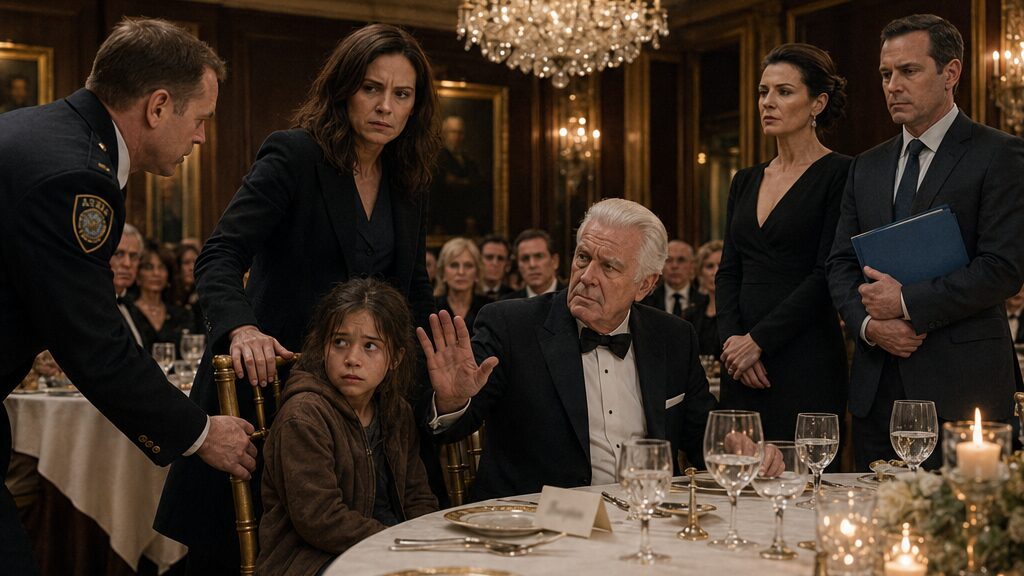
The security officer put two fingers on the back of Rachel’s chair and said, quietly enough to sound polite, “This seat is for family.”
Nicole Carter felt her daughter go still beside her.
The private dining room had gone soft with candlelight and expensive grief. Gold-backed chairs surrounded long white tables. Crystal glasses caught the chandelier glow. Men in dark suits and women in black dresses kept their voices low, as if George Carter’s death had made the room sacred instead of merely costly.
Rachel sat in the middle of it wearing the brown hoodie Nicole had begged her not to wear.
It was clean. It was also faded at the elbows and too big at the wrists, and it carried all the history of school mornings, grocery runs, and the last cold afternoon George had pressed five dollars into Rachel’s hand for hot chocolate. Rachel had refused the black sweater Nicole laid out for her. She had whispered, “Grandpa liked this one.”
Now the security officer’s hand hovered near the hood like it was something that did not belong in the room.
Nicole kept one hand on Rachel’s knee under the table. “Her name is on the chair.”
The officer glanced down. A small white place card sat above the charger plate, written in dark blue ink.
Rachel — beside Robert.
The handwriting was not printed from the club’s seating chart. It curved unevenly, the R too large, the final t in Robert drawn like a cross. Nicole had noticed it the moment they arrived. She had touched it once, then pulled her fingers away because it felt too much like touching her father’s hand.
Across the table, Robert Miller lowered his fork.
He looked smaller than Nicole remembered from childhood, though his tuxedo fit perfectly and his white hair had been brushed straight back. He had been George’s friend for forty years, the kind of man who never raised his voice but made rooms rearrange themselves around his silence. Tonight he had insisted Rachel sit beside him. Nicole had thought it was kindness.
Now she wondered if it was protection.
Kimberly Scott stood near the end of the table with the club manager and Daniel Hill, the estate attorney. Kimberly’s black dress was simple, expensive, and severe. Her hair was pinned at the back of her neck. She had been greeting guests all evening as if she had organized not only the dinner, but the grief itself.
“Nicole,” Kimberly said, smiling without warmth, “please don’t make this harder than it has to be.”
Rachel’s fingers pressed into Nicole’s palm.
The officer bent lower. “Ma’am, I was told the front table is reserved for beneficiaries and immediate family.”
“She is immediate family,” Nicole said.
Kimberly’s smile tightened. “That is not what the final documents say.”
For one second, Nicole heard nothing but the small click of silverware stopping around them.
The final documents.
Daniel Hill adjusted the blue folder under his arm. He was a neat man in a charcoal suit, with a face trained to reveal nothing before the paperwork did. Nicole had met him twice before George died. Once in the hallway of the rehab center, where he had smiled and said he was only helping George “clarify a few things.” Once at the funeral, where he had shaken her hand too briefly.
“Maybe we should wait until after dinner,” he said.
“No,” Kimberly said. “This is exactly why it needs to be clear.”
Rachel’s chair scraped faintly as she tried to stand.
Nicole held her there. “Don’t move.”
The officer shifted his hand toward Rachel’s shoulder.
Robert lifted his palm.
He did not slam the table. He did not speak at first. He only raised one wrinkled hand between the officer and the child, and the whole room seemed to understand it before anyone explained it.
The officer froze.
Robert looked at him. “Take your hand away from her.”
The words landed quietly. That made them worse.
A woman near the wall lowered her wine glass. Someone coughed once and stopped. Rachel’s eyes filled, but she did not cry. Nicole felt the tremor in her leg through the chair.
Kimberly drew in a breath. “Robert, this is not your decision.”
“Then whose is it?” Robert asked.
Daniel stepped forward, the blue folder now held against his chest like a shield. “Let’s keep this respectful. Mr. Carter wanted a short reading of the estate summary tonight so the family could avoid confusion.”
Nicole looked at the folder.
For three years, she had managed George’s pillbox, his appointments, the grocery list he pretended he could still remember, the bills he left unopened on the kitchen counter. Kimberly had handled calls and documents because Kimberly knew people who used phrases like estate strategy and asset protection. Nicole had let her. George hated family tension. Near the end he had grabbed Nicole’s wrist with frightening strength and made her promise not to turn grief into a fight.
She had kept that promise so well that she had not asked what was inside the folder.
Daniel opened it.
The sound of paper sliding free made Rachel flinch.
“Under the revised last will and testament of George Carter,” Daniel began, “executed and witnessed according to state requirements, the primary residence, controlling interest in the remaining estate assets, and authority over personal property distribution are granted to Kimberly Scott, who is also named personal representative.”
Nicole waited for the next sentence.
Daniel looked down and continued. “A small discretionary family remembrance fund is to be maintained at Ms. Scott’s discretion for certain memorial expenses and charitable gifts.”
He turned a page.
Nicole waited again.
There was no next sentence for her.
No “to my daughter Nicole.” No mention of Rachel. No trust. No shared house proceeds. No division of family photographs. No watch George had once told Rachel would be hers when she learned to tell time properly. No acknowledgment that Nicole had washed his sheets, learned his medication names, and sat beside him on the nights he woke not knowing whether it was morning.
Kimberly folded her hands. “Dad wanted the house protected.”
Nicole heard herself say, “Protected from whom?”
Kimberly’s eyes flicked toward Rachel’s hoodie, then back. “From confusion.”
Rachel stared at the place card as if the ink might rearrange itself into an answer.
Robert’s hand lowered slowly to the table. His face had lost color.
Nicole turned to Daniel. Her voice came out calmer than she felt. “What version is that?”
“The final executed version.”
“When?”
Daniel paused.
Kimberly said, “Nicole.”
Nicole did not look at her. “When was that version signed?”
Daniel checked the first page though Nicole knew he did not need to. “Six weeks before Mr. Carter’s passing.”
The room tilted in a way no one else could see.
Six weeks before George died, he had called Nicole by her mother’s name twice in one afternoon. Six weeks before George died, he had stared at the club dining room from the passenger seat of Nicole’s car and asked why she had brought him to a hotel he had never seen, though he had eaten there every Christmas Eve for twenty-five years.
Six weeks before George died, Nicole had stopped correcting him because correction made him afraid.
Rachel whispered, “Mom?”
Nicole looked at the place card again. Rachel — beside Robert. The card was real. The chair was real. Robert’s hand had stopped the officer. Daniel’s document had erased them anyway.
She slid the place card off the table and held it between two fingers.
Kimberly’s voice sharpened. “You don’t need to take that.”
Nicole looked up at her sister.
For the first time that night, she did not try to keep peace in her face.
“If this will was signed six weeks before he died,” Nicole said, “then I want to know who put the pen in his hand.”
Chapter 2: Six Weeks Before He Stopped Calling Her Nicole
“Did Grandpa George take our names away because I wore the hoodie?”
Rachel stood in the kitchen doorway with the sleeves pulled over her hands, the same brown hood bunched behind her neck. Morning light made the apartment look poorer than it had the night before. The cereal box was still open on the counter. Nicole’s black dress hung over a chair, smelling faintly of candle wax and club perfume.
Nicole had slept for less than two hours.
She put the kettle down without turning it on. “No, baby.”
Rachel’s eyes dropped to the small white place card on the table. Nicole had smoothed it under a heavy mug after they came home, trying to press out the crease where her thumb had bent the corner.
Rachel — beside Robert.
“But they said family only.”
“They were wrong.”
Rachel did not look convinced. Children trusted rooms more than adults sometimes. If enough grown-ups stared at you like a mistake, it became hard not to wonder whether you were one.
Nicole pulled out a chair. “Come here.”
Rachel crossed the kitchen slowly and sat. Nicole crouched in front of her, one knee protesting from the long night in heels. “Your grandfather did not take your name away. Whatever that paper said, it doesn’t get to decide what you were to him.”
“Then why did Aunt Kimberly say it?”
Nicole had no answer soft enough.
Because Kimberly had always known where to place a knife. Because Nicole had let her handle everything. Because grief had made Nicole obedient, and obedience had left Rachel standing beside a gold chair while a security officer reached for her.
Instead, Nicole said, “I don’t know yet. But I’m going to find out.”
After Rachel left for school, Nicole sat at the kitchen table with her phone, George’s old voicemails, and the place card. She had saved too many messages. Some were ordinary enough to hurt: George asking if she had picked up his low-sodium soup, George complaining that the neighbor’s dog had no manners, George reminding Rachel not to eat peppermints before dinner because “your mother sees everything.”
She played them one at a time, listening for dates.
Three months before he died, his voice was slow but clear.
“Nicky, tell Rachel I got her chair at the club. She wanted to sit beside Robert because he lets her steal rolls. Don’t let them move your chair. That’s the rule. If your name is there, you sit.”
Nicole stopped the recording.
The apartment seemed to hold its breath.
She played it again.
Don’t let them move your chair.
It was not a metaphor when he said it. It was George being George, turning a dinner seat into a family law because Rachel had once cried when Kimberly moved her to the children’s table at Thanksgiving. Nicole remembered George tapping the place beside him and saying, “This one stays.”
She had laughed then. She had thought it was a small thing.
Now small things were all she had.
Nicole emailed herself the voicemail. Then she photographed the place card front and back, including the faint smudge of blue ink on the corner. She wrote the date of the memorial dinner in a notebook and underlined six weeks before death until the paper nearly tore.
At noon she drove to George’s house.
The lawn had been trimmed. That annoyed her more than it should have. George had always left a wild strip near the porch because Rachel liked the clover flowers. Now the yard looked clean in a way that meant someone else had decided what counted as weeds.
Nicole parked across the street and sat for a moment with both hands on the wheel.
The house had not looked empty when George was alive. Even after illness thinned him and made his shirts hang loose, his presence filled the porch, the garage, the kitchen window where he overwatered basil every spring. Now the curtains were open, and the inside looked staged.
She climbed the porch steps and put her key into the lock.
It did not turn.
For a moment she tried again, gently, as if the lock might remember her.
The key stopped cold.
Nicole stared at it. She had used that key every week for years. She had let herself in with groceries, pill refills, clean towels, Rachel’s drawings. She had opened the door the night George fell beside the hallway table and pretended he was looking for a dropped dime.
She rang the bell.
No one came.
From inside, something scraped across the floor.
Nicole stepped back and looked through the side window.
Kimberly came out of the hallway carrying a banker’s box against her hip. She was dressed in cream slacks and a dark sweater, not funeral black now, not public grief. Her hair was loose around her shoulders. She saw Nicole through the glass and stopped.
For two seconds neither sister moved.
Then Kimberly turned away.
Nicole went to the front window and knocked. “Kimberly.”
The box shifted in Kimberly’s arms. Nicole saw a tabbed folder near the top. Visitor Log / Care Schedule. George’s hospice binder had used those labels. Nicole knew because she had written some of them herself.
Kimberly opened the door only as far as the chain allowed.
“You changed the locks,” Nicole said.
“I secured the property.”
“With my things inside?”
“With estate property inside.”
Nicole looked past her shoulder. “Is that Dad’s care binder?”
Kimberly’s expression closed. “It’s not your concern anymore.”
The words found their target too easily.
Nicole felt the old reflex rise: step back, swallow it, keep George’s peace. Her hand tightened around the phone in her coat pocket.
“Who was with him the day he signed the will?” she asked.
Kimberly’s mouth twisted. “You really want to do this on the porch?”
“Yes.”
“You weren’t here, Nicole.”
Nicole flinched before she could stop herself.
Kimberly saw it. Her voice lowered. “That’s the part you keep forgetting.”
The chain clicked as she shut the door.
Nicole stood on the porch, staring at the changed lock. Behind the glass, Kimberly walked down the hall with the box of records Nicole had not known to protect.
By the time Nicole reached her car, her hands were shaking. She opened her phone, pulled up George’s voicemail, and played it once more.
Don’t let them move your chair.
Across the street, Kimberly came out through the side door carrying the banker’s box to her car.
Nicole raised her phone and took one photograph before the trunk closed.
Chapter 3: The Lawyer Said Legal, She Asked For The Date
“Dad changed his mind. That was his right.”
Kimberly said it before Nicole had fully sat down in Daniel Hill’s office, as if she had been holding the sentence in her mouth since the memorial dinner.
The room was narrow and bright, with diplomas on one wall and a glass table too polished to touch. Daniel’s blue estate folder lay centered between them. Nicole sat on one side with her notebook and Rachel’s place card tucked inside the front cover. Kimberly sat opposite in a gray suit, legs crossed, one hand resting over the other.
Daniel closed the office door carefully. “I understand emotions are high.”
Nicole looked at him. “I’m not here to discuss emotions.”
Kimberly gave a short laugh. “That would be a first.”
Nicole kept her eyes on Daniel. “I’m here to ask when the will was signed, who was present, and what assessment was made of my father’s capacity.”
Daniel sat. He opened the folder with the careful movements of a man who trusted paper more than people. “The revised will was signed six weeks and two days before Mr. Carter’s death. It bears his signature, two witness signatures, and a notary acknowledgment. On its face, the document is valid.”
“On its face,” Nicole repeated.
“That is the legal starting point.”
Kimberly leaned forward. “Dad knew what he was doing.”
Nicole turned to her. “He called me Lisa that week.”
Kimberly’s face hardened. “He had bad days.”
“He asked why his dead wife hadn’t come home.”
“He had bad moments.”
“He didn’t recognize the club dining room from the parking lot.”
Daniel lifted a hand. “Memory fluctuation alone does not necessarily establish incapacity.”
Nicole nodded once. “Then tell me what does.”
Kimberly’s chair creaked. “This is exactly what I meant. You’re turning grief into a courtroom because you didn’t get what you expected.”
The words struck because they carried George’s warning in a distorted shape. Nicole saw him in the hospital bed, his fingers around her wrist, his eyes wet with exhaustion.
Promise me you won’t make them fight over what I leave behind.
She had promised. She had meant it. She had thought peace was something you could give the dead.
Nicole opened her notebook. Her handwriting from the night before ran slanted and dark across the page.
“Six weeks before he died,” she said, “he couldn’t remember what year it was.”
Kimberly looked away first.
Daniel did not. He drew a page from the folder. “Mr. Carter answered basic orientation questions on the day of signing, according to my notes.”
“Your notes say that?”
“They indicate he understood he was signing estate documents.”
“Did a doctor confirm it?”
Daniel paused long enough for Nicole to hear the answer before he gave it.
“No formal medical capacity evaluation was requested.”
Kimberly said, “It wasn’t required.”
Nicole looked at her. “Who brought him here?”
Daniel slid the page back into the folder. “Ms. Scott transported him.”
Nicole let the silence remain.
Kimberly’s jaw tightened. “I was the one available. You were busy.”
“With Rachel. She had a fever.”
“You always had a reason.”
Nicole’s hand curled around her pen. “I was with him for three years.”
“And I was cleaning up what you didn’t see.” Kimberly’s voice sharpened, then dropped when Daniel glanced toward the door. “You got to be the sweet one. The soup, the blankets, the little drawings on the fridge. I got the creditors, the tax notices, the calls from the bank, the house repairs he refused to pay for because he thought everything cost what it did in 1985.”
Nicole stared at her.
For the first time since the dinner, Kimberly did not look triumphant. She looked tired. Angry, yes. Defensive, yes. But also cornered by a version of George Nicole had not wanted to see: the man who hid bills in cookbooks and told each daughter a different piece of the truth.
Daniel cleared his throat. “The estate did have liquidity concerns. Mr. Carter expressed a desire for continuity.”
“Continuity,” Nicole said. “Is that what you call leaving one daughter everything and removing the other?”
Kimberly’s eyes snapped back. “He trusted me to handle it.”
“He trusted me with his body when he couldn’t stand.”
“Then where were you at the end?”
The room went still.
Nicole felt the old guilt open under her ribs. Rachel’s fever. The urgent care waiting room. The missed call from Robert. Kimberly’s text saying, Don’t come tonight. He’s sleeping. The next morning, George no longer saying Nicole’s name.
She looked down before either of them could see too much.
Daniel’s voice softened a fraction. “Ms. Carter, if your concern is personal property, there may be room for discussion without formal contest.”
Kimberly reached into her purse and took out a white envelope.
Nicole looked at it as if it had made a sound.
“I was going to wait,” Kimberly said, “but maybe this is better. There’s no reason to drag everyone through accusations. I can authorize a payment from the discretionary remembrance fund. Enough to help you and Rachel. You sign a release, stop calling Dad’s caregivers, stop showing up at the house, and we all move on.”
Nicole did not touch the envelope.
“How much is my silence worth?” she asked.
Kimberly flushed. “Don’t make it ugly.”
“It was ugly when you told security my daughter didn’t belong at her grandfather’s table.”
“I told them to follow the seating rules.”
“Her name was on the chair.”
Kimberly’s gaze flickered.
There it was. Not surprise. Recognition.
Daniel noticed it too. His eyes moved from Kimberly to Nicole, then down to the folder.
Nicole opened her notebook and removed the place card. She did not set it on the table. Not yet.
“Who wrote this?” she asked.
Kimberly stood. “I’m done.”
Daniel remained seated. “Ms. Scott.”
“No. She wants a fight, she can hire her own lawyer.”
Nicole slid the place card back into her notebook before Kimberly could reach for it. “I don’t want a fight.”
Kimberly gave her a bitter look. “Then stop.”
After Kimberly left, the office felt colder.
Daniel rubbed the bridge of his nose. “I cannot advise you against my client’s estate position.”
“I know.”
“I also cannot prevent you from requesting documents through proper channels.”
Nicole heard the carefulness in that. Not help. Not opposition either.
“Can I have a copy of the will summary?” she asked.
He hesitated, then removed several pages and walked to the copier by the wall. Nicole watched the blue folder sitting open on the table.
The top page had signature lines near the bottom.
George Carter.
Kimberly Scott, present for transportation.
Notary acknowledgment.
Two witnesses.
One was listed as a staff witness from Daniel’s office.
The second name stopped Nicole cold.
She leaned closer, careful not to touch the page.
The handwriting was sharp, unfamiliar, and nothing like Robert’s, nothing like anyone who had sat at George’s dining table or signed his birthday cards. Nicole read it once, then again, trying to place it and failing.
When Daniel returned with the copies, she pointed to the line.
“Who is that?” she asked.
Daniel followed her finger, and for the first time all morning, his professional expression faltered.
“That,” he said, “is one of the witnesses to your father’s signature.”
Nicole looked at the name again.
She had never heard it in her life.
Chapter 4: The Visitor Log Had One Name Too Often
The bank clerk looked at Nicole’s driver’s license, then at the copied will summary, then slid both back beneath the glass partition as if they had become contaminated.
“I’m sorry, Ms. Carter,” she said. “Under the current estate documents, you have no standing.”
Nicole did not move her hands from the counter. Behind the clerk, printers hummed and phones rang softly, ordinary sounds moving through a morning that had decided to be merciless.
“No standing to ask whether my father’s beneficiary forms were changed?”
“No standing to receive information.”
“I’m not asking for balances.”
The clerk’s expression did not change. “I understand. But the personal representative would have to request those records.”
“The personal representative is the person I’m asking about.”
The clerk looked down. There was pity in that glance, but pity did not open a file. “You may want to consult counsel.”
Nicole almost laughed. Everyone who did not want to answer a question seemed to recommend a lawyer.
She gathered the papers slowly. The copied will summary made a dry whisper against the counter. Daniel’s office had given her only enough to see the edges of the thing. Dates. Distributions. Witness lines. Kimberly’s name everywhere it mattered. Nicole’s name nowhere it should have been.
In the parking lot, she sat in her car with the engine off and took Rachel’s place card from her notebook.
The ink had faded slightly where her fingers kept touching it.
Rachel — beside Robert.
Nicole had called the unknown witness name twice that morning. No answer. No voicemail greeting, only an automated voice. Daniel had not returned her message asking whether the witness was office staff, notary staff, or someone Kimberly brought. Kimberly had sent one text at 7:12 a.m.
Stop harassing people. Dad made his choice.
Nicole stared at those last four words until they lost shape.
Then she drove to the hospice office.
It was in a low brick building between a physical therapy clinic and a tax service. Nicole had been there only once before, to sign a supply form when George’s hospital bed was delivered. The waiting room smelled faintly of coffee and hand sanitizer. A small fountain gurgled in the corner with forced calm.
The receptionist asked for George’s date of birth, date of death, and Nicole’s relationship.
When Nicole said “daughter,” the woman’s fingers moved over the keyboard. Her face changed just enough.
“I can request that someone speak with you,” she said.
“Can I get his visitor log?”
“That would need authorization.”
“From Kimberly Scott?”
The receptionist did not answer directly. “From the estate representative or through formal request.”
Nicole looked past her to the hallway. “I helped write some of those logs.”
“I’m sorry.”
There it was again. Sorry as a locked door.
Nicole stepped away from the desk before frustration could make her careless. She sat under a framed print of a sailboat and opened her notebook, writing down the receptionist’s exact words. No standing. Formal request. Estate representative.
When she looked up, a woman in blue scrubs had stopped near the hallway entrance.
The woman’s name badge read Lisa Perez.
Nicole recognized her after a second, not from the office, but from George’s kitchen. Lisa had come three evenings a week near the end, carrying a canvas bag and a tired gentleness that had made George behave better than he did for family. She had once coaxed him into taking pills by telling him Rachel would scold them both if he skipped.
“Ms. Carter?” Lisa said.
Nicole stood. “Yes.”
Lisa glanced toward the receptionist, then toward the hallway. “I heard the name.”
Nicole held her notebook close. “I’m trying to get Dad’s visitor log.”
Lisa’s face tightened in a way that looked like warning. “They won’t give that to you at the front desk.”
“I know.”
Lisa lowered her voice. “Come outside for a minute.”
They stood beside the building near a narrow strip of ornamental grass. Cars moved along the street beyond the lot. Lisa folded her arms against the breeze though the day was warm.
“I can’t release records,” she said before Nicole asked.
“I’m not asking you to lose your job.”
“Good.” Lisa’s mouth pulled to one side. “Because I need it.”
Nicole nodded. “Did you know my father signed a new will six weeks before he died?”
Lisa looked away.
That was enough to make Nicole’s grip tighten around the notebook.
“You knew,” Nicole said.
“I knew there was paperwork. I didn’t know what kind.” Lisa rubbed her forehead. “Families do paperwork. Powers of attorney, facility forms, insurance. We see it all the time.”
“Was he clear?”
Lisa did not answer immediately.
Nicole waited. She had learned in Daniel’s office that silence could be useful if she did not rush to fill it.
Lisa finally said, “Some days he knew exactly who I was. Some days he thought I was your mother. Some days he knew Rachel’s name before he knew the month.”
Nicole swallowed. “Rachel?”
Lisa’s expression softened. “He talked about her chair.”
The place card in Nicole’s notebook seemed to grow heavier.
“What did he say?”
Lisa looked toward the office windows, then stepped farther from them. “He said the little girl had to keep her chair. He said if people started moving chairs after he was gone, someone needed to put them back.”
Nicole closed her eyes for one second.
There it was again. Not money. Not a house. A chair. A child’s place beside people who were supposed to claim her.
“Would you write that down?” Nicole asked.
Lisa’s face closed.
“I can’t.”
“You just said it.”
“I know what I said.” Lisa’s voice was low now. “I also know what happens when families start dragging nurses into estate fights. And your sister already called asking who had access to chart notes.”
“When?”
“After the dinner.”
Nicole stared at her. “Kimberly called you?”
Lisa nodded once. “She reminded me that patient privacy continues after death. She wasn’t wrong.”
“She took Dad’s care binder from the house.”
Lisa went still. “The green one?”
“White banker’s box. Care schedule. Visitor log.”
Lisa looked down at the pavement.
“What?” Nicole asked.
Lisa shook her head. “I shouldn’t.”
“Please.”
Lisa’s shoulders sagged. “Kimberly was there almost every week near the end. Alone. Not always during scheduled visits. Sometimes she came right before your father’s bad hours, when he was tired enough to agree to things just to make people leave him alone.”
Nicole felt heat climb her neck. “Did you write that in the logs?”
“We wrote times. Not motives.”
“But the times matter.”
“They might.” Lisa looked at her directly now. “But I’m telling you this as a person, not as a nurse on record.”
Nicole opened her notebook and showed the place card.
Lisa’s eyes moved over Rachel’s name. Something in her face shifted.
“He asked me once how to spell Rachel,” Lisa said.
Nicole’s breath caught. “When?”
“Late. After the paperwork day, I think. I’d have to check.”
“After?”
Lisa pressed her lips together as if she had already said too much.
Nicole carefully returned the card to the notebook. “Who was with him the day he signed?”
Lisa’s eyes flicked to the street.
“Kimberly,” Nicole said.
“Yes.”
“Daniel?”
“I don’t know. I wasn’t in the room the whole time.”
“Who else?”
Lisa’s answer came barely above a whisper. “Someone from outside the family. Maybe from the attorney’s office. Maybe not. I only saw them leaving.”
“The witness?”
“I don’t know.”
Nicole pulled out the copied will summary with the unfamiliar witness name. “Was it this person?”
Lisa read the line. Her face did not show recognition, but it showed something worse: fear of recognizing too late.
“I can’t say.”
“Can’t or won’t?”
Lisa looked toward the hospice office. “Nicole, your father was not alone when he signed. And he was not having one of his good hours.”
The words did not solve anything. They opened a door and showed only darkness beyond it.
Before Nicole could ask more, Lisa stepped back. “I need to go.”
“Will you talk to me again?”
Lisa hesitated. “Not here.”
She walked toward the side entrance, then stopped with her hand on the door.
“There was a day,” Lisa said, not turning around, “when he kept asking why no one had brought Robert.”
Nicole’s chest tightened.
“Robert?”
Lisa nodded once. “He said Robert was supposed to know where the second folder was.”
Then she went inside, leaving Nicole in the parking lot with the place card, the copied will, and one more question than she had come with.
Chapter 5: The Settlement Was Less Than The Silence Cost
“You’re going to tear this family apart over money.”
Kimberly said it in the hallway of the private club, beneath the same chandelier that had turned Rachel’s tears gold a week earlier. The memorial flowers were gone. The tables had been reset for a charity luncheon. Nothing in the room admitted what had happened there except Nicole’s body, which remembered exactly where the security officer had stood.
Nicole kept her coat on. “You asked me to meet.”
“I asked you to stop.”
Kimberly held a cream envelope in one hand. She looked rested in the way people looked when they had decided their version of events would survive. Her earrings were small pearls George had given their mother, and Nicole hated that she noticed.
“This is generous,” Kimberly said, holding out the envelope. “More generous than I’m required to be.”
Nicole did not take it. “Required is doing a lot of work in that sentence.”
Kimberly’s eyes narrowed. “The estate has costs. The house isn’t some magical prize. There are taxes, repairs, debts you never asked about because you liked being the good daughter.”
Nicole looked past her into the dining room. One of the club staff was moving gold chairs into neat rows. Chair legs hissed softly over the carpet.
“I asked about Dad,” Nicole said.
“You asked about the parts that made you feel useful.”
The sentence landed harder than Nicole wanted it to. She had asked about medication, meals, blankets, pain, whether George wanted the blinds open. She had not asked enough about unpaid bills. George had brushed those away with a joke. Nicole had let him.
Kimberly saw the hit and pressed. “He was embarrassed. You know that? He didn’t want you to see the notices. He didn’t want Rachel seeing the house fall apart.”
“So you solved that by taking everything.”
“I solved it by keeping the house from being sold under us.”
“Under you.”
Kimberly’s fingers tightened around the envelope. “I was the one who stayed at the end.”
Nicole looked at her then.
The hallway seemed to narrow.
“Say that again,” Nicole said.
“You heard me.”
“I was at urgent care with Rachel. She had a fever of a hundred and three. You told me not to come because Dad was sleeping.”
Kimberly looked away for half a second. “He was.”
“Was he?”
“He was dying, Nicole. He was in and out. You missed things.”
The guilt that rose in Nicole was old, but Kimberly had sharpened it. It carried the smell of the urgent care waiting room, Rachel burning against her side, Nicole’s phone buzzing once with Robert’s missed call and then Kimberly’s text.
Don’t come tonight. He’s sleeping.
George was gone by morning in every way that mattered, though his body took five more days to finish leaving.
Kimberly moved closer. “Dad noticed who was there.”
Nicole’s throat tightened. “Don’t.”
“He asked for you.”
Nicole went still.
Kimberly’s face changed as if even she had not meant to say it that plainly.
“When?” Nicole asked.
Kimberly looked down at the envelope. “That night.”
Nicole felt the hallway tilt the way the dining room had tilted when Daniel said six weeks.
“You told me not to come.”
“I told you he was sleeping.”
“You just said he asked for me.”
Kimberly’s voice hardened again. “He asked, then forgot he asked. That’s what it was like. You think you’re the only one who suffered because he got confused?”
Nicole’s anger did not arrive as heat. It arrived as quiet.
She took the envelope from Kimberly’s hand.
For one brief second, Kimberly looked relieved.
Nicole opened it.
Inside was a settlement offer, already printed, already marked with colored tabs. A payment from the discretionary remembrance fund. Release of claims. Agreement not to contest estate administration. Agreement not to contact staff, caregivers, financial institutions, or club employees regarding George Carter’s final documents. Confidentiality.
Nicole read the amount.
It would cover Rachel’s school expenses for a year. Maybe two if Nicole stretched it. It would replace the savings Nicole had spent during George’s illness. It would make things easier in every visible way.
She thought of Rachel at the kitchen table asking if a dead man had taken their names away because of a hoodie.
“I’m not doing this over money,” Nicole said.
Kimberly gave a tired, bitter smile. “Everyone says that when they want money.”
Nicole placed the envelope on the narrow console table in the hallway. Then she opened her notebook and took out the place card.
The cream envelope and the white card sat side by side.
One offered silence. One offered a seat.
“I’m doing this because he didn’t sign that alone,” Nicole said.
Kimberly’s face drained of patience. “You don’t know what you’re talking about.”
“I know you were there.”
“I drove him.”
“I know no capacity review was done.”
“Because it wasn’t required.”
“I know Lisa remembers him talking about Rachel’s chair after the signing.”
Kimberly’s eyes flashed. “You went to Lisa?”
“She remembered Dad asking for Robert.”
That changed something.
Not fear exactly. Not surprise. A calculation interrupted by a fact Kimberly had not expected Nicole to have.
Then Kimberly laughed once, low and sharp. “Robert? Robert let this happen.”
Nicole said nothing.
Kimberly stepped closer. “You think he’s your witness? He sat at that table like some tragic old hero and lifted his hand after everything was already done. Ask him where he was when Dad needed him to speak.”
Nicole picked up the place card before Kimberly could reach it.
Behind them, a small sound came from the corridor leading to the coatroom.
Nicole turned.
Rachel stood there with her backpack hanging from one shoulder. Robert had offered to bring her from school so Nicole could meet Kimberly without dragging her into it. He must have been parking the car or speaking to the manager. Rachel’s face was pale, her eyes fixed on the settlement envelope.
“Are you fighting because of me?” she asked.
Nicole’s heart broke so fast she nearly stepped backward.
“No.”
Rachel looked at the place card in Nicole’s hand. “Because they moved my chair?”
Kimberly closed her eyes briefly, then opened them with something like irritation and shame mixed together. “This is exactly why children don’t belong in adult matters.”
Nicole turned on her. “She belongs where her grandfather put her.”
Rachel’s lower lip trembled. “I can sit somewhere else.”
The sentence was so small Nicole could hardly bear it.
She knelt in front of her daughter right there in the club hallway, envelope on the table, Kimberly watching, gold chairs sliding in the next room.
“You do not have to make yourself smaller to make adults comfortable,” Nicole said.
Rachel looked unconvinced, but she nodded.
Robert appeared at the far end of the hall, breathless, his white hair wind-tossed. He saw Rachel first, then Nicole, then Kimberly, then the envelope.
His face changed.
Kimberly picked up her purse. “You should all be ashamed of yourselves.”
Robert watched her go. He did not stop her.
Nicole stood slowly. “What did she mean?”
Robert’s gaze remained on the envelope.
“Nicole,” he said, “not here.”
“She said you let this happen.”
He closed his eyes.
Rachel moved closer to Nicole’s side.
Robert opened his eyes again, and the dignity he had carried at the dinner seemed thinner now, worn through at the edges.
“I should have stopped this before the dinner,” he said.
Nicole’s phone buzzed in her pocket at that exact moment. A new message from Robert, sent before he reached the hallway, appeared on her screen.
Come tomorrow morning. I found something George gave me, and I was too much of a coward to open it.
Chapter 6: Robert Remembered The Second Folder
“George told me not to let them move the child from the table,” Robert said, and then he put both hands over his face as if the sentence had exhausted him.
Nicole stood in the middle of his apartment with Rachel’s place card in her coat pocket and Rachel safely at school, though safety felt like a temporary arrangement now. Robert’s apartment overlooked the private club gardens. From his window, Nicole could see the roofline of the dining room where Kimberly had tried to erase a child with a seating rule.
Robert had not offered coffee. He had opened the door in yesterday’s shirt and led Nicole straight to a small desk beneath the window. On it lay a brown accordion folder tied with string.
Nicole recognized George’s handwriting on the tab.
Club Dinner / Seating / Robert.
Her knees weakened.
“You had this?” she asked.
Robert lowered his hands. “I had the folder. I didn’t know what was in it.”
“You didn’t open it?”
“He gave it to me in the last month.” Robert’s voice was rough. “He said, ‘For the dinner, if I get foggy.’ Then he laughed because he knew he was already foggy. I put it in the desk. I thought Kimberly had the estate documents handled. I thought this was menus, old club nonsense, who got chicken and who got fish.”
Nicole stared at the string around the folder. “And after the memorial?”
Robert looked toward the window. “After the memorial, I was ashamed.”
The honesty took some of Nicole’s anger and made it harder to hold cleanly.
She sat across from him. “Open it.”
His fingers fumbled with the tie. He was old in that moment in a way he had not been at the dinner. Not powerful. Not commanding. Just a man who had waited too long and knew it.
Inside were seating charts, handwritten notes, a printed menu, copies of emails with the club manager, and a stack of place cards wrapped in tissue.
Nicole saw Rachel’s name before Robert unfolded the paper.
There were several cards in George’s handwriting.
Rachel — beside Robert.
Nicole — beside Rachel.
Kimberly — head table.
Robert touched Nicole’s card with one finger. “He wrote these himself.”
“When?”
Robert found an email clipped to the seating chart. “The club confirmed final seating eleven days before he died.”
Nicole read the date.
Eleven days.
The revised will had been signed six weeks before George died. If George had truly decided Nicole and Rachel were no longer family in the way Kimberly claimed, why had he written their names into the most visible family table less than two weeks before he died?
It did not overturn a will. Nicole knew that even before Daniel would say it. But it cut through Kimberly’s story.
Robert removed another paper from the folder.
This one was not about the dinner.
It was a note in George’s hand, shaky and uneven, written on the back of a club reservation sheet.
Ask Daniel about Rachel trust. Not Kimberly alone. Robert knows.
Nicole read it twice. The words did not become clearer. They became heavier.
“Did he ask you?” she said.
Robert’s mouth tightened. “He tried.”
“What does that mean?”
“He called me after the signing. I could barely understand him. He was upset. He said Kimberly had made it sound simple. He said he thought he had signed something to keep the house from probate trouble, not to take you out of everything.”
Nicole felt the room narrow around the desk. “Why didn’t you tell me?”
Robert looked at her then, and there was no defense in his face, only failure.
“Because I thought I would make it worse.”
Nicole stood so abruptly the chair scraped. “Worse than what?”
“George was terrified of a family war.”
“There is already a war. Kimberly just got to fight it while the rest of us were being polite.”
Robert flinched.
Nicole turned away, pressing her hand against her mouth. She wanted to shout at him. She wanted to ask how many quiet men had let loud harm continue because dignity mattered more to them than action. She wanted George alive long enough to explain why he had left his daughters with half sentences and folders.
Robert spoke behind her. “He asked me to come to the house. The day after that call. I didn’t.”
Nicole closed her eyes.
“He sounded confused,” Robert said. “Then he sounded clear. Then confused again. I told myself I would visit when he was better. But he didn’t get better.”
Nicole turned back. “Lisa said he asked for you.”
Robert nodded.
“You knew he wanted you there.”
“Yes.”
The word cost him something, but not enough. Nothing would cost enough.
Nicole picked up the note again. Ask Daniel about Rachel trust. Not Kimberly alone. Robert knows.
“What exactly did you know?”
Robert opened a drawer and pulled out a second folder, thinner than the first, blue-gray and worn along the edges. “Years ago, George had a prior will. I was not his lawyer. I kept a copy because he asked me to witness where he stored the original. That version split the house proceeds between you and Kimberly and set aside a small education account for Rachel.”
Nicole did not reach for it.
“Why didn’t Daniel have it?”
“He may have known of it. A newer will can replace an older one.”
“Then this doesn’t fix anything.”
“No,” Robert said. “Not by itself.”
Nicole laughed once, bitter and quiet. “Everyone keeps giving me things that prove less than they should.”
Robert accepted that without argument. “Truth is often like that.”
“Don’t make this noble.”
“I’m not.” His voice broke slightly. “I am telling you I failed my friend.”
The room went silent except for the hum of the refrigerator.
Nicole sat again because anger had nowhere useful to go. She opened the older folder. There was George’s name, a date from four years earlier, Nicole’s name, Kimberly’s name, Rachel’s name. The language was formal and insufficient, but it was there. Proof that George had once intended what Nicole remembered him saying.
One page listed personal items.
Watch to Rachel when old enough, through Nicole.
Family photographs to be divided by both daughters.
Nicole touched that line. The photographs had seemed too small to ask about when the house and will were already burning. But suddenly she saw George’s hallway: Rachel’s first lost tooth smile, Nicole and Kimberly in matching Christmas dresses, their mother holding a pie with flour on her cheek. If Kimberly controlled the photographs, she controlled which version of the family survived.
Robert said, “There’s something else.”
Nicole looked up.
“The place cards were printed by the club after George wrote the first set. The manager kept the seating chart in storage. If the chart is dated, it establishes he placed you and Rachel at the family table after the revised will.”
“Would the club release it?”
“To me, perhaps.”
They went together.
The club was quiet before lunch service. The manager greeted Robert with the uneasy respect of someone who knew his membership number by heart. Nicole stood beside him while Robert asked for the memorial seating file. Not demanded. Asked. But this time, his quiet did not hide.
The manager disappeared into the back office and returned with a slim event folder.
Inside was the seating chart.
Nicole saw her name and Rachel’s before she saw the date. The chart had been approved eleven days before George died. A handwritten note ran along the margin: Mr. Carter confirmed child seated beside Mr. Miller. Do not move.
The manager looked uncomfortable. “Mr. Carter was very particular about that.”
Nicole’s fingers trembled around the paper.
Robert stared at the note so long the manager looked away.
In the club storage room, with stacked chairs around them and the smell of linen and polish in the air, Nicole placed the chart beside the revised will summary on a folding table. The blue folder and the seating file did not cancel each other. They argued.
George had signed one thing when Kimberly brought him to Daniel.
Then, weeks later, he had insisted Rachel keep her chair.
Nicole took a photograph of both documents side by side.
Robert said, “Daniel will say the seating chart does not change the will.”
“I know.”
“Kimberly will say George could want Rachel at dinner without wanting you in the estate.”
“I know that too.”
“What will you do?”
Nicole looked at the stacked gold chairs, each one waiting for someone to decide where it belonged.
For days she had searched for the one perfect proof that would make everyone apologize, hand back the house, and admit the document lied. But the truth was not arriving as a thunderclap. It was arriving in pieces: a voicemail, a place card, a nurse’s hesitation, an old will, a seating chart, Robert’s shame.
Maybe that was enough not to win everything.
Maybe it was enough to stop losing quietly.
Nicole took out her phone and called Daniel Hill’s office. When the paralegal answered, Nicole kept her voice steady.
“This is Nicole Carter. Tell Daniel I want a meeting with Kimberly, Robert, and anyone still claiming my father meant to remove my daughter from this family.”
The paralegal started to respond, but Nicole continued.
“And tell him I want it at the club.”
She looked at the gold chairs.
“At the table where they tried to take Rachel’s seat.”
Chapter 7: The Document Stayed, But The Table Changed
“She still doesn’t belong there.”
Kimberly stopped at the entrance to the private dining room with one hand on the doorframe, her face held perfectly still except for the small tightening around her mouth.
Rachel sat in the gold chair beside Robert.
She wore the black sweater Nicole had chosen this time, but the brown hoodie was folded neatly on the chair back, not hidden, not apologized for. In front of her sat the original place card, its corner still faintly bent.
Rachel — beside Robert.
Nicole stood behind her daughter with one hand resting lightly on the chair. She felt Rachel’s shoulders rise when Kimberly spoke, but the girl did not stand.
Daniel Hill entered behind Kimberly carrying the blue estate folder. He looked from Rachel to the place card, then to Robert, who sat in his tuxedo jacket though no dinner was being served. Lisa Perez stood near the wall in plain clothes, hands clasped in front of her as if she might still change her mind and leave.
The club manager had closed the dining room doors. No guests. No chandelier-lit audience. No security officer. Just the people who had moved the chair, the people who had watched it happen, and the child who had been told without words that a document could shrink a family.
Kimberly walked to the table but did not sit. “This is inappropriate.”
Nicole took the copied will summary from her folder and placed it on the white tablecloth.
Then she placed the dated seating chart beside it.
Daniel’s eyes lowered first.
Kimberly glanced at the chart and looked away. “A dinner arrangement is not an estate plan.”
“No,” Nicole said. “It’s not.”
Kimberly seemed ready for a larger argument. Nicole did not give her one.
Nicole took out the place card copy Robert had found in George’s folder, then the photograph of the original card from the memorial night, then the voicemail transcript she had typed herself after listening to George’s voice until it hurt.
Don’t let them move your chair.
She set each item down with space between them.
“This doesn’t overturn the will,” Nicole said.
Daniel looked up, startled perhaps by her saying it first.
Nicole met his eyes. “I know that. I also know what it does show. Eleven days before my father died, after the date on that revised will, he approved a seating chart that put Rachel at the family table. He wrote her place card himself. He told me in his own voice not to let anyone move her chair. He told Lisa the little girl’s chair had to be kept.”
Lisa drew a breath.
Kimberly turned on her. “You discussed private patient matters?”
Lisa’s face paled, but she did not step back. “I’m not releasing chart notes. I’m telling the truth about something Mr. Carter said in front of me.”
Daniel opened his folder slowly. “Ms. Perez, you understand this may become part of a formal inquiry.”
“I understand.”
Kimberly laughed without humor. “Of course. Now everyone suddenly remembers convenient things.”
Robert’s hand trembled on the table. “I remember inconvenient things, Kimberly.”
She looked at him, and for a moment something old passed between them: not affection, not exactly, but the shared knowledge of a dying man’s room and all the things done there under the name of helping.
Robert removed George’s note from the folder.
Ask Daniel about Rachel trust. Not Kimberly alone. Robert knows.
He placed it beside the seating chart.
Daniel picked it up before Kimberly could object. His professional mask thinned as he read. “Where did this come from?”
“George gave me the dinner folder,” Robert said. “I failed to open it in time.”
Kimberly’s eyes flashed. “That note could mean anything.”
“It means Dad was still thinking about Rachel after you say he decided to leave everything under your control,” Nicole said.
“I never said he stopped loving Rachel.”
“You let security reach for her chair.”
Kimberly’s face hardened. “Because you brought her to a legal family meeting dressed like she was going to a school bus stop.”
Rachel’s hand disappeared inside her sleeve.
Nicole felt the old anger rise, but this time she did not let it drive. She let it stand behind her.
“George liked that hoodie,” Nicole said. “He gave her hot chocolate money in that hoodie. He put her beside Robert in that hoodie. You were the one who decided fabric was evidence.”
Kimberly looked toward Daniel. “Are we here to discuss clothing?”
“No,” Daniel said quietly. “We are here because the timeline is now less clear than it appeared.”
Kimberly stared at him. “The document is valid.”
“On its face,” he said.
Nicole heard the phrase from his office come back with less certainty inside it.
Daniel turned to Lisa. “Was Mr. Carter alone with counsel on the day of signing?”
Lisa swallowed. “Not the whole time.”
Kimberly’s voice cut in. “She wasn’t in the room.”
Lisa looked at Nicole, then at Daniel. “I saw Ms. Scott bring him in from the car. He was tired. He asked twice where Robert was. Later, when I helped him with water, he asked if he had signed the dinner papers. I told him I didn’t know. He said, ‘Rachel’s chair has to stay.’”
Kimberly gripped the back of a chair. “He was confused. You just proved he was confused.”
“I’m not arguing he was clear,” Lisa said. “That is the point.”
The room went silent.
Nicole looked at Kimberly then, really looked. Her sister’s face had lost its clean edges. Under the control was exhaustion, and under that, resentment so old it had probably started before the will, before the hospice bed, before the unpaid bills.
“You wanted him to choose you,” Nicole said.
Kimberly’s mouth opened, but no words came.
“You wanted one piece of paper that said he trusted you most.”
Kimberly’s eyes shone, angry and bright. “You don’t know what it was like cleaning up his messes.”
“No,” Nicole said. “I don’t know all of it. Because you didn’t tell me.”
“You didn’t want to know.”
“Maybe I didn’t ask enough.”
That admission struck the room more softly than accusation, but Kimberly flinched anyway.
Nicole touched the edge of the will summary. “But that doesn’t make this right.”
Kimberly sat at last. Not gracefully. Not like the woman who had hosted a memorial dinner. She sat as if her body had finally refused to hold the pose.
“What do you want?” she asked.
Nicole had imagined this question for days. In some versions, she demanded everything. In some, she screamed until the chandelier shook. In one exhausted version, she took the envelope and let Kimberly keep the lie because Rachel needed stability more than Nicole needed truth.
But Rachel was still sitting in the chair.
“I want Rachel’s education trust funded the way Dad discussed in the older will,” Nicole said. “I want the family photographs copied and divided, not curated by you. I want Dad’s watch held for Rachel until she’s old enough. I want Daniel to note in the estate file that there are capacity concerns and conflicting evidence about intent after the revised will date.”
Kimberly’s laugh was small and broken. “You rehearsed that.”
“Yes.”
Daniel tapped the note once against the table. “Given what has been presented, a formal review would not be frivolous. It would be costly and uncomfortable for everyone.”
Kimberly looked at him. “You’re supposed to represent the estate.”
“I am also supposed to avoid pretending a clean signature cures an unclear process.”
Robert bowed his head.
Lisa’s shoulders loosened by a fraction.
Nicole waited. She did not beg. She did not fill the silence for Kimberly. For once, she let her sister sit inside the cost of her own choices.
Kimberly looked at Rachel.
Rachel looked back for only a second, then lowered her eyes to the place card.
Something in Kimberly’s face shifted—not surrender, not remorse large enough to repair what she had done, but recognition. Not of Nicole’s claim. Of the child.
“I’ll fund the trust,” Kimberly said finally. “Not because I admit what you’re implying.”
Nicole said nothing.
“And the photographs,” Kimberly added. “Copies. Not originals.”
“The watch,” Nicole said.
Kimberly closed her eyes. “Fine.”
Daniel wrote it down.
Nicole looked at the blue folder, still thick, still official, still capable of keeping most of what it had taken. The document had not vanished. It had not apologized. It had not become fair because the truth had entered the room.
But it no longer stood alone.
Robert reached into his jacket pocket and took out George’s watch. Its leather band was worn dark where his wrist had shaped it over years. He placed it gently in front of Rachel, not giving it to her yet, only letting her see that it existed outside Kimberly’s control.
Rachel touched the strap with one finger.
“Grandpa wore this when he taught me minutes,” she whispered.
Nicole’s throat tightened. “I know.”
Kimberly pushed back from the table. “This family will not be the same after this.”
Nicole looked at her sister, at the will summary, at the place card, at the gold chair that had held the whole argument better than any courtroom could have.
“No,” she said. “It already wasn’t.”
Kimberly gathered her purse and left without another word.
Daniel stayed long enough to confirm next steps, careful language, formal review, written agreement. Lisa signed a short statement limited to what she personally remembered. Robert signed one too, his hand unsteady but his name clear.
When the room finally emptied, Nicole and Rachel remained at the table.
Rachel picked up the place card. “Can I keep it?”
Nicole sat beside her. Not in the chair George had written for her. In the one next to Rachel, close enough that their shoulders touched.
“Yes,” she said.
Rachel tucked the card into the pocket of the brown hoodie.
Outside the dining room, chairs scraped faintly as staff prepared for another event, another family, another set of names placed around a table by someone who believed seating was simple.
Nicole looked at George’s watch resting between them.
She had not recovered everything. She had not undone the signature. She had not brought George back to answer the question that mattered most.
But Rachel’s chair had not moved.
And at last, neither had Nicole.
The story has ended.