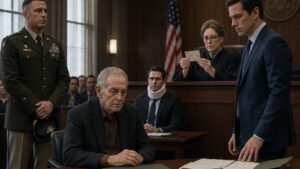
They Sent Security Toward the Old Man Before the Navy Remembered Who Built the Hall
Chapter 1: The Old Man Missing From the List
The voice coming through the assembly-hall speakers was describing a history William Campbell knew had not happened that way.
“Fifty years ago,” the announcer rehearsed, “this command transformed naval rescue training through decisive leadership, innovation, and an unwavering commitment to safety.”
William stopped beneath the security arch.
On the other side of the glass doors, sailors in white uniforms crossed the lobby carrying programs and folded flags. Their shoes struck the polished floor in a rhythm too precise to be hurried. Beyond them stood the assembly hall he had not entered in thirty-two years.
The words from the rehearsal continued.
Decisive leadership.
Innovation.
Commitment.
No mention of the warning that had been ignored. No mention of the men who had entered the flooded chamber before the equipment was ready. No mention of the young sailor who had found the defect and reported it hours too late.
William rested one hand against the front of his olive jacket.
The fabric had faded almost gray at the shoulders. The zipper caught halfway. Inside the left pocket, three uneven blue stitches held the lining together. His fingers found the folded invitation and the sealed envelope beneath it.
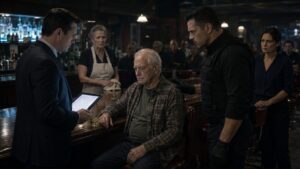
A civilian event coordinator looked up from a tablet.
“Sir, I need you to keep moving through the scanner.”
William stepped forward.
The machine remained silent.
The coordinator wore a navy-blue suit and a laminated badge that read SANDRA GARCIA. She offered him a professional smile that stopped short of warmth.
“Invitation, please.”
William removed the rain-softened card from his pocket. Its cream paper had buckled along one edge after the storm the night before. He had kept it flat beneath a book in his hotel room, but the ink around the digital code had bled.
Sandra turned it beneath the overhead light.
“This won’t scan.”
“I expected it might not.”
“Do you have the email version?”
“No.”
“A government-issued ID?”
He gave her his driver’s license.
She entered his name.
William watched the lobby while she searched. A group of officer candidates passed within a few feet of him. None looked twice. To them he was simply an old civilian in a worn coat, standing where someone had told him to stand.
Sandra frowned at the tablet.
“Campbell, William?”
“Yes.”
“You’re not in the system.”
“The invitation came by mail.”
“All mailed invitations were entered into the system.”
“Apparently not all of them.”
Her eyes lifted. The smile disappeared.
“Who invited you?”
“The command.”
“Which office?”
“The letter didn’t say.”
“That’s unusual.”
“It used to be considered sufficient.”
Sandra looked again at his jacket, his dark trousers, and the scuffed shoes he had polished that morning without much success.
“Are you here with a veterans’ group?”
“No.”
“Former civilian employee?”
“No.”
Her questions were reasonable. William knew that. The building held hundreds of service members, senior guests, and a live broadcast crew. She had procedures to follow.
But each answer he withheld made the next question harder.
He could have ended it with one sentence. He could have named his former office, given the year of his command, or asked her to call the Chief of Naval Personnel. Instead, he heard himself say, “There should be a paper list.”
Sandra glanced toward the doors where guests were beginning to gather.
“We moved to a digital system months ago.”
“The paper copy would have been prepared before that.”
“How would you know?”
William looked past her to the north wall.
“They kept the planning binders in the records office behind the old communications room.”
Sandra followed his gaze. “There is no communications room.”
“There was. The door is concealed behind the memorial display now.”
For the first time, uncertainty entered her expression.
Then she interpreted it in the easiest way available.
“You worked maintenance here?”
“No.”
“Construction?”
“No.”
She exhaled quietly and placed the damaged invitation beside her tablet.
“Sir, I’m going to ask you to wait in the lobby while I verify this.”
“The ceremony is beginning.”
“If we can confirm your invitation, someone will escort you inside.”
William looked at the sealed envelope still hidden in his pocket.
“Is Katherine Wilson on the list?”
Sandra searched.
“Yes. Civilian guest. Section C.”
“Has she arrived?”
“I can’t give out guest information.”
“She may already be inside.”
“That doesn’t change the verification process.”
William nodded once. “No. It doesn’t.”
Sandra seemed relieved by his agreement. She motioned toward a row of chairs beside a wall displaying photographs of past graduating classes.
“Please wait there.”
He sat beneath a portrait of young sailors kneeling beside rescue equipment that had been obsolete before half of them were born. Through the open inner doors, he could see the edge of the central aisle and the bright white shoulders of the assembled formation.
The rehearsal ended. A bell sounded. Conversations in the lobby quieted.
William unfolded the invitation on his knee.
The ceremony title remained legible:
FIFTIETH ANNIVERSARY OF THE NAVAL RESCUE TRAINING REFORMATION
Below it, partly blurred, were the words honored guest.
The ceremony was not supposed to be for him. He had made that clear when the first inquiry arrived months earlier. He had declined the speaking invitation and asked only for a seat near Katherine.
Then a second letter had come, written in a different hand.
Your presence may help correct an omission in the official record.
William had almost burned it.
Instead, he had placed the old casualty roster inside the invitation, folded a sealed note around it, and traveled alone.
A young ceremonial aide hurried past Sandra’s station carrying a laptop. The screen faced William for only a moment, but he saw the projected memorial slide.
Nine names appeared in two clean columns.
There should have been ten.
William stood.
Sandra turned immediately. “Sir, I asked you to wait.”
“One name is missing.”
“What?”
“From the memorial list.”
She looked toward the screen, then back at him. “You can’t see the program from here.”
“I just did.”
“The names were verified by command historians.”
“Not all of them.”
Sandra moved between him and the inner doors.
“Please sit down.”
William’s hand closed around the sealed envelope inside his coat.
Katherine’s father had been absent from official accounts for fifty years. A technical classification had placed him outside the final exercise roster, though he had entered the chamber with the others. The distinction had protected careers, budgets, and an investigation that wanted a clean boundary between participants and support personnel.
William had signed the report.
He had told himself he would correct it after the families were notified.
Then after the inquiry.
Then after the reforms passed.
Then after he found the right words.
Half a century had gone by while he waited to speak without causing further harm.
Inside the hall, the master of ceremonies began welcoming the guests.
Sandra reached for her radio.
“Sir, do not enter without an escort.”
William stepped around her.
She caught his sleeve, not roughly, but firmly enough to stop another elderly man.
He looked down at her hand.
Sandra released him.
“You are not cleared.”
“The name is still missing.”
“What name?”
William looked through the doors at the memorial slide.
“Steven Wilson.”
Sandra’s face changed at the certainty in his voice, but only for a second.
“Wait here.”
William had done that before.
He had waited beside hospital beds, outside inquiry rooms, in Pentagon corridors, and at a grave where he could not bring himself to approach the family.
He had waited until silence looked like restraint.
Then until restraint became cowardice.
The hall doors began closing.
William moved before they met.
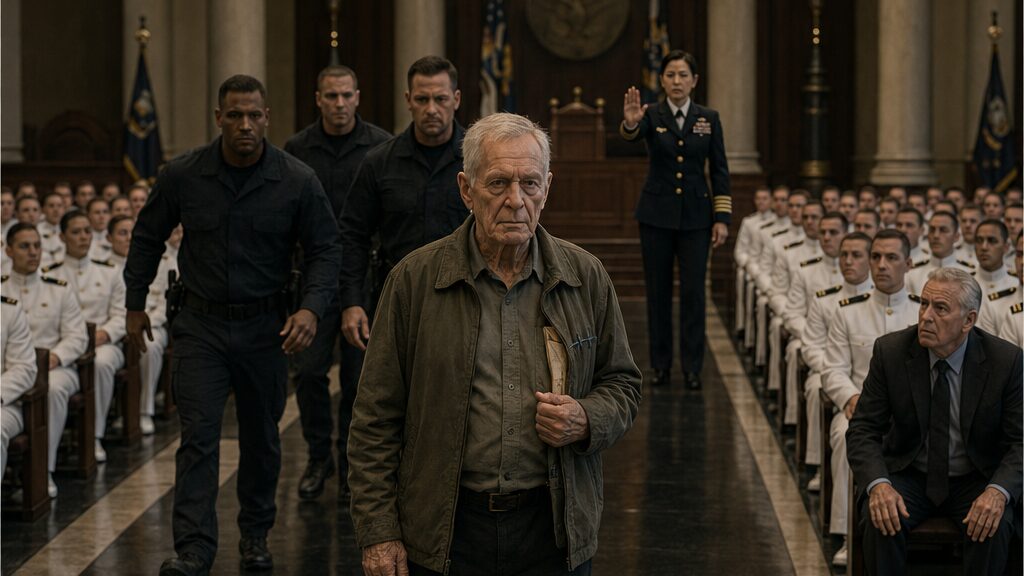
He entered the assembly alone, wearing the old olive jacket, while every white-uniformed head in the nearest rows turned toward him.
Chapter 2: Security Came Running Down the Aisle
Rear Admiral Samantha Lee saw the civilian man before the ceremonial aide finished whispering into her earpiece.
He stood halfway down the central aisle, surrounded by rows that had been aligned to the inch.
Every sailor faced forward except those nearest him. Their eyes moved without their heads at first. Then one officer candidate turned openly, and the motion spread down the formation like a flaw in polished metal.
Samantha kept both hands on the podium.
The event was being streamed. Senior officers occupied the first three rows. A congressional liaison sat near the aisle. Two weeks earlier, an unauthorized contractor had entered a restricted training building using an expired badge, and the resulting review had landed on Samantha’s desk with language she had not forgotten.
Command climate.
Procedural complacency.
Failure of visible control.
Now an old man in a worn green jacket was standing in the center of her ceremony.
The aide murmured, “Event staff says he isn’t on the list.”
“Security?”
“Responding.”
Samantha looked at the man.
He did not appear lost. That was what troubled her.
He stood with his feet planted evenly, shoulders slightly bent by age but held with a discipline she recognized without placing. His hands rested at his sides. He looked toward the memorial screen behind her, not toward the doors he had entered through.
Samantha leaned toward the microphone.
“Sir.”
The hall settled into absolute silence.
The man raised his eyes.
“This is a closed command event. Please return to the lobby with the staff member assisting you.”
“I need to speak to Katherine Wilson.”
His voice carried farther than it should have without amplification.
Samantha glanced toward the aide.
“Katherine Wilson is a registered guest,” the aide whispered. “Section C.”
Samantha returned her attention to the man.
“Mrs. Wilson can meet you outside after the ceremony.”
“It cannot wait until after the memorial list is read.”
A murmur moved through the civilian section.
Samantha saw Sandra standing at the rear doors, pale and breathless. She was speaking urgently into her radio.
“What is your relationship to Mrs. Wilson?” Samantha asked.
The man paused.
That pause hardened Samantha’s concern.
“I owe her something,” he said.
“This is not the place.”
“It became the place when her father’s name was removed.”
The silence changed.
Samantha turned slightly toward the memorial projection behind her. Nine names filled the screen beneath the title IN HONOR OF THOSE LOST.
“These names were verified through official records,” she said.
“The official record is wrong.”
A few faces in the front rows lifted toward her.
The public-affairs officer stood near the stage wing, one hand pressed to a headset. Samantha knew what the officer wanted: end the interruption, resume the script, preserve the broadcast.
Samantha’s voice sharpened.
“Sir, you will return to the lobby now.”
The old man did not move.
From the rear doors came the sound of running boots.
Three security officers entered in dark uniforms and advanced down the aisle. Their pace was controlled but fast, black shapes moving between the white formations.
The civilian guests turned to watch.
Samantha saw the old man glance once toward Section C.
She followed his gaze and found a woman in her fifties sitting rigidly near the aisle. Katherine Wilson, presumably. The woman’s expression held no recognition, only alarm.
The old man lifted his right hand toward the inside of his jacket.
“Hands where we can see them,” the lead security officer called.
The hall reacted with one collective intake of breath.
The man stopped.
His fingers remained against the coat opening.
“I have a document,” he said.
“Remove your hand.”
He did so slowly.
Samantha felt the entire ceremony narrowing around that movement: the cameras, the watching officers, the recent review, the possibility that caution would be judged either excessive or insufficient.
“Sir,” she said, “do not reach into your clothing again.”
He looked at her with tired, level eyes.
“The name you need is on the paper copy.”
“We have the official list.”
“No. You have the list that survived the transfer.”
The security officers reached him. One moved to his left, another to his right. The lead officer spoke quietly.
“We’re going to escort you outside.”
“I will walk.”
“Turn around.”
The man did not.
Samantha saw something in his posture then—not refusal exactly, but the practiced stillness of someone accustomed to receiving orders and measuring whether they were lawful, necessary, or merely convenient.
In the fourth row, an elderly man in a dark suit rose halfway from his seat.
Samantha recognized Gregory Davis from the guest roster, a retired command master chief invited as part of the historical delegation.
He stared at the civilian’s jacket.
Not his face. The jacket.
The lead security officer reached for the old man’s arm.
“Wait,” Gregory said.
The officer looked toward Samantha.
She did not yet give the order to stop.
Gregory stepped into the aisle, his knees stiff. “Sir, turn slightly.”
The old man’s expression changed for the first time.
“Gregory.”
The retired master chief gripped the back of the seat in front of him.
Samantha’s confidence shifted beneath her.
“You know him?” she asked.
Gregory did not answer. His eyes remained fixed on the edge of the coat where the lining had pulled outward. Three uneven blue stitches showed inside the pocket.
“I know those stitches,” he said.
The old man lowered his gaze to the repair.
Gregory’s face seemed to lose years and gain them at once.
“Steven did that,” he said. “In the equipment bay.”
Katherine Wilson stood.
“What did you say?”
Every camera in the hall was still running.
The old man looked toward her, and for a moment the public confrontation vanished from his face. What remained was grief stripped of ceremony.
“Katherine,” he said.
She did not respond to the familiarity.
The lead security officer shifted his weight. “Ma’am, we need direction.”
Samantha looked at the old man. “Who are you?”
He reached for his jacket again.
The officers tensed.
“Slowly,” Samantha ordered.
He slid two fingers into the repaired pocket and removed a folded cream invitation, swollen from water damage. Something darker and older was wrapped inside it.
The paper slipped as the lead officer took his wrist.
The bundle fell.
It struck the polished floor and opened at Samantha’s feet.
A handwritten roster spread across the aisle, its fold lines brown with age. Ten names appeared beneath a training exercise designation Samantha knew from the ceremony archive.
At the bottom were initials in blue-black ink.
Samantha bent and picked it up.
She had seen those initials every morning for three years, engraved beneath the portrait outside her office.
They belonged to the commander who had led the training center before the reforms being honored that day.
Her predecessor’s predecessor.
A man whose private files had supposedly been transferred to naval archives decades ago.
Samantha looked from the initials to the old man in the olive jacket.
“Where did you get this?”
His wrist was still in the security officer’s hand.
The old man looked down at the grip, then back at Samantha.
“I was there when it was written.”
Chapter 3: The Paper Record They Nearly Destroyed
“Was this taken from a naval archive?”
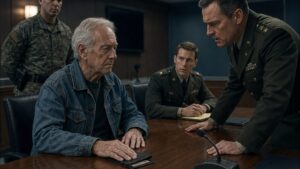
Samantha placed the casualty roster on the briefing-room table as if it might contaminate everything around it.
William stood opposite her. The security officers had released him, but they remained inside the room. Sandra waited near the door with her tablet clutched against her chest. Gregory sat heavily in a chair, watching William with an expression that combined recognition and accusation.
The ceremony had been paused under the explanation of a technical problem.
Through the wall came the muffled sound of several hundred people being asked to remain seated.
William looked at the roster.
“No.”
“Then where did you get it?”
“It was given to me.”
“By whom?”
“The officer whose initials are at the bottom.”
Samantha’s jaw tightened. “Vice Admiral Brian Lewis died twenty-one years ago.”
“I know.”
“You expect me to accept that he personally handed you an official casualty document?”
“It was not official when he handed it to me.”
The public-affairs officer entered without knocking and passed Samantha a phone. She read the screen, then set it facedown.
“We have national media asking why security detained an elderly guest during a memorial broadcast.”
“I was not detained,” William said.
The lead officer shifted uncomfortably.
Samantha ignored the correction.
“Until we verify your identity and the origin of this document, you are not returning to that hall.”
“I did not ask to return for myself.”
“You disrupted a formal ceremony, accused this command of falsifying a memorial record, and produced restricted historical material.”
“I said the record was wrong.”
“That distinction may matter to you.”
“It should matter to the Navy.”
The room went still.
Samantha studied him. Her expression no longer held simple authority. It held the irritation of someone who sensed the ground moving but refused to step away from her position.
Sandra cleared her throat.
“Admiral, there may be a paper planning file.”
Samantha turned. “You told me all invitations were in the database.”
“They were supposed to be.”
“Were they or weren’t they?”
Sandra lowered her tablet. “The original guest nominations were compiled before the migration. Some categories were imported manually.”
“Which categories?”
“Historical guests. Gold Star families. Retired leadership.”
William saw the moment Samantha understood the danger—not danger from him, but from a system she had trusted publicly.
“Find the paper file,” Samantha said.
“The records office is locked for the ceremony.”
William spoke before Sandra could answer.
“The old communications room has a second entrance.”
Sandra looked at him.
Samantha did too. “You mentioned that earlier.”
“Yes.”
“How do you know this building?”
William’s fingers rested against the worn invitation on the table.
He could have answered.
Instead, he said, “The door is behind the memorial display. The lower right panel releases if you press beneath the brass edge.”
Samantha stared at him, then motioned to Sandra. “Go.”
Sandra left with one security officer.
Gregory leaned forward.
“You always did that,” he said.
William turned toward him.
“Did what?”
“Answer the question beside the question.”
The years had changed Gregory’s voice, but not the bluntness beneath it.
William said, “You were less patient then.”
“I had less reason to be.”
Samantha looked between them. “Master Chief Davis, identify this man.”
Gregory’s eyes stayed on William.
“I’m trying to be certain.”
“You called him sir in front of the entire command.”
“I called plenty of men sir.”
“Did you serve with him?”
Gregory rubbed one hand across his mouth. “I served under someone who stood like him. Spoke like him. Wore that same ugly coat into the hospital after the chamber accident.”
William looked down at the olive fabric.
“It was less faded then.”
Gregory gave a short, humorless breath.
“That is not a denial.”
“No.”
Samantha stepped closer to the table. “What chamber accident?”
Gregory turned toward her sharply. “The one your ceremony is about.”
“The ceremony commemorates the rescue-training reformation.”
“It commemorates what came after.”
The words landed harder than a raised voice.
William saw Samantha glance at the roster again.
Ten names.
The ceremony displayed nine.
She asked, “Who is Steven Wilson?”
No one answered immediately.
William felt the sealed envelope inside his pocket. It seemed heavier than the roster.
Gregory looked at him. “Tell her.”
“It is not her truth to receive first.”
Samantha’s restraint thinned. “It became my responsibility when you stopped my ceremony.”
“Your ceremony stopped being yours when it named the dead incorrectly.”
The lead security officer looked toward the door, perhaps wishing to be anywhere else.
Samantha drew herself upright. “You are in no position to lecture this command about responsibility.”
William met her eyes.
“That remains to be established.”
The door opened.
Sandra returned carrying a thick blue binder powdered with dust. The records archivist followed, breathing hard, with a ring of keys at one hip.
“We found it behind the display,” Sandra said. “The room is still labeled communications storage on the internal plan.”
She placed the binder beside the roster and opened it.
Inside were typed seating charts, handwritten amendments, copies of mailed invitations, and correspondence bearing dates from before the digital migration.
Sandra turned pages quickly.
Her finger stopped.
No one spoke.
Samantha came around the table.
At the top of the page was a list titled HONORED HISTORICAL GUESTS.
Halfway down, typed in plain black letters, appeared:
ADM. W. CAMPBELL — FRONT ROW, CENTER
FORMER COMMANDING OFFICER
REQUESTED COMPANION SEATING: KATHERINE WILSON
Sandra swallowed.
“There’s also a notation,” she said.
Samantha read it aloud.
“Guest requests no public introduction before memorial correction is discussed.”
The room changed.
The security officers straightened. The public-affairs officer picked up the phone and then seemed uncertain whom to call. Sandra’s face flushed as she looked at William’s worn coat, then at the line naming him.
Samantha did not move for several seconds.
At last she said, “Admiral Campbell?”
William looked at the paper list rather than at her.
“That is what it says.”
“Are you denying it?”
“No.”
The lead security officer released a breath through his nose.
Sandra whispered, “Why didn’t you tell me?”
William turned to her. “Would it have made the invitat
Chapter 4: The Order Signed After Men Died
The archival film froze on William’s younger face.
The projector trembled softly in the darkened screening room, holding him at forty-two: shoulders square, hair still dark, eyes fixed somewhere beyond the camera. He wore the same olive jacket, though in the grainy image its fabric looked almost new.
Gregory had forgotten that detail.
He had remembered the jacket in hospital corridors and on the rain-soaked loading dock after the accident. He had remembered William refusing an umbrella while ambulances came and went. But he had not remembered how young the commander had been.
Samantha stood beside the projector console with the casualty roster in both hands. Sandra, the records archivist, and the public-affairs officer crowded near the back wall. William remained closest to the door, as though he might still leave before anyone decided what to call him.
The film resumed.
A narrator with the clipped confidence of another era described the training center’s “rapid transition to an integrated rescue-safety doctrine.” Onscreen, sailors installed redesigned breathing manifolds and marked new emergency routes through flooded training chambers.
Then William appeared at a podium.
The younger version of him spoke without sound beneath the narrator’s voice. Behind him stood a row of senior officers. A caption formed at the bottom of the frame:
REAR ADMIRAL WILLIAM CAMPBELL
COMMANDING OFFICER, NAVAL RESCUE TRAINING CENTER
No one in the screening room moved.
The public-affairs officer lowered the phone she had been holding. Sandra’s shoulders drew inward. Samantha looked from the image to the elderly man by the door.
William watched the floor.
The narrator praised the order that had suspended hazardous chamber exercises across the fleet until every facility completed new inspections. The film called it “a decisive intervention that prevented further loss and established standards still followed today.”
Samantha spoke quietly. “That order became the foundation of our current doctrine.”
Gregory nodded.
“It shut down twelve chambers before inspectors found the same valve defect in four of them.”
“How many people would have trained in those chambers?”
“Hundreds that month.”
The film showed William walking through the original equipment bay. Beside him, barely visible near the edge of the frame, moved a group of enlisted sailors carrying hoses and tool cases.
Gregory leaned forward.
“Stop it.”
The archivist paused the reel.
Gregory approached the screen until the projector light cut across his suit. He pointed toward a sailor half obscured behind William’s shoulder.
“That is Steven.”
Katherine’s father looked no older than twenty-seven. His sleeves were rolled above his elbows. A small sewing kit protruded from one shirt pocket.
Samantha turned toward the casualty roster.
“His name is not in the film.”
“It is not in the final report either,” William said.
His voice came from the doorway.
Gregory faced him. “Tell them why.”
William’s expression remained still, but Gregory could see the effort required to hold it there.
“He was assigned to equipment support,” William said. “The exercise roster had already been approved. When the chamber alarm sounded, he entered without being ordered.”
“To rescue the trainees?” Samantha asked.
“To reach the manifold.”
The archivist searched through a folder and pulled out a typed incident summary.
“It says the primary valve failure was identified during the post-accident inspection.”
“That is what the final report says,” William replied.
Gregory felt anger rise beneath his ribs, old and familiar.
“Steven identified it before the exercise.”
Samantha looked sharply at him.
Gregory continued. “He reported irregular pressure in the secondary line. The maintenance chief told him the gauge had been recalibrated. Steven asked for a shutdown.”
“Was the request recorded?”
“It was entered in a work log.”
The archivist began searching.
William said, “The page was removed from the command copy during the inquiry.”
The projector clicked as the film strip rested against the heat.
Samantha’s face tightened. “Removed by whom?”
“The inquiry staff said the entry was preliminary and unsigned.”
“Was it?”
“Yes.”
“Then why do you believe it was Steven’s?”
“Because he brought it to me.”
Gregory stared at William.
This was more than he had known.
“You saw the warning?”
“Not before the exercise.”
The distinction was careful, and terrible.
William moved nearer the table.
“He asked for five minutes. My aide told him I was preparing for the visiting inspection team. Steven left the work log and returned to the equipment bay. I saw it after the alarm.”
Gregory remembered the day suddenly in fragments: red lights turning over the chamber doors, boots sliding on wet concrete, someone shouting that the pressure line had gone dead.
He remembered Steven pushing past him with a wrench.
He remembered William arriving without his cover, demanding numbers no one could give him.
“You signed the shutdown order that night,” Gregory said.
“Before sunrise.”
“You fought fleet command for it.”
“I did.”
“They told you a full suspension would make the Navy look unprepared.”
“It was unprepared.”
Samantha’s eyes moved to the frozen film image of William at the podium.
“You accepted the investigation’s finding.”
William looked at her.
“I accepted command responsibility.”
“That is not the same as accepting an altered record.”
“No.”
“Then why didn’t you challenge it?”
The projector fan hummed in the silence.
William reached inside his jacket, slowly this time. No one moved toward him.
He touched the repaired pocket but removed nothing.
“The families had been told the deaths resulted from an unforeseeable mechanical failure,” he said. “A public dispute would have delayed compensation and reopened every finding. I was advised that the reforms mattered more than the wording.”
“Advised by whom?” Samantha asked.
“Men whose careers were already longer than Steven Wilson’s life.”
Gregory stepped away from the screen.
“And you agreed.”
“Yes.”
The answer was stripped of excuse.
Onscreen, the young William remained frozen in command, his mouth open around words no one could hear.
Samantha studied the archival folder.
“The ceremony program credits you with identifying the systemic defect.”
“I signed the order.”
“That is not what I asked.”
“No. I did not identify it first.”
Gregory looked again at Steven’s small figure behind William.
The institution had preserved the commander and cropped away the sailor.
A knock sounded.
The public-affairs officer opened the door a few inches, spoke to someone outside, then turned toward Samantha.
“Mrs. Wilson is asking to leave.”
William’s hand tightened at his side.
Samantha said, “Bring her here.”
“No,” William said.
It was the first order he had given all morning.
Samantha paused.
William looked toward the hall beyond the door.
“I will go to her.”
Before he could move, the door opened wider.
Katherine Wilson stood in the corridor.
She held the ceremony program folded lengthwise in one hand. Her father’s absence from the memorial page showed between her fingers like a deliberate blank.
Her gaze passed over Samantha, Gregory, and the frozen image on the screen.
Then it settled on William.
“You were there,” she said.
William did not retreat behind silence this time.
“Yes.”
Katherine’s face remained controlled.
“I know who you are now,” she said. “What I do not know is what you never told me.”
Chapter 5: The Promise Hidden Inside the Coat
Katherine recognized the stitches before she accepted the envelope.
She and William stood inside the small chapel adjoining the assembly hall. Its doors had been closed against the restless noise outside, but the paused ceremony still announced itself through distant footsteps and low voices.
William had placed the sealed note on the front pew between them.
Katherine had not touched it.
Instead, she stared at the inside of his jacket where the lining had turned outward. Three uneven blue stitches crossed the pocket seam.
“My father sewed like that,” she said.
William looked down.
“He said straight stitches took too long.”
A faint expression touched her face and disappeared.
“He repaired everything badly and permanently.”
“That describes this pocket.”
“When?”
“The morning of the accident.”
Katherine’s eyes lifted to his.
William sat at the end of the pew, leaving the envelope between them. The chapel smelled faintly of furniture polish and old paper.
“The pocket had torn on a filing cabinet,” he said. “I was carrying too many folders. Your father saw me trying to push the lining back in.”
“So he repaired an admiral’s coat?”
“I was a rear admiral. He told me that was not a sewing qualification.”
The memory almost produced a smile in her, but grief stopped it.
“What else did he say?”
William’s fingers closed over his knee.
“He said the manifold pressure was wrong.”
Katherine sat slowly.
“He told you?”
“He tried.”
“That is not the same answer.”
“No.”
William looked toward the chapel doors.
“I was preparing for an inspection. The visiting team had arrived early. Your father asked my aide for five minutes and left the unsigned work log when he was turned away.”
“Did you read it?”
“After the alarm.”
Katherine lowered her eyes to the envelope.
For fifty years, William had imagined this conversation. In some versions he had spoken perfectly and she had understood. In others she had thrown the note back at him. None had included the quiet scrape of her thumbnail against the pew or the way she kept her body angled toward the door.
“What happened inside the chamber?” she asked.
“The secondary breathing line lost pressure. The trainees were ordered toward the emergency route, but the inner gate jammed. Your father entered through the service hatch with a manual wrench.”
“He was not assigned to the exercise.”
“No.”
“Then why did he go in?”
“He knew where the valve was.”
William paused.
“He closed the failed line before the reserve tanks emptied. That gave the rescue team time to reach six men.”
Katherine stared at him.
“Six?”
“Yes.”
“The Navy told my mother he died while supporting emergency operations.”
“That phrase was selected because it was accurate without being complete.”
Her eyes sharpened.
“You signed it.”
“Yes.”
The word seemed to strike the chapel walls.
William did not soften it.
Katherine picked up the envelope but did not break the seal.
“Why was his name removed from the casualty list?”
“He was not on the approved exercise roster. The inquiry separated assigned participants from support personnel.”
“That sounds clean.”
“It was meant to.”
“And you let it remain that way.”
“Yes.”
She stood and walked toward the narrow stained-glass window. Color moved across her face.
“My mother spent years thinking he had ignored procedure and run into a chamber where he did not belong.”
“He did ignore procedure.”
Katherine turned.
“He also saved lives,” William said. “Both things are true.”
“Then why did no one tell us the second part?”
William’s hand went to the repaired pocket.
“Because the warning he gave before the exercise would have changed the finding. It would have shown the accident was not entirely unforeseeable.”
“And that would have embarrassed command.”
“It would have done more than that. Compensation had already begun. Criminal referrals were being considered. Senior officers argued that reopening the findings could delay payments to every family.”
“Did you believe them?”
“I wanted to.”
Katherine looked at him for a long time.
William felt the old instinct to say less. To give her the facts and leave her space. To call silence respect.
He forced himself to continue.
“I told myself I would come after the settlements were complete. Then after the reforms were approved. Then after your mother’s health improved. Each delay sounded responsible when I made it.”
“How long did my mother live?”
“Seventeen years after the accident.”
“You had seventeen years.”
“Yes.”
“And after she died?”
“I told myself you had built a life without this burden.”
“You mean without you.”
William met her gaze.
“Yes.”
The admission left him with nothing to hide behind.
Katherine returned to the pew. She held the envelope in both hands.
“What is in this?”
“The account I wrote the week after the accident. What your father reported. What he did in the chamber. The names of the men who lived because he closed the line.”
“You wrote it fifty years ago?”
“Yes.”
“And carried it all this time?”
“Not every day.”
“That is not what I asked.”
William looked at the blue stitches.
“I kept the coat. The letter stayed in its pocket.”
Katherine’s fingers tightened around the envelope.
“You preserved an apology better than you delivered it.”
The words were quiet. They hurt more for that.
William nodded.
“Yes.”
A chime sounded through the wall, followed by the indistinct voice of an aide testing the hall microphone.
Katherine looked toward the door.
“They are going to continue.”
“Samantha said the program is paused.”
“Paused is not corrected.”
William said nothing.
Katherine held the envelope toward him.
He did not take it.
“I came to give that to you.”
“I do not want this to become another private document the Navy can forget.”
“It belongs to you.”
“So does the truth about my father.”
William felt the old division inside him: private grief on one side, public duty on the other. For decades he had convinced himself that keeping them separate protected the family.
Katherine placed the envelope back into his hand.
“I will read it,” she said. “But not as a substitute.”
“For what?”
“For his name.”
The chapel door opened.
Samantha stood there, her expression composed too carefully.
“The ceremony will resume in five minutes,” she said. “We have prepared an acknowledgment of Admiral Campbell’s presence.”
Katherine looked past her toward the hall.
“Will my father be acknowledged?”
Samantha hesitated.
“The approved script cannot be revised without review.”
William felt the sealed letter against his palm.
Katherine’s voice remained level.
“Then you are about to leave him out again.”
The speakers in the assembly hall came alive.
“Ladies and gentlemen, please return your attention to the stage. The program will resume with the previously approved memorial presentation.”
Chapter 6: The Honored Seat He Would Not Take
The ceremonial coat arrived before William did.
A young aide carried it into the stage wing on a wooden hanger, dark blue wool pressed without a crease. Gold sleeve stripes caught the work lights. In the aide’s other hand was a white seat card printed with William Campbell’s name and former rank.
Samantha watched him place both on a table beside William’s worn olive jacket.
Except William had not removed the olive jacket.
He entered with Katherine several steps behind him, the sealed envelope once again inside the repaired pocket. Gregory followed from the chapel corridor.
The contrast between the two coats made Samantha feel worse than any accusation had.
One represented the man the institution was prepared to honor.
The other belonged to the man she had ordered security to remove.
“The front-row seat is ready,” she said.
William looked at the card.
“I will remain with Katherine.”
“We can place her beside you.”
“That is not the issue.”
Samantha glanced toward the stage entrance. The public-affairs officer stood there with a headset, watching the countdown clock.
Four minutes.
“We will introduce you before the memorial presentation,” Samantha said. “The audience deserves an explanation.”
“Of what?”
“Your identity. The interruption.”
William touched the edge of the ceremonial coat with two fingers, then let it fall still.
“You believe telling them my rank will explain what happened?”
“It will correct the misunderstanding.”
“No. It will change whom they think they mistreated.”
Samantha felt the words land where she had no defense ready.
“We followed a security process.”
“You followed it after refusing to check whether the process had failed.”
“We had an unverified man entering a controlled event.”
“You had an old man with damaged paper.”
“You reached inside your coat while security approached.”
“I told you I had a document.”
“You had already refused instructions.”
William nodded. “I made your decision harder.”
The concession startled her.
Then he asked, “Would you have listened if the binder had listed me as a retired machinist?”
Samantha looked toward Katherine, Gregory, the aide, and the public-affairs officer. Each had become very still.
“The circumstances would have been different,” she said.
“Why?”
“Because you were designated an honored guest.”
“That was not known in the hall.”
“No.”
“And before it was known?”
Samantha’s mouth went dry.
The countdown changed to three minutes.
William waited.
He did not use silence gently. He used it precisely, leaving no place for her to set down an incomplete answer.
“At that moment,” Samantha said, “I believed removing you was more important than hearing you.”
“Because you thought I had no standing.”
“Because I thought you might be a risk.”
“Those answers are not as different as they should be.”
The public-affairs officer stepped closer.
“Admiral Lee, we need a decision. The network has resumed the holding feed. If we change the memorial language live, questions will begin immediately.”
“They have already begun,” Samantha said.
“The approved position is that the historical list reflects the final inquiry.”
Katherine’s expression hardened.
William did not raise his voice.
“The final inquiry excluded a sailor whose warning led to the safety order this ceremony celebrates.”
The officer lowered her headset slightly.
“That claim has not completed archival review.”
“Neither had my invitation,” William said. “You were willing to act on that.”
Samantha turned toward the stage opening.
Beyond the curtain, hundreds waited beneath the memorial slide. She could hear the small sounds of discipline under strain: a cough suppre
Chapter 7: The Name the Navy Left Unspoken
William stepped through the curtain carrying the microphone in one hand and the casualty roster in the other.
The assembly hall had changed while he was gone. No one whispered now. The rows of white uniforms remained perfectly aligned, but the confidence had gone out of the arrangement. The formation looked less like an audience than a body waiting to learn what had been withheld from it.
Samantha walked to the podium first.
“Before we continue,” she said, “this command must correct two failures.”
The sentence moved through the room without sound.
“We failed to verify an invited guest before treating him as a disruption. We also relied on a historical record we now know is incomplete.”
She turned toward William.
The lead security officer stood near the rear doors. When William entered the aisle, the officer stepped aside. He did not salute or lower his head. He simply cleared the path that should never have been blocked.
William walked between the formations.
This time, no one turned to stare as though he did not belong. They watched him openly.
Katherine remained near the side entrance with the sealed envelope held against her chest. Gregory stood beside her.
William reached the podium and placed the casualty roster across its polished surface. The paper refused to lie flat. Its old folds rose like small ridges beneath the lights.
Samantha offered him the center position.
He shook his head and remained beside the podium rather than behind it.
“My former rank is the least important fact in this room,” he began.
The microphone carried his voice to every corner of the hall.
“I was Rear Admiral William Campbell when the flooded-chamber accident occurred. I later retired as an admiral. Those facts explain why my signature appears on certain orders. They do not explain why I should have been heard this morning.”
No one moved.
“A man without rank brought damaged paper to this command and said one of the dead was missing. That statement deserved verification before anyone knew who he had once been.”
Samantha’s face remained still, but she did not look away.
William unfolded the roster fully.
“This was the working casualty list prepared on the night of the accident. It contains ten names. The official memorial contains nine.”
He read the first nine slowly. Each name appeared on the screen behind him as the ceremonial aide entered it into the program.
Then William reached the final line.
“Petty Officer Steven Wilson.”
The aide typed.
Steven’s name appeared beneath the others.
Katherine closed her eyes.
William waited until the room had seen it.
“Petty Officer Wilson was assigned to equipment support, not to the exercise team. Before the exercise began, he detected unstable pressure in the secondary breathing manifold. He requested a shutdown.”
The words sounded harsher aloud than they had in the chapel.
“His work entry was unsigned. His request did not reach me before the exercise started. When the alarm sounded and the chamber’s inner gate jammed, he entered through a service hatch carrying a manual wrench.”
A diagram of the old chamber appeared on the side screen. The archivist had found it while the ceremony was paused.
“He reached the secondary valve and closed the failed line. That action preserved the reserve air long enough for six trainees to be removed.”
A stir passed through the rows.
William continued before it could become admiration detached from cost.
“Steven Wilson died inside the chamber.”
Katherine lowered the envelope to her lap.
“The report described his death as support provided during emergency operations. That phrase was accurate. It was also designed to avoid what his presence inside the chamber revealed.”
William placed one hand beside the roster.
“The defect had been reported before the exercise. The accident was not as unforeseeable as command declared.”
The hall seemed to contract around the admission.
“I signed the final report.”
Samantha’s eyes shifted toward him.
“I also signed the emergency order that suspended flooded-chamber training across the fleet. That order is the reason this ceremony was organized. It led to inspections, redesigned equipment, new rescue routes, and standards that protected thousands of sailors.”
William looked at the projected anniversary emblem.
“For many years, the Navy described that order as an act of decisive leadership.”
He let the phrase remain in the air.
“It was signed after men died.”
No one applauded.
William had feared applause more than anger. Applause would have allowed the room to turn confession into celebration.
“The order mattered,” he said. “The reforms mattered. But no institution should praise what it corrected while erasing the person who first warned it.”
He looked toward Katherine.
“Steven Wilson’s name was excluded because he was not assigned to the exercise. His warning was excluded because it complicated the finding. I was advised that challenging the report might delay compensation to the families and weaken approval for the reforms.”
William’s fingers tightened against the podium.
“I accepted that reasoning.”
Gregory lowered his head.
“At first, I believed I was choosing the living over the record. Later, I understood that I had chosen speed over truth. By then, correcting the record required admitting that I had permitted it to remain incomplete.”
William reached inside the olive jacket.
The movement that had brought security running now caused no one to flinch.
He touched the three blue stitches inside the pocket.
“On the morning of the accident, Steven repaired this pocket. He used the wrong color thread. The stitches were uneven. I kept the coat because he had touched it on the last day of his life.”
Katherine watched his hand.
“I told myself keeping it meant I had not forgotten him.”
William looked at the ten names behind him.
“Remembering privately is not the same as speaking when the truth is owed.”
The sentence was directed at the room, but it belonged to Katherine.
“I wrote an account for Steven’s family one week after the accident. I did not deliver it. I waited for the investigation, for the settlements, for the reforms, for grief to become easier to approach.”
He paused.
“It never did.”
The hall remained silent enough for the projector fan to be heard.
“My silence was not humility. Not entirely. Some of it was fear. Some was shame. I permitted the Navy to preserve a cleaner story because I did not want to stand before a family and explain the cost of the decisions made under my command.”
He turned to Samantha.
“Admiral Lee was wrong to believe I could be dismissed because I lacked visible standing. But I was also wrong to believe withholding my identity relieved me of the duty to explain why I had come.”
Samantha accepted the words without resistance.
William faced the formation again.
“You may remember today that an old admiral was mistaken for an intruder. That is not the lesson.”
Several officer candidates leaned forward almost imperceptibly.
“The lesson is that a person should not need stars on an old photograph before you listen. A damaged invitation does not erase a name. Plain clothing does not erase a life. And procedure does not become honorable merely because it is followed with confidence.”
He stepped away from the podium.
Samantha approached the microphone.
“Petty Officer Steven Wilson’s name will be entered into the permanent memorial record,” she said. “The command will also open a formal historical review of the accident documentation and the exclusion of support personnel from the casualty account.”
Her voice tightened.
“I will submit my own actions this morning as part of that review.”
The public-affairs officer looked startled, but Samantha continued.
“We cannot honor service by protecting ourselves from the truth about it.”
She turned toward Katherine.
“Mrs. Wilson, this command asks your permission to include your father’s warning and rescue action in the corrected exhibit.”
Katherine stood.
She did not answer immediately.
When she did, her voice carried without a microphone.
“Include what he did. Include what happened after.”
Samantha nodded. “We will.”
The room rose, not in sudden thunder but row by row, as the master of ceremonies quietly called the formation to attention.
William did not stand taller.
He looked at Steven’s name on the screen.
The applause, when it came, was brief. Samantha ended it before it could become absolution.
The formation was dismissed.
White uniforms flowed from the rows into the side aisles. No one crowded William. A few sailors passed close enough to meet his eyes, then continued without forcing gratitude upon him.
Katherine waited until the hall had nearly emptied.
She approached the podium and looked at the roster lying open beneath Steven’s restored name.
Then she held out the sealed envelope.
“Open it with me,” she said.
Chapter 8: He Left Wearing the Same Old Jacket
The hall was empty except for William and Katherine.
Programs lay forgotten on several seats. The memorial screen still displayed ten names, though the projector had dimmed and Steven Wilson’s line appeared softer than the others.
Katherine sat in the front row.
William took the chair beside her, leaving one empty seat between them. The sealed envelope rested on that seat.
For fifty years, he had imagined giving it away.
He had never imagined being asked to open it.
Katherine slid one finger beneath the flap. The old adhesive released with a faint tearing sound. Inside were six handwritten pages, their folds worn white.
She offered the first page to William.
“You read it.”
He shook his head. “It was written for your family.”
“It was written by you.”
William accepted the pages.
The handwriting belonged to a younger man who had still believed precision could contain grief.
He read the first lines aloud.
“To the family of Petty Officer Steven Wilson: Your husband and father identified a failure in the secondary breathing manifold before the training accident of May fourteenth. His warning was not acted upon in time.”
Katherine’s hand tightened around the empty envelope.
William continued.
He read Steven’s work-log observation. He read the sequence of alarms. He read how Steven had entered the service hatch and turned the manual valve while the reserve pressure fell.
He read the names of the six men removed alive.
There were no claims that Steven had felt no fear. No polished phrases about noble sacrifice. William had written that Steven’s wrench slipped twice because the chamber floor was flooding and that he had continued because he understood the equipment better than the men giving orders outside.
The final page contained only four lines.
“I was the commanding officer. The delay belonged to my command. The silence that follows must not belong to his family. I will come to you when the inquiry allows me to speak fully.”
William stopped.
Katherine looked at the date beneath his signature.
“You wrote that seven days after he died.”
“Yes.”
“And never came.”
“No.”
She took the pages from him and aligned their edges against her knee.
“My mother would have wanted this.”
“I know.”
“She spent years wondering whether he had caused the accident by going inside.”
William looked toward Steven’s name.
“He did not.”
“You could have told her.”
“Yes.”
Katherine’s voice remained steady, which made each word exact.
“I understand why the report was protected. I understand the settlements and the reforms and the men above you who wanted the story closed.”
William waited.
“I do not understand fifty years.”
Neither did he, not in any way that could help her.
“I cannot ask you to.”
She looked at him.
“Were you hoping I would forgive you today?”
William considered lying for half a second.
“Yes.”
Katherine folded the letter along its original lines.
“I cannot.”
The old answer rose inside him: silence, acceptance, retreat.
He made himself speak.
“I understand.”
“No, you do not. Not yet.”
William turned toward her.
She touched the repaired inner pocket of his jacket with two fingers.
“You carried this because it hurt you. My mother carried not knowing because it hurt her. Those are not equal.”
“No.”
“But I believe what you said about him.”
The words did not release him. They gave him something more difficult: responsibility without relief.
Katherine placed the letter inside the envelope.
“I want a copy of the roster.”
“You will have the original if you want it.”
“No. The original belongs in the corrected exhibit where people can see what was almost discarded.”
William looked at her.
She continued, “I want a copy for my family. And I will come back when they install his name permanently.”
A small breath left him.
It was not forgiveness.
It was a future date.
Across the hall, a door opened. Samantha entered with Sandra and the records archivist. They stopped at a respectful distance.
Samantha carried a written directive.
“I can return later,” she said.
Katherine stood. “Say what you came to say.”
Samantha looked at William, then at the damaged invitation lying beside him.
“Effective immediately, no guest will be denied entry solely because a digital system fails to verify a physical invitation. Historical and Gold Star guest lists will retain paper backups, and disputed entries will be reviewed by a supervisor before security removal is requested.”
Sandra spoke next.
“I should have checked the archive when you asked.”
William looked at her.
“Yes.”
She absorbed the answer.
“I am sorry.”
“Do not be sorry because of what the binder called me.”
Sandra’s eyes dropped.
“Be sorry because you believed a man without a title could wait outside while the truth was read incorrectly.”
She nodded. “I am.”
Samantha held the directive at her side.
“The review will include my decision in the hall.”
William said, “Good.”
There was no cruelty in it and no comfort.
Samantha looked toward Steven’s name.
“I cannot promise what headquarters will decide.”
“That is not the part under your control.”
“No.”
She understood him now.
“The corrected memorial panel will be installed within sixty days,” she said. “Mrs. Wilson will approve the wording.”
Katherine nodded.
The records archivist approached the podium and placed the casualty roster inside a protective sleeve. For the first time that day, the paper looked less like evidence and more like memory being properly handled.
William rose.
His knees resisted, and Katherine instinctively reached toward him before stopping. He steadied himself against the chair.
At the central aisle, the three security officers stood near the rear doors. The lead officer moved aside.
“Sir,” he said.
William paused.
The officer’s face carried embarrassment.
“I should have given you time to explain the document.”
“You followed the order you were given.”
“I held your wrist.”
“Yes.”
The officer waited for release.
William did not offer an easy one.
“Next time,” he said, “remember that control and haste are not the same thing.”
The officer nodded.
William walked down the aisle.
No formations closed around him now. No one blocked the doors. His scuffed shoes made small sounds against the polished floor that had once amplified running boots.
Outside, the afternoon light caught the faded shoulders of his olive jacket.
Katherine joined him on the steps.
She held the copied roster and the opened letter.
“I still hate that coat,” she said.
William looked at the torn cuff.
“So did your father.”
Her hand rose to the repaired pocket one last time.
“He would have replaced those stitches if you had given him another hour.”
“He did not have one.”
Katherine looked toward the parking lot.
“No.”
They stood without pretending the word had repaired anything.
Then she said, “Send me the date when the panel is ready.”
“I will.”
“Do not wait for someone else to decide the right time.”
William met her eyes.
“I will not.”
She walked toward her car carrying the truth he should have delivered decades earlier.
Behind him, Samantha’s staff removed the original nine-name memorial slide. Sandra carried it flat against her chest while the archivist followed with the protected roster.
William descended the steps alone.
The ceremonial admiral’s coat remained inside on its hanger.
He left in the same worn olive jacket he had arrived in, its three uneven blue stitches holding.
The story has ended.