They Dragged an Old Man From the Hangar Before Learning Who Had Commanded Its Final Rescue
Chapter 1: The Old Man Beneath the Open Helicopter
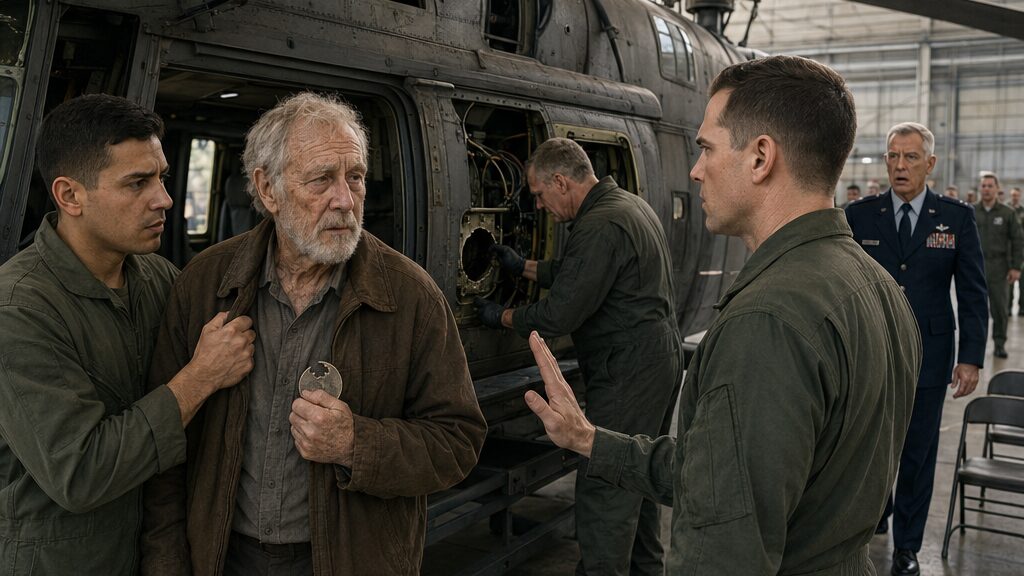
Tyler Garcia found the old man with one hand pressed against the helicopter’s scarred fuselage.
The hangar had not yet opened to ceremony guests. Folding chairs stood in precise rows beneath the overhead lights, and a red rope separated the viewing area from the maintenance lane. Beyond it, the rescue helicopter rested on its landing gear with the side door open and several inspection panels removed.
The old man stood inside the rope.
He wore a brown work coat polished smooth at the elbows, a faded gray shirt, dark trousers, and boots marked with pale dust. His white beard was neatly trimmed but wind-tangled. He did not look lost. He looked as though he had arrived at a place he had spent years avoiding.
“Sir,” Tyler called. “You can’t be back here.”
The man did not turn immediately. His fingers remained spread against a long dent beneath the side window.
Tyler stepped over the rope. “Sir.”
The man lowered his hand.
Up close, Tyler saw something metallic enclosed in the man’s left fist. Only a curved edge showed between his fingers.
“I was told I could come before the crowd,” the man said.
His voice was quiet and rough, with no uncertainty in it.
“Who told you?”
The old man reached inside his coat slowly. Tyler’s shoulders tightened until he saw the folded paper.
The invitation had once been cream-colored. Damp had blurred the seal at the top, and two folds had worn nearly through. The date was correct. The ceremony title was correct. But the access instructions referred to Gate Four, which had been closed for six years.
Tyler examined the name.
J. Walker.
No rank. No organization. No guest category.
“This entrance isn’t for visitors,” Tyler said.
“I noticed.”
“How did you get in?”
“The delivery gate was open.”
Tyler looked toward the distant loading doors. Contractors were bringing in exhibit cases and floral stands. Someone had failed to secure the interior lane.
The old man’s gaze returned to the helicopter.
“Pave Penny,” he murmured.
Tyler frowned. “What?”
“That was what the crews called her before the repaint.”
The aircraft’s official call sign had changed twice before Tyler was born. He had heard older maintainers use half a dozen nicknames, but not that one.
“You served with this unit?”
The man folded the invitation and put it away. “A long time ago.”
Tyler followed his gaze toward the open side door. A rectangular exhibit board stood nearby, waiting to be moved into position. It displayed photographs of the helicopter over thirty-three years of service, a list of credited missions, and the names of aircrew members killed in operations connected to it.
The old man crossed toward the board.
Tyler moved beside him, keeping his body between the man and the aircraft. “I need you to wait outside the restricted area.”
The old man stopped at the final section of the display.
His expression changed so little Tyler might have missed it if he had not been watching closely. The skin around his eyes tightened. His left fist closed harder around the metal object.
“What’s wrong?” Tyler asked.
The man read the names again.
“Three are missing.”
Tyler glanced at the list. “This was prepared from the official history.”
“Then the official history is incomplete.”
“Which names?”
The old man opened his mouth, then looked toward the helicopter instead.
That silence made Tyler uneasy. It was not the hesitation of someone searching his memory. It felt deliberate.
“Sir, who exactly are you?”
Before the man could answer, quick footsteps sounded across the concrete.
Captain Brandon Lewis approached with a tablet tucked against his chest. His uniform was immaculate despite the early hour. He had been in the hangar since before dawn, checking seating charts, security stations, podium wiring, and every detail that might be noticed by the senior command arriving at noon.
His eyes went first to the old man, then to Tyler, then to the rope hanging loose behind them.
“What happened?”
“Found him by the aircraft, sir,” Tyler said. “He has an invitation, but it lists the old gate.”
Brandon held out his hand. “Let me see it.”
The old man studied him for a moment before passing over the paper.
Brandon unfolded it and read the details. “This format hasn’t been used in years.”
“It was mailed three weeks ago,” the man said.
“By whom?”
“There’s no name.”
Brandon turned the paper over. “No barcode. No confirmation number. No sponsor. This is not valid access.”
“It brought me to the gate.”
“It did not bring you through the gate. You walked through a loading entrance.”
“The security post at Gate Four is gone.”
“That should have told you to contact someone instead of entering a restricted hangar.”
The old man looked toward the aircraft. “I contacted the office twice.”
“Which office?”
“The number printed on the invitation.”
Brandon checked it. “That extension was disconnected during the command reorganization.”
The old man gave a slight nod, as though another missing piece had fallen into an expected place.
Brandon’s gaze settled on his clenched hand. “What are you holding?”
“Something that belongs with the aircraft.”
“Open your hand.”
The man did not.
Tyler saw Brandon’s jaw tighten.
“Sir,” Brandon said, “you entered a controlled area without authorization and approached a military aircraft carrying an unidentified object. Open your hand.”
The old man looked at him directly. “It is not dangerous.”
“That is not your determination to make.”
He slowly opened his fingers enough to reveal a round metal token, darkened by age. One side was broken away in a rough diagonal line. A faded emblem remained on the surface, but Tyler could not identify it.
Brandon reached for it.
The old man closed his hand again.
“I won’t surrender it.”
Brandon’s voice flattened. “Then security will remove it from you.”
“It was returned to me under conditions you would not find in your current manual.”
“You are not helping yourself.”
“I did not come to help myself.”
Brandon glanced toward the ceremony display. “You told Airman Garcia the official history was wrong.”
“Yes.”
“And you expect us to accept that because you recognize an old nickname and carry a piece of metal?”
“No.”
“Then give me something verifiable.”
The old man looked once more at the names on the board.
Tyler expected him to state a unit, a rank, or the name of whoever had invited him. Instead, he said, “Let me stand inside the aircraft for five minutes. After that, I will leave.”
Brandon gave a short, incredulous breath. “Absolutely not.”
“There is a circular mounting point beside the flight engineer’s station. I need to see whether it is still there.”
Tyler knew the interior well. He pictured the right side of the cabin, the old communications housing, the web seating, the brackets preserved for the exhibit.
He could not remember a circular mount.
Brandon handed back the invitation. “You’re done here.”
The old man did not take it. Brandon pressed the damp paper against his chest until he accepted it.
“Airman Garcia, escort him outside the maintenance perimeter. Security can verify his identity there.”
Tyler hesitated. “Sir, maybe the historian’s office—”
“The historian’s office is preparing for the ceremony.”
“He knew the old call sign.”
“Anyone can read unit forums.”
The old man’s gaze shifted to Tyler. There was no plea in it. That somehow made the order feel heavier.
Brandon stepped back and pointed toward the exit.
“Take hold of him.”
Chapter 2: The Hand That Closed on His Coat
Tyler’s fingers had barely gathered the old man’s coat when the man stopped so abruptly that the fabric pulled tight across his shoulders.
It was not resistance.
His head turned toward the helicopter’s open side panel.
A maintenance chief stood on a platform beside it, guiding a narrow aluminum cover into place. Beneath the cover ran an original cable assembly that had been retained for historical accuracy. One of the junior maintainers pushed upward while the chief aligned the screws.
“Leave that panel open,” the old man said.
Brandon moved closer. “Keep walking.”
The old man did not look at him. “The lower guide is seated behind the bracket.”
The maintenance chief glanced down from the platform.
“What did he say?” Tyler asked.
“If they close it like that, the guide will split.”
Brandon gave Tyler a sharp look. “Outside. Now.”
Tyler tightened his grip. The old man glanced at the fist bunched beneath his collar, then at Tyler’s face.
“Take me outside if you must,” he said. “Leave that panel open.”
The chief paused. “Captain?”
Brandon looked toward the ceremony clock mounted above the hangar doors. Less than four hours remained before the guests arrived.
“Proceed,” he said.
The junior maintainer pressed the cover again.
A faint metallic click came from inside.
The old man’s expression hardened. “Stop.”
This time the word carried enough command that every hand on the platform froze.
Brandon stepped into his line of sight. “You do not give orders in this hangar.”
The old man’s chest rose beneath Tyler’s grip. “Then you give the correct one.”
For a second, neither moved.
Tyler felt heat creep into his face. Other personnel had begun watching from the rows of chairs and exhibit stations. He was holding an elderly man by the coat while the man tried to prevent damage to an aircraft scheduled to be displayed before two hundred guests.
Brandon pointed toward the door. “Remove him.”
Tyler took one step.
A sharp crack came from the open panel.
The maintenance chief swore under his breath and pulled the cover away. A narrow retaining sleeve had fractured at one end.
The old man closed his eyes.
Not in satisfaction. In pain.
Tyler released some of the pressure on the coat.
The maintenance chief reached into the compartment. “The cable’s intact. Guide sleeve split.”
He looked down at the stranger.
“How did you know?”
The old man opened his eyes. “Because the release sits behind it.”
“There’s no release on the schematic.”
“There was after the desert modification.”
The chief leaned closer to the opening and moved a bundle of wiring aside. His fingers disappeared behind the bracket.
“What am I looking for?”
“A flat lever. Two inches long. It will feel like a worn hinge.”
The chief searched, then stopped.
“I’ve got something.”
He pressed it. A recessed latch released with a low snap, allowing the cable assembly to shift forward without strain.
Several maintainers stared at the opening.
Tyler looked at the token in the old man’s fist. Its broken curve seemed close in size to a pale circular mark visible beside the flight engineer’s station.
Brandon saw it too.
“Where did you get those details?” he asked.
The old man said nothing.
“That modification is not in the public maintenance history.”
“It was never properly entered.”
“So you admit you had access to restricted technical information?”
The old man gave him a tired look. “That aircraft has not carried classified equipment in twenty years.”
“That was not my question.”
“No. It was your preferred conclusion.”
Brandon’s face reddened, but his voice stayed controlled. “You entered without authorization, refused inspection, interfered with maintenance, and demonstrated knowledge absent from current records. I now have more reason to hold you, not less.”
Tyler watched the old man absorb the accusation. Until that moment, his restraint had seemed almost effortless. Now the hand holding the token trembled once.
He hid it by pressing his fist against his thigh.
The maintenance chief climbed down. “Captain, he just saved an original assembly.”
“He also may have obtained protected records improperly.”
“Or he worked on it,” Tyler said.
The words escaped before he had decided to speak.
Brandon turned. “Airman?”
Tyler swallowed. “Sir, he knew exactly where the release was. Maybe we should call the historian.”
Brandon stepped close enough that Tyler had to straighten. “You were assigned to secure this area after last month’s breach. Do you remember that?”
“Yes, sir.”
“A civilian photographer reached the flight line because three people assumed someone else had checked his pass.”
“Yes, sir.”
“And now an unidentified man has entered through a service door with an invalid invitation and an object he refuses to surrender.”
Tyler understood the warning. Brandon was not inventing the danger. The previous breach had led to an investigation, rewritten protocols, and whispered questions about whether the captain was ready for greater responsibility.
But Tyler also understood what his hand was doing.
He looked down. His knuckles were white where they gathered the old man’s coat.
He loosened them.
Brandon noticed.
“Maintain control.”
Tyler obeyed, though less forcefully.
The old man turned his head toward the interior of the helicopter. From this angle, the pale circular mark was clearer. Four tiny screw holes surrounded it. The token in his fist had two matching holes along its intact edge.
Tyler leaned closer. “Was that mounted there?”
The old man’s eyes shifted to him.
“Once.”
“What was it?”
“A promise.”
Brandon let out an impatient breath. “Enough.”
He signaled toward the security sergeant stationed near the hangar doors.
The old man placed his free hand against the helicopter to steady himself as Tyler guided him away. His palm rested directly over the long dent he had touched earlier.
“What happened there?” Tyler asked quietly.
The old man looked at the scar in the metal.
“Someone brought her home after she should have fallen.”
“Who?”
The answer took too long.
Brandon heard the question and stepped between them. “You will stop interviewing him.”
The security sergeant approached with two personnel. Guests had not yet arrived, but nearly everyone working inside the hangar was now watching.
The old man straightened as far as his back allowed.
Brandon held out his hand again. “Last chance. Give me the token and state your full identity.”
“No.”
“You understand that refusal will be documented?”
“Yes.”
“And you still refuse?”
The old man looked past him at the board of names.
“You have documented enough without listening.”
The sentence landed harder than a raised voice.
Brandon’s mouth tightened. “Escort him to the security office.”
Tyler started forward.
The hangar doors behind them opened with a mechanical rumble.
A black command vehicle rolled to a stop just outside. The ceremony coordinator hurried toward it, horrified that senior leadership had arrived early.
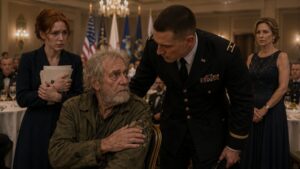
A silver-haired officer stepped out in full service dress. Rows of ribbons covered his chest. Three stars gleamed on each shoulder.
Lieutenant General Andrew Nelson entered the hangar while an aide tried to brief him on the unfinished preparations.
His attention moved across the chairs, the open aircraft panel, Brandon, the security detail, and Tyler’s hand gripping the old civilian’s coat.
Then he saw the man’s face.
Andrew stopped.
The aide nearly collided with him.
For one suspended second, the decorated commander looked less like a lieutenant general than a young officer who had encountered a ghost.
“General Walker?”
The title carried through the hangar.
Tyler’s hand opened.
Chapter 3: When the Commander Used His Former Title
Silence moved through the hangar faster than any order.
Tyler stepped away from Jerry as though the coat had burned him. The security personnel halted. The maintenance chief removed his cap. Brandon remained rigid, his eyes fixed on Andrew Nelson.
Jerry wished the general had kept walking.
Andrew crossed the concrete slowly. His face had changed since Jerry last saw him in person—thinner around the mouth, more deeply lined beside the eyes—but the old habit remained. When confronted by something he could not control, Andrew became unnaturally still.
He stopped three feet away.
“Sir,” Andrew said.
Jerry lowered his voice. “Don’t.”
Andrew’s gaze dropped to Tyler’s open hand, then to the wrinkled cloth at Jerry’s collar.
“What happened here?”
Brandon recovered first. “General, this individual entered through a restricted loading area with invalid credentials and refused to identify himself or surrender an unknown object.”
Andrew looked back at Jerry.
“Is that true?”
“The invitation named a gate that no longer exists.”
“That is not what I asked.”
Jerry had once taught Andrew never to let affection soften a necessary question. It seemed the lesson had survived.
“I entered through the wrong door,” Jerry said. “I refused to surrender the token.”
Andrew’s eyes moved to Jerry’s fist.
Recognition passed across his face.
“You still have it.”
Jerry did not answer.
Andrew turned toward Tyler. “Did you put your hands on him?”
Tyler stood at attention, pale beneath the hangar lights. “Yes, sir. On Captain Lewis’s order.”
Brandon began, “General, under the security protocol—”
Andrew raised one hand.
The gesture silenced him.
Jerry saw what would happen next and disliked it before Andrew’s fingers reached the brim of his cap.
The lieutenant general came to attention.
Then he saluted.
Not hurriedly. Not for display. The salute was exact, formal, and held before the entire hangar.
Jerry looked beyond him to the exhibit board.
The missing names appeared in black type on no line at all.
His arm remained at his side.
Andrew’s salute did not waver, but uncertainty entered his eyes.
Jerry finally raised his right hand. The movement pulled at an old injury in his shoulder. He returned the salute briefly, then lowered it.
The hangar exhaled.
Around them, uniforms shifted into straighter postures. The ceremony coordinator whispered urgently to the public affairs officer. Someone near the chairs said Jerry’s name under their breath.
Brandon’s confidence had not vanished. It had collapsed inward, replaced by calculation and alarm.
“Sir,” he said to Jerry, “I was not aware—”
“That is clear.”
The words were quiet, but Brandon flinched.
Andrew faced him. “Major General Jerry Walker commanded this rescue wing for nine years. He led the task force responsible for twenty-seven major recoveries and supervised the final operational deployment of this aircraft.”
Jerry looked at him sharply. “That is enough.”
Andrew stopped.
The public affairs officer had already lifted a phone. Jerry could see the machinery beginning around him: revised programs, hurried biographies, photographs recovered from archives, a chair added to the front row. The institution knew how to correct embarrassment by replacing one form of attention with another.
He had not come for either.
“Sir,” Tyler said.
Jerry turned.
The young maintainer stood near the open panel with his arms at his sides, unable to decide whether apology was permitted.
“I’m sorry.”
Jerry looked at the place where Tyler’s fist had crushed the coat.
“You should be.”
Tyler’s face tightened.
Jerry added, “Not because of the title he used.”
The young man lifted his eyes.
“Remember that part.”
Brandon took a breath. “General Walker, I accept full responsibility for the misunderstanding.”
“It was not a misunderstanding when I was only an old man with bad paperwork.”
Brandon had no answer.
Andrew’s expression shifted—not satisfaction, but something closer to recognition of a lesson he had once heard in another room.
Jerry turned toward the aircraft.
“The panel remains open?”
“Yes, sir,” the maintenance chief said.
“Do not call me sir. Not here.”
The chief nodded awkwardly.
Andrew stepped beside Jerry. “Why didn’t you contact me?”
“I did not come to see you.”
“That is not an answer.”
“It is the only one you need right now.”
Andrew followed his gaze to the ceremony board. His face softened when he saw the mission photographs.
“We would have arranged everything,” he said. “Transportation. Access. A private visit.”
“And an escort.”
“If necessary.”
“It was not.”
“You are seventy-eight years old and walked through a loading gate before dawn.”
“I managed.”
“You were being dragged out of a hangar.”
“That part was less successful.”
Andrew almost smiled, but Jerry did not. The humor died before it reached the general’s mouth.
The public affairs officer approached, carrying a printed schedule.
“General Nelson, we can revise the speaking order. If General Walker is willing, we could add a short recognition before the decommissioning remarks. The press would—”
“No,” Jerry said.
The officer stopped. “Sir?”
“No recognition.”
Andrew studied him. “Jerry.”
“I came to put something back.”
Jerry opened his left hand.
The damaged token lay across his palm. The old emblem was nearly worn away. Along the broken edge, bright metal showed where time had not darkened it.
Andrew stared at it.
“I thought that was lost.”
“Half of it was.”
The general looked toward the helicopter’s open cabin. “You brought it for the aircraft?”
“For the people who should be named with it.”
Jerry walked to the exhibit board. No one tried to stop him now.
That change angered him more than he expected.
An hour earlier, the coat and boots had made him a nuisance. One title had transformed the same body into something everyone feared mishandling.
He reached the section describing the final deployment.
The account praised the helicopter’s survival under hostile conditions and credited its evacuation of eleven wounded personnel. Below it appeared the names of the flight crew who returned with the aircraft.
Three names were absent.
Jerry touched the empty space beneath the paragraph.
Andrew came beside him. “What are you looking for?”
“Brandon King. Jeffrey Perez. Andrew Wilson.”
Andrew’s brow furrowed. “They were part of the ground support element.”
“They were part of the final rescue.”
“The record says they remained at the forward site after the aircraft departed.”
“They remained because the landing zone was collapsing.”
Andrew glanced toward the public affairs officer, then back to Jerry. “That mission file was reviewed.”
“I know.”
“You reviewed it.”
Jerry’s fingers closed around the token.
The ceremony coordinator was speaking rapidly to staff near the podium. A new name card had already been placed at the center of the front row: MAJ GEN JERRY WALKER, USAF, RET.
He could have sat there. He could have accepted the careful apology that would come, watched the helicopter honored, and left before anyone asked why his invitation had been issued through an obsolete office.
That had been his plan.
Place the token. Touch the scarred fuselage. Leave the burden where it belonged.
Silence had seemed easier when no one knew him.
Andrew lowered his voice. “Why are you really here?”
Jerry looked at the polished program in the general’s hand, then at the aircraft whose metal still carried the cost of a story reduced for convenience.
He pointed to the printed history.
“You are retiring the aircraft under a story that is not true.”
Chapter 4: The Three Names Missing From the Program
Susan Moore placed the official mission summary beside Jerry’s handwritten list.
The names did not match.
On the left, the typed report credited the helicopter’s final evacuation to five returning crew members. On the right, Jerry had written three additional names in block letters beneath them:
Brandon King.
Jeffrey Perez.
Andrew Wilson.
Susan adjusted her glasses and compared the pages again, though there was nothing ambiguous about the difference.
“This report was cleared through command review,” she said.
“I know.”
“It was used for the wing history, the aircraft restoration file, and the casualty exhibit.”
“I know that too.”
Jerry stood on the opposite side of the archive table, his worn coat still creased where Tyler had gripped it. Andrew remained near the closed door. He had ordered the room cleared except for Susan, Jerry, Tyler, and Brandon. Outside, preparations continued with the strained efficiency of people pretending nothing had happened.
Susan tapped the three handwritten names.
“These men are listed as support losses at the forward site. They were not assigned to the aircraft crew.”
“They were assigned to the mission.”
“That is not the same classification.”
“It was that night.”
Susan heard the impatience beneath his restraint. It made her cautious. She had spent twenty-two years protecting military history from memory sharpened by grief. Veterans often remembered truths that records missed. They also remembered promises as orders and guilt as fact.
“General Walker,” she said, “I cannot alter a public exhibit on your statement alone.”
Jerry’s eyes narrowed slightly at the title.
“Then stop calling me general and read the margin notes.”
Susan pulled the mission summary closer. Most annotations had been copied into the final archive index. One had not: a faint pencil mark beside the departure time, nearly lost beneath a later classification stamp.
Hold reduced by ground guide action.
No names. No explanation.
“The helicopter was overloaded,” Jerry said. “Eleven wounded, two litters secured in the aisle, hydraulic pressure falling. The landing zone had partially collapsed under the rear gear.”
Andrew moved from the wall. “The report says the crew cleared under fire.”
“They cleared because those three men stayed behind.”
Susan looked up. “To do what?”
“King stabilized the damaged surface with matting. Perez guided the rear gear by hand signal through smoke. Wilson remained on the external line after the engineer lost sight of the slope.”
“And they were killed after departure?”
Jerry’s jaw tightened.
“Yes.”
The word made the archive room smaller.
Susan turned to the casualty file. The three names were there, but their deaths were summarized in a separate ground-action entry. No direct connection to the aircraft’s departure appeared.
“The official account says they disobeyed the withdrawal signal,” she said.
“They did.”
Brandon, standing near the door, looked up sharply.
Jerry continued. “Because obeying it would have trapped the helicopter.”
Susan studied him. “You are saying their disobedience completed the rescue.”
“I am saying the aircraft came home because they chose not to.”
The fluorescent lights hummed overhead. Beyond the wall, a forklift sounded twice as exhibit cases were moved into place.
Tyler had been silent since entering the archive room. Now he set a small maintenance label on the table.
“I found this under the replacement plate,” he said.
One side was clean white plastic. The other carried faded grease pencil and part of an old notation.
Susan angled it toward the desk lamp.
F/E TOKEN REMOVED—IMPACT DAMAGE. RETURN TO—
The final line had been scraped away when the label was reused.
Jerry’s left hand closed around the token in his pocket.
“Where was this?” Susan asked.
“Behind the panel,” Tyler said. “Under the bracket he warned us about. Someone put a newer inventory label over it.”
Susan retrieved an archival photograph from a folder of restoration images. It showed the helicopter’s interior years before its final repaint. Beside the flight engineer’s station, a circular metal disk had been mounted with four screws.
The emblem matched Jerry’s token.
Only the disk in the photograph was whole.
Tyler leaned over the table. “That’s the same piece.”
“Half of it,” Jerry said.
Susan enlarged the photograph on her monitor. Four men stood inside the open side door. One wore a hand on the circular disk. Another held a grease pencil above it.
No rank markings were visible from the angle.
“What was it for?” she asked.
Jerry looked at the photograph without touching it.
“Every crew wrote one name on the back before a difficult launch.”
“Their own?”
“Someone they intended to come home for.”
Tyler looked at the broken token. “Who broke it?”
“The aircraft did.”
Jerry gave no more.
Susan opened the scanned maintenance logs. The final mission records had gaps: a missing inspection page, two redacted communications entries, and a replacement form filed three days later. She had seen the omissions before and assumed they reflected classified equipment removal.
Now the absences seemed shaped.
Andrew stood behind Jerry, reading the handwritten names.
“You never told me they were tied to the aircraft,” he said.
“You never asked.”
Andrew’s voice hardened. “I read the report.”
“So did everyone.”
The answer carried more accusation than Susan expected. Not toward Andrew alone. Toward the room, the archive, perhaps toward Jerry himself.
She returned to the summary’s authorization page.
The approving officer’s signature remained clear despite the degraded scan.
J. WALKER, COMMANDING.
Susan stopped.
Andrew saw it over her shoulder.
Tyler’s gaze moved from the signature to Jerry.
Brandon took one step away from the door.
Susan rotated the page so Jerry could see it.
“You approved this account.”
Jerry did not deny it.
The quiet that followed differed from the silence in the hangar. There, rank had changed the room. Here, the signature changed Jerry.
Andrew’s voice came low. “You signed the classification?”
“Yes.”
“You signed the casualty separation?”
“Yes.”
Susan watched his face. The old man who had endured Brandon’s suspicion without pleading now looked as if he had been waiting decades for a blow that had finally found him.
“Why?” she asked.
Jerry’s attention stayed on the signature.
Before he answered, the archive door opened.
A woman stood in the doorway holding a weathered envelope against her chest. She was in her early forties, dressed plainly, with the rigid posture of someone who had spent years preparing for a conversation she never expected to receive.
The ceremony coordinator hovered behind her.
“I told her this was restricted,” the coordinator said, “but she saw the names on the request sheet.”
The woman ignored everyone except Jerry.
Her eyes dropped to the signed report on the table.
Then to the name Andrew Wilson on Jerry’s handwritten list.
“My father,” she said.
Jerry lifted his head.
Ashley King stepped into the room and placed one hand on the authorization page.
“Why did you erase him?”
Chapter 5: The Order He Signed to Save the Wing
Ashley placed her father’s last letter directly over Jerry’s signature.
The envelope had softened along every edge. A dark fingerprint marked one corner, preserved under clear tape. On the front, in narrow handwriting, were the words For Ashley when she is old enough.
Jerry recognized Andrew Wilson’s hand before Ashley unfolded the page.
“You kept it sealed?” he asked.
“Until I was nineteen.”
Her voice held no tremor. That made it harder to hear.
Andrew Nelson closed the briefing-room door behind them. Susan carried the relevant files in a gray archive box. Brandon and Tyler had remained outside, though Jerry could see their shadows move across the wired-glass panel whenever someone passed.
Ashley flattened the letter with both palms.
“My father wrote that the aircraft was failing before it reached the landing zone. He wrote that the crew had been told the mission might be blamed on them if anything went wrong.”
Jerry sat across from her. The room’s old table bore scratches from decades of rings, maps, and hurried briefings. He remembered standing at its predecessor with a headset pressed to one ear while men disappeared into static.
“The mission was not authorized at the level it should have been,” he said.
“That is not what I asked.”
“No.”
“Why did you sign the report?”
Andrew moved closer. “Ashley, some of the material remains subject to review.”
She turned on him. “My father has been dead for thirty-one years. How much longer does the review need?”
Andrew’s mouth closed.
Jerry looked at the letter.
“Read the last paragraph,” Ashley said.
He already knew most of it. Not the wording, perhaps, but the shape of it. Men wrote differently when they believed they might not return. Some became tender. Some practical. Andrew Wilson had become precise.
Ashley read aloud.
“If the wing survives this, do not let them call what we did a mistake. We knew the ground would not hold. Somebody had to stay where the pilot could see us.”
She lowered the page.
“Did you receive a copy?”
“Yes.”
“And then you signed that.”
Her finger struck the report.
Jerry placed the damaged token on the table. Beside Susan’s archival photograph, the broken metal looked smaller than the decision it represented.
“The rescue program was already under investigation,” he said. “Two failed recoveries in six months. Funding review. Command review. People above us wanted a reason to dissolve the wing and transfer the aircraft.”
Ashley’s expression did not change.
“After the mission, they offered one.”
“Three dead men?”
“Three men who had disobeyed a withdrawal order. That was how headquarters intended to describe it.”
“But you knew why.”
“Yes.”
Andrew stepped forward. “Jerry, tell her the rest.”
Jerry looked at him.
The younger officer Andrew had once been had survived because the wing remained operational. So had hundreds of others. Jerry had repeated that arithmetic to himself for years.
Andrew seemed to understand the thought.
“If you do not say it,” he said, “I will.”
Jerry’s voice sharpened. “You were not in that room.”
“No. I was in a hospital bed six months later because the wing still existed to pull me out.”
Ashley glanced between them.
Andrew faced her. “The command was told the rescue program would be shut down if the final mission became proof of uncontrolled operations. The dead crew would be blamed for insubordination. The officers who approved the launch would be removed. The aircraft would be reassigned.”
“And the alternative?”
Jerry answered.
“A limited summary. The ground losses recorded separately. The rescue credited only to the returning crew. No finding of deliberate misconduct. No public inquiry.”
Ashley’s eyes narrowed. “You traded their names for the program.”
“I preserved the program.”
“You preserved the institution.”
“Yes.”
The admission settled between them.
Susan opened the archive box and removed a photograph of the token mounted inside the aircraft. Jerry placed his broken half beside it. The missing piece in the image had borne three shallow scoring marks.
“Each crewman marked the back,” Jerry said. “Wilson carried it on the final mission. An impact split it inside the cabin. The returning engineer brought this half to me.”
“And the other half?”
“Stayed mounted after the repair. Until someone removed it.”
Ashley picked up the photograph but not the token.
“My father’s name was on the back?”
“Yes.”
“Whose name did he write?”
“Yours.”
Her hand stopped.
For the first time, anger loosened its hold on her face. What replaced it was not forgiveness. It was the pain beneath it.
Jerry continued before courage became another form of delay.
“I told myself the report was temporary. That once the review passed, I would correct it. Then the wing saved more people. Every year, the cost of reopening the case seemed greater. Careers had been built on the official version. Families had accepted benefits under classifications that might have been challenged.”
“You could have called us.”
“Yes.”
“You could have told my mother privately.”
“Yes.”
“You could have given us the truth without giving the press anything.”
Jerry looked at the grooves in the table.
“Yes.”
Ashley folded the letter once, carefully.
“Then this was not only about saving the wing.”
“No.”
Andrew stared at Jerry. The respect in his face remained, but it had become painful.
Jerry pressed his palm flat beside the token.
“I was afraid.”
Ashley waited.
“I had ordered the helicopter to leave.”
Her eyes hardened again.
“The pilot refused at first,” Jerry said. “The ground was failing. Wilson, King, and Perez stayed behind to guide the aircraft clear. When the rear gear lifted, I ordered departure. I knew they would not make the next extraction window.”
“You spent them.”
The phrase struck exactly where Jerry had expected it to.
“I made the decision.”
“Was it the right one?”
“Eleven wounded people came home.”
“That was not my question.”
Jerry met her eyes.
“I do not know.”
The room remained still.
He had answered that question differently in official hearings, command reviews, and sleepless private arguments. Necessary. Lawful. Operationally sound. None of those words belonged here.
Andrew sat down slowly.
“The wing saved four hundred and twelve people after that mission,” he said. “I was one of them.”
Ashley looked at him. “And that makes my father’s name inconvenient?”
“No.” Andrew’s voice was quiet. “It makes the decision complicated. Not clean.”
Jerry saw Ashley absorb that. She had expected denial or defense. Complexity offered less comfort than either.
Susan removed a sealed digital case from the archive box. “There are missing communications segments in the official file.”
Ashley looked toward it.
“I know,” she said.
She reached into her bag and took out a small recorder, old enough to use physical controls. A strip of white tape crossed its back.
“My mother received this from one of the surviving radio operators after he retired. She never released it because he said doing so could affect benefits and reopen the misconduct finding.”
Andrew stood. “What is on it?”
“The final thirty seconds of my father’s cockpit transmission.”
Jerry’s hand tightened beside the token.
Ashley placed the recorder on the table but kept one finger over it.
Susan leaned forward. “That could authenticate the missing segment.”
“It could.”
“Then we need to hear it.”
“No.”
Ashley looked at Jerry.
“The ceremony starts in two hours. They want to put his name at the center of it because a general saluted him. They will call him a hero and make the rest disappear again.”
Jerry felt the accusation because it was true enough to deserve weight.
Ashley slid the recorder back toward herself.
“I will release this after he tells them what he signed and why.”
Andrew’s expression tightened. “Public disclosure without legal review could damage the command.”
“My father already paid for the command.”
Ashley gathered the letter, leaving the recorder on the table between them.
Her eyes stayed on Jerry.
“You wanted the truth returned to that aircraft. Tell it first.”
Chapter 6: The Ceremony Built Around the Wrong Hero
Brandon saw his own hand reflected in the glass case beside Jerry’s token.
Under the lights, the warped reflection made his fingers look stretched and pale. He remembered those same fingers pointing toward the hangar door while Tyler held the old man’s coat.
A temporary label had already been printed beneath the token.
PERSONAL MISSION EMBLEM OF MAJOR GENERAL JERRY WALKER
FORMER COMMANDER, 48TH RESCUE WING
Nothing mentioned the three missing names.
Nothing mentioned the report Jerry had signed.
The public affairs officer adjusted the case by half an inch. “This gives us a clean visual for the broadcast. General Nelson recognizes him, General Walker joins the program, and the decommissioning gains a living-history element.”
Brandon looked through the glass at the broken metal.
“It doesn’t belong to him alone.”
The officer glanced up. “What?”
“That’s what he said.”
Across the hangar, rows of guests were beginning to fill. Elderly veterans moved carefully between chairs. Families studied the aircraft photographs. Uniformed personnel guided them with rehearsed smiles. The repaired side panel remained open, awaiting a replacement guide sleeve.
Brandon had spent three months preparing for this hour.
Now every polished detail looked like concealment.
Jerry stood near the rear of the exhibit area with Andrew and Susan. Ashley remained several feet away, holding the old recorder. Tyler worked inside the helicopter, checking the hidden release and photographing the erased notation.
A colonel from command staff approached Brandon.
“Your incident report is due before the ceremony ends.”
“Yes, sir.”
“General Nelson has not made a decision regarding your status.”
“I understand.”
“Do you?”
Brandon looked at Jerry’s crushed collar.
“Yes, sir.”
The colonel left.
Brandon had replayed the confrontation repeatedly. The invalid invitation. The unsecured loading gate. The unknown object. The previous breach that still sat in his personnel file. Each fact supported intervention.
None required contempt.
He crossed the hangar and stopped before Jerry.
“General Walker.”
Jerry looked at him.
Brandon forced himself not to glance toward Andrew for approval.
“I owe you an apology. I failed to recognize who you were, and my handling of the situation was unacceptable.”
Jerry’s face remained unreadable.
“That apology is aimed at the wrong offense.”
Brandon felt several nearby conversations quiet.
“I do not understand.”
“You are apologizing because I was a general.”
“I am apologizing because I treated you improperly.”
“After learning I was a general.”
Brandon opened his mouth, then stopped.
Jerry nodded toward an elderly guest at the security table. The man wore a thrift-store blazer and searched anxiously through a paper envelope while a volunteer waited.
“If he cannot prove a title,” Jerry said, “what does he receive from you?”
“The same procedure.”
“That is not what I asked.”
Brandon looked toward the guest again.
The answer he wanted to give was easy. The true one was not.
“I assumed you were lying,” he said.
“Why?”
“Because your invitation was invalid. Because you entered through a restricted door.”
“Those are reasons to stop me.”
“Yes.”
“Not reasons to decide what kind of man I was.”
Brandon lowered his voice. “No.”
Jerry studied him for a moment. “Keep that part in your report.”
The public affairs officer approached with two revised programs.
“We need decisions now. Command legal recommends no reference to disputed mission details until the archive review is complete. We can acknowledge General Walker’s attendance, invite him to make brief remarks, and announce a future historical assessment.”
Ashley gave a humorless laugh.
“A future assessment,” she said. “That phrase buried my father for thirty-one years.”
Andrew took the programs. “What are the legal consequences of changing the account today?”
“Potential review of casualty classifications, survivor benefits, operational findings, and command conduct. There may also be questions about records retention and unauthorized possession of communications material.”
Susan looked at Ashley’s recorder. “The material can be authenticated.”
“Later,” the officer said. “Not during a live ceremony.”
Jerry looked toward the podium. A card bearing his name had been placed beside Andrew’s chair.
“Remove it,” he said.
The officer blinked. “Sir, the command believes your presence could help stabilize the event.”
“I am not a stabilizing element.”
“Your remarks could acknowledge the issue without making unsupported claims.”
“They are not unsupported.”
“They are not yet formally verified.”
Jerry glanced at Susan.
She held up the photograph and maintenance notation. “The evidence supports reopening the record. It does not complete it.”
The officer seized on that. “Exactly. We proceed with the approved history, recognize General Walker, and issue a review statement afterward.”
Brandon watched Jerry’s gaze settle on the glass case.
His token rested beneath the title everyone had denied him an hour earlier. The display turned recognition into another clean surface. It made the broken object look complete.
Jerry walked toward it.
The public affairs officer relaxed slightly, perhaps believing he had accepted the compromise.
Jerry opened the case.
“Sir, that is already positioned for broadcast.”
Jerry lifted the token from its stand.
The empty label remained beneath the lights.
Ashley watched him. Andrew did not move.
A ceremony coordinator appeared beside the podium and raised two fingers. Two minutes to air.
The hangar settled as guests took their seats. Camera indicators glowed red. The announcer began the formal welcome.
Brandon expected Jerry to return the token to his pocket and leave.
Instead, Jerry folded the approved remarks once and placed them inside his coat.
The announcer introduced the aircraft’s record of service.
Jerry walked past the seat bearing his name.
Andrew stepped into his path only long enough to ask, “Are you certain?”
“No.”
It was the first uncertain word Brandon had heard from him.
Jerry continued anyway.
The announcer turned toward the podium, prepared to introduce Andrew Nelson.
Jerry reached it first.
In his left hand, the broken token caught the broadcast lights.
Chapter 7: The General Who Named His Own Failure
Jerry folded the approved speech without reading a word.
The microphone carried the crackle of paper through the hangar. Camera lights faced him. Two hundred guests sat beneath the suspended banners, waiting for the familiar sequence of gratitude, service dates, and polished remembrance.
Jerry placed the folded pages on the podium.
“My name is Jerry Walker,” he began. “I commanded this rescue wing when the aircraft behind me flew its final operational mission.”
The public affairs officer shifted beside the stage. Andrew remained in the front row, still and watchful. Ashley stood near the aisle with the recorder held against her chest.
Jerry looked toward the helicopter rather than the cameras.
“You were told this morning that I came here as an honored guest. That is not true. I came through a loading entrance because my invitation led to a gate that no longer existed. I refused to identify myself properly. Captain Lewis stopped me, as his duty required.”
Brandon sat rigidly at the end of the first row.
Jerry continued.
“He also decided what kind of man I was before he knew my name. That part was not his duty.”
A few heads turned toward Brandon, but Jerry lifted one hand.
“This is not a trial of one officer. I know something about making a wrong judgment and allowing procedure to carry it long after the moment has passed.”
He opened his left hand.
The broken token rested in his palm.
“This was mounted beside the flight engineer’s station. Before difficult missions, members of the crew wrote on the back the name of someone they intended to return for. It did not belong to a commander. It belonged to everyone who climbed aboard.”
On the large display screen, Susan brought up the archival photograph of the token in its original place. The image showed its unbroken circle and the crew gathered around it.
Jerry held the damaged piece only long enough for the cameras to see it, then lowered his hand.
“Three names are missing from today’s program. Brandon King. Jeffrey Perez. Andrew Wilson.”
Ashley closed her eyes when he spoke the last name.
“They were not passengers,” Jerry said. “They were not incidental ground losses. They made the aircraft’s departure possible.”
The hangar had become so quiet that the faint hum from the exhibition lighting seemed loud.
Jerry described the landing zone without decoration. The fractured surface. The wounded packed into the cabin. The hydraulic warning. The rear gear sinking toward the edge. He did not describe heroism. He described choices.
“King placed matting beneath the damaged section. Perez stood in smoke where the pilot could see his signals. Wilson remained on the external communications line after visibility from the cabin was lost. They received the withdrawal order.”
Jerry paused.
“They did not obey it.”
A murmur passed through the seats.
“They understood that if they withdrew, the aircraft would remain trapped. They also understood what staying would cost.”
He looked at the families seated together near the front.
“The official summary separated their deaths from the rescue. It described their actions as an unauthorized delay. That summary bears my approval.”
The public affairs officer stepped toward Andrew, but the lieutenant general did not move.
Jerry placed both hands on the podium.
“I signed it.”
No one shifted now.
“I was told the wing would be dissolved if the mission became evidence of uncontrolled operations. The dead men would be blamed. The surviving crew would face inquiry. The aircraft would be reassigned. I accepted a limited account because I believed preserving the rescue program would save lives.”
He looked at Andrew.
“It did save lives.”
Andrew’s gaze did not leave him.
“That fact does not make the account true.”
Jerry heard his own breath enter the microphone.
“For years, I told myself the record could be corrected later. Then every year made correction more difficult. More careers depended on the report. More missions were credited to the command it preserved. Silence began as a decision made under pressure.”
He looked toward Ashley.
“It became a habit made from fear.”
The words felt smaller than the truth, but they were the closest he had come.
“I was afraid the families would see me as the commander who spent their loved ones’ lives.”
Ashley’s face remained hard.
Jerry did not look away.
“They would not have been wrong.”
The crowd reacted then—not with outrage, but with a collective tightening. Several former service members lowered their eyes. A surviving crewman in the second row pressed one fist against his mouth.
Jerry continued before anyone could rescue him with softer language.
“The pilot refused my first order to depart. The aircraft was unstable. Eleven wounded people were aboard. The landing zone was collapsing. I ordered him to leave.”
His fingers curled around the podium edge.
“I knew there would not be time to return for the three men on the ground.”
Ashley walked toward the stage.
For one moment, the public affairs officer seemed prepared to stop her. Brandon stood instead and moved the rope aside.
Ashley climbed the two steps and placed the recorder beside the microphone.
“Are you finished protecting it?” she asked.
Jerry looked at the aircraft.
“Yes.”
She pressed play.
Static filled the hangar.
A strained voice emerged beneath rotor noise.
“Rear clear by two feet. Keep her coming. Perez, hold that line.”
Another voice cut through, distant and breathless.
“Command says withdraw.”
Then Andrew Wilson’s voice, rough but steady:
“Negative. Bird leaves first.”
The recording broke into static. A pilot shouted that he could not see the slope. Wilson answered with short directional calls.
“Left one. Hold. Rear rising. Keep it level.”
An alarm pulsed in the background.
Then Jerry’s younger voice entered through the command circuit.
“Aircraft Six, depart now.”
The pilot answered, “Ground team remains in position.”
Jerry’s voice came again.
“That is a direct order. Depart now.”
The rotor noise climbed.
Wilson’s final words were nearly swallowed by it.
“Tell Ashley I kept the promise.”
The recording ended.
Ashley’s hand remained on the machine.
No one applauded.
Jerry was grateful for that.
Susan stepped to the screen and displayed the newly recovered maintenance notation beside the official report. The erased line confirmed impact damage to the mounted token and identified the flight engineer’s station. It did not prove every spoken memory. The recording did not erase the disobedience finding by itself. The signed report remained what it was.
But the pieces no longer supported the clean story on the ceremony board.
Andrew rose.
“On behalf of the command,” he said, “I am ordering an immediate historical and casualty review.”
Jerry turned toward him. “Not on my behalf.”
“No,” Andrew said. “On theirs.”
Ashley removed the recorder from the podium.
Jerry looked down at the token. On its darkened face, the broken edge caught the light like an unfinished line.
“I was invited here to be recognized,” he said. “I do not accept a program that gives my name more room because it left theirs out.”
He named the three men again.
Then he named the five who returned with the aircraft.
“The final rescue belongs to all of them. The command decision belongs to me.”
He stepped away from the podium.
The ceremony coordinator looked toward Andrew, unsure whether the event had ended. Andrew did not signal her.
Jerry walked to the open side door of the helicopter. Tyler stood inside near the empty circular mounting point. He moved aside.
Ashley remained at the foot of the steps.
Jerry held the token out toward her.
“This has been in my hand long enough.”
She did not take it.
“What do you want me to do with it?”
“I want nothing from you.”
“That is not an answer.”
Jerry looked at the place where the whole disk had once been mounted.
“If the families agree, it should go back there. Not under my name. Under all of theirs.”
Ashley studied him for a long moment.
Her eyes were wet, but her voice remained controlled.
“You do not get to decide that alone.”
“No.”
The answer came without defense.
Jerry extended the token again, not asking her to forgive him, only to take custody of the choice.
“Will you decide with the others?”
Chapter 8: The Empty Place Finally Carried Every Name
The ceremony seats were empty, but Jerry remained beside the helicopter waiting for Ashley’s decision.
Tyler watched from inside the cabin. The last guests had left nearly an hour earlier. Staff had removed the podium and coiled the broadcast cables, yet no one had touched the exhibit board with the incomplete history.
Ashley stood with two surviving family members near the open hangar doors. Susan had given them the report, the maintenance notation, and a transcript of the recording. They read in silence while Andrew waited at a distance.
Jerry did not approach them.
He stood beneath the scar in the fuselage with his left hand closed around the token.
Brandon entered from the security office carrying a folder.
“General Nelson has relieved me of ceremony and access duties pending review,” he told Andrew.
Jerry looked toward him.
Brandon continued before anyone could respond. “I submitted the incident report. I included my refusal to verify the invitation, Airman Garcia’s request to contact the historian, and my language toward General Walker.”
“Jerry,” Jerry said.
Brandon hesitated. “Sir?”
“If this lesson requires my title, you have not learned it.”
Brandon absorbed that.
“Jerry,” he said, with visible difficulty.
Ashley returned from the hangar doors.
“We agree the token can go back,” she said. “Under conditions.”
Jerry opened his hand.
“The exhibit includes the original summary with your signature. It includes the corrected account, the final transmission, and the explanation of why the first record was accepted. No clean version.”
“That is fair.”
“There will be no separate portrait of you beside the aircraft.”
“Good.”
“And the family names must be reviewed by every family before the plate is installed.”
Susan nodded. “I will send proofs tonight.”
Andrew stepped closer. “The command will support all of it.”
Ashley looked at Brandon. “What happens to him?”
“That will be determined through review,” Andrew said.
Brandon’s shoulders tightened.
Ashley glanced toward Jerry’s wrinkled collar.
“He should be held responsible,” she said. “But removing one officer does not fix a system that treats confused people, old people, or people with bad paperwork as problems before they become people.”
Brandon looked at her, surprised.
She continued. “Have him help write the new access process. Make him sit with the veterans who arrive without digital passes. Make him explain what happens when the invitation office changes and nobody updates the number.”
Andrew studied Brandon. “Would you accept that assignment?”
“Yes, sir.”
“It will not replace disciplinary review.”
“I understand.”
Ashley nodded once. It was not mercy offered for comfort. It was work assigned in place of spectacle.
Tyler turned back to the empty circular mounting point. He had cleaned the screw holes and removed the replacement label. Beneath it, the original outline remained visible—a pale ring against dark interior paint.
Susan brought the temporary memorial plate into the cabin. The permanent one would take weeks, but this version had been engraved by the base workshop before the last guests departed.
FINAL RESCUE CREW AND GROUND TEAM
Below it were eight names.
Tyler checked each against Susan’s proof sheet.
Jerry watched from the side door.
“Read them,” he said.
Tyler began.
He spoke the five returning crew names first. Then Brandon King. Jeffrey Perez. Andrew Wilson.
At the final name, Ashley touched the recorder in her pocket.
Tyler positioned the plate beneath the circular recess. He aligned the screws but did not tighten them.
“The token,” he said.
Jerry stepped into the cabin.
The space was narrow enough that Tyler could see the old man’s breathing change. Jerry ran one hand along the frame of the flight engineer’s station. His fingertips stopped where years of boots and equipment had worn the paint smooth.
He placed the broken token in Tyler’s palm.
It was heavier than it looked.
On the back, scratched lines crossed one another beneath corrosion. One name remained legible.
ASHLEY.
Tyler looked up.
Jerry had seen it too.
For a moment, neither moved.
Then Tyler fitted the token into the pale circular mark. Its broken edge left part of the recess uncovered. The piece would never make a whole circle again.
Ashley entered the cabin and stood beside them.
“That is how it should stay,” she said. “Do not fabricate the missing half.”
Susan nodded from below. “The exhibit text can explain why.”
Tyler tightened the first screw.
The metal settled into place with a soft click.
He secured the remaining points, then closed his hand around the panel latch. Earlier that morning, he had gripped Jerry’s coat with the same hand.
“Check the guide,” Jerry said.
Tyler reached behind the bracket and felt the hidden release. The new sleeve sat clear. No pressure caught against the cable.
“Clear.”
“Check the names.”
Tyler read all eight again, slowly this time.
Only then did Jerry nod.
Tyler closed the panel without forcing it.
Outside the aircraft, the public affairs officer approached Andrew with a mock-up for a separate display honoring Jerry’s command career. Andrew passed it to Jerry.
The proposed panel contained a formal portrait, rank history, and a list of operations.
Jerry handed it back.
“The archive can keep the record.”
“We thought visitors should understand who you were,” the officer said.
“They will understand enough from what I signed.”
The officer looked uncertain, but Andrew accepted the decision.
Jerry stepped down from the aircraft. His left hand remained open at his side, empty for the first time Tyler had seen.
Ashley stopped him near the fuselage.
“I do not forgive thirty-one years today,” she said.
“I did not expect you to.”
“My father believed you would tell the truth.”
Jerry looked toward the restored token.
“He believed better of me than I managed.”
“He also obeyed you until the last order.”
“No,” Jerry said. “On the last order, he obeyed what he thought was right.”
Ashley considered that.
Then she held out her father’s letter.
Jerry did not take it.
“I brought a copy,” she said. “This one is for the archive.”
Susan accepted it instead.
That seemed to satisfy them both.
Brandon moved toward Jerry as the hangar lights dimmed to their evening setting.
“I will not ask you to excuse what I did.”
“Good.”
“I would like to know who sent the invitation.”
Susan answered from the exhibit table. “The old veterans’ liaison office. The mailing list transferred during reorganization, but the access database did not. His invitation was genuine.”
Brandon closed his eyes briefly.
A valid invitation, an obsolete gate, a disconnected number, and a man judged fraudulent because the institution had failed to connect its own pieces.
“I will include that,” he said.
“Include the loading door too,” Jerry replied. “Security still matters.”
Brandon looked at him. “After everything, you are defending the procedure?”
“I am distinguishing it from the way you used it.”
Brandon nodded.
Jerry pulled his worn coat straight. The wrinkles at the collar remained. He made no effort to smooth them away.
Andrew offered to drive him home. Jerry refused twice before accepting a ride only as far as the civilian gate.
At the hangar threshold, he looked back once.
The helicopter rested beneath the lowered lights. The incomplete token sat beside the flight engineer’s station, no longer hidden in a fist or displayed beneath one man’s title. Under it, the temporary plate carried every name.
Tyler stood by the open door.
Jerry lifted his empty hand toward the aircraft—not a salute, exactly, but something older and more private.
Then he turned and walked out in the same dusty boots that had brought him through the wrong gate.
The story has ended.