He Gave Up His Own Place Before Anyone Knew Why the Safety Wall Was There
Chapter 1: The Glass Wall Everyone Praised
The new glass wall showed everything except the moment people decided you did not belong.
James Anderson stopped just inside Cedar Ridge Training Center and looked through it at the range beyond. Bright red safety flags hung motionless near the marked lanes. Rules were printed in large black letters beside the locked equipment room. Two range officers moved carefully between stations, visible from the lobby now, visible from the fundraiser tables, visible from the row of folding chairs where parents and donors sat holding paper cups of coffee.
Everyone could see what happened once a person crossed that wall.
No one could see the judgments made before they got there.
Amy came in behind him with a cardboard box balanced against one hip. “You planning to stand in the doorway all morning?”
“I’m looking.”
“You’re blocking the sandwiches.”
James stepped aside. His hip complained at the shift of weight, a low old ache that began near his lower back and settled into the joint like a stone. He kept his face still and reached for the faded cap tucked beneath his arm.
Near the entrance, a folding table held raffle tickets, donated gift baskets, and a framed photograph of Brian King. Brian stood in the picture beside a truck, grinning into sunlight, one arm around his wife, Mary, and the other raised behind two little girls who had clearly been trying to escape the camera.
James looked at the photograph longer than he meant to.
Mary noticed. She was arranging small paper cards beside a glass donation jar.
“You came,” she said softly.
“I said I would.”
Her smile wavered. “You always did.”
He did not know what to say to that, so he touched two fingers to the edge of the frame and let Amy carry the sandwich box toward the table.
The lobby had the clean, strained look of a place trying to prove it had learned a lesson. The new paint was too white. The signs were too large. The volunteers were too careful with their voices.
Last year, a complaint had been ignored. Nothing irreversible had happened, but it had come close enough. A staff member had waved away a safety concern, and the club had spent months answering questions from inspectors, donors, and families who had trusted them. Cedar Ridge had nearly lost its license.
Now people spoke about “standards” as though the word itself could keep anyone safe.
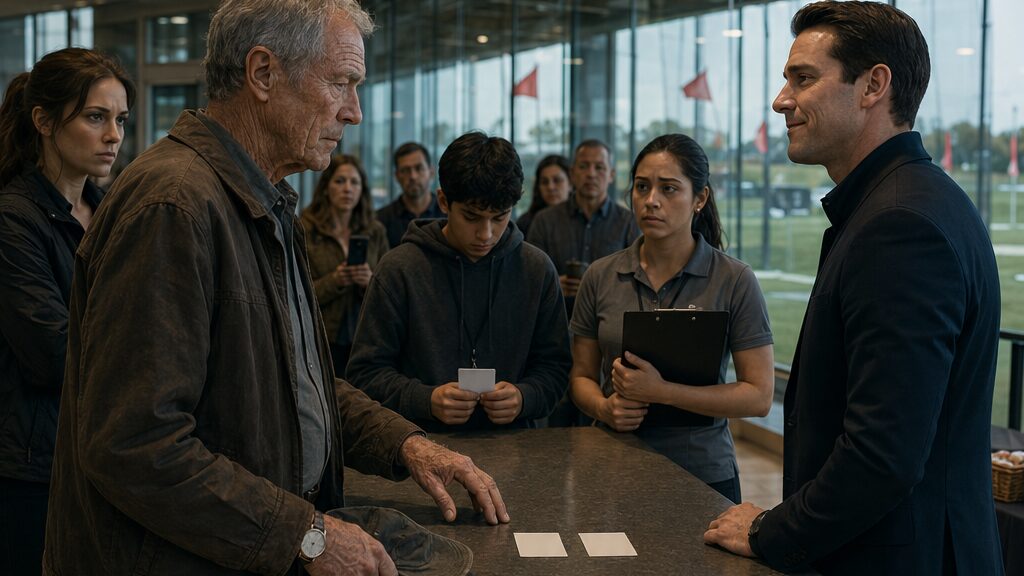
At the registration desk, Jennifer Lopez stood with a clipboard pressed against her chest. She was young enough that the instructor badge pinned to her shirt looked almost borrowed, though the way she kept checking the schedule made it clear she had learned every line of it by heart.
Across from her stood Jacob Torres.
The boy’s shoulders were narrow under his dark hoodie. He held his participant card in both hands, worrying the edge with his thumb. Every few seconds he looked toward the glass wall, then quickly away again.
Kevin Roberts stood beside him with a sponsor jacket zipped to his throat and a smile polished enough for photographs.
“Jacob,” Kevin was saying, “there’s no shame in watching your first time. You get a better sense of the rhythm. Come back next month when you’re more settled.”
Jacob’s mouth moved, but no answer came out.
Jennifer glanced down at her clipboard. “He completed the orientation,” she said. “He passed the safety check.”
Kevin’s smile did not change. “I know. And that’s good. But today’s a memorial event. We have donors, community partners, people who remember what happened last year.”
The words were mild. The effect was not.
James saw Jacob’s fingers tighten around the card.
Amy appeared at his side. “That guy always talk like he’s giving people a favor?”
“Seems to.”
“You know him?”
“No.”
Kevin looked toward the entrance, saw James, and brightened. He moved over with a quick, practiced step.
“Mr. Anderson,” he said. “I’m glad you made it.”
James nodded once.
Kevin’s eyes traveled over the worn jacket, the cap, the old shoes, and finally the cracked face of James’s watch. His gaze lingered there for half a second too long.
“We can get you a comfortable seat near the front,” Kevin said. “You’ll have a good view of everything.”
“My name’s on the list.”
“Of course it is.” Kevin’s voice softened. “But there’s no reason to push yourself through a long day. Memorial events can be tiring.”
Amy turned her head toward James. He could feel the question in the motion. Her concern had teeth. She had been watching him walk from the parking lot, watching every uneven step.
James looked past Kevin to the registration sheet.
Jennifer was still standing too straight. Her fingers had begun to tremble against the clipboard, though she was trying to hide it by shifting her grip.
Kevin followed James’s gaze. “We’re working out the youth bracket,” he said. “Nothing dramatic.”
“Is there a problem with the youth bracket?”
“No problem.” Kevin laughed lightly. “Just deciding what serves the event best.”
James said nothing.
The silence seemed to invite Kevin to keep talking.
“Cedar Ridge has worked hard to rebuild trust,” Kevin said. “People are here to see modern training done properly. Calm, structured, professional. We can’t afford confusion.”
James looked at Jacob.
The boy had lowered his eyes.
Something in James’s chest tightened—not anger exactly. A recognition. He remembered that posture from other rooms, other years. A young person deciding whether the easiest way to survive a moment was to become smaller inside it.
Jennifer cleared her throat. “Jacob’s paperwork is complete.”
Kevin’s smile thinned at the edges.
“And James?” Amy asked before James could stop her.
Kevin turned toward her. “Mr. Anderson is welcome to participate, naturally. I’m only suggesting we be sensible.”
“Sensible,” Amy repeated.
James placed his cap on the counter beside the registration cards. The faded fabric looked out of place against the clean laminated signs.
He had come to keep a promise to Brian. That was all. Attend the fundraiser. Stand through the memorial remarks. Put his name through one open round if his hip allowed it. Leave before anyone made too much of him.
He had not come to argue with a man like Kevin Roberts.
But Jennifer’s hands were shaking.
And Jacob was still staring at the floor.
James looked directly at her.
“Is Jacob qualified?” he asked.
Jennifer lifted her eyes.
“Yes,” she said.
Chapter 2: The Place He Refused To Keep
Kevin smiled toward the phones before answering.
“Sir, you can sit this round out,” he said gently. “Memorial events can be tiring.”
A volunteer near the raffle table had already raised a phone, perhaps recording the room for the fundraiser page. Another person glanced over from the coffee station. The attention gathered in small pieces.
James rested his stiff fingers on the cap lying beside the registration sheet.
Jennifer stood between him and Jacob, clipboard held tight against her ribs.
“He is qualified,” James said.
Kevin’s smile remained in place. “No one said he wasn’t.”
“Then why is he being moved?”
“We’re not moving him.” Kevin spread his hands. “We’re trying to protect the event from avoidable embarrassment.”
Jacob’s face went pale.
Amy took one step forward. “You mean protect it from a nervous kid?”
Kevin looked at her with patient disapproval. “I mean protect it from a situation that could be misread. This club has worked too hard to rebuild trust.”
“That doesn’t answer him,” James said.
For the first time, Kevin’s eyes sharpened.
Behind the desk, Jennifer flipped through the pages on her clipboard. “Jacob completed orientation with me on Tuesday,” she said. Her voice was quiet, but each word landed cleanly. “He completed the written safety review. He followed all range procedures during the supervised practice. He has the same clearance as every other youth participant.”
Kevin’s jaw moved once.
James reached for the registration sheet. Names were printed in neat black lines beneath their divisions. His own card sat in the open memorial round. Jacob’s was in the youth bracket.
He lifted James Anderson from the page.
Jennifer stared at him. “Mr. Anderson?”
James placed his name card beside Jacob’s.
“Put him in my place,” he said.
The lobby became very still.
Kevin blinked. “That’s generous. But you don’t need to sacrifice your chance because the kid is nervous.”
“I’m not sacrificing anything.”
Jacob looked up.
James could see the boy’s panic shifting into something else—not confidence yet, but confusion at being defended without being asked to earn the defense.
“Why would you do that?” Jacob said.
James adjusted the cuff of his jacket. “Because you signed up.”
The answer was small. It did not carry across the room like a speech. But Jacob’s shoulders lifted by the slightest amount.
Kevin leaned closer, lowering his voice. “Mr. Anderson, I appreciate the gesture. Truly. But this is a serious competition. We have guests. Donors. Press from the community page. People want to see what modern training looks like.”
James looked at the glass wall.
On the other side, a range officer checked the red flags. A parent guided a younger child away from the marked line. Everything was orderly. Everything was visible.
“Modern training,” James said, “should know the difference between safety and fear.”
Kevin’s smile disappeared for a moment. Then it returned, thinner than before.
“You’re misunderstanding me.”
“That happens.”
Amy’s mouth twitched, though she looked worried.
The announcement system clicked overhead. “Youth participants, please report to the staging area in ten minutes.”
Jennifer set Jacob’s card back on the clipboard.
“You’re still in,” she told him.
Jacob swallowed. “Okay.”
Kevin looked past James toward the far end of the lobby, where Elizabeth Hill had just entered through the side door. She carried a tablet and wore the expression of someone already late for a problem.
Kevin crossed to her before Jennifer could move.
James watched them speak in low voices. Kevin gestured once toward Jacob. Once toward James’s name card. Elizabeth’s eyes flicked up, then down again.
Amy leaned close. “You sure you want to give up the open round?”
James picked up his cap.
“Yes.”
“You came here to compete.”
“I came here because Brian asked me last spring whether I’d show up if he organized this thing.” James looked at the fundraiser photograph. “I told him I would.”
“That’s not what I meant.”
“I know.”
Amy studied him, frustrated by the answer. He could see the same thought forming in her face that had formed many times since his hip worsened: Why do you always act like wanting something is a burden?
He had no clean answer for that.
Jennifer guided Jacob toward the staging area, but before they reached the glass wall, Kevin called out, “Jennifer.”
She turned.
“Keep it simple,” he said. “No exceptions. No improvising.”
Her hand tightened around the clipboard.
James saw the words land harder than they should have.
Then Elizabeth approached him.
“Mr. Anderson,” she said, carefully. “I understand there has been some confusion about the open memorial round.”
James looked at Kevin over her shoulder.
Kevin met his eyes with the calm patience of a man who believed the version he had given would sound reasonable.
“There has,” James said.
Chapter 3: The Rule That Sounded Like Fear
Jacob stopped at the marked line and could not move.
Beyond the glass wall, the youth range looked smaller than it had from the lobby. The lanes were bright under overhead lights. The red safety flags seemed almost too vivid. A few parents stood behind the viewing area, trying not to look anxious. Donors drifted near the glass with coffee cups in hand, pretending they had only happened to stop there.
Jennifer stood beside Jacob with the clipboard open.
“Take your time,” she told him.
Jacob nodded, but his breathing had gone shallow.
From the viewing corridor, James could see the stiff line of the boy’s shoulders. He could also see Kevin near the far wall, arms folded, watching without appearing to watch.
Elizabeth stood beside him, tablet in hand.
James hated that he noticed all of it. He hated that after years of teaching himself to stay quiet, he could still read a room faster than most people in it.
Amy leaned against the glass beside him. “He’s freezing.”
“He’s thinking.”
“He’s terrified.”
James nodded.
Jennifer spoke again, her voice clear enough to carry through the open divider. “Jacob, tell me the first thing you do when you reach the station.”
Jacob did not answer.
The pause stretched.
A woman near the back shifted her phone lower.
James felt his own fingers curl around the edge of his cap. He wanted to step through the door. He wanted to stand beside Jacob and tell him exactly how to plant his feet, exactly when to look down, exactly how to make the room disappear.
But that would not be helping.
Not really.
Jennifer looked toward the viewing corridor. Her eyes found James’s.
He lifted one hand, not waving, not signaling. Just a small motion toward his chest.
Breathe.
Jacob saw it.
James pointed once toward Jennifer’s clipboard.
Listen.
Then he lowered his hand.
Jacob’s mouth opened. He drew in a breath that trembled on the way down.
“Check the line,” he said.
Jennifer nodded. “Good. Then?”
“Wait for instruction.”
“And then?”
“Follow it.”
The words came slowly, but they came.
The round began.
James did not watch every movement. He watched Jennifer more. She had stopped gripping the clipboard against herself. Her hands were steadier now. She gave Jacob each instruction without rushing him, and when Jacob hesitated, she waited instead of filling the silence.
The score, when it appeared, was ordinary.
Jacob looked at it as though it had betrayed him.
Jennifer leaned closer. “You completed the round safely.”
He shook his head. “I wasn’t good.”
“You were new.”
“That’s not the same.”
“No,” Jennifer said. “It isn’t.”
James saw Jacob look again at the screen. Then, slowly, he nodded.
A few people clapped. Not many. But Mary King did, standing near the fundraiser table with one hand pressed against the edge of it. Amy joined her. After a moment, a parent near the glass did too.
Kevin came forward with an approving expression that arrived too quickly.
“Good work,” he said to Jacob. “You handled it responsibly.”
Jacob looked uncertain whether he was being praised or dismissed.
Kevin turned toward Elizabeth. “That’s exactly why we need the right structure. He did fine, but you can see he’s not ready for the competitive side of this yet.”
Jennifer’s head lifted.
“He was in the competitive side,” she said.
Kevin’s smile remained polite. “And now we have data.”
James watched Elizabeth look from Kevin to Jacob. Fear moved across her face, quick and tired. Not fear of Jacob. Fear of the headlines she had imagined for months. Fear of one mistake becoming proof that Cedar Ridge had learned nothing.
Jennifer closed the clipboard.
“He followed every rule,” she said.
Kevin gave her a look meant to end the conversation.
She looked down.
Later, James found her in the hallway outside the equipment room. The noise from the fundraiser drifted in from the lobby, muffled by the closed door. Jennifer stood beside a rack of safety vests, staring at the clipboard in her hands.
“You did fine,” James said.
She gave a short laugh. “That sounds familiar.”
“It ought to.”
Jennifer looked at him. “I should have said more before today.”
“You said what he needed.”
“Not to Kevin. Not to Elizabeth. I raised it once, a few weeks ago. About first-time participants. About how some of the older members talk to them before they ever get on the range.” She rubbed her thumb across the edge of the clipboard. “I made it sound smaller than it was because I didn’t want them to think I was being dramatic.”
James knew the feeling too well. Making a truth small so no one could accuse you of making trouble.
“What did they say?” he asked.
“That I needed more experience before I understood how much pressure the club was under.”
“And did you believe them?”
Jennifer’s silence answered before she did.
“I don’t know,” she said.
Footsteps sounded at the end of the hall.
Elizabeth appeared with her tablet held against her side. She looked from Jennifer to James, then toward the lobby where Kevin’s voice carried faintly through the door.
“Mr. Anderson,” she said. “There is one opening in the exhibition assessment this afternoon. It isn’t scored for prizes. It’s a supervised demonstration of composure and safety.”
James waited.
“You would be welcome to participate,” Elizabeth continued. “There is no obligation.”
Behind her, Kevin stood just inside the hall entrance.
He did not say anything.
But the look on his face said he had already decided James would refuse.
Chapter 4: The Donation Without a Name
Elizabeth did not lower the tablet when she spoke.
“Mr. Anderson,” she said, “would you mind stepping into my office for a moment?”
Amy’s eyes narrowed at once. “Why?”
Elizabeth looked tired rather than offended. “Because I found something in our records, and I would prefer not to discuss it in the hallway.”
Kevin stood behind her, one shoulder against the doorframe. His expression had settled into something politely blank, but James could feel the attention in it.
Jennifer looked from Elizabeth to James. “I can stay with Jacob.”
“He’s fine,” Jacob said quickly, though he was still holding his participant card as if it might be taken from him.
James picked up his cap. “All right.”
Elizabeth’s office was narrow and too bright. A framed certificate from the licensing board hung on one wall. On the other was a photograph of the building before the renovation, its old viewing corridor closed off by a solid partition. The room had the smell of printer paper and stale coffee.
Elizabeth set the tablet on her desk and turned it toward James.
A spreadsheet glowed on the screen. Most of it meant nothing to Amy, but James recognized the line item immediately.
Safety wall installation. Final community contribution.
Below it was a donor code, then an old mailing address.
His address.
Amy looked at him. “Grandpa?”
Elizabeth rested both hands on the desk. “The contribution came through a community account. No name was attached to the public records, but the transfer information was not fully redacted in the internal file.” She hesitated. “Was this you?”
James took off his cap and turned it slowly in his hands.
“That wall needed to go up,” he said.
“That isn’t what I asked.”
“No,” he said. “It isn’t.”
For a moment, no one spoke.
Outside the office, the memorial event continued in fragments. A chair scraped. Someone laughed too loudly near the fundraiser table. The announcement system crackled, then went silent.
Amy stepped closer to the desk. “You paid for it?”
“Part of it.”
“Why didn’t you tell anyone?”
James looked through the office window toward the glass wall. From here it reflected the lobby lights and the movement of people passing by, making the range beyond look farther away than it was.
“Because the wall isn’t the point.”
Elizabeth’s face changed slightly.
James leaned on the back of the visitor chair, careful not to put too much weight through his hip. “A wall lets people see what happens after somebody gets inside. It doesn’t do much if the people at the door decide who is worth letting in.”
Elizabeth looked down at the tablet.
“That’s not fair,” she said, but there was no force in it.
“No,” James said. “It isn’t.”
Amy watched him with a hurt expression he knew well. It was not anger exactly. It was the look she had worn after finding old receipts in his kitchen drawer or hearing from a neighbor that he had spent a morning helping someone carry groceries but had never mentioned it.
“You gave that money away when you were saying the roof needed work,” she said.
“The roof got fixed.”
“After three buckets and two winters.”
James gave her a small, tired smile. “It held.”
“It shouldn’t have had to.”
The words stayed between them.
Elizabeth sat down slowly. “I remember when we were trying to raise the rest. People kept saying the club had already spent enough. That the repairs were for appearances.” She tapped the tablet once. “The donation came in three days before we had to make a decision about cutting the project.”
James said nothing.
“I thought it was from someone who wanted their name on a plaque and changed their mind,” Elizabeth said. “I never imagined it was you.”
“That’s because you were looking for the wrong kind of person.”
The door opened before she could answer.
Kevin stood there, not bothering to knock this time. His eyes went first to the tablet, then to James.
“So it’s true,” he said.
Elizabeth straightened. “Kevin.”
“No, it’s fine.” He looked at James again. “It explains a few things.”
James folded the cap under his arm.
“What does it explain?”
Kevin smiled, but the smile had changed. It carried calculation now. “Why you feel so invested. Why you think you should have a say in how today is run.”
Amy made a sound under her breath.
James did not move. “Paying for glass doesn’t give me a say in people.”
“Of course not,” Kevin said smoothly. “But it does mean people will listen to you.”
There it was.
Not admiration. Not gratitude.
A problem to manage.
Kevin glanced toward Elizabeth. “The exhibition assessment could be good for everyone. A chance for Mr. Anderson to be recognized. A respectful moment. It would make a strong closing image for the fundraiser.”
James felt Amy stiffen beside him.
“I didn’t offer it for that,” Elizabeth said.
“No,” Kevin replied. “But it could still be that.”
He left before anyone could stop him.
The office seemed smaller after he was gone.
Amy turned on James. “That’s what you’re worried about, isn’t it?”
James looked at her.
“You don’t want to do the exhibition because then everyone will make you into some kind of symbol,” she said. “The quiet donor. The old volunteer. The man who saved the wall. And then they’ll feel good about clapping for you instead of changing anything.”
He had not said those words aloud. Not to her. Not to anyone.
The fact that she could see them made him feel both proud and ashamed.
“I don’t need applause,” he said.
“That isn’t what I said.”
He looked down at the cap in his hands. The faded brim had a crease he had never managed to smooth out.
No, it was not what she said.
Jennifer appeared in the doorway a few minutes later. Her clipboard was tucked under one arm now, not clutched against her chest.
“Jacob’s with Mary,” she said. Then she looked at James. “Can I talk to you?”
Elizabeth nodded toward the hall.
Jennifer waited until they were beside the glass wall before speaking.
“I should have defended him sooner,” she said.
James kept his eyes on the range.
“You did defend him.”
“Not enough.” Her voice was low. “I made it easier for Kevin to say he was only being practical. I let him turn what I knew into something he could manage.”
James’s fingers found the cracked face of his watch.
Jennifer looked at it, then back at him. “How do you know when being quiet is patience and when it’s just fear?”
He had spent years avoiding that question.
For a while, he had called it dignity. Then caution. Then age. Each name had made it easier to live with.
Across the glass, Kevin was speaking to two volunteers. He pointed toward the exhibition station and then toward the small cluster of phones near the fundraiser table.
James watched Jennifer wait for an answer.
Finally, he said, “You know by what it costs someone else.”
Jennifer’s grip tightened around the clipboard.
Behind them, the announcement system clicked alive.
“Exhibition assessment will begin in thirty minutes.”
James looked through the glass wall at the station waiting under the lights.
For the first time all day, he understood that saying nothing now might not keep the moment small.
It might only leave Kevin free to decide what it meant.
Chapter 5: What Mark Meant By Responsibility
Kevin found James beside the old equipment display before James had decided whether to sit down.
A faded training vest hung behind glass near the hallway, along with photographs from years before the range had been renovated. In one picture, volunteers stood ankle-deep in muddy water beside a truck, smiling with the exhausted pride of people who had spent the day doing work no one would remember clearly.
James did not look at the photograph.
He did not need to.
“You know,” Kevin said, “the club cannot rebuild itself around memories.”
James turned.
Kevin had taken off his sponsor jacket. Without it, he looked younger. Less finished. His shirt sleeves were rolled neatly to his forearms, and there was a faint mark at the bridge of his nose where he had probably been rubbing it all morning.
“That’s true,” James said.
Kevin seemed prepared for resistance. The answer made him pause.
James shifted his weight away from the bad hip. “Young people ought to lead. They ought to make the place better than we left it.”
Kevin’s expression eased slightly. “Then you understand.”
“I understand that you keep saying ‘young people’ when you mean you.”
The ease vanished.
Around them, people moved through the corridor toward the fundraiser table. No one was close enough to hear. The glass wall reflected the two men back at themselves: Kevin standing straight, James slightly bent, cap tucked beneath his arm.
Kevin lowered his voice. “I’m trying to keep this place from falling apart again.”
“By taking places away from people before they can fail?”
“By preventing a situation from becoming something worse.” Kevin looked toward the range. “You weren’t here last year.”
“No.”
“You didn’t see parents walk out with their children. You didn’t sit in meetings where people asked whether the club should close. You didn’t have donors telling us they wouldn’t give another dollar unless we could prove we had standards.”
James said nothing.
Kevin let out a breath. “Everybody acts like I care about appearances because I want a title. Maybe I do want the assistant director position. I’ve worked for it. But I also know what happens when people think rules are optional.”
“Rules weren’t the problem,” James said.
Kevin’s eyes hardened. “Someone ignored a complaint.”
“Yes.”
“That’s a rule problem.”
“It’s a person problem.”
For a second, Kevin looked as though he might laugh. Instead, he rubbed a hand across the back of his neck.
“You can make it sound simple because people trust you now.”
“They don’t trust me.”
“They will.” Kevin glanced toward the office. “They know about the donation.”
James looked down at his watch.
The crack across the face ran from the number ten toward the center, catching the overhead light in a thin pale line.
“Trust isn’t people doing what you want because you’ve impressed them,” he said.
Kevin’s mouth tightened. “And what would you call it?”
James thought of Mark White, standing beside an old truck with mud dried up his boots. Mark had been younger than James was now. Stronger too. He had laughed easily, but never when someone was trying to make themselves smaller.
Responsibility is what you do when nobody is clapping.
James had carried the sentence for years, polished it in his mind until it became something smooth and private.
He had not always lived by it.
After the injury, after Mark died, James had stopped coming around. He told himself he was leaving room for younger volunteers. He told himself he was tired of being looked at with sympathy. He told himself the club would run fine without him.
Sometimes it had.
Sometimes it had not.
“You want to lead?” James asked.
Kevin looked at him cautiously.
“Then tell me something. Does leading mean deciding which people are too inconvenient to stand beside you?”
Kevin’s gaze went to the glass wall. On the other side, Jacob sat with Mary at the fundraiser table, holding a paper cup with both hands. Jennifer stood nearby, talking to another participant. The boy listened closely.
“It means not pretending everyone is ready for every situation,” Kevin said.
“No,” James replied. “It means making sure they are safe enough to learn.”
Kevin’s voice sharpened. “And what if they aren’t?”
“Then you help them become ready. You don’t make their fear useful to you.”
The words landed harder than James intended.
Kevin looked at him for a long moment. When he spoke again, the polish was gone.
“You think I wanted to watch that place almost get shut down?” he said. “You think I liked seeing people call us careless? I had friends leave because they didn’t want their names connected to it. I stayed. I took extra shifts. I answered calls from parents who thought we were dangerous.” His jaw worked. “I’m not trying to hurt anyone.”
James believed him.
That was the worst part.
“You don’t have to want harm,” James said. “You only have to decide it’s worth doing.”
Kevin looked away.
A volunteer approached from the lobby. “Kevin, should we start recording the exhibition from both angles?”
Kevin’s face closed.
For a moment, James thought he might say no.
Then Kevin turned back toward the range. “Yes,” he said. “The fundraiser page needs a strong ending.”
The volunteer nodded and hurried off.
James watched Kevin’s shoulders square again. The young man had chosen the version of himself that felt safer: composed, useful, in control.
He did not blame him for the fear.
He blamed him for what he did with it.
The announcement system clicked overhead.
“James Anderson to the exhibition station, please.”
James shifted forward.
Pain caught in his hip so sharply that his breath stopped halfway in.
His hand went to the wall before he could hide it.
Kevin saw.
So did Amy, hurrying toward them from the lobby.
“Grandpa,” she said.
James looked toward the exhibition station beyond the glass. The red flags waited. The volunteers lifted their phones.
For one tired second, he wanted to sit down and let the room move on without him.
Then he heard the announcement repeat his name.
Chapter 6: The Score That Was Never the Point
James stood at the edge of the exhibition station with his hip locked beneath him and every eye in the room pretending not to notice.
Amy was beside the glass wall, one hand pressed over her mouth.
Jennifer stood near the range officer, clipboard held at her side. Jacob had risen from his chair near the fundraiser table. Even Kevin had stopped moving.
James rested his palm against the divider until the worst of the pain loosened.
“You don’t have to do this,” Amy said quietly.
He knew that.
The range officer waited without impatience. That mattered. No one rushed him. No one filled the silence with encouragement that would turn his pain into a performance.
James looked down at his watch.
The cracked face caught the light.
He adjusted the strap once, the way he had done for years before any task that required him to slow down and remember his hands.
Then he stepped forward.
The assessment was simple by design. A sequence of safety checks, controlled movements, and measured decisions under supervision. No prize. No medal. No reason anyone should have cared as much as they did.
But they cared.
James could feel it in the quiet behind the glass.
He began with the first procedure.
His hands were not as steady as they had been when he was younger. The tremor came and went now, worse when pain climbed up through his hip. He could have rushed through it and hoped no one noticed.
Instead, he stopped.
The range officer looked at him.
James lowered his hands. “Restarting.”
The words carried farther than he expected.
He returned to the first step.
Behind the glass, someone shifted in a chair. Then the room settled again.
He moved through the sequence slowly. Not cautiously in the way Kevin had meant when he tried to sideline him. Carefully. The difference mattered. Each check was done twice when it needed to be. Each instruction was heard before he acted on it. When his hip pulled again, James paused, breathed, and waited until his balance was true.
No flourish. No apology.
At the second station, an older man near the back leaned toward the woman beside him.
“Is that Anderson?” he whispered.
The woman stared through the glass. “James Anderson?”
“I think so.”
“He was with the volunteer crews after the flood.”
James heard neither sentence clearly. He heard only the small murmur that followed, the movement of people fitting an old memory around the man they had nearly asked to sit down.
He kept his eyes on the station.
At the final step, the range officer gave the signal.
The electronic board blinked.
For a moment, nothing appeared.
Then the score came up.
Highest result of the day.
There was a silence before the room knew what to do with it.
James did not look at Kevin.
He looked for Jacob.
The boy stood near the glass wall, hands hanging loose at his sides. When he saw James looking, he did not glance away this time.
He smiled.
It was small. But it was not uncertain.
Jennifer was the first to clap. One sharp sound, then another.
Amy joined her. Mary did too. The applause spread unevenly through the room, not roaring, not theatrical. It moved from person to person as though each had to decide whether they meant it.
James picked up his cap from the chair beside the station.
Kevin approached after the applause began to fade. His face had gone pale, though whether from embarrassment or surprise James could not tell.
“That was…” Kevin started.
James waited.
Kevin looked at the board, then back at him. “I didn’t know.”
“No,” James said. “You didn’t.”
The words were not cruel. That seemed to make them harder for Kevin to bear.
Elizabeth stepped forward from the edge of the crowd with her tablet in both hands. Her cheeks were flushed, and James could see she had made up her mind about something.
“Before we close the exhibition,” she said, her voice carrying into the lobby, “there is something I need to say.”
James felt Amy turn toward him.
Elizabeth looked at the glass wall, then at the people gathered around it.
“This wall was installed because Cedar Ridge failed people before it ever failed a procedure,” she said. “We have talked for a year about inspections, policies, and trust. But we have not said enough about who helped us rebuild.”
James’s jaw tightened.
Elizabeth looked directly at him.
“James Anderson made the anonymous contribution that allowed us to finish the safety wall last winter.”
The room went still again.
This silence was different from the one before the score.
It had weight. It had expectation.
James could feel every face turn toward him, measuring him now in a new way. Not old. Not fragile. Not inconvenient.
Important.
He hated how quickly that could become another kind of distance.
Kevin looked at the glass wall behind Elizabeth. His reflection stood beside James’s in the bright surface: one man straight-backed and uncertain, the other bent slightly with a cap in his hand.
James looked past them both.
Jacob had moved closer to Jennifer now. The boy was saying something to another young participant who stood near the staging area, nervous and pale.
Jennifer listened, then nodded.
The electronic board still displayed James’s score.
He looked at it once.
Then he turned away.
Chapter 7: The Trophy Given to Someone Else
Elizabeth placed the memorial trophy in James’s hands before he could step away.
It was heavier than it looked. A small brass plate caught the fluorescent light, Brian King’s name engraved beneath the title of the event. Around James, the room had gone quiet again.
Not the uneasy quiet from before the exhibition.
This was expectant.
Amy stood close enough that her shoulder nearly touched his arm. Jennifer was beside Jacob near the glass wall, both of them watching. Mary remained at the fundraiser table with one hand on the photograph of her husband.
Kevin stood a few steps away.
He looked as though he had considered leaving, then decided that would make him smaller than staying.
Elizabeth cleared her throat. “James, after your assessment and everything we’ve learned today, it feels appropriate that—”
“No,” James said.
It was not loud.
Elizabeth stopped.
James looked down at the trophy. The brass reflected a blurred version of his worn jacket and the faded cap tucked under his left arm. For an instant, he saw Mark’s face in the memory of another day—mud on his boots, shoulders hunched from exhaustion, laughing because someone had brought cold coffee to a flood cleanup.
Responsibility is what you do when nobody is clapping.
James lifted his head.
“Brian would’ve hated this being about me,” he said.
Mary’s mouth tightened. She looked down, then nodded once.
James turned toward Jacob.
The boy did not move.
“Come here,” James said.
Jacob looked at Jennifer first. She gave him a quiet nod.
He crossed the floor slowly, hands shoved into the front pocket of his hoodie. He stopped in front of James with the same uncertain posture he had worn at the marked line earlier that day, but there was something different in it now. He was afraid, perhaps. But he had not disappeared inside the fear.
James held out the trophy.
Jacob stared at it. “I didn’t win.”
“You completed your first competition.”
“My score wasn’t—”
“I know.”
A ripple of nervous laughter passed through the room and died quickly.
James kept the trophy extended.
“You followed every instruction. You stopped when you needed to think. You stayed when it would’ve been easier to walk out.” He paused. “That took more courage than most people saw.”
Jacob’s eyes filled, though he blinked hard and looked at the floor.
“I don’t think I earned this,” he said.
James lowered the trophy slightly.
“Then don’t take it as a prize,” he said. “Take it as a reminder. Next time somebody tells you that you don’t belong because you’re nervous, remember you stood there anyway.”
Jacob looked up.
Then he took it.
The applause came again, but this time it did not feel as though it belonged to James. It moved toward Jacob in uneven waves, from Mary, from Amy, from the parents near the viewing corridor. Jennifer clapped with both hands raised in front of her chest, her clipboard tucked under one arm.
Kevin did not clap at first.
James saw him looking at the trophy, then at Jacob, then through the glass wall where the red safety flags hung in their proper places.
Finally, Kevin brought his hands together once.
Then again.
It was not enough to erase anything. James did not expect it to.
But it was a beginning.
The crowd began to loosen after that. People moved toward the raffle table. Someone asked Mary whether she needed help carrying donation boxes. The volunteers lowered their phones, suddenly unsure what footage they were supposed to use.
Elizabeth came to James with her tablet held at her side instead of in front of her.
“I owe you an apology,” she said.
James shifted his weight carefully. The ache in his hip had settled into a steady throb.
“You owe more than me one,” he said.
Elizabeth glanced toward Jennifer and Jacob.
“Yes,” she said. “I do.”
She stood there for a moment, looking at the wall. “We kept saying we were building transparency. I think we were mostly building something we could point at.”
James said nothing.
“I’m going to review how we handle first-time participants,” she continued. “Before they ever get to the range. The registration process. The orientation. Staff conduct. All of it.”
“That’s a start.”
“I know it is.”
Kevin approached before Elizabeth could say more.
He had removed his event badge. It hung from one hand, bent slightly where his fingers gripped it.
“Mr. Anderson,” he said.
James looked at him.
Kevin glanced toward the others, then lowered his voice. “I was trying to protect the club.”
“No,” James said. “You were trying to protect your place in it.”
Kevin absorbed that without arguing.
His face had lost the smooth confidence from that morning. James could see now how young he was beneath it—not innocent, not helpless, but frightened of being exposed as less certain than he looked.
“I didn’t think it would go that far,” Kevin said.
“It usually doesn’t, at first.”
Kevin looked through the glass at Jacob holding the trophy. “I thought if the day looked controlled, people would trust us.”
“And if it didn’t?”
Kevin’s answer took too long.
James reached into his jacket.
The folded photograph was still in the inner pocket, soft at the corners from years of being carried. He opened it carefully.
Mark White stood beside him in front of the old truck, both of them younger than Amy was now. Mark’s grin had been caught halfway through a joke. Behind them, a group of volunteers carried sandbags toward a house with water already climbing the steps.
James held the photograph out.
Kevin hesitated before taking it.
“That was Mark,” James said.
Kevin looked down.
“He used to say responsibility was what you did when nobody was clapping.”
Kevin’s thumb hovered over the edge of the photo.
James let him hold it for only a moment, then took it back and folded it along the same worn crease.
“I spent a long time thinking that meant keeping quiet,” James said. “I was wrong about that.”
Kevin looked up.
James tucked the photograph away.
“Quiet can be useful,” he said. “But not when somebody needs you to speak.”
Kevin nodded once.
Then, without another word, he walked toward the rows of folding chairs where volunteers had begun stacking them. He picked up two chairs and carried them to the far wall. No one watched him. No one thanked him.
That, James thought, was probably the right place to start.
Amy slipped her hand through his arm.
“You’re done now,” she said.
James smiled faintly. “Am I?”
Jennifer approached with Jacob beside her. The trophy looked too large in the boy’s hands.
“Mr. Anderson,” Jennifer said.
James turned.
“Would you come back sometime?” She glanced toward the range. “Not to compete. I mean… to talk to the newer instructors. Maybe the new participants too. About what you said.”
“What did I say?”
She smiled despite herself. “That being loud isn’t the same as being strong.”
James looked down at the cap beneath his arm.
For years, he had come and gone from places before anyone could ask him to stay. He had called it not wanting attention. He had called it not wanting to interfere. He had called it respect for younger people who were supposed to take over.
Some of it had been true.
Not all of it.
Through the glass wall, another teenage boy stood near the staging area, pale and uncertain as Jacob had been that morning. Jacob had set the trophy carefully on a nearby chair. He walked over to the boy and spoke quietly.
The boy shook his head.
Jacob pointed toward Jennifer’s clipboard.
Then he touched his own chest and breathed in.
Jennifer watched him, her eyes bright.
James put on his faded cap.
“Maybe,” he said. Then he looked at Jennifer again. “But only if you keep doing the talking.”
She nodded.
Outside, Amy kept her hand looped through his arm as they moved toward the parking lot. James walked slowly, not because he was trying to make the moment last, but because his hip demanded it.
Behind them, through the glass wall, Jacob stood beside the nervous boy while Jennifer opened her clipboard and began at the first line.
The story has ended.