He Kept a Dead Father’s Promise Folded Inside His Coat for Forty-Three Years
Chapter 1: The Map Inside Frank’s Brown Coat
The rededication notice had been slipped beneath Frank Bennett’s front door sometime after midnight.
It lay facedown on the faded rug, bright white against the brown threadbare wool. Frank saw it when he came into the hallway before dawn, one hand on the wall, the other holding his mug. He stood there longer than he meant to, listening to the refrigerator hum in the kitchen and the old pipes tick inside the walls.
Then he bent down.
The paper had the town seal printed at the top.
MEMORIAL REDEDICATION
SATURDAY, 10:00 A.M.
HONORING THOSE WHO SERVED AND THOSE WHO RETURNED
Frank’s thumb caught on the last words.
Those who returned.
He set the mug on the small table by the door and unfolded the notice once more, though there was nothing new to see. The committee had cleaned the old bronze plaque, rebuilt the stone border, planted fresh shrubs along the path. The names would be read aloud. There would be schoolchildren, flags, folding chairs, photographs for the local paper.
He had seen the announcement in the grocery store window two days ago. He had read it again at the pharmacy. He had told himself then that it did not concern him.
Now the notice was in his house.
On the narrow table beneath the hallway mirror sat an envelope that had been there for years. The edges were soft. The glue had long ago given up. No name was written across the front.
Frank reached for it.
Inside was the photograph.
Two young men sat on the hood of a military jeep, their sleeves rolled up, their boots dusty. Frank was thinner in those days. His jaw looked sharper. The man beside him had a round face and a smile that never quite straightened.
Gary Mercer.
Frank did not look at the picture for long. He never did.
He took the map from the inside pocket of his brown coat, where it had been hanging on the peg by the door even overnight. He had carried it for so many years that leaving it elsewhere felt wrong, like sleeping without a roof.
The paper had once been stiff. Now it opened with the softness of cloth.
A train station was marked in pencil. A diner. An apartment building with a tiny square drawn beside it. A church. Behind the church, a playground.
At the playground, in blue ink faded almost gray, were the words:
Jacob Mercer, age 9.
Frank lowered himself into the chair by the hallway table. His knees complained as they always did, but he barely noticed.
Every spring, he unfolded the map.
Every spring, he told himself there was still time.
That lie had been easier to carry when his wife was alive. She had never told him to stop looking. She had only asked him, once, after finding the map under a stack of tax papers, “Do you know who you’re trying to save?”
Frank had not answered.
She had not asked again.
The tea went cold beside him.
By seven, he had put the map back into his coat pocket, packed the photograph into a canvas bag, and added the small tin box from the top shelf of the cabinet. He almost left the box behind. His hand paused over it.
Then he put it in the bag too.
Outside, the morning was colorless and close. Frank’s car started on the second turn. The windshield took too long to clear, and his fingers hurt around the steering wheel. He drove slowly, past streets he knew too well, past houses with trash cans lined neatly at the curb, past the town square where someone had hung red, white, and blue ribbons from the lampposts.
At the traffic light near the old station road, he stopped.
The train station on the map had been gone for thirty years.
The diner had gone next. Then the apartment building. Then the pharmacy built where the diner used to be. Frank had driven those streets until he could have followed them blind, stopping at doors, calling old numbers, asking strangers whether they remembered a woman named Ruth Mercer and a boy with dark hair who climbed a fence behind a church playground.
Some people had remembered pieces.
A mother who worked nights.
A boy who waited for the Saturday mail.
A red toy truck that went everywhere with him.
No one had remembered where they went.
The library was not open yet when Frank arrived. The building stood behind the courthouse, all dark brick and narrow windows. A yellow sign in the glass announced the rededication ceremony. Someone had taped a paper flag beside it.
Frank sat in the car for a moment with the engine running.
He could leave.
He could go home, put the map back beneath the tax papers, make another cup of tea, and tell himself the memorial belonged to the town now. The town had decided what it believed. It had put the belief in bronze.
A knock on his window made him turn.
A young woman in a gray cardigan stood outside the library door, holding a ring of keys. She pointed at the sign, then at him, questioning.
Frank shut off the car.
Inside, the air smelled of floor polish and dust. The young woman introduced herself as Christine and led him through the front room, where books were stacked on carts waiting to be shelved.
“You’re early,” she said.
“So am I.”
She gave him a small smile at that, but it faded when she noticed how tightly he held the canvas bag.
“Are you here for family history?” she asked.
“No, ma’am.”
“Genealogy?”
“No.”
She looked toward the back hall, where a sign read ARCHIVES—STAFF ACCESS ONLY.
Frank followed her eyes. “I’m waiting for someone from the memorial committee.”
Christine checked something on the desk phone, then looked back at him. “Mrs. Vale is coming. She said she could spare twenty minutes.”
“Twenty minutes,” Frank repeated.
“I’m sorry. They’re finalizing the display materials this afternoon.”
Frank looked at her.
“Not Saturday?”
“No. The ceremony is Saturday, but the committee meets today. The plaques are already being prepared.”
The room seemed to narrow around him.
He thought of the map inside his coat. The blue ink. Jacob’s name. The years folded into the paper.
Christine’s phone rang.
She picked it up, listened, then covered the receiver with her hand. “There’s a Rachel Mercer on the line. She says she saw the rededication notice online and called yesterday. She asked whether anyone had contacted the library about her grandfather.”
Frank’s grip tightened around the canvas bag until the handles creaked.
Christine studied his face. “Do you know her?”
“No,” he said.
But his voice had changed.
Christine put the phone back to her ear. “Yes, Rachel. He’s here.”
Frank took one step toward the archive hall.
Then another.
“I’m here,” he said quietly, more to himself than to Christine, “for a name.”
Chapter 2: A Red Truck Beneath the Archives
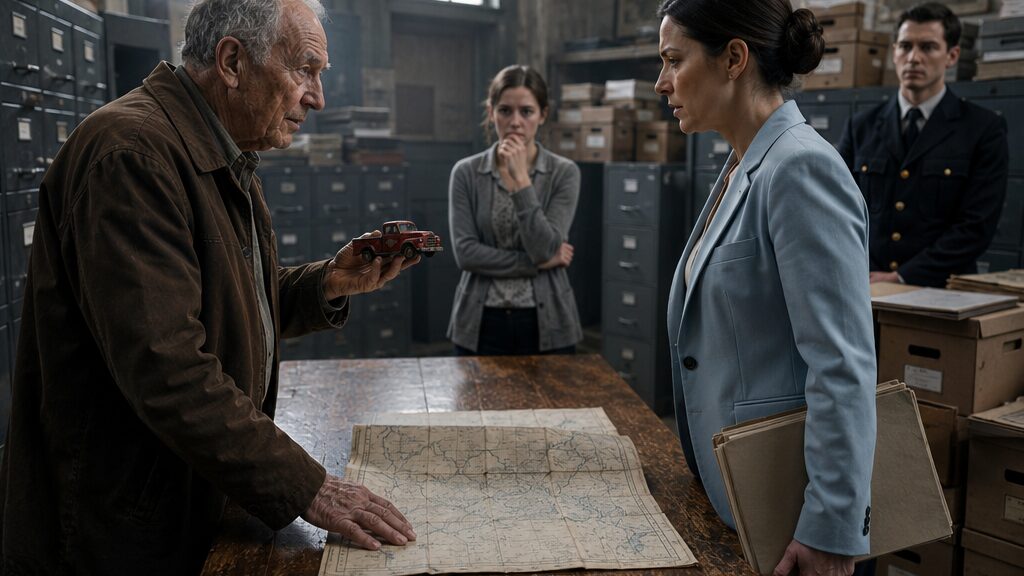
Heather Vale reached for the map before Frank had finished unfolding it.
He covered it with both hands.
The motion was not quick. His fingers did not move quickly anymore. But it stopped her.
For a moment, neither of them spoke.
The archive table between them was scarred oak, crowded with file boxes, photocopied newspaper pages, and a stack of committee folders tied with a blue ribbon. Christine stood by the cabinet drawers with one hand against the metal handle. At the far end of the room, a young man in dress uniform had set down a carton of donated records and gone very still.
Heather withdrew her hand.
“I only meant to look at it,” she said.
“You can look,” Frank replied. “You don’t take it.”
Her pale blue blazer was neat despite the rain-dark morning outside. Her hair was pinned close to her head. Nothing about her looked careless. Even the folders under her arm seemed arranged by size.
“Mr. Bennett,” she said, “I understand this matters to you.”
Frank said nothing.
“But the memorial has been in place for decades. We cannot revise it because someone brings us an old drawing and says a memory is wrong.”
“It isn’t a drawing.”
Heather glanced down at the paper. “What would you call it?”
“A map.”
“To where?”
Frank smoothed one crease flat with his thumb.
“To a boy.”
The young man by the boxes looked up.
Heather’s expression did not change much, but her shoulders shifted. “Let’s begin with the name you believe is missing.”
“Gary Mercer.”
She opened one of the folders. “There is a Mercer listed.”
“Not the right one.”
Heather turned the file toward him. A typed page sat inside a plastic sleeve.
MERCER, GARY A.
RETURNED HOME, 1968
Frank stared at the line.
“He wasn’t Gary A.,” he said.
“It says so in the municipal record.”
“He was Gary R.”
Heather sighed through her nose. “And you are certain?”
“I served with him.”
“Memories can become very firm over time,” she said. “That doesn’t make them reliable in every detail.”
Christine looked down at the table.
Frank lifted his eyes. “He died before he could come home.”
The young man in uniform shifted his weight. The floor creaked under his shoes.
Heather rested her fingertips on the folder. “That is a serious claim.”
“It is.”
“And why has this not been raised before now?”
Frank’s mouth tightened.
The question had been asked in different ways for forty-three years. Sometimes by people who wanted an answer. More often by people who wanted the subject to end.
“Because I couldn’t find his son,” he said.
Heather’s gaze moved to the map. “His son?”
“Jacob.”
Frank pointed to the faint blue ink beside the playground drawing. “Nine years old when Gary gave this to me. He said Jacob waited behind the church every Saturday morning. Said that was where he watched for him.”
The young man stepped closer to the table.
Heather folded her arms. “What does that have to do with the memorial?”
“Gary told me if I got home before him, I was to make sure the boy knew he didn’t leave.”
The archive room went quiet except for the small mechanical click of the climate-control unit in the wall.
Heather looked at the map again. “And you did?”
Frank’s hands remained on the paper.
“I tried.”
The answer sat there, unfinished.
Christine walked to the table. “Mr. Bennett said a family member contacted us,” she said carefully. “Rachel Mercer. She believes her father may be Gary’s son.”
Heather looked at her. “May be?”
“She said her grandfather’s name was Gary Mercer. Her father was told that Gary came home after the war and chose not to return to them.”
Heather’s face changed then—not into sympathy, exactly. Into caution.
“There are families involved,” she said. “That is precisely why we must be careful.”
“There was a family involved then too,” Frank said.
His voice was low. It made the words harder to dismiss.
The young man in uniform looked from Heather to Frank. “Sir,” he said, “why do you keep saying Jacob’s name like that?”
Heather turned sharply. “John, this is not your concern.”
John lowered his head, but Frank answered him.
“Because I’ve been carrying it longer than I should have.”
John looked at the map again. “Was it his son?”
Frank nodded.
Then he unfolded the last flap.
It had been tucked beneath the first fold for so long that the paper made a soft tearing sound when it opened. Underneath lay a smaller square of paper, yellowed along the edges.
Heather leaned forward despite herself.
The handwriting was cramped, hurried, slanted to the right.
If you get home before me, tell him I kept the red truck in my pocket.
Christine put her hand over her mouth.
Frank reached into the canvas bag and drew out the small tin box. He opened it with both thumbs.
Inside lay a toy truck no longer than his palm. Once, it had been bright red. Now most of the paint had worn away, leaving pale metal at the corners and one black wheel rubbed almost smooth.
John stared.
“That was his?” he asked.
“Gary’s boy’s,” Frank said. “He carried it with him.”
Heather did not touch the truck. “How do you know?”
“Because he showed it to me. Because he kept it in the inside pocket of his jacket. Because when he knew he wasn’t getting out, he gave me the map and said the boy must not think—”
Frank stopped.
The room held its breath.
Heather spoke more quietly this time. “You believe this proves he died.”
“I know he did.”
“But you have no casualty report. No official notification. No chain of custody for this item.”
Frank looked at her.
“You think I’ve kept it to fool a committee?”
“No.” Her answer came too fast, then slowed. “I think you may be asking us to change a public record based on grief. And grief can make people see certainty where there is none.”
Frank closed the tin box.
“No,” he said. “Grief makes people keep looking where there is none.”
Christine crossed to the newspaper cabinet before Heather could answer. She pulled open a drawer, then another. Bundled pages lay inside, tied with brittle string.
“I want to check the wartime lists,” she said.
Heather straightened. “Christine, those have been reviewed.”
“Not by me.”
For several minutes, no one spoke. Christine laid pages across the table one by one, her fingers moving carefully over ink that had gone brown with age. Frank stood beside the map, not sitting even when John brought a chair from the corner.
Heather watched the clock above the archive door.
John hovered near the boxes, uncertain whether he was allowed to stay.
Then Christine stopped.
“Here,” she whispered.
The page was dated two weeks after the town’s first list of returning servicemen. A column of names ran beneath a headline about a school fundraiser. Christine bent low, following the line with one finger.
“Thomas A. Mercer,” she read. “Returned home, 1968.”
Frank shook his head.
“That isn’t him.”
Christine turned the page.
Beneath a smaller correction printed along the bottom edge, another name appeared.
Heather leaned forward.
Christine read it once, silently.
Then she looked up at Frank.
“Gary R. Mercer,” she said. “Presumed deceased.”
Chapter 3: The Name Printed Under Another Man
Christine held the page so carefully that it seemed she feared the truth might crumble in her hands.
Heather took it from her.
The correction was barely three lines long. It had been printed beneath an advertisement for a hardware sale, in type so small that Frank had to lean close before he could make out the words.
Previous notice contains error. Gary R. Mercer, listed under incorrect return classification, is presumed deceased pending official confirmation.
Heather read it twice.
Then a third time.
“That is not enough,” she said.
Frank’s head came up. “Not enough?”
“It is evidence.” She placed the newspaper down flat, as though pressing it into certainty. “It is not enough for the committee to replace a name on a public memorial without documentation from the service records or confirmation from the family.”
“You have both names on one page.”
“We have a correction notice written by a newspaper.”
“And a memorial built on the wrong one.”
Heather’s jaw tightened. “Mr. Bennett, I am not denying what this suggests.”
“But you’re going to wait.”
“I am going to verify.”
Frank turned away from the table before the anger in his face could become something louder. The archive room had no windows, only a narrow strip of frosted glass high near the ceiling. He stared at it as though there might be a road beyond it.
Forty-three years.
Three days.
A few more hours, according to Heather, as though hours were harmless things.
Christine moved closer to the map. “There may be more in the municipal files,” she said. “Forwarding addresses, notification records, anything related to the original list.”
Heather looked at the clock. “The records office closes at four.”
“It’s not even two.”
Heather gathered the folders under her arm. “Then we should go now.”
The municipal records office occupied the lower floor of the courthouse annex, where the corridors smelled of old paper and wet coats. Heather walked ahead of Frank and Christine, her heels clicking hard against the tile. John followed at a distance until Heather turned and saw him.
“You don’t need to come,” she said.
“I can carry boxes,” he replied.
“We aren’t carrying boxes.”
John looked toward Frank. “I’ll wait outside, then.”
Frank almost told him not to. Instead, he nodded once.
The clerk at the records desk brought out two gray archive cartons after Heather showed her committee identification. The boxes were marked MEMORIAL FILES—1967–1972.
Frank watched Heather lift the lid from the first one.
For a moment, she looked less certain than she had in the library.
Inside were old correspondence folders, typed minutes, handwritten notes, and copies of official letters that had been made so many times the ink had gone purple at the edges.
Christine found the memorial application sheet.
“Here,” she said.
The form listed names to be added after the war. Someone had typed Gary A. Mercer under the returning servicemen section. Beneath it, in pencil, another hand had written:
check middle initial / family notification unclear
Frank leaned over the desk.
“Who wrote that?”
“No initials,” Christine said.
Heather flipped through the next folder. Her face grew still.
“This was never resolved,” she said.
“What wasn’t?” Frank asked.
She held out a letter.
It was addressed to Ruth Mercer. The name made Frank’s chest tighten.
The letter stated that the department could not confirm the final status of Gary R. Mercer due to conflicting information in the original field report. A later letter, dated six months afterward, referred to a presumed death classification. Neither contained a burial location. Neither contained a personal effect inventory.
“No wonder,” Frank said.
Heather looked at him. “No wonder what?”
“No wonder she told the boy he left.”
The words came out rougher than he intended.
Christine read the second letter again. “It’s not proof that she lied to him.”
“I didn’t say she lied.”
“You sounded like you did.”
Frank looked at the files. At the cold, official sentences. At the empty space where someone had failed to write a clear answer.
“She was alone,” he said. “She had a child asking when his father was coming back. What was she supposed to say? That strangers had sent papers full of maybe?”
Heather closed the folder slowly.
The records office was quiet around them. Somewhere down the hall, a copier began to run.
Christine pulled another sheet from the box. “There’s a forwarding record.”
She slid it across the counter.
It was an old change-of-address card. Ruth Mercer had moved from the apartment building marked on Frank’s map to a place near the train station. A handwritten note listed a temporary address, then another, then a final line stamped RETURNED—NO FORWARDING ADDRESS.
Frank saw the station name and felt the floor shift beneath him.
The map was in his coat pocket. He could feel its folded corner against his ribs.
“I went there,” he said.
Heather looked up.
“What?”
“The train station address.” He swallowed. “Years later. I found it in a phone book. I drove there.”
Christine did not speak.
Frank kept his eyes on the paper.
“There was a building with a green door. A woman on the steps said the Mercers had left. There was an eviction notice taped beside the mailbox.”
Heather’s voice was quieter now. “Did you ask where they went?”
“I asked.”
“And?”
“She said she didn’t know.”
He did not say the rest.
Not yet.
Heather stared at him, waiting. Frank could feel it.
The clerk returned with another folder, but Heather did not take it. Her attention had narrowed to Frank’s hands, which had begun to tremble against the counter.
Christine broke the silence. “We should call Rachel.”
Frank nodded, though he was not sure he could speak.
Outside, rain had started. John stood beneath the courthouse awning, his uniform darkened at the shoulders. When Frank came through the doors, John stepped forward.
“Did you find it?” he asked.
Frank looked at him.
“We found something.”
John seemed ready to ask more, then thought better of it. He moved away, giving Frank room near the parked car.
Frank sat behind the wheel without starting the engine. His phone lay in his lap.
Christine had written Rachel’s number on the back of a library receipt.
He stared at it until the numbers blurred.
Then he pressed call.
A woman answered on the third ring.
“This is Rachel.”
Frank’s mouth went dry. “My name is Frank Bennett.”
“I know.”
There was no anger in her voice. That was worse.
“I’m calling about Gary Mercer,” Frank said.
“I know that too.”
Rain tapped against the roof of the car.
Frank looked through the windshield at the courthouse steps, where John had turned his collar up against the weather.
Rachel spoke again. “The librarian said you have a map.”
“Yes.”
“And a toy truck?”
“Yes.”
“My father had dreams about a red truck when he was a child. He didn’t know why.”
Frank shut his eyes.
“I believe it was his.”
A pause stretched between them.
Then Rachel said, “I can bring him tomorrow.”
Frank opened his eyes.
“But before I do,” she continued, “I need to ask you something.”
He gripped the phone.
“Did you know where he was all those years?”
Chapter 4: The Door Frank Never Knocked On
Frank did not answer Rachel at once.
Rain slid down the windshield in thin crooked lines, making the courthouse across the street look farther away than it was. His hand had stiffened around the phone. Outside, John stood beneath the awning with his shoulders hunched, pretending not to watch the car.
“Mr. Bennett?” Rachel said.
“I knew where he might have been,” Frank said.
The silence on the line changed shape.
“Might have been.”
“Yes.”
“And you went there?”
Frank looked at the municipal papers on the passenger seat: Ruth Mercer’s name, the train station address, the stamped words returned—no forwarding address.
“Yes.”
“When?”
“A long time ago.”
“That isn’t an answer.”
He let out a breath that fogged the lower corner of the windshield.
“After I came home. Not right away. I had work. I had no address at first. I kept calling the church. I asked people who used to live near the playground. Then I found the station address.”
“And?”
“There was a green door.”
Rachel said nothing.
“There was a notice beside the mailboxes. The kind landlords put up when people have to leave. A woman was sitting on the steps. She told me the family had gone.”
“Did you ask where?”
“I did.”
“And then you stopped?”
The words landed more cleanly than accusation would have.
Frank pressed his thumb against the edge of the phone. “I drove back once.”
“Once.”
“The building was empty.”
“Did you keep looking after that?”
He closed his eyes.
He could still see the green door. The warped wood. The brass number hanging crooked. The eviction notice lifting at one corner in the wind. He remembered standing across the street with the map in his pocket and a grocery bag on the passenger seat because he had thought perhaps a boy needed food more than he needed a letter.
He remembered deciding that he had arrived too late.
It had been easier to call that mercy.
“No,” he said.
Rachel breathed in through her nose.
“My father waited for him,” she said. “Do you understand that? Not in a poetic way. He waited at windows. He asked his mother what day was Saturday because he thought Saturday meant his father might come. When he got older, he acted like he didn’t remember any of it. But he did.”
Frank looked through the rain at John, who had moved closer to the library van parked at the curb.
“I understand enough,” he said.
“No,” Rachel replied. “You understand what you carried. You don’t understand what he did.”
The call ended a few minutes later. Rachel said she would bring Jacob to the library in the morning. She said he did not want a ceremony, a speech, or strangers standing around him when he heard whatever Frank believed he had to say.
Frank promised none of that would happen.
Then he sat in the parked car until the rain slowed and the screen of his phone went dark.
At home, the house felt smaller than usual.
He hung his brown coat over the chair instead of its hook by the door. The map remained inside the pocket. He made tea, forgot to drink it, and stood at the kitchen counter while the light outside thinned into evening.
The unsent letter was in the bottom drawer of his desk.
He knew exactly where it was.
That knowledge had embarrassed him for years. It meant he had not lost the letter. He had preserved it. He had folded it with care, tucked it between old insurance papers and his wife’s recipe cards, and told himself that keeping it was different from avoiding it.
The envelope had no address.
Only two words were written across the front in faded ink.
Jacob Mercer.
Frank sat at the desk and opened it.
The paper inside had been folded into quarters. His own handwriting looked unfamiliar—harder, narrower, as if he had been afraid the words might take up too much room.
He read the beginning.
Your father did not leave you.
Then he stopped.
His fingers went to the map in his coat pocket. He took it out and opened it across the desk, flattening the old apartment building mark with the side of his hand.
The building had been demolished, he knew. The station was gone. The church playground had new equipment now, bright plastic and steel where the old fence had stood.
But the blue ink remained.
Jacob Mercer, age 9.
Frank remembered Gary on the last evening they had spoken properly. They had been sitting on overturned crates near the transport trucks, both too tired to pretend they were not afraid. Gary had taken the toy truck from his jacket pocket and rolled it once over his knuckles.
“He leaves it on the floor at night,” Gary had said. “I step on the thing every time I come in.”
Frank had laughed then. Gary had looked pleased.
“He thinks I don’t know he waits for me by the playground,” Gary had gone on. “He thinks he’s clever about it.”
“Maybe he is.”
“He’s nine, Frank.”
“That’s old enough to be clever.”
Gary had smiled, then folded the map and pushed it into Frank’s hand.
“If you get home before me.”
Frank had not answered.
Gary had looked at him until he did.
“I’ll tell him,” Frank had said.
The map lay open on the desk now, a promise made by two young men who had believed time was something they could count on.
The phone rang.
Frank startled so hard that the letter slid from his lap.
It was Heather.
“I’m sorry to call at this hour,” she said when he answered. Her voice was careful, as though she had rehearsed it. “The committee has reviewed the municipal documents.”
“And?”
“There are people who want to postpone the correction until after the rededication.”
Frank’s hand tightened on the phone.
“Postpone it?”
“They are concerned about announcing something before every detail has been verified.”
“Every detail will never be verified.”
“I know.”
The answer surprised him.
Heather continued, “I told them we have enough to begin formal correction. But I need family confirmation tomorrow. Without that, they will call this a committee dispute.”
“Jacob is coming.”
“I know. Christine told me.”
A pause.
“Mr. Bennett,” Heather said, “I was wrong to speak to you the way I did.”
Frank looked at the unsent letter.
“This is not about me.”
“I understand that now,” she said. “But I’m still responsible for what happens next.”
After the call, Frank sat until the kitchen had gone fully dark.
At last, he unfolded the letter again.
There were only three more lines beneath the first.
I tried to find you.
I failed.
I was too late to be brave.
He read them once.
Then he folded the paper and placed it beside the map, where the penciled road to the playground ran beneath his hand.
Chapter 5: The Son Who Waited Every Saturday
Jacob Mercer stopped in the archive doorway when he saw the red truck.
He had one hand on a cane and the other resting against the doorframe. Rachel stood just behind him, close enough to steady him without appearing to do so. He was taller than Frank had expected, though age had bent him slightly at the shoulders. His hair was gray and thin, combed carefully back from a high forehead.
But his eyes were Gary’s.
Frank knew it before Jacob spoke.
“My father had one like that,” Jacob said.
No one moved.
The archive room had been cleared of everything unnecessary. Heather had taken the committee folders away. Christine had left only the map, the photograph, the old newspaper correction, and the tin box on the table. John stood beside a shelf of bound newspapers, out of the way but not gone.
Frank rose too quickly from his chair. His knee caught, and he had to brace himself against the table.
Jacob noticed.
“So,” he said, not unkindly. “You’re Frank.”
“Yes.”
Rachel led her father to the chair across from him. Jacob lowered himself slowly, then looked at the map without touching it.
“That’s the church,” he said.
Frank’s throat tightened. “Yes.”
“They took the fence down.”
“I heard.”
“You heard.”
The words were quiet. Rachel looked toward the floor.
Frank pulled the tin box closer. “May I?”
Jacob did not answer, but he did not stop him.
Frank opened the lid and lifted out the truck. It was lighter than it looked. Its paint had worn off in places where another hand had once held it too often.
“He kept this with him,” Frank said.
Jacob stared at it.
“He talked about you. Every chance he got. He said you left it in the hallway at night. Said you liked the sound it made on the kitchen floor.”
Jacob’s mouth tightened. “I don’t remember that.”
“You were nine.”
“I remember the hallway.”
Frank placed the truck on the table between them.
Jacob did not pick it up.
“Was he afraid?” he asked.
Frank looked at Gary’s photograph.
“Yes.”
“Did he know he wasn’t coming back?”
Frank waited.
“Not at first,” he said. “Then later, I think he knew it was possible.”
“That isn’t what I asked.”
“No.” Frank lowered his eyes. “I don’t know what he knew at the end.”
Jacob nodded once. His fingers remained wrapped around the handle of his cane.
For several seconds, no one spoke. The archive room held the dry smell of old paper and the faint hiss of the heating vent.
Then Jacob reached for the truck.
He picked it up with both hands.
His thumb found the chipped side, rubbing gently over the place where the red paint had almost vanished.
“Did he know I waited?” he asked.
Frank had expected anger. He had expected disbelief. The question was worse.
“Yes,” Frank said.
Jacob did not look up.
“He knew?”
“Yes.”
“And he still didn’t come home.”
“He didn’t leave you.”
Jacob’s hand closed around the truck.
“My mother said he did.”
“I know.”
“She said he came back. She said he had another life somewhere. She said she got tired of waiting for a man who had already decided we were not enough.”
Frank’s chest ached, but he did not interrupt.
“She said it so many times that eventually I stopped asking,” Jacob continued. “That was easier for her. Maybe it was easier for me too.”
Rachel touched her father’s shoulder. He did not turn toward her.
“The papers were wrong,” Frank said. “The town record was wrong. The letters they sent her were unclear. They never gave her a straight answer.”
Jacob gave a short, humorless breath. “So she made one.”
“I think she had to.”
Jacob’s gaze rose then, sharp and wet. “And you?”
Frank felt Christine go still near the cabinet.
“What did I do?” Jacob asked.
Frank could have said that he searched. He could have described the diner, the church secretary, the people who forgot. He could have held up the map and made forty-three years of failure look like effort.
Instead, he looked at the blue circle around the playground.
“I found an address,” he said.
Rachel’s hand dropped from Jacob’s shoulder.
Jacob did not blink.
“When?”
“Years after the war. I found the train station address. I drove there.”
“And?”
“There was a green door. An eviction notice. A woman said the Mercers were gone.”
Jacob waited.
“I asked where.”
“And?”
“She didn’t know.”
“And then?”
Frank’s hands were flat against the table.
“Then I left.”
Jacob stared at him.
Frank continued because stopping now would have been the old way.
“I went back once. The building was empty. I told myself there was nowhere else to look. I had a wife by then. A job. Bills. I told myself I’d try again when I had more time.” He swallowed. “Then each year made it harder to admit I had let another one pass.”
Rachel’s face had gone pale, but she did not speak.
Jacob looked down at the truck.
“You had the map,” he said.
“Yes.”
“You had his note.”
“Yes.”
“And you kept them.”
“I did.”
“For who?”
Frank could not answer.
The question did not need an answer. It had lived in the coat pocket, in the desk drawer, in every spring he unfolded the map and told himself it still mattered.
Jacob placed the toy truck back in the tin box.
Then he reached for the map.
His fingers moved slowly across the page, following the line from the apartment building to the church, then the small penciled square beside the playground.
“That fence,” he said. “I used to climb it and look toward the street.”
Frank closed his eyes.
“I know.”
Jacob’s hand stopped.
“You know.”
“Yes.”
“Because he told you.”
“Yes.”
Jacob folded the first corner of the map inward. Then another. His movements were careful, almost gentle.
Frank watched him return the map to its worn shape.
When Jacob set it on the table again, he did not push it toward Frank.
He left it between them.
“Then this was never yours to keep,” he said.
Chapter 6: The Committee’s Quietest Correction
Heather Vale’s phone rang before the committee meeting had begun.
She glanced at the screen, then at the half circle of people waiting around the long table in the library’s downstairs meeting room. Frank sat near the door, his brown coat folded over one arm. Jacob and Rachel had not arrived yet. Christine stood beside the coffee urn, holding a stack of copied records.
Heather answered the call without leaving the room.
“Yes?”
Her expression changed as she listened.
“No, we are not postponing the ceremony.”
A man near the window shifted in his chair. “Heather—”
She held up one finger.
“We have documentation of a clerical error,” she said into the phone. “We have the family’s confirmation that the person identified in the correction notice is Gary Mercer.”
Frank looked down at his hands.
Heather continued, “No, I am not saying the committee caused the original error. I am saying we inherited it and failed to question it.”
The room went quiet.
When she ended the call, the man by the window leaned forward. “You’re putting all of this on the committee two days before the event.”
“No,” Heather said. “I’m putting the truth where it should have been.”
He frowned. “We don’t know every fact.”
“We know enough.”
“You’re willing to make the town look careless over one newspaper correction and one old soldier’s memory?”
Frank’s shoulders went rigid.
Heather looked at the man for a long moment. “No. I am willing to admit that a family was left with an answer no one bothered to finish.”
No one spoke after that.
Christine began placing copies of the records on the table. The original list. The correction notice. The letter to Ruth Mercer. The handwritten pencil mark that said check middle initial / family notification unclear.
The documents did not shout. They did not accuse. They simply existed, one beside another, proving that uncertainty had been noticed and then allowed to harden into silence.
Frank watched Heather read them aloud for the committee. Her voice was steady, but not polished now. She did not use the careful phrases she had used in the archive room.
When she finished, the man by the window looked down at the papers.
“What happens to the map?” he asked.
Heather turned toward Frank. “That is his decision.”
Frank looked at the folded paper resting on the table before him.
Heather said, “The memorial archive has a secure display case. We could preserve it there. The map is part of the historical record.”
Jacob had arrived quietly during the meeting. He stood in the doorway beside Rachel, his cane held close to his leg. Frank had not heard him enter.
The map was not on the table anymore.
It was in Frank’s hands.
He looked at Heather. “No.”
She paused. “Mr. Bennett, it would be protected.”
“It’s been protected.”
“I mean professionally.”
Frank glanced at Jacob.
“You mean behind glass.”
Heather followed his gaze.
The room held still.
Frank placed the map on the table between himself and Jacob. The creases were pale from years of opening. The blue ink beside the playground had nearly disappeared.
“It belongs to him,” Frank said.
Heather nodded slowly.
“I understand.”
The committee approved the correction before noon.
There would not be a new plaque in time; the bronze plate was already mounted. But the engraver could prepare a small corrected panel for the rededication, and Heather would make a public statement before the names were read. The permanent amendment would follow.
It was not as clean as Frank had hoped when he first walked into the library.
It was real.
At the print shop, Christine held a proof sheet under the bright counter light. Gary R. Mercer appeared in black letters above the date of presumed death. Beneath it was a line noting that the town record had previously contained an incorrect return classification.
Heather read it twice.
“Does that feel right?” Christine asked.
Heather looked toward Frank.
“No,” she said. “It feels late.”
Frank said nothing.
Jacob stood by the front window with Rachel. The red truck was in his coat pocket now. Frank had seen him place it there after the meeting, carefully, as though it might bruise.
Rachel stepped closer to Frank while the others spoke with the printer.
“My father will come Saturday,” she said.
Frank nodded.
“He doesn’t want anyone asking him to speak.”
“No one will.”
“He says he may leave if they try to make him into part of the program.”
“I understand.”
Rachel studied him. “Do you?”
Frank looked through the shop window at Jacob’s reflection in the glass.
“I’m trying to.”
Late that afternoon, they returned to the library one last time. The archive room was empty. Even Christine had gone to make copies for the committee files.
Frank stood beside the old oak table with the map in his hands.
Jacob waited across from him.
For forty-three years, Frank had imagined this moment incorrectly. In the versions he had made for himself, he handed the map over and Jacob understood everything. The weight in Frank’s chest lifted. The promise became a completed thing.
But Jacob’s face gave him no such mercy. There was grief there, and exhaustion, and something still guarded behind both.
Frank held out the map.
“It should have been yours first,” he said.
Jacob did not take it immediately.
Then he reached forward and closed his hand over the folded paper.
His fingers brushed Frank’s.
Neither man pulled away quickly.
Outside the archive room, someone rolled a cart across the library floor. The wheels rattled over the threshold, then faded.
Jacob looked down at the map.
“You’re not finished,” he said.
Frank did not pretend not to understand.
“No,” he said.
Jacob tucked the map beneath his arm, beside the cane.
“Then don’t stand too far away on Saturday.”
Chapter 7: When the Forgotten Name Came Home
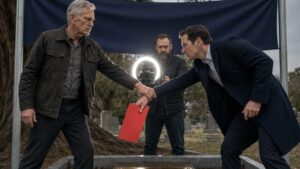
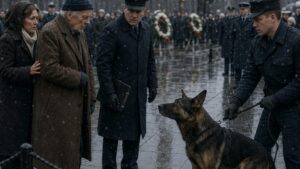
The organizer began reading the names while Frank stood at the edge of the crowd with his cap in both hands.
He had chosen a place near the stone wall, behind the folding chairs and just beyond the row of schoolchildren holding paper flags. From there, he could see the memorial without being seen by everyone who turned toward it. The sky hung low and gray above the trees. A light wind moved through the flags, making them snap once and then settle.
Jacob stood near the front with Rachel beside him.
The map was not in Frank’s coat pocket.
That absence felt strange at first. He kept reaching for it without meaning to, his fingers brushing the empty lining of the brown coat. Then he would see Jacob’s hand resting on the folded paper beneath his arm and stop himself.
The red truck was in Jacob’s other pocket.
Frank could see the small square shape pressing against the fabric.
Heather stood at the lectern in front of the plaque. She had replaced her pale blue blazer with a dark coat, but she wore the same composed expression Frank had first seen in the archive room. Only now it seemed less like armor.
The organizer finished the opening remarks and stepped aside.
Heather unfolded one sheet of paper.
“We are here,” she said, “to recognize the men and women whose names belong to this town’s memory.”
Her voice carried clearly across the small crowd.
Frank looked down at his cap.
“There is one correction that must be spoken before we continue,” Heather said. “For many years, the town record listed Gary R. Mercer incorrectly. It stated that he returned home. That was not true.”
A murmur moved through the chairs.
Heather did not look away from the page.
“The committee inherited an error that should have been examined sooner. The record is now being corrected. Gary R. Mercer did not abandon his family. He was presumed deceased in service, and his name belongs among those who did not return.”
Frank heard no applause.
He was grateful for that.
The silence that followed was not empty. It had weight. It allowed the words to stay where they had landed.
Heather lowered the paper.
“Mr. Mercer’s family is here today,” she said. “We offer them our respect, and we acknowledge that a correction made late is still late.”
Jacob’s shoulders rose once beneath his coat.
Rachel touched his arm.
Then the organizer stepped back to the lectern and began reading names.
Frank had heard many of them before. Some belonged to boys he had known. Some had belonged to men he had only met in passing. The names moved through the morning one by one, each followed by a pause that was meant to be respectful but never seemed long enough.
Frank watched Jacob.
At first, Jacob stared at the plaque. Then he looked down at the map. He unfolded one corner, just enough to see the old blue writing. His thumb rested there.
When the organizer reached the corrected panel, he paused.
“Gary R. Mercer.”
The name sounded ordinary in the open air.
That was what made Frank’s chest tighten.
It was not a legend. Not a speech. Not a story anyone had polished into something easier to admire. It was just a man’s name, spoken where it should have been spoken long ago.
Jacob closed his eyes.
Rachel leaned toward him, but he did not need help standing. He put one hand on his cane and the other over the pocket that held the truck.
Frank looked away.
He did not know how long he stood like that. Long enough for the children to lower their flags. Long enough for the organizer to continue. Long enough for the crowd to begin shifting toward the coffee table and the trays of small sandwiches under a white canopy.
John appeared beside him.
He had removed his dress cap and held it against his chest.
“Mr. Bennett,” he said quietly.
Frank did not answer at first.
John looked toward Jacob. “You should stand with them.”
Frank shook his head.
“That place is his.”
“He might want you there.”
“He has his daughter.”
John glanced back at the family. “That’s not what I mean.”
Frank looked at the young recruit.
John’s face had changed since the archive room. The eagerness was still there, but it had been tempered by something more careful. He did not look as though he wanted Frank to be seen. He looked as though he did not want Frank to disappear.
Frank lowered his gaze to the empty coat pocket.
“I spent too many years thinking I had to carry it alone,” he said. “I don’t intend to make this another thing he has to carry for me.”
John nodded slowly.
Then he stepped away.
Near the plaque, Heather spoke with Rachel. Christine stood a few feet back, holding a folder against her side. Frank saw her glance toward Jacob, then stop herself from approaching. She had learned, perhaps, that not every truth needed a witness close enough to touch it.
The crowd thinned.
Jacob remained by the memorial.
At last, he turned.
Frank expected him to look at Rachel first. Or Heather. Or the corrected panel where Gary’s name had been placed.
Instead, he found Frank.
The distance between them was not great. A few yards of wet grass. A row of empty folding chairs. The space of forty-three years.
Frank did not move.
Jacob’s face was unreadable. Not hard. Not forgiving. Just tired in a way Frank understood too well.
Then Jacob reached into his pocket.
He did not take out the truck. He only rested his hand over it.
With the other hand, he lifted his cane against his side and straightened as much as he could.
Frank saw what he was about to do before it happened.
Jacob raised his free hand to his brow.
The salute was slow. Trembling slightly. Held for only a moment.
John saw it and came to attention where he stood. Heather did the same, quietly. Christine lowered her head.
Frank’s hand remained at his side.
For one terrible second, he could not lift it.
Not because he did not know how.
Because he did.
He looked at Gary’s name engraved on the corrected panel. Then at Jacob’s hand. Then at the small shape of the red truck beneath Jacob’s coat.
At last, Frank raised his hand to his brow.
He held the salute until Jacob lowered his.
No one spoke.
Afterward, Rachel walked with Jacob toward the path. The map was tucked beneath his arm, protected from the damp air. Before they reached the gate, Jacob looked back once.
Not for long.
Then he continued on.
Frank waited until they were gone before he crossed the grass.
The memorial stone was cold under his fingers.
He touched Gary Mercer’s name once, lightly, with two fingertips.
Then he stood there with his empty coat pocket and the morning moving around him, knowing the map no longer had to lead anyone home.
The story has ended.