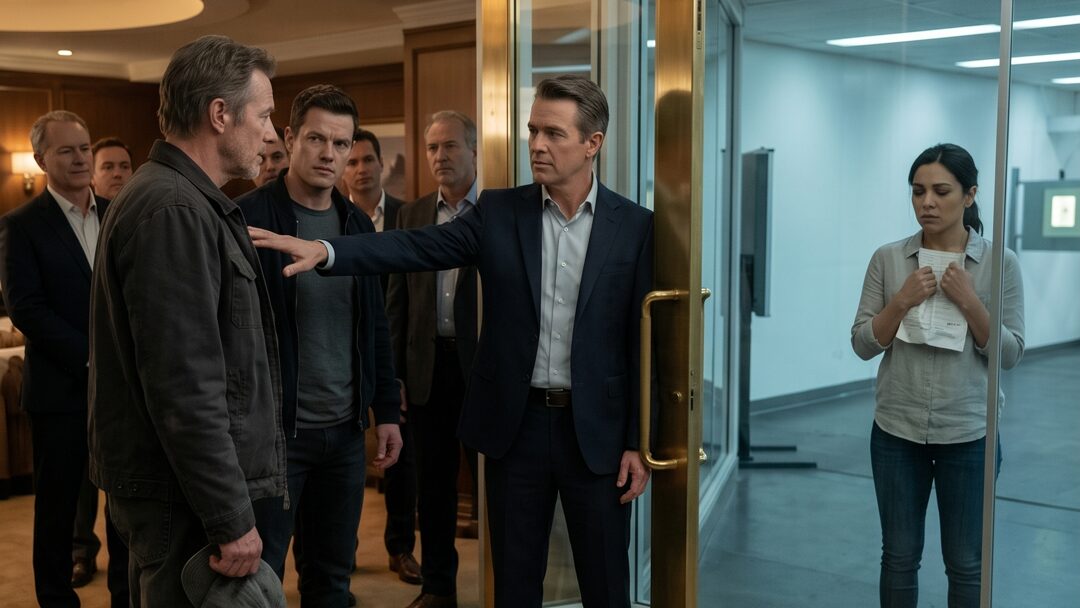
At the Tournament Door, Frank Asked the Girl’s Name Before Anyone Knew Why
Chapter 1: The Brass Door Would Not Open
“My grandfather was invited.”
Christopher said it with more force than the words deserved, as if saying them loudly could make Gary Anderson move his arm from the brass-plated door.
Gary did not move.
The door stood polished behind him, its narrow glass pane reflecting the crowded lobby: pressed jackets, club badges, clean shooting cases, women with sponsor lanyards, men pretending not to listen while listening to everything.
Frank Hall stood beside his grandson with his faded cap tucked beneath one arm. His other hand rested low against his hip, where the ache had started in the car and sharpened now from standing still. His shoes were scuffed at the toes. His dark jacket had been brushed clean, but not recently enough to fool anyone who cared about such things.
Gary looked at Christopher first, not Frank.
“Members’ lounge is for competitors and sponsors,” he said. “You two have the wrong entrance.”
Christopher’s face reddened. “He has an invitation.”
Frank felt the folded card inside his coat pocket. Thick paper. The club seal pressed in blue. Deborah’s name written beneath a line that called him a guest of honor.
He did not reach for it.
Gary’s eyes ran over Frank’s shoes, then his cap, then the old watch strapped to his wrist. The watch had a crack at the edge of its face, thin as a hair. Frank’s thumb found it without thinking.
“Invited to a serious competition?” Gary said. “At his age?”
A few people near the lounge entrance laughed. Not loudly. That made it worse. They laughed the way people did when they wanted the person being laughed at to understand they had been noticed.
Christopher stepped forward. Frank caught the sleeve of his jacket.
“Leave it,” Frank said.
Gary smiled, pleased with himself. “No offense. But this isn’t a museum day. We’ve got qualifiers starting.”
“No offense,” Frank repeated.
“Then leave it to people who still know what they’re doing.”
The timer sounded from the range beyond the glass wall. One clean electronic chirp. Then another. The sound traveled through Frank more quickly than it traveled through the room.
On the far side of the glass, a girl stood alone beside Lane Four. She was maybe sixteen. Her safety glasses sat crooked on her head, unused. Both hands gripped a registration form that had been folded and unfolded until the paper looked soft at the creases.
She was not looking at the targets.
She was looking at the exit.
Frank watched her shoulders lift.
One breath.
Then another.
Her fingers tightened around the form.
A third.
He had seen that rhythm before. Not her. Not this girl. The rhythm.
Four breaths held too high in the chest. A fifth that never quite made it down. Then the pause before the sixth, when a person decided whether to run or pretend she had never wanted to stay.
Behind Frank, somebody said, “That kid’s been hovering there all morning.”
Gary glanced through the glass. “She’ll either shoot or she won’t.”
Frank’s fingers left his watch.
He stepped away from the door.
Christopher stared at him. “Grandpa?”
Frank did not answer. He walked toward the glass wall, slow enough that his hip protested, past a display case filled with old plaques and silver cups. Gary’s voice followed him.
“Sir, you can’t go through there either.”
Frank stopped at the edge of the lobby where the range entrance began. The girl had seen him now. Her eyes flicked to his cap, then to his face, then down to the form in her hands.
She looked prepared to apologize for existing.
Frank had known that look too.
“What’s her name?” he asked.
The laughter near the lounge door stopped.
Christopher came closer. “Who?”
“The girl.”
Gary let out a breath through his nose. “Why does it matter?”
Frank looked at him once. Not hard. Not angry. Just long enough that Gary’s smile loosened at the edges.
“It matters to me.”
The girl’s throat moved before she spoke.
“Amy,” she said.
Her voice barely crossed the space between them.
Frank nodded. “Amy what?”
“Perez.”
“Frank Hall.”
She looked at his hand when he offered it. He did not push it closer. After a second, she shifted the registration form to one hand and shook his.
Her palm was cold.
“Are you competing?” he asked.
Amy gave a short laugh that did not sound amused. “I was supposed to.”
“Supposed to?”
She looked toward the registration desk. A woman in a gray blazer—Deborah Martinez, though Frank had not seen her face straight on yet—was speaking to two officials with clipboards. Amy lowered her eyes.
“They said there might be a problem with my form.”
Gary came up behind Frank, his irritation now carefully hidden under a pleasant tone.
“Mr. Hall, isn’t it? I’d appreciate it if you didn’t distract registered shooters.”
Frank kept his eyes on Amy. “Was I distracting you?”
She shook her head.
“No,” she said.
Her answer surprised her as much as it did anyone else.
Frank looked at the paper in her hands. The top corner had been torn from where it had caught under her thumb.
“You were about to leave,” he said.
Amy’s cheeks flushed. “No.”
“You were.”
She tried to smile, but it vanished before it formed. “How did you know?”
The range timer chirped again beyond the glass.
Frank looked down at his watch, then back at her.
“Because you count the same way my son used to.”
Chapter 2: Six Breaths Before the Trigger Breaks
“Can you tell I’m shaking?”
Amy asked it without looking at Frank.
They stood near the practice lanes, where the early qualifiers had thinned into a steady rhythm of muffled shots, electronic tones, and low instructions from club volunteers. The range had the same dry smell Frank remembered: paper targets, machine oil, old carpet holding years of dust.
Amy had borrowed a lane during a break. Her equipment case sat open by her feet. She kept both hands flat against the edge of the table as though she could pin the shaking into place.
Frank leaned against the wall a few yards away. He had not come closer until she asked him to.
“Your hands?” he said. “Not much.”
She gave him a sideways look.
“Your shoulders are telling on you.”
“That’s worse.”
“It’s honest.”
Amy looked downrange. The targets were blank circles waiting for mistakes. Behind them, the concrete wall swallowed every sound.
Christopher stood a little behind Frank, holding the faded cap now. He had not said much since the lobby. He kept looking at his grandfather as though he had found a door in a familiar wall and wanted to know what was behind it.
Amy swallowed. “The first shot is always bad.”
“Always?”
“Usually.” She corrected herself quickly. “Sometimes it’s okay. But when people are watching, I get to the line and I start thinking about everybody hearing it if I miss.”
Frank nodded once.
“You count before you shoot.”
Her fingers curled against the table. “How do you know that?”
“I saw you.”
“No, I mean…” She stopped. “Nobody showed me. Not really.”
From her case, she took out a thin, battered binder with the club emblem stamped on the front. The spine had been repaired with clear tape. She opened it carefully, as if something inside might break.
“It was in the old equipment closet at my school,” she said. “Our instructor said it belonged to the range a long time ago. Most of the pages are just safety stuff. But there are notes in the margins.”
She turned the binder toward him.
The page showed diagrams of stance and sight alignment. Along the side, in faded blue ink, someone had written:
Six breaths, then choose.
Frank’s chest tightened before he could stop it.
The handwriting leaned forward. The letters were narrow and impatient, the final e in choose curled too far up. William had written like that when he was young, when every sentence looked like it was already trying to leave the page.
Christopher saw it too. Frank knew by the way he went still.
Amy traced the words with one finger.
“I thought it meant you count six breaths and then pull the trigger,” she said. “But I don’t think that’s what it means.”
Frank could not answer right away.
A memory came too quickly: William at seventeen, standing in a lane one county over, shoulder stiff beneath his jacket. The fluorescent lights buzzing. Frank’s own voice, low and firm, telling him not to waste the round.
Six breaths, then choose.
Not pull.
Choose.
Amy looked at Frank. “Did you know whoever wrote it?”
He adjusted the watch at his wrist. The leather strap had darkened with age where it crossed his skin.
“I knew him,” he said.
“Was he good?”
Frank’s mouth moved once before sound came out.
“Yes.”
“That’s not what I asked.” Amy looked almost embarrassed by the sharpness in her voice. “Sorry.”
“No.” Frank looked back at the handwriting. “He was good. And he was more than that.”
A cart rolled past the lane entrance. Gary pushed it with a box of bottled water balanced on top. He slowed when he saw Frank standing near Amy.
“This is a practice area,” Gary said. “Not a coaching clinic.”
Amy stiffened.
Frank held up one hand, palm outward. “I’m not coaching.”
Gary’s gaze dropped to the binder. “Then keep it that way.”
He moved on, but not before glancing toward Deborah at the registration desk. He made a small motion with two fingers. Deborah saw it. Her lips pressed together.
Christopher waited until Gary was out of earshot.
“You knew him,” he said quietly. “Who?”
Frank looked at Amy. “Do you want advice?”
She blinked. “What?”
“You asked me if I could tell you were shaking. That isn’t the same as asking me what to do.”
For a moment, the only sound was the timer from the far lanes.
Amy seemed to consider this. Then she nodded.
“One thing,” she said. “Not a whole speech.”
Frank almost smiled.
“One thing.”
She stepped into the lane. Her glasses sat right now. She checked the equipment with careful, practiced movements, but her breath began climbing again as she faced the target.
Frank felt the old instinct rise in him—move closer, fix the angle, touch the shoulder, correct before failure had a chance to settle.
Instead he stayed where he was.
“Your left foot,” he said. “It’s trying to leave before you do.”
Amy looked down.
“What?”
“Turn it in a little. Not because I said so. See whether it makes you feel less like you’re standing on a train platform.”
She shifted her foot.
Her shoulders lowered by a fraction.
“That better?” he asked.
She nodded.
“Then take your time.”
Amy closed her eyes for one breath. Then another.
Frank’s thumb rested against the cracked glass of his watch, but he did not count for her.
At the sixth breath, she opened her eyes.
The shot broke cleanly.
The electronic display flickered. Amy stared at it, then let out a breath that turned into a surprised laugh.
“It hit.”
“It did.”
Christopher grinned at Frank as if Frank had just done something extraordinary. Frank looked away before the look could settle on him.
Gary was standing at the end of the lane with his phone held loosely at his side.
“I got that,” he said.
Amy’s smile disappeared.
Frank’s stomach dropped.
Gary slipped the phone into his pocket. “Unauthorized coaching. I’ll report it.”
“You watched the whole thing,” Amy said.
“That’s how I know.”
Frank stepped forward before he could stop himself. “She asked for one adjustment.”
Gary’s expression stayed calm, almost tired. “And that’s exactly the problem. Everyone here has rules. You don’t get to decide you’re above them because you used to matter.”
Christopher moved closer to Frank.
Gary turned away, already looking toward Deborah.
Frank looked back at the binder in Amy’s hands. The blue ink had blurred where someone’s thumb had passed over it a thousand times.
Six breaths, then choose.
Christopher was staring at the words too.
His voice came out quieter than before.
“Was that Dad’s?”
Chapter 3: The Registration Form That Was Not Wrong
“It is not exactly a disqualification yet.”
Deborah slid Amy’s registration form across the desk as though the paper might leave a stain.
Amy reached for it, but Deborah kept two fingers on the corner.
The lobby had grown louder since morning. Competitors moved through in clusters now, carrying cases and coffee cups, discussing scores in voices meant to sound casual. Gary stood near the entrance to the committee corridor with his arms folded, speaking to a man in a sponsor badge. He did not look at Amy.
That was worse than looking.
“What does ‘not exactly’ mean?” Nicole asked.
She had arrived ten minutes earlier, still wearing a coat she had not fully taken off. Her hair was damp near the temples, as if she had hurried from the car through mist. She stood beside Amy, close enough to protect her without touching her.
Deborah glanced at Frank before answering.
“It means the affiliation field is incomplete,” she said. “And because there has been a question about outside instruction, the form needs review.”
Amy looked down.
“My school doesn’t have a club,” she said. “That’s why it says independent.”
“The line is blank under sponsor confirmation.”
“It was blank when I brought it in.”
Deborah nodded too quickly. “Yes. I know.”
Frank heard the change in her voice.
“You accepted it,” he said.
Deborah’s eyes met his. Recognition moved across her face at last, unwilling but clear.
“Frank.”
She said his name like a person opening a drawer she had kept shut for years.
“You accepted it weeks ago,” he said.
“I processed it,” Deborah replied. “The review is different.”
“Who asked for the review?”
She did not answer.
Across the lobby, Gary laughed at something the sponsor representative said.
Amy tugged once at the form. Deborah let go.
“It was Gary,” Frank said.
Deborah lowered her voice. “He raised a concern after the practice lane.”
“About me.”
“About procedure.”
Frank looked at the paper. The affiliation box was blank. So was the same box on three other forms stacked in a tray beside Deborah’s elbow.
Christopher saw it too.
“Those are blank,” he said.
Deborah covered the tray with a folder.
“They are being handled.”
“Are they being handled because an old man talked to them?” Christopher asked.
Frank touched his arm. “Christopher.”
“No.” His grandson looked at Deborah, not angry exactly, but wounded in a way Frank did not know how to answer. “She had the form. She was already here. Why is it suddenly wrong?”
Deborah’s shoulders sank a little.
“Because today has sponsors,” she said. “Because people are watching. Because Gary believes every exception looks like favoritism.”
Amy’s face hardened at that word.
“I didn’t ask for an exception.”
“No,” Deborah said. “You didn’t.”
Nicole stepped closer to the desk. “Then fix it.”
Deborah’s mouth tightened. “It is not only my call now.”
Frank had spent enough years in rooms like this to know what that meant. A person had wanted to do the right thing while still keeping her hands clean of it.
He took the registration form from Amy gently.
“May I?”
Amy hesitated, then nodded.
The paper was warm from her hands. Frank smoothed one crease with his thumb and saw the inked signature at the bottom. Deborah Martinez. Dated three weeks earlier.
He turned the form toward Deborah.
“You approved this.”
“I accepted the entry.”
“You approved it.”
Deborah looked at the signature, then at Gary.
Frank felt his hip throbbing, but he did not shift his weight. “You can either say it was approved, or you can say your name means nothing when someone louder objects.”
Christopher looked sharply at him. Frank had not raised his voice. That made the words land harder.
Deborah’s face changed, but only for a second.
“I can schedule a review,” she said. “That is what I can do.”
Amy took back her form. The crease Frank had smoothed sprang halfway open again.
“I don’t want a review,” she said.
Nicole put a hand on her shoulder. Amy shrugged it off, not roughly, but enough.
Frank watched the movement. A small refusal. A choice.
“Where’s the old archive?” Christopher asked.
Deborah looked surprised. “What?”
“The room with the old photos and club papers. Grandpa said there used to be one.”
Frank had not said that. Not today.
But Christopher was already looking toward the corridor beyond the lounge.
Deborah pointed reluctantly. “Past the stairwell. It is not open to guests.”
“Neither is the lounge,” Christopher said, and walked away before Frank could stop him.
Nicole gave Frank a look that said she did not like him, did not trust him, and did not have time to explain either.
Amy followed Christopher after a moment, holding the form against her chest.
Frank went after them.
The archive room smelled of cardboard and dust. Its single overhead bulb flickered when Christopher found the switch. Along the walls, old framed photographs leaned in uneven rows: teams in matching jackets, club dinners, award nights, rows of young faces looking too serious under fluorescent light.
Christopher moved straight to a cabinet marked HISTORICAL RECORDS.
“Don’t touch anything,” Frank said.
Christopher looked over his shoulder. “You said that when I was five and found your tool drawer.”
“That was different.”
“How?”
Frank had no answer.
Amy stood near the photo wall, quiet now. Nicole remained in the doorway, arms crossed.
Christopher opened a flat box and lifted out a stack of photographs tied with a faded blue ribbon.
The first few showed people Frank did not recognize. Then Christopher stopped.
“Grandpa.”
Frank knew before he saw it.
The photograph had been taken at this range. He stood in the middle, younger by decades, wearing a club jacket with the collar too tight around his neck. On one side was a boy of seventeen, thin and unsmiling, holding a medal he had not wanted. On the other side stood a teenage girl with dark hair pulled back and both hands shoved into the pockets of an oversized sweatshirt.
Nicole’s breath caught.
Christopher turned the photo over.
The back had been written on in blue ink.
Frank. William. Nicole. Regional Finals.
The room became very small.
“You knew Dad,” Christopher said.
Nicole looked at Frank, not at Christopher.
“I knew him,” she said.
Frank set the cap down on a box of old score sheets. His hand had begun to shake. He closed it into a fist.
Amy looked from Nicole to him. “Was he the person who wrote in the binder?”
Nicole did not answer.
Frank did.
“Yes.”
Christopher’s eyes moved to the folded picture, then back to Frank. “Why didn’t you tell me?”
Because Frank had told himself there had been no use. Because William had been gone too long. Because the story, once spoken aloud, might become something real enough to blame him for.
He opened his mouth.
Nicole stepped forward before he could speak.
“Amy,” she said, “don’t let him coach you.”
Amy stared at her.
Nicole’s gaze stayed on Frank.
“Your father was not the only young person he trained to ignore pain.”
Chapter 4: The Match Frank Never Finished Watching
Christopher held the photograph by its corners as if it might come apart in his hands.
“Why has this been folded so many times?”
The question was not loud. It did not need to be.
The archive room seemed to hold its breath around it. Dust drifted through the weak light. Behind Christopher, the old framed teams watched from the walls with their frozen smiles and polished trophies.
Frank looked at the photograph.
He had folded it once, years ago, before putting it in a drawer. Then again after William stopped answering his calls. Then once more after the funeral, when he had found it under a stack of old scorecards and could not bear the sight of his son’s face staring past the camera.
“I kept it in my wallet for a while,” he said.
“That doesn’t answer me.”
No, it did not.
Amy stood beside Nicole, still holding her registration form. Her eyes moved between Frank and Christopher but never stayed long enough to make either of them feel watched.
Nicole reached into the box and took the photograph gently from Christopher. She looked at the younger version of herself for a long moment.
“That was the regional finals,” she said. “Your dad was seventeen.”
Christopher frowned. “He shot competitions?”
“For years,” Frank said.
“And you never told me.”
Frank rested one hand on the top of the archive cabinet. The metal was cold through his palm.
“I should have.”
Christopher waited.
The silence lengthened until Frank could hear the timer from the range through the corridor wall. A brief tone. Then the muffled crack of a shot. The sound struck somewhere behind his ribs.
Nicole turned the photograph over. Her thumb brushed the blue writing.
“William hated this picture,” she said. “He said everybody looked like they were waiting to be congratulated for something they hadn’t earned.”
Frank closed his eyes.
“Nicole,” he said.
“No.” She set the photograph down on the cabinet. “He deserves to know.”
Christopher looked from her to Frank. “Know what?”
Nicole’s face had gone still in the way people’s faces did when they had carried anger long enough for it to become heavier than anger.
“At that match,” she said, “your father’s shoulder was hurt.”
Frank’s hand went to his wristwatch.
The glass was cracked near the four.
“It was a strain,” he said. “He said it was a strain.”
“He could barely lift his arm after the second round.”
“He wanted to finish.”
Nicole looked at him sharply. “He wanted you to stop looking at him like quitting would make him less than you.”
Christopher’s mouth opened, then shut.
Frank stared at the watch. Its hands had stopped years ago at 3:17. He had never repaired it. He had told people it was sentimental. That was true, but not enough.
“He had qualified,” Frank said. “He had worked for it all year.”
“He was seventeen.”
“He was talented.”
“He was in pain.”
The words landed without force, which made them harder to push away.
Frank remembered the corridor outside the old regional range. William sitting on a folding chair with his shooting jacket half off, his face pale beneath the fluorescent lights. The medic had suggested rest. Nicole, younger then, had stood by the water fountain with both hands clenched.
Frank had crouched in front of his son.
Six breaths, then choose.
But he had not said those words.
He had said, You can finish one more round.
William had looked at him with an expression Frank had spent years trying not to name.
Not fear.
Not exactly.
Disappointment.
“I thought I was helping him get through it,” Frank said.
Nicole’s eyes filled, but she did not look away. “That was what you always thought.”
Christopher backed against the archive table. “Did Dad quit because of that?”
Frank felt the question settle over every excuse he had kept polished and ready.
“He quit after,” Frank said.
“Because of his shoulder?”
“No.”
Christopher’s eyes fixed on him.
Frank swallowed. “Because I made him feel like there was no room for anything except finishing.”
The range timer sounded again.
Amy looked down at her form, smoothing a crease with both hands.
Nicole spoke more softly now. “After he left the team, he started writing notes in the old binders. For the younger kids. Things he wished someone had told him.”
Amy raised her head. “The note. Six breaths, then choose.”
Nicole nodded.
“He wrote it after he quit,” she said. “Not when he was trying to win.”
Frank looked at the battered binder tucked under Amy’s arm. He had thought the words belonged to a boy he had failed. He had not understood that William had turned them into something beyond that failure.
Christopher reached toward the photograph but stopped before touching it.
“Why did you stop coming here?” he asked.
Frank could have said his hip. He had said it often enough that the lie had worn itself smooth.
Instead, he looked through the archive doorway toward the range he had avoided for almost two decades.
“Because I knew every lane here,” he said. “And every lane reminded me of the one place I should have stood beside him and didn’t.”
Amy’s face changed slightly. Not forgiveness. Not yet. Something more careful.
A shadow crossed the doorway.
Gary stood there with a clipboard in one hand.
“Sorry to interrupt,” he said, though his tone suggested he was not sorry at all. “Deborah needs everyone involved in the practice-lane incident to report to the committee room.”
Nicole folded her arms. “Everyone involved?”
Gary glanced at Amy. “An objection has been filed. Outside coaching. Possible effect on a competitor’s eligibility.”
Amy’s fingers tightened around the binder.
Frank stepped toward her before he thought better of it.
She took one step back.
It was small. Barely anything.
But Frank saw it.
Gary held out the clipboard. “You can sign in here.”
Frank looked at the paper. At the neat lines. At the blank spaces waiting to become a record of what someone else had decided.
Then Amy spoke.
“I’ll withdraw,” she said.
Nicole turned to her. “Amy—”
“I don’t want this because of me.” Her voice trembled, but she kept going. She looked at Christopher, then at Frank. “I don’t want him finding out things about his dad because I needed help.”
Frank felt something inside him reach for the old answer. Tell her it was fine. Tell her she could finish. Tell her what to do.
He did not.
He looked at Amy’s crumpled form and said, “You don’t have to decide that in this hallway.”
Gary’s clipboard remained between them.
And Amy did not lower her eyes.
Chapter 5: The Rule Gary Chose to Enforce
“Rules do not change because someone feels sorry for you.”
Gary placed the printed rulebook beside Amy’s registration form with enough care to make the gesture look official.
The committee room was too small for the number of people inside it. Deborah sat at the far end of the table with a legal pad in front of her. Frank stood near the wall because the chair offered him would have made it harder to rise again. Christopher leaned against the radiator beneath the window. Nicole sat beside Amy, though Amy had pulled her own chair a few inches away.
Gary remained standing.
He had traded his volunteer badge for a competitor’s jacket, crisp at the shoulders. It made him look younger, Frank thought. Or like he wanted to.
“No one is asking for rules to change,” Amy said.
Gary looked at her. “Then you understand the issue.”
“I understand that you watched other people get advice all day.”
“That is not relevant.”
“It is if you are saying advice is the reason I should lose my lane.”
Gary’s jaw tightened.
Deborah lifted a hand. “Let’s keep this orderly.”
Frank almost laughed. It would have been a poor choice, so he did not.
Gary opened the rulebook to a marked page. “No competitor may receive technical instruction from an unregistered coach after check-in. Mr. Hall gave Ms. Perez a stance correction during active practice.”
“He asked if she wanted it,” Christopher said.
Gary turned toward him. “That does not make it permitted.”
“He didn’t touch her,” Christopher said.
“Christopher,” Frank said quietly.
But his grandson did not look at him.
“You had somebody standing behind you this morning,” Christopher continued. “The guy with the blue case. He told you something between shots.”
Gary’s face changed, just enough.
“That was a team spotter.”
“Was he registered as a coach?”
Deborah’s pen stopped moving.
Gary glanced toward her. “That is different.”
“How?” Amy asked.
Gary took a breath through his nose. “Because he is affiliated with my club.”
Amy looked at the blank line on her own form.
“And I’m not.”
Nobody answered.
Frank saw Deborah’s eyes go to the form, then away. He had known her when she was younger than Amy, when she had been the person who found every broken latch and missing screw at the range before anyone else did. She had hated unfairness then. Or perhaps she had simply been less afraid of making someone angry.
“Mr. Hall,” she said, “your invitation includes a legacy exhibition after the qualifiers. It does not include authorization to coach.”
Frank nodded.
Christopher stared at him.
“You knew that?” he asked.
“I knew I wasn’t supposed to give technical instruction.”
“And you did anyway.”
Frank’s hip hurt. His wristwatch felt heavy against his skin.
“Yes.”
The room became quieter.
Gary leaned back a little. Frank could see the relief in it. A clean admission. A rule made simple.
“I gave her advice,” Frank said. “One correction. She asked for it, but that doesn’t erase the rule.”
Amy turned toward him. “Frank—”
He held up a hand, then lowered it before it became a command.
“I’m not saying you did anything wrong,” he told her. “I’m saying I did.”
Nicole watched him closely, waiting for the part where he would make the admission sound noble.
It did not feel noble.
It felt late.
Gary tapped the rulebook. “Then this should be straightforward.”
“It isn’t,” Frank said.
Gary’s eyes narrowed.
“Because you do not enforce it straightforwardly.”
Deborah looked up.
Frank went on. “You saw your own spotter speak to you. You saw competitors receive corrections from club instructors along the practice lanes. You raised no objection until Amy took one suggestion from an old man you had already decided did not belong here.”
Gary’s face reddened. “You are making this personal.”
“You made it personal at the door.”
The words sat in the room.
For the first time, Gary looked uncertain. Not because he had been caught in a lie. Frank did not think Gary believed he was lying. He believed he was protecting the tournament. Protecting standards. Protecting the version of the club that sponsors wanted to see.
But he had chosen which person needed protecting from.
Amy folded her hands over the registration form.
“I did ask him,” she said.
Everyone looked at her.
“I asked him for advice. He said one thing. I moved my foot. That’s all.” Her voice steadied as she continued. “And I didn’t shoot because he made me. I shot because I wanted to.”
Gary opened his mouth.
Amy spoke before he could.
“I’m not asking for you to let me stay because you feel sorry for me either.”
The words were simple. They did not need to be louder.
Christopher looked at her with something close to awe. Frank understood the feeling, and it embarrassed him.
Deborah pressed her fingertips together. “The problem is that the rule was breached.”
“By me,” Frank said.
“And by others,” Nicole added.
Deborah’s gaze moved from one face to another. Outside the room, the loudspeaker announced the approaching final qualifying round. The schedule was tightening. The sponsor representatives would be waiting. Deborah could feel every minute like a hand against her back.
“We cannot settle every concern right now,” she said.
“That is convenient,” Nicole said.
“It is practical.”
“It is convenient.”
Frank saw Deborah flinch. He also saw Gary looking toward the door, toward the range, toward the event that could still run smoothly if Amy simply disappeared from it.
Frank pulled the invitation from his coat pocket.
The card had been folded once at the edge. He placed it on the table.
Deborah looked at it.
“Do you want to use that?” she asked.
Christopher’s head turned sharply.
Frank knew what she meant. The club had invited him because of old photographs, old scores, old stories that became safer after enough years. He could remind them who he had been. He could make Deborah say it aloud in front of Gary. He could turn the day into proof that he still mattered.
The urge came hot and immediate.
Frank looked at Amy.
She had gone still again, but this time she was not counting breaths. She was waiting to see what the adults would do.
He slid the invitation back toward himself.
“No,” he said.
Gary’s expression shifted, almost imperceptibly.
Frank folded the card and returned it to his pocket.
“I will not ask for special treatment. Not for me. Not for her.”
Deborah looked exhausted. “Then I will review the matter before the final qualifying round. Amy’s lane is suspended until then.”
Amy’s face went pale.
“That’s not a decision,” Nicole said.
“It is the decision I can make now.”
The loudspeaker called for competitors to prepare.
Gary closed the rulebook. “That is fair.”
Frank watched him leave the room.
Christopher stepped closer to his grandfather. “You could have made her listen.”
Frank looked at the closed door.
“I could have tried.”
“Why didn’t you?”
Frank’s fingers touched the old watch, then stopped.
“Because trying to make someone listen is not the same as being right.”
Deborah gathered the form and the rulebook into a single stack.
“The ruling will be announced immediately before the final qualifying round,” she said.
Amy stared at the empty place where her lane number should have been.
The timer sounded from the range beyond the wall.
And for the first time that day, she had nowhere to stand.
Chapter 6: What Frank Refused to Win
“You can still have your moment,” Deborah said. “But not with her beside you.”
The words were quiet enough that Christopher, standing a few feet away, could not hear them over the noise from the spectator area.
Frank could.
They stood near the entrance to the qualifying range, where the evening crowd had begun to press in around the ropes. The brass door to the members’ lounge was open now. Nobody stood in front of it. That somehow made Frank dislike it more.
Deborah held his exhibition card between two fingers.
“If Amy withdraws voluntarily,” she said, “the committee can close the coaching question without a formal finding. You can still take the legacy lane after the qualifiers. The sponsors are expecting it.”
Frank looked past her into the range.
Amy sat alone on a bench near Lane Four, her equipment case shut at her feet. Nicole stood by the wall with her arms crossed. Gary spoke to a sponsor representative near the score display, his head lowered, his manner attentive.
“Why does it matter to the sponsors?” Frank asked.
Deborah followed his gaze.
“One of them asked why an independent junior entrant had become the center of the event,” she said. “Gary believes it looks disorganized.”
“Does it?”
Deborah looked tired. “It looks like we have a dispute we should have handled before today.”
“That is not what I asked.”
Her face tightened.
“No,” she said. “It looks like we were not prepared to make room for her.”
Frank nodded once.
Deborah held out the exhibition card. “Frank, you were invited because people still remember what you did here.”
“That is generous of them.”
“It is true.”
“No,” he said. “People remember whatever version fits on a plaque.”
For a moment, Deborah said nothing. The card remained between them.
Christopher came closer. “What is she talking about?”
Frank looked at him. “They want me to do an exhibition round.”
“Seriously?” Christopher’s face brightened despite everything. “Grandpa, that’s why we came.”
The words struck harder than they should have.
Frank had brought Christopher because he had wanted to show him something. Not necessarily a score. Not even a medal. Just a place where Frank had once known what he was doing.
He had not expected the place to ask him whether he still deserved to.
Amy stood from the bench and walked toward them. Her registration form was folded into a small square now. She held it in one hand.
“Can I talk to you?” she asked Frank.
He glanced at Nicole. Nicole did not nod. She did not stop Amy either.
Frank stepped aside with her, near the glass wall. The target lanes stretched behind them in pale rectangles of light.
“I heard Deborah,” Amy said.
“I’m sorry.”
“For what?”
“For them putting you in this position.”
Amy looked down at the folded form. “You keep saying things like that.”
“What should I say?”
She let out a breath. “I don’t know.”
Frank waited.
Amy looked at him then. Her eyes were tired, but not soft.
“I don’t want you to save me if saving me means you decide everything again.”
The words were not cruel. That made them truer.
Frank felt the old instinct flinch. He wanted to tell her he had not decided anything. He wanted to explain that he was trying to do better.
But she was not asking for an explanation.
“What do you want?” he said.
Amy’s expression changed slightly.
Frank kept his voice low. “Not what your mother wants. Not what Deborah wants. Not what I want. What do you want?”
She stared through the glass at Lane Four.
“I want them to decide fairly,” she said. “If I broke a rule, say I broke it. If other people did the same thing, say that too.”
“And if the answer costs you the round?”
“Then it costs me the round.” Her fingers tightened around the form. “I don’t want someone to make me stay just so they can feel better about me staying.”
Frank nodded.
Behind them, Christopher had heard enough to look away.
Frank turned to Deborah.
“I’m withdrawing from the exhibition.”
She blinked. “Frank—”
“I will not be part of a ceremony while Amy is being asked to disappear for everyone’s comfort.”
“You do not have to make it dramatic.”
“I’m not.”
Gary came over from the sponsor area, his expression already guarded.
“What’s going on?” he asked.
Frank faced him. “Apply the rule to every competitor who received instruction after check-in.”
Gary gave a short, unbelieving laugh. “You can’t be serious.”
“I am.”
“You want us to investigate half the range minutes before qualifiers?”
“I want you to stop pretending Amy is the only person you saw.”
Gary’s eyes flicked toward Deborah. “This will ruin the schedule.”
“No,” Frank said. “It will inconvenience it.”
Gary lowered his voice. “You think this is easy for me? We have sponsors in there. We have people who paid to be here. The club gets one chance to look like it has standards.”
“And you think standards are what people see when you pick the smallest person in the room to enforce them on?”
Gary’s face hardened.
“You have no idea what it takes to keep this place open.”
Frank believed him. That was the trouble. Gary probably did carry more than Frank knew: budgets, memberships, board pressure, the fear of being the person who let the club become another locked building with old trophies behind dusty glass.
But he had still chosen Amy.
Deborah rubbed one hand across her forehead. “We need the committee.”
Gary reached into his jacket pocket.
“No,” he said. “We need to deal with what actually happened.”
He pulled out his phone and tapped the screen. Then he held it toward Deborah.
A photograph filled the display.
Amy stood in her lane. Frank stood close behind her. One hand was raised near her shoulder; the other seemed to rest against the side of her equipment.
From the angle, it looked exactly like Gary said it would.
Like Frank was positioning her.
Like he had crossed a line.
Christopher stepped beside him. “That’s not—”
Gary swiped to the next image.
Frank’s hand was clearer there.
Amy’s shoulder was under it.
The sponsor representative had turned to watch.
Deborah’s face drained of color.
Gary looked at Frank.
“Tell them,” he said. “Tell them this is not coaching.”
Chapter 7: The Photograph Did Not Show Everything
Gary enlarged the photograph until Frank’s hand filled the screen.
Outside the committee room, people had gathered in the corridor. Frank could see their shapes through the narrow window in the door: club jackets, sponsor badges, faces turned toward the small drama that had interrupted their evening. The range timer sounded somewhere beyond them, steady and indifferent.
On the tablet, Amy’s shoulder sat beneath Frank’s palm.
It looked bad.
It looked familiar.
Frank had spent years knowing exactly how much pressure a hand could put on a young person without anyone else noticing.
“Tell them,” Gary said. “Tell them this is not coaching.”
Frank looked at the photograph again.
He remembered the moment. Amy had stepped into the lane. Her equipment strap had caught under the side of her jacket and twisted, pulling the fit crooked. She had reached back, frustrated, unable to see what had gone wrong.
He had moved without asking.
That was the part he hated most.
Not the strap. Not the photograph. The fact that the old instinct had been faster than thought.
“I touched her equipment,” Frank said.
Gary folded his arms. “You touched her shoulder.”
“I steadied the strap.”
“You were behind her in a live practice lane.”
“Yes.”
Deborah stood at the end of the table with both hands pressed flat against the wood. Her face had lost the tired politeness she had worn all day. Now she looked trapped.
Nicole reached for Amy’s hand. Amy did not take it.
“You weren’t adjusting her?” Deborah asked Amy.
Amy inhaled sharply.
Frank saw the answer rising in her face. She was about to explain it. About to defend him. About to become responsible for making the room forgive him.
He turned toward her.
“You do not owe anyone a statement,” he said.
Amy blinked.
Gary let out an impatient breath. “That is not helpful.”
“It is honest.”
“She is the only person who knows what happened.”
“No,” Frank said. “I know what happened too. And I know what I did not ask before I stepped in.”
The room quieted.
Christopher stood beside the radiator, his hands jammed deep in his pockets. He was watching Frank with an expression Frank could not read.
Deborah looked from the photograph to Frank. “Are you admitting a violation?”
“I am admitting that I crossed into her space without asking first.”
Gary’s mouth tightened, as though the answer had not given him the clean conclusion he wanted.
“That is coaching.”
“No,” Nicole said.
Everyone turned toward her.
Nicole’s voice was even, but Frank could hear the effort inside it.
“Coaching is more than putting a hand near someone. Sometimes it is telling a kid that their body belongs to the result. Sometimes it is making them believe you are helping when you are really making them afraid to disappoint you.”
Frank did not move.
Nicole looked at Amy.
“What do you want to say?”
Amy looked down at the folded registration form in her lap. Its corners had softened from being handled all day. For a moment, Frank thought she might say nothing.
Then she unfolded it.
The paper crackled in the room.
“The strap was twisted,” Amy said. “I couldn’t reach it.”
Gary opened his mouth, but Deborah lifted one hand.
Amy continued. “Frank came over and fixed it. He didn’t tell me where to stand. He didn’t tell me how to shoot. He did give me advice earlier. I asked for it. One thing.”
Her voice wavered at the end. She pressed the registration form flat against her knees.
“And I know that still might be against the rule.”
“It is,” Gary said.
Amy looked at him. “Then ask everyone else too.”
Gary’s eyes narrowed.
“There were coaches standing behind club shooters all afternoon,” she said. “There were people talking after check-in. You saw them. You didn’t take pictures of them.”
“I was monitoring my own lane.”
“You were watching mine.”
The sentence landed harder than a raised voice would have.
Deborah turned toward Gary.
“Did you photograph any other competitor receiving instruction?”
Gary hesitated.
“That is not the point.”
“It is now,” Deborah said.
The corridor beyond the door had gone quiet enough that Frank wondered whether people could hear them.
Gary looked at the tablet again, then shut off the screen.
“I had a responsibility to protect the event,” he said. “We have sponsors. We have standards. I was told to make sure the competition looked organized.”
Deborah’s face changed.
“I told you to prevent disruptions,” she said. “I did not tell you to sing