The Name He Finally Read
Part I — The Open Hand
Captain Michael Hayes stopped in front of Emily Carter so suddenly that the entire line seemed to stop breathing with him.
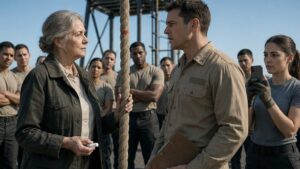
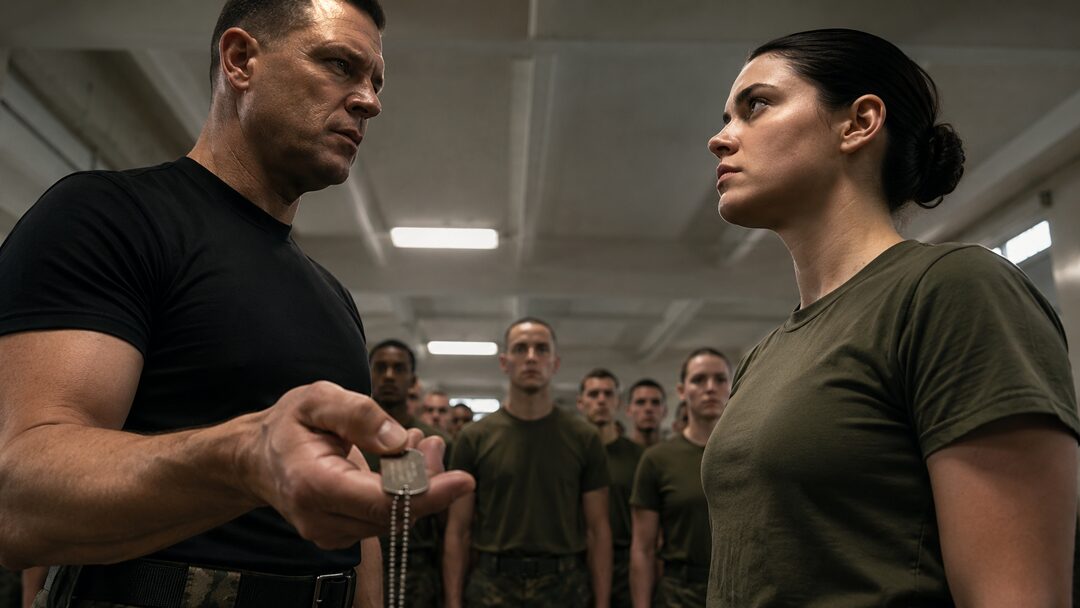
Thirty recruits stood shoulder to shoulder in the pale morning light, boots aligned on the painted concrete, eyes forward, faces arranged into the blankness they had been taught to wear. Emily had worn that same blankness since sunrise. She had checked her collar twice. She had tucked the thin silver chain deep beneath her shirt.
It was not enough.
Hayes’s eyes dropped to the small flash of metal at her throat.
“Private Carter,” he said.
Emily’s spine tightened.
“Yes, sir.”
His voice stayed calm, which somehow made it worse. “What is that?”
No one moved. Not even the recruit at Emily’s left, Sarah Mitchell, who had been whispering complaints about the cold ten minutes earlier. Now Sarah stared straight ahead, jaw clenched, pretending not to see the chain.
Emily lifted her chin by a fraction. “Personal item, sir.”
Hayes held out his hand.
The gesture was simple. Open palm. No raised voice. No threat.
But it emptied the space between them.
“Remove it.”
Emily did not reach for it right away.
That was the first mistake everyone saw.
Her hesitation lasted maybe two seconds, but in a formation it felt like open defiance. The recruits behind her felt it. Sarah felt it. Hayes felt it most of all.
His hand remained extended.
“Now.”
Emily’s fingers went to her collar. She pulled the chain free slowly, careful not to let it snag. A battered metal tag slid out from under her shirt and caught the morning light.
It was not shiny. It was not decorative. It looked worn down by years of sweat, weather, and fingers that had touched it when no one was watching.
Hayes’s expression did not change.
Emily worked the clasp at the back of her neck. For one brief moment, the chain resisted, and her hand trembled.
Hayes saw that too.
The line saw it.
Emily hated that most.
She had spent six weeks proving she could run until her lungs burned, climb until her shoulders shook, and take correction without blinking. She had not cried when her palms split open on the rope climb. She had not quit when she threw up behind the range shed and returned before anyone could tell her to sit down.
But this small clasp almost broke her in front of everyone.
The chain came loose.
Emily lowered it into Hayes’s waiting palm.
His fingers closed around the tag.
Something in her chest followed it.
Hayes held the chain up for the platoon to see.
“This,” he said, turning slightly so his voice carried, “is how people confuse memory with readiness.”
Emily stared at a fixed point over his shoulder.
He looked from face to face, measuring the group. “You want to carry charms, pictures, promises, old letters? Keep them in a drawer. Keep them at home. Keep them anywhere except where they can pull your mind out of the present when the present needs all of you.”
The tag hung from his fingers.
Emily’s jaw tightened.
Hayes noticed, but continued.
“You think attachment makes you stronger. Most of the time, it makes you slow. It makes you hesitate. And hesitation gets people depending on you hurt.”
The words landed with the weight of doctrine. He was not performing cruelty. That almost made it harder. He believed every word.
Emily said nothing.
Hayes lowered the chain and folded it into his fist.
“You can retrieve it when I decide you understand why it was taken.”
“Yes, sir,” Emily said.
Her voice was steady.
Too steady.
Hayes leaned in just enough for only her and the first row to hear.
“Discipline first, Private. Feelings later.”
Emily looked at him then.
Not angry. Not pleading.
Almost sorry.
That look stayed with him long after he moved down the line.
Part II — What Silence Carries
After formation, the platoon scattered into the day’s schedule with the brittle energy of people grateful not to be the one singled out.
Whispers followed Emily anyway.
She heard her name by the water station. Heard chain. Heard attitude. Heard somebody say, “It was probably her boyfriend’s.”
Sarah caught up beside her near the equipment shed.
“Don’t listen,” Sarah said under her breath.
Emily kept walking.
“I mean it,” Sarah said. “They’ll forget by lunch.”
“No, they won’t.”
Sarah glanced at her. “Then let them be stupid.”
Emily almost smiled. Almost.
She reached the shed, lifted a weighted pack from the rack, and swung it onto her shoulders. The motion was sharp. Too sharp.
Sarah lowered her voice. “Was it really worth getting on Hayes’s radar?”
Emily tightened the straps. “Yes.”
That was all she gave her.
During the conditioning course, Emily ran like she was trying to outrun the empty place at her collar. She cleared the wall on her first attempt. Dragged the dummy faster than two recruits twice her size. Crossed the low crawl with mud streaked across her cheek and no change in expression.
Hayes watched from the far side of the course with a clipboard tucked under his arm.
He had expected the loss of the chain to shake her.
It did.
But not the way he expected.
She got colder. Sharper. More exact.
When another recruit fumbled a strap on the stretcher carry, Emily snapped it into place without speaking. When the team lost time at the rope station, she climbed first, dropped down, and shouted the count until the last recruit made it over.
Hayes marked her score.
Then he looked again at the name on the top of the sheet.
Carter, Emily.
The chain sat in the small envelope inside his cargo pocket. He could feel it every time he moved.
That irritated him.
Objects had no business feeling heavy.
At lunch, Emily sat at the end of the table with her tray untouched except for coffee. Sarah sat across from her and waited until the noise around them rose enough to cover a private conversation.
“You don’t have to tell me,” Sarah said.
Emily gave her a look.
“I’m serious. I was going to ask. I’m not asking.”
Emily wrapped both hands around the paper cup.
Sarah watched the movement. “But you do have to eat.”
“I’m fine.”
“That’s what people say when they’re trying to make everyone else stop noticing they’re not.”
Emily looked down at the cup.
For a second, Sarah thought she might say something real.
Then Emily stood.
“I have inspection prep.”
“Emily.”
The first name stopped her. Here, first names felt almost illegal.
Sarah softened. “I’m on your side.”
Emily’s eyes flicked toward her. There was gratitude there, but it was buried under something harder.
“Then don’t make me explain him.”
Sarah did not know who him meant.
But she knew enough not to follow.
That afternoon, Hayes called Emily to his office.
She arrived exactly three minutes early. Uniform clean. Hair perfect. Boots still damp at the seams from the course.
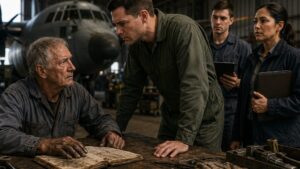
Hayes sat behind a metal desk with the envelope placed in front of him like evidence.
“Private Carter.”
“Sir.”
“You asked Sergeant Lewis about retrieving your property.”
“Yes, sir.”
“Explain why it was on your person.”
Emily’s eyes dropped once to the envelope.
“It was my brother’s.”
Hayes held her gaze.
Something faint moved behind his eyes, then locked back down.
“I’m sorry for your loss,” he said.
Emily said nothing.
“But grief does not exempt you from standards.”
“No, sir.”
“Then you understand why I’m keeping it until further notice.”
Her hands curled once at her sides.
Hayes saw.
“You have something to say?”
Emily inhaled through her nose.
“No, sir.”
“That answer doesn’t convince me.”
“It’s the only answer I can give respectfully.”
For the first time that day, Hayes leaned back.
The room seemed to narrow.
“You think restraint is the same as discipline?” he asked.
Emily’s voice stayed low. “No, sir.”
“Then what is it?”
She looked at the envelope.
“Sometimes it’s the only thing keeping discipline from becoming something uglier.”
The words hung there.
Hayes should have corrected her. He should have called it insolence. He should have ended the meeting cleanly.
Instead, for one dangerous second, he felt the envelope in the room like a third person.
He dismissed her.
Emily saluted, turned, and left without looking back.
Only after the door closed did Hayes pick up the envelope.
He told himself he was documenting the item.
Nothing more.
Part III — The Mark Beneath the Name
The tag slid into Hayes’s palm with a soft metallic tap.
He had confiscated dozens of unauthorized items over the years. Bracelets. rings. folded photographs. prayer cards. luck coins. None had stayed in his mind past the paperwork.
This one did.
The metal was dull, edges worn smooth. One side held the standard lines: name, number, blood type, preference. Hayes read them without expecting anything.
Then his hand stopped.
CARTER, DANIEL R.
For a moment, the office went silent in a way the building never was.
Not quiet. Silent.
Hayes turned the tag over.
At the bottom corner, nearly hidden beneath scratches, someone had carved a tiny crosshatched mark. Four short lines, uneven, made by a pocketknife or whatever sharp edge a man could find when the world had narrowed to waiting.
Hayes knew that mark.
He had seen Daniel Carter cut it into his gear case years earlier while laughing at something no one else thought was funny.
“Luck is just preparation with better timing,” Daniel had said.
He had been twenty-six then. A medic with tired eyes, quick hands, and an impossible habit of treating fear like an inconvenience someone had left in the walkway.
Hayes closed his hand around the tag.
The office disappeared for half a breath.
A hot road. White dust. Radio chatter cutting in and out. A damaged vehicle blocking the narrow route. Two men down behind a wall that would not hold. Daniel moving toward them when everyone else was moving back.
Hayes heard his own voice from years ago, flat with command.
“Carter, fall back.”
Daniel had looked over his shoulder.
“Sir, they’re still breathing.”
“That is an order.”
Daniel’s answer had been swallowed by noise, but Hayes remembered his mouth forming it.
Then I’ll be quick.
The memory snapped shut.
Hayes stood so fast his chair rolled back and struck the wall.
He set the tag on the desk as if it had burned him.
For years, Daniel Carter had existed in Hayes’s mind as a report filed in correct language. Fatality during evacuation support. Hostile conditions. Actions consistent with duty.
Clean words.
Words that did not mention the two men Daniel dragged out before he was hit. Words that did not mention Hayes ordering the withdrawal because staying meant losing more. Words that did not mention how Daniel had looked straight at him and chosen the wounded anyway.
Hayes picked up the tag again.
Emily Carter.
Daniel Carter.
His stomach tightened.
That evening, he opened an old locked drawer at the bottom of his filing cabinet. It stuck at first. He had not touched it in months.
Inside were things he had never put in frames and never thrown away: a faded map with coffee stains at the fold, a unit coin, a photograph of men standing in dust with forced smiles, and a report creased at the corners from being read too many times for someone who claimed to have moved on.
Hayes unfolded the report.
There it was.
Sergeant Daniel R. Carter.
The same clean sentences.
The same emptiness.
Hayes sat with the page until the room lights clicked louder than they should have.
A knock came at the door.
He closed the folder.
“Enter.”
Major Robert Ellis stepped in with a tablet under one arm, polished and calm as always.
“Captain,” Ellis said. “I heard there was a scene this morning.”
Hayes placed the dog tag under a file without thinking.
Ellis noticed the movement, of course. Men like him noticed everything and reacted to almost nothing.
“Private Carter,” Hayes said. “Unauthorized personal item.”
“I also heard she challenged you after formation.”
“She asked for it back.”
“Did she receive it?”
“No.”
“Good.”
Hayes looked at him.
Ellis walked to the window and glanced out at the darkening training yard. “These things spread. Recruits love a symbol. One person gets special permission, suddenly everyone has a reason their exception is sacred.”
Hayes said nothing.
Ellis turned back. “Document it. Corrective action if needed. Keep it simple.”
Simple.
Hayes almost laughed.
Ellis studied him. “Is there a complication?”
Hayes felt the tag beneath the file.
“No, sir.”
The lie sounded exactly like discipline.
Part IV — A Letter She Never Showed
Emily was summoned back to Hayes’s office the next morning.
Sarah walked beside her as far as the hallway corner.
“You want me to wait?” Sarah asked.
“No.”
“I’m going to anyway.”
Emily looked at her.
Sarah shrugged. “I can wait quietly. It’s a skill I’m developing.”
This time Emily did smile, but it vanished quickly.
Inside the office, Hayes stood instead of sitting. The envelope was on the desk again. The tag lay beside it.
Emily saw it and went still.
Hayes did not miss the way her eyes changed.
“Your brother was Sergeant Daniel Carter,” he said.
Not a question.
Emily’s face gave away nothing, but her silence became different. Less defensive. More dangerous.
“Yes, sir.”
Hayes swallowed. “He was with the 2-14.”
“Yes, sir.”
“I knew him.”
For the first time since he had met her, Emily looked fully unguarded.
Only for a second.
Then the wall came back up.
“I know.”
Hayes had prepared for anger. He had prepared for accusation. He had prepared, badly, for tears.
He had not prepared for that.
“You know?”
Emily’s hands remained at her sides. “My mother kept his letters. He wrote names. Places when he was allowed. Stories when he wasn’t.”
Hayes felt the room shift beneath him.
“My name was in them?”
“Once.”
Only once.
Somehow that hurt more.
Hayes looked at the tag. “Why didn’t you say anything?”
“Because I didn’t come here to make you remember him.”
“Then why wear it?”
Emily’s eyes moved to the metal.
For a long moment she did not answer.
When she did, her voice was quiet enough that Hayes had to listen carefully.
“Because the day after they brought his things home, my mother put this on the kitchen table and didn’t touch it for three years. She dusted around it. Ate beside it. Paid bills beside it. It became the center of the house, and nobody was allowed to say that out loud.”
Hayes said nothing.
“Then I found his last letter.”
Emily reached into her pocket and pulled out a folded sheet of paper, soft at the creases. Not the original, Hayes could tell. A copy. Carried often.
She did not hand it to him.
She held it because holding it seemed to give her somewhere to put her hands.
“He wrote, ‘If I don’t come home, don’t make a shrine out of me. Make a life I’d recognize.’”
Hayes’s throat tightened.
Emily folded the paper once.
“I enlisted because of that line. Not because I wanted to be him. Not because I wanted anyone to salute my grief. Because he made courage sound ordinary. Like something you were supposed to use, not display.”
The office was too small for the silence that followed.
Hayes looked at her, and the speech from formation came back to him word for word.
You think attachment makes you stronger. Most of the time, it makes you slow.
He had said that while holding Daniel Carter’s tag.
Emily watched the recognition cross his face.
She did not soften.
“My brother wasn’t a lesson about distraction, sir.”
The sentence struck harder because she did not raise her voice.
Hayes looked down.
“No,” he said. “He wasn’t.”
It was not enough. He knew it as soon as he said it.
Emily knew too.
A knock interrupted them.
Ellis entered before Hayes answered, his expression neutral until he saw Emily.
“Private Carter,” he said.
“Sir.”
Ellis looked at Hayes. “Captain, when you’re finished, I need your recommendation on the disciplinary note.”
Emily’s eyes did not move, but Hayes felt the impact of the words land.
Disciplinary note.
A clean label.
A simple path.
Ellis continued. “Given the public nature of yesterday’s exchange, I recommend making the corrective action equally clear. Nothing excessive. Just enough to reestablish the standard.”
Hayes heard another phrase beneath it.
Keep it simple.
Emily stood between them, low rank, no power, no permission to speak unless given. The dog tag sat on the desk, small enough to fit in a fist and heavy enough to pull years into the room.
Hayes picked it up.
Ellis watched.
“So?” Ellis asked.
Hayes closed his fingers around the tag.
“I’ll address it at formation.”
Emily looked at him then.
She could not know what he meant.
Hayes was not sure he knew either.
Part V — The Same Room, Changed
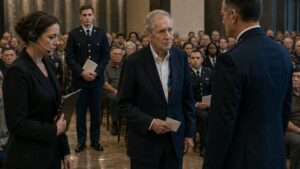
The next morning, the platoon assembled before sunrise.
The rumor had already outrun the facts. Emily had mouthed off. Emily had cried in Hayes’s office. Emily was getting washed back. Emily had a senator uncle. Emily had a dead fiancé. Emily had a problem with authority.
By the time Hayes stepped in front of them, the air was full of stories no one had earned.
Emily stood in the first row, eyes forward. Sarah stood beside her, close enough that their sleeves almost touched.
Hayes carried no clipboard.
That was the first thing Sarah noticed.
He stopped in front of the formation.
“Private Carter.”
Emily stepped forward.
“Yes, sir.”
The line stiffened with anticipation.
Hayes reached into his pocket and removed the chain.
For one second, the morning became yesterday again.
His hand. Her tag. Everyone watching.
But this time Hayes did not extend his palm to take.
He held the tag between both hands and looked at the platoon.
“Yesterday,” he said, “I took this from Private Carter and used it as an example.”
No one moved.
“I told you personal memory can become a weakness. I told you attachment can make a soldier hesitate.”
Emily’s face remained still.
Hayes looked down at the tag.
“I was incomplete.”
The word surprised the formation more than an apology would have. Captains corrected recruits. They did not correct themselves.
Hayes turned the tag so the stamped side faced outward.
“This belonged to Sergeant Daniel Carter.”
Emily’s lips parted slightly.
Hayes did not look at her yet.
“Sergeant Carter served as a medic under my command. In conditions I will not describe here, he moved toward men who needed him when every reasonable instinct told him to move away.”
The line was silent.
Even the recruits who had whispered stopped breathing like people waiting for a verdict.
“He saved lives,” Hayes said. “He paid for it.”
Emily’s eyes shone, but she did not look down.
Hayes took one breath.
“I reduced that history yesterday to a rule violation. That was my failure.”
Ellis stood near the back of the formation, his face unreadable.
Hayes knew what the moment cost. Not his career. Not likely. That would have been easier to dramatize. It cost something more private: the clean version of himself.
He looked at the platoon again.
“Discipline matters. Standards matter. You will meet them. But discipline without memory becomes arrogance. And authority without humility becomes noise.”
No one spoke.
Hayes turned to Emily.
He opened his hand.
The tag rested in his palm.
The same gesture as before.
A different meaning.
Emily stepped closer.
For the first time, her hand trembled and she did not try to hide it.
Hayes lowered his voice, but not so low the front row could not hear.
“Private Carter, your brother was not a distraction.”
Emily looked at the tag.
Then at him.
“No, sir,” she said.
Her voice held.
“He was not.”
She took the chain from his palm.
Their fingers did not touch.
That somehow made it more respectful.
The platoon waited for her to put it around her neck.
She did not.
Emily folded the chain once, twice, carefully, as if the metal could hear her. Then she slipped it into the breast pocket of her uniform, over her heart.
Hayes saw it.
Sarah saw it.
Half the line saw it and understood only part of what it meant, which was enough.
Emily stepped back into formation.
Hayes let her.
No salute. No speech from her. No public forgiveness offered like a medal pinned to his chest.
Just the return.
Just the standing.
Just the name, finally placed where it belonged.
Part VI — What Remained
The day continued because days always do.
Recruits ran. Boots struck gravel. Orders carried across the yard. Someone dropped a canteen and got corrected for it. Someone else laughed too loud at lunch and was told to find better timing.
But the air around Emily changed.
Not softer. She would have hated softer.
Clearer.
No one asked if she was okay. Not after Sarah turned one look on the first recruit who tried.
At the obstacle course, Emily missed a grip and landed hard on one knee. Before anyone could react, she got up and finished. Sarah jogged beside her afterward and said nothing about the limp.
Only at the water station did she speak.
“Your brother’s name was Daniel?”
Emily wiped mud from her sleeve.
“Yes.”
Sarah nodded, absorbing the answer without reaching for more.
After a moment, Emily said, “He would’ve liked you.”
Sarah’s face changed. Just a little.
“That’s a dangerous thing to tell me,” she said. “I’ll become impossible.”
Emily breathed out something almost like a laugh.
It did not heal anything.
It mattered anyway.
That night, Hayes stayed in his office after the building emptied.
The dog tag was gone from his desk. Its absence seemed larger than its presence had been.
He opened the bottom drawer again and removed the old folded report. The paper had weakened along the creases. He set it beside a blank sheet.
For a long time, he wrote nothing.
He had written hundreds of reports. He knew how to make loss sound procedural. He knew how to make hard choices fit inside clean margins.
This was not that.
He wrote Daniel Carter’s name first.
Then he stopped.
Outside, a late formation marched past in the dark, voices calling cadence somewhere beyond the window. Hayes listened until they faded.
Finally, he began again.
Mrs. Carter,
There are things the official record says correctly, and things it cannot carry.
He paused, jaw tight.
Then he kept writing.
He did not excuse himself. He did not ask forgiveness. He did not describe every detail. Some truths belonged to the men who had lived them and the families who had paid for them, not to anyone hungry for drama.
But he wrote enough.
That Daniel had moved when others froze.
That two men came home because he did not.
That Hayes had ordered him back.
That Daniel had understood the order and chosen the wounded anyway.
That for years Hayes had called that moment discipline because he could not bear to call it courage.
Near midnight, Hayes folded the letter and placed it in an envelope.
He did not seal it yet.
Across the barracks, Emily sat on the edge of her bunk with the chain in her hands. The room was dim. Sarah slept in the next row, one arm hanging off the mattress, mouth slightly open.
Emily turned the tag over and found the small rough mark at the corner.
Daniel had once told her he carved it so he could tell his tag apart in the dark.
She had been sixteen and had rolled her eyes.
“Why would you need to do that?”
He had grinned at her from across the kitchen table. “Because the dark makes everything look like it belongs to somebody else.”
She had not understood then.
She understood more now.
Not everything. Never everything.
Emily threaded the chain through her fingers once, then folded it and placed it back in her breast pocket, where it would rest during tomorrow’s run, tomorrow’s inspection, tomorrow’s ordinary suffering.
She would not wear it around her neck again during formation.
Not because Hayes had won.
Because Daniel had not asked to be displayed.
He had asked her to live.
Emily lay down and stared at the bunk above her.
In the morning, she would get up before the alarm. She would lace her boots. She would stand in line. She would meet the standard.
And beneath the pocket over her heart, the small piece of metal would remain quiet.
Not a shrine.
Not an excuse.
A weight she had chosen.
A name someone had finally read aloud.