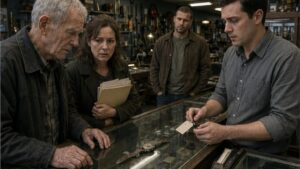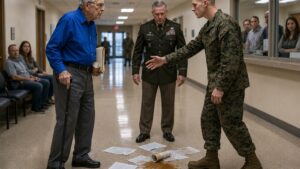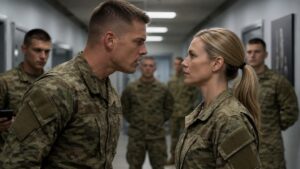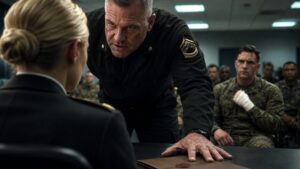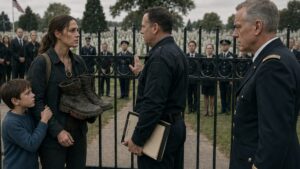
They Ordered The Old Veteran To Remove The Empty Chair, Then Learned Who It Was For
Chapter 1: The Empty Chair Under The Floodlights
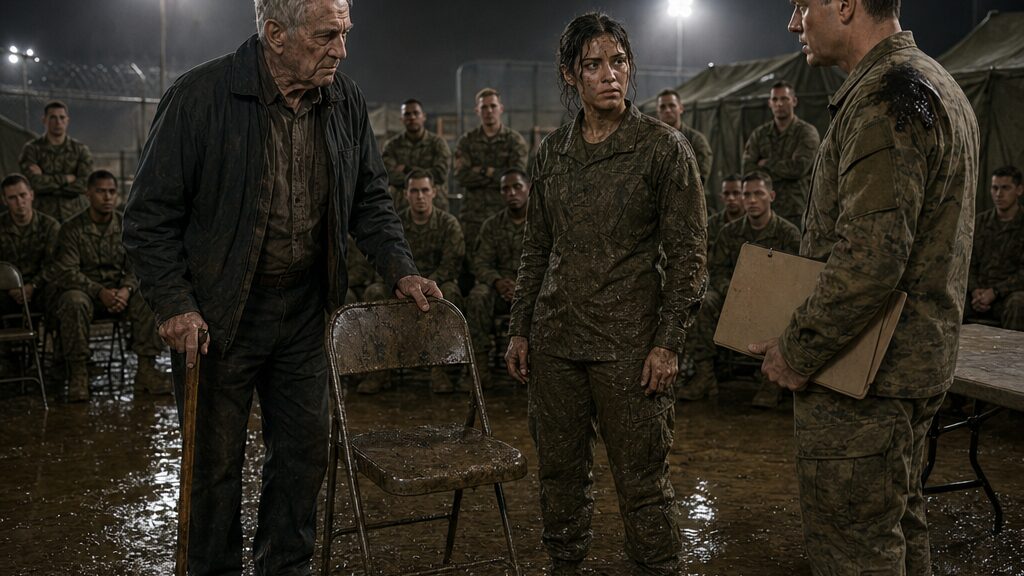
John White came through the floodlights carrying a folding chair while the soldiers stared at the mud-covered young woman standing alone in the dirt.
The chair scraped once against his bad leg. He stopped, shifted the weight into his left hand, and planted his cane before anyone could offer help. No one did. They were too busy watching the hearing table, the captain, the file box, and the young specialist whose sleeves were dark with creek mud up to the elbows.
The camp still smelled of rain and wet canvas, though the storm had passed two hours ago. Floodlights turned the puddles white. Beyond the training yard, chain-link fencing rattled in the wind, and rows of temporary tents sagged under ropes pulled tight into the mud. Folding chairs had been set in a half circle for the late-night inquiry, all of them occupied except the one John had brought from the storage shed behind the old classroom.
It was not newer than the others. Its metal legs were scratched gray. One rubber foot was missing. The seat sagged at the center from use and years.
John knew its sound when it opened.
He had opened it every year.
Captain Thomas Scott stood behind a field table with a clipboard pressed against his palm. He had the hard stillness of a man who had been awake too long and intended to make that someone else’s problem. His uniform was clean except for one dark splash across his shoulder where the storm had reached him before the tarps went up. Beside him, a hearing-room aide held a stack of forms. Behind the table, two military police stood with hands folded in front of them.
The young woman did not look at John when he entered the circle of light. She looked at the ground just beyond her boots, breathing through her mouth as if keeping herself steady by counting dust.
“Specialist Garcia,” Captain Scott said, “you left the marked return route during an active night exercise.”
Her jaw flexed.
“You entered a restricted records tent after the storm warning was issued,” he continued. “You removed a file box from a secured area. You ignored two direct calls to return.”
“I heard the calls,” she said.
Her voice was rough, not from disrespect but from cold, mud, and whatever she had swallowed down before being put in front of everyone.
Captain Scott glanced at the file. “Then you admit you ignored them.”
“I admit I heard them.”
A few soldiers shifted in their chairs. One coughed and stopped quickly.
John took another step forward.
The captain’s eyes moved to him at last. “Sir, you need to stay behind the line.”
John looked down. Someone had dragged a boot heel through the dirt to mark the edge of the inquiry space.
He stepped over it.
A military police escort moved half a pace, then stopped when John raised two fingers from the cane, not in command, only in request. The gesture was so small it might have been missed by anyone who had not spent a life reading pain in men who would not speak it.
“I won’t be long,” John said.
Captain Scott stared at the chair. “This is a closed proceeding.”
“It’s outdoors,” John said.
“That does not make it public.”
“No,” John said. “But it makes it where it happened.”
The words thinned the air. Michelle Garcia lifted her head a fraction. Mud had dried along her cheekbone and cracked at the corner of her mouth. She looked too young for the exhaustion in her eyes and too angry to let anyone call it fear.
Captain Scott set the clipboard down. “Mr. White, you were permitted on base for a memorial observance, not to interrupt a disciplinary inquiry.”
John’s hand tightened on the chair.
He had been called worse than interrupting. Confused. Sentimental. Persistent. The old medic with the chair. The man who came every year and did not ask for a ceremony. Most years they let him pass through the gate after checking his identification and calling someone old enough to remember the arrangement. Most years no one was standing in the exact place where William Garcia had once been counted absent.
Tonight there was a young woman with William’s last name, mud on her sleeves, and a captain ready to write her into a report before dawn.
John moved toward the empty space beside Michelle.
“Sir,” Captain Scott said sharply, “that chair is not part of the inquiry.”
John unfolded it.
The metal legs snapped open with a dry, familiar crack. A few soldiers turned their heads at the sound. One of them looked away, embarrassed by something he did not understand.
Michelle watched the chair come down beside her, close enough that if she reached out, her knuckles would brush the back rail.
“That chair needs to be removed,” Captain Scott said.
John rested both hands on the top of his cane. “That chair was assigned before hers.”
The yard went quiet except for the generator humming behind the tents.
Captain Scott’s face changed, not softened, only tightened. “Assigned to whom?”
John did not answer. He looked at the empty seat until the floodlights made the scratched metal shine. He had learned long ago that if he looked directly at people on this date, they wanted him to explain. If he looked at the chair, most of them let the silence do what it could.
But Michelle Garcia was not most people.
Her eyes dropped from his face to the chair, then to the corner of the flat paper folder tucked beneath his arm. The old photograph had slipped partly loose when he opened the chair. Its edge showed a faded strip of handwriting. The ink had browned, but the name was still clear enough under the light.
Garcia.
Michelle stared at it as if the mud had frozen on her skin.
Captain Scott came around the table. “Mr. White, whatever private meaning this has, it does not belong in a formal proceeding. Specialist Garcia is answering for her own actions.”
“Is she?” John asked.
“That is exactly what she is doing.”
John looked at Michelle then. He had meant to avoid it. He had meant, as he always did, to set the chair down, stand with it until the minute passed, fold it back, and leave without making anyone carry more than they had volunteered to carry. But there was William in the cut of her mouth. Not the shape of it, exactly. The way she held it shut when anger asked for speech.
“How long have you been coming here?” Michelle asked.
Captain Scott turned toward her. “Specialist—”
“How long?” she asked John.
The question struck him harder than the captain’s order had.
John swallowed. His throat had gone dry from dust and age. “Every year.”
“For what?”
The soldiers were watching again. Not the captain. Not the file box. Him.
John shifted his cane and felt the handle press into the groove worn in his palm. “To put the chair back.”
Michelle’s eyes flicked once more to the photograph. “Back for who?”
Captain Scott stepped between them. “Enough. Mr. White, you may wait outside the inquiry area. Specialist Garcia, you will answer the question on the record. Why did you enter the restricted tent?”
Michelle did not look away from John. “Because his file wasn’t where it was supposed to be.”
The aide glanced at the captain.
John’s pulse gave one hard beat against his ribs.
Captain Scott lowered his voice. “Whose file?”
Michelle wiped mud from her chin with the back of her hand. It only smeared darker. “William Garcia.”
The name moved through the camp without anyone repeating it. John felt it pass through the folding chairs, the wet ropes, the table, the soldiers’ faces. It had been said here before, but not by her. Not by someone who carried it in blood.
Captain Scott looked from Michelle to John. “You two know each other?”
“No,” Michelle said.
John could have let that be the answer. It was clean. Accurate enough to survive a report. He did not know Michelle Garcia. He had never held her as a baby, never written on her birthday cards, never sat at the edge of Kathleen Garcia’s kitchen while the child slept in the next room. He had not earned the right to claim familiarity.
But the photograph under his arm felt suddenly hot.
Michelle took one step toward him, close enough for him to see how badly her hands shook.
“Why,” she whispered, “do you have my father’s name?”
Chapter 2: The File That Was Supposed To Stay Closed
The mud-stained folder hit the metal table hard enough to make Michelle flinch.
She hated that she flinched. Captain Scott saw it. The hearing-room aide saw it. John White, standing in the doorway with one hand braced against his cane, saw it too. The empty chair sat outside in the hall where a military police escort had placed it after folding it with unnecessary force. Even through the open door, Michelle could see one gray leg of it angled against the wall like a broken thing.
“Specialist Garcia,” Captain Scott said, “this is no longer a field clarification. This is a formal statement.”
Michelle sat with her hands flat on the table. Dirt had dried under her nails. Her boots left clumps of mud beneath the chair. Someone had given her a towel but no time to use it. The office smelled like wet canvas, old paper, and coffee burned down to the bottom of a pot.
Captain Scott opened the folder. Inside were photographs, sign-out sheets sealed in plastic sleeves, and one torn corner of a cardboard file box. He placed the torn corner in front of her.
“Restricted Records Annex, temporary storm relocation container B,” he said. “This was found in your pack.”
“I didn’t steal it.”
“You removed it.”
“It was floating.”
“In a secured tent.”
“The sidewall came loose in the storm. Half the boxes were in water.”
The captain’s mouth tightened. “You were ordered to return to the marked route.”
Michelle looked past him to John. The old man had not been invited into the room, but no one had made him leave the doorway. Maybe because of his age. Maybe because everyone was too tired to decide what to do with him. He had tucked the old photograph back beneath his arm, but she had seen enough.
Garcia.
Her father’s last name written in brown ink on a photograph carried by a stranger who came every year with a chair.
“Answer Captain Scott,” the aide said.
Michelle pulled her eyes back to the table. “I saw the label.”
“What label?”
“Garcia, William. Training incident. Supplemental.”
Captain Scott turned a page. “You were searching for a particular file before the storm.”
“No.”
“Specialist.”
“I was checking the water damage.”
“You are assigned to route recovery, not records salvage.”
Michelle bit down until the inside of her cheek hurt. She had told herself she would stay calm. Anger had already walked her into the tent, into the water, into the hands of two military police who found her kneeling in the mud with a file box hugged to her chest like a child. Anger would not get her out.
But there on the table lay a photocopied index sheet with her father’s name printed so faintly it looked like it had been erased by years of being passed over.
“Where is the rest of it?” she asked.
Captain Scott paused. “That is not your question to ask.”
“It’s my father’s file.”
“It is a military record.”
“It’s his name.”
“It is evidence in this inquiry.”
The door opened wider before Michelle could answer. A civilian woman in a base lanyard stepped in carrying another thin folder against her chest. She was maybe in her fifties, hair pulled back, glasses on a chain. She looked at the mud on Michelle, then at John in the doorway, and something in her face became careful.
“Captain Scott,” she said, “you asked for the archival pull sheet.”
“Thank you, Ms. Lee.”
Kimberly Lee set the folder on the table but did not move away. “There are gaps.”
Captain Scott gave her a warning glance. “We can discuss that separately.”
“The gaps are the discussion,” Michelle said.
Kimberly looked at the captain again, then opened the folder. “William Garcia. Army. Deceased during a training event on this installation. Peacetime, not combat. The personnel file is incomplete. The incident packet was transferred twice, water damaged once, scanned partially.” She hesitated. “The memorial eligibility note says non-memorial eligible pending command review.”
Michelle felt the room tilt slightly.
Non-memorial eligible.
The phrase had no face. No boots. No hands. No voice at the breakfast table she barely remembered. It sounded like a stamp, like a door shut from the outside.
“My mother said his name was submitted,” Michelle said.
Kimberly’s mouth tightened with sympathy she was trying not to show. “There may have been a submission. I do not have a completed approval.”
Captain Scott closed the folder halfway. “That does not change Specialist Garcia’s conduct tonight.”
“It changes why she was there,” John said from the doorway.
Every head turned.
His voice had been quiet, but it carried. Maybe because he had not spoken since the yard. Maybe because the room had been waiting for him to become either harmless or necessary.
Captain Scott stepped toward the door. “Mr. White, you are not part of this statement.”
John looked at the folder on the table. “I know.”
“Then wait outside.”
John did not move. “I did that once.”
Michelle saw Kimberly Lee glance at the floor, as if the words had landed somewhere she did not want to step.
Captain Scott’s patience thinned. “Are you claiming knowledge of this record?”
John took a breath through his nose. “Some.”
“How?”
The old man’s fingers shifted on the cane. He was not tall, not anymore, but he filled the doorway because he did not lean aside.
“I was there.”
Michelle’s hand curled against the table edge.
Captain Scott waited. When John said nothing else, the captain turned back to the evidence and slid one of the photographs out from under a plastic sleeve.
It was old. Black-and-white, or faded so badly it might as well have been. At first Michelle could not understand what she was seeing. A table leg, bent inward. Mud on tile. A strip of wall with a dark line across it, as if water had marked the room with a ruler. Under the collapsed edge of the table were boots. Not full bodies. Just boots and lower legs, half hidden in shadow, dust and silt gathered around the soles.
Michelle stared at the photograph until her eyes hurt.
No battlefield. No flag. No clear heroic image. Nothing like the framed photograph her mother kept in the hallway, where William Garcia wore a clean uniform and looked past the camera with the expression of a man trying not to smile.
This was ugly and small and official.
“Why is this in his file?” she asked.
Captain Scott did not answer.
Kimberly said, “It’s part of the incident packet.”
“Was he under that table?”
John’s cane tapped once against the floor. Not a deliberate signal. A failure of his hand.
Michelle turned toward him.
He looked older now than he had under the floodlights. The lines in his face seemed filled with dust. The photograph was reflected in his eyes, though he was too far away to read it from the table.
“Mr. White,” Captain Scott said, “do not answer unless you are prepared to make a formal statement.”
John looked at Michelle, then at the folded chair visible beyond the door.
Michelle’s anger had carried her all night. It had carried her through the storm, through the records tent, through the hands on her arms, through the floodlit circle where soldiers watched her like she was a warning. But something colder was rising now.
Fear.
Not fear that she would be charged. Not even fear that her career would break before it began.
Fear that her father had been made smaller on paper because everyone who knew better had stayed quiet.
Captain Scott gathered the photographs. “Specialist Garcia, based on your admission and the recovered material, this may proceed as a formal charge. Unauthorized entry. Removal of restricted records. Failure to obey return calls.”
“I was trying to save the file.”
“You were trying to take it.”
“I was trying to keep it from getting ruined again.”
“Again?” Captain Scott asked.
Michelle looked at Kimberly, then at John.
Kimberly’s face said she had no authority to help.
John’s face said he had spent years not helping enough.
Captain Scott slid the photograph of the boots beneath the table back into the folder.
John spoke before the folder closed.
“That picture,” he said, “was taken after they pulled me out.”
Chapter 3: The Man Who Came Back Every Year
John found the chair at dawn folded against the chain-link fence with a removal tag tied through its back rail.
The tag was bright orange, the kind maintenance crews used for broken equipment and tripping hazards. Its string had been looped tightly, biting into the old metal. John stood before it with his cane sunk half an inch into wet dirt and read the printed line twice before accepting that it said what it said.
UNAUTHORIZED ITEM. REMOVE BY 1200.
Behind the fence, the training yard had gone gray with morning. Floodlights still burned though the sky no longer needed them. Soldiers moved between tents with cups of coffee and stiff shoulders, pretending not to glance at him. The storm had left the whole camp smelling of wet dust and diesel.
John reached for the tag but his fingers would not close cleanly. They had been like that since winter, sometimes worse in the mornings. He hooked one finger through the string and tugged.
The tag did not break.
“Leave it,” Michelle Garcia said behind him.
He turned slowly. She stood ten feet away, cleaned up only enough to show the damage the night had done. Mud still clung to the seams of her uniform. Her hair was tied back badly. Someone had given her a dry jacket, but she held it closed with one fist as if warmth were an order she resented.
“You should be resting,” John said.
“You should be answering.”
He looked back at the chair. “I answered too much already.”
“You said you were pulled out from under that table.”
“Yes.”
“With my father?”
John’s grip tightened around the cane handle. “Not with him.”
The answer struck her. He saw it in the way she stopped breathing for one count.
Beyond them, Captain Scott’s voice carried from the hearing tent. He was speaking to someone about timelines, damaged records, statements due by noon. The word noon came clear across the yard.
Michelle stepped closer. “Why did you bring a chair for him?”
John touched the folded seat. Cold metal. Scratched paint. The same hinge. The same reluctant give when opened.
“Because the first year after it happened, they set out chairs for the inquiry,” he said. “Everyone had one. Command, witnesses, safety board. Men who had never been wet that night sat down and asked questions about who heard what order.” His thumb moved over the chair’s back rail. “There wasn’t one for William.”
Michelle’s face hardened, but her eyes did not. “Because he was dead.”
“Because they had already decided what he was.”
“And what was that?”
John looked toward the yard. The place had changed over the decades—new tents, new floodlights, new fencing, new names on badges—but the ground still dropped slightly near the old classroom. Water still knew where to go.
“Absent from formation,” he said.
Michelle laughed once, without humor. “That’s what they called him?”
“That was one phrase.”
“What was the other?”
He did not answer quickly enough.
She stepped closer. “Disobeyed a direct order?”
John said nothing.
“My mother used those exact words,” Michelle said. “All my life, whenever I asked why his name wasn’t on the wall, why his unit didn’t send anyone, why there wasn’t a full story like other families had, she’d say, ‘Your father broke orders.’ She wouldn’t say he was wrong. She wouldn’t say he was right. Just that he broke orders.” Her voice dropped. “Was she repeating you?”
John flinched.
Michelle saw it.
Her expression changed from anger to something sharper. “She was.”
“I wrote a statement,” John said.
“You wrote that?”
“I wrote what I knew then.”
“No. You wrote what they could use.”
The words cut because they were too close to what he had told himself for years and never allowed to stand still long enough to be judged.
A military truck rolled past beyond the tents, tires hissing over wet ground. Someone shouted for a lost clipboard. Life on the installation had resumed. That was the trouble with places where people died. The next morning always found a reason to continue.
Michelle reached for the orange tag and yanked it. The string snapped. She held the tag up between them.
“Unauthorized item,” she read. “That’s what he is now? A tripping hazard?”
John took the tag from her, though she did not give it willingly. “The chair isn’t him.”
“Then stop acting like it is.”
He folded the tag into his palm. “I come here because no one else does.”
“You don’t know that.”
“I do.”
“You never came to us.”
The accusation was quiet, and because it was quiet, he had no defense ready.
He saw Kathleen’s porch as it had been thirty years ago, the light over the door, the folded letter inside his coat pocket, the sound of a baby crying somewhere in the house. He had stood there long enough for the porch boards to creak under his boots. Then he had left before knocking.
Michelle’s mouth tightened. “You came to a chair instead.”
John looked at the chair. “The chair never asked me a question I couldn’t answer.”
For a moment Michelle seemed too angry to speak. Then the anger moved, and something underneath it showed.
“You think that sounds loyal?”
“No,” John said.
That answer stopped her.
He bent slowly, painfully, and picked up the chair. It took more effort than it should have. His shoulder complained. His breath came short. He hated that she saw it. Hated more that William would have laughed softly and taken the chair without making him feel old.
Michelle did not help.
He was grateful for that.
“How many years?” she asked.
“Forty-seven.”
She looked away toward the old classroom at the edge of the yard. Its windows were dark, its door chained. “Forty-seven years and you never told his daughter why?”
John balanced the chair against his hip. “I told myself your mother knew enough.”
“She didn’t.”
“I told myself opening it again would hurt her.”
“It did anyway.”
“Yes.”
The single word left him with nowhere to hide.
Michelle watched him for a long moment, then looked back toward the hearing tent. “Captain Scott is going to charge me.”
“He might.”
“Can you stop him?”
John almost said no. It would have been honest. It would also have been familiar: a small answer, a safe answer, one that kept him inside the narrow duty he had assigned himself.
Instead he said, “Not if I keep standing out here.”
Before Michelle could respond, Captain Scott came from the tent with the hearing-room aide beside him. He carried the same clipboard, now with a fresh sheet clipped to the top.
“Mr. White,” he called. “That chair and any associated unofficial memorial items are to be removed from the training area by noon.”
Michelle turned. “Associated items?”
Captain Scott’s eyes flicked to her, then back to John. “Photographs, notes, personal markers, anything not authorized by installation command.”
John felt the folded orange tag inside his fist.
“Captain,” he said, “that chair has been here longer than your policy.”
“That may be the problem,” Thomas said. He did not sound cruel. He sounded tired, cornered by rules he had decided to stand inside. “This inquiry cannot become a memorial dispute. Specialist Garcia’s conduct is under review. Old grievances are not evidence.”
Michelle took one step forward. “My father’s file is not an old grievance.”
Thomas looked at her with controlled warning. “Your father’s file is incomplete, and your attempt to remove it has made correcting that harder, not easier.”
John saw Michelle absorb that. Her anger faltered just enough to reveal the fear beneath it.
Thomas lowered his voice. “Noon, Mr. White. After that, maintenance will clear the area.”
He walked away before either of them could answer.
Michelle stared at the chair in John’s hand. “My mother said he died because he broke orders.”
John could still hear the alarm horn in that sentence. The water. The table leg cracking. William’s voice somewhere behind him, too calm for the dark.
Michelle waited.
John looked at her and understood, with a shame that had taken forty-seven years to arrive fully formed, that his silence had not protected William’s family from the story. It had trapped them inside the worst piece of it.
“He did break orders,” John said.
Michelle’s face closed.
John gripped the chair harder. “But not for the reason they wrote down.”
Chapter 4: The Photograph Beneath The Table
Kimberly Lee slid the second photograph across the records counter with two fingers, as if touching it too firmly might make the past crumble.
Michelle reached for it first, but John’s hand moved before hers. Not quickly. Nothing in him moved quickly anymore. Still, his fingers covered the edge of the photo before she could take it, and the small act stopped all three of them.
Kimberly looked from John’s hand to his face. “Mr. White.”
“I know,” he said.
Michelle’s eyes hardened. “You don’t get to hide it now.”
John lifted his hand.
The photograph was clearer than the first. Same room. Same floor. Same dark waterline staining the wall. A table had collapsed inward, one metal leg bent under the weight of something heavy. Beneath it were two pairs of boots. One pair was pointed toward the door. The other faced inward, as if the person wearing them had turned back.
Michelle stared at the second pair.
“My father?” she asked.
Kimberly folded her hands against her lanyard. “The incident packet doesn’t identify the individuals in the photograph. The back only says recovery image two.”
Michelle flipped the photograph over. The handwriting was thin and faded.
Recovery image two. Classroom B. Garcia / White.
John heard Michelle stop breathing.
Captain Scott, standing near the records-office door, stepped forward. “This is exactly why these materials were restricted. Partial records invite conclusions without context.”
Michelle turned on him. “Then give me context.”
“I’m trying to prevent a disciplinary matter from becoming an emotional excavation.”
“It became emotional when you put my father in a file marked non-memorial eligible.”
Thomas’s jaw tightened. He did not answer right away. There were circles under his eyes now, and the crispness he had carried under the floodlights looked worn at the edges. “Specialist Garcia, I understand you believe this is personal.”
“It is personal.”
“And that is why you are making dangerous decisions.”
John looked at Thomas then. For the first time, he saw not cruelty, but fear wearing a clean uniform. The captain had inherited a storm, a broken records tent, a soldier who had gone missing on a route, an elderly visitor with an unauthorized memorial, and a decades-old death that could turn an inquiry into a command failure before noon.
Thomas wanted the line drawn because without lines the whole place began to look like water.
Kimberly cleared her throat. “There is another location reference. Classroom B still exists. It’s used for storage now.”
John closed his eyes.
He had known it still existed. Buildings like that never had the decency to disappear when they should. They got repainted. Rewired. Filled with broken desks, traffic cones, spare tarps, plastic bins. They stood there letting young people pass without knowing what had once been dragged across the floor.
Michelle looked at him. “Take me.”
“No.”
The refusal came too fast.
She recoiled as if he had struck the table. “No?”
John gripped the counter. “There’s nothing in that room that will help you.”
“Then why did you just look like it could kill you?”
Kimberly lowered her eyes.
Thomas said, “No one is going anywhere until I authorize—”
John turned toward him. “Captain, if you want her to stop guessing, stop making her guess.”
The room fell still.
Thomas studied him. “If I allow this, it is not a search. It is a supervised review of a historical location. Specialist Garcia does not touch anything. Ms. Lee retains the photographs. You answer only what you are willing to put in a statement.”
John almost said he would answer nothing.
Then he looked at Michelle’s hands. They were clenched the same way William’s had been the night the horn failed to sound the second time.
“Fine,” John said.
Classroom B stood at the edge of the training yard, behind a locked gate and a strip of cracked pavement where weeds grew through the seams. The morning sun had burned off the storm haze, but the ground around the building remained damp. A chain hung through the door handles. Kimberly unlocked it with a key from a ring that carried too many keys for one person’s comfort.
The door stuck.
When it opened, the smell came out first: dust, old wood, rust, and something faintly mineral that lived in concrete after too much water.
Michelle stepped in behind Thomas. John came last. He told himself it was because of the cane. It was not.
The room was smaller than memory had made it. That offended him. For forty-seven years it had widened in dreams until it became a warehouse, a tunnel, a whole world of dark water and shouting. In daylight, it was only a storage room with stacked folding tables, boxed training signs, and a wall stained three feet from the floor.
John stopped at the stain.
His cane tapped once.
Michelle heard it and turned. “That’s the line?”
John nodded.
Kimberly held up the photograph, comparing the wall. “Same room.”
Thomas moved toward the far corner, careful not to touch the stacked tables. “Records say a flash flood hit the lower training area after a drainage failure. Cadre ordered evacuation.”
“They did,” John said.
Michelle looked at him. “And my father broke formation.”
John’s throat tightened. “After the first count.”
“Why?”
John stared at the floor where the table had been. There was nothing left there now. No mud. No boot marks. No handprints. Only concrete.
“Because the count was wrong,” he said.
Thomas looked up sharply.
Michelle took one step closer. “Who was missing?”
John did not answer.
The room waited with them. Outside, a truck backed up somewhere in the yard, beeping steadily, a sound too ordinary for the weight pressing against John’s chest.
Kimberly, quieter now, read from a photocopy. “Initial evacuation roster lists Garcia, William, present at north door. White, John, unconfirmed. Later amended to present after recovery.”
Michelle looked at John. “You were still inside.”
He kept his eyes on the waterline.
“The report says my father returned after being ordered out.”
“Yes.”
“To get records? Equipment?”
“No.”
“Then why?”
John’s hand began to shake. He pressed it against the cane until the knuckles whitened.
Thomas said, “Mr. White, you don’t have to continue without counsel or—”
John almost laughed. The idea of counsel arriving forty-seven years late had a cruelty no one in the room intended.
Michelle’s voice softened, and that was worse than anger. “Who was still inside?”
John looked at her then.
For one second he almost told her. The whole thing. The broken table. His leg caught under the frame. The water shoving chairs against the door. William’s voice saying, Hold on, Doc, like John had only dropped something, not lost the right to keep breathing. The hand that found his collar. The second rush of water.
He opened his mouth.
A knock struck the open door.
A woman stood in the doorway, one hand pressed against the frame as if she had walked too fast and regretted it. Her face was pale, composed with effort, and older than the photograph Michelle kept folded in her wallet. She looked at Michelle first, then at John, then at the wall stain.
“Kathleen,” John said.
Kathleen Garcia did not answer him.
Michelle’s whole body changed. Anger, surprise, and a child’s old need crossed her face before she could stop them. “Mom?”
Kathleen stepped into the room but not far. Her eyes found the photograph in Kimberly’s hand, then the place on the floor where John could not stop looking.
“No,” she said quietly.
Michelle moved toward her. “You knew this room?”
Kathleen shook her head, but tears had already gathered. “I knew enough.”
“You told me he broke orders.”
“He did.”
“You didn’t tell me why.”
Kathleen looked past her daughter at John. There was no hatred in her face. That made it harder to bear.
“Stop digging,” she said. “Before you hate the only man who still remembers him.”
Chapter 5: The Widow Who Chose Silence
Kathleen Garcia would not enter the waiting room until the empty chair was moved away from the door.
It stood folded against the wall beside a bench, the orange removal tag still creased in John’s coat pocket. No one had put it there deliberately to hurt her. The hearing-room aide had leaned it outside because Thomas had ordered the old classroom cleared for review. But when Kathleen saw the chair, she stopped so abruptly Michelle nearly ran into her.
“Move it,” Kathleen said.
Michelle looked from her mother to the chair. “It’s just a chair.”
“No,” Kathleen said. “It isn’t.”
John stood at the end of the hall, one hand on his cane, the other holding the worn folder and the old photographs Kimberly had returned to a protective sleeve. He had not meant to follow them. He had meant to give mother and daughter the privacy he had denied them for decades. But when Kathleen refused the room because of the chair, his feet would not leave.
Michelle unfolded the chair herself and set it against the opposite wall.
Kathleen watched every inch of the movement. Only then did she enter.
The waiting room had no windows. A coffee machine hummed on a side table. A television mounted in the corner played without sound. Michelle remained standing near the door, still in uniform, still not clean enough to look like she had slept. Kathleen sat on the edge of a vinyl chair and clasped her purse in both hands.
“When were you going to tell me you came here?” Kathleen asked.
Michelle laughed once. “That’s what you want to start with?”
“I got a call saying you were under inquiry.”
“I was looking for Dad’s file.”
“You had no right.”
Michelle stared at her. “No right?”
Kathleen closed her eyes for a moment. “That is not what I meant.”
“It’s exactly what everyone keeps meaning. Captain Scott says it’s a military record. Ms. Lee says it’s incomplete. He”—she pointed toward the hall without looking at John—“says almost nothing. And you say I had no right.”
Kathleen’s hands tightened around her purse. “I spent your whole life trying to give you a father you could love without drowning in how he died.”
Michelle’s anger faltered. “You gave me a photograph in the hallway and three sentences.”
“I gave you what I could survive saying.”
The room went quiet except for the coffee machine.
John heard that sentence from the hall and felt it settle over him like dust. He had spent years thinking Kathleen’s silence accused him. He had never considered that it might have been the only way she got breakfast on the table, bills paid, a child dressed, a life dragged forward after the Army mailed her words no widow should have had to translate alone.
Michelle sat across from her. “Did John tell you?”
Kathleen looked toward the open door. She knew he was there. Of course she did. Grief had a way of counting who stood outside rooms.
“He came once,” she said.
John’s hand shifted on the cane.
Michelle turned slowly. “You came to our house?”
John did not step in. “I came to the porch.”
Kathleen’s mouth trembled, but she held it still. “You didn’t knock.”
“No.”
Michelle stood again. “Why?”
John looked down at the folder. “Because I heard you crying.”
“I was a baby.”
“Yes.”
“And you left?”
He had no answer that would not make it worse.
Kathleen opened her purse with careful, practiced movements and took out a folded envelope, yellowed at the edges, softened from being handled but never opened. Michelle stared at it.
“What is that?”
Kathleen placed it on the low table between them. “He left it in the mailbox three weeks later.”
John’s breath stopped.
He recognized the envelope before he saw the handwriting. His own block letters. Kathleen Garcia. No return address. No rank. No courage.
Michelle reached for it.
Kathleen covered it with her hand. “I never opened it.”
“Why?”
“Because I knew if I read it, I would either forgive him or hate him, and I didn’t have room for either. I had you.”
Michelle’s face changed. “Mom.”
“I was twenty-four,” Kathleen said. “You were six months old. Men came to my door with polished shoes and careful voices. They said training accident. They said review pending. They said William left formation after being ordered to evacuate. Then John White came to my porch and stood there like a ghost I did not invite. After that, the envelope came.” She looked toward the door. “I put it in a drawer. Then another drawer. Then a box. Then my purse when you called me crying from this base.”
Michelle looked at the envelope as if it might speak if she waited long enough.
John felt the hallway tilt. He had believed the letter gone. Burned, maybe. Thrown away. He had punished himself for writing too little and too late, but some small cowardly part of him had also been relieved she never answered.
Now it lay ten feet away, unopened, and time had not made it smaller.
Michelle picked it up despite Kathleen’s hand. Kathleen let her.
The paper crackled.
“Don’t,” Kathleen said.
Michelle froze.
Kathleen’s voice dropped. “Not here. Not like this. Not because we’re angry.”
Michelle looked toward John. “What’s in it?”
John’s fingers went numb around the cane. He remembered the kitchen table where he wrote it, the pen stopping again and again over the words I was still inside. He remembered crossing out sentences until truth became something thin enough to mail.
“Not enough,” he said.
Michelle walked to the door and held the envelope out to him. “Then say the rest.”
Behind him, boots sounded in the hall. Captain Scott approached with the hearing-room aide, clipboard under his arm. He took in the room, Kathleen’s pale face, Michelle’s outstretched hand, John standing outside like a man awaiting sentence.
“Final statement at eighteen hundred,” Thomas said. “After that, maintenance clears the unofficial items from the training area. The chair, photographs, anything not logged as evidence.”
Michelle closed her fist around the envelope. “You can’t clear a dead man.”
Thomas’s face tightened, but he did not answer with anger. “I can stop a disciplinary inquiry from being compromised.”
John looked at the empty chair across the hall. For forty-seven years he had put it down and picked it up. He had thought that was devotion. Maybe it had been. But it had also been a way to decide when William’s name entered a room and when it left.
Kathleen stood unsteadily. “John.”
He looked at her.
For a moment, she was twenty-four again in a doorway he had not entered.
“I’m tired,” she said.
So was he.
John took the envelope from Michelle. The paper was warm from her hand.
“Then I’ll read it where he died,” he said.
Chapter 6: The Name They Would Not Put On The Wall
“The chair is not evidence,” Captain Scott said.
John stood at the end of the metal table with the folded chair under one arm and the unopened envelope in his coat pocket. The final inquiry room had been arranged with military neatness: files squared, photographs sleeved, statement forms centered, pens lined beside them. Thomas Scott sat at the head of the table. Kimberly Lee stood near the wall with the archival folder. Kathleen and Michelle sat together, not touching, but close enough that their shoulders nearly met.
The old chair was the only thing that did not belong.
John set it down anyway.
Thomas exhaled through his nose. “Mr. White.”
John opened the chair. Its legs snapped into place. The sound moved through the room exactly as it had under the floodlights.
“No,” John said. “It’s the reason the evidence exists.”
Thomas did not immediately object. That was the first mercy he had offered.
John took the photograph of the boots under the collapsed table and laid it on the seat of the chair. He did it carefully, with two fingers at the edges, as if William might object to fingerprints.
Michelle leaned forward.
John did not look at her yet. If he did, he might make the story smaller to spare her. He had done enough sparing.
“This was Classroom B,” he said. “Forty-seven years ago. Night training. Heavy rain before the forecast called it. The drainage ditch behind the south field backed up. Water came through the lower door first, then under the wall.”
Kimberly lowered her eyes to the file, but John knew she was listening beyond the words.
“We were doing casualty movement drills,” he continued. “Tables set up as barriers. Lights low. Noise. Cadre yelling over the rain. Then the first alarm. Evacuate to north door. William was ahead of me.”
Michelle’s mouth pressed tight.
“He was always ahead of me,” John said. “Not in rank. Not in showing off. Just the kind of man who got where he needed to be before anyone had to ask.”
Kathleen closed her eyes.
John’s hand trembled. He placed it flat on the table.
“I slipped near the last row. A table went over. My leg wedged under the frame. Water wasn’t high yet, but it was moving hard. Hard enough to shove chairs into the door. Hard enough that when I yelled, I heard myself only once.”
Thomas looked at the photograph. His expression had lost its official blankness.
“The first count at the north door had William present,” John said. “He was out. He had done what he was ordered to do.”
Michelle’s eyes filled, but she did not wipe them.
“Then he heard I wasn’t there.”
John removed the envelope from his pocket. His own handwriting looked obscene to him now, so careful, so small.
“The order was no reentry,” he said. “The cadre gave it twice. William went back anyway.”
Kathleen made a sound then, barely more than breath.
John opened the envelope. The paper inside had yellowed along the folds. He did not need to read it. He knew every inadequate line. But he unfolded it because Kathleen had carried it for decades, and it deserved to become air.
His voice shook once at the beginning, then steadied because the words were worse when performed.
“Kathleen,” he read, “I was with William the night he died. I need you to know he was not alone. I need you to know he was brave.”
He stopped.
Michelle looked at him. “That’s it?”
John nodded.
The room did not forgive him.
He folded the paper once, then opened it again, as if the rest might appear now that he needed it.
“That was all I sent you,” he said to Kathleen. “Because I could not write the sentence that mattered.”
Kathleen’s face had gone still. “Say it now.”
John looked at Michelle.
“Your father came back for me,” he said. “He got the table off my leg. He pushed me toward the door. I remember his hands on my collar. I remember him saying, ‘Don’t argue, Doc.’ Like we were in a clinic and I was being stubborn about a bandage.”
Michelle’s fingers dug into the table edge.
“The second rush of water hit before we reached the hall. It took my feet out. He shoved me sideways under the doorway frame where two others could reach me. The photo was taken after they dragged me out. Those boots pointed toward the door are mine.”
John touched the photograph on the chair.
“The other pair is his.”
Thomas swallowed. “The report says he was recovered inside.”
“Yes.”
“Why didn’t your statement say he reentered to recover you?”
John looked at the captain then. “Because when they asked me, I was in a hospital bed with my leg wrapped and my head full of water. They said William had violated the reentry order. They said command needed to know whether I heard the order too. I said I heard the alarm. I said I did not hear who told him to go back.”
“But no one told him,” Michelle said.
“No.”
“He chose to.”
“Yes.”
“And they used that against him.”
John looked down. “They used what I didn’t say.”
Thomas sat back slowly.
There it was. Not the whole failure of the Army. Not a neat villain. Not a single line that could be erased and rewritten without cost. A young man had broken an order to save another man. A frightened survivor had answered too narrowly. A command had chosen the cleanest version. A widow had received silence. A daughter had inherited a phrase.
Broke orders.
Michelle stood so suddenly her chair scraped back. “You let me grow up thinking he died wrong.”
Kathleen reached for her hand, but Michelle pulled away.
John accepted the words. They belonged to her.
“I let myself think I was keeping him alive by coming here,” he said. “Every year. Same date. Same chair. I said his name when no one else did. I thought that counted.”
Michelle’s voice broke. “It did count.”
John looked at her.
“But not enough,” she said.
He nodded. The mercy of that hurt more than accusation.
Thomas closed the folder in front of him, but softly this time. “Specialist Garcia’s actions tonight were still unauthorized.”
Michelle laughed through tears. “Of course that’s what you care about.”
“No,” Thomas said, and the word surprised even him. He looked at John, then at the photograph. “But the record matters because people use it to decide what kind of truth they are allowed to remember. I can’t pretend the rules disappeared because the old file was wrong.” He paused. “I can suspend the charge pending review of the historical packet.”
Michelle stared at him.
“I can also stop removal of the chair as potential associated material until the review is complete.”
John almost thanked him, but gratitude would have been too simple and too soon.
Thomas looked at Kimberly. “We’ll need a sworn statement from Mr. White.”
Kimberly nodded, her eyes wet behind her glasses.
John’s knees weakened. He reached for the table, missed it, and caught the back of the folding chair instead. For the first time in forty-seven years, the chair held him up.
Michelle saw. She moved around the table, not quickly, not gently either. She stood in front of the empty chair and looked down at the photograph on its seat.
“Move the picture,” she said.
John did.
Michelle sat in the chair.
Kathleen covered her mouth.
John could not speak.
Michelle put both boots flat on the floor, her muddy cuffs brushing the chair legs. She looked at the scratched metal arms, the worn seat, the place where John’s hand had polished the back rail by carrying it year after year.
Then she looked up at him.
“Was this,” she asked, “where he should have been sitting?”
Chapter 7: Someone Else Said His Name
John arrived at the old classroom expecting to carry the chair, and found Michelle Garcia already holding it.
She stood outside Classroom B with both hands around the scratched metal back rail, the folded legs resting against her boots. Her uniform had been cleaned, but the cuffs still held a faint brown stain where the mud had dried too deep into the fabric. Morning light came through the chain-link fence in narrow bars. The floodlights were off now. Without them, the training yard looked smaller, less severe, almost ordinary.
That made the chair harder to look at.
John stopped with his cane planted in the dirt. “You don’t have to do that.”
Michelle looked at him. “I know.”
Kathleen stood a few paces behind her daughter, wrapped in a dark coat though the morning was not cold. She watched the chair the way some people watched a grave, not because the thing itself was sacred, but because of what touching it might wake.
Captain Thomas Scott came from the memorial wall area with Kimberly Lee beside him. He carried no clipboard this time, only a thin folder tucked under one arm. The absence of the clipboard changed him. He seemed less armored, and more tired.
“Mr. White,” he said.
John nodded.
Thomas looked at the folded chair in Michelle’s hands. “The removal order is suspended.”
Michelle’s grip shifted.
“Suspended,” Kathleen repeated, as if the word was both relief and insult.
Thomas accepted that. “The correction request has been filed with the historical records office and command review. Ms. Lee attached the recovered images, the incident packet, and Mr. White’s sworn statement from last night. But it will take time.”
“How much time?” Michelle asked.
“I don’t know.”
Her face tightened.
Thomas did not look away. “Months, possibly longer. There are old forms missing. Some approvals may need outside review. I won’t pretend it will be fast.”
John looked past him toward the small memorial wall near the edge of the yard. It was not grand. A low stone structure, a few plaques, names from accidents and training losses and service-connected deaths that had not fit neatly anywhere else. William’s name was not there. John had stood before that blank place for forty-seven years and told himself the chair was enough because the wall was not his to fix.
Thomas followed his gaze. “Until the record is settled, nothing connected to William Garcia will be cleared from this training area without review.”
Michelle looked down at the chair. “Connected.”
“Yes,” Thomas said. “That includes the chair.”
John heard the care in the wording. It was not an apology. Maybe it was better that way. Apologies often tried to make themselves the center of the room.
Kimberly Lee stepped forward with a small archival sleeve. Inside was a copy of the photograph: the bent table leg, the floor, the boots beneath it. Not the original. A copy made clean enough to be handled.
“I thought you should have this,” she said to Michelle. “The official copy remains in the packet.”
Michelle took it but did not look down. “Thank you.”
Kimberly’s eyes moved to John. “There’s one more thing. The original index card was misfiled under classroom equipment loss, not casualty review. That’s why it kept disappearing from searches.”
John almost smiled, but the shape would not come. “Equipment loss.”
Kimberly’s face tightened. “A table, six chairs, two training radios.”
“And one man,” Michelle said.
No one corrected her.
John’s legs had begun to ache. He had known they would. The night had cost more than he had admitted, and the morning demanded more standing than his body wanted to give. He shifted his weight onto the cane, but the cane sank slightly into the damp ground.
Michelle saw. She opened the chair.
The sound was quieter in daylight, but it still found its way into John’s chest.
She set it in the doorway of Classroom B.
John looked at the seat. Empty. Waiting. Not for him.
“I usually put it inside,” he said.
“Then show me where.”
He stepped forward, but his right leg failed him on the threshold. Not completely. Just enough. His knee buckled, his cane slipped against the concrete, and for one terrible second he was falling toward the room where he had once been unable to stand.
Michelle caught his arm.
Not gently. Firmly.
“Easy,” she said.
The word belonged to the present, but John heard William in it anyway. Easy, Doc. Don’t argue.
He gripped Michelle’s sleeve until the room steadied. His breath came thin and hot. Shame rose first, old and useless.
“I’m all right,” he said.
“No,” Michelle said. “You’re here.”
Kathleen stepped closer but stopped when John straightened. She did not crowd him. He was grateful for that too.
Inside Classroom B, the storage boxes had been pushed back. Someone had cleared the center of the room overnight. The wall still held the waterline. The concrete floor still showed faint scars where old bolts had been removed. Morning light came through dusty windows, pale and flat.
Michelle carried the chair in.
John followed, slower than he wanted. Thomas, Kimberly, and Kathleen remained near the door, giving them room without leaving.
“Here?” Michelle asked.
John pointed with his cane to a place near the old table mark. “A little to the left.”
She moved it.
“Not facing the door,” he said.
Michelle turned the chair. “Facing what?”
John swallowed. “Where the count was taken.”
She looked at him, then adjusted the chair so it faced the far wall.
For the first time in forty-seven years, John did not touch it.
Michelle stood behind the chair with the photograph in her hand. Her shoulders rose once, then settled. She looked at the empty seat as if the man it belonged to might be easier to imagine from behind.
“What do you say?” she asked.
John’s throat closed.
He had said different things over the years. Some years only the name. Some years a report of weather, age, repairs made to the building, a joke William would not have laughed at but would have let him finish. Some years he said nothing at all and stood until his knees shook.
“Start with his name,” John said.
Michelle looked at the chair.
“William Garcia,” she said.
Kathleen covered her mouth, but no sound came out.
Michelle continued, her voice steadier than John expected. “I’m Michelle. I should have said that first. I think you knew, but I didn’t.”
John lowered himself slowly onto a storage crate near the wall. He hated needing it. He took it anyway.
Michelle held up the photograph. “They had you in the wrong file.”
Thomas looked down.
“We’re working on that,” Michelle said, not to him, but to the chair. “It may take months. Captain Scott says longer, maybe. I don’t know if that makes you angry. It makes me angry.”
A faint breath moved through Kathleen, half laugh, half grief.
Michelle touched the back of the chair. “But you’re not equipment loss.”
John pressed his palm against the cane handle and stared at the floor until the room blurred.
“You’re William Garcia,” Michelle said. “You got out. You heard someone was missing. You went back.”
She stopped there.
John looked up.
Michelle turned to him. The anger that had carried her through the storm was not gone. It had changed shape. It no longer pointed only at him.
“What else?” she asked.
He understood then what she was offering. Not forgiveness. Not yet. Maybe not ever in the simple way people wanted. She was offering to hear the part that did not fit in reports.
John drew a slow breath. “He sang when he was nervous.”
Michelle’s face shifted.
Kathleen lowered her hand.
“Badly,” John said. “Not loud. Just enough to irritate whoever was closest. Same three lines from songs he didn’t know the rest of.”
Michelle sat on the floor beside the empty chair, still holding the photograph. “What else?”
“He wrote letters on yellow paper. Said white paper made every mistake look official.”
Kathleen let out a small sound, then reached into her purse. She removed a folded piece of yellow stationery worn soft at the creases. “He wrote me on yellow paper.”
Michelle looked at it, then back at John. “What else?”
John looked at the empty chair. For decades he had brought William here and given him silence, duty, the shape of attendance. It had been something. It had not been nothing.
But it had never been this.
“He wanted to go home and build a porch,” John said. “Said a man with a daughter needed a porch before she was old enough to run across it.”
Michelle closed her eyes.
Kathleen stepped into the room at last. She did not come to John. She came to the chair. She stood behind Michelle and placed one hand on her daughter’s shoulder.
Thomas remained by the door, his face turned slightly away. Kimberly held the folder against her chest.
John’s hand loosened on the cane.
The room did not become lighter. The record was not fixed. The wall outside still lacked the name it should have carried. William Garcia was still dead. John’s silence was still part of the story, and no morning could wash that clean.
But Michelle sat beside the chair and asked another question.
And another.
When John’s voice grew thin, Kathleen answered one. When Kathleen could not, John filled what he could. Kimberly quietly wrote down a detail about yellow paper. Thomas stepped outside once and returned with a second chair for John, placing it without a word near the wall.
John did not thank him. Thomas did not ask him to.
Near noon, Michelle stood and carried the empty chair to the center of the room. She placed John’s chair beside it, angled slightly, not taking its place.
John sat down because his legs demanded it.
Michelle remained standing for a moment, then lowered herself into the chair Thomas had brought and faced the empty one.
“Next year,” she said, “you won’t carry it alone.”
John looked at William’s chair, at Michelle beside it, at Kathleen standing close enough now to touch both the living and the memory.
For the first time since the night the water came through the wall, John left his hand off the empty chair.
The story has ended.