They Interrogated The Old Man In Denim Until His Black Case Revealed Who Commanded Them
Chapter 1: The Old Man At The Polished Table
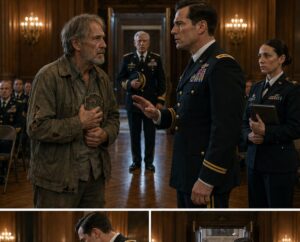
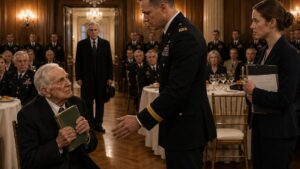
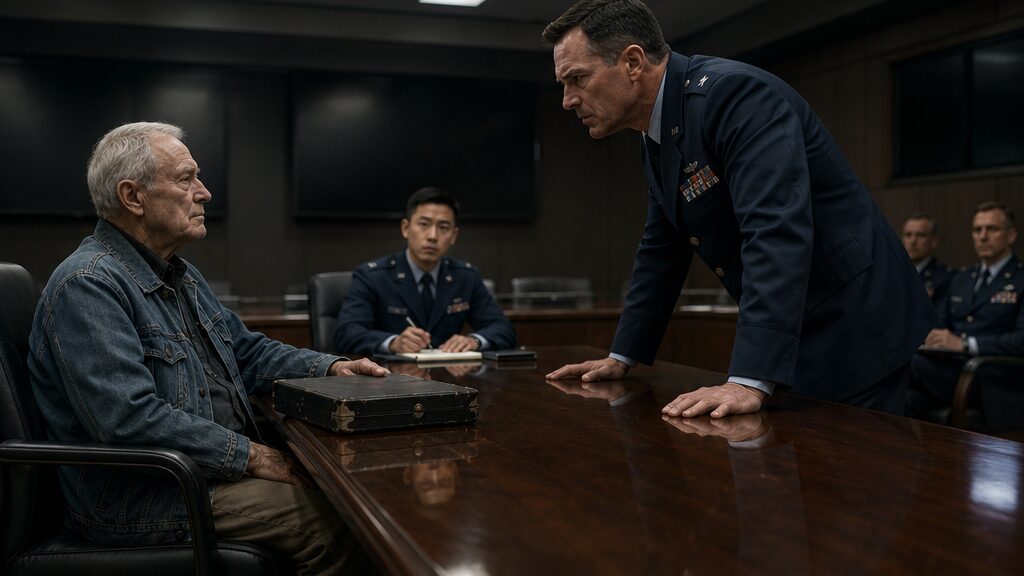
The first thing Stephen Hill did was lean close enough for William Carter to see the pulse beating under the younger man’s jaw.
“Mr. Carter,” he said, voice clipped and loud in the sealed room, “this board has been waiting twenty-six minutes for you to explain why your name appears beside restricted military records you had no authority to touch.”
William kept his left hand flat on the polished table.
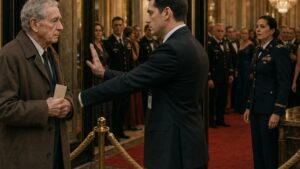
The table had been waxed until it reflected every uniform in the room. Blue coats, brass buttons, ribbons, nameplates, the cold shine of rank. William’s own reflection looked thinner between them, a gray-haired old man in a faded denim jacket, dark shirt, khaki pants, and brown shoes that had been brushed but not recently polished. The lights above the table made a pale line across his knuckles.
He did not look up at Stephen at first.
Behind the standing officer, two board members sat with folders open. A clerk watched from a side desk. Near the wall screen, a young officer in a blue uniform held a pen over a yellow legal pad, waiting for something worth writing. William had noticed him the moment he entered. The young officer’s shoulders were too square, as if he had taught himself not to look nervous.
William breathed once, slowly.
“I came because I was summoned,” he said.
Stephen’s mouth tightened.
“You were summoned to answer questions. Not to sit in silence.”
William let his gaze move from the tabletop to the folder in front of Stephen. The folder bore a red diagonal stamp and a case number he had not seen in thirty-one years. They had covered part of it with a fresh label, as if new paper could tame old decisions.
“I understand,” William said.
“Do you?” Stephen placed both hands on the table and bent lower. His reflection widened across the polished wood. “Because from where I’m standing, you walked into a military inquiry with no current credentials, no service identification, no legal representative, and no explanation for why a retired civilian’s name is attached to a missing command packet.”
The clerk’s fingers hovered over the keyboard.
William could feel the black document case inside his jacket, pressed flat against his ribs. Its cracked leather had warmed against him during the drive through the base gate, during the receptionist’s puzzled glance, during the security sergeant asking twice whether he was sure he had the right building. He had carried it for so long that its weight had become less like an object and more like an old injury.
“I brought what the summons requested,” William said.
Stephen straightened just enough to look toward the clerk.
“Let the record show the witness claims compliance.”
The word witness moved around the room like a small insult nobody wanted to own.
William folded his fingers once, then flattened his hand again. The surface beneath him was too smooth. It reminded him of other tables where young men had waited for orders with their eyes fixed on maps they did not believe would save them.
“State your full name,” Stephen said.
“William Carter.”
“Age.”
“Seventy-nine.”
“Current occupation.”
William paused.
The pause was small, but Stephen saw it and smiled without warmth.
“Mr. Carter?”
“Retired.”
“From what?”
William looked toward the wall screen. It was blank except for the seal of the review board and the date. The seal looked new. The institution liked new seals, new headings, new language for old questions.
“Government service,” William said.
A board officer shifted in his chair.
Stephen made a note in the folder with unnecessary force. “That is not an answer.”
“It is the answer I can give.”
“You can give?” Stephen repeated, his voice rising. “You are not here to decide what this board is permitted to know.”
William looked at him then.
Stephen Hill was not young, exactly, but he was young enough to believe urgency and authority were the same thing. His uniform was perfect. His hair was trimmed close. Every ribbon sat straight. Nothing on him suggested neglect, hesitation, or the kind of night when a man learned that a correct order and a merciful order might not be the same.
William had known officers like him. Some became good men after their first real failure. Some spent the rest of their lives trying to avoid one.
“I know why I am here,” William said.
“Then start acting like it.”
The room became very still.
The young officer with the legal pad lowered his eyes. The clerk stopped typing. One of the board officers looked at the table, not at Stephen, not at William. Public disrespect rarely announced itself as cruelty. More often it arrived dressed as procedure and waited for everyone else to pretend it was necessary.
William let the silence remain.
Stephen misread it.
“Mr. Carter, there are people who treat official summonses as suggestions. They arrive late, underprepared, and offended when asked basic questions. This is not a county office. This is a formal military review. If you are confused, say so. If you need assistance, ask for it. But do not sit here as if this room owes you patience you have not earned.”
William’s hand stayed on the table.
There had been years when men stood when he entered a room. Years when a phone call from him could move aircraft, open gates, divert convoys, make sleeping commanders curse and obey. He remembered none of that with pleasure. Authority was heaviest when people imagined it was a crown. It had never felt like that to him. It had felt like carrying water in cupped hands while the building burned.
“I am not confused,” he said.
Stephen watched him for a moment, as if waiting for anger. When none came, his irritation sharpened.
“You entered through the east security checkpoint at 0813.”
“Yes.”
“You presented a paper summons and a driver’s license.”
“Yes.”
“You failed to present military identification.”
“I was not asked to bring one.”
“You were entering a restricted review area.”
“I was escorted here.”
“You told the receptionist you had an appointment with the board.”
“That is what the summons said.”
Stephen lifted a sheet from the folder and turned it toward William, too far away for William to read clearly without leaning forward. “This summons was issued to William Carter of a civilian address in Maryland. It does not state rank. It does not state service history. It does not state authorization. Yet the file under review contains references to a William Carter connected to Operation Night Harbor. You understand why that raises concern.”
For the first time, William’s fingers moved.
Only once.
His thumb touched the edge of his palm, then stilled.
The young officer near the wall noticed. His pen touched the pad but did not write.
“I understand,” William said.
Stephen sat down slowly, as if granting William the mercy of less height. It did not make the room warmer.
“Then let us make this simple. Did you remove pages from the Night Harbor command file?”
“No.”
“Did you receive restricted materials from any current service member?”
“No.”
“Did you ever possess original documents connected to that operation?”
William looked at the folder.
The black case pressed against his ribs.
“Yes,” he said.
Stephen leaned back.
The clerk began typing again.
“Now we are getting somewhere.” Stephen’s voice had the satisfaction of a man hearing what he expected. “When did you obtain them?”
“A long time ago.”
“That is not sufficient.”
“It is true.”
“Mr. Carter, truth without detail is obstruction.”
William’s eyes settled on the polished table. His face looked older in the reflection than he felt. Not weaker. Just worn down by rooms that asked for truth only after they had already chosen what shape it should have.
Stephen tapped the folder. “This board is reviewing possible tampering with an archived command record. You appear in the chain of custody without verified standing. You offer vague answers. You refuse to clarify your government service. You entered this building with no valid proof of military authority.”
“I did not claim military authority.”
“That is exactly the problem.”
William almost smiled, but the feeling passed before it reached his face.
A man could spend half a lifetime trying to lay authority down, only to be accused of hiding because he did not wave it like a flag.
Stephen turned toward the clerk.
“Record that Mr. William Carter has failed to provide valid proof of identity relevant to the Night Harbor file and has declined to give a clear account of his past government service.”
The clerk hesitated.
Stephen looked at him.
The clerk typed.
The sound of the keys clicked across the hearing room. It was a small sound, but William felt it settle in the air like a door closing.
He lowered his gaze to his hand on the table and kept it there.
Inside his jacket, the black case waited.
Chapter 2: The Name They Refused To Check
Thomas Lee wrote the sentence exactly as the clerk read it back, but his pen slowed at the words failed to provide valid proof.
He had been assigned to record supplemental observations, not to judge the hearing. The board had its own clerk. The officers had their files. His job was simple: watch, note, keep his face still. He had been told that the elderly witness might be evasive. He had been told that the review concerned old records, incomplete custody chains, and a civilian name that should not have appeared where it did.
He had not been told the man would look so tired.
William Carter sat with his shoulders slightly forward, not collapsed, just conserving motion. His denim jacket looked clean but old. The cuffs were pale where years of use had thinned the blue. His hair was silver-gray and combed back without vanity. He had the kind of face that made Thomas think of bus stations before dawn, hospital waiting rooms, men sitting alone at diners with coffee they had forgotten to drink.
Not a threat.
Not a thief.
But Thomas knew appearances could mislead. The whole room had been built around that assumption.
Stephen Hill turned a page. “Let us return to the chain of custody. The Night Harbor review was reopened after discrepancies were found between the digital archive and the original index. Three pages are missing from the command authorization packet. Your name appears in the margin of the old transfer log. How did it get there?”
William looked at the folder.
“I do not know which log you mean.”
Stephen pushed the paper toward the center of the table. “This one.”
It still was not close enough for William to read without reaching. He did not reach.
Thomas noticed that too.
Most witnesses grabbed at documents. They leaned in, pointed, defended, corrected. William Carter only looked at the page from where he sat, as if he had learned long ago not to take what had not been offered.
Stephen exhaled through his nose.
“Would you like me to enlarge it for you, Mr. Carter?”
One of the board officers looked down.
The words were polite. The tone was not.
William answered evenly. “If you want me to read it, yes.”
Stephen held the page for another second, then slid it across.
The paper whispered over the polished table and stopped beside William’s hand.
Thomas saw the old man’s eyes move across the transfer log. He did not squint. He did not seem confused. He read slowly, but not uncertainly. When he reached the lower right corner of the page, his face changed by almost nothing. A small stillness entered him.
Thomas looked at his own copy.
Case Reference: NH-17-A. Supplemental Archive Transfer. Witness Irregularity Review.
But the transfer code in the corner did not match the header.
Thomas turned to the second sheet in his packet and checked again. The hearing file was marked NH-17-A. The transfer log said NH-17-C beneath a faded stamp. Not a typing error, not if the old index rules applied. A and C meant different streams of authority. A was field review. C was command-level restriction.
He wrote the discrepancy in the margin.
Stephen was still watching William.
“Do you recognize your name?”
“Yes.”
“Do you recognize the date?”
“Yes.”
“Do you recognize the signature beside it?”
William looked at the paper a moment longer.
“No.”
Stephen’s eyes sharpened. “No?”
“No.”
“You just said you recognized the date.”
“I did.”
“But not the signature.”
“That is correct.”
Stephen closed the folder halfway, then opened it again, as if annoyed by the papers for not arranging themselves into a confession.
Thomas glanced at the old man’s jacket. When William settled back from the page, the denim shifted open near his chest. For less than a second, Thomas saw the edge of something black inside.
Not a wallet. Too flat and tall.
A case.
The corner had been worn smooth, and a line of old tape crossed the spine. It disappeared as William’s jacket fell closed.
Thomas looked down before anyone noticed him looking.
Stephen said, “You understand that possessing or withholding command documents can constitute serious misconduct.”
William said nothing.
“Do you understand?”
“Yes.”
“Then explain why your name was handwritten into a transfer log connected to missing command pages.”
“I cannot explain a handwriting choice I did not make.”
“You are very careful with your words.”
“I try to be.”
“Careful men can still lie.”
William’s eyes lifted. The room seemed to tilt toward him.
“Yes,” he said. “They can.”
Thomas’s pen stopped.
Stephen smiled faintly, thinking he had drawn blood. “Is that an admission?”
“It is an agreement with a general statement.”
The board officer on the left shifted again, this time to hide a glance toward Stephen.
Stephen’s face hardened. “Do you find this amusing?”
“No.”
“Then perhaps you should show this board the seriousness it deserves.”
William’s hand rested beside the transfer log. The fingers were long, the nails neatly trimmed, the skin marked with age spots and faint scars. Thomas’s own father had hands like that, except his father’s trembled whenever thunder rolled in from the west. He had been a child during whatever had happened before Thomas was born, and he never spoke of it except once, after too many sleepless nights, when he said, There was a commander who chose the road no one was allowed to choose.
Thomas had not known what that meant.
He wrote nothing for several seconds.
Stephen turned to him suddenly. “Lieutenant Lee.”
Thomas straightened. “Sir.”
“You have the supplemental index?”
“Yes, sir.”
“Read the file category aloud.”
Thomas checked the header, then the corner code.
“Sir, the primary category is listed as witness irregularity review.”
“Read the category, Lieutenant.”
Thomas swallowed. “Witness irregularity review, sir.”
Stephen nodded, satisfied. “And the subject?”
“Possible unauthorized possession of Night Harbor materials.”
“Thank you.”
Thomas looked back down.
The corner code still bothered him.
Stephen returned to William. “The operation name has been made available to you for purposes of this hearing. Do not assume familiarity with that name gives you standing. Many people have heard old stories.”
William’s expression did not move.
Stephen continued. “Operation Night Harbor was a restricted evacuation mission. The official record states that command confusion caused a secondary convoy to move outside approved routes, resulting in loss of equipment, violation of border protocol, and severe diplomatic consequences. The missing pages may identify who altered the route order.”
The young officer’s pen felt suddenly too heavy.
William looked at the blank wall screen.
Stephen said, “Do you deny involvement in altering the evacuation route?”
The silence that followed was not like the earlier silence.
Earlier, William had seemed patient. Now he seemed far away.
Thomas saw his thumb touch his palm again.
“Mr. Carter,” Stephen said.
William’s voice was quiet. “People were still at the river.”
Stephen blinked. “That was not my question.”
“No,” William said. “It was not.”
Stephen leaned back, eyes narrowing. “How would you know where people were positioned?”
William did not answer.
Thomas felt something move through the room. Not proof. Not revelation. Only the sense that everyone had stepped closer to a door without knowing what waited behind it.
Stephen turned sharply to the clerk. “Strike the witness’s last statement as nonresponsive.”
The clerk looked uncertain.
“Sir,” Thomas said before he could stop himself.
Stephen’s gaze cut to him. “Yes?”
Thomas kept his voice controlled. “The transfer log corner code appears inconsistent with the file header.”
The room went still.
Stephen’s expression did not change, but his eyes did.
“Explain.”
“The packet is marked NH-17-A, sir. The transfer log corner stamp appears to read NH-17-C. It may indicate a command-level restriction.”
Stephen held out his hand. “Give it here.”
Thomas passed his copy over.
Stephen looked at the corner, then at the original page near William’s hand. For a moment, his confidence thinned. Then he closed around it.
“Old archive stamps are often degraded,” he said. “Do not speculate beyond your assignment.”
“Yes, sir.”
William looked at Thomas.
It was brief. No gratitude, no encouragement. Just recognition that the young man had seen a line others preferred to ignore.
Stephen turned back to William. “Let us be very clear. Hearing old operation names, reading damaged archive codes, or making sentimental references to people at a river does not establish authority.”
William’s gaze returned to him.
Stephen spoke each word carefully. “Who told you about Night Harbor?”
William’s hand moved, not toward the paper, not toward Stephen, but toward the inside of his denim jacket.
Then it stopped.
His fingers rested over the place where the black case lay hidden.
“Someone who was there,” he said.
Thomas lowered his pen.
Stephen’s voice dropped. “And who was that?”
William looked at the old transfer log, at the wrong code, at the name no one had bothered to check beyond the surface.
Then he said, “You already have his name.”
Chapter 3: The Black Case On The Table
By noon, Stephen Hill had decided the old man was either lying or hiding behind half-truths polished smooth by age.
He disliked both possibilities.
The hearing room had grown warmer, though the air system hummed steadily above the ceiling panels. Coffee cups had appeared near the board officers. The clerk had loosened his shoulders. Lieutenant Thomas Lee sat straighter than before, pen ready, eyes moving too often between the file and the witness.
Stephen noticed that. He noticed everything that might weaken control of a room.
William Carter had given them almost nothing useful. He answered with care. He admitted recognition without context. He denied signatures but not dates. He spoke of people at a river as if memory mattered more than authority. And now a young officer was watching him as though silence had become evidence in the old man’s favor.
Stephen could not allow the hearing to drift into reverence for mystery.
He closed the folder and stood.
“Mr. Carter, this board has given you several opportunities to clarify your connection to Operation Night Harbor. You have declined. You have acknowledged past possession of original documents. You have referenced mission details not contained in the public summary. You have no current clearance and no verified military status.”
William looked up slowly.
Stephen came around the end of the table.
The movement was deliberate. He could feel the room following him. A hearing was theater whether anyone admitted it or not. Authority had to be visible, especially when a witness tried to replace facts with quiet.
He stopped beside William’s chair.
“You are not in a position,” Stephen said, “to lecture officers about command responsibility.”
William’s face remained still.
Stephen lowered his voice, but the room carried every word. “And you are certainly not in a position to decide what this board may or may not know.”
William’s hand rested on the table, palm down.
Stephen looked at it. Old skin. Thin veins. A faint scar along one knuckle. No ring. No watch. Nothing that explained why the man had entered a restricted building carrying himself like someone who expected doors to remember him.
“You came here with something,” Stephen said.
William did not answer.
“I saw you touch your jacket. Lieutenant Lee saw it as well.” Stephen let the accusation hang. “If you are carrying documents relevant to this inquiry, produce them now.”
The clerk stopped typing.
One of the board officers said, “Colonel Hill—”
Stephen did not look away from William. “If he has brought restricted material into this room, we need to know.”
William’s eyes shifted toward the officer who had spoken, then back to Stephen.
“I was asked to bring records responsive to the summons,” he said.
“You were asked to bring lawful records.”
“Yes.”
Stephen’s jaw tightened. “Do you have lawful records?”
William’s fingers curled once against the polished table.
Then his hand rose.
The room watched the slow movement toward the inside of his denim jacket. No one spoke. Even Stephen, who had demanded action, felt the sudden thinness of the air. The old man’s movement had none of the fumble of panic. He reached with precision, as if he had rehearsed not the gesture, but the decision behind it.
William drew out a black document case.
It was older than Stephen expected. Not the plastic sleeve of a careless civilian, not a modern portfolio, not a wallet stuffed with expired cards. Black leather, worn soft at the corners, spine reinforced with a strip of dull tape, brass snap darkened by years of handling. There were no medals attached to it, no bright insignia, nothing theatrical.
William held it for a moment in both hands.
His thumbs rested along the edges.
Stephen felt irritation return, sharpened by the room’s attention. “Place it on the table.”
William did.
The sound was quiet.
Leather against polished wood.
It landed between the old man and the officer like a thing too small to justify the silence it caused.
William removed his hand.
“You can check the name again,” he said.
Stephen looked at the case, then at him.
“What is this?”
“What I was asked to bring.”
“Open it.”
“No.”
A board officer lifted his head.
Stephen’s voice hardened. “No?”
William’s gaze did not waver. “Not for you alone.”
Stephen felt heat rise behind his collar. “You misunderstand your position.”
“No,” William said. “I remember yours.”
The sentence was quiet enough that it might have passed as confusion if spoken by another man. In William’s mouth, it was not confusion. It was restraint, and that irritated Stephen more than defiance would have.
Stephen reached for the case.
William’s hand moved faster than anyone expected.
Not aggressively. Not even dramatically. His palm came down on the table beside the case, not touching Stephen, only marking the boundary.
Stephen stopped.
The room stopped with him.
William said, “That seal is active.”
Stephen stared at him.
“There is no active seal on privately held material from a closed operation,” Stephen said.
William looked at the case. “Then you have nothing to worry about.”
Thomas Lee made a small sound with his pen. Stephen ignored it.
He bent lower, reading the faded rectangular label set beneath a cloudy protective strip on the case’s front. The writing was not fully visible. Age had blurred the ink. But there was a typed line, and beneath it, in older black print, the name:
William Carter.
Below the name sat a code.
NH-17-C.
Stephen felt the room recede by an inch.
He picked up the transfer log and checked the corner again. The same code. Command-level restriction, if Thomas had been right. But command-level did not mean untouchable. It did not mean authentic. It might mean stolen. Forged. Misused.
Stephen chose that path because the alternative opened too many doors.
“Where did you get this case?” he asked.
William’s hand remained near it. “It was issued.”
“To whom?”
William said nothing.
“To whom, Mr. Carter?”
“The name is on the case.”
Stephen laughed once, without humor. “A name is not authority.”
“No.”
That answer should have satisfied him. It did not.
Stephen turned to the clerk. “Record that the witness has produced an unauthorized case bearing restricted archive markings.”
Thomas looked up sharply.
William did not.
The clerk’s fingers hovered.
Stephen said, “Record it.”
The clerk typed, slower than before.
Stephen reached for the case again, this time with more control. William did not stop him. The old man simply withdrew his hand and sat back.
The leather felt dry under Stephen’s fingers. He turned the case toward himself and examined the snap. There, etched into the metal so faintly it was almost gone, was a tiny seal. Not decorative. Not ceremonial. Functional. A controlled-access impression from an older system.
Stephen had seen pictures of them in training materials, usually under headings about obsolete but binding authority marks.
He did not open it.
Instead, he set the case down and looked at William.
“Assuming this is authentic,” Stephen said, “its presence outside the archive is itself a violation.”
William’s expression remained calm. “Assuming the archive was complete.”
“That is not your determination to make.”
“No.”
Stephen waited.
William added nothing.
It was unbearable, that refusal to fill the silence. Stephen had built his whole career on making silence uncomfortable for other people. William sat inside it as though he had lived there longer than Stephen had worn a uniform.
Stephen lifted the case again, turning it toward the board.
“Colonel,” one of the board officers said carefully, “we may need records to verify the seal before proceeding.”
Stephen looked at him. “We can verify without interrupting the hearing.”
“With respect, if the seal is active—”
“It is a thirty-year-old case in the hands of a civilian witness.”
William’s eyes lowered to the table.
Stephen caught the gesture and mistook it for weakness.
He leaned forward again, voice cold. “Did someone give you this to protect? Is that what this is? Did a retired officer hand you a case and tell you to keep quiet?”
William looked at him.
“No.”
“Then explain how you possess it.”
“I already answered.”
“You have answered nothing.”
William’s face tightened for the first time, not with anger but with fatigue.
“Colonel Hill,” he said, “there are questions men ask because they want truth, and questions they ask because they have already chosen who must be guilty.”
Stephen went still.
The use of his title, spoken so quietly by a man he had not granted standing, landed wrong in the room. Not insolent. Familiar.
Stephen’s eyes narrowed. “Be careful.”
William’s hand returned to the tabletop, palm flat, beside the case.
“I have been,” he said.
Thomas was staring at the label now. The board officers were no longer pretending indifference. The clerk had stopped mid-sentence, one hand still raised over the keyboard.
Stephen turned toward the side wall. “Call records.”
The clerk blinked. “Sir?”
“Now. Get the archive liaison. I want verification of the seal, the case number, and the name William Carter attached to NH-17-C.”
William closed his eyes for a brief moment.
It was not relief.
Thomas saw that clearly. Whatever had just happened, the old man had not won. He had opened a door he had spent the morning trying to keep shut.
Stephen saw only the case.
“Tell Records Officer Moore,” he said, “this packet may still be active.”
Chapter 4: The Archive Door Opens Quietly
Virginia Moore had worked in military records long enough to know that panic usually arrived disguised as urgency.
The call came through the archive desk at 1307, patched twice and misdirected once before the clerk finally said the words that made her hand stop over the intake ledger.
“Records Officer Moore, Colonel Hill requests immediate seal verification for an NH-17-C packet.”
Virginia looked at the phone receiver.
“Repeat the code.”
The clerk repeated it.
Behind Virginia, the archive office continued its quiet breathing. Air filtration vents whispered over rows of locked cabinets. A scanner hummed near the rear counter. The archive assistant stood beside a cart of declassified training manuals, waiting for Virginia to say the code had been misread.
She did not.
“Who opened the packet?” she asked.
“No one, ma’am.”
“Who handled it?”
A pause.
“Colonel Hill examined the exterior.”
Virginia closed the ledger.
“Tell him not to touch it again.”
The clerk lowered his voice. “Ma’am?”
“Tell him exactly that. I am on my way.”
She hung up and stood still for one second, letting irritation settle into procedure. Panic wasted time. Anger wasted more. She took a camera kit, a seal gauge, a pair of cotton gloves, and the restricted-index tablet from the locked drawer beneath her desk. Then she signed herself out of the archive with a code she had used only three times in eight years.
The archive assistant watched her.
“Is it real?”
“I don’t know yet.”
“But NH-17-C—”
“Means we walk, not run.”
The hallway to the hearing wing was bright and overcooled. Virginia passed framed photographs of commanders, inspectors, visiting officials, people who had smiled for history because history had not yet asked hard questions of them. She knew many of their names from paper records. Paper was less flattering than portraits.
At the hearing room door, the security sergeant opened it before she knocked.
The room turned toward her.
Virginia noticed the old man first.
He sat in civilian clothes beneath the hard overhead lights, hands resting on the table, face composed in a way she had seen only in people who had already endured the worst question in a room and were waiting for everyone else to catch up. The black case lay several feet away from him now, nearer to Colonel Hill. That bothered her.
Everything about the case bothered her.
Not because it looked dramatic. It did not. It looked tired. Black leather, taped spine, worn corners, dull snap. But the shape was correct. The proportions were correct. The old brass compression seal was exactly where it should have been.
Virginia set her kit down at the table’s edge.
“Who moved it from the witness?” she asked.
Stephen Hill’s expression sharpened. “Records Officer Moore, this board is conducting—”
“Who moved it?”
The directness clipped the room quiet.
Stephen held her gaze. “I did.”
“Has it been opened?”
“No.”
“Has anyone attempted to open it?”
“No.”
“Has anyone pressed the seal release?”
Stephen’s jaw shifted. “I examined it.”
Virginia looked at the case instead of him. “That is not an answer.”
One of the board officers lowered his eyes.
Stephen’s voice cooled. “No. It has not been opened.”
“Good.”
She pulled on gloves and adjusted the small lamp from her kit. The old man watched her with neither hope nor fear. That bothered her too. People who brought false records into official rooms tended to oversell their calm. This man did not seem to be performing calm. He seemed to be preserving something with it.
Virginia photographed the case from four angles. Then she measured the seal impression without touching the release.
“Colonel Hill,” she said, “until verified, this packet should be treated as restricted historical material.”
“It was brought in by a civilian witness.”
“That may become relevant after verification.”
“It is relevant now.”
Virginia glanced at him. “So is chain of custody.”
Stephen leaned back in his chair.
Thomas Lee sat near the wall, pen unmoving. His eyes followed every tool Virginia lifted. On his pad she saw a line written darker than the rest: NH-17-C.
She returned to the case.
The label was aged but partly legible. William Carter. Below it, an index string, faded at the left edge. She entered the code into the restricted-index tablet.
The tablet did not load immediately.
That, more than anything, made the room change.
Most dead codes returned quickly. Invalid. Retired. Archived. No match.
This one made the system think.
Virginia felt the old habits of the archive settle over her. Do not anticipate. Do not decorate. Let the record answer, then decide what question comes next.
The tablet chimed softly.
Restricted Index Match Found.
Access Tier: Command Historical Lock.
Packet Family: NIGHT HARBOR.
Custodial Note: External retention authorized under sealed order.
Virginia read the line twice before speaking.
“The exterior code is authentic.”
Stephen’s chair made a short sound against the floor. “Authentic as a historical object?”
“Authentic as a restricted command packet.”
“Current legal status?”
“Pending verification of retention authority.”
Stephen seized on that. “So its possession may still be unauthorized.”
Virginia looked at him through the reflection on the table. “It may also be explicitly authorized. I will need to compare the packet against the sealed index.”
The old man spoke for the first time since she had entered.
“Only the necessary pages.”
Virginia turned.
His voice was low, tired, and precise. Not pleading. Not ordering. Requesting with the weight of someone who knew exactly what could be damaged by unnecessary exposure.
Stephen made a dismissive sound. “Mr. Carter, you do not dictate archive review.”
Virginia did not look away from the old man. “Are there protected names inside?”
William’s fingers touched the tabletop once.
“Yes.”
The answer brought a new silence.
“Living protected names?” Virginia asked.
“Yes.”
Stephen leaned forward. “This board has authority—”
“This board has authority to review the matter before it,” Virginia said. “It does not have authority to expose protected names because someone is impatient.”
Stephen stared at her.
Virginia opened the restricted index on her tablet and keyed in the secondary code. A warning screen appeared. She cleared it with her officer authorization. Another screen followed, older in design, almost crude compared with the current system.
Packet NH-17-C: Retention Holder — Carter, William.
Status: Command Exception.
Attached File: Evacuation Route Deviation / Civilian Recovery / Sealed Addendum.
Virginia felt the first cold line of recognition move up the back of her neck.
Carter, William. Not witness. Not incidental transfer. Retention holder.
She looked at the old man’s denim jacket, at the old case, at the polished table reflecting the uniforms of men who had spoken over him all morning.
Stephen said, “Well?”
Virginia chose her words carefully.
“The packet belongs to a classified evacuation file. The system recognizes William Carter as the retention holder under command exception.”
Stephen’s face remained controlled, but his hand moved from the folder.
“What command exception?”
“The index does not display that without deeper access.”
“Then get deeper access.”
“I am requesting it now.”
She sent the request through the tablet. The system asked for justification. She entered: Active board verification; external retention challenge; protected-name risk.
The wait stretched.
William watched the blank wall screen.
Virginia studied him. There was something unsettling about seeing a man and a file begin to align. The record did not make him larger. It made the room smaller around him.
The tablet chimed again.
Supplemental visual record available.
Virginia hesitated.
Stephen saw it. “What is it?”
“A linked historical image.”
“Put it on the screen.”
Virginia’s first instinct was to refuse until she reviewed it privately. Then she saw William’s eyes close briefly, almost the same way they might if someone had opened a window in winter.
He knew what it was.
“Mr. Carter,” she said, “do you object to display of the linked visual record?”
Stephen almost snapped at her. She could feel it.
William opened his eyes.
“Is it marked protected?”
Virginia checked. “No. Redacted for external display.”
“Then display it.”
She connected the tablet to the hearing room screen.
The wall seal disappeared.
For a moment there was only a gray loading field, then a grainy photograph filled the room: a line of exhausted soldiers, civilians wrapped in blankets, floodlights cutting through dust or smoke, and near the left edge a younger officer standing beside an open transport truck.
The image was damaged. Faces blurred at the edges. Time had eaten the contrast.
But the officer near the truck had William Carter’s eyes.
Virginia heard Thomas Lee inhale.
Stephen said nothing.
William looked at the screen without moving his hands.
The archive had opened its door quietly, but something old had stepped through.
Chapter 5: The Photograph Nobody Wanted To Explain
Thomas Lee knew his father’s face from three ages: the stern one in his old identification photo, the tired one at the breakfast table, and the broken one that appeared whenever July thunderstorms rolled across the fields behind their house.
The face on the screen was none of those.
It was younger. Thinner. Half-hidden beneath dirt and the shadow of a torn blanket. The boy in the photograph could not have been more than nineteen. He stood behind a woman holding a child, one hand gripping the side rail of a transport truck, eyes wide with the look of someone who had survived before he understood what survival would cost.
Thomas stopped breathing.
The hearing room became distant. Stephen Hill’s voice moved somewhere at the far end of the table, but Thomas did not understand the words at first. The photograph held him by the throat.
His father.
Not as a veteran in framed memory. Not as a man who woke shouting from dreams he would not name. As a frightened young soldier caught inside the record everyone in the room was discussing as if it were a damaged file.
“Lieutenant Lee.”
Thomas blinked.
Stephen was looking at him.
“Are you with us?”
Thomas lowered his eyes to his pad. His pen had left a dark point in the paper where he had pressed too hard.
“Yes, sir.”
Stephen turned back toward Virginia Moore. “This image proves only that Mr. Carter may resemble someone present at an evacuation site.”
Virginia stood beside the screen, tablet in hand. “The archive link identifies the image as attached to Packet NH-17-C.”
“Attached images can be misfiled.”
“They can.”
Stephen’s gaze sharpened. “Then say that.”
Virginia’s face did not change. “They can be misfiled. This one does not appear to be.”
A board officer cleared his throat, but did not speak.
William Carter sat at the table with his eyes on the screen. The old man’s face had shifted by a degree so small Thomas might have missed it earlier in the morning. The lines around his mouth had deepened. His hand remained flat beside the black case, but the fingers were no longer fully relaxed.
Thomas looked from the old man to the younger officer in the photograph.
The years between them collapsed and did not.
The man on the screen wore field gear, not dress uniform. His sleeves were rolled. His head was turned slightly, as if someone outside the frame had called to him. He did not look heroic. He looked exhausted and responsible for too many directions at once.
Thomas’s father stood twenty feet behind him in the image.
Stephen walked closer to the screen. “Zoom in.”
Virginia did.
The image enlarged until the younger officer’s face filled the wall. Grain broke across his features. Still, the resemblance held: the eyes, the narrow bridge of the nose, the set of the mouth. William Carter did not look away.
Stephen folded his arms. “Resemblance is not identity.”
“No,” Virginia said. “But the embedded caption lists field command personnel.”
“Read the caption.”
Virginia tapped the tablet.
The lower corner of the screen populated with old typed text, partially redacted.
NIGHT HARBOR SECONDARY RECOVERY POINT. ROUTE C. TEMPORARY HOLD SITE. FIELD COMMAND PRESENT: [REDACTED], W. CARTER, D. GREEN, [REDACTED].
Thomas’s eyes caught on the second name.
W. Carter.
Stephen said, “W. Carter could be anyone.”
The old man’s gaze lowered from the screen to the black case.
For the first time, Thomas felt anger rise in him—not hot, not clean, but ashamed and uncertain. Stephen was not entirely wrong by procedure. W. Carter could be another man. Images could be mislabeled. Old files could be corrupt. But Stephen did not sound like a man protecting truth. He sounded like a man protecting his first assumption.
Virginia said, “The caption is linked to the same command exception.”
“Again,” Stephen said, “that does not establish that the witness seated here had command authority.”
William spoke quietly. “No one said it did.”
Everyone looked at him.
His eyes remained on the case.
Stephen stepped away from the screen. “Then perhaps you can explain why your case is tied to a route that, according to the official record, should never have existed.”
William looked at him.
“Because it existed.”
Stephen’s mouth tightened. “Do not play word games.”
“There were people on that road.”
“You keep saying that.”
“Because it keeps being left out.”
The room held still around the sentence.
Thomas looked back at the photograph. The truck. The blankets. The floodlights. His father’s young face. People on that road.
His father had once told him, after a thunderstorm knocked out the power when Thomas was sixteen, that he owed his life to someone who broke the shape of the map. Thomas had thought it was a phrase born of fear or memory. His father had been staring at the dark kitchen window when he said it, not at Thomas.
Someone changed the road. We cursed him until we saw the river.
Thomas had never known what river.
He turned a page in his notes, mostly to steady his hand.
Stephen said, “Route C was unauthorized.”
William’s face became very still.
Stephen continued, “The official Night Harbor summary states that command confusion caused an unapproved route deviation.”
William’s eyes remained on him.
“That deviation created diplomatic exposure, equipment losses, and long-term classification problems,” Stephen said. “If you have knowledge of who issued the route change, now is the time to say so.”
William’s hand moved to the edge of the black case but did not open it.
“Some orders are written because there is time,” he said. “Some are carried because there is not.”
Stephen gave a short breath of disbelief. “That may sound meaningful, Mr. Carter, but it does not answer the question.”
“It answers more than you asked.”
Thomas looked up.
Stephen turned slightly, noticing him again. “Lieutenant, continue recording.”
Thomas looked down at his pad. He had written W. CARTER without realizing it. Beneath it, he had written my father?
He covered the words with his hand.
Virginia lowered the zoom and brought the full photograph back onto the screen.
The image looked less like evidence now and more like a room crowded with ghosts.
Thomas forced himself to study details: the truck number, the temporary floodlight rig, the uneven line of evacuees, the mud on the boots. His father’s face stayed in the edge of his vision no matter where he looked.
He raised his hand slightly.
Stephen frowned. “What is it now?”
Thomas heard his own voice come out quieter than he intended. “Sir, may I ask Records Officer Moore to zoom the lower right quadrant?”
Stephen glanced at the screen. “Why?”
“There may be a personnel marking on the truck.”
Stephen hesitated, then gave a curt nod.
Virginia zoomed.
The side of the truck enlarged. White stencil letters appeared broken by scratches and mud. Thomas leaned forward.
Beneath the truck rail, half obscured by a hanging blanket, was a chalk mark: RIVER LOAD — LEE / 12.
The room blurred.
Thomas’s father had kept an old brass tag in a kitchen drawer. LEE / 12. Thomas had thought it was a laundry mark or a unit joke. His father had taken it from him once, gently but firmly, and said, Not everything in a drawer is yours to sort.
“Lieutenant?” Stephen said.
Thomas swallowed. “My father was part of an evacuation when he was nineteen.”
Stephen’s expression closed. “This hearing is not about your father.”
“No, sir.”
Thomas looked at William.
The old man did not look surprised. He looked sorry.
Thomas felt the apology before it was spoken, and that made it worse.
He turned back to Stephen. “The chalk marking on the truck matches an item my father kept. He never named the operation.”
Stephen’s voice hardened. “Personal associations are not evidence.”
“No, sir,” Thomas said. “But they may explain why the public record is incomplete.”
Stephen stared at him.
Virginia, still beside the screen, said carefully, “There is another issue.”
Stephen’s patience thinned visibly. “What issue?”
“The public Night Harbor summary lists the route deviation under unnamed command confusion.” She looked down at her tablet. “But this packet’s restricted index does not use that phrase.”
“What phrase does it use?”
Virginia’s thumb hovered. “Command substitution under emergency civilian recovery authority.”
Stephen said nothing.
The words sat in the room, dry and official and enormous.
William closed his eyes.
Thomas looked at him and understood, not fully, but enough to feel the first weight of it. The old man had not come here because he wanted recognition. He had come because the record was being opened by people who did not know what they were touching.
Stephen took the tablet from Virginia and read the line himself. His eyes moved once, then again.
“Who authorized the substitution?” he asked.
Virginia did not answer immediately.
Stephen looked up. “Records Officer Moore.”
“The authorization field is sealed.”
“By whom?”
“The public display is redacted.”
“Then remove the redaction.”
“I cannot without the retention holder’s consent or higher archive authority.”
Stephen turned slowly toward William.
William’s hand was on the black case now.
Stephen’s voice lowered. “Mr. Carter, why was your name removed from the public version of Operation Night Harbor?”
The question should have sounded like an accusation.
Instead, for the first time that day, it sounded like fear.
William opened his eyes.
He looked at the photograph, at the truck, at Thomas, at the young face of a soldier who had lived long enough to become someone’s father.
Then he said nothing.
Thomas felt the question tear loose from him before rank or caution could stop it.
“Why did they take your name out?”
Chapter 6: The Man Who Still Called Him General
William Carter had learned, very young, that a man could survive noise by choosing one sound and holding onto it.
In the hearing room, he chose the air system.
The soft, steady rush above the ceiling panels. Not the screen humming with the old photograph. Not Stephen Hill’s controlled breathing. Not Thomas Lee asking the question William had spent decades not answering in rooms full of uniforms.
Why did they take your name out?
William kept his eyes on the black case.
There were questions that wanted facts. There were questions that wanted permission to grieve. Thomas’s question carried both, and that was why William did not answer quickly.
Stephen filled the silence because men like him could not bear to let silence belong to someone else.
“Mr. Carter,” he said, “the lieutenant asked a direct question.”
William looked up. “He did.”
“Then answer it.”
“It was not your question.”
Stephen’s face tightened, but before he could respond, the hearing room door opened.
The security sergeant stepped in first, uncertain. Behind him stood a broad-shouldered old man in a dark coat, one hand gripping the back of a chair as though he had refused help on the walk from the entrance. His hair was white. His posture leaned to one side. A shallow scar crossed the left side of his chin.
Virginia Moore moved first.
“Dennis Green?” she asked.
The old man nodded. “Records called.”
Stephen turned sharply. “Who authorized—”
“I did,” Virginia said. “His name appears in the linked visual caption and the packet index. D. Green.”
Dennis Green looked past her.
He saw William.
The change in him was immediate and unguarded. His hand left the chair. His shoulders straightened, not fully, not easily, but with the instinct of a body remembering a room that no longer existed.
For a moment, the years left his face and returned all at once.
“General Carter,” he said.
No one moved.
The words did not ring like ceremony. They landed softly, almost painfully, in the space between the polished table and the old black case.
William closed his eyes for half a breath.
“Dennis,” he said.
Dennis stood near the door, as if afraid to come closer without being told. His gaze flicked over the uniforms, the screen, the photograph, Stephen Hill’s posture. Something old and protective hardened in his face.
“What is this?” he asked.
“A hearing,” William said.
Dennis looked at the black case. “About that?”
“Yes.”
Dennis gave a tired laugh with no humor in it. “Took them long enough to be curious.”
Stephen recovered first. “Mr. Green, this board has not verified any title you just used.”
Dennis turned to him slowly. “Then your board is behind.”
A board officer shifted in his chair.
Stephen stood. “You will address this proceeding with respect.”
Dennis looked at him, then at William, as if asking silently whether to obey the room or the memory.
William gave the smallest shake of his head.
Dennis swallowed whatever he had been about to say.
“Yes, Colonel,” he said.
The restraint cost him. William saw it in the muscles along his jaw.
Virginia guided Dennis to the chair at the side of the table. He did not sit until William nodded. That, too, was noticed. Thomas Lee noticed everything now. His pen lay flat on his pad. He had stopped pretending to record.
Stephen remained standing. “State your full name.”
“Dennis Green.”
“Past service connection to Operation Night Harbor?”
Dennis looked at William again.
William did not rescue him.
“Field communications and convoy coordination,” Dennis said. “Secondary recovery group.”
“Under whose command?”
The room tightened.
Dennis’s eyes went to the black case. “Under his.”
Stephen’s gaze flicked to William. “Be specific.”
Dennis leaned both hands on the chair back. “Under General William Carter.”
The clerk’s fingers rose toward the keyboard and stopped.
Stephen said, “The public summary contains no General William Carter in the command chain.”
“No,” Dennis said. “It wouldn’t.”
“Why not?”
Dennis looked at William a third time. This time the look was not permission. It was apology.
William’s hand moved to the black case. He rested his palm over it, feeling the old leather give slightly under his fingers. The case had been new the night it was issued. Black, stiff, official, absurdly small for the weight it would carry. A young clerk had handed it to him with a clipboard while radios cracked and men shouted over maps.
External retention authorized, sir. Sign here.
He had signed because there had been no time not to.
Now there was too much time.
“Dennis,” William said quietly, “answer only what they ask.”
Dennis’s mouth trembled at the corner. He nodded.
Stephen’s voice grew colder. “Why would General Carter’s name be absent from the public record?”
Dennis looked at Stephen with visible effort. “Because someone had to be blamed in a way that did not expose the protected route.”
Stephen frowned. “Explain.”
Dennis sat then, slowly. The chair creaked under him.
“Route C was not a mistake,” he said. “It was a road the official plan excluded because using it would reveal that local families had been marked for recovery. Civilians, translators, medics’ families. People who were not supposed to be in the report.”
Virginia’s eyes lowered to her tablet.
Stephen said, “The official record states the secondary convoy deviated without authorization.”
Dennis nodded. “That was the lie that kept the names sealed.”
William’s hand tightened on the case.
Stephen looked between them. “You are alleging a falsified public record.”
“I am saying the public record was incomplete on purpose.”
“For whose benefit?”
Dennis looked at Thomas.
Thomas went very still.
“For theirs,” Dennis said. “For people who got out and needed to stay vanished. For families who would have been hunted if their names showed up in the wrong archive. For young soldiers who were ordered onto a road they did not understand and survived because someone higher than them took the weight.”
Thomas’s face had gone pale.
Stephen’s voice was quieter now. “And General Carter authorized this?”
Dennis shook his head once. “He carried it.”
“That is not the same thing.”
“No,” Dennis said. “It is not.”
William looked up.
Stephen saw the movement. “Mr. Carter?”
William’s voice came slowly. “The approved route was compromised before dawn. We had confirmation that the primary crossing was watched. There were civilians still at the river. Families connected to our people. If we used the approved route, we would preserve the record and lose them. If we used Route C, we would save who we could and create a problem no one wanted attached to the official plan.”
Stephen stared at him.
“So you changed the route.”
William did not answer at once.
The room had disappeared. He could see the river now, though he had trained himself not to summon it whole. Brown water under floodlight. A child wrapped in a field jacket too large for her shoulders. A radio operator crying without making sound. Dennis, younger, bleeding from the chin and still repeating coordinates. A convoy waiting for an answer no book could give.
“I accepted responsibility for the route,” William said.
“That is not what I asked.”
“It is the answer.”
Stephen’s face flashed with frustration, but it no longer had the same force. “Did you issue the order?”
William looked at the screen, at the younger version of himself standing near the truck.
“Yes.”
The word moved through the room without drama.
Thomas’s hand went to his mouth and dropped again.
Dennis closed his eyes.
Stephen sat down slowly.
“If that is true,” Stephen said, “why was the order sealed?”
William looked at Thomas.
“Because the list of evacuees was attached.”
Thomas understood enough to look away.
Virginia said, “The protected-name warning.”
William nodded.
Stephen rubbed a hand once over his mouth. “You could have corrected the record after the danger passed.”
“No.”
“Why not?”
“Because danger does not pass for everyone at the same speed.”
Dennis whispered, “Sir.”
William looked at him.
It was the old word, but not the title. Sir. The word Dennis had used in the field when he wanted to object without mutinying.
William’s fingers rested on the black case.
Dennis leaned forward. “They are asking now.”
William looked at the case, then at Thomas, then at Stephen Hill. The colonel’s confidence had not vanished. It had become defensive, brittle, human. He was beginning to understand that procedure could be correct and still cruel.
William did not hate him for that. Hate required energy he no longer wished to spend.
Virginia placed a form beside the case.
“Mr. Carter,” she said gently, “if you consent to open only the authorization sleeve, the protected names can remain sealed.”
Stephen looked at her as though he might object, then did not.
William read the form.
The letters were clear enough. His eyes were still good. That had never been the part of him time had damaged most.
“General,” Dennis said softly.
William did not correct him.
Thomas looked at the table, ashamed now of every word he had helped record before he understood the man sitting there.
William thought of all the years the black case had lived in drawers, safes, cardboard boxes, the bottom shelf of a closet after his wife died, the passenger seat that morning as he drove himself through the gate. He had told himself he carried it to protect the living. That was true.
But not all true.
He had also carried it because if he let someone else hold the story, they might make it cleaner than it was. They might turn frightened people into statistics and a desperate order into a footnote.
His hand moved to the brass snap.
He did not open it yet.
He looked at Stephen.
“Before I do this,” William said, “understand one thing.”
Stephen met his eyes.
William’s voice stayed low. “Rank will not make what happened in this room right.”
No one answered.
William pressed his thumb against the old brass release.
The snap gave beneath his hand.
Chapter 7: Do Not Apologize Because I Was A General
The black case opened like something exhaling after years underground.
No one leaned forward at first.
William Carter kept his thumb on the brass release until the lid settled flat against the polished table. The leather creaked softly. Inside, the case held fewer papers than Stephen Hill had expected. Not a stack of dramatic secrets, not folders bulging with accusation. One sealed sleeve. One thin authorization sheet yellowed at the edges. A narrow strip of old field tape. A folded map segment, brittle enough that Virginia Moore immediately lifted one gloved hand in warning.
“Please don’t remove the map,” she said.
William nodded.
“I won’t.”
Stephen stared at the open case. The worn leather, which had looked suspicious an hour earlier, now seemed almost too modest for the silence around it.
Virginia moved closer with the tablet. Her voice was professional, but softer than before.
“Mr. Carter, I need your verbal consent to review only the authorization sleeve and identity confirmation page.”
William looked at the sleeve. The old paper beneath its cloudy cover had a typed heading, most of it faded. He could still read it without effort.
COMMAND SUBSTITUTION AUTHORITY.
His younger hand had signed under those words in a tent full of radio noise and fear. His older hand rested beside them now.
“You have my consent,” he said. “Only those pages.”
Virginia nodded and photographed the case as it lay open. She did not reach inside until the tablet logged her access. Then, with care, she lifted the authorization sleeve just enough to view the exposed margin.
Stephen stood across from her, but the posture had gone out of him. He was still rigid, still in command of the room by title, yet something about his authority no longer reached the end of the table.
Thomas Lee sat with his hands folded over his legal pad. His pen lay above the line where he had written General William Carter? and then scratched nothing after it. He watched the sleeve as though the paper might tell him what his father never could.
Dennis Green had not sat back since the case opened. His shoulders were hunched, his eyes fixed on William instead of the document. He looked like a man watching a door open in a house he had escaped from long ago.
Virginia read silently at first.
The tablet chimed as she matched the sleeve number.
Then another sound came, deeper and lower, from the wall system as the archive accepted her verification.
Confirmed.
The word appeared on the screen.
Packet NH-17-C.
Retention Holder: Carter, William.
Verified Identity: Carter, William.
Former Command Rank: General.
Operation Authority: Night Harbor Secondary Recovery / Emergency Route Substitution.
The room did not gasp. It did not need to.
Silence did the work better.
Stephen’s eyes stayed on the word General.
William looked at none of them. He looked at the open case, at the tape strip, at the folded map he would not let anyone touch. Old things were not always fragile because of age. Sometimes they were fragile because too many living people had been built on top of them.
Virginia touched the tablet. “There is an attached order.”
William said, “Read only the authority line.”
She looked at him, then nodded.
On the screen, the photograph disappeared. A redacted page appeared in its place, most names hidden behind black bars. Near the bottom, a section remained visible.
Emergency route substitution authorized under field command authority due to compromised primary crossing and confirmed civilian recovery risk.
Below that, a signature line.
W. Carter.
The digital system clarified it beside the old handwriting.
General William Carter.
Stephen lowered himself into his chair.
It was the same chair he had used earlier to sit across from William after standing over him. Now it made a small sound beneath his weight, and that sound, too ordinary and human, seemed to embarrass him.
Virginia continued, “The order confirms that Route C was not an unauthorized deviation. It was an emergency substitution authorized by field command.”
Stephen swallowed. “And the public summary?”
Virginia checked the next linked note. “Redacted under protected-name authority. Public language was altered to prevent exposure of evacuee identities and assisting local contacts.”
Dennis closed his eyes.
Thomas’s face had gone still.
William could feel the whole room waiting for him to become larger than he was. They wanted the reveal to give them a shape they understood: accusation, vindication, apology, punishment, honor. A clean reversal. A story they could repeat without carrying its weight.
He had lived too long with the truth to let it become clean now.
Stephen lifted the authorization sheet with his eyes, not his hands.
“I need to read the finding into the record,” he said.
His voice was hoarse.
Virginia stepped back.
The clerk prepared his keyboard, but his fingers trembled slightly.
Stephen looked at the screen. The first words would not come. He had spoken all morning with the ease of a man certain of his place. Now each syllable seemed to require permission from something inside him that had been avoiding the room.
Finally, he said, “The board acknowledges verification of Packet NH-17-C as an authentic command historical packet. Retention holder identified as William Carter.”
He stopped.
No one corrected him.
William did not move.
Stephen looked at the screen again.
“Former rank,” he said, and the words tightened around his throat, “General.”
The clerk typed.
Stephen continued, slower. “Attached authorization confirms emergency field command substitution of Route C during Operation Night Harbor. Public summary language appears to have been altered under protected-name authority.”
The room absorbed it.
Thomas looked at the old photograph still minimized in the screen corner, where his father’s younger face had been reduced to a thumbnail among evacuees and soldiers. He reached for his pen, then stopped. For once, he seemed to understand that not everything important could be saved by writing it down quickly.
Stephen closed the folder before him, then opened it again, as if the old habit of control might return if he repeated the motion.
It did not.
He looked at William.
“General Carter.”
William’s eyes lifted.
The title crossed the table and arrived too late to be useful.
Stephen stood. Not sharply this time. Carefully.
“I owe you an apology.”
William watched him.
The room waited again.
Stephen seemed to feel every person in it. His career, his uniform, his earlier words, the clerk’s record, the young officer’s notes, Dennis Green’s hard stare, Virginia Moore’s guarded professionalism. All of it stood with him.
“I treated you improperly,” Stephen said. “I questioned your integrity, your memory, and your right to be heard. I made assumptions about your standing before verifying the record.”
William’s face remained calm, but tiredness moved behind his eyes.
Stephen continued. “I apologize, General.”
Dennis looked down.
Thomas’s fingers tightened around his pen.
William closed the black case halfway, not snapping it shut, only lowering the lid enough that the papers were no longer exposed to the room.
“Do not apologize because I was a general,” he said.
Stephen stood motionless.
William’s voice did not rise. “Apologize because this morning you believed an old man in a denim jacket could be treated that way if he had no title worth fearing.”
The sentence left no room for defense.
Stephen’s face changed slowly. Not with collapse, not with theatrical shame, but with the private recognition of a man who had been caught not merely wrong, but small.
William looked at the clerk.
“And change the record.”
The clerk looked to Stephen.
Stephen nodded once.
William said, “Not to make me sound grand. Not to clean up what happened. Write that I appeared voluntarily. Write that my identity was challenged before it was verified. Write that the board proceeded on assumption before confirmation.”
The clerk began typing, but Stephen raised a hand.
“I’ll enter the correction.”
He moved to the clerk’s station. The clerk stood aside.
Stephen typed slowly. Each key sounded clearer than it had before.
William Carter appeared voluntarily pursuant to formal summons.
He paused, then added:
Initial proceedings challenged identity and standing prior to full verification of archived command authority.
Stephen looked back at William.
William did not nod. Approval was not his to give like a medal.
Virginia secured the authorization sleeve back into place. “The protected pages remain sealed,” she said.
“They should,” William answered.
Thomas finally spoke. “Sir?”
William turned toward him.
The young officer’s face carried several griefs at once: embarrassment for the morning, shock at the record, the sudden nearness of his father’s hidden past.
“My father,” Thomas said. “Was he on that road because of your order?”
William looked at the screen, where the photograph waited in the corner.
“Yes.”
Thomas pressed his lips together.
“He never told me.”
“Many did not.”
“Did he know your name?”
William’s hand rested on the case.
“I don’t know.”
Dennis answered quietly from the side. “Some of us knew enough.”
Thomas looked at him.
Dennis’s voice softened. “Not all. Enough.”
Thomas nodded once, but the movement failed halfway. He looked down at his notes. The page was crowded with fragments: case numbers, quotes, objections, codes, his father’s name written nowhere but present in every line.
William saw the young man’s struggle and recognized the danger in it. Gratitude could become another burden if placed carelessly. So could guilt.
“Lieutenant Lee,” he said.
Thomas looked up.
“Your father survived because many people did their jobs under conditions no report can hold. Drivers. Radio operators. Medics. People whose names stayed protected. Do not give one old man more weight than he can carry.”
Thomas’s eyes shone, but he held himself steady.
“Yes, sir.”
William almost corrected the sir, then let it pass. Some words belonged to the person speaking them.
Stephen returned to his chair but did not sit. “General Carter, the board will recommend immediate correction of the Night Harbor public summary where possible without exposing protected identities.”
William said nothing.
Stephen added, “And a review of witness intake procedures.”
That made William look at him.
Stephen met his eyes with difficulty.
“No witness should be treated as you were treated this morning.”
William closed the black case fully.
This time the snap sounded final.
“No person,” William said.
Stephen bowed his head once, not deeply, not ceremonially. Just enough to show he had heard the difference.
Outside the high windows, evening had begun to dull the light along the edge of the blinds. The polished table no longer reflected the uniforms as brightly. It held fingerprints now, a camera kit, Thomas’s legal pad, Stephen’s corrected record, and the black case that had made a room remember what it had tried to reduce.
Virginia packed her tools with care. Dennis stood slowly, using the chair back again. Thomas rose as well, then seemed unsure whether to approach William.
William saved him from deciding.
He stood.
The movement took effort. Not enough for pity, only enough for truth. Age had its own chain of command, and he had been answering to it for years.
Dennis stepped toward him. “Can I walk you out?”
William looked at his old subordinate. Beneath Dennis’s white hair, beneath the scar, he could still see the young man at the radio, refusing to abandon a broken channel because someone might still be calling.
“If you want,” William said.
Dennis smiled faintly. “I do.”
Thomas came around the table then. He stopped at a respectful distance.
“General Carter.”
William turned.
Thomas held out the legal pad, then seemed embarrassed and lowered it. “I’m correcting my notes.”
William waited.
Thomas looked down at the first page, crossed out a line, and wrote carefully beneath it. The pen moved slowly, deliberately, no longer chasing the room’s assumptions.
When he finished, William saw the sentence before Thomas turned the pad away.
General William Carter appeared voluntarily.
Thomas closed the pad.
“Thank you,” he said.
William shook his head. “Ask your father about the river only if he wants to tell you.”
Thomas absorbed that.
“Yes, sir.”
Stephen stood near his chair, hands at his sides. For the first time all day, he looked less like a man occupying authority and more like one measuring whether he deserved it.
“Mr. Carter,” he said, then stopped.
William looked at him.
Stephen corrected himself, but not back to the title.
“William,” he said quietly, “the record will show the truth.”
William picked up the black case. Its old handle settled into his palm. “Records rarely show all of it.”
“No,” Stephen said. “But this one will show more than it did.”
William accepted that with a small nod.
He did not offer forgiveness. Not because he wished to punish Stephen, but because forgiveness given too quickly could become another way of hiding what had happened. Stephen would have to carry the morning longer than one apology. That was not cruelty. It was instruction.
The security sergeant opened the hearing room door.
William walked out in the same faded denim jacket he had worn when he entered, the black case at his side, Dennis Green a step behind him, not as escort, not as guard, but as witness.
No one applauded.
No one saluted dramatically.
The room stood anyway.
William did not turn back to see it. He had learned long ago that the measure of respect was not whether people rose when history entered a room.
It was whether they remembered to see the person before they knew the history.
Behind him, in the hearing room, Thomas opened his legal pad once more and added one final line beneath the corrected record.
Treat the quiet witness as if the truth may be older than your first assumption.
Then he closed the pad gently, as if the sound itself mattered.
The story has ended.