They Laughed At The Old Veteran Kneeling In The Dust Until His Target Came Back Silent
Chapter 1: The Old Man Kneeling Below The Firing Line
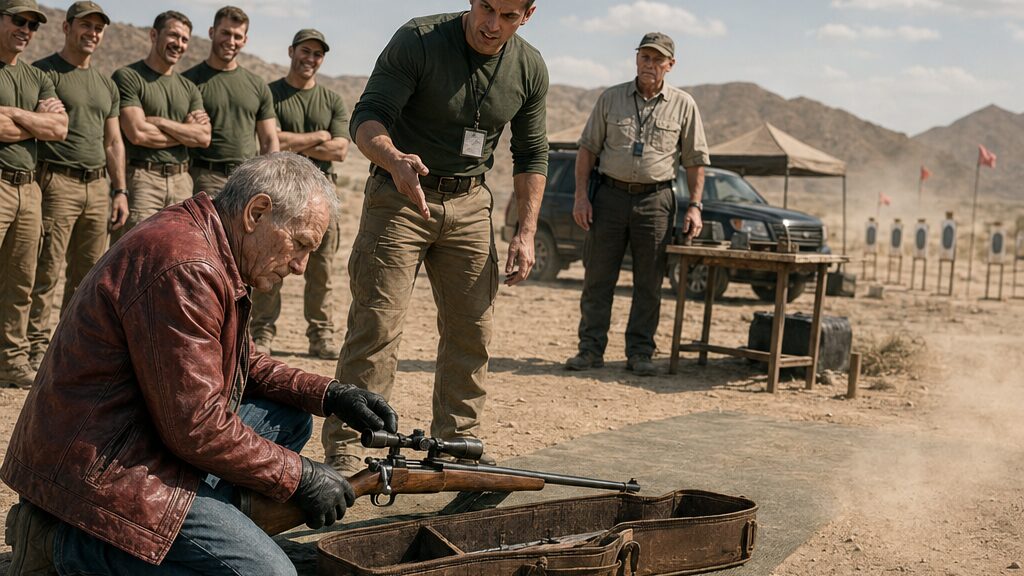
The first laugh came while Gary Walker was on one knee in the dust, both hands still on the latches of his rifle case.
He did not look up right away.
The desert wind moved across the range in dry sheets, lifting grit against the legs of the shooting benches and rattling the paper targets stacked near the registration table. Beyond the firing line, white steel plates shimmered in the heat. A dark SUV idled near the sponsor tent with its windows black and polished, looking out of place among folding chairs, ammunition boxes, sun-faded range flags, and old men in ball caps waiting for the veterans’ charity match to begin.
Gary had parked far from the tents. He had done that on purpose. At eighty-two, he walked slower than he once had, and he preferred to let people pass him without feeling watched. His old red leather jacket was too warm for the morning, but he wore it because the inside pocket still carried a thin range card, folded soft at the corners from years of handling. His jeans were faded at the knees. His black gloves had creases along the fingers. The rifle case in his right hand was plain, brown, and scarred in places where the finish had worn away.
A trainee near the ready area glanced at the case and smirked.
“Somebody brought a museum piece.”
Another young man, dressed in a green tactical shirt and tan range pants, looked over his shoulder. Two others laughed, not loudly enough to become a scene, but loudly enough that Gary heard every part of it.
He set the case down on the mat assigned to lane seven.
The mat was already dusty. Someone had placed it low and slightly crooked, half under the shade line and half in the sun. Gary noticed the muzzle direction markers first, then the wind flags, then the target distance signs. He noticed the loose cartridge lying near the edge of the concrete and the way a young shooter stepped around it without seeing it.
He bent slowly, picked it up, and placed it on the safety table with the bullet facing away from the line.
No one thanked him. He did not expect anyone to.
The registration clerk, a woman in sunglasses with a clipboard pressed to her chest, hurried over from the table.
“Sir, spectators are behind the rope.”
Gary opened the old case just enough to show the tag clipped inside the lid. “I’m registered.”
She leaned down, surprised. “For the match?”
“For the match.”
Her eyes moved from his face to the case and then to the mat. “You’re shooting prone?”
“If the lane allows it.”
“It does, but most of the competitors are using benches today. We have a senior viewing area under the tent, if that’s more comfortable.”
Gary nodded once, as if she had told him the weather.
“I’m comfortable here.”
The clerk hesitated. There was kindness in her face, but it was the kind that had already decided what a man could no longer do. She checked the tag against her clipboard, found his name, and marked it with her pen.
“Gary Walker,” she read. “No team affiliation.”
“No.”
“No sponsor?”
“No.”
“No listed division?”
“Open.”
She paused again at that. “Open is the main category.”
Gary looked past her toward the long range. The first wind flag leaned left, then softened, then snapped once to the right.
“I read the form.”
The clerk gave a thin smile and retreated.
Gary unlatched the case fully.
Inside lay a wooden-stock rifle with a mounted scope, old but clean. The stock had darkened from hand oil and weather. The metal was worn where hands had worked it over the years, but the bolt was polished smooth from care, not neglect. Gary touched the chamber flag, the sling, the capped scope. He moved with a slowness that made people impatient if they did not know what they were seeing.
He knew that. He had lived long enough to recognize impatience before it spoke.
A row of younger shooters near the next lanes laid out newer rifles with bright rails, large optics, bipods, electronic wind meters, data cards, and neatly marked gear bags. One of them watched Gary pull out a small cloth and wipe dust from the wooden stock.
“That thing even hold zero?” the trainee asked.
Gary did not answer.
He opened the bolt, checked the chamber, checked the magazine well, set the rifle down pointed safely downrange, then checked it again. His fingers trembled slightly when he removed his glove to adjust the sling keeper. It was the kind of tremor that came before effort now, not during it. He had learned to wait through it.
A young girl in a junior shooter vest stood near the rope, watching him with open curiosity. Her dark hair was tied back beneath a cap. She had a practice rifle slung properly over one shoulder, muzzle up, chamber flagged. She watched Gary’s hands more than his face.
Gary noticed that, too.
“Laura,” someone called from the junior lanes. “Get back over here.”
The girl stepped away.
The crowd thickened as the charity event came to life. A local reporter adjusted a camera near the sponsor tent. Veteran spectators sat beneath the shade, some with canes resting between their knees. Range safety volunteers carried radios. A man in a white polo shirt shook hands beside the dark SUV, laughing with donors.
Then Stephen Miller walked onto the firing line as though he owned the dust.
He was tall, fit, and young enough that his confidence still had a shine on it. His green tactical shirt fit tight across his shoulders. His tan pants were clean. A range badge hung from his belt, and people made room for him without being asked. He stopped near lane seven and looked down at Gary’s rifle.
At first he smiled.
Then he looked at Gary kneeling beside the mat.
“Sir,” Stephen said, loudly enough for the nearest lanes to hear, “you lost?”
Gary placed his glove beside the open case. “No.”
Stephen’s smile widened for the audience he knew he had. “This is the competitor line. Spectators and demonstration shooters are behind the rope.”
“I’m registered.”
Stephen looked toward the clerk. She gave him a small helpless shrug from the table.
“For Open?” Stephen asked.
“Yes.”
One of the trainees behind him laughed under his breath. Stephen did not stop him.
Gary lifted the rifle with both hands and set it gently on the mat, muzzle downrange, bolt open. He checked the flag again. He could feel the younger man standing over him, casting a narrow shadow across the case.
Stephen crouched slightly, not enough to meet Gary eye to eye, only enough to inspect the rifle like something left behind at an estate sale.
“That’s an old setup,” he said.
“It is.”
“You know the course today has timed stages, wind calls, position changes. This isn’t a nostalgia shoot.”
Gary’s hand rested on the edge of the mat. He watched a thin curl of dust slide over the toe of Stephen’s boot.
“I read the course.”
Stephen glanced at the trainees. “You read the course.”
A few more smiles appeared.
The senior range director, Joseph Nelson, crossed behind the safety table with a radio in one hand. He was older than Stephen, square-shouldered, wearing a beige uniform-style range shirt and a brimmed cap pulled low. He slowed when he saw the small gathering around lane seven, but he did not intervene yet.
Gary saw him without turning his head.
Stephen straightened. “Tell you what. We can set you up on the demonstration lane after the opening relay. You can kneel for a picture with the rifle, fire a couple supervised rounds if the safety team clears it, and still be part of the day.”
The trainees chuckled.
Gary closed the case lid, but not the latches. The sound was soft.
“I didn’t come for a picture.”
Stephen’s expression tightened, still smiling but with less warmth. “Sir, I’m trying to keep this line safe.”
“That’s good.”
“And I’m telling you this lane is for active competitors.”
Gary looked up then.
His face was deeply lined, pale under the desert sun, eyes narrowed not with anger but with the habit of distance. For a moment Stephen had nothing to say. There was no challenge in Gary’s expression, no wounded pride, no plea to be respected. Only patience.
Then Stephen recovered, turning half toward the small audience.
“You can kneel here for a picture,” he said, “but you’re not competing on the main line.”
Gary looked back down at the rifle.
The wind flag snapped once.
He reached for the bolt, stopped before touching it, and placed his gloved hand flat on the mat instead.
Chapter 2: Stephen Miller Measures Skill By Noise
Stephen Miller knew how to control a range.
He knew where to stand so people looked at him. He knew when to lower his voice so a correction sounded dangerous. He knew how to make a joke land without looking cruel. He knew which donors liked firm handshakes and which trainees needed public praise before they would follow him anywhere.
What he did not know, yet, was what to do with Gary Walker’s silence.
The old man did not complain. That made it harder. A loud old man could be dismissed. An angry one could be escorted politely behind the rope. But Gary simply stayed on one knee beside lane seven, his rifle open, his case squared with the edge of the mat, his eyes moving across the range with an attention Stephen found irritating.
Stephen turned to the trainees.
“Before we start, this is a good reminder. Gear age matters. Body mechanics matter. If you can’t transition safely, you don’t belong under time pressure.”
The words were meant for Gary and the crowd at the same time.
Gary’s left hand rested near the rifle bolt, not on it. His right hand lay open on his thigh. He kept the muzzle downrange and the chamber visible. Every movement he made, Stephen noticed, was slow enough to be criticized and clean enough to be difficult to fault.
A volunteer approached with a stack of numbered scorecards. “Lane seven is listed under Walker.”
Stephen took the card before Gary could. “We’re adjusting that.”
Joseph Nelson’s voice came from behind him. “Are we?”
Stephen turned. “Safety concern.”
Joseph stood with his radio clipped now to his shoulder. He looked at Stephen, then at Gary, then at the old rifle. His face did not change much. He had the dry, measured look of a man who had spent too many years watching people do careless things near loaded chambers.
“What concern?” Joseph asked.
Stephen gestured lightly. “Age, mobility, unfamiliar equipment, prone position during a timed charity relay. We have cameras today. Junior shooters. Donors. I don’t want a problem.”
Gary looked at the safety table. The loose cartridge he had moved earlier still sat there, brass shining under the shade.
Joseph saw it too.
“Did you clear him?” Joseph asked.
“Not yet.”
“Then clear him.”
The instruction landed in the space between them. Stephen’s jaw moved once.
“Fine.”
He crouched near Gary’s mat, this time closer, performing for the half-circle of trainees and spectators. “Sir, I need you to demonstrate safe handling before this goes any further.”
Gary nodded.
“Do you understand the muzzle direction?”
“Yes.”
“Do you understand the chamber flag?”
“Yes.”
“Do you understand this is a cold line until command?”
Gary looked at him. “I heard no hot command.”
A couple of trainees exchanged looks. One smiled again, but less confidently.
Stephen pointed. “Open the bolt.”
Gary’s gloved hand moved to the rifle. The tremor in his fingers was visible for one second, and Stephen caught it like a gift.
“Careful,” Stephen said, too quickly. “Hands look a little shaky.”
The nearest trainee laughed aloud this time. Another covered his mouth. Someone behind the rope whispered, and the whisper spread in fragments.
Gary paused. Not from embarrassment. Not from anger. He simply waited until the line was still enough for movement to mean something.
Then he opened the bolt.
Not roughly. Not dramatically. Smoothly. The action slid back with a clean metallic sound. He angled the rifle so Stephen could see the empty chamber without the muzzle drifting an inch off the safe line. He removed the chamber flag, showed it, replaced it, checked the magazine well, and set the rifle back down.
His gloved hand remained resting near the bolt.
Joseph’s attention sharpened.
It was not only the safety sequence. Plenty of careful shooters checked chambers twice. It was the order. Muzzle, bolt, chamber, well, flag, hands clear. Joseph had heard that rhythm before, spoken in a dry voice across a dusty Army range when he was nineteen and thought speed mattered more than breath.
Stephen missed the change in Joseph’s face.
“All right,” Stephen said. “You know which end goes downrange.”
A few people laughed again, but softer.
Gary did not answer.
Stephen picked up Gary’s scorecard and held it between two fingers. “The main relay is not beginner-friendly. There’s wind off the wash, target transitions, and no coaching once you’re on the clock. If you insist on staying here, you may embarrass yourself in front of a lot of people who came to support veterans.”
Gary looked toward the far targets. The white paper squares were small and bright against the berm.
“This is a veterans’ event,” he said.
Stephen frowned. “Yes.”
“I’m a veteran.”
That quiet sentence did something the jokes had not. It did not silence the line, but it thinned the laughter. A few of the older men beneath the shade turned their heads. The junior girl, Laura, had drifted back toward the rope and was watching again.
Stephen forced a softer tone. “Nobody’s disrespecting your service, sir.”
Gary’s eyes moved to the range badge on Stephen’s belt, then back to the targets.
Stephen heard the unspoken answer and disliked it.
“No one gets special treatment,” he said.
“I didn’t ask for any.”
“Then you’ll follow the same standard.”
“That’s the only one worth following.”
The words were not loud, but Joseph’s gaze settled fully on Gary now.
Stephen stood. “All right. Since you want the same standard, you’ll start from prone, rifle grounded, bolt open, chamber flagged, on command only. Three rounds confirmation. Then we’ll see if you belong in Open.”
Gary nodded once.
Stephen looked at the trainees. “Everybody clear back. Give him room.”
But no one really cleared back. They shifted just enough to watch better. One trainee lifted his phone before a range volunteer told him to put it away. Frank Johnson, the sponsor from the tent, stood near the dark SUV with the reporter beside him, both glancing toward the unexpected scene.
Gary lowered himself onto the mat.
It took him longer than it would have taken Stephen. One knee first, then one hand, then his shoulder easing down behind the rifle. Dust pressed into the red leather of his jacket. His breath moved once, shallow, then again, deeper.
Stephen stood over him, arms crossed.
Gary aligned the rifle without closing the bolt. He looked through the scope only after checking the flag again. Then he lifted his head, not satisfied.
The first wind flag had softened. The second tugged left. The third near the berm hung limp.
Gary waited.
Stephen glanced at his watch. “We do have a schedule.”
Gary did not move.
A trainee muttered, “Maybe he fell asleep.”
The line broke into another small laugh.
Joseph did not laugh.
He had seen Gary’s left hand stop half an inch above the bolt. Not shaking now. Waiting. Listening to the range. Reading what the young men were too impatient to see.
Stephen leaned down. “Sir, if you can’t operate the rifle under command, we’re done.”
Gary turned his head slightly and looked up from the mat.
“The target will tell you.”
The words reached Joseph like a door opening in an old hallway.
Chapter 3: The Safety Rule Nobody Remembered
Joseph Nelson had not heard that sentence in forty-three years.
Not exactly like that. Not with the same dry calm. But close enough that his hand tightened around the radio before he knew he had moved.
The target will tell you.
He was nineteen again for half a breath, belly-down in brown dust under a white sun, angry because the old instructor would not let him blame his rifle, the wind, the sling, the heat, or the shooter beside him. He remembered a voice saying, Not your mouth, Nelson. Not your excuse. The target will tell you.
Joseph blinked and the old memory broke apart.
The desert range returned around him. Sponsor banners. Folding chairs. Young men in clean tactical shirts. A reporter pretending not to film the argument. Stephen Miller standing above an old man as if height was proof.
Joseph stepped back from the firing line.
“Hold the relay,” he said into the radio.
Static answered. Then a volunteer’s voice: “Holding relay.”
Stephen looked over. “Why?”
Joseph ignored him for the moment and walked to the safety table. The loose cartridge sat there, placed squarely, bullet facing away from the line. He knew his volunteers. None of them arranged loose rounds like that. Most shooters would have kicked it aside or ignored it.
Gary had seen it.
Gary had moved it.
Joseph looked toward lane seven. The old man remained prone on the mat, rifle still cold, bolt open, chamber flagged. He was not looking around for approval. He was not watching the crowd. He was looking downrange, calm as a stone set into the earth.
Joseph felt something old and uncomfortable stir behind his ribs.
He went to the range office.
The office was a low building behind the registration table, part cinder block and part corrugated metal, cooled by a struggling wall unit that rattled when the wind hit the vents. Inside, the air smelled of coffee, dust, paper, and gun oil. A faded range rule card hung behind the front glass near the sign-out sheets.
Joseph stopped in front of it.
The card had been printed years ago, laminated badly, then sun-bleached at the edges. Most people passed it without reading. It listed the standard commands, emergency procedures, muzzle discipline rules, and beneath them a line in bold:
Safety Before Skill. Breath Before Trigger. Target Before Ego.
Joseph stared at the words.
They had become a slogan now. The club printed them on donor programs and youth-team shirts. Frank Johnson had suggested putting them on a banner last year because they sounded “authentic.” Stephen used them in beginner classes, usually before demonstrating how fast he could run a stage.
Joseph had approved all of that. It had seemed harmless.
Now he could not remember the last time he had made anyone stop and understand the order of the words.
A volunteer leaned into the office doorway. “Everything okay?”
“Relay stays cold.”
“For how long?”
“Until I say.”
The volunteer nodded and vanished.
Joseph went to the locked cabinet under the old score shelves. The key ring was heavier than it needed to be, crowded with keys no one had labeled properly. He tried two before the third turned.
Inside were binders from older matches, range certifications, insurance forms, photographs from charity shoots, yellowed course diagrams, and a stack of Army-era training photocopies nobody used anymore. Joseph lifted the top binder and dust slid off in a gray skin.
He told himself he was checking a safety issue.
That was true enough to keep him moving.
Outside, through the office window, he could see Stephen talking to the crowd with his hands spread in a calming gesture. Gary was still down on the mat. The red leather jacket made him easy to find against the pale dust. Laura Sanchez stood by the rope, holding the strap of her junior rifle bag, eyes fixed on the old man.
Joseph opened the first binder.
No.
Second binder.
No.
Third.
The old photocopies stuck together at the corners. Course design notes. Wind-reading diagrams. Prone position sketches. Range commands written in block letters. He turned faster, then slowed when he saw a page headed with the same phrase from the rule card.
Safety Before Skill.
Beneath it, in smaller type, was a name.
The type was faded, but readable.
Prepared from field instruction notes by G. Walker.
Joseph sat down in the metal chair.
The chair creaked beneath him. The wall unit rattled. Outside, Stephen’s voice carried faintly through the glass, smooth and confident, telling someone there was no problem, just a safety delay.
Joseph turned the page.
There were margin notes written in pencil, sharper and more personal than the typed instruction. Muzzle first. Pride last. If they laugh, let the paper answer. Do not let a student outrun his breathing.
He knew that handwriting. Not from paper. From chalkboards. From range boards. From a man who could stand behind a line of impatient young soldiers and make them slow down without raising his voice.
Joseph remembered the instructor now in pieces: a square jaw under a brimmed cap, sunburned hands, an old wooden-stock rifle used for demonstrations after newer ones failed, and eyes that missed nothing.
He had not remembered the first name. Maybe he had never known it. To young soldiers, instructors became rank, nickname, fear, and myth. The man had been called Walker by everyone. Sometimes Sergeant Walker. Sometimes, when the students thought he could not hear, Old Stone.
Joseph looked through the office window again.
Gary Walker had shifted slightly on the mat, probably to take pressure off one hip. The movement was careful and human. Old age had changed the shape of him. It had bent him at the shoulders, slowed his joints, silvered his hair. But the rifle lay in front of him exactly as Joseph remembered from another range under another sun: safe, open, waiting.
Joseph closed the binder but kept one finger between the pages.
His first instinct was to go outside and say the name loudly enough for everyone to hear. To cut Stephen off. To tell the trainees that the man they were laughing at had taught men before their fathers were grown. To restore order with a fact.
But he stayed seated.
Because another memory arrived with the same force as the first.
A younger Joseph, angry after missing left in a crosswind, waiting for Walker to correct him in front of the line. Walker had not. He had only placed the target paper on the bench and tapped the group with one finger.
“Let the proof be clean,” Walker had said. “If you have to dress it up, it is not proof yet.”
Joseph looked down at the binder.
Outside, the charity match waited. Stephen waited. Gary waited.
Joseph stood slowly, carrying the binder under one arm, and walked back toward the door. He stopped at the rule card behind the glass.
Safety Before Skill. Breath Before Trigger. Target Before Ego.
For years he had let those words become decoration.
At lane seven, Stephen had begun guiding Gary up from the mat as if the matter was settled. Gary did not resist. He kept one hand on the rifle case, one hand free, muzzle safe, bolt still open.
Joseph stepped out into the heat.
“Stephen,” he called.
Stephen turned, annoyed but smiling for the crowd. “We’re just moving him to demonstration.”
“No,” Joseph said.
The range quieted enough that the wind could be heard moving the target paper on the board.
Joseph held the old binder against his side.
“Lane seven stays active.”
Stephen’s smile thinned. “Based on what?”
Joseph looked past him to Gary, then down at the worn rifle, then back at the binder in his own hand.
He opened it to the page with the faded name.
Chapter 4: The Sponsor Wanted A Cleaner Picture
Joseph did not read the name aloud.
He stood with the binder open in one hand and let the silence do the first part. The range had gone still in that odd way outdoor places could, not truly quiet but stripped of casual noise. The wind kept moving across the flags. Brass clicked somewhere as a shooter adjusted a box. Far downrange, the target stands shimmered.
Stephen looked at the page, then at Joseph.
“What is that?”
“Old course material,” Joseph said.
Stephen’s eyes narrowed. “And that changes the safety call?”
“It confirms I should have made the safety call myself.”
The answer was not the rescue Stephen expected, and it was not the announcement Gary might have dreaded. Joseph closed the binder. “Lane seven stays active. Mr. Walker shoots under the same commands as everyone else.”
Frank Johnson arrived before Stephen could answer. He came from the sponsor tent with a bottle of water in one hand, sunglasses hooked at the collar of his clean white polo, and the local reporter half a step behind him. He was smiling until he saw the faces around lane seven.
“Joseph,” Frank said, pitching his voice low but not low enough. “Can we not do this right now?”
Joseph did not move. “Do what?”
Frank’s glance slid toward Gary. “Turn the event into a scene.”
Gary had risen from the mat with slow care. He stood beside his old rifle case, one hand resting lightly on the lid, the rifle inside again with the bolt open and flag visible. Dust clung to one knee of his jeans. There was a patch of it across the sleeve of his red leather jacket where he had lain prone.
The reporter looked from Gary to Stephen and back again, sensing a better story than the donor photos she had been promised.
Frank stepped closer to Joseph. “We have families here. Donors. Junior teams. I’m not saying the gentleman can’t participate, but the visual matters.”
“The visual,” Joseph repeated.
Frank smiled harder. “You know what I mean. The charity is supposed to look strong. Capable. Future-facing. We’ve got a featured relay with Stephen, the junior exhibition, the sponsor presentation. If an elderly man struggles on the main line and someone records it, that’s what people remember.”
Gary watched the target papers clipped to a board near the safety table. The wind lifted their lower corners and slapped them back against the wood. Each page was blank for now. Each would carry its answer later.
Joseph said, “He is registered.”
“I’m not disputing paperwork.”
“Then what are you disputing?”
Frank’s mouth tightened. He turned slightly toward Gary as though including him kindly. “Sir, no disrespect intended. We’d be happy to honor your service during the ceremony. Maybe a photo by the flag, a few words, whatever you’re comfortable with. We can make sure you’re seen.”
Gary looked at him then.
“I didn’t come to be seen.”
Frank blinked once, unprepared for the directness.
Stephen crossed his arms. He had recovered enough to look annoyed again, but not enough to look certain. “Nobody is stopping him from being honored. We’re talking about safety and event flow.”
Gary latched one side of his case, then the other. The clicks were small and neat. “I signed for Open.”
Frank gave Joseph a sharp look. “Open has sponsors watching. It has the camera. It has timed strings. If he wants to participate, put him in a senior demonstration after lunch.”
Gary lifted the case by its handle. For a moment Joseph thought he was leaving.
Instead, Gary carried it two paces to the competitor table and placed it beside the other gear bags. Expensive rifles lay on foam rests. Rangefinders, tablets, clean bipods, branded cases, and bright nylon pouches filled the tabletop. Gary’s old case looked like it had come from another century.
He took out his scorecard and held it toward Joseph.
“Same rules,” Gary said.
Joseph took the card.
Frank exhaled through his nose. “This is exactly what I’m talking about.”
One of the veteran spectators under the shade leaned forward in his folding chair. Another removed his sunglasses. The junior shooters had stopped pretending not to watch. Laura Sanchez stood near the rope again, her rifle bag hanging from one shoulder.
Stephen noticed the audience shifting away from him and toward Gary. He did not like it.
“Fine,” Stephen said. “If he wants same rules, he gets same rules. No coaching. No special time. No modified positions once the course starts.”
Gary nodded.
“And if he can’t keep pace, I pull him.”
Joseph looked at Gary. “You understand?”
Gary’s face gave away nothing. “Yes.”
Frank lowered his voice, but Gary still heard him. “Joseph, this is bad optics.”
Gary had heard that kind of sentence in many forms. Too slow. Too old. Too risky. Too much trouble. Not for this line. Not for this room. Not for this future. It was never spoken as cruelty by people who thought themselves polite. That made it easier for them.
He turned toward Frank.
“Bad optics,” Gary said, “is a range that photographs veterans but moves them aside when they enter.”
No one laughed.
Frank’s cheeks colored, but he did not answer. The reporter lowered her camera slightly, as if deciding whether she should keep recording or pretend she had not heard.
Joseph slipped Gary’s scorecard into the active stack.
“Lane seven,” he said. “Main relay after lunch.”
Stephen’s eyes flicked to the stack, then to Gary. “Be ready.”
Gary picked up the case.
“I came ready.”
He walked away from the main line before the conversation could turn into something larger than it needed to be. Each step sent a little dust sideways around his shoes. His hip ached from the mat. His left hand trembled again now that no rifle rested under it.
He found a strip of shade near the junior practice area, away from the donor tent and its clean white tables. There, he placed the case on a bench and sat beside it. He did not open it. He only rested his palm on the worn lid.
A shadow fell near his boots.
Laura stood there, not quite brave enough to step closer. “Sir?”
Gary looked up.
She nodded toward the main range, where the wind flags kept changing their minds. “Why do you keep checking the wind before touching the trigger?”
Gary followed her gaze.
For the first time that day, his expression softened.
Chapter 5: The Girl Who Watched His Breathing
Laura Sanchez had been taught to shoot fast.
Not recklessly. Not exactly. Stephen did not allow sloppy muzzle direction or fingers on triggers during cold commands. He was strict about the visible rules. But in the junior program, speed had become the thing everyone praised first. Fast to position. Fast to sight picture. Fast to call the shot. Fast to clear. Fast to post the clip online where sponsors could see young talent moving with confidence.
Laura was good at fast.
She was less good at waiting.
Gary sat on the bench beside his old rifle case and watched her look toward the wind flags as though they were a language she had been told existed but had never learned to read.
“Do you shoot today?” he asked.
“Junior exhibition,” Laura said. “Not the main charity match.”
“You nervous?”
“No.”
The answer came too quickly.
Gary nodded as though she had said yes.
Across the range, Stephen was resetting the schedule with sharp gestures. Joseph stood near the office with the old binder tucked under one arm. Frank had returned to the sponsor tent, where he spoke to the reporter with the careful smile of a man trying to regain control of the day.
Laura shifted her rifle bag higher on her shoulder. “Mr. Miller says wind matters less if your fundamentals are strong.”
“Fundamentals matter more when the wind lies to you.”
She frowned, trying to decide if that was a correction.
Gary tapped one gloved finger lightly on the case. “Where’s your practice lane?”
Laura pointed to the junior side berm, where four small paper targets waited at a modest distance. A volunteer stood behind the safety rope, watching three young shooters set up under supervision.
Gary stood.
Laura stepped back as if she had not meant to invite him.
“I can’t leave the junior area with you,” she said.
“I wasn’t going to take you anywhere.”
He followed her at a slow pace to the practice lane. He stayed behind the marked line until the volunteer recognized that Laura knew him only as “the old man from lane seven” and moved closer, uncertain.
Gary kept both hands visible.
“Cold line?” he asked.
The volunteer nodded. “Cold.”
Gary looked at the rifles on the mats. Chamber flags in. Muzzles downrange. One sling twisted under a stock. One rear bag set too far back. Laura’s rifle was clean, light, and modern, with a bright optic and a sticker near the stock from the junior team.
“May I watch?” Gary asked.
The volunteer hesitated. Then Laura said, “It’s okay.”
Gary stood a step behind her and to the side, where he could see without crowding.
Laura went through her prep fast. Mat, elbows, rifle, cheek, breath. Her movements were efficient, but tight. She wanted the shot to happen before doubt could enter. When the line went hot under the volunteer’s command, she closed the bolt, found her target, and fired.
The first shot landed low right.
Her mouth tightened.
She fired again too soon.
Farther right.
The third shot missed the scoring circle entirely.
Behind the rope, one of the boys glanced over and smirked. Laura kept her face down, but Gary saw the flush rise along her neck.
“Clear,” the volunteer called after the string.
Laura opened the bolt, inserted the flag, and sat back on her heels with the stiff dignity of someone trying not to show disappointment.
Gary waited until the line was cold and the volunteer gave permission for movement.
“You moved before the rifle did,” he said.
Laura looked at him. “What?”
“You decided it was a miss before the bullet arrived.”
“That doesn’t make sense.”
“It will.”
She looked toward Stephen. He was too far away to hear, but not too far to see. “Mr. Miller says not to overthink it.”
“Good advice,” Gary said. “If thinking is what you’re doing.”
Laura studied him more sharply. She seemed to expect an insult hidden inside the sentence. There was none.
Gary pointed, not at her rifle, but at the edge of the mat. “Set again, if they allow it.”
The volunteer, now listening with interest, checked the line and nodded. “One more practice string. Same safety commands.”
Laura got down behind the rifle again.
Gary did not touch her. He did not touch the rifle. He did not adjust her position as if she were a piece of equipment. He only watched.
“Don’t chase the center,” he said.
“I’m supposed to hit the center.”
“You are supposed to build the shot. The center is where it tells the truth.”
She breathed out in frustration.
“Close your eyes,” Gary said.
“What?”
“Not for the shot. Just close them.”
She did, reluctantly.
“Feel your left elbow.”
“It’s on the mat.”
“Feel if it wants to move.”
A pause.
“It does.”
“Then it will.”
She opened her eyes, shifted slightly, and settled again.
Gary watched the wind flag closest to the junior lane. It leaned, fell, then leaned again.
“Do not hurry because people are watching,” he said.
Laura’s cheek rested against the stock. “People are always watching.”
“That is their problem until you make it yours.”
The volunteer called the line hot.
Laura closed the bolt.
Gary heard her breathing change. Too high at first. Too shallow. Then slower. She let the first moment pass. The rifle stayed still. The wind flag moved and softened.
“Slow is smooth,” Gary said, barely above the scrape of dust across the concrete.
Laura did not fire.
“Smooth is accurate,” he finished.
The shot came after a quiet second.
Then another.
Then the third.
When the line cleared and the target was checked through the spotting scope, Laura did not speak. The group was not perfect. It was not miraculous. But it had moved back into the scoring circle and tightened enough that even the boy behind the rope stopped smirking.
Laura looked at Gary.
He gave one small nod, nothing more.
“That was breathing?” she asked.
“That was listening.”
“To what?”
“The rifle. The ground. Yourself. The part of you that wants to hurry.”
She looked down at her hands. “Mr. Miller says pressure makes winners.”
“Pressure shows habits,” Gary said. “It does not create them.”
Laura absorbed that as if she intended to keep it somewhere safe.
A shadow crossed both of them.
Stephen stood behind the rope, arms folded, looking from Laura’s target to Gary. His face had the smooth calm of someone who had decided not to look angry in public.
“Giving lessons now?” Stephen asked.
Gary turned slowly. “She asked a question.”
“She has coaches.”
“She has ears, too.”
The volunteer looked away.
Laura’s eyes dropped to her mat.
Stephen’s smile returned, controlled and thin. “Since you’re feeling instructional, Mr. Walker, why don’t we stop circling the issue?”
Gary said nothing.
Stephen looked toward the main line, where competitors were gathering for the afternoon stage.
“You wanted Open,” he said. “Take an official stage.”
The junior shooters went still.
Stephen stepped closer to the rope.
“Long-range lane. Crosswind. Same clock as everybody else. No warm-up beyond what the course allows.”
Laura looked at Gary quickly, as if expecting him to refuse.
Gary picked up his rifle case from the bench. His hand trembled once under the weight, then steadied around the handle.
“All right,” he said.
Chapter 6: The Wind Did Not Care About Expensive Gear
By mid-afternoon, the desert had stopped pretending to be gentle.
Heat rose from the ground in transparent waves. The shade tents snapped and sagged under restless gusts. Dust had worked its way into rifle cases, boot seams, chair legs, and the corners of scorecards. The wind flags downrange no longer agreed with one another. The closest one pulled left. The middle flag rolled and dropped. The far flag twitched right, then hung limp against its pole.
Stephen called it “a thinking stage” when he introduced it to the spectators.
Gary heard the phrase from behind lane seven and almost smiled.
The long-range stage had been set for the featured shooters. Three paper targets at distance, each marked by a small frame against the berm. Limited rounds. Time pressure. No coaching. Score by group and placement, with penalties for rushing the safety sequence. It was not impossible. It was not even cruel. But it was hard enough that confidence could become a mistake.
Stephen had chosen lane seven for Gary.
The mat there was still half sun and half shade. Dust lay over it from the morning. Gary set his old case down beside it and opened the latches.
A few spectators drifted closer.
Frank Johnson stood near the sponsor tent with his arms folded. The reporter had moved to an angle where she could see Gary, Stephen, and the target boards when they came back. Joseph stood behind the firing line, binder no longer visible, face unreadable beneath his brimmed cap.
Laura was behind the junior rope. She had not left.
Stephen moved down the line, issuing reminders.
“Remember, competitors, this is not a benchrest picnic. Wind calls matter, but time matters too. Build fast. Break clean. Trust your equipment.”
He paused near Gary.
“Need help getting down?”
Gary shook his head.
The answer was quiet enough that Stephen could pretend not to hear it.
Gary lowered himself to the mat. It cost him more this time. His knee complained first, then his hip. He placed one hand down, then the other, easing behind the rifle with deliberate care. There was no grace in it, not the kind young men praised. But there was order. Nothing unsafe. Nothing wasted. The muzzle remained downrange. The bolt stayed open. The chamber flag stayed visible until the command allowed otherwise.
Stephen watched with a stopwatch in hand.
Gary settled the old rifle into position. The wooden stock touched his shoulder like a familiar question. He checked the sling tension, then let his hand hover near the bolt without closing it. His eye went to the first flag, then the second, then the far berm. He watched dust leave the ground near the target frames and disappear before reaching the middle of the range.
The wind was not steady. It breathed in pieces.
Stephen moved close enough to speak without the whole line hearing. “You understand there’s no shame in stepping out before the clock starts.”
Gary kept looking downrange. “There is shame in starting before you are ready.”
Stephen’s mouth tightened.
The range officer called competitors to prepare.
Gary removed the chamber flag only on command, placed it flat beside the mat, and waited with the bolt open.
“Load on command only,” the range officer called.
Gary did.
The brass slid cleanly. The bolt closed with a soft, practiced motion.
Stephen’s shooters moved quickly around him. New rifles settled. Bipods adjusted. Electronic meters came up, numbers read and murmured. Stephen himself had a sleek rifle on the next featured lane, set to shoot after Gary’s string for demonstration. His gear looked as polished as the sponsor tent.
Gary’s rifle looked dark and plain in the dust.
“Stand by.”
The line held its breath.
The signal sounded.
Several rifles fired within seconds.
Gary did not fire.
The crack of shots rolled across the range, echoed off the berm, and thinned into the desert. A target marker fluttered. A shooter cursed softly under his breath. Another worked his bolt fast, eager to correct.
Gary’s finger remained indexed outside the trigger guard.
He watched the flags.
The closest flag leaned left.
The second dipped.
The far flag stirred right.
Not yet.
Stephen, standing behind the line now, looked at the stopwatch. “Clock is running, Mr. Walker.”
Gary did not answer.
A spectator whispered something. Someone else shushed him. The morning laughter had changed shape. It had not vanished, but it had become wary, waiting for either failure or something no one wanted to name first.
Gary breathed in.
Held nothing.
Let it go.
The wind softened through the middle flags for less than two seconds.
His hand moved.
The first shot broke.
No flourish. No drama. The old rifle came back against his shoulder and settled again. Gary opened the bolt, slow and clean, eyes still downrange. He did not look toward the spotting scopes. He did not look at Stephen.
He waited again.
The clock kept eating time.
Stephen’s face showed satisfaction for one brief moment. The old man was too slow. That was all this would be. A lesson, maybe uncomfortable, but necessary. No one could say Stephen had not given him the same standard.
Then Gary fired the second shot.
A longer wait.
Dust moved low across the range like smoke without fire.
Gary’s breathing was visible only in the slight rise and fall of his back. His gloved hand paused above the bolt again, patient while other shooters worked through their strings. One finished fast and sat back with a grin. Another shook his head at his own target call.
Gary fired the third shot near the end of the window.
The range officer called time.
Gary opened the bolt, cleared the rifle, inserted the chamber flag, and placed both hands flat on the mat before moving. Only then did he lift his head.
Stephen stepped forward, already preparing his face for disappointment that could look like concern.
“You left a lot of time unused.”
Gary pushed himself slowly up to one knee. “Time is not always there to be spent.”
Stephen gave a short laugh. “We’ll see what the paper says.”
“Yes,” Gary said.
The target runner headed downrange with two volunteers after the line was declared cold. The wait stretched. People began talking again, low and uncertain. Stephen took his own rifle to the adjacent lane for his demonstration string while the targets were being gathered from the previous shooters.
He shot fast.
Not carelessly. He was too skilled for that. His movements were crisp, practiced, athletic. The spectators responded to the sound and rhythm of it. He completed his string with time left, cleared properly, and stood as if the stage had returned to its expected shape.
Then the target runner came back.
He carried several papers clipped to a board, flipping through them as he walked. He paused once, looked down, and stopped walking altogether.
The volunteer beside him leaned in.
Neither man spoke.
Gary saw the pause.
So did Joseph.
So did Stephen.
The wind tugged at the bottom of the target paper, trying to lift it from the board. The runner gripped it tighter and looked toward the firing line as if he needed permission to continue.
Chapter 7: The Target Came Back Without An Argument
The target runner did not bring the board to Stephen first.
That was the first thing people noticed.
He came down the narrow path from the berm with the paper clipped flat against the wind, walking slower than he had on the earlier relays. The volunteer beside him kept looking down at the board, then back toward the firing line, as if the answer might change if he gave it enough time.
Stephen stood with his rifle cleared and flagged beside him. He had finished his own string cleanly, quickly, with the kind of competence that usually drew nods from the spectators. His target was already being discussed by two trainees near the spotting scope. Good hits. Tight enough. Strong time.
He waited with the relaxed posture of a man expecting the day to return to its proper order.
Gary stayed on one knee beside lane seven, still not fully risen from the mat. He had cleared the old rifle, flagged it, and set it down with the muzzle exactly where it belonged. Dust clung to his jacket. A line of sweat ran from his temple into the white stubble along his jaw. His left hand rested flat on the mat while his right knee slowly found the strength to lift.
Laura watched from behind the rope without blinking.
Joseph stepped forward.
“Bring them here,” he said.
The target runner obeyed. He laid the board on the safety table, weighting the corners with two empty chamber flags so the wind could not flip the paper. Around it, the half-circle tightened.
Stephen reached first for his own target.
The group was respectable. Not perfect, not embarrassing. Two shots inside the center scoring ring and one just outside, pulled with the gust he had tried to beat by speed. On most days, at most charity events, it would have held the crowd. It proved he could shoot. It proved he had reason for confidence.
Then the volunteer lifted Gary’s paper.
No one spoke.
At first, the silence had no shape. People leaned in simply because others had leaned in. A trainee squinted, then lowered his sunglasses. Frank Johnson came from the sponsor tent with the reporter a step behind him. The junior shooters pressed toward the rope until a volunteer extended one arm to keep them back.
Three holes sat near the center, so close that the paper looked almost misprinted. Not one ragged, theatrical tear. Not an impossible myth. Just a tight, disciplined cluster where the wind should have punished impatience and rewarded waiting.
Joseph looked at the paper for a long moment.
He had seen better groups in controlled conditions. He had seen records set under glassy mornings with custom rifles, hand-loaded rounds, and shooters half Gary’s age. But that was not what this paper said. This paper said the old man had read the broken wind correctly. This paper said he had fired only when the range allowed truth. This paper said he had not been slow because he was lost.
He had been slow because he was listening.
Stephen stared at the target.
His mouth opened slightly, then closed. The easy remark did not arrive. There was no angle in the paper for him to use. No equipment excuse, no safety excuse, no timing excuse. Gary had shot under the same command, on the same line, in the same wind, after being mocked in front of the same witnesses.
Frank leaned closer. “Is that confirmed?”
The target runner looked offended. “Pulled it myself.”
The reporter lifted her camera, then hesitated, as if the quiet mattered more than the shot.
Stephen picked up the paper. He held it near the light, then lowered it. “Could be luck.”
Gary did not move.
That made the words smaller.
Joseph turned his head toward Stephen. “Three rounds in a condition change is not luck.”
Stephen’s jaw tightened. His face had gone pale under the tan line at his temples. He set the paper down carefully, as if rough handling might make him look worse.
Gary stood at last.
It was not easy. He had to put one hand on his thigh and the other on the rifle case. His body showed its age plainly now. The crowd saw the effort. They saw the tremor return once the shooting was done. They saw the old man breathe through the pain of rising from the mat.
No one laughed.
Stephen saw it too, and for the first time that day his expression changed not because he had been defeated, but because the thing he had mocked was still true. Gary was old. Gary was slow. Gary’s hands did shake. The proof on the table had not erased those things.
It had made them irrelevant to the question Stephen had claimed to ask.
Joseph picked up Gary’s target and clipped it beside Stephen’s on the board.
“Scores stand,” he said.
A few spectators began to clap, uncertainly.
Gary turned his head slightly toward the sound.
The clapping faded before it could grow. Not because someone stopped it, but because Gary did not seem to need it. His eyes were on the rifle case, on the chamber flag, on the line still declared cold. The range remembered itself around him.
Joseph stepped beside the safety table.
“There is something this range has been saying for years,” he said. His voice carried without shouting. “Safety before skill. Breath before trigger. Target before ego.”
Frank looked quickly toward the reporter, aware of the phrase from banners and programs.
Joseph pointed to the faded rule card visible through the office window. “Most of us have been wearing those words out. Printing them. Repeating them. Selling them, sometimes.”
Gary looked at Joseph then, a faint warning in his eyes.
Joseph saw it and kept his voice measured.
“The original field notes that became that rule were written from instruction by a man named Walker.”
The crowd shifted.
Stephen’s eyes went to Gary.
Joseph did not dress it up. He did not say legendary. He did not call him a hero. He did not list service records or try to build the old man into a statue. He only placed the fact where it belonged.
“Gary Walker helped teach the standard this range claims to follow.”
Wind moved over the firing line.
Laura looked from the rule card to Gary, then to the target paper. The pieces joined slowly in her face.
Frank removed his sunglasses.
Stephen stared at Gary as if seeing two people at once: the elderly man in the dusty red jacket and the instructor whose words had been printed on the range wall long before Stephen ever gave a class there.
Gary closed the latches on his rifle case.
One click.
Then the other.
Joseph lowered his voice. “Mr. Walker, would you say a few words?”
Frank, sensing the turn of the day, stepped in quickly. “Yes, that would be perfect. We can bring the microphone from the tent. The donors should hear this.”
The reporter was already adjusting her camera.
Stephen stepped back, still holding his own target loosely in one hand. The trainees had stopped looking to him for cues.
Gary looked at the microphone stand near the sponsor tent, then at the blank faces waiting for him to become something easier to applaud.
He shook his head.
“No.”
Frank faltered. “Sir, people would appreciate—”
Gary picked up the target paper from the table. Not Stephen’s. His own. He looked at the tight group, then at the wind flags, then at the line of junior shooters behind the rope.
“They already heard enough.”
He carried the paper with him past Stephen.
For a moment Stephen seemed to expect Gary to stop, to answer the morning’s insult with something sharp and permanent. He braced for it. His shoulders lifted. His eyes dropped.
Gary paused beside him.
Stephen swallowed. “Mr. Walker—”
Gary waited.
The apology did not come whole. Not yet. Stephen’s pride was still finding its way through the dust.
Gary spared him the performance.
“Clear your rifle before you clear your throat,” he said quietly.
Stephen looked down.
His rifle was already flagged and safe, but the point landed deeper than the words. He nodded once, small and stiff.
Gary continued toward the junior rope.
Laura stood there with both hands on the strap of her rifle bag. When he reached her, he held out the target paper. She did not take it at first.
“That’s yours,” she said.
Gary looked at the three close holes.
“No,” he said. “It’s the range’s. It told the truth.”
Chapter 8: The Lesson Was Never About Winning
By sunset, the desert range looked smaller.
The sponsor banners had been unclipped from their poles. Folding chairs scraped across the dust. Volunteers gathered brass from the firing line with slow brooms and plastic buckets. The dark SUV pulled away first, leaving a brief cloud hanging where it had been. The reporter stayed longer than Frank wanted, filming the rule card behind the office glass and the target board where Gary’s paper remained clipped beside Stephen’s.
Gary had asked them to take it down.
Joseph had said, “After the juniors see it.”
Gary had not argued.
Now he sat on the bench near lane seven with the old rifle case across his knees. The wood inside was clean again. He had wiped dust from the stock, checked the chamber once more out of habit, replaced the flag, and closed the lid. His hands ached. The tremor had returned and stayed. In the softer light, it looked more pronounced.
Stephen stood near the safety table, alone for the first time all day.
His sponsor smile was gone. So was the polished certainty he had worn like part of his uniform. He had spent the last hour helping clear equipment without being asked, moving quietly, correcting no one unless he needed to. Twice, trainees had looked to him for a joke about the old man. Both times, Stephen had looked away.
Joseph came from the office carrying the old binder.
“You left before the ceremony,” he said.
Gary kept one hand on the case. “Wasn’t my ceremony.”
“They announced your score.”
“I heard.”
“They announced your name.”
“I heard that too.”
Joseph sat beside him, leaving space between them. For a while they watched the volunteers work. The range was cold, quiet, and safe. The wind had settled at last, as if it had grown tired of being studied.
“I should have recognized you sooner,” Joseph said.
Gary looked toward the berm. “I was younger then.”
“So was I.”
“That tends to happen.”
A tired smile crossed Joseph’s face and disappeared.
He placed the binder on the bench between them. “Those notes have been in the office for years. We used the phrase, put it on cards, shirts, signs. I don’t think half the instructors know where it came from.”
Gary touched the edge of the rifle case.
“That’s why I came.”
Joseph turned toward him.
Gary kept his eyes downrange. “Not for the match. Not to prove I could still put holes in paper. I saw a video from one of your classes. Young shooters racing through commands. Instructor talking over safety checks like they were warm-up words. Then I saw the rule on the banner behind him.”
Stephen was far enough away not to hear, but Gary still lowered his voice.
“I knew the words had survived. I wanted to know if the meaning had.”
Joseph absorbed that without defending himself. The day had taken most of his defenses.
“You could have called,” he said.
Gary gave a small shrug. “A call lets people clean the table before you arrive.”
Joseph nodded slowly.
Across the lane, Laura approached with her rifle bag over one shoulder. She stopped a few feet away, waiting to be noticed.
Gary looked up. “You heading home?”
“My mom’s coming,” Laura said. “I wanted to say thank you.”
Gary’s gaze moved to the junior rifle bag. “You shot better after you waited.”
“I still rushed the last one.”
“You knew it before anyone told you.”
She thought about that, then nodded.
Joseph stood. “I’ll give you two a minute.”
He picked up the binder, then paused. “Gary. I’m updating the instructor briefing. Tomorrow morning. Not just the sign.”
Gary said, “Put the safety sequence first.”
“I will.”
“And stop saying breath like it’s decoration.”
Joseph looked toward the junior lanes. “I will.”
When he walked away, Laura stepped closer to the bench.
“Mr. Walker?”
“Yes.”
“Were you famous?”
Gary looked at her with mild surprise. “No.”
“But everyone acted like—”
“People are uncomfortable when they find out they were wrong. Sometimes they call it respect so they don’t have to sit with the rest.”
Laura considered that with the seriousness of someone young enough to still believe words could be kept clean.
“I don’t want to shoot like Mr. Miller,” she said.
Gary looked toward Stephen. He was helping a volunteer stack target frames now. He moved differently than he had in the morning, less like an audience was watching.
“You could do worse,” Gary said.
Laura frowned.
“He knows the rifle,” Gary added. “He forgot the line is not a stage. Maybe he remembers after today.”
Near the safety table, Stephen looked over as if he had felt himself being spoken of. He hesitated, then walked toward them.
Laura stiffened.
Stephen stopped a few paces from Gary. For once, he did not stand over him. He stayed level, hands empty, eyes on the rifle case before meeting Gary’s face.
“Mr. Walker,” he said.
Gary waited.
Stephen drew a breath. It seemed harder for him than any shot he had taken that day.
“I was out of line.”
The words came plain. Not loud. Not polished for spectators. Gary accepted them with the same quiet he had given the insults.
“Yes,” Gary said.
Stephen’s face tightened, but he nodded. “I’m sorry.”
Gary studied him. “What are you sorry for?”
Laura looked at the ground.
Stephen opened his mouth, then stopped. The first answer had been easy. The second required aim.
“For deciding what you were before I watched what you did,” he said. “And for doing it in front of students.”
Gary looked toward the range flags, now hanging still.
“That’s closer.”
Stephen lowered his eyes briefly. “Joseph wants a safety briefing tomorrow. He asked me to help rewrite the instructor flow.”
“Good.”
“I was wondering if…” Stephen glanced at Laura, then back at Gary. “If you’d look at it before we use it.”
Gary’s hand rested on the case latch.
“No.”
Stephen’s face fell before he could hide it.
Gary continued, “Write it first. Then shoot it in your head. Every command. Every hand. Every muzzle. Find what can go wrong before someone else does.”
Stephen listened.
“Then ask Joseph.”
Stephen nodded slowly. The refusal had not dismissed him. It had made him work.
Gary reached into the inside pocket of his red jacket and removed the old folded range card. Laura recognized it from the morning without knowing why. It was creased soft, yellowed at the edges, and marked with neat, faded boxes for safety sequence, wind call, sight picture, breath, trigger, follow-through.
Gary unfolded it once, then again.
“This was never a lucky charm,” he said. “It was a reminder.”
He held it toward Laura.
She did not take it immediately. “I can’t keep that.”
“You can return it when you no longer need it.”
“What if that takes a long time?”
Gary’s eyes warmed slightly. “Then it is doing its job.”
Laura took the card with both hands.
Stephen watched the exchange without speaking.
Gary stood slowly. Stephen made a small movement as if to help, then stopped himself. Gary noticed and gave him the smallest nod. Not gratitude. Permission to have learned.
Once upright, Gary picked up the rifle case.
The old case looked heavier in the evening light. Its worn handle settled into his gloved palm as if it had always belonged there. Laura held the range card against her chest. Stephen stood beside her, no longer the center of the picture.
Joseph called from the safety table. “Last equipment check.”
Stephen turned toward a trainee who had picked up a cased rifle too casually near the rope.
“Stop,” Stephen said.
The trainee froze.
Stephen’s voice was quieter than it had been that morning. “Muzzle direction first. Case down. Check the flag before you move.”
The trainee obeyed.
Stephen watched until the rifle was safe.
Then, almost under his breath, he added, “Safety before skill.”
Gary heard it.
He did not turn around for praise. He did not look back to see who else had heard. He walked toward the parking area, past the empty sponsor tent, past the place where the dark SUV had idled, past the dust where people had laughed while he knelt.
Behind him, the range settled into evening.
The paper targets no longer snapped in the wind. The last light touched the berm, the flags, the benches, the old rule card in the office window.
Laura unfolded the range card once more and read the first line silently.
Gary reached his truck, placed the rifle case carefully across the seat, and rested one hand on the lid before closing the door.
The day had not made him young again.
It had not taken away the ache in his hip or the tremor in his fingers. It had not returned the men he had trained or the years that had carried their voices out of reach.
But as he stood in the cooling dust, he heard Stephen repeat the safety command again, softer this time, correctly.
Gary looked toward the far targets one last time.
Then he got into the truck and drove away without raising his hand.
The story has ended.