What Ranger Remembered
Part I — The Right Boot
Laura Mitchell knew the night had gone wrong when Ranger stopped looking at faces.
The Belgian Malinois stood at her left knee beside the funnel cake stand, ears high, mouth closed, whole body locked so still that even children stopped pointing at him. Around them, the county fair kept trying to be cheerful. String lights swung above the dusty walkway. A brass band had just finished the homecoming tribute near the grandstand. Someone was laughing too loudly by the ring toss.
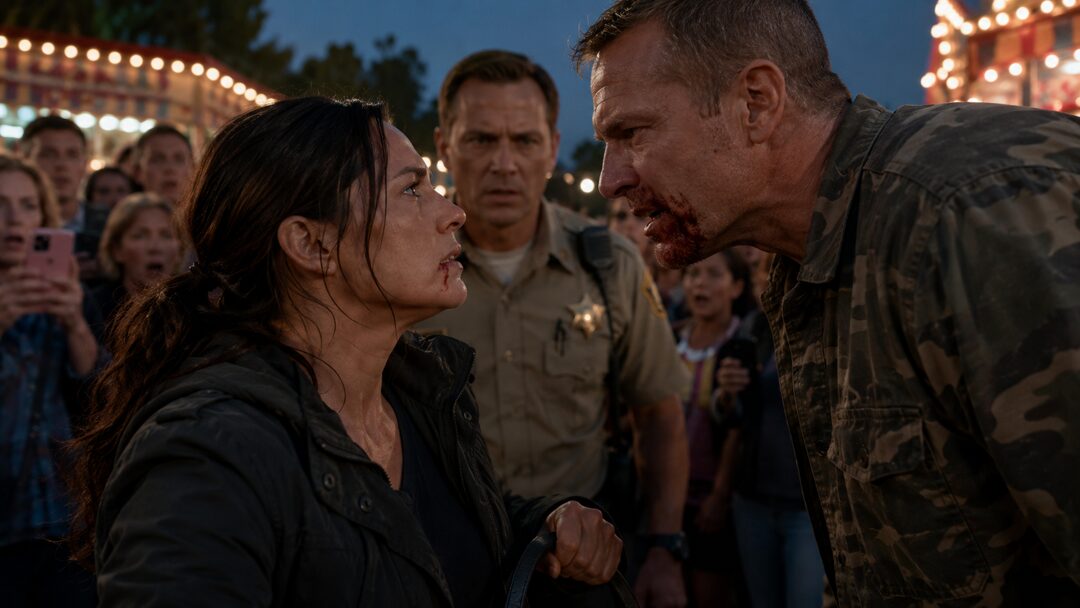
And Sergeant Mark Reynolds was shouting so close to Laura’s face that she could smell beer, copper, and old rage on his breath.
“Tell them,” Mark said. His camouflage jacket was smeared dark near the collar. One corner of his mouth had split open from whatever had happened near the beer tent before he found her. “Go ahead. Tell them what really happened.”
Laura’s lip throbbed where he had clipped her with the back of his hand when she turned away from him the first time.
She did not wipe it.
She did not step back.
Her fingers tightened once around Ranger’s leash.
“Walk away, Mark,” she said. “Before you make this night something nobody can repair.”
A phone rose in the crowd.
Then another.
Laura saw the screens before she saw the people holding them. Bright little rectangles. Hungry little witnesses. The fair had been full of flags an hour ago, full of applause and speeches about service and sacrifice. Now it was full of strangers filming a decorated man in uniform cornering a woman with a dog.
Mark noticed the phones too.
Instead of calming him, they fed him.
“You hear that?” he shouted over his shoulder, giving the crowd a hard smile. “She wants me to walk away. That’s what she does. When things get hard, Laura Mitchell walks away and lets the dog decide.”
Ranger’s eyes never moved from Mark’s right boot.
That was the thing Laura could not explain to anyone without explaining everything.
“Easy,” she murmured.
Ranger’s ears flicked back at her voice. His body answered before his eyes did. His front shoulders lowered half an inch. He had heard the command. He had accepted it.
But he did not relax.
He glanced up at Laura once, quick and searching, waiting for something warmer.
She did not say it.
She had not said it in almost two years.
Mark saw the tiny pause between handler and dog. His face changed.
There were men who became smaller when they lost control. Mark became larger. Louder. He filled the space with his chest, his rank, his history, the applause that still clung to him from the grandstand.
“You still won’t say it to him,” he said, quieter now, and worse. “Even after all this time.”
Laura’s jaw tightened.
The crowd did not know what he meant.
Ranger did.
Somewhere beyond the food trucks, the first test firework cracked faintly in the dark.
Ranger’s muscles jumped.
Laura turned her left wrist, shortening the leash by a few inches.
“Easy,” she said again.
Not the other words.
Never the other words.
Mark laughed once, without humor. “That’s right. Keep him locked down. Wouldn’t want people to see what he really is.”
A woman in a county fair sweatshirt pulled her son back. The boy had been staring at Ranger with open wonder. Now his mother looked afraid.
Laura felt that small change move through the crowd.
Fear was contagious. So was a uniform.
Mark knew both.
“He shouldn’t be here,” he said, pointing at Ranger. “That dog should’ve been put down after Kandahar.”
Laura felt the leash go hot in her palm.
Not because Ranger moved.
Because he didn’t.
He only stared harder at the boot.
Part II — Public Honor
Sheriff David Harris reached the edge of the crowd and stopped.
Laura saw her brother’s tan shirt before she saw his face. Broad shoulders, radio clipped high, one hand low and ready. David had worn the same careful expression at their mother’s funeral, at Laura’s discharge hearing, and the first night Ranger came home and refused to sleep unless his body blocked Laura’s bedroom door.
Careful meant afraid.
Careful meant he was deciding how much of Laura’s life he could manage before she noticed.
“Laura,” David said, his voice low. “Let’s step over here.”
Mark turned on him. “Sheriff. Perfect. You can hear it too.”
“No one needs a scene,” David said.
Mark smiled. “Then she shouldn’t have brought one.”
“I came for the exit,” Laura said. “Ranger reacted to the fireworks. I was leaving.”
Mark leaned closer. “You came because they were honoring me.”
The words landed harder than his hand had.
Behind him, veterans from the ceremony stood in small clusters, their dress shirts tucked in, their caps low, their faces caught between loyalty and curiosity. They knew Mark. They had clapped for him. Some had shaken his hand near the stage.
Most of them knew Laura only as David Harris’s sister. The one who had come back quiet. The one with the dog. The one who never attended ceremonies, never joined the veterans’ breakfast, never stood when people asked former service members to be recognized.
Mark looked at those men and women now like they were his jury.
“She ruined my career,” he said. “She left a man behind, then hid behind that animal like it made her brave.”
Laura said nothing.
That was the first rule she had made for herself after the inquiry. Silence was ugly, but it stayed where you put it. Truth moved. Truth entered rooms and changed the furniture. Truth made mothers ask new questions about sons who were not coming home.
David stepped closer. “Mark, you’ve had a long night. Let me walk you over to the medical tent.”
“I don’t need a medic.”
“You’re bleeding.”
“So is she,” Mark said, and looked back at Laura with satisfaction.
The crowd shifted.
Laura felt the humiliation then. Not as heat, but as cold. The county fair lights made everything visible: the split in her lip, the dirt on her jeans, the old field jacket she should have thrown away. Her hand on the leash. Ranger’s teeth hidden behind his closed mouth.
A man near the lemonade booth whispered, “Is that dog safe?”
Ranger heard the whisper. His ears moved.
Laura did not look away from Mark.
“He is safe,” she said. “As long as people are.”
Mark’s eyes flashed.
Then he used the voice.
“Handler,” he snapped. “Heel your dog.”
The word cut through the fair noise.
Ranger moved before Laura could stop him.
Not forward. Not loose. Just into the old shape. Left shoulder aligned to Laura’s knee. Spine straight. Head angled toward threat. Ready, because that voice had once meant command, dust, doorways, alleys, and men with their hands up yelling in a language Laura still heard when she woke too quickly.
The crowd saw obedience.
Laura felt the damage beneath it.
Mark did too.
His smile twisted. “Look at that. Still remembers who outranked you.”
Laura’s thumb pressed against the leash clip.
“Do not give my dog commands,” she said.
“Your dog?” Mark took one step closer. “He was unit property.”
“He’s retired.”
“So were you.”
That got a laugh from someone who did not understand why nobody else joined in.
David’s eyes moved to Laura’s hand. “Laura.”
“I have him.”
“I know you do.”
But he said it like he was trying to convince himself.
Mark lowered his voice again. “You always did have him. Had him watching you, waiting for you, choosing you. Even when a man was down.”
Laura’s breath caught so faintly only Ranger heard it.
He turned his head toward her.
Again, he waited for the phrase.
Again, she did not say it.
Because the last time she had said it, Brian Lewis had still been breathing.
Part III — The Name
The fair loudspeaker crackled behind them.
“Ladies and gentlemen, fireworks will begin in approximately fifteen minutes near the south field. Please keep a safe distance from the launch area.”
A child cheered.
Ranger did not.
His breathing changed.
Laura lowered her hand, two fingers touching the side of his neck. Not petting. Measuring. Counting the tremor under his coat.
“We’re leaving,” David said.
“No,” Laura said.
Her brother stared at her. “Laura.”
“If I leave now, he tells it again.”
“Let him talk.”
“He’s been talking for two years.”
Mark heard that. Of course he heard that.
“And you’ve been hiding for two years,” he said. “Behind your brother. Behind that leash. Behind procedure.”
Laura turned to him slowly.
The word procedure opened something old and airless.
A rooftop radio cutting in and out.
A narrow alley washed in beige light.
Ranger’s low warning growl.
A child’s face behind a hanging sheet.
Mark’s voice in her headset: Send him.
Laura’s own voice: Negative.
Then Brian moving anyway, because Mark had said go, and Brian had believed command was the same as truth.
Laura blinked once, and the fair came back.
Mark was still there. Older. Red-eyed. Alive.
Brian was not.
Mark stepped close enough that Ranger’s front paws dug into the dust.
“You want to tell them?” Mark asked. “Tell them how Corporal Brian Lewis called your name.”
Ranger broke.
The bark came out of him like a door kicked open.
People screamed and stumbled back. Powdered sugar flew from a paper plate. A teenager dropped his phone and grabbed it again without looking away.
Ranger lunged half a foot before Laura’s hand locked.
“Down,” she said.
The word was soft.
It should not have carried.
It did.
Ranger dropped low to the ground, chest near the dirt, teeth visible, a growl rolling through him so deep Laura felt it up the leash.
He was not looking at Mark’s face.
He was looking at the boot.
The right boot.
Mark saw it then. Really saw it.
For the first time that night, fear crossed his face cleanly enough that everyone could recognize it.
Not fear of being bitten.
Fear of being known.
Laura felt the whole scene tilt.
“Mark,” she said, and now her voice was different. “What do you have?”
His eyes snapped to hers. “Nothing.”
Ranger’s growl deepened.
David moved between two fairgoers, one hand out toward the crowd. “Everybody step back.”
Nobody did.
Phones rose higher.
The fair had gone silent in the strange way loud places do when everyone is still making noise but nobody is laughing. Music played somewhere. A ride clanked. A vendor asked someone to move away from the fryer.
But around Laura, Mark, Ranger, and David, the air was tight enough to tear.
Mark pointed down at Ranger. “You see this? You all see this? He’s unstable.”
“He’s indicating,” Laura said.
Mark’s jaw worked. “He’s a dog.”
“Yes,” she said. “That’s why he isn’t lying.”
The line moved through the crowd before anyone understood it.
Mark did.
His face hardened, but the hardness did not fit anymore. It looked placed there by habit.
“You don’t get to talk about lying,” he said.
Laura’s fingers tightened around the leash until the nylon cut her palm.
David leaned in close. “What is Ranger smelling?”
Laura did not answer.
Because if she said it, the night would have to become something else.
And Mark knew that too.
He smiled again, but now it shook at the edges.
“Careful, Laura,” he said. “You open that door, you don’t get to choose who comes through.”
Part IV — The Collar
David touched Laura’s elbow.
It was gentle. It was brotherly. It was exactly wrong.
Ranger’s head snapped toward his hand.
Laura pulled her arm free before the dog had to decide.
“Don’t,” she told David.
“I’m trying to help you.”
“I know.”
That was the problem. David had been trying to help her since she came home. He had helped by telling neighbors not to ask questions. Helped by changing the subject when someone mentioned Mark. Helped by putting his patrol car outside her house the week Ranger woke barking every night at 3:17.
He loved her like she was breakable.
But she had not survived by being unbroken.
She had survived by holding the pieces in formation.
“If you pull me away,” she said quietly, “Ranger may read it as restraint under threat.”
David’s face changed. “Then tell him to stand down.”
“I have.”
“All the way.”
Laura looked at Ranger.
He lay low, shaking with effort, eyes fixed on Mark’s right boot.
All the way would mean telling Ranger that what he knew did not matter.
She had done that to him for two years.
No.
Not tonight.
Mark laughed under his breath. “Still hiding behind procedure.”
The word hit the dog before it hit Laura.
Ranger snarled.
David’s hand went up. “Mark, stop talking.”
Mark ignored him. He moved in so fast that several people gasped before Laura could shift her weight.
His fist caught the front of her field jacket.
Not a strike. Worse.
A claim.
He grabbed her by the collar and yanked her close enough that the old unit patch on his sleeve brushed her chest.
“You don’t get to stand there like you were clean,” he said.
For one half-second, Laura saw him not as the shouting man at the fair, but as he had been in the alley light: certain, furious, young enough to believe certainty could save everyone.
Then Ranger erupted.
The leash snapped tight.
His bark slammed into the crowd.
Mark’s eyes widened as Ranger came off the ground—not at his arm, not at his throat, not at the hand twisted in Laura’s jacket.
At his right boot.
Laura had one heartbeat to decide.
If she hauled Ranger back too hard, he could redirect. If she released him fully, he could destroy Mark’s leg. If she gave the wrong command, the crowd would remember only the teeth.
So she did what she had spent years training to do.
She made the smallest choice that could still save the moment.
“Hold,” she commanded.
Ranger hit Mark’s boot with both front paws and an open-mouthed snarl, pinning it to the dirt.
Mark shouted and stumbled backward, dragging Laura half a step before releasing her collar. David caught Laura by the shoulder, then let go immediately when Ranger’s growl sharpened.
“Hold,” Laura said again.
Ranger held.
Not biting flesh.
Not letting go.
His teeth worked at the tucked cuff of Mark’s boot, pulling at something hidden there.
Mark kicked once.
Ranger snarled so violently Mark froze.
“Get him off me!” Mark yelled.
“Then stop moving,” Laura said.
There was no softness in her now. No panic either.
Only command.
David moved toward Mark. “Hands where I can see them.”
“You’re serious?” Mark’s voice cracked. “You’re taking her side?”
“I’m taking control of my fairground,” David said.
But he looked at Laura when he said it.
For once, he did not tell her to leave.
Ranger jerked his head back.
Something came loose from inside Mark’s boot and fell into the dust.
A small wrapped bundle.
For a second, nobody moved.
Then the cloth opened.
A metal unit tag slid out first, catching the carnival light.
After it came a narrow strip of torn harness webbing, dark with old staining no rain had washed clean.
Laura knew the tag before she saw the name.
Brian Lewis.
Her mouth went dry.
Mark stared at the objects like Ranger had pulled his heart out and dropped it in public.
“No,” he said.
It was not denial.
It was pleading.
Laura looked from the tag to Ranger, from Ranger to Mark.
All the rage in Mark’s face had been hiding this.
Not proof.
Punishment.
He had carried Brian at his ankle for two years, every step a private sentence, every polished boot a sealed confession.
The crowd was silent now.
Even the phones seemed ashamed to be recording.
Ranger stood over the tag and harness strip, teeth bared, body trembling.
Waiting.
Always waiting for Laura to tell him what the truth was allowed to do.
Part V — What the Dog Knew
“Ranger,” Laura said.
The dog did not move.
Mark swallowed hard. “That was mine to carry.”
Laura looked at him.
His voice was smaller now, but not gentle. Mark had not become innocent just because he had become wounded.
“Brian was under my command,” he said. “You don’t get to take him from me too.”
Laura’s split lip pulsed. Her throat burned. The whole fair seemed to lean toward her.
She could let Ranger hold Mark there until David cuffed him. She could say nothing. She could let the crowd decide from the boot, the tag, the strip, the shouting, the collar.
For one sharp second, she wanted that.
She wanted Mark reduced to the thing he had made of her: a story other people told badly.
Then Ranger’s growl shuddered.
Not from anger.
From effort.
Laura saw him clearly then. Not as a symbol. Not as a weapon. Not as proof.
As a dog who had obeyed every silence she put on him.
A dog who had dragged Brian back by a harness strap while Laura screamed herself hoarse into a radio that answered only with static.
A dog who still checked her face after every command, waiting for the praise that meant the danger had passed.
Laura stepped forward.
David caught his breath. “Laura—”
“I have him,” she said.
This time, he believed her.
Laura moved between Ranger and Mark.
Ranger’s head lifted, confused, furious, faithful.
“Off,” she said.
He resisted for half a heartbeat.
Laura did not raise her voice.
“Ranger. Off.”
The Malinois stepped back.
Only one step.
Enough.
Mark’s knees bent as if his body had lost the argument before his mouth could. David moved in, not grabbing, just placing himself where Mark would have to go through him to reach Laura again.
Laura crouched and picked up the tag.
Brian Lewis.
A name should have been heavier than metal.
She held the torn harness strip in her other hand. Her thumb found the edge where Ranger’s gear had ripped that night. She had washed her own hands until the skin split afterward, but some things did not come clean because they were never only on the skin.
Mark stared at her. “Don’t.”
Laura stood.
The crowd waited.
She did not give them a speech. She did not give them the whole mission, the coordinates, the reports, the official language that had turned people into entries and choices into conclusions.
She gave them what mattered.
“Mark ordered Ranger forward into an uncleared alley,” she said.
Mark’s face twisted. “You don’t know what I saw.”
“I saw a child.”
That quieted even him.
Laura looked at the veterans first. Not the phones. Not the fairgoers who wanted a simple villain and a simple hero. The veterans.
“I countermanded him,” she said. “Brian followed Mark’s order anyway.”
Mark shook his head once.
Laura kept going before silence could protect him again.
“There was a blast. Brian went down. Ranger went in after him before anyone could reach the alley.”
Her voice nearly failed on the next part, so she made it smaller.
“He dragged Brian back by this.”
She lifted the strip of harness.
Ranger whined once.
It was the first soft sound he had made all night.
Laura did not look at him yet. If she did, she might not finish.
“Afterward, Mark said my hesitation cost Brian his life. I didn’t fight it. Brian’s mother had already lost enough. The unit had already lost enough. I thought silence was loyalty.”
Her eyes moved to Mark.
“It wasn’t.”
Mark looked ruined, but not relieved. His mouth opened and closed. The old command presence was gone, and without it he seemed almost ordinary. A man with blood at his mouth. A man in a dirty jacket. A man who had needed obedience to mean forgiveness.
“You let them pin it on me,” he said.
Laura’s expression changed.
Not anger.
A colder kind of sorrow.
“No, Mark. You pinned it on me. I let you.”
David’s hand came down gently on Mark’s shoulder.
This time Mark did not shake him off.
One of the older veterans near the front removed his cap. Another looked away. A woman with a phone lowered it to her chest, still recording the dirt.
Mark looked at the tag in Laura’s hand.
“He called your name,” he whispered.
Laura closed her fingers around the metal.
“I know.”
“You heard him.”
“I know.”
“He should have called mine.”
There it was.
Not the whole truth. Not redemption. Not enough.
But the thing under the thing.
Mark had not come to the fair only to shame her.
He had come because the town had clapped for him, and applause had finally become unbearable.
Laura’s voice softened by one degree.
“He trusted you.”
Mark flinched.
“Brian trusted all of us,” she said. “That’s why it matters what we do with his name.”
David guided Mark back. Not roughly. Not ceremoniously. Just away from Laura, away from Ranger, away from the center of the lights.
Mark went three steps before turning.
For a moment Laura thought he would lunge again, shout again, rebuild himself out of noise.
Instead, he looked at Ranger.
The dog stared back.
Mark lowered his eyes first.
Part VI — Good Watch
The fair did not know how to restart.
People knew how to gather around spectacle. They did not know how to leave after truth.
David spoke first, voice firm enough to give everyone permission to move. “Give them room.”
A deputy Laura had not noticed began pushing the circle wider. Someone picked up the dropped funnel cake plate. A mother told her son not to stare, then stared herself. The loudspeaker crackled again and announced the fireworks as if nothing had happened, as if the sky had kept its schedule.
Mark stood near the side of the walkway with David between him and the crowd.
No cuffs.
No grand punishment.
Just distance.
Some of the men who had clapped for him earlier would not meet his eyes now. One did. The older veteran with the cap. He stepped close to Mark, said something Laura could not hear, and Mark bent forward like the words had weight.
Laura did not ask what would happen next.
Reports would be reopened or not. Men would deny things or remember them differently. The town would talk by morning. Videos would spread with captions that got almost everything wrong.
But not everything.
Laura still held Brian’s tag.
Ranger stood beside her, trembling so hard now that the movement reached the leash.
Only then did Laura kneel.
She checked his mouth first.
That was habit. Duty before comfort. Teeth, gums, tongue, no blood that belonged to him. She ran her fingers along his muzzle, over the pale scar near his nose, under his jaw where his pulse hammered like a fist.
“You’re okay,” she whispered.
Ranger pressed forward until his forehead touched her shoulder.
Laura closed her eyes.
Around them, the fair lights blurred. Gold and red and blue. Cheap prizes swinging from hooks. Flags along the grandstand. Dust in the air. Children being pulled away and looking back because children knew when adults had failed to explain the important part.
Ranger shifted, waiting.
Laura felt it.
The old space after a mission. The moment when the dog had done the job and needed to be told the job was done. She had denied him that comfort for two years, as if withholding the words could keep Brian’s death from becoming real.
Ranger waited anyway.
Faithful things often waited longer than they should.
Laura placed one hand flat against his chest.
Her voice broke only after the words began.
“Good watch, Ranger.”
The dog exhaled into her jacket.
Not a dramatic collapse. Not healing. Just one breath leaving a body that had carried it too long.
Laura bowed her head against him.
David came back a minute later. He stopped a few feet away, close enough to guard, far enough not to manage.
“You ready?” he asked.
Laura looked up.
Her brother’s eyes were wet, but he did not reach for her. That was how she knew something had changed.
“Not yet,” she said.
David nodded. “Okay.”
A small object rolled near Ranger’s front paws.
Laura turned.
A girl in a pink sweatshirt stood half-hidden behind her father’s leg. She had won one of the stuffed dogs from the ring toss booth, a floppy brown thing with a blue ribbon around its neck. It lay in the dust now, close to Ranger but not touching him.
The girl’s father began to apologize. “Sorry, Sheriff, she—”
Laura lifted one hand slightly.
The apology stopped.
Ranger looked at the toy.
Then at Laura.
Asking.
Always asking.
Laura almost said no. The world was still too sharp. The noise too close. The fireworks too near. Mark still stood only yards away with David’s deputy watching him. Brian’s tag still pressed its shape into Laura’s palm.
But the stuffed dog lay there absurd and soft under the same lights that had exposed everything else.
Laura loosened the leash by one inch.
“Go on,” she said.
Ranger lowered his head and sniffed the toy carefully, as if it too might carry a message from the past.
The girl smiled.
Not wide. Not fearless.
Just enough.
Above the fairground, the first firework opened soundlessly for a split second before the boom arrived.
Ranger flinched.
Laura’s hand was already on him.
He did not bark.
He leaned into her knee, and she held Brian’s tag in one hand, Ranger’s leash in the other, standing between what had happened and whatever would have to come next.
The lights kept shining.
They did not make anything clean.
But they let her see what remained.