They Laughed at the Rusted Fragment Until the Officer Read the Name Raymond Never Said
Chapter 1: The Old Man Who Brought Rust to Court
The rusted fragment slipped from Raymond Harris’s hand at the security table and struck the tray with a sound too small for the room, but loud enough to make the security officer look up.
It was not sharp enough to be a weapon anymore. Not clean enough to be evidence, either. It lay there in the gray plastic tray like something swept from a garage floor, brown at the edges, black in the grooves, one side pitted where heat had once eaten through metal.
The officer lifted a gloved hand toward it, then stopped.
“What is that supposed to be?”
Raymond looked at the fragment before he looked at the man. He had worn his dark suit because the letter had said formal review. He had chosen the white shirt because it still buttoned at the collar. The burgundy tie had taken him three tries in the motel mirror, and the knot sat slightly low, pressing against the hollow in his throat.
“It goes with the file,” he said.
The officer’s eyes moved to the folder under Raymond’s left arm. Its corners had softened from years in drawers and boxes. A rubber band held it closed. Inside were photocopies, black-and-white photographs, three handwritten notes, and a page Raymond had stared at long enough to know every blank space on it.
“We don’t allow loose metal objects into the hearing room.”
Raymond reached for the tray. “Then I can leave.”
The officer frowned, as if the answer had been rude. “Sir, that’s not what I said.”
Behind Raymond, someone in uniform sighed. The lobby was not full, but it had the tight impatience of a place where everyone believed their reason for being there outranked everyone else’s. Shoes tapped. A clerk behind glass called numbers. The flag in the corner hung motionless beside a framed photograph of a commander Raymond did not recognize.
A younger man in a navy blazer stepped forward from behind him.
“He’s here for the records board,” Timothy Young said. “Case number should be under Harris.”
The security officer glanced from Timothy to Raymond. “This yours?”
“I’m assisting him.”
“That’s not what I asked.”
Raymond picked up the folded white handkerchief from the tray and opened it with his thumb. The fabric was clean except for the permanent reddish shadow in the center. He placed the fragment back into its shallow stain, folded once, then again.
“It won’t leave my hand,” he said.
The officer looked at him a moment longer. Something in Raymond’s voice made the room quieter around them, though not kinder.
“Fine. But if the board asks for it, you hand it over.”
Raymond closed his fingers around the handkerchief. “No.”
Timothy gave him a sharp look. “Mr. Harris—”
“No,” Raymond repeated, softly enough that only the two men nearest him heard. “Not unless they ask right.”
The officer stared at him, then waved him through.
Timothy leaned close as they crossed into the hall. “You can’t start like that. We need them patient, not irritated.”
Raymond kept walking. The building smelled of floor wax, paper, and coffee gone cold in government pots. Down the hall, glass cases displayed medals and unit plaques polished by people who had not earned them and probably handled with more care than living men at the counter.
“I didn’t come for patience,” Raymond said.
“You came for a correction. That means rules, Mr. Harris. Procedure. You heard what they said in the prep call. They’re already skeptical because the request is late.”
Raymond stopped outside the hearing room door. The brass plate read MILITARY RECORDS REVIEW BOARD. Under it, a sheet of paper listed the morning’s cases. His name was third.
Not the name he had come for.
He pressed his thumb into the fold of the handkerchief until he felt the hard crescent under cloth.
Timothy softened his voice. “I know this matters. But when they ask why you waited this long, you need to answer clearly.”
Raymond looked at the closed door. He could hear voices inside, a chair dragging, someone laughing at something unrelated to him. Laughter in official rooms always sounded the same to him: careless because it believed itself safe.
“I answer what belongs to me,” he said.
“And the rest?”
Raymond did not reply.
The hallway receptionist opened the door and called, “Harris case.”
Timothy reached for the folder, but Raymond held it tighter. He had let people carry rifles, stretchers, radios, men too heavy with blood and mud to be lifted alone. He had let officers carry orders into rooms where the truth never came out whole. This folder, he carried himself.
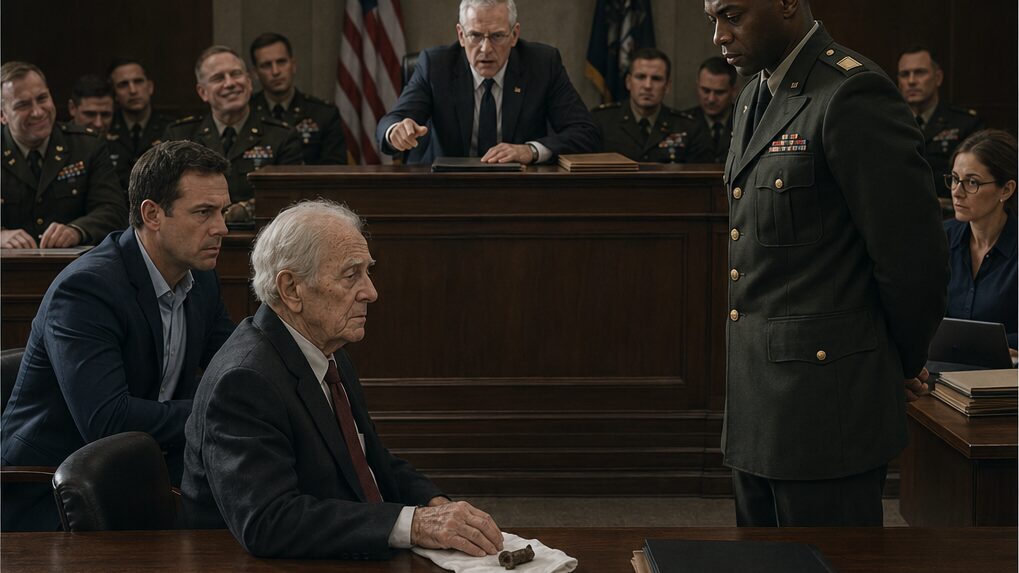
The hearing room was smaller than the word court made it sound, but it knew how to make a man feel low. Three board seats stood raised behind a long desk. A court recorder sat below them. A flag stood at each side. On the right, several uniformed observers occupied two rows, some with tablets, some with folded arms, all with faces trained to show nothing until they did.
Paul Robinson sat at the center of the board, silver hair trimmed close, glasses folded beside one hand. He did not look cruel. That almost made it worse. Cruel men announced themselves. Tired men with authority could cut deeper because they believed they were simply keeping order.
“Mr. Raymond Harris,” Paul said, reading from the file in front of him. “Petition for amendment of archival casualty and evacuation record. Claim filed on behalf of another service member’s family.”
Raymond stood at the table until the bailiff told him he could sit.
Timothy took the chair beside him and set out his pen. Raymond laid the old folder on the table. Then, after a breath, he placed the folded handkerchief beside it.
A uniformed observer in the second row leaned toward another and whispered, “Is that his lunch?”
The other man covered a laugh with his hand.
Raymond heard it. He kept his eyes on the board.
Paul glanced at the handkerchief, then back to the packet. “Before we begin, Mr. Harris, I want to be clear. This board does not reconsider records based on personal memory alone. We require substantiating documentation, service records, official reports, corroborating statements, or material evidence with chain of custody.”
Raymond nodded once.
“You understand that?”
“Yes.”
Paul turned a page. “Your submission includes photocopied photographs, a partial evacuation map, a personal statement, and what you describe as a recovered shell-casing fragment.”
Raymond’s hand closed slowly over the handkerchief.
Paul looked over his glasses. “Do you have the object with you?”
“Yes.”
“Place it on the table.”
Raymond unfolded the cloth.
The fragment looked smaller under the hearing room lights. Meaner, somehow. Less like memory. More like trash.
The court recorder leaned forward. One of the observers gave a short breath of amusement before swallowing it.
Paul did not smile, but his mouth tightened.
“Mr. Harris,” he said, “this case was previously deemed unsupported.”
Timothy shifted beside Raymond, ready to speak.
Raymond touched the fragment with two fingers and slid it forward until it rested in the bare center of the table.
Paul’s eyes followed it.
Raymond said nothing.
Chapter 2: The File With the Missing Name
Paul Robinson let the silence sit only long enough to show he controlled it.
“For the record,” he said, “the petitioner has placed a rusted metal fragment on the table. No evidence tag, no certified recovery record, no witness chain attached to the object itself.”
The court recorder’s keys clicked softly.
Raymond watched the woman’s hands move. He had always noticed hands. Men gave themselves away there: fear in knuckles, anger in thumbs, guilt in stillness. Nicole Williams, seated at the records station below the board, turned pages with the care of someone who hated being rushed but had learned not to show it.
Timothy leaned toward his microphone. “The fragment is not being offered as standalone proof. It corresponds to Mr. Harris’s personal statement and the photographs submitted—”
“Mr. Young,” Paul said, “you’ll have your opportunity.”
Timothy sat back, jaw tight.
Paul looked at Raymond. “Mr. Harris, this request concerns the record of a soldier listed in the archived evacuation report as presence unconfirmed. You are asking the board to amend that line.”
“Yes.”
“To deceased in action while assisting an evacuation.”
“Yes.”
“And you base this request primarily on your memory of events more than fifty years old.”
Raymond lowered his eyes to the page Paul was holding. He did not need to see the words. They had lived in him too long.
“No,” he said. “I base it on the fact that he was there.”
A board member on Paul’s left shifted. “That is memory, Mr. Harris.”
Raymond did not answer.
Paul opened a folder. “The official report from that date identifies personnel confirmed at checkpoint Delta, transport line three. It lists twelve evacuated, four wounded, two deceased confirmed, and one unconfirmed. The name you are asking us to alter appears in the unconfirmed line.”
“It shouldn’t.”
“Because?”
“Because I saw him.”
Paul waited. “Doing what?”
Raymond’s fingers moved against his knee under the table. Once, twice. Not shaking. Counting.
“Keeping the line open,” he said.
A faint sound passed through the observers. It was not laughter this time, not quite. It was the sound people made when they expected a story and received a stone.
Paul glanced at Timothy. “Is there a sworn statement from any other surviving witness?”
“No,” Timothy said. “Most members of the unit are deceased. Two could not be located. One declined comment due to medical condition.”
“And the family?”
Timothy’s mouth tightened. “The family is present.”
Raymond did not turn.
He had known Ruth Allen was in the room from the moment he entered. Not by seeing her. By the space behind him that refused to breathe easily. She sat somewhere on the left, away from the uniformed observers. He had seen her once in the hallway when she was a girl standing beside a woman in a black coat, clutching a folded flag she was too young to understand. That had been after the first letter, before the file closed and the calls stopped being returned.
He had not spoken to her then.
That was one of the things he carried without wrapping.
Paul lifted a photograph from the packet. “Let’s discuss the submitted image.”
Nicole rose and took a copy to the display screen. The photograph appeared enlarged on the wall: grainy, sun-bleached, men in dirty uniforms near a transport truck. One face near the edge had been circled in black ink. The circle was old enough that the ink had faded brown.
Raymond looked at the photograph the way he always did: first at the circled face, then at the hand visible beside the truck bed, then at the patch of road behind them where the dust blurred.
“That circle was added by you?” Paul asked.
“Yes.”
“When?”
“Nineteen seventy-one.”
Paul looked up. “You circled this face the year after the incident?”
“Yes.”
“But you did not submit it then.”
Raymond’s mouth became a line.
Timothy moved again, but Raymond spoke before him.
“I submitted a statement.”
Paul checked the folder. “There is no statement from you in the original adjudication file.”
“I know.”
Nicole, at the records station, paused with one page halfway turned.
Raymond saw it. A small hesitation. The kind most men on boards missed because they were listening only for words.
Paul continued. “The record before us does not contain one.”
“That’s why I’m here.”
Ruth Allen made a sound behind him. Not quite a laugh. Not quite pain. Raymond kept his face forward.
The board member on the right tapped the photograph. “This image does not clearly identify the circled individual. The face is partially obstructed.”
“He had his head down because he was lifting the rear chain.”
“You can’t see that in the photograph.”
“No.”
“Then how can the board rely on it?”
Raymond looked at the circled blur. “Because I was holding the other end.”
The room went still, but not in belief. In inconvenience.
Paul took off his glasses and rubbed the bridge of his nose. “Mr. Harris, you must understand the difficulty. You are asking this board to alter a military record affecting casualty status, family history, and potential benefits based on a photograph that does not clearly identify the soldier, an object with no chain of custody, and a personal claim not present in the original file.”
Raymond nodded.
“Do you have any explanation for why your alleged original statement is missing?”
“No.”
Nicole looked down at the packet again. Her thumb moved back two pages, then forward three. The motion was careful enough to hide from the room and obvious enough for a man who had spent his life watching hands.
Paul turned toward her. “Ms. Williams?”
Nicole straightened. “Yes, sir.”
“Do we have the certified page sequence from the archive?”
“Yes, sir.”
“Any indication of attachment beyond the listed exhibits?”
She glanced at the file. “The index lists exhibits A through F.”
“And the packet contains?”
“A through E in the copy provided to the board.”
Paul’s eyes sharpened. “Missing F?”
Nicole’s throat moved. “It appears so in this working copy, sir. I would need to verify against the sealed archive scan.”
Timothy sat forward. “That’s significant.”
Paul held up a hand. “It may be clerical.”
Raymond looked at the fragment. Clerical was a clean word. It had no mud on it. No flies. No man pressing metal into another man’s palm because his own hand could not close anymore.
Paul turned back to him. “Mr. Harris, until and unless that document exists and supports your claim, we cannot treat absence as proof.”
“I didn’t ask you to.”
“What are you asking?”
Raymond looked, finally, toward the left side of the room.
Ruth Allen sat in the second row, hands locked around a worn envelope. She was not young anymore. Lines at her mouth. Gray at the temples. Her eyes had the guarded anger of someone who had spent years deciding grief was safer than hope.
Raymond looked away before she had to.
“I’m asking you to put his name where it belongs,” he said.
Paul studied him. “And you brought us that piece of metal to do it?”
Raymond did not touch the fragment. “He did.”
A murmur moved behind him.
Paul’s patience thinned into formality. “Mr. Harris, unless you can provide something real besides that piece of rust, this board has very little basis to continue.”
Raymond looked at the fragment under the white lights and heard, from somewhere far beneath the room, the old sound of chains striking a truck bed.
Chapter 3: When the Room Laughed at Evidence
The word rust stayed in the air longer than Paul Robinson intended.
It reached the back row first, where one of the uniformed observers breathed a laugh through his nose. Then another man leaned back, lips pressed together, shoulders shaking once before he controlled himself. No one laughed loudly enough to be called out. That made it worse. The room did not become cruel all at once. It became careless by degrees.
Timothy turned, angry. “This is a formal hearing.”
Paul gave him a warning look. “Mr. Young.”
Raymond lifted one hand slightly from the table. Not to stop Paul. Not to defend himself. Only to keep Timothy from spending anger in the wrong place.
Timothy saw the motion and went still.
Raymond looked at the fragment. Its broken edge had worn smoother with the years, but one corner remained jagged. He had wrapped it in cloth through six apartments, two storage units, one nursing facility he had left after eleven days, and every winter coat he had owned since 1970. It had sat in drawers beside unpaid bills, under socks, inside a tobacco tin though he had never smoked. Once, a home aide had found it and asked if she should throw away the old junk.
He had said no too fast. She had looked frightened for the rest of the afternoon.
Paul closed the folder halfway. “We will take a brief recess after this line of questioning. Mr. Harris, for clarity, please describe what you believe this object to be.”
Raymond touched the handkerchief, not the metal.
“A fragment from a shell casing.”
“Recovered where?”
“Checkpoint Delta approach road.”
“What date?”
Raymond gave it.
“And you personally recovered it?”
“No.”
Paul waited.
Raymond’s eyes stayed on the table. “It was given to me.”
“By whom?”
The name rose in him, complete and heavy.
He did not say it.
A chair creaked behind him. Ruth, perhaps. Or someone else impatient with old men who made everyone walk slowly through pain.
Paul’s tone cooled. “Mr. Harris, you can’t ask this board to amend a record while refusing to answer basic questions.”
Raymond nodded once.
“Then answer.”
The door at the back of the hearing room opened.
Raymond did not turn. He had spent too many years learning not to look at every sudden sound.
Paul glanced past him with irritation. “This session is closed to late entry until recess.”
A man’s voice answered from the doorway. “Apologies, sir. Records liaison ordered to attend Harris review.”
The room shifted. Boots on the floor. A chair leg bumped. Paper moved.
Raymond saw the effect before he saw the man. The observers straightened. Nicole’s eyes lifted from the file. Even Paul adjusted his posture.
The officer who entered wore his uniform the way some men wore responsibility: not stiffly, not for display, but with the quiet awareness that cloth could carry more than a body. He was younger than Raymond by decades, Black, tall, with a controlled face and a folder tucked under one arm.
Paul frowned. “Identify yourself.”
“Alexander Moore, sir. Records liaison, casualty review support. I was notified of a possible archival inconsistency.”
Nicole looked down quickly at her desk, as if she had not been the one to send the message.
Paul saw it anyway.
“Take a seat, Officer Moore. We are not yet at recess.”
Alexander moved toward the side row, then stopped.
His eyes had fallen to the table.
Not to Raymond first. Not to the photograph. To the fragment.
Raymond felt the room narrow around that small piece of metal.
Alexander took one step closer. “Sir, may I approach the table?”
Paul’s irritation deepened. “For what purpose?”
Alexander did not take his eyes off the fragment. “I’d like to confirm something visually.”
Timothy looked from him to Raymond. The observers were quiet now, interested in the way people became interested when authority noticed what they had just dismissed.
Paul gave a short nod. “Proceed.”
Alexander came to the table slowly. He did not reach down. That was the first thing Raymond noticed. He bent slightly, hands behind his back, reading the metal with his eyes instead of claiming it.
The fragment’s outer curve faced the light. Near the pitted edge, beneath rust and blackened scoring, were three shallow marks Raymond had not looked at directly in years: D-3 and half of another stamp, cut away by the break.
Alexander’s jaw tightened.
“Who handled this?” he asked.
Paul said, “The petitioner placed it on the table.”
Alexander turned to Raymond.
For the first time that morning, someone in uniform looked at him as if waiting mattered.
“Sir,” Alexander said, voice lower, “may I ask permission to look closer?”
The room changed at that word.
Permission.
Raymond’s throat worked once. He slid the handkerchief open wider and turned the fragment with two fingers.
Alexander leaned in. His eyes moved over the partial code. Then to the photograph on the display. Then to the hard copy lying near Raymond’s folder.
“D-three,” Alexander said quietly.
Paul adjusted his glasses. “Officer Moore?”
Alexander stood straight. “Checkpoint Delta, transport line three.”
Paul’s expression sharpened. “That information is in the submitted claim.”
“No, sir.” Alexander looked at Nicole. “Not the way this is.”
Nicole had risen without seeming to decide to. “The archived map code uses D-3 only on internal route overlays. Public report says Delta line three.”
The board member on the right frowned. “What is the distinction?”
Alexander looked again at the fragment. “D-3 was not just a location. It was the failed lane.”
The word failed moved through the room differently than rust had.
Raymond closed his eyes for half a breath.
Paul leaned forward. “Explain.”
Alexander did not answer him immediately. He looked at Raymond instead.
“Sir,” he said, “who told you to keep this?”
Raymond’s fingers curled inward on the tabletop. The name pressed against his teeth. He had kept it from anger, from fear, from shame, from the belief that speaking it wrong would bury the man a second time.
Behind him, Ruth Allen whispered something under her breath.
Alexander’s face changed.
Not dramatically. Not for anyone watching from the back. But Raymond saw the recognition settle there—not full knowledge, not yet, but enough. Enough to understand that this was not junk. Enough to know a living hand had carried it too long.
Alexander stepped back from the table.
Then he brought his heels together and raised his right hand in a clean, restrained salute.
No one moved.
Raymond stared at him.
The salute was not large. It did not ask the room to join it. It did not turn Raymond into a monument. It simply stood between him and the laughter that had come before.
Paul’s mouth opened slightly, then closed.
The observers who had laughed looked down.
Raymond did not return the salute. His right hand remained near the fragment, two fingers touching the edge of the handkerchief. For a moment, he was back on a road full of dust, kneeling beside a man who could not feel his legs and still cared about the line behind him.
“It was never mine to throw away,” Raymond said.
Alexander lowered his hand.
His voice remained quiet. “Sir, who gave it to you?”
Raymond looked toward the left side of the room.
Ruth Allen was standing now, the envelope crushed in her hand.
Raymond looked back at Alexander.
The name was there. In the photograph. In the missing page. In the fragment. In the mouth of a dying man who had asked for one thing and not received it.
Raymond’s lips parted, but no sound came.
Alexander waited.
Paul did not interrupt.
At last Alexander spoke again, softer than before.
“Sir,” he said, “who told you to keep this?”
Chapter 4: The Officer Who Knew the Route
Paul Robinson called the recess with a voice that had lost its clean edge.
The room stood in uneven pieces. Chairs scraped. The court recorder lifted her hands from the keys and flexed her fingers. The observers stayed quiet now, no longer eager to be heard. Raymond remained seated until Timothy touched his elbow.
“Mr. Harris,” Timothy said carefully, as if the name itself had changed weight. “We should step out.”
Raymond folded the handkerchief around the fragment. His hands obeyed him, but slowly. Cloth over rust. Edge tucked under. Thumb pressed once to the center. He had done that motion in motel rooms, hospital waiting areas, bus stations, and once in a church basement where a veterans’ group had asked him to share memories and he had left before coffee.
Alexander Moore waited near the table, not close enough to crowd him.
“Sir,” Alexander said, “there’s a side conference room available. Only if you agree.”
Raymond looked at Paul.
The board chair stood behind the bench with one hand on the open file. He had not apologized. Raymond had not expected him to. Men like Paul trusted procedure to do their speaking. But Paul’s eyes kept returning to the handkerchief now, not as clutter, not as inconvenience.
“What happens in that room?” Raymond asked.
Alexander answered, not Paul. “I ask questions. You answer only what you choose. Ms. Williams checks the archive against what we have. Nothing gets entered until permission or board order.”
Raymond heard the difference. Permission before order.
He rose.
The side conference room had no flag and no raised seats. Just a rectangular table, six chairs, a wall clock, a water pitcher, and a framed print of a field no one in the room had ever fought over. Timothy entered behind Raymond, then Nicole with a thin laptop and two file sleeves. Paul came last, carrying the official folder under his arm.
Raymond sat with his back to the wall. Old habit. He noticed Alexander noticing and saying nothing.
Nicole spread the documents carefully. “The working copy includes exhibits A through E. Exhibit F is referenced in the index but not attached. The archive scan indicates one sealed addendum connected to the file, restricted under command review at the time of original adjudication.”
Paul’s jaw tightened. “Why was that not in the board packet?”
Nicole did not look away. “Because the packet request pulled the public file, sir. The sealed addendum requires a secondary authorization.”
“Who has authority?”
“You do.”
The room held still.
Paul removed his glasses and placed them on the table. “Request it.”
Nicole nodded and typed.
Alexander had not sat. He stood beside the wall map displayed on Nicole’s screen, eyes on the partial route overlay she had pulled from the training archive.
“D-3,” he said. “Checkpoint Delta, transport lane three. In training materials it’s described as a blocked evacuation lane caused by a vehicle loss and command misreporting.”
Paul turned. “Training materials?”
Alexander glanced at Raymond before answering. “A case study. Not by name. We were taught it as a failure of route redundancy. No personal identifiers. Just a lesson: never erase the last man from the chain.”
Raymond looked down.
That phrase had not existed then. Men made lessons later out of what other men had failed to survive.
Timothy leaned forward. “Mr. Harris, is that the route?”
Raymond opened the folder. He did not touch the fragment yet. He took out the old photograph instead, the one with the circled face near the truck. The photocopy had been handled so often the paper had softened along the image.
“The road bent here,” he said, placing a finger on the blurred dust behind the truck. “The report says the transport cleared before contact.”
Alexander moved closer. “But it didn’t.”
“No.”
“What happened?”
Raymond looked at the clock. It ticked with cheap patience.
“Rear chain jammed,” he said. “Truck couldn’t clear. Wounded in the back. Civilians behind it. Command had already marked the lane moving.”
Paul’s voice was quieter. “Marked it moving before it moved?”
Raymond did not answer directly. “Radio said clear.”
“Who sent that radio call?”
Raymond’s hand closed under the table.
Alexander saw it. “Sir, you don’t have to answer that now.”
Paul looked at Alexander, displeased at first, then said nothing.
Raymond took the folded handkerchief from his pocket and laid it on the table. He did not open it.
“He was at the chain,” Raymond said.
“Ruth Allen’s father?” Timothy asked.
Raymond nodded once.
Nicole’s typing stopped.
“He wasn’t assigned to that vehicle,” Raymond continued. “He came back from the ditch line because the truck was hung. Said if it didn’t move, the whole lane would close. He had one good arm by then.”
Alexander lowered himself into a chair, slowly.
“And the fragment?” he asked.
Raymond’s eyes remained on the cloth. “Later.”
The word had a wall behind it.
Paul inhaled as though preparing to press, but Alexander spoke first.
“Sir, may I show you something?”
Raymond looked up.
Alexander opened his folder and removed a photocopied training page, its margins marked with neat notes. He turned it so Raymond could see. At the top was a washed-out route diagram. Delta. Three lanes. A black X near the bend.
“I studied this as a lieutenant,” Alexander said. “They told us the last confirmed engineer on that lane kept the opening long enough for forty-three people to pass. They never gave his name. They said records were incomplete.”
Raymond’s eyes moved over the page. There were arrows where there had been smoke. Lines where men had crawled. A box that said DELAY POINT where a man had bled into dust and made a joke because he did not want the younger ones to hear him scared.
“Records weren’t incomplete,” Raymond said.
The room waited.
“They were made incomplete.”
Paul’s face changed, but only slightly. “That is a serious claim.”
“Yes.”
“Are you prepared to support it?”
Raymond looked at the photograph. “Not the way you want.”
Nicole’s laptop chimed softly. She looked down, read, then sat very still.
Paul turned to her. “Ms. Williams?”
“The sealed addendum is available,” she said. “It was logged but never entered into the family copy.”
“Open it.”
Nicole hesitated.
Paul’s eyes narrowed. “What is it?”
Her voice lowered. “It is marked as command correspondence. There is also a handwritten witness statement listed as attached.”
Timothy looked sharply at Raymond.
Raymond did not move.
Nicole swallowed. “The witness name is redacted in the index, but the service number suffix matches Mr. Harris’s file.”
The room’s silence changed again. It was no longer the silence before dismissal. It was the silence before a door opened onto something no one could make small again.
Paul looked at Raymond. “Did you submit a statement?”
Raymond kept his eyes on the folded cloth.
“Yes,” he said.
“When?”
“When they asked me to.”
“And why did you say there was no explanation for its absence?”
Raymond’s mouth pulled slightly at one corner, not a smile. “Because I don’t have one.”
Alexander leaned forward, his voice careful. “Sir, do you want that addendum read in open session?”
Raymond looked at him.
No one had asked him that kind of question the first time. They had taken his words, typed them, stamped them, misplaced them, buried them, cleaned the blood off the sentences until a family received a blank where a man should have been.
“Not yet,” Raymond said.
Paul looked ready to object.
Alexander did not. “Then we wait.”
Raymond studied him. The officer’s salute had unsettled the room, but this did more. Waiting did more. Respect, Raymond thought, was not the hand raised. It was the hand held back.
Nicole closed the laptop halfway.
In the pause that followed, Raymond touched the handkerchief once, then drew his hand away.
Through the conference room wall, he could hear the muffled sound of people returning to seats.
Nicole looked down at the screen again, and her face drained of professional color.
“There’s one more item,” she said.
Paul’s voice tightened. “What item?”
“A sealed casualty addendum,” she said, “and an evidence note that was never entered into the public record.”
Alexander stood.
Raymond did not ask what it said. He already knew what it would cost.
Chapter 5: The Daughter Who Heard Silence as Betrayal
Ruth Allen was waiting in the hallway with the envelope held against her chest like a shield.
Raymond saw her as soon as he stepped out of the conference room. She had moved away from the other observers and stood near a window that overlooked the parking lot. The afternoon sun cut across her face, showing the fine lines around her eyes and the tightness in her jaw. She did not look like the girl with the folded flag anymore, except for the way she held paper when she was afraid someone might take it.
Timothy saw her too and lowered his voice. “We can ask for a private waiting room.”
“No,” Raymond said.
Alexander remained a few steps behind, speaking quietly with Nicole. Paul had returned to the hearing room ahead of them to consult with the other board members. For the first time that day, no one was rushing Raymond.
Ruth pushed away from the window.
“Mr. Harris.”
He stopped.
The hallway seemed to lengthen between them. A receptionist typed behind glass. Somewhere down the corridor, a vending machine hummed. Ordinary sounds, almost insulting in their steadiness.
“Mrs. Allen,” Raymond said.
Her expression flickered. “You remember me?”
“Yes.”
That made her angrier than if he had said no.
“You remember me,” she repeated. “But you never came to our house. You never answered my mother’s second letter. You never told us what you’re telling them now.”
Raymond let the words reach him. He did not lower his eyes. He did not defend himself with age, or illness, or the dead weight of military offices that had closed before she was grown.
Timothy stepped slightly forward. “Mrs. Allen, this may not be the best—”
Ruth turned on him. “No, it’s exactly the best time. I have spent most of my life being told there was no best time.”
Timothy stepped back.
Ruth looked at Raymond again. “Do you know what unconfirmed does to a family?”
Raymond’s hand moved toward his pocket, then stopped.
“It doesn’t bury anyone,” she said. “It doesn’t let you mourn right. It doesn’t let you be proud without feeling foolish. My mother kept every letter. Every envelope. Every form that said the same nothing in a different way.”
She opened the envelope and pulled out a folded document. The paper had been unfolded and folded too many times. One corner was repaired with clear tape gone yellow.
“They told her he may have left the route. They told her maybe he was separated from his unit. They told her maybe there was confusion, maybe no one could verify. Do you know what that word did to her? Maybe.”
Raymond nodded once.
“No.” Ruth’s voice cracked, but she held it. “Don’t nod like you understand and then give me another silence.”
The hallway receptionist looked up, then down again.
Ruth unfolded the paper and turned it toward him. Raymond did not need to read it. The Army’s language had a particular shape when it did not want to say it had failed.
“My father became a maybe,” Ruth said. “At school, other children had fathers who died brave or came home broken or didn’t come home at all, but at least there was a sentence. We had maybe. My mother died with maybe in a drawer beside her bed.”
Raymond’s mouth tightened. The old defense rose in him: I tried. I wrote. I was twenty-three. They told me the statement was received. They told me the family had been notified. They told me not to interfere with command review.
Every sentence was true. None of them was enough.
“I should have come,” he said.
Ruth stared at him. She seemed unprepared for the plainness of it.
“Yes,” she said.
“I know.”
“Do you?”
“Yes.”
She looked down at the envelope, then back at his suit, his tie, his old hands. “Then why now?”
Raymond felt Timothy watching him, willing him to say the useful thing. Alexander had gone quiet behind him. Nicole stood near the conference room door with her laptop pressed to her ribs, eyes lowered as if she had found herself in the middle of a family room instead of a federal hallway.
Raymond took the photograph from his folder. Not the copy on display. The older one. The one he had circled in 1971 with a borrowed pen at a kitchen table in a base apartment where he had not slept.
He held it out to Ruth.
She did not take it at first.
“That is your father,” he said.
Her face hardened. “They said the image was unclear.”
“It is.”
“Then why should I believe you?”
“Because he had his head down.”
“That isn’t proof.”
“No.”
Ruth’s eyes shone. “You see? You do this. You give half an answer and then make everyone else carry the rest.”
Raymond absorbed that too.
“My father’s face is a blur in that picture,” she said. “His name is a blank in that report. And you stand there holding something in your pocket like it matters more than telling me.”
Raymond slowly drew the folded handkerchief out.
Timothy inhaled as if to caution him, but did not speak.
Raymond opened the cloth. The fragment lay in his palm, dark against white cotton. In the hallway light, the partial stamp was harder to see. D-3. Half a mark. Rust over heat.
Ruth looked at it with dislike first. Then confusion. Then something else she fought back quickly.
“He gave this to me,” Raymond said.
Her voice dropped. “My father.”
“Yes.”
She reached toward it, then pulled her hand back before touching the metal. “Why?”
Raymond closed his fingers slightly, not hiding it, only protecting the moment from becoming too easy.
“Because he couldn’t hold it anymore.”
Ruth’s face changed.
The envelope bent in her grip.
“He was alive when you left him?”
Raymond could not answer quickly. That was his failure. Not the silence alone, but the way time had not made the answer gentler.
Ruth saw the hesitation and took one step back.
“Oh, God.”
“He was alive when he gave it to me,” Raymond said.
“When you left him?” Her voice sharpened. “Was he alive when you left him?”
The hallway had gone still around them. Even the receptionist no longer typed.
Raymond looked at the photograph in his hand. The circled blur near the truck. The chain. The dust. The road bending where it should have stayed open.
“I was ordered to move the line,” he said.
“That’s not what I asked.”
“No.”
Ruth’s eyes filled, but the anger held them back. “Did my father die alone, or did you leave him there?”
Raymond felt the question enter him where the fragment had lived all these years.
Alexander took half a step forward, then stopped himself.
Raymond looked at Ruth, at the daughter of the man whose name had been turned into a gap, whose last request had become an object in another man’s pocket.
“I left with the line,” Raymond said. “I have asked myself the rest every day since.”
Ruth’s face tightened as if he had struck her.
The hearing room door opened behind them. The bailiff looked out, uncertain. “They’re ready to resume.”
No one moved.
Ruth folded the old letter once, then again, with hands that trembled only at the fingertips.
“Then tell them,” she said. “Not for you. Not for your peace. Tell them what he did.”
Raymond looked down at the fragment.
For the first time that day, it felt heavier outside his pocket than in it.
Chapter 6: The Testimony Raymond Refused to Weaponize
When Raymond returned to the hearing room, no one laughed.
That did not mean the room had become kind. Respect did not arrive that quickly. It came first as uncertainty, then as caution. The observers watched him with the embarrassed focus of people unsure where to put their eyes after misjudging a man in public. Paul Robinson sat straighter behind the bench, the open folder before him now joined by a sealed packet Nicole had placed at his right.
The fragment lay wrapped in Raymond’s handkerchief again.
Paul waited until Raymond sat before speaking.
“Mr. Harris,” he said, and stopped.
The room seemed to notice the pause.
Paul looked down at the file, then back at him. “Raymond Harris, this board has recovered a sealed addendum associated with the original casualty review. Before we proceed, I need to ask whether you are willing to provide testimony regarding the events at checkpoint Delta, transport lane three.”
Raymond looked at the nameplate in front of Paul. Then at Nicole, whose hands rested near the sealed packet but did not touch it. Then at Alexander, standing beside the records table, not at attention, not relaxed. Waiting.
Ruth sat in the left row with the envelope in her lap.
Raymond placed the handkerchief on the table.
“Yes,” he said.
Timothy leaned toward him. “Take your time.”
Raymond almost smiled at that. Time had been taking him for fifty years.
Paul nodded to the court recorder. “Proceed.”
Raymond unfolded the cloth. The fragment sat in the open like something that had survived judgment by being too stubborn to disappear.
“The report says the lane was clear,” Raymond began. “It wasn’t.”
The recorder’s keys started.
Raymond kept his eyes on the fragment, not because he could not face the room, but because looking at it kept the old road from taking all of him at once.
“The rear chain on the third transport jammed after the first impact. We had wounded in the truck and civilians behind the ditch line. The radio call went out early. Clear before clear.”
Paul’s face tightened, but he did not interrupt.
“Who made that call?” a board member asked.
Raymond’s jaw shifted.
Timothy glanced at him, then at the board.
Raymond said, “A frightened man with a radio and an officer shouting behind him.”
The board member leaned forward. “Do you know the name?”
“Yes.”
“Will you provide it?”
Raymond looked up then. “Not to make this about him.”
Paul’s mouth opened, but Alexander spoke from the side. “The command correspondence may establish that independently, sir.”
Paul looked at him, then gave one short nod. “Continue, Mr. Harris.”
Raymond returned his eyes to Ruth. Only for a moment. Long enough to be sure she heard what came next.
“Your father came back from the ditch line,” he said.
Ruth’s hands closed around the envelope.
“He wasn’t ordered?”
“No.”
The room stilled further.
“He had already been hit,” Raymond said. “Left arm. Shoulder. Maybe ribs. He moved like a man carrying broken glass inside him. I told him to get back. He said the chain wouldn’t lift itself.”
A sound came from Ruth, but she covered it.
Raymond’s voice stayed low. “I was at the rear hook. He took the other side. We lifted together. Truck moved three feet, then stopped again. He laughed.”
Ruth looked at him sharply.
“He laughed?” she whispered.
Raymond nodded once. “Said, ‘Tell Ruth I lifted the heavy end.’”
Her face folded around the name, not crying yet, but close.
Raymond looked back at the board. “I didn’t know who Ruth was. Not then.”
The fragment blurred slightly, and Raymond blinked until it returned.
“Second impact hit behind the lane. Metal everywhere. Noise went out for a second. When I could hear again, he was down by the wheel. Still awake. Still giving orders, though he had none to give.”
Paul’s hands had folded on the bench. No pen. No page turning.
“He told me to move the line,” Raymond said. “I told him we could pull him. He said if we tried, the truck stayed. If the truck stayed, the lane closed.”
“And the fragment?” Paul asked, quieter than before.
Raymond touched the metal with one finger.
“It was in his hand. From the casing near the wheel, or from the strike. I don’t know. He pressed it into my palm. Said, ‘Then don’t let them say I wasn’t here.’”
Ruth lowered her head.
Raymond did not stop. If he stopped, he did not know whether he would begin again.
“I moved with the line. I looked back once. He was still there. The truck cleared. People passed. The report later said presence unconfirmed because his body was not recovered with the first count and the lane log had already marked clear.”
Paul’s voice came carefully. “You submitted a statement saying this?”
“Yes.”
“Why did you not pursue it when the record did not change?”
Raymond’s fingers curled around the edge of the handkerchief.
“Because I was twenty-three,” he said. “Because they told me command review had handled it. Because another family would have learned their son made the wrong radio call before anyone was ready to say the officer above him demanded it. Because I thought the statement was enough. Because when the letters stopped, I let silence become easier than shame.”
The room did not move.
There it was. Not all of it, because no room could hold all of it. But enough.
Timothy looked down at his pen.
Alexander’s face remained still, but his eyes did not leave Raymond.
Paul took the sealed packet from Nicole. Before opening it, he paused.
“Mr. Harris,” he said.
Raymond looked up.
“This packet contains your original witness statement and command correspondence. Some items may be physically fragile. May the board examine the fragment alongside the documents?”
It was a small question. It should not have mattered.
But Raymond felt its weight.
No one had asked before taking his words the first time. No one had asked before filing them where a family could not reach them. No one had asked before leaving him with the only proof he could hold.
He nodded.
Paul did not reach immediately. He waited until Raymond unfolded the handkerchief fully and pushed it forward.
A board aide stepped toward the table, but Paul lifted a hand to stop him.
“I’ll handle it.”
The board chair came down from behind the raised bench. The movement changed the room more than any apology would have. He stood beside Raymond’s table, not above it, and picked up the fragment with two careful fingers through the cloth.
He did not call it rust.
Nicole opened the sealed packet. Inside were copies browned at the edges, a routing slip, and a witness statement marked received. She placed the statement under the document camera. Raymond recognized his own old signature before the enlarged words appeared on the screen.
The letters looked like they belonged to someone stronger and more foolish.
Nicole read the first lines, voice steady until she reached the name.
Paul lifted the folder from the table and turned to the court recorder.
“Let the record reflect,” he said, “that the previously missing addendum contains a witness statement from Raymond Harris identifying the unconfirmed soldier as present at checkpoint Delta, transport lane three, engaged in maintaining evacuation movement at the time of fatal injury.”
He stopped, looked at Ruth, then back at the page.
“The board will hear the addendum aloud.”
A board member leaned toward him and murmured something Raymond could not catch.
Paul listened. Then he closed the folder.
For one breath, Raymond thought the old machine had swallowed the truth again.
Paul looked at the closed cover under his hand. Then he opened it once
Chapter 7: Respect Became the Way They Handled the File
Nicole read the addendum in a voice that did not try to make the words softer.
At first the room heard only the formal shape of the old document: date, unit designation, location, the proper sequence of identifiers that made men sound less like sons and fathers and more like items moved between drawers. Then she reached the witness statement, and Raymond heard his younger self come back in type.
I state that the soldier listed as presence unconfirmed remained at checkpoint Delta, transport lane three after the first call marked clear. I saw him assist with the rear chain under fire. I saw him remain in position after receiving injury. His action allowed the transport to move and the lane to remain open.
Nicole paused at the next line. Her eyes moved once to Ruth.
The soldier requested that his presence be recorded.
Ruth covered her mouth with one hand.
Raymond did not look away from the table. He did not want to see gratitude before the truth had finished its work. Gratitude too early could become a curtain. Men hid behind it. Institutions hid behind it better.
Nicole continued.
The command correspondence that followed was shorter, harder. It did not say lie. It did not say erase. It said reporting uncertainty. It said delayed recovery. It said operational confusion. It said notification risk. It said further verification pending.
Pending had lasted fifty years.
When Nicole finished, Paul Robinson did not speak right away. The old packet lay open before him. The fragment rested beside the corrected copy of the route map. Under the document camera, its rusted curve appeared large on the screen, ugly and undeniable.
A board member shifted. “The addendum supports reopening the line item.”
Paul nodded slowly. “More than reopening.”
He looked toward Raymond. Not over him now. Toward him.
“Raymond Harris,” Paul said, and the full name crossed the room with a different weight than Mr. Harris had carried that morning, “this board acknowledges receipt of your original witness statement, improperly excluded from the public adjudication file.”
Raymond’s fingers tightened once against his knee.
Paul continued, “The record will be amended to identify the previously unconfirmed soldier as present at checkpoint Delta, transport lane three, performing evacuation support at the time of fatal injury. The corrected record will be transmitted to the family.”
Ruth closed her eyes.
The court recorder’s keys moved steadily, catching each word before it could disappear.
Timothy sat beside Raymond with both hands folded around his pen. He had not interrupted once since the testimony. When he turned his face slightly, Raymond saw wetness in his eyes and a kind of apology he did not know how to say without making it about himself.
Paul looked down at the sealed correspondence. “Additionally, this board will initiate review of related files from the same evacuation route where sealed addenda or command correspondence may have affected family notification.”
A murmur moved through the observers, but no one laughed.
Alexander Moore stood near the records table, shoulders level, face still. He did not salute again. Raymond was grateful for that. Once had been enough. More would have made it a performance.
Paul closed the addendum folder, then rested his palm on top of it.
“I want the fragment entered as associated material,” he said.
A board aide stepped forward with an evidence sleeve.
Raymond’s hand moved before thought. He covered the fragment with the handkerchief.
The aide stopped.
The room noticed.
For a moment the morning almost returned—the assumption, the impatience, the belief that old hands were obstacles to clean process. Then Paul rose from his chair and came down from the bench again.
He stopped on the opposite side of Raymond’s table.
“May we enter it into the file?” Paul asked.
Raymond looked at him.
Not can we. Not hand it over. May we.
The question did not fix fifty years. It did not give a daughter back her father or a young soldier back his courage before it hardened into guilt. It did not make Paul a different man. But it changed the handling of one thing in one room, and sometimes repair entered the world that way, smaller than the injury but real.
Raymond unfolded the handkerchief.
“It goes with his name,” he said.
Paul nodded. “Then it will stay with his name.”
He did not touch it barehanded. He slid the evidence sleeve closer and waited while Raymond placed the fragment inside himself. The plastic looked too clean around it, too modern, but the label Nicole typed carried the corrected line. Checkpoint Delta. Transport lane three. Associated witness evidence. Presence confirmed.
Raymond read the words once.
Presence confirmed.
Ruth made a sound that broke and steadied in the same breath.
The board adjourned without ceremony. No one clapped. No one stood to make a speech. The observers gathered their tablets and files with the quiet care of people leaving a room where they had been made smaller by their own certainty.
Paul remained at the table while Raymond closed his folder. The old photographs went back inside, except the one with the circled face. Ruth still held it.
“I owe you an apology,” Paul said.
Raymond looked at him. “You owe the file one.”
Paul accepted that with a small nod. “We’ll start there.”
Alexander stepped closer, but stopped beside Ruth rather than Raymond.
“Mrs. Allen,” he said, “the corrected packet will take processing time, but I can make sure you receive a certified copy directly.”
Ruth wiped beneath one eye with the side of her hand. “I’ve had copies.”
“This one will have his name where it belongs.”
She looked down at the photograph. Her thumb rested near the blurred face, careful not to cover it.
“Thank you,” she said, but her eyes were on Raymond.
Raymond put his empty handkerchief into his pocket. Without the fragment inside it, the cloth felt useless and light.
In the hallway, the receptionist stopped typing as they passed. She seemed about to say something, then only opened the door for them. That was better.
Outside, evening had lowered over the review building. The flag at the entrance moved in a thin wind. Cars glinted in the lot. Somewhere beyond the base road, ordinary traffic carried people toward dinners, phone calls, errands, rooms where no one knew a record had shifted by one name.
Raymond paused on the steps.
Timothy stood beside him. “I pushed too hard,” he said.
“Yes,” Raymond said.
Timothy absorbed it.
Then Raymond added, “You stayed.”
The younger man nodded, once, grateful for the smaller mercy.
Paul came out carrying a flat file box. Nicole followed with her laptop bag over one shoulder. Alexander held the certified intake receipt in one hand. He offered it to Raymond first, not Timothy.
Raymond took it. The paper was warm from the printer.
Paul lowered his voice. “Raymond Harris, the fragment will remain sealed with the corrected record. If you request its return after review, that request will be honored.”
Raymond folded the receipt carefully. “No.”
Paul waited.
“It can stay there,” Raymond said. “That’s where he asked to be.”
Ruth stepped down one stair and stood beside him. For a while they watched the flag move.
Then she said, “What did he sound like?”
Raymond turned to her.
The question was not accusation now. It was not forgiveness either. It was a door opened only a little, with a hand still braced against it.
He looked across the parking lot, where the evening light lay flat on windshields.
“He had a rough voice,” Raymond said. “Like he’d spent all morning arguing with dust.”
Ruth laughed once, not because it was funny enough, but because it was alive.
Raymond continued carefully. “He talked when he worked. Not big talk. Just enough so the men around him knew he was still there. He called bad coffee a leadership failure. Said every truck sounded better if you lied to it.”
Ruth held the photograph with both hands. “And when he said my name?”
Raymond closed his eyes for a moment. This time, when the road came back, it did not take the whole room with it. It came as a voice, strained but stubborn, forcing one last ordinary joke through pain.
“He said you would know he lifted the heavy end.”
Ruth pressed the photograph to her chest.
Raymond did not reach for her. He had no right to decide what comfort she wanted. But after a moment, she moved closer until her shoulder touched his sleeve.
Alexander stood a few steps away, giving them room. Paul and Nicole had stopped near the door. No one filled the silence.
The building behind them still held its sealed files, its polished cases, its raised desks. It would not become gentle overnight. Tomorrow someone would stamp something wrong. Someone would hurry an old man. Someone would mistake quiet for emptiness.
But inside, one line had changed.
One piece of rust had become testimony because someone had finally asked before touching it.
Raymond stepped down from the curb. His knees ached. His tie was loose. His pocket was empty where the fragment had rested for half a century, and the emptiness frightened him for three steps before it began to feel like space.
Ruth walked beside him to the edge of the lot.
At her car, she stopped. “Did he suffer?”
Raymond looked at the receipt in his hand, then at the photograph she still carried. The easy lie stood nearby, waiting to be useful.
He did not take it.
“Yes,” he said.
Ruth’s eyes closed.
“But he knew the truck moved,” Raymond said. “He heard it. I made sure he heard it.”
She nodded, crying now without hiding it.
Raymond folded the receipt once and placed it in his breast pocket. Not where the fragment had been, but near enough.
Behind him, Alexander’s voice carried softly as he spoke to Paul about related files, sealed addenda, families still waiting without knowing they were waiting. Paul answered with fewer words than before. Nicole was already typing a note into her laptop on the hood of a government car.
Respect had not ended in the salute. It had moved into paper, into permission, into lowered voices, into the way a man carried a file box as if it held something breakable.
Raymond looked once more at the building.
Then he walked toward the parking lot without applause, without a crowd, without the rusted weight in his pocket.
He carried less than he had brought in.
The story has ended.