When Stephen Tried to Sell the Last Pistol He Carried Through War, the Entire Gun Show Learned What It Was Really Worth
Chapter 1: The Case He Never Opened In Public
The knock came at eight in the morning.
Not a friendly knock. Not a neighbor.
Three hard strikes.
Stephen Anderson already knew who it was before he reached the door.
He stayed still in the kitchen.
The knocking came again.
Then silence.
A moment later, paper scraped against wood.
Stephen waited until the footsteps faded before opening the door.
An envelope lay on the porch.
Bright red lettering.
FINAL NOTICE.
His jaw tightened.
The house was quiet except for the refrigerator humming in the corner.
He picked up the envelope and returned inside.
The kitchen table held three other notices already.
This one was thicker.
Worse.
He sat down and opened it.
The numbers stared back at him.
Outstanding balance.
Penalty fees.
Collection action pending.
A deadline only days away.
Stephen removed his glasses and rubbed his eyes.
For a long time he looked at nothing.
The house around him felt smaller than it had once been.
There had been a time when the place was loud.
Family dinners.
Arguments.
Football games on television.
Laura laughing in the next room.
Now every sound echoed.
Even the refrigerator seemed lonely.
He folded the notice carefully.
Not because it deserved respect.
Because he had spent a lifetime treating important papers carefully.
Orders.
Reports.
Letters.
Documents that changed lives.
The habit remained.
His gaze drifted toward the hallway.
Toward the locked closet.
He looked away.
Then back again.
The envelope sat beside him like a challenge.
Eventually he stood.
His knees protested.
The old injury always complained in the morning.
He walked slowly down the hall.
At the closet he paused.
For several seconds his hand remained on the knob.
Then he opened the door.
The wooden case rested exactly where it always had.
Dust covered the top.
Nothing else in the closet received such careful treatment.
Stephen carried the case into the living room.
He set it on the coffee table.
The brass hinges were scratched.
The handle had been replaced decades earlier.
He ran a thumb along the worn edge.
The case felt heavier than its actual weight.
Maybe because it carried years.
Maybe because it carried ghosts.
For nearly ten minutes he simply stared at it.
Then he opened it.
The smell arrived first.
Old oil.
Old wood.
Old metal.
The pistol rested inside on faded cloth.
Time had darkened parts of the finish.
The grips showed wear from hands long gone.
Stephen’s expression softened.
“Still here,” he murmured.
The words sounded foolish in the empty room.
Yet he said them anyway.
His fingers hovered above the weapon without touching it.
A memory flashed.
Young faces.
Ocean wind.
Fear hidden behind bad jokes.
The memory vanished before it fully formed.
That happened more often now.
Fragments.
Pieces.
Never the whole thing.
He carefully lifted the pistol.
The metal felt familiar.
Not comfortable.
Not comforting.
Familiar.
There was a difference.
He turned it slightly.
Near the grip sat markings few people ever noticed.
Tiny details.
Nearly invisible unless someone knew where to look.
Most collectors looked at condition.
Most buyers looked at profit.
The important things were usually missed.
Stephen gave a short laugh.
Maybe that was true of people too.
The pistol had spent years hidden in this house.
Longer than Laura knew.
Longer than most friends knew.
He had shown it to almost nobody.
Not because he feared theft.
Because questions always followed.
And some answers hurt.
His phone buzzed.
The screen lit up.
COLLECTIONS OFFICE.
He let it ring.
It stopped.
A voicemail notification appeared seconds later.
Another one.
The fourth this week.
Stephen placed the phone face down.
The room felt suddenly airless.
He looked at the pistol again.
The practical part of his mind was already doing arithmetic.
Fees.
Deadlines.
Mortgage.
Insurance.
Utilities.
He knew the numbers.
The numbers never forgot him.
A framed photograph sat nearby.
Laura.
Ten years younger.
Smiling.
Standing beside her husband and child.
Stephen stared at it.
The call with Laura two months earlier returned to him.
You should’ve told me.
There was nothing to tell.
Dad, there is always something to tell.
He had ended the conversation quickly.
Too quickly.
Pride had done that.
Pride usually did.
He returned the pistol to the cloth.
Closed the case halfway.
Opened it again.
Closed it.
Opened it.
As if repetition might create a different answer.
By noon he had reached none.
By one o’clock the phone rang again.
Collections.
Then another call.
Then another.
The pressure no longer arrived as fear.
It arrived as exhaustion.
Finally he stood and walked into the bedroom.
From a drawer he retrieved a folded brochure.
The massive regional gun show.
Collectors.
Dealers.
Appraisers.
Thousands of attendees.
He had picked it up weeks ago and hidden it from himself.
Now it sat in his hand.
The choice suddenly felt simple.
Not easy.
Simple.
Keep the pistol and lose everything else.
Or sell the pistol and survive.
Stephen hated both options.
But one of them was still an option.
He returned to the living room.
Opened the case once more.
His fingers brushed the grip.
“Just this once,” he said quietly.
Whether he was speaking to the pistol or himself, he wasn’t sure.
The afternoon passed in preparation.
He cleaned the case.
Polished the brass latch.
Found old paperwork.
Gathered what little documentation remained.
As evening approached, he placed everything beside the front door.
The sight made his chest tighten.
The case looked like luggage.
Like something preparing to leave forever.
That night he barely slept.
Every time he closed his eyes he saw the empty space the pistol would leave behind.
Not in the closet.
Inside himself.
Morning arrived too quickly.
The final notice remained on the kitchen table.
Waiting.
Stephen looked at it one last time.
Then he picked up the wooden case.
Locked the front door behind him.
And headed toward the gun show.
Chapter 2: The Booth Packed With Strangers
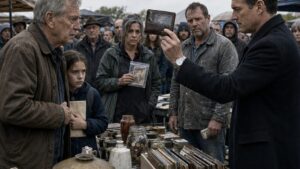
The crowd noticed the case before Stephen reached the first booth.
He hadn’t expected that.
The convention hall stretched across what felt like acres of concrete floor.
Rows of tables.
Display cases.
Collectors.
Dealers.
Military enthusiasts.
People carrying coffee cups and backpacks.
Thousands of conversations blended into a constant roar.
Stephen moved slowly through the aisles.
The wooden case felt heavier with every step.
He told himself nobody cared.
Then he noticed people looking.
Not at him.
At the case.
A younger collector passed by and glanced twice.
An older man stopped talking midway through a conversation.
Another attendee stared openly.
Stephen frowned.
Maybe he was imagining it.
Maybe not.
Near the center of the hall he found an appraisal booth.
A handwritten sign advertised free evaluations.
A short line had formed.
Stephen joined it.
The case remained at his feet.
People continued looking.
Eventually the man behind him spoke.
“What’s in there?”
Stephen smiled politely.
“Old pistol.”
The man nodded.
Then looked again.
“Looks important.”
Stephen offered no answer.
The line moved forward.
One person presented a hunting rifle.
Another showed an antique revolver.
The appraiser gave values quickly.
Businesslike.
Efficient.
When Stephen finally reached the table, he hesitated.
The appraiser noticed.
“Take your time.”
Stephen set the case down.
Opened it.
The conversation at the neighboring booth briefly stopped.
The appraiser leaned forward.
His expression changed.
Not dramatically.
Just enough.
Interesting.
He lifted the pistol carefully.
Examined it.
Turned it beneath the overhead lights.
For nearly a minute he said nothing.
People nearby began drifting closer.
Stephen noticed but pretended not to.
The appraiser pointed at a marking.
“Where’d you get this?”
“Long time ago.”
The appraiser smiled slightly.
“Clearly.”
Several people chuckled.
The tension eased.
For a moment Stephen felt something unexpected.
Hope.
The appraiser continued studying the weapon.
Then he handed it back.
“I’d get additional opinions.”
“What does that mean?”
“It means somebody here will know more than I do.”
That answer created more questions than it solved.
The appraiser lowered his voice.
“I wouldn’t rush a sale.”
Stephen’s stomach tightened.
“What kind of value are we talking about?”
The appraiser shrugged.
“Depends who’s buying.”
Not helpful.
Yet somehow reassuring.
The crowd dispersed slowly.
A few people remained watching.
One collector approached.
Asked if the pistol was available.
Stephen said maybe.
Another asked.
Then another.
Interest spread faster than he expected.
The pistol was becoming visible.
Dangerously visible.
For the first time that day, Stephen wondered whether he had underestimated what he was carrying.
A man wearing an expensive watch appeared nearby.
He studied the pistol from a distance.
Then disappeared into the crowd.
Minutes later another man arrived.
Tall.
Well dressed.
Confident.
His badge identified him as Jack Miller.
Stephen had met people like him before.
People who entered rooms expecting ownership.
Jack smiled.
Not warmly.
Professionally.
“Mind if I take a look?”
Stephen hesitated.
Then handed over the pistol.
Jack examined it without speaking.
The silence stretched.
His eyes lingered on certain details.
Longer than expected.
Interesting.
Very interesting.
Yet his face revealed little.
That alone made Stephen cautious.
“What do you think?” Stephen asked.
Jack didn’t answer immediately.
Instead he glanced around the hall.
At the growing number of interested observers.
At the nearby booths.
At the pistol.
Then back to Stephen.
“I think we should talk somewhere quieter.”
Stephen’s pulse quickened.
Jack closed the case carefully.
Too carefully.
The gesture felt deliberate.
Calculated.
As though he already saw something worth hiding from others.
He handed the case back.
“Private conversation,” Jack said.
“Five minutes.”
Stephen looked across the crowded convention hall.
The collection notices waiting at home seemed suddenly very close.
So did the possibility of a solution.
Finally he nodded.
Jack smiled.
This time the smile carried something else.
And for the first time that day, Stephen wondered whether the man had seen more than he was willing to admit.
Chapter 3: Enough For A Bus Ticket Home
Jack didn’t lead Stephen to a private office.
He led him to a booth.
A crowded booth.
People stood shoulder to shoulder around display cases filled with collectible firearms.
The noise of the convention hall flowed around them.
Jack took a seat behind the counter.
Stephen remained standing.
Already the balance felt wrong.
Jack rested the pistol on a black cloth.
For several moments he inspected it again.
No hurry.
No urgency.
Like a fisherman letting tension build on a line.
Stephen waited.
Finally Jack spoke.
“Interesting piece.”
“That’s what everyone keeps saying.”
Jack smiled faintly.
“Most people say that when they don’t know what they’re looking at.”
Stephen felt irritation rise.
“Do you know what you’re looking at?”
“I know enough.”
The answer came too quickly.
Jack leaned back.
“The condition isn’t ideal.”
Stephen said nothing.
“The finish is worn.”
Silence.
“The documentation is incomplete.”
More silence.
Jack tapped a finger against the counter.
“Frankly, it’s not the easiest item to move.”
Something in his tone made Stephen uneasy.
The earlier confidence was disappearing.
Being replaced by something colder.
More transactional.
“What are you offering?” Stephen asked.
Jack folded his hands.
“Before we get there, why are you selling it?”
The question landed harder than expected.
Stephen looked away.
“Need money.”
“Most people do.”
Jack waited.
Eventually Stephen said, “Debt.”
That seemed enough.
Jack nodded.
As though confirming something.
As though a puzzle piece had clicked into place.
Nearby conversations faded into background noise.
Stephen suddenly felt exposed.
Jack saw it.
And used it.
“How bad?”
Stephen almost refused to answer.
Instead he heard himself say, “Bad enough.”
Jack’s eyes narrowed.
Not with sympathy.
With calculation.
The realization hit immediately.
The man wasn’t evaluating the pistol anymore.
He was evaluating desperation.
Jack placed the weapon on the cloth.
Then shrugged.
“I’ll give you enough for a bus ticket home.”
Stephen blinked.
A few people nearby laughed softly.
Jack continued.
“That’s more than generous for this relic.”
The words hung in the air.
For a moment Stephen wasn’t sure he had heard correctly.
Then heat climbed into his face.
The humiliation arrived before the anger.
A familiar feeling.
One he’d experienced before.
Hospitals.
Government offices.
Loan meetings.
Places where strangers measured his worth through paperwork.
Jack spread his hands.
“What? You asked.”
Several spectators lingered nearby now.
Watching.
Listening.
Stephen looked at the pistol.
At the worn finish.
At the marks only a few people seemed interested in.
Then at Jack.
“You know it’s worth more.”
Jack’s smile vanished.
“Do I?”
The answer came softly.
Dangerously softly.
Stephen understood.
Jack wasn’t ignorant.
He was bargaining.
And public humiliation was part of the strategy.
The crowd had become leverage.
Stephen reached toward the pistol.
For one brief second he considered leaving.
Walking away.
Taking the case.
Keeping the gun.
Keeping his pride.
Then his phone buzzed.
The sound felt deafening.
Another message.
Collections.
Payment required immediately.
His chest tightened.
Jack noticed.
Of course he noticed.
“You need money now,” Jack said.
Not cruelly.
Matter-of-factly.
“Sometimes timing matters more than value.”
The words carried a terrible logic.
Stephen hated that.
Because they were true.
A woman nearby looked uncomfortable.
Another collector glanced away.
Yet nobody intervened.
Why would they?
This was business.
Just business.
Stephen’s hand rested on the wooden case.
He remembered Laura’s voice.
You should’ve told me.
He remembered ignoring the calls.
Ignoring help.
Ignoring reality until only impossible choices remained.
The fault wasn’t entirely Jack’s.
That truth hurt most of all.
Jack removed a checkbook.
The motion felt final.
“You can walk away.”
Stephen stared at him.
“Or you can solve your problem today.”
The pistol sat between them.
No longer looking like history.
No longer looking like memory.
Looking only like money.
Stephen hated himself for seeing it that way.
But exhaustion was winning.
The collection notices.
The late nights.
The silence.
The fear.
All of it had worn him down.
His shoulders sagged.
The fight drained away.
Slowly, painfully, he nodded.
Jack began writing.
Around them, the crowd leaned closer.
Stephen felt every eye.
Every ounce of pity.
Every assumption.
The checkbook scratched across paper.
Jack tore out the check.
Placed it beside the pistol.
Stephen stared at it.
Then reached forward.
And agreed to sell.
Just as a voice behind him said one word.
“Stop.”
Chapter 4: The Marks Hidden In Plain Sight
“Stop.”
The voice cut through the crowd like a blade.
Stephen froze.
Jack’s hand stopped halfway toward the pistol.
Several heads turned.
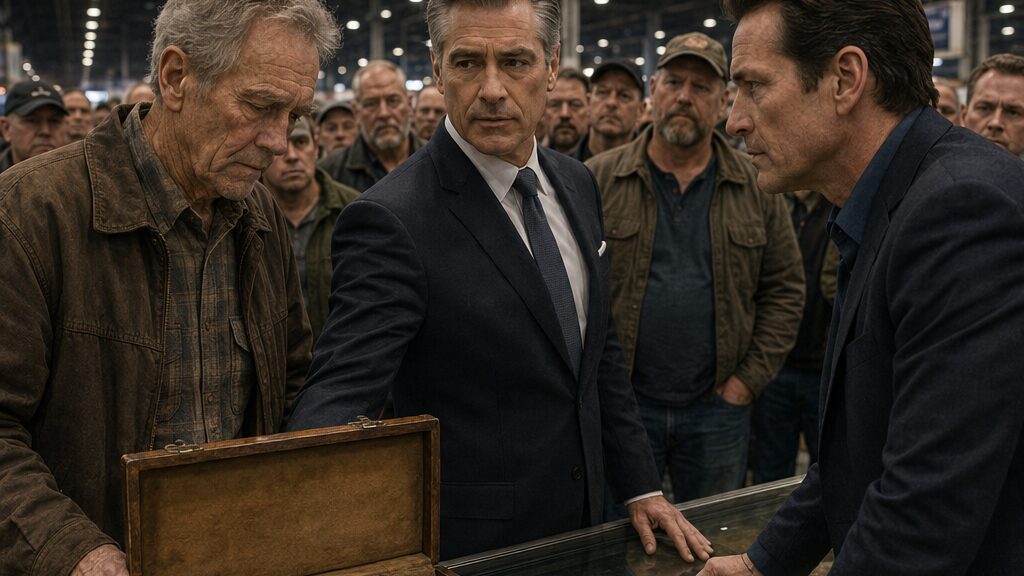
A tall man in a dark suit stepped away from a nearby display of luxury watches and walked toward the booth.
He moved without hurry.
Without uncertainty.
The crowd shifted to make room.
Jack frowned.
“Can I help you?”
The stranger ignored him.
His attention remained on the pistol.
“May I?”
Jack hesitated.
The hesitation lasted only a second, but Stephen noticed it.
A man confident moments earlier was suddenly cautious.
The stranger picked up the pistol carefully.
Not like a collector handling merchandise.
Like someone handling evidence.
He studied the weapon beneath the lights.
Turned it over.
Examined the grip.
The slide.
The worn steel.
Then he looked at Jack.
“What did you offer him?”
Jack crossed his arms.
“That’s private.”
The stranger smiled faintly.
“No. It’s embarrassing.”
A ripple moved through the crowd.
Jack’s face hardened.
“You know something about firearms?”
“A little.”
The answer sounded almost amused.
Stephen watched silently.
The stranger pointed toward a series of faint marks near the frame.
“Did you inspect these?”
Jack said nothing.
The stranger continued.
“What about these?”
His finger moved to another section.
Tiny markings almost invisible beneath decades of wear.
The crowd leaned closer.
A collector near the front squinted.
Another pulled out reading glasses.
Stephen knew those marks.
He had seen them thousands of times.
Yet hearing someone else notice them felt strange.
Like listening to a stranger speak a dead language.
Jack’s confidence began slipping.
“They don’t prove anything.”
The stranger looked at him.
“They prove you didn’t look very hard.”
Several people laughed.
Jack didn’t.
The stranger turned toward Stephen.
“Sir, how long have you owned this pistol?”
“A long time.”
“Did it belong to you during service?”
Stephen nodded.
The stranger’s expression changed slightly.
Respect.
Not for the gun.
For the answer.
He examined the pistol again.
Then pointed to a worn section near the grip.
“Most people see damage.”
He looked toward the crowd.
“What they’re actually seeing is history.”
Someone asked, “What kind of history?”
The stranger didn’t answer immediately.
Instead he traced the edge of the steel with his thumb.
“There are markings here that shouldn’t exist together.”
The crowd grew quieter.
Even Jack listened.
The stranger continued.
“Different periods. Different modifications. Different records.”
Stephen felt his pulse quicken.
The man wasn’t guessing.
He knew enough to be dangerous.
Or helpful.
Maybe both.
Jack stepped forward.
“You’re making assumptions.”
“No.”
The stranger met his eyes.
“You did.”
The silence that followed felt heavy.
The crowd had changed sides.
Stephen could feel it.
An hour earlier nobody had known he existed.
Now dozens of strangers were invested in the outcome.
The strange thing was that it made him uncomfortable.
He hadn’t come for attention.
He had come to sell something and leave.
Instead he stood at the center of a growing spectacle.
The stranger carefully returned the pistol to the cloth.
Then extended a hand.
“Christopher Davis.”
Stephen shook it.
“Stephen Anderson.”
“Good to meet you.”
Christopher glanced toward Jack.
“Not sure I can say the same.”
More laughter.
Jack’s jaw tightened.
But he remained composed.
Stephen had to give him credit for that.
Many people would’ve exploded.
Jack simply recalculated.
The way a businessman does when a deal becomes difficult.
Christopher folded his arms.
“What concerns me isn’t the pistol.”
Stephen blinked.
“Then what concerns you?”
Christopher looked directly at him.
“The fact that you’re willing to let it go.”
The question landed harder than expected.
Stephen looked away.
The crowd sensed the shift.
The conversation had stopped being about money.
Christopher lowered his voice.
“Something must be very wrong.”
Stephen didn’t answer.
Because the answer was obvious.
The debt.
The notices.
The calls.
The shame.
All of it sat just beneath the surface.
Christopher studied him for a moment.
Then nodded slowly.
As if he already understood more than Stephen had said.
Jack stepped back into the conversation.
“If he wants to sell, that’s his business.”
“Agreed,” Christopher said.
“Which is why I’m curious.”
“About what?”
Christopher looked at Stephen.
“Where he got it.”
The crowd grew quiet again.
Stephen stared at the pistol.
The question should have been simple.
Instead it opened a door he rarely approached.
A door he had spent decades keeping shut.
Christopher waited.
No pressure.
No demand.
Just patience.
And for the first time all day, Stephen wondered whether the real value of the pistol had nothing to do with money at all.
Chapter 5: The Promise Carried Home
The crowd eventually thinned.
Not completely.
But enough.
Christopher suggested they move to a small café area inside the convention center.
Stephen carried the wooden case.
Christopher carried two coffees.
Neither man spoke much while they walked.
The noise of the gun show faded behind them.
At a corner table, Christopher sat down.
The pistol remained inside the case between them.
Like a third person.
Waiting.
Christopher finally broke the silence.
“You don’t have to tell me.”
Stephen stared at the case.
“Then why ask?”
“Because nobody sells something like that unless they’re cornered.”
The answer was simple.
Honest.
Stephen appreciated that.
For several moments he said nothing.
Then he opened the case.
The pistol rested inside exactly as before.
Yet it felt different now.
Less like an object.
More like a question.
Christopher waited.
Eventually Stephen spoke.
“I wasn’t supposed to bring it home.”
Christopher remained silent.
Encouraging without pushing.
Stephen rubbed a thumb along the edge of the case.
“It belonged to someone else first.”
A memory surfaced.
This time stronger.
Salt air.
Exhaustion.
Voices.
Fear.
“You ever carry something for fifty years?”
Christopher smiled faintly.
“No.”
“You feel responsible for it.”
Stephen looked at the pistol.
“Even when you shouldn’t.”
The story came slowly.
In pieces.
Not because he wanted suspense.
Because memory hurt.
Years ago there had been another soldier.
A friend.
Not family.
Something harder to explain.
The kind of bond formed when survival depends on another person.
The pistol had belonged to him.
When everything fell apart, Stephen made a promise.
A simple one.
Bring it home.
Keep it safe.
Make sure it isn’t forgotten.
Christopher listened without interruption.
The café noise faded.
The years folded inward.
For the first time in a long while, Stephen spoke about things he usually carried alone.
Not details.
Not dramatic stories.
Just enough.
The promise.
The responsibility.
The weight.
When he finished, Christopher sat quietly.
Finally he asked, “Did you keep that promise?”
Stephen laughed softly.
A tired sound.
“I’ve spent fifty years trying.”
Christopher nodded.
Neither man spoke for a while.
Then Christopher noticed something.
A photograph partially visible inside the case.
Folded.
Old.
Stephen hesitated before handing it over.
Christopher examined it.
Several young men.
Uniforms.
Arms over shoulders.
A frozen moment from another lifetime.
One face drew Christopher’s attention.
He stared longer.
Then looked back at Stephen.
“That’s strange.”
“What?”
Christopher turned the photograph.
“My grandfather had a picture like this.”
Stephen frowned.
“What?”
Christopher nodded.
“Not the same photograph. Same unit.”
Stephen sat motionless.
The coincidence felt too large.
Too specific.
Christopher looked again.
“My grandfather talked about a man named Stephen once.”
The room seemed to shrink.
Stephen stared at him.
“Your grandfather?”
Christopher nodded.
“He served with them for a while before being reassigned.”
For a moment neither man spoke.
The years between them suddenly felt smaller.
Not gone.
Just smaller.
Christopher smiled.
“He always said the people he left behind carried the harder burden.”
Stephen looked away.
Emotion threatened.
He hated that.
Not because emotion was weakness.
Because it arrived unexpectedly.
Like an ambush.
He focused on the pistol.
On the steel.
On the scratches.
Safe territory.
Yet Christopher’s words lingered.
The burden.
Maybe someone had remembered after all.
Christopher leaned back.
“So why the loans?”
Stephen sighed.
There it was.
The question he never wanted.
He could lie.
He almost did.
Instead he told the truth.
Years earlier he had borrowed money.
Then borrowed more.
Helping former service friends.
Medical costs.
Funeral expenses.
Emergency bills.
Small acts.
Reasonable acts.
Until they weren’t.
Until interest arrived.
Until payments multiplied.
Until help became debt.
Christopher listened carefully.
“You never told your daughter?”
“No.”
“Why?”
Stephen laughed without humor.
“Pride.”
The word tasted bitter.
Because it was true.
Every mistake seemed connected to it.
Every silence.
Every avoided conversation.
Every unpaid notice hidden in a drawer.
Christopher looked at him for a long moment.
Then asked quietly, “Do you think she’d rather lose you or hear the truth?”
Stephen had no answer.
The question hurt because it was fair.
His phone buzzed.
Another collection message.
Another deadline.
Reality returning.
The debt still existed.
The notices still waited.
The conversation had changed meaning.
The pistol felt more important than ever.
Which made selling it nearly impossible.
Stephen closed the wooden case.
Slowly.
Carefully.
Like closing a wound.
Across the table, Christopher watched.
Neither man mentioned money.
Not yet.
Because they both understood the same thing.
The pistol was no longer the problem.
The debt was.
And Stephen still had no way to escape it.
Chapter 6: What It Was Really Worth
Christopher pulled a checkbook from his jacket.
Stephen immediately shook his head.
“No.”
They had returned to the main exhibition floor.
The crowd remained larger than before.
Word had spread.
People recognized the case now.
Recognized the veteran.
Recognized the argument.
Christopher ignored the refusal.
“Look at me.”
Stephen didn’t.
Instead he stared at the pistol resting on the cloth-covered counter.
The old temptation returned.
Sell it.
Solve the problem.
Go home.
Simple.
Painful.
Finished.
Christopher opened the checkbook.
The sound drew attention.
People nearby turned.
Jack Miller appeared from across the aisle.
He had been watching.
Waiting.
Calculating.
Christopher began writing.
Stephen felt trapped between two worlds.
One valued the pistol as property.
The other valued it as memory.
Both were asking him to choose.
Christopher tore out the check.
Placed it on the counter.
The amount made several nearby spectators inhale sharply.
Stephen stared.
His debt.
Gone.
Not reduced.
Gone.
For a moment the hall disappeared.
The noise vanished.
All he could see was the number.
Then Christopher slid the check forward.
And pushed the pistol beside it.
Back toward Stephen.
“You bled for that steel,” he said quietly.
“It belongs in your family, not in a glass case.”
Silence spread.
Not complete silence.
But enough.
Enough for people to hear.
Enough for the words to matter.
Stephen looked from the check to the pistol.
Then back again.
He had imagined this moment differently.
In every version of the future, the pistol left.
That was the price.
The sacrifice.
The unavoidable cost.
Yet here it was.
Returned.
His throat tightened.
Christopher wasn’t buying the pistol.
He was buying Stephen a choice.
A choice he hadn’t possessed this morning.
The realization struck harder than the money.
Jack moved forward immediately.
“That’s ridiculous.”
Nobody answered.
Jack pointed toward the pistol.
“I’ll offer more.”
The crowd reacted instantly.
Not positively.
Not negatively.
Curiously.
Jack sensed it.
And pushed harder.
“Name a number.”
Stephen finally looked at him.
For the first time all day, he truly saw the man.
Not as an enemy.
Not as a villain.
Just a collector who thought everything had a price.
Jack wasn’t evil.
He simply couldn’t understand.
That made the moment strangely sad.
“I don’t think you understand,” Stephen said.
Jack frowned.
“I understand value.”
“No.”
Stephen rested a hand on the wooden case.
“You understand cost.”
The crowd went quiet.
Jack opened his mouth.
Then closed it.
For once, he had nothing prepared.
Nothing strategic.
Nothing to negotiate.
Because the conversation had moved somewhere money couldn’t follow.
A laugh sounded from the back.
Then another.
Someone shook their head.
A collector muttered, “Should’ve looked closer.”
More laughter followed.
Not cruel.
Dismissive.
The kind that strips authority away.
Jack’s face reddened.
He glanced around the crowd.
Realized he had lost them.
Completely.
The same audience that had watched Stephen’s humiliation now watched his own.
Jack looked at Christopher.
At the check.
At the pistol.
Then finally stepped back.
Without another word.
The crowd parted as he walked away.
And the moment he disappeared into the aisle, the tension broke.
People began talking again.
Moving again.
Breathing again.
Christopher extended the check once more.
This time Stephen accepted it.
Not immediately.
Not eagerly.
Carefully.
As though accepting help required its own kind of courage.
Then he picked up the pistol.
Held it in both hands.
The steel felt different.
Not lighter.
But no longer carrying the same burden.
For years he had protected the weapon.
Protected the promise.
Protected the memories.
Today, for the first time, someone else had helped carry the weight.
And standing in the middle of the crowded gun show, surrounded by strangers, Stephen realized the thing he feared losing most had never been the pistol.
It had been the belief that nobody remembered why it mattered.
Chapter 7: Some Things Are Not For Sale
Stephen stood beside a row of display tables long after the crowd began dispersing.
The check remained folded in his jacket pocket.
The pistol rested inside the wooden case.
Both felt unreal.
Christopher stayed nearby, speaking occasionally with collectors who wanted one last look at the firearm. Not to buy it anymore. Just to understand it.
The difference mattered.
For years Stephen had watched people assign prices to things.
Homes.
Time.
Work.
Memories.
Today, for the first time in a long while, he had seen people stop asking what something cost and start asking why it mattered.
The distinction stayed with him.
“You all right?”
Christopher’s voice pulled him back.
Stephen nodded.
“Think so.”
“You don’t sound convinced.”
“I’m not used to days changing direction this fast.”
Christopher laughed softly.
“Neither am I.”
For a moment they simply stood together watching workers begin folding chairs and packing equipment.
The gun show was winding down.
The strange spotlight that had followed Stephen all afternoon was fading.
He found himself grateful for that.
Attention exhausted him.
Silence felt safer.
Christopher glanced toward the wooden case.
“You know, when I first walked over, I thought I was helping save a piece of history.”
Stephen looked at him.
“And now?”
Christopher smiled.
“Now I think the history was helping save you.”
Stephen shook his head.
“You give me too much credit.”
“No,” Christopher said. “I think you’ve spent years giving yourself too little.”
The words lingered.
Christopher checked his watch.
Eventually he extended a hand.
“I’m glad I stopped.”
Stephen shook it firmly.
“So am I.”
The businessman hesitated.
Then reached into his wallet and handed over a card.
“If you ever need anything.”
Stephen looked at the card.
His first instinct was to refuse.
To say he didn’t need help.
To retreat behind the same pride that had gotten him here.
The instinct was so automatic it almost happened.
Then he remembered the notices.
The debt.
The years of silence.
The distance between himself and Laura.
He accepted the card.
A small decision.
But not an easy one.
Christopher seemed to understand.
Without another word, he nodded and walked away.
Stephen watched him disappear into the thinning crowd.
Then he found himself alone.
Truly alone.
For the first time all day.
His hand rested on the wooden case.
The familiar shape no longer felt like a burden.
Not exactly.
More like a responsibility he had finally stopped carrying by himself.
His phone sat in his pocket.
He knew what he needed to do.
That didn’t make it easier.
He pulled it out anyway.
Laura’s number remained exactly where it had always been.
One touch away.
Stephen stared at it.
His thumb hovered over the screen.
Then stopped.
Old habits.
Old fears.
What would he even say?
Sorry?
Too small.
I should have called?
Too late.
The truth was messier than that.
He hadn’t simply failed to call.
He had spent years convincing himself that protecting people meant keeping them away from his problems.
The result was loneliness dressed up as independence.
His phone felt heavier with every passing second.
Finally he pressed the button.
The call rang.
Once.
Twice.
Three times.
He nearly ended it.
Then Laura answered.
“Dad?”
The single word tightened something inside his chest.
“Hi.”
A pause.
Not hostile.
Not warm.
Careful.
“You okay?”
The question surprised him.
Not Are you calling for a reason?
Not What happened?
Just Are you okay?
He looked down at the wooden case.
“I think I am.”
Another pause.
“What does that mean?”
Stephen laughed quietly.
“I had a strange day.”
Laura waited.
He appreciated that she didn’t rush him.
Didn’t fill the silence.
Didn’t rescue him from it.
Finally he said, “I should’ve called earlier.”
This time the silence lasted longer.
When Laura answered, her voice softened.
“Yeah.”
The simple honesty hurt more than anger would have.
Stephen closed his eyes briefly.
“I know.”
“What happened?”
He looked around the nearly empty convention hall.
The story sounded ridiculous.
Yet he told it.
Not every detail.
Not all at once.
Just enough.
The debt.
The gun show.
The pistol.
The offer.
The crowd.
Christopher.
The check.
Laura listened without interruption.
The longer he spoke, the lighter the words seemed.
Not because the problems disappeared.
Because they were finally being shared.
When he finished, she exhaled slowly.
“Dad.”
“What?”
“You should’ve told me.”
There it was.
The sentence he had avoided for years.
This time he didn’t argue.
Didn’t defend himself.
Didn’t change the subject.
“You’re right.”
The words felt strange.
Necessary.
“I know.”
Laura laughed softly.
A sound halfway between relief and frustration.
“Do you realize how rare it is for you to admit that?”
Stephen smiled despite himself.
“Probably.”
“You think?”
For the first time in years, the conversation felt easy.
Not perfect.
But real.
They talked longer.
About practical things.
The debt.
The next steps.
The paperwork.
Then about less practical things.
Her family.
His grandson.
A school project.
A fishing trip that never happened.
Small pieces of life.
The kind that disappear when people stop calling.
Eventually Laura grew quiet.
“Dad?”
“Yeah?”
“Bring the pistol next time.”
Stephen frowned.
“What?”
“I want my son to see it.”
He looked down at the case.
The brass latch reflected the overhead lights.
For decades he had treated the pistol like something to protect from the world.
Something to hide.
Something to preserve by keeping separate.
Laura continued.
“If it’s that important, maybe we should know why.”
Stephen swallowed.
The words struck deeper than she realized.
Because she was right.
The promise had never been about hiding history.
It had been about carrying it forward.
And history carried alone eventually disappears.
“I’d like that,” he said.
“Good.”
The convention center speakers announced final closing procedures.
Workers continued packing tables.
The day was ending.
At last.
After a few more minutes, they said goodbye.
Not awkwardly.
Not formally.
Just naturally.
As people should.
Stephen slipped the phone back into his pocket.
Then he picked up the wooden case.
The same case he had carried into the building that morning.
Yet somehow it felt different now.
Not because the pistol had changed.
Not because the scars in the steel had changed.
Because he had.
The exit doors stood open ahead of him.
Evening light spilled across the floor.
Stephen walked toward it slowly.
The debt wasn’t magically gone.
There would still be paperwork.
Conversations.
Repayments.
Consequences.
Life would remain complicated.
But something fundamental had shifted.
The shame no longer owned him.
The pistol remained his.
The promise remained intact.
And for the first time in years, the future contained more than survival.
At the doors, Stephen paused.
He opened the wooden case one final time.
The pistol rested inside.
Quiet.
Steady.
A witness to decades.
He smiled.
Then carefully closed the lid.
Locked it.
And carried it home.
The story has ended.