Fifty Years After He Vanished, The Widow With Dog Tags Stood Outside The Gala Meant To Honor His Sacrifice
Chapter 1: The Woman Outside The Gala Tent
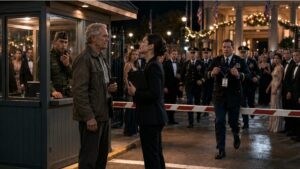
“You can’t just walk up to the General’s tent.”
The words stopped Patricia Campbell so abruptly that the flowers in her hands trembled.
She had been focused on the white canvas structure ahead of her, on the warm glow of lights spilling through its open entrance, on the distant sound of a military band tuning their instruments. For a brief moment she had almost imagined she could walk straight in.
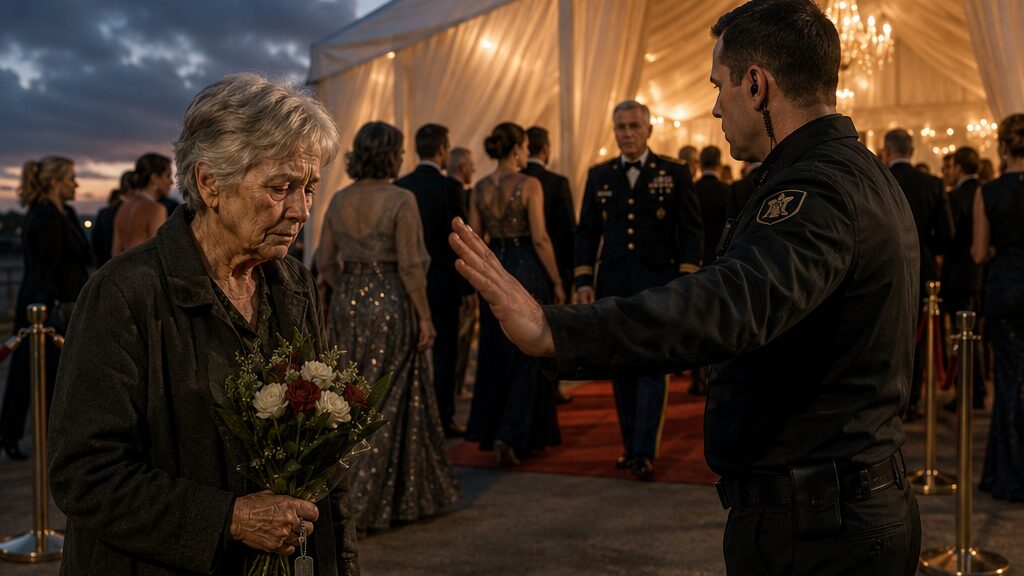
Instead, a uniformed security guard stepped into her path.
“Ma’am,” he said, forcing a polite smile. “You’ll need to move back.”
Patricia blinked.
The guard looked barely older than some of the recruits she remembered seeing decades ago.
She tightened her grip on the flowers.
“I’m sorry,” she said softly. “I only need a few minutes.”
The guard glanced at her coat, her worn handbag, and the bouquet wrapped in brown paper.
His eyes moved past her toward the arriving guests.
Black cars rolled up one after another.
Men in tailored suits stepped out.
Women in evening gowns followed.
A cluster of donors approached carrying invitation packets decorated with gold lettering.
The guard shifted his attention back to Patricia.
“Do you know how important the people inside are?”
The question landed harder than he intended.
Or perhaps exactly as hard as he intended.
Patricia lowered her eyes.
“Yes.”
“Then you understand.”
She nodded.
The answer should have ended the conversation.
Instead she remained standing there.
The guard exhaled.
The line of arriving guests continued growing behind her.
“Ma’am, are you here with someone?”
“No.”
“Do you have an invitation?”
Patricia hesitated.
She had received invitations before.
Not recently.
Not for several years.
Eventually they had stopped arriving altogether.
She had never called to ask why.
She had never wanted to become a burden.
“No,” she admitted.
The guard’s posture stiffened.
“I’m sorry. This event is private.”
The military band began playing a march somewhere beyond the tent.
Patricia listened for a moment.
The melody was familiar.
Everything about this place was familiar.
The old base had expanded.
Buildings had changed.
Roads had been repaved.
But every year she still came.
Every year she brought flowers.
Every year she stood before the portrait.
For fifty years.
The thought settled heavily inside her chest.
The guard noticed her silence.
“Ma’am?”
She looked up.
“Today marks fifty years.”
His expression remained blank.
“Fifty years since what?”
Patricia swallowed.
“Since my husband disappeared.”
For the first time, the guard seemed uncertain.
Only briefly.
Then professionalism returned.
“I’m sorry to hear that.”
He stepped aside and gestured toward the parking area.
“But this isn’t the place for that.”
Patricia stared at him.
Not angry.
Not shocked.
Only tired.
A couple dressed in formal clothing brushed past her.
The woman glanced toward Patricia’s flowers.
The man leaned closer and whispered something.
Patricia couldn’t hear the words.
She didn’t need to.
She recognized the look.
The look people gave elderly strangers who seemed lost.
The guard cleared his throat.
“Please move aside.”
Patricia obeyed.
That was what she had always done.
She moved to the edge of the entrance path.
Guests streamed past.
Nobody stopped.
Nobody recognized her.
Nobody asked why she stood alone holding flowers.
The military band switched songs.
A slower piece now.
One Michael had liked.
She remembered him humming it while polishing boots in their tiny apartment.
The memory arrived unexpectedly.
Sharp as ever.
She could still picture him laughing because he had gotten polish on his cheek.
Still hear him promising he’d be home before Christmas.
Still feel the embarrassment of admitting, even now, that part of her had never stopped waiting.
A gust of wind tugged at the bouquet paper.
Patricia adjusted it carefully.
One flower bent sideways.
She straightened it.
The action felt strangely important.
Like repairing something larger.
A voice interrupted her thoughts.
“You should probably head home.”
The guard again.
Not cruel.
Simply practical.
Patricia looked toward the tent.
Inside, she could see chandeliers.
Round tables.
Flags.
Portrait displays.
History exhibits.
A celebration of sacrifice.
And yet she remained outside.
Her husband would have found irony in that.
Michael always noticed irony.
A small smile touched her lips before fading.
Perhaps the guard was right.
Perhaps she should leave.
The realization hurt more than she expected.
Not because of the gala.
Because of what leaving would mean.
It would mean accepting that the anniversary mattered only to her.
That fifty years of remembrance existed solely inside one aging widow.
That the world had finally moved on.
The thought hollowed something inside her.
She turned slightly.
Her feet actually started toward the parking lot.
Then she stopped.
No.
Not yet.
At least the flowers.
She wanted to leave them somewhere.
Anywhere.
A memorial wall.
A bench.
The base chapel.
It didn’t matter.
She reached into her purse, searching for a handkerchief.
Instead her fingers brushed cool metal.
The dog tags.
She carried them everywhere.
One chain.
Two tags.
Michael’s name engraved into steel.
The only thing she had received after he vanished.
No body.
No grave.
No final goodbye.
Just those.
The guard was speaking into a radio now.
More guests arrived.
Someone laughed loudly.
A camera flashed.
Patricia carefully closed her purse.
Then she noticed something.
The paper around the flowers had loosened.
One stem was slipping free.
She bent to adjust it.
The purse shifted from her shoulder.
The clasp opened.
A metallic sound struck the pavement.
Clink.
Both dog tags slid across the concrete and stopped near the guard’s polished shoes.
Patricia froze.
For a second nobody moved.
Then the guard sighed and bent down.
“I’ve got them.”
He picked up the chain casually.
The irritation on his face remained.
Until he looked at the name.
Everything changed.
The color drained from his face.
His eyes widened.
The crowd noise seemed to disappear around him.
He stared at the metal tag as if it had suddenly become something impossible.
Patricia slowly straightened.
The guard looked up.
No longer annoyed.
No longer impatient.
Only stunned.
The chain trembled slightly in his hand.
And for the first time since she arrived, he seemed afraid to speak.
Chapter 2: The Name On The Metal
James Jackson read the name twice.
Then a third time.
Certain he had made a mistake.
He hadn’t.
MICHAEL CAMPBELL.
The engraved letters stared back at him beneath the entrance lights.
His pulse quickened.
No.
That couldn’t be right.
He looked toward the elderly woman.
Then back to the tag.
Then toward the enormous portrait hanging inside the gala tent.
The portrait he had walked past all afternoon.
The portrait every person on the base recognized.
The portrait of the man whose story was taught to recruits.
Michael Campbell.
James suddenly realized he was still holding the tags.
“Ma’am…”
His voice sounded different now.
Patricia looked uncomfortable.
As if she regretted dropping them.
“Could I have those back, please?”
James swallowed.
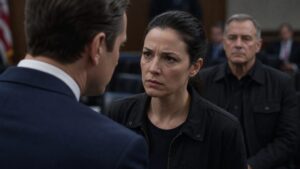
“You’re… Patricia Campbell?”
Her expression shifted.
Not surprise.
Caution.
“Yes.”
The answer hit him like a physical blow.
Around them, guests continued arriving.
But James barely noticed.
He remembered the training sessions.
The history briefings.
The memorial hall.
Michael Campbell wasn’t merely a name.
He was part of the foundation of the base itself.
And his widow had been standing outside while James lectured her about important people.
Heat climbed into his face.
Patricia reached for the tags.
James handed them over immediately.
“I’m sorry.”
The words came out before he could stop them.
She accepted the chain.
“It’s all right.”
No anger.
No accusation.
That somehow made it worse.
James pressed a hand against his radio.
His thoughts raced.
Surely someone needed to know.
A nearby event coordinator noticed his expression.
“What happened?”
James hesitated.
Then lowered his voice.
“That’s Patricia Campbell.”
The coordinator frowned.
The name meant nothing.
Then realization arrived.
The coordinator’s eyes widened.
Within minutes whispers began moving through the entrance area.
Patricia noticed.
People looked at her differently now.
Not warmly.
Not yet.
But curiously.
The shift made her uncomfortable.
She preferred being invisible.
Visibility came with questions.
Questions came with expectations.
A young woman hurried toward them carrying a folder.
Amanda Lopez.
The base historian.
She stopped abruptly.
“Mrs. Campbell?”
Patricia nodded.
Amanda looked almost embarrassed.
“I didn’t know you were coming.”
Patricia offered a faint smile.
“I wasn’t sure I was.”
Amanda glanced at James.
Then at the flowers.
Then at the dog tags.
Something like guilt crossed her face.
“I’ve studied your husband’s records for years.”
Patricia wasn’t sure how to respond.
People often said things like that.
Very few ever asked about Michael himself.
His favorite music.
His terrible singing.
The way he always forgot where he left his keys.
They knew the hero.
Not the man.
Amanda seemed to sense it.
“I mean…” she corrected herself softly. “I’ve studied what happened. Not who he was.”
Patricia appreciated the honesty.
Before she could answer, Amanda’s phone vibrated.
She listened briefly.
Then her eyes widened.
“The General’s been informed.”
James felt his stomach tighten.
Patricia looked confused.
“Informed about what?”
Amanda stared.
“About you.”
The words sounded absurd.
Patricia almost laughed.
Why would a General care that an elderly widow had arrived with flowers?
The answer came faster than expected.
Movement erupted inside the tent.
Staff members stepped aside.
Conversations faltered.
Heads turned.
A tall officer emerged from the crowd.
Three stars gleamed beneath the lights.
General Richard Wright.
He wasn’t walking.
He was moving with the urgency of someone who believed he had already lost too much time.
Patricia recognized him vaguely.
Years ago he had been much younger.
Now gray streaked his hair.
Lines marked his face.
Yet his expression was unmistakable.
Concern.
Real concern.
The General crossed the distance quickly.
He stopped directly before Patricia.
For a brief second neither spoke.
Then he looked at the flowers.
The dog tags.
Her face.
And something painful flickered through his eyes.
“Mrs. Campbell.”
His voice was quiet.
“I am so sorry.”
The apology stunned everyone nearby.
Including Patricia.
General Wright shook his head.
“You should never have been standing out here.”
Patricia glanced toward James.
The guard stared at the ground.
The General followed her gaze.
Understanding arrived immediately.
But instead of anger, disappointment settled across his face.
Not directed at one man.
At himself.
At the institution.
At the fact that this had happened at all.
“I thought someone contacted you this year.”
Patricia blinked.
“No.”
The General closed his eyes briefly.
Amanda looked alarmed.
Staff members exchanged nervous glances.
Somewhere along the line, something had failed.
A list.
An invitation.
A tradition.
Nobody yet knew.
The General opened his eyes.
“Please come with me.”
Patricia hesitated.
The sudden attention felt overwhelming.
Only ten minutes earlier she had been invisible.
Now dozens of people were watching.
She almost refused.
The old instinct surfaced immediately.
Don’t inconvenience anyone.
Don’t make a scene.
Don’t take up space.
Then she looked down at the flowers.
Fifty years.
She had not carried them this far to leave.
General Wright gently offered his arm.
“Mrs. Campbell.”
A faint smile touched his face.
“This evening exists because of your husband.”
Patricia stared at him.
The statement felt impossible.
Before she could ask what he meant, a distant murmur spread through the gala hall.
People were standing.
Turning.
Watching.
The General escorted her toward the entrance.
And somewhere behind them, Amanda Lopez stood frozen beside a display table.
In her hands was an old archival file she had just retrieved from storage.
A file marked with Michael Campbell’s name.
A file she had never seen before.
Its corner carried a handwritten note.
INCOMPLETE.
Chapter 3: The Story Everyone Half Remembered
The moment Patricia entered the gala hall, three wealthy donors were asked to surrender their front-row seats.
Nobody argued.
That alone told her something was happening that she did not understand.
Conversations rippled through the room.
People stood.
Some stared openly.
Others whispered behind raised glasses.
General Wright remained beside her.
His presence acted like a shield against the attention she never wanted.
Patricia wished she could disappear.
Instead she found herself being escorted deeper into the event than she had ever been before.
The portrait waited near the stage.
Michael.
Young forever.
His uniform pressed neatly.
His eyes confident.
The artist had captured him exactly as the world preferred to remember him.
Heroic.
Certain.
Untouched by fear.
Patricia knew better.
Michael had been brave.
But he had also worried about bills.
Complained about cold mornings.
Missed anniversaries.
Forgot birthdays.
The portrait never showed those things.
She approached it slowly.
The flowers trembled in her hands.
For a moment the noise around her vanished.
Only Michael remained.
Fifty years.
Still no grave.
Still no certainty.
Still no final answer.
Just a portrait.
And a memory.
General Wright stepped back respectfully.
Giving her space.
Patricia placed her fingertips lightly against the frame.
“Hello, Michael.”
The words were almost inaudible.
Yet they carried the weight of decades.
A sudden lump rose in her throat.
She lowered her hand before anyone could notice.
Across the room Amanda Lopez was already moving.
The file marked INCOMPLETE remained tucked beneath her arm.
She could barely focus on the ceremony.
Something about the document bothered her.
She had spent years researching Michael Campbell.
She knew every publicly available report.
Every citation.
Every speech.
Yet she had never seen that file.
That should have been impossible.
Amanda slipped into a side corridor and opened it.
Yellowed pages filled the folder.
Mission summaries.
Witness statements.
Field reports.
Halfway through the stack she stopped.
Several pages were missing.
Not lost.
Removed.
The page numbers proved it.
Amanda frowned.
Why would anyone remove pages from a historical archive?
Back in the main hall, General Wright began greeting donors.
Patricia sat quietly in the front row.
People approached one by one.
Some offered condolences.
Others thanked her for her husband’s service.
Most seemed sincere.
Yet nearly all of them repeated the same phrases.
The same rehearsed language.
Patricia smiled politely.
She had heard it for decades.
Then a retired officer sat beside her.
Unlike the others, he looked directly at Michael’s portrait instead of at her.
“I served here forty years ago.”
Patricia nodded.
The man swallowed.
“We used to hear stories about him.”
Patricia waited.
The officer shook his head.
“The strange thing is that every version was different.”
That caught her attention.
“What do you mean?”
“No one seemed to know exactly what happened.”
He looked toward the stage.
“Only that a lot of people came home because he didn’t.”
Before Patricia could respond, Amanda reappeared.
Her expression had changed.
Focused.
Concerned.
She approached General Wright immediately.
The General listened for less than thirty seconds before his face tightened.
Amanda handed him the file.
He opened it.
Read several pages.
Then closed it again.
Very carefully.
Patricia noticed.
So did the retired officer.
Neither could hear the conversation.
But they saw the General’s reaction.
Something important had shifted.
Amanda pointed toward the archive wing.
The General nodded once.
Reluctantly.
As if he had hoped never to revisit whatever waited inside that file.
The band began playing again.
Applause followed.
A speaker stepped onto the stage.
The evening continued.
Yet General Wright’s attention remained fixed on the folder in his hands.
At one point he looked toward Patricia.
Not with pride.
Not with ceremony.
With concern.
The expression unsettled her.
Later, during an intermission, Amanda approached.
“Mrs. Campbell.”
Patricia looked up.
Amanda hesitated.
“We may have found something.”
The words instantly sharpened the air around them.
Something.
After fifty years.
Patricia’s fingers tightened around the dog tags resting in her lap.
Amanda glanced at the chain.
Then toward the file.
“We think part of the historical record is missing.”
Patricia stared at her.
Missing.
The word felt familiar.
Too familiar.
Amanda lowered her voice.
“The official story may not be the complete story.”
Patricia’s heartbeat quickened.
Across the room, General Wright remained standing beside the stage.
The file was still in his hands.
And from the troubled look on his face, he already knew exactly what had been left out.
Chapter 4: The Missing Part Of The Citation
Amanda did not wait for the ceremony to end.
The moment General Wright gave a brief nod, she led Patricia through a side corridor and into the quieter administrative wing attached to the gala hall.
The sounds of conversation and music faded behind thick walls.
Patricia still carried the flowers.
The dog tags rested in her hand now instead of her purse.
She found herself gripping them whenever she felt uncertain.
Amanda unlocked a door marked ARCHIVE STORAGE.
Inside, rows of filing cabinets stretched beneath fluorescent lights.
The room smelled faintly of paper and dust.
General Wright arrived moments later carrying the incomplete file.
He closed the door behind him.
For a long moment nobody spoke.
Patricia looked from Amanda to the General.
“What was missing?”
Amanda glanced toward the General.
The hesitation was enough to tighten Patricia’s chest.
After fifty years, she had learned to recognize that look.
The look people wore when deciding how much truth someone could handle.
General Wright rested the file on a table.
“Mrs. Campbell, some historical records were classified for years.”
Patricia gave a tired smile.
“That sounds like a long way of saying you know something.”
The General accepted the criticism.
“I do.”
Amanda carefully opened the folder.
Several pages had been copied from older documents.
Others existed only as fragments.
Mission reports.
Radio transcripts.
Witness statements.
Patricia stared at Michael’s name appearing over and over across the pages.
The sight felt strange.
The world remembered him in ink.
She remembered him in laughter.
Amanda slid one report forward.
“The official story says your husband volunteered to stay behind during the withdrawal.”
Patricia nodded.
That part she knew.
Every newspaper article had repeated it.
Every speech.
Every memorial plaque.
“He protected the evacuation route.”
“Yes.”
Amanda looked uncomfortable.
“That isn’t the whole story.”
Silence filled the room.
The General rubbed his forehead.
“As far as public records go, Michael Campbell became a symbol very quickly.”
Patricia frowned.
“A symbol?”
“A hero.”
The General corrected himself immediately.
“But symbols are easier for institutions than people.”
The sentence lingered.
Amanda opened another document.
“This report came from survivors who were there.”
Patricia leaned closer.
Several names had been blacked out decades ago.
One paragraph remained visible.
She read it twice.
Then a third time.
Michael had not volunteered to remain behind.
At least not immediately.
The report described an argument.
A disagreement among officers.
A delayed withdrawal.
Confusion.
Michael had repeatedly urged them to leave sooner.
No one had listened.
Patricia slowly lowered the page.
“What does this mean?”
General Wright answered.
“It means the situation should never have reached that point.”
The room seemed smaller.
Amanda pointed toward another statement.
A survivor described Michael arguing with a commanding officer who wanted to hold position.
Minutes later enemy forces closed in.
The evacuation became a desperate retreat.
Lives were lost.
More would have been lost without Michael.
Patricia stared at the paper.
The official version had always sounded clean.
Simple.
Hero stays behind.
Hero disappears.
Hero becomes legend.
This version felt messier.
Human.
Painfully human.
“He was right?” she asked.
The General nodded.
“According to every witness statement we still have.”
Patricia sat down slowly.
For fifty years she had imagined Michael’s final hours countless times.
Never this way.
Never arguing.
Never frustrated.
Never ignored.
Amanda carefully turned another page.
“This part was removed from the public citation.”
“Why?”
Neither woman looked surprised when the General answered.
“Because the military didn’t want the focus on mistakes.”
Patricia closed her eyes briefly.
Not out of anger.
Out of exhaustion.
After all these years, institutions were still institutions.
Amanda continued reading.
The reports described Michael directing survivors toward a safe extraction route.
Repeatedly exposing himself to danger.
Refusing multiple opportunities to leave.
Not because he sought glory.
Because too many wounded soldiers remained behind.
Patricia felt her throat tighten.
That sounded like him.
Stubborn.
Impossible.
The sort of man who would miss a dinner appointment because someone else needed help.
A faint smile touched her face.
Then disappeared.
Amanda reached the final surviving report.
“This is where things become unclear.”
The document ended abruptly.
No confirmed sighting after the final radio transmission.
No recovered remains.
No certainty.
Only assumptions.
The same uncertainty Patricia had carried for half a century.
The room fell quiet.
General Wright remained standing near the table.
His gaze stayed fixed on the file.
Eventually Patricia spoke.
“Why are you troubled?”
The question caught him off guard.
Amanda looked surprised too.
Patricia had spent decades reading people.
The General’s discomfort wasn’t about classified records.
It was something else.
General Wright exhaled slowly.
“Because people remember Michael Campbell as a perfect hero.”
Patricia waited.
The General continued.
“And every year we tell the same polished story.”
He touched the folder.
“But the truth is harder.”
“Harder how?”
“He wasn’t lost because he chased glory.”
The General’s voice softened.
“He was lost because he stayed behind cleaning up mistakes made by others.”
The words settled heavily in the archive room.
Amanda looked down.
Patricia stared at Michael’s name.
For some reason that truth hurt more than the others.
Not because it diminished him.
Because it didn’t.
It made him more real.
More unfairly burdened.
More human.
The hero had not simply sacrificed himself.
He had paid the price for failures that began higher up the chain.
The room remained silent.
Then Amanda reached into the folder one final time.
“There was one more document.”
She placed it gently before Patricia.
Not a report.
Not a military form.
A handwritten note.
Short.
Unfinished.
The handwriting belonged to Michael.
Patricia recognized it instantly.
Her breath caught.
The note ended mid-sentence.
Apparently never delivered.
Never filed properly.
Never shown publicly.
The final visible line read:
If anything happens, tell Patricia I kept my promise. I made sure they got home—
The sentence stopped there.
Nothing followed.
Patricia stared at the page.
Her fingers trembled.
Suddenly she understood.
Not where Michael had gone.
Not how he died.
But why he never came home.
Because leaving had never been an option once others depended on him.
The realization struck with painful clarity.
She folded the note carefully.
Outside the archive room, the applause of the gala echoed faintly through the walls.
Inside, Patricia held the unfinished message and wondered whether she could finally live with the truth it carried.
Chapter 5: Fifty Years Of Waiting
“You don’t have to do it.”
General Wright’s voice was gentle.
Patricia stood alone in a small preparation room behind the stage.
The unfinished note rested beside the dog tags.
The flowers lay across her lap.
Outside, the ceremony continued.
Hundreds of people waited.
Many without realizing they were waiting for her.
Patricia wished they weren’t.
Amanda had just informed her that the evening organizers wanted her to speak before the final tribute.
The request felt absurd.
For fifty years she had avoided microphones.
Avoided attention.
Avoided becoming part of the story.
Michael was the hero.
Not her.
She had spent decades making sure people remembered him while remaining invisible herself.
Now that invisibility was slipping away.
General Wright remained near the doorway.
“We can proceed without remarks.”
Patricia almost accepted.
The words rose immediately.
Yes.
Please.
Let someone else speak.
Let someone else stand in front of the crowd.
Let someone else carry the weight.
The familiar instinct returned.
Step aside.
Don’t cause trouble.
Don’t inconvenience people.
The habit had governed much of her life.
Yet something felt different tonight.
Amanda entered carrying several pages.
“We prepared remarks if you’d like them.”
Patricia accepted the pages.
Typed paragraphs.
Polished language.
Formal gratitude.
References to sacrifice.
Tribute and legacy.
She read half a page before lowering it.
The words were kind.
But they belonged to strangers.
Not her.
Amanda noticed.
“You don’t have to use them.”
Patricia smiled faintly.
“I don’t think Michael would recognize any of this.”
That earned a laugh from both Amanda and the General.
A small one.
But genuine.
The tension eased briefly.
Then Amanda sat beside her.
“Can I ask something?”
Patricia nodded.
“When was the last time you came here?”
Patricia looked at the flowers.
“Three years ago.”
Amanda seemed surprised.
General Wright looked startled.
“Three?”
Patricia nodded.
“Before that, every year.”
“What changed?”
Patricia hesitated.
Then answered honestly.
“I thought people had forgotten.”
The admission hung in the room.
No accusation.
Just truth.
Amanda lowered her eyes.
The General looked away.
Patricia continued.
“The invitations stopped coming.”
Nobody spoke.
“The displays became smaller.”
Silence.
“Eventually I assumed it was time for me to stop showing up.”
Amanda looked stricken.
“We never intended—”
“I know.”
Patricia interrupted gently.
She truly did know.
Forgetting rarely happened all at once.
It happened a little at a time.
A missed phone call.
A lost address.
A retired officer.
A new generation.
Then suddenly fifty years had passed.
Amanda stared at the dog tags.
“You still came.”
Patricia smiled sadly.
“Not because of the gala.”
Her fingers closed around the chain.
“Because I promised him.”
The words surprised even her.
Amanda waited.
Patricia looked toward the closed door.
“I promised that as long as I was alive, somebody would remember him as a person.”
Not a hero.
Not a portrait.
A person.
The room fell quiet again.
This time the silence felt different.
Amanda’s eyes glistened.
General Wright cleared his throat.
Neither attempted to fill the moment.
A knock interrupted them.
An event coordinator appeared.
“They’re ready.”
The words landed like a deadline.
Patricia’s pulse quickened.
The ceremony could not continue without her decision.
She looked down at the prepared speech.
Then at Michael’s unfinished note.
Then at the flowers.
The years seemed to gather around her.
Fifty birthdays.
Fifty anniversaries.
Fifty years of unanswered questions.
Fifty years of carrying memory alone.
General Wright stepped forward.
“No pressure.”
Patricia laughed softly.
The irony was impossible to ignore.
Hundreds of people waited beyond the wall.
No pressure.
Amanda reached for the prepared remarks.
Patricia stopped her.
Then folded the pages neatly.
And set them aside.
A surprising calm settled over her.
Not certainty.
Something smaller.
Something enough.
She picked up the dog tags.
The metal felt warm now.
Familiar.
Steady.
For decades they had represented absence.
Tonight they felt different.
Connection.
Proof that Michael had existed beyond the legend.
Beyond the portrait.
Beyond the speeches.
Amanda noticed the change in her expression.
“What are you going to say?”
Patricia considered the question.
Then shook her head.
“I don’t know yet.”
For the first time all evening, that answer didn’t frighten her.
General Wright opened the door.
Applause drifted in from the ceremony hall.
The audience was waiting.
The stage lights glowed beyond the curtain.
Patricia rose slowly.
Her knees protested.
Her hands trembled.
But she stood.
Flowers in one hand.
Dog tags in the other.
The unfinished note tucked safely into her coat pocket.
Then she walked toward the doorway.
Toward the stage.
Toward the story she had spent fifty years refusing to place herself inside.
Chapter 6: The Place That Exists Because Of Him
The moment Patricia stepped onto the stage, the entire hall rose to its feet.
The sound startled her.
Hundreds of chairs moved at once.
Conversations ceased.
Uniforms and evening gowns blurred together as people stood.
For a second she almost turned around.
The old instinct urged retreat.
Hide.
Let someone else take this place.
Instead she continued forward.
One careful step after another.
The flowers rested against her arm.
The dog tags remained wrapped around her fingers.
General Wright stood at the podium waiting.
When Patricia reached the front row of seats reserved for speakers, he offered a respectful nod.
Then he faced the audience.
The room became silent.
Not ceremonial silence.
Expectant silence.
The kind that carried weight.
General Wright looked toward Patricia before speaking.
“Tonight was scheduled as a celebration of sacrifice.”
His voice carried easily through the hall.
“But before we continue, there is a truth many people here deserve to hear.”
The audience listened.
Some already knew fragments.
Most did not.
General Wright paused.
Then continued.
“Many of you know the name Michael Campbell.”
Heads nodded throughout the room.
Military personnel straightened.
Donors glanced toward the portrait.
“He is remembered as one of the most honored soldiers in this base’s history.”
The General looked toward the massive photograph displayed above the stage.
“But history sometimes becomes smaller than the people who lived it.”
The sentence shifted the room.
Patricia noticed it immediately.
People leaned forward.
The General wasn’t delivering the usual speech.
He spoke without notes.
Without ceremony.
As though correcting something overdue.
“Fifty years ago, Michael Campbell remained behind during a disastrous withdrawal.”
A murmur passed through the audience.
General Wright continued.
“He did not remain because he sought recognition.”
His voice sharpened.
“He remained because others would not have survived otherwise.”
The room grew still again.
Amanda sat near the front with the recovered file resting in her lap.
The General glanced briefly toward her.
Then back to the audience.
“Recent review of archived records has reminded us of something important.”
He chose his next words carefully.
“Heroes often become symbols. Symbols are easy to celebrate. People are harder.”
Patricia felt the truth of that settle through the hall.
The General looked directly toward her.
“For fifty years, one person refused to forget the man behind the symbol.”
Every eye turned.
Patricia wished they wouldn’t.
Yet this time she didn’t lower her head.
General Wright stepped away from the podium.
He walked toward her instead.
“This base exists in its current form because of the lives saved during that mission.”
The audience listened closely.
“Those survivors returned home.”
Another pause.
“They raised families.”
Silence.
“They built careers.”
The General’s voice softened.
“And many helped build the institution gathered here tonight.”
The meaning spread gradually through the room.
The gala.
The memorial foundation.
The traditions.
The donations.
Much of it traced back to that single mission.
To lives that continued because Michael Campbell never returned.
Patricia saw understanding dawn across faces.
Not admiration.
Recognition.
The difference mattered.
The General stepped aside.
The podium now stood empty.
Waiting.
For her.
Patricia stared at it.
Her heartbeat echoed loudly in her ears.
She had prepared nothing.
No speech.
No plan.
No script.
Only fifty years of memory.
The audience remained standing.
Waiting.
General Wright offered a quiet nod.
Patricia walked forward.
Every step felt strangely steady.
When she reached the podium, she placed the flowers beside it.
The dog tags remained in her hand.
She looked across the crowd.
Young soldiers.
Retired veterans.
Donors.
Historians.
People who knew Michael’s name.
People who had only learned it tonight.
For several seconds she said nothing.
Then she smiled faintly.
“Michael hated speeches.”
Laughter rippled unexpectedly through the room.
The tension broke.
Patricia smiled again.
“He was terrible at them.”
A few more laughs.
Then silence returned.
A gentler silence now.
Patricia glanced at the portrait.
“They tell you about the brave things.”
She touched the dog tags.
“They don’t tell you he could never remember where he left his keys.”
A smile spread through the audience.
“They don’t tell you he sang badly.”
Another ripple of laughter.
“They don’t tell you he once ruined our anniversary dinner because he stopped to help a stranded family and forgot what day it was.”
This time even General Wright laughed.
Patricia looked down briefly.
Then back up.
Her voice softened.
“The reason I came tonight wasn’t because of a medal.”
Silence settled again.
“It wasn’t because of history.”
The dog tags rested against her palm.
“I came because fifty years ago I promised myself that someone would remember him as a person.”
No one moved.
No one spoke.
Patricia continued.
“And tonight I discovered that I wasn’t the only one remembering.”
The words carried more emotion than she intended.
She paused.
Collected herself.
Then reached into her coat pocket.
The unfinished note emerged.
She unfolded it carefully.
A few people recognized it from the recovered records.
Most did not.
Patricia read the final surviving line.
“If anything happens, tell Patricia I kept my promise. I made sure they got home.”
Her voice nearly failed.
But she finished.
Then folded the paper.
Silence filled the hall.
A profound silence.
Not empty.
Respectful.
Patricia stepped away from the podium.
The speech was finished.
Short.
Imperfect.
Enough.
The military band began playing softly.
Not because anyone instructed them to.
Because it felt right.
Patricia picked up the flowers.
Then walked toward Michael’s portrait.
Nobody stopped her.
Nobody rushed her.
The crowd simply watched.
She knelt carefully beneath the display.
Placed the flowers below the frame.
And rested the dog tags beside them for a moment.
The portrait smiled down unchanged.
Yet something felt different.
Not the memory.
The burden.
For the first time in fifty years, she no longer carried it alone.
Chapter 7: The Salute That Reached Across Decades
The line began forming before Patricia had even risen from beneath the portrait.
At first she thought people were simply moving toward the exits.
The ceremony had ended.
The band played softly in the background.
Conversations resumed.
The evening should have been winding down.
Instead, soldiers were waiting.
Young soldiers.
Old soldiers.
Officers.
Enlisted personnel.
One by one they approached her.
Patricia remained standing beside Michael’s portrait with the flowers resting below it.
For the first time in years, she felt unsure what to do with her hands.
The dog tags were back around her fingers.
A nervous habit she had never managed to break.
A young lieutenant stopped first.
He offered a respectful nod.
“Ma’am.”
Patricia nodded back.
The lieutenant hesitated.
Then smiled.
“My grandfather was one of the men who came home from that mission.”
Patricia blinked.
The words struck unexpectedly.
The young officer looked barely thirty.
Far too young to have known Michael.
Yet here he stood because of something that happened half a century ago.
“My family talks about him every year,” the lieutenant continued.
“We always have.”
His voice softened.
“I just wanted you to know that.”
Patricia found herself unable to answer immediately.
The lieutenant seemed to understand.
He nodded once and stepped away.
Others followed.
A retired veteran who remembered hearing stories while serving overseas.
A military nurse who said she planned to teach Michael’s story during leadership training.
A young recruit who admitted he knew almost nothing before tonight but wanted to learn more.
Each conversation lasted only a minute or two.
Yet together they formed something larger.
A chain.
A connection stretching across generations.
Patricia slowly realized something she had never fully understood.
Memory did not survive because institutions preserved it.
Memory survived because people carried it.
The realization felt strangely comforting.
Amanda appeared carrying the archival file against her chest.
She looked exhausted.
And excited.
The combination made Patricia smile.
“You’ve had quite a night.”
Amanda laughed.
“That’s one way to describe it.”
She looked toward Michael’s portrait.
Then at the line of soldiers.
“I keep thinking about all the things we documented.”
Patricia listened.
Amanda shook her head.
“We collected reports. Citations. Records.”
She glanced at Patricia.
“But somehow we almost lost the person.”
The statement lingered.
Patricia understood exactly what she meant.
Amanda opened the file.
Several photographs rested inside.
Recently copied documents.
Witness statements.
The recovered note.
“We’d like to create a permanent exhibit.”
Patricia looked surprised.
“A new one?”
Amanda nodded.
“Not just about the mission.”
Her eyes moved toward the flowers.
“About the people connected to it.”
Patricia remained silent.
Amanda continued.
“The story shouldn’t end with a medal.”
For a moment neither spoke.
Then Amanda carefully removed a preservation envelope.
“We were wondering…”
She hesitated.
“If you’d ever consider allowing us to display the dog tags occasionally.”
Patricia instinctively closed her hand around them.
The reaction was immediate.
Protective.
The tags had been hers for fifty years.
Her only physical connection to Michael.
Amanda noticed.
“I’m sorry.”
Patricia shook her head.
“No.”
She looked down at the chain.
Not angry.
Only uncertain.
The metal had accompanied her through every difficult year.
Every lonely anniversary.
Every unanswered question.
The thought of letting them leave her possession felt impossible.
Yet for the first time she considered it.
Not tonight.
Maybe someday.
The possibility itself surprised her.
Before she could answer, another figure approached.
James Jackson.
The security guard stopped several feet away.
Far enough to leave if asked.
Patricia immediately recognized the tension in his posture.
The man looked more nervous now than he had at the entrance.
Amanda quietly excused herself.
Leaving them alone.
James stood awkwardly.
The confidence from earlier was gone.
“I wasn’t sure if I should come over.”
Patricia waited.
He rubbed the back of his neck.
“I owe you an apology.”
She said nothing.
Not because she wanted him uncomfortable.
Because she wanted him honest.
James took a breath.
“When I saw you outside…” He stopped. “I made assumptions.”
Patricia nodded slightly.
“Yes.”
The simple answer forced him forward.
“I thought I was doing my job.”
His gaze dropped.
“And I was.”
He swallowed.
“But I wasn’t treating you like a person.”
The honesty caught her off guard.
Many apologies focused on intentions.
James focused on actions.
Patricia studied him.
The young man looked genuinely troubled.
Not because he had embarrassed himself.
Because he understood the harm.
Finally she spoke.
“What made you become a guard?”
The question surprised him.
“Ma’am?”
“What made you choose it?”
James looked confused.
Then answered.
“My father served here.”
Patricia waited.
“He always told me responsibility mattered.”
The words emerged slowly.
“As a kid I thought responsibility meant enforcing rules.”
He glanced toward the portrait.
“Tonight I realized that’s not all it means.”
Patricia felt something inside her soften.
Not because of the apology.
Because of the lesson behind it.
People learned.
Sometimes slowly.
Sometimes painfully.
But they learned.
She offered a small smile.
“I think Michael would have liked that answer.”
Relief flooded James’s face.
Not complete forgiveness.
Something more meaningful.
The chance to become better.
He nodded.
Then quietly stepped away.
Patricia watched him go.
Around her the gala continued winding down.
Tables emptied.
Guests departed.
The band packed equipment.
Yet she found herself lingering.
For once she wasn’t in a hurry to leave.
General Wright eventually joined her.
The evening had aged him noticeably.
Or perhaps simply exhausted him.
He looked at the portrait.
Then at Patricia.
“I’ve been thinking.”
That rarely led anywhere simple.
Patricia smiled.
“Dangerous.”
The General laughed.
“Probably.”
He gestured toward the historical displays.
“We’d like you involved moving forward.”
Patricia frowned slightly.
“Involved how?”
“However you want.”
The answer surprised her.
No committee assignment.
No formal title.
No obligation.
Just a choice.
The General continued.
“Amanda wants to expand the exhibit.”
Patricia glanced toward the historian.
Amanda was already speaking enthusiastically with staff members.
General Wright smiled.
“I suspect she’ll work on it regardless.”
That earned another laugh.
Then his expression grew more serious.
“For years we’ve honored Michael Campbell.”
Patricia listened.
“It’s time we remembered Patricia Campbell too.”
Immediately she shook her head.
“No.”
The response came so quickly that even she smiled.
The old habit.
The instinct to step aside.
To shrink.
To disappear.
General Wright recognized it too.
He said nothing.
Simply waited.
Patricia looked around the room.
At the soldiers.
The displays.
The portrait.
The flowers.
The dog tags.
Then she thought about the young lieutenant whose grandfather survived.
About the recruit who wanted to learn.
About Amanda searching dusty archives.
About James confronting his mistake.
Perhaps memory was larger than one person.
Larger than one widow carrying flowers.
Perhaps accepting a place within the story was not selfish.
Perhaps it was another form of responsibility.
The realization arrived quietly.
Like dawn rather than lightning.
Patricia looked toward General Wright.
“Maybe.”
The single word seemed to please him immensely.
Hours later, after most guests had left, Patricia returned one final time to the portrait.
The hall stood nearly empty now.
Only a few staff members remained.
The flowers rested beneath the frame.
Fresh and bright.
The dog tags hung from her hand.
She gazed up at Michael’s image.
For decades she had spoken to portraits because there was nowhere else to direct her words.
Tonight felt different.
Not because she finally knew everything.
She never would.
Some mysteries remained.
Some questions always would.
But the loneliness had changed.
The burden had changed.
The story had changed.
Patricia reached down and gently touched the flowers.
Then she looked at the portrait one last time.
“You kept your promise,” she whispered.
A faint smile touched her lips.
“And I kept mine.”
She turned toward the exit.
Not alone.
Not forgotten.
Behind her, Michael’s portrait remained where it had always been.
Ahead of her, voices waited.
New generations.
New memories.
New caretakers of an old story.
As Patricia walked from the hall, a young soldier entering for cleanup paused and instinctively came to attention.
Then another did the same.
And another.
No orders were given.
No ceremony announced.
The salute moved quietly from one person to the next.
Across age.
Across rank.
Across decades.
Patricia stopped only once.
She looked back.
Not at the portrait.
At the people.
Then she nodded in gratitude and continued forward, carrying the dog tags into the future while knowing she no longer carried the memory alone.
The story has ended.