What the Room Remembered
Part I — The Phone Screen
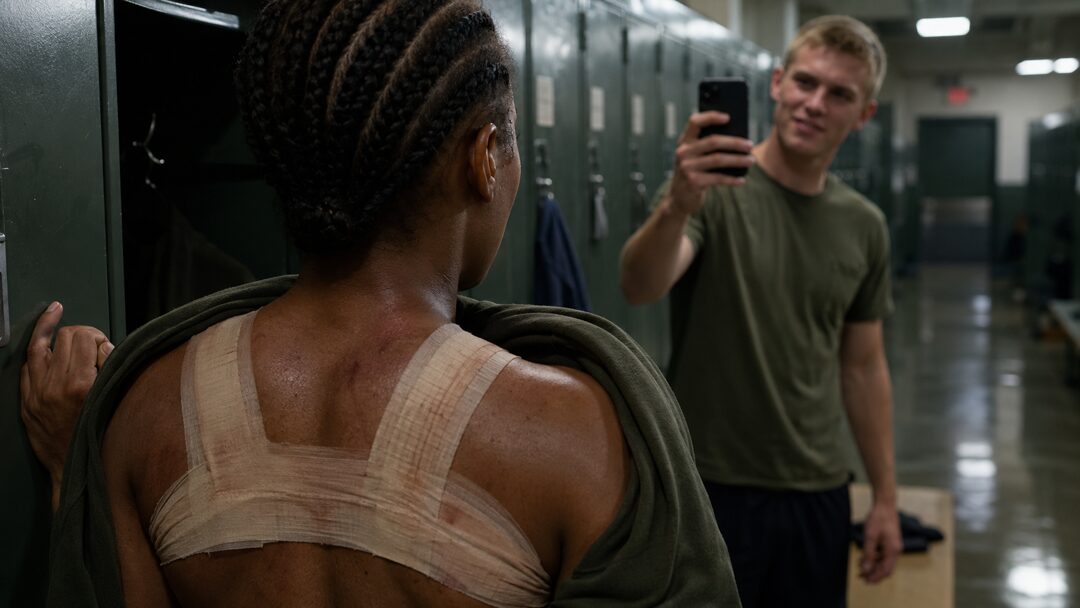
Kimberly Harris had one hand braced against the green metal locker and the other pressed to the strip of gauze peeling away from her back when Ryan Miller started laughing.
Not a nervous laugh.
Not the kind of laugh people made when they saw something awful and did not know where to put their eyes.
A real laugh.
Sharp, pleased, loud enough to bounce off the wet tile and come back meaner.
“Damn,” Ryan said, lifting his phone. “Look at those tiger stripes.”
Kimberly froze.
The locker room smelled of bleach, damp towels, and the metallic edge of fresh blood. Her dark tank was bunched under her arms. Her cornrows were tied tight at the nape of her neck. Across her upper back, the cuts ran in deep parallel lines from shoulder blade to ribs, too clean in some places, torn in others, as if the wire had tried to hold on when she pulled herself free.
She had waited until the room emptied before changing the dressing.
She had checked the corridor twice.
She had told herself she could clean it fast, breathe through it, put the uniform back on, and make formation.
Then Ryan had walked in with Jason Cole behind him.
Jason saw her first. His face changed before he could stop it. His mouth parted. His eyes dropped to the bloody gauze in her hand, then to the cuts, then to the floor.
For half a second, Kimberly thought he might say something human.
Then Ryan laughed.
And Jason, after one terrible pause, laughed too.
Kimberly reached for her shirt.
Ryan stepped closer.
“Hold on, Sergeant. Don’t hide it. People should see what happens when you try to play hero.”
His phone was angled at her back.
The red recording dot glowed.
Kimberly’s chest tightened with something worse than pain.
“Put it down,” she said.
Her voice came out low. Controlled. That was what thirty-four years had taught her. That was what rank had taught her. That was what every room like this had taught her.
Never let them hear the break.
Ryan smiled wider.
“Come on. This is training material.”
Jason shifted beside him. “Miller,” he muttered.
Ryan ignored him.
Kimberly turned too fast. Pain tore bright and white through her shoulders. She lunged for the phone anyway.
Her knees buckled.
The locker caught her before the floor did.
Ryan lifted the phone above his head, laughing harder now.
“Careful,” he said. “Wouldn’t want another panic run.”
Kimberly stopped breathing.
Another panic run.
The words landed too cleanly.
Not guessed. Not invented. Repeated.
Her fingers tightened around the locker door until it rattled.
Ryan saw that he had hit something. His grin changed. It became less childish. More deliberate.
“Nobody’s gonna believe you,” he said quietly, still recording. “Not after the report. Not after they hear you got yourself tangled up and almost cost the whole team.”
Jason looked at him.
This time, he did not laugh.
Kimberly stared at the red dot on the phone.
She had crawled through the wire because someone had screamed.
She had crawled back because someone had still been breathing.
She had crawled until the world narrowed to smoke, metal, heat, and a woman’s hand slipping in hers.
And now Ryan Miller was turning it into a joke.
“Delete it,” Kimberly said.
Ryan lowered the phone just enough to frame her face.
Her eyes burned. She refused to blink.
“Or what?” he asked. “You’ll write me up? With what credibility?”
The word cracked something in her.
Credibility.
Not courage. Not pain. Not truth.
Credibility.
Kimberly grabbed her shirt, pulled it over her head, and nearly blacked out from the movement. She shoved past Jason so hard his shoulder hit the lockers.
“Sergeant,” Jason said.
She did not look at him.
Ryan called after her, “Hey, Harris. The stripes suit you.”
The laughter followed her into the corridor.
By the time Kimberly reached the wooden bench outside the locker room, her hands were shaking so badly she could not grip the edge.
She sat.
Then she folded forward.
Then she cried into both palms where no one could see her face.
But she could still hear them.
Ryan’s laugh.
Jason’s silence.
And beneath both, the worst sound of all—
the tiny electronic chirp of a video being saved.
Part II — The Phrase
Kimberly had been wounded before.
A broken finger in a training fall.
A shoulder dislocation during an extraction exercise.
A burn along her wrist from a vehicle door in a place no one was supposed to name.
Those had been simple pains. Clean pains. They belonged to the body.
This was different.
This had teeth.
Her back pulsed beneath the shirt. The gauze had shifted. She could feel warmth spreading again, slow and damp, under the fabric.
She pressed her hands together until the tremor stopped.
Do not go back in there, she told herself.
Then Ryan spoke from inside the locker room, and the words pulled her upright.
“She’s done,” he said. “You saw her face.”
Jason said something too low to hear.
Ryan answered louder. “What? You want to go down with her?”
Kimberly turned her head.
The corridor was narrow and painted the color of old bone. At the far end, light spilled from the locker-room doorway in a hard rectangle. She could see Ryan’s shadow moving inside it. Jason’s shadow stood still.
“You laughed,” Ryan said. “Don’t act like you didn’t.”
“I shouldn’t have.”
“No, you shouldn’t have said anything at all.”
A silence.
Then Jason: “She went back because—”
Ryan cut him off. “Don’t.”
The word snapped like a hand over a mouth.
Kimberly stood before she knew she had decided to move.
Her body objected. Her back screamed. She did not care.
She took one step toward the doorway.
Ryan’s voice dropped, but not enough.
“My uncle already fixed the first statement. You think they’re reopening it because you got feelings?”
The hallway tilted.
Kimberly put her palm against the wall.
So that was it.
Colonel Miller.
She had heard the name once, after the convoy returned. Heard it through a half-open operations-room door, spoken by men who lowered their voices when she passed.
A route was compromised.
A civilian asset was lost.
A decorated NCO made an unauthorized move.
No one had said cowardice.
They did not need to.
Cowardice was what people heard when reports used words like panic, confusion, reckless deviation.
Jason appeared in the doorway.
His face went pale when he saw her standing there.
Ryan came up behind him. His expression hardened.
Kimberly looked at Jason first.
“You started to say something.”
Jason swallowed.
Ryan placed a hand on Jason’s shoulder. Not friendly. Heavy.
“He didn’t start anything,” Ryan said.
Kimberly’s eyes moved to the phone in Ryan’s hand.
“Delete it.”
Ryan slipped it into his pocket.
“Already backed up.”
Jason closed his eyes for half a second.
Kimberly saw it.
There were men who were cruel because they enjoyed power.
There were men who followed cruelty because they feared standing alone.
Jason was the second kind.
It did not make the laughter hurt less.
Ryan leaned closer.
“You want to make noise? Go ahead. You’ll look emotional. Unstable. And I’ll have video of you coming at me half-dressed in the locker room.”
Kimberly’s hand curled.
She had put men twice his size on the ground in training. She knew exactly where to strike and how long it would take him to lose the smirk.
She also knew what the report would say after.
Staff Sergeant Harris became aggressive when questioned.
Staff Sergeant Harris was not in control.
Staff Sergeant Harris confirmed concerns.
So she did the harder thing.
She stepped back.
Ryan smiled like he had won.
Jason looked like he wished the floor would open under him.
From outside the building came the distant sound of boots striking pavement in formation. The ceremony was starting.
Kimberly was supposed to be there.
General Robert Hayes was visiting the facility that morning. The commander had planned a clean event. A few clipped speeches. A few medals. A photo no one would be allowed to post until the operation cleared review.
Kimberly had been told to wear service dress.
She had not been told that the men who failed her would be standing in the same formation.
She had not been told that Ryan had already begun feeding the room a story.
She had not been told that her back would be turned into evidence against her before anyone asked what it had cost.
Ryan glanced toward the sound of formation.
“You’re late, Sergeant.”
Kimberly looked at him.
For the first time, her tears had dried.
“Then you better hope nobody asks why.”
His smirk twitched.
It was small.
But Jason saw it too.
And for one second, power moved in the room.
Not enough to save her.
Enough to make Ryan afraid.
Part III — The Doorway
General Robert Hayes knew ceremony when it was real, and he knew ceremony when it was being used to cover a smell.
This one smelled wrong.
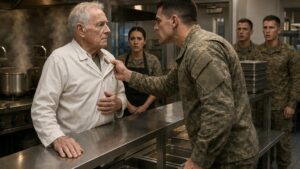
The formation was too stiff. The officers smiled too quickly. The young soldiers stood in rows under the gray morning light, polished and silent, while the commander beside Hayes recited words like resilience, professionalism, and mission success.
Hayes listened.
He had spent thirty-six years listening to what people did not say.
One name was missing from the line.
Staff Sergeant Kimberly Harris.
He had read her file the night before. Combat lifesaver certification. Two commendations. No disciplinary record. Recommended for recognition after a classified rescue in a border sector where the official summary had been thin enough to see through.
He waited until the commander finished praising the unit.
Then he asked, “Where is Harris?”
The commander blinked.
“Medical follow-up, sir.”
Hayes turned his head.
“During her commendation?”
A junior officer shifted his weight.
Hayes heard laughter from the building behind them.
Not loud at first.
Just a burst. Then another.
The kind of laughter that did not belong anywhere near a medical follow-up.
He stepped away from the formation before anyone could explain.
The commander followed. “Sir, we can have someone—”
Hayes did not slow down.
His boots struck the concrete walkway with a rhythm that made conversations die before he reached them. By the time he entered the barracks building, three soldiers in the hallway snapped upright so fast one dropped a clipboard.
The laughter came again.
Clearer now.
From the locker room.
Hayes walked toward it.
He saw Kimberly first.
She was standing in the corridor with her shirt clinging wrong across her back. Her face was composed in the way people looked when they were using every piece of themselves not to fall apart.
Behind her, in the locker-room doorway, two younger men stood too close together.
One blond. One dark-haired.
The blond one still had a smile on his face.
Hayes stopped.
The building seemed to stop with him.
“Staff Sergeant Harris,” he said.
Kimberly straightened.
“Sir.”
Her voice was steady.
Too steady.
Hayes looked at the dark stain spreading beneath her shirt.
Then at Ryan.
Then at Jason.
“What is happening here?”
Ryan snapped to attention. “Nothing, sir.”
Hayes’s eyes moved to Ryan’s pocket.
The corner of a phone was visible.
“Nothing,” Hayes repeated.
Ryan swallowed. “Private Miller, sir. We were just—”
“Were you laughing?”
No one answered.
Hayes stepped into the locker room.
The air changed.
There were still open lockers, wet tile, towels hanging from hooks. But now the space felt smaller, as if every metal door had become a witness.
“Everyone out,” Hayes said.
Two soldiers who had been pretending not to listen moved fast.
Hayes pointed without looking away from Ryan. “Not you. Not you.” His finger shifted to Jason. “And not her.”
The door swung shut.
The room held four people.
Kimberly did not sit. Hayes noticed that. He noticed the way she kept one shoulder slightly lower than the other. He noticed the blood at the edge of her collar. He noticed Jason’s hands, half-curled at his sides.
He had seen men hide fear in many ways.
Jason wore his badly.
Hayes turned to Kimberly.
“Show me.”
Ryan’s eyes flicked up.
Kimberly did not move.
Hayes softened his voice by one degree. “Staff Sergeant.”
She looked at him then.
There was a question in her face that made Hayes ashamed before he knew why.
If I show you, will you see me?
Or will you see a problem?
Kimberly reached for the hem of her shirt.
Jason looked away.
Ryan did not.
She lifted the shirt slowly, stopping when the movement pulled too hard. The gauze had slipped. Beneath it, the cuts crossed her back in long, raw lines, swollen at the edges, reopening where fabric had dragged.
Hayes had been in field hospitals. He had stood beside beds where no one knew what to say.
Still, the sight hit him.
Not because of the injuries alone.
Because someone had laughed at them.
His jaw tightened.
“What happened to her back?”
Ryan answered too quickly.
“Sir, during extraction, Staff Sergeant Harris panicked and got tangled in concertina wire. She deviated from the route and endangered the team.”
Kimberly closed her eyes.
There it was.
Perfectly worded.
Perfectly false.
Hayes looked at Ryan.
“Who told you that?”
Ryan’s confidence faltered.
“It’s in the report, sir.”
“I didn’t ask where you read it. I asked who told you.”
Ryan opened his mouth.
Nothing came out.
Kimberly lowered her shirt.
Her voice came from somewhere low and quiet.
“That’s not what the wire was for.”
Hayes turned to her.
Jason’s face changed again.
Ryan’s hand twitched toward his pocket.
Hayes saw it.
“Phone on the bench,” Hayes said.
Ryan stiffened.
“Sir?”
“Now.”
Ryan pulled the phone out slowly and placed it on the wooden bench beneath the row of lockers.
Hayes did not touch it yet.
He looked at Kimberly.
“Tell me what the wire was for.”
She stared at the bench.
For a moment, the locker room was gone.
In its place came a road lined with black smoke, a vehicle burning sideways, someone crying in two languages, and a woman pinned where no one could reach her without crawling through the barrier.
Kimberly’s hands curled once.
Then opened.
“There was an interpreter,” she said. “Her name was Sarah.”
No one moved.
“She was trapped after the lead vehicle went over. Route was already compromised. We had less than eight minutes before the next wave hit.”
Ryan said, “Sir, she’s leaving out—”
Hayes did not raise his voice.
“Private Miller, if you interrupt her again, you will regret the first breath you take afterward.”
Ryan went silent.
Kimberly kept her eyes forward.
“She was alive. She was asking for her daughter. I had two men ordered to cover the gap while I went in.”
She did not look at them.
She did not need to.
Jason’s breathing changed.
Hayes heard it.
Kimberly swallowed.
“The wire was between us. I went through it.”
Ryan’s face hardened again, but the smirk did not return.
“Did you reach her?” Hayes asked.
Kimberly’s mouth tightened.
“Yes.”
The word had no victory in it.
“Did she survive?”
Kimberly looked down.
“No.”
The room became brutally quiet.
For the first time, Hayes understood the real shape of the wound.
Not the lines on her back.
The space between the rescue and the loss.
Ryan seized on it.
“So it didn’t matter,” he said.
Kimberly’s head lifted.
Jason flinched before Hayes moved.
Hayes took one step toward Ryan.
“Say that again.”
Ryan realized too late what had left his mouth.
“I mean—sir, I mean the mission outcome was—”
Kimberly’s voice cut through, soft as a blade.
“It mattered to her while she was breathing.”
No one answered that.
No one could.
Part IV — The Sound Under the Laughter
Hayes picked up the phone.
Ryan’s face changed completely.
“Sir, that’s personal property.”
Hayes looked at him.
“So was her back.”
The line landed hard enough that Jason looked up.
Ryan’s mouth shut.
The phone was unlocked. Maybe Ryan had been too confident. Maybe he thought humiliation had a life of its own once recorded, that no one in the room would dare turn it around on him.
The newest video sat at the top of the gallery.
Hayes pressed play.
Kimberly turned away.
She did not want to hear it.
But the locker room filled again with Ryan’s laugh.
“Damn. Look at those tiger stripes.”
Her own voice followed.
“Put it down.”
The sound of pain came next, small and involuntary, when she had lunged and nearly fallen.
Kimberly hated that sound more than the laughter.
Ryan’s recorded voice: “Wouldn’t want another panic run.”
Hayes watched the screen.
Jason stared at the floor.
Then came the part none of them had heard clearly in the moment.
Under Ryan’s laughter, under Kimberly’s breathing, Jason’s voice slipped into the recording.
Low.
Almost swallowed.
“She went back because we didn’t.”
Hayes stopped the video.
The silence afterward was worse than the sound.
Ryan moved first.
“He was joking.”
Hayes did not look at him.
“Specialist Cole.”
Jason’s eyes lifted.
Hayes held the phone between two fingers, as if it had become something contaminated.
“Repeat what you said.”
Jason’s throat worked.
Ryan turned on him. “Don’t be stupid.”
Hayes snapped, “Eyes forward, Miller.”
Ryan faced front.
Jason looked at Kimberly.
That was his mistake.
If he had looked at Hayes, maybe he could have lied. If he had looked at Ryan, maybe fear would have held him.
But he looked at Kimberly.
He saw her standing with her arms at her sides because folding them hurt too much. He saw the way she refused to wipe her face, though the tears had started again without permission. He saw the woman he had followed into smoke and failed to follow one step farther.
His voice cracked.
“She went back because we didn’t.”
Ryan exhaled through his nose. “Jason.”
Jason shook his head once.
Small.
Destroyed.
But no longer obedient.
“We were supposed to cover her,” he said. “Miller and me. First rounds came in from the ridge. I dropped behind the axle. Miller dropped with me.”
Ryan said, “That is not—”
“Shut up,” Jason said.
The words shocked him as much as anyone.
He kept going before courage could leave.
“She yelled for cover. I heard her. We both heard her. Sarah was caught in the wire near the second vehicle. Harris went in anyway.”
Kimberly’s eyes closed.
She was back there again.
Heat against her cheek.
Sarah’s fingers slipping.
A child’s name repeated like a prayer.
Hayes’s face had gone still.
Dangerously still.
“And the report?” he asked.
Jason wiped one hand over his mouth.
“Miller said if we told it straight, we were finished. His uncle had already heard the team lost the interpreter. Colonel Miller said the language needed to be controlled until review.”
Ryan laughed once.
It died immediately.
“You make it sound like some conspiracy.”
Jason looked at him then.
“You told me to say she bolted.”
Ryan’s jaw worked.
“You agreed.”
“Yes,” Jason said.
The word came out empty.
Then he added, “And I laughed today because you laughed.”
That was not redemption.
Kimberly knew it.
Jason knew it too.
Some truths did not clean a person.
They only stopped the rot from spreading.
Hayes turned to Ryan.
“Did you record Staff Sergeant Harris without consent?”
Ryan stared past him.
“Did you distribute or upload the video?”
“No, sir.”
Kimberly looked at the phone.
Hayes saw it.
“Is there a backup?”
Ryan said nothing.
Hayes took one step closer.
“Private Miller.”
Ryan’s face flushed.
“It auto-syncs.”
Jason whispered, “Jesus.”
Hayes handed the phone to Kimberly.
She did not take it.
For the first time since he entered the room, Hayes seemed unsure.
Not weak. Not indecisive.
Aware.
He had walked in ready to punish. Now punishment was too small for what the room contained.
“Staff Sergeant Harris,” he said, “you have two choices right now. I can remove them, call medical, and have your injuries documented privately. Or you can make a formal statement now, with them present.”
Ryan’s head jerked up.
“Sir, she’s not in condition to—”
Hayes turned.
“You are out of chances to speak.”
Kimberly looked at the bench.
The phone lay in Hayes’s hand again.
The same phone that had made her body public.
The same phone that now held Jason’s words.
She thought of Sarah trapped behind the wire.
She thought of the report calling her reckless.
She thought of every room where people learned to laugh before they learned the truth, because laughter was easier and truth asked too much.
She reached for the hem of her shirt.
Jason looked away again.
This time, she did not care.
“Keep looking,” Kimberly said.
Jason froze.
Ryan’s eyes flickered.
Kimberly turned her back to them.
Slowly.
The room drew in a breath.
She lifted the shirt.
Not high.
Just enough.
Enough for Hayes to see the lines clearly.
Enough for Ryan to have nowhere to put his eyes.
Enough for Jason to understand that looking away had been part of the problem from the beginning.
Kimberly’s voice stayed steady.
“This one is Sarah,” she said.
No one asked which one.
“This one is the cover I didn’t get. This one is the report. This one is him laughing.”
Her fingers curled into the fabric.
“And this one is me staying quiet because I thought silence was discipline.”
Hayes looked at her back.
Then at the two young men.
His anger had changed.
It no longer filled the room like heat.
It focused.
“Lower your shirt, Staff Sergeant,” he said.
She did.
But something had already shifted.
Her back was no longer the spectacle.
It was the record.
Part V — The Name of It
Ryan tried one last time because men like him often mistook the end of power for a pause.
“With respect, sir,” he said, though there was no respect in it, “she’s playing hero because the mission went bad.”
Kimberly did not turn around.
Jason stared at the floor.
Hayes walked toward Ryan.
Not fast.
That made it worse.
Ryan straightened, but the old smirk returned by instinct, thin and ugly.
Hayes stopped inches from him.
“You think that word protects you?”
Ryan blinked.
“What word, sir?”
“Hero.”
Ryan said nothing.
“You use it like an insult because you are terrified it might apply to someone else.”
Ryan’s jaw tightened.
Hayes reached out and gripped him by the chin.
Not hard enough to injure.
Hard enough to command.
Ryan’s eyes widened.
Hayes turned his face toward Kimberly.
“Look.”
Ryan resisted for half a second.
Hayes’s voice dropped.
“Look at what you needed to make funny.”
Ryan looked.
Kimberly stood still with her shirt lowered, but everyone in the room knew what lay beneath it.
Hayes released him.
Ryan’s face had lost color.
“You are relieved from this unit pending investigation,” Hayes said. “Your phone is evidence. Any synced copies will be recovered. Specialist Cole will be separated for sworn testimony. The mission report is reopened as of now.”
Ryan’s mouth opened.
Hayes cut him off.
“And if you contact Staff Sergeant Harris, speak about Staff Sergeant Harris, post about Staff Sergeant Harris, or attempt to shape another word of this before review, I will make sure your uncle cannot save you from the consequences of your own mouth.”
Ryan swallowed.
For the first time, he looked twenty-three.
Not brave.
Not charming.
Not untouchable.
Just young and cornered and furious that the room no longer belonged to him.
Two officers entered after Hayes called them in. The space filled with clipped instructions, confiscated property, names written down, Jason led out separately, Ryan trying not to look afraid.
Kimberly remained near the lockers.
No one touched her.
No one asked her to explain again.
That was mercy.
When Jason passed her, he slowed.
“I’m sorry,” he said.
Kimberly looked at him.
There were many things she could have said.
That sorry was late.
That sorry was small.
That sorry did not unmake laughter.
Instead she said, “Tell it right.”
Jason nodded once.
His eyes were wet.
Then he was gone.
Ryan did not apologize.
Kimberly had not expected him to.
He walked out with one officer on either side, shoulders stiff, chin up, performing until the doorway swallowed him.
Only then did Kimberly sit.
The bench was cold.
Her body finally understood that the danger had changed shape, not disappeared.
Hayes stood across from her, holding the seized phone in an evidence bag one of the officers had brought.
For a moment, he looked older than he had when he entered.
“Staff Sergeant,” he said.
Kimberly looked up.
He seemed about to say something official.
He did not.
Instead, he said, “I should have asked better questions before this morning.”
That landed harder than an apology.
Kimberly lowered her eyes.
“Yes, sir.”
Hayes accepted it.
Not as disrespect.
As truth.
A medic arrived ten minutes later. Her name tag read Parker, but Kimberly never caught her first name. She was gentle in the efficient way of people who knew gentleness could become unbearable if stretched too long.
“Shirt off,” the medic said softly. “I’ll keep it quick.”
Kimberly obeyed.
Hayes turned away before she had to ask.
The dressing came off in pieces.
Kimberly gripped the edge of the bench.
The medic inhaled once through her nose, then said nothing.
That silence, Kimberly appreciated.
Some people made horror about themselves.
The medic did not.
When the new dressing touched her skin, Kimberly’s vision blurred.
She thought again of Sarah.
Not as she had looked at the end.
Before.
In the convoy staging area, tightening the scarf around her hair, teasing Kimberly for checking her gear three times.
“You soldiers always count what you carry,” Sarah had said.
Kimberly had answered, “Counting keeps people alive.”
Sarah had smiled.
“Not everything that matters can be counted.”
Kimberly had not known then that the sentence would follow her home.
Hayes’s phone buzzed.
He stepped into the corridor to answer.
Kimberly heard only fragments.
Yes.
Confirmed.
Daughter.
Evacuated.
She sat up despite the medic’s warning.
Hayes returned slowly.
His expression had changed again.
No ceremony now.
No anger.
Only the weight of something carefully carried.
“Staff Sergeant Harris,” he said.
Kimberly braced herself.
Hayes looked at the medic, then back at Kimberly.
“The interpreter’s daughter made it through the checkpoint. She was on the second convoy.”
Kimberly stared at him.
The room did not move.
Hayes continued, “The delay you created gave them six minutes. That was enough.”
Kimberly’s lips parted.
For one wild, painful second, she did not understand the words.
Then she did.
Sarah had died asking for her daughter.
But her daughter had crossed.
Her daughter had lived long enough to be lifted into another vehicle, carried through another gate, handed into another pair of arms.
Six minutes.
Kimberly bent forward.
The medic reached for her shoulder, then stopped herself.
Hayes did not speak.
Kimberly’s tears fell onto the tile.
Quietly this time.
Not the hidden, choking tears from the hallway.
Not humiliation.
Not defeat.
This grief had somewhere to go.
After a while, Kimberly asked, “Does she know?”
Hayes’s voice was low.
“That her mother tried to go back for her?”
Kimberly nodded.
“Yes,” Hayes said. “She knows.”
Kimberly closed her eyes.
The answer did not heal the cuts.
It did not bring Sarah back.
It did not erase Ryan’s laugh or Jason’s silence or the report already written in careful language by careful men.
But it placed one truth where a lie had been standing.
Sometimes that was not enough.
Sometimes it was the first thing.
The medic finished taping the dressing into place.
Kimberly sat upright, slower now.
Hayes stood near the doorway, no longer blocking it, no longer filling it. Just waiting.
Outside, the ceremony had dissolved. The formation was gone. The building had returned to its ordinary sounds: pipes ticking, lockers closing, distant boots in the hall.
Kimberly reached for her shirt.
Her hands were steadier.
Not steady.
Steadier.
Hayes looked away again while she dressed.
When she was done, she stood.
Pain flashed across her back, but she stayed on her feet.
“Sir,” she said.
Hayes turned.
Kimberly’s face was tired. Tear-marked. Unhidden.
“Put her name in the report.”
Hayes did not ask which name.
“Sarah,” he said.
Kimberly nodded.
“And her daughter.”
Hayes held her gaze.
“I will.”
Kimberly walked past him into the corridor.
The bench was still there. The locker-room door was still open. Nothing about the place had changed enough for the eye to notice.
But no one was laughing now.
And for the first time since she had crawled through the wire, Kimberly did not feel like her back was carrying the story alone.