They Mocked the Trembling Veteran Until the Old Rifle Made the Whole Platoon Stand Silent
Chapter 1: The Old Man Beyond the Safety Barrier
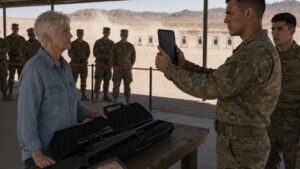
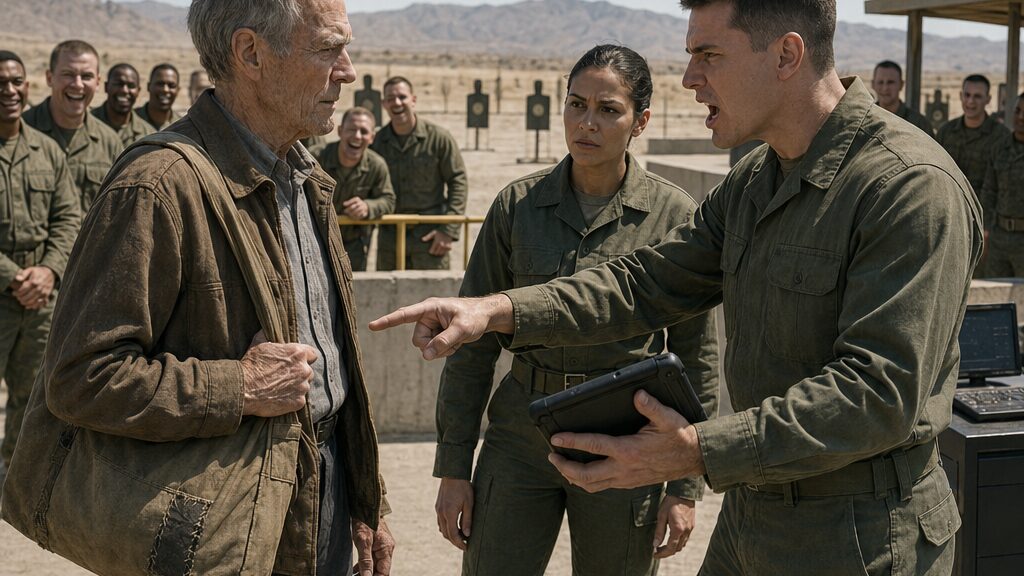
The last burst of rifle fire cracked across the range just as Ryan Miller stepped in front of Charles Harris and pointed at the worn bag hanging from his shoulder.
“How did you get past that barrier?”
Charles stopped beneath the red warning placard. Beyond Ryan, heat trembled over the qualification lanes. Steel targets stood in the dust, and a line of soldiers waited behind painted concrete markers while range staff checked the firing positions.
The repaired handle of Charles’s bag pressed into his palm. Its weight pulled against the old injury in his right shoulder. He shifted it slightly, careful not to let the movement show as pain.
“I walked through the visitor gate,” he said.
Ryan glanced toward the gate as though Charles had claimed to pass through a wall. He was younger by several decades, his uniform exact, his tablet secured against one forearm. A cable ran from the device to the radio clipped near his chest.
“This is an active-duty live-fire area.”
“I noticed.”
Ryan’s eyes narrowed. “Then you should understand that visitors remain behind the community safety line.”
Charles looked past him. A shaded platform had been built for families and local guests. Flags moved lazily above folding chairs. Beside them, a television camera rested on one operator’s shoulder while a reporter spoke with an event coordinator.
Charles turned his face away before the camera could swing toward him.
The motion did not escape Ryan.
“Sir, I need identification and your event registration.”
Charles set the bag carefully against his leg and reached into his coat. His fingers trembled once before closing around the folded authorization. The tremor had worsened during the drive, as it often did when his shoulder ached.
Ryan watched the hand, then the bag.
Charles handed over the paper.
The document bore the community committee’s seal, a base event signature, and the name of the person he had come to see: Drill Sergeant Angela Torres.
Ryan scanned it, then tapped his tablet.
“You’re not in the system.”
“The committee was told the paper would be sufficient.”
“The committee doesn’t control access to a live range.”
Charles reached into his inner pocket again. His fingers touched the thick edge of the sealed envelope inside. A neighbor had entrusted it to him two nights earlier at the veterans’ hall, placing both hands around his as though the envelope were heavier than money.
You knew what her father intended, the neighbor had said. It should come from you.
Charles had agreed before learning that local press would cover the event.
Now, from behind Ryan, the reporter turned slightly. Her camera operator followed.
Charles shifted so Ryan’s body blocked their view.
“What is the purpose of your visit?” Ryan asked.
“To see Angela Torres.”
“Personal visit?”
“Community responsibility.”
Ryan waited.
Charles did not elaborate.
The officer’s jaw tightened. “What kind of responsibility?”
“One entrusted to me.”
“That isn’t an answer I can enter.”
“It is the answer you asked for.”
A whistle sounded downrange. Soldiers stepped away from the firing positions as targets reset. Dust rolled across the lanes in a thin yellow sheet.
Ryan looked down at the paper again. “This format was replaced three months ago.”
“The signature is dated last week.”
“That doesn’t place you in today’s database.”
Charles saw the exact moment Ryan stopped treating the problem as a mismatch and began treating him as the cause of it. The officer’s shoulders settled. His voice took on the patient firmness used for someone assumed incapable of following simple directions.
“Do you understand the range is currently hot?”
“Lane conditions are cold. Bolts are open. No one is forward of the marked line.”
Ryan glanced toward the firing positions.
Charles continued, “The red light is off. Your reset team is waiting for clearance from the tower.”
For the first time, Ryan looked uncertain.
Only for a moment.
“You’ve been on ranges before.”
“Yes.”
“When?”
Charles bent to lift the bag. Pain pulled through his shoulder and down his arm. He paused with the handle halfway raised, breath held behind closed lips.
The television camera turned.
He saw the dark circle of the lens from the corner of his eye.
A woman stood beside it, hair pinned back against the heat. Jessica Rivera. Older than when he had last seen her, but not enough to make him mistake the shape of her face or the attentive forward tilt of her head.
Years earlier, she had placed photographs of a ruined mission site beneath a headline about sacrifice and courage. She had called Charles twice afterward, asking for a statement about heroism. He had never returned the messages.
Now her gaze passed over Ryan and stopped on him.
Charles lowered his head and gripped the sealed envelope through his coat.
He could still leave.
The scholarship could be delivered through the event office. Angela would receive it. The committee would be disappointed, but the duty itself would be completed.
He took one step backward.
Ryan moved with him.
“Sir, you can’t leave with an undeclared item after entering a controlled area.”
Charles looked down at the bag.
“It was declared at the visitor gate.”
“Not to me.”
“You weren’t at the gate.”
“That bag contains a firearm.”
It was not a question.
Nearby, two soldiers turned from the water station. One nudged the other.
Charles felt the old seam beneath his fingers. The repair had been done by hand, the stitches uneven but strong. The bag had crossed oceans, training grounds, storage rooms, and years of silence. He had never liked strangers touching it.
Ryan’s voice rose enough to carry.
“Place the bag on the inspection table.”
The soldiers at the water station stopped talking.
A third looked over from the drill lane.
Charles glanced once toward the exit, then toward the shaded platform where Jessica’s camera had begun to turn fully in his direction.
Ryan pointed at the metal table beside the barrier.
“Now, sir.”
Charles lifted the worn bag and walked toward the table as the platoon began to gather.
Chapter 2: The Officer Who Spoke Too Loudly
“DO. YOU. UNDERSTAND. WHERE. YOU. ARE?”
Ryan separated every word as though speaking across a great distance.
The nearest soldiers laughed.
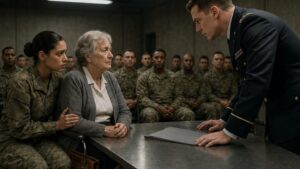
Charles stood beside the inspection table with one hand resting on the worn rifle bag. The laughter did not spread at first. It moved through the platoon by permission—one soldier grinning, another repeating Ryan’s slow rhythm under his breath, then several more turning from their abandoned drill formation to watch.
Charles looked directly at Ryan.
“This is the infantry qualification range, west tactical annex,” he said. “The line is cold pending clearance. I understand you perfectly.”
A few smiles disappeared.
Ryan’s face tightened, but a louder laugh came from the rear of the group. The officer heard it and glanced toward them. Something in his posture changed. He had lost ground when Charles corrected him. The crowd offered it back.
Ryan placed his tablet on the table.
“Then—you—should—understand—that—old—equipment—does—not—enter—an—active—course.”
More laughter.
Charles felt heat rising along the back of his neck. It was not the loudness that humiliated him. It was the performance—the officer looking past him for approval while pretending to address him.
“I have not asked to enter your course.”
“You entered the controlled area carrying this.”
Ryan seized the bag by its repaired handle.
The old stitches pulled tight.
Charles’s hand moved before he thought better of it. He caught Ryan’s wrist, not hard, but fast enough to stop the bag from rising.
The laughter ended.
“Set it down,” Charles said.
Ryan stared at the hand around his wrist.
Charles released him immediately.
A slight tremor returned to his fingers.
Someone behind the barrier snickered.
Ryan lowered the bag, but not gently. “You do not grab an officer on an active range.”
“You do not lift a firearm bag by damaged stitching.”
“So now you’re giving equipment instruction?”
“I’m preventing you from dropping it.”
Ryan opened his mouth, then looked toward the watching soldiers. The reply he chose was not the one he might have made in private.
“Maybe you should have brought something manufactured this century.”
A young soldier bent one hand into a shaking claw and imitated Charles reaching for the bag. Several others laughed. One of them stopped when Charles looked at him, but the rest continued.
The bag’s repaired seam had stretched. A single thread stood away from the canvas.
Charles pressed it flat with his thumb.
A man wearing a range safety vest approached from the tower lane. Patrick Baker had been monitoring the exchange from a distance, his expression caught between professional concern and reluctance to intervene before cameras.
“What’s the issue?” Patrick asked.
Ryan handed him the folded authorization. “Unregistered visitor carrying an undeclared firearm. No current digital entry, no equipment documentation, and no confirmed escort.”
Patrick examined the paper.
Charles watched his eyes pause at the seal and signature.
“This is genuine,” Patrick said.
Ryan tapped his tablet. “It isn’t current.”
“The authorization is current. The form is old.”
“That makes it incomplete.”
“It makes it badly processed.”
A few soldiers shifted. The amusement in the crowd weakened.
Patrick looked at Charles. “You came to see Drill Sergeant Torres?”
“Yes.”
“Were you told where to report?”
“The visitor gate sent me here.”
Ryan said, “The gate should have contacted logistics.”
Patrick folded the document along its existing crease. “That is not his error.”
It was a small correction, quietly delivered. Charles saw Ryan absorb it like an insult.
The officer turned back to the bag.
“Paperwork doesn’t resolve the safety concern.”
Patrick’s gaze moved to Charles’s hand. The tremor was visible now, more pronounced under the strain of holding still.
Ryan noticed the same thing.
“This gentleman may have known ranges once,” he said, projecting his voice to the soldiers, “but familiarity is not current qualification. Neither is nostalgia.”
Charles remained silent.
Ryan opened the event equipment standards on his tablet. Diagrams and compliance boxes filled the screen.
“Modern courses require verified optics, current maintenance records, approved accessories, and operator fitness. We do not make exceptions because someone brought a sentimental antique.”
“It passed the visitor-gate declaration,” Charles said.
“That was transport clearance, not course approval.”
“I did not request course approval.”
Ryan gave a thin smile. “Then there should be no objection to removing it from the active area.”
There was procedural sense beneath the arrogance. Charles could hear it. Ryan was responsible for the equipment lanes. An old man with an old bag and incomplete registration was exactly the kind of irregularity an officer was expected to stop.
But legitimate caution had ended when Ryan learned Charles could hear him.
Everything after that had been a choice.
The young soldier imitated the tremor again, this time holding an imaginary rifle. The platoon laughed harder.
Charles looked along the line of faces.
Some were entertained. Some looked uncomfortable. None moved away.
The anger that came was clean and cold. Not because they had mocked his body. Age had made him slow; pain had made his grip unreliable. There was no shame in truth.
But they were learning something from Ryan.
They were learning that weakness could be invented from appearance, that authority made cruelty acceptable, and that a crowd relieved each person of responsibility.
Patrick lowered the authorization. “We can secure the bag at the inspection station until Drill Sergeant Torres is located.”
Ryan shook his head. “Not without confirming the weapon is safe.”
Charles rested his palm against the canvas.
“It is safe.”
Ryan spoke loudly again. “WE. HAVE. TO. VERIFY. THAT.”
Charles’s eyes rose to his.
“I heard you the first time.”
Silence flickered across the platoon.
Then a woman’s command cut through the range.
“Why has my entire drill stopped?”
Soldiers snapped halfway toward formation before realizing they had nowhere to go without making their abandonment more obvious.
Angela Torres crossed the concrete from the command awning. She wore the stillness of someone whose anger did not need speed. Her eyes passed over the platoon, Ryan’s tablet, Patrick’s paper, and finally Charles.
She stopped.
For a moment, the range sounds seemed to withdraw—the distant machinery, the radio calls, the flags striking their poles.
Angela looked older than the child Charles remembered, but the shape of her eyes had not changed.
Her gaze dropped to the repaired seam of the bag.
Then it returned to his face.
“You knew my father,” she said.
Chapter 3: The Envelope Bearing Her Father’s Year
Angela reached for the sealed envelope, but Charles did not let it go.
“I can have the ceremony staff deliver it,” she said.
Her hand remained beneath his, waiting. The heavy paper bore the embossed year of her father’s unit, pressed so deeply into the seal that Charles could feel the numbers through his thumb.
“It was not entrusted to the ceremony staff.”
Angela looked from the envelope to his face. Behind her, the platoon had attempted to reform into something resembling order, though every soldier remained close enough to hear.
“Then you’ve delivered it to me.”
“Not yet.”
A small line appeared between her brows.
Ryan stepped beneath the command awning, tablet in hand. “Drill Sergeant, this visitor’s authorization was not processed through the active system. He entered with a firearm not registered for range use.”
Angela’s eyes stayed on Charles. “He has a name.”
“Charles Harris,” Ryan said. “It doesn’t appear in today’s database.”
Patrick handed Angela the paper. “The signature is valid. The form wasn’t transferred.”
Angela read it once.
“You were expected,” she said.
Charles nodded.
“Why didn’t you call me?”
“I did not have your number.”
“You could have asked the committee.”
“I was told where you would be.”
“That isn’t what I asked.”
Charles released the envelope, but only after Angela closed her fingers around it. She turned it over and saw her father’s unit year on the seal.
The change in her expression was slight. Her grip tightened.
“What is this?”
“A memorial scholarship.”
“In his name?”
“Yes.”
She looked toward the community platform, where chairs and a lectern waited for the afternoon presentation. “Then it belongs with the ceremony materials.”
“No.”
The word came out sharper than Charles intended.
Angela’s chin lifted.
Charles softened his voice. “It is not a ceremonial donation. The committee selected a student from the community. The money is secured. What is being transferred today is responsibility.”
“To me.”
“To the person who will oversee what the scholarship asks of its recipients.”
Ryan made an impatient sound. “This can be discussed outside the controlled area.”
Angela turned on him. “You will return my platoon to its drill.”
Ryan glanced at the soldiers. “With respect, their movement stopped because an unauthorized individual—”
“Their movement stopped because they chose entertainment over discipline.”
Several soldiers straightened.
Angela’s voice hardened. “Formation. Now.”
Boots struck concrete. The platoon moved, though slowly enough that they could still listen.
Ryan did not move with them.
“Drill Sergeant, personal familiarity does not override range procedure.”
“It establishes that he did not wander here in confusion.”
“It does not establish equipment compliance.”
Angela glanced at the bag. Her eyes settled on the repaired seam.
Charles saw recognition arrive without understanding.
“I’ve seen that before,” she said.
He looked away.
“In a photograph,” she continued. “At my mother’s house. My father was standing beside a bag with stitching like that.”
Ryan’s attention sharpened.
Charles felt the old impulse close around him: say less, reveal nothing, keep the past contained.
Angela waited.
“He trained with it,” Charles said.
“With the bag?”
“With what is inside.”
The platoon had reached formation, but not one face pointed fully forward.
Angela stepped closer. “You told my mother you were his friend.”
“I was.”
“Only his friend?”
Charles’s shoulder throbbed beneath the strap. He should have removed the bag, but taking it off would have felt like surrendering ground.
Ryan raised his tablet. “Whatever history exists here, the rifle cannot enter the tactical course without current verification.”
“No one said it would,” Angela replied.
Ryan swiped to a standards page. “It is already in an active equipment zone. If he intends to remain, it must be inspected and secured. If he intends to use it, it requires validation under supervision.”
Angela looked at Charles. “You are not using it.”
The order in her voice was familiar. Her father had possessed the same habit of turning concern into command.
Charles said nothing.
Angela’s expression changed. “You came to deliver the envelope. Do that, and I’ll escort you out before the press turns this into something it isn’t.”
Behind the safety barrier, Jessica Rivera spoke quietly to her camera operator. The lens was angled toward the awning.
Angela noticed Charles watching it.
“So that’s why,” she said. “You’re afraid they’ll recognize you.”
“I prefer not to be reported.”
“Recognized for what?”
Ryan answered before Charles could.
“That is irrelevant. The immediate issue is an elderly civilian carrying an unverified rifle in a controlled zone.”
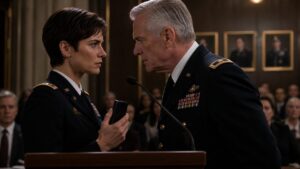
Angela faced him. “You made him the immediate issue when you stopped a platoon to mock him.”
“I stopped a potential safety breach.”
“You spoke to him as if he were incompetent.”
“I adjusted communication to visible conditions.”
Charles heard several soldiers exchange uncomfortable breaths.
Angela did too.
“You assumed,” she said.
Ryan’s face flushed. “I assessed.”
“And when the assessment was wrong?”
“He still lacks equipment validation.”
The tablet had become a shield in Ryan’s hands. Every time one claim failed, he moved to the next measurable category.
Charles understood the instinct. Rules preserved lives. Documentation caught failures before failures reached a firing line.
But Ryan was no longer defending rules. He was defending himself.
Angela turned back to Charles. “Give me the envelope. I will sign for it. Then we leave.”
“We?”
“I am taking you to the visitor office myself.”
“You have a platoon.”
“I have people capable of waiting ten minutes.”
“They have already learned too much from waiting.”
Angela’s mouth tightened. “Do not turn this into a lesson because you refuse help.”
The accusation struck more accurately than Ryan’s mockery.
Charles had spent years turning silence into virtue. He had called it protection when it was often avoidance. Now Angela stood before him with questions she had earned long ago, and his first instinct was still to leave.
Ryan held out the tablet so Patrick could see the equipment standards.
“Any personally owned rifle must pass inspection, function validation, and supervised course confirmation before approval. His weapon has none of that.”
Patrick studied the page. “Those provisions still apply.”
Ryan looked toward Charles. “Then there is no argument. The bag is secured, and he leaves.”
A gust moved through the awning. The edge of the envelope lifted in Angela’s hand, revealing the embossed unit year again.
Charles remembered the same number painted on a metal locker. A younger man leaning against it, laughing after missing a timed transition by less than a second. A promise made later in a place where laughter had become impossible.
He looked at the soldiers in formation.
The one who had imitated his tremor stared at the ground.
Angela said, “Charles, let me handle this.”
That was what he had always allowed others to believe—that his silence spared them the burden of handling what he would not.
He eased the rifle bag from his shoulder and placed it on the inspection table.
Ryan’s expression sharpened with satisfaction.
Charles turned to Patrick.
“Does this range still permit a personally owned rifle to complete the official supervised course after passing inspection?”
Patrick hesitated.
Angela stared at Charles. “No.”
Ryan looked from one to the other. “Technically, yes.”
Patrick gave him a warning glance, then answered Charles directly.
“Yes. The provision remains active.”
Charles rested his trembling hand on the repaired canvas.
“Then inspect it.”
Chapter 4: What the Scarred Receiver Remembered
The zipper caught at the repaired seam.
Charles stopped pulling.
Across the safety barrier, Jessica Rivera’s camera lens settled on the narrow opening in the bag as if it had been waiting for that exact moment.
“Problem?” Ryan asked.
“No.”
Charles lowered the zipper half an inch, eased the stretched canvas away from its teeth, and tried again. The bag opened with a dry metallic whisper.
Inside lay a rifle whose age could not be hidden and whose care could not be mistaken. The wood bore shallow dents beneath years of oil-darkened handling. The blued steel had faded along the receiver where hands had repeatedly found the same places. A pale scar crossed one side of the metal, too straight to be ordinary wear and too carefully smoothed to have been ignored.
The platoon watched from formation.
Charles’s fingers trembled as he reached into the bag. Before lifting the rifle, he placed two fingertips against the scar.
For one breath, the range vanished.
He saw a younger hand closing over the same steel. Heard laughter after a failed transition. Heard Angela’s father insist that half a second mattered only if a man wasted it.
Then Patrick stepped closer, and the present returned.
“May I inspect it?” he asked.
Charles withdrew his hand. “You may.”
Patrick put on clear safety glasses and began his examination with deliberate care. He did not rush for the benefit of Ryan or the cameras. He checked the chamber, action, stock, sling points, and visible condition. Each movement was announced and confirmed.
Ryan stood beside him with the tablet open.
“No current optic,” he said.
“It doesn’t require one,” Patrick replied.
“No electronic round counter.”
“Not required.”
“Maintenance record?”
Charles reached into the side pocket of the bag and produced a folded card protected by a cracked plastic sleeve.
Ryan looked almost offended. “Handwritten.”
“Legible,” Patrick said.
He read the dates, then turned the card over. The maintenance entries extended back farther than Ryan had been alive.
“This weapon has been cared for,” Patrick said.
Ryan folded his arms. “Care is not validation.”
“No,” Patrick agreed. “Inspection is.”
He completed the check, then placed the rifle on the padded bench with the action open.
“Mechanically sound.”
The words moved through the soldiers more effectively than a command. A few shifted their attention from Charles to Ryan.
Ryan tapped the tablet. “Mechanical soundness does not address operator capability.”
Angela stood just beyond the inspection lane, the sealed envelope held against her side. She had not opened it. She had not left, either.
Patrick looked at Charles. “Before any live course, I need to see basic unloaded positions and safe movement.”
Charles nodded.
Ryan gestured toward the staging lane. “This should clarify matters.”
The tone made his expectation plain.
Charles took the rifle from the bench. Its weight settled into familiar points along his palms. He stepped into the marked lane and checked the action exactly as Patrick had instructed.
“Standing ready position,” Patrick said.
Charles raised the rifle.
Pain struck before the stock reached his shoulder.
The old injury tightened beneath the joint like a wire pulled through bone. His right arm weakened. The muzzle dipped.
A murmur passed through the platoon.
Ryan said nothing, which was worse than laughter.
Charles lowered the rifle safely and breathed through his nose. Heat pressed against his face. His hand shook harder now, not from fear but from the effort of keeping the weapon controlled while his shoulder refused the angle.
Angela moved forward. “That’s enough.”
Charles did not look at her.
Patrick’s voice remained neutral. “Can you continue?”
“Yes.”
Ryan glanced toward the soldiers. “Range safety is not a matter of determination.”
“No,” Charles said. “It is a matter of adjustment.”
He changed his stance. Not dramatically. He moved one foot, rotated his torso, and brought the rifle up through a shorter path. The position was less elegant than the one his younger body had used. It asked less of the damaged shoulder and more of his center balance.
The stock settled.
The muzzle remained steady.
Patrick walked around him, watching the alignment and control.
“Lower.”
Charles lowered.
“Kneeling.”
He descended carefully, refusing the instinct to hurry because people were watching. His hip protested before his knee reached the mat. He shifted his weight, used the support permitted by the course standard, and completed the position without allowing the muzzle to cross the boundary.
The young soldier who had imitated his tremor was no longer smiling.
Ryan looked down at his tablet. “His movement time is already outside competitive pace.”
“This is inspection,” Patrick said. “Not scoring.”
“His limitations will become more severe under course pressure.”
Charles rose slowly. The movement cost him. He could feel each year in the joint and the pull of scar tissue under his coat.
Ryan was not wrong about that.
The rifle could be sound. The mind could remember. Neither fact made the body young.
Charles returned the weapon to the bench.
From behind the barrier, Jessica lowered her microphone and spoke to her camera operator. Then she approached Angela rather than Charles.
“I’ve seen that rifle,” she said quietly.
Angela’s attention sharpened. “Where?”
“In archive material. A photograph from the mission anniversary piece.”
Charles heard every word.
Jessica kept her voice low, but Ryan moved nearer.
“There was a man beside it,” she continued. “Not your father. An instructor, I think. His face was partly turned away.”
Angela looked toward Charles.
He busied himself checking the rifle’s open action, though Patrick had already done so.
“Was it him?” she asked.
Jessica studied Charles’s profile. “I’m not certain.”
But recognition had entered her voice.
Ryan stepped between the women and the table. “This cannot become a press identification exercise inside an active range.”
For once, Charles agreed with him.
Patrick placed the rifle back on the pad. “The weapon passes inspection. Mr. Harris demonstrated safe adaptation in the required unloaded positions.”
“Adaptation is not course fitness,” Ryan said.
“No. The course determines that.”
Angela came to Charles. “You taught him.”
Charles kept his eyes on the rifle.
“My father,” she said. “You taught him with this.”
“He trained with it.”
“That is not the same answer.”
“It is the answer I can give you here.”
Her expression hardened. “You’ve had years to choose another place.”
Charles flinched more from that than from his shoulder.
Behind her, Jessica had opened a tablet of her own. Images flickered beneath her fingertips.
Ryan checked the event schedule. “We are delaying the afternoon demonstration. Either he proceeds under the provision or withdraws now.”
The officer sounded controlled again. Professional. But his gaze kept returning to the platoon, measuring whether their attention still belonged to him.
Charles understood that Ryan wanted the course because a failure would restore the order that humiliation had broken.
Angela understood it too.
“You don’t owe him a performance,” she said.
“No.”
“You don’t owe them one.”
Charles looked toward the formation.
Several soldiers immediately faced forward.
He thought of how quickly laughter had moved through them. How easily one man’s contempt had become a group’s permission.
“I owe something,” he said.
Angela’s eyes dropped to the envelope in her hand.
Ryan stepped closer to the staging lane. “Last chance to withdraw before the course is configured.”
Charles lifted the rifle, returned it to the bag, and closed the zipper partway. Then he took the sealed envelope from Angela.
For a moment she looked relieved.
Charles placed it back into her hands and folded her fingers over the embossed year.
“Keep it closed until I finish.”
Chapter 5: The Standard Hidden Inside His Silence
Angela stepped into Charles’s path before he reached the firing line.
“You are not going another foot until you tell me why my father’s rifle appears in an archived photograph beside you.”
The course staff were moving target frames into position beyond them. Radios clicked. Patrick reviewed the lane sequence with two safety personnel. Ryan stood at the digital scoring station, pretending not to listen.
Charles looked at the rifle bag in his hand.
“It was never your father’s rifle.”
Jessica had remained near the observation barrier. At those words, she turned the tablet so Angela could see the photograph she had found.
The image was grainy, taken decades earlier outside a training structure. Angela’s father stood beside the same worn bag, younger than Angela was now, his sleeve rolled and his face split by a tired grin. Charles stood several feet away with one hand extended toward the scarred rifle.
Angela stared at the picture.
“You brought this to our house,” she said.
Charles said nothing.
“I remember the stitching.” Her voice dropped. “After the funeral. You stood at the gate with that bag, and my mother went outside.”
“I remember.”
“You left without coming in.”
“Yes.”
“Why?”
The directness of the question opened something he had kept sealed more carefully than the rifle.
Ryan’s phone vibrated on the scoring table.
He glanced at the screen. The name was not visible from where Charles stood, but the officer’s reaction was. Irritation. Weariness. Something defensive.
Ryan rejected the call.
A moment later it rang again.
He silenced it and muttered, “He refuses to learn.”
Patrick looked up from the course sheet. “Problem?”
“My father. He locked himself out of his medical account again and won’t use the access system I set up.”
“That can wait?”
“It has waited for three years.” Ryan shoved the phone into his pocket. “Some people would rather make everyone else compensate for their stubbornness than admit they can’t keep up.”
The words hung between him and Charles.
Ryan seemed to hear the resemblance only after speaking. His face closed, and he turned back to the tablet.
Angela did not look away from Charles.
“Was that what you thought of my father?” she asked. “That he could not keep up?”
“No.”
“Then tell me what you thought.”
Charles glanced toward the press platform. Jessica’s camera operator was speaking with a producer near a portable broadcast unit. The story was expanding around him while he stood still.
He had believed silence could keep ownership of the past in the hands of the dead.
In truth, silence had left the living to build explanations from empty space.
“I trained your father,” he said.
Angela waited.
“He was already capable. He was faster than most men and too willing to prove it. My work was to slow him down.”
A small crease appeared at the corner of her mouth, almost recognition.
“That sounds like him.”
“He believed speed solved hesitation. I taught him that discipline solved it first.”
“With this rifle?”
“With this one, and others. This was the one we used when a man had to feel every mistake instead of blaming equipment.”
Ryan looked over. “Old methods.”
Charles met his gaze. “Clear methods.”
Ryan’s jaw tightened.
Angela held up the photograph. “Why did you leave us?”
Charles looked beyond her toward the course. The final target bank stood against the dust, white shapes edged in shadow.
“Your father asked me to tell you what the standard meant when you were old enough.”
“Then why didn’t you?”
“Because I was there when he died.”
Angela went still.
Even the activity behind them seemed to narrow around the sentence.
Charles continued before courage failed.
“The position was failing. People were trapped behind it. He volunteered to remain while the others moved.”
“He was ordered?”
“No.”
Her eyes sharpened with pain. “You let him?”
“I was not in command of him.”
“But you trained him.”
“Yes.”
The word came out rough.
Charles looked down at his hand. It trembled against the bag handle.
“I taught him to control fear. To keep working when movement became difficult. To spend no shot, no second, no choice without purpose.” His fingers tightened. “When he stayed, I saw my lessons in every decision he made.”
Angela’s face changed—not softened, not yet. The anger remained, but its direction became uncertain.
“You thought you caused it.”
“I thought I helped make him able to choose it.”
“And that was enough for you to disappear?”
“I told myself your family had lost enough.”
“You decided that for us.”
“Yes.”
The admission struck harder than any defense would have.
Angela looked at the sealed envelope in her hand. “What did he ask you to tell me?”
Charles’s throat tightened.
“That part waits.”
Her head snapped up. “No.”
“It waits until I have done what I came to do.”
“You came to deliver this.”
“I came because the committee trusted me. I stayed because your platoon was being taught the wrong meaning of weakness.”
“And the course fixes that?”
“No.” Charles looked toward Ryan. “The course only removes an excuse.”
Ryan left the scoring station and approached. “We need a decision. The lanes are configured, and the event schedule is slipping.”
Angela turned on him. “You wanted this challenge.”
“I wanted the range protected.”
“You wanted him to fail where everyone could see.”
Ryan’s gaze flickered toward the platoon. “He invoked the qualification provision.”
“After you humiliated him.”
“He made the choice.”
Charles said, “He is right about that.”
Angela faced him again. “Then make sure it is your choice for the right reason.”
Charles felt the truth in her demand. Pride had carried him part of the distance. Not vanity, but the older, quieter kind—the belief that he alone could decide how much truth others were allowed to carry.
If he entered the course only to silence Ryan, then Ryan would still determine the meaning of the act.
Angela stepped aside, but not fully.
“If you finish,” she said, “you tell me the rest.”
Charles nodded.
“No more deciding what I can bear.”
“I understand.”
“Do you?”
He looked at the envelope.
“I am beginning to.”
Ryan’s phone vibrated again. He glanced at it, then turned it face down on the scoring table without answering.
Patrick approached Charles. “The course is ready. You may withdraw at any time. Safety overrides score.”
“As it should.”
Jessica moved suddenly behind the barrier. She had enlarged the archival photograph and was comparing it with another image on her screen.
Her producer leaned close. “That’s him?”
Jessica looked at Charles.
This time there was no uncertainty in her face.
Charles lifted the bag and walked toward the preparation line.
Behind him, Jessica began moving toward the live broadcast position.
Chapter 6: When the Trembling Hand Became Still
The start signal sounded.
Charles did not move.
Ryan looked up from the tablet. “Mr. Harris, the course has begun.”
Charles kept the rifle lowered and pointed toward the second target lane.
“The left boundary marker has shifted inside the travel path.”
Patrick turned.
A weighted strip had curled loose from the concrete, lifted by dust and repeated foot traffic. It lay where a shooter changing position could catch a boot.
One of the safety staff stepped forward, checked it, and raised a hand.
“Hold course.”
The marker was reset and secured.
Patrick returned to Charles. “Good catch.”
From the scoring station, Ryan said nothing.
The platoon stood behind the observation barrier. No one laughed, but Charles could feel their attention pressing against him.
He opened the worn bag.
The zipper passed over the repaired seam without catching this time. He lifted the rifle and checked it under Patrick’s supervision. His fingers shook as they found the scarred receiver.
He placed his thumb over the pale line.
The metal was warm from the sun.
He remembered telling Angela’s father that discipline began before the first action. Not in speed. Not in aggression. In seeing what others missed because they were eager to begin.
Charles moved his hand to the grip.
The tremor stopped.
Not everywhere. His shoulder still ached. His hip still resisted the angle of his stance. Nothing inside his body had become young.
But the movement in his hand narrowed into purpose.
Patrick stepped behind the safety line. “Shooter ready?”
Charles settled the stock.
“Ready.”
The signal sounded again.
He moved.
The first target appeared from behind a barrier. Charles fired, transitioned, fired again. The rifle’s report struck the range walls and rolled outward.
On Ryan’s tablet, two marks appeared at the center of the scoring diagram.
Charles advanced to the next position with short, measured steps. He did not imitate the speed of the younger soldiers. He cut away what his body no longer needed—no flourish, no wasted turn, no reach longer than necessary.
A target rose.
Another turned.
He engaged both.
The tablet chimed twice.
The young soldier who had mocked his tremor leaned closer to the barrier.
At the first reload point, Charles’s shoulder tightened. He adjusted the rifle lower, completed the required action, and returned it to position without breaking control.
Ryan watched the numbers accumulate.
“Time is behind benchmark,” he said.
Patrick did not answer.
Charles reached the low wall.
The course expected a rapid descent into a kneeling position followed by a lateral movement. His hip warned him before he bent. He altered the sequence within the permitted boundary—one hand briefly stabilizing against the wall, knee settling under control.
The delay cost him seconds.
A murmur passed through the platoon.
Then his hip nearly gave way.
His weight shifted outside his base. For an instant, the edge of his vision whitened with pain.
The shortest recovery would have been to swing across the lane and catch himself against the barrier.
It would also have carried the muzzle through an unsafe angle.
Charles let the rifle settle inward, away from everyone, and accepted the fall of his knee against the mat.
The impact jarred his shoulder.
He paused.
Ryan’s tablet continued counting time.
Angela gripped the sealed envelope against her chest.
Charles could feel the course waiting for him.
So could the platoon.
He reset one foot, rose through the leg that still obeyed him, and completed the lateral transition by the longer route.
No shortcut.
No violation.
The next target rose.
He struck it.
The laughter had disappeared completely now. Not because the score was perfect—they could not yet know that—but because the soldiers recognized the choice he had made. He had accepted lost time rather than spend safety for appearance.
Patrick’s expression changed first.
Then Angela saw it.
This was not an old man pretending his body had no limits. It was a trained man refusing to let those limits choose his standards.
Charles reached the middle section of the course.
The targets came faster there, appearing from alternating angles. He turned through the smallest possible arcs. Each shot followed the previous one with disciplined rhythm, neither hurried nor delayed.
The old rifle moved as though its wear marks had been shaped for his hands.
At the scoring station, Ryan zoomed in on the hit pattern.
His face lost color.
Every registered impact sat within the required zone.
Jessica had reached the portable broadcast position. Her producer pointed toward Charles, then toward the camera. The operator shifted the lens to frame the course exit.
Jessica raised the microphone but did not yet speak.
Charles saw none of it.
He reached the final sequence.
The firing position was low and angled, designed to test control beneath an obstructed line. It demanded the very shoulder rotation that had failed during inspection.
Patrick called the instruction.
Charles lowered himself.
Pain cut through the joint so sharply that the rifle blurred for half a heartbeat.
Ryan looked at the tablet clock. “He can stop.”
Angela turned toward him.
Ryan’s voice was quieter now. “He has already demonstrated capability. He does not need to injure himself.”
It was the first thing he had said that did not sound like self-defense.
Charles heard it.
He also heard the echo of Angela’s question: Make sure it is your choice for the right reason.
He looked through the final opening.
Not at Ryan.
Not at the cameras.
He thought of Angela’s father at the training line, angry after being ordered to repeat a slow drill. Thought of him years later, calm where panic would have killed more people. Thought of Angela standing behind the barrier with the truth still sealed in her hands.
The standard had never been about proving a man could not be broken.
It was about knowing what must not be broken, even when the man was.
Charles adjusted the stock below the most painful point of his shoulder.
The final targets moved.
He fired.
One.
Transition.
Two.
A last target appeared at the far edge.
Charles breathed out, allowed the rifle to settle, and pressed the trigger.
The final report faded into the open range.
For several seconds, nothing happened.
Then Ryan’s tablet chimed.
The score filled the display.
Every target marked.
Every required zone confirmed.
No penalty.
Above the benchmark line, a single result appeared.
Perfect.
Ryan stared at it, then refreshed the system.
The same result returned.
Patrick checked the course record and the manual verification feed. He looked toward Charles, who remained in position until ordered to clear.
“Course complete,” Patrick called.
Charles opened the action and followed every command. Only when Patrick confirmed the rifle safe did he rise.
The platoon came to attention.
No order had been given.
Boots aligned against concrete in one hard movement, followed by a silence so complete Charles heard a spent casing spin near the boundary line before falling flat.
Ryan slowly lowered the tablet.
Charles returned to the preparation table and laid the rifle inside the worn bag. His hand had begun trembling again.
Jessica stepped to the edge of the broadcast area, microphone raised.
Her eyes met his.
Recognition had become certainty.
“Charles Harris,” she began.
Chapter 7: The Truth No Camera Was Given
“Charles Harris,” Jessica began, raising the microphone toward him, “are you the veteran pictured in the archived—”
Angela stepped between them.
The movement was so precise that the microphone stopped inches from the front of her uniform instead of Charles’s face.
“This firing line is still controlled,” Angela said.
Jessica glanced past her. Charles had begun closing the rifle bag, but the zipper paused at the repaired seam. His fingers were trembling again. Without the course before him, the years had returned to his hand.
“We’re not broadcasting yet,” Jessica said.
Her producer, standing beside the portable unit, looked away.
Angela did not.
“You were preparing to.”
Jessica lowered the microphone slightly. “People just watched an unidentified elderly visitor outperform an active course after being publicly mocked. There is a legitimate story here.”
“There is,” Angela said. “That does not mean his name belongs to you.”
Charles pulled the canvas clear of the zipper teeth and closed the bag. The final click sounded louder than it should have in the silence left by the platoon.
They were still at attention.
No one had ordered them to remain that way.
Patrick crossed from the scoring station carrying Ryan’s tablet and the manual verification sheet. He stopped beside Charles.
“The score is confirmed,” he said. “No penalties. All required zones.”
Charles nodded.
Patrick waited, perhaps expecting satisfaction. Charles only lifted the bag onto the table and checked that the repaired handle had not torn further.
Ryan remained near the scoring equipment. The certainty had gone from his posture. He looked at the display as though the numbers might rearrange themselves if he gave them enough time.
Jessica shifted her attention to Charles again.
“I covered the anniversary of the mission,” she said. “You refused to speak then.”
“Yes.”
“People believed you were dead.”
“Some did.”
“Others said you had disappeared because of what happened.”
Angela turned toward him.
Charles felt the old door inside him begin to close. The cameras, the soldiers, Jessica’s questions—each offered a reason to pick up the bag and walk away.
He had spent years calling that instinct restraint.
Angela touched the sealed envelope against her side.
“If you leave now,” she said quietly, “is that the same choice you made at our gate?”
The question held no accusation. That made it harder to resist.
Charles looked at the road beyond the safety barrier. It was less than two hundred yards to the visitor parking area. Once he reached it, no one here could require anything more from him.
But Angela was not requiring it.
She was asking him to stop deciding for her.
Charles faced Jessica.
“You may report the scholarship,” he said. “You may report that the course was completed.”
“With your name?”
“No.”
Jessica’s expression tightened. “The score has meaning because of who you are.”
“The score has meaning because it was measured.”
“That is not the whole story.”
“No,” Charles said. “It isn’t. But the rest is not automatically public because you found a photograph.”
Jessica looked at Angela, then at the platoon. The soldiers stood in rigid silence behind the barrier, their earlier laughter now impossible to imagine from their faces.
“What am I supposed to call you?” she asked.
“The person who delivered the scholarship.”
For several seconds, Jessica said nothing.
Then she turned to her producer. “We lead with the memorial fund. No archival identification. No name unless he changes his mind.”
The producer frowned. “The station will want—”
“That is what we have permission to use.”
Jessica lowered the microphone completely.
It was not an apology. It was better than one.
Patrick handed the verification sheet to Charles. “The official course record requires an identity.”
Charles looked at him.
Patrick continued, “The public event release does not. I can mark the record restricted and list the result without personal distribution.”
Ryan finally looked up from the tablet.
“You can do that?”
Patrick met his eyes. “The system allows professional judgment.”
The words landed without force and still struck.
Patrick entered the restriction, then turned the screen so Charles could see it before saving.
Charles nodded once. “Thank you.”
Angela held out the envelope.
“You told me to keep it closed until you finished.”
Charles looked toward the command awning. “Not here.”
They moved several yards away from the cameras, though not far enough to leave the range. Charles placed the rifle bag on a bench beneath the awning. Angela sat across from him and broke the seal.
Inside was the scholarship document, the committee’s letter, and a smaller folded page yellowed at the edges.
Angela unfolded it carefully.
The handwriting was uneven, written under conditions that had offered no patience.
She read the first line and stopped.
“My father wrote this.”
“Yes.”
Her eyes moved over the page.
Charles watched her reach the sentence he had carried in memory even after the paper had begun to fade.
Teach her the standard when she is old enough to understand it. Not how to shoot. Why restraint matters when fear makes speed feel easier.
Angela pressed her thumb against the edge of the page.
“You had this all these years?”
“Yes.”
“Why was it not given to my mother?”
“The rest of the message was operational. This part was addressed to me.”
“And you did nothing.”
Charles accepted the words.
“I kept the rifle. I funded the first scholarship contribution anonymously. I checked on your family through others.” He looked at the bag. “I did everything that allowed me to remain absent.”
Angela’s eyes shone, but her voice remained controlled. “You thought the training killed him.”
“I thought it made him able to stay.”
“What did staying accomplish?”
Charles hesitated.
Then he gave her the truth without trimming it into heroism.
“The position was already lost. He held it long enough for six people to cross out. Two were injured. One could not move without help. Your father understood that if everyone withdrew at once, none of them would clear the exposed ground.”
“He chose last place.”
“Yes.”
“Did he know he would die?”
“He knew the risk.”
Angela looked down at the letter.
Charles continued, “The standard did not send him there. The danger was already there. What he learned allowed him to keep other people alive inside it.”
The awning canvas stirred above them.
Angela folded the letter along its original creases.
“You should have told me.”
“Yes.”
“When I was eighteen.”
“Yes.”
“When I enlisted.”
“Yes.”
“Before today.”
Charles looked at his trembling hand.
“Yes.”
She sat with that answer.
Across the lane, Ryan approached. He had removed the tablet from his arm and carried it at his side.
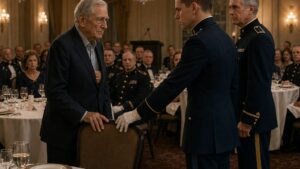
“Mr. Harris,” he said, loud enough for the platoon and press to hear, “my conduct was unacceptable. I misjudged your authorization, your equipment, and your ability. I apologize.”
It was formally correct. Charles could also see Ryan measuring how far his voice carried.
“You are apologizing to the audience,” Charles said.
Ryan’s face reddened.
“I am apologizing to you.”
“Then come closer.”
Ryan did.
Charles lowered his voice.
“Your father called three times.”
Ryan stiffened.
“You do not know anything about him.”
“No. I know what you said after you refused to answer.”
Ryan looked toward the scoring station.
Charles said, “Fear does not always sound like fear. Sometimes it sounds like impatience. Sometimes contempt.”
“My father refuses every form of help.”
“And that frightens you.”
Ryan’s jaw worked.
Charles did not excuse him. “Being frightened of what age is doing to him does not give you permission to practice cruelty on someone else.”
Ryan looked at the ground.
Charles added, “Call him before your apology becomes a thing you can only deliver to an empty room.”
The officer said nothing. He took out his phone and walked away from the cameras before placing the call.
Angela watched him go.
“You are better at giving other people truth than receiving it,” she said.
Charles almost smiled.
“Yes.”
She slipped her father’s letter back into the envelope. “The scholarship stays in his name. The recipients learn service, judgment, and responsibility. No mythology.”
“No mythology,” Charles agreed.
“And no hiding the purpose behind a score.”
He looked at her.
She placed one hand on the repaired seam of the rifle bag.
“You did not preserve this as a trophy.”
“No.”
“As evidence?”
“As a reminder.”
“Of him?”
Charles shook his head. “Of what the tool was for.”
Angela understood.
She rose and faced the platoon. They were still at attention, waiting for a speech, an introduction, perhaps an order to applaud.
She gave them none.
“Return to drill.”
The formation turned.
Boots struck concrete. Commands resumed. The first movements were uneven, then tightened into rhythm.
Charles lifted the bag onto his aching shoulder.
Angela walked with him as far as the safety gate.
“You could come back,” she said.
He looked toward the range.
“Not for a ceremony.”
“Not for one.”
He considered that, then nodded.
Angela did not salute him. She did not call the platoon back or speak his name for the cameras. She simply opened the gate and allowed him to leave under his own power.
Charles walked toward the access road with the worn bag resting against his shoulder. Behind him, Angela’s commands carried across the concrete, followed by the measured answer of the platoon returning to work.
Their movements settled into precision.
The old standard had not been preserved in the rifle, the perfect score, or the silence after the final shot.
It had passed forward.
Charles allowed himself one small smile and kept walking.
The story has ended.