She Came To The Memorial In A Faded Jacket Because His Name Was Still Missing
Chapter 1: The Woman With The Cane At The Memorial
Mary Carter stopped three steps short of the new memorial wall because the empty space was still empty.
Her cane found the ground once, twice, three times.
The sound was small beneath the folding chairs being opened, the murmur of volunteers carrying programs, the metallic click of the honor guard checking straps and buttons near the far side of the lawn. Nobody turned at first. She was used to that. Old women became part of the background if they stood still long enough.
But the name was not there.
Not on the polished black panel. Not on the printed dedication program lying in neat stacks beside the registration table. Not on the temporary display board where local families had clipped photographs of sons, daughters, brothers, husbands. Mary had known before she looked. She had told herself she would not expect anything this year. Expectations made the body foolish. Expectations made the hand tremble.
Still, she had come before the crowd.
Her faded camouflage jacket was too warm for the morning, and one sleeve had been patched with thread that did not quite match. She wore it because Steven had once laughed that clerks never looked like soldiers unless they stole somebody else’s field coat. He had been wrong about plenty of things. That had not been one of them.
Mary reached into the inside pocket and drew out the envelope.
It was cream-colored once. Years had pressed it toward yellow. The flap remained sealed, softened along the edges from being touched too many times and opened never. Tucked behind it was the old photograph, the corner bent where Steven’s shoulder disappeared into a strip of sunlight. His smile had faded to gray, but Mary still knew which blur was him before her glasses settled on her nose.
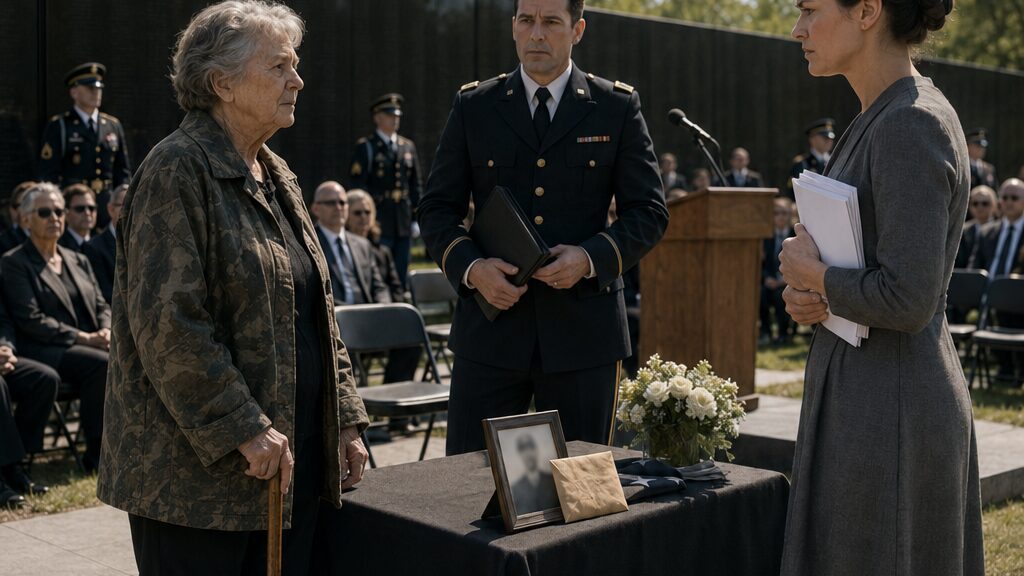
She moved to the end of the display table. There was a small gap between a framed picture of a young Marine and a folded program secured beneath a paperweight. Mary placed Steven’s photograph there, just enough for his face to show. The envelope stayed behind it like a backing, hidden unless someone lifted the picture.
Her fingers lingered a moment too long.
“Ma’am?”
Mary did not turn immediately. The voice was close, careful, already alarmed.
A woman in a gray dress stood at the other side of the table, both arms full of papers and clipped badges. Her hair was pinned neatly, her mouth drawn into the expression of someone who had been holding a ceremony together with tape and prayers since sunrise. She looked at the photograph, then at Mary’s jacket, then at the cane.
“That table is for approved families,” the woman said.
Mary slid her hand back from the photograph. “Yes.”
The woman waited for more. When none came, her grip tightened around the papers.
“I’m Laura Hill. I’m coordinating the family display. Are you with one of the listed families?”
The last name struck Mary beneath the ribs, not sharply, but with the old dullness that had outlived sharp things. Hill. She looked at Laura’s face again, more carefully this time. The cheekbones were not Steven’s. The eyes, maybe. No, not the eyes. Anna’s eyes. Tired and guarded and quicker to close than to ask.
Mary set both hands on top of the cane.
“I came for Steven Hill.”
Laura’s face changed too quickly. Not recognition. Defense.
“There is no Steven Hill on the program.”
“That is why I came.”
A volunteer passing with a box of small flags slowed down. Two seated veterans near the front row stopped talking. Mary could feel the ceremony beginning to gather around them, not with attention yet, but with pressure. A public thing did not need to be loud to become cruel. Sometimes all it needed was people pretending not to listen.
Laura glanced at the photograph again. “Ma’am, we can’t add names this morning. The committee verified the final list weeks ago.”
“I am not asking you to add him this morning.”
“Then I need you to remove that.”
Mary did not move.
Laura lowered her voice. “Please. I don’t want this to become uncomfortable.”
“It already is.”
The woman blinked, as though she had expected confusion but not precision.
Mary looked past her toward the new wall. The names cut into the stone caught the sun in clean lines. There were hundreds of them, county sons and daughters, names carved so deeply that rain and years would have to work hard to erase them. Steven’s absence looked just as deliberate.
A uniformed officer stepped down from the side of the wooden podium with a black folder tucked beneath one arm. He was younger than Mary expected officers to be now, though perhaps everyone in a pressed uniform looked young when one had watched so many uniforms become photographs.
“Is there a problem?” he asked.
Laura gave him a relieved look. “Andrew, this woman placed an unapproved photograph on the family table.”
Mary almost smiled at the word woman. Not veteran. Not guest. Not family. Woman. Accurate and incomplete.
Andrew Thompson turned to Mary. His expression softened for half a second when he saw the cane, then disciplined itself. “Ma’am, we’re about fifteen minutes from beginning.”
“I know.”
“We need to keep the display consistent with the printed program.”
Mary shifted her weight. Her right knee had begun to burn from standing, but she would not sit while Steven’s face lay under threat of being taken away.
Andrew glanced at the photograph. “Who is this?”
“Steven Hill.”
The name did not land on him. Not yet.
Laura said, “He isn’t on the approved list.”
Andrew opened the black folder. The pages inside were clipped into sections: ceremony order, remarks, list of names, family seating. Mary knew folders like that. She had assembled hundreds. She knew the smell of official paper, the strange authority of anything tabbed and signed.
Andrew’s finger moved down one page. Then another.
Laura continued, “The committee went through county records, service confirmations, casualty lists, everything. If he qualified, he would be there.”
“He qualified before there was a committee,” Mary said.
The nearby voices quieted. Someone setting up the microphone at the podium looked over.
Andrew stopped turning pages.
“What was the name again?” he asked.
Mary held his eyes. “Steven Hill.”
Laura made a small impatient sound. “Andrew—”
He raised one hand, not rude, only asking for a breath. He flipped toward the rear of the folder, where documents had been added after the main program. Loose pages. Last-minute notes. A photocopy corner showed from beneath a blue sheet.
Mary watched his finger pause.
Then he looked at her differently.
Not with understanding. Not even with belief. But with the recognition that paper had just complicated certainty.
“Do you have identification?” he asked.
Mary’s jaw tightened. “For myself or for the dead?”
Laura’s face flushed. “That’s not fair.”
“No,” Mary said. “It has not been.”
Andrew closed the folder halfway, shielding the page from the wind. “Mrs. Carter?”
Mary did not remember giving him her name. Then she saw it on the page. Something old had traveled ahead of her, after all.
“Yes.”
Laura looked from Andrew to Mary. “You know her?”
“I know the file says Mary Carter was listed as a contact on an old service-related inquiry.”
“That doesn’t make him eligible for the wall.”
Mary reached toward the photograph, not to take it back, but to straighten it. Laura moved first, her hand quick and anxious, as if the photo were a match dropped near gasoline.
Mary’s fingers closed around the top of the cane.
“Do not touch his face.”
The words were quiet. They carried farther than she intended.
Laura froze.
Andrew looked toward the podium, where the microphone waited and a row of chairs had filled with families who had come to hear names spoken properly. Mary saw him making a calculation. Ceremony against disruption. Procedure against an old woman’s grief. A file against a printed program.
“I need to check this before we begin,” he said.
Laura stared at him. “Now?”
“If the file is wrong, we need to know how.”
“If the program is changed now, every family will ask questions.”
Mary looked at the photograph. Steven’s face was tilted toward a sun that no longer existed.
“Questions are not the worst thing that can happen to a name.”
Laura hugged the papers to her chest. A wind lifted the corner of the printed program, and Mary saw the clean line where Steven should have been between two other Hills who had died long after him.
Andrew stepped closer to the table. “Mrs. Carter, I’m not promising a change. But I’m not removing the photograph until I understand what this is.”
For the first time that morning, Mary’s hand loosened on the cane.
Then Andrew turned the folder toward Laura just enough for her to see the page.
Her eyes dropped.
Mary watched the younger woman read. Watched the first crease of confusion break through the practiced calm.
Andrew’s voice lowered.
“The file has Steven Hill listed,” he said, “but the program does not.”
Chapter 2: The Name That Was Not Printed
Laura Hill saw her own last name in Andrew’s black folder and felt, absurdly, as if someone had written it there to accuse her.
Steven Hill.
The letters sat halfway down a copied page, crooked from some older file, one line among dates and service numbers and blurred stamps. Laura held hundreds of pages every week for work, county permits and donor lists and historical forms. She trusted paper when people became emotional. Paper had borders. Paper could be checked.
This paper did not settle anything.
“Let me see that,” she said.
Andrew hesitated.
“I’m on the committee,” she said, sharper than she meant. “If this affects the program, I need to see it.”
Mary Carter stood beside the table in her faded jacket, both hands folded over the cane, her face unreadable. That was what unsettled Laura most. The woman was not pleading. Not apologizing. Not acting confused in any way Laura could categorize and gently manage.
Andrew turned the folder toward her but kept one hand on it. “It’s not part of the ceremony packet. It was clipped into the supplemental county military records. I don’t know why.”
Laura bent over the page.
Steven Hill. Army. County of residence. Service verified. Status line: deceased while assigned to training command. Beneath that, a note in smaller print: eligibility review incomplete.
Her throat tightened at the surname.
“How old is this?” she asked.
“Original record appears to be from the late sixties,” Andrew said. “The copy was requested later. I can’t tell by whom from this page.”
Mary said nothing.
Laura looked at her. “Who was he to you?”
Mary’s gaze shifted past her, toward the wall.
“A soldier.”
“That’s not an answer.”
“It is the answer the Army gave most people.”
The words irritated Laura because they sounded like accusation and grief at the same time. She turned a page, searching for something cleaner. “The memorial criteria were public. Killed in action, died of wounds, active-duty death confirmed by official record. The committee didn’t exclude anyone casually.”
“His death was confirmed.”
Andrew tapped a line. “It says training command. There may have been a distinction in the original review.”
“There is always a distinction,” Mary said.
Laura had heard that tone before, from old men at public hearings who carried one grievance for forty years and expected the present to kneel before it. But Mary did not have the heat of those men. She had something more difficult: endurance without performance.
Behind them, volunteers were handing out programs. Families had begun to take seats. A microphone squealed once, then settled. Laura felt time pressing at the back of her neck.
“This is not the moment to litigate old eligibility language,” she said. “We have families here. We have speakers. We have a printed order.”
Mary looked at the stack of programs. “And he is not in it.”
Laura’s fingers slid beneath the top page of Andrew’s folder and found another copied sheet. A service number. A county address. Her eyes moved without permission to the emergency contact line.
Anna Hill.
The name struck like a door opening in an empty house.
Laura pulled the page closer. “Anna Hill?”
Mary’s head turned.
Andrew looked between them. “You recognize the name?”
Laura tried to speak, but the first word caught. “My mother.”
The ceremony noise seemed to move farther away.
Mary’s hands tightened on the cane. Only for an instant, but Laura saw it.
“My mother had a brother named Steven,” Laura said slowly. “She mentioned him once or twice. Not like this.”
Mary did not ask what Anna had said. That made Laura colder.
“He wasn’t on any of our family veteran forms,” Laura continued. “When we built the county family registry, I used my mother’s papers. Steven was not listed as a fallen service member.”
Mary’s mouth folded in. “No. I expect he was not.”
That quiet certainty angered Laura more than an argument would have. “You don’t know what she kept.”
Mary’s eyes met hers then. Gray, steady, tired past politeness. “I know what she asked me not to say.”
Laura felt Andrew shift beside her, but he did not interrupt.
The old photograph remained on the table between them. Laura had avoided looking closely. Now she forced herself to. A young man in fatigues, laughing at something outside the frame. His hair was too dark to see much shape. His face had the open confidence of someone not yet taught how quickly a day could turn.
Nothing in him looked like disgrace.
That was the problem.
“My mother said he died after making a mistake,” Laura said. “She said it broke my grandmother. She said the family didn’t talk about it because there was no good in reopening it.”
Mary’s gaze dropped to the photograph. “Families often call silence mercy when it is easier than memory.”
Laura’s face warmed. “You don’t get to judge my mother.”
“No,” Mary said. “I do not.”
But the restraint made the words worse.
Andrew closed the folder partway. “We need to decide what happens in the next ten minutes.”
Laura seized the practical problem because it gave her somewhere to stand. “The ceremony proceeds as printed. We cannot announce a name that the committee did not approve.”
Mary said, “You can say his name without carving it.”
Laura looked at her sharply.
Andrew’s eyes lifted from the folder. “Mrs. Carter.”
Mary did not look away from Laura. “If your mother was Anna Hill, then Steven was not only a line in that folder. He was your blood.”
The word blood made Laura step back. The papers in her arms bent against her chest.
“You came here this morning with a photograph no one approved, a sealed envelope no one can verify, and a story you won’t tell. Now you expect me to interrupt a public memorial because my mother’s name appears on an old form?”
“I expect you to let him remain on that table.”
“That is not the same thing.”
“It is today.”
The honor guard leader called something from the far side of the lawn. The first speaker was being guided toward the podium. The ceremony had its own momentum now. Laura felt every chair behind her, every family who had arrived with one grief properly documented and one name correctly printed.
Andrew looked at Laura. “I can make a brief procedural note. Something neutral. Say there is an additional service record under review.”
“No,” Laura said immediately. Then she heard herself and softened the edge. “Not during the dedication. We can review it after. Properly.”
Mary’s eyes closed once, slowly. When they opened, Laura expected anger. Instead she saw recognition, as if Mary had heard the sentence before from other people behind other desks.
“Properly,” Mary repeated.
Laura wanted to tell her she was trying to be fair. That fairness required order. That one unverified photograph could open the ceremony to arguments no one had prepared for. But the photograph lay there, small and stubborn, with Steven Hill’s faded face turned toward the wall that had no room for him.
Andrew slid the copied sheet free and folded it once. “I’ll keep this page separate. After the ceremony, we’ll compare the original record.”
Mary reached for the photograph.
Laura thought she was taking it away. Instead Mary moved it two inches back from the front edge of the table, less visible to the crowd, still present.
It was a concession so small it shamed Laura.
“Mrs. Carter,” Laura said, before she could stop herself. “If Steven Hill was my uncle, why do you know more about him than his own family?”
Mary looked past Laura to the chairs filling in rows, to the podium waiting, to the flag hanging still in the morning air.
“Because your mother made sure I would,” she said.
Chapter 3: The Photograph Laura Was Never Shown
Mary’s knee would not bend far enough to let her kneel, so she lowered herself in stages beside the old marker, one hand on the cane, one on the warm stone, refusing to make a sound that might turn pain into spectacle.
The new memorial lawn ended fifty yards behind her, where clean chairs and bright programs faced the polished wall. Here, past a line of cedar trees and an uneven strip of older graves, the ground changed. The markers were smaller, some military, some family, some temporary stones that had somehow become permanent because no one had taken responsibility for replacing them.
Steven Hill’s marker was not grand. It was a flat rectangle, weathered at the edges, set slightly lower than the grass around it. His name was readable if one already knew where to look.
Mary always knew.
She set the photograph on the stone first. Then the envelope behind it. The cane lay across her lap. She tapped the handle three times with her thumb, not against the ground now, only against the worn wood.
“Steven Hill,” she said.
The name came out low. Not prayer. Not announcement. Attendance.
Behind her, footsteps stopped.
Mary did not turn. She had heard Laura following from the memorial lawn, keeping enough distance to pretend she was not following and close enough to make sure Mary did not disappear with the question.
“You come here every year,” Laura said.
Mary adjusted the photograph so the wind would not catch it. “When my legs allow.”
“This isn’t part of the county dedication site.”
“No.”
“But you knew exactly where it was.”
Mary looked at the grass that had grown against one corner of the marker. She took a folded handkerchief from her pocket and wiped the dirt away from Steven’s last name. The motion was careful, practiced, almost irritating in its tenderness.
Laura stepped closer. “Mrs. Carter, I need that photograph.”
Mary’s hand stilled.
“For the committee record,” Laura added. “If we’re going to review this, we need copies of whatever you have.”
“You need many things,” Mary said. “You do not need to take him from here.”
“I’m not taking him. I’m asking to document him.”
Mary looked over her shoulder. “That is what people say when they want to move a thing without carrying it.”
Laura’s face tightened. She had removed her heels, or perhaps traded them for flats after the ceremony; Mary noticed the change without meaning to. The younger woman’s neatness had begun to fray. One strand of hair had slipped loose near her cheek. The stack of papers she still carried was less straight now.
“The ceremony is over,” Laura said. “Andrew made no announcement. He said the record was under review, exactly as he promised. No one was embarrassed.”
“No one?”
Laura opened her mouth, then closed it.
Mary returned to the marker. The dedication had ended with polite clapping, a bugle recording because the scheduled player had taken ill, and families lining up to touch names already carved. Andrew had spoken one sentence about supplemental records being examined for future inclusion. It had been enough to stop Laura from removing the photograph. It had not been enough to give Steven back his place.
Mary had not expected more. Expectation was the luxury of people with committees on their side.
Laura moved around until she stood opposite Mary, the marker between them. She looked down at the photograph more closely now.
“He was young.”
Mary almost answered, They usually are. Instead she said, “Nineteen in that picture.”
Laura’s expression shifted. “My mother would have been seventeen.”
“Yes.”
“You knew her then?”
Mary’s fingers went to the envelope.
Laura noticed. Her eyes narrowed, not with suspicion this time, but recognition. “That’s my mother’s handwriting.”
Mary slid the envelope partly beneath her palm.
Laura crouched, slowly, as if approaching a frightened animal. “On the front. That M. Carter. My mother wrote that.”
Mary said nothing.
“I have boxes of her things,” Laura whispered. “Recipe cards. Christmas lists. Notes to herself. That M looks like hers.”
The cemetery seemed to hold its breath. A mower buzzed far away near the maintenance shed, then faded.
Laura reached toward the envelope.
Mary’s hand came down flat over it.
“No.”
“I’m his family.”
“Yes.”
“Then why do you have something addressed by my mother?”
“Because she gave it to me.”
Laura sat back on her heels. “When?”
Mary looked at the photograph. Steven’s smile had survived badly. Paper did that. Memory had been kinder and crueler. It kept the exact angle of his grin and the way he used to knock twice on the records office door even when it was open. It kept the sound of Anna Hill in a hospital corridor saying, Please, Mary. Please don’t make them say it again.
“A long time ago,” Mary said.
Laura’s voice hardened. “That isn’t enough.”
“It is all I have for you today.”
“Why? Because you don’t trust me?”
Mary’s thumb pressed against the sealed flap. “Because opening it is not a thing to do because you are angry.”
Laura stared at her. Then she looked at the marker, at the name, at the photograph that had never appeared in her family albums.
“My mother told me Steven made a mistake during training,” she said. “She said another man was hurt because of him. She said the Army handled it quietly. After that, my grandmother wouldn’t let his picture stay on the mantel.”
Mary felt the old corridor come back. Bleached floors. Closed doors. A chaplain’s voice in the wrong tone. A cardboard box with Steven’s belt, wallet, field notebook, and a letter no one had signed for yet.
“No,” she said.
Laura’s eyes lifted. “No what?”
Mary should have stopped. She knew the discipline of stopping. She had survived on it. One did not open a sealed thing in a cemetery because a stranger with familiar eyes demanded a story. One did not hand over the last whole piece of a person because time had finally produced a niece.
But Laura had said disgraced.
The word stood there between them like someone had set a boot on the photograph.
“No,” Mary said again. “That is not why he died.”
Laura’s face went pale with anger or hope. Mary could not tell which.
“Then why didn’t my mother say so?”
Mary folded the handkerchief once, twice, more carefully than needed. Her hands were steadier when they had a task. She tucked it back into her pocket and used the cane to push herself upright. The effort took longer than dignity preferred.
Laura rose too.
“Mrs. Carter.”
Mary picked up the photograph and envelope, holding them against her jacket.
“Not here,” she said.
“You can’t just leave after saying that.”
“I can.”
“You said my mother gave you that envelope. You said my uncle didn’t die the way she told me. You come to his grave every year with a picture none of us had. You don’t get to decide I’m not allowed to ask.”
Mary looked at the stone one last time.
“I have been deciding that for fifty-six years,” she said.
Laura’s anger faltered.
Mary turned toward the path, cane sinking slightly into the grass. She had taken only three steps when Laura spoke again, quieter this time, and the quietness stopped her more surely than shouting would have.
“My mother said Steven disgraced the family.”
Mary closed her eyes.
Behind her, Laura’s voice broke around the question she did not ask.
“Was she lying to me, or was she lying to herself?”
Chapter 4: The File That Proved Too Little
Andrew Thompson found two versions of Steven Hill’s service record before the county clerk finished unlocking the second file cabinet.
One was clean enough for a memorial committee: name, branch, county residence, date of enlistment, date of death. The other had been copied badly from a brittle form, its left margin darkened by age and the bottom line nearly swallowed by a stamp. Andrew held both pages side by side beneath the records room light and felt the old familiar discomfort of a file that wanted to become a person.
“Those shouldn’t both exist,” the clerk said.
Andrew did not look up. “They do.”
The clerk stood with one hand still on the drawer handle. The county records room smelled of dust, toner, and old cardboard. Boxes were stacked on metal shelves by year and department, some labeled clearly, others wearing strips of tape that had curled at the edges. Outside the narrow window, the memorial lawn was empty now except for volunteers collecting chairs from the previous day’s dedication.
On the clean record, Steven Hill’s status line read: deceased, training accident.
On the older copy, beneath the same service number, a typed notation appeared in faint ink: line of duty pending review.
Andrew ran his thumb along the second line without touching the words. He had spent years trusting military paperwork because he had to. Reports moved people. Lists made ceremonies possible. Names, when handled correctly, kept order among grief. But the two pages in front of him did not create order. They opened a crack in it.
“Was the review completed?” he asked.
The clerk shook her head. “If it was, the final determination isn’t in the county packet. Might be federal. Might be archived somewhere else. Might have been lost before we digitized anything.”
“Lost,” Andrew repeated.
The clerk glanced toward the hallway, where voices from the memorial office drifted in and out. “It happens.”
Andrew closed his eyes for one beat, too short to be noticed. It happens was the sort of phrase institutions used when a person had fallen through a gap too narrow for responsibility and too wide for excuse.
He slid the old copy into the black folder, behind the ceremony program where Steven Hill’s name was absent.
Mary Carter sat in the memorial office when he returned, her cane upright between her knees, both hands on the handle. She had not taken off the faded camouflage jacket. Laura Hill stood near the printer, arms crossed, her own stack of family registry papers resting on the counter beside her. Neither woman was speaking. The silence had weight, but not peace.
Andrew placed the folder on the table.
“There are two county records,” he said.
Laura stepped forward immediately. “Two?”
“One simplified. One older. The older version notes a line-of-duty review pending.”
Mary’s fingers flexed on the cane. Not victory. Andrew saw that. If anything, the phrase seemed to strike her harder than the missing name had.
Laura took the clean page first. She read it quickly, then the older one more slowly.
“Pending,” she said. “So not approved.”
“Not denied either,” Andrew said.
“That matters for the wall.”
“It matters for the paperwork. It doesn’t answer what happened.”
Mary gave a small sound, almost a breath.
Laura looked at her. “You knew about this?”
Mary’s gaze stayed on the folder. “I knew there had been a review.”
“Did you know it was never completed?”
No answer.
Andrew noticed it then, the smallest withdrawal. Mary did not shrink from accusation the way someone innocent of all burden might. She folded inward around something older than yesterday’s confrontation.
Laura noticed too.
“Mrs. Carter?”
Mary’s thumb moved against the cane handle, once, twice, then stopped before the third tap.
“I was not in charge of reviews,” she said.
“That isn’t what I asked.”
Andrew intervened before Laura’s voice sharpened further. “The committee can reopen the question, but I need to be clear. This does not authorize adding Steven Hill immediately. The wall criteria require final documentation.”
Mary looked up at him. “How long?”
“I don’t know.”
“Say it in committee language.”
He took the rebuke without flinching. “It could be deferred until the next review cycle.”
Laura’s shoulders dropped slightly, relieved and guilty at once. “That’s what I said yesterday.”
Mary turned toward her. “Yes. You did.”
The office seemed smaller after that.
Andrew opened the older record again. “There’s more. The death summary says training equipment failure with command investigation attached. But the attachment isn’t here. The clean version leaves that out.”
Laura’s eyes lifted. “Equipment failure?”
“That’s what this says.”
“My mother said Steven made a mistake.”
Mary’s face did not change, but the hand on her cane tightened until the knuckles showed pale beneath the skin.
Andrew pointed to the page. “This record does not say that.”
Laura stared at the words as if they had rearranged themselves just to shame her. “Then why would she say it?”
Mary answered quietly. “Because people told her things when she was too young and too hurt to sort truth from blame.”
Laura looked at her, anger rising again because grief needed somewhere to go. “And you let her believe it?”
Mary’s mouth opened, then closed.
Andrew expected denial. He expected Mary to say she had tried, or that she had not known, or that it was not her place. Instead she turned her face toward the window. Outside, a volunteer folded the last row of chairs. The memorial lawn looked stripped after ceremony, as if all the formal honor had been temporary after all.
“I let many things remain where they were put,” Mary said.
The sentence disturbed Andrew more than a confession would have.
Laura folded the old copy with careful, furious hands. “This still doesn’t explain why your name is on his file.”
Andrew glanced down. “There’s a contact note. Mary Carter listed on a later inquiry.”
“I saw that,” Laura said. “But there has to be more.”
The clerk appeared in the doorway holding a thin ledger, its cover cracked along the spine. “There’s an inventory page from the old veterans’ hospital records,” she said. “Not much. Personal effects log.”
Andrew took it from her, already wary. Old logs rarely solved anything. They had a way of making absence more precise.
He turned pages by date until the clerk pointed to a narrow entry halfway down.
Hill, Steven. Personal effects received. Wallet. Unit card. Photograph. One sealed letter. Field notebook. Belt. Wristwatch, damaged.
Beside the entry, in faded blue ink, were initials.
M.C.
Laura leaned over the table. “What does that mean?”
Andrew did not answer. He looked at Mary.
Mary Carter had gone still in a way that made age disappear and training return. Her face was composed, but her eyes were fixed on the initials as if she had expected them and dreaded them for decades.
Laura saw the initials too.
“M.C.,” she said. “Mary Carter.”
Mary’s cane tapped the floor once.
The sound was too loud in the office.
Laura’s voice dropped. “You signed out his belongings.”
Mary did not deny it.
Andrew looked from the ledger to the sealed envelope barely visible inside Mary’s jacket pocket and understood, too late, that the file had proved only enough to make every answer more dangerous.
Chapter 5: The Argument Beside The Empty Space
The committee member removed Steven Hill’s photograph from the display table as if it were a coffee cup left behind after a meeting.
Laura saw Mary Carter’s hand move toward her cane before the old woman took a single step. Not fast. Not dramatic. Just a tightening, a preparation, the body deciding whether dignity could survive another small theft.
“Please put that back,” Mary said.
The committee member paused with the photograph held by one corner. Around them, the unfinished memorial wall caught the evening light in black panels and blank seams. The public dedication was over, but the committee had called an emergency review beside the wall itself, because moving inside the county office would have looked too much like hiding.
Laura had argued for that. Now she regretted it.
“We can’t leave unofficial material on county property,” the committee member said. “Not while the review is pending.”
Mary’s gaze stayed on the photograph. “Then set him on the table while you talk about him.”
“Mrs. Carter,” Laura said, trying to make her voice gentle and procedural at once, “no one is throwing anything away.”
Mary looked at her. “No. You are only removing him carefully.”
The words landed harder than shouting.
Andrew stood at the side with the black folder under his arm. He was not in command of the committee, and everyone seemed relieved by that except him. The county clerk had brought copies of the two records. The memorial committee members had brought rules, binders, and faces arranged into concern.
Laura held her mother’s old family papers against her chest, the same way she had held ceremony packets the day before. The papers felt heavier now because they no longer protected her. Every blank where Steven should have appeared had become a choice she had inherited without knowing.
The committee chair cleared his throat. “The question tonight is not whether Mr. Hill served. The question is whether the wall can include a name without final line-of-duty confirmation.”
“He died while assigned,” Mary said.
“Yes, ma’am, but the classification is unclear.”
“He died wearing the uniform. That is not unclear.”
Laura looked down.
The committee chair shifted. He was not a cruel man. He had spent years gathering donations, calling families, correcting spellings. But he loved completed forms with the devotion of someone who feared what grief could do if not organized.
“We have to protect the integrity of the memorial,” he said.
Mary lifted her head. “Integrity does not mean leaving a man outside because the paper got tired before the truth did.”
No one spoke for a moment.
Laura felt the pressure of every person looking somewhere else. She wanted to step toward Mary. She wanted to ask the committee member to put the photograph back. She wanted to ask Mary, again, why she had signed for the belongings and then stayed silent long enough for Anna to teach her daughter shame instead of memory.
Instead, Laura said, “There’s also the family record issue.”
Mary turned.
Laura hated the sentence as soon as it left her mouth, but it was the one practical objection she had left. “My mother’s papers do not identify Steven as a fallen service member. If the immediate family chose not to pursue inclusion—”
“Your mother was seventeen,” Mary said.
“She lived decades after that.”
“She lived with what people told her.”
“And you?” Laura asked. “What did you live with?”
The committee member still held the photograph. Andrew reached out, took it from his hand, and placed it flat on the table between the binders. Not back in the display, not hidden either. A soldier’s compromise.
Mary’s eyes softened toward him for half a second.
The committee chair tapped the old record. “We can open a formal review. That is the appropriate path. But adding or displaying his photograph before that review risks misleading families who complied with the criteria.”
Mary gave a faint nod, as if she respected the shape of the argument while despising what it did. “Families complied because they had papers that survived.”
Laura looked at Steven’s face. In the photo, he leaned slightly toward someone cut out of the frame. Maybe Mary. Maybe another soldier. Maybe no one. The unknown bothered her more than it should have.
Andrew opened the black folder. “The inventory log confirms Mrs. Carter handled his personal effects after death. That supports her connection to the case.”
“It supports access,” Laura said. “Not accuracy.”
Mary’s eyes moved to her.
There it was. Laura heard herself standing with the committee, with the forms, with every careful person who had ever decided that an old woman’s memory was useful only if backed by a stamp.
But she could not pull back. Not with everyone watching. Not with the Hill name sitting in public uncertainty. Not with her mother’s voice in her head, low and strained: We do not talk about Steven.
The committee chair looked at Laura. “As family representative, what is your recommendation?”
The phrase startled her. Family representative. Yesterday she had been a coordinator. Today she was suddenly blood.
Mary did not appeal to her. That made the choice worse.
Laura looked at the blank section of wall where future names would be carved. She imagined Steven’s name there and felt the panic of bringing something buried into daylight. She imagined it absent and felt the shame of agreeing with absence.
“We should delay inclusion,” she said. “Until the documentation is complete.”
Mary closed her eyes.
Andrew lowered the folder.
The committee chair nodded with relief. “Then that is the recommendation. We will revisit at the next cycle.”
“How long is a cycle?” Mary asked.
“Six months, usually.”
“Usually,” Mary said.
Laura could not look at her.
The committee member gathered papers. Chairs scraped against the concrete path. The meeting loosened now that the difficult thing had been made official. That was what bothered Laura most: how easily people moved once delay had been renamed process.
Mary reached for the photograph. Andrew slid it toward her.
“Thank you,” she said.
The committee chair, perhaps sensing the ugliness of the moment, said, “Mrs. Carter, no one here is questioning your devotion.”
Mary tucked the photograph behind the sealed envelope inside her jacket. “Devotion is not the word for standing where someone else should have stood.”
Laura looked up.
Mary turned toward her then, not toward the committee, not toward Andrew. “Your mother came to me after they sent Steven home without a story anyone could bear. She was not cruel. She was young. She asked me to stop saying his name where your grandmother could hear it.”
Laura’s mouth went dry.
Mary took the cane in both hands. “I did what she asked.”
“Why?” Laura whispered.
Mary’s face held steady, but there was something raw behind the steadiness now.
“Because Anna Hill was crying so hard she could not stand,” Mary said. “And because I thought silence would be kinder than the truth.”
The committee members had stopped gathering papers. Andrew had stopped closing the folder.
Laura felt every old family omission tilt toward her at once.
Mary stepped away from the empty wall, cane striking the path once, twice, three times.
“Your mother did not forget him,” she said. “She made me promise to remember him somewhere else.”
Chapter 6: The Promise Anna Asked Her To Keep
Laura arrived at Mary Carter’s kitchen with a shoebox of Anna Hill’s papers and found the same slanted M written on two envelopes before Mary had even offered her a chair.
The kitchen was small, clean, and stubbornly plain. A round table sat under a window with a chipped sill. The cane rested against one chair. Mary’s faded camouflage jacket hung over the back of another, as if it had taken the seat before anyone else could. On the table lay Steven’s photograph and the sealed envelope Mary had carried for decades.
Laura placed her shoebox beside it.
Mary looked at the box but did not touch it. “You should not have brought all that in the open.”
“They were in my mother’s closet,” Laura said. “That’s not exactly safe keeping.”
Mary’s face tightened at the mention of Anna, but she only nodded toward the chair. Laura sat. Mary did not. She stood by the counter with one hand braced lightly on the edge, the posture of someone pretending she did not need to sit.
Laura opened the shoebox.
There were recipe cards, church bulletins, a folded program from a school concert, old appointment slips, lists in Anna’s handwriting. Ordinary things. That ordinariness had made Laura cry the night before, though she had not cried at the committee meeting. She had searched past midnight, not for proof exactly, but for contradiction. For any sign that her mother had not built an entire room inside the family and locked Steven there.
She pulled out a small envelope with Mary Carter written across the front.
Mary’s hand left the counter.
“This was with my mother’s keepsakes,” Laura said. “Empty. But look at the M.”
Mary did not move closer. “I can see it.”
“It matches the one on yours.”
“Yes.”
“So she wrote to you more than once.”
Mary turned toward the sink. “Your mother wrote when words were easier on paper.”
“Did you answer?”
“Sometimes.”
“Did you tell her the truth?”
Mary gave a small tired laugh with no humor in it. “Which truth?”
Laura pushed the shoebox back from the table, frustrated by the carefulness, by Mary’s habit of making every answer a hallway. “The truth about Steven.”
Mary finally sat. Slowly. The chair complained beneath the shift of weight. For a moment, she looked older than she had at the memorial, because the kitchen had no ceremony for her to stand inside.
“Anna knew he did not die dishonorably,” Mary said.
Laura’s breath caught. “Then why did she tell me he did?”
“She did not know how to say the Army had not cleared him fully, that your grandmother blamed him anyway, that every neighbor had a version, and that every version hurt someone still breathing.”
Laura’s hands curled around the edge of the shoebox. “That’s not an answer. That’s an excuse.”
“It is both.”
The clock above the stove ticked too loudly.
Mary reached toward Steven’s photograph, then stopped short of touching it. “There was an equipment failure during a training exercise. A vehicle. A bad hitch. Bad timing. Young men doing what they had been told to do too quickly because someone above them wanted the day finished before dark. Steven was closest when it went wrong.”
Laura swallowed. “Was another man hurt?”
“Yes.”
“So my mother didn’t invent that.”
“No.”
“Was it Steven’s fault?”
Mary’s eyes did not leave the photograph. “He blamed himself before anyone else had the chance.”
That answer did something Laura had not expected. It did not clear Steven. It made him real. Nineteen. Frightened. Human enough to carry guilt even while dying from a thing he did not begin.
Mary continued, “I was assigned to records by then, but I helped in the hospital when they were short. Not as a nurse. Not anything grand. I carried charts. I found blankets. I wrote down what men said when someone needed to write it.”
Laura looked at the sealed envelope. “And Steven said something?”
Mary’s mouth tightened. “Steven asked whether Anna had been told.”
“That’s all?”
“No.”
Mary folded her hands in her lap. For the first time since Laura had met her, those hands looked unsure.
“He had a letter in his locker. Written before the accident. Not mailed. Addressed to Anna. After he died, his belongings came through the hospital office because the unit was in confusion and the family contact was incomplete. I signed the log to keep the effects together until they could be sent properly.”
“M.C.”
“Yes.”
Laura looked at the old envelope on the table. “And instead of sending it, you kept it.”
Mary flinched.
The reaction was small, but it changed the room. Laura had expected Mary to be unmovable. The flinch revealed something selfish inside the devotion, something Mary knew and hated.
“Anna came for his things,” Mary said. “She was seventeen. Her mother would not enter the office. Anna’s hands shook so badly she dropped his watch. She asked me what happened. I told her what little I knew. Then she asked me not to repeat any of it at home. Not the equipment failure. Not the review. Not that Steven had asked about her. She said her mother had decided blame was easier than uncertainty.”
Laura whispered, “And the letter?”
“Anna saw it. She knew it was for her. She could not open it.”
“So she gave it to you.”
Mary nodded once.
“Why would she do that?”
“Because I said I would keep it safe until she was ready.”
Laura looked around the kitchen: the single cup drying near the sink, the clean counter, the cane within reach, the jacket on the chair, the photograph that had traveled to a grave longer than Laura had been alive.
“She never became ready,” Laura said.
“No.”
“And neither did you.”
Mary’s face folded, not into tears, but into something worse: agreement.
The kitchen seemed to shrink around the sealed envelope.
Laura pushed it gently toward Mary. “Open it.”
Mary drew back as if the paper were hot.
“Please,” Laura said, quieter now. “I need to know what he wrote.”
Mary stared at the envelope. “If I open it, it stops being what it has been.”
“What has it been?”
Mary’s hand hovered above Steven’s faded face. “The last thing of his that had not changed.”
Laura’s anger thinned. She saw then that Mary had not only guarded Steven from the world. She had guarded herself from the moment when his last unknown words would become known, ordinary, finite. A sealed letter could hold every possible comfort. An opened one could disappoint, or wound, or simply end.
“You were there,” Laura said. “After he died.”
Mary nodded.
“You carried his belongings.”
Another nod.
“You kept the letter because my mother asked you to.”
“At first.”
Laura waited.
Mary’s eyes filled, but nothing fell. “Then I kept it because I was afraid she would never ask. And after she died, I kept it because there was no one left who had the right.”
Laura touched the empty envelope from Anna’s shoebox. “I’m here.”
Mary looked at her, and all the restraint of the memorial, the committee meeting, the grave, seemed to gather behind her eyes like a door braced from the other side.
Laura slid Steven’s sealed envelope back toward the center of the table, exactly between them.
“Then open it with me,” she said.
Chapter 7: When The Letter Finally Had A Reader
Mary handed Laura the envelope at Steven’s old marker, but her fingers did not let go.
The paper bent slightly between them. Laura felt the resistance through the old seal, through Mary’s thumb pressed against the flap, through fifty-six years of someone refusing to make one final thing ordinary.
Neither woman spoke.
The marker lay low in the grass, its edges darkened where dirt had gathered after rain. Steven Hill’s name was visible because Mary had cleaned it again, though the new memorial wall shone beyond the cedars without him. The morning after the kitchen felt too bright for what they had come to do. Laura had brought Anna’s empty envelope in her purse, as if her mother’s handwriting might stand witness to the one that had remained sealed.
Mary looked at the envelope and then at Laura. “Once it is open, there is no putting it back.”
“I know.”
“No,” Mary said softly. “You don’t.”
Laura let her hand stay still. “Then let me know with you.”
Mary’s eyes closed.
For a moment Laura thought the old woman would take it back. She had seen that motion already, that careful withdrawal, as if Mary could save Steven by keeping him just out of reach. But Mary’s hand loosened. The envelope came fully into Laura’s palm, unexpectedly light.
Mary sat on the low stone bench near the marker. Her cane rested across her knees. The photograph lay between them, Steven’s faded face angled toward the sealed letter as if he too were waiting.
Laura did not tear the envelope. She slid one finger beneath the flap and worked slowly, careful of the brittle glue. The paper released with a faint dry sound. Mary looked away at that sound.
Inside was one folded sheet.
Laura opened it.
The handwriting was young. Uneven in places. The first line had been crossed out, then started again.
Anna,
Laura’s throat tightened at the sight of her mother’s name written by a brother whose face she had never seen until Mary placed him on a table no one wanted disturbed.
She read silently at first.
Then she said, “Do you want me to read it aloud?”
Mary’s answer came after three breaths. “He wrote it to her.”
Laura understood. That was not a no.
She began.
“Anna, don’t let Mama sell my books even if she says I won’t read them. I’m coming back for them, and if I don’t, you take the one with the blue cover because I wrote your name inside it.”
Laura stopped. It was such a small thing. Not a final wish. Not a heroic farewell. A brother teasing a sister about books.
Mary’s mouth moved, almost a smile and almost pain.
Laura continued.
“He says training is harder than he expected,” she said. “He says he hates getting yelled at before breakfast. He says he’s not brave the way people think soldiers are brave.”
Mary’s hands tightened around the cane.
Laura looked down again. The words blurred, cleared.
“He says, ‘Mostly I just do what the man next to me needs done. Maybe that is enough.’”
The breeze moved through the grass. A mower started somewhere far from them, then cut off.
Laura read the next lines more slowly.
“He says there’s talk of a demonstration exercise. He says one of the vehicles has been giving trouble. He says he told a sergeant, but nobody wants another delay because inspection is coming.”
Mary whispered, “I never knew he wrote that.”
Laura looked at her.
Mary’s face had changed. The letter was no longer only precious. It had become evidence Mary had denied herself. Not evidence clean enough for a wall, perhaps, but evidence that Steven had seen danger before anyone wrote reports around it.
Laura looked back at the page.
“He says, ‘If I sound worried, don’t tell Mama. She will make it bigger than it is. You know how she gets. I’m probably just tired.’”
Mary’s eyes stayed fixed on the marker.
Laura read on, and Steven became less rumor with every ordinary sentence. He missed home. He asked Anna to keep his baseball cards away from a cousin. He admitted he had snapped at another soldier and felt bad about it. He wrote that he was afraid of making one stupid mistake and being remembered only for that. He asked Anna, if anything ever happened, not to let people turn him into either a saint or a shame.
Laura stopped there.
Mary looked at her. “Read it.”
Laura’s voice shook. “He wrote, ‘Just say I tried to do right. Say my whole name once in a while. That should be enough.’”
The words seemed to settle onto the marker, into the grass, into the space between them where Steven’s photograph lay.
Laura folded the bottom of the page back with care. “He knew.”
“He was nineteen,” Mary said.
“He knew what people might do.”
Mary shut her eyes. “He knew people.”
Laura looked toward the new memorial wall beyond the cedar line. From here, it was only a black shine between trees. All that polish, all those carved names, and Steven had been left to a low stone and a letter asking not to be simplified.
“My mother could have cleared him,” Laura said, though she heard the unfairness even as she said it. “If she had opened this.”
Mary’s head turned sharply. “Do not make a seventeen-year-old girl carry what grown officers set down.”
Laura absorbed that. It stung because it was true.
“And you?” she asked.
Mary did not defend herself.
The silence became its own answer.
“You had it,” Laura said. “All this time.”
“I had it sealed.”
“That was a choice.”
“Yes.”
The word carried no excuse.
Mary’s thumb tapped the cane once, twice. On the third tap, it faltered.
“I told myself I was protecting what Anna could not face,” she said. “Then your grandmother died. Then Anna married. Then years passed, and every year it seemed worse to arrive with an old letter and say, now, now you must reopen this. When Anna died, I told myself the right had passed with her.”
Laura held the letter carefully in both hands. “But really?”
Mary looked at Steven’s photograph. “Really, I was afraid that if someone else read his last words, he would not be mine to keep anymore.”
There it was. Not noble. Not cruel. Human enough that Laura could not hate it cleanly.
“He was never only yours,” Laura said.
Mary nodded. “No.”
The admission was smaller than apology and heavier.
Laura read the last paragraph.
“He says, ‘If I don’t come home, don’t let them lower their voices when they say my name. I would rather be remembered wrong for a while than not remembered at all. But if you can help it, make them say it plain. Steven Hill. That is all.’”
Laura lowered the letter.
Mary’s eyes were wet now, though no tear crossed her face. She reached for the photograph, then stopped and let her hand rest on the stone instead.
Laura placed the opened letter beside the photograph. Steven’s face, Steven’s name, Steven’s words. Three things that had been kept apart too long.
“I helped keep him quiet,” Laura said.
“You did not know.”
“I didn’t want to know yesterday.”
Mary looked at her then, not forgiving, not accusing. Simply seeing.
Laura folded the letter along its old crease. “The committee may still delay the wall.”
“They will.”
“Andrew can start the correction.”
“He can start it.”
Laura looked at the marker. “That won’t be enough.”
“No,” Mary said. “It never was.”
Laura slipped the letter back into the envelope, leaving the flap open. She did not ask permission before setting it on the stone. Mary watched but did not stop her.
“I want to say his name at the next gathering,” Laura said.
Mary’s hand found the cane.
“Not as a committee note,” Laura added. “Not as a pending record. As Anna Hill’s daughter.”
Mary breathed in, and the breath shook despite all her discipline.
Laura waited for the old refusal, the careful no, the sentence that would keep Steven safe by keeping him small.
Instead Mary looked at the low marker and whispered, “Then say it so he can hear you.”
Chapter 8: Someone Else Said His Name First
Mary arrived at Steven Hill’s marker one week later and found Laura already standing there with the photograph in her hands.
For a moment Mary thought her body had made a mistake, that the path had carried her to the wrong place among the older graves. She stopped beneath the cedars, one hand tightening around the cane, the faded camouflage jacket hanging loose on her shoulders. The new memorial wall still gleamed through the trees with Steven’s name absent from its polished face.
But at the old marker, Laura stood quietly, her head bowed, Steven’s photograph held against her chest.
Mary did not step forward.
She had never seen anyone there before her.
Not in all the years. Not in heat, rain, winter cold, county parades, Memorial Day mornings, or ordinary Tuesdays when grief became too loud inside her house. The marker had always waited without witness. Mary had always arrived to prove somebody still knew the way.
Now someone else had found it.
Laura looked up. She did not smile. That would have been wrong. Instead she lifted the photograph a little, as if showing Mary that she had carried it carefully.
“I was afraid you might not come,” Laura said.
Mary’s cane sank slightly into the grass. “I considered not coming early.”
“I came earlier.”
“So I see.”
The words were plain, but Mary felt something shift under them. Not relief. Relief was too clean. This was more like a locked joint moving after years of pain.
Laura crouched and placed the photograph against the marker. Beside it, she laid the envelope, open now, with Steven’s letter inside a clear protective sleeve. Not sealed. Not exposed to damage either. Changed, but not careless.
Mary’s throat tightened.
“You brought it back,” she said.
“I made a copy for the committee files,” Laura answered. “Andrew said the formal correction process is started. He warned me it could take months. Maybe longer if they need federal confirmation.”
Mary gave a small nod. “Paper takes its time.”
Laura looked toward the wall. “His name still isn’t there.”
“No.”
“I wanted to be angry about that this morning.”
“You may.”
“I am,” Laura said. “But I didn’t want that to be the only reason I came.”
Mary took a careful step closer.
The grass was damp beneath her shoes. Her knee resisted the slight slope, but she did not hurry. She reached the marker and stood beside Laura, not in her old place directly before it. There was not enough room for the old way now.
Laura looked down at the stone.
Then, before Mary could tap the cane, before Mary could clear her throat, before Mary could perform the duty that had shaped half her life, Laura spoke.
“Steven Hill.”
Mary closed her eyes.
The name sounded different in Laura’s voice. Younger, uncertain, alive with family resemblance Mary had not heard until that moment. It did not erase the way Mary had said it for decades. It did not replace Anna, who had never been ready, or Steven, who had never come home for the blue-covered book. It did not fix the wall.
But the name had crossed from Mary’s keeping into another mouth.
Laura said it again, steadier. “Steven Hill.”
Mary’s cane struck the ground once.
Laura looked at her.
Mary tapped it twice more.
Laura understood without being told. On the third tap, she placed her hand on the top of the marker, beside the photograph but not over it.
“I don’t know how to do this,” Laura said.
Mary’s eyes opened. “No one does at first.”
“What did you say all those years?”
Mary looked at the photograph. Steven’s faded smile had become no clearer, but it seemed less stranded.
“At first I told him the news,” she said. “Small things. Who married. Who moved. Which old building got torn down. Later, when most names he knew were gone, I told him I had not forgotten him.”
Laura listened as if receiving instructions for something both simple and sacred.
“And then?”
“Then I said his name.”
“That’s all?”
“That is not all.”
Laura nodded, accepting the correction.
They stood together without speaking. A car passed beyond the cemetery road. Somewhere at the memorial lawn, a worker’s hammer sounded once against metal. The world went on making practical noises around the dead.
After a while Laura reached into her purse and took out a folded sheet.
“I wrote something for the next committee meeting,” she said. “Not a speech. Just a statement for the record.”
Mary looked at the paper but did not take it.
Laura unfolded it. “It says Steven Hill was my uncle. It says his death record is incomplete, not absent. It says the family requests formal review for inclusion. It says his name should be considered in the next cycle.”
“That is good.”
Laura looked at the last line and hesitated. “I added something else.”
Mary waited.
“It says that until the wall is corrected, the family will maintain his marker and place his photograph during each memorial observance.”
The family.
Mary turned her face away.
Laura did not pretend not to notice. She gave Mary the dignity of looking at the stone instead.
“Is that all right?” Laura asked.
Mary’s hand trembled on the cane. “It is more than all right.”
“I should have asked before making myself part of it.”
“You are part of it.”
Laura folded the statement. “I don’t know what my mother would think.”
Mary looked at the open envelope. “Anna would be afraid first.”
Laura gave a faint breath that was almost a laugh and almost grief. “That sounds like her.”
“Then she would come around the next day with a casserole and pretend she had not been afraid.”
This time Laura did smile, briefly, painfully. “That sounds like her too.”
Mary sat on the stone bench. She had not meant to sit so soon, but her knee had begun its complaint, and perhaps there was no shame now in letting the body be old. Laura sat beside her, leaving a careful space between them.
The new memorial wall shone through the cedars. From where they sat, the missing name was not visible as absence. That was what frightened Mary about polished things. They hid what they lacked.
“Andrew said he’ll help search for the federal review,” Laura said. “He thinks the equipment report may be archived. He said not to expect miracles.”
“Good.”
“Good?”
“Miracles make people careless. Work makes them remember.”
Laura folded her hands around the committee statement. “Will you come with me when I present this?”
Mary thought of the committee member lifting Steven’s photograph by one corner. The chair’s careful voice. The word pending. Laura’s vote to delay. Her own anger, still present, though quieter now. Forgiveness did not arrive simply because someone had learned to say a name.
“I will come,” Mary said. “But you will speak.”
Laura swallowed. “I will.”
The answer sat between them like a promise, not yet tested.
After a while, Laura picked up the photograph again. She held it not as evidence, not as a disputed item, but as something belonging to a person. Mary watched the younger woman study Steven’s face.
“He looks like he was laughing at somebody,” Laura said.
“He was.”
“Who?”
Mary almost answered lightly. Almost protected herself with the smallest version of the truth. Instead she let the memory open.
“Me,” she said. “I had dropped a whole tray of file cards that morning. He said I had wounded more paper than the enemy ever would.”
Laura looked at her, surprised into tenderness.
Mary continued, “I told him clerks won wars after soldiers made messes. He said if that was true, I outranked all of them.”
Laura’s smile softened. “Did he always joke like that?”
“When he was nervous.”
“He was nervous a lot?”
“He was nineteen.”
Laura looked back at the photograph with new understanding. Steven became, in that moment, neither a shame nor a symbol. Just a young man who made jokes when afraid and asked his sister to keep his books.
Mary felt the grief shift again. Not lessen. Never that. But make room.
Laura placed the photograph back against the marker. “Tell me from the beginning.”
Mary’s hand rested on the cane. For decades, the beginning had been hers alone: a records office door, two polite knocks, a young soldier leaning in with a grin, a name written on forms before it was carved anywhere. She had carried it so long that speaking it felt like setting down a weight and fearing the shape her arms would have without it.
Laura waited.
Mary looked at Steven’s marker, at the open envelope, at the photograph no longer hidden behind secrecy. Then she looked at Laura Hill, Anna’s daughter, Steven’s blood, the first person to arrive before her.
“He came to the office looking for the mailroom,” Mary said. “He was in the wrong building and too proud to admit it.”
Laura leaned closer.
Mary tapped the cane once, twice, three times, not to begin the ritual this time, but to make room for the story.
“And that,” Mary said, “was how I first heard Steven Hill say his own name.”
The story has ended.