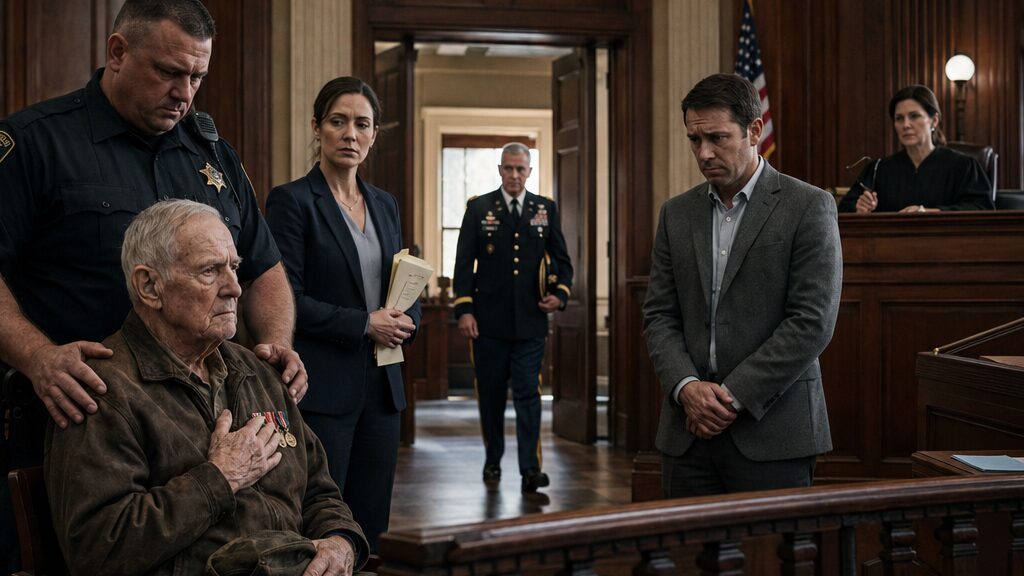
The Old Veteran Held His Medals in Court Until One Officer Finally Asked His Name
Chapter 1: The Old Man Under the Bailiff’s Hands
Frank Bennett had learned, long ago, that a man could keep breathing through almost anything if he did not waste breath trying to explain himself to people who had already decided what they saw.
So he sat in the front row of the county courtroom with his hat folded in his lap, his shoulders rounded inside a brown jacket that had gone shiny at the elbows, and his right hand resting over the three small medals pinned close to his heart.
The medals were not polished for show. They had not been arranged straight. One leaned slightly, its ribbon faded at the edge, and another had a small dark spot near the clasp where age had taken hold of the metal. His late wife used to fix them before church on Memorial Day, pinching the cloth between two careful fingers and saying, “Frank, if you’re going to wear them, let them sit right.”
He had not let anyone fix them that morning.
Behind him, Bailiff Mark Carter stood too close.
Frank could feel the man’s shadow before he felt the pressure of his hands. Not hard. Not cruel. Just present in the way a locked door was present. Two broad palms hovered near Frank’s shoulders every time he shifted, and once, when Frank leaned forward to hear the clerk, the left hand settled there.
“Stay seated, sir,” Mark said.
The word sir came out like a command with manners wrapped around it.
Frank looked at the polished rail in front of him. Beyond it, Judge Margaret Hayes was speaking to an attorney at the bench, her glasses low on her nose, her docket stacked high enough that every page seemed to weigh more than the one beneath it. The courtroom smelled faintly of old paper, floor polish, and rain-damp coats. A flag stood to the judge’s right. Another stood near the seal mounted behind her chair.
Frank’s hand tightened over the medals.
“I know how to sit,” he said softly.
Mark leaned down, not enough for the whole courtroom to hear, but enough for Frank to feel the breath beside his ear. “Then help me out and do it.”
On the other side of the aisle, Joseph Bennett pressed his fingers together and stared straight ahead as if the empty witness chair had accused him of something. He wore a gray sport coat Frank did not recognize and shoes polished brighter than the courtroom floor. His son had always shined shoes before something difficult. As a boy, he had done it before school concerts. As a man, before hospital meetings. Today, before asking a judge to give him authority over his father’s papers, appointments, and decisions.
Frank knew the word they were using. Limited guardianship. A careful phrase. Soft edges. The sort of phrase that sounded like a handrail until someone started building a fence.
At the counsel table, Emily Parker glanced back at him. She was young enough to still believe a file could contain the shape of a life if enough pages were clipped together. Her legal pad had Frank’s name written at the top in neat blue ink. Beneath it, he had seen the words refusal to leave records office, possible confusion, family petition.
Possible confusion.
Frank had told them three times that he was not confused.
He was tired. That was different.
The clerk’s voice rose from the front. “Matter of Bennett, Frank. Petition for emergency limited guardianship and related courthouse disturbance.”
A few heads turned toward him.
Frank had been in rooms where men turned their heads because a shell had landed too close, because a medic had shouted for pressure, because a name had not been answered when called. The turning of heads in a courtroom was quieter but somehow meaner. It did not ask whether a man was alive. It asked what he had done.
Joseph stood first.
Emily stood after him, too quickly, gathering her papers.
Frank put both hands on the rail in front of him and began to rise.
Mark’s hands came down at once.
“Sir,” he said, firmer now.
Frank froze halfway up. His knees trembled, not from fear, not entirely from age, but from the sudden memory of being pushed down in mud while someone shouted to stay below the line of fire. For half a second, the courtroom wood blurred into wet earth and a dark sleeve across his chest.
Then it was gone.
“I stand when my name is called,” Frank said.
Judge Hayes looked over the top of her glasses. “Mr. Bennett, you may remain seated.”
May.
A permission that felt like a dismissal.
Joseph turned, his mouth tight. “Dad, please. Just sit. Don’t make this harder.”
Frank looked at his son then. Joseph’s face had his mother’s eyes when he was tired, but not her patience. He looked worried. Frank could see that. Worry had been driving Joseph for months, maybe longer. Worry had brought him to Frank’s house with pill organizers and grocery lists and printed articles. Worry had made him speak louder every time Frank spoke quietly.
But worry could still do harm.
“I did not come to make it hard,” Frank said.
No one answered that.
Emily touched his sleeve, lighter than Mark had. “Mr. Bennett, I’ll speak first. Then the judge may ask you questions.”
“She may ask me now.”
Emily lowered her voice. “Let me help.”
Frank looked down at the medals under his palm. The smallest one had caught on a thread in the lining. He rubbed it loose with his thumb.
At the far table, the assistant county attorney began explaining what had happened two days before in the records office. Frank Bennett had arrived shortly after opening. Frank Bennett had requested a file not available to him without additional documentation. Frank Bennett had become agitated. Frank Bennett had refused to leave when instructed. Frank Bennett had returned after lunch. Frank Bennett had placed himself at the service window and blocked other citizens from being helped.
Each sentence had his name in it, yet none seemed to contain him.
“I did not block anyone,” Frank said.
Emily glanced back, warning in her eyes.
Judge Hayes raised one hand. “Mr. Bennett, you’ll have a chance.”
Frank folded his lips inward and nodded once.
Joseph stared at the table.
The attorney continued. “Given Mr. Bennett’s age, his son’s concerns, and the repeated nature of the incident, courthouse security believed a wellness evaluation might be appropriate. The family petition followed.”
Wellness.
Frank almost smiled at that. A man could carry a body across broken ground with two fingers pressed into a wound and never hear that word. Then one day he asked a clerk to spell a dead man’s name correctly, and suddenly everyone wanted to discuss wellness.
Judge Hayes turned to Emily. “Ms. Parker?”
Emily stood straighter. “Your Honor, Mr. Bennett disputes the characterization of confusion. He maintains he had a specific purpose in visiting the records office. I have not yet had sufficient time to review all relevant documents.”
“Because he would not give them to you,” Joseph said.
The judge looked at him.
Joseph swallowed. “Sorry, Your Honor.”
Frank reached inside his jacket.
Mark’s hand moved.
The courtroom seemed to tighten around that motion.
Frank stopped with two fingers just inside the inner pocket. Slowly, he withdrew a folded slip of paper no bigger than a church bulletin. It had been creased so many times that the corners had softened like cloth.
“This,” he said.
Emily stepped toward him, but Mark was already watching his hands.
“What is that, Dad?” Joseph asked, and there it was again, that mixture of fear and embarrassment.
Frank held the paper out to Emily. “Read the name.”
Emily took it carefully but not yet with understanding. She unfolded it and scanned the lines. “It appears to be a request receipt from the county archives.”
“The name,” Frank said.
She looked again.
Judge Hayes tapped her pen once against the bench. “Ms. Parker?”
Emily hesitated. “The listed name is Thomas—no. It says ‘T. Reed’ as the requesting official for verification, and below that there is an old veterans registry entry. The surname on the registry is…” She paused.
Frank closed his eyes.
Joseph exhaled sharply. “This is what I mean. He keeps carrying that paper around. He won’t let it go.”
Frank opened his eyes. “It was never his name.”
The judge leaned back slightly. For the first time since the matter had been called, the room did not move on without him.
“What was never whose name, Mr. Bennett?” she asked.
Frank looked at the slip in Emily’s hand. His own fingers curled against the rail, empty now that the paper was gone.
Before he could answer, the rear doors opened.
The sound was not loud. Just hinges, a brief sweep of hallway air, and a soft interruption in the courtroom’s rhythm. But Frank knew the change in a room when authority entered it. Everyone did, even those who pretended not to.
A man in a dark dress uniform stepped inside.
He removed his cap and held it beneath one arm. His hair was silver at the temples, his posture straight without stiffness. The rows of ribbons on his chest were precise, but he did not wear them like armor. He paused just inside the doorway, eyes moving once over the benches, the tables, the judge, the bailiff.
Then he saw Frank.
For one long second, the man did not move.
Frank’s hand found the medals again.
The clerk looked down at her schedule. “Your Honor, that may be the veterans liaison witness.”
Judge Hayes frowned slightly. “We were not expecting him until later.”
The man started down the aisle.
Frank watched him come, each step measured against the old floorboards. He did not know the officer’s face. Not truly. Age changed men. Rank changed how others looked at them. But there was something in the way the officer’s eyes settled on the folded slip in Emily’s hand, then on the medals under Frank’s palm, that made the courtroom feel smaller.
Joseph whispered, “Dad?”
Frank did not answer.
The officer stopped at the rail.
“Colonel Thomas Reed,” he said to the judge. “County veterans liaison, attached through the state office. I was asked to verify a records question.”
Judge Hayes nodded. “Colonel Reed, we’ll hear from you shortly.”
Thomas Reed’s gaze remained on Frank.
Frank sat very still.
Mark’s hands were still near his shoulders.
Chapter 2: The Records Slip With the Wrong Name
Emily Parker had met plenty of clients who carried papers.
They came into court with envelopes from kitchen drawers, receipts from places no longer open, letters folded around old anger, medical statements with the important lines circled in red. Some believed a single paper would save them. Some hoped it would condemn someone else. Most simply needed the paper to prove that their version of life existed somewhere outside their own mouth.
At first, she had placed Frank Bennett in that category.
The folded slip looked too fragile to carry the weight he had given it. It was a county archives request receipt, printed on cheap paper, the ink faded by handling. Someone had written a note across the bottom in pencil, then erased part of it so roughly that a gray bruise remained. There was an old registry line reproduced beneath the request number.
Bennet, Frank / attached inquiry: military homecoming record / cross-reference name: G. Colman
Emily stood in the hallway during recess with her thumb beneath that line, reading it again.
G. Colman.
Frank had insisted it was wrong.
The courthouse hallway was narrow outside Courtroom Two. People moved past with wet umbrellas and impatient shoes. A child cried somewhere near the elevators. The records office sat at the far end behind a glass service window, its blinds half-open as if the room itself were suspicious of visitors.
Frank sat on a bench beneath a framed photograph of the old courthouse, his hat resting on his knees. Mark Carter stood several feet away now, arms crossed, still assigned to him but less close than before. Joseph paced near the vending machine. Every few steps, he glanced at Frank, then away.
Emily lowered herself onto the bench beside her client.
“Mr. Bennett,” she said, “I need you to explain this to me in the simplest way you can.”
Frank looked at the slip, not at her. “They spelled it wrong.”
“Colman?”
“That was not his name.”
“What was his name?”
Frank’s jaw worked once. “Coleman. With an e.”
Emily waited.
“That matters?” she asked gently.
Frank turned his head then. His eyes were pale and sharp despite the heaviness beneath them. “Would it matter if it was yours?”
She felt the answer land before she formed it.
“Yes,” she said.
He nodded once, as if she had passed the first test but not the second.
Joseph stopped pacing. “Ms. Parker, he has been doing this for months. He calls offices. He writes letters. He takes buses when I tell him not to. Last week he left the stove on because he was digging through boxes for some old photograph.”
Frank’s eyes stayed on Emily. “The burner was off.”
“The knob was turned.”
“The burner was off.”
“You forgot your appointment with the cardiologist.”
“I remembered the name.”
Joseph gave a humorless laugh and rubbed both hands down his face. “Do you hear him?”
Emily did hear him. She heard both of them, which was the trouble. Joseph’s fear had the exhausted rhythm of someone who had repeated himself in kitchens, doctors’ offices, and parking lots. Frank’s answers had the hard, narrow shape of a man protecting one necessary thing from being buried beneath many unnecessary ones.
“What happened at the records office?” Emily asked.
Frank looked down the hall toward the glass window.
“They told me the file was closed.”
“Did you raise your voice?”
“No.”
“Did you refuse to leave?”
“Yes.”
Joseph spread his hands. “There.”
Frank glanced at him. “They said if I left, the request would go back in the box.”
“What box?” Emily asked.
“The kind that never opens again.”
That was not an answer a judge could work with, but Emily wrote it down anyway.
The records-room supervisor appeared behind the glass at the far end, sorting forms with brisk little taps against the counter. Emily had spoken to her that morning before court. The supervisor had said Mr. Bennett became fixated on an archival veterans registry connected to a county memorial project. He did not have legal standing to demand correction. He could file the proper petition. He could wait ninety days. He could provide proof.
Proof, Emily had learned, was often a luxury given to people who had not spent their lives surviving events no one documented properly.
“Mr. Bennett,” she said, “who was Coleman?”
The old man’s hand moved toward his jacket.
Mark shifted immediately.
Frank saw it. So did Emily. For the first time, she noticed how small the movement had been, how large the reaction.
“Bailiff Carter,” she said, keeping her voice even, “he’s reaching into his inner pocket.”
Mark’s face tightened, but he stepped closer rather than back. “Ma’am, I have to—”
“I’m telling you what he’s doing.”
Frank slowly withdrew a small black-and-white photograph. The edges had cracked white at the corners. He did not hand it to Emily right away. He looked at it first, and the hallway noise seemed to pass around him.
When he finally gave it to her, she saw five young men standing near the back of a transport truck. Their uniforms were dusty. Their faces were too young for the tiredness in their eyes. One of them was Frank. She recognized him only by the set of his mouth. Another stood with an arm crooked around Frank’s neck, grinning as if he had just told a joke. On the back, in faded ink, four names had been written. The fifth had been partly smeared.
Emily turned it over again.
“Which one is Coleman?”
Frank pointed to the grinning man.
Joseph took a step closer despite himself.
Emily looked at the photo, then the slip. “And the county has him listed as Colman?”
Frank nodded.
“Why is the county involved in a military record?”
“The memorial wall,” Frank said. “They copied names from old homecoming lists. If the county sends the wrong name to the state office, the wrong name goes on the new plaque.”
Joseph softened for half a second. Then fear pulled him back. “Dad, you could have told me that.”
“I did.”
“You said they were erasing him.”
Frank looked at him. “They are.”
Joseph’s mouth closed.
Emily studied the photograph. On the surface, it was small: one missing letter. One correction in a county file. But Frank held himself as if a door stood open behind that letter, and beyond it something he had spent decades refusing to enter.
“Colonel Reed,” Emily said, glancing toward the courtroom doors. “Why was he requested?”
Frank took back the photograph and slid it behind the folded slip. “His office handles the state verification.”
“Do you know him?”
“No.”
“Does he know you?”
Frank’s thumb pressed the photo’s edge. “He might know the unit.”
Joseph made a frustrated sound. “This is what keeps happening. Might. Maybe. Some old record. Some old story. And meanwhile he misses meals. He won’t answer my calls. He goes down to offices alone.”
Frank folded the slip around the photograph with careful, practiced movements.
“I answered when your mother called,” he said.
Joseph went still.
Emily felt the air change between them. It was not anger exactly. It was a room in a house no one had opened since the funeral.
Joseph looked away first. “Mom isn’t here to call.”
Frank placed the folded paper back inside his jacket, behind the medals.
“No,” he said. “She is not.”
For a moment, neither man looked old or young. They looked only bereaved in different directions.
The courtroom doors opened, and the clerk leaned out. “Ms. Parker? Judge is ready to resume.”
Emily stood, but she did not move immediately. “Mr. Bennett, when we go back in, I need to be able to tell the judge what you want.”
Frank adjusted his hat on his knees.
“I want the right name read into the record,” he said.
“And after that?”
He looked toward the courtroom, toward the bench, toward the place where people made decisions while sitting higher than others.
“After that,” he said, “we will see if anyone heard it.”
Joseph shook his head faintly, but he did not speak.
Mark stepped forward. “Sir, we’re going back in.”
Frank began to rise.
Mark’s hand lifted out of habit.
Emily turned sharply enough that Mark stopped.
Frank noticed. His expression did not change, but his fingers left the bench without trembling this time.
He stood on his own.
Chapter 3: The Officer Who Stopped at the Aisle
Colonel Thomas Reed had expected a file, not a face.
The request from the county had been ordinary enough when it crossed his desk: verification needed for a memorial registry discrepancy, possible duplicate or misspelled surname, elderly petitioner contesting local archival entry. Most such requests involved dates, branch abbreviations, or family stories softened by time into certainty. Thomas treated them carefully anyway. Names mattered. He had learned that before rank, before gray hair, before people began standing a little straighter when he entered a room.
But he had not expected to walk into Courtroom Two and see an old man in a brown jacket sitting under a bailiff’s shadow with his hand pressed over three small medals.
Thomas had stopped because the gesture was familiar.
Not the medals. Men wore medals for many reasons: remembrance, pride, habit, loneliness, sometimes because families asked them to. It was the hand. Flat over the chest, not displaying, not protecting property, but holding something in place.
Thomas had seen that gesture at bedsides, at funerals, in parking lots after reunions when someone said a name no one had said aloud for years.
Now he stood near the witness chair while Judge Hayes resumed the matter.
“Colonel Reed,” she said, “we appreciate your coming earlier than scheduled.”
“Yes, Your Honor.”
His eyes moved briefly to Frank. The old man looked forward, not at him. The bailiff remained behind him, less close than before but still ready.
The judge turned to Emily. “Ms. Parker, you indicated your client disputes both the disturbance report and the family’s interpretation of his actions. Proceed.”
Emily stood with the folded slip in one hand. The photograph, Thomas noticed, was tucked behind it. Old paper. Creased. Carried close.
“Your Honor, Mr. Bennett went to the records office because a county veterans registry entry may contain an incorrect name. The disputed entry relates to a memorial update being sent for state verification. My client’s position is that the listed surname is wrong.”
The assistant county attorney rose. “Your Honor, even if true, that does not address the immediate concern. Mr. Bennett refused lawful instructions from courthouse staff.”
Joseph sat at the opposite table, his hands clenched together.
Frank remained still.
Judge Hayes nodded. “The court understands the distinction. Ms. Parker, the name?”
Emily unfolded the paper.
Frank’s hand closed over his medals.
“Current county entry reads G. Colman,” Emily said. “Mr. Bennett states the correct name is Coleman. With an e.”
Thomas felt something go quiet inside him.
Coleman.
He did not yet move.
Emily continued, “There is also a photograph my client believes supports his request, though I understand it may not meet formal verification standards by itself.”
The assistant county attorney gave a small sigh. “A decades-old photograph with handwriting on the back is not—”
“Let me see it,” Thomas said.
The words came out more sharply than he intended.
Everyone turned.
Judge Hayes studied him. “Colonel?”
Thomas inclined his head. “Apologies, Your Honor. May I examine the photograph?”
Emily looked to Frank.
That mattered to Thomas. She did not simply hand it over.
Frank nodded once.
Emily carried the folded slip and photograph to Thomas. He received both with two hands. The photograph was lighter than he expected. The kind of lightness that made a man afraid his own grip might erase something.
Five young men by a transport truck. Dust on their boots. One grinning with his arm hooked around another’s neck. Thomas knew the unit marker painted on the truck before he fully understood why.
He turned the photo over.
The ink had faded, but three names remained readable. Frank Bennett. G. Coleman. D. Ward. T. Miller. The fifth name had smeared into a ghost.
Thomas looked again at the young Frank Bennett in the photograph. Same mouth. Same eyes, though time had folded the skin around them. Same way of standing slightly aside while someone else pulled him into the frame.
He drew in one breath, slow and controlled.
Then he looked at the registry slip.
G. Colman.
One missing letter. One careless shortening. One error ready to become stone.
Thomas raised his eyes to Frank.
“Mr. Bennett,” he said, and his voice had changed enough that even the clerk looked up.
Frank looked back.
Thomas did not ask whether Frank had served. He did not ask whether the medals were real. He did not ask why the old man had not presented himself better, spoken louder, filed sooner, or waited patiently for a system that had already misplaced the name once.
He stepped away from the witness chair.
Mark Carter straightened.
Thomas walked to the rail in front of Frank. He stopped with enough distance that the old man did not have to tilt his head too far. Then Thomas brought his right hand up in a formal salute.
Not broad. Not theatrical. Exact.
The courtroom fell silent in a way that no gavel had achieved.
Frank’s fingers tightened once over the medals. His face did not break. His eyes lowered for half a second, not in shame, but as if the salute had touched a bruise under the skin.
Then, slowly, he lifted his own hand from his chest.
It trembled before it reached the angle. His salute was not as crisp as Thomas’s. Age had taken precision from the joints. But it carried something no regulation could teach.
Thomas held until Frank lowered first.
Only then did Thomas drop his hand.
Behind Frank, Mark Carter had gone rigid. His hands were no longer near Frank’s shoulders. They hung at his sides.
Joseph stared as if he had watched a stranger enter his father’s body and stand there wearing his face.
Judge Hayes did not speak immediately. When she did, her voice had lost some of its docket-room speed.
“Colonel Reed,” she said, “please explain what you recognized.”
Thomas returned to the witness chair, but he did not sit. “Your Honor, the unit marking in this photograph corresponds to a medical evacuation support attachment active during the period listed in the registry project. I cannot complete formal verification from this photograph alone, but I can say this is not random memorabilia. The names on the back appear consistent with personnel attached to that unit.”
The assistant county attorney shifted. “And Mr. Bennett?”
Thomas looked at Frank. “If the man in that photograph is Mr. Bennett, then his concern deserves careful review.”
Frank’s mouth moved slightly. He did not smile.
Judge Hayes leaned forward. “Mr. Bennett, is that you in the photograph?”
Frank answered quietly. “Yes, ma’am.”
“And Coleman?”
Frank’s hand returned to the medals, but this time it rested lower, near the jacket seam.
“He was beside me when the truck came in,” Frank said.
No one moved.
Judge Hayes waited. “The truck?”
Frank looked down.
Emily took half a step toward him, not to stop him but to be near enough if he needed the paper.
Frank’s voice remained level. “Not today, Judge.”
It was the first time he had asked for mercy without using the word.
Judge Hayes heard it. To her credit, she did not press.
Thomas picked up the folded slip again. “Your Honor, my office can request a fast review of the state-side files. But Mr. Bennett is correct about one thing. If the county sends the wrong spelling forward, the error may be reproduced on the memorial plaque.”
The judge turned to the assistant county attorney. “Is the memorial submission pending?”
The attorney checked a file. “It appears scheduled for final transmission at the end of the week.”
Joseph’s head lifted.
Frank closed his eyes.
Emily said, “That is why he would not leave.”
The words were simple. They did not excuse everything. They did not answer the guardianship petition, the missed appointments, the stove knob, the fear that had brought Joseph there. But they opened a door the court had been ready to walk past.
Judge Hayes looked at Mark Carter. “Bailiff, give Mr. Bennett some room.”
Mark’s face flushed. “Yes, Your Honor.”
He stepped back.
The space around Frank changed. Nothing dramatic. No one applauded. No one stood except those already standing. But the air shifted as surely as if a window had opened.
Frank drew a breath that seemed to reach him slowly.
Joseph whispered, “Dad, why didn’t you tell me it was this?”
Frank turned toward him. The question was not cruel, but it came too late to be easy.
“I tried,” Frank said.
Joseph looked away.
Judge Hayes set down her pen. “This court is not prepared to decide guardianship on assumptions. Nor am I prepared to ignore the security report. We will recess briefly. Colonel Reed, Ms. Parker, I want whatever can be verified today. Mr. Bennett will be given an opportunity to speak when we return.”
The gavel sounded once.
People began moving, but quietly now. Papers were gathered with less snap. Chairs slid back without scraping.
Thomas walked toward Emily and returned the photograph.
Before he let go, he looked at Frank again.
“Mr. Bennett,” he said, “I’ll handle this carefully.”
Frank studied him for a moment.
“Handle the name carefully,” he said.
Thomas nodded. “Yes, sir.”
Frank flinched at the sir, not because it offended him, but because it had finally meant what the word was supposed to mean.
Mark Carter opened the gate in the rail. This time, before reaching toward Frank, he stopped himself.
“Mr. Bennett,” he said, quieter than before, “do you need a hand?”
Frank looked at the offered space where a command had been.
“Not yet,” he said.
He pushed himself upright, one palm on the rail, the other still against his chest.
And for the first time that morning, no one touched him.
Chapter 4: What a Salute Could Not Fix
Joseph Bennett had wanted the hearing to be quiet.
That was all he had told himself driving to the courthouse that morning, both hands tight on the steering wheel while his father sat beside him with that old brown jacket buttoned wrong and his hat resting on his knees. Quiet, orderly, safe. No scenes in the records office. No calls from courthouse security. No neighbors watching Frank stand on the porch in the rain because he had forgotten his house key inside. No more unopened prescription bottles lined up beside a stack of letters addressed to offices that never wrote back.
Quiet had seemed merciful.
Now Joseph stood near a courthouse bench outside Courtroom Two while people glanced at his father with a new kind of caution, and quiet felt like something else.
It felt like not listening.
Frank sat beneath the framed photograph of the old courthouse again. His shoulders looked smaller after the salute, not larger. That surprised Joseph. He had expected the room’s sudden respect to straighten his father, to make him look like the man Joseph remembered from childhood, the one who could lift a stuck lawn mower with one hand and tell a boy to hold the flashlight steady. Instead Frank looked worn through, as if the salute had taken more from him than Mark Carter’s hands had.
Colonel Thomas Reed had gone with Emily Parker toward the records office. Judge Hayes had ordered a short recess and told the clerk to locate whatever memorial submission file existed. The assistant county attorney was speaking into a phone near the stairwell. Mark Carter stood by the courtroom doors, no longer hovering near Frank, his face set in a careful neutrality that did not fool anyone.
Joseph leaned against the wall by the vending machine and watched his father take off his glasses, polish them with the edge of his sleeve, and put them back on though they had not been dirty.
He had seen that same motion at the hospital after his mother’s final scan.
“Dad,” Joseph said.
Frank looked up.
The old irritation rose in Joseph before he could stop it: the slowness, the silence, the way every conversation felt like approaching a locked shed from the wrong side.
“Why didn’t you tell me it was about the memorial plaque?” he asked.
Frank’s mouth tightened. “I said they were sending the wrong name.”
“That’s not the same thing.”
“It is to me.”
Joseph pushed away from the wall. “You know what I mean. You didn’t say there was a deadline. You didn’t say there was a state office involved. You didn’t say Colonel Reed was coming. You just kept saying they were erasing him.”
Frank looked down at his hat. His fingers worked the brim once, smoothing a dent that had been there for years.
“They are,” he said.
Joseph almost laughed, but it would have come out wrong. “Dad.”
Frank’s eyes lifted then, and Joseph stopped.
There were times when his father’s age filled the room before he did. The careful steps. The pill bottles. The way he paused before answering the phone, as if deciding whether the world deserved a response. But now, looking at him, Joseph saw the old stubbornness without the frailty wrapped around it. Not confusion. Not exactly. A fixed point inside a weakening body.
Joseph lowered his voice. “You scared me.”
Frank did not answer.
“You scared me,” Joseph repeated. “When security called, they said you refused to leave. They said you were agitated. Then I get there and you won’t explain anything except a name. What was I supposed to think?”
Frank rubbed his thumb along the underside of his hat brim. “That I had a reason.”
The words were not sharp, but Joseph felt them as if they were.
He looked away. Across the hall, a woman guided an elderly man toward the elevators, one hand tucked under his elbow. The man complained about the speed. The woman answered with practiced patience. Joseph knew that grip, that tone, that tired fear disguised as helpfulness.
“I’ve been trying,” Joseph said. “You think I want to be here? You think I want to ask some judge for permission to help my own father?”
Frank’s hand drifted toward his jacket.
Joseph saw it and closed his eyes for a second. The medals again. Always the medals now, as if every hard thing could be answered by touching metal.
“When Mom was alive,” Joseph said, softer, “she could get through to you.”
Frank’s fingers stopped.
“She could get you to go to appointments,” Joseph continued. “She could get you to eat. She could make you laugh when you got like this. I don’t know how to do that.”
Frank turned his head toward the window at the end of the hall. Rain streaked the glass in thin, crooked lines.
“Your mother did not get through to me,” he said. “She waited better than most.”
Joseph did not know what to do with that.
Frank reached slowly to the inside of his jacket, paused, then looked at Mark Carter.
The bailiff noticed. For a moment, habit crossed his face. Then he said, “Go ahead, Mr. Bennett.”
Joseph saw his father absorb the difference.
Frank took out the folded records slip and the photograph behind it. He did not open the slip. He held the photograph, back side up, as if reading the faded names without needing to see them.
“Your mother used to pin the medals inside the kitchen,” he said. “Not in the bedroom. Not by the mirror. Kitchen table. She said I should not stand alone while I put them on.”
Joseph’s throat tightened despite himself.
“She never told me that.”
“She knew you did not like them.”
“I didn’t dislike them.”
Frank gave him a look that held no blame, only memory.
Joseph remembered being a teenager, impatient and embarrassed, while his father stood in the hallway before a Veterans Day assembly, wearing the brown jacket and those three medals. Joseph had told him the jacket looked old. His father had taken it off and gone without the medals. His mother had stared at Joseph across the dinner table that night until he apologized, but the apology had been about manners. He had not understood what he had taken.
“I was a kid,” Joseph said.
“Yes.”
The single word was kinder than Joseph deserved.
Frank turned the photograph over. Joseph stepped closer. He had seen it before, but only in passing, tucked in books or sliding from envelopes when his mother cleaned. Five young men by a truck. His father’s young face almost unrecognizable. Another man grinning with his arm hooked around Frank’s neck.
“Coleman?” Joseph asked.
Frank tapped the grinning man.
Joseph studied the face. The man looked alive in a way that made the whole photograph hurt.
“What happened to him?”
Frank’s hand closed around the photograph. “Not here.”
The answer frustrated Joseph, but less than it had an hour ago. He heard the strain beneath it.
“Then when?” he asked.
Frank looked at him for a long time.
The hallway moved around them. Shoes passed. A phone rang. The clerk carried a stack of files from one room to another. Ordinary life insisting on itself.
“When you can hear it without trying to fix me,” Frank said.
Joseph looked down.
At the courtroom doors, Mark Carter shifted his weight. He had heard enough to understand he should pretend he had not.
Joseph sat on the bench, leaving a careful space between himself and his father. Not too close. Not across the hall. He rested his elbows on his knees and stared at his polished shoes.
“I thought if I got the paperwork,” he said, “then I could keep you safe.”
Frank folded the photograph back into the slip. “Safe from what?”
“From missing things. From forgetting. From getting hurt.”
Frank slid the paper into his jacket. “A man can be remembered wrong and still be alive. That is a kind of hurt too.”
Joseph had no answer.
The courtroom doors opened. Emily Parker appeared first, her expression changed in a way Joseph could not read. Colonel Reed stood behind her holding a thin copied file. Judge Hayes had returned to the bench inside; Joseph could see her through the open doorway, speaking quietly to the clerk.
Emily looked at Frank. “Judge Hayes wants everyone back in the courtroom.”
Frank nodded and began to rise.
Joseph stood quickly, but stopped himself before reaching for him.
Frank noticed.
He put one hand on the bench and lifted himself slowly. His balance wavered at the end, just slightly. Joseph’s body moved before thought, but he caught himself again, hands half-raised.
Frank looked at those hands, then at his son.
“You may stand beside me,” he said.
Joseph swallowed.
“Not over me,” Frank added.
Joseph nodded once. “Okay.”
Together, not touching, they walked back toward the courtroom.
Chapter 5: The Promise Beneath the Brown Jacket
The conference room behind Courtroom Two had no windows.
Frank was grateful for that. Windows invited a man to look for escape, and there were some rooms a person had to stay inside until the air changed or he did.
The table was small, built for plea discussions and hurried signatures. Its laminate edge had peeled near one corner. A pitcher of water sat in the center beside four paper cups. Emily Parker took one chair. Joseph took another, then seemed unsure whether he should sit closer to Frank or farther away. Colonel Thomas Reed remained standing by the door until Frank lowered himself into the chair at the head of the table.
Only then did Thomas sit.
That, too, was a kind of language.
Emily placed the copied file on the table but did not open it yet. “Mr. Bennett, Judge Hayes asked us to clarify what can be verified today and what still needs formal review. But before we go back in, I need to understand what you are comfortable saying.”
Frank looked at the file. Its paper was fresh and white. Too white. Nothing important ever happened on paper that clean.
Thomas folded his hands. “The county registry does show G. Colman. The state preliminary index has a possible match for Graham Coleman, medical evacuation support attachment, same period. There are enough similarities to justify a correction review, but not enough for me to certify it on the spot.”
Graham.
Joseph looked at Frank.
Frank kept his eyes on the file.
Emily’s voice softened. “Is Graham Coleman the man in the photograph?”
“Yes.”
The room waited.
Frank reached for the water cup but did not drink. His fingers looked older against the paper rim than they had when holding the photograph. He thought of Margaret, his wife, telling him once that his hands changed most when he remembered. They closed around invisible things.
“You do not have to tell all of it,” Thomas said.
Frank looked at him. “No one ever tells all of it.”
Thomas accepted that with a small nod.
Frank set the cup down. “Graham liked to sing when he was scared. Badly. He knew two lines of every song and made up the rest. Drove men half crazy.” His mouth moved near a smile but did not become one. “He said if you sang loud enough, fear had to make room.”
Joseph sat very still.
“We were not heroes,” Frank continued. “That word gets used by people who come in after the floor is clean. We were young. We did what we were told. Sometimes we did it well. Sometimes we just did it because stopping would mean thinking.”
Emily did not write. Frank was grateful for that too.
“The day in the photograph was not a good day or a bad day. It was before one and after another. That’s how most days were. Graham’s sister had sent him a joke book. He was reading pieces of it to men who were too tired to laugh. I told him he ought to save his voice. He said, ‘Bennett, if I save it, I might misplace it.’”
Joseph’s eyes flicked toward the folded slip inside Frank’s jacket.
Frank touched the medals, but lightly now.
“We got orders to move wounded from a field station after shelling. Roads were bad. Radio worse. The truck in the picture came in twice that morning. Third time, it did not come all the way.”
The room seemed to narrow.
Frank could smell mud again. Diesel. Wet canvas. The copper weight of blood. He kept his voice level because the past did not deserve to take his breath in front of his son.
“There were four of us near the ditch. Graham was closest to me. We had one man on a stretcher between us. He was talking. Then he wasn’t. Graham went back for the bag. I told him not to. He grinned like he did in that picture and said, ‘Somebody’s got to remember where we put the useful things.’”
Frank stopped.
Joseph’s face had gone pale.
Emily finally moved, but only to slide the water closer.
Frank did not take it.
“When they brought him in, he was still trying to spell his name to a clerk. There was noise. Too much of it. Someone wrote fast. Someone heard wrong. He kept saying Coleman. Not Colman. Coleman. He had a sister named Angela, and he said she hated when people left out letters because their family had already lost enough.”
Thomas closed his eyes briefly.
Frank pressed two fingers to the edge of the table. “I told him I heard it. I told him I would make sure.”
Joseph whispered, “You promised him.”
Frank nodded.
“After?” Emily asked.
“After is a long word,” Frank said.
No one interrupted.
He looked at Joseph then. “I wrote letters. Years ago. Different offices. Some came back. Some said records were incomplete. Some said the local lists were only ceremonial and not official. Your mother helped. She made copies. She kept stamps in the blue drawer. When her hands got bad, she still folded the envelopes.”
Joseph’s mouth parted slightly.
“She never told me.”
“She did not want you carrying it before I was finished.”
“But you weren’t finished.”
Frank looked down at the clean file. “No.”
A quiet pain crossed Joseph’s face. It was not just guilt. It was the recognition that his mother had known a whole chamber of Frank’s life and had kept the door partly closed, not to exclude Joseph but to spare him.
Emily opened the copied file. “Mr. Bennett, the memorial update created a deadline. That’s why the issue came back now.”
Frank nodded. “The county put out a notice asking families to check names before the plaque order. I saw it in the paper. Graham’s sister is gone now. His parents long gone. I may be the last one who heard him say it.”
Thomas looked at the photograph on the table. “You should not have had to fight alone for a spelling.”
Frank gave him a tired glance. “There are larger things men have had to fight alone.”
“That doesn’t make this right.”
“No,” Frank said. “It only makes it familiar.”
Joseph leaned forward. “Dad, why didn’t you show me Mom’s copies?”
Frank looked at his son’s polished shoes beneath the table. “Because when I started, you said the boxes made the house look sad.”
Joseph flinched.
Frank wished he had not said it so plainly, but truth, once invited in, did not always wipe its feet.
“I was trying to help clean,” Joseph said.
“I know.”
“I didn’t know what was in them.”
“I know that too.”
Emily turned one page in the file, slowly. “The guardianship petition is still before the court. Joseph’s concerns about your health will not disappear because this records issue is real.”
Frank nodded. “I did not expect them to.”
Joseph looked at him, startled.
Frank met his eyes. “I forget things. Not that.”
The words hung between them, small and devastating.
Joseph’s shoulders lowered. “I know.”
“No,” Frank said gently. “You fear.”
Joseph looked down.
Frank reached into his jacket and removed the folded slip, then the photograph. He placed both on the table, between himself and his son.
“I was afraid too,” he said.
Joseph looked up.
“When your mother died, the house made noises I did not know houses made. Refrigerator. Pipes. Wind at the back window. I would wake and think she was in the kitchen. Then I would remember she was not. So I opened boxes. I found this again. I thought if I finished one promise, the house might quiet.”
Emily lowered her eyes.
Thomas looked at the wall as if giving Frank privacy by not looking.
Joseph touched the edge of the photograph but did not take it. “Did it?”
“No.”
Frank’s answer was almost a breath.
“But it gave me a place to put my hands.”
Joseph stared at the photograph, at the young grinning Graham Coleman, at the young version of his father standing half-pulled into friendship.
“What do you want from the judge?” Emily asked.
Frank looked at the file, then the door leading back to the courtroom.
“I want the name entered correctly,” he said. “I want the county to hold the memorial submission until Colonel Reed’s office checks the state file. I want the records office to stop telling old men to wait ninety days when the stone is being ordered Friday.”
Emily nodded. “And the disturbance report?”
Frank sat back. The chair creaked beneath him.
“I did refuse to leave.”
Joseph looked at him. “Dad—”
“I did,” Frank said. “I will not call that false.”
Thomas studied him with quiet approval.
“But I did not threaten anyone,” Frank added. “I did not forget why I was there. And I do not need my son given my voice because mine has become inconvenient.”
Joseph closed his eyes.
Emily took that in. “Can you say that to Judge Hayes?”
Frank’s gaze drifted toward the door.
He thought of the bench, the flag, the high seat, Mark Carter’s hands, the sound of his name spoken by people who had not yet met him. He thought of Graham trying to spell through pain and noise. He thought of Margaret at the kitchen table, pinning medals straight because she understood that memory sometimes needed help holding itself upright.
“Yes,” Frank said.
A knock came at the door.
The clerk opened it halfway. “Judge Hayes is ready.”
Thomas stood first, then Emily.
Joseph remained seated for a moment, staring at the photograph.
Frank gathered the slip and picture, but before he could fold them, Joseph spoke.
“Dad.”
Frank waited.
“When you say his name in there,” Joseph said, voice rough, “say it slowly enough for me to hear it right.”
Frank held his son’s gaze.
Then he folded the paper once, carefully, and tucked it behind the medals.
Chapter 6: Frank Bennett Speaks Without Raising His Voice
When Frank returned to the courtroom, Mark Carter did not stand behind his chair.
He stood beside the gate in the rail and kept both hands folded in front of him. It was a small adjustment, the sort that could have been missed by anyone who had not spent the morning measuring the distance between a hand and a shoulder. Frank did not miss it.
“Mr. Bennett,” Mark said quietly, “would you like the front chair or the counsel table?”
The question unsettled Frank more than the command had.
Emily glanced at him, waiting.
Frank looked at the front row where he had sat before, low beneath everyone’s sightline. Then he looked at the counsel table, beside Emily, facing the bench like a man whose words belonged to the matter.
“The table,” he said.
Mark opened the gate. He did not touch Frank’s elbow. He did not reach for the hat. He simply held the gate and let Frank pass.
Joseph watched from the other side, his face drawn and attentive.
Judge Margaret Hayes had removed her glasses and set them beside the file. The courtroom had thinned during recess, but not emptied. A few people remained in the gallery, waiting on later matters or pretending to. The assistant county attorney sat with a yellow pad ready. Colonel Reed took the witness chair only after Frank was seated.
Frank lowered himself carefully. His knees complained. His chest felt tight beneath the medals, not from illness but from the weight of all the words he had kept folded smaller than paper.
Judge Hayes looked at him directly.
“Mr. Bennett,” she said, “we have two issues before the court. One is the petition concerning your capacity and need for assistance. The other is the incident at the records office, which now appears connected to a time-sensitive veterans registry matter. I am going to let you speak. Take your time, but answer what is asked.”
Frank nodded. “Yes, ma’am.”
The assistant county attorney began. “Your Honor, the county maintains that staff acted appropriately based on what they knew at the time. Mr. Bennett did refuse to leave a public service window—”
“I did,” Frank said.
Emily touched his sleeve lightly.
Frank looked at her. “It is all right.”
Judge Hayes watched him. “Go on, Mr. Bennett.”
Frank rested the folded slip on the table.
“I refused to leave because I believed if I left, the wrong name would travel farther than I could follow.”
No one wrote for a moment. Then pens began moving.
“I was told to file a correction request and wait. That is a reasonable thing to say if there is time. There was not time. The memorial submission was going out this week. I did not explain that well. I was angry.”
Joseph’s eyes lowered.
Frank turned his hat once in his hands. “I am old, Judge. Sometimes when an old man is angry, people call it confusion because that is easier to handle. Sometimes it is confusion. Sometimes it is grief. Sometimes it is a promise that has outlived the people who helped him keep it.”
Judge Hayes leaned forward slightly.
Frank unfolded the slip. He did not need to read it, but he wanted the paper open where everyone could see the smallness of the error and the size of its shadow.
“The name is Graham Coleman. Not Colman. Coleman. He said it to me. I heard it. I gave my word.”
The room stayed still.
Frank’s fingers hovered above the medals but did not touch them. He placed his hand instead on the records slip.
“I am not asking this court to pretend I did everything right. I should have left when the officer told me. I should have let my lawyer speak before I reached into my jacket. I should have told my son more. But I am asking you not to take the fact that I am old and use it to make every hard thing I do meaningless.”
Joseph looked up then.
Frank did not look at him yet.
Judge Hayes turned to Thomas Reed. “Colonel, can your office complete expedited verification?”
Thomas stood. “Yes, Your Honor. I cannot certify the correction today, but I can request immediate hold on the state submission pending review. Based on the photograph, the county registry, and preliminary state index, there is sufficient reason not to transmit the disputed spelling as final.”
“And if verified?”
“The correction can be made before plaque production.”
The judge nodded. “Ms. Parker?”
Emily stood. “We request the court order the county to hold the memorial submission as to this entry, direct cooperation with Colonel Reed’s office, and decline emergency guardianship today. Mr. Bennett has acknowledged concerns about support but objects to loss of voice over his affairs.”
The assistant county attorney rose. “Your Honor, the county does not oppose a limited records hold if properly framed. As to guardianship, Mr. Bennett’s son has submitted good-faith concerns.”
Joseph stood slowly. His chair legs scraped, loud in the quiet room.
Frank looked at him.
Judge Hayes said, “Mr. Bennett—Joseph Bennett—you may speak briefly.”
Joseph buttoned his coat, then unbuttoned it again.
“I thought,” he began, and stopped.
Frank watched his son struggle with words the way he himself had struggled with stairs.
“I thought my father was getting stuck in the past,” Joseph said. “I thought the name was another sign that he wasn’t safe alone. I still have concerns. About the house. Medicine. Appointments.” He swallowed. “But I don’t want his voice taken. Not today.”
Frank looked down at the slip.
The judge studied Joseph. “Are you withdrawing the emergency request?”
Joseph’s breath shook. “I’m asking to convert it. Maybe to a support plan. Something he agrees to. Not guardianship today.”
The assistant county attorney made a note. Emily’s shoulders eased slightly.
Judge Hayes turned back to Frank. “Mr. Bennett, would you accept assistance short of guardianship?”
Frank felt the old pride rise, automatic and useless. He thought of unopened pill bottles. Of Margaret’s empty side of the bed. Of Joseph standing with his hands half-raised, learning not to grab.
“I will accept help,” Frank said. “I will not accept being talked around.”
“That is a fair distinction,” Judge Hayes said.
Near the rail, Mark Carter shifted.
The judge looked toward him. “Bailiff Carter, the security report states Mr. Bennett became physically resistant when you attempted to guide him away from the service window.”
Mark’s face tightened. “Yes, Your Honor.”
Frank remembered the hand on his shoulder. The turn of his own body. The flash of ditch mud and a stretcher slipping. He could say it now. He could make the room turn toward Mark the way it had turned toward him. He could let shame travel.
Instead he took a breath.
“I moved wrong,” Frank said.
Mark looked at him sharply.
Frank kept his eyes on the judge. “The bailiff touched my shoulder. I did not expect it. I pulled away harder than I meant to. He did not know what that would bring back.”
Judge Hayes’s gaze softened only slightly. “And what did it bring back, Mr. Bennett?”
Frank’s fingers pressed the paper flat.
“A day when staying down kept men alive,” he said.
That was all.
It was enough.
Mark’s face changed. Not dramatically. No sudden nobility. Just the look of a man understanding that his ordinary hand had landed on an old wound.
“I’m sorry, Mr. Bennett,” Mark said.
Frank turned to him.
Mark stood straighter, but not like a guard now. “I should have asked before touching you.”
Frank studied him for a moment. “You were doing your work.”
“I can do it better.”
The judge let the silence hold.
Then she said, “This court will order a temporary hold on transmission of the disputed registry entry pending expedited review through Colonel Reed’s office. The county will provide all relevant records by close of business. As to the emergency guardianship petition, it is denied without prejudice. I will set a review hearing for voluntary support arrangements, including medical scheduling assistance, transportation, and records advocacy, with Mr. Bennett’s participation.”
The gavel did not fall immediately.
Judge Hayes looked at Frank. “Mr. Bennett, I will ask you plainly. What outcome do you want from the disturbance matter?”
The courtroom seemed to lean toward him.
Frank felt Joseph watching. Emily too. Thomas Reed. Mark Carter. The assistant county attorney with pen waiting above paper.
There were many answers he could have given. An apology from the county. A reprimand. A dismissal read aloud. A statement that he had not been confused. Each had its own small justice.
But Graham Coleman’s name lay open on the table.
Frank touched the edge of it.
“I want the records window to put up a sign,” he said.
Judge Hayes blinked once. “A sign?”
“Yes, ma’am.”
“What should it say?”
Frank looked at the back of the courtroom, where strangers sat waiting for their matters to be called. Some were old. Some would be, if life allowed it.
“Ask what the paper means before you tell someone it does not matter.”
No one spoke.
Then Judge Hayes pi
Chapter 7: The Name the Court Finally Heard
By the time Judge Hayes finished writing the order, the rain had stopped tapping at the courthouse windows.
It had not cleared. The sky beyond the high glass still hung low and gray, and water trailed down the panes in uneven lines, but the hard sound of weather had passed. In the courtroom, that absence made every smaller sound stand out: the clerk’s keyboard, the thin slide of paper from the printer, Joseph breathing through his nose as if careful not to disturb what had just been said.
Frank sat at the counsel table with the folded records slip open before him.
The name looked smaller now that the judge had spoken it correctly into the record. Graham Coleman. Two words. One missing letter restored first by voice, then by ink, and soon, if Colonel Reed’s office confirmed what Frank already knew, by metal or stone or whatever surface the county had chosen for its memorial.
It should have felt larger.
Instead, Frank felt tired in a way that seemed to begin behind his eyes and move slowly through bone.
Emily Parker stood beside him while the clerk brought the order to the bench. The assistant county attorney reviewed the language and did not object. Colonel Reed had already called his office twice, his voice low and precise in the hallway, asking for an expedited hold, a preliminary file pull, and any attached service rosters that had not yet been digitized. He did not promise what he could not promise. Frank respected that.
Judge Hayes signed the first page, then the second.
“The county is ordered to delay transmission of the disputed registry entry pending expedited review,” she said. “The records office will provide all relevant materials to Colonel Reed’s office by close of business. Mr. Bennett will not be barred from submitting supporting documents through counsel or through the veterans liaison. The disturbance matter will be held open for thirty days and dismissed if there are no further incidents.”
Frank heard the words. Some of them mattered. Some belonged to the court’s machinery and would matter because others said they did. He watched the judge set down her pen.
“As to the family petition,” Judge Hayes continued, looking from Joseph to Frank, “emergency guardianship is denied. A voluntary support conference will be scheduled. Mr. Bennett is to participate directly in any plan concerning his medical appointments, transportation, and records assistance. No one is to speak for him unless he asks them to.”
Joseph nodded before the judge finished.
Frank did not look at him yet.
Judge Hayes’s gaze settled on Frank. “Mr. Bennett, I cannot order people to understand what a paper means before they dismiss it. But I can order this court’s public service staff to review procedures for time-sensitive record disputes, especially involving elderly petitioners and veterans’ matters.”
Frank lifted his eyes.
The judge’s expression remained composed, but not distant. “And I can ask the clerk’s office to draft plain-language instructions for what to do when a memorial or service record deadline is involved.”
Frank thought of the sign he had asked for. Ask what the paper means before you tell someone it does not matter. He knew courts did not like signs that sounded like old men speaking from benches. They liked policy, procedure, instructions. Maybe that was the court’s language for mercy.
“That will do,” he said.
Judge Hayes gave a small nod. “Court is adjourned.”
The gavel fell once.
No one applauded.
Frank was grateful.
Chairs moved. The clerk gathered papers. The assistant county attorney approached Emily and spoke quietly about copies. Colonel Reed stepped aside to let them pass, then returned to the counsel table. Mark Carter remained near the gate in the rail, hands clasped loosely in front of him.
Joseph stood slowly.
“Dad,” he said.
Frank folded the records slip along its oldest crease, then placed the photograph behind it. He did not rush. The room could wait now. Or if it could not, that was no longer his burden.
Emily handed him a copy of the order. “I’ll keep one too,” she said. “Colonel Reed’s office will contact me, and I’ll call Joseph only if you want me to.”
Joseph’s face tightened, but he said nothing.
Frank slipped the paper into his jacket behind the medals. “Call both of us,” he said.
Emily smiled faintly. “Both of you.”
That word moved through Joseph visibly.
Frank pushed back from the table. Mark opened the gate. For an instant the bailiff’s hand twitched toward Frank’s elbow, then stopped. He cleared his throat.
“May I help you stand, Mr. Bennett?”
Frank looked at him.
Mark’s face carried embarrassment, but not the kind that asked to be comforted. It asked to be corrected by future conduct. Frank had seen men wear that look after mistakes that could not be undone and still had to be lived past.
“Yes,” Frank said.
Mark offered his hand palm-up, not gripping, not steering. Frank placed his own hand in it and rose. The strength in Mark’s arm was steady but restrained, there only as much as Frank used it.
When Frank was standing, Mark let go first.
“Thank you,” Frank said.
Mark swallowed. “Yes, sir.”
This time the word did not press down on him. It stood aside and opened space.
Colonel Reed picked up his cap. He did not salute again. Frank noticed that too. A second salute would have made the first one smaller, turned respect into display. Instead Thomas held the low gate until Frank passed through.
At the aisle, Joseph moved to Frank’s side but left room between them.
The gallery had nearly emptied. An elderly woman waiting for another case watched Frank with damp eyes, but she did not speak. A young deputy by the door straightened when Colonel Reed approached, then looked uncertainly at Frank. Mark Carter saw it.
“Give Mr. Bennett the doorway,” Mark said quietly.
The deputy stepped back.
Frank heard the correction. He did not turn around.
In the hallway, the records office window was closed for lunch. A handwritten note had been taped to the glass: Back at 1:30. The blinds were still half-open. Behind them, a stack of folders sat beside a rubber stamp.
Frank stopped.
Joseph stopped with him.
Emily, Thomas, and Mark waited a few feet back, as if by shared instinct they had learned that every old man’s pause was not a problem to solve.
Frank looked at the window where he had stood two days before. He could still see the counter, the small metal tray where forms passed from one side to the other, the place where he had laid the slip and been told there was a process. He had not been wrong. They had not been entirely wrong either. That was the hard part. Most harm did not arrive carrying a black flag. Sometimes it arrived saying, Fill this out and wait.
Joseph’s voice was low. “Do you want to go in?”
Frank shook his head. “Not today.”
They walked toward the front doors.
The courthouse steps were wet, shining under the gray sky. The flag outside moved in a light wind. Cars hissed along the street. Somewhere beyond the square, a church bell marked the hour late.
At the top of the steps, Thomas Reed came beside Frank, not in front of him.
“My office will do what it can,” Thomas said.
Frank nodded. “Do what is right. That will be enough.”
Thomas held his cap against his side. “Mr. Bennett, may I ask one thing?”
Frank looked at him.
“When the corrected record comes through, if it comes through, would you want to be notified privately, or would you want to attend the memorial update?”
Joseph’s eyes moved to his father.
Frank looked past the courthouse lawn to the street beyond. He imagined a ceremony, folding chairs, a microphone that squealed, officials reading names in solemn voices. He imagined Graham’s name said properly in public. He imagined his own medals pinned straight, perhaps by his own hand, perhaps not. He imagined Margaret’s empty chair.
“I do not know yet,” he said.
Thomas accepted that. “Then we’ll ask again later.”
Frank appreciated the later more than the question.
Emily shook his hand on the steps. “I’ll call tomorrow,” she said.
“After nine,” Frank replied.
She smiled. “After nine.”
Mark Carter had followed only as far as the doorway. He stood under the stone arch, hat in hand now, though no one had told him to remove it. Frank looked back once. Mark gave no salute. He only dipped his head, a plain motion from one man to another.
Frank returned it.
Joseph opened the passenger door of his car, then hesitated.
Frank looked at the open door, then at his son.
Joseph stepped back. “Do you want to drive home with me?”
Frank could have said no out of habit. He could have said yes out of weariness. Instead he took the question as it had been given: not an order disguised as concern, not a plan already made, but a door held open.
“Yes,” he said. “But we will stop first.”
Joseph’s shoulders stiffened. “Where?”
“The cemetery.”
Joseph looked toward the road, then back. “For Mom?”
Frank’s hand moved over the medals beneath his jacket. The metal was hidden now. Only the shape of it showed through the worn cloth.
“For your mother,” he said. “And then I will tell you Graham Coleman’s name again.”
Joseph’s face changed at the sound of it. Not healed. Not forgiven of everything. But listening.
“Say it now,” Joseph said.
Frank studied him.
Joseph’s voice roughened. “Please. Say it once before we go.”
The courthouse doors opened behind them, and a few people came out into the damp afternoon, carrying folders and ordinary troubles. Traffic moved around the square. The flag rope tapped softly against the pole.
Frank stood beside the open car door and looked at his son.
“Graham Coleman,” he said.
Joseph repeated it carefully. “Graham Coleman.”
Frank listened for the missing letter.
It was there.
He nodded, got into the car, and let Joseph close the door gently.
The story has ended.