They Stopped the Elderly Veteran at the Gala Until Her Old Envelope Changed the Room
Chapter 1: The Woman Outside the Velvet Rope
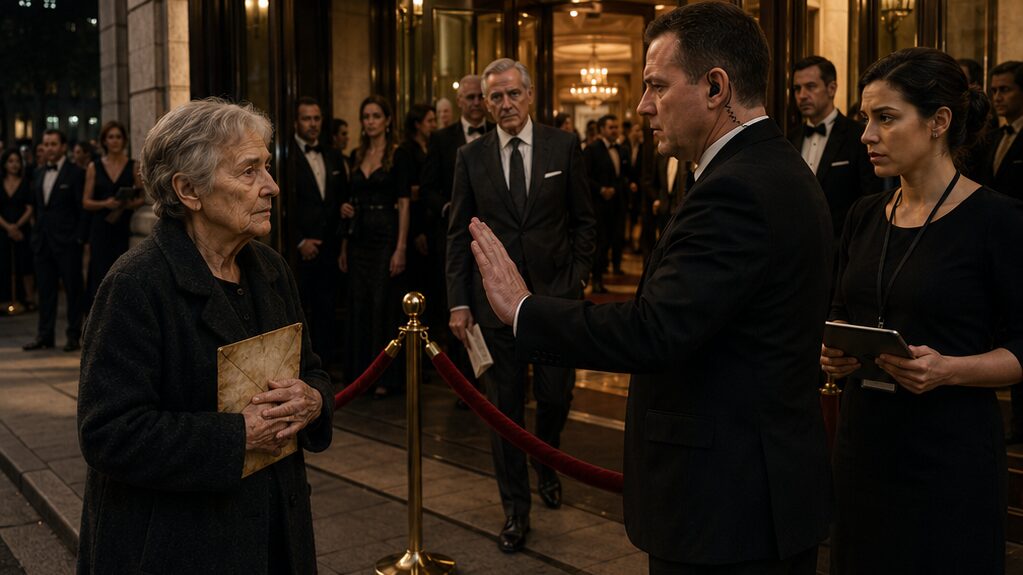
The red rope stopped Sharon Mitchell before any person did.
It stretched between two brass posts at the hotel entrance, bright as a warning under the gold wash of the marquee lights. Beyond it, women in black satin and men in fitted tuxedos moved through the open doors with printed invitations in their hands and silver name badges already clipped to their lapels. A string quartet played somewhere inside, soft enough to make the laughter seem expensive.
Sharon stood on the sidewalk with an old envelope pressed between both hands.
It was not the kind of thing that belonged at a gala. The paper had yellowed at the edges and gone soft along the folds. One corner was darkened by an old stain she had never tried to clean. The flap had been opened once, long ago, then closed again with care that looked almost like fear. In the light, the envelope seemed small and tired. In Sharon’s hands, it felt heavier than anything else she owned.
“Ma’am,” the security lead said, stepping in front of the rope before she could reach the check-in table. “This entrance is for registered guests only.”
Sharon looked up at him. He was younger than her by at least thirty years, broad-shouldered, clean-shaven, his tuxedo jacket cut sharp enough to make him look more like part of the décor than a guard. A small earpiece curled behind one ear.
“I understand,” Sharon said.
The man waited, not unkindly at first, but with the impatience of someone trained to keep a line moving. His badge read Mark King. Behind him, a second security guard watched the curb, and a volunteer with a lanyard stood over a tablet at the check-in stand. Her name tag said Nicole Rivera in neat black letters.
Sharon shifted the envelope slightly so that it rested higher against her coat. Her dark wool coat was brushed clean but old at the cuffs. The black dress beneath it had been taken in twice and still hung loose at her shoulders. She had polished her shoes before leaving home, not because anyone would notice, but because she had been raised to show up properly when a thing mattered.
“I’m here for the archive table,” she said.
Mark glanced toward Nicole, then back at Sharon. “Do you have a ticket or confirmation email?”
“No email.”
“Printed invitation?”
Sharon lifted the envelope a few inches.
Mark’s expression changed, only slightly. It was not contempt. It was worse in its way: the careful patience people used when they believed age had made someone confused.
“That isn’t an event pass, ma’am.”
“I know what it is.”
A couple behind Sharon stopped short. The woman wore a pearl-colored wrap and held her phone in front of her, searching for a QR code. The man with her leaned subtly to see around Sharon, his eyes already on the entrance beyond the rope.
Nicole came closer with the tablet held against her waist. “May I have your name?”
“Sharon Mitchell.”
Nicole typed. The tiny tapping of her nails on the glass seemed loud to Sharon. The hotel doors opened and closed, letting out bursts of warm air carrying perfume, roasted meat, and the faint brass note of a microphone being tested inside.
Nicole scrolled. Her brow tightened.
“I’m sorry,” she said. “I’m not seeing that name.”
Sharon nodded once, as if she had expected this and hoped against it anyway. “It may be under Mitchell. Or under an old unit file.”
Mark looked at the envelope again. “A unit file?”
Sharon did not answer quickly enough.
He took that silence as confirmation of his own suspicion. “Ma’am, this is a private foundation event. Veterans letters archive fundraiser. There’s a formal intake inside, but only scheduled donors and invited contributors are being admitted tonight.”
“I was told there would be a table.”
“By who?”
Sharon’s fingers tightened against the envelope. The name she might have said had been dead so long that speaking it in front of the rope felt like setting it down on wet pavement.
“A notice came through the veterans center,” she said. “They said letters could be brought in person.”
Nicole’s face softened. “The public intake day is next month. Tonight is the opening gala. The donors are previewing the archive exhibit.”
“I don’t need dinner,” Sharon said. “I don’t need a seat.”
The couple behind her shifted. The woman with the pearl wrap looked away, embarrassed for Sharon without wanting to share the embarrassment. A car pulled to the curb and a driver opened the door for a man in a dark suit. Cameras flashed near the step-and-repeat backdrop where guests smiled beneath the words Voices of Service: Preserving Every Letter.
Every letter.
Sharon saw those words and felt the envelope pulse once under her palms, though of course paper could not pulse.
Mark moved a half step closer to the rope. “I’m going to have to ask you to step aside so we can keep the entrance clear.”
“I can wait.”
“We don’t have anyone available to review documents out here.”
“I don’t want it reviewed out here.”
Mark’s jaw set. “Then I can’t help you.”
For one brief second Sharon almost told him. Not the whole of it. Just enough. Army. Convoy. Communications. The date. The field postmark. Words that might straighten his back, alter his voice, make Nicole stop scrolling and look at her hands differently.
But she had spent most of her life refusing to spend her service like currency. She had not worn it to cut lines. She had not used it to win arguments with clerks or doctors or impatient boys in polished shoes. If the envelope mattered only after she made herself into a headline, then perhaps she had come to the wrong door.
So she said nothing.
Mark reached toward the envelope. “If you’d like to leave that with the foundation—”
Sharon pulled it back before his fingers came close.
The movement was small but sharp. Mark stopped. Nicole’s eyes lifted from the tablet.
“I’ll hold it,” Sharon said.
Her voice remained level, but heat had risen into her chest. Not anger, exactly. Anger had edges; this was older and duller, worn smooth by years of being mistaken for someone who needed help crossing streets she had once crossed under fire.
Mark lowered his hand. “All right. But you can’t block the entrance.”
“I’m not blocking it.”
No one answered. The couple behind her slipped around to Nicole’s side. Their QR code scanned with a bright chirp. The rope opened for them. The man avoided Sharon’s eyes as he stepped past. His sleeve brushed the envelope, and Sharon pulled it closer.
Inside the doorway, a donor table host laughed with a group of guests. Champagne glasses caught the chandelier light. A polished display board showed enlarged photographs of handwritten letters, each one mounted under clear glass, each one labeled and lit. Sharon could see only fragments from where she stood: a salutation, a date, a line about coming home.
She had imagined, foolishly, that someone at the table would understand the moment they saw what she carried.
Instead, she was an old woman holding old paper at a rope.
Nicole glanced at Mark, then at Sharon. “Maybe if you come back during public intake—”
“I can’t promise that.”
Nicole seemed unsure what to do with that answer.
Mark used the voice again, gentle enough to avoid blame, firm enough to end the matter. “Ma’am, please step away from the rope.”
Sharon looked at the entrance one more time. Not at the guests. Not at the flowers. At the words above the display board.
Preserving Every Letter.
She tucked the envelope against her sternum and took one step back.
The sidewalk felt colder away from the heat of the doorway. She moved to the side, near a planter filled with white winter flowers, and let the next guests pass without looking at them. Her hands had begun to ache. She had been gripping the envelope too tightly.
She told herself she had tried. After so many years, trying should have counted for something. But the thought brought no comfort. A promise did not become lighter because the first door stayed closed.
She turned as if to leave.
Across the entrance, near the line of photographers, an older man in a charcoal suit stopped in the middle of a conversation. He had a champagne glass in one hand and a program folded in the other. Someone beside him kept talking, but his attention had fixed on Sharon’s hands.
Not on her face.
On the envelope.
The man’s smile faded. His gaze sharpened, and the glass lowered slowly from his chest.
Sharon did not know him. She only saw that he was looking at the old field-stained paper as if it had spoken his name.
Chapter 2: The Name Gregory Hall Recognized
Gregory Hall knew the shape of old military mail before he could read a single word.
It was not simply the age of the envelope. Plenty of families brought old letters to foundation events now, some tied in ribbon, some flattened carefully between acid-free sleeves, some purchased from estate sales by people who liked the feeling of history without the burden of knowing anyone in it. Gregory had seen them all since agreeing to chair the archive campaign.
But the envelope in the elderly woman’s hands had the familiar cramped discipline of something written where there had been no proper desk. The address slanted down and corrected itself. The upper corner bore the ghost of a field postmark, darkened by years and fingers. Even from several yards away, he could see the handling marks—not collector’s wear, not attic neglect. Carrying wear.
Someone had kept that letter close.
“Gregory?” Katherine Lewis said beside him. “The remarks are in twenty minutes. We need to review the donor acknowledgments.”
He did not answer.
At the entrance, Mark King stood in front of the rope with his body angled toward the sidewalk, the way security did when they wanted a problem to move along without becoming one. Nicole Rivera held her tablet like a shield. The elderly woman had already stepped away.
Gregory set his champagne glass on the nearest cocktail table.
“Excuse me,” he said.
Katherine followed his gaze. “Is something wrong?”
“I’m not sure.”
He crossed the entrance quickly enough that two guests paused to let him pass. Mark noticed him first and straightened.
“Mr. Hall,” Mark said, relief and worry mixing in his voice. “We just had a walk-up. She doesn’t appear on the guest list.”
Nicole turned. “I checked Sharon Mitchell and Mitchell. Nothing came up for tonight.”
The elderly woman looked at Gregory then. Her eyes were steady, guarded, and very tired. She did not step forward. She did not ask him to overrule anyone. The envelope remained against her coat.
Gregory stopped on the other side of the rope.
“Mrs. Mitchell?” he asked.
“Miss,” she said.
“Miss Mitchell.” He lowered his voice without meaning to. “May I see the outside of the envelope?”
Mark extended a hand as if to take it from her.
Gregory caught the movement. “No,” he said quietly.
Mark froze.
Gregory softened the word by turning fully toward Sharon. “Only if you’re willing to show it. You can keep it in your hands.”
For the first time since she had arrived, something in Sharon’s face moved. Not trust. Not yet. But recognition of the difference between being handled and being asked.
She lifted the envelope.
Gregory leaned close enough to read without touching. The old ink had faded to brown. The return line was partly smeared, but the unit mark remained legible in fragments. His breath caught on the APO number. He had spent years in records rooms with numbers like that, years reading rosters whose names blurred after midnight until one detail brought a whole lost life back into focus.
Then he saw the addressee line.
S. Mitchell
Under it, in a second hand, someone had written a service designation he had not heard aloud in years.
Gregory’s shoulders straightened.
Nicole saw it happen. Mark saw it too. So did Sharon, though she gave no sign that she needed it.
Gregory looked from the envelope to her face. “Were you with that unit?”
The noise around the entrance seemed to fall away.
Sharon’s thumb rested along the envelope’s crease. “For part of one tour.”
Mark’s expression changed, not dramatically, not in the kind of way that made a scene. His eyes went to the envelope again, then to Sharon’s coat, her shoes, the careful way she stood even with one hip bearing more weight than the other.
Nicole’s tablet lowered.
Gregory did not salute. The entrance was too crowded, too uncertain, and Sharon had not asked to be made into a display. But his posture changed into something close to attention.
“Miss Mitchell,” he said, “I’m Gregory Hall. I chair the foundation’s archive committee. I’m sorry you were kept out here.”
Sharon looked past him at the rope. “They were following rules.”
“They were following incomplete ones.”
Mark swallowed. “Sir, we didn’t have her on the list.”
“I understand.” Gregory did not look away from Sharon. “Mark, lower the rope, please.”
Mark moved at once. The brass clip gave a small metallic sound as he unhooked it. The red rope dipped, opening a gap that had not existed a moment before.
Sharon did not move.
Gregory stepped back to give her room. “Would you like to come inside?”
She looked toward the lobby. Warmth spilled from it. Beyond the glass doors, the mounted letters glowed under museum lights. Donors moved past them with drinks in their hands, reading fragments of other people’s wars between conversations.
“I came for the archive table,” she said.
“Then I’ll take you there myself.”
“I can walk.”
Gregory nodded once. “Of course.”
The correction landed softly but clearly. He had offered help as though age had requested it. She had declined without offense. He adjusted.
Nicole stepped to the side. “Miss Mitchell, I can update your entry manually.”
Sharon turned the envelope slightly away from the tablet. “Not yet.”
Nicole blinked. “I only need—”
“Not yet,” Sharon repeated.
Gregory saw the way her fingers pressed against the old paper. It was not possessiveness. It was custody.
“Nicole,” he said, “give us a moment.”
A gust of cool air moved along the sidewalk as another car pulled away. Somewhere inside, a microphone squealed and a man laughed too loudly to cover it. Katherine approached slowly, her sponsor smile ready but uncertain.
“Gregory,” she said, “is everything all right?”
He did not introduce Sharon as a charming surprise. He did not raise his voice for nearby guests. Instead, he shifted his body slightly, placing himself between Sharon and the growing curiosity at the entrance.
“We need a private intake room,” he said.
Katherine’s eyes flicked to the envelope. “Now?”
“Yes.”
“The program is about to begin.”
“This came before the program.”
Sharon heard the weight in that sentence and looked at him more carefully. Gregory Hall was not young. His hair had gone silver at the temples; his face held the trained composure of a man who had spent years delivering difficult information in rooms where people sat too still. He was not merely wealthy, then. Not merely another suit with authority.
He knew enough to be careful.
Mark remained beside the lowered rope, stiff and silent.
Sharon stepped through.
No one clapped. No one announced her. The lack of spectacle steadied her more than any welcome could have. Still, as she crossed from the sidewalk into the golden lobby, she felt the eyes on her. Guests pretended not to watch. The woman in the pearl wrap glanced back and then quickly turned toward the display.
Nicole came around the check-in table. “Miss Mitchell, I’m sorry if I sounded dismissive.”
Sharon looked at her. The young woman’s face had color in it now, shame rising under professional makeup.
“You sounded busy,” Sharon said.
Nicole did not seem sure whether that was forgiveness.
Gregory guided them toward a side corridor, not by touching Sharon, but by clearing the path ahead of her. Mark spoke into his earpiece in a low tone. Katherine walked beside Gregory, her heels clicking faster than the rest of them.
At the corridor entrance, Sharon paused and looked back at the display board.
There were enlarged letters behind glass, each one flattened and captioned. The donors leaned in to read them with reverent faces. Sharon wondered if reverence was easier when the writer was safely gone.
Gregory followed her gaze. “Your envelope belongs in that archive if you want it there.”
Sharon’s hand closed tighter.
“That is the question,” she said.
He waited.
She turned from the display toward the quieter hallway. Her voice was calm, but something underneath it had begun to show.
“I didn’t come here to be introduced,” she said. “I came to return something that never should have stayed with me.”
Chapter 3: What the Gala Was Really Honoring
Nicole Rivera had been told three things before the gala doors opened: keep the check-in line moving, protect the donor experience, and direct all unscheduled archive materials to the public intake day.
No one had said what to do if the archive came to the door holding itself together with two elderly hands.
She walked behind Sharon Mitchell and Gregory Hall through the side corridor, the tablet dark against her chest. The hallway ran parallel to the ballroom and was meant for staff movement, not guests. Its carpet was plain, its lighting harsher, its walls undecorated except for temporary signs pointing toward restrooms, catering, and the archive intake room. From behind the ballroom doors came the low swell of strings and conversation, interrupted now and then by microphone checks.
Sharon moved slowly but not uncertainly. That difference bothered Nicole because she had missed it outside. She had seen age before she saw purpose. She had seen an old envelope before she saw a guarded object. She had seen a missing name on a tablet and let the tablet decide what kind of person stood in front of her.
Katherine Lewis came up beside Gregory, lowering her voice in the way people did when they wanted urgency to sound polished.
“Gregory, I’m trying to understand what we’re changing. Is she a donor? A speaker?”
“No,” Gregory said.
“Then what is the emergency?”
Sharon stopped.
Not abruptly. She simply ceased moving, and because she did, everyone else stopped too.
Gregory turned back. “Miss Mitchell?”
Sharon looked at Katherine. “There isn’t an emergency.”
Katherine’s sponsor smile appeared, softer now, shaped for reassurance. “Of course. I only meant we’re in the middle of a very carefully timed event.”
“I know.”
“The archive table is prepared for scheduled contributors tonight. Preservation staff, photography, documentation. If you brought a family letter, that’s wonderful, truly. But there is a process.”
Sharon held the envelope lower now, against her ribs. “It isn’t a family letter.”
Nicole felt the sentence settle in the hallway.
Katherine glanced at Gregory.
He said nothing.
The archive intake room had been set up in a small conference space just off the corridor. Nicole opened the door because no one else moved to. Inside, the hotel had tried to disguise a workroom as part of the gala. A white tablecloth covered the main table. Two archival boxes sat beside a scanner, cotton gloves, acid-free sleeves, and a stack of glossy donor forms. Program cards fanned out near a vase of white flowers. On the wall, a poster displayed the archive campaign slogan in elegant script:
Every Letter Has a Home.
Sharon saw it immediately.
Her face did not change, but Nicole wished someone would take the poster down.
Gregory pulled out a chair, then stopped before offering it too quickly. “Would you prefer to sit?”
“Yes,” Sharon said.
Only then did he move the chair fully.
She sat with care, placing the envelope on the table in front of her but keeping one palm resting lightly across it. Nicole stood near the scanner. The machine looked suddenly crude, a bright plastic mouth waiting to swallow what did not belong to it.
Katherine remained by the door. “I need to ask plainly. Is this connected to tonight’s program?”
Gregory looked at Sharon rather than answering for her.
Sharon’s gaze moved over the table—the gloves, the sleeves, the donor forms with blank lines waiting to turn pain into categories. She touched the envelope once with her fingertips.
“It may be connected to a name in your program,” she said.
Katherine straightened. “Which name?”
Sharon did not answer.
Nicole placed her tablet on the far corner of the table, away from the envelope. “Miss Mitchell, would you like water?”
Sharon looked at her, and Nicole could not read whether the offer helped or only arrived late.
“No, thank you.”
Gregory sat across from Sharon but not directly opposite, leaving the envelope unboxed between them. “We don’t need to scan anything tonight. We don’t need to record anything you don’t want recorded. But if there is a risk we’re presenting something incorrectly in that ballroom, I need to know.”
Katherine exhaled softly. “Gregory.”
He turned to her. “That is why we built the archive.”
“We built the archive to preserve stories responsibly,” she said. “Not rewrite the program ten minutes before remarks because someone arrived with an unverified envelope.”
The word unverified struck the room like a dropped utensil.
Nicole saw Sharon’s hand still.
Katherine seemed to hear it too, because she added quickly, “I don’t mean that disrespectfully. I mean legally, archivally. We have standards.”
Sharon lifted her palm from the envelope. “So did we.”
No one spoke.
The ballroom music swelled through the wall, bright and graceful. Nicole imagined the guests on the other side reading framed excerpts under warm light, nodding at courage arranged in clean paragraphs. Here, under fluorescent bulbs, an old woman sat with a stained envelope nobody quite knew how to honor without first controlling.
Nicole moved the glossy program cards away from the envelope. It was a small motion, almost nothing. But Sharon noticed.
“Thank you,” Sharon said.
Nicole’s throat tightened. “You’re welcome.”
Katherine watched the exchange. Her expression was not cruel. That made it harder. She looked like someone balancing budgets, promises, donor expectations, press photos, and a room full of people waiting to feel that their money had touched something noble.
“I’m not trying to be difficult,” Katherine said. “This foundation has spent years building trust. Tonight matters. If Miss Mitchell’s story belongs here, we should handle it beautifully.”
Sharon looked up. “Beautifully?”
Katherine’s smile faltered. “With care.”
“Those are not always the same thing.”
Gregory’s eyes lowered briefly, as if the sentence had landed where it needed to.
Nicole opened one of the folders prepared for contributors. The first page asked for donor name, contact information, relation to service member, preferred display language, and permission for public use.
Preferred display language.
She closed the folder.
From the ballroom came applause, sudden and enthusiastic. Someone must have stepped to the podium early, or a sponsor had been acknowledged. The sound passed through the wall and faded.
Sharon looked toward it.
“I should go,” she said.
Gregory leaned forward slightly. “Please don’t.”
“You have an event to run.”
“We have an event that may need to listen.”
Katherine’s eyes sharpened at that, not with anger alone, but with calculation. Nicole saw the exact moment a public-facing idea formed.
“Gregory,” Katherine said slowly, “if Miss Mitchell is willing, perhaps there’s a way to include her tonight.”
Sharon’s hand returned to the envelope.
Katherine turned toward her, voice warming. “Not as pressure. As recognition. People in that room came because they care about stories like yours. If you were stopped outside and then welcomed in, that could be a powerful reminder of why this archive matters.”
Nicole looked at Sharon, then at the envelope, then at the poster on the wall.
Every Letter Has a Home.
For the first time that evening, Nicole understood that a home could be another kind of taking if the person at the door was not allowed to decide how to enter.
Sharon did not raise her voice.
“You still don’t know what story this is,” she said.
Katherine paused. “Then let us learn it.”
Sharon studied her for a long moment, not unkindly, but with the tired accuracy of someone who had heard many polished invitations in her life and knew where the hook was hidden.
Gregory said, “Katherine, not yet.”
But Katherine had already stepped closer to the table, her eyes bright with the possibility of salvaging disruption into meaning.
“If handled carefully,” she said, “Sharon’s entrance could become the moment of the night.”
Chapter 4: The Letter Sharon Mitchell Refused to Perform
Sharon had learned long ago that a room could become dangerous without anyone raising a hand.
The archive intake room was too clean. Too arranged. White flowers in a glass vase. White cards stacked in perfect fans. White cotton gloves folded beside a scanner that hummed faintly, waiting to make copies of things that could not be copied. On the far wall, the poster promised that every letter had a home, and Sharon kept her palm on the envelope as if it might hear the promise and believe it before she did.
Katherine Lewis stood near the door, still carrying herself like a woman responsible for the temperature of a whole building. Gregory Hall had sent someone to delay the remarks, though he had done it without drama. Nicole Rivera had stepped into the hallway and returned with a plain paper cup of water anyway, placing it near Sharon without pushing it toward her.
No one touched the envelope.
That was something.
Gregory sat across from Sharon with a legal pad he had not written on. His pen lay beside it, capped.
“We don’t have to do this tonight,” he said.
Sharon looked at him.
He corrected himself. “You don’t have to do this tonight.”
She let that settle. There was a difference between the two sentences, and he had noticed it himself. That was also something.
From the ballroom came a wave of applause, muffled by the wall. The crowd sounded pleased, warmed, prepared for whatever version of courage had been placed before them in neat sequence. Sharon wondered how many of them had ever held a letter so long that the paper learned the shape of their guilt.
Katherine checked her phone, then turned it face down. “The keynote can stretch for a few minutes,” she said. “Not much more.”
Gregory did not look at her. “Miss Mitchell, you said the letter may be connected to a name in our program.”
Sharon’s hand moved over the envelope, following the crease at its center. The paper had thinned there, almost worn through.
“Not may be,” she said. “Is.”
“What name?”
She did not answer at once.
The name lived in her with a young man’s face attached to it, though she knew he would have been old now if the world had allowed it. She could still see him leaning against the side of a transport truck, helmet tipped back, grinning at something he had no business finding funny. He had been too thin and too loud when he was nervous. He wrote letters during any halt longer than ten minutes, balancing paper on his knee, asking everyone if they knew a better way to say ordinary things.
Does “I miss your biscuits” sound childish, Mitchell?
Depends how good the biscuits are.
Best in the county.
Then write it.
She had not thought of that line in years. Or she had thought of it every week and called it something else.
“Larry Campbell,” Sharon said.
Gregory’s face changed carefully. Not the entrance kind of recognition, sharp and immediate, but something slower.
Katherine looked toward the program cards on the table. Nicole had gone still beside the scanner.
“He’s in the memorial segment tonight,” Katherine said. “One of the featured letters.”
Sharon looked at her. “A letter from him?”
“An excerpt from his family’s collection,” Katherine said. “I believe so.”
“No,” Sharon said.
The word was quiet enough that Nicole leaned in slightly.
Gregory reached for the program card, then stopped and asked with his eyes. Sharon nodded once. He lifted it and scanned the printed schedule.
“Larry Campbell,” he read softly. “Infantry. Killed in action. Final correspondence to his mother preserved through family donation.”
Sharon closed her eyes.
The years did not return as pictures first. They returned as heat. Dust. The metal taste of fear. The stutter of a radio that would not clear. Her own hands moving over coded sheets while men shouted outside the canvas flap. Larry’s voice asking her, not joking that time, whether mail still went out if the road was closed.
She opened her eyes.
“That isn’t the final correspondence,” she said.
Gregory placed the card down.
Katherine drew one measured breath. “Miss Mitchell, the program copy came from archived family materials and public records. If there is a discrepancy, we can review it after tonight.”
Sharon almost smiled. Not because anything was funny. Because after tonight had been the doorway through which so many important things disappeared.
“Larry gave me this,” she said.
No one moved.
“He gave it to me the morning our convoy was supposed to move south. He’d written it before dawn. Folded it wrong, then made me wait while he fixed the crease because he said his mother would notice. He asked me to hold it until the mail pouch reopened. We had delays. Then a route change. Then incoming fire. Then names on a board.”
Her voice stayed even. That mattered to her. If it broke, Katherine would hear only sorrow. Gregory might hear only regret. Nicole might look at her the way people looked at breakable things.
Sharon had never been breakable. Damaged, yes. Delayed, yes. Wrong in ways she had carried privately. But not breakable.
“I was a communications clerk,” she continued. “Convoy support when they needed hands. I tracked movements, messages, mail when there was mail to track. Not glamorous work. Mostly paper, static, dust, and being told to hurry by men who then complained when you hurried them back.”
Gregory’s mouth softened at that.
“Larry was not supposed to be near my station that morning,” Sharon said. “But everyone came through when they wanted something posted. He said if anything happened, I was to make sure his mother got it. I told him not to talk foolish.”
She looked down at the envelope.
“He said, ‘Then prove me foolish when I get back.’”
The room seemed smaller now. The flowers too white. The scanner too loud.
Nicole whispered, “He didn’t come back.”
Sharon’s fingers tightened. “No.”
Katherine lowered herself into the chair near the door as if she had forgotten she was standing.
Gregory did not write anything down. Sharon noticed and was grateful.
“Why did it stay with you?” he asked.
It was the right question because it did not soften the hard part.
Sharon drew the envelope closer. “At first, because I was injured and moved before I understood what had been lost. Then because records moved faster than people. Then because his mother had relocated, and the address I had was no good. Then because I was twenty-two and ashamed that a thing so small had become impossible.”
She swallowed once.
“After that, because every year made it harder to explain the year before.”
Outside the room, footsteps passed in the corridor. A burst of laughter from the ballroom followed, then the clink of glassware.
“I tried,” Sharon said, and hated how thin the words sounded. “Not enough. But I tried. Letters came back. A county office had no forwarding record. A veterans contact said next of kin files were restricted. Then my own life became what lives become. Work. Caregiving. Funerals. Bills. I put the envelope in a drawer where I could see it every time I opened the drawer, because hiding it all the way felt worse.”
She did not tell them about the years when she had taken it out on Memorial Day and set it on the kitchen table beside a cup of coffee gone cold. She did not tell them about writing Larry Campbell’s name in the margins of grocery lists so she would not let memory polish him into a symbol. She did not tell them that once, after a fever, she had dreamed the envelope had opened itself and the pages inside were blank.
Gregory’s hand rested beside his pen, still not touching it.
“When I saw the notice about this archive,” she said, “I thought maybe I had finally found the right hands. Not a stage. Not a display. The right hands.”
Nicole looked down.
Katherine spoke carefully. “If this is authentic, it matters a great deal.”
Sharon looked at her until Katherine’s face colored.
Gregory said, “It matters before authentication.”
Katherine accepted the correction with a small nod, though not easily.
Sharon looked toward the program cards. “You said his final correspondence is already in your program.”
Gregory picked up the card again, slower this time. “Yes.”
“Read what you have written.”
He hesitated.
“Please,” Sharon said.
Gregory read in a low voice. “Larry Campbell’s final known letter, written days before his death, expresses his pride in service and his hope that future generations remember the cost of freedom.”
Sharon’s expression did not change.
But inside her, something old recoiled.
Pride. Cost. Future generations. Fine words, all of them. Clean enough for a ballroom. Broad enough to fit over any name after the rough edges had been cut away.
“That is not Larry,” she said.
Nicole’s eyes flicked toward the envelope.
Katherine folded her hands. “That language is introductory. It frames the exhibit.”
“It replaces him.”
Gregory looked up from the card.
Sharon tapped the envelope once, gently. “Larry Campbell did not ask to be made noble. He asked whether his mother would forgive him for lying about being less scared than he was. He asked that someone check on the man in the next cot because that man wouldn’t admit his feet were going bad. He asked me to tell the mail clerk he was sorry for stealing two envelopes. He asked ordinary things.”
The room held still around her.
“And you have him standing in there saying words he never said.”
Katherine looked toward the wall, toward the ballroom she could not see but clearly felt slipping out of her control. “The memorial segment begins after dinner.”
“How much time?” Gregory asked.
“Not enough to rebuild it.”
Sharon looked at the envelope. Her thumb found the old stain near the corner. “Then maybe don’t say his name.”
Katherine’s head turned back quickly. “Miss Mitchell—”
“If you can’t say it right.”
Gregory stood and crossed to the program stack. He lifted one of the glossy cards and studied the printed memorial section under the hard ceiling light. His face had gone pale beneath the composure.
“There’s more,” he said.
Sharon did not want there to be more.
He set the card down in front of her, turning it so she could read the line herself. The print was elegant. The error was small, almost invisible to anyone who did not carry the truth in an envelope.
Larry Campbell, 1946–1968, final letter donated by surviving spouse.
Sharon stared at it.
For a moment, she heard nothing from the ballroom. Not the music. Not the applause. Not the soft panic in Katherine’s breathing.
Larry had not had a surviving spouse. He had been nineteen. He had written to his mother about biscuits, stolen envelopes, and the man in the next cot. Whoever had given the foundation that other letter, whatever family branch or collector or mistaken file had carried it here, the program had dressed him in a life he never lived.
Sharon placed one hand over the old envelope and one over the printed card.
The paper beneath her right palm was slick and new.
The paper beneath her left was soft with time.
Gregory said her name quietly.
Sharon looked up.
“This,” she said, touching the program card, “is why I should have come sooner.”
Chapter 5: The Gala Wanted a Cleaner Story
Gregory Hall had spent much of his adult life reading mistakes made by official hands.
A transposed digit. A missing middle initial. A date copied from one form to another until error became record. The dead were especially vulnerable to neatness. Their files could be thinned, summarized, corrected by people who had never heard their voices. The living, Gregory had learned, were not always much safer.
He stood at the edge of the ballroom with Katherine Lewis beside him and the wrong program card folded once in his hand.
Inside, the gala had reached the part of the evening that donors liked best. Plates had been cleared. Coffee was being poured. The lights had lowered over the tables and brightened near the podium, where the foundation seal glowed on a screen behind the microphone. Along the walls, enlarged service letters floated in frames of warm light, their rough handwriting made elegant by glass and spacing.
At table twelve, two elderly veterans sat shoulder to shoulder, their jackets a size too large, their medals modest and mostly unnoticed by guests busy greeting sponsors. Near the front, a donor table host laughed softly with a hotel manager. Everything looked exactly as Katherine had intended: dignified, generous, moving, controlled.
Gregory could no longer bear the word controlled.
“She cannot be turned into a surprise,” he said.
Katherine kept her voice low. “No one is turning her into anything.”
“You said her entrance could be the moment of the night.”
“Because it could. Not in a cheap way. Gregory, listen to me.” She turned toward him fully, blocking his view of the podium. “A seventy-eight-year-old veteran carrying a lost letter connected to one of our featured names walks into the gala on opening night. If we handle that with grace, people will remember why this work matters.”
“She was stopped outside this work.”
“Which is exactly why acknowledging her matters.”
“Acknowledging is not the same as using.”
Katherine’s jaw tightened. “That is unfair.”
He knew it was, partly. Katherine had raised money when no one else could. She had persuaded corporations to sponsor archival storage, convinced families to donate collections, hired preservation staff, rented this hotel, filled this ballroom, and made people with money care about paper that might otherwise have rotted in basements. She was not empty. She was not cruel.
But she believed, as fundraisers often did, that pain became safer when shaped for an audience.
Gregory looked back toward the service corridor. Sharon remained in the intake room with Nicole. She had not raised her voice. She had not asked for anyone to be punished. She had simply placed the wrong program beside the envelope and made the room understand that polish could become a kind of falsehood.
“The memorial segment has to change,” Gregory said.
“We can adjust wording.”
“We need to remove the surviving spouse line.”
“Obviously.”
“And the phrase ‘final known letter.’”
Katherine hesitated. “That is more complicated. We don’t know yet what Miss Mitchell brought.”
“We know enough not to call the other one final.”
“We know enough to say a second letter may exist. We do not know enough to rewrite a tribute in front of four hundred people.”
Gregory glanced at the tables. Four hundred people, all waiting for a clean emotional arc between dessert and the donation pledge.
“Then we don’t rewrite it,” he said. “We correct it.”
Katherine exhaled. “You make that sound simple.”
“No. I make it sound necessary.”
A staff member approached with a headset and whispered to Katherine that the keynote was almost finished. Katherine nodded, dismissed her, then turned back to Gregory.
“Here is what I propose,” she said. “We introduce Miss Mitchell briefly. We don’t go into the details. We say tonight’s mission became real at our own front door. We ask the room to stand for her service. We let her place the envelope in the archive box. No pressure to speak. Thirty seconds. Restrained. Powerful. Then you correct the record in follow-up materials after preservation review.”
Gregory looked at her.
It was elegant. It would work. The room would stand, hands over hearts or glasses lowered. Some would cry. Donations would rise. Mark King would look chastened. Nicole would feel redeemed. The archive would gain a story people repeated.
And Sharon would have arrived with a burden only to become proof that the evening had been meaningful after all.
“No,” he said.
Katherine’s eyes cooled. “You don’t get to make that decision alone.”
“Neither do you.”
“Then ask her.”
“I intend to.”
They returned to the intake room.
Nicole stood near the table, but she had changed the room in the few minutes they were gone. The scanner had been turned off. The glossy donor forms had been moved to a side chair. The cotton gloves remained, but no longer in front of the envelope like an instruction. The cup of water sat closer to Sharon now, half empty.
Sharon looked up as they entered.
Gregory saw the fatigue in her face and felt ashamed of the ballroom lights.
Katherine stepped in first. To her credit, she did not wear the sponsor smile now.
“Miss Mitchell,” she said, “I owe you an apology for the program error.”
Sharon folded her hands over the envelope. “Do you?”
Katherine paused. “Yes.”
“For the error, or for being caught with it?”
Nicole looked down at the table.
Katherine absorbed the question. “Both, probably.”
That answer was honest enough to surprise Gregory.
Sharon nodded once.
Katherine sat, carefully keeping distance from the envelope. “The memorial segment begins soon. We can correct the false details tonight. We should. But there is also an opportunity, if you are willing, for the room to recognize your service and the importance of what you brought.”
“No.”
The answer came before Katherine finished breathing.
Gregory felt relief and worry at the same time.
Katherine kept her tone even. “You would not have to speak.”
“No.”
“No one would touch the envelope without permission.”
“No.”
“We could simply ask the room to stand.”
Sharon looked at Gregory then, not Katherine. The look was not accusation. It was a test.
Gregory said, “You don’t owe the room your face.”
Katherine’s mouth tightened, but she did not interrupt.
Sharon leaned back slightly. “When I came here, Mr. King thought I was confused because I had old paper. Miss Rivera thought the tablet knew more about why I came than I did. You”—she turned to Katherine—“saw a problem to manage. Mr. Hall saw a unit mark and became careful. That was better. But careful is not finished.”
Gregory accepted the words because they were true.
“I am not ashamed of serving,” Sharon said. “But I did not come tonight to be proof that this gala has a heart.”
Katherine lowered her eyes.
“I came because your notice said letters could be preserved. I came because Larry Campbell’s name was going to be spoken in a room where people might listen. I came late. That part is mine. But I will not hand him over to be made cleaner.”
Gregory unfolded the program card and placed it on the table, away from the envelope. “What do you want corrected tonight?”
Sharon looked at the printed line. “Do not call that other letter final. Do not say surviving spouse. Do not use words like pride if the letter you have does not say pride. Say the archive record is incomplete. Say a veteran came forward tonight with information that requires correction.”
Katherine frowned slightly. “That sounds institutional.”
“It sounds true.”
“What about you?”
Sharon’s face did not move. “What about me?”
“Your service deserves recognition too.”
“My service is not a garnish for your correction.”
Silence spread through the room.
Nicole’s eyes filled, but she blinked it back before it became something anyone had to tend.
Gregory sat across from Sharon again. “If we make those corrections, will you allow the foundation to begin intake of the envelope?”
Sharon looked at the old paper. For the first time, Gregory saw uncertainty break through her restraint. Not about them. About herself.
“I don’t know.”
Katherine looked stunned. “After all this?”
Sharon’s hand tightened.
Gregory said softly, “Katherine.”
But Sharon answered.
“You are worried about your timing,” she said. “I have been worried for fifty-six years about whether giving this away means I am finally doing right or only finding a better place to hide it.”
Katherine sat back as if the sentence had touched something she did not want seen.
Gregory placed both hands flat on the table, empty. “Then we do not take it tonight unless you decide we do.”
“The program changes first,” Sharon said.
“Yes.”
“And not because I am a veteran you can point to.”
“Yes.”
“And no one reads from this envelope tonight.”
Katherine looked at Gregory. The keynote applause rose beyond the wall, long and warm. Time had run out.
Gregory stood.
Katherine remained seated for one second longer, then rose too.
Sharon lifted the envelope and held it against her chest again. The gesture was not fear now. It was decision waiting to harden.
“If you cannot correct the record,” she said, “the envelope leaves with me.”
Chapter 6: The Letter Asked for More Than Memory
Sharon knew the envelope would make a sound when it opened.
She had heard it before in her kitchen, in bedrooms rented and owned, in the dim back room of a veterans center where she had once sat alone after a Memorial Day breakfast and almost asked for help. The flap always released with a faint dry whisper, paper fibers lifting from paper fibers after decades of being persuaded to remain still.
Now, in the archive intake room, with the ballroom waiting on the other side of the wall, the sound seemed louder than applause.
Nicole had brought a pair of cotton gloves but had not offered them until Sharon asked. That mattered. Gregory stood near the door, one hand on the frame, listening to a staff member whisper through the crack about timing. Katherine had gone to the podium area with the corrected program card folded in her hand and a face that had given up on elegance for the moment.
The envelope lay on the table.
Sharon had removed her coat. Beneath it, her black dress showed its age at the seams. Her wrists looked thin under the fluorescent light. On the left one, a pale band marked where she had worn a watch for years after the watch itself stopped working. Larry had once teased her for checking it when no convoy in the world had ever left on time.
She put on the gloves.
Her hands did not shake until she touched the flap.
Nicole saw it and looked away, giving her the privacy of not being watched too closely.
“Would you like us outside?” Gregory asked.
“No.”
He stayed.
Sharon lifted the flap with two fingers. The old adhesive resisted, then let go. Inside was a folded sheet, thinner than she remembered, and a smaller scrap tucked against it. She had read the letter only twice. Once because she thought she had to know where to send it. Once because she could not bear not knowing what she had failed to send.
She slid the pages out.
The room changed.
Not visibly. The scanner remained off. The program cards stayed stacked on the chair. The white flowers still leaned in their vase. But the air around the table seemed to tighten, as though everyone understood that the object had stopped being a symbol and become someone’s voice.
Sharon unfolded the letter.
Larry’s handwriting crossed the page in uneven lines, crowded at the bottom where he had run out of space and refused to use a second sheet. He had pressed too hard in places. The letters dug into the paper. She could still see the impatience in them.
Nicole stood silently across from her.
Gregory returned from the doorway and sat, careful not to scrape the chair.
Sharon read the first line to herself.
Mama, I told you last time not to worry, which was a lie but a loving one, so I hope the Lord grades on intention.
Her breath stopped in the middle of her chest.
There he was. Not the foundation’s polished figure. Not the young man flattened into pride and cost. Larry Campbell, nineteen years old, making jokes because fear was easier to carry if he could make someone smile.
Sharon lowered the page slightly.
“I used to think the worst part was that his mother never got this,” she said. “Then I got older and realized the worst part was that I had made him silent in my own way too. I kept him safe by keeping him unread.”
Gregory’s voice was low. “You were young.”
“So was he.”
No one offered comfort after that. Sharon was grateful again.
She read a few lines aloud, not all of them. She did not give the room his mother’s private name. She did not read the sentence where he admitted he had dreamed of home and woken ashamed of wanting it so badly. She chose what belonged to the correction, not what belonged to grief.
“He wrote about a man in the next cot,” she said. “Said his feet were bad and he was hiding it because he didn’t want to be pulled off rotation. Larry wanted someone to check on him without making him feel weak.”
Nicole pressed her lips together.
“He wrote that he stole two envelopes,” Sharon continued. “Not stole, exactly. Borrowed without asking from the mail clerk. Said he would pay back four if he got the chance.”
Her eyes moved down the page.
“And here.”
She stopped.
The sentence had waited for her for fifty-six years with no accusation in it, which somehow made it harder.
Gregory leaned forward slightly but did not ask.
Sharon read, “If this gets there after I do something stupid or brave, please don’t let them make it sound better than it was. Tell Mama I tried to keep my hands useful. Tell her I was scared when I should have been and laughing when I could.”
Nicole turned away, wiping once beneath her eye with the heel of her hand.
Sharon folded the letter down enough to see the smaller scrap. She had forgotten, or pretended to forget, that it was there.
On it, Larry had written another name and a partial address. Beneath that, a line meant for Sharon, though he had not used her first name.
Mitchell, if the mail gets fouled up, you know how to find the right desk. You always do.
Sharon stared at the words until they blurred.
That had been the wound inside the wound. He had trusted not her kindness but her competence. The part of herself she had believed in then. The part that knew how to trace a message, correct a route, find a desk, make someone answer. After the blast, after the hospital, after the forms and transfers and discharge papers, that part had seemed to belong to someone else.
She had not found the right desk.
Or she had stopped too soon.
Gregory read the line upside down from across the table. His face tightened with understanding.
“He gave you a task,” he said.
“He gave me faith,” Sharon said. “The task was simpler.”
The ballroom applause began again, then faded under the muffled voice of someone at the podium. Katherine must have started the correction or delayed it with donor language. Sharon could not make out the words.
Nicole moved toward the door, listened, and came back. “They’re introducing the memorial segment soon. Katherine is buying time.”
Sharon almost smiled at that. “Buying time is what events do best.”
Gregory looked toward the page. “Miss Mitchell, we can still correct the record without taking the envelope tonight.”
“I know.”
“And we can arrange a proper preservation intake later, with legal documentation and whatever restrictions you want.”
“I know.”
He waited.
Sharon looked at the letter again. Larry’s handwriting filled the page with the urgency of someone who believed paper could cross whatever people could not.
She had carried the envelope as punishment for so long that she had mistaken punishment for loyalty. Keeping it had felt like proof that she had not forgotten. But Larry had not asked to be remembered by being kept in a drawer. He had asked for useful hands.
She removed the smaller scrap and placed it beside the letter.
“I don’t want them to read him tonight,” she said.
Gregory nodded. “They won’t.”
“I don’t want a photograph of me holding it.”
“No.”
“I don’t want Mr. King made into a lesson in front of everyone.”
Nicole looked surprised.
Sharon glanced at her. “He was wrong. That doesn’t make him the story.”
Gregory’s eyes softened.
“I don’t want your donors standing up for me because it makes them feel clean,” Sharon said. “If they stand later, let it be because they are about to do something harder than stand.”
“What would that be?” Nicole asked.
Sharon looked at the program card with Larry’s wrong life printed in black ink.
“Listen to the correction without being entertained by it,” she said. “Fund the intake days that are inconvenient. Send people to the veterans center instead of waiting for stories to arrive polished. Make room at the table for living people who don’t have the right clothes or the right email.”
Gregory leaned back slowly.
In the hallway, a staff member appeared at the door, anxious. “Mr. Hall, they’re ready for you.”
Gregory did not move. “In a minute.”
The staff member vanished.
Sharon folded Larry’s letter along its original creases, slower this time. She did not put it back into the envelope. She set both on the table: the opened letter, the scrap, the old stained envelope that had held them too long.
Her hands, freed from the paper, looked unfamiliar.
“I can’t undo late,” she said.
Nicole’s voice was barely above a whisper. “No.”
“But I can stop being later.”
Gregory stood, not with ceremony, but with purpose. “Tell me what you want said.”
Sharon looked at him, then at Nicole.
“No,” she said. “First tell me what you are willing to change.”
The question held them more firmly than any accusation could have. Gregory’s face stilled. Nicole straightened, the lanyard shifting against her black dress. Beyond the wall, the gala waited for another polished story.
Sharon rested her gloved hand beside Larry Campbell’s open letter.
“Before they hear one more clean version,” she said, “are you willing to change the program?”
Chapter 7: Respect Had to Become Behavior
Gregory Hall walked to the podium without the program card.
He had left it on the archive table beside Larry Campbell’s open letter, where the wrong words could no longer pretend to be harmless. Sharon watched from the ballroom threshold, standing just inside the side corridor with Nicole beside her. She had put her coat back on. The envelope remained on the table behind them, no longer against her chest, and the absence of its weight made her feel unsteady in a way she had not expected.
The ballroom quieted by degrees.
At the front, Katherine Lewis stood near the sponsor table with her hands folded tightly at her waist. Her face had lost its gala brightness. Mark King had returned to the entrance, but he was visible through the open lobby doors, no longer planted in front of the rope. He stood off to one side, speaking quietly to the additional security guard.
Gregory adjusted the microphone lower than the keynote speaker had left it.
“For those of you following the printed program,” he began, “there is a correction we need to make before the memorial segment.”
A mild stir moved through the room. Guests looked down at their cards. Some smiled politely, expecting a date, a donor name, a harmless administrative fix.
Gregory did not smile.
“In our program tonight, we describe a letter from Larry Campbell as his final known correspondence. We also list a family detail that we now believe is inaccurate. That was our error.”
Sharon felt Nicole inhale beside her.
Gregory continued, his voice even. “The archive exists because records can be incomplete, and because memory can be damaged by carelessness as easily as by time. Tonight, a veteran came forward with information that requires us to correct what we thought we knew.”
A few heads turned toward the side corridor. Sharon remained still.
Gregory did not look at her. She had asked not to be pointed at, and he honored that by keeping his eyes on the room.
“We will not read from that material tonight,” he said. “We will not display it. We will not turn someone’s private custody of a difficult promise into a moment for this stage. What we will do is correct the public record, suspend the inaccurate exhibit language, and reopen our intake process with better access for living veterans and families who cannot attend events like this one.”
The room did not know whether to clap. That uncertainty pleased Sharon more than applause would have. It meant the words had not fit neatly into the evening’s rhythm.
At the front table, Katherine looked down, then back up. She did not rescue the silence.
Gregory placed both hands on the podium. “If you came tonight to support preservation, I’m asking you to support the less elegant part of it. The intake days in community rooms. The returned phone calls. The transportation vouchers. The patient correction of names, dates, and relationships. The willingness to hear that a story may not say what we hoped it would say.”
An elderly veteran at table twelve lowered his coffee cup.
Sharon saw him clearly now. His jacket hung loose at the shoulders. His hands rested on the table, fingers bent slightly with age. Beside him, another veteran looked toward the side corridor, not searching for spectacle, simply listening.
Gregory’s voice softened. “We honor service poorly when we love only the parts that sound finished.”
No one moved.
Then Katherine stepped away from the sponsor table and walked to the side of the podium. She did not take the microphone from Gregory. She stood beside him, waited until he turned, and nodded once.
Gregory stepped back.
Katherine faced the room. For the first time that evening, she seemed smaller than the lighting had made her.
“The foundation will amend tonight’s pledge allocation,” she said. “A portion of funds raised this evening will be directed to veteran outreach intake—transportation, local center visits, and mobile preservation appointments. That change begins tonight.”
She looked toward the donors near the front.
“And the corrected program language will be sent to every attendee, not as a footnote.”
There was still no applause. A woman near the center reached for her program card and folded it closed. A man at the sponsor table removed his glasses and rubbed his eyes. The room was doing something harder than responding. It was absorbing.
Sharon stepped back from the threshold.
Nicole turned to her. “Was that all right?”
Sharon listened to the quiet beyond the wall. “It was a beginning.”
Nicole nodded as though she had been entrusted with something fragile.
They returned to the intake room.
The envelope lay where Sharon had left it, open and emptied of its secret. Larry’s letter rested on the clean table, its creases visible under the fluorescent light. The old stain on the envelope looked different now. Less like damage. More like evidence that it had traveled through hands, drawers, weather, delay, and a woman’s stubborn fear of getting one more thing wrong.
Nicole opened a drawer and removed a fresh archival sleeve. She paused before touching anything.
“May I?” she asked.
Sharon looked at the sleeve, then at Nicole’s hands.
“Yes.”
Nicole put on gloves with careful, almost awkward slowness. She did not perform expertise. She simply took care. With Sharon watching, she lifted the envelope first, supporting it beneath the weakened crease. The motion was small, but it changed the room more than Gregory’s speech had. Outside, respect had been spoken. Here, it became a behavior.
Sharon sat.
Her knees had begun to ache, and the chair accepted the truth of that without comment.
Nicole slid the envelope into the sleeve, then placed Larry’s letter in another. She labeled nothing yet. No donor name. No display title. No simplified caption. Just a temporary intake number and the words pending review with contributor present.
Contributor.
Sharon read the word upside down and let it stand. Not widow. Not witness. Not symbol. Contributor was incomplete, but it did not take more than she had given.
Gregory returned a few minutes later. He did not ask whether she had heard. He seemed to understand that asking would make her praise him.
“The memorial segment is being shortened,” he said. “Larry’s name will be spoken only in correction tonight. No excerpt. No false frame.”
Sharon nodded.
Katherine appeared behind him but did not enter until Sharon looked at her. “May I come in?”
Sharon studied her, then gave a small nod.
Katherine stepped inside. Her phone was gone. So were the cue cards. “I am sorry,” she said.
Sharon waited.
Katherine seemed to understand that the apology could not arrive polished either.
“I wanted the room to feel something,” she said. “I did not ask enough about what was true.”
Sharon looked at the sleeved envelope. “Feeling is easier.”
“Yes.”
“Truth takes longer.”
“Yes.”
That was enough for the moment.
From the lobby came a faint metallic sound. Sharon turned her head. Through the corridor opening, she could see Mark at the entrance. An older man in a worn blazer had arrived late, leaning on a cane, a folded notice in his hand. Mark did not block him with his body. He did not take the paper from him. He stepped aside first, then bent his head to hear.
Nicole saw it too.
Mark unhooked the red velvet rope and held it open. Not high and theatrical, not as an apology meant to be witnessed. Just open. The older man passed through slowly, and Mark waited until he was clear before replacing it.
Then, after a moment, Mark looked back toward the rope, frowned, and unhooked it again. This time he carried it away from the side entrance entirely and leaned it against the wall behind the check-in table.
No one clapped for that either.
Sharon looked down before anyone could see too much in her face.
Gregory followed her gaze to the archival sleeve. “We can stop for tonight. Lock it in temporary storage. You can come back tomorrow, or next week, with whoever you want present.”
“There isn’t anyone else.”
Nicole’s eyes lifted.
Sharon did not regret saying it. Loneliness was not shameful merely because it made other people uncomfortable.
Gregory nodded. “Then we come back when you choose. Nicole and I can be here. Katherine too, if you want. Or not.”
Katherine accepted the last words without flinching.
Sharon touched the edge of the archival sleeve. Cotton and plastic now stood between her skin and the paper. She had imagined that would feel like loss. Instead, it felt like setting down a weight on a table strong enough to hold it.
“Write his name correctly,” she said.
Nicole picked up a pencil. “Larry Campbell.”
“Not just the name. The person. Don’t make him older than he was. Don’t give him a wife because it sounds better. Don’t sand off the fear.”
Nicole wrote slowly on a separate worksheet, not on the sleeve.
“Don’t make me braver than I was either,” Sharon said.
Gregory’s eyes moved to her.
“I was late,” she said. “That remains true.”
“So does the fact that you came,” he answered.
She did not argue. Not because he had solved it. Because both things could remain.
The ballroom began to empty in small currents. Guests passed the corridor door speaking more quietly than they had entered. Some glanced into the intake room and then looked away, sensing correctly that whatever had happened there was not theirs to consume. The veterans from table twelve came by with the donor table host, who started to introduce them, then stopped when Gregory gently shook his head.
One of the veterans looked at Sharon. He did not ask what she had brought. He did not thank her for her service. He only stood a little straighter, touched two fingers to his brow in a gesture too informal to be a salute and too precise to be anything else, then walked on.
Sharon returned the smallest nod.
Later, when the ballroom lights brightened and the flowers looked tired, Nicole placed the sleeved envelope and letter into a temporary archival box. She did it with both hands. Sharon signed the intake form only after Gregory crossed out the public-use permission section and wrote deferred by contributor beside it.
Katherine watched, silent.
At the bottom of the form, Sharon paused over the signature line. For most of her life, signing things had meant surrendering something to systems that might misplace it. Tonight, her name looked strange in her own hand, older than she felt and younger than the paper beside it.
She signed.
Gregory did not take the pen from her. He let her set it down.
When Sharon finally walked back toward the lobby, the red rope was gone from the side entrance. The brass posts remained, useless and gleaming. Mark stood near them, hands folded in front of him.
“Miss Mitchell,” he said.
She stopped.
He did not apologize loudly. He did not straighten into a salute for the room to notice. He lowered his voice.
“I should have asked before I reached for it.”
Sharon looked at him for a long moment. “Yes.”
He accepted the answer.
“And I should have listened before I moved you aside,” he said.
“Yes.”
He swallowed. “I’m sorry.”
Sharon looked past him to the open doorway, where the night air waited beyond the hotel warmth.
“Open the rope first next time,” she said. “Then ask your questions.”
Mark nodded. “I will.”
She believed he meant it. She did not need to know whether he would always manage it. Respect, like record-keeping, required correction more than confidence.
Outside, the marquee lights made the sidewalk shine gold. The cold touched Sharon’s face, and she breathed it in. Her hands felt empty. Not clean. Not healed. Empty in the way a room was empty after something long stored had finally been carried out.
Gregory walked her to the door but not beyond it.
“We’ll call tomorrow,” he said. “Not to rush you. To confirm what you want next.”
Sharon nodded.
Nicole stood behind him with the archival box held against her chest, not unlike the way Sharon had held the envelope earlier. The sight might have hurt if Nicole’s grip had been possessive. It was not. It was careful.
Katherine remained farther back, speaking quietly with the hotel manager about removing the old program cards from the tables before anyone else took them home as souvenirs.
Sharon stepped onto the sidewalk.
For a second she looked back into the lobby. The display board still read Voices of Service, but beneath it a staff member was removing the smaller sign that had promised Preserving Every Letter. Nicole had told him to replace it with a handwritten notice in the morning: Still Listening. Records Being Corrected.
It was not beautiful.
It was better.
Sharon turned toward the curb. She had no envelope to press against her chest now, so she buttoned her coat with both hands. The night was quiet enough that she could hear the soft scrape of the brass rope posts being carried away behind her.
Larry Campbell’s letter was no longer in hiding. Neither was the error. Neither was the fact that Sharon Mitchell had served, failed, remembered, delayed, and come anyway.
At the curb, she paused before stepping down.
For the first time in years, she did not feel the need to check whether the envelope was still with her.
The story has ended.