The Officer Mocked The Old Man In The Interrogation Room Until The Camera Went Dark
Chapter 1: The Old Man Behind The Metal Table
The red light over the interrogation room door was already on when Raymond Clark reached the end of the secure hallway.
It glowed through the frosted panel like a small warning flare, steady and silent, marking the room as active, sealed, and recorded. A young military police officer stood beside it with one hand resting near his belt, his eyes moving from Raymond’s lined face to the black folder tucked beneath Raymond’s arm.
Raymond stopped before the checkpoint desk.
He wore a plain green coat that had lost its shape at the elbows, dark trousers pressed neatly but old enough to shine at the knees, and black shoes polished with the patient hand of a man who still believed shoes said something about discipline. His hair was white, thin at the crown, cut close. Nothing on him announced importance. No ribbon rack. No badge. No escort. Just an old man with a black folder and a temporary authorization sheet that had been folded twice.
The security clerk looked at the sheet for the third time.
“Sir, this clearance format is outdated.”
Raymond kept his hand on the edge of the desk. “Yes.”
The clerk glanced up, as if the answer had made things worse. “This code block hasn’t been used in years.”
“That is also correct.”
Behind the desk, a printer clicked and hummed. A wall monitor showed four grainy camera feeds: corridor, lobby, records door, and the interrogation room from a high corner angle. In the last feed, a young woman sat at a metal table with her hands close together. Her shoulders were straight, but the stillness in them had become too tight.
Raymond looked once at the screen, then back at the clerk.
“Please check the name again.”
The clerk frowned at the authorization sheet. “Raymond Clark?”
“Yes.”
“No rank listed.”
“No current rank.”
The clerk’s expression settled into the careful blankness of a junior person trying not to be rude. “Sir, if you’re here as family or clergy, you need a different form. If you’re here as a legal observer, you need an active appointment letter. This document doesn’t tell me what you are.”
Raymond’s fingers rested quietly on the black folder.
“No,” he said. “It does not.”
The clerk waited for more. Raymond gave him nothing.
At the far end of the hall, behind another security door, a voice rose. It was muffled by steel and acoustic paneling, but the shape of anger moved through the walls. A man’s voice. Sharp, trained, impatient.
Raymond looked again at the monitor.
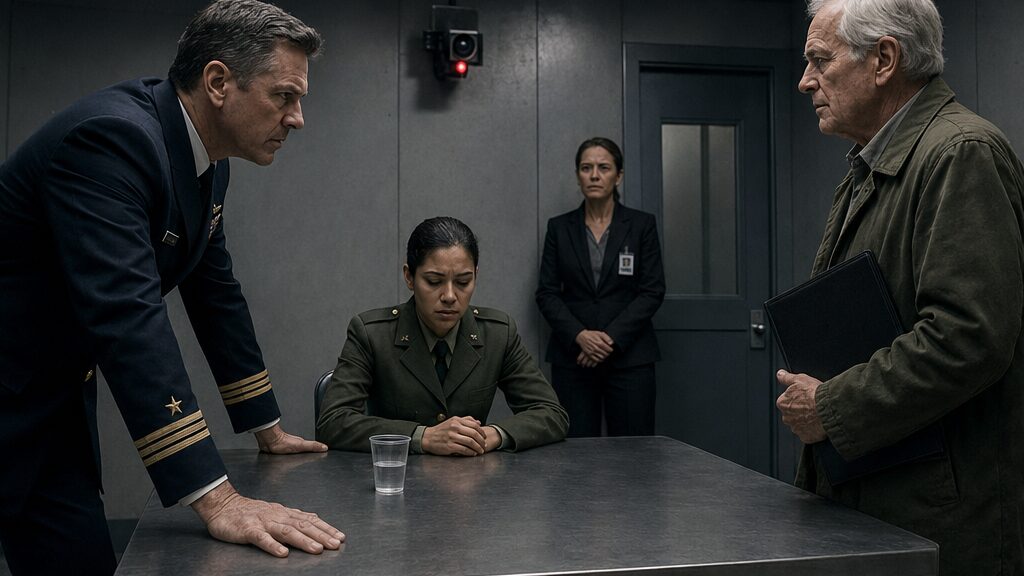
In the corner feed, the seated woman did not move. Across from her, a senior Navy officer in dark dress uniform leaned over the table. One hand was planted flat on the metal surface. The other pointed toward a document between them.
The clerk noticed Raymond watching. “That room is restricted.”
“I understand.”
“Then you understand I can’t just let someone in because they say they were invited.”
Raymond turned his eyes back to him. “I did not say I was invited.”
The clerk hesitated.
A door opened behind the desk, and Patricia Wilson stepped into the corridor with a tablet in one hand and irritation already arranged on her face. She was dressed in the neat civilian suit of base legal administration, with a badge clipped high enough to be read before she had to speak. She took in Raymond’s coat, the folded sheet, the folder beneath his arm, and the clerk’s uncertainty.
“What’s the delay?”
The clerk handed her the sheet. “Ma’am, he says his name should clear, but there’s no active role.”
Patricia read the paper quickly, then again more slowly.
“Mr. Clark,” she said.
Raymond nodded once.
“You were told to report to Legal Intake, not the secure wing.”
“I was told Specialist Lopez would be questioned at nine.”
Patricia’s mouth tightened at the title he used. “Specialist Lopez is in a preliminary interview.”
“That is why I am here.”
“You’re listed as an authorized observer only pending verification.”
“Yes.”
“That means you wait until verification is complete.”
Raymond looked past her to the monitor. The Navy officer had leaned closer. The young woman’s chin had lifted a fraction, enough for Raymond to see her face clearly for the first time. Virginia Lopez looked younger than the file had made her feel. Not inexperienced. Not weak. Just young in the way people were young when a roomful of older officials had already decided how the story should end.
Patricia followed his gaze and reached over to darken the monitor with a tap.
“That feed is not for public viewing.”
“I am not the public.”
“No,” she said, with professional politeness that carried a faint edge. “But right now, you are not cleared either.”
Raymond lowered his eyes to the authorization sheet in her hand. “The code will confirm through the restricted archive.”
“That archive requires a current sponsor.”
“Then call Records.”
“I did.”
“And?”
Patricia looked annoyed that he had asked so calmly. “And the records officer found a partial legacy match. Nothing sufficient to admit you into a live interview.”
The man’s voice rose again from behind the sealed door.
This time the words broke through.
“You don’t get to hide behind silence in my room.”
Raymond’s hand closed around the edge of the black folder.
Patricia heard it too. A quick flicker crossed her face—not concern, exactly, but awareness that Raymond had noticed something she would rather call routine.
“Commander Roberts is conducting the interview within authority,” she said.
“Thomas Roberts?”
That made her pause. “You know Commander Roberts?”
“I know his type.”
Her eyes sharpened. “Sir, you need to be careful.”
Raymond gave her a tired, almost gentle look. “I am being careful.”
The security clerk shifted behind the desk. One of the military police officers looked down the hall toward the interrogation room, then away again. Everyone in the corridor had heard the voice. Everyone pretended they had not heard enough.
Patricia glanced at the folder. “What is that?”
“A record.”
“Pertaining to this matter?”
“Yes.”
“Then you should have submitted it through proper channels before today.”
“I tried.”
Her expression did not change, but she stopped tapping the tablet. “When?”
“Seventeen months ago.”
The hallway seemed quieter after that. The printer stopped humming. Somewhere behind the wall, ventilation breathed cold air down through the ceiling vents.
Patricia looked at him more closely now, not with respect, but with the first inconvenience of doubt. “To whom?”
“Base Legal. Joint Review. Records Preservation. Twice to an office that no longer exists under the same name.”
“That doesn’t answer why you’re standing here with it now.”
Raymond turned his head slightly toward the sealed room. “Because she is in there.”
For a moment, Patricia had no answer. Then the professional shell returned.
“Mr. Clark, I don’t know what you believe you know about this investigation, but Specialist Lopez is being questioned about unauthorized contact with a protected civilian source and obstruction of a naval inquiry. If you have relevant evidence, we will receive it after your access is verified.”
Raymond’s face stayed composed, but something old moved behind his eyes. Not surprise. Not fear. Recognition.
“Unauthorized contact,” he repeated.
“Yes.”
“And obstruction.”
“Yes.”
“Because she refused to name the source.”
Patricia’s lips parted slightly. “That detail is not public.”
“No,” Raymond said. “It is not.”
Before she could respond, the interrogation room door shook with the dull sound of a hand striking metal. Not hard enough to be violence. Hard enough to be heard.
Raymond looked at the red light above the door.
Still on.
Patricia turned to the clerk. “Call inside. Tell Commander Roberts there is an access issue.”
Raymond stepped forward before the clerk could move. Not quickly. Raymond had not moved quickly in years unless there was fire, blood, or water rising under a door. But there was such certainty in the step that the military police officer straightened.
Patricia lifted a hand. “Sir.”
Raymond stopped.
He did not raise his voice. “Ms. Wilson, if that interview continues on the assumption I just heard, the record will be false before it is complete.”
“You are not authorized to make that judgment.”
“No.”
“Then wait here.”
Inside the room, Thomas Roberts’s voice cut through again.
“Your silence proves you knew exactly what you were doing.”
Raymond looked at Patricia.
The words had landed differently in him than the earlier shouting. Not as noise. As a line crossed. A young soldier’s silence turned into guilt by the man controlling the microphone.
Raymond extended his hand, palm up.
“My authorization sheet.”
Patricia did not give it back.
For the first time, Raymond’s voice carried a little weight. Not volume. Weight. “Check the lower line.”
Patricia looked down. Beneath the faded block of access codes, nearly hidden where the fold had worn the ink pale, was a short sequence printed in narrow type. She entered it into her tablet.
The tablet did not load immediately. It blinked, froze, then required her fingerprint. Her expression shifted from irritation to confusion.
The security clerk leaned slightly to see.
Patricia entered the print. A second prompt appeared. She swiped her badge. The screen changed again. Whatever she saw on it drained the argument from her face, though not yet replaced it with understanding.
The red light above the interrogation room door continued to burn.
Patricia returned the authorization sheet to Raymond without meeting his eyes.
“Two minutes,” she said.
Raymond took the paper and folded it carefully along the old crease. “One will do.”
She keyed the door.
Cold air rolled out of the room. The light above the door remained red. Recorded. Official. Clean.
Raymond stepped through with the black folder under his arm just as Thomas Roberts leaned over the metal table and told Virginia Lopez, “Your silence is the nearest thing to a confession you’re going to give me.”
Chapter 2: When The Red Light Went Dark
The interrogation room smelled of coffee gone cold, plastic cups, and metal scrubbed too often.
Raymond noticed those things before he looked fully at Thomas Roberts. Old habit. Rooms spoke before people did. The table had been moved six inches off center so the person being questioned sat closer to the wall camera. The empty chair beside Virginia Lopez had not been offered. The water cup near her hand was untouched. The recording camera in the upper corner showed a small red eye.
Thomas Roberts turned as Raymond entered.
He was not young, but he carried himself like a man still fighting younger men for space. His dark Navy uniform fit perfectly. His ribbons were aligned with a precision that invited notice. A gold ring flashed when he lifted one hand from the table.
Patricia stayed near the door. The military police officer remained outside.
Thomas looked Raymond up and down.
“This is a closed interview.”
Raymond closed the door behind him. “So I was told.”
Virginia Lopez turned her head. For half a second, her eyes met Raymond’s. She did not recognize him. That was expected. What Raymond saw in her face was something more painful than recognition would have been: she was measuring whether his arrival made things safer or worse.
Thomas followed the glance and frowned.
“Specialist Lopez, eyes forward.”
Virginia obeyed.
Raymond set his black folder on the empty chair but did not sit.
Thomas’s jaw worked once. “Mr. Clark, is it?”
“Yes.”
“I allowed an observer after Legal insisted there was a pending verification. That does not mean you participate. You sit. You listen. You do not interrupt.”
Raymond rested one hand lightly on the chair back. “Has Specialist Lopez been advised that the file category may limit her answers?”
Thomas stared at him.
Patricia shifted behind Raymond, a slight warning movement.
“This is not your interview,” Thomas said.
“No.”
“Then sit down.”
Raymond did not sit.
Thomas’s face tightened. “Specialist Lopez is under review for withholding the identity of a protected contact during an active inquiry. That is not complicated.”
“Most errors begin with that sentence.”
The room went still.
Thomas gave a short laugh with no humor in it. “I don’t know what kind of civilian review board you wandered in from, but this room has rules.”
Raymond looked at Virginia. “Has he asked you whether the contact is covered by a prior protection order?”
Virginia’s throat moved. She said nothing.
Thomas struck the table with two fingers, not loudly, but sharply enough to make the plastic cup tremble. “She doesn’t answer you.”
Raymond looked at the cup until it stopped shaking.
Thomas leaned in closer to Virginia again, using his body to reclaim the room. “You were ordered to disclose the name attached to the evacuation report. You refused. You were given a second lawful order. You refused again. Now you sit here pretending silence is discipline.”
Virginia’s hands tightened together in her lap.
Raymond watched her knuckles pale.
Thomas lowered his voice. “Who gave you the name?”
Virginia kept her gaze on the table.
“Who authorized the contact?”
Nothing.
“Who are you protecting?”
The red light on the camera watched them all.
Raymond opened his mouth, then closed it. Restraint had weight. People thought silence was emptiness because they had never had to hold something heavy inside it. He had held names in sealed envelopes. Coordinates that could not be spoken. Casualty estimates that made a room grow older. Orders that saved lives and ruined sleep.
Thomas turned slightly, eyes still on Virginia. “You see, Mr. Clark? This is what obstruction looks like.”
Virginia lifted her eyes. “Sir, I followed the classification guidance available to me.”
“Convenient.”
“I requested a closed legal channel.”
“You requested delay.”
“I requested verification.”
Thomas bent closer. “You requested a hiding place.”
Raymond’s hand moved to the black folder. He did not open it.
“Commander Roberts,” he said, “check the appendix attached to the original evacuation file.”
Thomas turned slowly. “You will not direct me.”
“Then direct yourself there.”
Patricia said quietly from the door, “Commander, there may be a legacy restriction in the record.”
Thomas did not look at her. “There is no current flag on the file.”
“There is a partial archive match,” she said.
“It’s partial because old systems are full of ghosts.” Thomas pointed at Virginia without taking his eyes from Raymond. “This specialist had a current order from a current officer in a current investigation. I won’t have some outdated advisory note used as a shield.”
Raymond looked at him for a long moment.
There it was. Not cruelty. Not even stupidity. Something harder to correct: certainty dressed as procedure.
Thomas stepped closer to Raymond. “You are here as a courtesy because someone in Legal got nervous. Do not mistake that for standing.”
Raymond’s face did not change.
“I have waited in worse rooms,” he said.
Thomas blinked, then smiled thinly. “I’m sure that line works on clerks.”
Virginia’s eyes flickered toward Raymond again.
Thomas saw it and turned back on her. “No. Don’t look at him. He can’t help you. If you had a lawful reason to refuse, you would have brought it already. If he had proof, he would have given it before walking in here with a folder like a stage prop.”
Raymond lowered his eyes to the black folder.
Seventeen months of returned requests. Three offices renamed. Two officials retired. One archive marker erased by system migration and no one willing to say erased out loud. He had told himself he was pursuing correction. Quietly. Properly. Without pulling rank from the grave of his career.
Then a young woman had found the same buried order and followed it better than the institution that had issued it.
Thomas placed both hands on the table and leaned until his shadow fell over Virginia’s face.
“Last time,” he said. “Name the source.”
Virginia breathed in.
Raymond saw the decision form in her before she spoke. The small set of the jaw. The acceptance of consequence. She was going to stay silent, and Thomas was going to turn that silence into guilt.
“No, sir,” Virginia said.
Thomas straightened. “Then we’re done.”
He reached toward the recorder control panel on the side wall, not to stop the recording but to mark the segment. Raymond moved first.
He did not hurry. He picked up the black folder, stepped to the end of the table, and placed it flat between Thomas and Virginia.
The sound was small. Cardboard against metal.
Thomas looked at the folder as if Raymond had put a hand on him.
“What do you think you’re doing?”
Raymond looked toward the wall camera.
The red light burned steadily.
Then Raymond turned his head toward the narrow observation glass behind which the recording technician sat unseen.
“Turn it off,” he said.
Patricia inhaled sharply. “Mr. Clark—”
The red light went dark.
No one moved.
The quiet after it was different from silence. It was the quiet of a machine that had stopped obeying the person everyone assumed it served.
Thomas stared at the camera, then at Patricia. “Who authorized that?”
Patricia looked as startled as he did.
Virginia sat perfectly still.
Thomas turned on Raymond, anger rising fast now because it had met something it could not name. “I asked you a question.”
Raymond kept one hand on the black folder.
“You asked Specialist Lopez many questions,” he said. “You ignored the one that mattered.”
Thomas took a step toward him. “You do not have the authority to interrupt an official recording.”
Raymond’s voice remained even. “Then turn it back on and say that.”
Thomas looked at the dead red light. Something uncertain crossed his face and vanished.
Patricia moved to the side wall and checked the panel. “The recording has been suspended from outside the room.”
“By whom?” Thomas snapped.
She checked the display. Her mouth tightened. “Restricted control.”
“That’s not an answer.”
“No,” Raymond said. “It is not.”
Thomas faced him fully now. For the first time since Raymond entered, he was no longer performing for Virginia. His anger had found a larger target, and beneath it was the first edge of doubt.
“Who are you?” he demanded.
Raymond opened the black folder just enough to remove a single page, face down. He did not slide it over.
“My name was checked at the door.”
“I didn’t ask your name.”
“I know.”
Thomas’s voice dropped. “Who authorized you?”
Raymond looked at Virginia, then back at Thomas.
“The same office that sealed the file.”
Chapter 3: The File Nobody Wanted Reopened
Virginia Lopez had been trained to keep her breathing quiet.
Not shallow. Quiet. Shallow breathing made hands tremble. Quiet breathing let the body obey when the room wanted it to panic.
She practiced it in the legal waiting room while Thomas Roberts argued behind the frosted glass wall and Patricia Wilson stood at the records terminal with her tablet clutched in both hands. Raymond Clark sat three chairs away with the black folder closed across his knees. He had not looked at the folder since leaving the interrogation room.
Without the red recording light, the facility felt less official and more dangerous.
The interview had stopped, but nothing had ended. Virginia understood the difference. Investigations did not collapse because one old man gave a calm order. They adjusted. They found another hallway, another form, another signature line. The machine did not apologize when interrupted.
Thomas’s voice cut through the glass.
“I want her statement marked as refusal. I want the disciplinary recommendation drafted before command decides this is a political problem.”
Patricia answered too low for Virginia to hear.
Raymond sat motionless.
Virginia looked at him from the corner of her eye. In the interrogation room, she had thought he might be a retired officer from some advisory board, or maybe an inspector sent because the file had become inconvenient. He did not look like a man who could stop a recording inside a secure room. He looked tired. His coat was old at the cuffs. His hands had age spots and one crooked finger that did not fully straighten. But when he had said “Turn it off,” the room had obeyed.
That should have frightened her more than it did.
Instead, it had made her feel, for one brief second, less alone.
A junior enlisted staff member passed with a stack of binders, glanced at Virginia, then looked quickly away. Word had already begun moving. She knew how it would sound by lunch: intelligence specialist refuses order, outside observer stops recording, commander furious, sealed file involved. By evening, she would become whatever version people needed to repeat.
Thomas came out first.
His face had cooled into discipline. That was worse than the anger. Anger made mistakes. Discipline wrote them down.
“Specialist Lopez,” he said, “you are not released from obligation. Your refusal remains on record.”
Virginia stood. “Yes, sir.”
Raymond did not move.
Thomas looked at him. “And you are not to speak with her privately.”
“I did not ask to.”
“You seem to do a great deal without asking.”
Raymond looked at Patricia. “Has Records located the appendix?”
Patricia’s fingers tightened on the tablet. “Records has located an index reference.”
“Appendix C,” Raymond said.
She glanced up. “The index does not display the appendix title.”
“No.”
Thomas’s eyes narrowed. “And yet you know it.”
Raymond said nothing.
Thomas gave a short nod, as if Raymond’s silence proved something useful. “This is exactly the problem. Half references. Dead offices. People invoking restrictions no one can verify. Specialist Lopez used the same fog to defy a direct order.”
Virginia felt heat rise in her face but kept her voice steady. “Sir, I requested a closed legal channel because the contact category was marked protected by origin authority.”
“You saw an old mark and built yourself a shield.”
“I saw a surviving designation.”
“You saw what you wanted.”
Raymond’s hand shifted on the folder.
Virginia noticed the movement. Thomas did not.
Patricia stepped between them, not physically, but with tone. “Commander Roberts, the archive match is real. The problem is access.”
“That problem has a solution,” Thomas said. “We proceed on the current file.”
“The current file may be incomplete.”
“Every old file is incomplete.”
Virginia’s jaw tightened.
Raymond finally spoke. “Not every old file was made incomplete.”
The waiting room changed around the sentence.
Patricia looked at him sharply. Thomas looked annoyed, then cautious.
“What is that supposed to mean?” Thomas asked.
Raymond did not answer him directly. “The original evacuation report contained a civilian liaison list, field contact restrictions, and a post-operation protection order. If Specialist Lopez accessed the current file and found only the liaison reference without the attached restriction, she did what she was supposed to do. She stopped.”
Virginia stared at him.
No one outside her unit had described it that cleanly. Not her supervisor. Not Legal Intake. Not Thomas, who had treated the missing pages as proof that she invented them. She had found the gap three weeks ago while reviewing a reopened evacuation incident tied to a naval contractor inquiry. The source name had appeared in an old chain, then vanished behind a classification marker that no current system could resolve. She had refused to speak the name in an open interview until someone verified the restriction.
That refusal had become the charge.
Patricia’s tablet chimed. She read it and looked older for an instant.
“Records found the old operation shell,” she said. “Evacuation file, joint classification, archived under humanitarian extraction support. Several attachments missing from the current system.”
Thomas took the tablet from her without asking. His eyes moved across the screen.
“Missing does not mean favorable to Specialist Lopez.”
“No,” Raymond said. “It means incomplete.”
Thomas looked up. “And your folder completes it?”
Raymond’s hand rested on the black cover. “My folder explains why it was sealed.”
“Then open it.”
“No.”
Thomas gave a humorless smile. “Of course.”
Virginia expected Raymond to defend himself. He did not. He simply sat with the folder across his knees, as if the refusal cost him more than opening it would cost Thomas.
Patricia recovered the tablet from Thomas. “The records officer says full retrieval requires base commander authorization or legacy origin verification.”
“Then request it,” Raymond said.
“I already did.”
Thomas turned on her. “You had no authority to escalate this beyond my inquiry.”
“I had a suspended recording, a sealed file marker, and an observer with restricted control recognition,” Patricia said. “That is enough authority to ask a question.”
Thomas’s nostrils flared, but he held back. Virginia saw the calculation. He was not a fool. That almost made him more frightening. He could feel the floor shifting and was already looking for where to place his weight.
He turned to Virginia. “Until this is resolved, your clearance remains suspended.”
Virginia kept her posture straight. “Understood.”
“Your access to secure systems remains revoked.”
“Yes, sir.”
“You will not contact anyone connected to the file.”
“No, sir.”
His eyes lingered on her face. “And if this old paper chase collapses, Specialist, your refusal will look less principled than it does right now.”
Virginia did not answer.
Raymond stood.
It took him a second. Not long. But long enough for Thomas’s eyes to drop to his knees, then back to his face with a small look of contempt that vanished almost as soon as it appeared.
Raymond saw it. Virginia knew he saw it.
He only picked up the folder.
“Ms. Wilson,” he said, “where is Records holding the shell file?”
“Secure archive room three.”
“Then we should go there.”
Thomas stepped in front of him. “We?”
Raymond stopped.
Patricia looked from one man to the other. “Commander Roberts, if the file may affect the charge—”
“I know what it may affect.”
Raymond’s voice was quiet. “Do you?”
Thomas stared at him.
For a moment, Virginia thought Raymond might finally say something that would explain him. Something about his office. His rank. His right to stand in that corridor with everyone suddenly uncertain around him.
Instead, he looked at her.
“Specialist Lopez,” he said, “when you saw the missing attachment marker, did you tell anyone the source name?”
“No, sir.”
“Did you write it on an unsecured form?”
“No, sir.”
“Did you repeat it in the interview?”
“No, sir.”
“Why?”
Virginia felt Thomas watching, waiting to punish the answer if it gave him room.
She chose each word carefully.
“Because if the marker was valid, saying the name could expose a living protected person. If the marker was invalid, verification would clear me. Either way, speaking first would have been the only action I could not take back.”
Raymond’s expression changed then. Barely. A softening around the eyes, not relief exactly. Recognition.
Thomas scoffed. “That sounds rehearsed.”
Raymond turned to him. “It sounds trained.”
The words struck harder because he did not raise them.
Patricia’s tablet chimed again. This time she did not speak immediately. She read, scrolled, stopped, and read the same line again.
Thomas’s impatience broke. “What now?”
She looked at Raymond. “The archive index has a signatory field.”
The waiting room seemed to pull inward.
Raymond’s fingers tightened once around the folder.
Patricia swallowed. “Most of it is redacted.”
Thomas stepped closer. “Name.”
Patricia did not answer him. Her eyes remained on the screen.
Virginia could hear the ventilation overhead. The sound was thin and cold.
Finally Patricia said, “First name visible. Raymond.”
Thomas turned slowly toward the old man.
Raymond looked at the dark glass wall where the interrogation room waited beyond it, unrecorded now, the red light asleep.
Patricia’s voice lowered.
“The rest of the entry is locked.”
Chapter 4: A Name Half Hidden In The Archive
The secure archive room accepted Raymond Clark’s temporary code on the second try.
On the first try, the keypad blinked yellow and gave a low denial tone that seemed to satisfy Thomas Roberts more than it should have. On the second, after Patricia Wilson entered the legacy line from Raymond’s authorization sheet and pressed her thumb against the scanner, the lock clicked open with the reluctant sound of a door remembering an old debt.
Cold air breathed out of the room.
Raymond stepped inside before anyone else. The archive smelled of dust trapped beneath refrigerant, paper sealed too long, and electrical insulation warmed by machines that never slept. Rows of gray cabinets stood behind mesh doors. A terminal glowed on a steel desk bolted to the floor. There were no windows. Only one small ceiling camera watched from the corner, its red light unlit.
Thomas noticed it too.
“No recording in here?” he asked.
Patricia moved to the terminal. “Archive rooms log access, not conversation.”
Thomas looked at Raymond. “Convenient.”
Raymond set the black folder on the steel desk. “Not for everyone.”
Virginia had been left in the legal waiting room under instruction not to speak to anyone. Raymond had seen the way she accepted it. Not with relief. With discipline. That discipline bothered him because he knew exactly where it came from. Somewhere in a training room, a young soldier had been taught that silence could protect lives. Somewhere after that, a different officer had mistaken that silence for guilt.
Patricia entered the file shell number. The terminal hesitated, then produced a list of gray fields and black bars. Operation name redacted. Theater redacted. Liaison chain redacted. Attachments missing. Appendix C restricted.
Thomas stood over her shoulder. “There. Missing. Not hidden. Missing.”
Patricia did not answer. She scrolled.
Raymond watched the screen from a few feet back, close enough to read, far enough not to crowd her. His knees ached from the hallway wait and the cold made his right hand stiffen, but he kept both hands loose at his sides. He had learned long ago that men who needed others to see their authority often pointed, leaned, struck tables, filled silence. Men who had signed orders people died under learned to hold still.
Patricia stopped scrolling.
“What?” Thomas asked.
“The appendix has an origin-control note,” she said.
“Read it.”
“I can’t open it.”
“Read what you can.”
Patricia glanced once at Raymond before she spoke.
“Civilian source protection remains active pending death confirmation or origin authority release. Unauthorized disclosure prohibited under continuing order.”
Thomas’s face hardened, but not with victory. “Date?”
Patricia read the line.
The room seemed to shrink around Raymond.
He remembered that date without needing the screen. He remembered rain beating against a hangar roof. The smell of wet canvas and diesel. A map curling at one corner because the tent kept flooding. A young interpreter with blood on his sleeve asking whether his family would be moved before dawn. A list of names Raymond had ordered split into three copies because one convoy had already vanished on the road.
He had signed too many papers that night. Some with certainty. Some with prayer disguised as command.
Thomas turned to him. “That’s an old order.”
“Yes.”
“Old orders expire.”
“Some do.”
“This one doesn’t show active in the current system.”
“No.”
“Then the current officer had no reason to treat it as binding.”
Raymond looked at him. “Specialist Lopez saw enough to stop.”
“She saw enough to stall.”
Raymond’s hand moved to the black folder, then rested beside it. “There is a difference between delay and caution.”
Thomas laughed once. “That is easy to say when you’re not responsible for a current investigation.”
Raymond looked at the screen, at the line that had survived when so much else had been buried under new systems and cleaner labels.
“I was responsible for the old one.”
Thomas went quiet.
Patricia’s hands stilled over the keyboard.
Raymond had not meant to say it that plainly. The sentence had not given his rank. It had not explained enough to satisfy anyone. But it had moved the air.
Thomas recovered first. “Responsible how?”
Raymond did not answer.
Thomas stepped closer. “Responsible how, Mr. Clark?”
Patricia said, “Commander—”
“No. If he’s going to sit on a file and stop an interview, I want the scope of his supposed responsibility.”
Raymond opened the black folder.
The sound of the cover lifting was small and dry. Inside were copies, not originals. Some were old enough to carry the faint blur of repeated scanning. Some had classification marks blacked out so heavily the pages looked bruised. Raymond removed one sheet and laid it on the desk, face up.
Patricia leaned in.
Thomas did too.
The document showed the bottom half of an order. Most of the header was obscured. The body contained enough fragments to make the shape clear: civilian liaison chain, extraction support, source continuity, non-disclosure beyond origin authority. At the bottom, a signature line had been copied poorly. The first name was legible.
Raymond.
The rest had been redacted by a thick black bar.
Thomas stared at it. “That proves nothing.”
“No,” Raymond said.
“Anyone can carry a copied page.”
“Yes.”
Patricia looked at Raymond. “Why is your first name visible?”
“Because the redaction was done quickly.”
“When?”
“After the hearing that never happened.”
Thomas seized on that. “What hearing?”
Raymond closed the folder halfway, then opened it again. The movement betrayed him more than his face did. His fingers did not tremble, but they paused.
The room waited.
He saw Virginia’s empty chair in his mind. Saw the plastic cup trembling when Thomas struck the table. Saw the red light going dark.
“After the evacuation,” Raymond said, “there was supposed to be a review. Not a public one. Not even a full internal one. A narrow review. Who was protected, who was exposed, which promises could still be kept.”
Patricia’s voice softened against her own professional instinct. “And?”
“It was postponed.”
Thomas snorted. “Reviews get postponed.”
“This one buried a living person.”
The words fell hard enough that no one touched them.
Patricia looked back at the terminal. “The protected source.”
Raymond said nothing.
Thomas moved around the desk until he faced Raymond directly. “You are asking me to accept that a current specialist disobeyed a direct order because of an unresolved protection matter from an old operation you may or may not have touched.”
Raymond met his eyes. “No. I am asking you to verify before you destroy her.”
“That’s dramatic.”
“It is procedural.”
Thomas’s jaw tightened.
Patricia typed again. The terminal asked for authorization beyond her access. She tried a secondary code. Denied. She tried a records officer override. Denied. A red line appeared across the screen: BASE COMMAND AUTHORITY REQUIRED FOR ORIGIN RELEASE.
Thomas saw it and straightened, as if the machine had returned the room to him. “There. We stop here until command reviews.”
“We should have stopped before the interview,” Raymond said.
Thomas turned on him. “You keep saying should. You know what that sounds like to those of us still wearing the uniform? It sounds like an old man judging a room he no longer has to answer for.”
Raymond absorbed it.
There were insults that missed because they were false. There were others that landed because they found an old bruise. He no longer wore the uniform. He no longer woke to a secure phone on the nightstand. He no longer had to stand before families, committees, presidents, or frightened twenty-year-olds and say the plan was the best bad choice available.
But he still answered for it. Quietly. Daily. In rooms where no one asked.
“You are right about one thing,” Raymond said.
Thomas blinked, caught off guard.
Raymond looked down at the redacted signature. “I no longer wear the uniform.”
Thomas let the silence stretch, believing he had won something.
Raymond looked up. “That is not the same as no longer answering.”
Patricia’s tablet chimed from the desk. She read the incoming notice, then looked between them.
“Command office responded,” she said.
Thomas reached for the tablet. Patricia did not hand it to him.
“They want the file held for base commander release,” she continued. “Commander James Perez is being notified directly.”
Raymond closed his eyes for one brief second.
James Perez.
A name from another room, another decade. A younger officer then, standing in floodwater outside an aircraft hangar, refusing to leave a communications board until the last convoy checked in. Raymond had signed a commendation for him later. Then the years had folded. Promotions, transfers, retirements, silence. The institution kept records better than it kept promises, and sometimes not even records.
Thomas noticed the change in Raymond’s face.
“You know Commander Perez?”
Raymond opened his eyes. “He served.”
“That wasn’t the question.”
“No.”
Patricia’s voice became careful. “The base commander is in transit to the hearing room. Until he arrives, the file stays locked.”
Thomas nodded once, already rebuilding himself around the next phase. “Fine. Then we do this properly. Formal hearing. On record. Specialist Lopez remains under restriction.”
Raymond touched the black folder, not possessively, but as if feeling the weight of what still lay inside.
Patricia looked at him. “Mr. Clark, if Commander Perez unlocks the final record, will it confirm what you’re implying?”
Raymond did not answer immediately.
The unlit camera in the archive corner watched nothing. That, somehow, was worse than the red light. There was no official eye here, no clean record to hold the sentence. Only three people in a cold room and a truth that had learned to survive by staying folded.
“At the time,” Raymond said, “I believed sealing it protected more than it harmed.”
Thomas’s expression sharpened. “That sounds like an admission.”
Raymond looked at the half-hidden name on the page.
“It is,” he said quietly. “Just not the one you want.”
Chapter 5: The Commander Recognized The Quiet Observer
Thomas Roberts had always trusted rooms with rules.
A hearing room, properly arranged, could calm almost anything. Tables placed in order. Chairs assigned by function. Recording equipment visible. Names entered. Statements taken one at a time. Procedure did what emotion could not; it gave uncertainty a place to stand.
By late afternoon, he had restored the room to order.
Virginia Lopez sat at the side table with her hands folded and her clearance badge removed from her uniform pocket. Patricia Wilson sat near the records terminal, visibly uneasy but contained. Two hearing panel members waited at the far end, speaking in low voices. A recording technician tested the wall camera, and the red light blinked once, then steadied.
Thomas watched the light with satisfaction.
On record again.
He had not liked the way the interrogation room had gone silent after Raymond Clark’s command. He had not liked the way Patricia had started looking at the old man as if a wrinkle in the system might turn into a crater. He had not liked the archive page with the half-visible name.
But a half-visible name was not proof. A retired man with a folder was not authority. And Thomas, whatever else they could say about him, knew how to keep a record clean.
“Begin formal continuation,” he told the technician.
The technician nodded. “Recording active.”
The red light glowed.
Thomas stood at the head of the table. “This hearing concerns Specialist Virginia Lopez and her refusal to comply with a lawful disclosure order during an active inquiry. Additional archive review has been requested due to legacy file irregularities. Until those irregularities are verified, the current charge remains in effect.”
Virginia did not react.
That bothered him more than he wanted to admit. Most people under pressure gave something away: anger, fear, pleading, resentment. Virginia Lopez gave discipline. It made her look either innocent or very well trained, and Thomas disliked situations in which the same quality could support opposite conclusions.
Raymond Clark sat in the last chair along the wall.
Thomas had put him there deliberately. Not at the table. Not beside Virginia. Not within reach of the terminal. An observer’s place. An old man’s place. If Raymond noticed the insult, he gave no sign. The black folder rested across his knees like a quiet animal.
Thomas turned toward him.
“Mr. Clark, you will not speak unless addressed.”
Raymond nodded once.
Something about the nod irritated Thomas. It did not ask permission. It simply acknowledged that words had been spoken.
Patricia looked down at the tablet in front of her.
Thomas resumed. “Specialist Lopez, before command arrives, I will give you one more opportunity to clarify whether you had direct knowledge that the source designation remained active.”
Virginia lifted her eyes. “Sir, I had direct knowledge of a surviving restriction marker. I did not have authority to determine whether it remained active.”
“So you made that determination yourself.”
“No, sir. I refused to make it myself.”
Thomas paused.
It was a neat answer. Too neat. He glanced at Raymond, expecting to catch some sign that the old man had fed it to her. Raymond was looking at the red light.
“Did Mr. Clark instruct you in any way before this hearing?”
“No, sir.”
“Had you met him before today?”
“No, sir.”
“Then why did he know details from your file?”
“I don’t know, sir.”
Thomas let the silence stretch. “That does not concern you?”
Virginia’s mouth tightened slightly. “It concerns me less than being ordered to expose a protected person without verification.”
Patricia closed her eyes for half a second.
Thomas turned away before his irritation showed too clearly. He could feel the hearing panel watching. He could feel the recording light holding every exchange. He had intended the formal room to steady the matter, but it had made each answer sharper.
The door opened.
The room stood before anyone ordered it.
Commander James Perez entered with no entourage, only a records officer behind him carrying a sealed archive case. James wore the controlled expression of a base commander pulled into an unpleasant matter too late in the day. He was broad-shouldered, dark-haired with gray at the sides, and his uniform had the clean economy of a man who did not decorate himself beyond requirement.
Thomas felt immediate relief.
Command authority. Current authority. The room would now move through proper channels.
“Commander Perez,” Thomas said. “Thank you for coming. We have a legacy file obstruction issue tied to Specialist Lopez’s refusal.”
James nodded, but his eyes were already moving across the room. He looked at Virginia first, then Patricia, then the recording technician, then the hearing panel.
Then he saw Raymond.
The change was so sudden that Thomas almost missed it.
James stopped mid-step.
The records officer nearly walked into him.
Raymond remained seated against the wall, the black folder still across his knees. He did not stand. He did not smile. He looked at James with the quiet sadness of a man seeing a younger soldier grown into command and wishing the reunion had happened anywhere else.
James’s face lost all administrative distance.
For one unguarded second, he looked twenty years younger.
Then he straightened.
“General Clark,” he said.
The room went silent.
Thomas felt the words pass him before their meaning struck. General. Not Mister. Not observer. Not retired advisor. General Clark.
Raymond lowered his eyes briefly, as though the title had weight he had not asked to carry into the room.
“Commander Perez,” he said.
James did not move for another moment. Then he walked to Raymond and stood before him with a formality that made every other posture in the room look careless.
“I didn’t know you were on base, sir.”
Raymond’s voice stayed low. “That was intentional.”
Thomas became aware of his own hands at his sides. He had the absurd impulse to adjust his cuffs, then stopped himself.
Patricia looked pale.
Virginia’s eyes moved from James to Raymond and back again. She did not look relieved. Not yet. She looked as if the room had opened beneath a floor she had been ordered to stand on.
Thomas forced himself to speak.
“Commander Perez, for the record, Mr. Clark’s current status had not been verified.”
James turned.
The look he gave Thomas was not anger. Anger would have been easier to meet. This was assessment.
“Then verify it now,” James said.
Thomas held his ground. “That is why we requested you.”
James looked to the records officer. “Open the archive case.”
The officer placed the sealed case on the table and unlocked it with a keycard and code. Inside was a thin stack of printed records enclosed in clear sleeves, along with a digital storage module in a foam cutout.
James did not touch the documents immediately.
He looked at Raymond. “Sir, do you consent to origin release for limited hearing review?”
The question landed heavily.
Not because of its words, but because James had asked Raymond.
Thomas heard a small shift among the hearing panel members. Patricia looked at the table. Virginia sat very still.
Raymond’s hand moved over the black folder.
“I consent to what is necessary to determine Specialist Lopez’s compliance,” he said.
James waited.
Raymond added, “Nothing beyond that.”
“Yes, sir.”
Thomas could not stop himself. “With respect, Commander, why is a retired officer granting origin release on an active inquiry?”
James turned to him fully.
“Because this file originated under his command authority.”
Thomas felt heat rise along the back of his neck. “His command authority as what?”
James held his gaze.
“General Raymond Clark served as joint crisis commander for the original evacuation operation. The protection order in question was issued under his signature.”
The red light on the camera kept burning.
Thomas heard it now, though it made no sound. He had insisted on the record. The record was taking him in.
He looked at Raymond. The old coat. The crooked finger. The tired eyes. The black folder. The chair against the wall where Thomas had placed him like an inconvenience.
General Raymond Clark.
Thomas tried to recover the room. “That still does not automatically clear Specialist Lopez.”
Raymond looked at him then.
For the first time all day, Thomas felt that Raymond was seeing him entirely. Not the uniform, not the rank, not the performance of control. The man beneath it, reaching for procedure because humility frightened him when it wore no insignia.
“No,” Raymond said. “It does not.”
James removed the first document sleeve from the archive case. “That is why we are opening the record.”
Patricia activated the terminal link. The technician adjusted the camera. The red light remained steady.
James stood at the table with one hand on the sealed file.
“For the record,” he said, “this hearing will now review origin-controlled material under limited command release.”
Thomas sat down slowly.
Raymond remained against the wall.
No one told him to move. No one needed to. The room had already rearranged itself around him.
James looked once more at the old man before breaking the seal.
“General Clark,” he said, “the file is open.”
Chapter 6: The Order That Protected Her Silence
Raymond Clark had imagined the file opening many times.
In those imaginings, it had always happened in a quiet room, maybe with one records officer and a legal witness, maybe after enough requests had finally reached someone willing to read beyond the first page. He had imagined signing a limited release, correcting the archive, closing the gap that should never have widened.
He had not imagined Virginia Lopez sitting across the table with her clearance stripped from her pocket.
He had not imagined Thomas Roberts watching him with the careful stillness of a man who had built a case on the wrong silence.
He had not imagined the red recording light glowing above them.
The light was necessary now. That was what made it difficult to look at.
James Perez removed the first document from its sleeve and placed it beneath the camera’s view. Patricia linked the file to the terminal. A scanned header appeared on the wall display, most of it still marked by black redactions. The operation name remained hidden. The location remained hidden. But the order category was visible.
Civilian Source Continuity Protection.
Raymond felt the old words enter the room like cold water.
James read only what the limited release allowed. His voice was even, but Raymond heard strain beneath it.
“Origin authority directs that any civilian liaison identity attached to extraction support chain remains protected until positive death confirmation or written release by origin authority. Disclosure beyond restricted legal channel prohibited.”
Virginia closed her eyes.
Not long. Just long enough for her face to change when she opened them again. She had not been imagining it. She had not been hiding behind a ghost marker. The order had existed. It still existed.
Thomas leaned forward. “Date of order?”
James read it.
“Origin signatory?”
James looked at Raymond.
Raymond stood.
The chair made a soft scrape behind him. Every eye followed him, but he kept his gaze on the folder in his hands. He had carried it into too many offices. He had placed it on desks where people promised a call back. He had held it on nights when sleep brought him the names he had not been able to move fast enough.
Now he walked to the table and set the black folder under the recording camera.
The red light held steady.
Raymond opened the folder and removed his copy of the signed order. He placed it beside the archive version. The signatures matched where the archive allowed them to match: the visible first name, the angle of the pen stroke, the beginning of a surname hidden under black ink.
James spoke for the record. “Origin signatory is General Raymond Clark, then joint crisis commander.”
The title sat in the room like a chair no one wanted to touch.
Raymond did not look at Thomas. He looked at Virginia.
“Specialist Lopez,” he said, “when you found the marker, you were right to stop.”
Her throat moved. “Yes, sir.”
“No.” His voice softened, but did not weaken. “You were right before you knew who signed it.”
She looked down then, and the relief that crossed her face was not triumphant. It was almost grief. The kind that came when the body finally understood how close it had been to breaking.
Thomas shifted. “The current file did not display the full order.”
Raymond turned to him.
“No,” he said. “It did not.”
“Then the investigating officer had an incomplete file.”
“Yes.”
Thomas seized on the answer. “So my order was based on the available record.”
Raymond held his gaze. “Your first order, perhaps.”
Thomas’s mouth closed.
Raymond placed one hand on the edge of the table. Not to dominate it. To steady himself.
“After Specialist Lopez requested verification, you had a choice. You could pause the interview, seek the missing attachment, and protect the name until the file was complete. Instead, you treated her caution as defiance.”
Thomas’s face tightened. “She refused a direct order.”
“She refused to do the one thing that could not be undone.”
The room stayed quiet.
Raymond looked back at the documents. The paper had aged, but the night inside it had not. He could still see the hangar. The crowded floor. Civilians sitting on packs and crates. A little girl asleep under a poncho. A radio operator repeating a call sign that never answered. James Perez, young and soaked to the waist, shouting convoy times over generator noise. A civilian liaison standing beside Raymond with a list folded inside his shirt because if the wrong militia found it, every family on it would disappear.
Raymond had ordered names sealed before the last aircraft lifted.
He had also ordered the convoy split.
That was the part the file did not say plainly. Not in the visible portions. Maybe not anywhere anymore. One road had washed out. One convoy had taken the alternate route. It survived because a local source warned them. Another group waited six hours in the rain because Raymond chose the hospital evacuees first. Most lived. Not all. No order saved everyone. That was the lie young commanders believed until command cured them of it.
Patricia’s voice interrupted softly. “General Clark, the appendix includes a post-operation review note.”
Raymond looked at the screen.
James did too. His face changed before he read.
Patricia swallowed. “Review postponed pending operational sensitivity. Protection order to remain in force until review completed.”
Thomas looked at the line. “Was the review ever completed?”
No one answered.
Raymond did.
“No.”
Virginia’s eyes lifted.
Raymond felt the old shame enter the room and take its place beside the official record.
“I requested it twice before retirement,” he said. “Once after. Then the office changed names. The file moved systems. The people who knew why it mattered left their posts or died. I told myself the order remaining sealed was enough.”
The red light recorded him.
He had avoided saying this for years because once it was spoken, it would become less private and no less true.
“It was not enough,” he said.
James lowered his eyes.
Thomas sat back slowly, his certainty thinning into something more human and less useful to him.
Raymond looked at Virginia. “You found the hole we left.”
Virginia shook her head once, small and controlled. “Sir, I only followed the marker.”
“That is sometimes the difference between harm and duty.”
She did not answer.
James turned to the hearing panel. “Based on the origin-controlled order and continuing protection language, Specialist Lopez’s refusal to disclose the civilian source identity in an open inquiry was lawful pending verification.”
One of the panel members nodded. The other made notes.
Thomas spoke, quieter now. “What about unauthorized contact?”
Patricia checked the file. “The contact was not initiated by Specialist Lopez. The source identifier appeared in a contractor-linked report chain. She flagged the discrepancy.”
James looked at Virginia. “Is that accurate?”
“Yes, sir.”
Thomas rubbed one thumb against the edge of his notes. “Then why didn’t she say that clearly in the interview?”
Virginia looked at him with a steadiness that made Raymond’s chest ache.
“I tried, sir. You asked for the name.”
Thomas looked down.
The room did not punish him. That was almost worse. There was only the record, the red light, and the silence that followed a man discovering he had made his own authority smaller.
James gave the formal direction. “Specialist Lopez’s clearance suspension is held pending administrative restoration, not disciplinary action. The disclosure refusal is removed as a misconduct basis. The file irregularity will be referred for correction under base command.”
Patricia entered the notes. Her fingers moved carefully.
Raymond reached for the black folder, then stopped.
There was one more page inside. He had not planned to use it. A short memorandum written in his own hand after the postponed review, never entered properly because he had sent it to an office already dissolving into another acronym. It said, in plain language, that no subordinate should be penalized for refusing to disclose a source name tied to the protection order until origin authority clarified status.
He removed it and placed it beside the archive order.
Patricia read the first lines and looked up. “This wasn’t in the official file.”
“No.”
Thomas said, “Then it has no standing.”
Raymond looked at him. “Correct.”
Thomas seemed surprised.
Raymond continued, “It is not proof. It is responsibility.”
The room waited.
“I knew the order could be misunderstood if the review stayed incomplete. I wrote that memorandum because I knew the risk. I failed to make sure it reached the people who would need it.”
Virginia stared at him. “Sir—”
Raymond lifted a hand gently, stopping her before she could defend him.
He had not come to be defended by the young woman nearly broken by the gap he left behind.
James’s voice was low. “General, that failure belongs to more than you.”
“Yes,” Raymond said. “But not less.”
The red light shone on the folder, the old order, the unofficial memorandum, and Raymond’s hand resting near them.
He turned to the hearing panel.
“Enter this memorandum as contextual material only. Do not use it to clear Specialist Lopez. The order clears her. The missing archive clears her. Her own restraint clears her.”
Virginia looked away.
Thomas looked at the table.
Raymond closed the folder, but did not remove it from beneath the camera.
For the first time all day, he felt the burden shift. Not lift. Burdens like this did not lift. They changed shape when shared with the truth.
James gave the final procedural instruction. “The official finding will reflect that Specialist Lopez acted within lawful caution under incomplete records. Base Legal will begin restoration of access. Commander Roberts, your recommendation will be withdrawn.”
Thomas’s face worked once, then settled.
“Yes, Commander.”
The hearing panel began gathering papers. Patricia saved the record and backed it up twice. The technician watched the red light, waiting for the order to end the recording.
Thomas stood.
He faced Raymond with the stiff posture of a man trying to perform humility while still learning what it was.
“General Clark,” he began, “I owe you an apology.”
Raymond turned his head toward him.
“No,” he said.
Thomas stopped.
The red light kept recording.
Chapter 7: Not Because I Was A General
Thomas Roberts stood with his apology caught halfway between rank and shame.
Raymond let the word no remain in the room long enough for Thomas to understand that it was not anger. Anger would have given him somewhere to put his hands, something to answer. Raymond offered him nothing that easy.
The recording technician looked uncertainly toward James Perez. The red light still burned above the hearing room camera, holding the room in its official stare.
James did not intervene.
Thomas lowered his chin. “Sir, I meant—”
“I know what you meant,” Raymond said.
His voice was not sharp. That made Thomas look more unsettled.
Raymond gathered the pages slowly. The archive order returned to its sleeve. The unofficial memorandum went back into the black folder. Patricia Wilson watched each movement as if handling paper had become a kind of testimony. Virginia Lopez remained seated, her hands still folded, but the tension had left her fingers. She looked exhausted now. Younger than she had looked under accusation.
Thomas tried again. “General Clark, I spoke out of turn. I misjudged your role in this matter.”
Raymond closed the folder.
“My role is not the first thing you misjudged.”
Thomas’s face tightened, then changed as the sentence found its mark.
The hearing panel members looked down at their notes. Patricia stopped typing. James stood near the head of the table, silent, his eyes on Raymond.
Raymond turned to the technician. “End the recording.”
The technician looked to James.
James nodded.
The red light went dark.
This time, the darkness did not frighten the room. It settled over them like the end of a long procedure. No mystery. No hidden pressure. No one trying to force a confession into the shape of truth.
Raymond lifted the black folder beneath one arm. “Now apologize if you still intend to.”
Thomas swallowed.
For the first time that day, he did not stand like a man bracing against inspection. His shoulders lowered a fraction. His eyes moved once toward Virginia, then away, as if he had found that looking at her required more courage than looking at Raymond.
He faced her fully.
“Specialist Lopez,” he said. The words came stiffly, but not carelessly. “I treated your caution as dishonesty. I should have verified the file before pressing for disclosure. I was wrong.”
Virginia did not answer immediately.
Raymond watched her decide what she owed him. Not what the room wanted. Not what rank expected. What she owed.
“Thank you, sir,” she said at last.
Thomas nodded once, then turned back to Raymond. “And sir, I apologize for the way I addressed you.”
Raymond looked at him for a long moment.
“Do not apologize because I was a general,” he said. “Apologize because you thought I was not worth listening to when you believed I was no one.”
Thomas looked as if he had been struck more cleanly by that than by any reprimand James could have given.
Raymond continued, quieter. “That is the part you need to correct.”
No one spoke.
Outside the hearing room, evening had pressed against the secure windows, turning the glass dark enough to reflect the people inside. Raymond saw himself in that reflection: old green coat, white hair, tired shoulders, black folder held against his side. He looked like an old man who had waited too long in government hallways.
That was true enough.
James moved first. “Commander Roberts, you will submit a corrected record before end of day. Specialist Lopez’s clearance restoration begins tonight. Her system access will be reinstated under supervision until the administrative hold is removed.”
Thomas nodded. “Yes, Commander.”
“Ms. Wilson,” James said, “I want a review of every active file connected to that archive shell. If there are missing attachment markers, they come to command before another interview is scheduled.”
Patricia’s voice was subdued. “Yes, Commander.”
Raymond looked at her. “And the intake process.”
She met his eyes, uncertain.
“If someone brings an old authorization,” Raymond said, “do not make the hallway decide whether the truth is current enough to enter.”
Color rose faintly in her face. “Understood.”
He did not say more. He had not come to embarrass her. Systems trained people to trust clean forms and distrust wrinkled hands carrying old paper. She had done what the system rewarded until it nearly failed a soldier standing inside it.
Virginia stood when James dismissed the hearing. She picked up her clearance badge from the table but did not clip it back onto her pocket. She held it in her palm, thumb brushing the blank plastic edge as if she had not yet decided whether to trust its return.
Raymond moved toward the door.
“General Clark,” James said.
Raymond stopped but did not turn fully.
James’s formal expression had softened. “Sir, I should have known this file was still broken.”
Raymond looked back at him. “You command enough rooms to know that every file is broken somewhere.”
“That doesn’t excuse it.”
“No.”
James looked at the black folder. “Will you leave copies with Records?”
Raymond’s hand tightened slightly on the spine. Then he nodded. “Copies.”
“Thank you, sir.”
Raymond almost corrected the title. He had spent years letting people drop it, then years avoiding places where it might be picked up again. But James had earned the word differently. Not as worship. As memory.
So Raymond only nodded.
The hallway outside was quieter than it had been that morning. The same military police officer stood by the door, but his posture had changed. Not dramatic. Not ceremonial. He simply stepped aside before Raymond had to ask.
The security clerk at the checkpoint looked up from the desk and froze when he saw James walking a few steps behind Raymond.
Raymond returned his temporary authorization sheet.
The clerk accepted it with both hands. “Sir, I’m sorry about earlier.”
Raymond looked at him. The young man’s face held embarrassment, but not contempt. Fear of procedure, not pride. Raymond could tell the difference.
“You checked the paper,” Raymond said. “Next time, check the person too.”
The clerk nodded, eyes lowered. “Yes, sir.”
Raymond walked on.
Near the exit, Virginia caught up to him. Her steps were quick at first, then slowed as she reached his side, as if she did not want to seem like she was chasing him.
“General Clark.”
He stopped beneath a ceiling light that hummed faintly.
She stood before him with the clearance badge still in her hand.
“I don’t know how to thank you,” she said.
Raymond looked through the glass doors at the parking lot beyond. The sky had gone dark blue. The base lights had come on, white and evenly spaced, making every vehicle look inspected and alone.
“You do not have to.”
“I think I do.”
He looked at her then.
The controlled face she had worn through the interview had cracked at the edges. Not broken. She was too disciplined for that. But the person beneath it had come close enough to the surface that Raymond felt the old protective ache of command, the kind that never retired with the uniform.
“You held the line,” he said. “That was yours.”
“I was scared.”
“I would worry if you weren’t.”
Her mouth moved toward a smile and failed. “Did you know? Before today?”
“That the order was still active? Yes.”
“That I followed it?”
“I hoped.”
She looked down at the badge in her palm. “They made it sound like silence was cowardice.”
Raymond shifted the folder under his arm. “People who need quick answers often call patience cowardice.”
“Is that why you stayed quiet so long?”
The question was gentle. It still reached him.
He looked past her down the hallway. The interrogation room door was closed now. No red light over it. No raised voices. Just a plain metal door in a government building, waiting for the next person to be brought inside and measured by the people holding the forms.
“No,” he said. “I stayed quiet because I mistook being done with command for being done with responsibility.”
Virginia did not answer.
Raymond let the admission stand. There was no way to make it smaller.
After a moment, she clipped the clearance badge back onto her pocket. The gesture was simple, but her hand steadied as she did it.
“What should I do now?” she asked.
“Go home if they let you. Sleep if you can. Tomorrow, make them restore every access point properly. Not verbally. In writing.”
She nodded.
“And Specialist Lopez?”
“Yes, sir?”
“Do not let this teach you to speak too soon next time.”
Her eyes shone, but she held herself upright. “No, sir.”
Raymond nodded once and turned toward the exit.
James waited by the inner doors, giving him space but not abandoning him to the hallway. Patricia stood farther back with the records officer, already speaking in a low voice about file markers and command review. Thomas remained outside the hearing room, looking through the glass wall at the dark camera inside, his hands clasped behind him. He did not look defeated. Not ruined. Only smaller in the way a man became smaller when he finally saw the size of what he had assumed.
That was enough.
Raymond pushed through the outer doors into the night.
Cool air met his face. For a moment, he stood under the base entrance canopy and breathed without the taste of old paper and recycled air. His car sat in the visitor row, modest and slightly dusty, under a light that flickered every few seconds. No escort waited. No ceremony. No one in the parking lot knew that a room had gone silent for him that afternoon.
He preferred it that way.
James stepped out behind him. “Sir, I can have someone drive you.”
Raymond shook his head. “I drove here.”
“It’s late.”
“I have driven later.”
James accepted that. Then, after a pause, he said, “I remember the hangar.”
Raymond did not look at him.
James continued, quietly. “I remember you standing by the map after the last aircraft left. Someone told you there were reporters asking for numbers. You said numbers could wait until names were safe.”
Raymond’s throat tightened.
“I was younger than Specialist Lopez is now,” James said. “I didn’t understand what that cost.”
Raymond looked toward the rows of base lights.
“Neither did I,” he said.
They stood together without speaking. Not as general and subordinate exactly. Not anymore. More like two men who had carried the same night in different years and met at last beside a visitor parking lot.
Virginia appeared behind the glass doors.
She did not come outside. She only stood there for a moment, watching Raymond through the reflection of the hallway lights. Then she raised her hand, not in salute, not quite a wave. A small, restrained gesture of acknowledgment.
Raymond returned it the same way.
Then he walked to his car, the black folder under his arm, his old coat moving lightly in the evening wind.
Behind him, inside the secure building, the interrogation room remained dark and empty. The camera watched nothing. Its red light was off.
For once, that felt right.
The story has ended.